In the Beginning
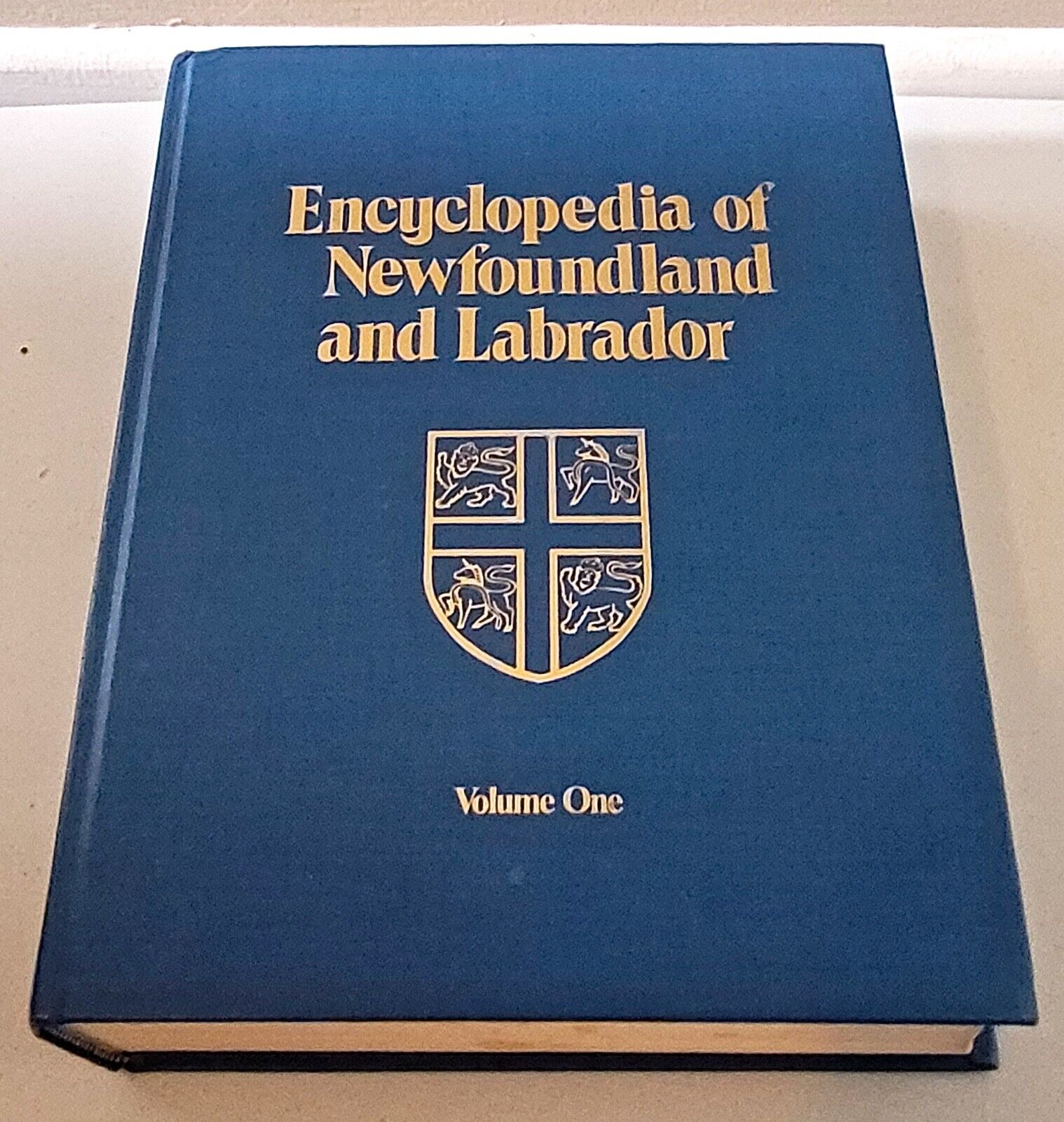
Joey Smallwood – the man who became first Premier of Newfoundland after it joined Canada in 1949 – approached my father. Dr. Robert John Francis Homfray Pinsent – a Medical Practitioner in Birmingham – in the 1960s looking for information on my great grandfather, Sir Robert John Pinsent. Sir Robert had been a notable Judge on the Supreme Court in Newfoundland in the 1880s and Mr. Smallwood was looking for data for his epic “Encyclopaedia of Newfoundland.” That was the start of it all. My father went through his papers and sent him what he could. Some of the items are now in the “Memorial University Archives” and can be viewed on-line. The incident set my father thinking about the origins of the family and he decided to embark on an all-embracing “One Name Study.”
Dr. Pinsent was the “Research Director” of the “Royal College of General Practitioners” and well aware that some medical conditions and afflictions were genetically transmitted, and, as the College was looking for ways to see if a person’s genetic makeup either helped create a subtle predisposition to, or slight resistance against, certain ailments he toyed with the idea of studying the birth, marriage and death data of selected families looking for these statistical predispositions. It was a long shot – given the state of computing in those days – nevertheless, my father started out by looking at his own family.
The College recorded morbidity (sickness) in time and space using coded sheets in what it called “e-books” and my father modified the approach for his “one-name” study. With the help of a small outside grant he compiled details of all “Pinsent” births, marriages, and deaths filed in the “General Records Office” between 1837 and 1964. He did not touch the “Pinsons” as they were far too numerous and, as far as he knew, unrelated. He then added the “Registrar General’s (I-V) occupation-based social class classification” and the “Royal College of General Practitioner’s” “Classification of Morbidity” code to the death records.

This was well over fifty years ago, so the study was rudimentary by modern standards. However, he tabulated the data in different ways and discussed his methodology and early findings of morbidity by geographic area in a paper entitled “Some Characteristics of a Family” in the “Journal of BioSocial Sciences, Volume 2, 1970: pp 199-212″. Cambridge University Press published the article on-line on 31st July 2008.
The recent past
The coding sheets are long gone but my father left enough data for me to recreate the Birth (613 entries), Marriage (410 entries) and Death (421 entries) data as “GROB”, “GROM” and “GROD” files in “excel”. They will be included in the “resources” section of the database at some point. I used the data to create simple trees (using “Family Tree Maker” software). The trees (actually branches) are not yet on-line but it should be easy enough to reconstruct family relationships from the “branch summaries” and the more detailed “biographical” files given here.
Since the arrival of computers, I have been able to be more systematic about collecting data than my father ever was; however at the outset I did so in a somewhat cumbersome “1990s” sort of way. I started by transcribing my father’s descriptive notes and then searched through countless microfilms and microfiche to verify his work – which was pretty accurate. From there I, gratefully, transitioned to computer-based searches. Now, with the help of my family, I have a fairly well integrated digital database.
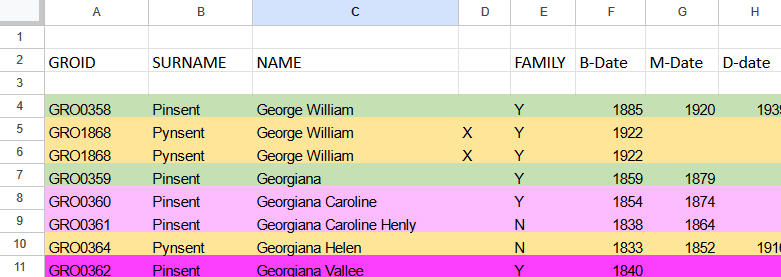
In the early days, I found it a thankless task to look for a specific “Mr. Thomas Pinsent” or “Mr. John Pinsent,” so I gave anyone who could be placed in an established family a two-part identifier – a unique number and a family-branch designation. The “GROID” (Individual-Identifier) list, which started with “General Record Office” data, has grown considerably over the years as I have pushed linkages back in time (through the use of parish records) and forward into the twenty-first century (through newspapers articles and other sources). The listing has grown a lot in fifty years! In truth, it should be larger.
A quick look online shows that approximately 170 Pinsent births, 170 Pinsent marriages, and 140 Pinsent deaths occurred in the United Kingdom between 1963 and 2003 — and there will have been many, many more since then! I know of some of them (including my own children) and I have given all those that I can place in family lines “GROID” identifiers – but, for the most part, I have left them out of the “branch descriptions” and “biographies.” I have also redacted people born within the last hundred years – unless I know for sure that they have died.
My children and their peers have been left to get on with their own lives and the “sons” and “daughters” of current and recent families are (for the most part) unnamed. However, there are a few exceptions – principally on the grounds of celebrity (Sir Matthew Pinsent!). There may be a named widow or two mentioned as well. This approach cuts down the numbers considerably and keeps the focus on the past!
If you are looking for an English “Pinsent” under the age of 70 you may not find them but their fathers and grandfathers (and their husbands and wives) should be there. Note that I have (again with a few exceptions) dropped the causes of death over concerns for privacy. If you have questions – or concerns for that matter about the content of the database – feel free to bring them to my attention. I may not be able to answer all your queries, but I will try to do so.
The birth, marriage and death records my father used were originally held in the “General Record Office” but they are now in the “Public Records Office” (PRO) at Kew, in London. Note that I did not see the records as they were being abstracted and, for me, the transcribed data constitute a secondary source. Nevertheless, the files should be reasonably accurate. Most seem to refer to people who readily fit into one or other of eight family lines. However, there are a few individuals left over. They may come from overseas or as-yet unknown marriages, or they may be data abstraction errors — “Pinsons” or “Vincents” showing up as “Pinsents,” – etc. The “GROID” database contains over 2,000 people, each of whom is attached to a currently delineated branch of the over-all “family tree”.
This is, of course, only a small subset of the population that has lived since the 16th Century as most of the early Pinsents – born in the 16th, 17th, and even early 18th Centuries – belonged to branches that are long dead and fallen. Few have been fully studied and, given the paucity of records, their linkages may be hard to establish. There are still countless “Pinsents” still waiting to be attached to the family tree.
The distant past
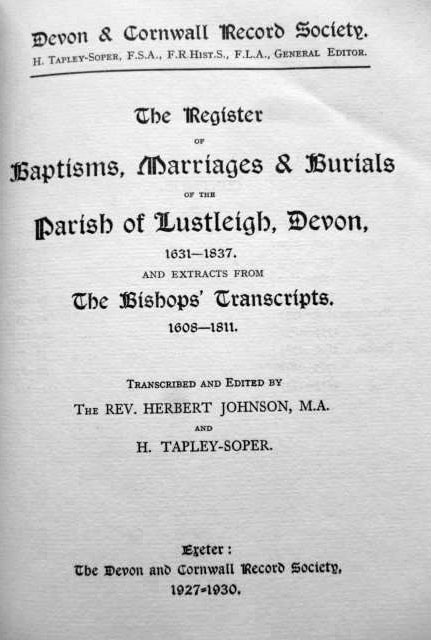
The “Parish and Chapel BMD” data used to build the early structure of the family consist of 2700 plus Devonshire “Pinson/Pinsent” entries dating from 1538 to 1837. I do have some post 1837 parish entries and they too can be useful, however, the Government’s data is easier to interpret and I have used it, where available.
In my early (pre-computer) days, my parish data came from 1960s-era transcriptions made by the “Devon and Cornwall Record Society” housed in Exeter. Since then, most of the entries have been checked against the original source documents either on microfilm or microfiche, or, more recently, on-line scans of the original registers on the “findmypast” and other websites. If you are interested in my linkages and wish to check my work, I strongly recommend going back to the original source material.
Note that, in addition to the Devonshire data, I have located over 500 “Pinson/Pinsent” parish and chapel entries from London, Essex, Wiltshire and elsewhere in England that may be relevant.
Together, the records provide a reasonably complete coverage of the “Pinsents” up to the 1960s but nothing like a complete record of the English “Pinsons” and “Pensons” – who have always been more widely spread and are mostly (from my Pinsent point of view) unrelated. We can exclude the latter entirely if they come from the Midlands or the north of England. Their Devonshire cousins may, however, be relevant – particularly as many of them relate to early, long-since broken, branches of the family tree.
Most old-time “Pinsents” in the “BMD” (Birth, Marriage, Death) databases stand alone or are attached to twigs and branches that have long since withered and died. I am working on these and some individuals have been given “DROID” (“Devon Record Office Identifiers.”) tags. Conceivably, some may eventually link up to one or other of the known branches – and be given “GROID” identifiers. For now, they stand alone: pieces for the jig-saw puzzle.
With regard to broken branches, I invite you to meet Sir William Pynsent, the second of that name and one of the most notable individuals from times-past: He was an eccentric baronet who died childless in 1765 and left his entire estate to the Prime Minister, William Pitt – later First Earl of Chatham! Why? – is a good question! Some sources claim that Sir William strongly supported William Pitt’s handling of the British government during the “Seven Years War”. Others say that he, like Pitt, objected to a cider tax being placed on Somerset farmers! Sir William’s ancestry and life has its own place in the website. [“The Pynsent Baronetcy: The Trials and Tribulations of a Litigious Family: 1687 – 1765”]
Another section ought to (and, I hope one-day, will) deal with imposters! These are people who have tried to work their way into the “Pinsent/Pynsent” family through works of fiction. You will find them hiding in plays, novels, films and on television. You have no idea what various authors thought the “Pinsents” might get up to! If these interlopers do not quite cover the full spectrum of “Tinker, Tailor, Soldier, Sailor, Rich-man, Poor-man, Beggar-man and Thief,” they must have come pretty close.
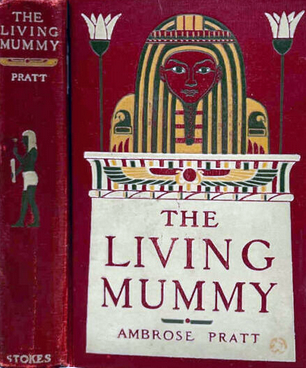
I mean, who can forget the tribulations of Mr. Samuel Pinsent, the Mayor of Troy (Cornwall) when his dovecote was raided – as regaled to us by A. T. Quiller-Couch, in 1921? Or what should we make of Dr. Hugh Pinsent (like me, a graduate of Aberdeen University) and his experiences on the Nile with “The Living Mummy” (Ambrose Pratt: 1910)? To say nothing of Ora Pinsent, the indecisive and contrary actress conjured up by Anthony Hope in “A Servant of the Public” in 1905. If the latter name seems strangely familiar to visitors from Australasia, it was later given to a racehorse. On some occasions the line between truth and fiction gets blurred, as in “Murder Will Out” – which purports to describes the murder of Charles and James Pincent or Pinchert during a mutiny on the Good Ship “Earl of Sandwich” in August 1765. There are several versions of this tale, not all of them naming the brothers. But I digress.
Stick to the Facts
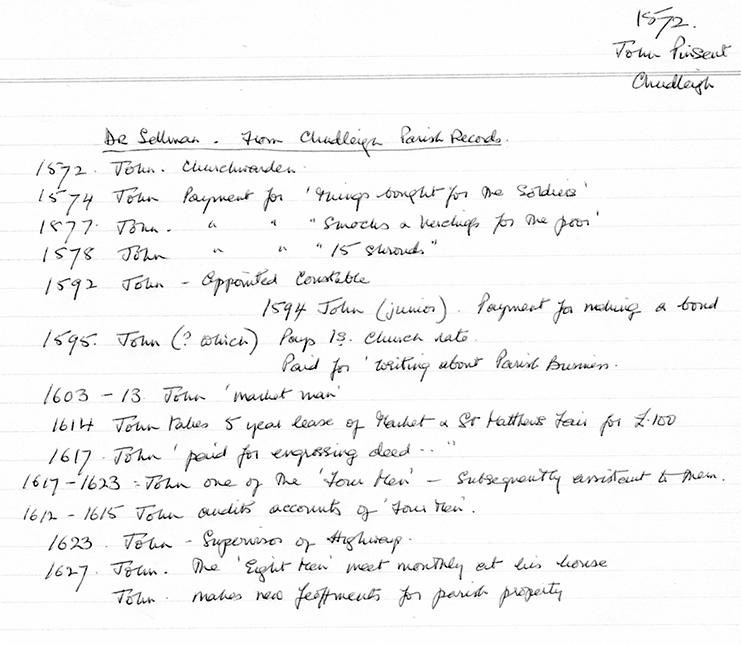
The database is also built on a large amount of anecdotal data that my father and I (and “Cousin John” from Liverpool of whom more later) have compiled over the years. It has helped to identify people and flesh out their “biographies” and family lines. Some of the data were acquired before the arrival of computers. Some even came to light before the concept of “photocopying” – let alone “scanning!” I remember my father’s delight on getting a chemical drum-roll photocopier in the 1960s!
I have transcribed most of the anecdotal data – largely because it is easier to organize and search for digital files that have been tagged with “GROID” identifiers. I admit that there are far easier ways these days, but the approach has worked for me.
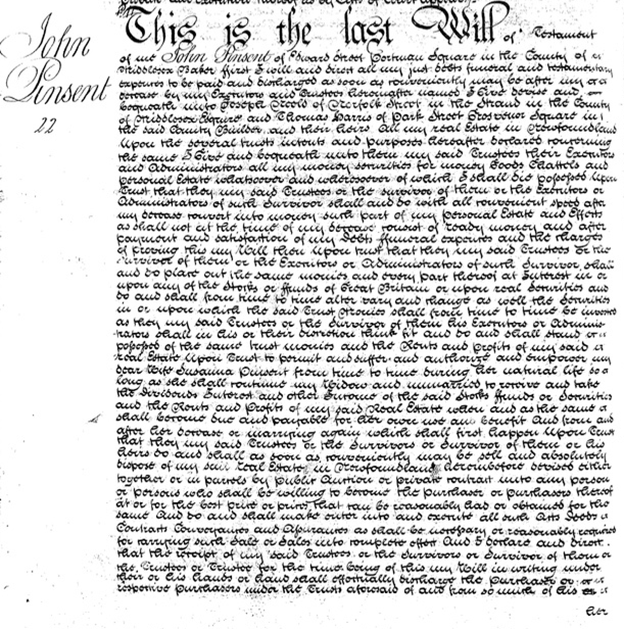
The text files are derived from primary and secondary sources. They include copies of wills, land transfer papers, legal depositions – particularly from the Court of Chancery – census records, travel manifests, military service records, telephone directory abstracts and, last but by no-means least, newspaper clippings from the 1700s onward. The latter provide an extraordinary wealth of information, from birth, marriage and death notices to participation in rugby, cricket and other sporting events, to attendance at schools and at local committee meetings. They throw light on miscreants in court and (occasionally) give credit where it is due.
How else would we know that William Swain Pinsent (1843 – 1920) bred poultry? The York Herald (Tuesday 23rd June 1891) opined: “Dorkings were a particularly strong lot. Amongst the coloured Dorking cocks a very fine bird, the property of Mr. W. S. Pinsent, Newton Abbot, South Devon, was selected as winner. We believe the same bird carried off the first at the Crystal Palace” also “There was no doubt as to the first for a hen of the same breed getting into the proper hands when it was secured by Mr. Pinsent, for his bird was a long way in advance.” His cockerel won and “Amongst the pullets the same thing occurred as in the three previous classes, so that Mr. Pincent thus carried off the four premier prizes for coloured Dorkings with the only four birds he had in the exhibition, which it must be admitted was a fairly good performance:” Yes, in deed.
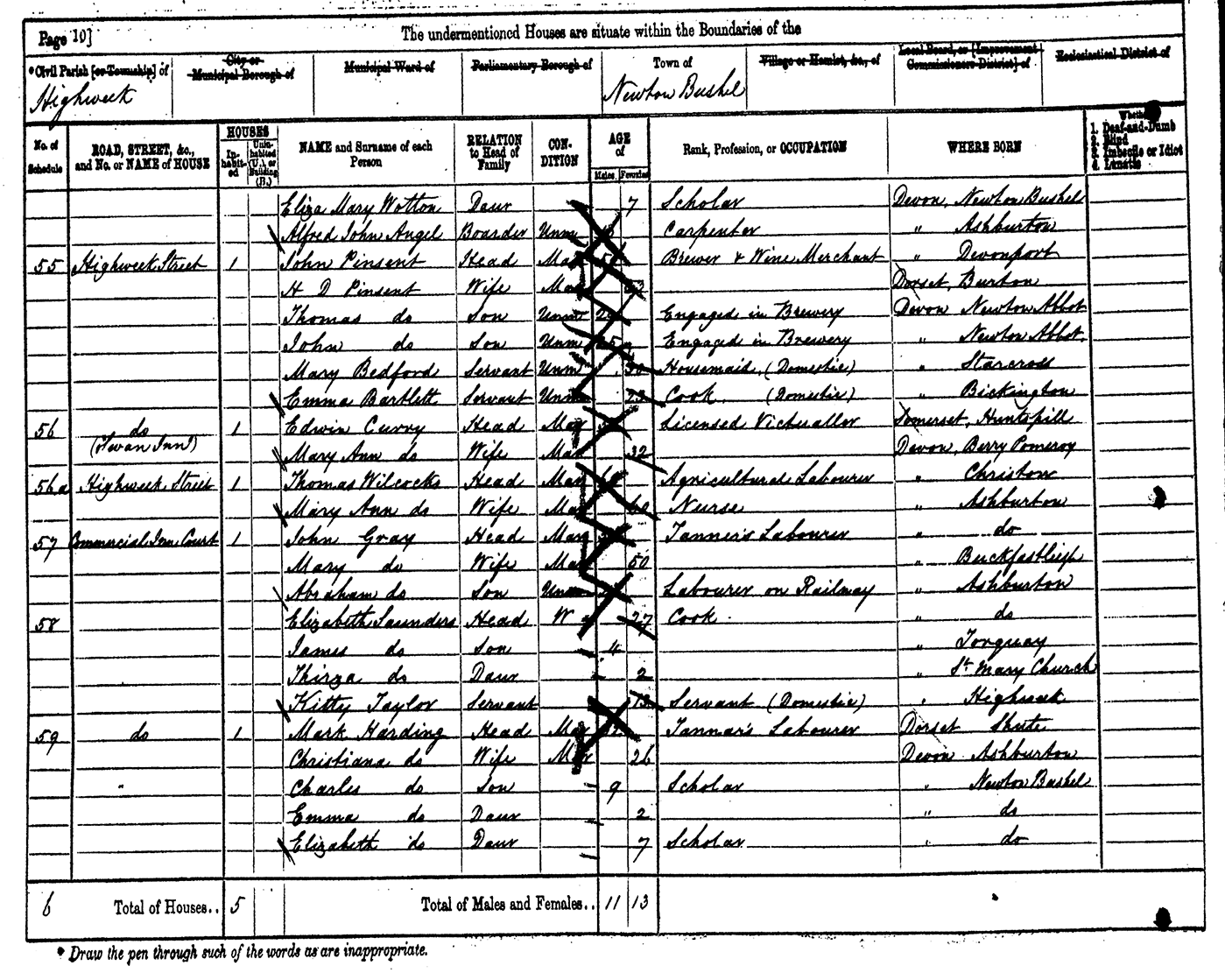
Anecdotal items found in the PRO and DRO (“Devon Records Office” in Exeter) and found on-line and elsewhere provide considerable insight into peoples’ lives – although I admit to being stumped by the ubiquitous references to “Mr. and Mrs. Pinsent.” They certainly got around. Given enough anecdotal evidence one can see patterns. Even “Johns” and “Thomas’s” start to come into focus. I have, where possible, tagged anecdotal items with my best guess as to the relevant “GROID” identifier or identifiers. However, needless to say, as with the parish and other records, I still have a considerable amount of data waiting to be allocated.
Some of my anecdotal data is now available on-line through commercial websites that link to primary records. I have found the “British Newspaper Archive,” Memorial University of Newfoundland’s “Digital Archive Initiative” and Australia’s “Trove” of Newspapers particularly useful. The “biographies” refer to some of the more relevant newspaper sources. Should you wish to follow-up on anyone, my transcripts should provide enough information for you to locate the original source record. I strongly recommend checking the original records where ever possible. Still, be aware that even “primary sources” are not always accurate! Census-takers made mistakes; names are misheard and miss-spelled, etc.
If you would like to know more about the evolution of the website: I would refer you to the attached item: “Pinsent/Pynsent: The Building of a Database” which was written in 2011. It is in the “Resources” section.
Next: Historical Context