In the very beginning
1066 and all that
The Devonshire Pinsons
Pinsents appear
And then the Plague
Finding home
Pinsents at sea
To the manor born
In the beginning
The story continues
The taxman cometh
Parish records
Pinsents past
The here and now
Early days in Devonshire
PINSENTS AT SEA
Ever since Christopher Columbus – the Commander of the “Santa Maria” – along with Martin Alonzo Pinzon, the Commander of the “Pinta,” and his two brothers Martin Francisco Pinzon (Pilot of the “Pinta”) and Vincente Janes Pinzon (Captain of the “Nina,”) made their epic voyage of discovery to the Americas in 1492, there has been European settlement in North America.
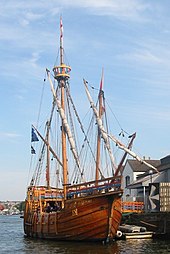
For most West Countrymen, their first point of contact with the New World would have been Newfoundland, which was – at least nominally – “discovered” by John Cabot in 1497. In reality it had, almost certainly, been known to Viking explorers and tight-lipped Bristol and Basque fishermen. They seem to have known about the cod on the “Grand Banks” but thought it prudent to keep quiet about it. It was left to Sir Humphrey Gilbert to claim “The Rock” for England in 1583 – and to give the England its first formal toehold in what is now Canada.
The English Government had a vested interest in maintaining a maritime fishery and it deliberately discouraged settlement in Newfoundland (“Soe longe as there comes noe women” Origins of English Settlement in Newfoundland: W. Gordon Handcock: 1989).
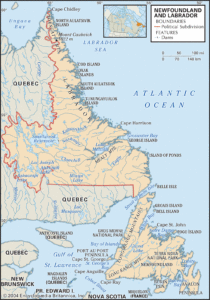
Instead, it encourage English fishermen to sail to Newfoundland in the spring, fish for cod either on the “Grand Banks” or around the coast, process (dry and salt) their catch on shore on temporary platforms called “flakes” and return to Europe in the autumn. They were expected to sell most of their catch in Catholic countries in the Mediterranean and then head home to England. This emphasis on a maritime fishery ensured that the country had a pool of well-trained seamen available when it fought its seemingly interminable wars. Predictably, most of the ships that fought the Spanish Armada in 1588 were crewed by men from the West Country. Sir Francis Drake was, of course, born in Tavistock, in Devon. Even Nelson’s Navy depended on sailors from the south and west of England.
In the early days, West Country fishermen contributed ships to a convoy that set out for Newfoundland in the spring. However, there was an advantage in being the first ship to enter and to settle in a cove as it had priority there for the remainder of the season – so some wealthy merchant sent their ships out early. Each ship carried its own crew and, from around 1700 onward, increasing numbers of “bye-boatmen.” They were independent operators who ran crews of long-line fishermen in small boats called “dories” alongside their mother ships. Eventually, the ship owners and merchants left “agents” to look after and protect their fishing stations over the winter, and the population started to grow as women started to arrived.
As an aside, there was an Admiral Pinzon who gained fame (or notoriety if you prefer) in the New World. Admiral Luiz Hernandez Pinzon was a Spaniard who was sent out to Peru on a good-will mission in 1863. Unfortunately, a Spanish citizen was murdered while he was there, and this triggered an international incident. The Admiral took it upon himself to “invade” the Chincha Islands off Peru’s coast in retaliation for the affront to Spain’s sensibilities. The islands were an important source of guano (bird droppings) which was sold in Europe as fertilizer. After several years of ill feeling, Spain returned the Islands to Peru. Admiral Pinzon is a reminder that there is, or was, a branch of the “Pinson” family in Spain.
Although most of the early Devonshire “Pinsons” and “Pinsents” were born in inland parishes (Bovey Tracey, Hennock, Chudleigh etc.) quite a few took to the sea. When the parish “clerk” in Hennock recorded Thomas Pinsent’s daughter’s baptism in September 1630 he made a point of noting that Thomas was a “sailor”. In this case, he may well have done so to differentiate him from Thomas Pinsent of “Huxbeare” – a wealthy farmer whose daughter was baptized two months later. Just to complicate matters, both mothers were called Julian! At least some clerks tried to keep their records straight.
Andrew Pinson (1728 – 1810) was born in Abbotskerswell, in Devon. He joined up with John Noble in the mid-1700s and they ran a shipping and fishery business out of Bristol until Mr. Noble retired and Andrew took full control of the company. He moved the operation to Dartmouth, on Devon’s south coast. The Company had a base in St. John’s, Newfoundland and its boats fished on the Grand Banks, around Conche in northern Newfoundland, and along the coast of Labrador. Andrew brought his son (another Andrew) and his two sons-in-law into the business and, according to Francis Niering (see below), owned around 50 ships. The “Pinsons” built a successful fishery at “Temple Bay” in Labrador; however, it was undefended and vulnerable, and succumbed to an attack by an American privateer in 1778. The fishery was a high-risk business! Newfoundland Merchants and Shipowners not only lost their crews to the Royal Navy through “press-gangs”, and their ships, shore stations and fish to privateers – but they also had bad weather to contend with and, inevitably, lost ships at sea!
Andrew’s branch of the family kept its “Pinson” name – but for which, it would certainly warrant inclusion in this database. It has had its own cast of characters – including Lieutenant Albert Andrew Pinson of the 16th Regiment of Foot. He was a bit of a “dandy” and so besotted Victor Hugo’s daughter Adele when they first met in Jersey (one of the Channel Islands) that she followed him to Canada, Barbados and back to England in the hope that they would marry. He was having none of it and she ended up in a mental asylum near Paris. I hope to add something about this family some day. In the meantime, other people have studied it and there is a fair amount of material on-line (“Andrew Pinson: Dartmouth Merchant, Ship Owner and Gentleman Farmer, Trading to Labrador:” M.A. Dissertation; Francis Eduard Niering: University of Exeter: 1999).
William Pinsent of Port de Grave, Newfoundland and his brother John Pinsent of Portman Square, London, from my HENNOCK branch of the family, were involved in the cod fishery at much the same time as the “Pinsons”. Having the two families trading into and out of Newfoundland at the same time has, needless to say, caused some confusion. It is not always clear which family owned which ship, or who exactly was involved in a particular deal. Even now, nobody knows if “Pinsent’s Arm”, – a small coastal community in Labrador – was named after the “Temple Bay” fishermen, or William Pinsent’s nephew, a Judge of the Labrador Court. The two families are quite separate.
I do not know who the first “Pinsons”/“Pinsents” who settled in Newfoundland were; however, they seem to have arrived in the Trinity Bay area in the late 1700s and had large families of resident in-shore fishermen. Their descendants have given rise to a “Pinsent” population in Newfoundland and (now) Canada that far exceeds that of the United Kingdom! Several Canadian “Pinsents” have compiled their own “Newfie” family histories and some of their work can be seen online. My Newfoundland trees are coming along, but they are still very much a work in progress.
For the most part, the “Pinsons” and “Pinsents” live in in-land parishes and the two main families described above are anomalies. Parish records show that a family of “Pensons” settled on the south coast in the early 1700s. In this case, the name “Penson” is probably just a corruption of “Pinson.” I am sure the family had nothing to do with the “Pensons” found in the Midland counties of Shropshire and Warwickshire.
TO THE MANOR BORN
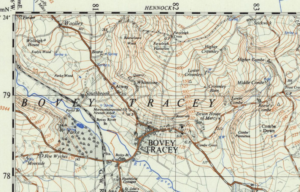
The “Pinsents” and “Pinsons” who stayed home were farmers and tradesmen who lived in small towns and villages south and east of Dartmoor. There is not much known about them in the aftermath of the first few bouts of plague (1350s); however, scattered references in the surviving “manor rolls” tell us that some were living in and around Bovey Tracey in 1429.
They lived in a world of small villages, scattered farms and homesteads, enclosed fields, open woodlands, moorlands, streams and meadows. It was a predominantly rural landscape that was arbitrarily divided into a patchwork mosaic of ecclesiastical parishes superimposed on large and small feudal manors. Sadly, the boundaries of both have changed over the years, and nowadays they rarely seem to match!
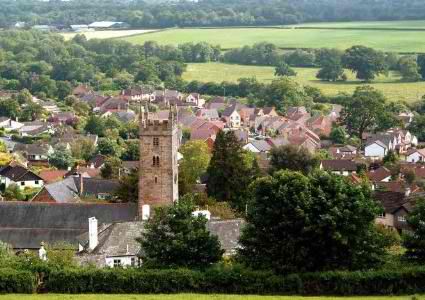
The miss-alignments frequently led to legal complications. For instance, in 1602 John Pynsent of “Yeo” (in Bovey Tracey parish) was one of several local farmers who refused to take his corn to be ground at the King’s (“grist”) mill in the manor of Bovey Tracey.
Bovey Tracey was, by then, a small market market town that straddled the Bovey, a tributary of the River Teign. The town had water-powered mills for processing wool (“fulling”) and for grinding corn. John Pinsent (and his colleagues) claimed that as they lived in the manors of Wreyland and Langallar and not the King’s manor of Bovey they were not obliged to use the his mill. They claimed, rightly or wrongly, that they, like their ancestors “time out of mind,” had the right to grind their corn wherever they chose. The dispute was bitterly contested in the “Court of Exchequer Chamber” and two other Pinsents, John Pynsent of “Combe” in Bovey Tracey and his brother Hugh Pynsent, who was from “Combe” but was by then living in the nearby parish of Ilsington, were called upon to testify. In those days, the law was to a large extent adjudicated on oral rather than written testimony.
Presumably they won their cases as Frances Billinge in her on-line discussion of the Customs of the Manor of Bovey Tracey (boveytraceyhistory.org.uk) notes that, by 1615, there was no obligation for anyone to have one’s corn ground in the King’s mill.
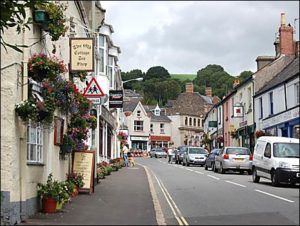
According to Dr. Billinge, Bovey Tracey first acquired its right to a market in around 1260 and by 1500 it had grown to be a small market town. The borough of Bovey Tracey, and the surrounding manor lands had their own “Leet” and “Manor Courts” by 1600.
Bovey manor belonged to the de Tracey family until 1274 (Frances Billinge: Rep. Trans. Devon Assoc. Advmt. Sci. Vol. 128, 2016) – not withstanding that a certain Sir William de Tracey and two other knights had acted on King Henry II’s wishes and, rather foolishly, rid him of his “troublesome priest” – Thomas Beckett – in 1170. They killed him in the knave of Canterbury Cathedral. The manor reverted to the crown in 1353 and, for the next three hundred and fifty years it was either held or leased by a succession of aristocrats and/or gentry – at the King’s discretion. It was eventually sold to a local lawyer in 1614.
The neighbouring manor of Wreyland straddles the Wrey, a small tributary of the River Bovey just to the north of Bovey Tracey. It originally covered parts of the parishes of Bovey Tracey and Hennock; however, nowadays, much of it seems to lie in the adjoining parish of Lustleigh.
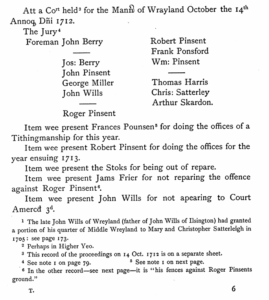
Manor and parish boundaries both change over time and, although farms (obviously) remained where they were, they bounced around from one parish to another – causing considerable grief to modern-day local historians. Wreyland had a chequered early ownership that is, fortunately, well spelt out in a useful little book entitled “Wreyland Documents” written by a gentleman called Cecil Torr in 1910 (Cambridge University Press). It sheds considerable light on the early history of the area – and of the “Pinsent” family’s activities. It is worth noting that one had to own your property “freehold” to hold office on the manor court. Several members of the family seem to have qualified.
There were “Pinsents” in the neighbouring market town of Chudleigh, which grew up around the rural palace of an early Bishop of Exeter. When they first settled there is not known; however, they were there when the parish started to collect birth, marriage and death data. The first known was Thomas Pynson “clerk”, who died around 1551. Perhaps he was in some way employed by the Bishopric.
The Bishop, who owned Chudleigh manor, knew of King Henry VIII’s plan to break the power of the Catholic Church by dismantling and dissolving monasteries (and other ecclesiastical establishments) and may have felt that long-term divestiture was the way to go. In 1547, he leased it to the Duke of Somerset for 99 years. Over the next few years, much of the land previously owned by the church was broken up and either sold or sublet. The Clifford family acquired the manor in 1595. They became, and still are, significant landowners in the Chudleigh area (chudleighhistorygroup.uk). The “Chudleigh” family for whom the town was named (or visa versa) owned the nearby manor of Ashton. The Chudleigh manor records may not have survived but the Clifford family archives at Ugbrooke House must contains land ownership documents relevant to the “Pinsent” family .
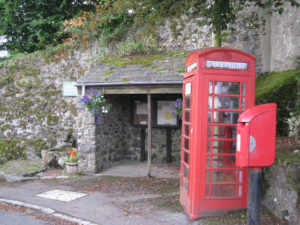
The “Pinsents” lived in the neighbouring parish of Hennock in the 1400s – if not earlier. When they first arrived, is unknown. There may have been a Saxon village around the farm at Warmhill for quite some time before the current church and village were built on an east facing slope higher up the hill. “Hennock” and “Knighton,” are both mentioned in the Doomesday Book and were probably originally manor farms (Hennock.org.uk/hennock_history).
Roger Fitz Payne held the manor of “Hanock”, which was said to be a small community of 20 households, from Sheriff Baldwin in 1086. “Knighton” (at the south end of Hennock parish) seems to have been a smaller adjacent manor owned by the Bishop of (St. Peter’s), Exeter. It had only 7 households. It was owned by the Southcote family in the reign of Charles I and remained a separate entity until the end of the 18th Century. There is a report of a “Perambulation of the Manor of Knighton made September 27, 1798” in the Devon Archives [Southwest Heritage Trust: 5421A/PB/1/f1]. However, that was quite sometime after the “Pinsent” family had moved on. The manor of “Knighton” is probably now almost entirely subsumed into the village of Chudleigh Knighton.
“Huxbeare” was one of five farms in the parish (Huish, Fluda, Clayparks, Lynham and Huxbear) owned by Torre Abbey in the 13th Century (Hennock.org.uk/hennock_history). All (except Lynham) feature in the family story to some extent or other. “Huxbeare,” the most important, may have been a small manor in its own right. Farms typically become reduced in size over the years; however, “Huxbeare” still covered 230 acres in 1851. Perhaps there are documents in the Torre Abbey and/or Clifford Archives that could tell us more.
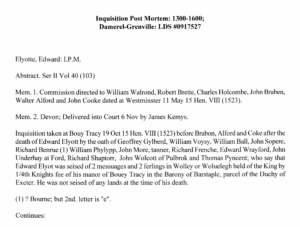
“Huxbeare Barton” (or “Huxbear” as it is now known) was once owned by the Chudleigh family; however, it must have passed to a Pomeroy as, in 1402, Sir Thomas Pomeroy petitioned the King to have it returned to him – claiming that Sir Philip Courtenay had attempted to repossessed it in the name of his wife (who was a Chudleigh by birth) while he, Sir Thomas, was serving with the King’s army in Wales. The case was heard in the Court of Star Chamber (SC 8/22/1078). Much later, in 1570, an “Inquisition Post Mortem” (i.e. a local tribunal set up to establish the land holdings of a Lady or Gentleman after his or her death) was taken on the lands of Christopher Chudleigh. It refers to Huxbeare farm, “which William Pynsent now holdeth”. So the Chudleigh family seems to have got it back in the end. The farm at “Huxbeare” and the neighbouring farm at “Knighton” both play an important part in the family’s story.
IN THE BEGINNING
The few Bovey Tracey Manor Rolls that have survived are instructive. They show that Joan Pynson paid a “heriot” (a customary payment made to the Lord of the Manor after the death of a tenant [in this case her husband Roger]) in 1429. She paid an ox worth 10/6d for “2 ferlings in Warmehele” (which was in Bovey Tracey but is now, somewhat confusingly, in Hennock parish). The farm was still in Pinsent hands over a hundred years later.
Similarly, the Wreyland Court Rolls show that another Roger Pynsent held “half a furlong of land in Calwelegh (Kelly with Leigh)” in Bovey Tracey in 1437 (Wreyland Documents: 1910: Cecil Torr). Ten years on, an “Inquisition Post Mortem” on the lands of Anne Holand, Duchess of Exeter, tells us that John Pynson held land at “Culverhouse” in Bovey Tracey in 1447. It too was in Pinsent hands several hundred years later. Its last owner, Thomas Pinsent, died without a male heir in 1798.
Inquisition and other Court Juries were selected from well-respected local “landowners” and “merchants” old enough to know not only who owned what land and where but, just as important, how it was acquired and what feudal conditions – if any – were still attached to it. John Pynsent “senior” and John Pynsent “junior,” were called upon to serve at an inquisition held on the death of Elizabeth Mannying, in Hennock in 1476. They must have had some standing in the local community and probably came from “Huxbeare”; however, that needs to be confirmed.
The Calmady Manuscripts (#372-3/1/14) in the West Devon Record Office tell us that a William Pynson co-owned property in Bovey Tracey in 1497; and a further inquisition into the lands of John Scoos held in Exeter in 1521 had a William Pyncent on its jury. Similarly, there was a Thomas Pyncent on the jury of an inquisition held into the lands of Edward Elyotte in Bovey Tracey in 1523.
These and other such documents show that there were several “Pinson” and “Pinsent” families living in the Bovey Tracey – Hennock area, and that some of their members were deemed eligible for jury duty. At this point, it is impossible to know exactly who they were and how they were related as the family-at-large had been in the area for a couple of hundred years or more. The families themselves doubtless contained yeomen farmers, merchants, craftsmen, tradesmen and labourers.
I doubt if anyone in the Pinsent family in the early to mid 1500s would have properly qualified as a “gentleman”. However, John Pynsent (“of Combe” mentioned above) certainly had pretensions and made that important jump in status. He probably owned a share in a “tin mine” developed on his property. He had money, rubbed shoulders with the local “gentry” and acquired a coat of arms in the early 1600s. His son moved to Chudleigh, where he became, presumably, an upper middle-class “inn-keeper” and “merchant.”
This latter John (the “merchant”) married his son – another John, who had gone into law – into the Clifford family in 1631. They unquestionably were “gentry,” and the family took its final step into respectability. This John Pynsent was to become a “Prothenotary” (“senior clerk”) in the “Court of Common Pleas” in London during the interregnum – that chaotic period between the execution of King Charles I and the restoration of the Monarchy under King Charles II. The appointment enabled him to acquire (we won’t ask how) the wealth he needed to build and endow “Pynsents Free School” in Chudleigh – and, after his death – enable his nephew, William Pynsent, to purchase a baronetcy – but that is another story: [The Pynsent Baronetcy: The Trials and Tribulations of a Litigious Family: 1687 – 1976].
John Pinsent “of Combe” had several sons whose lives are touched on in the story (above) and they too benefited from their father’s wealth and good fortune. Their lives and lines of descent are described in more detail as the “Combe Family Branch.” Note that it is a broken branch that does not appear to have made it into the 19th Century. Beware, it has a few speculative links.
Back: Historical context
Next: The story continues