Vital Statistics
Thomas Pinsent: 1633 – 1701 GRO1755 (Tanner of Slade, Hennock)
Julian Wilmeade: xxxx – xxxx
Married: 1657: Hennock
Children by Julian Wilmeade:
(?) Thomas Pinsent: 1657 – 1696 (Tanner of Slade, Married Ann Waters, 1678: Bovey Tracey)
Family Branch: Devonport
PinsentID: GRO1755
Click here to view close family
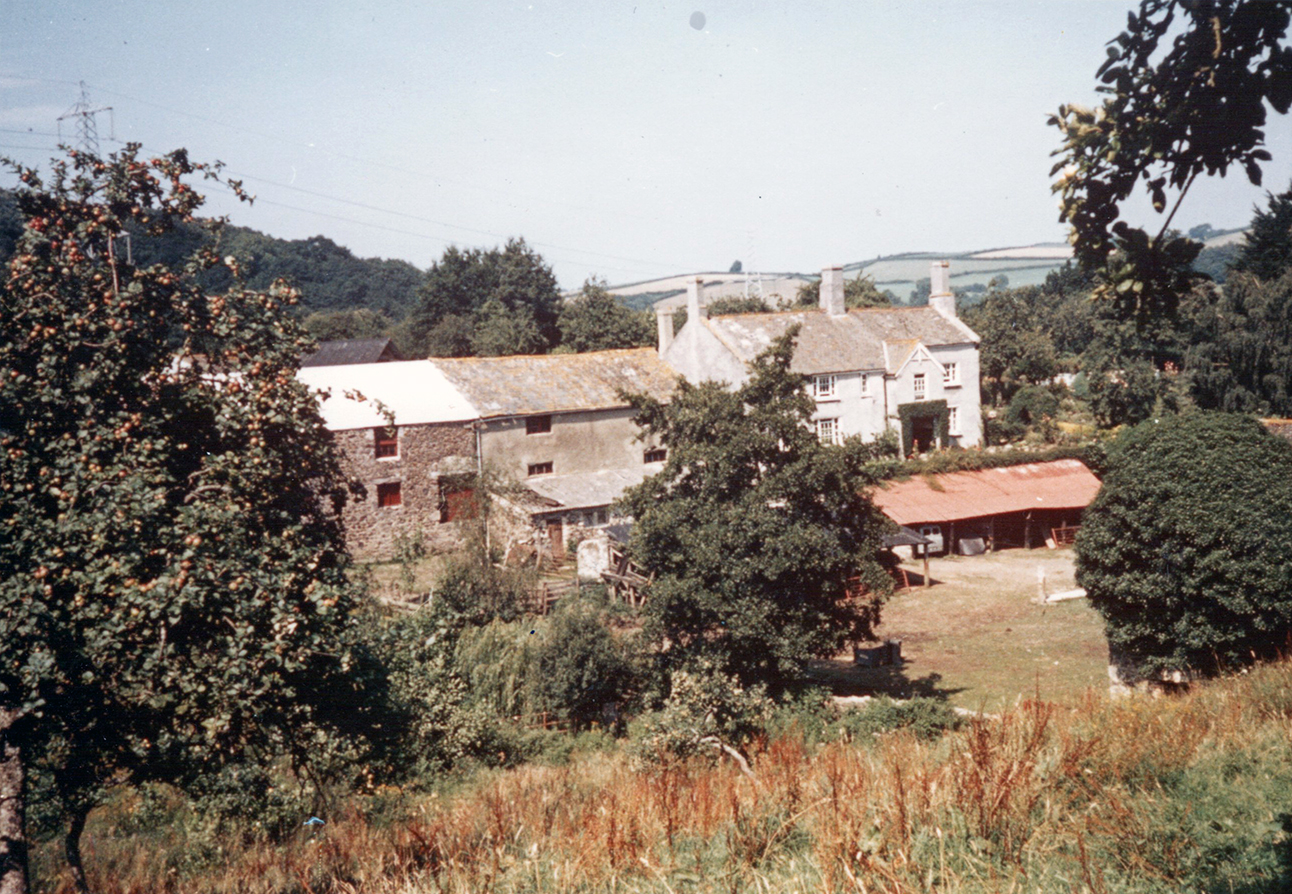
Thomas was the third (surviving) son of Thomas Pinsent of Huxbeare in Hennock by his wife, Julian Stidstone. His father was a substantial farmer who managed to hold on to his property during the English Civil Wars. When Thomas “senior” died, in 1649, his elder sons, Robert and John, took over the family farms at “Huxbeare” and “Knighton” respectively: Thomas, being the third son, was out of luck!
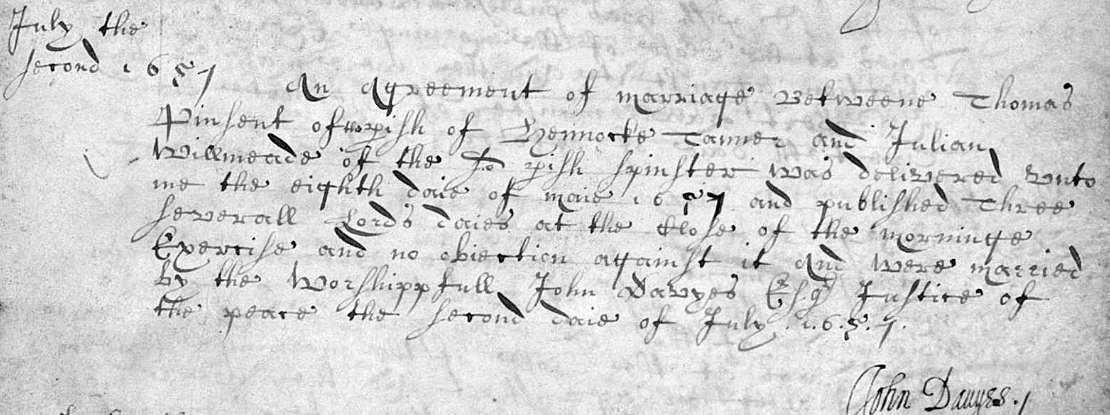
However, he was a good catch and he married Julian Wilmeade in 1657 and, through her, acquired a “tannery at Slade.” Hennock’s parish records tell us that “An agreement of marriage between Thomas Pinsent of the pish of Hennock, tanner, and Julian Willmeade of the sd. pish, spinster, was delivered to me the eighth daie of Maie 1657 and published three several Lords daies at the close of the morning exercise, and no objections against it and were married by the Worshippfull John Davyes, Esq., Justice of the peace the second day of July 1657.” From this we learn that Thomas was already a “tanner” by profession. He probably worked at Julian’s grandfather’s tannery at Slade Cross, on the A382 north of Bovey Tracey.
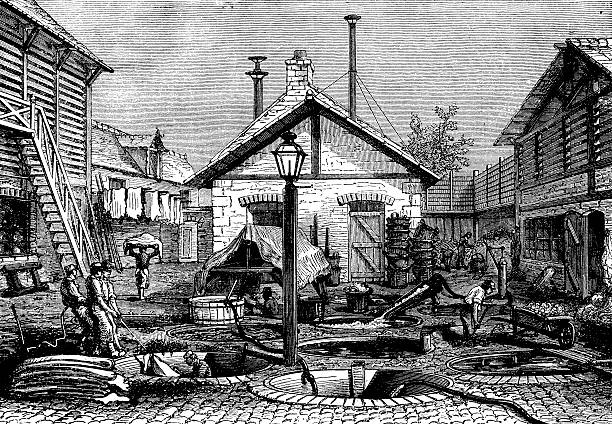
Tanning was a traditional country craft best carried out away from towns and cities as it required soaking hides in vats rich in lime to loosen the fat and hair, cleaning them and then re-soaking them in a tannin-rich fluid that commonly contained animal dung and urine as well as wood bark. The smell must have been awful. The hide was then rubbed with tallow or some such grease and then laid out. The whole process took months.
Julian Wilmeade’s grandfather, Michael Meardon, named her as the “reversionary” recipient of the tannery and 100 acres of meadow, pasture and heath land at “Poole Mill Down” on the death of Elizabeth Wrayford (née Wilmeade) – his erstwhile daughter-in-law. “Pool Mill Down” is, likely, on the low lying hill east of Slade Cross and between it and Pool Mill Cross – which is on Beadon Brook at the south end of what is now Trenchiford Reservoir. Elizabeth Wrayford was Michael’s son John Meardon’s widow and had a “life interest” in the property – on the clear understanding that she would pass to Julian when she died.
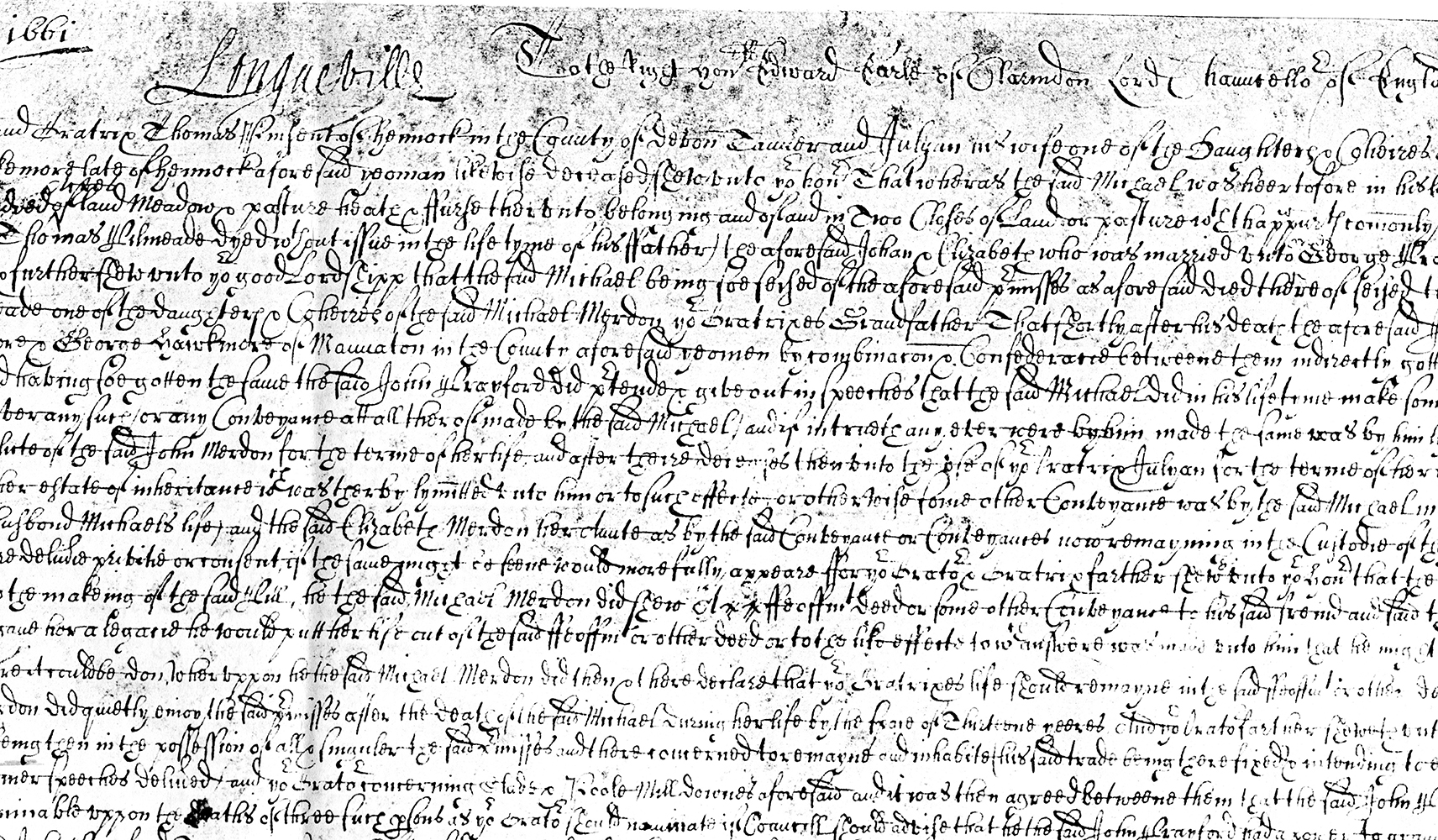
Perhaps predictably, Elizabeth’s son from a second marriage (John Wrayford) was reluctant to part with the tannery when the time came – and it took a suit in “Court of Chancery” to settle the issue in Julian’s favour [C9/409-244, 1661]. Michael Meardon also had a daughter Johanne (John Meardon’s sister) who married Elizabeth Wrayford’s brother Thomas Wilmeade and he had managed the tannery before he died. Given the Wilmeade involvement, it must have made sense to pass the “reversion” back to Thomas’s daughter Julian.
To complicate matters; one of Thomas Pinsent’s sisters seems to have married into the Meardon family; however, I can find no records and I do not know which sister it was. What I do know, is that a John Meardon in his Will proved in 1676 (Moger Abstract of Devon Wills): “desired (his) three brothers in law, Thomas Pinsent of Hennock, tanner, Jonas Pridham and John Pridham (of Bovey Tracey, clothier)” to act as “over-seers in trust” and guardians for his under-age sons, Thomas and Michael Meardon.
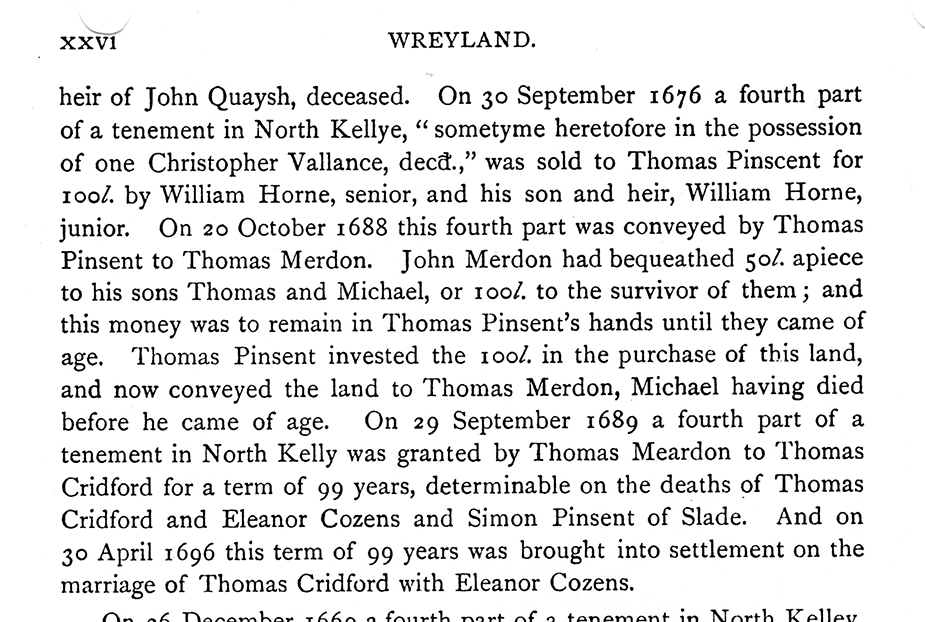
According to a later document transcribed by Cecil Torr (Wreyland Documents, 1910), Thomas Pinsent invested £100 from John Meardon’s estate in the purchase of “1/4th part of a tenement in North Kelly” from William Horne and his son, and conveyed the same to John Meardon’s surviving son, Thomas Meardon, in 1689. “Wreyland Documents” also show that as part of the same deal, Thomas Meardon granted the land to Thomas Cridford for a term of 99 years, determinable on the deaths of Thomas Cridford, Eleanor Cozens and “Simon Pinsent of Slade”. Thomas Cridford married Eleanor in 1696, so that makes sense.
Simon was probably Thomas’s eldest son, although that needs to be confirmed (see elsewhere). Interestingly, there was a Symon Pinsent baptized in Bovey Tracey in 1652 – which was five years before Thomas married Julian Wilmeade. It is a late (non-contemporaneous) entry in the parish record and it could, I suppose, have been inserted as 1652 instead of 1657 by mistake.
Leases “on three lives” were fairly common in the 15th, 16th and 17th Centuries. They were long-term leases whereby the main leaser of the property accepted the terms of a land deal on the understanding that if he died one or other of the named individuals would inherit the lease (subject to transfer fees and rents) and a new, presumably younger, relative would be introduced to make up the number of “lives”. It was a way of maintaining continuity.
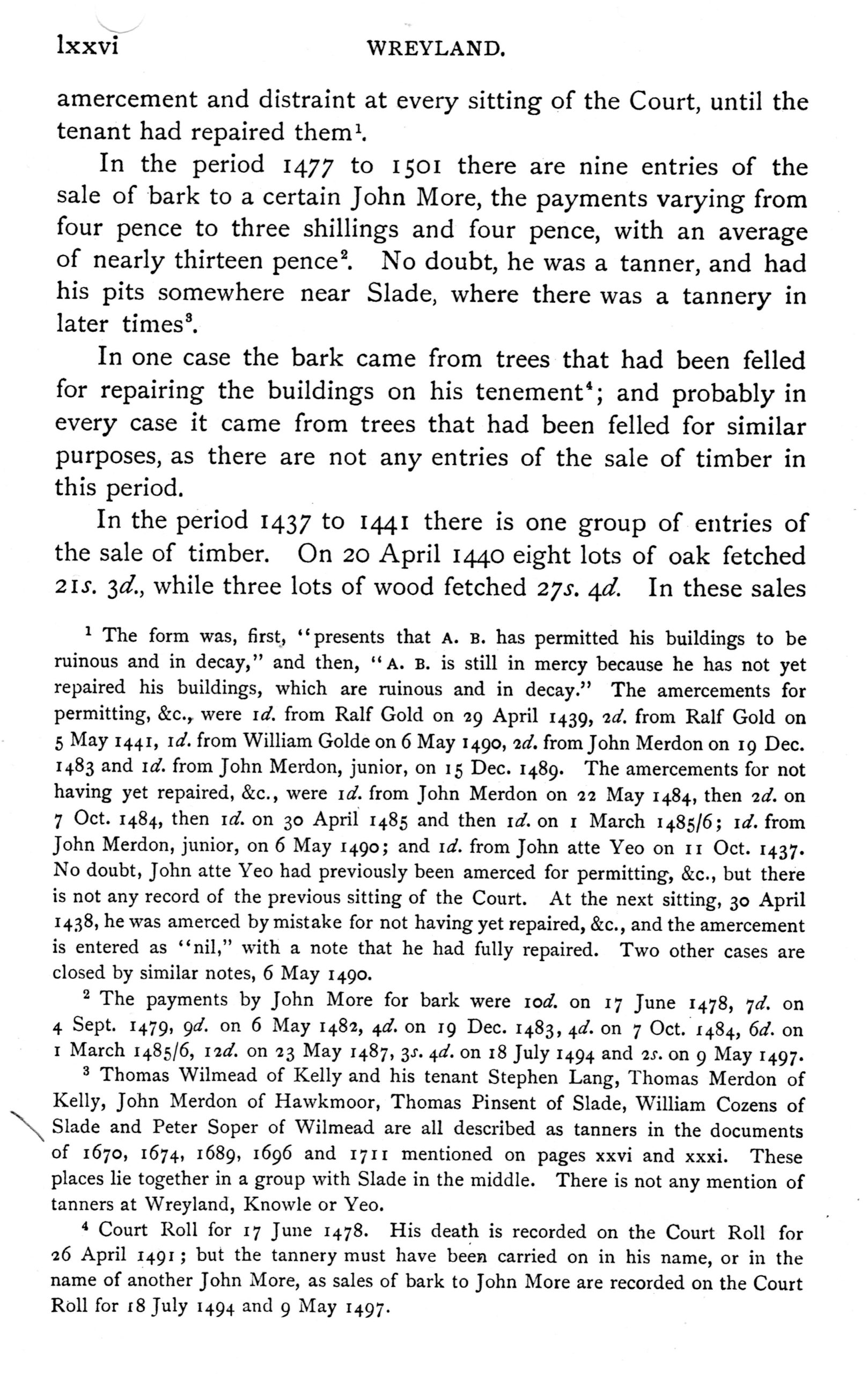
Thomas Pinsent “of Slade” took on apprentices as he and the Hennock parish “guardians” required. However, he seems to have bought his way out of one particularly unsatisfactory contract: According to Rev. R. Medley Fulford, in his review of the parish in the “Transactions of the Exeter Diocesan Architectural Society” the parish: “Received, the 21st of April 1679, of Thomas Pynsent of Slade, by consent of the Justices, Wardens & Overseers, to be freed from his apprenticeship until his turn comes again according to the rule of the parish, the sum of £2 0s 0d.” There are later references to Thomas Pinsent “of Slade” and Cecil Torr refers to a Thomas “of Slade” in 1696 while discussing local tanners in “Wreyland Documents (1910).” Whether this is Thomas “senior”, or Thomas “junior” is unclear.
Unfortunately, there are tantalizing breaks in the Hennock and Bovey Tracey parish records in the mid 1600s and, although Thomas and his wife, Julian (née Wilmead) probably had children I have yet to find any record of their births and that is a problem!
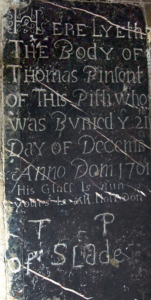
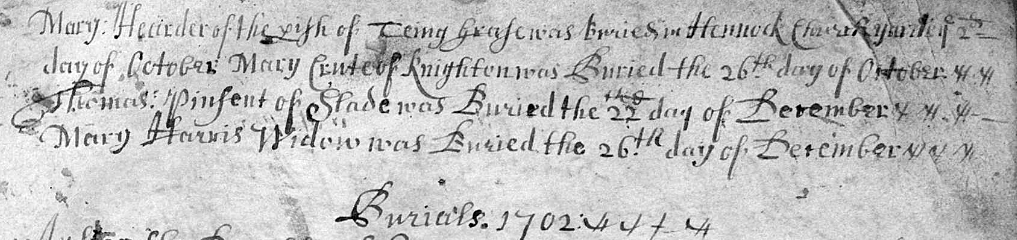
The couple likely had at least one son, Thomas Pinsent, who was born around 1658 or 1659 and married Ann Waters in 1678. They lived in Bovey Tracey and had children. This Thomas worked with his father at “Slade” and the two are hard to differentiate. However, I suspect Thomas Pinsent “junior” predeceased his father, and died in 1696. A stone in the floor of Hennock Church records Thomas Pinsent (presumably the “elder” of Slade’s) passing, in 1701. It reminds us that: “His glass is run: yours is almost done”: true, but very depressing.
In the absence of a birth record, I have made Thomas Pinsent “junior” the founding father of the HENNOCK Branch of the family. His and their lives are discussed elsewhere. The current batch of Pinsents (of which I am one) descend from Thomas Pinsent “junior’s” son, another Thomas Pinsent, who seems to have owned and then sold “Slade” and farmed at “Pitt” in Hennock.
Family Tree
Grandparents
Grandfather: Robert Pinsent: 1562 – 1626
Grandmother: Dorothy Carpenter: 1565 – 1643
Parents
Father: Thomas Pinsent: 1597 – 1649
Mother: Julian Sidstone: xxxx – 1663
Father’s Siblings (Aunts, Uncles)
Simon Pinsent: 1587 – xxxx
Robert Pinsent: 1589 – 1650
Dorothy Pinsent: xxxx – 1590
William Pinsent: 1591 – 1591
Helen Pinsent: 1592 – xxxx
Thomas Pinsent: 1597 – 1649 ✔️
George Pinsent: 1599 – xxxx
John Pinsent: xxxx – 1600
Male Siblings (Brothers)
Robert Pinsent: 1624 – 1671
John Pinsent: 1626 – 1663
Thomas Pinsent: 1633 – 1701 ✔️
William Pinsent: 1638 – xxxx
Please use the above links to explore this branch of the family tree. The default “Next” and “Previous” links below may lead to other unrelated branches.