Vital Statistics
Thomas Pinsent: 1597 – 1649 GRO1746 (Huxbeare Barton and Knighton, in Hennock)
Julian Sidstone: xxxx – 1663
Married: 1617: Hennock
Children by Julian Sidstone:
Helen Pinsent: 1618 – 1618
Joan Pinsent: 1619 – xxxx
Mary Pinsent: 1622 – xxxx
Robert Pinsent: 1624 – 1671 (Married Urith Woolcombe, 1650, Huxbeare)
John Pinsent: 1626 – 1663 (Married Philippa Wilmeade, xxxx, Knighton)
Julian Pinsent: 1628 – xxxx
Margaret Pinsent: 1630 – xxxx
Thomas Pinsent: 1633 – 1701 (Married Julian Wilmeade, 1657, Slade)
William Pinsent: 1638 – xxxx
Family Branch: Devonport
PinsentID: GRO1746
Click here to view close family members.
Thomas Pinsent was one of Robert Pinsent and Dorothy née Carpenter’s younger sons. He was born at “Huxbeare” and grew up there with two known surviving brothers (Simon and Robert). He married Julian Stidstone, a widow from Dartington, in Hennock, in 1617. Some online sources suggest that her maiden name was “Gill.”
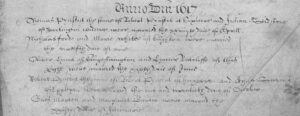
Thomas’s elder brother, Simon, seems to have predeceased his father and Robert Pinsent, the next in line, had moved to Bovey Tracey by the time his father died in 1626. Thomas had the good fortune to inherited the bulk of the family estate in Hennock. I am not aware of his having a brother, Richard Pinsent; however, there was a farmer of that name in the parish around then. In 1623, Thomas and Richard Pinsent of Hennock, “husbandmen” were summoned to appear at the Quarter Sessions for Devon in a case related to the paternity of a “base child begotten on the body of Gillian Lambshead, which is not yet delivered” [DRO 48/26/10/6 – 1623]. What that was about, beyond the obvious, I do not know.
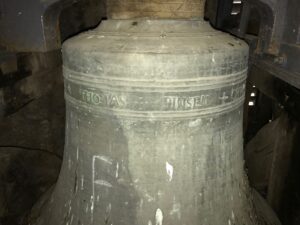
“Huxbeare Barton” was a large mixed farm and, through his father’s efforts and his own, Thomas became a man of some standing in the local community. He was a “Church Warden” in Hennock in 1637 when the tenor bell was recast. The inscription on it reads: “RICHARD BALL THOMAS PINSEN CHURCHWARDENS T P 1637” (hennock.org.uk). The T.P. stands for Thomas Pennington, the man who cast the bell.
There are breaks in the parish record and “Churchwardens’ Accounts” however, the latter show that Thomas not only paid the rates for “Huxbeare” but he also paid for “Downend tenement in Knighton, Warmhill and also ‘that which was Pinsents’” in 1648 – shortly before he died.
Thomas had had the unenviable job of managing the family’s property during the English Civil War(s). What he made of it all, I do not know. However, he (along with George and Richard Pinsent) signed off on the “39 Articles of Faith” agreed to by the Bishops, in 1562, when asked of them in the parish church in 1645.
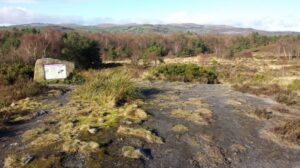
It must have been a delicate task trying to balance off the two sides when they came demanding food, “taxes,” and billets for their soldiers. Thomas lived to see the Parliamentarians, under Cromwell and Fairfax, rout a Royalist army camped on Bovey Heath in January 1646. Evidently, the Cavalier Officers were caught by surprise playing cards and they abandoned their stake money as a way of distracting the Parliamentary soldiers. Thomas’s farm at “Knighton” was right next door to the heath. Thomas died shortly after King Charles I was beheaded by the Parliamentarians in London, in 1649. That ended the first round of hostilities.
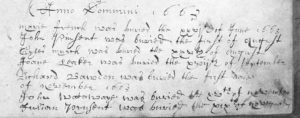
Thomas Pinsent was 52 years old when he died. According to J. P. Jones in “Hundred of Teignbridge”, (~1845) there was once a monument to him (“Here lyeth the body of Thomas Pinsett of Huxbeare; Mar. 1646”) in the church. However, it is no longer visible. In fact, Thomas died on 12th March, 1648/9 and his widow, Julian (née Stidstone) was granted administration of his will in the “Prerogative Court of Canterbury” (LDS #916908). She took responsibility for paying the parish rates for “Huxbeare” and for “four tenements” (houses), and continued to make them (sometimes with her son, Robert) until 1658. Julian then retired. She was growing old herself and from then on she seems to have been periodically “in receipt” of parish funds until in 1663, when she died.
Thomas Pinsent and Julian had four sons, (Robert Pinsent, John Pinsent, Thomas Pinsent and William Pinsent) and five daughters (Helen Pinsent, Joan Pinsent, Mary Pinsent, Julian Pinsent and Margaret Pinsent) who were born and baptized in Hennock between 1618 and 1638. A completely unrelated couple, Thomas Pinsent [GROxxxx xxxx] “sailor” and his wife, Julian Pinsent [GROxxxx xxxx] were having their children baptized in the parish at around the same time but the parish clerk, helpfully, spelt out which child belonged to Thomas and Julian Pinsent of “Huxbeare” and which belonged to Thomas Pinsent “sailor”. The lineage of the latter has yet to be defined. It is a useful reminder that the “Huxbeare” Pinsents were not alone and they have to be teased out of a much larger overall family.
The “Churchwardens’ Accounts” tell us that Julian’s sons, Robert Pinsent and John Pinsent signed indentures prepared by the parish “guardians” in 1652. The documents are long gone but John got married around then, so the documents may have been to do with a formal break up of their father’s estate.
Thomas Pinsent’s eldest son Robert Pinsent married Urith Woolcombe, of Chudleigh, in Chudleigh in 1650. He farmed “Huxbeare” and “Cressida Down” and took full control of both properties when his mother retired. His younger brother, John Pinsent, married a girl called Philippa Wilmeade and took over two, presumably smaller, farms at “Knighton” and “Warmhill” in around 1653. Their younger brother Thomas Pinsent married Phillipa’s sister Julian Wilmeade in 1657 and, through her, acquired a tannery at Slade in Hennock. What happened to the youngest brother, William Pinsent is uncertain. I suspect he moved out of the district but we will return to him later as he may have founded another major family line – based out of TIVERTON. The descendants of these brothers comprise the vast majority of modern day British Pinsents. The descent of each will be examined in turn.
Thomas Pinsent “senior’s” wealth when he died is uncertain. However, he held all or part of two small manor farms at “Huxbeare” and “Knighton” and his holdings may have extended beyond the parish of Hennock into the neighbouring parishes of Bovey Tracey and Chudleigh. He appears to have left “Woodhouse Down” to a nephew, Robert and Agnes’s son Thomas Pinsent.
Thomas appears to have been a wealthy “yeoman,” but he would not have formally qualified as a “gentleman.” The Magna Britannia shows that “the advowson of the vicarage (of Hennock) had gone to the Washer family after the Reformation and had later passed to the Pinsent family, and Southcotes before being bought by the Chamber of Exeter for £400 in 1615 for the endowment of a lectureship in the City of Exeter”. However, another source disputes this. It says that the Abbot of Torre, at Torquay, sold the advowson to John Southcote Esquire in 1553 and it remained in his family until it was sold to the City of Exeter in 1631 (Ecclesiastical Antiquities of Devon: G. Oliver and J. P. Jones 1928). The latter seems more likely.
There was a well-off merchant called Mr. John Pynsent living in Chudleigh in the early years of the 17th Century and his family had the highest profile in the district. Mr. John’s son (also called John) became a “Prothonotary” (“Senior Clerk”) of the “Court of Common Pleas” during the English Civil War. He founded “Pynsent’s Free School” in Chudleigh when he died in 1668. His story is told in “The Pynsent Baronetcy: The Trials and Tribulations of a Litigious Family: 1687-1765”.
When Thomas Pinsent died, his estate was split. His widow Julian Pinsent and his eldest son (another Robert Pinsent), paid the parish rates for “Huxbeare” and “Cressida Down”; while a younger son John Pinsent paid for “Knighton”, and a nephew, Thomas Pinsent seems to have made the payments for “Woodhouse Down”.
Family Tree
Grandparents
Grandfather: William Pinsent: 1527 – 1601
Grandmother: Joan Unknown: 1535 – 1590
Parents
Father: Robert Pinsent: 1562 – 1626
Mother: Dorothy Carpenter: 1565 – 1643
Male Siblings (Brothers)
Simon Pinsent: 1587 – xxxx
Robert Pinsent: 1589 – 1650
William Pinsent: 1591 – 1591
Thomas Pinsent: 1597 – 1649 ✔️
George Pinsent: 1599 – xxxx
John Pinsent: xxxx – 1600
Please use the above links to explore this branch of the family tree. The default “Next” and “Previous” links below may lead to other unrelated branches.