Vital Statistics
Charles Pinsent: 1762 – 1816 GRO1325 (Carpenter of St. Marylebone, and Soho, London)
Elizabeth Butter: 1762 – 1815
Married: 1791: Woodbury, Devon
Children by Elizabeth Butter:
Elizabeth Milton Pinsent: 1792 – 1839 (Married Thomas Scott, 1812)
Charles Thomas Pinsent: 1794 – 1795
Mary Pinsent: 1796 – xxxx
Anna Pinsent: 1800 – xxxx (Married Charles Muirhead Burgess, 1823)
Eleanor Pinsent: 1802 – xxxx (Married Henry George, Hartland, 1828)
Eleanor Pinsent: 1798 – 1801
Family Branch: Hennock
PinsentID: GRO1325
Click here to view close relatives.
According to LDS (Latter Day Saints) Film #0917202, Charles Pinsent was the youngest son of a a “Charles” and Eleanor Pinsent. However, this is wrong. His father was actually “Robert” Pinsent , a “serge cloth manufacturer and salesman” in Newton Abbot and one of Thomas Pinsent “the younger of Pitt”’s brothers. It was Robert who had married Eleanor.
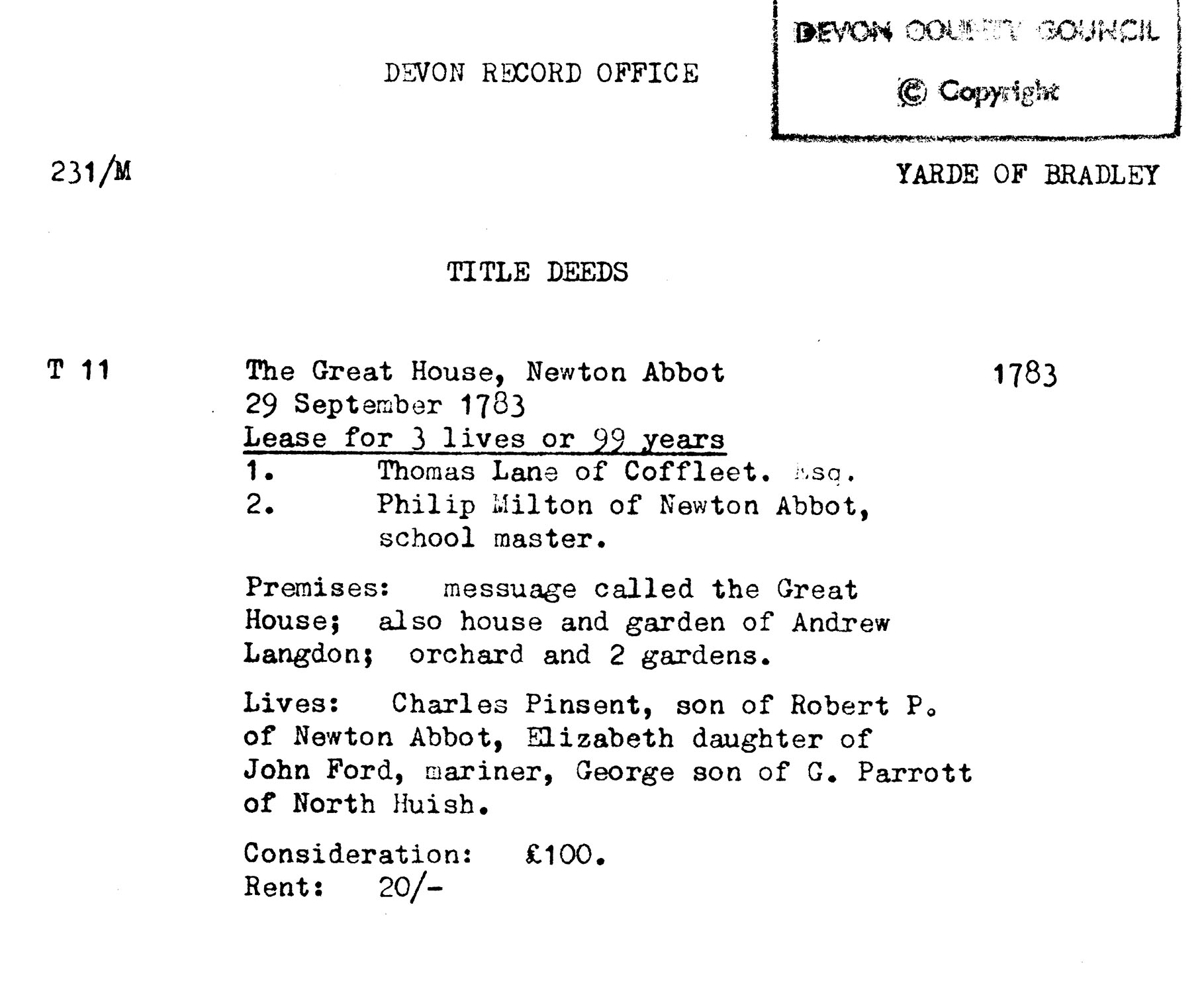
Charles seems to have been brought up in Newton Abbot with at least one brother and been apprenticed to John Searle, a “carpenter” in Chudleigh in 1777 (Register of Duties Paid for Apprentices’ Indentures, 1710-1811). I do not known a lot about his life in Devon. However, the Devon Records Office has a “lease for three lives for 99 years” dated September 1783 that records the change in ownership of the “Great House,” Newton Abbot, from Thomas Lane of Coffleet, Esquire, to Philip Milton, Schoolmaster, for £100 “consideration” and 20s rent. The three lives mentioned are Charles, (son of Robert Pinsent of Newton Abbot), Elizabeth, daughter of John Ford, (mariner) and George (son of G. Parrott of North Huish). This type of land transfer was fairly common in those days. The idea was that if you choose three people covering a range in ages, then if one dies the other two can hold on to the property while they negotiate with the owner for the addition of a third name – and thus keep the property in one family almost indefinitely. Interestingly, Charles later named one of his children Elizabeth “Milton” (see below).
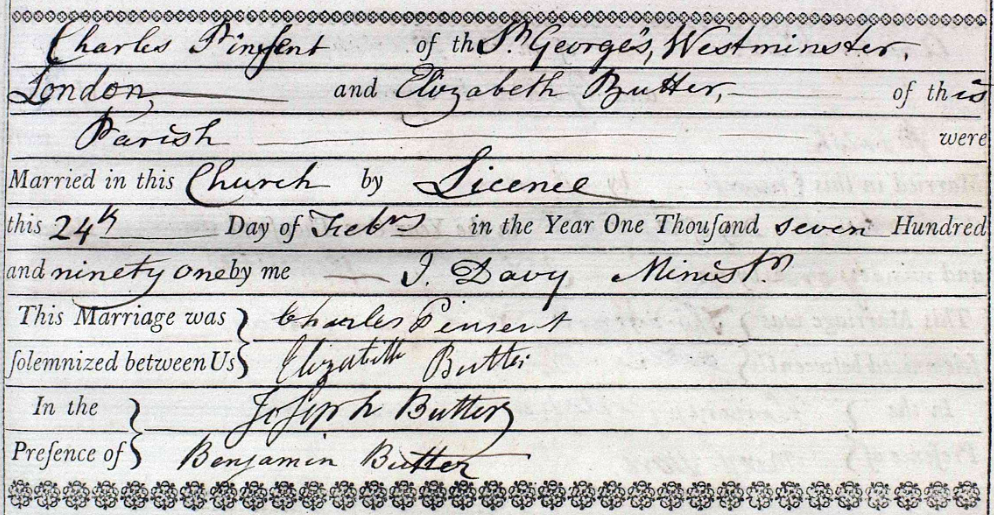
Charles married Elizabeth Butter in Woodbury in Devon in 1791 and they headed up to London where they, appropriately enough, set up in business as “cheese-mongers”. They moved to London shortly after Charles’s cousin, John Pinsent, who was a “baker” and they seem to have shared a property at “35 Edward Street, Portman Square” in St. Marylebone from 1792 to 1798 or, perhaps even later. John was the son of John Pinsent and Susanna Pooke of Newton Abbot. They were both grandsons of Thomas Pinsent the elder of “Pitt” by his wife, Mary (nee Gale) and they both received small bequests from their uncle Thomas the younger of “Pitt” when he died in 1802.
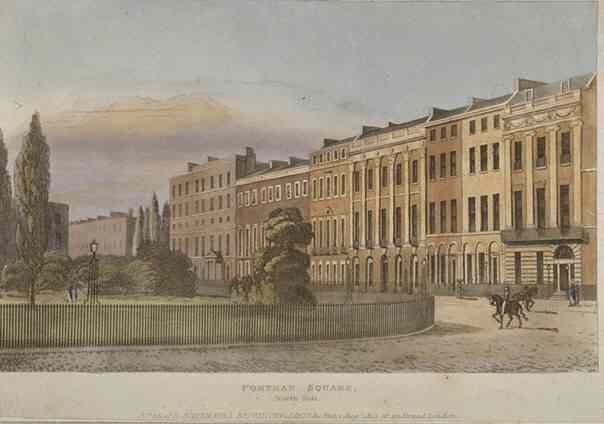
There is a document in the London Metropolitan Archives that shows that “Charles Pinsent, cheese-monger” took out a “Royal and Sun Alliance” insurance policy on the Edward Street property in 1792. Charles and his cousin John were neighbours throughout the 1790s and they both had children baptized in St. Marylebone Parish church.
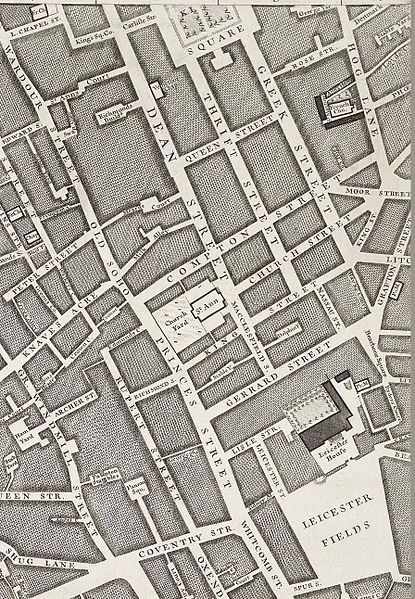
Charles paid approximately 12s 6d in rent and 2s 6d in tax annually from 1792 to 1798 for his part of the communal property on Edward Street from 1792 to 1798. Shortly thereafter, he moved to a more substantial property at “80 Dean Street, in St. Anne’s parish, Soho.” He paid around £7 in rent and taxes (it varied from year to year) between 1804 to 1815. Charles may have acquired #61 Dean Street at the same time, as he offered a lease of the premises which “contain(ed) two and three rooms on a floor, well fitted up, and now in the possession of Mr. Charles Pinsent, carpenter” for 20 years at a yearly rent of £60, land tax allowed (Oracle and Daily Advertiser: Monday 28th February 1803).
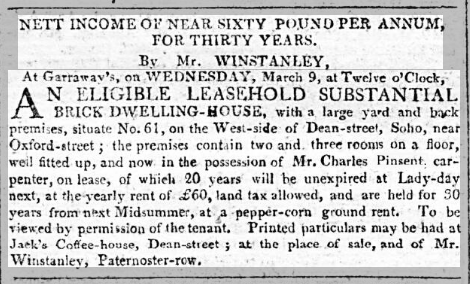
The move to Soho may well have been triggered by a switch in his career as he went back to using his carpentry skill and became a builder. He would have needed a yard of his own as his cousin needed the Edward Street site for the commercial shipping business that he ran with his brother William in Newfoundland.
Four of Charles and Elizabeth’s children (Elizabeth Milton, Charles Thomas, Mary, Eleanor and Anna Pinsent) were baptized in St. Marylebone Parish between 1792 and 1800. The present day church was not built until 1817. However, the “Old Church” – which was built in 1760 – still remains as a Chapel of Ease. Charles and Elizabeth’s fifth child, Eleanor Pinsent, was born in Soho in 1802; however, she was baptized in her mother’s home parish of Woodbury, in Devon. Two of the children, Thomas Charles and the first Eleanor Pinsent died within a year of so of their birth.
It is not clear what happened to Mary; however, Elizabeth, Anna and Eleanor later married. However, before Anna and Eleanor did so they were named as beneficiaries in the will of their uncle, John Butter, of Woodbury, who was a Private in the 83rd Regiment of Foot. He left Anna a property called Haynes and Eleanor his interest in a farm called Hammetts. As they were then underaged, he left their respective interests in event of their death before the age of maturity to their mother, his sister Elizabeth. John Butter’s will was probated in 1815 (Inland Revenue Wills: 1815).
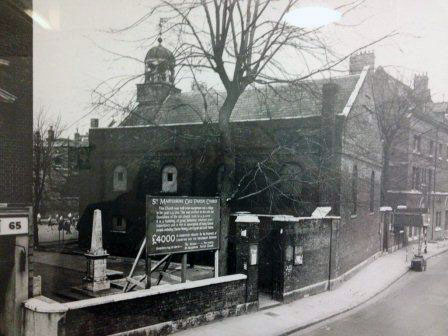
A reference in “Burke’s Colonial Gentry” shows that Mr. Thomas Scott of Boode House, near Braunton, in Devon, married “Elizabeth Milton, daughter of —– Pinsent of Pitt House, near Chumleigh (sic), County Devon”. The connection to Pitt House (farm as it was then) is a bit of a stretch, although Elizabeth’s grandfather was certainly born there. Elizabeth was, technically, a “minor” when she married in St. Anne’s Church in Soho in 1812. The marriage suggests that Charles was doing reasonably well and he had made a good marriage for his daughter. Thomas and Elizabeth Scott had several sons. The first, born in 1814, was baptized Thomas Pinsent Scott. He went out to Australia where his family held property at “Benacre”, “Glen Osmond”, and “Mount Lofty” near Adelaide in South Australia. Another son, William Scott, also went out to Australia. He became a Warden of St. Paul’s College – at what is now the University of Sydney.
Charles’s daughter Anna Pinsent moved to Liverpool and married a local “merchant”, Charles Muirhead Burgess, in 1823. Charles’s youngest daughter, Eleanor Pinsent also skipped town – which was actually a sensible thing to do as London was not a particularly healthy place to be in those days. She married Mr. Henry George, a “bookseller” from Bath (in Somersetshire) in Hartland in North Devon in 1828. Coincidentally or probably otherwise, Elizabeth Milton (Scott) and her sister Eleanor (George) both ended up living in North Devon. Braunton and Hartland are just 30 miles (50 kilometres) apart! If the linkages are correct, their uncle John Pinsent who was a retired soldier may have moved to North Devon too. He lived in Great Torrington in later life.
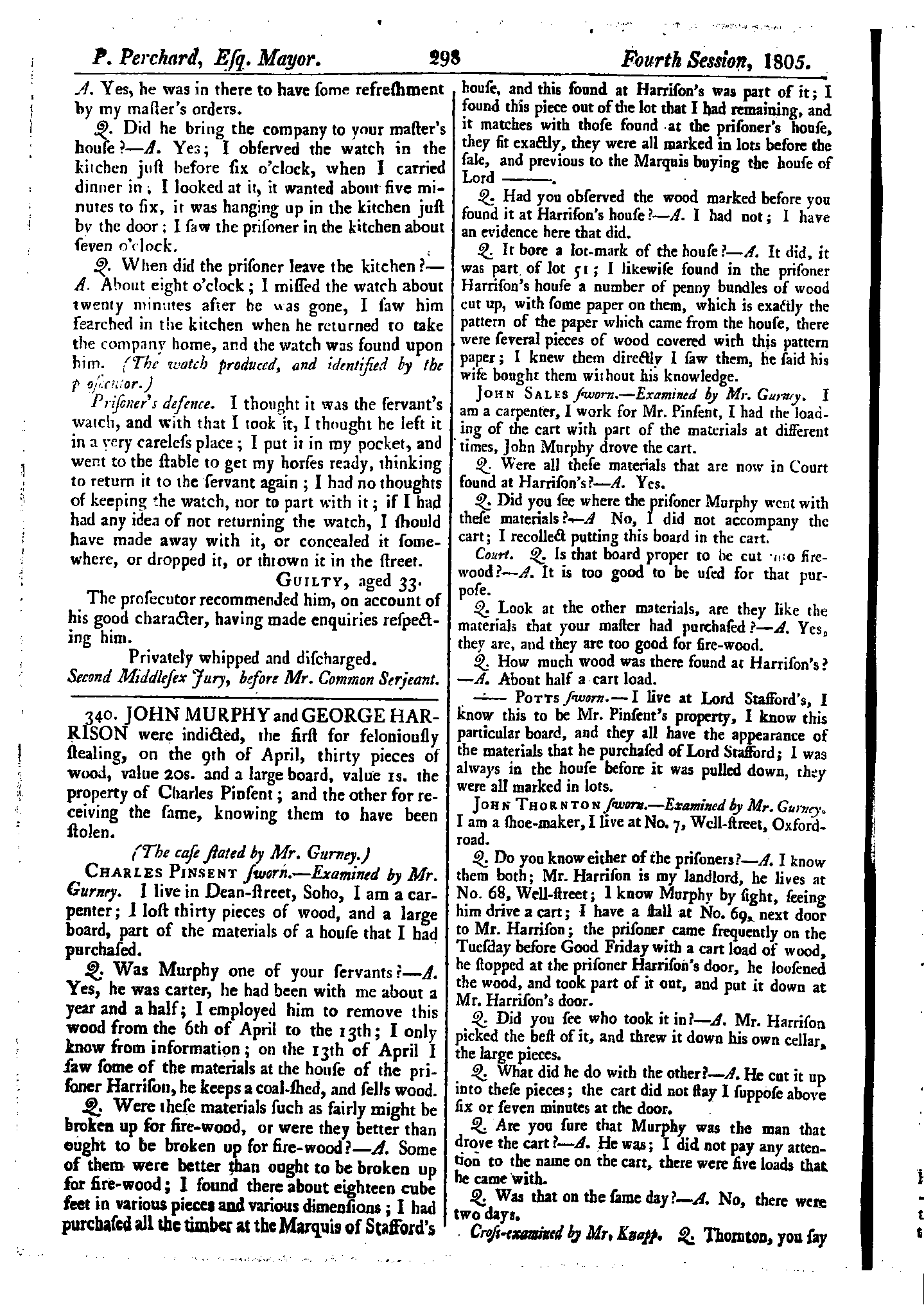
The records of the Central Criminal Court (Old Bailey) are now on-line and they show that John Pinsent (Charles’s cousin) was summoned for jury service on 1st July, 1790. He was appointed to the “First Middlesex Jury” of the “King’s Commission of Oyer and Terminer, and Goal Delivery”. He was also appointed to the “Second Middlesex Jury” on 17th February 1796 and on that occasion his cousin Charles Pinsent was appointed to the “First Middlesex Jury.” They fulfilled their civic duty.
There was a considerable amount or rebuilding going on in London in the early 1800s and Charles very sensibly recycled lumber. In 1805 he was back at the Old Bailey – this time as a plaintiff. Some salvaged wood was stolen from his yard shortly after he moved to Dean Street. The miscreants were caught and John Murphy and George Harrison were duly indicted for (respectively) stealing, and receiving 30 pieces of wood valued 20s.
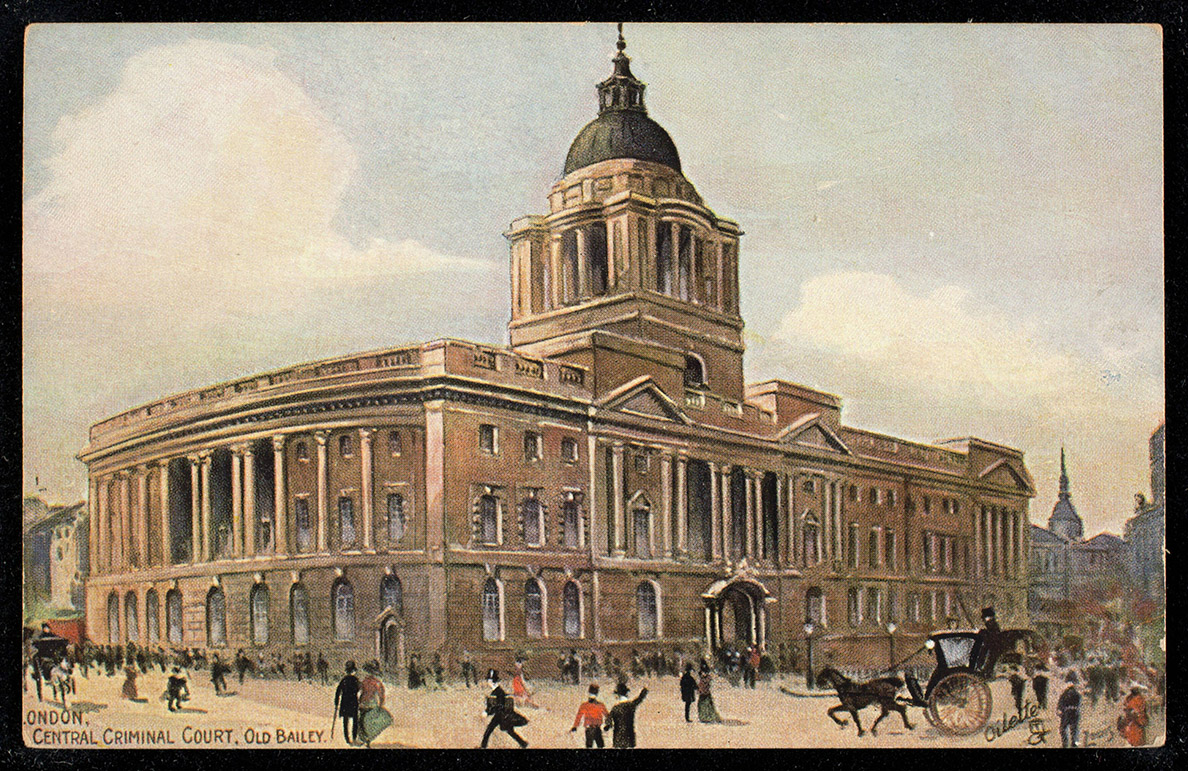
They were tried at the Old Bailey on 24th April 1805. Charles testified that the wood in question came from the Marquis of Stafford’s old house and that some of the pieces still showed their purchase lot number. Other pieces had remnants of wallpaper attached that clearly matched pieces that were still in his possession! There is a lesson in there somewhere. Murphy was sentenced to transportation for seven years and Harrison for fourteen (Old Bailey Online).
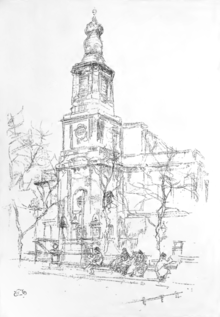
Charles Pinsent died in 1816. He was buried in St. Anne’s Churchyard in Soho. He was predeceased by his wife Elizabeth. Interestingly, Charles still seems to have been operating out of Dean Street – albeit supposedly under the “Pinson” name several years later (Underhill’s Triennial Directory: 1822 – 1824). Who took over, I do not know. Sadly, it can not have been his son as he died young.
Family Tree
Grandparents
Grandfather: Thomas Pinsent: 1691 – 1777
Grandmother: Mary Gale: 1690 – 1774
Parents
Father: Robert Pinsent: 1721 – 1783
Mother: Eleanor Shapley: 1720 – 1780
Father’s Siblings (Aunts, Uncles)
Thomas Pinsent: 1717 – 1802
Robert Pinsent: 1721 – 1783 ✔️
Gilbert Pinsent: 1724 – 1794
John Pinsent: 1728 – 1772
Male Siblings (Brothers)
Robert Pinsent: 1747 – 1748
Robert Pinsent: 1750 – 1786
Thomas Pinsent: 1754 – 1762
John Pinsent: 1757 – xxxx
William Pinsent: 1760 – xxxx
Charles Pinsent: 1762 – 1816 ✔️
Please use the above links to explore this branch of the family tree. The default “Next” and “Previous” links below may lead to other unrelated branches.