Vital Statistics
Robert Pinsent: 1721 – 1783 GRO1306 (Serge-maker and shopkeeper of Newton Abbot)
Eleanor Shapley: 1720 – 1780
Married: 1744: Wolborough (Newton Abbot), Devon
Children by Eleanor Shapley:
Robert Pinsent: 1747 – 1748
Eleanor Pinsent: 1748 – 1748
Robert Pinsent: 1750 – 1786 (Tallow Chandler, Newton Abbot: Married (1) Mary Pinsent, Newton Abbot, 1771; (2) Mary Jordan, Newton Abbot, 1774)
Eleanor Pinsent: 1752 – xxxx (Married John Adams, Newton Abbot, 1788)
Thomas Pinsent: 1754 – 1762
Mary Pinsent: 1756 – 1789
John Pinsent: 1757 – xxxx (Woolcomber of Newton Abbot and Soldier of First Regiment of Foot; mason of Great Torrington (?))
William Pinsent: 1760 – xxxx (Baker of Exeter)
Charles Pinsent: 1762 – 1816 (Carpenter and Builder, Chudleigh and London, Married Elizabeth Butter, Woodbury, 1791, and had children)
Family Branch: Hennock
PinsentID: GRO1306
Click here to view close relatives.
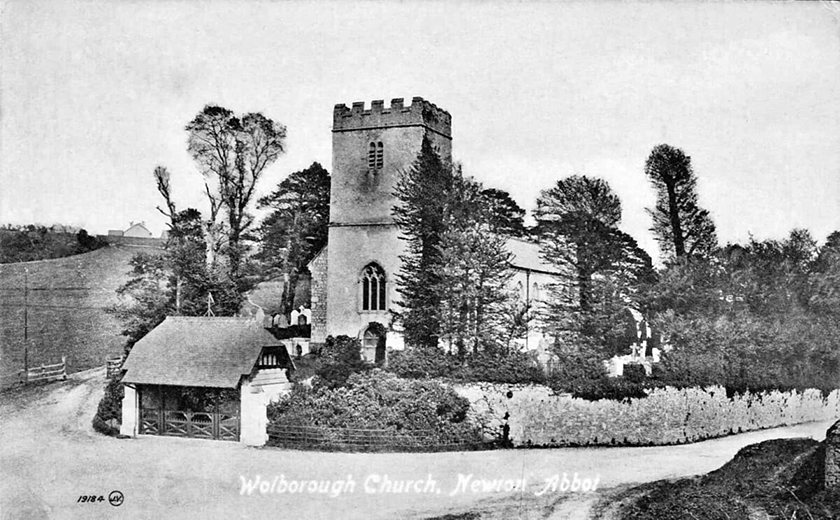
Robert Pinsent was the second to eldest son of Thomas Pinsent and Mary Gale of “Knighton” (a.k.a Thomas Pinsent “the elder” of “Pitt”). How and when his father had acquired “Pitt” I am not sure. However, his father before him (another Thomas) was a “tanner” at “Slade.” Presumably Robert was brought up on the family farm. He married Eleanor Shapley in Wolborough in 1743/1744 and had several children but only two sons (Robert Pinsent and Charles Pinsent) and a daughter (Eleanor Pinsent) are known to have married. Another son, John Pinsent, may also have done so. Robert’s son Thomas Pinsent died whilst still a young boy and his daughter Mary Pinsent died unmarried, at the age of 33 years.
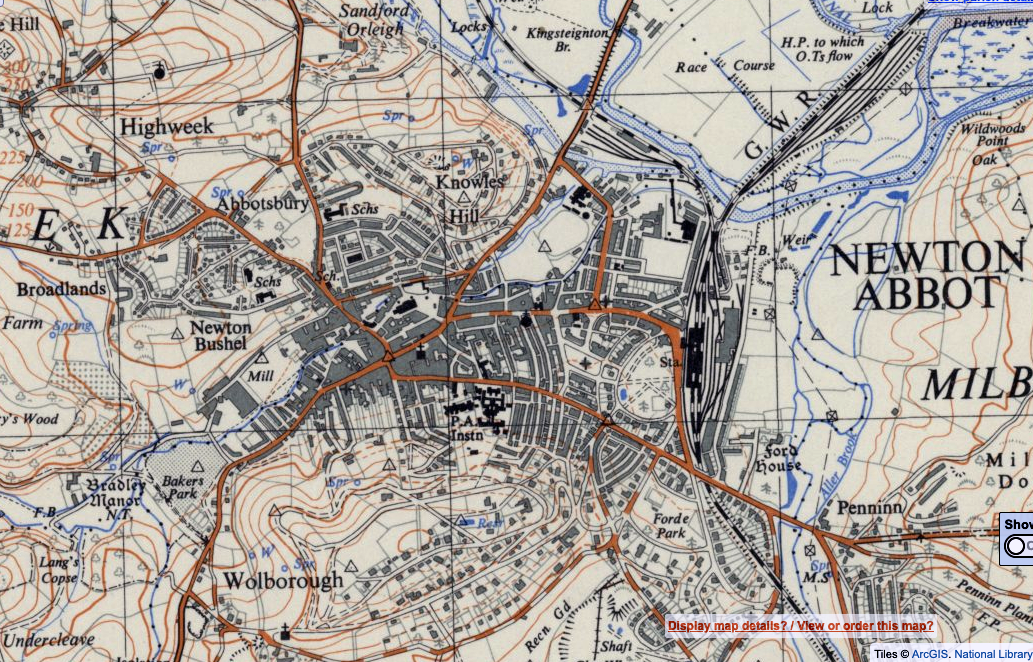
Robert “senior” had an elder brother, Thomas, who was destined to take over the farm at “Pitt” and it fell to “Mr. Robert Pinsent” to become a “serge” (worsted fabric) maker and a “shopkeeper” in a nearby market town. Robert, his elder brother John, and their brother Gilbert all moved from Hennock to Newton Abbot – which was then a thriving commercial centre upstream from Teignmouth. It was active both in the cloth trade and the Newfoundland fishery. Most of the town is in Wolborough parish; however, even then, part of it was in the neighbouring parish of Newton Bushell (Highweek).
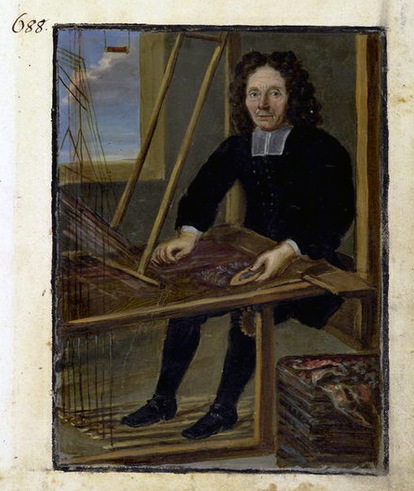
According to the “Sun Fire Office Inventories of Policies”, Robert’s house in Newton Abbot was worth £100 on October 31st, 1766; his household goods were valued at £100 and his utensils and stock were estimated at £300. A list of “freeholders” (www.foda.org.uk/freeholders/QS7/44/haytor.htm) shows that Robert Pinsent was a “shopkeeper” in Wolborough in 1771.
Like most merchants and farmers, Robert took on apprentices to help them out and also to train them. The Apprenticeship Records for the parish of Bovey Tracey show that William Spray was apprenticed to Robert Pinsent of Wolborough “yeoman” in 1772. The usage of the term “yeoman” is interesting. In this case it seems to refer to his social status and not occupation.
In the 1780s, Robert and a partner, Gilbert Duke, paid a Land Tax of 13s 9d for their business premises, which appear to have passed to Robert’s daughter, Eleanor, after his death in 1783. According to Bailey’s British Directory, Eleanor was a “mercer, draper (textiles)” in Newton Abbot in 1784.
Robert’s brother, Thomas Pinsent “the younger” of “Pitt” had no children of his own; however, he mentions three of Robert’s sons (John, William and Charles) in his Will – which was written around 1791. This tells us that they lived to maturity.
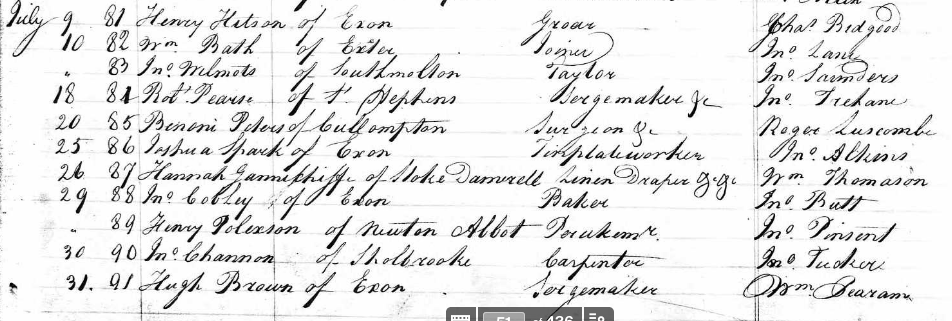
The eldest – John Pinsent – was most likely apprenticed to a peruk (wig) maker in Newton Abbot but there is nothing to suggest that he became one. He most likely joined the army and served with the “First Regiment of Foot” (“Royal Scots”) in Canada – where he likely kept an eye on the French. The regiment fought the French at the Battle of Helder in a vain attempt to kick them out of Holland in August 1799. Whether he present or not, I do not know.
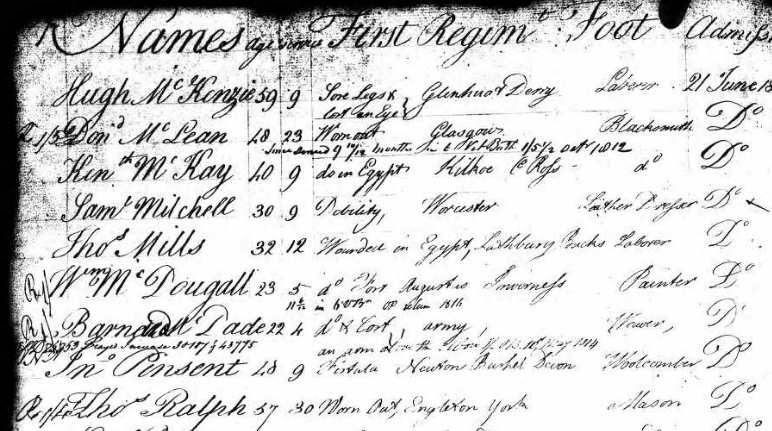
John was admitted to “Chelsea Hospital” with a fistula on 21st June 1802. He is described as having being a “woolcomber” from Newton Bushell, (Newton Abbot) in civilian life, however it is not clear that he did more than help out his father. John served with the regiment for nine years (U.K. Royal Hospital Chelsea Pensioner Registers: 1743-1882). The injury may have continued to bother him as he was readmitted to the hospital with a problem with the fistula in his arm in 1814.
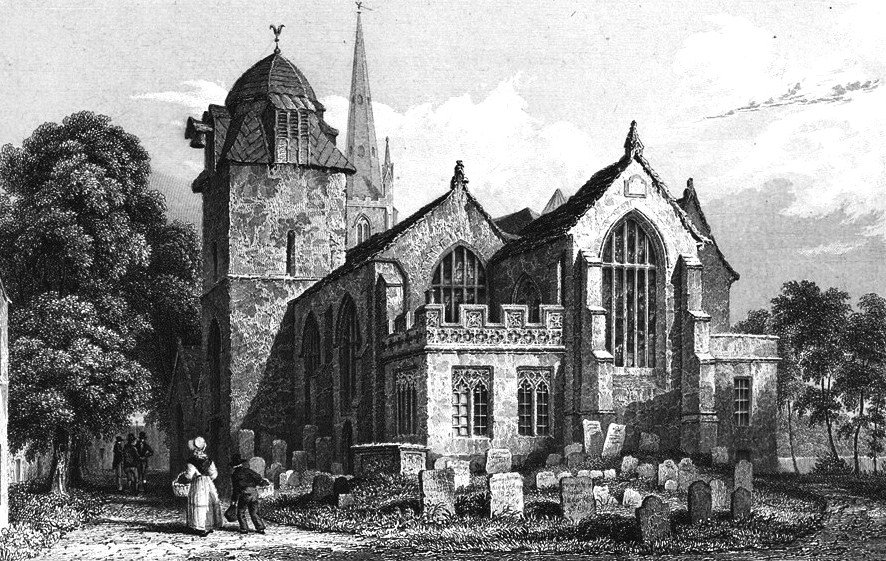
Internet sources suggest that this is the same John Pinsent who later lived in Great Torrington in North Devon and married (1) Philippa Cock and then (2) Mary Walkey. The Church in Great Torrington (St. Michael’s) is notable for having been blown up in 1645, during the English Civil Wars. Clearly, it was rebuilt!
If this is the same John, he later worked as a “mason” and had a daughter Elizabeth by his second wife, Mary. He was buried in Buckland Brewer, in 1833. According to an on-line source (MyHeritage.com), his daughter Elizabeth was baptized in Great Torrington in 1792 and married William Charles Prouse in Buckland Brewer in 1812. The couple emigrated to Canada, where Elizabeth died in Little Britain, Kawartha Lakes, Ontario.
Perhaps it is worth noting that two of John’s nieces married into families who also lived in north Devon, so there may have been a connection. I am not aware that John had any sons to continue his family line.
John Pinsent’s younger brother William Pinsent was likely apprenticed to Samuel Speare of the City of Exeter, baker, in 1777 (U.K. Register of Duties Paid for Apprentices’ Indentures: 1710 – 1811). I am not certain what happened to him after that. Interestingly, John uncle (another John) had a son John who seems to have been apprenticed at the same bakery – and probably went on to marry the baker’s daughter (Susanna)! It was this latter John who, with his brother, ran a shipping business in Newfoundland.
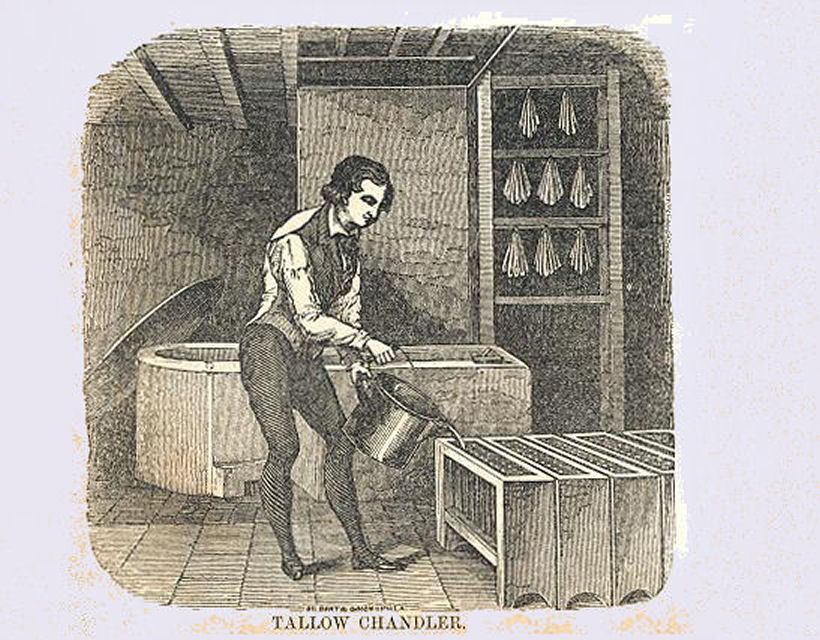
Robert and Eleanor (née Shapley’s) third son Robert Pinsent was apprenticed to John Matthew, a “tallow chandler,” in 1764. This was an interesting choice of profession as his (very, very distant) “cousin” Mr. John Pinsent owned a major “soap and candle manufacturing business” in Moretonhampstead and John’s brother, Thomas Pinsent, was a well-known “tallow chandler” in Newton Abbot in the 1780s (Bailey’s British Directory: 1784). They were from the DEVONPORT branch of the family. The families clearly knew each other, although they may not have been clear on the degree of separation.
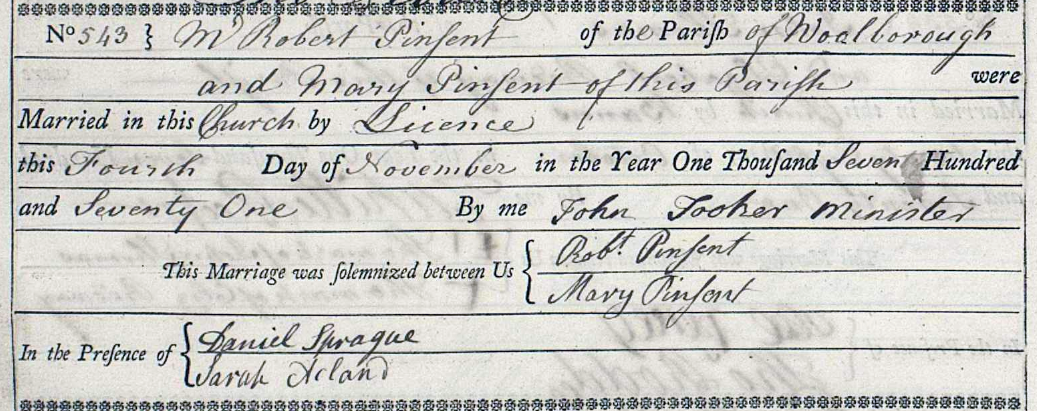
Robert Pinsent “junior” married Mary Pinsent, the daughter of Mr. John Pinsent’s brother Thomas Pinsent in Tiverton in November 1771. Why they married in Tiverton and not Newton Abbot, I am not sure! All did not go well, however, as these are likely the Robert and Mary who were registered at Tiverton St. Peter’s as “paupers” in 1776. Mary was said to be a cripple. The date seems odd, as Mary probably died in Newton Abbott in 1772. Perhaps the date is wrong.
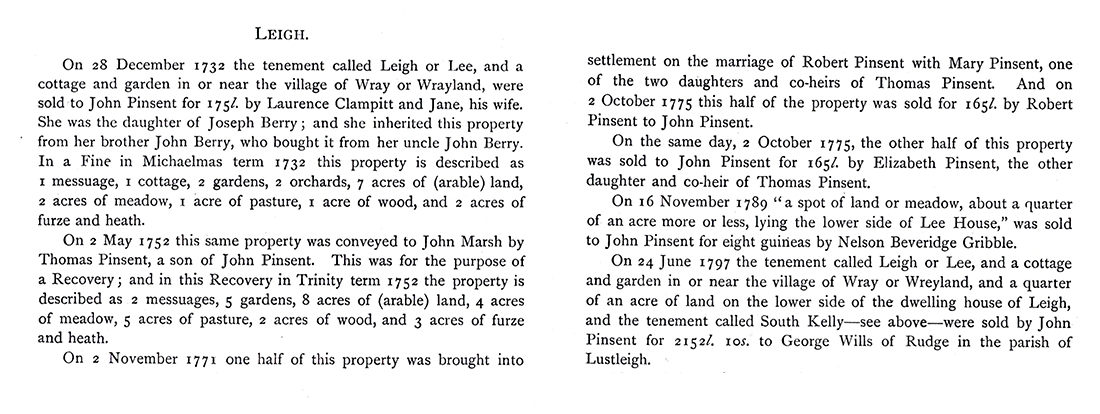
In his book “Wreyland Documents” Cecil Torr (1910) describes how Mary’s half ownership of a property called “Leigh”, in Hennock was brought into their marriage settlement. This caused a problem as Mary’s sister Elizabeth owned the other half. To resolve the issue, Robert sold Mary’s half to his late-wife’s uncle, Mr. John Pinsent, for £165 in 1775 and her sister sold Mr. John her half for the same amount on the same day. The “DEVONPORT” Pinsents clearly wanted the property back! They must have realized that if Elizabeth married, her half would be controlled by her husband. It was not a risk they were prepared to take.
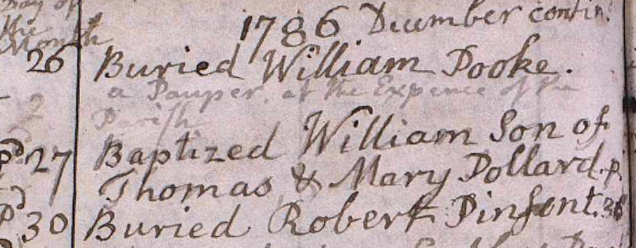
The U.K. Register of Duties paid for Apprentices Indentures 1710 -1811 (Ancestry.com) shows that Robert was a “tallow chandler” in Newton Abbot when he apprenticed Wm. Reed in 1774. His mother, Eleanor, died in 1780 and his father died in 1783. He, himself, died three years later, aged only 36 years. He outlived his father but was still being referred to as Robert Pinsent “junior” when he was buried in Wolborough in 1786!
Robert and Eleanor’s youngest son, Charles was a “carpenter” by trade. He went up to London and (initially at least) joined and shared premises with his cousin John Pinsent, a “baker” who ran a shipping business tied to the Newfoundland cod-fishery with his brother, William Pinsent. It is worth noting that the John and William also had a brother called Charles Pinsent but as he was busy farming at “Pitt” it is highly unlikely that he was the “carpenter” in London! John and Charles Pinsent seem to have worked from premises at 35 Edward Street, Portman Square in St. Marylebone Parish the 1790s.
Charles moved to Dean Street in Soho in the early 1800s but John stayed on and used the premises for his shipping business. London Directories show that Charles was both a “carpenter” and a “builder”. Charles married in London in 1791 and he was the only one of Robert and Eleanor Pinsent’s sons to have children of his own. His life is described elsewhere.
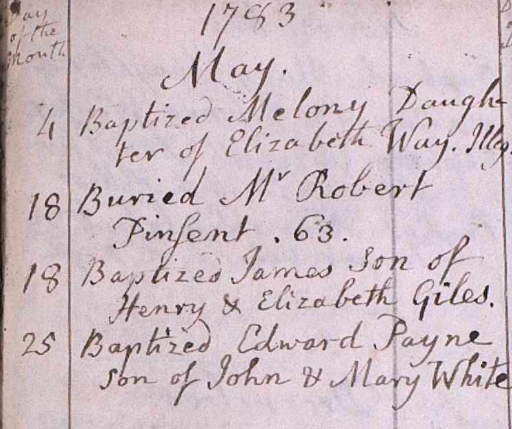
When Robert Pinsent “senior” died in 1783, his eldest son, also called Robert Pinsent, might have been expected to inherit the family “serge cloth sales business”; however, he did not do so. He died three years later, so perhaps he was not fit enough to do so. It fell to Robert “senior’s” daughter Eleanor to pay the land tax and run the business (Bailey’s British Directories 1784). She did so until she married John Adams in 1788. He, presumably, took over the business. It passed out of the family.
Family Tree
Grandparents
Grandfather: Thomas Pinsent: 1657 – 1696
Grandmother: Ann Waters: xxxx – xxxx
Parents
Father: Thomas Pinsent: 1691 – 1777
Mother: Mary Gale: 1690 – 1774
Father’s Siblings (Aunts, Uncles)
Susannah Pinsent: 1678 – xxxx
(?) Simon Pinsent: xxxx – 1744
Elizabeth Pinsent: 1682 – xxxx
Thomas Pinsent: 1684 – 1685
Ann Pinsent: 1686 – xxxx
Thomas Pinsent: 1691 – 1777 ✔️
Robert Pinsent: 1693 – xxxx
Unknown Pinsent: 1696 – 1696
Unknown Pinsent: 1696 – 1696
Male Siblings (Brothers)
Thomas Pinsent: 1717 – 1802
Robert Pinsent: 1721 – 1783 ✔️
Gilbert Pinsent: 1724 – 1794
John Pinsent: 1728 – 1772
Please use the above links to explore this branch of the family tree. The default “Next” and “Previous” links below may lead to other unrelated branches.