Vital Statistics
Joseph Burton Pinsent: 1806 – 1874 GRO1194 (Grain Merchant, Bristol and Merchant and Dairyman, St. Kilda, Melbourne, Victoria, Australia)
1. Mary Ann Ogden Hassall: xxxx – 1876
Married: 1836: Westbury on Trim, Gloucestershire
Children by Mary Ann Ogden Hassall:
Thomas Ogden Pynsent: 1839 – 1864
2. Mary Bridget Fogarty: 1832 – 1875
Married: xxxx: xxxx
Children by Mary Bridget Fogarty:
Mary Ann Theresa Pynsent: 1856 – 1888 (?) (Married Charles Edward Taylor, Victoria, Australia: 1883)
Burton William Pynsent: 1856 – 1856
Elizabeth Ellen Pynsent: 1858 – 1941 (Married Paul Rheinold Carl Boehm: Victoria, Australia, 1883)
Burton Michael Pynsent: 1861 – 1876
Joseph William Pynsent: 1862 – 1926 (Married Nellie Garland, Sydney, New South Wales, 1886)
Charles Pynsent: 1865 – 1878
Alfred Thomas Pynsent: 1869 – 1911
Family Branch: Hennock
PinsentID: GRO1194
Click here to view close relatives.
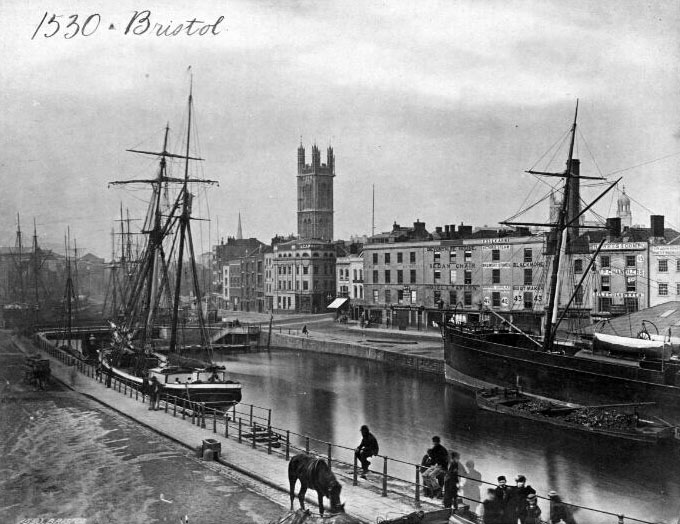
Joseph Burton Pinsent (later Pynsent) was the only surviving son of Joseph Pinsent by his second wife, Elizabeth Pinsent. He was born on his father’s farm in Devon and grew up there and in London, where his father was a “ships broker” – he arranged for the shipment of cargo. His mother died when he was three years old and Joseph Burton (or “Burton” as he was more commonly known) and his older sister Elizabeth Satterley Pinsent were brought up by his step-mother, his father’s third wife, Ann (née Tucker). They grew up with several half-siblings. Elizabeth Satterley married a merchant, William Francis Splatt, in 1840 and he and one of Elizabeth’s other half-brothers, Charles Pitt Pinsent (later Pynsent) – figure in Joseph Burton’s story. Mr. Splatt was a Devon man. He was born in Chudleigh, and he may have known the Pynsent family while it was living at Lettaford.
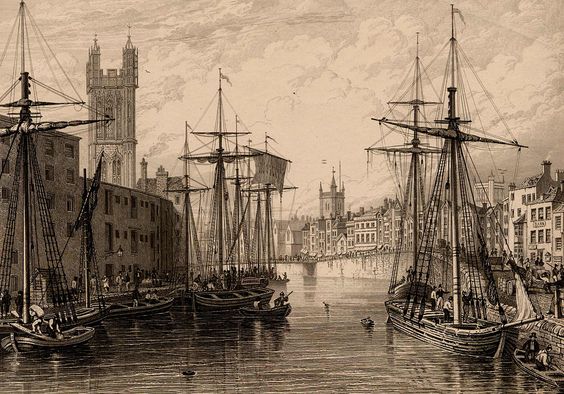
Joseph “Burton” Pinsent and William Francis Splatt went into business together as “corn factors” sometime in the early 1830s and they worked together in Bristol for several years. Their partnership was dissolved – by mutual consent – in January 1835 (London Gazette: 23rd January 1835).
The partners acquired a warehouse on the “Welsh Backs” – a section of the docks along the Avon River – and started to import grain and flour from Ireland. Their warehouse had a prime dockside location but it was old and only accessible by narrow streets that were poorly suited to the size of the wagons of the day. It did not help that their stretch of docks was near a well-known choke point, the Redcliffe Bridge.
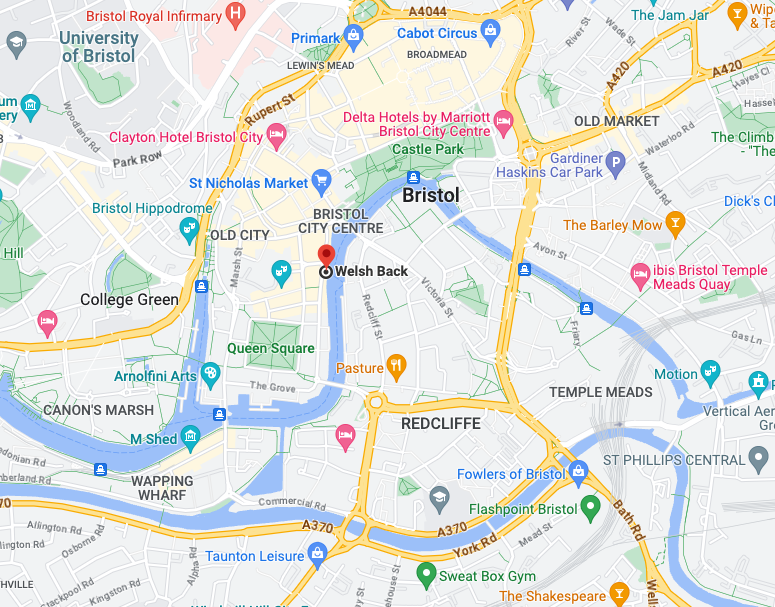
In June 1839, Burton became so irate with one his neighbours for blocking Redcliffe Street for longer than he (himeslf) felt was necessary for him to unload and load cargo that he had him brought up before the magistrates on a charge in June 1839! The magistrates tactfully suggested that they should have settled their disagreement amicably … but as they had not, they gave Mr. Roger Moore, the offender, a token penalty of 1s and costs (Bristol Mercury: Saturday 29th June 1839).
Burton married Mary Ann Ogden Hassall, the daughter of a well established Bristol merchant, in Westbury-upon-Trym in 1836, and they had a son, Thomas Ogden Pynsent, in 1839. Mr. Splatt, meanwhile, married Burton’s sister Elizabeth Satterley Pinsent in 1840 and the two of them went out to Australia shortly afterwards. He made a fortune running sheep in Victoria.
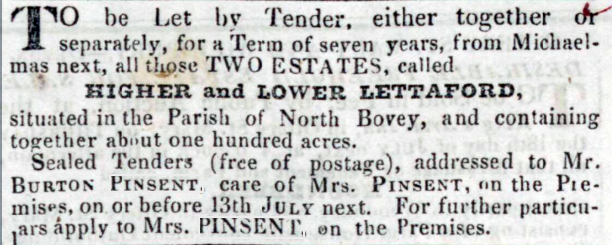
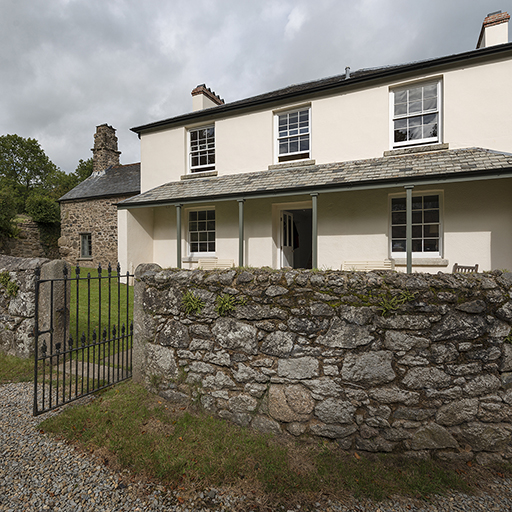
Burton sold cider as a sideline while his father still lived, (Exeter and Plymouth Gazette: Saturday 21st May 1836). It probably came from the family’s farm at Lettaford in North Bovey. However, Burton seems to have had no desire to take over the farm after his father died. He set about selling-off the freehold in 1837 (Western Times: Saturday 19th August 1837). It did not sell so Burton, and Joseph’s widow Ann (née Tucker), “Advertised Higher and Lower Lettaford” for lease in June 1839 (Exeter and Plymouth Gazette: Saturday 29th June 1839). They manage to sell at least some of the land eventually; however, Burton’s half-sister, Mary Anna Pynsent was living at Lettaford when she died in 1875 – so the family seems to have retained the principal residence.
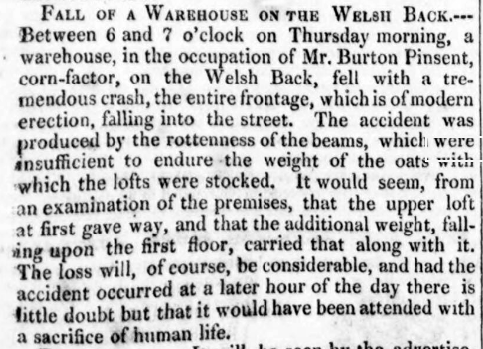
Burton imported wheat, oats and other grain from Ireland (Robson’s Directory: 1839) and seems to have done fairly well for himself, at least until he made the mistake of placing 1,500 bushels of grain on one of the upper floors of his four-story brick warehouse – and collapsing the whole building. It went down early in the morning of 2nd April 1840! Fortunately, no one was hurt. The building had rotten beams and the sides caved and the front came down as the sacks of grain slipped forward (Bristol Mercury: Saturday 4th April 1840). Joseph Burton’s sister, Elizabeth Satterley Pinsent had married Mr. Splatt just a few weeks later (Bristol Times and Mirror: Saturday 23rd May 1840). He must have been relieved that he was, by then, no longer a partner!
The warehouse was rebuilt and it remained Burton’s base of operation throughout the 1840s. Burton’s choice of clerk left something to be desired, though. John Taylor was charged at “Bristol Quarter Sessions” in 1841 with embezzling £18 8s from one customer and £23 from another. There was some confusion over who had made an entry in the account book and, when- and the prosecuting lawyer gave contradicting evidence. Mr. Taylor was acquitted (Bristol Mercury: Saturday 17th April 1841).
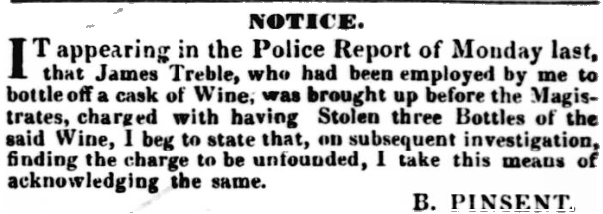
Burton also seems have got into a muddle with the law the following year. He hired James Treble to bottle a quarter cask of wine and (perhaps unsurprisingly) discovered him drunk! Burton charged him with stealing three bottles of wine. He denied the charge and when Burton was brought before the Magistrates he admitted it was unfounded, and that he had made it in a fit of pique. He had the decency to retract the charge (Bristol Mercury: Saturday 19th February 1842).
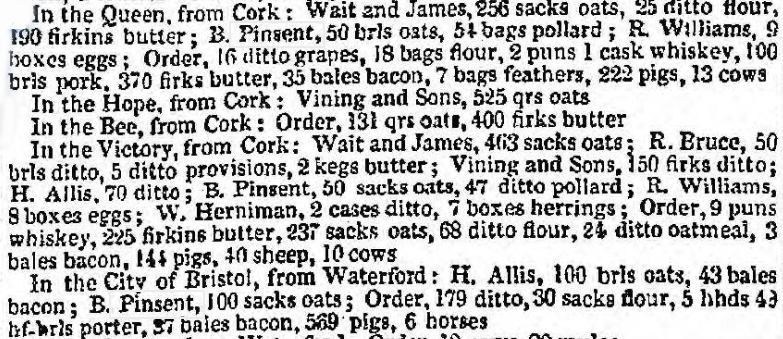
In the early 1800s, nearly all the Bristol newspapers reported on movement of ship in the Avon and described the imports off-loaded in its docks. The shipping news provides a pretty clear picture of Burton’s activities as a “corn factor”. For instance: “Bristol Imports: In the Queen, from Cork: B. Pinsent, 50 brls (barrels) oats, 54 bags pollard; In the Victory, from Cork: B. Pinsent 50 sacks oats, 47 sacks pollard; In the City of Bristol, from Waterford; 100 sacks oats (Bristol Mercury: Friday 2nd November 1839) and similarly “Bristol, Foreign and Irish Imports: … In the City of Bristol, … Burton Pinsent, 50 brls barley … In the Queen, Moriarty, from Cork: … Burton Pinsent, 54 bags pollards and coarse flour … In the Nora Creina, Mortimer, from Waterford: … Burton Pinsent, 50 brls barley … In the Thomas and Ann, Murray, from Waterford: Burton Pinsent, 95 brls best white oats” (Bristol Times and Mirror: Saturday 7th December 1839).
There would be several ships from Ireland and elsewhere coming into Bristol daily bringing goods for the the local merchants and distributors. Some of the grain may have been for human consumption; however, much of it – including some of the oats and the “pollard” (a by-product of the grain milling process) must have been animal feed. There were almost as many horses to feed as humans in those days. Note that, the “Times and Mirror” gives the name of the ship’s captain as well as that of the ship and the same ships seem to have plied the same routes and many made regular deliveries. Burton was receiving several shipments a month in the early 1840s.
Burton rarely handled outgoing ships; however we find:“For Port Philip and Sydney, New South Wales: The fine, fast-sailing ship, Thomas Hughes, A-1 at Lloyds, 500 tons burthen, Thomas Butler Commander, will be dispatched from Liverpool early in July. The Thomas Hughes will be supplied with abundance of provisions of the best quality, and with everything necessary for the comfort and conveniences of the passengers. For freight or passage, apply to Burton Pinsent, 13, Welsh Back, Bristol” (Bristol Mercury: Saturday 25th June 1842).
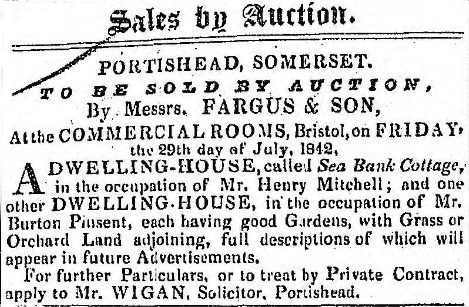
Burton and Mary Ann seem to have lived at a house called “Smarts” in Portishead, near Bristol in the 1840s. It was said to have “two gardens, orchard, barton, barn stable and other out-buildings adjoining, the whole containing one acre and a half, or thereabouts” They had a lease on the property that was to expire in March 1848, so they were sitting tenants when the freehold was sold at auction in 1842 (Bristol Mercury: Saturday 16th July 1842).
Burton was one of several “corn and flour factors” called upon to act as trustees for Mary and John Simpkin, “bakers of Bristol,” who had, presumably, applied for bankruptcy in April 1843 (Bristol Mercury: Saturday 1st April 1843). Times were tough and Burton had his own financial troubles. He had his first bout of insolvency later that same year. He was obliged to assigned all his property to Benjamin Ogden, Valentine Hellican and Alfred Robinson as trustees for the payment of his creditors (Bristol Times and Mirror: Saturday 3rd June 1843). Benjamin Ogden was his wife’s uncle, which kept the business in the family and he was able to recover it.
It seems likely that his financial troubles, at least in part, related to dealings within his own family. Burton corresponded with his brother-in-law and erstwhile partner, William Francis Splatt, and through him he conducted business in Melbourne. Letters transcribed in “The Historical Records of Australia (Series I Vol. XXIII)” show that in September 1842 Burton had a heated correspondence with Lord Stanley and other Colonial Office officials over losses he incurred as a result of the reputed negligence of the Post Master at Port Philip (Melbourne). Burton wrote to Lord Stanly complaining that: “I have scarce a letter comes the regular way. Within the last year, I have had two instances of original letters and their duplicates (although directed one direct – and the other via Sydney) yet have been sent by the Post Office Authorities through the same conveyance. One of these sets of letters had a remittance to a considerable amount, and the interest alone (which would have been saved, had one letter been forwarded as directed) was considerable, and the disappointment in not receiving at the time was of great injury to me. I also received a letter last week, which had been posted at Melbourne, and yet 15 months on the way. I have now a lot of wool on board a vessel that I cannot get, which I am satisfied is owing to the Post Office not having forwarded the letter containing the necessary document.”
Burton’s insolvency had repercussions. Mr. Rees Williams, a provisions dealer in Bristol who had gone through bankruptcy in 1842, had borrowed £200 from the Charity Trustees to reestablish himself. In so doing, he had called on Burton Pinsent, Henry Stephens and Thomas Dix to act as sureties for the loan. When Burton also became insolvent he was forced to find a replacement and he called on a Mr. Robinson (Bristol Mercury: Saturday 28th February 1844).
Burton’s brother-in-law (Mr. Splatt) owned a sheep run in Victoria and Burton seems have been bringing his wool into the country through London. His father had been a Guild Member and shipping agent there, and Burton’s name is to be found on long list of merchants that are said to have imported wool through the City of London in 1842 (Sydney Morning Herald: Saturday 12th August 1843). English merchants living abroad routinely sent several copies of letters by different routes to reduce the chance of correspondence going astray. In this case, the system had broken down as the postmaster sent them all as a bundle on one ship! Added to which, one letter that took 15 months to arrive from Melbourne should have gone to Bombay for overland transfer from there, but instead, made its way slowly round by sea.
How Burton’s insolvency was resolved is not recorded but he was back in business importing grain from Ireland by July 1844. The amount of grain he imported increased throughout the 1840s and he diversified by bringing in special deliveries (hams, cheeses, peas, beans, canary seed, vetches, etc.) from Europe and from other small ports around the coast of England: “Bristol, Foreign and Irish Imports: … In the Samuel, Murphy, from Waterford: … B. Pinsent 340 brls prime black oats … In the Rose: Burgess, from Waterford: … B. Pinsent, 100 brls black oats … In the Alida, Harding, from Rotterdam: … B. Pinsent, 106 qrs 7 bush beans, 40 mats, 630 Edam cheese, 200 Gouda cheese, 15 bales hemp seed …” (Bristol Times and Mirror: Saturday 7th April 1849) and also: “Bristol, Foreign and Irish Imports: … In the Cultivateur, Durand, from Nantes: B. Pinsent, 1474 hectolitres barley … In the Twins, Cooper, from Youghal: B. Pinsent, 921 brls black oats … In the Jessie Amelia, Maxwell, from Riga: B. Pinsent, 1809 chetwerts white oats, 2020 mats … In the Kierstine, Bay, from Copenhagen: F. Adams, 800 qrs barely, B. Pinsent, 200 qrs barley” (Bristol Times and Mirror: Saturday 11th August 1849). Two hundred quarters of barley was 50 hundredweight in old, non-metric, measure and one “chetwort” in Russian measurement would be equivalent to 5 ¾ imperial bushels. Why beans were sold in mats, I do not know!
The 1840s seem to have been particularly difficult years, and there was considerable social distress caused by widespread lack of employment and poverty. There was a riot in Bristol in June 1844 that involved the public, police and members of the 41st Regiment. Anthony Chapman, who had worked for Burton for four years, was later charged with throwing a stone at the police. Two of his friends, who had been with him at the riot, claimed he was innocent and Burton gave him a good reference. Nevertheless, the magistrates found him guilty and sentenced him to a fine of £3 or one month with hard labour. The sentence did not go down well. There were murmurs and hissing in court (Bristol Mercury: Saturday 22nd June 1844).
Like most businesses, Burton’s home and premises were targets for miscreants. For instance, two youths, Charles Cooke and James Butler, were brought up at Bristol Police Court in October 1844 charged with “intent to commit a felony”. They were sent to the house of correction for a month (Bristol Times and Mirror: Saturday 12th October 1844). Also, some time later, James Hewlett was charged at Bristol Police Court with stealing a ferret that Burton kept in this yard with his fowls and horses. Whether Joseph used the ferret to catch rabbits or to deter vermin in his yard, I do not know. Burton had employed James to look after the yard and, although he protested that someone else must have taken it, the magistrates learnt that he had sold a ferret just like it for half a crown! They were not impressed, and gave him a fine as well as three weeks hard labour (Bristol Times and Mirror: Saturday 24th January 1846).
Burton was back in Court in August 1846 for the for the Midsummer Quarter Sessions. This time he was a material witness in a case where a Mr. John Vincen was plaintiff and Messrs. James and Samuel Lorymer were defendants. Mr. Vincen’s trustees where trying to recover £23 12s 5d from the Lorymers’ for distribution to Mr. Vincen’s creditors. The defendants claimed that Burton Pinsent had drawn a bill (of credit) on Vincen of £37 12s 6d and then had endorsed it over to them as part of another transaction. They had off-set it against their debt. The issue was whether that transaction occurred before or after Mr. Vincen’s bankruptcy: if after, it would defraud his other creditors! After a long trial, the jury decided it was not a legal transfer (Bristol Mercury: Saturday 1st August 1846).
Meanwhile Burton’s business continued apace, although not without the occasional incident. One of his horses backed up unexpectedly while waiting with a wagon to be loaded on 20th August 1846, and both the horse and the wagon fell off the dock and landed up in the water! There was no harm done (Bristol Mercury: Saturday 15th August 1846). What the wagon was waiting for, I am not sure. Burton seems to have been importing more peas and beans and less grain around this time. Perhaps, this was because of the looming agricultural crisis in Ireland.
The Mayor of Bristol responded to reports of a major famine in Ireland and the Highlands and Islands of Scotland caused by the near total collapse of the potato crop in January 1847. He called for donations and Burton was one of many who responded. He gave £5 0s 0d (Bristol Times and Mirror: Saturday 16th January 1847). This does not seem like much for someone who made his living by importing Irish corn. A few months later, he donated £2 2s to an appeal on behalf of the Bristol General Hospital (Bristol Mercury: Saturday 3rd April 1847).
Business seems to have been better towards the end of the 1840s; so much so, in fact, that the City of Bristol Council imposed an import tax on grain coming into the City. Burton (among others) objected and the council later published a list of merchants and their arrears up to the 5th of December 1849. Burton was liable for £12 2s 1d for imported corn (Bristol Times and Mirror: Saturday 8th December 1849).
Burton continued to import oats, barley and other items from Ireland (and, occasionally, elsewhere) into the early 1850s and they were still stored near the quay on the “Welsh Backs.” It was a busy anchorages and, in January 1852, a French vessel with a consignment of his wheat had its cable cut and was set adrift by a Welsh trader who claimed he had priority over the dock in front of Joseph’s warehouse. Joseph sought the opinion of the Magistrates who felt that the Frenchman had every right to be there – but it was really up to the harbour master or quay warden to assign berths (Bristol Mercury: Saturday 17th January 1852).
Perhaps the red tape and inconvenience of operating a shipping business in a cramped setting was getting to be too much for Burton, particularly when he heard about the wide-open spaces and the opportunities afforded his relations in Australia. Mr. Splatt was a wealthy sheep runner and merchant in Melbourne and, by then, a respected member of the Legislative Assembly. Joseph’s half brother Charles Pitt Pynsent was busy managing Mr. Splatt’s sheep runs. Part of the Mr. Spratt’s family intended to emigrate in 1850 and they took the “S.S. Orion” up to Glasgow to board a ship for Melbourne. Unfortunately, all but one of them, Mr. John Splatt, drowned when the “S.S. Orion” sank off Scotland taking £700 worth of the family’s gold with it (Bristol Times and Mirror: Saturday 22nd June 1850).
Burton would have known of the discovery of gold at Ballarat, in Victoria State, in August 1851, as his half-brother (Charles Pitt Pynsent) and his brother-in-law (William Francis Splatt) would have told him. The gold rush was well underway by 1852 and Burton must have realized that it presented an opportunity for a merchant who was capable of brokering, organizing and handling overseas shipments. He decided leave Bristol and join his relatives in Melbourne, and make his fortune servicing the men out in “the diggings.”
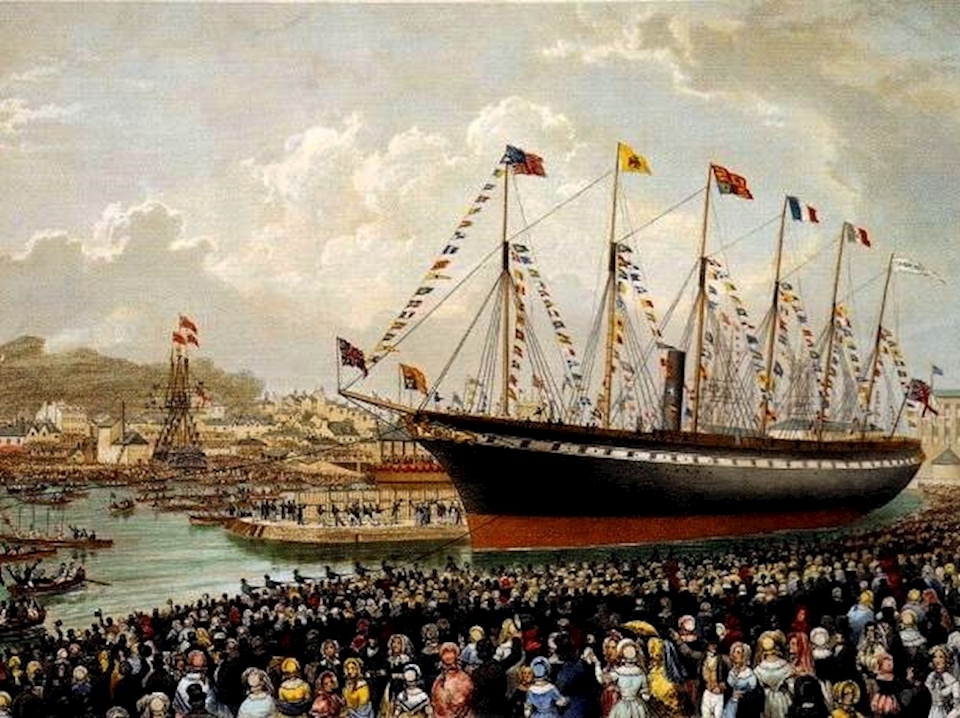
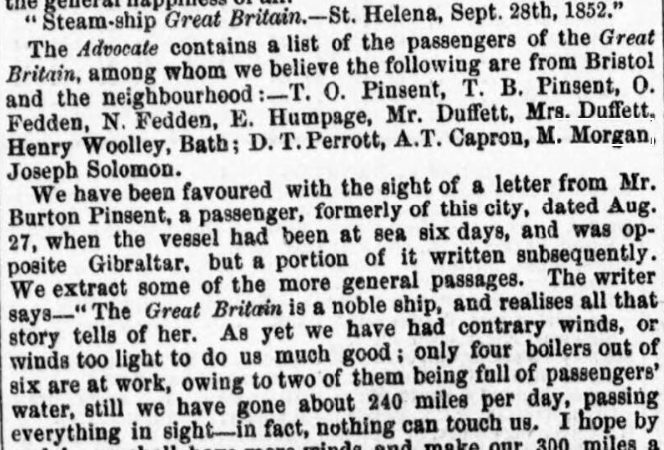
Burton set sail for Australia on the “S.S. Great Britain” in November 1852. The ship, had been designed by Isambard Kingdom Brunel and it was the largest iron-hulled, screw propelled, passenger ship ever to have been built when it was first launched, in 1846. It had recently been through a refit and this was to be the first of what were to be many runs carrying emigrants out to Australia.
Burton took his son, Thomas Ogden Pinsent (aged 13) with him but left his wife Mary Ann Ogden Pinsent at home in Bristol. It was an exciting trip for Burton and “Tom” and he arranged for his letters home to be published in the Bristol Mercury. He described their initial satisfaction with the ship and talked about their fellow passengers; he voices their disappointment that, at one point in the journey, the ship had to backtrack to St. Helena (Saturday 27th November 1852). It is not clear why. Perhaps they were using more coal than expected. It was, after all, a steam ship. In a letter written while coaling up at the Cape of Good Hope, Burton displays the then all too normal patriotic prejudice of the English … pity about the Dutch … and he casts a merchant’s eye over the quality and price of local products. At least one could get a decent cup of tea while ashore … (Saturday 18th December 1852). If you are wondering what it must have been like aboard, you can check it out for yourself. The ship is now a museum in Bristol.
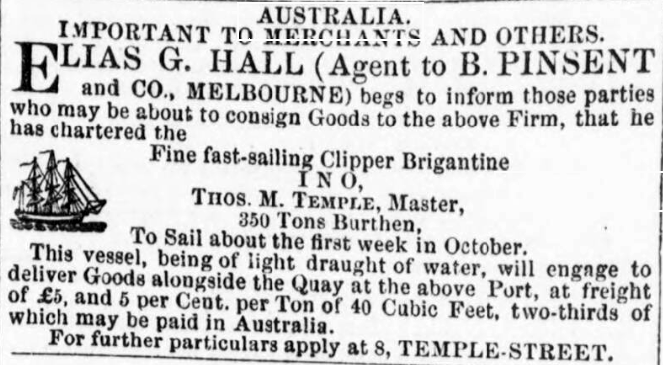
On his arrival in Melbourne, Burton went into partnership with Mr. Henry Player, another ex-patriot Briton from Bristol, and established the firm of “B. Pinsent & Co.” with its base in Melbourne and a branch at “the Diggings.” They placed an advertisement in the Bristol Mercury to that effect and offered to act as a broker for “any goods their friends may assign to them” (Bristol Mercury: 9th July 1853). Later the same year, Burton wrote to his friends in Bristol that “Burton Pinsent and Co.” had engaged Elias George Hall of Bristol as their agent and they had chartered the fast-sailing clipper brigantine INO to sail from Bristol about the first week in October (Bristol Mercury: Saturday 24th September 1853). Those letters he had sent home while on board ship had probably been part of a well thought out advertising campaign!
A digression: Joseph Burton Pinsent’s father Joseph had been mildly obsessed by the story of Sir William Pynsent and his bequest of two large estates in Wiltshire (Urchfont) and Somerset (Burton) to William Pitt (later Earl of Chatham). The names Joseph Burton and Charles Pitt speak for themselves. Joseph’s nephew Thomas Pinsent picked up on his uncle’s obsession and, when he married in 1843, he decided that from hence forth he would be known as “Thomas Pynsent”. The baronet’s line had expired and Thomas had no children but he persuaded several of his cousins (including Joseph Burton and Charles Pitt) to make the change. Burton did so on his arrival in Australia.
Charles Pitt Pynsent had run sheep with his brother-in-law, (William Francis Splatt) for several years and would have been well known in Melbourne. In fact, he had married Georgiana Helen Ball, in St. Kilda, near Melbourne in September 1852 – a few months before Burton and Tom arrived. It would have been easier for Burton change his name from Pinsent to Pynsent than to explain the difference!
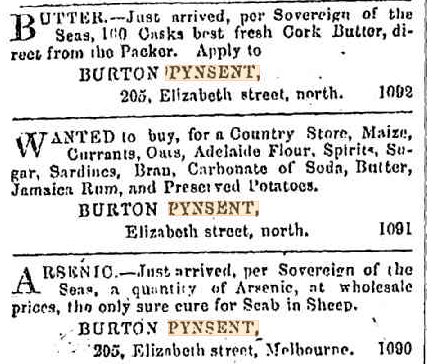
Burton had his business up and running by February 1853 and we find him advertising for sale “50 firkins of butter, 100 sacks of oats 4 cases of chocolate and 60 dozen bottled beer, I case of shoes and boots” and other items that had recently arrived on the Kyle (Geelong Advertiser and Intelligencer: Friday 25th February 1853). He knew the shipping business and advertised a variety of different goods over the following months. The only major difference between his old life and his new one, was that the wheat and oats were now brought in with all that one could possibly need for a country-store in the outback: for instance: “Now landing: Salmon in cask, biscuits in tins, pickles, bottled fruits, wills, lard, Van Diemen’s land flour, Adelaide potatoes and onions: Burton Pynsent, 205 Elizabeth Street: … also … Now Landing, Cutlery, Stakes, dials, twine, sacks, trucks spring scales, beer engine, netting, hammocks, account books, pencils, iron safe, bottled cider and champagne: Burton Pynsent, 205 Elizabeth Street: … also … Now Landing: … stoneware, corks, saddles, harness clothing millinery guns, pistols, percussion caps, cavalry swords, thermometers, telescopes, opera glasses and earth boring machine: Burton Pynsent, 205 Elizabeth Street:” (The Melbourne Argus: Monday 6th March 1854).
Other items followed, including “five hundred cases and twenty hogsheads of brandy” on Saturday 23rd of September 1854 and “five thousand dozen bottles of Porter and Ale” on the Friday 29th September 1854 (The Melbourne Argus). Digging was thirsty work.
The partners worked out of a Blue Stone, two-story, store at #44 Elizabeth Street “a little beyond Passmore’s Hotel”. Whether they bought it, or it was already in the family I am not sure. Apparently, Mr. Splatt had letters addressed there. Either way, the two partners must have felt that it was too small as they put it up for sale in September 1853 (The Melbourne Argus: Monday 12th September 1853). They reopened the business at #205 Elizabeth Street later the same month (The Melbourne Argus: Tuesday 27th September 1853). Burton purchased the Elizabeth Street property on a mortgage and Mr. Splatt, his brother-in-law (who was unquestionably a wealthy man) included in a will he wrote in 1856, a bequest of four thousand pounds to help him pay it down. As it turned out, Mr. Splatt outlived Burton by many years and the bequest was never made – although Burton could have used it. He was, eventually, forced into bankruptcy. Nevertheless, the future looked bright for Burton in those days. He was well established and on the electoral role for the City of Melbourne by 1856.
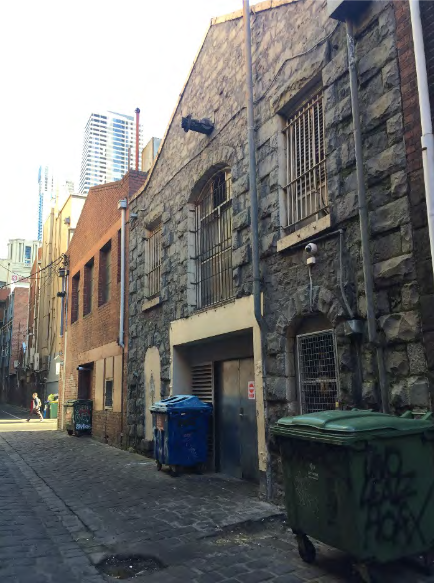
The partners drew up plans for a new warehouse and put its construction out to tender through an advertisement in the Melbourne Argus (Thursday 28th April 1853). The building still exists as a rare survival of a gold-rush era brick warehouse (Wikipedia). It is at the rear of #361/365 Little Lonsdale Street in what is now known as “Heape Court.” Melbourne was growing rapidly and Burton saw a need for imported building materials. In May 1854, he went looking for land to rent or purchase to store them (Melbourne Argus: Friday 5th May 1854). Presumably they found somewhere suitable as they advertised timber for sale a few days later (Melbourne Argus: Thursday 22nd June 1854). The firm was very clearly still in expansion mode.
At some point, Burton set up a sales outlet near the gold-fields at Geelong but how successful it was is uncertain. He put the “whole of his stock-in-trade” there, consisting of food and “the usual items (to be found) in a general store” up for auction in July 1854 (Geelong Advertiser and Intelligencer: Monday 24th July 1854). Still, he must have maintained a foothold there as he advertised for a young man with experience in the grocery trade to work in a General Store at “the diggings” in March 1855 (The Melbourne Argus: Tuesday 27th March 1855). The following year, he was looking for a young man for the diggings store who “understands a horse” (The Melbourne Argus: Tuesday 18th November 1856).
Conditions in Melbourne were pretty rudimentary at the time and it must have been difficult to get and keep reliable staff. In October 1854, Burton became embroiled in an insolvency case involving two of his employees who had also been dealing for themselves. They appear to have bought £272 worth of boots from the an insolvent trader, a Mr. Davies, and it was not clear whether they had done so on Burton’s behalf and with his knowledge, or not. Mr. Davies’s trustees eventually took the boots back (The Melbourne Age: Monday 9th October 1854).
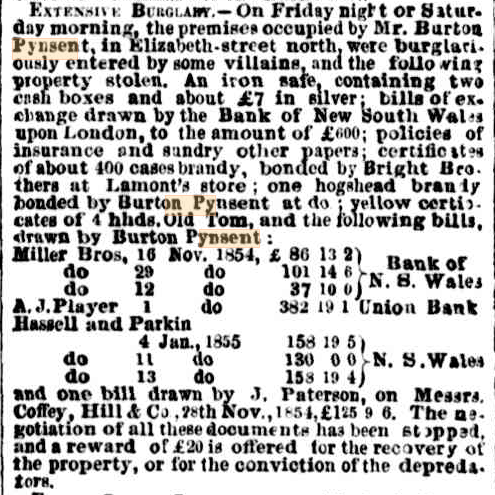
Burton realized that there was good money to be made as a wholesale “Spirit Merchant” and he paid the State fee necessary for a license to sell liquor from December 1854 to August 1855 (Victoria Police Gazette: August 24th 1855). Unfortunately, this made him a target and his store on Elizabeth Street was “burglariously entered”in January 1855. It was another setback. The miscreants stole a safe containing cash, bills of exchange drawn on several Australian banks, insurance policies and other papers, including the certificates of ownership of 400 cases of brandy held by another merchant, one hogshead of brandy of his own and also certificates for four hogsheads of “Old Tom”. The safe contained several bills that Burton had drawn – including three from “Hassell and Parkin” to the value of approximately £460 – on the Bank of New South Wales. Presumably the Hassall in question was one of his wife’s relatives. The papers were immediately cancelled and a reward of £20 was offered for the recovery of the safe or for the conviction of those responsible (Victoria Police Gazette: Friday January 26th 1855; Melbourne Argus: 22nd January 1855). How much, if any was covered by insurance I do not know.
Burton’s business continued on regardless: He continued to advertise in the local papers. This was often in the form of “On Sale: Cork, Butter, Liverpool Soap, Westphalia Hams, Adelaide Flour, at Burton Pynsent’s 205 Elizabeth Street” but it occasionally included the name or origin of the incoming ship. On another occasion we find: “Chilian Flour: two hundred tons at Burton Pynsent, 205 Elizabeth Street” (Melbourne Argus: Saturday 10th May 1856).
The Ballarat gold rush was starting to run out of steam in the mid-1850s and the local papers frequently refer to court cases between merchants and their suppliers, as both were then coming under financial pressure. Many of the cases were just listed by surname (e.g. “Hewitson v. Pynsent”: Melbourne Argus: Thursday 12th April 1855; “Pynsent v. Chandler”: Melbourne Argus: Wednesday 9th April 1856 etc.). What those cases were about, I am not sure.
However, Joseph Burton is specifically mentioned in the case of “McCullock v. Hassell” which made its way to the Supreme Court in August 1856. James McCullock claimed that Burton, the shipping agent for the Nora Creina, had approached him in 1855 to obtain credit for the purchase of flour in Valparaiso. Mr. McCullock said that he also discussed the matter with the ship’s captain, Thomas Ogden Hassall (who was (presumably) one of Mary Ann Ogden Pynsent (née Hassall’s) brothers) and he had assured him of prompt repayment. The credit was granted and, after Mr. Hassall purchased the flour he signed a receipt for the transaction. The Nora Creina brought the flour into Melbourne in May 1856 (see above). The essence of the case was that Captain Hassall had verbally promised Mr. McCullock that he would pay back the money but he now seemed either unwilling or unable to do so. Mr. Hassall’s lawyer argued that: “it was really the debt of Mr. Burton Pynsent. The captain had foolishly promised to pay it.” When His Honour asked the jury if they thought the captain was liable, they answered that “they considered him liable for the sums he had receipted for” (Melbourne Age: Wednesday 6th August 1856). Presumably the deal was sorted out amicably enough as Captain Hassall brought in another load from Valparaiso the following October (Melbourne Argus: Wednesday 29th October 1856). Who Nora Creina actually was, I do not know but she was likely linked to the Hassalls as another ship of the same name routinely brought grain into Bristol from Ireland in the 1830s (see above).
In another case, it was probably Burton who was sued by a Mr. Meldrum over a consignment of flour that should have been taken from Mr. Dight’s mill (wherever that was) to Wangaratta, an inland community. It never arrived. Both the gentleman contracted to transport the flour and the flour itself vanished without trace (Melbourne Argus: Thursday 30th October 1856). By then, Joseph’s half-brother, Charles Pitt Pynsent and his brother-in-law, William Francis Splatt, were both back in England. They dissolved their partnership – running sheep at “Wonwondah” and “Lexington” in Victoria – in June 1856. The former had his signature witnessed by his cousin, Thomas Pynsent in Weston-super-Mare, and the latter by the Reverend G. R. Harding, at Gittisham, in Devon. Burton was on his own.
Burton may have become increasingly worried about the state of business at “the diggings” and in September 1858 as he took the unusual step of actively promoting the area. He sent the following letter to the Editor of the Melbourne Argus: Devil’s River Diggings: “Dear Sir, As so many diggers are returning from Port Curtis, undetermined where next to direct their steps, perhaps you may consider it worth while inserting a paragraph in your paper to the effect that there are good payable diggings on the Devil’s River. There are at present about 200 at work on the Dry Creek and Hell’s Hole, who are all getting at least a living. The principal part of the population have been there some months. A party of five, known as Johnson’s, washed out on Saturday week 15 oz, and Gall’s party is averaging 30s. per. man per day. There is plenty of water and nothing but sluicing has yet been tried. My information is undeniable, and is from a storekeeper who has been sending me about 40 oz. gold weekly. The gold is very like that obtained at the Ovens’, and has been selling at Beechworth as Ovens gold. The way from Melbourne is up the Sydney road to Longwood, over the Big Hill, and through Merton into the diggings; or from Beechworth down the Sydney road to Benalla, then turn off past McKellars and Moore’s stations. I cannot say I am uninterested, on the contrary, I am interested in the development of these diggings, and consider by making them more public I shall be conferring a benefit on many who do not now know where to turn for a livelihood. Should any further, information be required, I shall be happy to furnish it. I am, Sir, your obedient servant: B. PYNSENT: 205 Elizabeth-street, Melbourne 19th October” (Melbourne Argus: Wednesday 20th October 1858).
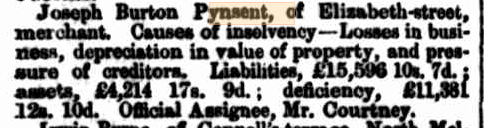
It was all to no avail: Burton resigned from a partnership agreement he had carrying out business at Forest Creek with Mr. John Arthur Parkin – probably the gentleman who had partnered with Mr. Hassall when Burton first set up shop in Melbourne: see above – and declared bankruptcy at the Insolvency Court a few days later (Melbourne Argus: Wednesday 5th October 1859). He had liabilities of £15,596 10s 7d and assets of £4,214 17s 9d (Melbourne Argus: Tuesday 18th October 1859). A week later Burton’s store on Elizabeth Street was put up for sale and an official assignee was appointed in December (The Melbourne Age: Tuesday 20th December 1859).
Burton stayed on in Melbourne after his bankruptcy and set up shop as a “Clothier and Outfitter” based at #84 Collins Street (Melbourne Directory: 1861). He had learnt the power of advertising and the needs of the traveling public: “GREAT BRITAIN, for Liverpool: – Passengers supplied with complete OUTFITS, by Burton Pynsent, 84 Collins-street west” (Melbourne Argus: Saturday 20th October 1860). Burton lived in Melbourne but he placed an advertisement for “a cheap cottage, with garden, (near sea preferred)” to rent in February 1861 (Melbourne Argus: Saturday 23rd February 1861). It was probably for his “wife” and family and a “Female General Servant” for his family that he advertised for in September 1861 (Melbourne Argus: Friday 20th September 1861). Presumably he thought his finances would support one.
Why Burton sent his young son, Thomas Ogden Pinsent, down to Hobart, in Tasmania, in 1853 (shortly after they arrived in Melbourne) I am not sure. He left on the “S.S. Clarence” with a large number of other passengers (The Hobart Courier: Friday 17th June 1853) and returned some time later. The only family connection to Tasmania that I know about came through Charles Pitt Pynsent’s wife, Georgina Hellen (nee Ball). She came from there but married Charles in Melbourne. In the years that followed, both Burton and Tom took occasional trips to Hobart and up to Sydney in New South Wales.
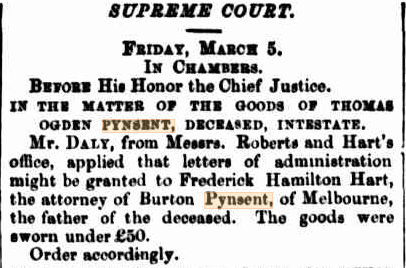
I know very little about Thomas Ogden Pynsent, or “Tom” as he was known in the family. I assume he worked with his father in the store in Melbourne; however, he seems to have spent time in New South Wales before dying of consumption (tuberculosis) in Queensland in September 1864 (Melbourne Argus: Saturday 24th September 1864). The Queensland Postal Authorities advertised that they had letters in their possession for “T. O. Pynsent of Port Denison” in January, and again in April 1864 (Queensland Unclaimed Letters: 1859 – 1874). Thomas never married and he died intestate. His father applied for “Letters of Administration” that were granted in the “Supreme Court of Queensland” in March 1869 (Brisbane Courier: Saturday 6th March 1869). He had goods sworn at under £50. The “letters” were to be refilled in the “Prerogative Court of Canterbury”, in England, in February 1878 (PCC Will and Administration Summaries: 1858-1947). There, they were granted “to the use of Mary Ann Theresa Pynsent (otherwise Fogarty, spinster), the surviving executrix of the will of Joseph Burton Pynsent, otherwise Burton Pynsent”. She was Joseph Burton’s eldest daughter by his second “wife” Bridget Mary Fogarty.
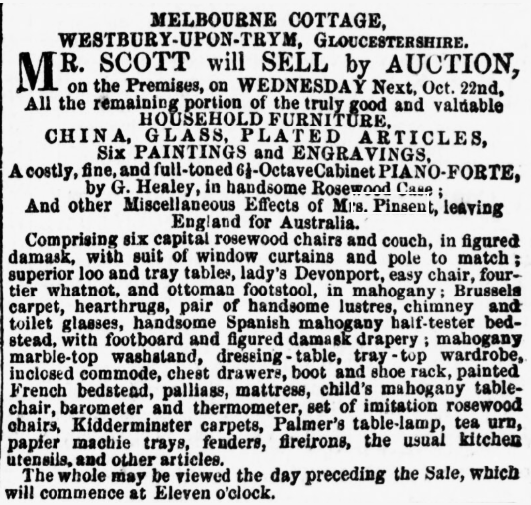
For some reason, Burton’s wife, Mary Ann Ogden (née Hassall) stayed on in Bristol when her husband and son went out to Australia in 1852. I can see why she might have stayed home for a year or two, while her husband got established and she wound up their affairs in England; however, she held off until the autumn of 1856. The newspapers tell us that: “all the remaining portion of the truly good and valuable household furniture, china, glass, etc., … and other miscellaneous effects of Mrs. Pinsent, leaving England for Australia” were put up for auction at the family home at Melbourne Cottage in Westbury upon Trym in October, 1856 (Bristol Mercury: Saturday 18th October 1856). The implication is that she went out to Melbourne to join her family; however, I can find no evidence that she ever did, and she probably had no intention of doing so. Her husband had, by then, entered into a common-law relationship with Mary Bridget Fogarty. What happened to Mary Ann is anyone’s guess.
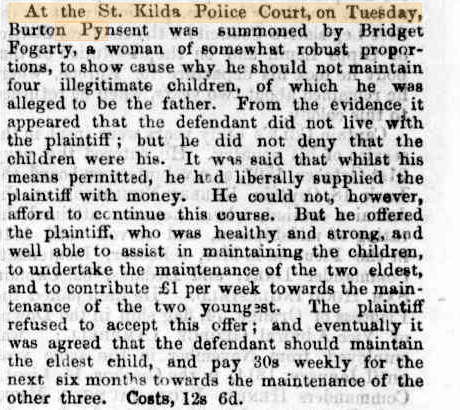
The details of Burton’s relationship with Bridget became public when she summoned him to appear in St. Kilda Police court to show cause why he should not provide child support for their illegitimate children (Melbourne Argus: 30th July 1862). She claimed that she had arrived in Melbourne in 1855 (at age 23) and taken employment with Mr. Pynsent, and that within a month they had entered into a common-law relationship. She had had six children by him – although two had since died. She said that she lived in a cottage in St. Kilda and that Burton had, until recently, given her £2 a week for the children’s maintenance. Burton did not deny paternity. However, he explained that he could no longer give her the money as he had recently been declared insolvent and his present business only generated a profit of £1 per week. Burton admitted that he did occasionally receive remittances from England (probably from his half-brother Charles Pitt Pynsent and/or his sister Elizabeth, who was the wife of Mr. William Francis Spratt).
The couple were living apart at the time, and the magistrates ordered that Burton take charge of his eldest child and pay Bridget 30s a week to look after the other three – at least for the next six months – after which she could, if necessary, reapply to the magistrates. The Melbourne Age (Wednesday 30th July 1862) notes that an alternative arrangement had been discussed and rejected. It would have had Burton looking after the two eldest children and contributing 20s a week for the maintenance of the younger ones.
I know of five of the six children referred to at this point: Burton William Pynsent and Mary Ann Theresa Pynsent born in around 1856, Elizabeth Ellen Pynsent and Burton Michael Pynsent born in 1857 and 1861 respectively, and Joseph William Pynsent who was born in 1862. Burton and Bridget overcame this particular domestic hiccup and had two more children.
Burton’s financial problems continued and he appears to have given up his clothing business and moved to St. Kilda (on the outskirts of Melbourne) and rejoined his family. His sons Charles Pynsent and Alfred Thomas Pynsent were born there in 1865, and 1869 respectively. The Victoria State Archives contain records of civil cases heard before the “Supreme Court” in the 1860s that show that Burton was sued by Henry Steel Shaw in 1865 and by the “Bank of Australasia” in 1866. Three years later, he was back fighting an action by James Aitken. I do not know the details of these cases, but they were probably for non-payment of bills.
The family lived on Carlisle Street in 1867 (Melbourne Directory: 1867). In March that year, while he was staying at the “Botanical Hotel” in South Yarra, Burton got into an argument with a resident, Mr. Mardon. Mr. Mardon had been drinking and become aggressive and they got into a fight during which Burton (who was over sixty years old by then) was hit on the head, knocked over, and had his throat grabbed. Burton claimed that he had been left in charge of the hotel, but the plaintiff (and the magistrates) felt that he was needlessly interfering with Mr. Mardon, who was just returning to his room to collect some clothes. They concluded that Burton had brought the fight on himself. Mr. Mardon was fined a token 5s or 24 hours imprisonment (The Telegraph, St. Kilda, Prahran, and South Yarra Guardian: Saturday 30th March 1867).
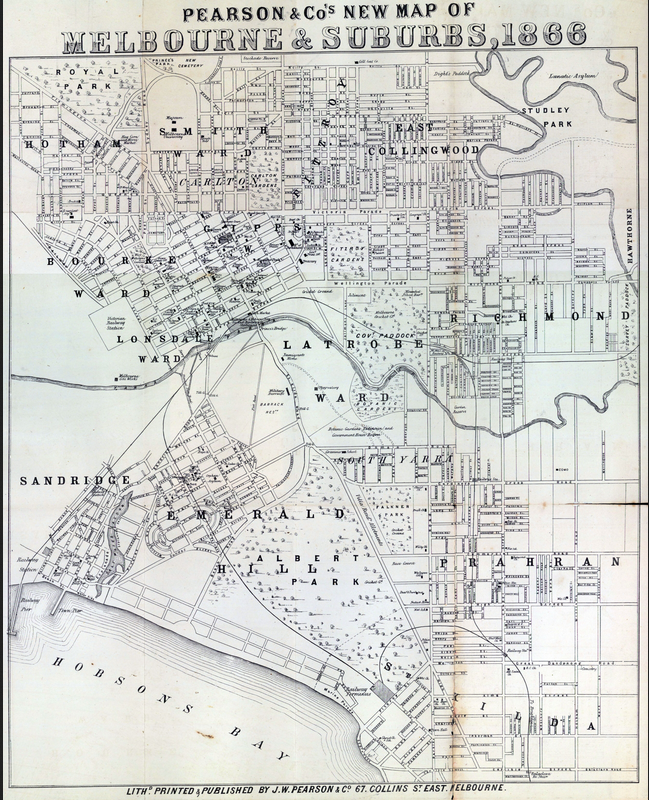
Burton and Bridget were later to set up a small dairy farm on Acland Street, in St. Kilda, near the coast to the south of Albert Park. Perhaps Burton fondly remembered his father’s small dairy farm at Gorway, in East Teignmouth. At any rate, Burton, with the help of his family, kept cows and pigs and was fined 4s in August 1866 for allowing two of the latter to wander around St. Kilda unattended (The Telegraph, St. Kilda, Prahran and South Yarra Guardian: Saturday 25th August 1866).
In 1869, Burton’s family washing stolen while it was hanging out to dry – which must have been embarrassing! The Victorian Police Gazette (January 21st 1869) dutifully reports that “2 new long white flannel chemises, 2 pairs of white flannel drawers, one of them patched on the seat; 2 nearly new flannel petticoats, a printed muslin dress lined round the waist with brown holland, 2 white calico nightgowns with frills, 2 pairs of white calico drawers, 2 girls’ calico chemises, a large linen table-cover, and about 6 bath towels” were stolen from his yard on Carlisle Street in East St. Kilda on 12th January. Money must have been tight around then and the washing may have been missed as Burton was forced to put “one white cow, in milk” up for auction a couple of months later (Melbourne Argus: Tuesday 22nd March 1869). Nevertheless, with his family’s help he managed to stay in business.
In December 1872, on of Burton’s younger sons, Joseph William Pynsent, deposed that on one occasion when he delivered milk to Mr. MacGregor’s house he had seen a servant (Maria Davenish) in the kitchen looking very ill. She had asked him where she could find a doctor and he had told her. Other witnesses deposed to finding the body of an infant and Maria was charged with infanticide. She admitted she had had the child but claimed that it had died from a fall shortly after birth. There was no evidence to the contrary, so she was acquitted (The Melbourne Argus: Saturday 21st December 1872). Joseph William’s life is discussed elsewhere.
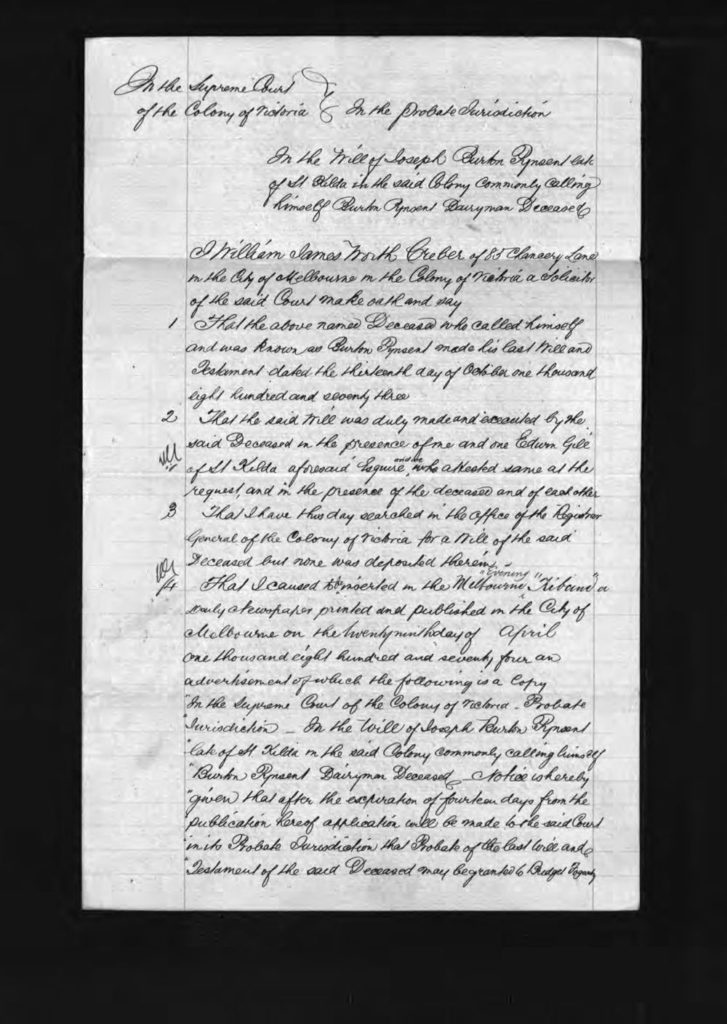
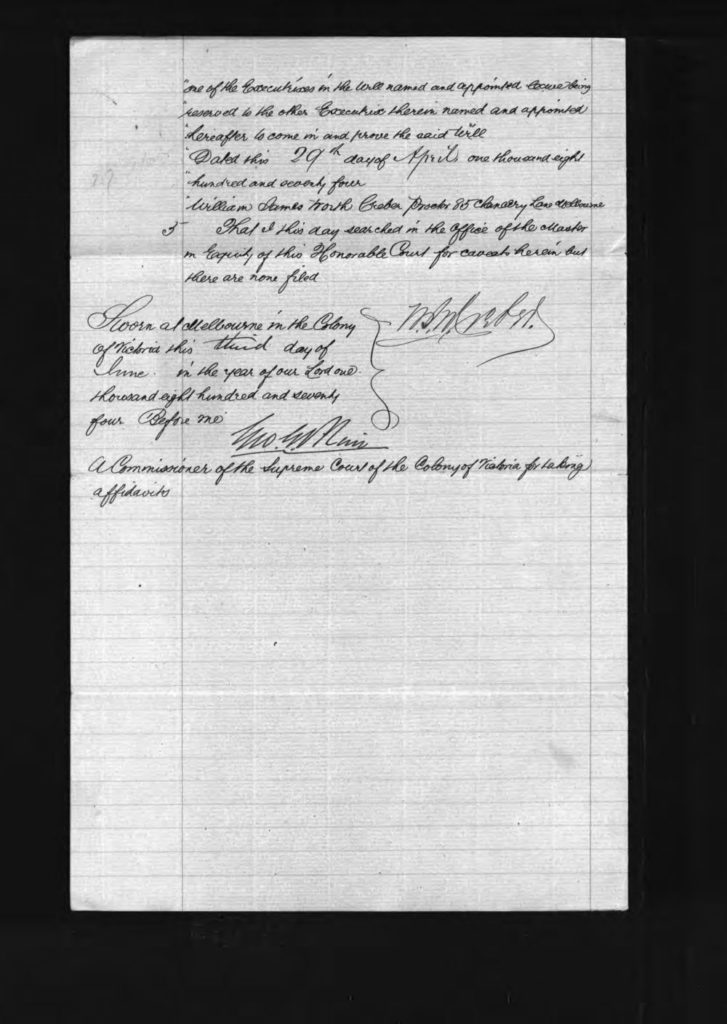
Joseph Burton Pynsent died at his home on Acland Street in West St. Kilda in March 1874, leaving his common-law wife (and former house-keeper) Bridget Fogarty and his under-age daughter Mary Ann Theresa Pynsent to process his last Will and Testament. The probate records, which are in the Public Records Office, in Victoria show that he was all but destitute. He had no real estate and his personal estate – his clothes and a silver watch – were valued at £5. After deducting his medical expenses he was overdrawn by £10.
Bridget Fogarty died in March in the following year (Melbourne Argus: Wednesday 17th March 1875) and her children, who were teenagers or younger, were left to fend for themselves and look after the, presumable a lease-hold, farm. Burton had appointed his eldest daughter, Mary Ann Theresa Pynsent (“otherwise Fogarty, spinster”) as one of his executrices but she was under age and unable to apply to the Court for administration until 1879. When she did, she confirmed what her mother had said previously. At the same time, Mary Ann Theresa arranged for a solicitor in Bristol to process her father’s Will in the Prerogative Court of Canterbury – presumably on the off-chance that he might have left assets in England. At the same time, she sought administration for anything that might have belonged to her late half-brother (Thomas Ogden Pynsent “late of Bowen, in Queensland”) estate. He had died in 1864. Whether she derived any benefit from the exercise, I do not know.
Mary Ann Theresa Pynsent (“Teresa”) was now nominally responsible for the farm and she, not infrequently, found herself in front of the magistrates at St. Kilda’s Court trying to explaining why her cows had been allowed to wander on to common property: “Mary F. Richardson was fined 5s for allowing three cows to wander in the public streets, and Teresa Pynsent was fined double that amount for allowing eight of her lactine tribe to exercise their freedom as they pleased” and “John Hayes, Catherine Egan, Eliz. Conroy, and Teresa Pynsent were summoned for allowing their cows to wander about the borough unprotected. In the Case of Pynsent, the cows had got into the enclosures on the Esplanade, and did considerable damage. They were variously fined from 5s to 20s”. Theresa was also dinged 20s and 12s 6d in costs for allowing five of her cows to wander in the public streets the following April (The Telegraph, St. Kilda, Prahran and South Yarra Guardian: Saturday 9th October 1875, Saturday 4th December 1875 and Saturday 15th April 1876).
Clearly, grazing was an ongoing issue. In 1878, Theresa’s brother Joseph (although still only a teenager) wrote to the St. Kilda Municipal Council offering to pay £60 per annum for the right to graze on 200 acres of unsold borough property, on the condition that the council enforced the bye-law that prevented other people’s cattle from grazing on unfenced common lands in the borough. The issue was complicated by the confused legal status of the land in question and the proposal was shunted off to the “Public Works Committee” (The Telegraph, St. Kilda, Prahran and South Yarra Guardian: Saturday 19th October 1878). I doubt if anything came of it.
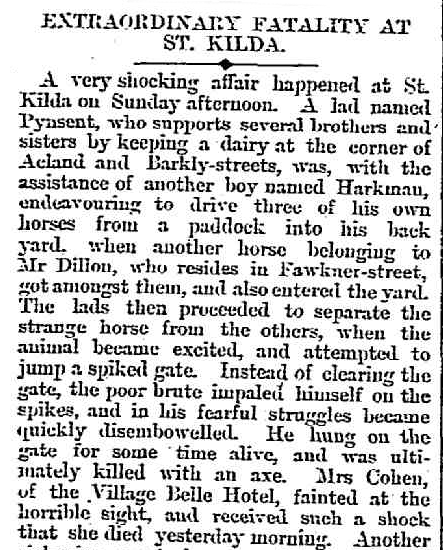
The children did not have an easy time. In November 1876, while one of the boys (unstated) and a friend were trying to coral the Pynsents’ herd into their yard, one of Mr. Dillon’s horses accidentally got mixed in with the herd and panicked. After considerable commotion, it attempted to jump over the picket fence that separated the yard from Acland Street and failed. It impaled itself on one of the spikes and it ripped its stomach open. It had to be killed. The noise drew public attention and one old lady who fainted at the sight died the following day (Geelong Advertiser: Saturday 18th November 1876).
To add to the family’s sorrows, two of the elder brothers died shortly after their parents. “Burton Michael Pynsent, aged fifteen, second son of the late Joseph Burton Pynsent, merchant, Melbourne” died in July 1876 (Melbourne Argus: Tuesday 1st August 1876) and Charles Pynsent “third son of Joseph Burton and Mary Bridget Pynsent, aged 14 years passed away in August 1878 (The Telegraph, St. Kilda, Prahran and South Yarra Guardian: Saturday 31st August 1878).
Theresa was back in court in August 1877. Evidently, “Teresa Pynsent summoned G. Agnew, for detaining three cows and calf, valued at £ 55. From the evidence it would appear that the plaintiff sent her brother with the animals to the Melbourne sale yards but instead of selling them, the lad and the defendant entered, into a compact to keep the cows, and take home, only three or four pounds which the brother said had been the whole amount realized by the sale: The case was dismissed by the bench for want of jurisdiction” (The Telegraph, St. Kilda, Prahran and South Yarra Guardian: Saturday 11th August 1877). Which brother had been taken advantage off, is unstated. Alfred, the youngest, had a reputation for causing trouble; however, he was only eight years old. He, and another three other boys were “fined 1s with 2s 6d in costs for damaging plants on Mr. Eason’s ground in the Brighton Road” (The Telegraph, St. Kilda, Prahran and South Yarra Guardian: Saturday 31st August 1878).
Burton’s four remaining children, Mary Ann Theresa, Elizabeth Ellen, Joseph William and Alfred Thomas successfully ran the dairy farm into the early 1880s, However, by the time Joseph William reached the age of 21 years, in 1883, his elder sisters Mary Ann Theresa and Elizabeth Ellen were ready to marry and move on. Mary Ann Theresa married Edward Taylor and moved to South Yarra, and Elizabeth married a German immigrant, Paul Reinhold Carl Boehm in December that same year. The Argus was later (on Monday 28th December 1908) to publish a notice of their Silver Wedding, in which it states that Paul and “Bessie” were married at Christ Church in St. Kilda. They were living at Newport in Victoria in 1915.
How profitable St. Kilda farm was, I do not know but I suspect it was fairly marginal. Supreme Court records in the “Victoria State Archives” show that David Henry took Theresa to court in a civil case in 1882 and Mark Moss took her to court under her married name of Theresa Taylor in 1885. These may well have been for debt. The farm may have been unsustainable without the two women and the family likely sold up and moved on around then.
Joseph William Pynsent married Nellie Garland in St. Peter’s Church in Sydney, New South Wales, in January 1886 (The Sydney Morning Herald: Thursday 28th January 1886). They ran a more successful dairy farm near Bondi in Sydney (see elsewhere).
His youngest brother, Alfred Thomas Pynsent, also left St. Kilda. He had a chequered life but never married and is not described separately. Alfred had a troubled childhood. He ran away from home in 1880, when he eleven years old. His family were, needless to say, alarmed and they put the following notice in the local paper “Reward: Anyone that can give information of Alfred or Thomas Pynsent, who left his home 7th inst.: anyone detaining him prosecuted according to law: Apply Detective Office” (Melbourne Argus: Wednesday 21st April 1880). He eventually came home but went missing again two years later: “Missing – Alfred Pynsent, aged 13, wore blue serge trousers, last seen Castlemaine: Information thankfully received, anxious friends: Edith Cottage, West Beach, St. Kilda” (Mount Alexander Main (Victoria): Thursday 19th January 1882). Once again, he reappeared.
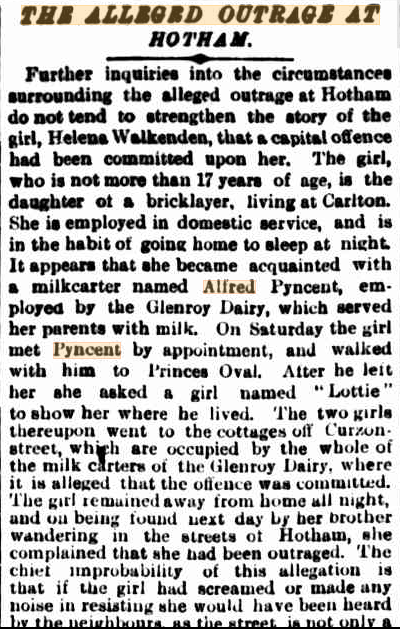
When he was 18/19 (1887/8) he went to work as a “carter” and “delivery boy” for Mr. Kerr, a dairyman in Hotham (North Melbourne). While there, in January 1887, he was one of several dairy boys arrested and charged with assaulting a 16/17 years old girl named Helen Walkerden. In court, Helen explained that she knew Alfred because he delivered milk to her parents. She said she had sat down with him under a tree and he assaulted her. Later that evening, she said she had gone out with another girl, called “Lottie”, who led her to Mr. Kerr’s dairy in Curzon Street, where Alfred and the other boys lived. Her friend got away (somehow), but she had been forcibly detained overnight and seven of the boys had assaulted her. Six, including Alfred, were charged (Riverine Herald: Thursday 20th January 1887 and other papers).
Her story started to unravel at a later hearing. The police stated that they were unable to locate the mysterious “Lottie” and doubted her existence. They also discovered that when Helen’s brother had met her in the street the following morning, she had said nothing about the outrage. It only came out when her mother questioned her about her absence overnight. There was no medical evidence of assault or complaints of noise from the boys’ house overnight, and other witnesses testified to the close relationship Helen had with Alfred and the other carters.
The boys pleaded “consent” and the magistrates accepted that that was probably the case. They discharged the defendants with a tongue-lashing. They said: “It was a disgraceful thing that young men should descend to such sensual, filthy, and degrading indulgence (Bendigo Advertiser: Tuesday 25th January 1887 and other papers).
Alfred was probably glad to move on, and he appears to have been living on Barkly Street, in Footscray a few months later. While there, he had his silver watch, with its attached gold chain (valued at £4 10s) stolen from his lodgings (Victorian Police Gazette: May 4th 1887). He later became a station-hand and he joined the Australian army at the outset of the Boer War. Arthur served as a Trouper (#1430) in the “6th Regiment of the New South Wales Imperial Bushmen” between 1899 and 1902. His unit fought in Rhodesia and the Eastern Transvaal and returned to Sydney on “The Orient” in January 1901 (Sydney Morning Herald: Monday 8th July 1901). Some idea of his experiences may be found in “Boer War: Regimental Orders for the 6th Regiment Imperial Bushmen, New South Wales, and the 3rd Mounted Brigade” in the “Western Sydney Records Centre”. Unfortunately, it is not yet on-line (2019). Alfred was awarded medals and clasps for service in South Africa, Belmont, Cape Colony, Orange Free State, Transvaal and Rhodesia (U.K. Military Campaign Medals & Award Rolls 1793 – 1949).
I can find no evidence of Alfred Thomas ever marrying. He seems to have stayed on in Sydney, New South Wales and died there in December 1911. He was buried in the Anglican portion of Rookwood Cemetery. I don’t know why as his mother was Roman Catholic and his brother Joseph William and his family were later to be buried there in the Roman Catholic section.
Joseph Burton Pynsent had six sons that I know of by his two wives; however, only one Joseph William Pynsent seems to have married and had children. His life is discussed elsewhere.
Family Tree
Grandparents
Grandfather: John Pinsent: 1728 – 1772
Grandmother: Susanna Pooke: 1730 – 1772
Parents
Father: Joseph Pinsent: 1770 – 1835
Mother: Elizabeth Pinsent: 1777 – 1809
Father’s Siblings (Aunts, Uncles)
John Pinsent: 1751 – 1753
John Pinsent: 1753 – 1821
Robert Pinsent: 1753 – 1787
Thomas Pinsent: 1754 – 1785
William Pinsent: 1757 – 1835
Gilbert Pinsent: 1758 – 1835
Charles Pinsent: 1765 – 1765
Charles Pinsent: 1766 – 1826
Samuel Pinsent: 1767 – 1775
Joseph Pinsent: 1770 – 1835 ✔️
Male Siblings (Brothers, half-brothers)
Joseph William Pitt Burton Pinsent: 1804 – 1805
Joseph Burton Pynsent: 1806 – 1874 ✔️
John Robert Pinsent: 1807 – 1808
Robert Baring Pinsent: 1818 – 1833
Ferdinand Alfred Pynsent: 1822 – 1894
Charles Pitt Pynsent: 1824 – 1903
Please use the above links to explore this branch of the family tree. The default “Next” and “Previous” links below may lead to other unrelated branches.