Vital Statistics
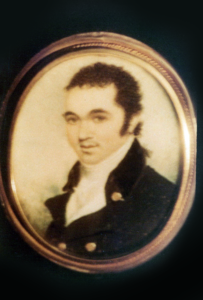
Joseph Pinsent: 1770 – 1835 GRO1191 (Shipping Agent and Broker of London and Farmer of Lettaford, North Bovey, Devon)
1. Anna Thomasin Croat Pinsent: 1777 – 1799
Married: 1799: Newton Abbot, Devon
2. Elizabeth Pinsent: 1777 – 1809
Married: 1800: Moretonhampstead, Devon
Children by Elizabeth Pinsent:
Mary Anna Lambert Pinsent: 1802 – 1809
Joseph William Pitt Burton Pinsent: 1804 – 1805
Elizabeth Satterley Pinsent: 1805 – 1878 (Married, William Francis Splatt, Saltford, Somerset, 1840)
Joseph Burton Pynsent: 1806 – 1874 (Married (1) Mary Ann Ogden Hassall, Westbury on Trym, Gloucestershire (2) Mary Bridget Fogarty, Victoria, Australia, xxxx)
John Robert Pinsent: 1807 – 1808
3. Ann Tucker: 1785 – 1855
Married: 1809: Drewsteignton, Devon
Children by Ann Tucker:
Mary Anna Pynsent: 1810 – 1875
Anna Lucretia Pinsent: 1812 – 1880
Harriet Cordelia Pynsent: 1814 – 1900 (Married John Partridge, North Bovey, Devon, 1838)
Maria Sophia Pinsent: 1815 – 1819
Robert Baring Pinsent: 1818 – 1833
Ferdinand Alfred Pynsent: 1822 – 1894 (Married Emma Furlonge, West Indies, 1847)
Charles Pitt Pynsent: 1824 – 1903 (Married Georgiana Helen Ball, Melbourne, Australia, 1852)
Family Branch: Hennock
PinsentID: GRO1191
Click here to view close relatives.
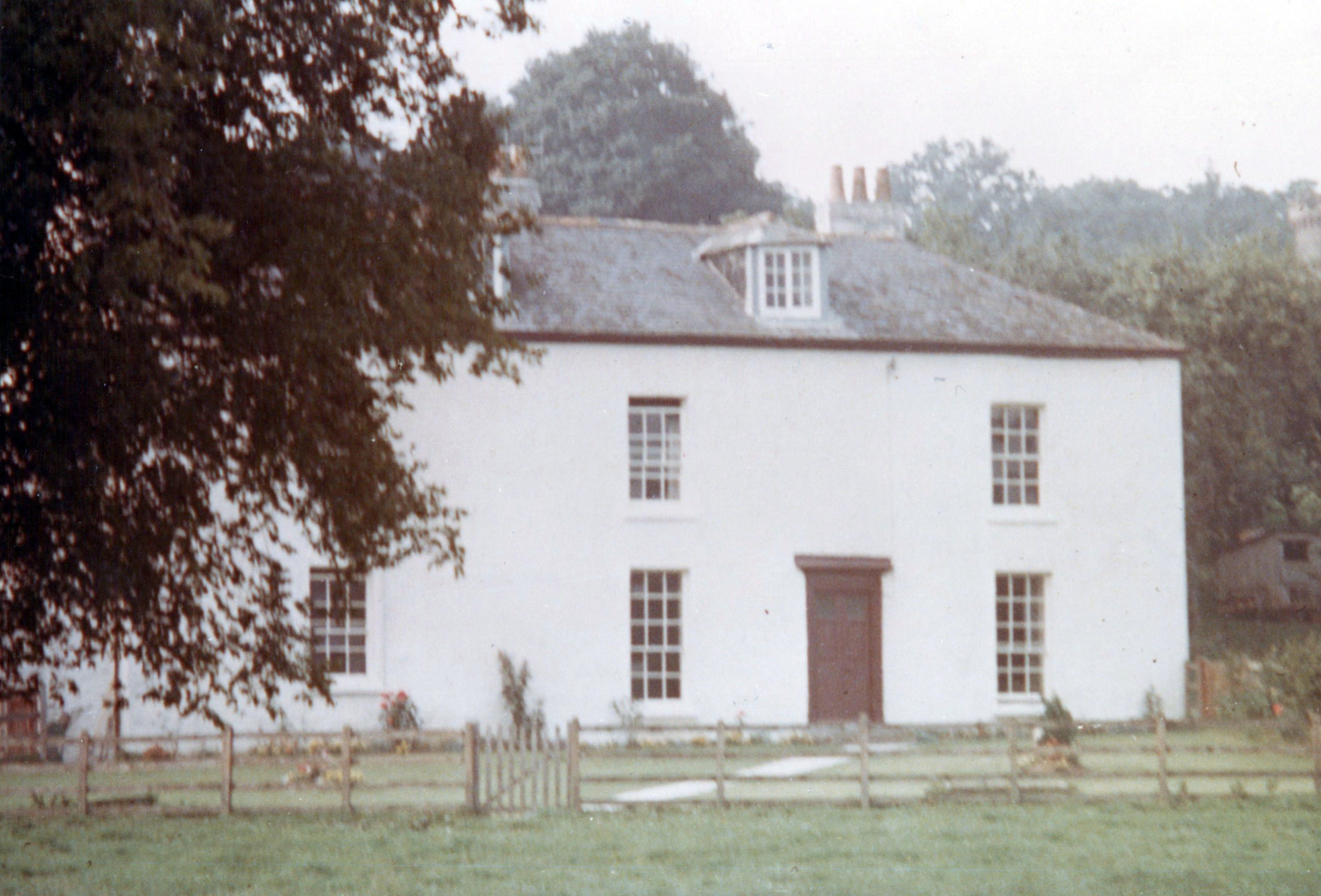
Joseph Pinsent was the youngest of John Pinsent and Susanna (née Pooke’s) seven (surviving) sons. He was born on Newton Abbot, in Devon on 10th March 1770 and was seventeen years younger than his brother John (from whom I am descended). Joseph’s parents died before he was two years old and it seems likely that Joseph and three of his brothers, Gilbert, Charles and Samuel – who were only slightly older than he was – were brought-up by their uncle, Thomas Pinsent and his wife Mary (née Gale) at “Pitt Farm” in Hennock
Joseph inherited a small sum of money when his brother Robert died in 1781. However, he was still a minor at that point and the bequest had to be administered by his older brothers, John and William until he “attained the age of 21”. He also received a small legacy from his uncle Thomas Pinsent “of Pitt”, when his Will was probated in 1802. Thomas and Mary had no children of their own and the family farm passed to Joseph’s elder brother Charles Pinsent.
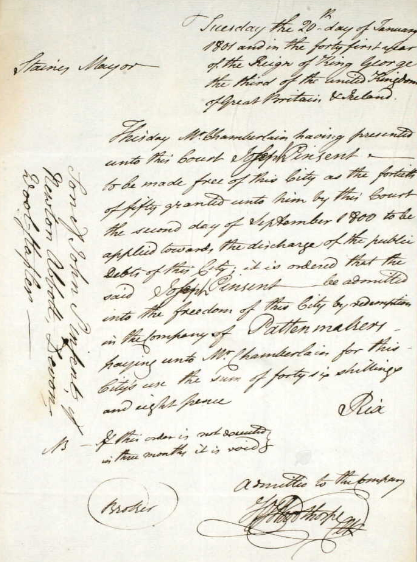
Joseph’s brothers John and William were active in Newfoundland cod fishery and Joseph may have started out working with them; however, he quickly set up his own business. London’s Commercial Directories show that “Pinsent, Richardson and Walker” were “Shipping Agents and Insurance Brokers at #44 Great Towers Street”, in 1798. However, the partnership did not last long. It was dissolved the following year (London Gazette: 30th July 1799). Two years later, Joseph applied to Join the “Company of Patternmakers.” He had no intention of becoming a “patternmaker” but membership of any guild was a way of become a “Freeman and Citizen of London” which was, even in those days, a prerequisite for operating a successful business in the City of London. It cost him the princely sum of 46s 8d (London, England, Freedom of the City Admission Papers: 1681-1925).
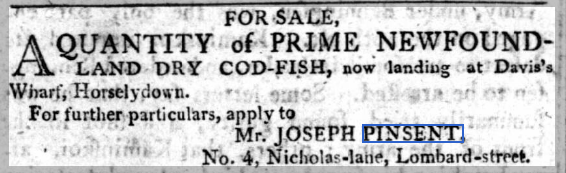
Joseph set up in business as an independent “Ships Broker and Agent” operating out of “#23 (sometimes called #3 Castle Court) Birchin Lane, Cheapside” and also “#4 Nicholas Lane.” He ran the agency out of London through until at least 1833 – two years before he died. However, the number of work-related advertisements he placed in the London papers dropped markedly after 1822, when he, himself, returned to Devon.
Joseph started out as a farmer. Devonshire’s Land Tax Assessments show that he rented a farm at Teignyeo in Kingsteignton taxed at £4 19s 8d in 1798 (the year before his first marriage) and he held onto it until 1814 – by which time he was fully occupied in London. Presumably it was leased out for much of the time after that.
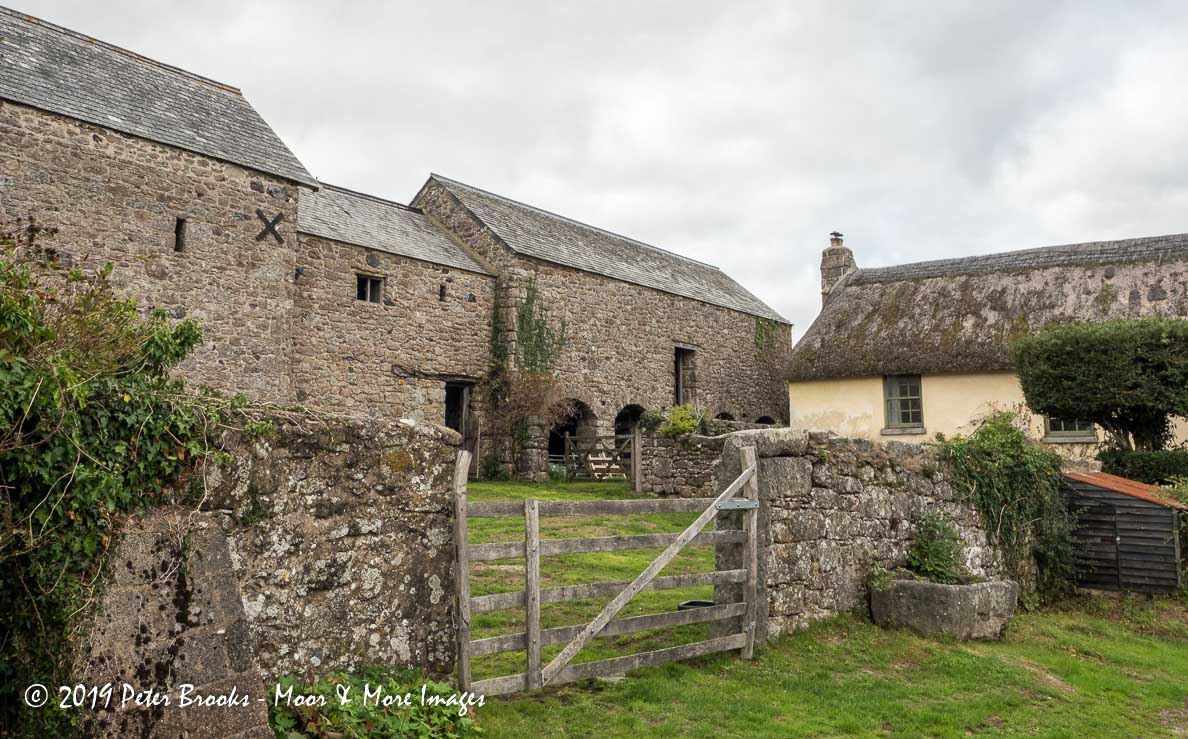
Joseph also owned a relatively small farm (86 acres) called “Lower Jurston” farm, in Chagford Parish from 1807 to at least 1831. It cost him £1 18s 9d per annum in land tax. He may have bought the farm after his uncle Thomas Pinsent “of Pitt” died in 1802. It was not a big farm – or particularly well located – being on the edge of Dartmoor. Nevertheless, Joseph felt that with modern technology it could become provitable.
In March 1813, Joseph demonstrated the “operation of a Cultivator … held by the ploughman and drawn by three horses without a driver, and in five hours tormented the field which is two acres very completely …” (Evans and Ruffy’s Farmer’s Journal: Monday 1st March 1813).
When Charles Vancouver submitted his report entitled a “General View of the Agriculture of the County of Devon” to the Board of Agriculture in 1808, he showed that the rural economy was in deep trouble and that “agricultural labourers” in particular were suffering hardship. Life did not get much easier when Napoleon was defeated, as cheap food imports kept local farm prices down. There was little employment available for returning soldiers – which did not help. They were all too often thrown on the mercy of the parish. In any event, sometime in the 1790s Joseph decided to rent out his farms and move up to London and become a “Shipping Agent and Broker.”
There were two high profile Pinsent families living in the Teign Valley, west of Exeter, in the early 1800s. They were the HENNOCK family personified by Mr. Thomas Pinsent at “Pitt”, and the DEVONPORT family personified by a Mr. Thomas Pinsent who was a “tallow chandler” and owned “Greenhill Farm” in Kingsteignton. Their many relations clearly knew each other and their lines touched through marriage, in Joseph’ case not once but twice.
Many years later, Lucretia Maude Pinsent said of Joseph in her diary (as abstracted by my grandfather, Francis Wingfield Homfay Pinsent in 1929), “his first two wives were Pynsents (sic) and first cousins. The second having been bridesmaid at the wedding of the first: it was said there were then three beautiful women in Devon and he had married two of them, they being the Pynsents (sic)”. One is left to speculate as to the name of the third!
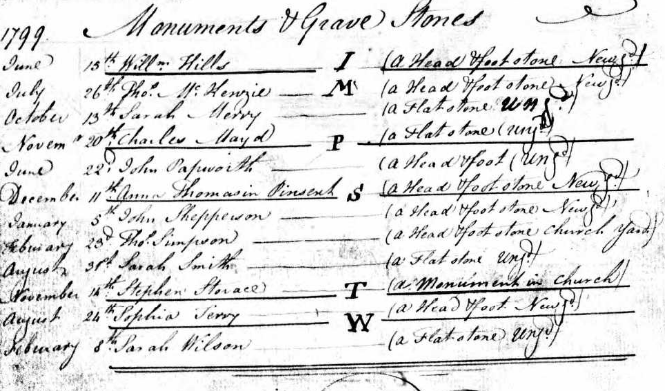
Joseph’s first wife was Anna Thomasin Croat Pinsent, who was the daughter of Thomas Pinsent and Ann (née Ball) of Newton Abbot. She was the Devonport “draper’s” elder sister. They married in Newton Abbot in May 1799; however, shortly after going up to London with her husband she took sick and she died later that year. They had been living on Prospect Row, in the parish of St. Magdalene, Bermondsey. Anna’s will was proved in the Prerogative Court of Canterbury. She left most of her estate to her husband but gave “one equal half part of her interest in Greenhill estate, in Kingsteignton (now or late in the occupation of Mr. Smale)” to her “dearly beloved sister Betsey”. The Elizabeth Pinsent who witnessed the signing of the will was presumably her cousin Elizabeth and not her sister “Betsey,” as a legatee should not have been acting as a witness.
Joseph married Anna’s cousin Elizabeth (the daughter of her uncle John Pinsent) in June the following year. The marriage took place a few months before the patriarch of the Newton Abbot branch of the family, Mr. John Pinsent “senior” (a “soap boiler” and “land-owner”), died. The activities of the DEVONPORT Pinsents are documented in another part of this database.
Much of Mr. John Pinsent’s estate passed to his eldest son, John Pinsent “junior,” so when his father died in October 1800 he, naturally, took over the family soap-boiling business in Moretonhampstead. Mr. John Pinsent’s estate included a farm at Lettaford, in North Bovey Parish that, according to the Land Tax returns, had been in his brother Thomas‘s hands since 1780, or earlier. John “junior” must have felt that it was superfluous to need and he put it up for sale in 1803. His brother-in-law Joseph Pinsent was in London at the time and interested parties were referred to him for details (Exeter Flying Post: Thursday 24th February 1803). It was not a good time for farmers and there were no takers.
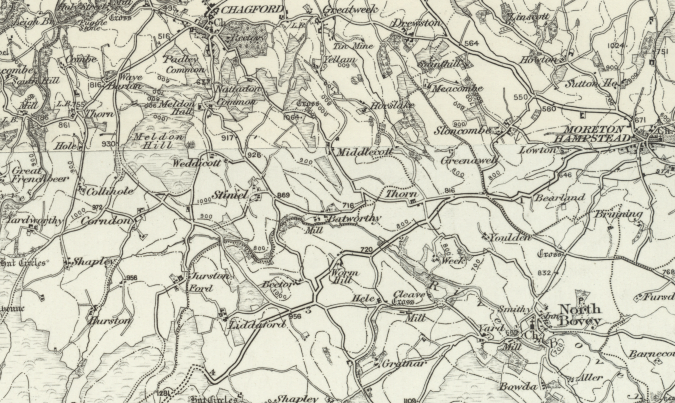
“Higher” and “Lower Lettaford” remained part of the DEVONPORT Pinsents’ family’s holdings and probably passed to Thomas Pinsent when John “junior” died in 1804. Thomas was Anna Thomasin Croat Pinsent‘s father and, of course, Joseph’s erstwhile father-in-law! Thomas seems to have transferred Lettaford to Joseph in 1807 – possibly in exchange for his late wife, Anna’s, interest in his (Thomas’s) farm at “Greenhill” in Kingsteignton. The farm at “Lettaford” was contiguous to Joseph’s existing farm at “Lower Jurston” but located across the Chagford parish boundary in North Bovey. It cost Joseph an additional £1 17s 11d in land tax but must have provided economies of scale. Both farms were rented out while he was in London.
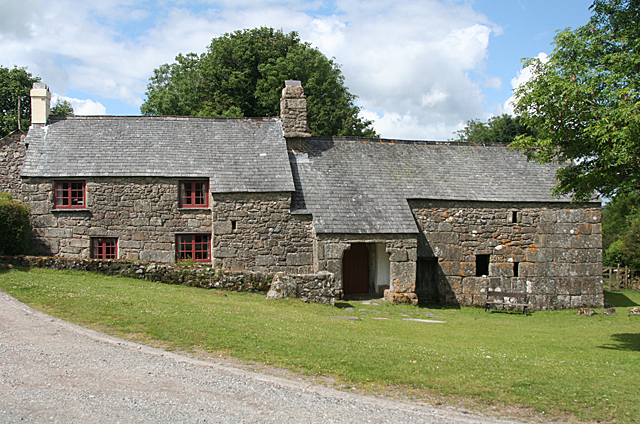
Lettaford is a small hamlet on the banks of the Bovey River near the edge of Dartmoor, north of the B3212. It has changed little and it includes a modernized Devon Longhouse called “Sanders” that the “Landmark Trust” has recently made over into a rental cottage. The original medieval building consisted of two adjoining but connected parts – a single living room for a family and a byre for the livestock. Joseph would have lived in a more modern house!
There is a small Methodist chapel at Lettaford that appears to date to around 1860. The DEVONPORT Pinsents were non-conformist and Mr. John Pinsent of Moretonhampstead, the patriarch mentioned above, left a bequest to the “Deacon or leader of the Tabernacle in Moretonhampstead”. Perhaps the building marks the site of an older chapel that existed in Joseph’s day. It has also been made over into a cottage. As we shall see, Joseph himself seems to have been open to all religions.
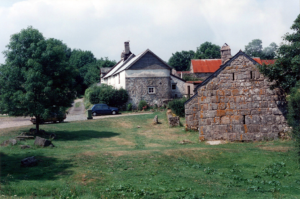
The Devon Record Office contains a document dated 1811 showing Joseph’s consent to the diversion of the Tavistock – Chagford Road through his property. The farms at “Jurston” and “Lettaford” were leased out for much of the time that Joseph was in London; which meant that he periodically had to find new tenants. The properties were advertised for “Let” or “Sale” several times (e.g. Exeter Flying Post: 25th August 1814). Together, they were described as comprising 180 acres and a large down (heath) that were well suited for about 25 cows and young stock and several hundred sheep (Exeter Flying Post: Thursday 15th February 1816).
Joseph was unable to sell either of the farms and he appears to have doubled down and bought a small (20 acres) and probably more profitable dairy farm at “Higher Gorway” in East Teignmouth in 1818 (Morning Post: Wednesday 4th March 1818). He rented it out while up in London and attempted to sell it after his return to Devon in the early 1820s. He put the property up for sale in 1828. He felt the site could be sold or leased out to a dairy farmer or, because of its views and setting, be subdivided and used for development (building) land (Exeter Flying Post: Thursday 25th December 1828).
Joseph and Elizabeth (née Pinsent) had five children, three sons and two daughters between 1802 and 1807; however, only one of each sex (Joseph Burton Pinsent and Elizabeth Satterley Pinsent) survived into adulthood. Sadly, Joseph William Pitt Burton Pinsent died as an infant in London in 1805, and John Robert Pinsent died as an infant in Moretonhampstead in 1808. What he died of, I am not sure but, but as noted by Silvester Treleaven in his diary, his elder sister Mary Anna Lambert Pinsent followed him to the grave in January 1809 and their mother, Joseph’s second wife Elizabeth died the following month: “Last Wednesday, at Moretonhampstead died, after a lingering illness which she bore with great resignation, Mrs. Pensent, wife of Joseph Pensent, esq., of London: her exemplary conduct thro’ life, and her truly amiable disposition, rendered her greatly beloved by all who had the pleasure of her acquaintance, by whom her loss is severely felt” (Exeter Flying Post: Thursday 16th March 1809). She was buried beside her children in Moretonhampstead.
Elizabeth’s death in 1809 left Joseph with two young children (Elizabeth Satterley Pinsent and Joseph Burton Pinsent) to look after, so he remarried a few months later. His late-wife’s sister, Mary Pinsent, had married the local schoolmaster in Moretonhampstead, William Tucker, in 1806 and the Ann Tucker that Joseph married in Drewsteignton was probably his sister. Joseph and Ann had seven children (four girls and three boys) over the next fourteen years. Mary Anna Pinsent, Anna Lucretia Pinsent and Harriet Cordelia Pinsent were baptized in Chagford in 1810, 1812 and 1814 respectively, so they were presumably born at “Lower Jurston” despite Joseph spending a considerable amount of time in London.
London’s Local Directories tell us that Joseph and Elizabeth had lived on Bernard Street, near Russell Square, in 1805 and in 1807. However Joseph and Ann were living in Blackheath by 1811 and in Camberwell (in what must then been a more rural part of Surrey) shortly after that. Their daughter Maria Sophia Pinsent was born in Camberwell in 1815 and died there in 1819. Joseph and Ann were still living in Camberwell when their sons Robert Baring Pinsent and Ferdinand Alfred Pinsent were born in 1818 and 1822 respectively. The former died “at sea” as a teenager in 1832. His loss is recorded on Joseph’s memorial in North Bovey Church. I would love to know more. As for Ferdinand Alfred, he went out to the West Indies and returned an Anglican Church Minister.
Joseph made a good living as a broker and shipping agent but he clearly thought of himself as a “gentleman farmer.” Somehow, he managed to have himself “elected” to a select club that was invited to attend Lord Somerville’s Cattle Show when it was held in Mr. Sadler’s yard in Goswell Street in London, in March 1807, and again the following year when it was held in March 1808 (St. James’s Chronicle: Thursday 5th March 1807 and 3rd March 1908). The show came with a free dinner and doubtless very useful contacts.
Joseph negotiated the sale of ships and secured passengers and cargo for European and colonial destinations. His activities are well documented in the London and other newspapers from at least 1799 onward. For instance, he arranged for the “fast sailing copper bottomed vessel “Isabella and Ann … armed with carriage guns” to take on freight and/or passengers for Palermo and also Genoa and Leghorn (Levorno) “if open to British Ships.” The ship was to join a convoy which was to be escorted by ships of the Royal Navy (Manchester Mercury: Tuesday 13th August 1799).
The “London Public Ledger and Commercial and General Advertiser” had carried the following advertisement on the 4th March 1806: “For the Cape of Good Hope, or elsewhere as the nature of the voyage may require: The New ship Earl Moira, coppered and copper fastened, burthen about 250 tons, armed with ten carriage guns, has excellent accommodations for passengers: Michael Brooks, Commander, who is well known in the trade: Applications for freight or passage to be made to Mr. Joseph Pinsent, No. 4, Nicholas Street”. Napoleonic wars were still going on and armament was important! The following year Joseph advertised, for sale or charter: “Two Good Ships the property of one owner, about 270 tons each per register, one of them just come out of dock, and now in readiness to take in a cargo; the other is coppered, and could be made ready in about ten days to take in Goods: For further Particulars apply to Joseph Pinsent, No. 4 Nicholas lane, Lombard Street” in the London Public Ledger (24th February 1807). A later advertisement in the same paper – inserted on 4th April of the following year (1807) – alerted the public that anyone interested in buying “a quantity of dried cod-fish now landed at Davis’s wharf, Horsley Down” should contact him at the same address. The wars played havoc with Newfoundland’s cod trade and it is not particularly surprising to see a cargo that must have been destined for Portugal or some other European country turn up in London.
Perhaps Joseph was helping out his brothers, John and William Pinsent, who were still involved in the cod trade. They may have commissioned him to sell “The Hull of the Ship “John and William”, of about 241 tons per register, about three years old, lately driven on shore near Lyminton, but now lying in Cowes Harbour. After the sale of the Hull will be sold the stores of the said ship in different lots. The purchaser of the hull may be accommodated, if required in part payment,” (Public Ledger and Daily Advertiser: Wednesday 11th June 1806). Clearly the mariners of the day had weather to contend with as well as enemy ships.
Joseph was commissioned to sell “The Good Ship, Peggy, Francis Pearson, late Commander, 365 tons register measurement, or thereabouts, built at Newcastle on Tyne, Mr. S. Wharton of Scarboro’ late owner” at Lloyd’s Coffee House, Cornhill, on Tuesday the 20th inst. (September) 1808, unless previously disposed of by private contract. “She is a fine, roomy vessel, sails fast and carries a large cargo at an easy draft or water, is well adapted to general purposes, particularly the West Indies Trade or the Transport Service, having great heights for either of those purposes. She is about seven years old. Now lying in the Surrey Canal and there to be delivered”. For further information, the London Public Ledger and Commercial and General Advertiser (16th September, 1808) referred its readers to Joseph Pinsent at No, 4 Nicholas Lane, Lombard Street. The Transport Service refers to the Royal Navy’s use of contract vessels for moving freight and personnel.
Joseph (along with many others) organized freight and negotiated the sale of ships throughout the Napoleonic wars and did very well for himself. There seems to have been plenty of cargo to ship and a stream of captured “Prize” ships brought into London to be sold. For instance: “The Galliot Ceres, formerly the Die Hoffnung, round stern, apparently Dutch of Danish built and free, burthen per register 75 tons, sails fast and will carry large cargo at an easy draft of water, well adapted for the coasting or neutral trades, newly fitted and wants little more than provisions to send her to sea immediately, now lying at the South Bank of the Surrey Canal: For further particulars apply to Jos. Pinsent, Broker, 4 Nicholas Lane, Lombard Street” (London Public Ledger and Daily Advertiser: July 10th 1810).
It took businessmen time to reestablished peacetime trade routes when the war ended in 1815 and, for a while, business remained strong. However, it dropped off soon enough and Joseph had to change his focus. His business with Newfoundland picked up to compensate and the “London Public Ledger and Daily Advertiser” (the paper had had the sense to shorten its name but it still had a way to go in this regard) of 3rd March 1817 shows that: “The First Spring Ship to sail in about ten days for St. John’s Newfoundland: The Eliza, A. 1: George Ford Master, nearly New, built at Teignmouth, Devon, burthen 140 tons, lying of the Tower. For freight or passage apply to the Master, at the New York Coffee House, on the American Walk at ‘Change Time; or to Joseph Pinsent, Broker, 25 Birchin Lane, Cornhill: N.B. The master is well acquainted with the Coast having been brought up in the Newfoundland trade:”
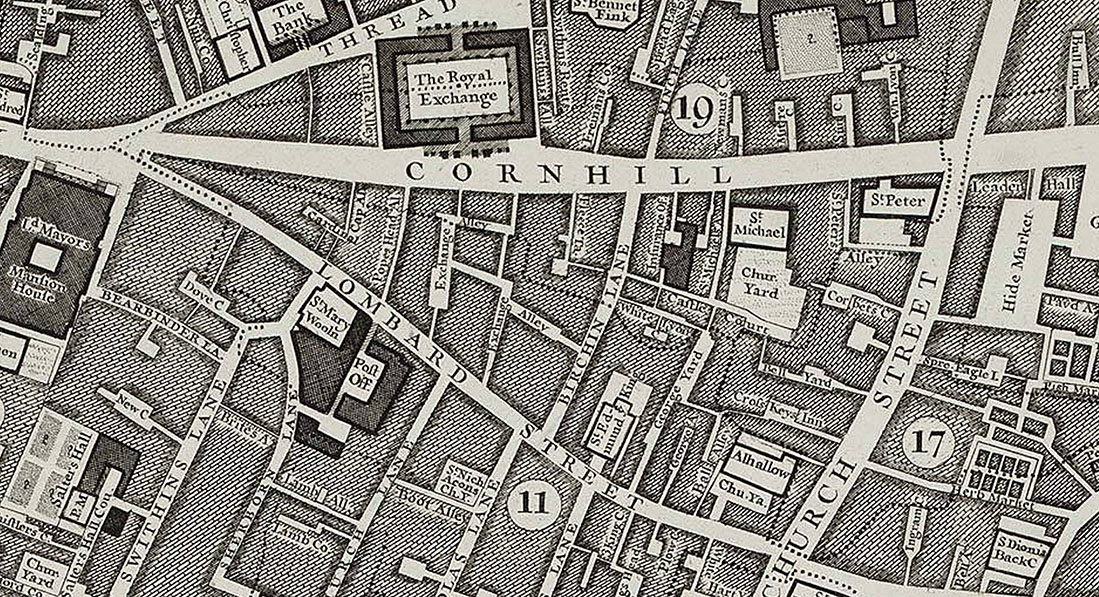
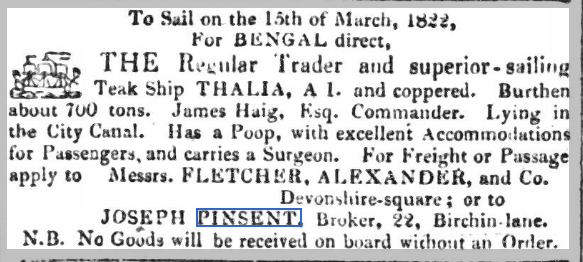
Joseph moved his business from Nicholas Lane to Birchin Lane sometime around the end of 1816. Whether this was a sign of growth or retrenchment, I am not sure. Perhaps, for him, the most important post-war development was the growth of trade with South Africa, India and Australia. The London Public Ledger and Daily Advertiser shows that Joseph assembled freight and passengers for ships bound for Britain’s eastern colonies.
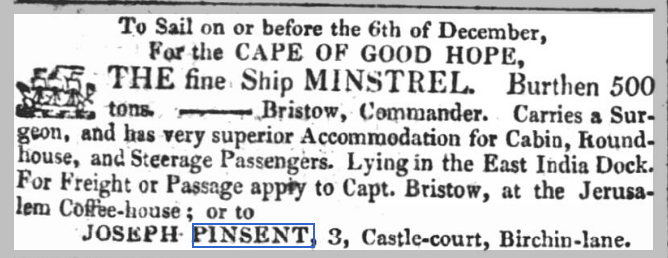
For instance, he placed an advertisement in the newspaper on 31st July 1819 (and other dates) that shows: “The First Ship for Bombay, with leave to touch at the Cape of Good Hope and the Isle of France: The Oromocto, burthen 600 tons, coppered and A 1, Richard Strickland, Commander, lying in the City Canal: Has excellent accommodations for passengers for which, and for freight, apply to Joseph Pinsent, Broker, 24 Birchin Lane, or at the Jerusalem and Lloyd’s Coffee House:” The Isle of France refers to Mauritius, an originally French Colony that had been ceded to Britain by the Treaty of Paris in 1814.
Another advertisement posted in the London Public Ledger and Daily Adviser (Friday 2nd June 1820) shows: “To sail on or before the 3rd June, for Calcutta, with leave to touch at the Isle of France: the fine coppered ship Egfrid, 450 tons per register. Robert Brown Commander (late of the Lord Suffield): has excellent accommodation of passengers, lying in the City Canal: For freight or passage: Joseph Pinsent, Broker, at the Jerusalem and Lloyds Coffee Houses, or No. 3 Castle Court, Birchin Lane.” The following year we find: “For Van Diemen’s Land and New South Wales, to sail in all October, the fine coppered ship, Louisa, A-1, burthen 300 tons: A. Anderson commander: lying in the London Docks: her poop, cabin and between decks afford excellent accommodation for passengers: For Freight or passage apply to the Commander, at the Jerusalem and Lloyds coffee-houses or to Joseph Pinsent, Broker, 22 Birchin Lane, Cornhill” (London Times: Friday 12th October 1821). Van Diemen’s land was, of course, the name then applied to Tasmania.
Despite these and other advertisements that filled up the newspapers of the day, Joseph (and presumably other London brokers and merchants) found it difficult to adjust to “free trade.” They had had a monopoly of business during the Napoleonic Wars and they were not used to competition. Post war, other countries were building up their fleets and Britain was importing more of its food – particularly grain and all too often in their own ships and the affects of this were now rippling their way through the economy. In 1817, David Ricardo, Esq. M.P., a noted economist and Chairman of the “Committee of the House of Commons on Agricultural Distresses” published a book entitled “On the Principles of Political Economy and Taxation.” In it, he explained the seemingly counter-intuitive arguments behind comparative advantage and “free trade”. The idea was starting to catch on, but Joseph was not impressed. It did not fit with his empirical assessment of the situation.
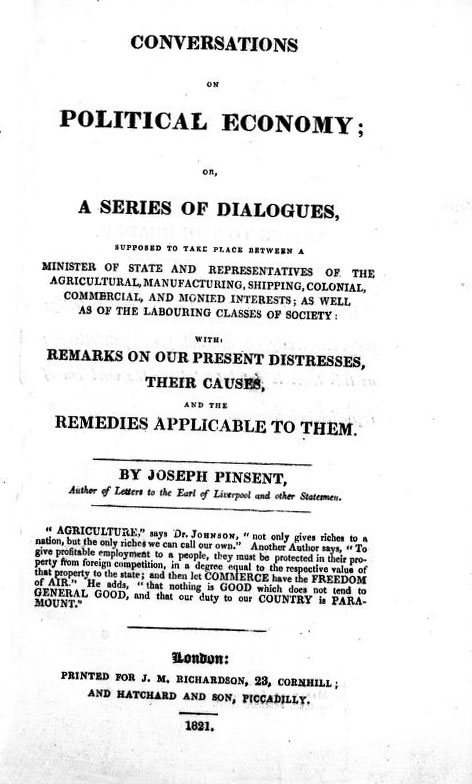
In 1820, Joseph wrote a series of pamphlets entitled “Conversations on Political Economy: or A Series of Dialogues, supposed to take place between a Minister and State and Representatives of the Agricultural, Manufacturing, Shipping, Colonial, Commercial and Monied Interests; as well as of the Labouring classes of Society, with remarks on our present distresses, their causes, and the remedies applicable to them”. They were published by J. M. Richardson of 23 Cornhill, and Hatchard and son of Piccadilly in March 1820 and went on sale for the modest sum of 1s 6d. They were based on a series letters written to the Earl of Liverpool (First Lord of the Treasury) and other members of the Government.
Joseph felt that there was an obvious flaw in Ricardo’s argument that Britain should concentrate on manufacturing and make up any shortfall in food by importing it from abroad as ultimately the agricultural (and associated “landed”) sector – of which he was a junior member – would fail and the full weight of taxation including tithes and poor law payments would devolve to the manufacturing sector, which would lead them to raise their prices to such an extent that our continental competitors would stop buying our products. This would leave us without the wherewithal to buy their produce! Eventually, England would, thereby, lose any competitive advantage it might have had in manufacturing and its people – particularly in time of war, or during bad harvests, would be left to starve. He had a point.
The answer, as Joseph saw it, was to reduce our dependence on foreigners and harness the resources of the British Empire (Letter to David Ricardo, Esq. M.P.: March 16th 1821: David Riccardo: Critical Responses). Essentially, what he was advocating was the promotion of trade within Britain’s growing empire “let every kind of property in the British Empire be protected in the ratio of its respective value to the state”, and for the “doing away with restrictive laws and let(ting) all imports be made in British Ships.” – which seems a bit of a contradiction. He was hoping for free trade but only within the confines of the Empire.
The timber trade with the Baltic states was a matter of public concern in early 1821 and Joseph jumped into the debate to point out that he was only asking for appropriate protection for British and Colonial shippers against “unfair” foreign competition and not for state control of what can and should be shipped – or when and where. That aspect should be “free as air” (Public Ledger and Daily Advertiser: Tuesday 27th February 1821). Presumably his views reflected those of many London merchants at the time, and certain “Merchant Ship Owners and Others of the City of London” persuaded Sir W. De Crespigny of the City of London to present a petition to Parliament praying that it take both Mr. Pinsent’s and Mr. Ricardo’s views into consideration when preparing relevant legislation (Morning Post: Wednesday 28th March 1821). They wanted to see fewer restrictive practices. Mr. Stuart Wortley, however, felt that as they were only adding to the Parliamentarians reading list there was no value in their petition (Morning Post: Wednesday 28th May 1821)!
In a letter to the Prime Minister, the Earl of Liverpool, published in the Public Ledger and Daily Advertiser on 14th April 1821, Joseph waxed lyrical on the subject of protection. He claimed “love for my country will not permit me to be silent while I see your Lordship, as a Statesman, laboring under your present delusive system as it relates to your foreign policy, prejudicial as it is to the nation’s best interests and I feel constrained to offer my feeble aid to dispel that delusion.” It was a long, somewhat hectoring letter in which he stated that in an unequal world, Britain had the advantage of an empire and that by protecting employment, agriculture, industry and the transport trade within the empire we would reduce our dependence on foreigners and benefit the national purse. For instance, we could obtain our hemp, flax, cotton and tobacco from our own colonies rather than the United States, and we could import our timber from British North America and not the Baltic States.
Joseph went on to suggest that by giving preference to our colonies, we would increase investment in them; whereas by not doing so we were stunting their growth and limiting our export markets. He complained that the current policies would only lead to less self-sufficiency, and more unemployment and suffering. As he had said before, we would be far better off with protection! “The hackneyed remark of Dr. Adam Smith, that we have ‘risen in spite and not by protection’, should never haven uttered by a statesman who values his reputation.” “I further contend that it is not taxation but the want of knowing and properly applying the wealth and resources of the British Empire to their proper purposes that causes our present distresses” (Public Ledger and Daily Advertiser; Saturday 14th April 1821). Well, if you put it like that!
Not content with that, Joseph submitted a petition to the “House of Commons Agricultural Committee” in June explaining his position on maritime trade and asking for a hearing and a Mr. Lockhart bravely attempted to introduce the petition. He was howled down for his pains – largely because Parliament accepted David Ricardo’s arguments in favour of Free Trade. The meeting ended in confusion (Public Ledger and Daily Advertiser: Tuesday 19th June 1821). The petition was tabled in the house and it was made public in the Morning Post on Thursday 12th July 1821. It was yet another plea for government to use tariffs to protect Britain and her Colonies from “unfair foreign competition”. He was sure that protection would lead to investment in the colonies that would reduce Britain’s dependence of foreigners, encourage growth of industry and reduce unemployment and suffering at home.
Joseph’s main concern at the time was the affect of free trade on shipping. In December he wrote another long letter to the editor of the Morning Post (Tuesday 11th December 1821) decrying the Governments intention of repealing the Navigation Act – which required trade with Britain and its colonies to be done in British ships. The act had originally been passed in 1651 to break Dutch control of European shipping and it had largely succeeded. Without it, Joseph feared Britain’s maritime fleet would be priced out of the market. He saw no point in dismantling a system that had proved so advantageous to Britain in the past.
Joseph had other issues to deal with in December 1821. They concerned an insurance policy for £6,000 that had been taken out on the ship Oromocto to cover its return voyage from Bombay. The point of contention aired in the “Court of Common Pleas” was “whether or not the ship was sea-worthy at the time she made the voyage.” Evidently, she made it as far as Rio Janeiro and then “sustained some injury and on arriving at Maranham (Maranhao), it was found necessary to abandon the cargo to the underwriters and to dispose of her, she not being in a state to perform the voyage to England and no timber being at the place to repair her” (English Chronicle and Whitehall Evening Post: 18th December 1821). After considerable discussion, the jury decided that the ship had not been seaworthy when she left Bombay and it, therefore, found for the defendant. Presumably Joseph was not out of pocket.
The English had started to build canals to transport bulk products in the early years of the industrial revolution and by the 1760s they were a critical piece of national transportation infrastructure. It was a position they held until they were superseded by the railways built in and after the mid 1800s. Joseph latched onto the idea of building a canal from Southampton to London and he wrote a letter to the editor of the Public Ledger and Daily Advertiser (Wednesday 2nd January 1822) extolling the idea – with his usual back-of-envelope economic analysis. He pointed out the saving in time versus sailing up the channel and down the Thames, the saving in insurance for ships that were all too often lost on that stretch of coast and the benefit of employment for those involved in the enterprise. He admitted that the venture might cost £10 million but it would, doubtless, pay for itself. In this case, Joseph signs off as Joseph Pinsent “A True Pittite.” Joseph clearly thought that he was following in the steps of his hero, William Pitt, Earl of Chatham. Whether Pitt would have thought so, I am not sure. The idea had its detractors. W.B.O. wrote that, as Joseph must be well aware, the last thing shipping needed right then was a tax levied on it to pay for such a venture (Public Ledger and Daily Advertiser: Thursday 3rd January 1822. A few days later, on 8th, Joseph responded that if the project was feasible and economic the money would and should be found.
As an aside, it is worth noting that the first indication we have of Joseph’s fascination with “The Great Commoner” William Pitt, Earl of Chatham – the Whig statesman who headed the British Government during the Seven Years War (1756 – 1763) and transformed it into an imperial power – came in 1802, when he, along with many others contributed to a “Subscription for erecting a statue of the Right Hon. William Pitt, late First Lord of the Treasury and Chancellor of the Exchequer, for the distinguished and valuable services he has rendered to his country during the course of his able and upright administration” (Hampshire Chronicle: Monday 21st June 1802). Joseph was by no means the first Pinsent to become enamoured of Pitt.
For reasons that are hard to fathom, Sir William Pynsent, a wealthy baronet from Curry Rivell in Somerset, left his entire estate to William Pitt in 1765! In acknowledgement, Pitt built the Burton Pynsent Monument on a bluff overlooking Sedgemoor. The rise and fall of the Pynsent branch of the family is described in a separate section of this database under The Pynsent Baronetcy: “The Trials and Tribulations of a Litigious Family: 1687 – 1765″. Another hint came in April 1804 when he had one of his sons christened Joseph William Pitt Burton Pinsent. Sadly, the boy died a year later. Nothing daunted, Joseph and Elizabeth baptized their next son, Joseph Burton Pinsent (Pynsent). He lived and his life is described elsewhere.
Back to politics: next up was Thomas Wallace, Vice-president of the Board of Trade: Joseph wrote him a long letter on the subject of global trade and the need to protect British and colonial ships from unfair competition. He clearly felt that Britain’s past success had come from protection, not in spite of protection. However, he objected to obscure constraints, such as those written in the East India Charter and American Treaties: “I offer to enter into a bond to forfeit the sum of £100 to you, your colleagues, or any leader or leaders of your new theory of Commerce and Finance if I do not substantially prove that the consequences of our East India Charter, independent of those arrangements by which the company is benefited, are to protect foreign commerce against British Competition, or, in other words, that a portion of the commerce of Great Britain is thus practically sacrificed for the promotion of the Commerce of Foreign States … …” (Morning Post: Saturday 5th January 1822).
The battle raged on in the press with Joseph fending off skeptics on the one hand (Morning Post: Friday 11th January) while trying to rally support with the other. He suggested a meeting of interested Agricultural, Colonial, East Indies, Shipping, and Moneyed interests at the City of London Tavern on the occasion of next assembly of Parliament to discuss the issue. Presumably he expected most would support his views; however, he was prepared to be magnanimous: “The gentlemen who attend it are requested to be prepared to approve or to dispute the accuracy of the above propositions. The Editors of Newspapers, and other publications are invited to insert arguments in opposition to these principles, provided they do the same by the answers” (Public Ledger and Daily Advertiser: Friday 11th January 1822).
Joseph thought the Marquis of Wellesley (then his Majesty’s Lord Lieutenant of Ireland) might give him as sympathetic hearing – given the level of poverty in Ireland, so he sent him a copy of his pamphlet “Conversations on Political Economy” and wrote him one of his long and meticulously argued letters (lectures) on how his proposal would foster growth at home and be of particular value to Ireland. “The want of profitable employment for her people is the principal if not the whole cause, and nothing (as I said before) but the protection of every property of the British Empire from foreign competition, according to its respective value to the State, so as to give all our people profitable employment at home and in our Colonies and increase the revenue in the like ratio can effect this desirable object, and that will give permanent prosperity to the Empire” (Morning Post: Thursday 17th January 1822). He was confident it would solve unemployment.
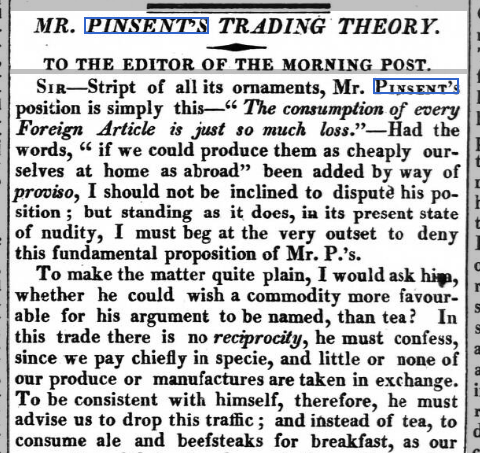
Joseph’s views were seen as heretical by “free traders” and several anonymous merchants (including O.P.) wrote refutations in the press. They pointed out that, with the best will in the world the Empire could not meet every need and “that wherever we can procure an article better and cheaper than we can produce ourselves, there it is in our best interest invariable to go for it either for the purposes of necessity or luxury” (Morning Post: Saturday 19th January 1822). Mr. Pinsent responded that he would be happy to discuss the matter with O.P. if he would reveal himself and, besides, we could grow tea in New Holland (Australia).
Joseph’s frustration mounted as his ideas failed to gain traction and he felt obliged to submit a copy of a letter he sent to the Foreign Secretary, the Most Noble Marquis of Londonderry (Viscount Castlereagh) questioning the motives of the government and the competence of its ministers, to the Morning Post. “I wish to be understood as not charging your Lordship and Colleagues with improper motives, but with ignorance of such sound States-manly knowledge as is necessary to bring our might resources into action, and to give all our people profitable employment, increase our revenue, wealth and power in the like ratio. Could you but see your errors, self-interest would lead you to adopt different measures …” (Saturday 15th February 1822). The Marquis committed suicide six months later.
By March, the Most Noble Marquis was probably not alone in being heartily fed up with Joseph’s interminable repetitive letters and the tide had turned against him. His friends persuaded him to cancel his proposed meeting at the London Tavern at the beginning of the parliamentary session until the situation clarified. As a parting shot, he wrote: “No one can more sincerely hope that I many in the events prove a false prophet and that not one of my predictions may be verified than, Mr. Editor, your very obedient, humble servant: Joseph Pinsent: “A True Pittite” 22 Birchin Lane” (Morning Post: Saturday 9th March 1822).
It was a short hiatus, as Parliament almost immediately agreed to allow him to submit a petition that he hastily arranged to be printed in the Public Ledger and Daily Advertiser (Monday 18th March 1822). It was yet another, perhaps more respectful, distillation of the ideas he had been promoting for quite some time and would have come as no surprise to anyone. However, he felt a little background reading for the Chancellor of the Exchequer (The Right Hon. Nicholas Vansittart) might not go amiss … (Morning Post: Tuesday 26th March 1822). He sent a similar letter to the Chairman of the Committee of the House of Commons on the Agricultural Distresses – David Ricardo, M.P. – the principal advocate of “free-trade.” What he thought of it, I do not know but I imagine his response would have been unprintable anyway.
Perhaps Joseph should have left it at that; however, the “West Indies Ship Owners Society” had recently met to discuss the implications of opening West Indies ports to foreigners. He jumped into the discussion – pointing out that it would be far more cost effective if Britain abandoned the West Indies and obtained its sugar from the East Indies, as he felt the cost of maintaining the West Indies as a British Colony was prohibitive (Morning Post: Wednesday 17th April 1822). The sugar “interests” were, needless to say, not impressed. They felt that previous administrations had enc0uraged them to exploit the West Indies and they were only asking for protection against foreigners after all – which was what Joseph wanted, wasn’t it (Morning Post: Friday 19th April 1822)?
Joseph was genuinely disturbed by the poverty he saw at home and that he read about in Irish Newspapers and he attributed it to lack of employment. He wrote a letter to the Chancellor of the Exchequer in June 1822 asking for the repeal of the Excise Laws as they tended to “lessen the consumption of our agricultural produce as well as the employment of our people” and thereby promote pauperism and starvation – which in turn leads to social unrest and the added cost of maintaining an army. He felt that cutting the West Indies loose would reduce the size of the army and ease the Government’s budgetary pressure (Morning Post: Friday 28th June 1822)
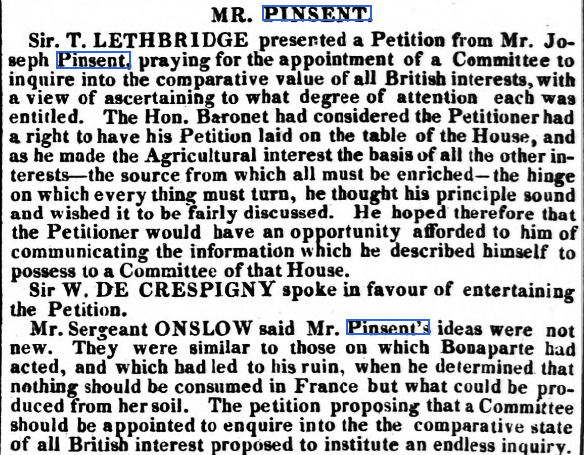
Despite Parliament’s opposition to Joseph’s views, Sir T. Lethbridge felt obliged to put forward Joseph’s petition that proposed “a committee be formed to enquire into the comparative value of all British interests, with a view to ascertaining to what degree of attention each was entitled …” and to see that it was presented to the appropriate committee. Mr. Sergeant Onslow said that Mr. Pinsent’s ideas were not new. “They are similar to those on which Bonaparte had acted, and which had led to his ruin when he determined that nothing should be consumed in France but what could be produced from her soil.” A Mr. Hume accepted that the ideas needed to be examined; however, he felt that they would lead to the destruction of British Commerce. Despite this unquestionable hint of negativity, the petition was ordered read and printed (London Statesman: May 31st 1822). Joseph appreciated getting the hearing but was disappointed that so many members of the House failed to comprehend the complexity of his plan (Morning Post: Tuesday 4th June 1822)! His ideas were based on forty years of observation and business practice and he was sure that if they were implemented they would lead to national prosperity and independence.
One of Joseph’s detractors, who signed himself “A.B.C.”, wrote to the Editor of the London St. James Chronicle and General Evening Post to complain that Joseph displayed more brass than judgement in criticizing Mr. Ricardo and by setting himself up as a political economist. “Alas! How little does he appear to know …” A.B.C. then presented a detailed refutation of Joseph’s concerns about the affect on the landed gentry, tithes and the implementation of “free trade” on the poor-law. His letter was published on 23rd April 1822, and Joseph came up with his own, somewhat sarcastic response on 2nd May. I doubt if A.B.C. was particularly mollified but Joseph probably appreciated getting in the last word. MERCATOR also took him to task and received a blistering discussion on the price of imported rice for his pains (Morning Post: Wednesday 3rd April 1822).
Doubtless to the intense annoyance of typesetters everywhere, the battle continued on over the summer. In July, Joseph was back to the West Indies issue. For all his protectionist instincts, Joseph still believed in “free-trade” within the empire. In a letter to W.I., who was presumably a “sugar planter” who wondered why he preferred the East Indies to the West Indies. He said he saw a clear distinction between them, as the former was essentially self-supporting while the latter was largely maintained at the expense of the British taxpayer. It was, thus, expendable (Morning Post: Tuesday 2nd July 1822). However, he acknowledged that there were “stupid clauses in their (East India Company) charter which tend to protect foreign commerce from British competition and limits the size of British ships trading from the United Kingdom to and from India.” W.I. was not impressed and argued that the West Indies were British Colonies within the Empire and they produced the bulk of the sugar consumed in Britain (as Joseph would have wished – surely?). The current generation of Planters were not responsible for slavery and if Britain did abandon the region and shift it’s sourcing to the east, it would be a disaster for the black population in the West Indies (Morning Post: Saturday 24th August 1822.
The summer’s correspondence sparked off another missive to the Earl of Liverpool on the damage done to the Navy by the relaxing of the Navigation Laws (Morning Post: Wednesday 10th July 1822). The following month he wrote to the Editor of the Morning Post explaining the absurdities in the Government’s current treaties with the United States and France. “I cannot, in the construction as well as in the principle laid down in this French Treaty, but admire the superior knowledge and abilities displayed by the French Statesmen over ours on the like occasion with America, as the protection duty of 16s per ton which the French have reserved to their own by levying it on the cargoes of American shipping in French ports very properly secures to French shipping the carrying trade of their own imports … “ (Morning Post: Thursday 8th August 1822). Joseph saw no problem with other countries applying his principle of “protection according to the value to the state”. His point was that Britain had an empire, and if it used it wisely, it would lessen its need for foreign products, and it would increase employment and wealth both in the colonies and at home. He used the example of hemp, which the Royal Navy then bought from Russia. It had recently agreed to purchase hemp from Canada – if it could be obtained at a comparable cost. Joseph argued that price was not everything, and there was extra value in producing hemp in Canada. The trade would spur British and Colonial industry – and perhaps even encourage the outward emigration of people now sustained by the Poor Rate (Morning Post: Friday 16th August 1822). By then, Joseph was routinely signing off his letters claiming to be “A True Pittite”. Rightly or wrongly, he felt that he was following in the steps of William Pitt the elder.
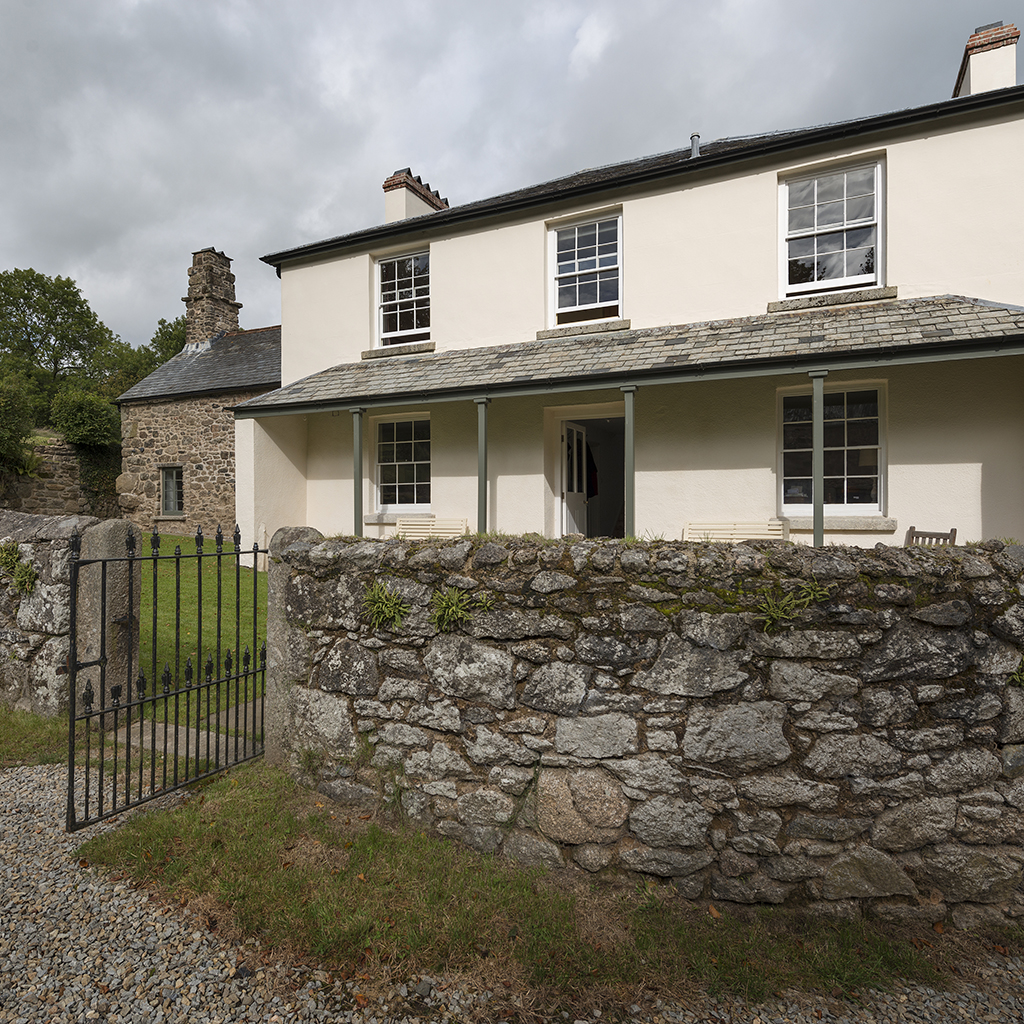
By then, Joseph had had about enough of London. He appears to have moved back to Devon in 1823. Records now held in the Devon Records Office show that the Chagford parish guardians assigned him apprentices for work at “Lower Jurston” in 1824 and 1825. Joseph put the farm up for sale in 1831 and with his family moved to his adjoining farm at “Higher Lettaford.”
Joseph’s brother John Pinsent (who had been a baker in St. Marylebone, London, and had run a shipping business in Newfoundland with another of his brothers, William) died in March 1821 and his son – Joseph’s nephew – Robert John Pinsent decided to sell up in London and move to Port de Grave to assist his aging uncle William run the Newfoundland end of the business. John’s widow and his unmarried daughters moved down to Devon and this may have factored into Joseph’s own decision to return there and concentrate on farming.
Joseph and Ann (née Tucker) returned to Devon with their seven children (Elizabeth Satterley and Joseph Burton Pinsent from Joseph’s second marriage and Mary Anna, Anna Lucretia, Harriet Cordellia, Robert Baring and Ferdinand Alfred Pinsent from his third). The couple had their last child, Charles Pitt Pinsent (Pynsent) after their return to Devon. He was baptized in in Chagford in 1824. His name is yet another nod to William Pitt and the long-gone baronetcy!
Joseph still had two brothers in Devon. Charles Pinsent and his wife Ann (née Yeo) was farming at “Pitt” in Hennock; however, he was to die a few years later (1826) and his son Thomas Pinsent who inherited “Pitt” ran the farm. His life is described elsewhere. As an aside here, it is worth mentioning that Thomas resurrected the name “Pynsent” and persuaded several of his cousins (Joseph’s sons and daughters) to go along with the idea and they changed their names as well! Hence the occasional reference to “Joseph Burton Pynsent” rather than “Pinsent”, and to the consistent reference to his younger half-brother, “Charles Pitt Pynsent”.
Joseph’s brother Gilbert Pinsent meanwhile, was a tenant farmer living at “Ponswin Farm” in Kingsteignton with his wife, Margaret, and their two sons William Pinsent and John Pinsent. They were shortly to move to “Aller Barton” in nearby Abbotskerswell. William Pinsent, the brother who had spent his life in Newfoundland, gratefully transferred the shipping business to his nephew Robert John Pinsent (as mentioned above) and retired to East Teignmouth in the mid-1820s with his wife Amy (née Richards). They had a surprisingly young son William Pinsent in tow. Joseph and has family must have had a lot to talk about.
Joseph also had family connections through his first wife, Anna Thomasin Crout Pinsent. His erstwhile father-in-law Thomas Pinsent was a “tallow chandler” living at “Greenhill” in Kingsteignton and his son Thomas Pinsent (Anna’s brother) was making a name for himself as a “draper” in Devonport. Thomas’s sons John Ball Pinsent and Richard Steele Pinsent were still young children. However, they would prove to be very influential in the years ahead. Joseph’s second wife’s brother John Heard Pinsent had died young but she had two married sisters living in the neighbourhood. All in all, and especially considering the number of related women-folk, Joseph was in good company and the Pinsents had rarely been more interconnected. They were, for the most part, successful middle-class merchants and farmers who knew each other, and their family name was well known throughout South Devon.
Joseph retained his business in London after his return to Devon and still diligently read the newspapers, and kept up his combative approach to political governance. In early 1827 he wrote an exasperated letter to Mr. E. P. Bastard, Esq., and Sir Thomas Dyke Ackland, Bart, the Members of Parliament for Devon, calling for public debate on the price of bread and the need for protection under the Corn Laws (Flindell’s Western Luminary: 9th January 1827). The following year, he reminded the public of his past efforts to influence foreign commercial policy “I did in vain, for some years previous to 1821, constantly and anxiously endeavour to call our then miscalculating ministers’ attention to the errors of their system; but as I could not serve my country directly in that way, I addressed the annexed [letter] to the ministers of foreign states, in hopes of doing indirectly what I could not do directly for my suffering country. France, and the United States of America, come near to my views, and I was in hopes that this would have shamed Messrs. Huskisson and Co. to have abandoned their quackery, but you see not even the destruction of their country would convince them of their errors. Jos. PINSENT: Now of Jurston, Chagford, Devon: N.B. All countries should possess a public board under the direct appointment and control of the democratic branch of its legislature, for the purpose of receiving the communications of men of talent and genius, otherwise the ignorance and superciliousness of men in power may render abortive all the talent, genius, industry, and virtue of the rest of the community. This has been verified in more instances and in more countries than one” (London Packet and New Lloyd’s Evening Post: Friday 25th January 1828). He was not a happy man.
Later that year, Joseph wrote to the Earl of Malmesbury asking for another petition to be heard in the House of Lords in 1828. He claimed: “that he possessed information upon financial, commercial, and agricultural subjects, which, if communicated to the Lordships, could not fail to promote the best interests of the country, and without the violation of any fixed principle” (St. James’s Chronicle: Thursday 5th June 1828. The petition, “having been read at length was ordered to be laid on the table”. Where it, presumably, gathered dust.
On another front, Joseph was becoming concerned about the availability of currency in the country. He felt that most of the twenty-two million gold sovereigns the Chancellor of the Exchequer then said were in circulation, most were probably in foreign hands (Flindell’s Western Luminary: 17th June 1828). He worried that the Bank of England’s plan to replace one pound notes issued by Country banks with its own would further reduce the amount of money in circulation (Western Times: Saturday 21st June 1828). In 1832, and wrote a letter to the editor of the Exeter Flying Post (Thursday October 25th 1832) arguing that Britain’s ongoing financial difficulties were caused by lack of protection and by restriction of the money supply: “add to what I before have stated, the decline of the prosperity of the British empire may be dated from the period of our diminishing our circulating medium, combined with our withdrawing our protection of our native and colonial industry.” Clearly, he was still hankering for the “good old days” when Britain prospered under William Pitt.
The great Reform Act enacted in 1832 improved voters rights in Britain but Joseph had serious doubts about the economic policies proposed by the so-called “Reform” Government which, he felt, too closely resembled those of the previous one. Earl Grey, obviously, needed to be reminded of the proper way of doing things: “our colonies should by an act of union, be made integral portions of the British Empire, and then with all our other interests they should be protected from foreign competition, commensurate with their respective value to the state, and subject thereto, the commerce of the Empire should be allowed to have the freedom of air” (Exeter and Plymouth Gazette: Saturday 5th January 1833).
Living in Devon, Joseph certainly saw the effect of poverty on its “agricultural labourers” and he blamed the local magistrates who, he felt, were unreasonably harsh. They failed to realize that it was economic policy and not indolence that led people into misery and crime. He said they deserved public support. “The genius of Pitt is required to put us to rights, for until the people are restored to their profitable employment, no property of the British Empire can be secure” (Exeter and Plymouth Gazette: Saturday 4th May 1833). Joseph thought that as most of the magistrates were (like him) landowners and paid land-tax and local poor rates, they too would see the benefit of promoting full employment. Joseph could not understand why the recently elected Reform Act Parliament had not done anything about it (Exeter Flying Post: Thursday 3rd October 1833)! His disappointment clearly shows through in the letter he wrote to the Editor of “Flindell’s Western Luminary” published on 31st December 1833, and in others that followed.
Some people listened (I doubt he was reticent in conversation) and others doubtless read his letters and quietly approved. In January 1834 “An Englishman” wrote an open letter to the press pleading for Joseph to do something about the Government’s policy of “free trade” as applied to shipping, which he felt was ruining British commerce (Exeter and Plymouth Gazette: Saturday 25th January 1834). Joseph was getting on in years by then but he, of course, responded. He acknowledged the problem – which was, he felt, because the current administration was full of “dolts, sophists and knaves.” He suggested the writer “get up a petition to both houses of parliament to protect every interest and industry of the British Empire …” You get the picture. In addition, he wrote a letter to Lord Althorp, the Chancellor of the Exchequer. In it, he reiterated his long-held position on protection, especially as applied to shipping, and he pointed out the danger to Britain of reliance on foreign food and other items. Once again, he attributed poverty and social unrest to lack of meaningful employment. Joseph pointed to the rotting hulks around Britain’s shores and wondered out loud where Britain’s sailors would come from when they were needed by the Nation in time of war. He feared Britain’s lack of ability to respond militarily (Exeter and Plymouth Gazette: Saturday 8th February 1834). Not content with that, on the 8th March, Joseph sent the Chancellor another letter propounding his theories. The Morning Herald (Saturday 1st February 1834) went so far as to decline to publish his letter to Lord Althorp – on the grounds that “we insert no letters but such as are addressed to the Editor. The extreme length of the communication is also objectionable.”
By now, Joseph was definitely getting repetitive and quarrelsome and there must have been many who agreed with “T. M. Devonport” “Mr. Editor, spare our readers another inflection of bad grammar, illogical reasoning, tiresome tautology and obsolete doctrines from the garrulous pen of THE REAL PITTITE, who appeared by his own showing to have had the vanity to offer himself as a Mentor of the Chancellor of the Exchequer” (Exeter and Plymouth Gazette: Saturday 1st March 1834).
It did not work. A week later, the newspaper published yet another letter directed at the Chancellor of the Exchequer. This one was full of specific recommendations, including the actual duties that should be applied to commodities brought by foreign ships into British (and colonial) ports “fifty shillings per quarter on all foreign wheat and other grain in seed in proportion – one shilling per pound on all foreign sheep and cotton wool … etc.” The revenue so generated, he felt, could be used to reduce costs at home “These duties, my Lord would produce from ten to twelve millions sterling per annum for some years to come, which would not only enable your lordship to repeal our present impolitic and partial assessed taxes, the malt and hops duties, and nearly abolish all our turnpikes and toll bars …” To Joseph, it was obvious that imposing costs on foreigners and encouraging trade within the empire would be of lasting benefit to the country as a whole. The issue was discussed in Parliament and, to Joseph’s horror, Mr. P. Thompson, the President of the Board of Trade was less than responsive and Joseph was left gasping that “the substance of his imbecile arguments were intended to prove that English ships were not only capably of competing with foreign ships, although the latter were built and sailed at about half the expense of our ships, but that England depended for prosperity on her foreign trade, and that unless we permitted foreigners to trade on the terms of our reciprocity bill, they would exclude our ships and merchandize from their ports altogether” (Exeter and Plymouth Gazette: Saturday 21st June 1834).
1835 was an election year and in the month of May Joseph picked up his pen to make a few pointed comments about Lord John Russell, the presumptive Whig candidate for South Devon. He had been one of the main architects of the Reform Bill passed by Earl Grey’s administration in 1832. Joseph argued that his Lordship “like that of his colleagues in general, proceeds from his and their ignorance of the science of finance, of the science of currency, of the science of commerce – or in other words, of the bearing of those matters on the industry of the people and welfare of the state”. Joseph assumes from his total failure, hitherto, to vote for legislation that eases the lot of the people, that although he “appears to be a good-hearted, talkative sort of man, and has without knowing it become the dupe of a faction” it would be folly to vote him back into Parliament until he changes his ways (Exeter and Plymouth Gazette: Saturday 2nd May 1835. He was, nevertheless, duly elected and appointed Secretary of State for the Home Department.
For his swansong, Joseph wrote to Lord Russell that December to explain his views on parliamentary reform: “I strongly recommend to your Lordship to add to our present House of Commons, twenty representatives from the Labouring and Mechanical classes, twenty more to represent our shipping interests, and thirty to represent our Colonial Empire, when I have every reason to believe that those seventy members will bring more practical men and commonsense intelligence into the great Council of the Nation, than all its present members put together.” Joseph also suggested that new members should be qualified “each of them shall be able, in the most explicit manner, to state what constitutes the wealth and support of the State, and also to describe the geographic position and statistical capabilities of the mighty Empire for which they are called on to make laws, as well as to describe the measures necessary for bring the vast resources of our unrivalled empire in to action …” (Exeter and Plymouth Gazette: Saturday 12th December 1835). These, like most of his ideas, for better or worse, came to naught.
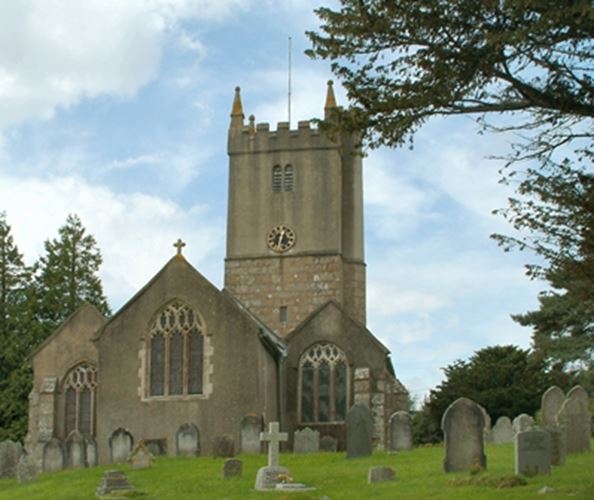
Joseph died a few weeks later, aged 65. He was buried in North Bovey where there is a monument to his passing in the Parish Church. Interestingly, it carries the coat of arms of the old Pynsent baronetcy, although Joseph had no real right to it – as his nephew, Thomas Pynsent would later show. Joseph (and I for that matter) come from a different branch of the Pinsent family.
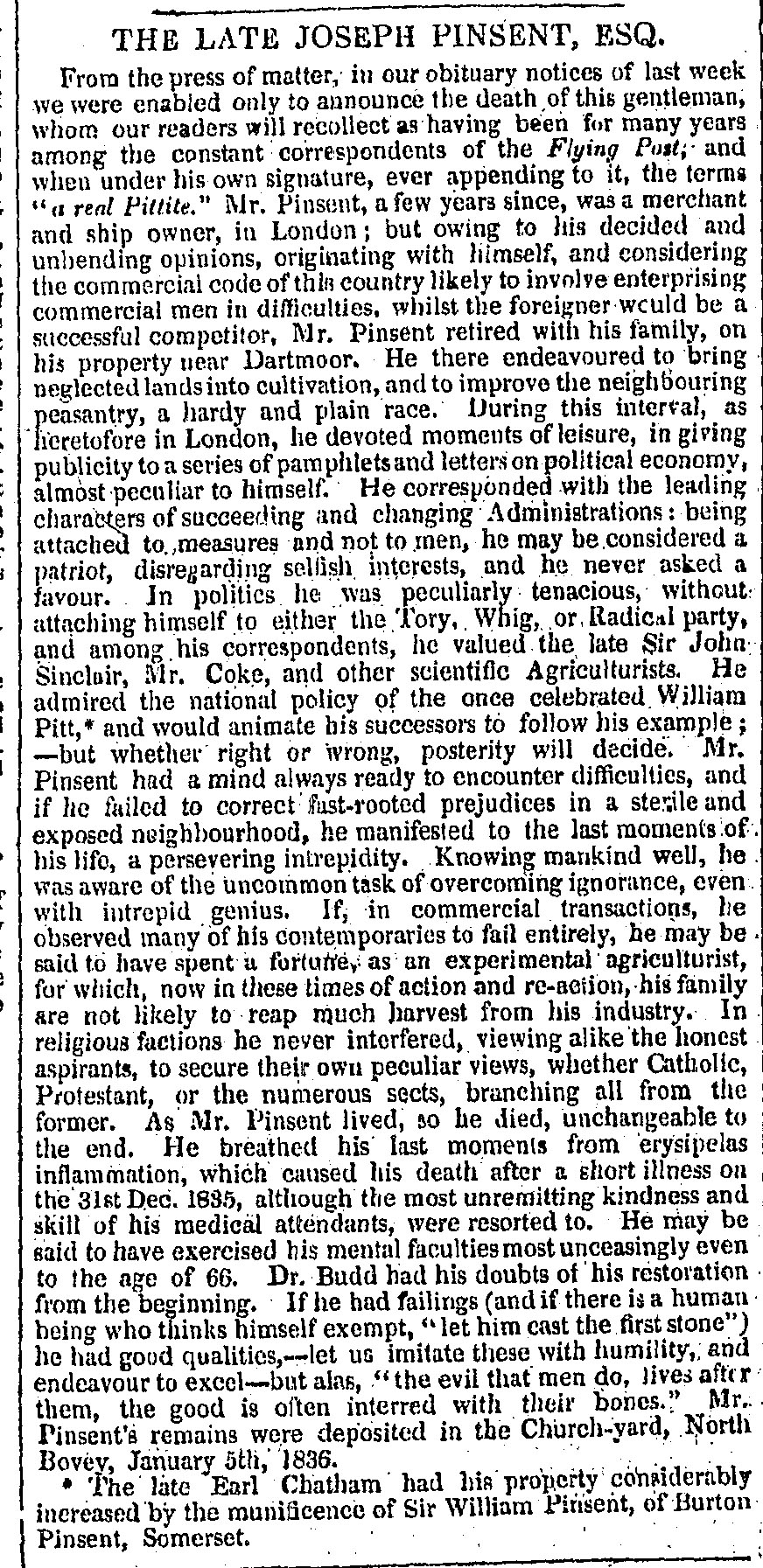
In a somewhat quirky obituary, the editor of the Exeter Flying Post noted that Joseph was “a constant correspondent.” He notes that he was a merchant and ship owner in London who disagreed strongly with the government over economic policy and retired back to Devon, where he “endeavoured to bring neglected land into cultivation and to improve the neighbouring peasantry.” Joseph had certainly shared his insights on agriculture: he wrote a letter to the Exeter and Plymouth Gazette in November 1833 on the design and management of plough-teams. He pointed out that wheeled ploughs may work well in Kent but, he claimed, they were not really suitable for most Devon soils (Saturday 16th November 1833). Joseph admired progressive farmers and “he may be said to have spent a fortune, as an experimental agriculturalist, for which, now in these times of action and reaction, his family are not likely to reap much harvest from his industry” (Exeter Flying Post: Thursday January 14th 1836). Joseph had just about admitted as much. When advertising “Lower Jurston” (86 acres) for sale in June 1831, he described its cultivation potential and stock holding capability, and then states: “It has been in the occupation of the present proprietor and has cost him in real useful improvements some thousands of pounds more than he expected now to get for it” (St. James’s Chronicle and General Evening Post: Saturday 18th June 1831). What his assets amounted to at the time of his death is unclear; however, an interesting note in the London Times (Friday 5th February 1836) states that “The Executors of the late Mr. Joseph Pinsent are requested to apply to Mr. Rolfe, Gracechurch Street, where they may hear something of consequence to them.” Perhaps he had had overseas assets that had come to light.
After Joseph’s death, his wife Ann and his son Joseph Burton Pinsent (who was by then living in Bristol) tried to sell the farm at Lettaford, which they thought could be divided into three lots (35 acres at “Lower Lettaford”; 15 acres including two cottages, a field, plantation and moorland around Lettaford village and 16 acres including “Higher Lettaford” house and its farmstead) (Western Times: Saturday 19th August 1837). Presumably there were no takers. Mrs. Pinsent advertised “Higher” and “Lower Lettaford” for Let in May 1839 and sold off the remaining crops (including corn, hay and quality potatoes), stock (cattle, sheep and pigs) and implements of husbandry the following August (Exeter Flying Post: Thursday 8th August 1839). Nevertheless, Ann was still living there at the time of the Census in 1841. How much of the land had been sold by then is not clear; the family seems to have retained “Higher Lettaford” house as Joseph’s daughter Mary Anna Pynsent was living at there in 1871.
Joseph’s eldest daughter from his second marriage, Elizabeth Satterley Pinsent, married William Francis Splatt in 1840. He was a Devonian and (apparently) an accountant in Manchester. The couple emigrated to Victoria, in Australia, in 1841 and Mr. Splatt made a fortune running sheep on the Wimmera River. He then spent a few years as a “businessman” and “merchant” in Melbourne before returning to Devon ten years later.
In 1853, William Francis Splatt wrote a letter to the Governor of Victoria (His Excellency C. J. La Trobe, Esq.) describing his experiences running sheep in the State in the 1840s. He told him about the various pioneers and the land they owned, and when and how the business had evolved. He also commented on the the local aborigines and was not entirely complementary. William Francis went on to say that he bought the “Wonwondah” sheep station in 1845 and brought in his brother-in-law Charles Pitt Pynsent (Elizabeth’s half-brother – who was 21 years old) to help him run it. He then said that he bought the life-stock and the rights to Messrs. Jackson and Gibson’s station at “Roseneath” on the banks of the Glenelg River in 1846 but – sold it to a Mr. John Ralston in 1849. That year, he purchased Messrs. Curlewis and Campbell’s stock and stations on the Lower Murray River.
Mr. Splatt was appointed a member of the Victoria Legislative Assembly in the early 1850s and he was a wealthy man when he returned to England a few years later. His wife, Elizabeth, died in 1878 and Mr. Splatt remarried and towards the end of his life participated in local politics. He was appointed a magistrate in Torquay and, in 1892, became its first mayor. He died suddenly, shortly after his term in office ended (genuki-website-inquest-F.W.Splatt).
Foreign travel was risky and Mr. Splatt signed what was probably one of what were to be many wills in 1856. Certainly, it is unlikely to have been his “Last Will and Testamant”. In it, he made provision for his (then) wife Elizabeth but makes no mention of children and they probably did not have any. A partial family tree later made by my father suggests that Mr. and Mrs. Splatt adopted Elizabeth’s half-brother Charles Pitt Pynsent’s eldest daughter Frances Elizabeth Pynsent. Certainly, we find Mr. and Mrs. Splatt and “Miss Pinsent” staying in Torquay in May 1862 (Torquay Chronicle and South Devon Advertiser: Saturday 31st May 1862 and Frances was with them, at Flete in Holberton, Devon, at the time of the 1871 Census. However, Elizabeth’s half-sister Lucretia and her half-brother Charles Pitt Pynsent, and their cousin Thomas Pynsent (above) were also there so that may not mean much.
In his 1856 will, William Francis Splatt gave an annuity to his “wife’s sister” (actually half-sister) Mary Anna Pynsent and allocated four thousand pounds to “satisfy a mortgage made by my brother in law Joseph Burton Pynsent on Premises situated in Melbourne”. Joseph would not have received this bequest as he had died long before Mr. Splatt. Also, “Burton” (as Joseph was known) had had to surrender the property many years earlier while going through at least bankruptcy. He would have appreciated having the money when he needed it! Charles Pitt Pynsent, William Francis Splatt’s erstwhile partner in Victoria was to have been one of three executors of this likely redundant will.
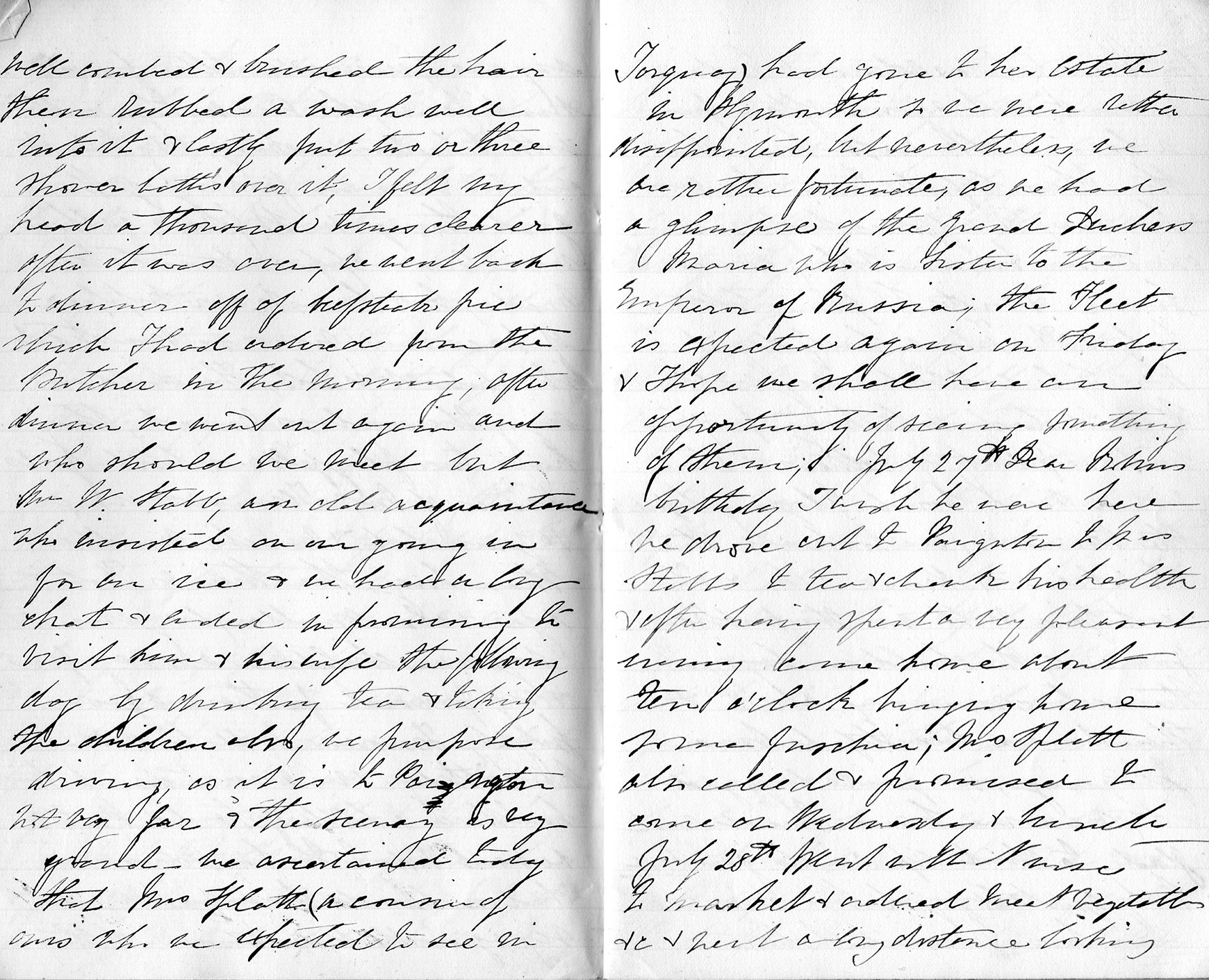
In 1864, Anna Brown Pinsent—the first wife of (Sir) Robert John Pinsent, one of Joseph’s brother John’s family, who lived in Newfoundland—took three of her children Lucy (7), Kate (6) and “baby” Willie to England for a visit. While there, she wrote a diary that is now in my possession. The entries from Saturday 23rd July to Sunday 25th September describe her life in Torquay – where they were entertained by Mrs. Elizabeth Satterley Splatt – and also her subsequent visit to London. Anna describes daily happenings: she complains about the cost of living and talks about Sunday church services. She describes family visits and outings, and discusses letters received from home. She was clearly missing her husband and her other son (Hedley (2)). She makes the following observations: “July 27th, Dear Robin’s birthday, [her husband] I wish he were here….”. “July 30th. Baby [William Satterly Splatt Pinsent – clearly named in honour of their hostess] is 4 months old today: raining in the morning and I employed myself in writing a letter to Mrs. Keddell [one of Charles Pinsent of Pitt’s daughters] and a “Miss Pinsent”, who was probably one of Charles’s granddaughters, none of whom were then married. My guess is that this would have been Margaret Jane Pynsent who was then twenty and an appropriate age to escort Anna and her children around. Elizabeth, being the eldest of Joseph’s daughters had clearly taken on the role of the matriarch of the family-at-large after her step-mother (Ann née Tucker) died in 1855. Interestingly, she appears to have inherited at least one of her father’s oil paintings of Sir William Pynsent as her cousin Thomas Pynsent describes seeing it at her home in Torquay. He had another [The Pynsent Baronetcy: The Trials and Tribulation of a Litigious Family: 1687-1765].
William Francis Splatt and his brother-in-law Joseph Burton Pinsent set up in business as a corn-factors in Bristol in the early 1830s. The firm operated under the title “Pinsent and Splatt” for a few years before the partnership was dissolved by mutual consent in 1835 (London Gazette: 23rd January 1835). The two men remained connected, of course, through William’s marriage to Joseph’s sister.
Joseph Burton (or “Burton” as he was generally known) married Mary Ann Ogden Hassall in 1836 and continued to import grain from Ireland for a few years. However, he headed out to Melbourne shortly before William and Elizabeth returned to Devon in 1853. Joseph Burton set up as “merchant” on Elizabeth Street and (through a woman other than his wife!) went on to found the Australian Pynsent branch of the Hennock family. You will find his story (and theirs) elsewhere in this database.
William Francis Splatt also went into partnership with his wife’s youngest half-brother, Charles Pitt Pynsent (who was from the third marriage) shortly before returning to England in around 1853/4. William acquired a sheep run in 1852 and brought in his young brother-in-law to run it. In “The Currency Lad” a book by T. S. Willis Cooke, there is a letter that William wrote to the previous owner, It states: “Dear Sir, I agree to purchase your stock and stations at the price and terms described in your offer of the 23rd October inst (copy of which is annexed hereto) and I hereby authorize my partner, Mr. Charles P. Pynsent, to draw on me on sight payable to your order for the sum of £2,000 being the deposit money mentioned in your offer. Mr. Pinsent is also authorized to take delivery of the stock and stations at your convenience and on your handing me his receipt for the same and your making the usual transfer, I will grant you my acceptances for £4,000 and £2,000 as stipulated and also a mortgage over the entire property to secure the one payment of the said acceptances and also the residue of the purchase money with the interest thereon in conformity with your offer. I have only to add that if Mr. Pynsent should make any further purchases of you either of live or dead stock the same will be a binding, one, Dear Sir, Yours very Truly, Wm. F. Splatt: P.S. As Mr. Pynsent takes an equal interest with me in this purchase and will take the active management I shall of course readily acquiesce in all his arrangements: W.F.S.” It seems that the previous owner had over extended himself and “It became impossible to get enough servants and farm hands as people headed for the diggings and in October 1852, just over a year after moving into his ‘Mansion’, he was forced to sell Lexington to William Francis Splatt and Charles Pitt Pynsent on the basis of ‘walk in – walk-out’ for the huge sum of £35,000 on mutually agreeable terms: the property was 120,000 acres, or 187 square miles” The letter included an inventory of contents; including 28 or 29,000 sheep. It was a lot of responsibility for Charles Pitt Pynsent who was still a relatively young man. His story is told elsewhere.
Meanwhile back in England, the Census takers found Joseph’s widow Ann (née Tucker) living with her unmarried daughter Mary Anna Pynsent at “Feoffees House” in Manaton in 1851. Mary Anna was a native of Devon and a boarding “school-mistress”. Her household included her half-brother Joseph Burton Pinsent’s son Thomas Ogden Pinsent (who would have been around 12 years old), a niece and nephew, Fanny and Frederick Partridge (who had been born in the Cape of Good Hope and London respectively), and a Jane Tucker who was, presumably, another young cousin as Anna’s sister Harriet Cordelia Pynsent had married John Partridge, a local farmer, in North Bovey, in 1838. Her children must have attended the school. Mary Anna employed three local female “teachers” aged between 15 and 20. In addition to family, they also taught nine local female scholars aged between 12 and 15, and three younger male scholars. Of these, John and James Tucker, were probably also “cousins”.
Mary Anna’s mother died in Manton in November 1855 (Melbourne Argus: Monday 3rd March 1856). Mary Anna stayed on there and kept teaching. In 1861, she was living at Ivy Cottage in Manaton with two Tucker children (Mary and Charlotte) and four local male scholars. She retired sometime in the 1860s and was back living at her father’s erstwhile home in Lettaford when the next Census was taken in 1871. She died at Lettaford in 1875. Mary Anna’s sister, Anna Lucretia Pynsent never married either. She was described as “independent” when she died in Torquay in 1880. Her will was probated by her brother, the Reverend Ferdinand Alfred Pynsent.
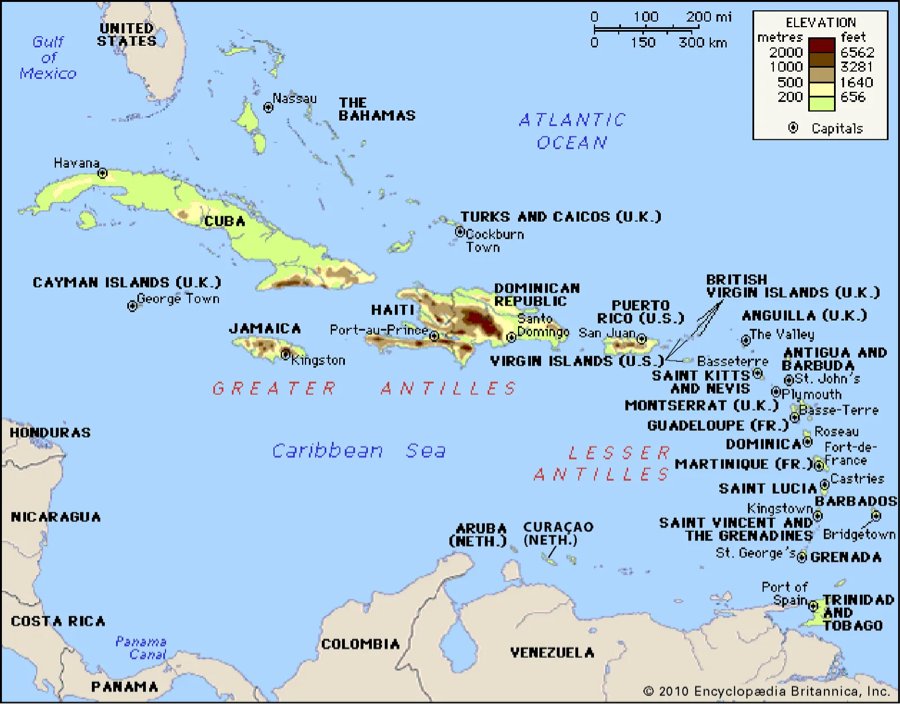
Ferdinand Alfred Pynsent was born in London in 1822 and educated at the “King’s Grammar School” in Ottery St. Mary. From there, he went out to the West Indies. He must have forgotten his father’s disparaging remarks about West Indies “sugar planters!”
Ferdinand was baptized (re-baptized ?) in 1837 and was one of three young men granted Exhibitions at “Codrington Grammar School” in Barbados in 1839 (Barbadian: 27th April 1839). He went on to become a “master” in the “Public Grammar School” in Antigua the same year and later to become an Anglican clergyman. The Lord Bishop admitted Ferdinand Alfred Pynsent (sic) and two others to the “holy office of Deacons” in Antigua in February 1847 (Barbadian: Saturday 27th February 1847). Ferdinand had evidently bowed to pressure from his cousin Thomas Pynsent of Pitt House in Hennock and changed his name from Pinsent to Pynsent!
They were unsettled times in the West Indies, and Ferdinand was one of several clergymen who signed a “letter of appreciation and support for the Bishop following an ecclesiastical revolt on nearby Montserrat” (Barbadian: Wednesday 12 May 1847). It seems to have earned him a promotion as his licences was forthwith transfered to “St. James district, within the parish of St. John.” (Church and State Gazette (London): Friday 25th June 1847).
Ferdinand married a local girl, Emma Furlong in 1847. The 1881 Census shows that she was “a British Subject born in Montserrat, in the West Indies.” Ferdinand returned to England shortly after the marriage – perhaps to look for a clerical appointment. However, he was back in the West Indies in February 1848 (Barbadian: Wednesday 9th February 1848).
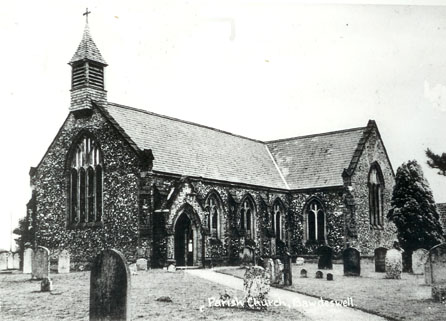
Ferdinand moved back to England shortly thereafter and was installed as Rector of Bawdeswell in Norfolk. This was probably through the influence of Edward Lombe Esq. (Norfolk News: Saturday 2nd August 1851.) Mr. Lombe seems to have been a friend of the family as Ferdinand’s cousin, Thomas Pynsent, had even gone so far as to name one of his daughters Florence Lombe Pynsent. Presumably he was her god-father.
Bawdeswell was a fairly affluent parish in East Anglia – perhaps best known for being the home of the Reeve in Geoffrey Chaucer’s “Canterbury Tales.”
Ferdinand and Emma had no children that I know about; however, he was sensitive to the needs of children. In 1859, he made as subscription to “The Soldiers’ Daughters’ Home for the Maintenance, Clothing and Education of Daughters of Soldiers, Orphans or Not” (Morning Herald (London) Thursday 9th June 1859). Ferdinand was (hardly surprisingly) a delegate at the Church Congress held in Norwich in 1865 (Morning Herald (London): Wednesday 4th October 1865). He remained the incumbent at Bawdeswell until he died.
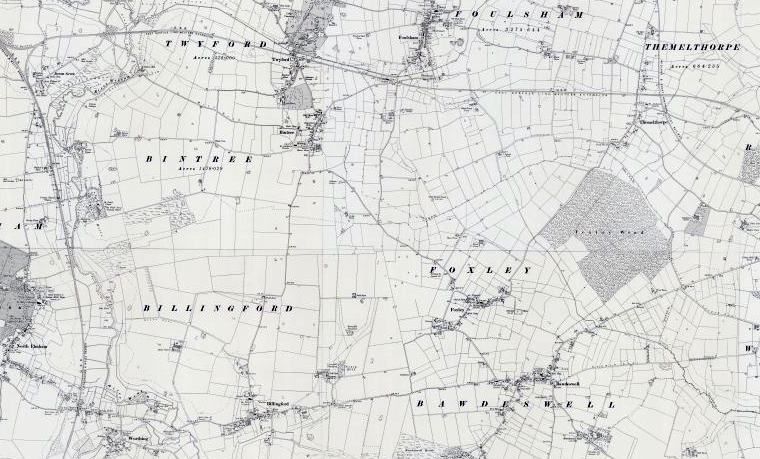
Bawdeswell is a few miles to the southeast of Bintry (a.k.a. Bintree), where the Rev. F. Wingfield Homfray was incumbent and it seems likely that Ferdinand introduced one of his Newfoundland “cousins”, Robert John Pinsent (later Sir Robert) to his neighbour’s daughter Emily Hetty Sabine Homfray.
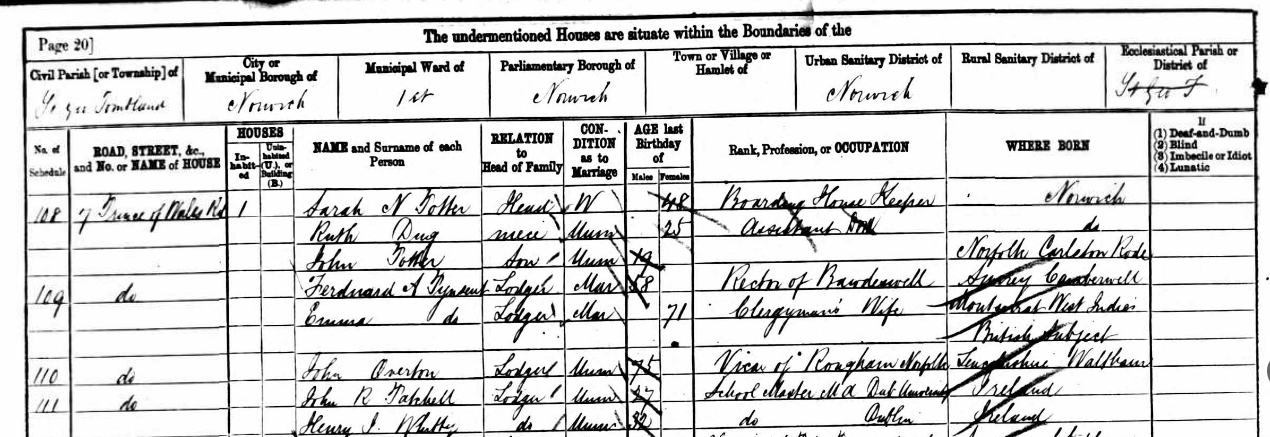
The connection between Ferdinand and his father Joseph’s extended family and that of his uncle, John Pinsent, extended down at least one more generation as Sir Robert’s son Francis Wingfield Homfray Pinsent later had dealings with one of Charles Pitt Pynsent’s sons. Ferdinand also helped officiate at the marriage of his cousin Thomas Pynsent of Northam’s daughter Jane Augusta Pynsent to Colonel T. A. Rawlins in 1877 (The Patriot: 10th December 1877). Their lives are all discussed elsewhere.
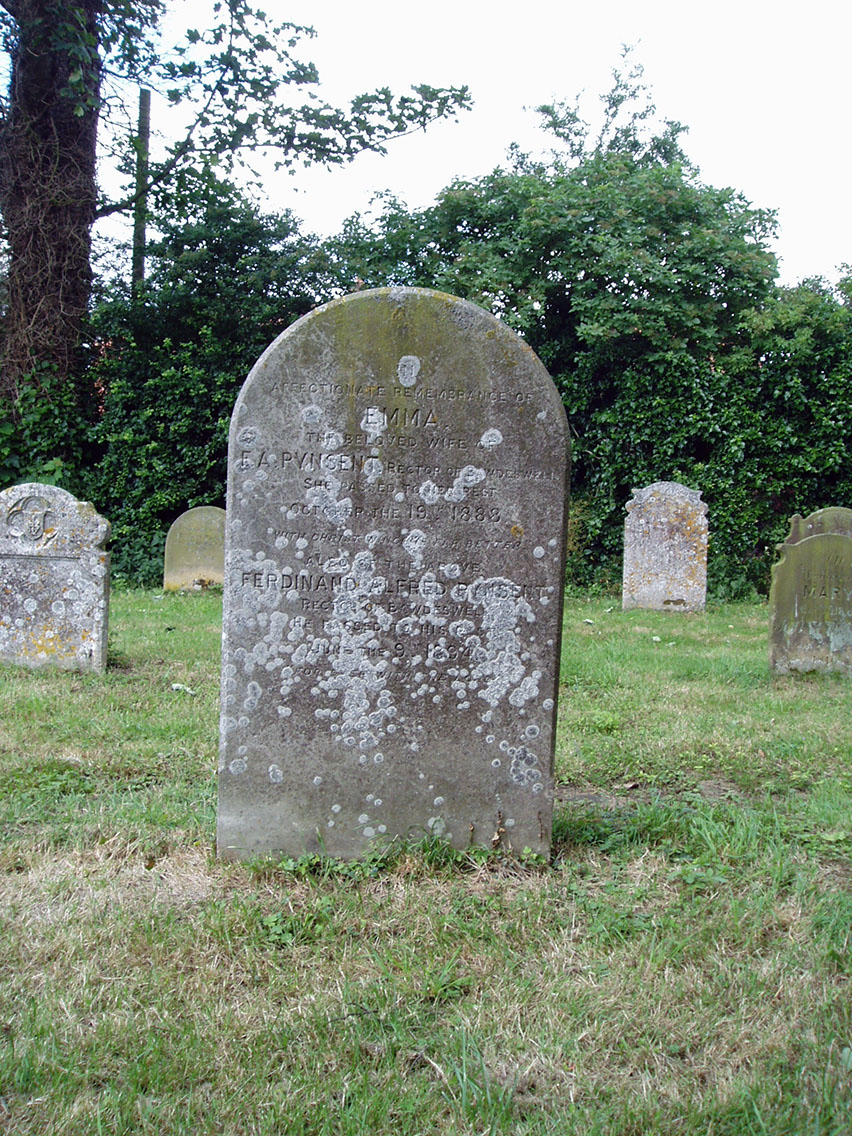
Emma died in 1888 and Ferdinand Alfred died a few years later, in 1894. He was the last of his generation and his passing was even acknowledged in Australia. The Sydney Morning Herald (28th July 1894) notes that he was the “dearly beloved uncle of Joseph and Alfred Pynsent of Bondi Beach.” They were two of Ferdinand’s brother Joseph Burton Pynsent’s sons. I doubt if they had ever met but their father presumably held Ferdinand in high regard.
Ferdinand and Emma are buried side by side in the churchyard next to Bawdeswell Church. However, it is not the edifice he knew as that was destroyed by a Royal Air Force Mosquito bomber that crash landed on it in 1944. The current church was built after the Second World War.
Family Tree
Grandparents
Grandfather: Thomas Pinsent: 1691 – 1777
Grandmother: Mary Gale: 1690 – 1774
Parents
Father: John Pinsent: 1728 – 1772
Mother: Susanna Pooke: 1730 – 1772
Father’s Siblings (Aunts, Uncles)
Urith Pinsent: 1714 – 1751
Thomas Pinsent: 1717 – 1802
Julian Pinsent: 1719 – 1721
Robert Pinsent: 1721 – 1783
Gilbert Pinsent: 1724 – 1794
Julian Pinsent: 1726 – xxxx
John Pinsent: 1728 – 1772 ✔️
Mary Pinsent: 1731 – xxxx
Male Siblings (Brothers)
John Pinsent: 1751 – 1753
John Pinsent: 1753 – 1821
Robert Pinsent: 1753 – 1787
Thomas Pinsent: 1754 – 1785
William Pinsent: 1757 – 1835
Gilbert Pinsent: 1758 – 1835
Charles Pinsent: 1765 – 1765
Charles Pinsent: 1766 – 1826
Samuel Pinsent: 1767 – 1775
Joseph Pinsent: 1770 – 1835 ✔️
Please use the above links to explore this branch of the family tree. The default “Next” and “Previous” links below may lead to other unrelated branches.