Vital Statistics
Earl Speare Pinsent: 1887 – 1958 GRO1161 (Solicitor, St. John’s Newfoundland)
1. Augusta Beatrix Dickinson: 1885 – 1937
Married: 1916: St. John’s Newfoundland
Children by Augusta Beatrix Dickinson:
Pamela Gertrude Pinsent: 1917 – 1999 (Married Robert F. Horwood, xxxx xxxx, 1948).
Charles Douglas Pinsent: 1919 – 1953 (Married Madeleine Waterman, Seattle, Washington State, 1948)
Ethel Reynette Pinsent: 1926 – 2020 (Married Herbert Hall, xxxx xxxx, xxxx)
2. Phyllis Ruth Hadwill: 1888 – 1983
Married: 1940: Montreal, Quebec.
Family Branch: Hennock
PinsentID: GRO1161
Click here to view relatives.
Earl Speare was the only son of Charles Speare Pinsent by his wife, Blanche née Brown. He was born in St. John’s, Newfoundland, where his father was a “bank manager” – who was later to be appointed “Gentleman Usher” in the “Colonial Legislature.” Charles was also a leading member of the “Freemasons”. Earl grew up with three sisters (Constance Douglas, Eleanor Vicars and Frances Isobel Pinsent); however one of them, Eleanor, died when she was twelve years old.
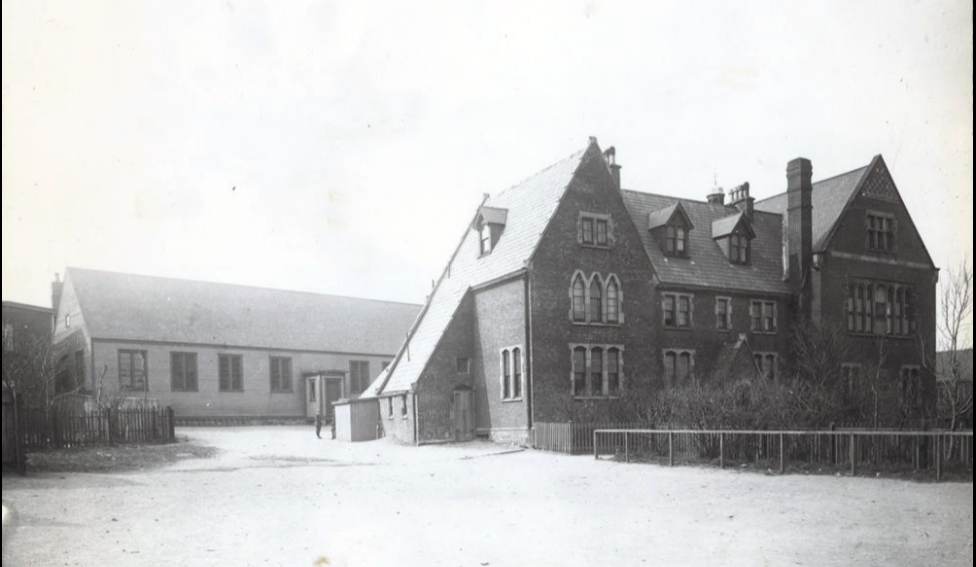
Earl attended “Bishop Feild (sic) College”, which was one of the preeminent schools in St. John’s, and received attendance medals in December 1903 (Evening Telegram: 24th December 1903), 1904 (Evening Telegram: 23rd December 1904) and 1907 (Evening Telegram: 23rd March 1908). It is worth noting that the “Old Bishop Feild School” has been replaced with a much larger and more modern building than the one shown.
Earl passed his intermediate level C.H.E. (“Certificate of Higher Education”) exams in 1906 (Evening Telegram: 10th September 1906) and he, presumably, graduated the following year. He was an active student and his prowess in ice hockey and soccer were also acknowledged, along with his five years of service as a “bugler” in “College Cadet Corps” in 1906 (Evening Telegram: 21st December 1906).
The Canadian sport of ice hockey arrived in St. John’s with the large influx of hockey-playing bankers and merchants and their sons that came from Ontario, Quebec and the Maritime Provinces after the financial crash of 1894. It required equipment that – under the circumstances – only the affluent could afford and it had taken root in the (religiously denominated) “upper class” schools. The Anglican (“Bishop Feild College”), the Roman Catholic (“St. Bonaventure”) and Methodists colleges formed an (intercollegiate) hockey league in the early 1900s. The matches were played to a slightly different set of rules than those used today but the essence of the game has not changed. It is still fast and physical. According to Arthur Farrell who played for the “Shamrock Hockey Club” (“Hockey Canada’s Royal Game: 1899”) seven players played two half hour periods with a 10 minutes break between them. The teams switched ends at half time and tied games were resolved by the golden goal process – he who scores next wins! No substitutes were allowed except in case of injury and the referee decided how long a penalty should be. There was a stringent off-side rule; an active player must always be on his side of the puck. The current arrangement – that allows for frequent substitution of the six players – did not come into effect until shortly before the First World War (“Icing the Puck: The Origins, Rise and Decline of the Newfoundland Senior Hockey, 1896-1996:” Gregory B. White: M.A. Thesis, Memorial University, April 1997). Nowadays, (NHL teams at least) play three twenty-minute periods and ties are resolved by having three skaters (and one goalie) on each side play an extra period of five minutes. If that does not end it, then they go to a shootout – a single skater v. the goalie and the first team to score three goals wins.
The “Feildians” won the inter-collegiate competition in 1903, 1904, 1905 and 1906. Earl was probably a member of the team during the last two seasons. On one occasion, in 1905, he was said to have: “turned out excellent, rushing well, and always getting forward on to his man when the puck got ahead” (The Feildian 1905, Vol. 12, Nos. 3 &4). The following year, he was made “vice-captain”. He played in the left forward position, “which he filled to the satisfaction of all concerned. He excels in combination and rarely misses a chance for goal. He has not, however, been in very good health this winter and so his play was hardly as brilliant as during last season” (The Feildian: 1906: Vol 13 No. 3). Presumably most of the college games were played out-doors on frozen ponds.
The “Prince of Wales Rink” in St. John’s had been built in around 1899 as the home of the, newly formed, “St. John’s Senior Hockey League”. The league initially consisted of seven teams: the “Feildians”, “St. Bons”, “Victorias”, (employees of the “Reid Company” – which had largely paid for the new rink), “Bankers”, “Stars”, “St. Andrews” and “City” (“Icing the puck” , Gregory B. White, M.A. Thesis, MUN, 1997). Other teams came and went over the years. The “Feildians” were in reality the “Ex” or “Old Feildians” and Earl, and many of his friends and erstwhile foes transitioned into teams in the new league which – now that it had a covered rink – developed a considerable following and even press coverage.
The various teams played almost weekly from mid-January to April and the “Evening Telegram” gave detailed descriptions of the games. The papers can be found on the “Memorial University of Newfoundland” website. Earl played his first match for the “Feildians” (a.k.a the “boys in blue”) against the “Saints” in January 1907. He got off to a bad start as his skate broke and he had to leave the ice to replace it (Evening Telegram: 17th January 1907). Nevertheless, his career took off and he became a prolific and useful goal scorer for his team. For instance, in a January fixture against “St. Bonaventures'” (a.k.a “St. Bons”) “… Both teams now played up in a determined manner, being all round bent on securing the winning goal of the match. Off-side play marred the game and nullified some good attempts of scoring on both sides for a short time, and then came the winner, which Pinsent registered for the Feildians amidst loud cheers. The game now raged fast and furious, both sides being in turn aggressive and defensive” (Evening Telegram: 26th January 1909).
The management of the “St. John’s Senior League” arranged for a hockey team from Truro, in Nova Scotia, to visit the City for a three-match contest at the end of February 1909 (Evening Telegram: 28th January 1909) and it invited a team from Brigus to play a few games against the City boys ahead of time. Earl was one of the City men selected to play in the warm-up series. They won the first match 6 – 2: “… Pinsent then distinguished himself by a run up west on the left wing, finishing up by centering to Will Herder who sent the rubber to the Brigus net for the third time …”. The score was not a surprise to anyone as Brigus had few (if any) young men with college experience. Their equipment was poor and they did not have proper uniforms. The newspaper correspondent thought they should borrow kit from a city team not represented on the city side (Evening Telegram: 4th February 1909). It only got worse! The score was “City” 18, “Brigus” 2 when they played again the following night. Presumably the warm-up matches helped Earl and the rest of the St. John’s to win their matches against Truro in early March.
Earl was “Secretary” of the “Feildian Hockey Team” and he duly presented its report at the Club’s annual meeting in the College Hall on 13th May 1909 (Evening Telegram: 14th May 1909). He also attended a Club Dinner in early June (Evening Telegram: 10th June 1909). However, his primary interest over the summer was – as we shall see below – playing soccer! Nevertheless, he laced up his skates again in January 1910 and was back playing in February when the “Feildians” beat the “Crescents” 6 to 4 (Evening Telegram: 19th February 1910). Earl had not lost his touch. He contributed to the score – as he did most games. It was another good year and he made his mark; however, the team came second to the “Crescents” in the Championship (Evening Telegram: 8th March 1910). It was much the same in 1911. The “Crescents” won again.
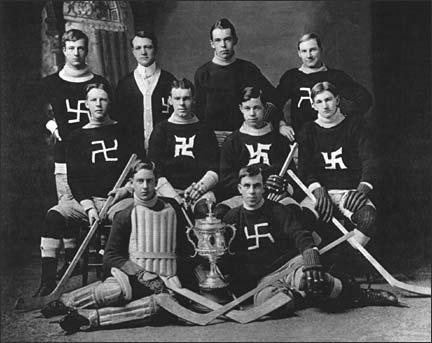
Hockey was catching on in St. John’s and by 1911 there was an acute shortage of referees. Earl volunteered to adjudicate a match between the “Post and Telegraph Department” and “Anglo-American Telegraph Company” (Evening Telegram: Evening Telegram: 24th February 1911). That sounds like a grudge match if there ever was one! The “Swastikas” – a team from Windsor, Nova Scotia, who proudly wore what was to become a Nazi symbol – visited St. John’s that month and competed in another hard-fought three match series. The City team beat them by 5 to 4 in the first match, with Earl scoring once – and getting caught off-side far too often. Still, a win is a win (Evening Telegram: 10th March 1911). The “Swastikas” won the second match but lost the third, so the St. John’s boys took the series.
Earl played for the “Feildians” in 1912 and also refereed games between other teams in the league (Evening Telegram: 30th January 1912). How he found the time, I am not sure! He was supposed to be studying for his law exams. It was not one of the “Feildians” better years, and their defeat of the “Crescents” in February caused quite a stir: “P. Winter and Pinsent particularly played dashing hockey; and the latter, after hot work had occurred in mid-rink, hooked the rubber clear, dashed away and taking a pretty shot landed the equalizer amidst thunderous applause. Both sides now put on a terrific pace and a fine exhibition of hockey was given. After 24 minutes’ play Pinsent again found the net. A dispute cropped up as to whether the rubber had gone into the net but the referee awarded the goal” (Evening Telegram: 17th February 1912). The “Swastika’s” returned later that month for another three game series which – with Earl again playing his part – was once again won by the home team. Both teams were invited to attend a dinner, the following day (Evening Telegram: 1st March 1912) and, although the City was hardly starved of hockey, one of the local organizers pleaded for the Nova Scotians to stay for another game.
Earl played for the “Feildians” at the start of the 1913 season and the team got off to a good start – beating “St. Bon’s” 16 – 2 (Evening Telegram: 24th January 1913); however, they were beaten by the previous year’s champions, the “Crescents” 10 – 1 a few days later (Evening Telegram: 28th January 1913), which must have brought them back to reality. The team had mixed results that year. Nevertheless, Pinsent was once more called upon when the “Wanderers” came to town from Halifax for a series in mid-February. The City team won all three games with Earl doing his fair share, particularly in the second match: “Some good play was witnessed on both sides until Pinsent got up steam. And getting away like a cyclone, essayed a shot to Stensend, which he was unequal for and the second goal was recorded for the home team” (Evening Telegram: 22nd February 1913).
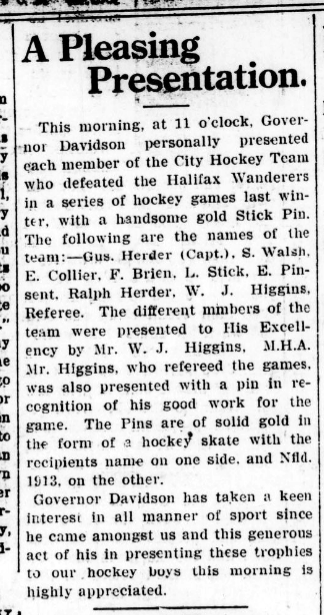
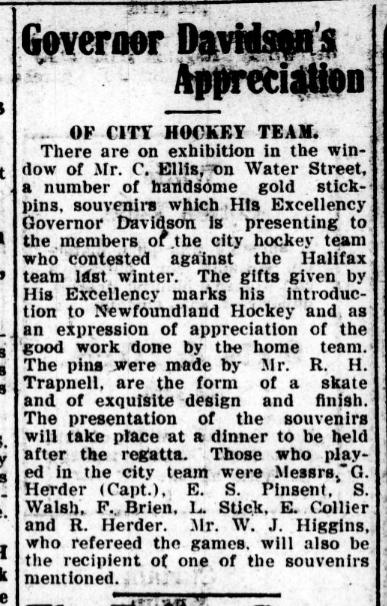
His Excellency, the Governor of Newfoundland was so gratified by the performance that he gave each member of the winning team a handsome gold stick pin as a souvenir of their achievement (Evening Telegram: 12th November 1913).
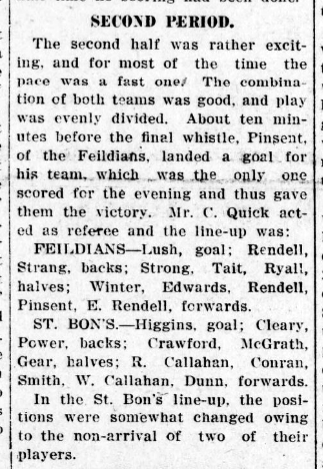
Earl could well have retired at this point but he decided to keep going for another year. However, he missed much of the season through injury (Evening Telegram: 14th February 1914). The “Feildians” had a mixed year – loosing matches they could/should have won and winning others they had expected to lose. That is hockey for you.
Newfoundland lost more than its fair share of young men during the “First World War” and the league was severely depleted. Earl retired as a player, but he kept his skates on and occasionally refereed matches (Evening Telegram: 3rd February 1915).
When he was not playing ice-hockey, Earl could be found playing football (soccer). He started out playing inside left for “Bishop Feilds College” in 1903 (Feildian 1903: Vol 11. Nos 1 &2) and was “Secretary” of the soccer team the following year (Feildian 1904: Vol. 12, Nos 1&2). As with hockey, the “Feildians” played in an inter-collegiate league that included teams from “St. Bonaventures” and the “Methodist College”. These games were reasonably well covered by the press – particularly the “Evening Telegram”. Earl played for the “Feildians” in 1905 and was on the team that lost (3 – 2) to “St. Bon’s” in October – despite his having scored a goal (Evening Telegram: 17th October 1905). That was not a particularly good year for the team.
When he was not playing he could be found acting as a “linesman” when other teams met, and he was on duty when “St. Bon’s” defeated the “Collegians” in November (Evening Telegram: 13th November 1905). The “Feildians” – those “boys in blue” again – were back on the pitch in 1906 (Evening Telegram: 13th July 1906) but it was “St. Bon’s” who won college cup that year. Earl attended the Inter-Collegiate Football League dinner – where he was presented with a knife for “his prowess in the Inter-Collegiate paper chase which took place last Saturday” (Evening Telegram: 23 November 1906).
The “Newfoundland Football League” was formed in St. John’s in around 1896 but, unlike its hockey equivalent, it was less elitist and included teams from diverse backgrounds. The “Old Feildian” football team won the league in 1907 but (to everyone’s surprise) lost to a newly formed team, the “Star’s” by 3 – 2 at the league’s “St. George’s Field” ground in June 1908 (Evening Telegram: 13th June 1908). They lost another match a week later but won against the “C.E.I”. by 4 – 2 at the end of the month. Note: “Pinsent made a good run and from right wing sent the leather between the posts scoring fourth for his team” (Evening Telegram: 30th June 1908). The “Feildians” won against the “Collegians” a few days later and the “B.I.S.” a week after that – “Pinsent watched his chance and securing the ball made a fine run down-field, got beyond Brophy, and notched up the second goal for his team” (Evening Telegram: 14th July 1908).
The “Feildians” played several more league games over the summer and the “Old Feildians” – of which Earl was a member – played a team from “H.M.S. Cornwall”, in October (Evening Telegram: 5th October 1908). It ended in a draw. It was common practice for City teams to play against crews from naval ships in the harbour and the City played the mariners again in 1909 and 1910. The City lost somewhat ignominiously (6 – 0) to “H.M.S. Cornwall” the latter year (Evening Telegram: 5th October 1910)!
At the start of the following season the “Feildians” played the “Stars” on the 11th and the “Collegians” on the 19th June 1909 (Evening Telegram). In a match against the “C.E.I.” the following month: “Then Feildians got on the run for the Institute goal, and Pinsent getting possession in the centre easily eluded Institute backs and sent, a beauty over Hayter’s head to the net. One for the Feildians seven minutes from the start” (Evening Telegram: 20th July 1909).
Earl was selected as his team’s captain the following year (Evening Telegram: 16th April 1910). This started with a goal-less draw against the “Casuals” in wet and cold weather in June (Evening Telegram: 24th June 1910). It, and the 1911 season passed without much to cheer about; however, Earl lent his support to “College Feildians” who won the inter-collegiate championship that year (Evening Telegram: 29th November 1911). The 1912 season also past without much excitement.
Earl was injured in the first match of the 1913 season, against “St. Bons.” At one point, “On resumption the Feildians worked with old time vim and determination. Pinsent and Rendell distinguished themselves by getting in some pretty combination. The former tried hard for honours for his team and in attempting to beat St. John received a blow in the stomach and was put out of commission for a few minutes. On recovering he captured the ball, centered to Winter who in turn passed to Rendell. The latter neatly heading the leather into the twines, scoring the first goal for the season” (Evening Telegram: 6th June 1913). They had a good season that year and it was July before they went first went down to defeat – at the hands (feet?) of the “C.E.I.” (Evening Telegram: 8th July 1913).
Earl was invited out to Bell Island in August to referee the final match of the “Bell Island Football League” season. Evidently, the “Dominion Athletic Association came off victors over the Scotias by the score of 2 – 0, and in so doing carried off the championship for this year. Mr. E. S. Pinsent, Treasurer of the St. John’s Football League, was the guest of the Bell League for the occasion and acted as referee giving entire satisfaction” (Evening Telegram: 19th August 1913). I am sure he did.
The 1914 season went off without a hitch too. Earl seems to have played but also refereed matches between other teams (Evening Telegram: 22nd July 1914). However, many of the young players signed up to serve in the “Royal Navy” and/or the “Royal Newfoundland Regiment” and the teams were considerably depleted during the war. Nevertheless, the league kept going – and donated the gate proceeds to the “Newfoundland Patriotic Fund”. Earl was appointed “treasurer” (Evening Telegram: 31st April 1915). The games were, predictably, less well documented during the war-years but “Pinsent” seems to have played a few games and retired in mid-season in 1915. Nevertheless, he stayed on as the league’s “treasurer” (Evening Telegram: 7th June 1916), a position he held through to the end of the war. He was a “Feildian” at heart and was – in his capacity as a lawyer – asked to draw up a new constitution for the “Old Feildian Club” when it restructured in 1921 (Evening Telegram: 9th April 1921).
Somehow, Earl had found time to study between his time on the ice and on the football pitch. On leaving school he articled with “Messrs. Furlong & Conroy” and he passed his first set of law exams in January 1909 (Evening Telegram: 18th January 1909). He managed a social life too, and was on the “Feild-Spenser” Dance Committee that summer (Evening Telegram: 15th July 1909).
Earl and his sisters were growing up, and their parents started to take them to events at Government House. They attended a “Reception” there in September (Evening Telegram: 17th September 1909) and an “Open House” in November 1909 (Evening Telegram: 10th November 1909). They also attended similar events in later years. It was a tradition in St. John’s that the Governor of Newfoundland and the Protestant and Catholic Bishops held “open houses” on New Year’s Day and the “elite” of the city could drop by and make “New Year’s Calls.” Their names were published in the newspapers and we find that Charles and Earl paid their respects to the Governor and Anglican Bishop pretty well annually from 1908 onward, and visited all three establishments in 1910 (Evening Telegram: 3rd January 1910).
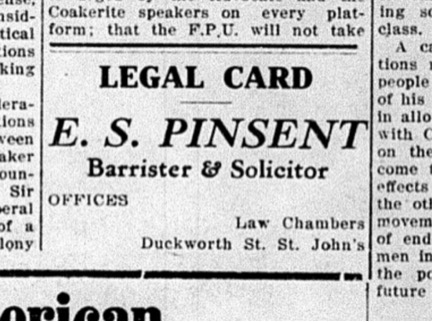
Earl Speare Pinsent was in training to be a barrister – in the footsteps of his uncle, Sir Robert Pinsent – so it is hardly surprising that he was involved in a series of debates put on by the “C.E.I.” in 1910. The subjects chosen were the “Daylight Bill” and the “Liquor Bill” (12th and 19th March 1910). Whether he was in favour or opposed I am not sure – but it hardly mattered. He passed his intermediate grade law exams in January 1910 (Evening Herald: 15th January 1910) and his final exams two years later. His hard work paid off and he was called to the bar of the Supreme Court where: “Mr. Conroy presented Mr. E. Pinsent for enrolment as a Solicitor. Mr. Pinsent was then sworn in as a Solicitor, taking also the oath of allegiance, and signed the roll of Solicitors and was congratulated by the Bench” (Evening Telegram: 14th October 1912). The following day he proudly posted his professional business card “E. S. PINSENT, Solicitor: OFFICES: Law Chambers, Duckworth St., St. John’s, Newfoundland” in the local press. One early client came to him looking for heirs! Thus: “All parties claiming to be heirs of Bridget (Brady) Fitzgerald, who died in Newfoundland about fifty years ago may learn something to their advantage by applying to E. S. PINSENT, Solicitor. Law Chambers, St. John’s, Nfld.” (Evening Telegram: 26th August 1913). He was recalled to the bar that October, when Mr. Furlong introduced him to the Supreme Court as a newly qualified barrister (Evening Telegram: 13th October 1913). He updated his business card the following day!
Earl’s elder sister, Constance, had married in 1911 but the rest of the family still attended events together. Earl joined his parents at a garden party and dance given in honour of “His Royal Highness” Prince Albert, who was a cadet aboard “H.M.S. Cumberland,” which was then visiting St. John’s (Evening Telegram: 3rd July 1913). Sadly, these family visits came to an end when his father, Charles Speare Pinsent (see elsewhere) died in 1914 and his sister Frances married in England the following year. As son and heir, Earl became head of the family and as a young professional had less time for sport.
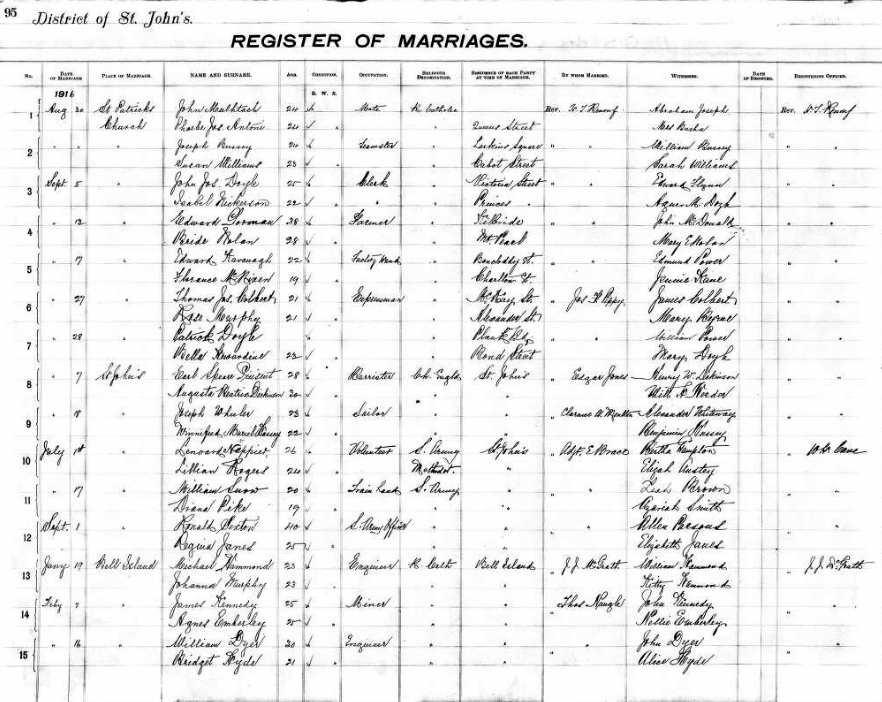
Earl married Augusta Beatrix Dickinson, in St. Thomas’s Church in September 1916. According to the St. John’s Daily Star (7th September 1916): “The groom is one of the younger lawyers and is highly esteemed by all who know him, while the bride has many friends.” “Trixie’s” sister Ethel Dickinson was her bridesmaid.
Sadly, Ethel was to die after volunteering in a sick ward in St. John’s two years later. She contracted influenza and died after a short, sudden and fierce bout of the disease (Evening Telegram: 26th October 1918). Earl and Beatrix were to have three children, Pamela Gertrude in 1917, Charles Douglas in 1919 and Ethel Reynette Pinsent in 1926. The family lived at #78 Circular Road in St. John’s.
Earl’s father Charles Speare Pinsent had been a leading light in the “Order of Freemasons” and he had been honoured in 1913 by “St. John’s Lodge No. 579, A.F. and A.M” on the occasion of the 50th Anniversary of his joining the brotherhood (Evening Herald: Saturday 6th December 1913). The then current “District Grand Master” Mr. J. A. Clift, K.C., who was clearly a friend of the family, was one of the first to offer his congratulations. Earl eventually bowed to the inevitable and, joined the masons (Lodge 579) in December 1914 (Newfoundland’s Freemason Membership Registers) – this was several months after his father died.
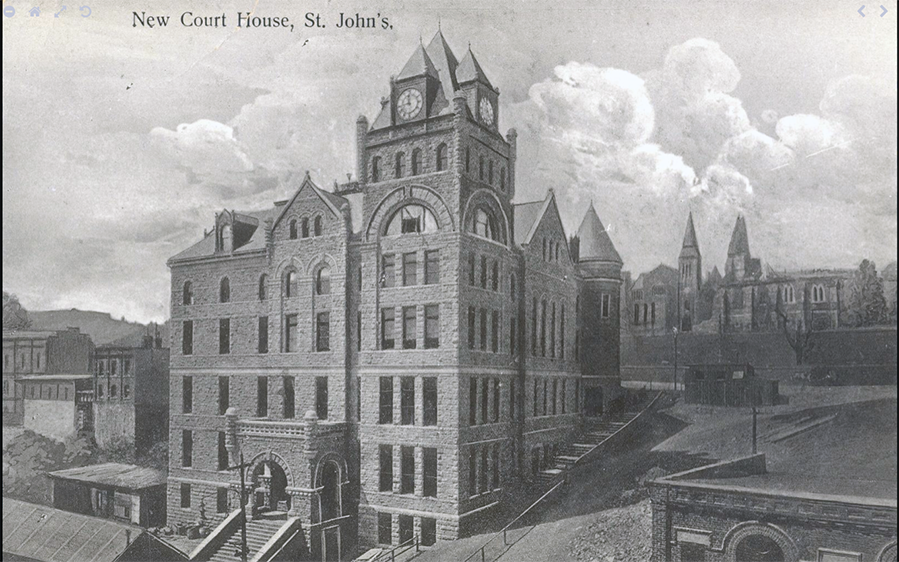
The following year (1915) Mr. Clift – who was a “senior barrister” in St. John’s – took Earl on as his junior partner and the firm of “Clift & Pinsent, Barristers and Solicitors” was formed. Earl expeditiously modified his business card (Evening Telegram: 2nd February 1915). They worked in partnership until 1923, when the Hon. Augustus Clift, K.C., C.B.E. died (Evening Telegram: 9th February 1923).
The two families had been close for years and Mr. Clift’s son John was a lawyer taking his articles under Earl when he (sadly) died, in February 1920. John Clift had been one of the first to sign up when Newfoundland entered the First World War. He had fought with distinction, attained the rank of Captain, won a Military Cross (St. John’s Daily Star: 12th February 1920) and survived -unlike so many of his contemporaries. His death must have been devastating for his father.
Earl Speare was appointed “J. D.” (whatever that was) of “St. John’s Lodge” in 1917 (St. John’s Daily Star: 28th December 1917), “S.D.” in 1918 (St. John’s Daily Star: 28th December 1918) and “J.W.” (“Junior Warden”) in 1920 (St. John’s Daily Star: 28th December 1920). The following year, he advanced to “Worshipful Master:” As the “Evening Advocate” (3rd December 1921) put it: “The new Worshipful Master, Bro. Earl Pinsent, had the unique experience of moving directly from the South to East. It is an interesting fact that exactly fifty years ago his late revered father became Master of the St. John’s Lodge and he also went in to the chair direct from the Junior Warden’s Seat”. He seems to have served as “Worshipful Master” for a couple of years.
Earl’s father, Charles Speare, had been appointed “Gentleman Usher of the Black Rod” in the Newfoundland Legislature (see elsewhere) after the collapse of the “Union Bank of Newfoundland” in 1894 and when he died in 1914 his son was asked to fill the role. Thus Earl played the traditional ceremonial role at the annual opening of the Legislature. One on-looker was to remark: “As I mounted the steps and passed in through the gang-way to the Council Chamber, I was forcibly struck by the smallness of the gathering there also. I do not think there were twenty persons present outside the officials. Mr. Earl Pinsent, the courteous young “Usher of the Black Rod” promptly conducted me to a very comfortable seat just behind the member’s desks. Presently there was a commotion in the lobby, and everybody at once knew that his Excellency was coming … “ (St. John’s Daily Star: 9th June 1915).
Earl concentrated on his professional duties. He started to appear in court (Evening Telegram: 9th May 1914) and he occasionally traveled with the Supreme Court, when it visited the outports to administer justice. He was in Grand Falls with the Court in September 1914 (Evening Telegram: 12th September 1914). Earl’s name crops up in relation to cases heard in Court or legal notices placed in the press from this date onward. Many of the items are available on-line through the University of Newfoundland web-site.
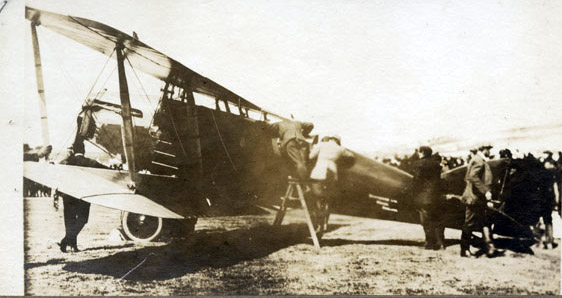
On the lighter side, Clift and Pinsent took an interest in the “Great Trans-Atlantic Air Race” when it was held in 1919, and he took time out to visit the British aviators Morgan and Raynham at Pleasantville (near Quidi Vidi Lake), as they prepared for the race (St. John’s Daily Star: Monday 14th April 1919). They attempted to take off on 18th May but their plane was over-weight in fuel and there was an adverse wind, so that it crashed on the airstrip before getting properly airborne. Both of the aviators survived, relatively unharmed, but it was Morgan’s last flight. The plane was repaired and Raynham and Biddlescombe made an attempt on 17th July 1919. This time they got airborne but were caught by a gust of wind and crashed shortly after taking off! Fortunately, neither was seriously hurt but their challenge to Allcock and Brown had unquestionable failuref (Evening Telegram: 18th July 1919).
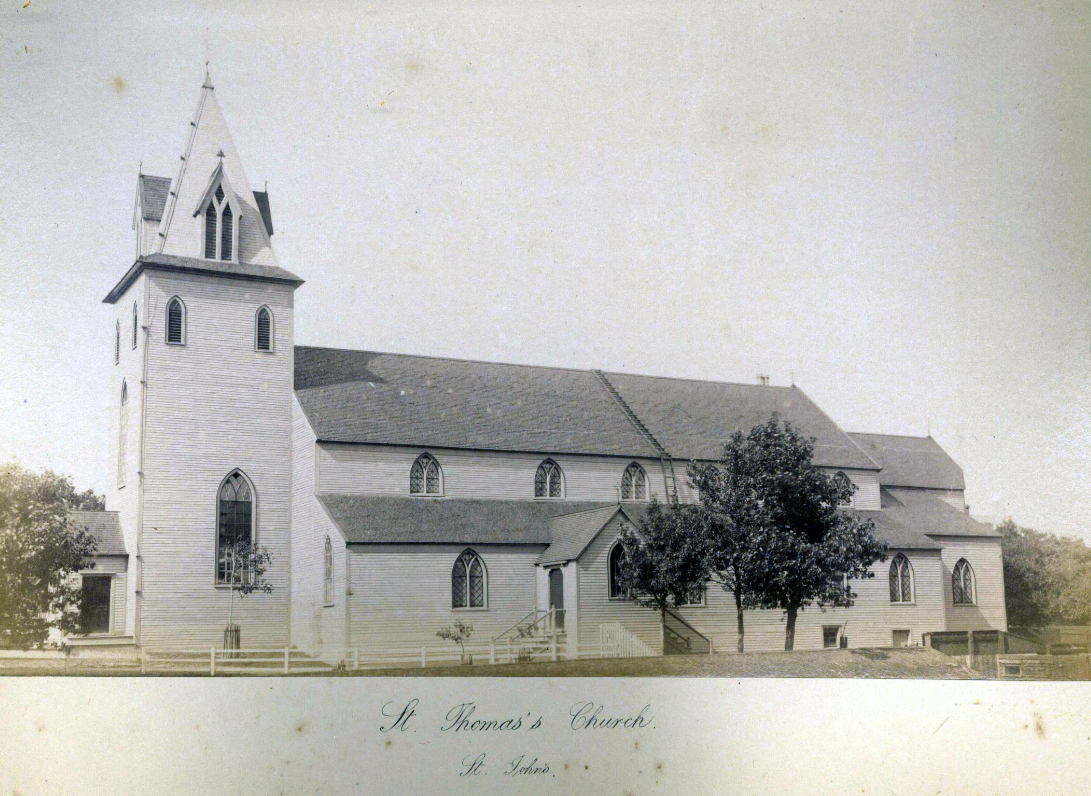
Earl’s father, Charles (and his uncle, Sir Robert John Pinsent) attended biennial “Synods” of the Anglican Church and he was similarly committed to the welfare of the church. He took on the role of “Secretary to the Cemetery Committee” of St. Thomas’s Church in St. John’s and held the position for the rest of his life (Evening Telegram: 26th April 1916). Quite a few of the family were, or were to be, buried there, including his mother who was interred after her body was returned from Hughesville in the United States in 1918 (St. John’s Daily Star: 24th July 1918).
Most of the “Secretary of the Cemetery Committee’s” work was routine. However, there were aspects of interest. Part of the designated burial ground was unused when he assumed the role and Earl wrote to the “City Council” in 1916 granting permission for its horses to pass through it while a nearby Boulevard was under repair (St. John’s Daily Star: 26th May 1916). At the same time, he tactfully asked the Council to ensure that stray paper from a nearby dump did not blow into the area. The following year he sought the City’s permission to erect a fence around the northern boundary of the cemetery – and insisted that it stop using part of the burial ground as a dump (St. John’s Daily Star: 15th June 1917)! The committee did its best to maintain the cemetery and the Anglican Church made an appeal for funds to assist them in their work in 1925. According to the “Evening Telegram”, the “present Cemetery Committee has displayed a commendable devotion to their duties as supervisors of the place. Under their direction innumerable improvements have been made in the surroundings and an effort is constantly being made to beautify the grounds and all that appertains to them.” It goes on to describe the well-kept paths and shady lanes and reminds the public of the fence construction of the past few years and the repair work on the Mortuary Chapel. It then goes on to suggest that relatives of the deceased might like to return the collection envelopes left in the various churches to their clergy – or to Mr. E. S. Pinsent, “Secretary-Treasurer” of the Cemetery Committee (Evening Telegram: 23rd July 1925). I hope they did.
Earl seems to have operated on his own account after the death of his erstwhile partner, Mr. J. A. Clift, K.C., and his practice covered a wide range of aspects – from arguing cases before the Supreme Court, dealing with probate and bankruptcy issues, and negotiating real-estate and business deals. Many of the items are described in detail in the local newspapers – should anyone be interested (Evening Telegram; Evening Herald, St. John’s Daily Star; Evening Advocate).
Earl took what may have been a business trip down to New York on “S.S. Rosalind” in April 1927 and his wife, Beatrix (a.k.a. “Trixie”), took their nine-year old son, Charles Douglas to Montreal the following year. Canada was still a separate Dominion of the Crown. They were admitted for three months.
Earl had not forgotten his English relations (or they him) and he went over to England with his wife in 1933. Two years later, he went over with his daughter Pamela, who was by then a “student.” He may have been dropping her off at college as ship’s manifests show she returned to St. John’s in July in both 1936 and 1937. In the latter case, she arrived a matter of weeks after her mother died. On the first occasion, when Earl returned to St. John’s on the “Furness Steamship Lines” ship “Nova Scotia” on 10th October 1935 he gave his last residence as being “Higherfield, Horrabridge, S. Devon” – which was where his cousin Francis Wingfield Homfray Pinsent lived.
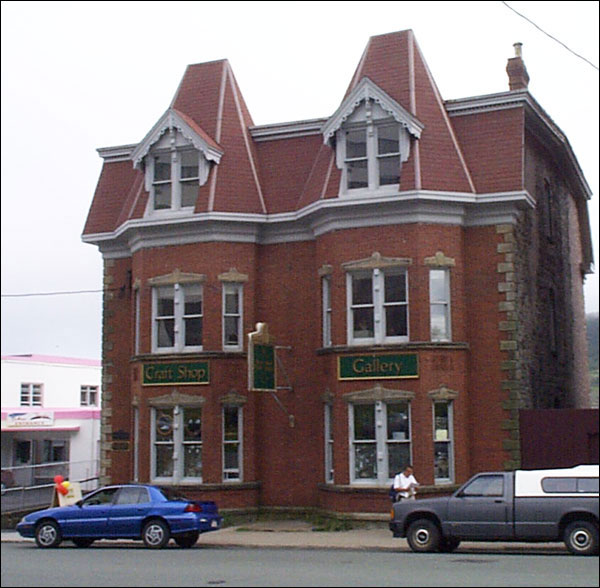
In 1937, Earl’s family lived at “Devon House” (N0. 59 Duckworth Street) (Earl Speare Pinsent: Who’s Who in Newfoundland: 1937) – and this was probably their home throughout the war (Newfoundland, Canada Census: 1945). However, they had moved to King’s Bridge Court by 1953 (Canada, Voters Lists: St. John’s East) and that is where Earl died. Somehow “Devon House”, which currently belongs to the “Craft Council of Newfoundland and Labrador,” survived the great fire of 1892.
Augusta Beatrix (née Dickinson) predeceased her husband. She died in June 1937 and was buried in the Anglican Cemetery. She left her estate, and the care of her still relatively young children, in her husband’s hands. The following year, Earl took time off from work and went down to Bermuda. From ship manifests we know that he left St. John’s for New York on the “S.S. Fort Amherst” on 18th March and arrived back in New York after leaving Hamilton on the “S.S. Georgic” on 9th April 1938 (New York Passenger Lists: 1820-1957: Ancestry.com). On his return, Earl settled back into his law practice.
Earl re-married in September 1940. He married Phyllis Ruth Hadwill, a Canadian from Montreal, in Quebec (Quebec Vital and Church Records). There were no children from this second marriage – that I am aware of. His son Charles Douglas Pinsent, meanwhile, attended “Bishop’s Feild College” and “King’s College” in Windsor, Nova Scotia (an affiliate of “Dalhousie University” in Halifax) and grew to be as noted a sportsman and lawyer as his father – (see elsewhere). Charles was articled with his father in October 1937 and was called to the bar in October 1943. The two of them went on to practice law together under the title of “Pinsent and Pinsent”.
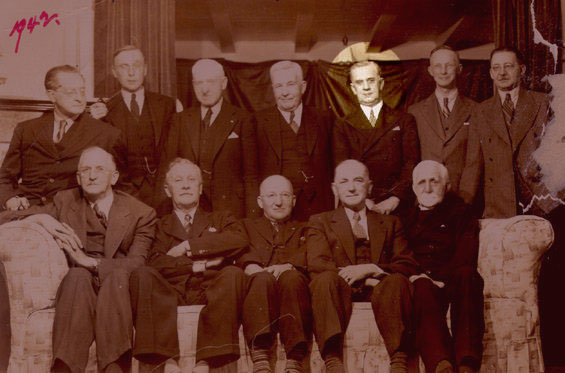
After the Second World War, Earl seems to have acted more as “solicitor” than a “barrister” and his firm was less in evidence in the Law Courts and more visible through its probate and its business related work. The “Newfoundland Wills Books” list many of their filings and the St. John’s newspapers printed their formal business notifications. He was well known in business, legal and masonic circles and he appears (representing the masons) in a photograph entitled “Group of Twelve Prominent Businessmen” taken in 1942 and viewable online through the “Maritime History Archive at Memorial University”. It is shown above.
Earl had taken up the sport of curling pre-war and he also appears, in his capacity as manager of “St. John’s Curling Association,” in a photograph published in the Western Star on Saturday 7th April 1945. Earl and Phyllis took a trip down to the States later that month (April). They may have been going down to visit his sister in Maryland. They took a flight from Montreal to Buffalo en route to New York. The American immigration officials described Earl as being “5ft 8in tall with a medium complexion, grey hair and brown eyes”. Time was catching up with him!
During the war, Earl became a “Notary Public” and an authorized “Accident Insurance Agent” (Western Star: Saturday 25th November 1944) and he was a “Queen’s Council” by the time he was “reelected to the Bench for another term” in February 1953 (Daily News: 12th February 1953). Earl was getting on in years and he brought in another partner, William Gilbert Adams in April 1953. The firm of “Pinsent, Pinsent & Adams” proposed to practiced from an office in the Royal Bank Chambers on Water Street (Daily News: 15th April 1953). However, Charles Douglas Pinsent died a month later (see elsewhere) so the firm had to be rebranded as “Pinsent and Adams”(Daily News: 29th July 1953). Sometime later, Mr. Adams left Earl to create the firm of “Noel and Adams.”
Earl was a member of the “Divisional Executive of the Canadian Red Cross Society” (Daily News: 27th February 1953) and, of course, a stalwart on the “Cemetery Committee” (Daily News 5th April 1954). Both he and Phyllis contributed to charitable causes such as the “Red Cross”, “Church of England Orphanage” (Daily News: 27th November 1953), the “Y.W.C.A.” (Daily News: 3rd November 1953), “St. John’s Ambulance” (Daily News: 25th March 1954) and others.
Earl was appointed to the “Newfoundland Board of Insurance Underwriters” in October 1955 (Daily News: 11th October 1955). The firm of “Pinsent & Coady” was formed in 1957 (Daily News: 18th December 1957) but it did not last long. Earl was nearing the end of his days and it may have been dissolved in September 1858 (Daily News 30th September 1958) in order to simplify matters.
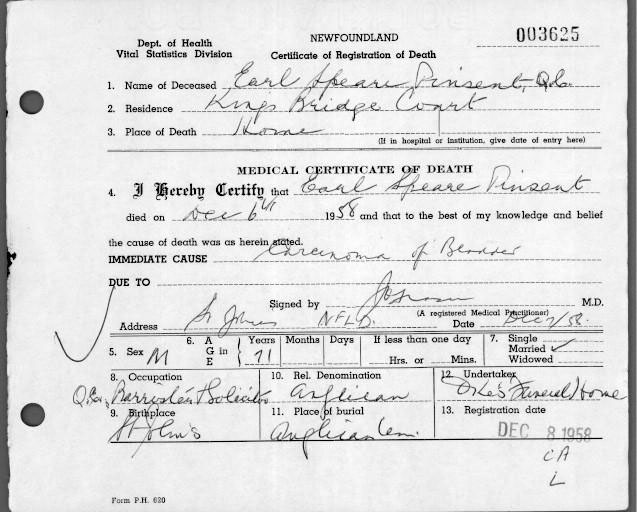
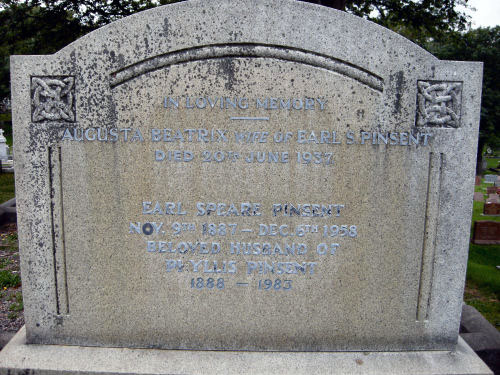
Earl died on 6th December 1958 (Daily News: 8th December 1958) and was buried in Forest Road Anglican Cemetery in St. John’s. The contents of his office on Water Street was auctioned off in February the following year (Daily News: 23rd February 1959).
His wife, Phyllis (née Hadwill) and her housekeeper, Mary Connor stayed on in the family home at #4 King’s Bridge Court (St. John’s Voters Lists) after Earl died. Phyllis died there in 1983 and was buried with her husband. Earl had been predeceased by his son, but his daughters Pamela Gertrude, who had married an “architect”, Robert F. Horwood, in 1948 and her younger sister, Ethel Reynette, who had become engaged to Herbert Hall (Daily News: 25th November 1955) – and presumably married him shortly afterwards – were still around.
Family Tree
Grandparents
Grandfather: Robert John Pinsent: 1798 – 1876
Grandmother: Louisa Broom Williams: 1808 – 1882
Parents
Father: Charles Speare Pinsent: 1838 – 1914
Mother: Blanche Brown: 1850 – 1918
Father’s Siblings (Aunts, Uncles)
Mary Speare Pinsent: 1833 – 1833
Robert John Pinsent: 1834 – 1893
Thomas Williams Pinsent: 1837 – 1890
Charles Speare Pinsent: 1838 – 1914 ✔️
Louisa Williams Pinsent: 1841 – 1921
Mary Elizabeth Pinsent: 1844 – xxxx
William Burton Pinsent: 1846 – 1846
Male Siblings (Brothers)
Earl Speare Pinsent: 1887 – 1958 ✔️
Please use the above links to explore this branch of the family tree. The default “Next” and “Previous” links below may lead to other unrelated branches.