Vital Statistics
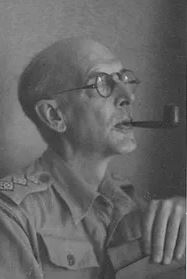
Cecil Ross Pinsent: 1884 – 1963
Family Branch: Devonport
PinsentID: GRO1100
References
Click here to view close family members.
Cecil Ross Pinsent was Adolphus Ross’s second son by Alice Mary (née Nuttall). He was born in Montevideo, Uruguay, in 1884 but his parents returned to England, so he grew up there. He was educated at “Marlborough College” in Wiltshire, where he was a contemporary of his cousin, Roy Pinsent. Cecil won a bursary to the “Architectural Association School” in London and later became a highly regarded “garden architect” in Italy.
His life is described in a book entitled “An Infinity of Graces” written by Ethne Clarke (published by W. W. Norton & Company, New York and London, 2013). I admit, I have not yet read it. Michael Spens, who reviewed the book, (www.studiointernational.com) and an observation on the “Foundation for the Preservation of Art” website tells us that Cecil was accepted into the “Royal Academy of Architecture” in 1905. The “Royal Institute of British Architects” has in its possession in its “British Architectural Library,” Cecil’s photograph albums for the years 1904 and 1905. I have not seen the albums, but I have one photograph – a family grouping – see attached. The albums they are said to contain several other family-related photographs, as well as numerous architectural studies. Cecil’s cousin, Clive Pinsent, is specifically mentioned (Worldcat.org: – OCLC No:943157680). He was of a similar age and shortly to join the Royal Navy.
Cecil traveled to Florence to study classical Italian architecture in 1906. He visited the “Villa Gamberaia” and was strongly influenced by the symmetry of structure and design of its Renaissance garden. While in Florence, he met Edmond Houghton, an elderly British gentleman and his wife Mary and, if R. Terry Schnadelbach in his book “Hidden Lives – Secret Gardens: The Florentine Villas Gamberaia, La Pietra …” is to be believed, he entered into a ménage à trois with them – to the point where he was commonly referred to as their “adopted son”. Houghton gave him his first architectural contract – designing his sister’s home in Bournemouth.
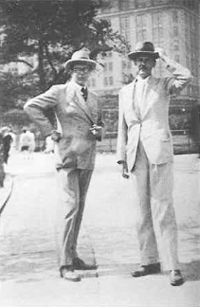
However, Cecil’s first major contract came from American art historian Bernard Berenson and his wife, Mary, in 1909. Cecil Pinsent and Geoffrey Scott (another Englishman) were hired to design and rebuild their “Villa I. Tatti”, near Florence. The garden is among Cecil’s best-known architectural achievements. Monty Don (a modern-day authority on garden design) describes his geometric designs and clever usage of trees and hedges. Evidently, any flowers that might have existed in an Italian Renaissance garden were long gone by the time Cecil arrived on the scene (BBC: Monty Don’s Italian Gardens: Episode 2: 2011; www.siteandinsight.com/tag/cecil-pinsent/). Bernard Berenson donated the villa to “Harvard University” in the 1950s and it is still in its hands.
Cecil was in Florence at the start of the “First World War,” and he joined the “British Red Cross” and ran a “Mobile X-ray Unit”. He probably stayed on in Florence as he organized the scenery and lighting for a charity performance put on in aid of the English Branch of the Red Cross in Villa Medici, Fiesole, near Florence in November 1915 (The World: 30th November 1915). After the war, he joined a group of like-minded, artistic ex-patriots in Florence and continued his work on Italian gardens.
Cecil visited New York for about a month in 1929. Whether he was visiting friends or making contacts (or both) is unclear. The relevant ships’ manifests (findmypast.com, ancestry.com) describe him as being a “broker” on the way out to America and an “architect” on the way back to England. Either way, contracts soon followed. He was hired by a wealthy American, Iris Origio to redesign and rebuilt “La Foce” in the Val D’Orcia southwest of Florence. He built on his reputation for designing Italian-Renaissance style gardens using blocked out shapes and hedging but, at her request, added more colour. Evidently, he had an eye for fitting gardens into their natural landscape and he was elected a “Fellow” of the “Royal Institute of British Architects” in 1933. Monty Don describes the garden at “La Foce” in his BBC review of Florentine Gardens. The current owner – who knew Pinsent when she was young – describes him as being a tall man with a dry, English, sense of humour. He worked at “La Foce” throughout the 1930s. He had only just finish it before the “Second World War” broke out.
Cecil had retired to Warborough, in Oxfordshire, and he signed on there as an “Air Raid Warden” when the time came (1939 Register). When filling out the forms, he noted his profession and ability to speak Italian and, although he might have hoped for peace and quiet in Oxfordshire, it was not to be. He was called into service in 1943 and became one of Britain’s “Monuments Men” (Monuments, Fine Arts and Archives personnel). He must have lived a similar sort of life as that portrayed by George Clooney, Matt Damon and Bill Murray (perhaps without the heroics) in the film of that name, released in 2014.
“Captain” Cecil Ross Pinsent worked with the American Army as it fought its way through Tuscany and his typed field reports are held by the “American Commission on the Protection and Salvage of Artistic and Historic Monuments in the War Area” (www.Fold3.com – Robert Commission: 1943 – 1946). He describes the damage done by the departing Germans (and, presumably, by allied artillery and bombers) – including the destruction of the bridges in Florence, and he comments on the architectural significance of the various antiquities that were either damaged or lost.
On 24th September 1944, Capt. C. R. Pinsent, MFA&A, AMG, wrote a letter regarding “Complication in Protection of Antique” (United States Army in World War II: Special Studies: Civil Volume 8: by Harry L. Coles: p. 424: City of Florence, to Perkins, ACC Files, 10000/145/71). In it, he describes the work of “U.S. Army Engineers” and local workers in saving the facades and a tower in “Via Guicciardini” and “Via Por Santa Maria” and goes on to explain that he has been to assess damage at local villas and found that many have been neglected for so long or been rebuilt to such an extent that they do not warrant an “Off Limits” notice, as any damage would be irremediable. One had been used as a stable. After the war, he continued to work in Italy for a while, but he eventually returned to England.
He had fully “retired” by the time he took another trip to New York in 1950 (New York Passenger Lists: Ancestry.com). He later moved to Switzerland, where he died at Hilterfingen, Thunersee, in 1963. His will was probated in London the following year: his effects were valued at £29,439.
I have not read her book, but Spens quotes Ethne Clarke as saying that Cecil was an attractive man with many female suitors and that he pursued other women. However, Schnadelbach (above) makes it clear that he was bisexual. The Police Constable who charged four young men, including Cecil, of “causing an obstruction” walking around “Leicester Square” in London arm in arm after a concert in 1913 probably knew what he was looking at. On that occasion, however, the Magistrate felt the Constable had been overly aggressive and rejected the charge (Sheffield Evening Telegraph: 30th October 1913). Cecil never married.
Family Tree
GRANDPARENTS
Grandfather: Richard Steele Pinsent: 1820 – 1864
Grandmother: Catherine Agnes Ross: 1830 – 1906
PARENTS
Father: Adolphus Ross Pinsent: 1851 – 1929
Mother: Alice Mary Nuttall: 1855 – 1901
FATHER’S SIBLINGS (AUNTS, UNCLES)
Richard Alfred Pinsent: 1852 – 1948
Edith Mary Pinsent: 1853 – xxxx
Hume Chancellor Pinsent: 1857 – 1920
MALE SIBLINGS (BROTHERS, Half-Brothers)
Sidney Hume Pinsent: 1879 – 1969
Gerald Hume Saverie Pinsent: 1888 – 1976
Basil Hume Pinsent: 1911 – 2000
Please use the above links to explore this branch of the family tree. The default “Next” and “Previous” links below may lead to other unrelated branches.