Vital Statistics
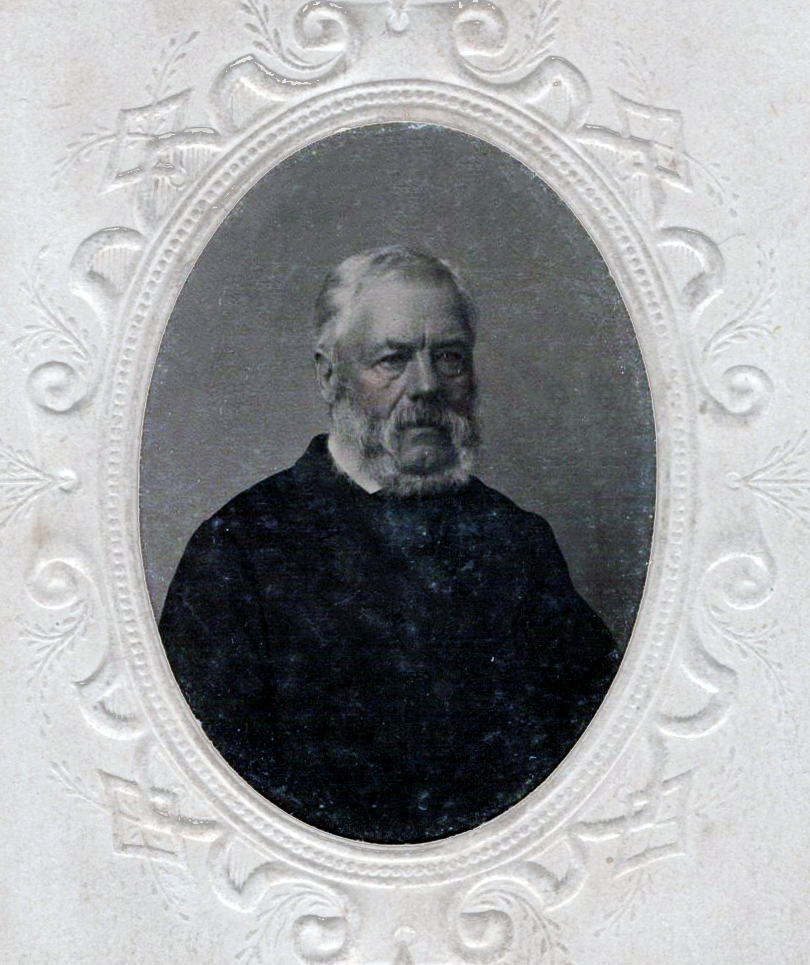
Robert John Pinsent: 1798 – 1876 GRO0748 (Merchant and Magistrate, Newfoundland)
Louisa Broom Williams: 1808 – 1882
Married: 1828: St. John’s, Newfoundland
Children by Louisa Broom Williams:
Mary Speare Pinsent: 1833 – 1833
Robert John Pinsent: 1834 – 1893 (Married Anna Brown Cooke, St. John’s Newfoundland, 1856; Emily Hetty Sabine Homfray, Hungerford, Wiltshire, 1872)
Thomas Williams Pinsent: 1837 – 1890 (Married Sophia Milroy, xxxx, xxxx)
Charles Speare Pinsent: 1838 – 1914 (Married Blanche Brown, St. John’s Newfoundland, 1883)
Louisa Williams Pinsent: 1841 – 1921 (Married Charles W. Green, St. John’s, Newfoundland, 1891)
Mary Elizabeth Pinsent: 1844 – xxxx (Married Joseph Hatch, Christchurch, New Zealand, 1882)
William Burton Pinsent: 1846 – 1846
PinsentID: GRO0748
Family Tree: Hennock
Click here to view close family members.


Robert John Pinsent was the only surviving son of John Pinsent by his wife Susanna (née Speare). He was born and baptized in St. Marylebone Parish and brought up in London with three sisters (Mary Speare, Susanna Speare and Elizabeth Pinsent). The children were all baptized on the same day.
Robert John’s father was nominally a baker; however, along with his elder brother, William, he also ran a shipping business in support of the Newfoundland cod fishery.
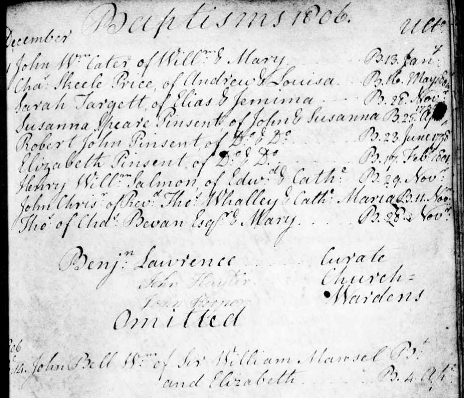
John died in 1821 and his son inherited most (but not all) of his interest in the family firm: “William and John Pinsent of Portman Square, London.” He seems to have been given the right of first refusal to negotiated with the rest of the family to acquire the rest – and, to a large extent, he seems to have done so. His father’s executors sold off the bakery and the London end of the shipping business and – after seeing his mother and his sisters settled in Devon – Robert John moved to Newfoundland to help out his then elderly uncle in Port de Grave.
Colonial Office records tell us that Robert John was living in Port de Grave and actively involved in the family business there by 1827; so it is not so surprising that the “Encyclopedia of Newfoundland and Labrador” (and other Canadian sources for that matter) mistakenly show that he was William’s son – and that he was born in Conception Bay, Newfoundland. He was not!
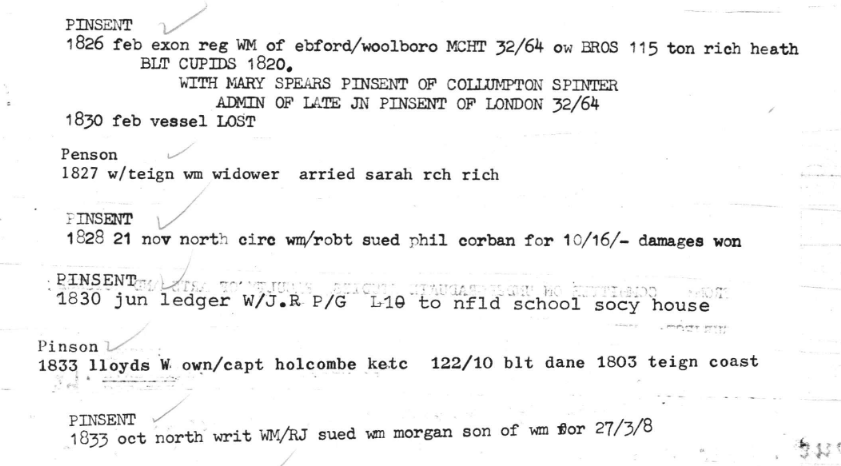
Robert John joined his uncle William in suing Philip Corban for £10 16s at a sitting of the “Northern Circuit of Newfoundland Surrogates Court” in 1827. They won. A quick look at the “Keith Matthews Name Index” in the Maritime History Archive at Memorial University in St. John’s and at contemporary newspapers shows numerous cases of debt and bankruptcy in those days as the “truck” (credit) system – by which the out-port fishermen bought their supplies – could lead to financial ruin for both fisherman and merchant, if and when the fishery failed. It is worth noting that Keith Matthews used copious abbreviations and I take W./R.J. to mean William and Robert John! It is worth noting the presence of “Pensons” and “Pinsons” intermixed with the “Pinsents” in Professor Matthew’s notes. They are not always properly differentiated.
The family firm was operated under the name of “William and Robert John Pinsent” from 1827 onward; however, its senior partner was ready to retire. William returned to England in the early 1830s and died in Teignmouth, in Devon, in 1835. Robert John (and to a lesser extent his sister Mary Speare Pinsent) carried on the shipping business with William’s widow, Amy. They must have hoped and expected that William and Amy’s young son William would take over the business when he came of age; however, it was not to be. The boy died in 1840 and his mother passed away the following year.
Robert John executed her will and acquired his late uncle’s property in Port de Grave and Cupids: “I give and bequeath to Robert John Pinsent, Esquire of Brigus, Magistrate, his heirs and assigns all that part of the rooms and premises formerly belonging to my late husband and his brother John (under the firm of John and William Pinsent) situate at Port de Grave and Cupids Newfoundland, which I possess or to which I have or may have any claim or title whatsoever and whereas there are some unsettled accounts existing between the said Robert John Pinsent and myself and my late husband and my lately deceased son, I will and declare that I fully acquit and discharge him the said Robert John Pinsent his heirs executors and administrators from all claims and demands whatsoever on account of the same.”
Robert John Pinsent was said to be “of Port de Grave” when he married Louisa Broom Williams in St. John’s Anglican Cathedral in 1828. She came from a well-regarded family and the marriage probably did much to raise the family’s social standing as it linked Robert John to four of St. John’s’ most prominent families (Williams, Vicars, Rennie and Blackman) and indirectly to a fifth (Monier).
Interestingly, one of Louisa’s aunts on her father’s side, Anne Williams, had married a Colonel Skinner of the Royal Engineers and – according to correspondence between my grandfather (Francis Wingfield Homfray Pinsent) and a Major Haldane Macfall in 1924 – one of their descendants, a Kathleen Boyce, later married Major John Ryland Pinsent of the Royal Engineers. He was one of Sir Richard Alfred Pinsent’s sons and a prominent member of the DEVONPORT branch of the family.
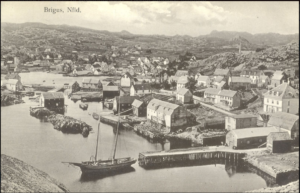
Robert John and Louisa lived in Port de Grave in the early 1830s but later moved to Brigus. They had three sons (Robert John (later Sir Robert), Thomas Williams and Charles Speare Pinsent) and two daughters (Louisa Williams and Mary Elizabeth Pinsent) who grew up in Brigus and, still later, in Harbour Grace. The boys eventually moved to St. John’s. Their lives are discussed elsewhere.
George Bussey, a local “planter” (landowner), left Robert John Pinsent, Robert Prowse (a neighbour and fellow merchant) and William B. Row of St. John’s, £200 in trust for his “infant” (12 years old) son Abraham in 1831. This was while the family was living in Port de Grave. The trustees committed to look after the boy and to ensuring that he received his estate in good order at age 21 years.
Robert John ran for office when the Colony elected its first assembly in 1832. However, he lost as he had yet to build up a reputation in the (Conception Bay) district (Newfoundland Times and General Commercial Gazette). Nevertheless, his supporters cried foul and claimed “combination” (i.e. “collusion”) on the part of the winners (Royal Gazette and Newfoundland Advertiser). The election and the controversy that followed raised his profile and, coincidently or otherwise, he was appointed a Magistrate the same year. They were largely responsible for running the outports, and in 1836 we find R. J. Pinsent (& Joshua Green) writing to the Acting Colonial Secretary regarding the amount of money they had been assigned to complete a bridge-building project. They had been given £120 for a job that would require £200 (Journal of the House Assembly, 1836: MUN).
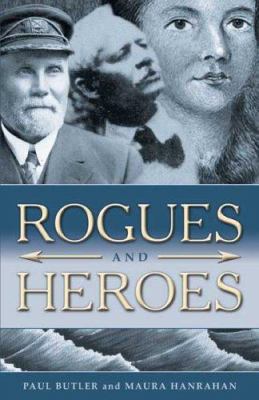
In his book entitled “The Story of Port de Grave,” Gerald Andrews describes how John Snow, a merchant from Capelin Cove, was murdered in 1833. Robert John Pinsent arrested and incarcerated the two principal suspects and put a “credible witness” in the room next to their cell to listen in on their conversation over night. The following morning, the suspects realized that they had been overheard and they asked to see “Magistrate Pinsent” to make a new joint statement. They admitted they had killed the man; however, they said they had done so at the behest of his wife! She was later tried separately and condemned to death. The incident is (apparently) described in detail in a book entitled “Rogues and Heroes” by Paul Butler and Maura Hanrahan (Flanker Press Ltd., 2009).
In 1836, he was upgraded to a “Stipendiary (paid) Magistrate and Justice of the Peace for the Northern District” based out of Brigus (Patriot: Saturday 25th June 1836), and he was also appointed “Returning Officer” for the Conception Bay area (Patriot: 17th September 1836). Newfoundland’s Electoral districts were large and politically and religiously far from homogenous: – some of the out-ports were predominantly inhabited by protestant West Country Englishmen; however, others were largely made up of Irish Roman Catholics. The two communities distrusted each other – and “incidents” were all too frequent, particularly at election time.
The Conception Bay District included Harbour Grace, Port de Grave, Brigus, Harbour Main, Western Bay and Carbonear, and polling stations were set up in each on one or more days during the month in which the elections were to be held. It was Mr. Pinsent’s duty to monitor the election in each of the communities and report on the results. It was a thankless task – as he found out in November 1836.
According to evidence presented at trial the following year, the arrival of the “Liberal” (Roman Catholic) candidates – Mr. Pack and Mr. Power, and their supporters – in Harbour Grace from the nearby community of Carbonear led to a riot. Some of the new arrivals came with sticks and, after forming up some distance away from the (predominantly Protestant) local supporters of the “Tory” candidates – Mr. Prowse and Mr. Ridley – they crowded around the hustings in an intimidating fashion. Mr. Pinsent, fearing conflict, addressed them saying that he was the “Returning Officer” and that they should conduct themselves as peaceable and honest men – to which one of the Carbonear men replied “we don’t care who the devil you are.” They then set upon the “Conservative” faction (Patriot: 18th February 1837).
Three of the men in the crowd were later convicted of riotous behaviour but Messrs. Pack and Powers were acquitted of any wrongdoing and were deemed to have won the election (The Patriot: 25th February 1837). Later, the people of Carbonear presented their side of the case to the “Right Honourable and Honourable the Knights, Citizens and Burgesses of Great Britain, in Imperial Parliament Assembled” and asked for the sentences given to their comrades be reduced (Patriot: 11th March 1837).
Evidently, the road was rough – they needed walking sticks! Mr. Pinsent’s testimony at the trial annoyed the more extreme “Orange Magistracy” which had presumable hoped for more fire and brimstone, and they refused to attend when the next Quarter Session at Port de Grave was called. Robert John waited for them but, in the absence of a quorum, dismissed the Grand Jury without having been able to address any of the charges on the docket (Patriot: 27th May 1837). This breech of attendance protocol did not go unnoticed. The House of Assembly asked the Governor to table the correspondence between Robert John and the other magistrates (Patriot: 8th August 1837).
One of the representatives for Conception Bay died in 1840, and Robert John was once again appointed “Returning Officer” (Patriot: 24th August 1840) – although not without some grumblings in the press ahead of time (Patriot: 18th August 1840). This time, the election went off without a hitch (Patriot: 21st November 1840) after Robert John made “a short address, delivered in his usual gentlemanly and ingratiation manner, giving praise to all for their becoming conduct during the nomination of the candidates, and trusting that the same praiseworthy spirit might characterize their proceedings during the whole term of the Election, a recommendation which was assented to by universal acclaim” (Patriot: 21st November 1840). This may not have been entirely true, a letter posted in the London Times the following January (7th January 1841) claims that “a Mr. Ash of Carbonear had his house attacked by the mob who commenced tearing it down; he warned them off in vain, and then fired a volley of sealing guns, knocked over six men and put the rest to flight; they contrived, however, to get his house on fire, and he in it, and it is now a heap of smoking ashes; the returning officer, Mr. Pinsent, was frightened and fled. One hundred soldiers were sent off today, but it was too late when all the mischief has been done”. Robert John was known to have been reluctant to send in the troops, fearing bloodshed, but to say he “fled” seems a bit over the top.
Robert John’s nephew, William, died in 1840 and his aunt Amy died the followed a year; which left him to deal with the shipping business. He offered to lease his “…very commodious House, Shop, Stores and Mercantile Premises, situate at Port de Grave and Cupids formerly occupied by the subscriber, and very recently by the late Mr. William Pinsent. These premises are now advertised for lease in consequence of the decease of Mr. William Pinsent in November last. A most eligible opportunity is offered to any respectable person inclined to engage in a moderate-sized mercantile business, in a desirable Outport, as the dealers and other connections in the trade of the late occupant are still available to a successor, and the whole Premises and also the necessary utensils of business, are in perfect good order and condition. Further particulars may be obtained by application to Messrs. McBride & Kerr, and the Rev. Charles Blackman, St. John’s, or to the Subscriber at Brigus: Robert John Pinsent: April. 2”(Public Ledger: 16th April 1841).
Not long after this, “His Excellency the Governor” offered him the position of junior “Stipendiary Magistrate” at Harbour Grace. It was a larger community and a promotion (Patriot: 3rd July 1843). He moved his family to Harbour Grace (a.k.a. “Harbor Grace”).
It was a convention in Newfoundland to write letters of appreciation to British functionaries when they left for home at the end of their tour of duty. These, like the “Flattering Testimonial” that Robert John and others wrote to Lieutenant Walter Sartori Bold Esq., who had been in charge of the military detachment in Harbour Grace, frequently made their way into Newfoundland newspapers and, less frequently but as in this instance, into English papers (City Chronicle: Tuesday 9th July 1844).
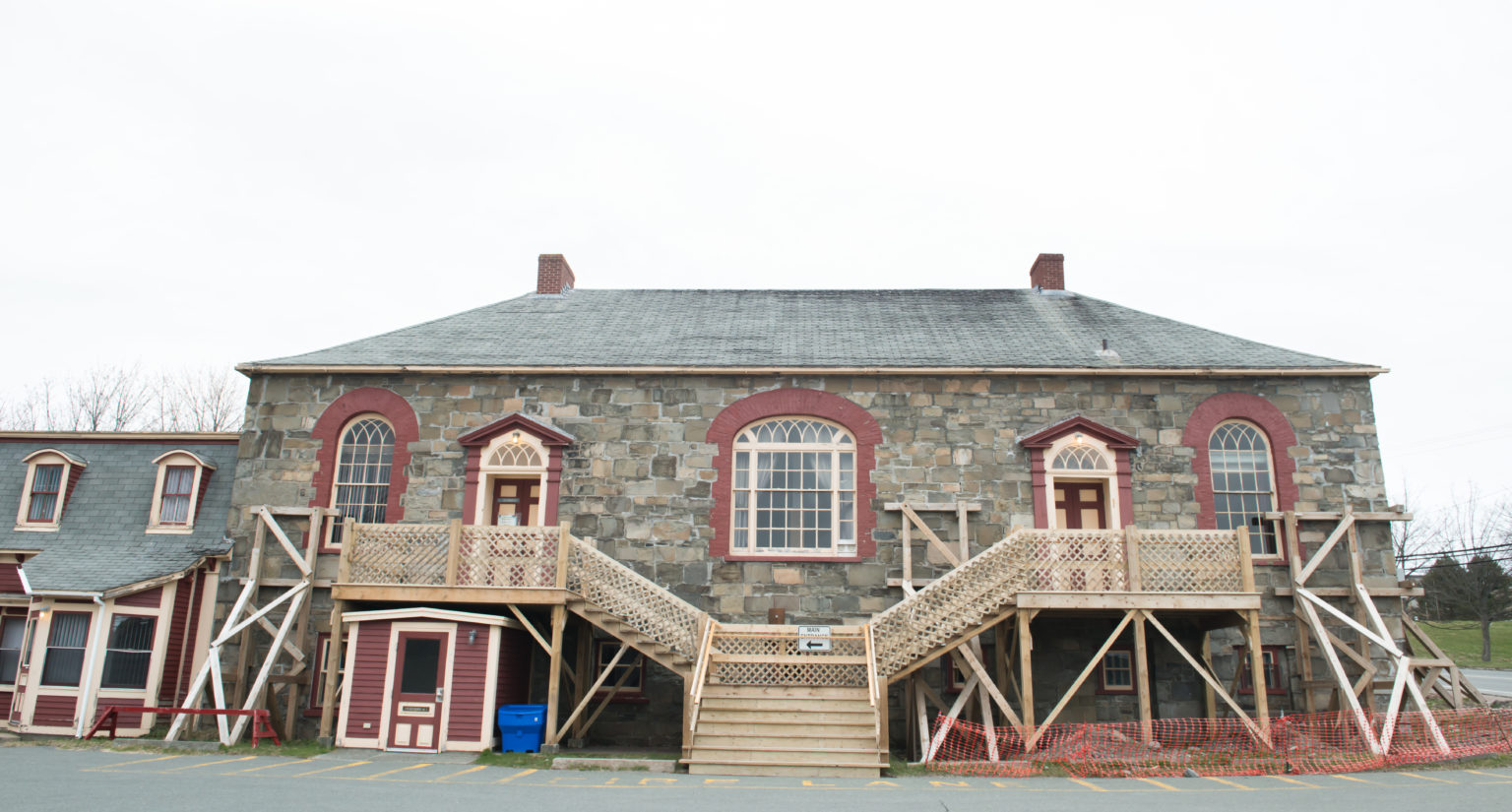
Robert’s new position kept him busy. In 1845, the magistrates attempted to stamp out abuse of “An Act for the relief of sick and disabled Seamen, Fishermen and Other Persons” by demanding that anyone collecting such money from the public purse should show them their accounts (Weekly Herald: 1st January 1845) – and by asking people to attend a meeting to review and examine the returns of the 1845 Census in the Conception Bay District (Weekly Herald: 16th July 1845). On a lighter note, he was asked to escort His Royal Highness Prince Henry of the Netherlands, the Governor and other notables around the Court House (Weekly Herald: 20th August 1845).
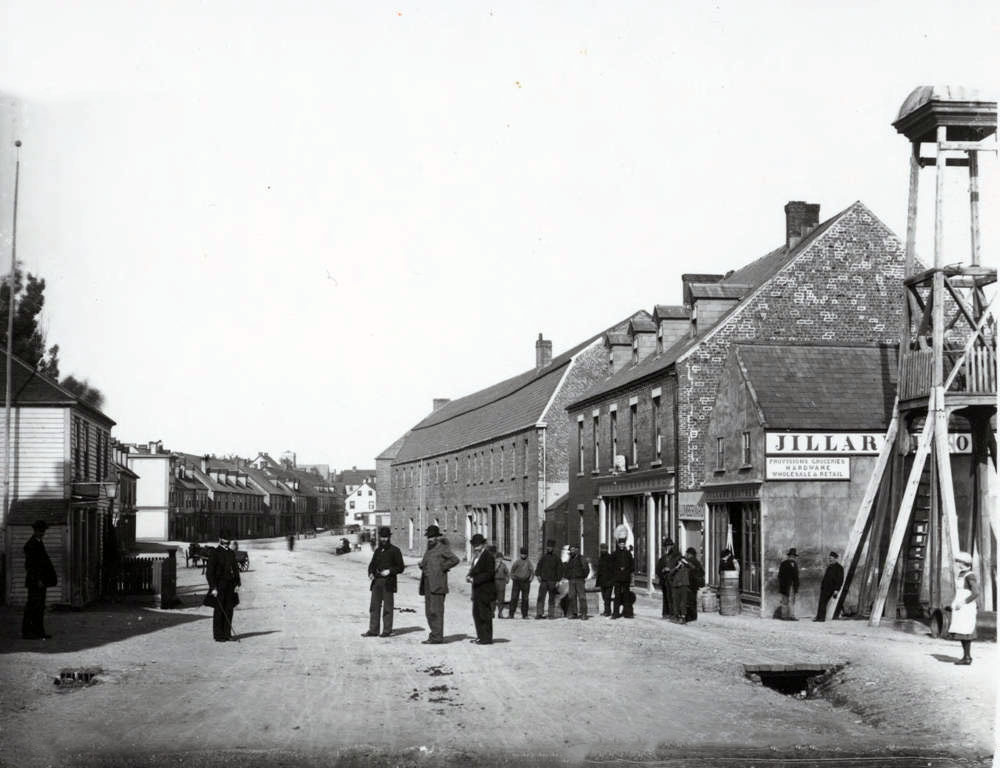
Harbour Grace was growing, and in addition to their legal function the magistrates were called upon to act as urban planners. In August 1845, James L. Prendergast, Robert J. Pinsent and William Stirling, Esq., were appointed Commissioners for the laying out and construction of a new street to be called Harvey Street (Patriot: 20th August 1845). Other streets were added later (Weekly Herald: 28th August 1850).
The threat of fire was an ongoing issue as many of the buildings in Harbour Grace were made from wood, so the magistrates looked favourably on a request from fire wardens in 1847 that six pence in the pound be added to the rates to pay for fire fighting services (Weekly Herald: 29th September 1847). What the town needed was a well organized street system with some wide enough to form firebreaks, and the Commissioners were authorized to purchase the land needed to make the changes (Weekly Herald: 7th May 1851). It was an ongoing issue. Robert John was also called upon to assist in laying out another street, Water Street, in 1858 (Evening Herald: Monday 24th May 1858).
Another sign of growth in Harbour Grace was the appointment of an “Assayer of Weights and Measures” (Weekly Herald: 28th August 1850). This must have been a benefit to the public and an annoyance to the grocers and bakers! There was a lot to do, and as the senior magistrate was elderly and infirm and no longer able to perform his duties properly, it fell to Robert to do it all. The Harbour Grace merchants appreciated this and formaly petitioned Central Government to increase the salary of their junior magistrate – “R. J. Pinsent, Esq., Magistrate” (Patriot: Saturday 1st March 1851). The matter came before the “House of Assembly” the following April (Newfoundlander: 22nd April 1852). Mr. Prendergast and others lobbied hard on the community’s behalf – they would rather have their magistrates paid properly and not have him looking for local kick-backs – but it was not easy, as the standard practice was for magistrates to split remuneration sent from Central Government. The issue came to the fore the following year (Newfoundlander: 26th March 1853), at which time the comptroller acknowledged that “… the returns from the Treasury were everything he could desire. He was pleased with the returns from the worthy Magistrate at Harbour Grace, Mr. Pinsent; they contained full and satisfactory information on all points connected with the subjects they embrace, even more information than has been sought for; and for this he expressed his grateful acknowledgement” (Newfoundlander: 15th March 1853). How much of a difference it made, I am not sure.
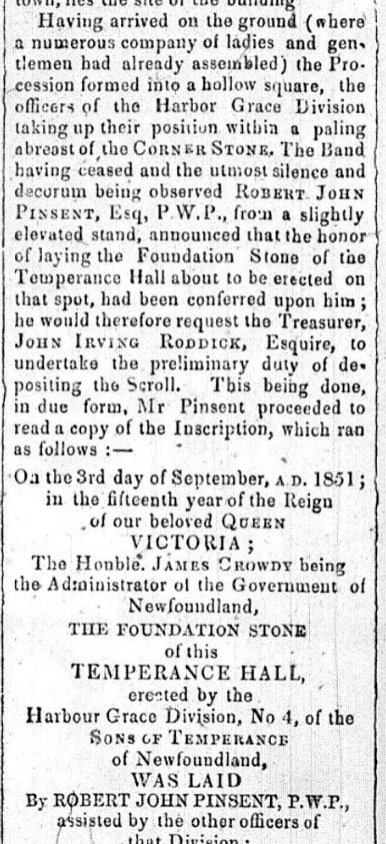
Robert John was a strong advocate of the “temperance movement” in Harbour Grace and, as one of the leading members of the “Sons of Temperance,” he was asked to lay the foundation stone for its Temperance Hall in September 1851. The ceremony was conducted with great pomp: “Mr. Pinsent proceeded to read a copy of the Inscription, which ran as follows: — On the 3rd day of September, a d. 1851; in the fifteenth year of the Reign of our beloved Queen VICTORIA; The Honourable James Crowdy being the Administrator of the Government of Newfoundland, THE FOUNDATION STONE of this TEMPERANCE HALL, erected by the Harbour Grace Division, No 4, of the Sons of Temperance of Newfoundland, WAS LAID By ROBERT JOHN PINSENT, P.W.P., assisted by the other officers of that Division”. Evidently this was done “in presence of the Brethren of the Harbour Grace and Carbonear Divisions, their Cadets of the former place, and a numerous body of well-wishers of the undertaking.” Robert John was presented with the trowel, and “he proceeded to address the assemblage in his usual clear and impressive style. He gave a brief recital of the rise and progress of Total abstinence throughput the world, especially in this Island; adverted to the prodigious labours and success of the Rev Father Mathew; complimented the fidelity and untiring zeal of the members of the Harbour Grace Temperance Band, to whom they were so largely indebted for the enjoyment of that day; tendered on behalf of Division No 4, the warmest acknowledgements, to the Brethren of Carbonear for their assistance on the occasion; and concluded by proposing Three hearty cheers for the success of the cause of Temperance and of the Hall then about to be built” (Weekly Herald: Wednesday 10th September 1851).
Robert John was an active member of the “Sons of Temperance” and he, along with several other high-ranking members of the organization advertised for a traveling lecturer “of energy and ability” to spread the word north of St. John’s over the winter of 1853/4 (Weekly Herald: 30th November 1853). Alcoholism must have been a serious issue in St. John’s and the Out-ports in those days and the “Sons” tried hard to fight back. In December 1853, they placed an all-embracing “Appeal to the People of Newfoundland” in a local paper (Newfoundlander: 22nd December 1853). In it, the authors pointed out the financial, physical and emotional cost and harm that liquour caused, and pleaded with everyone in authority – reverend gentlemen, teachers, politicians, lawyers, merchants etc., and people in general – men, women, brothers and sisters etc., all of whom influence the young, to “rally around the banner of Temperance” and sign a petition endorsing the cause. Robert John Pinsent, J.P., was the second signature and must have had a hand in writing it.
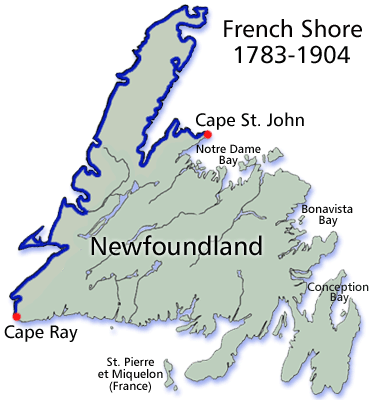
There was trouble in St. George’s Bay on Newfoundland’s west coast in the 1850s. This was a remote area on the “French Shore” that was difficult to access by land and had few “English” settlements because of the competition with the French for the fish. The unrest started when the Colonial Government installed an over-zealous Roman Catholic magistrate who collected taxes that the transitory French fishermen were, of course, not expected to pay. He fined or incarcerated anyone who complained and made himself extremely unpopular (Newfoundlander: 25th December 1852)!
The Government sent Robert John Pinsent and George Ramsey to investigate and the “Newfoundlander”, which was a Catholic Newspaper, said of Robert John’s appointment as a J.P.: “We entirely concur with the fitness of the selection of Mr. Pinsent, the well-earned reputation of the gentleman being an excellent voucher for the impartial and efficient discharge of his responsibility”. In the event, Pinsent and Ramsay recommended that the Catholic magistrate, James Tobin (who was, presumably, deemed to be biased) be replaced by a “Protestant of good plain sense, having a patient temper and tolerable acquaintance with the law.” The Governor felt that was unnecessary – it would be a shame to alienate the Catholics voters or their Bishop (Dictionary of Canadian Biography). What the editor of the “Newfoundlander” thought of Mr. Pinsent’s idea for calming the district may be on record somewhere. I doubt if he were too pleased but the paper itself seems to have forgiven Mr. Pinsent by 1861.
Newfoundland’s coastal town were a rough place to live in the 1850s and the locals townsfolk frequently got into fights with foreign sailors. On one occasion, a Swedish sailor knifed a townsman and fled to his ship were his crew defied the Police and Mr. Pinsent, the magistrate, until a Lieutenant from the local barracks arrived with soldiers – at which point the sailors backed down and allowed the man to be arrested. A Coroner’s jury convicted him of murder (Weekly Herald: Wednesday 17th December 1851).
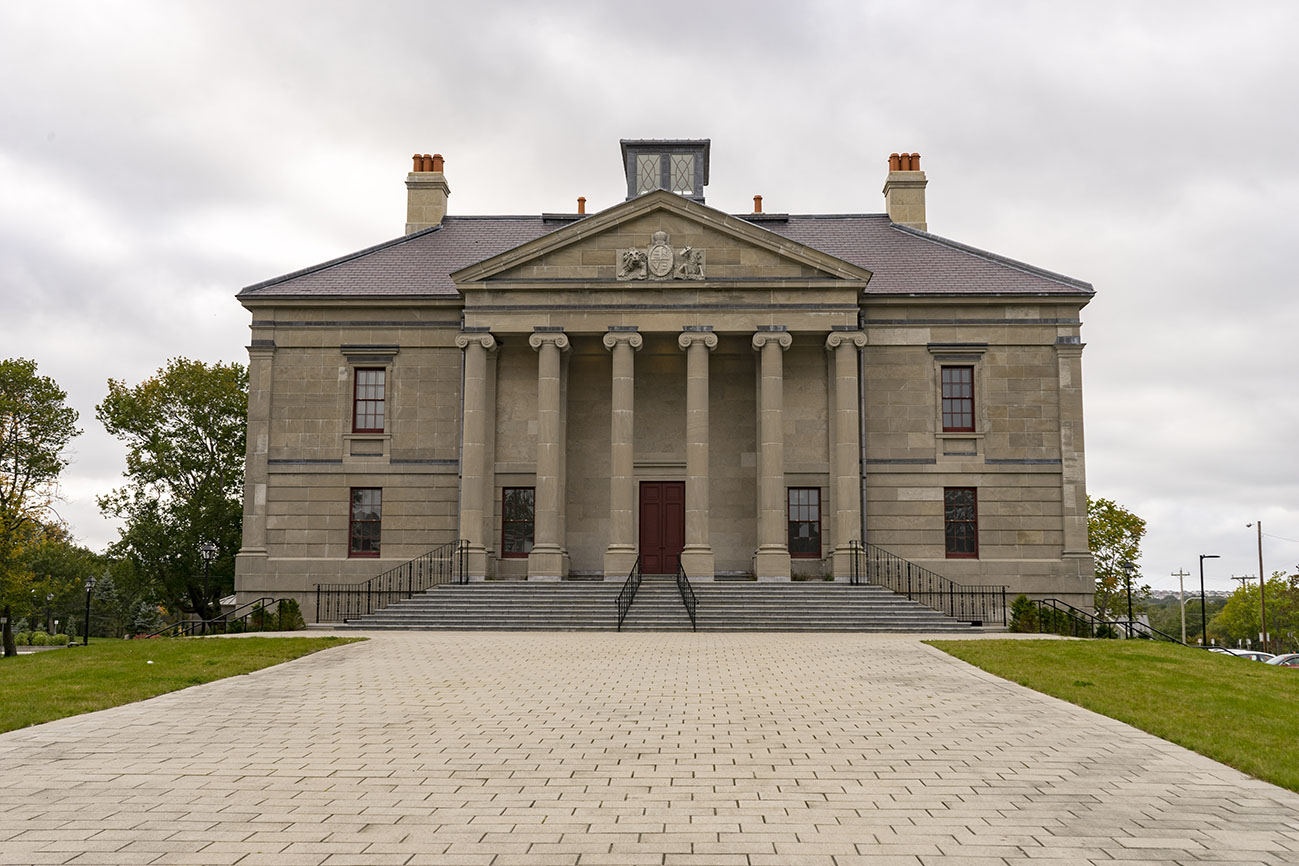
Robert John was appointed Returning Officer for the district on 3rd October 1859 and on 7th November he suffered through another highly contentious election. The political temperature in Newfoundland had been rising for several years and nowhere more so than in Harbour Grace which was one of only three swing districts in the Colony. The electorate was reasonably well balanced between Protestants who voted “Conservative” and Catholics who (largely) voted “Liberal”. After this election Robert Walsh, one of the Conservative candidates, claimed that he had been threatened and had his house attacked and his supporters had been intimidated and set upon by Mr. Prendergast, the “Liberal” candidate’s supporters. The latter had also invaded the polling booths – intent on destroying any polling books or registers they could find. Although he would likely have been the winner, Mr. Walsh had resigned as a result of the intimidation and he later petitioned the “House of Assembly” to have Mr. Prendergast’s election revoked.
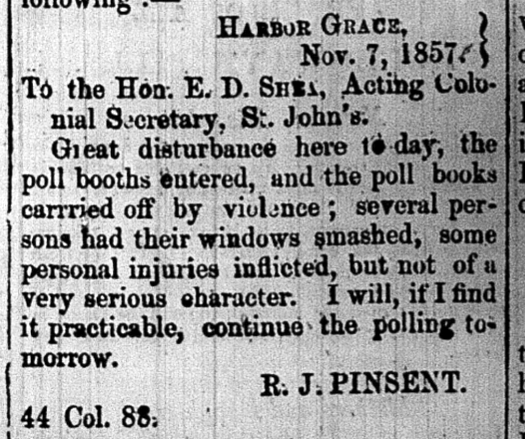
Robert John Pinsent was called to testify before a “Select Committee” of the House and he agreed that there had been mob violence and some of the poll books and registers had indeed been stolen. He testified that the Catholic clergy had tried to quieten the crowd and he explained that although there was property damage there were no serious injuries. He said that he had tried to reopen the polls the next day but when it came to it, only two of his four local “Returning Officers” were willing to reopen their stations! He knew that Mr. Walsh had resigned in protest as he feared for his life – and the lives of his supporters. Robert John said that after he tabulated the (obviously incomplete) results he wrote to the “Colonial Secretary” who advised him to certify Messrs. Hayward and Prendergast. Mr. Pinsent agreed to do so, as he said: “On the resignation of Mr. Walsh, I had, in my opinion no other alternative but to declare the other two elected, there being no other candidate in the field” (Patriot: 30th April 1860). In the days that followed, other witnesses were called in but the story stayed the same.
The political crisis came to a head in April 1861. There was considerable tension in Harbour Grace before that year’s election and Mr. Pinsent read the “riot act” and pleaded with the crowd to disperse, but the “Conservative” supporters of Robert Prowse and Thomas Ridley and the “Liberal” supporters of Robert Pack and James Power came to blows anyway. Robert John had been given 100 soldiers on standby – in case of such an eventuality but refrained from using them, realizing that it would inevitably lead to blood-shed “and that last and deadly resort I did not feel warranted in adopting … as although the damage to property was considerable, little or no personal violence was inflicted on anyone” (Dictionary of Canadian Biography). The Governor, who was a Protestant, tried to force that year’s election in favour of his co-religionists. He closed the polls in Harbour Grace early (which blocked two “Liberal candidates”) and deferred the election there until the autumn. This, with other measures, allowed the “Conservatives” to win – but led to riots in St. John’s that had to be put down by military force. Three people died and others were wounded (Heritage.nf.ca/… The Election Riots of 1861).
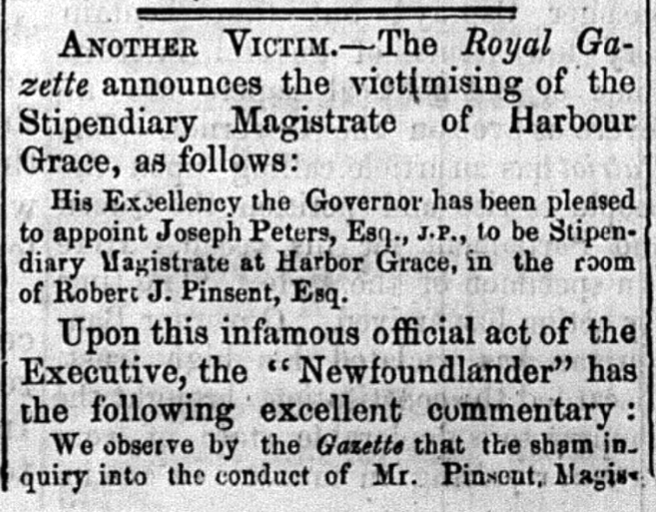
When the dust settled, the “Executive Council” appointed another magistrate to Harbour Grace but Mr. Pinsent refused to recognize his authority – and was promptly removed from his post (Dictionary of Canadian Biography) following what the “Patriot” called a “sham inquiry” into his conduct during the last election (Patriot: 12th August 1861). The newspaper reprinted an article from the “Newfoundlander” – an admittedly “liberal” newspaper – which stated that “Mr. Pinsent’s crime was that he did not obtain an order to the troops to fire during the election disturbances at Harbour Grace” as “he felt too, that were he to adopt this extreme measure the town would have been reddened with the blood of the innocent and the guilty the military and the populace together.” By acting in this way, there was comparatively little property damage and no loss of life. It goes on to say: “We need not remind our readers that magisterially and in very other respect, Mr. Pinsent is a man of the highest character. His intelligent discreet judgement united to unimpeachable firmness and devotion to duty rendered him a model Magistrate” (Patriot: 12th August 1861).
Troops were sent to Harbour Grace that fall and the delayed election passed off without incident under their the new magistrates’ watchful eyes. Two “Conservatives” were duly elected – which pleased the Government. The electoral and political trauma caused by the 1861 election shocked the Colony’s elite and from then on they made a determined effort to integrate the two factions in positions of authority (Heritage.nf.ca/… The Election Riots of 1861) It had the desired effect. [It can be done.]
Robert John and Louisa’s three sons had come of age by then and as they were clearly destined to live in St. John’s (see elsewhere), their parents decided to join them.
The St. John’s City Directory shows that Robert John was the “Collector of Water Assessments” with an office on Duckworth Street by 1863. It was a position that his son Thomas Williams Pinsent was later to hold. Although this may not have seemed a particularly contentious position, it led to an action in the Supreme Court of Newfoundland that year. In “Pinsent v Boyle and McDougall”, the point of issue was a claim for £15 9s made by Robert John in his capacity as collector of water rates and taxes assessed by the “General Water Company of St. John’s”. His application for a “writ of certiorari” (an order given by a higher court to a lower one) was denied – apparently because the action was brought by him “on behalf” of the company, rather than “in the name of” the “Incorporated Water Company.” Such is the law!
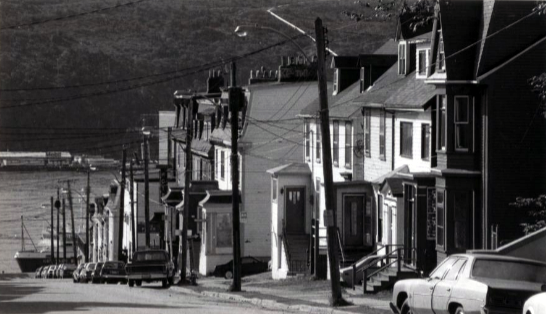
According to “Huchinson’s Directory”, he was living on Cochrane Street by 1864. However, he was hardly house-bound. Robert John Pinsent was named a “Judge of the Court of Labrador” in 1863 and held the position until 1874 (Dictionary of Canadian Biography). The court ship would sail along the Coast of Labrador and stop at the larger communities to assess the state of affairs and mete out justice. At each year’s end, he would write a short but informative report (“Judge Pinsent’s Report of Court of Labrador, 1867” etc.) for “His Excellency the Governor” and it was filed with other “Colonial Office Records.” They are now available on-line.
In 1867, for instance, he describes a visit to Battle Harbour and the out-ports between Red Bay (in the Straights of Belle Isle) and Rigoulette (Rigolet, in Hamilton Inlet). He looked into cases of debt, interference with nets, deformation, bastardy and lunacy, and investigated a (probably false) report of murder. He traveled with the tax collector and arrested one man for assaulting the collector he had had with him the previous year. The prisoner was bound over for trial in St. John. Robert John admitted that there was not a lot of legal work to do that year; however, he felt that the presence of the Court on Circuit every year had a sobering effect on the population. He made specific suggestions too, such as devising an equitable way of handling debt repayment in the out-ports (in the absence of banks), granting power of probate, installing a lock-up on the ship for transporting miscreants to St. John’s etc.
As important perhaps, the Judge reported on the social and economic conditions he found. The population was largely of English origin, however there were “Esquimaux” and half-breeds families. He felt that they were well-behaved and no particular problem. Evidently, the cod fishery had, by then, declined in Southern Labrador and part of the fishery fleet had moved north. Nevertheless. the “Hudson Bay Company” had moved in and it bought and canned salmon for shipment and sale in England.
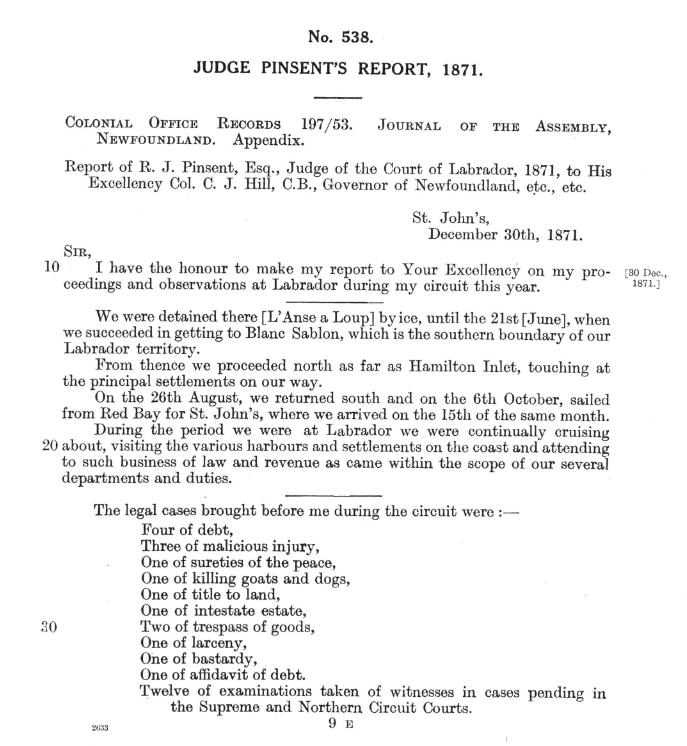
The people fished, trapped and shot game for meat, and he felt there was actually less pauperism than elsewhere in Newfoundland. Nevertheless, he thought that it might be a good idea if the Government reimbursed merchants who looked after those who needed assistance. He discussed the religious establishments he saw and heard about and visited the schools (such as they were) where he distributed money and supplies, and he gave out the medical supplies he had with him. He said that it might be a good idea to have a doctor travel with the next Circuit. Incidentally, he noted, the residents felt that, as taxpayers, they deserved a formal postal system, even if limited to only a few trips a year … Judge Pinsent wrote similar reports in other years. There were good years and bad – but Labrador did get its postal service.
Robert John retired from Government Service in 1874 and received a pension of $1,154 per annum when (Labrador Boundary: Privy Council Documents: Volume III).
Lovell’s Newfoundland Directory for 1871 shows that Robert John, “senior,” as he then was, was not only a “Judge of the Court of Civil and Criminal Jurisdiction for Labrador” but also an “ex-officio magistrate and coroner”. Mr. Justice Pinsent was living with his son, Thomas Williams Pinsent at #4 Cochrane Place, Military Road in St. John’s when he retired but he returned home to London shortly thereafter.
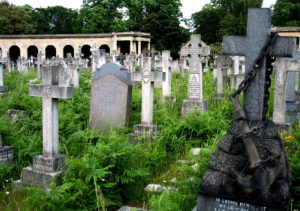

Robert John died on Cumberland Street, aged 78, in 1876 (Week’s News (London): Saturday 2nd December 1876) and had a private burial in the West of London and Westminster Cemetery, Earls Court in Old Brompton on 1st December 1876. For some reason, he asked for his grave to be dug to a depth of eight feet rather than the more usual six (K 254-6 x 29-9). Body snatching would have been an issue in early 1800s but less so, I would have thought, in the 1870s.
Robert John’s eldest son, Robert John Pinsent “junior” was a rising “barrister” by then. His middle son, Thomas Williams Pinsent (who seems to have taken over his father’s role of “collector of water assessments,”) moved out of the Newfoundland house and Charles Speare Pinsent, his youngest son, who lived next door at #3 Cochrane Place – also moved. Charles sold the two houses at auction in May 1876 (Newfoundland Express: 23rd May 1876). He was, himself, a prominent “banker”. The son’s lives are discussed elsewhere.
Louisa Broome Pinsent stayed on in London and died in Fulham in September 1882. Robert John and Louisa’s Broome’s elder daughter – Louisa Williams Pinsent – married Charles W. Green in St. John’s Newfoundland in July 1891 (Evening Telegram: 30th July 1891); however, the link is complicated, as Louisa seems to have had an illegitimate daughter, “Louise King Pinsent” while living in her parents erstwhile home in London in 1888. The child died of diptheria in “University College Hospital” on 15th August 1891 – two weeks after her marriage to Charles Green in Newfoundland. According to the child’s death certificate, her “reputed father” was Charles Wolfe “King” however; that may be a mistake. Life is complicated.
The younger of the daughters, Mary Elizabeth Pinsent married a clergyman, Rev. Joseph Hatch, in New Zealand in 1882 (Evening Telegram: 28th April 1882). What she was doing there, I have no idea! However, it is worth noting that her brother Charles Speare Pinsent married Blanche Brown; who was the sister of a “Mining Engineer” (Douglas James Brown) who had spent a few years in the “Government Survey Office,” in Nelson, New Zealand in the early 1880s. This was before Mr. Brown moved on to Australia (Evening Telegram: 12th August 1916). Mary Elizabeth’s nephew – Sir Robert’s son – Robert Hedley Vicars Pinsent went out to New Zealand later in the 1880s. He worked in the “Registrar General’s Office” for a few years before returning to Newfoundland – where he died at the early age of 25 years in February 1888. Clearly, there was a link to New Zealand in the 1880s. Whether it reached as far as Charles Pitt Pynsent – one of the sons of Robert John’s younger brother Joseph Pinsent – who was living in Wellington in those days, I do not know. Charles Pitt’s life is discussed elsewhere.
Family Tree
Grandparents
Grandfather: John Pinsent: 1728 – 1772
Grandmother: Susanna Pooke: 1730 – 1772
Parents
Father: John Pinsent: 1753 -1821
Mother: Susanna Speare: 1766 – 1830
Father’s Siblings (Aunts, Uncles)
John Pinsent: 1751 – 1753
John Pinsent: 1753 – 1821 ✔️
Robert Pinsent: 1753 – 1787
Thomas Pinsent: 1754 – 1785
William Pinsent: 1757 – 1835
Gilbert Pinsent: 1758 – 1835
Charles Pinsent: 1765 – 1765
Charles Pinsent: 1766 – 1826
Samuel Pinsent: 1767 – 1775
Joseph Pinsent: 1770 – 1835
Male Siblings (Brothers)
John Pinsent: 1796 – xxxx
Robert John Pinsent: 1798 – 1876 ✔️
Please use the above links to explore this branch of the family tree. The default “Next” and “Previous” links below may lead to other unrelated branches.