Vital Statistics
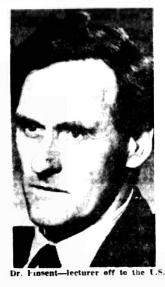
John Pinsent: 1922 – 1995 GRO0497 (Lecturer in Classical Studies, Liverpool)
1. Barbara Mary Pinsent: 1923 – xxxx
Married: 1946: Merton, Surrey
2. Wife (GRO1442)
Children by Wife (GRO1442):
John Pinsent: 1956 – 2016
Son (GRO0193)
Daughter (GRO0184)
3. Wife (GRO1443)
Family Branch: Hennock
PinsentID: GRO0497
Click here to view close relatives.
John Pinsent was the only son of the Rev. John Pinsent by his wife Edith Mary (née Lane). His parents decided to emigrate to Australia when he was two years old. Unfortunately, his father died on the “S.S. Hobson Bay” en route to Melbourne and his mother, who also had a young daughter to care for, decided to return to England. The family grew up in New Milton, in Hampshire. John was fond of the place. On returning there after the war, he wrote a letter to the Editor of the New Milton Advertiser questioning its local development plans: “I am not attacking this on any political lines. I am merely stating an evident economic fact. The real strength of this Borough, I suggest, lies in the development of Lymington as a town of craft industries, its (original position in the country), and of the rest of the Borough as a predominantly farming community. The over-development of the rentier class has already destroyed much the real of community in the Borough” (New Milton Advertiser: Saturday 19th January 1946). He was a young man of strong opinions!
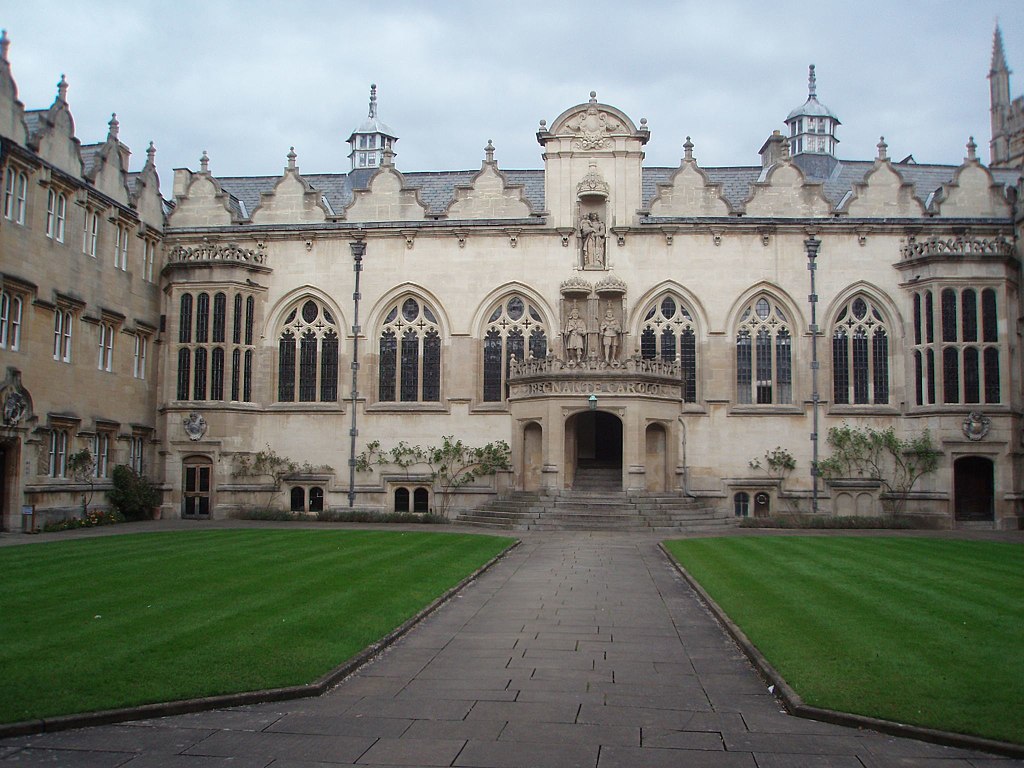

John was educated at “St. Edmund’s School Canterbury” where he (predictably) did well in Latin, Modern Languages and English and History (Kentish Express: Friday 1st July 1938). He was at “Oriel College”, Oxford, studying classics, at the outbreak of the Second World War. He stayed on at university for a while, and was at home in New Milton long enough to participate in a four scene version of “Romeo and Juliet” in which he “made a gallant, albeit remorseful lover, gaily attired” (New Milton Advertiser: Saturday 30th August 1941).
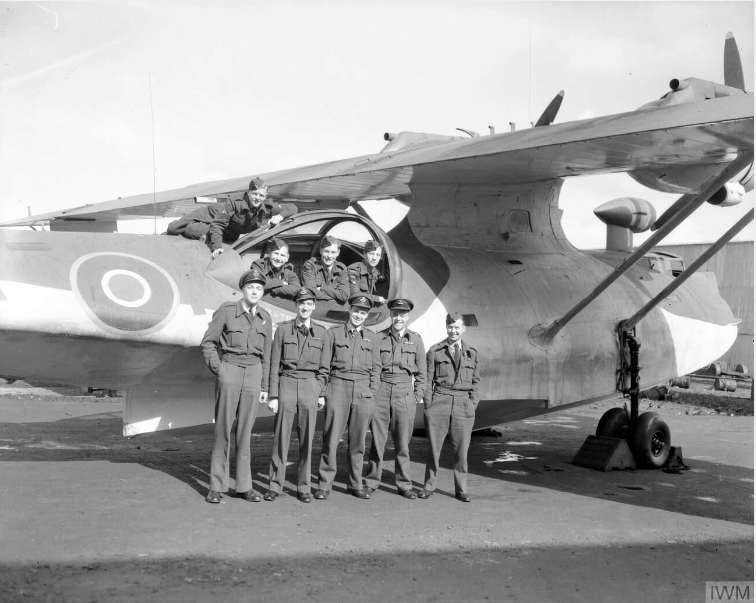
John joined the Royal Air Force as a “leading aircraftsman” in July 1943. He was promoted to “Flight Officer” in November 1943, and “Flight Lieutenant” in May 1945 (London Gazette). John the war with “Coastal Command”, much of it piloting Catalina flying boats out of Loch Erne in Northern Ireland. Presumably he was looking for enemy submarines and monitoring the progress of convoys in the Atlantic. After the war, he stayed on in the “Royal Air Force Volunteer Reserve” and in 1969 he was attached to a unit serving in Scotland. He was an active member of the “Volunteer Reserve” until March 1972, when he retired with the rank of “Squadron Leader” (London Gazette: 27th March 1972).
John’s interest in national defense reemerged in a series of letters that he sent to the Editor of the London Times in 1966. Sir Ralph Cochrane was looking for ways to include the knowledge and experience of a broad range of people in political and military decision-making, and Dr. Pinsent (as he was then) came up with the idea of a “country house” model, whereby military personnel, defense strategists and politicians could meet with university staff and other invited individuals. As a side-benefit, he thought the approach might lead to more productive scientific research both in universities and the private sector (The Times: Monday 31st January 1966). Another correspondent pointed out that a similar model had been used very successfully during the last war and a third, who happened to be the “Director of the Royal United Services Institute”, pointed out that it already had the facilities required and a staff to go with it! It had been around for over 130 years (The Times: Friday 4th February 1966)! The following year John gave his support for the creation of a “Royal Defense College” specifically designed to provide a more focused education on military matters than was currently available through the universities (London Times: Monday 12th June 1967).
After the war, John returned to finish his degree in Classical Studies at Oxford University and in 1950 he accepted the position of “Assistant Lecturer in Greek” at Liverpool University. He later became a “Senior Lecturer”, and then a “Reader” in the Classics Department. Dr. J. Pinsent, M.A., D.Phil. retired from teaching in 1990. He had been at it for 40 years.
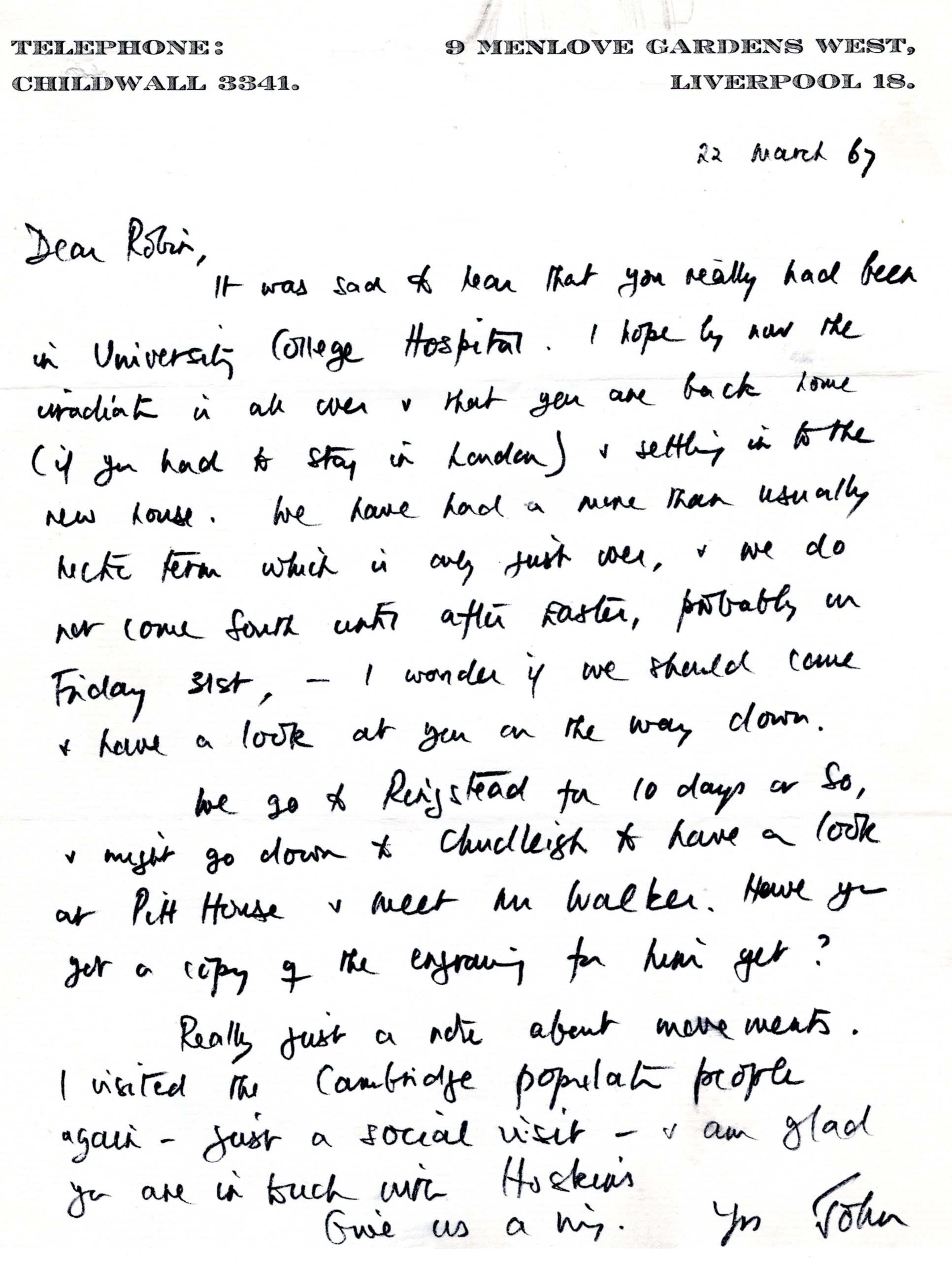
Dr. John Pinsent took a sabbatical year at the “University of Pennsylvania in Philadelphia” in the United States in 1958/9 and on his return to Liverpool heard of my father, Dr. R. J. F. H. Pinsent‘s, interest in family history. They corresponded on family related matters into the 1970s and their work forms the foundation for the current “One Name” study. Interestingly, he called his home in Liverpool (#9 Menlove Gardens West, Liverpool) “Rocombe” – hearkening back to the family’s farm in Stokeinteignhead in Devon.
According to his Obituary published in the “London Times” (Tuesday 28th February 1995), John first visited Greece while on a military exercise with the R.A.F. in 1968 and quickly realized its potential for on-site learning.
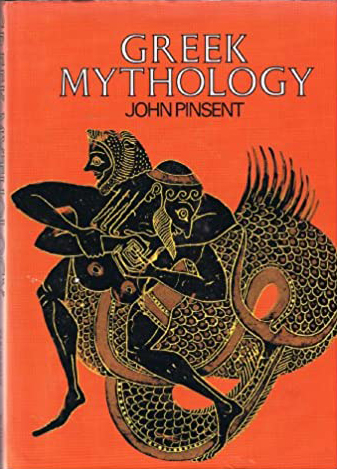
Dr. Pinsent gave a series of public lectures on Greek and Roman history in August 1966 (Chester Chronicle: Friday 19th August 1966) and he completed his well-known book on “Greek Mythology” (published by Hamlyn, London: 1969) three years later – in August 1969. He then took his family out to America for a year on sabbatical, teaching at “University of Michigan” (Liverpool Echo: Monday 18th August 1969).
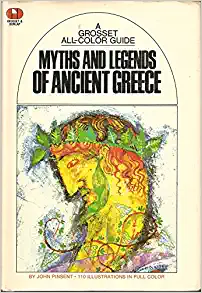
While there, he wrote a companion book, “Myths and Legends of Ancient Greece” – a paperback that presents “nearly 100 tales from Greek mythology with the aim of providing a fascinating insight into Greek“ (Kensington News and West London Times: Friday 20th March 1970).
On his return to Liverpool, Dr. Pinsent started to organize annual tours of the principal archaeological sites in Greece and for several years “The Doctor Pinsent’s Tour” was a mainstay of the University’s “Institute of Extension Studies” (Liverpool Echo: Monday 24th December 1973). From 1977 onward, he regularly attended the “Homeric Conferences” in Ithaca. It provided material for illustrated lectures (Staffordshire Sentinel: Friday 18th November 1983) and was a rewarding way of networking and promoting his periodical magazine.
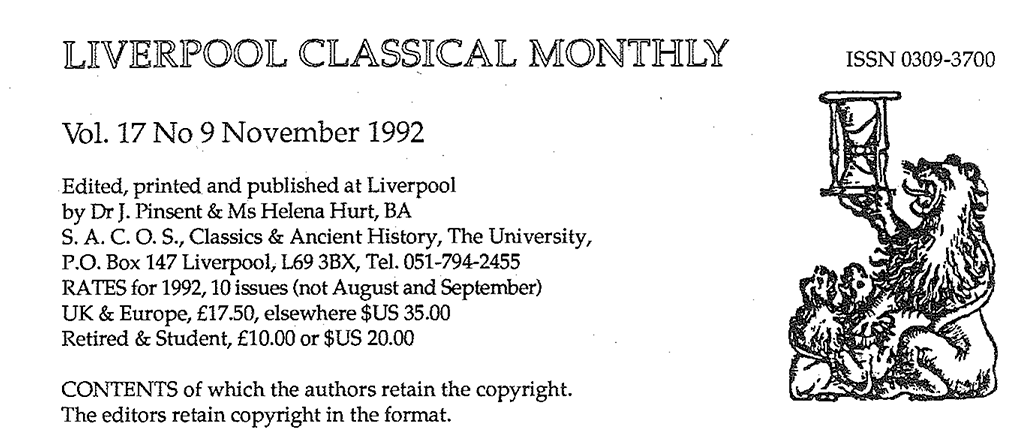
Dr. Pinsent had become intensely frustrated by the intricate formatting (and the inevitable delays) that came in getting professional papers published in the established Classical Journals; so he had established his own outlet in 1975. He solicited eclectic papers and articles and personally contributed and edited the “The Liverpool Classical Monthly” until he died in 1995. Sadly, the newsletter died with him (Obituary: H. D. Jocelyn). However, it is still available in libraries and online and his ideas live on – as they do in other publications: for instance, in his comments on “Ascetic Moods and Greek and Latin” (in, “Asceticism”, by V. L. Wimbush, R. Valantasis, Oxford University Press: 1998).
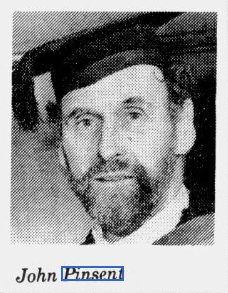
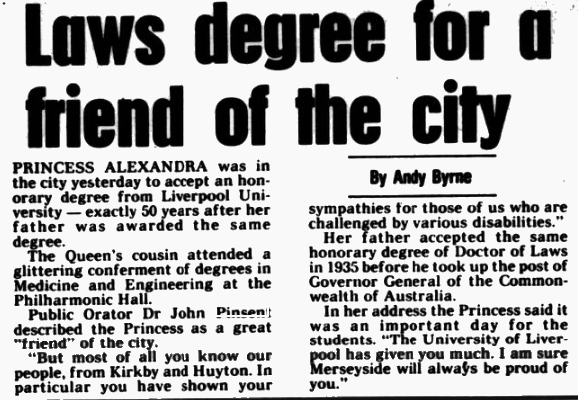
John Pinsent evidently had charm and wit and he was well-enough versed in French wine to be appointed Chairman of University’s “Laid Down Wine Committee”. He had a booming voice (I can attest) and served as “Liverpool’s Public Orator” from 1983 to 1987. He had the honour of addressing Princess Alexandra, the Queen’s cousin, when she attended a conferment ceremony in Liverpool in July 1985 (Liverpool Echo: Friday 19th July, 1985).
John and his sister Mary Catherine Pinsent were “best man” and “brides maid” when their friends Kenneth Friend and Lexie Foxton married in Hinton Admiral (New Milton Advertiser: Saturday 29th June 1946) in 1946.
As for John, himself, he married a few weeks later. In fact, he married three times. Firstly, he married while back at University after the war. The wedding notice tells us that: “The bridegroom served with R.A.F. Coastal Command during the late war, holding the rank of Flight Lieutenant, and in the later stages of his service he was captain of a Catalina flying boat, while his bride was engaged in research work at Bart’s Hospital” (New Milton Advertiser: Saturday 31st August 1946). The marriage ended in divorce in July 1950. There were no children and his erstwhile wife remarried two years later.
Secondly, John married a schoolteacher in 1955 and they had three children, two sons, one of whom has since died, and a daughter: His son, John Pinsent – the last (5th) in a long line of “John Pinsents” – died in Newcastle upon Tyne in 2016. He had been predeceased by his own wife, Margaret. I am not aware of any children by that marriage. John’s other two children live on.
Later on in life, John married for a third time. On this occasion it was to a colleague in the Classics Department. Dr. J. Pinsent died in Liverpool in 1995. He is buried in Toxteth Cemetery.
Family Tree
Grandparents
Grandfather: John Pinsent: 1838 – 1916
Grandmother: Catherine Whidborne: 1840 – 1923
Parents
Father: John Pinsent: 1880 – 1925
Mother: Edith Mary Lane: 1894 – 1989
Father’s Siblings (Aunts, Uncles)
Catherine Ann Pinsent: 1866 – 1972
Mary Eliza Pinsent: 1868 – 1869
Mary Eliza Pinsent: 1869 – 1960
Lucy Whidborne Pinsent: 1869 – 1948
Emma Pinsent: 1871 – xxxx
Ellen Maud Pinsent: 1872 – xxxx
Ada Pinsent: 1874 – 1903
Jessie Florence Pinsent: 1877 – 1959
John Pinsent: 1880 – 1925 ✔️
George Whidborne Pinsent: 1882 – 1883
Please use the above links to explore this branch of the family tree. The default “Next” and “Previous” links below may lead to other unrelated branches.