Vital Statistics
John Pinsent: 1838 – 1916 GRO0492 (Farmer, Middle Roccombe, Combeinteignhead, Devon and Gambledown, Sherfield English, Hampshire)
Catherine Whidborne: 1840 – 1923
Married: 1865: Kingsteignton, Devon
Children by Catherine Whidborne:
Catherine Ann Pinsent: 1866 – 1972 (Married Edward Fawcett, Sherfield English, Hampshire, 1898)
Mary Eliza Pinsent: 1868 – 1869
Mary Eliza Pinsent: 1869 – 1960
Lucy Whidborne Pinsent: 1869 – 1948 (Married Harry John May, Sherfield English, Hampshire, 1888)
Emma Pinsent: 1871 – xxxx (Married Alfred Ernest Read, Sherfield English, Hampshire, 1910)
Ellen Maud Pinsent: 1872 – xxxx
Ada Pinsent: 1874 – 1903
Jessie Florence Pinsent: 1877 – 1959 (Married Edward Galliard Gibson, Sherfield English, Hampshire, 1908)
John Pinsent: 1880 – 1925 (Married Edith Mary Lane, Portsea, Hampshire, 1921)
George Whidborne Pinsent: 1882 – 1883
Family Branch: Hennock
PinsentID: GRO0492
References
Click here to view close relatives.
John Pinsent was the eldest son of John Pinsent by his wife Ann (née Brock). He was born at “Aller Barton” in Abbotskerswell and grew up there and at “Ware Barton” in Kingsteington with several younger brothers. His father taught them how to farm; however, he died in 1858, while they were still quite young. John – as the eldest son – nominally took over the tenancy of the family farm and became the next “Mr. Pinsent of Ware Barton.” His mother Ann was still alive and ran it with the help of her sons.
John “senior’s” loss created vacancies in the village hierarchy and John “junior” was appointed to fill a vacancy on the “Newton Abbot Dispensary Committee” in April 1861. At the same meeting, his more elderly (and more affluent) neighbour, Mr. Thomas Pinsent of (“Greenhills”) Kingsteignton was appointed a “vice president” (Exeter and Plymouth Gazette: Friday 5th April 1861). Thomas was from the DEVONPORT branch of the family. John attended the “Joint Annual Meeting of the South Devon and Newton Agricultural Societies” in Torquay in November that year (Western Times: Saturday 2nd November 1861) and he could be seen at most of the “Newton Abbott Agricultural and Labourers’ Friend Society” meetings and dinners in the early 1860s. One of his young ploughmen, George Warren, won second prize in the youth category at the “25th Annual Ploughing Competition” in 1863 (Western Mercury: Friday 23rd October 1863).
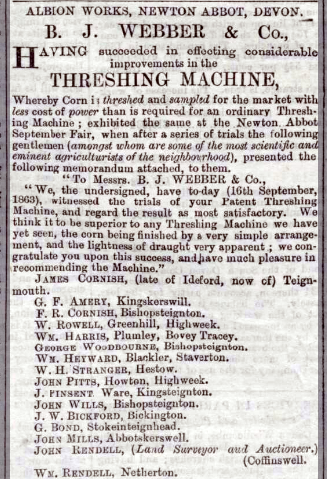
Mr. John Pinsent of Ware (and, one would imagine, some of this brothers) witnessed a “B. J. Webber & Co.” threshing machine in action in October 1863 and he, along with other local farmers signed a promotional letter extolling its virtues (Exeter and Plymouth Gazette: Friday 2nd October 1863).
John married Catherine Whidborne, the daughter of a farmer from Bishopsteignton and took over the tenancy of a farm at “Middle Rocombe” – in the nearby parish of Combeinteignhead on “Ladyday” (25th March) 1865. “Middle Rocombe” is south of the Teign River and inland from the estuary town of Shaldon. It is now in the parish of Stokeinteignhead but, in those days, was in Combeinteignhead. The farm was up put up for sale relatively recently, which accounts for the excellent quality of the photographs on line.
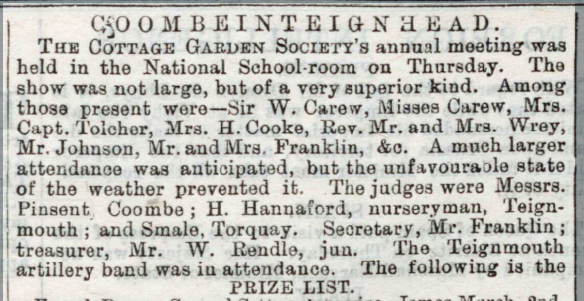
John left “Ware Barton” in the hands of his mother and his capable younger brother Gilbert. Soon after his arrival in Combeinteignhead, John was asked to act as a judge at the annual “Cottage Garden Society” meeting. Presumably, the locals thought that, as a new-comer, he would be impartial (Western Times: Tuesday 11th September 1866). He must have made good impression as they invited him back the following year (Exeter and Plymouth Gazette: Friday 2nd August 1867)!
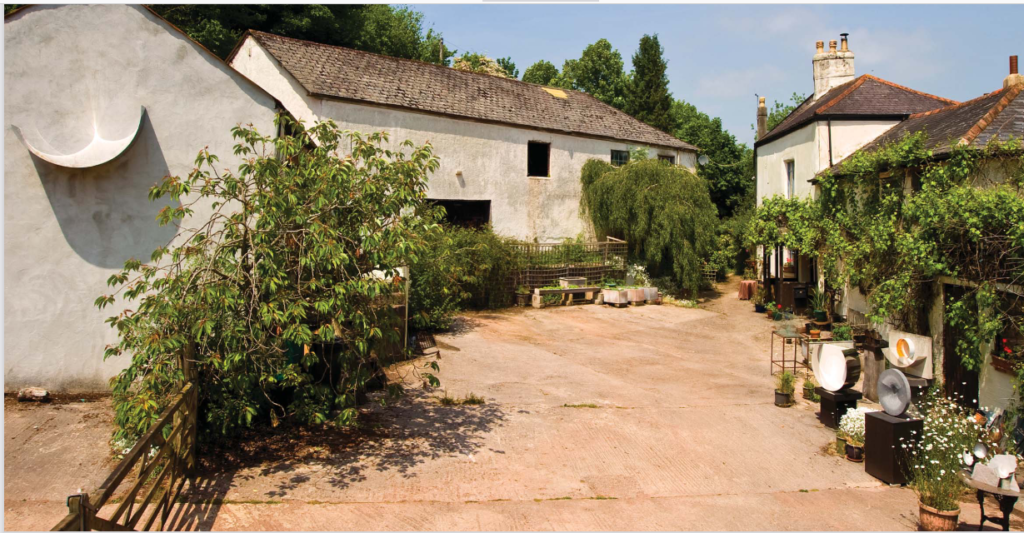
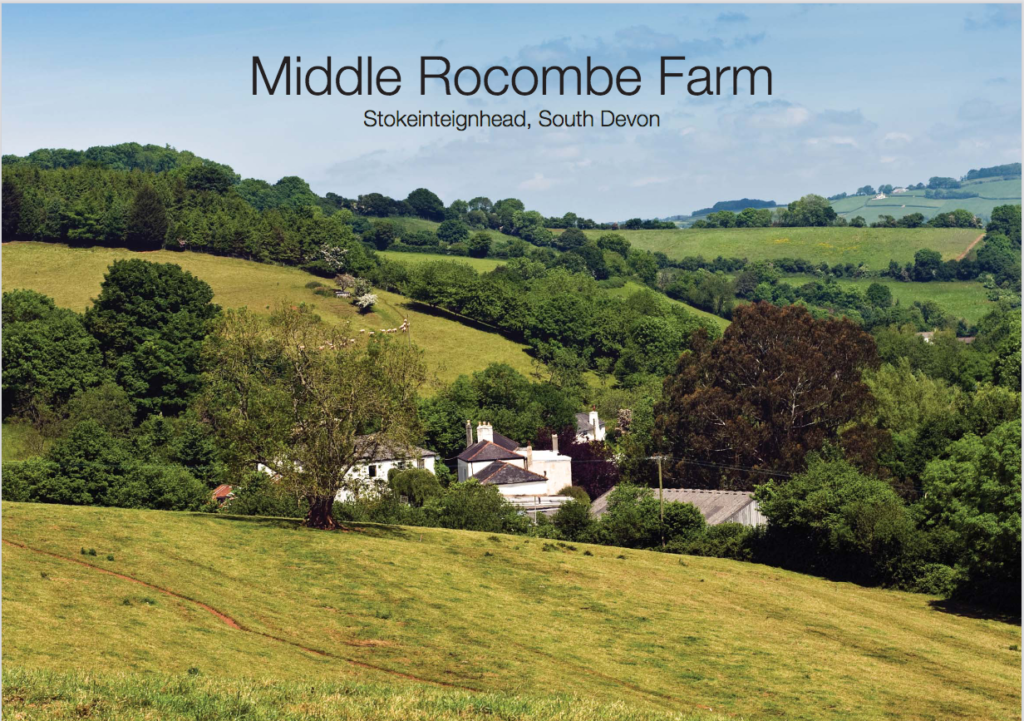
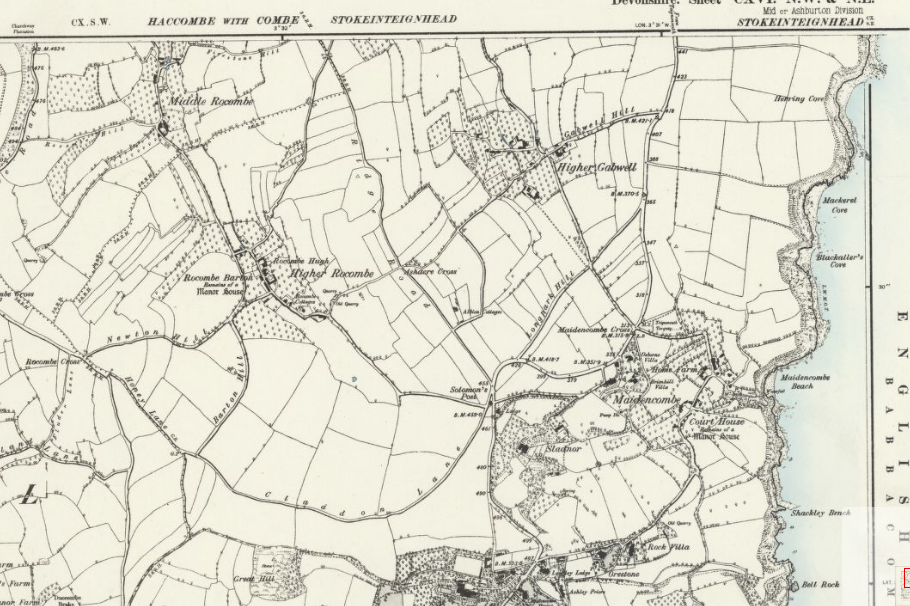
A week or so after that first flower show, “Middle Rocombe” was advertised for sale with Mr. Pinsent as its then sitting tenant – as he had signed a fourteen-year lease. According to the announcement: “The Farm is very compact, and comprises a recently erected Dwelling House and all necessary Outbuildings, Cellarage, Yards, Gardens, Labourers’ Cottages, and about 164 Acres of Land, of which about 36 Acres are fertile Pasture and Watered Meadow, about 18 Acres of Orchard in full bearing, and the residue, about 110 Acres, superior Arable Land, and is very conveniently situated about four miles from the excellent market town of Newton Abbot …” (Exeter and Plymouth Gazette: Friday 21st September 1866).
John and Gilbert Pinsent attended numerous events and meetings together in the late 1860 and 1870s. For instance, they attended a lecture on the “Education of the Labouring Classes” in April 1868 (Western Times: Friday 17th April 1868), and a discussion on “Agricultural Taxation” put on by the “Devon Central Chamber of Agriculture” the following month (Western Times: Friday 22nd May 1868). They also attended funerals, often in the company of representatives of the DEVONPORT branch of the family (Western Times: Friday 12th March 1880).
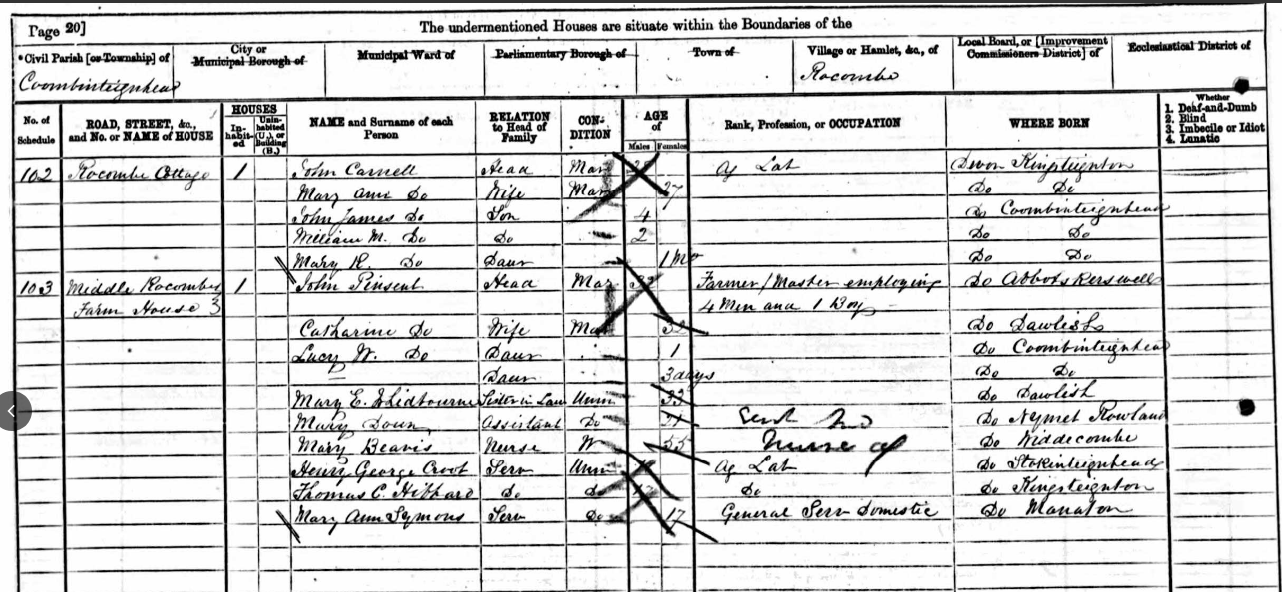
The 1871 Census tells us that John Pinsent employed four men, a boy and three full-time domestic servants at “Middle Rocombe”. The Census was taken three days after John’s daughter, Emma Pinsent, was born, so it is not that surprising to find that Catherine’s unmarried sister, Mary E. Whidborne was also present. She was a widowed nurse. Catherine’s two eldest daughters, Catherine Ann Pinsent and Mary E. Pinsent had gone to stay with their uncle Gilbert at “Ware Barton” but the third, Lucy Whidborne Pinsent, was still at home with her mother. She was only two years old.
Farming was the lifeblood of the community and in Combeinteignhead it was honoured by an annual harvest festival that included, a church service and – at least in 1872 – quite a party: “after (the) service, the whole of the male population, about 150, were regaled in Mr. Lang’s building with a good substantial meal of beef and plum pudding without stint, beer and cider being also supplied them. The happiness evinced by the labouring portion showed that very pleasant relations existed between them and their employers. The women and children, about 250, were provided with tea, cake etc.” The “Teignmouth Artillery Band” played, cannons were fired, bells rung and the evening ended with a firework display. Needless to say, as an important local farmer, J. Pinsent was on the organizing committee (Exeter Flying Post: Wednesday October 2nd 1872) and doubtless threw in some cash as well. The East and South Devon Advertiser (Saturday 21st September 1878) tells of a similar event at which “no less than 600 persons were regaled in this way” on the rector’s lawn.
Some residential servants stayed with their masters – or at least on their farms – for decades and the “Newton Abbot Agricultural and Labourers’ Friend Society” awarded prizes annually to those who had stayed put the longest. In 1874, Ann Howard came second for her 30 years and 4 months service at “Ware Barton”. That was the year that John Balkwill, who worked for Mr. J. Pinsent in Combeinteignhead, came in second in the “double or one-way ploughing competition” (Exeter and Plymouth Gazette: Friday 23rd October 1874).
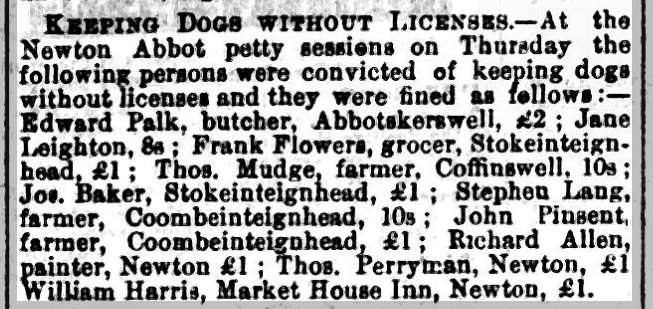
Two advertisements placed in the Western Times Friday 10th December 1875 issue are of note: One describes the loss of a white and liver coloured spaniel called “Sport:” – Mr. Pinsent of Rocombe was offering a reward. The other placed immediately below it, says: “Found, a spaniel dog”. … One hopes they were reunited. Interestingly, another liver and white spaniel turned up “Found” at the neighbouring farm of Lower Rocombe around Christmas 1880. However, this one may have come from Christow (Western Times: Friday 31st December 1880).“Sport” and his kennel mates led to their master receiving a dressing down at the “Newton Abbot Petty Sessions” in April 1884. John Pinsent was fined £1 for keeping dogs without a license (East and South Devon Advertiser: Saturday 12th April 1884)!
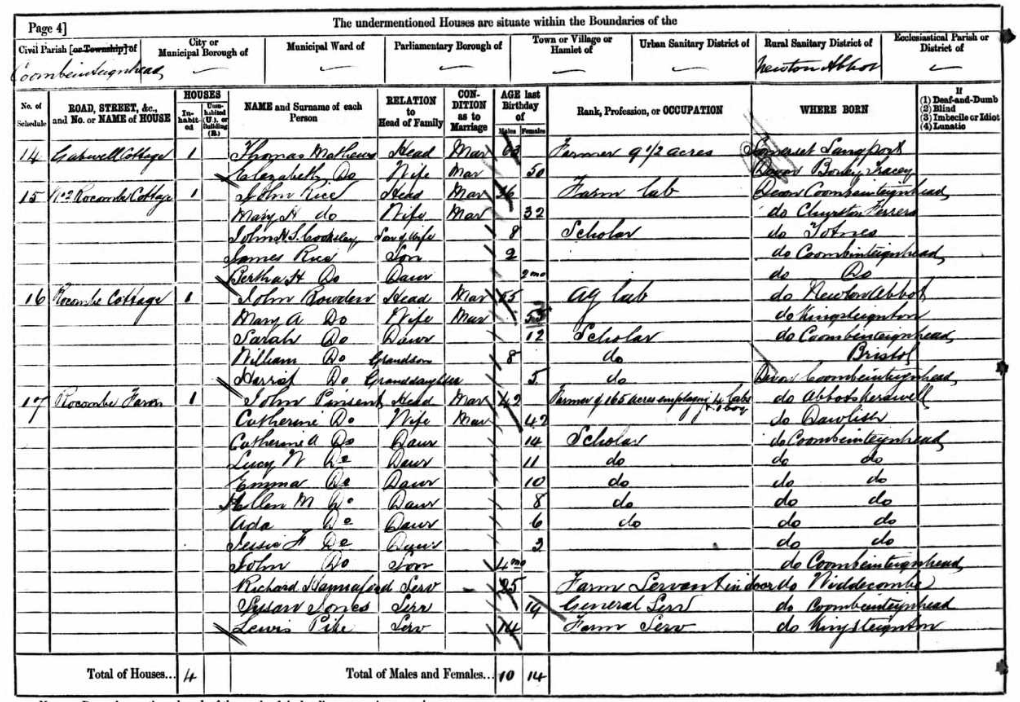
John and Catherine and their ever-growing family of young daughters (he had seven before the arrival of his first, and as it happens, only surviving, son, John Pinsent) were still living at “Middle Rocombe” when the Census was retaken in 1881. This one tells us that the farm covered 165 acres and that John was still employing four labourers and a boy, and he still had three household servants. His daughters were growing up; Catherine Pinsent, Lucy Pinsent, Emma Pinsent, Ellen Pinsent and Ada Pinsent were “scholars.” Their sister, Mary Eliza Pinsent was, for some reason, staying with Whidborne relations at Shute in Bishopsteignton. John’s two youngest children, Jessie Pinsent and John Pinsent were still young; she was two and John was just four months old.
John’s 14-year tenancy at Middle Rocombe officially expired in 1879 but he stayed on for a few more years holding the farm on a series of annual leases. Messrs. Rendell and Symons auctioned off the fee-simple inheritance of and in the “Manor and Lordship of Combeinteignhead” – along with the freehold estate of “Middle Rocombe” (“now in the occupation of Mr. John Pinsent”) in June 1883 (Exeter and Plymouth Gazette: Friday 8th June 1883). John seems to have realized that it was time to move on and the same auctioneers sold off some of John’s stock in August 1883. They disposed of the remainder at an auction held on the farm on March 24th 1884. John sold 182 sheep and lambs, 24 bullocks, 5 horses, 4 pigs, poultry and implements of husbandry (Western Times: Friday 7th March 1884). He surrendered the tenancy of the farm on Ladyday (25th March 1884).
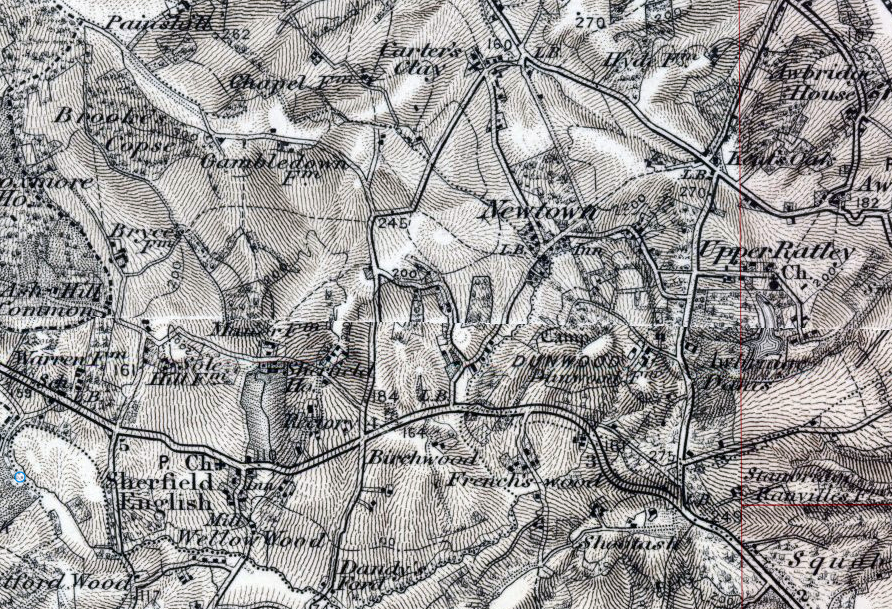
John moved his family to another mixed farm, at “Gambledown”, in Sherfield English, near Romsey in Hampshire. His brother, Gilbert, coincidentally, or probably otherwise, followed him east a few years later. He moved to “Scrope Farm”, in Froxford, in Wiltshire.
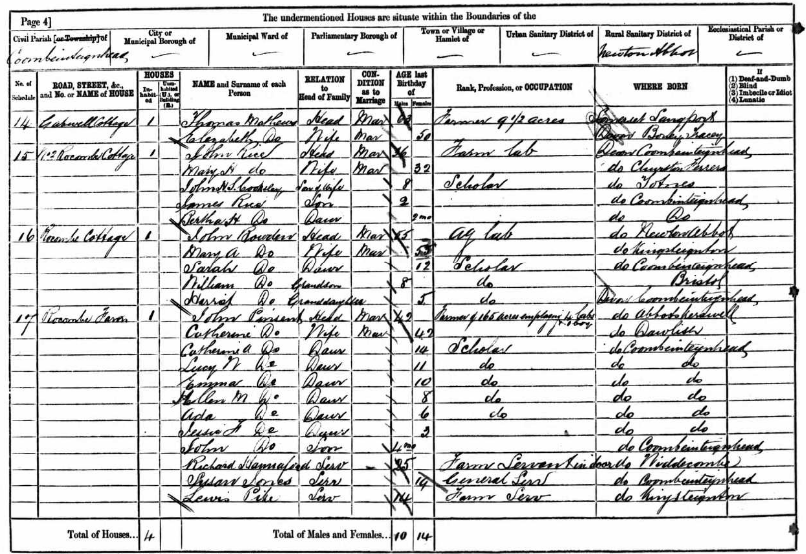
John and Catherine Pinsent were living at “Gambledown” with their children Jessie F. and John, and two domestic servants when the 1891 Census was taken. Two of their daughters, Catherine A. and Ada were then with their uncle Gilbert, who had recently moved to “Scrope Farm.” Lucy was married and the other two, Emma and Mary Eliza were working as a shop assistant, at Leamington in Warwickshire, and as a governess for a farmer’s family at Liskeard in Cornwall. Even farmer’s daughters were expected to work in those days! John was elected as one of the two “Guardians” representing Sherfield English Parish in the “Romsey Union” that year – so was becoming an established member of the community (Romsey Register and General News Gazette: Thursday 2nd April 1891). He was a member of the “Romsey and South Hants Farmers’ Union” and a member of its committee in 1896 (Eastleigh Weekly News and Hants Gazette: Saturday 1st February 1896).
By 1901, all but two of the children (Ellen and John Pinsent), had moved out and, by 1911, John and Catherine only had their one son in residence. John was 70 years’-old in 1908, and winding down his farm. That autumn, he arranged for a four-year old roan colt and a two year-old shorthorn bull to be sold at auction at Salisbury (Salisbury times: Friday 18th September 1908). However, he kept his Clydesdale horses. He bred them and we find that one of his foals won second prize and another came second in the yearling category in a competition sponsored by Major S. F. Chichester of Embley Park in 1910 (West Sussex Gazette: Thursday 22nd November 1910).
At least four of the girls, who had been properly educated as befitting young ladies, went on to marry in Sherfield English. Catherine married a “medical practitioner” in 1898 and Lucy a local “gentleman” in 1888. In the latter case, the marriage announcement noted that her father was John Pinsent “of Gambledown, Romsey, formerly of Combe-in-Teignhead, Devon” (London Evening Standard: Friday 2nd November 1888). Emma married a “draper” (1910) and Jessie a “banker’s clerk” (1908). The latter was said to have been “a very pretty country wedding” (Grimsby News: Friday 24th January 1908). Jessie had attended the Goldsmiths’ Institute in London and taken part in an “Art Students’ Conversazione” there in December 1896. She played “The Lady of Shallott” in a presentation entitled “Tennyson’s Heroines” (Brockley New, New Cross and Hatcham Review: Friday 25th December 1896).
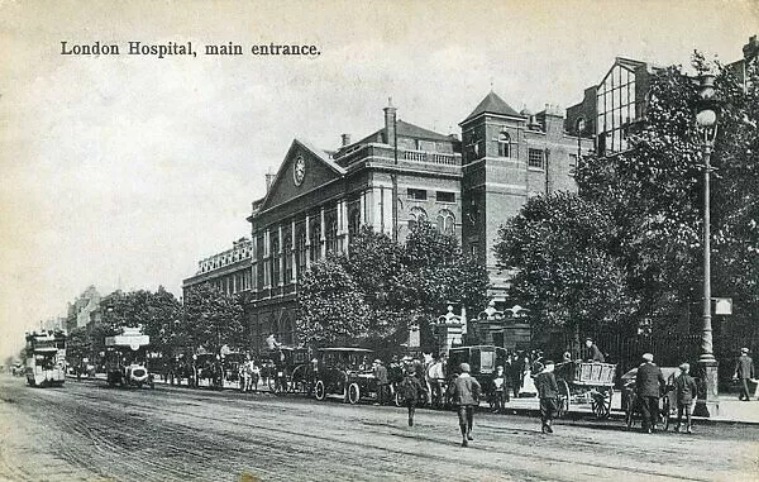
Their sister Ada was to become a nurse at the “London Hospital” in Whitechapel, which was, in those days, one of the poorest and most squalid parts of London. She lived in a world without vaccines or antibiotics and it is not that surprising that she died of pneumonia in 1903. Whether her time there overlapped with Edith Cavell, the nurse executed by the Germans for assisting British and French soldiers in Belgium during the first world war, I do not know. Edith left the London Hospital in 1907. The story of “London Hospital” – as it was in 1906 – was dramatized by the British Broadcasting Corporation (BBC) in 2006. The series story lines are based on hospital records and give a sense of the world in which Ada (and her sister Mary Eliza) lived. Neither married. Nursing was considered to be a commitment for life.
There were, however, male Whidborne weddings for their parents to attend. John and Catherine and their daughter Mary attended one of their nephew’s weddings in 1910 (Middlesex County Times: Saturday 17th September 1910).
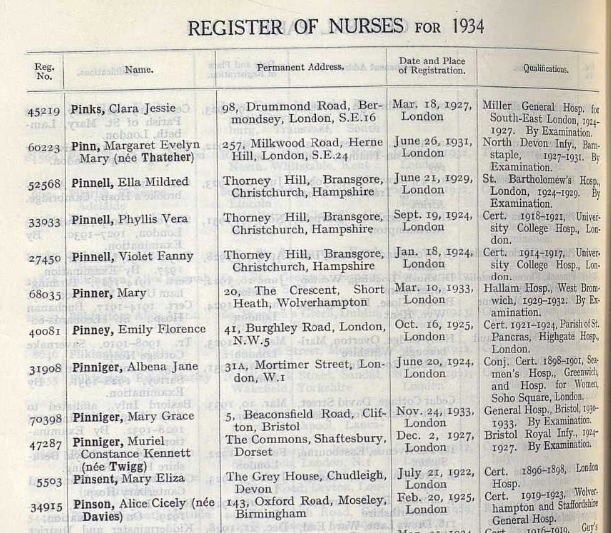
Mary Eliza Pinsent trained at the self-same “London Hospital” (Charity Record: Thursday 15th August 1901) and, fortunately, lived to tell the tale. Perhaps she knew Edith Cavell before she left the London Hospital to go to Belgium in 1907. Mary Eliza later moved to the “Royal Orthopaedic London Hospital,” where she was appointed “Matron” in 1901. This merged with the “National Orthopaedic Hospital” in 1906 and Mary Eliza, who had been acting Matron under Miss Frances Hole was promoted to “Lady Superintendent” of the combined “Royal National Orthopaedic Hospital” (Charity Record: 15th March 1906).
The “Royal” hospital “had been opened by King Edward VII for the treatment and cure of crippled and deformed patients, 75 per cent of whom were children.” It held annual bazaars to raise funds and the Mayoress of Marylebone opened one of them in 1911. Evidently, it proved a great success: “Miss Mary E. Pinsent, the matron, presided at a stall that had upon it many pretty goods dear to the hearts of the gentler sex, such as exquisite table covers, miniature cushions and picture frames” (Marylebone Mercury: Saturday 4th November 1911).
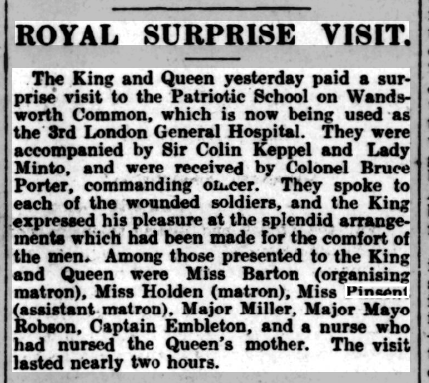
At the outset of the war, Mary switched to war-work (Southwestern Star: Friday 28th August 1914). She was appointed assistant matron at the “3rd London General Hospital” on Wandsworth Common and was called upon to help escort the King and Queen around when they made a surprise visit in October 1914 (London Evening Standard: 7th October 1914). She later worked at the “Military Hospital” at Bagthorpe, in Nottingham before joining the “Queen Alexandra’s Imperial Military Nursing Service Reserve” (Q.A.I.M.N.S. R.), (London Gazette: 2nd June 1916). From there, she went out to Alexandria, in Egypt, as a resident “Matron” (National Archives: WO 372/23).
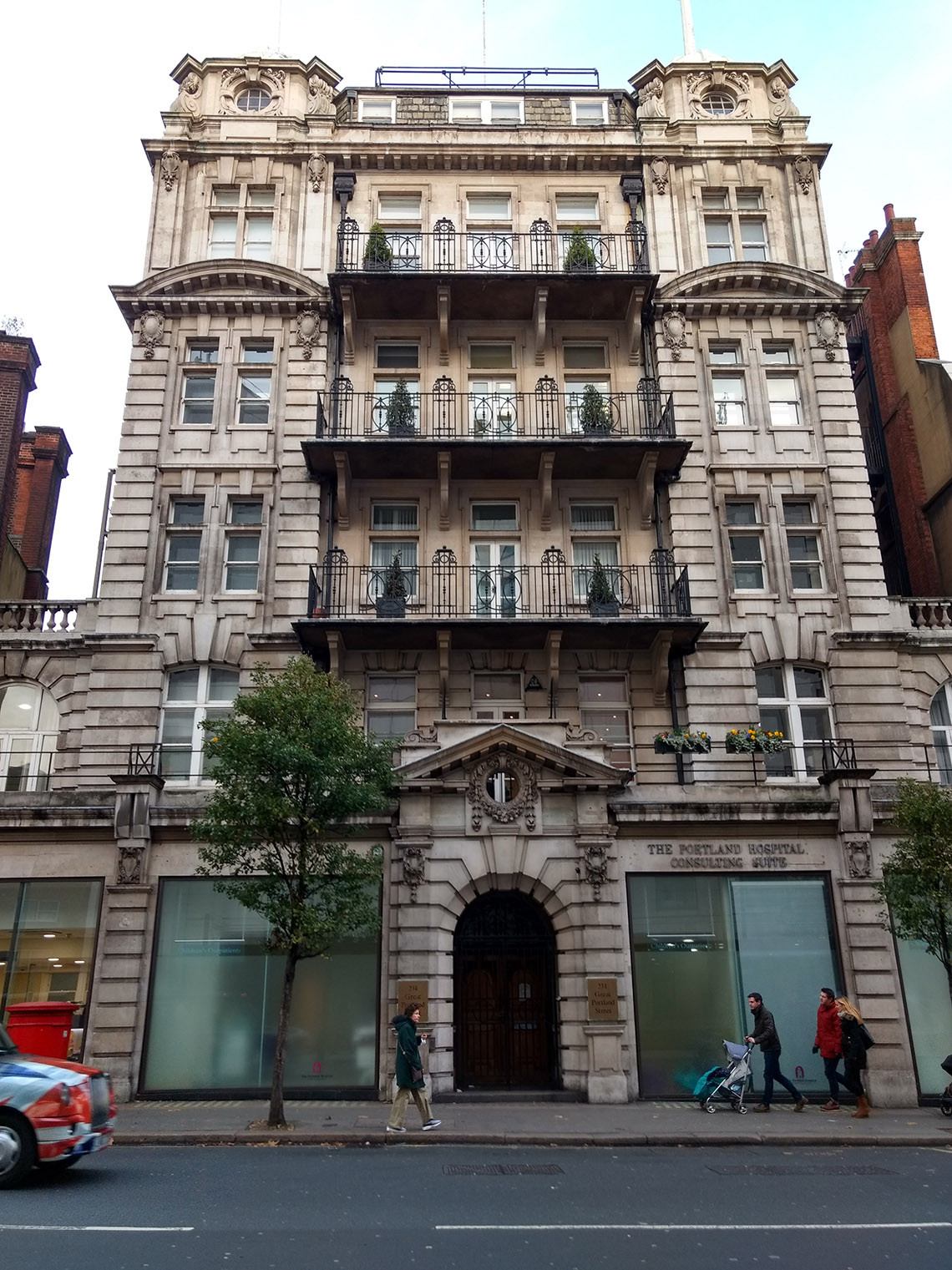
After the war, Mary Eliza returned to the “Royal National Orthopaedic Hospital” (234 Great Portland Street, London W. 1), as its Matron. There is a photograph of her with Lord Denbigh, Lady Dorothie Moor and some of the children from the Orthopaedic Hospital who were involved in an event on behalf of crippled children at Devonshire House shown in the Nottingham Journal: Friday 14th January 1921.
Mary Eliza retired back to Devon. She was there by 1933. Interestingly, Mary took trips into the Mediterranean on ships bound for Suez in 1932, 1933 and 1935. Perhaps she was going back to Alexandria to see friends. She died at “Seaway” in Torquay in 1960 (livesofthefirstworldwar.org/lifestory/5152960). She left about a third of her estate to the “First Church of Christ Scientist” in Torquay (Torquay Times and South Devon Advertiser: Friday 22nd July 1960).
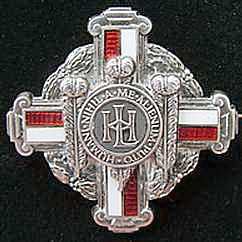
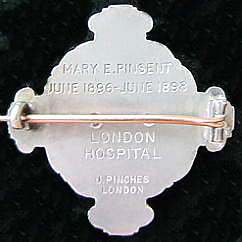
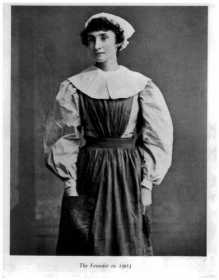
Mary Eliza’s life and her career as a Nurse has been studied in considerable detail by Sarah Rogers. Her work is available on line under “Collecting Nursing History”: Mary Eliza Pinsent 1869 – 1960: (www.schoolof nursing.co.uk/collections/ … Mary Eliza’s photograph comes from a Pinsent family tree found on Ancestry.com. It does not specifically identify the individual as Mary Eliza; however, there are facial similarities with lesser quality photographs and, given the nurse’s uniform, it seems likely.
It is not clear what happened to her sister Ellen. However, she may well have been the Ellen Pinsent who testified during the “Tasker Divorce” proceedings in 1895 (Gloucestershire Echo: Wednesday 10th July 1895). If so, she “formerly (was a) chambermaid at a Plymouth hotel (and) said that when the parties stayed there Mr. Paton occupied a bedroom opposite Mrs. Tasker’s. Two or three nights Paton’s bed was not occupied, and Mrs. Taskers looked as if two had slept there.” I can not speak for Mr. Paton, or Mrs. Tasker for that matter but, but by the sound of it, Mr. Tasker was not the best of husbands. I am not sure what happened to Ellen.
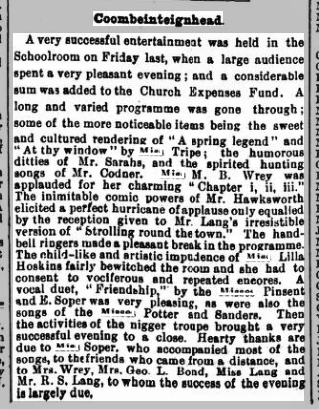
Catherine Ann, or“Katie” as she was known gave singing and music lessons in the Romsey area in 1891 (Romsey Register and General News Gazette: Thursday 22nd January 1891) and likely continued to do so until she married in 1898. I can not be sure, but I suspect that she was also the “Miss Pinsent” who gave two mandolin solos (“Blue Eyes” and “Rialto March”) at a Literary and Musical Society meeting at Axminster in February 1895 (Pulman’s Weekly News and Advertiser: Tuesday 26th February 1895). She was definitely the “Aunt Katie” that John Pinsent, the “Senior Lecturer in Classical Studies at Liverpool University”, corresponded with in the early 1960s. Catherine would have been in her 90s at the time and, hardly surprisingly, her memory was a bit faulty. John and Catherine’s only surviving son, another John Pinsent, had no interest in farming. He became a clergyman and married Edith Mary Lane in Portsea, Portsmouth, in 1921. His life is described elsewhere.
John Pinsent, senior, retired from farming and auctioned off his lifestock and farming implements in September 1913 (Salisbury Times: 19th September 1913). He died at “Gambledown” three years later and the “Calendar of Grants of Probate and Letters of Administration” show that the administration of his estate was granted to his son, Rev. John Pinsent, “clerk”. John’s widow, Catherine went to live with her daughter Lucy Whidmore May, and her husband Harry John May, who was a retired “physician and surgeon” in Romsey. She was there, as were several visiting members of the May family, when the census was taken in 1921. Catherine died in Romsey in July 1923. Her son, the Reverend John Pinsent, probated her will.
Gambledown was and still is a mixed-farm on the edge of the New Forest. On-line sources say that it has diversified in recent years and the current owners run holiday lets and host events and meetings.
Family Tree
Grandparents
Grandfather: Gilbert Pinsent: 1758 – 1835
Grandmother: Margaret Snow: 1756 – 1843
Parents
Father: John Pinsent: 1799 – 1858
Mother: Ann Brock: 1811 – 1866
Father’s Siblings (Aunts, Uncles)
Thomas Pinsent: 1790 – 1804
Mary Snow Pinsent: 1793 – 1890
William Pinsent: 1797 – 1882
John Pinsent: 1799 – 1858 ✔️
Male Siblings (Brothers)
John Pinsent: 1838 – 1916 ✔️
Gilbert Pinsent: 1840 – 1918
James Pinsent: 1842 – 1902
Henry Pinsent: 1844 – 1894
Albert Pinsent: 1846 – 1846
Please use the above links to explore this branch of the family tree. The default “Next” and “Previous” links below may lead to other unrelated branches.