Vital Statistics
James Macpherson Pinsent: 1925 – 1983 GRO0457 (Officer, Royal Navy and Member of London Stock Exchange)
1) Daphne Miranda Harkness: 1934 – 1991
Married: 1956: Rogate, Sussex
Children by Daphne Miranda Harkness:
Daughter (GRO0108)
Son (GRO0706)
2) Eleanor Mary Penrose Robinson: 1934 – 2015
Married: 1976: London
Family Branch: Devonport
PinsentID: GRO0457
References
Click here to view close family members.
James Macpherson Pinsent was Commander Clive Pinsent‘s second son by his wife Kathleen Jane Macpherson. He was born in Stevenage in Hertfordshire in 1925 and he, along with his brothers Andrew Clive Macpherson Pinsent and Ewen Macpherson grew up there and at “Edinglassie”, near Huntly, in Aberdeenshire that their mother inherited from her father.
James Macpherson was admitted to the “Royal Naval College” at Dartmouth in January 1939 (Exeter and Plymouth Gazette: 23rd December 1938) and joined his father and, in September 1942, he joined his elder brother Andrew in the “Royal Navy.” James signed on as a “midshipman;” however, he was promoted to “acting sub-lieutenant” in October 1944 and full “lieutenant” in February 1946.
James’s first posting was to the “battleship” “H.M.S. Duke of York” – where he saw action during the “Operation Torch” landings in North Africa in November 1942, and the “Operation Husky” landings in Sicily in July 1943. “H.M.S. Duke of York” was tasked with protecting the allies’ “aircraft carriers. “ Whether James knew his brother Andrew was aboard “H.M.S. Cleveland” – one of the screening destroyers, during “Operation Husky” (or visa versa for that matter) is unknown! “H.M.S. Duke of York’s” main claim to fame was her part in sinking the German battleship “Scharnhorst” off the Norwegian coast in December 1943.
Acting Sub-Lieutenant James Macpherson Pinsent seems to have been loaned out to a “destroyer” –“H.M.S. Onslaught” in the early months of 1944. Certainly, he is reported to be among a group of officers photographed aboard the ship (see online: Royal Navy Volunteer Reserve Officers: 1939-1945). The “H.M.S. Onslaught,” like most other destroyers, was used to screen convoys and capital ships against attack by enemy submarines and surface raiders. It encountered a U-boat, U990, while on convoy duty in the Barrent’s Sea, in March 1944. It sank one of the “Onslaught’s” companions, the destroyer “H.M.S. Maharatta,” but the “Onslaught” got a measure of revenge a couple of days later when it destroyed another German submarine that had been previously damaged by allied aircraft.
Acting Sub-Lieutenant James Macpherson Pinsent missed out on the Normandy Landings when they took place in June 1944. He was at “H.M.S. Excellent”, a training establishment in Portsmouth. He was assigned to “H.M.S. Crane”, a “sloop,” when he returned to sea in December 1945. They were similar to destroyers but slower and they placed more emphasis on anti-aircraft fire. The ship had hitherto spent much of its war in the Atlantic escorting convoys and hunting for submarines. However, it had recently had a refit and James Macpherson embarked shortly before it joined “Task Force 112” – a fleet being sent through the Suez Canal to join in the war against Japan in the Western Pacific. Again, it was primarily to be used for escort and perimeter defence duties. “H.M.S. Crane” returned to England after the war and both it and the crew were demobilized.
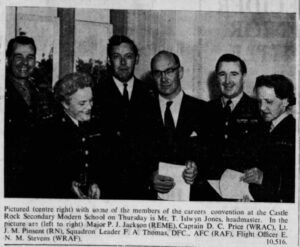
Nevertheless, James stayed on in the Navy. I do not know about all his postings but he was based at a shore station at Lossiemouth, in Scotland, for a while in the late 1940s – shortly after the station had been transferred from the “Royal Air Force” to the “Royal Navy Air Service”. Lossiemouth was later to be returned to the R.A.F. – and it is still one Britain’s principal Scottish bases (Life at Full Throttle: John Treacher, 2004).
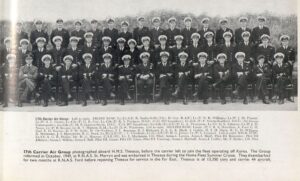
Lieutenant James M. Pinsent served with the “17th Carrier Air Group” on “H.M.S. Theseus” (Tatler: 30th August 1950) and he may have seen action during the “Korean War” between 1950 and 1953. He was promoted to “Lieutenant Commander” in February 1954 and served as an “Executive Officer” at the “Royal Naval Air Service” base at Culdrose, in Cornwall. He retired from the Navy at the end of August 1959.
James Macpherson married Daphne Miranda Harkness, the daughter of a fellow Naval Officer, in Rogate, in Sussex, in June 1956 (Portsmouth Evening News: Monday 25th June 1956). It was a society wedding where his brother, Ewen, was “best man”. James and Daphne had a son and a daughter who were both born in London in the early 1960s. They are both married and may well have families of their own. Sadly, James’s marriage ended in divorce in 1972. Both parties remarried. Daphne married John Carrington in 1974, and James married Eleanor Mary Penrose Robinson (“Audrey” as she was, somewhat confusingly, known) in Kensington London two years later. They had no children that I know about.
James and Daphne seem to have parted on relatively good terms, as James, Daphne and her father, (Captain Kenneth Lanyon Harkness, C.B.E, D.S.C., R.N.) were all called upon to act as trustees of her mother, Joan Phyllis Harkness’s will when she died in 1979 (London Gazette: 11th June 1979). James and his family lived in a house near Pembroke Gardens in London W. 8 in the 1960s and 1970s; however, he had moved to Felden Street, London, S.W. 6, by 1978. Possibly in response to the breakup.
Like so many of his extended Pinsent family, James was good at mathematics. He had been a statistician in the Navy, and on returning to civilian life in the early 1960s he joined a brokerage business. He joined “Capel-Cure Myers” (then a major brokerage house) and can be found chairing a meeting to discuss the winding up of “Deveron Investments Ltd” on 17th November 1965 (London Gazette: 19th Nov 1965). Within a few years, he became a partner at “Capel-Cure Myers” (Financial Times: 30th Mary 1968) and a “Member of the (London) Stock Exchange.” This was a much sought after position. The “Exchange” gave him a silver medal (made by John Pincher) and engraved “J. M. Pinsent” in 1972. What for, exactly, I am not sure. Sadly, it is no longer in the family. It was put up for sale on “ebay” (in its original case and in near perfect condition) and sold in September 2016. James’s “Early 20th Century Military Tin Chest” had been sold at auction a year earlier, in August 2015. Who disposed of the items I do not know.
James worked for “Capel-Cure Myers” until May 1975, when the partnership was dissolved and reconstituted as a limited company under the name of “Capel-Cure Myers Limited” (London Gazette: 9th May 1975). James continued to work for the firm until he died in 1983, at the relatively young age of 57. James and his wife, Eleanor, had been living on Felden Street in London. They do not seem to have had children.
Eleanor Mary Penrose (née Robinson) Pinsent outlived her husband by over thirty years. I know very little about her, other than that she played golf at Weybridge in Surrey and won its New Zealand Lamb Golf Club trophy in 1985 (Westminster and Pimlico News: Friday 3rd May 1985)! She either died in February 2014 (www.anzpauk.co.uk) or February 2015 (England and Wales Death Index 1989 – 2019) depending on which source is correct. I favour the latter.
Family Tree
GRANDPARENTS
Grandfather: Richard Alfred Pinsent: 1852 – 1948
Grandmother: Laura Proctor Ryland: 1855 – 1931
PARENTS
Father: Clive Pinsent: 1886 – 1948
Mother: Kathleen Jane Macpherson: 1895 – 1974
FATHER’S SIBLINGS (AUNTS, UNCLES)
Roy Pinsent: 1883 – 1978
Clive Pinsent: 1886 – 1948
John Ryland Pinsent: 1888 – 1957
Laurence Alfred Pinsent: 1894 – 1915
Philip Ryland Pinsent: 1897 – 1916
MALE SIBLINGS (BROTHERS)
Andrew Clive Macpherson Pinsent: 1922 – 1982
James Macpherson Pinsent: 1925 – 1983
Ewen Macpherson Pinsent: 1930 – 2020
Please use the above links to explore this branch of the family tree. The default “Next” and “Previous” links below may lead to other unrelated branches.