Vital Statistics
Henry James Pinsent: 1872 – 1927 GRO0419 (Farmer, Whitstone, Bovey Tracey; Alton, Hampshire and Vernon in British Columbia, Canada)
Kate Hewett: 1865 – 1961
Married: 1900: Farnham, Surrey
Children by Kate Hewett:
Henry Hewett Pinsent: 1901 – 1938
Marion Pinsent: 1904 – 1950 (Married William Isaac Withrow, 1924, Vernon, British Columbia)
Family Branch: Hennock
PinsentID: GRO0419
References
Click here to view close relatives.
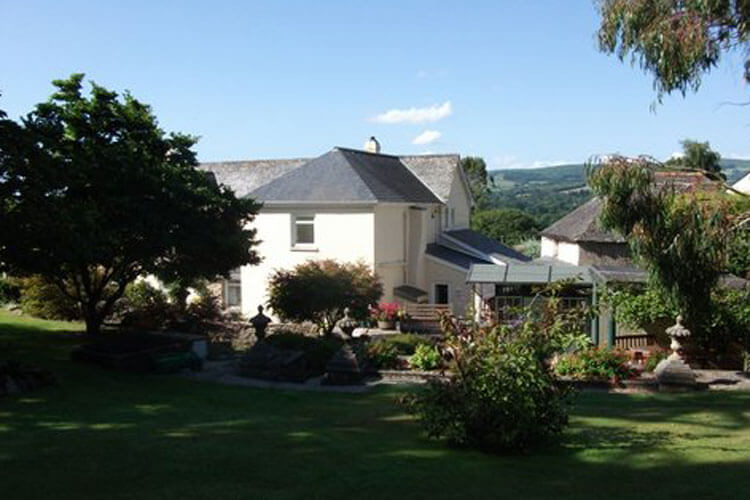
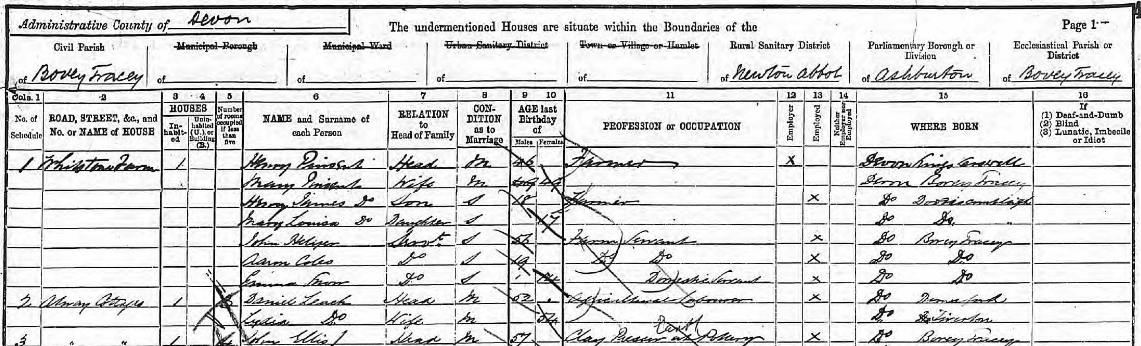
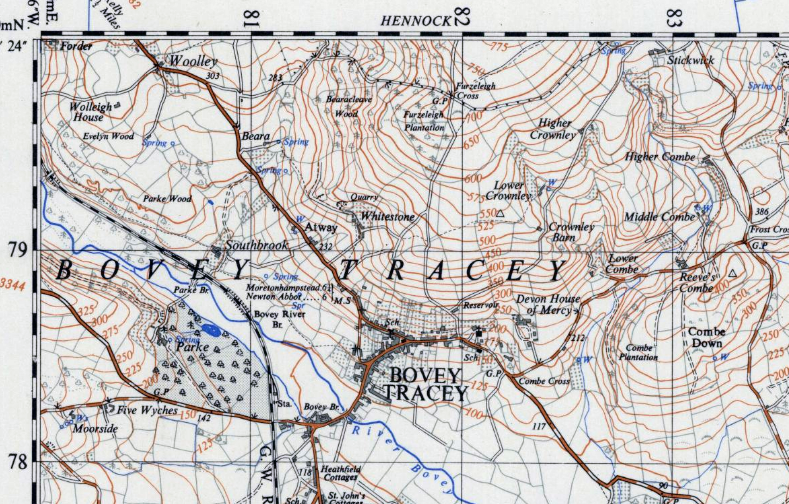
Henry James Pinsent was the only son of Henry Pinsent by his wife, Mary (née Langmead). He took over the tenancy of the family farm at “Whitstone,” in Bovey Tracey, in 1894, when his father died. Henry James married Kate Hewett, a farmer’s daughter from Seale, near Farnham, in Surrey, on 17th April 1900 and they had a son, Henry Hewett Pinsent, at “Whitstone” the following January. His parents moved to “Lode Farm”, at Kingsley, Alton, in Hampshire shortly afterwards and they were there by the time their second child, Marion Pinsent, was born in 1904. Henry Hewett was technically a Devonian but he never really knew the place.
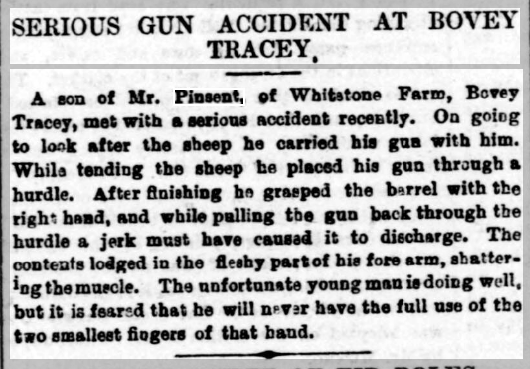
Henry James had grown up on a mixed farm and he was a known to be an effective farmer, despite his having injured his arm through the poor handling of a gun in 1892. He had placed a loaded gun against a hurdle while tending a sheep and it had discharged as he grabbed the barrel to pick it up. In the process, he badly damaged his right hand and forearm (Exeter and Plymouth Gazette: Thursday 11th February 1892). Nevertheless, he seems to have functioned reasonably well and he even played billiards for the local team in 1895 (Western Times: Saturday 7th December 1895)!
Henry James, like his father before him, had some level of success in local agricultural competitions. For instance, his entry “Perfection” fetched 21 guineas at an “Exhibition and Sale of South Devon Cattle” held in Totnes in March 1899 (Western Times: Wednesday 22nd March 1899) and his collection of “six roots of each kind” (mangolds, swedes and turnips) came first at the “Newton Abbot Fat Stock (and vegetable) Show” in December that year. Henry was asked to judge the sheep in 1899 (Western Times: Thursday 7th December 1899) and was, thus, unable to compete in that particular category. The following year, he did well in the “Judge the Weight” of a bullock competition at the “Totnes Fat Stock Show”. His estimate of 6 cwt. 3 qrts 6 lbs came in fifth, being only two pounds short (Western Times: Tuesday 11th December 1900)!
One of Henry’s horses, a roan mare, got loose in Kenn in September 1900 and he advertised for its return (Western Times: Monday 3rd September 1900). Whether he got it back or not, is not recorded.
Henry purchased a bull in 1901 (Totnes Weekly Times: Saturday 23rd March 1901). Why, I am not sure as he was planning to move before long. In the meantime, he had a farm to run and accidents will happen. Later that year, Henry was called to give evidence at the inquest of a five year old boy, Edwin Winsor, who had fallen from a wagon-load of timber. The boy’s abdominal injuries proved to be fatal. The Jury placed no blame on the wagoner and returned a verdict of “Accidental Death” and (Western Morning News: Friday 28th June 1901).
In 1903, Rendell and Symons (the “auctioneers”) were called upon to find a new tenant to take over at “Whitstone” as of Lady Day (25th March 1903). The farm, which was owned Mr. W. R. A. Hole, J.P., C.C., was said to consisted of 247 acres, 1 rude and 10 perches; including 71 acres of pasture and 11 of orchard, with a superior farmhouse, buildings and three cottages (Western Times: Friday 4th July 1902).
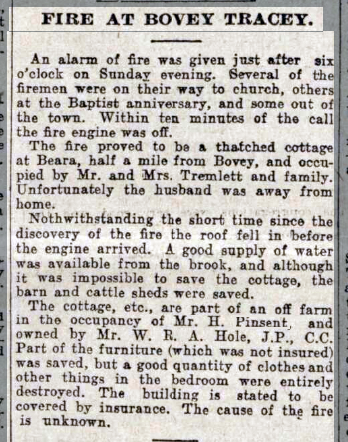
Unfortunately one of the cottages caught fire two weeks later! There was considerable damage but no loss of life. The occupant, Mr. Tremlett, who was one of Henry’s farm hands, was out at the time but his wife and five children were at home and they were, understandably, extremely shaken and upset. They were taken to “Whitstone”, where they were looked-after by Mr. and Mrs. Pinsent (Western Times: Friday 18th July 1902). The Bovey fire engines did what they could to extinguish the fire but most of the building and its contents were destroyed. The building was insured but the furnishings were not. The episode must have cast a shadow over the community, particularly as it came just after the presentation of a “silver loving cup” to Mr. William Gerald Hole the previous day. It was a gift made by the tenants of Parke Estate (including Henry James) to honour his coming of age (Western Times: Friday 18th July 1902).
Messrs. Rendell and Symons (“auctioneers”) sold off Henry James’s horses, pigs, fowls, implements of husbandry and furnishings the following February (Western Times: Friday 13th February 1903). Presumably, they had already disposed of his sheep and cattle. The family left “Whitstone” at the end of March and moved to “Lode Farm”, at Kingsley, near Alton in Hampshire. “Lode Farm,” which had been built around an old Royal (Tudor) hunting lodge was painted by Vincent Lines in 1942 and there are lithographic prints available on-line. Henry James’s uncles (John and Gilbert Pinsent) and Kate’s father seem to have persuaded him to leave Devon and move east into Hampshire. The previous occupant of his new farm – a Mr. J. W. Mitchell – had been a “prominent and successful agriculturalist” and well regarded breeder of cattle who had retired from farming in October 1902 (Hampshire Chronicle: Saturday 21st January 1905).
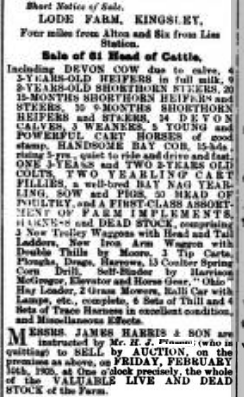
Henry James and Kate moved into “Lode farm” sometime after Ladyday, 1903 and their daughter, Marion Pinsent, was born there the following year. Henry James built up a considerable inventory of life-stock and machinery on arrival – as one would have expected if he planned run the farm for several years; however, it was not to be. Their tenancy was to be short lived. We find that he instructed Messrs. James Harris and Son (“auctioneers”) to sell his 61 head of cattle and his farm equipment on 10th February 1905 (Hampshire Chronicle: Saturday 4th February 1905). At the same time, he instructed them to sell off all his household furniture, including carpets, mahogany and other furniture, an eight-day clock, a 7-octave cottage pianoforte and miscellaneous other items three days later (Hampshire Observer and Basingstoke News: Saturday 4th February 1906). The usual practice was to sell off the life-stock the autumn before leaving, which suggests the decision to leave was a hurried one. Why they left, I do not know.
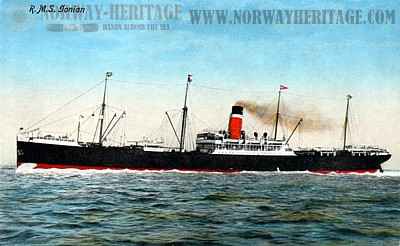
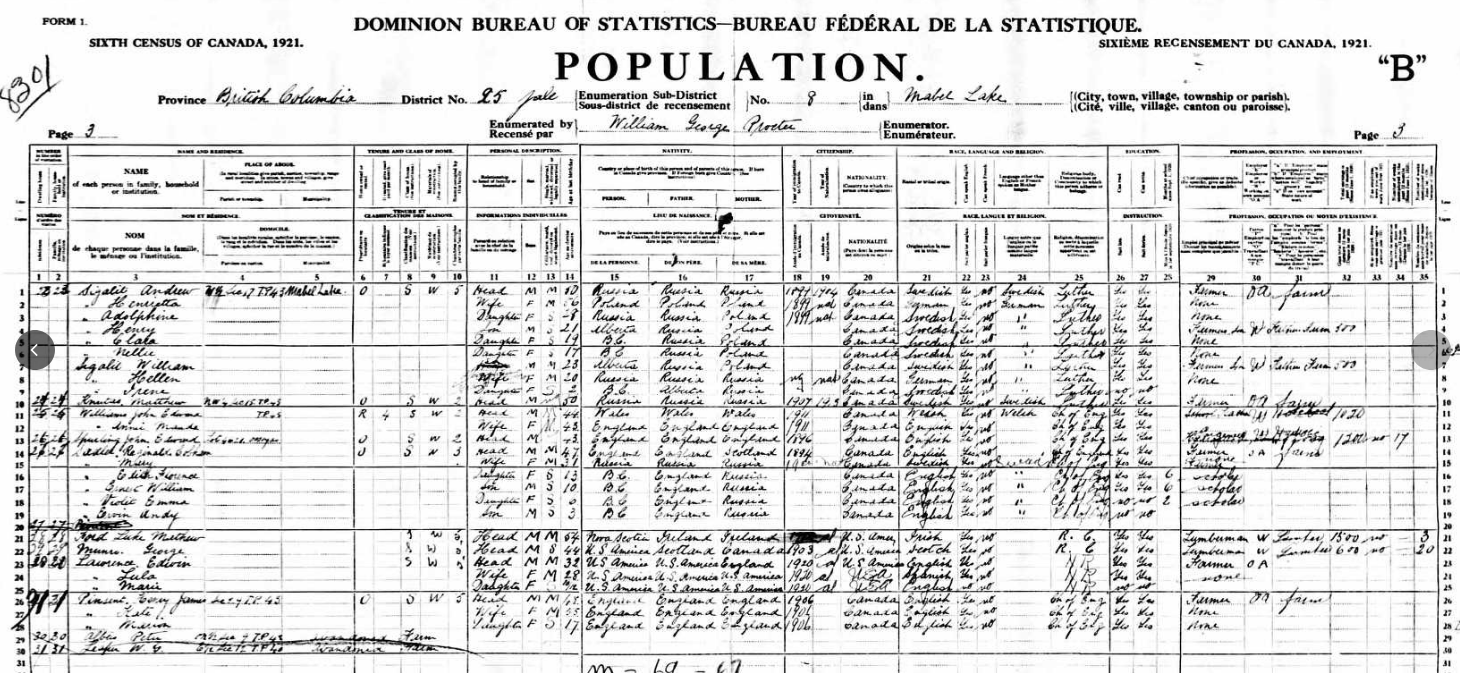
Henry James went out to Canada and his wife, Kate, took the the children out a few months later. The family settled in British Columbia. Their son, Henry Hewett’s (much later) application for U.S. Citizenship submitted to the “U.S. Department of Labour” noted that he (a.k.a “Harry”) had arrived in Montreal on the “S.S. Ionian” with his mother and sister in May 1906. He would have been five years old. Presumably his father had already acquired a farm in Vernon, British Columbia. The 1921 Canadian Census shows that Henry James and Kate (nee Hewett), and their daughter, Marion, were still farming at Mabel Lake, near Vernon in the 1920s. Marion married there, three years later.
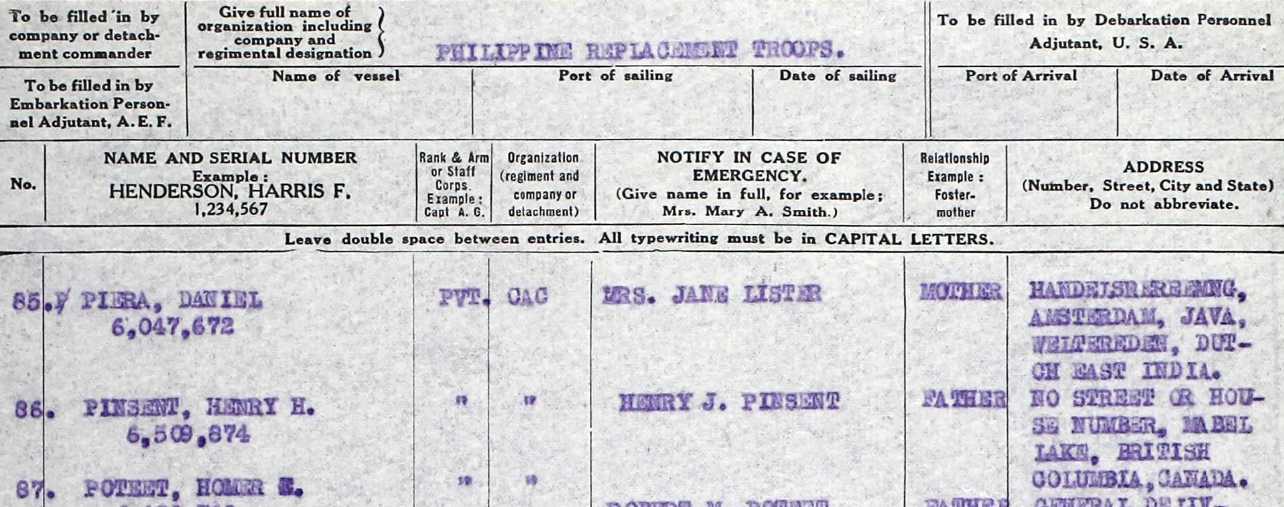
Marion’s brother, Henry Hewett Pinsent forsook the farm and took to the sea. He was a single, 18 years old, “deckhand”, when he first arrived in Seattle on the “S.S. Princess” in 1919 and applied for entry into the United States (Seattle Passenger and Crew Lists). This was granted and he enlisted in the U.S. Army the following year. Henry Hewett was a “Private” attached to 104th Company (C.A.C) when it left San Francisco for the Philippines on 5th April 1920 (U.S. Army Transport Service Passenger List: 1910 – 1939: Ancestry.com) and a “Sergeant” when it went out to Honolulu in February 1923. Three years was enough, and he was honourably discharged from the army in April that year.
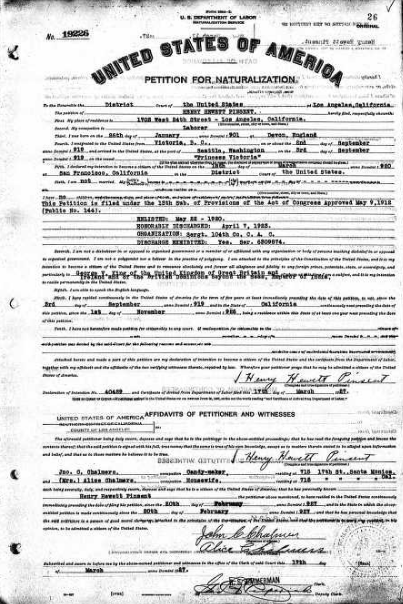
Service in the U.S. Army was an excellent route to Naturalization and he had no difficulty when he applied. According to his papers, Henry Hewett moved to Los Angeles and applied for Citizenship at the U.S. District Court for the Southern California, and duly renouncing his British Citizenship and swore his oath of allegiance to the United States on 17th June 1927. He was described as being 5ft 3.5in high, with brown hair and grey eyes.
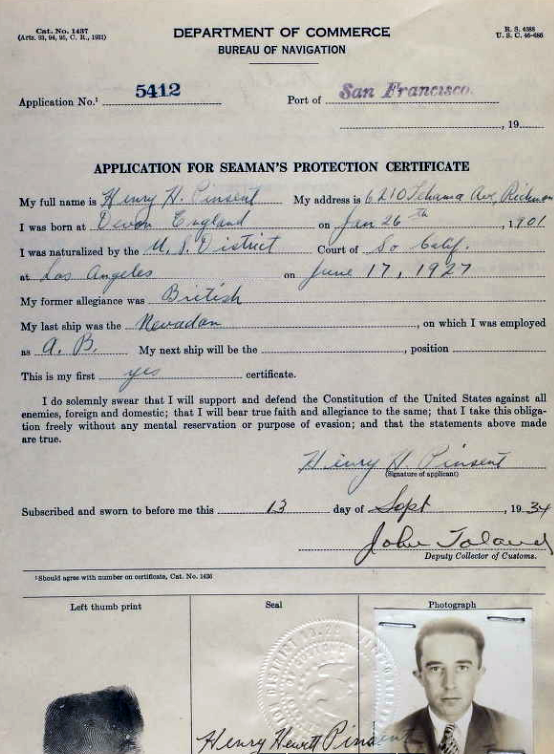
Henry Hewett Pinsent settled in Los Angeles (California Voter Registrations) and returned to the merchant marine. He was a “cok(er)” in 1928, an “able seaman” in 1934 and a “seaman” in 1938. He took what he could get between ships and the United States 1930 Census tells us that he was an English born “dishwasher in a restaurant”. They were tough times! In September 1934, Henry applied for a “U.S. Seaman’s Protection Certificate” – essentially an identity card that proved his citizenship and stated that his last position had been as an “able seaman” on the “S.S. Nevadan.” The application provides a similar description to the one given when he applied for citizenship; however, it is endorsed by his photograph and thumb print!
There is no indication that he ever married. Henry Hewett Pinsent of #606 Front Street, San Francisco, California, U.S.A., died 2nd January 1938. Limited Administration was granted to Francis Mapleton Iremonger Watts, attorney for Kate Pinsent. This was probably his mother and not an, as yet unidentified, wife. His effects in England were valued at £97 18s (England and Wales: National Probate Calendar (Index of Wills & Administrations) 1858 – 1995).
Henry James Pinsent was thirty-four years old when he emigrated to Canada and started farming in British Columbia. He could have had more children; however, I am not aware of any. His daughter Marion married William Isaac Withrow in Vernon in 1924 and Henry James died three years later, in April 1927. He died in New Westminster, British Columbia at the age of fifty-four years (British Columbia Death Index: 1872-1979: Ancestry.com). His widow Kate, lived to be 94 years old. She probably became deaf in old age as she was an active member of the Vancouver area “Hard-of-Hearing league” in the 1940s (Vancouver Daily Province: 27th October 1942). She died in Burnaby, near Vancouver, British Columbia in March 1961.
Family Tree
Grandparents
Grandfather: John Pinsent: 1799 – 1858
Grandmother: Ann Brock: 1811 – 1866
Parents
Father: Henry Pinsent: 1844 – 1894
Mother: Mary Langmead: 1842 – 1909
Father’s Siblings (Aunts, Uncles)
Anne Pinsent: 1833 – 1907
Martha Pinsent: 1834 – 1908
Eliza Pinsent: 1836 – 1837
John Pinsent: 1838 – 1916
Gilbert Pinsent: 1840 – 1918
James Pinsent: 1842 – 1902
Henry Pinsent: 1844 – 1894 ✔️
Albert Pinsent: 1846 – 1846
Emma Louisa Pinsent: 1848 – 1926
Mary Isabella Pinsent: 1850 – 1935
Harriet Carlotta Pinsent: 1853 – 1895
Male Siblings (Brothers)
Henry James Pinsent: 1872 – xxxx ✔️
Please use the above links to explore this branch of the family tree. The default “Next” and “Previous” links below may lead to other unrelated branches.