Vital Statistics
Henry Pinsent: 1844 – 1894 GRO0412 (Farmer, Town Barton, Doddiscombleigh and Whitstone, Bovey Tracey)
Mary Langmead: 1842 – 1909
Married: 1870: Bovey Tracey, Devon
Children by Mary Langmead:
Ellen Anne Pinsent: 1871 – 1958 (Married George Tapper, 1890, Bovey Tracey, Devon)
Henry James Pinsent: 1872 – 1927 (Married Kate Hewett, 1900, Farnham, Surrey)
Mary Louise Pinsent: 1874 – 1904 (Married John Stevens Neck, 1901, Totnes, Devon)
Family Branch: Hennock
PinsentID: GRO0412
Click here to view close relatives.
Henry was the fourth son of John Pinsent by his wife Ann (née Brock). He was born at “Aller Barton” in Abbotskerswell in 1844 and was brought up with his elder brothers John Pinsent, Gilbert Pinsent and James Pinsent at “Ware Barton”, a farm in Kingsteington. By the time their father died, in 1858, John had already left home and it fell to Gilbert to take over the running of the farm with the help of his brothers James and Henry. James eventually emigrated to Australia. Their lives are discussed elsewhere.
Henry was fourteen years old when his father died. He lived at “Ware Barton” in the 1860s with his mother and brothers and the young men attended local events together. John, Gilbert and Henry heard a talk on “Middle Class Education” sponsored by the Devon “Central Chamber of Agriculture” and given by the local Member of Parliament in September 1869 (Western Times: Friday 10th September 1869). Henry seems to have been listening. He was later to be involved in local education.
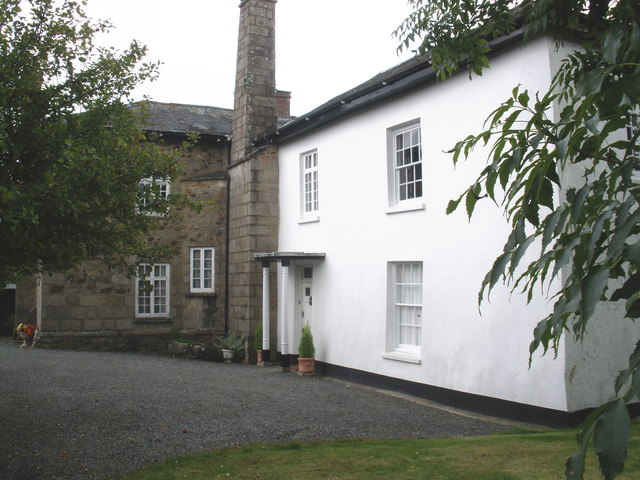
Henry married Mary Langmead, a farmer’s daughter from Bovey Tracey, in Bovey Tracey, in 1870 and they moved into “Town Barton” farm in Doddiscombsleigh, which is a small parish just to the north of Ashton.
According to the census taken the following year, they farmed 215 acres with the help of five labourers and two domestic servants. They probably needed the latter as they had a three-month old daughter, Ellen Anne Pinsent by then. Their other children, Henry James and Mary Louise Pinsent arrived soon after.
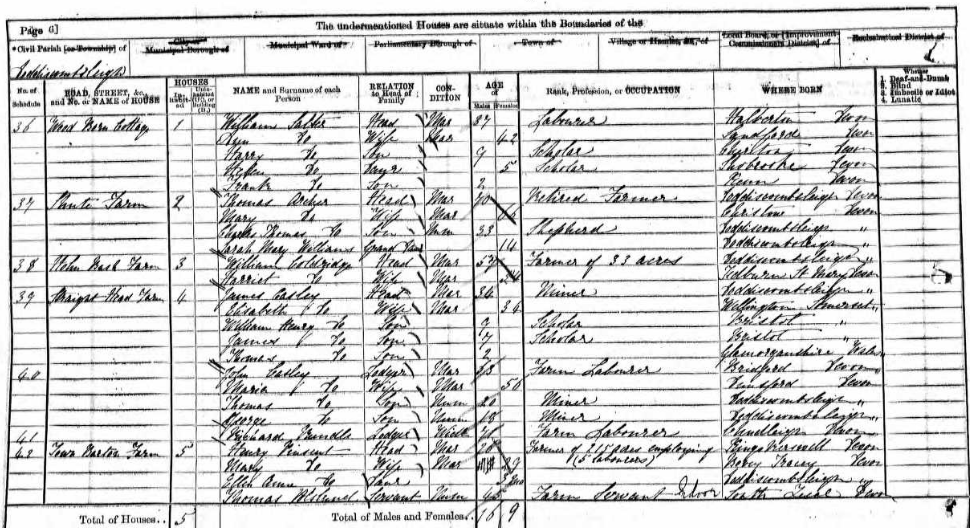
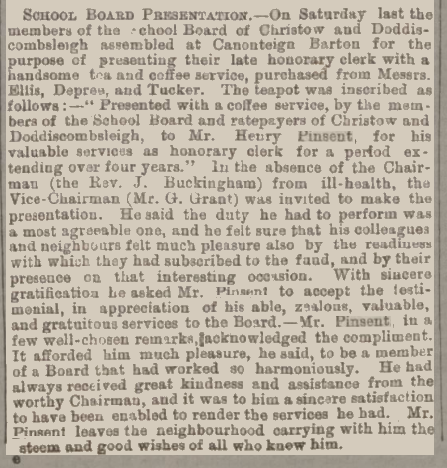
According to White’s Directory, the family was still living at “Town Barton” in 1878 and he must have been there two years later when he was appointed Clerk of the “Christow and Doddiscombleigh School Board”. Henry handled the paper work when the board went looking for a new schoolmistress, and when it changed its bylaws in 1880 (Western Times: Friday 27th February 1880; Exeter and Plymouth Gazette: Friday 17th December 1880).
When he left the district two years later, the School Board presented “their late honourary clerk” with a handsome tea and coffee service for his four years of service (Exeter and Plymouth Gazette: Friday 21st July 1882). The School Board had been formed in 1875 and the school built in 1879 (White’s History, Gazetteer and Directory, 1878), so it would have been a busy time for them.
Henry also represented Doddiscombsleigh, and Christow, on the “Wonford Highway Board”, which monitored the activities of the region’s Surveyor and allocated money to improve the region’s roads and bridges. The “Surveyor reported that the bridge over College Lane Brook in the parish of Ide had recently fallen in or been thrown down” (Western Times: Saturday 4th December 1880). There was a lot to be done there as well.
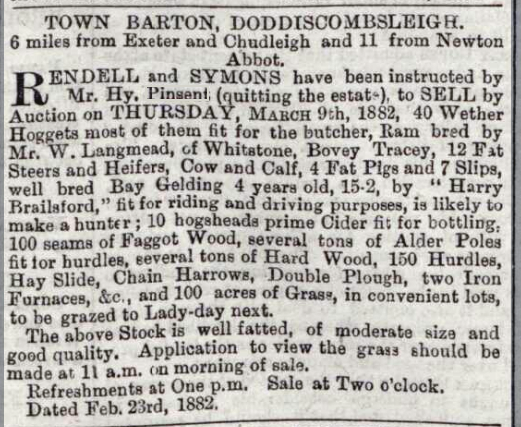
I cannot find any mention of Henry and his family in the 1881 Census records; however, he must have been living at “Town Barton.” That was the year that he was one of three farmers from outside the Chudleigh District chosen to judge “farms and roots” at its annual show and ploughing competition (Western Times: Thursday 27th October 1881). Henry was shortly to leave Doddiscombsleigh and move his family to “Whitstone Farm” in Bovey Tracey – which was in the Chudleigh District! In March 1882, he arranged for the firm of Rendell and Symons, to sell his 40 “wether hoggets” (young males) 12 steers and heifers, 4 pigs a gelding and, most important, “10 hogsheads prime cider fit for bottling” – and much else besides – at auction at “Town Barton” on 9th March, 1882. He also sold the grass or grazing on 100 acres of land through to the following 25th March, Ladyday (Western Times Friday 3rd March 1882). He
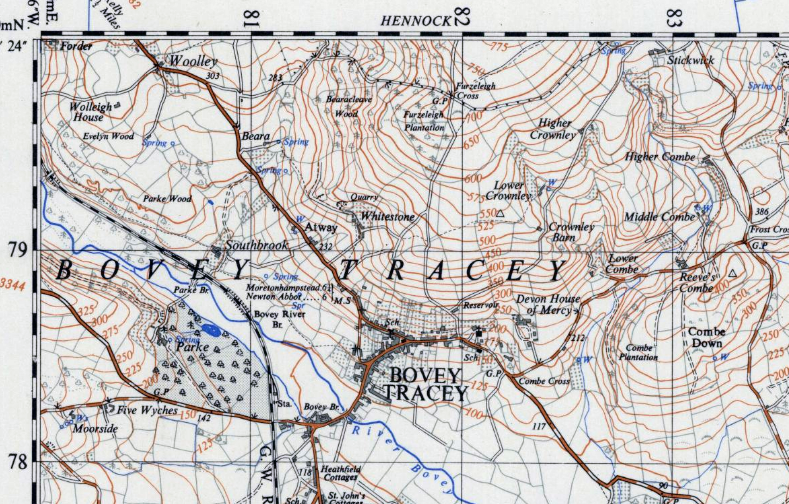
Interestingly, we find that a Mr. Wm. Langmead, of “Whitstone Farm” sold his stock, which included a very highly regarded flock of sheep, at much the same time (Western Times: Thursday 14th April 1881). He was leaving the county and he sold off his residual stock, implements of trade and furniture early in March the following year (Western Times: Friday 10th March 1882). Presumably, William Langmead was one of Mary’s relations and his vacating the property allowed Henry and his family to take over what was probably a larger and more productive farm. It is probably not a coincidence that the “wether hoggets” that Henry had sold had been bred from “Mr. W. Langmead’s ram.”
Henry next turns up at a dinner that was given by the Vicar of Bovey Tracey to acknowledge the half-yearly “tithe audit” – payment of parish dues (Exeter Flying Post: Wednesday 9th August 1882). It was an annual event and, from this year on, Henry becomes a regular attendee.
As a new arrival in Bovey Tracey, Henry offered up two of his fields for the “Chudleigh District Agricultural Society” annual ploughing competition in 1882. The contest was carried out in thick mud on a particularly rainy day in October. Nevertheless, Mr. Pinsent of Bovey was warded third prize for “best general green crop” and for “best crop of common turnips, not less than three acres” (Exeter Flying Post: Wednesday 25th October 1882). Whether Henry or Mr. Langmead, his predecessor, should have had the credit I am not sure. However, his green crops and his swedes came in second the following year (Exeter and Plymouth Gazette; Friday 19th October 1883) and he deserved full credit for that. He did better still in 1884, coming first in both categories. He was a strong supporter of the “Agricultural Society” and involved in it in some for or other for several years (Teignmouth Post and Gazette: Friday 11th November 1887).
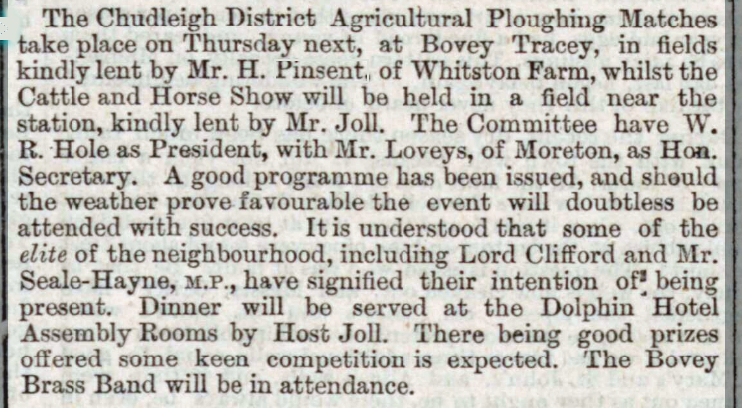
One of Henry’s bulls came in third in its particular category in 1884 and his heifers and his rams and ewes did well too. While this was happening, Henry and two other farmers were busy judging the thatching and hedging events (Exeter Flying Post: Wednesday 5th October 1884). Henry was in demand! The “Dawlish Agricultural Association” asked him to serve on its panel of judges later that month (Exeter Flying Post: Wednesday 24th October 1884). In later years, Henry appears to have concentrated on sheep breeding and he regularly won awards. He seems to have focused on long-wool sheep (East and South Devon Advertiser: Saturday 21st May 1887). He volunteered to host the ploughing competition for a second time in October 1886 (Western Times: Friday 8th October 1886).
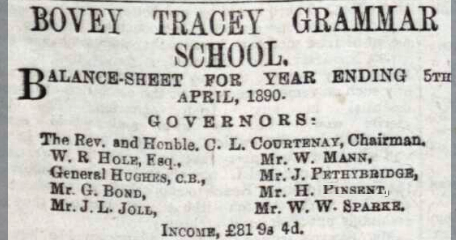
Henry was elected to the Newton Abbot “Board of Guardians” in 1883, and assigned to the “School Attendance Committee” to fill a vacancy created by the death of the previous representative from Bovey Tracey (Exeter and Plymouth Gazette: Friday 20th April 1883). He was re-elected to the “Board of Guardians” annually throughout the 1880s. Admittedly, the seats were rarely contested (Exeter and Plymouth Gazette: Saturday 30th March 1889). Henry was on the Board of Governors of “Bovey Tracey Grammar School” in 1890 (Western Times: Friday 2nd May 1890), so clearly kept up his early interest in Education.
Henry Pinsent was assigned another civic duty. He was appointed to the Grand Jury at the Devon Quarter Sessions when they were held in Exeter in July 1883 (Exeter Flying Post: Wednesday 11th July 1883). Henry seems to have been a good neighbour himself. When he found a stray, Dartmoor breed, “wether hog” (i.e. castrated male ram) that had inadvertently strayed onto his land. He resisted the temptation to make mutton stew and advertised the fact in the local press (Western Times: Friday 9th May 1884). It was a fairly common occurrence for stock to wander and most of the farmers thereabouts knew better than to keep waifs and strays.
Politically, Henry was a Conservative who supported the formation of a “Conservative Association in Bovey Tracey”. He believed that English farmers needed protection “when wheat went below 6s a bushel the land could not be properly cultivated for want of sufficient means to employ ample labour upon it” (Exeter and Plymouth Gazette: Friday 13th March 1885). His concerns showed through at a Vestry meeting held in April 1885. Some parishioners thought that the “Assistant Overseer”, who collected the rates, should receive a pay raise. However, Henry thought not, as it was inconsistent with the then downward tendency of wage rates. It was eventually agreed that the parish council should look into the payments made in neighbouring parishes (Exeter and Plymouth Gazette Daily Telegrams: Tuesday 14th April 1885) and report back before any decision was made. At the same meeting Henry was appointed a “way-warden” – which saw him returning to road management. Later that year, he supported Mr. W. J. Harris’s run for of parliament in the “Mid-Devon” Division in. He was one of his “Assessors” (East and South Devon Advertiser: Saturday 28th November 1885).
Presumably his wife, Mary (née Langmead) supported his Conservatism. In May 1886, we find Henry attending a meeting of the “Bovey Tracey Habitation of the Primrose League”. The league was a vehicle for women to become involved in the Conservative movement (Exeter and Plymouth Gazette: Friday 21st May 1886). Henry was still attending political meetings in November 1891 (East and South Devon Advertiser: Saturday 7th November 1891).
Henry Pinsent’s father and his brother Gilbert Pinsent, who was then farming at “Ware Barton” in Kingsteignton, were “non-conformists,” and Henry’s sisters had all been married at the Independent Chapel in Newton Abbot. However, Henry seems to have been less committed to the chapel than they were. Nevertheless, he contributed £15 3s 6d to a special collection made by the local “dissidents” to pay off the final tranche of the cost of building their own Wesleyan Chapel in Bovey Tracey (Western Times: Friday 7th October 1887).
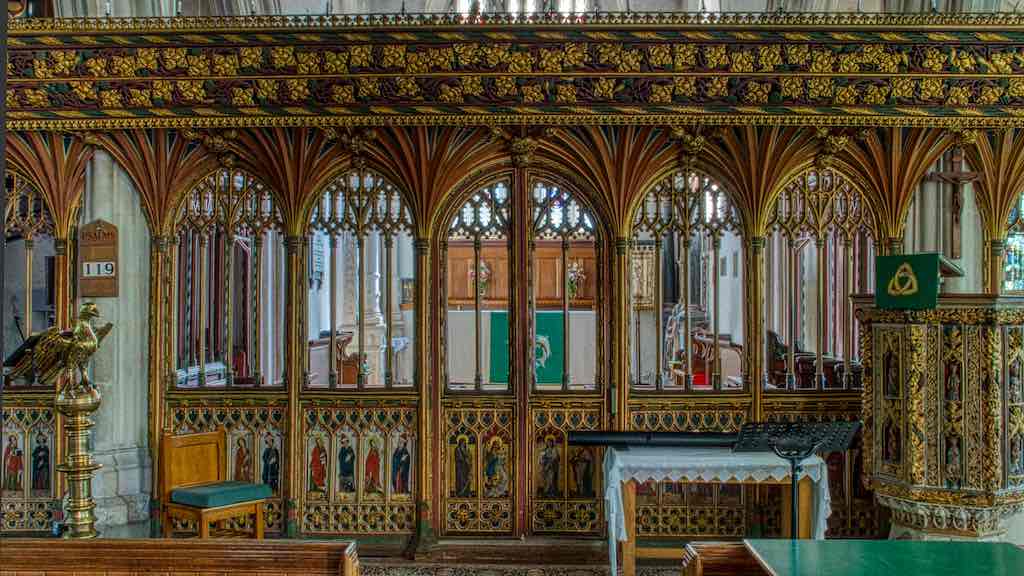
Henry was an important member of both the town and the parish of Bovey Tracey, and a prominent member of the Vestry; however, he was reluctant to spend money on the parish church (Western Times: Tuesday 21st April 1885). In the spring of 1885, there were several meeting to discuss the restoration of the chancel. In the end, an anonymous donor agreed to pay for some of it and the incumbent, the Hon. and Rev. C. L. Courtenay was willing to pay for the rest. The plan was to remove the old-fashioned box pews and the replace the rood screen. At least the screen seems to have survived. The box pews had been assigned to local families for generations and their location bestowed status. Mr. W. R. Hole (President of the “Bovey Tracey Conservative Association”), who was a large contributor to the tithes in the parish, refused to give up his box (Exeter and Plymouth Gazette: Friday 1st May 1885). There was an acrimonious vote on the proposal on 22nd April 1885 (Exeter Flying Post: Wednesday 6th May 1885). Henry complained that there had been unauthorized canvassing: “(he) regretted to say he had been canvassed for his vote by two or three. — Mr. Westwood challenged him name the party. He knew he had not done so. Mr. Pinsent declined to give the information asked. Mr. Baker said one person had mentioned that two oz. of “baccy” had been offered him to vote for the vicar.” (East and South Devon Advertiser: Saturday 9th May 1885). The plan was approved but went ahead in the face of opposition.
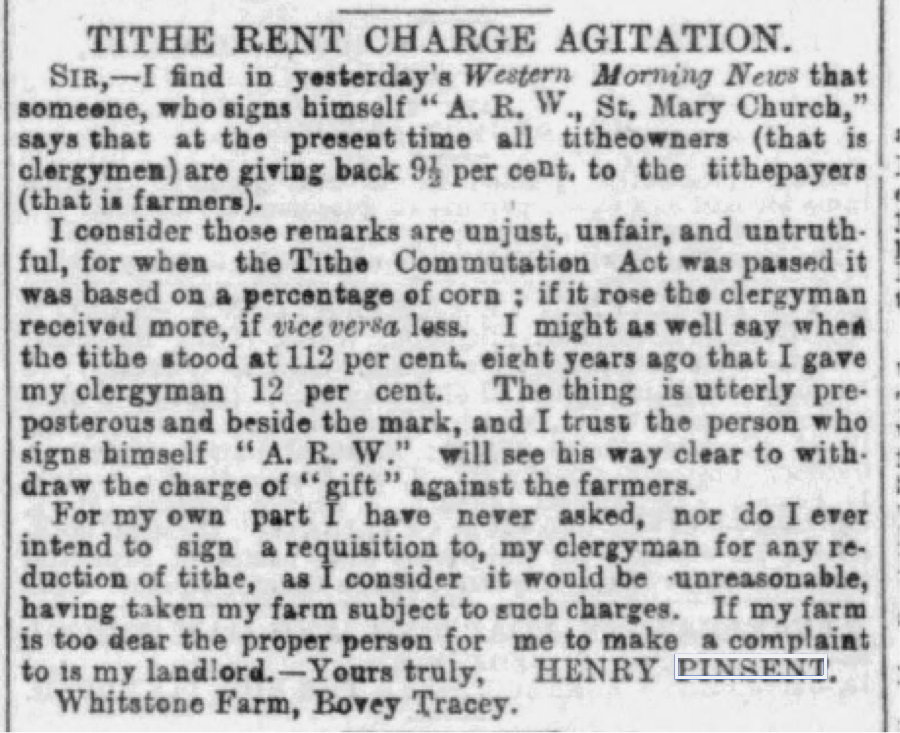
Tithes were an all too frequent cause of friction in the community as there were times when the economics of the agricultural economy favoured the farmer and times when it favoured the clergy. Henry answered one farmer’s complaint in the Western Morning News by saying: “For my own part I have never asked for, nor do I ever intend to sign a requisition to my clergyman for reduction of tithe as I consider it would be unreasonable having my farm subject to such charges. If a farm is too dear the proper person for me to make a complaint to is my landlord” (Western Morning News: Thursday 23rd December 1886).
Bovey Tracey was a large parish and the Churchyard and the Baptist burial ground were just about full. The Vestry reassembled in March 1889 to discuss the problem and a committee was formed … (Exeter Flying Post: Saturday 30th March 1889). Several parishioners favoured buying ground immediately adjacent to the Churchyard regardless of cost; however a new, presumably cheaper, site was eventually selected and purchased (Totnes Weekly Times: Saturday 28th September 1889).
The newly renovated parish church was back in action in May 1889 when Mr. J. L. Joll (the manager of the “Dolphin Hotel”) married Mrs. Ellen Shaddon (presumably née Langmead). She was given away by her brother-in-law, Mr. Henry Pinsent. His two daughters, Ellen and Mary, were bridesmaids. After the ceremony, sixty people sat down for a, doubtless very impressive, wedding breakfast at the “Dolphin Hotel” (Totnes Weekly Times: Saturday 25th May 1889). Ellen Anne (Nellie) Pinsent married George Tapper of “Twinyeo Farm” in Chudleigh Knighton, in Hennock, in April 1890 (Western Times: Friday 11th April 1890).
When the Mayor of Bovey Tracey, Mr. Thomas Crocker, entertained the borough freeholds to a dinner at the said same “Dolphin Hotel” in May 1887, it fell to Henry to respond to the customary toast to “The Army, Navy and Auxiliary Forces.” Evidently, he did so with humour and stated that: “He had never been connected (he said) with the Army, but had been a member of the Yeomanry Cavalry for eight years, and he always felt when called up for duty, ready to fight – (cheers, and laughter). At the same time; he believed it was the ambition of the branch he had the honour of belonging to, to do their best to maintain peace and good will with all nations” (East and South Devon Advertiser: Saturday 14th May 1887).
By 1891, Henry and his wife Mary (née Langmead) and their other two children, Henry James Pinsent, who was also described in the Census as being a “farmer”, and Mary Louise Pinsent (a.k.a. “Minnie”) were living at “Whitstone” with two farm servants, and a domestic servant. I imagine he also used day labourers on and around the farm as well.
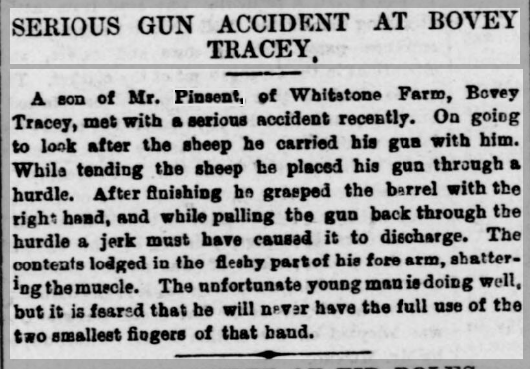
Henry’s son, Henry James Pinsent was, sadly, badly injured working on the farm in February 1892. He placed a loaded gun against a hurdle while tending to a sheep and the gun discharged as he grabbed the barrel to pick it up. He badly damaged his right hand and forearm (Exeter and Plymouth Gazette: Thursday 11th February 1892). He was fortunate that that was all.
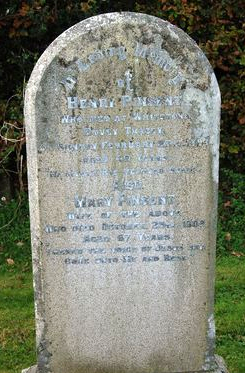
The pre-Christmas market at Newton Abbot was always very competitive and the best livestock received the best prices. In December 1893, one of Henry’s heifers came in second in its category (Western Times: Thursday 7th December 1893). Henry and his son Henry James had considerable success with their sheep and cattle over the years; however, this was to be Henry’s last award. Henry died at “Whitstone Farm” in 1894, aged 49 years, and his gravestone can still be seen in the cemetery at Bovey Tracey. His widow, Mary, probated his will and his effects were, according to the Calendar of Grants of Probate and Letters of Administration, valued at £2,131 4s 9d.
Henry’s son, Henry James Pinsent took over the running of the farm. He married, Kate Hewett, a farmer’s daughter from Farnham in Surrey in 1900 and they had a son of their own born in Bovey Tracey the following year. His life is discussed elsewhere.
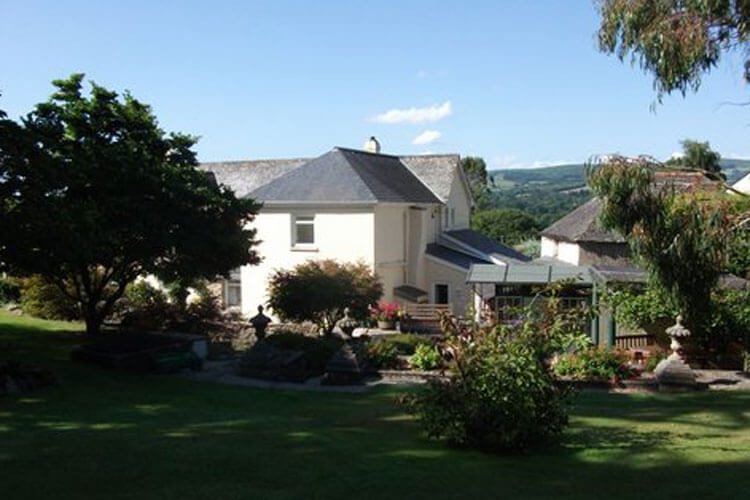
According to Kelly’s Directory, Mary (née Langmead) lived at “Whitstone” until 1897. However, I suspect that she was there for quite sometime after that. Mary and her son Henry James Pinsent were visiting a young Langmead relative in Sussex at the time of the 1901 Census. Henry James’s wife Kate, was, meanwhile, at “Whitstone” looking after her newborn son. Mary’s younger daughter Mary Louise Pinsent was staying with an uncle, John Lamble Joll (a Hotel Proprietor) in Hennock.
I do not know very much about Mary Louise; however, there is a head-shot photograph of her on the Lambert Website (Ancestry.com). She was likely the Mary L. Pinsent who was awarded “first class excellent” certificates for freehand and model drawing at the Newton Abbot Science and Art Class in 1889 (Express and Echo: Thursday 18th July 1889). She probably had a good singing voice too. On one occasion, “Miss Pinsent (daughter of the late Mr. H. Pinsent of Whitstone) who not only has a very sweet voice but used it with much artistic skill” sang a song entitled “Mona” (East and South Devon Advertiser: Saturday 28th April 1894) at a social event in Teignmouth. She was not alone on stage as William Henry Pinsent (from the DEVONPORT branch of the family) – who was just starting his own career as a banjo player and musical comedian – was also performing. Similarly, she was probably the Miss Pinsent whose pretty song “Whisper and I shall hear” entranced everyone at Miss C. E. Linter’s amateur concert for the benefit of the poor in Teignmouth at Christmas in 1894 (Teignmouth Post and Gazette: Friday 14th December 1894). Miss Pinsent was a bridesmaid when Sarah Hewett of White Lake Farm, Searle, married William Herbert Langmead, of Todhurst, Warbleton, Sussex (Aldershot Military Gazette: 14th November 1896). She, herself, married John Stevens Neck, a “gentleman” from Moretonhampstead, in Totnes, in 1901.
Henry’s widow, Mary Pinsent, (née Langmead) died in in Paignton, in October, 1909 and her son-in-law, George Tapper, a retired farmer, took probate of her will. She was buried with her husband. Her effects were valued at £376.
Family Tree
Grandparents
Grandfather: Gilbert Pinsent: 1758 – 1835
Grandmother: Margaret Snow: 1756 – 1843
Parents
Father: John Pinsent: 1799 – 1858
Mother: Ann Brock: 1811 – 1866
Father’s Siblings (Aunts, Uncles)
Thomas Pinsent: 1790 – 1804
Mary Snow Pinsent: 1793 – 1890
William Pinsent: 1797 – 1882
John Pinsent: 1799 – 1858 ✔️
Male Siblings (Brothers)
John Pinsent: 1838 – 1916
Gilbert Pinsent: 1840 – 1918
James Pinsent: 1842 – 1902
Henry Pinsent: 1844 – 1894 ✔️
Albert Pinsent: 1846 – 1846
Please use the above links to explore this branch of the family tree. The default “Next” and “Previous” links below may lead to other unrelated branches.