Vital Statistics
Donovan Henry Douglas Pinsent: 1901 – 1980 GRO0174 (Engineer, Paignton)
1. Vera Gweneth Salter: 1905 – 1986
Married: 1924: Paignton, Devon
Children by Vera Gweneth Salter:
John Henry Pinsent: 1925 – 1945 (Royal Air Force, War Casualty)
Son (GRO0155)
2. Flora Helen Hales: 1901 – 1976:
Married: 1937: Worthing, Sussex
3. Gladys Parsons: 1907 – 1984:
Married: 1978: Torbay, Devon
Family Branch: Devonport
PinsentID: GRO0174
References
Click here to view close family members.
Donovan Henry Douglas Pinsent was the elder of William Henry Pinsent’s two sons by Minnie Gertrude Pearse. He was born in Teignmouth in 1901 and lived there while his parents made an unsuccessful attempt to run a seaside boarding house. He first comes to our attention in 1908 when he helped in a collection drive in support of the Teignmouth Lifeboats (Teignmouth Post and Gazette; Friday 14th August 1908). He managed to collect 16s. Donovan was interested in song and dance and was in the chorus when the “Teignmouth School of Art” put on an “Old English Fair” at Bitton (Teignmouth Post and Gazette: Friday 18th June 1909).
When he was eleven years-old, in 1912, Donovan saw his father forced into bankruptcy (see, William Henry Pinsent) – which must have been traumatic. His father later claimed that one of the reasons for his predicament was that he was trying to keep up appearances, and that meant that paying school fees (Exeter and Plymouth Gazette: Friday 16th February 1912). William seems to have sent his sons to Wallingbrook, an expensive “private (Public) school” at Chumleigh, in North Devon. I can not say definitively that Donovan was there in the mid-1910s; however, his brother, Gerald Swain Pinsent was certainly there in the early 1920s.
On leaving school, in 1918, Donovan was apprenticed to the “Great Western Railway Company”. Its records show that he was trained as a “fitter” and a “turner” in its “Locomotive, Carriage & Wagon Department”, in Newton Abbot between 2nd December 1918 and 1st December 1921 (Great Western Apprentices and Prospectives: 1893 – 1924). Perhaps he lived at “Minerva House” with his grandfather, William Swain Pinsent. If so, he may have been the “Donald” Pinsent who is said to have witnessed a case of dangerous driving in Newton Abbot and given evidence against a motor-cyclist, William Parkhurst, at “Newton Abbot Police Court” (Brixham Western Guardian: Thursday 27th May 1920). I know of no other likely candidate. Donovan was living in Newton Abbot when his grandfather died in September 1920 and, along with his father William Henry and his uncle John Douglas Pinsent, he was listed as one of the principal mourners at the funeral (Western Times: Friday 10th September 1920).
Donovan was an “engineer” by the time he married Vera Gweneth Salter in Paignton in 1924. She was the daughter of a “caterer.” They had two sons, John Henry Pinsent born in 1925 and Clifford Frederick Pinsent in 1927. The marriage did not last. Unlike his father and younger brother, Donovan was not particularly passionate about sports; he had other interests. In 1927, he competing in the “Western Counties Dancing Championships” in Torquay and, with a Miss McColgan, came in seventh (Western Morning News: Monday 25th April 1927).
That same year, 1927, Vera Gweneth Pinsent (née Salter) applied to the Torquay Magistrates for a separation order against her husband. She claimed that he had recently taken a job as a “live-in chauffeur” in Croydon, near London, and was earning £2 10s per week – while she was left to look after his children at her parents’ house in Torquay. The Magistrates granted her legal custody of the children and issued an order for her to receive 25s a week (Western Morning News: Tuesday 20th December 1927). Donovan failed to comply and he was arrested on a warrant served in Bognor, in Sussex, the following year. It stated that he was in arrears for £37 10s. Donovan appeared in “Torquay Police Court” and admitted to the facts of the case. However, he claimed that although he had been out of work for quite a while, he had recently found employment as a “driver” in Brighton. He was now earning 48s per week – but he had to pay 34s 6d for his keep. The Chairman gave him ten days to pay £4 and ordered him to pay 10s a week until he was in a better financial position (Western Morning News: Wednesday 5th December 1928).
Donovan and Vera never reconciled. Vera filed for a divorce in 1931 (Public Record Office: J77/2973/1853). She claimed that her husband had left her without warning in 1927. The divorce was granted based on evidence of his “misconduct at a London hotel” (Exeter and Plymouth Gazette: Friday 17th June 1932). I leave that to your imagination. Vera continued to bring up her children at her parent’s home on Bamfylde Road, in Torquay. She went into “sales” and was selling “gowns” when the War-time Register was made, in 1939. She stayed on in Torquay throughout the war and could be found running a stall at Torre’s “Christmas Bazaars” in 1949 and 1950. She attended other events, including a “Tor Parish Garden party” in 1952 (Torquay Times and South Devon Advertiser, Friday 24th November 1950 etc.). Vera never remarried. She died in Taunton Deane in Somerset in 1986.
Vera’s son, John Henry Pinsent, was educated at Torquay Grammar School. He joined the “Royal Air Force Volunteer Reserve” at the outbreak of the “Second World War” and became a “Flight Engineer” assigned to “170 Squadron, Bomber Command” at RAF Hemswell, in Lincolnshire. Sadly, he was killed on a night raid over Stuttgart on 7th/8th January 1945. His Lancaster bomber is said to have collided with another plane on route to the same target. His fate was unknown for a while, and he was initially reported missing (Torquay Times and South Devon Advertiser: Friday 14th December 1945). “Flight Srgt.” John Henry Pinsent [#1852125] died and was buried at Durnbach War Cemetery (aircrewremembered.com). He was only 19 years old and unmarried. His mother, Vera Gweneth Pinsent, applied for Letters of Administration for his effects, which were valued at £192 4s 11d. John’s name was added to the Grammar School’s memorial rostrum which was unveiled in May 1952 (Torquay Times and South Devon Advertiser: Friday 2nd May 1952).
Her younger son, born in 1927, survived the war, married, and had at least one daughter. I am not aware of any death notice so he could, conceivable, still be alive.
Donovan, meanwhile, married Flora Helen Hales, of Lancing in Sussex, at Worthing Registry Office on 6th August 1937. They lived in Paignton, where Donovan had found a new passion – building and sailing model yachts. He was hon. treasurer of the “Paignton Model Yacht Club” by 1936 (Paignton Observer and Echo: 12th March 1936) and become its official measure-er. In other words, he checked that competitive yachts were up to “Model Yacht Association” specifications (Torquay Times and South Devon Advertiser: Friday 26th May 1939).
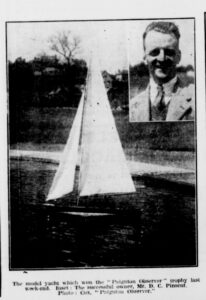
Donovan built yachts; so, we find that when the “10-rater” category competed for the “Studdy Cup” in Paignton in 1938, the “Dolores” (owned by R. Perryman) “sailed by its late owner and builder, Mr. D. Pinsent, showed to advantage” – and won (Paignton Observer and Echo: 15th December 1938). Donovan’s yacht “Imp” had represented the club at an event held in Plymouth the previous year (Western Morning News: Monday 23rd August 1937). Donovan built a “Marblehead” class yacht named the “Black Widow” in 1939. It was a convention for the class that they all be named after insects (Paignton Observer and Echo: 29th June 1939). Donovan was active in the yacht club up to and immediately prior to the Second World War.
A ship manifest, meanwhile, shows that Flora Pinsent (an English housewife from Stoke Gabriel in Devon, aged 36) returned from Trinidad on the “Hamburg-Amerika Line” ship “Cordillera,” which arrived at Plymouth on 23rd June 1938 (UK, Incoming Passenger Lists: Ancestry.com). What she had been doing in the West Indies is uncertain; perhaps she had family there.
At the outset of the war, Donovan was said to be an “Engineer” and a “Master Boat Builder” (1939 Register) who lived with his wife on Pines Road in Paignton. However, they had moved to #2 Barcombe Road by 1942, and they lived there until the 1970s. During the war, Donovan put his three-wheeler (two-cylinder) “Morgan Aero” motorcar up for sale (Western Morning News: Saturday 24th January 1942). What he replaced it with, I do not know but he kept on driving. Flora, his wife, was fined £1 at Paignton Police court later that year for driving without her licence (Paignton Observer and Echo: 18th June 1942), and they were both fined £1 (with 4s costs) for miss-using their car two years later. Donovan’s lawyer said that his client was involved in “priority Admiralty work” and was entitled to drive to Teignmouth, but in this case he had actually driven to Paignton Harbour instead—to talk over some business. He had his wife with him; however, it was only a small infraction as he had only used “enough petrol to make a hankerchief smell.” The court considered that here was a principle involved … (Western Morning News: Thursday 14th September 1944; Paignton Observer and Echo: 14th September 1944).
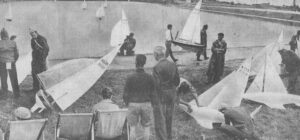
After the war, Donovan applied for, and was granted a licence – at a price of around £250 – to operate two speed-boats from the southern end of Paignton beach for five years (Paignton Observer and Echo: 24th March 1949). He also returned to model yacht racing and, being a seasoned member of the “Paignton and District Model Yacht Club”, he was nominated “Officer of the Day” when the club met for the final contest of its “Marblehead Cup” competition in 1948. Perhaps his own entry (if he had one) had been eliminated (Torbay Express and South Devon Echo: Monday 15th November 1948).
Donovan’s “Trixie” sailed well in various competitions in May and June the following year (Torbay Express and South Devon Echo: Tuesday 28th May 1949) and did even better on land. “Trixie” won first prize in the “Racing Yacht Category” at the “Devon Industries Fair Model Exhibition” (Torbay Express and South Devon Echo: Saturday 10th September 1949).
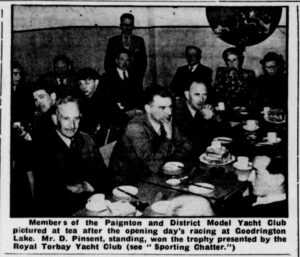
The Paignton Club regularly competed both internally and with teams from other communities and the results were invariably reported in the press. The reports refer to the “Paignton Observer Cup”; the “Studdy Cup”; the “Joy Cup”; the “Marblehead Cup”; the “Chamber of Commerce Shield” and many other trophies, and Donovan was always a contender. For instance, at one match – against the Exeter Club – Paignton lost by 120 to 105 points after 45 separate races. Mr. D. Pinsent (Paignton) did well, though. He came second at the event (Western Morning News: Tuesday 30th May 1950). “Mr. D. Pinsent, Paignton model yachtsman, won six cups this season (1950). He was runner up in the only other competition he entered. Among the trophies he has won is the only cup offered for competition by Exeter Model Yacht Club. Mr. Pinsent is a member of both the Exeter and Paignton Model Yacht clubs” (Paignton Observer and Echo: 10th August 1950).
Yacht Racing was a popular spectator sport and when the Paignton Club arranged for the “Trixie” and “Dolores” to be displayed in the window of the “South Western Gas Board” showroom in April 1952, it did so in hopes of attracting new recruits to the sport – “The club loan the yachts for display every two or three years but this year the object of exhibiting them was to capture the interest of the public and obtain recruits to the club. When the club commenced in 1952 sailing season at Goodrington on April 6 Trixie won the Royal Torbay Yacht Club’s silver rose bowl for the third year in succession. Those interested in joining the club should contact Mr. D. Pinsent, 2 Barcombe Road, Paignton” (Paignton Observer and Echo: 17th April 1952). Donovan was, by then, the “Commodore” of the Paignton Model Yacht Club (Paignton Observer and Echo: 10th January 1952).
It was Donovan’s yacht “Trixie” that placed first in the “Gosport Model Yacht Club” competition held for the “Trojan Cup” (Portsmouth Evening News: Monday 30th August 1954). This may, infact, have been “Trixie II” as she had raced at the “British Open” class “A” model yacht championship meet at Gosport a couple of weeks earlier (Portsmouth Evening News: Wednesday 11th August 1954). Donovan sailed on throughout the 1950s and won the “Model Yachting Association’s South-Western District Championship” in 1959 (Portsmouth Evening News: Monday 18th May 1959). His yacht “Trixie II” did not fair quite so well when it came to the “Nyria Cup” two days later, and his wife, doing the honours, presented Mr. R. Gardner with the trophy for his “Serenade” after it won the “Gosport Model Yacht Club’s” premier event at Walpole Lake (Portsmouth Evening News: Wednesday 20th May 1959).
Donovan was a “refrigeration engineer” by then and he seems to have driven extensively to race his yachts and perhaps also conduct his business. There were no motorways in those days and he was, unfortunately, involved in a motorcar accident, in Tolpuddle, in Dorset in 1950. The local rector there, Rev. Henry Knight, failed to hear him coming and died from injuries received when hit a glancing blow by Donovan’s car. Donovan was called as a witness at the “Coroner’s Inquest” held at Dorchester in November 1950 and was exonerated (Paignton Observer and Echo: 23rd November 1950). The Coroner returned a verdict of “death by misadventure” (Western Morning News: Friday 17th November 1950).
Flora must have been fairly sick in November 1953, as her doctor visited her a couple of times while she was in a Nursing Home. He sent Donovan a bill for 18 guineas for his services which he refused to pay – saying that he had no record of the visits and the sum should have been included in the over-all cost of Flora’s stay at the nursing home! The Judge at Torquay County Court sided with the doctor on that one (Torquay Times and South Devon Advertiser: Friday 12th March 1954; Paignton Observer and Echo: 18th March 1954).
Flora Helen Pinsent (née Hales), presumably, had business interests of her own as she was awarded £500 in damages when she took a local chartered accountant to court over a disputed sale. He was trying to make a quick sale of the “Manor Club” at Preston, which had been put into receivership. The accountant came to an oral agreement with Mrs. Pinsent’s solicitors to the effect that she would buy the property for £1,500. However, he then responded to another offer to purchase the property at the same price and sold it before her paper work was completed. Mr. Justice Devlin determined that the original contract should have been honoured (Paignton Observer and Echo: 12th November 1959).
Flora died in 1976 and Donovan married (for a third time) two years later. He married Gladys Parsons somewhere in the Torbay area in the spring of 1978. Donovan Henry Douglas Pinsent died in June 1980. His will was probated in Paignton. His net personalty was valued at £86,888. Gladys Pinsent died in Totnes, a few years later. Her will was probated in Bristol. She had assets valued at “not exceeding £40,000”. I am not aware of Donovan having had children by either Fora or Gladys.
Family Tree
Grandparents
Grandfather: William Swain Pinsent: 1843 – 1920
Grandmother: Harriet Eliza Cookson: 1846 – 1892
Parents
Father: William Henry Pinsent: 1874 – 1949
Mother: Minnie Gertrude Pearse: 1872 – 1937:
Father’s Siblings (Aunts, Uncles)
John Douglas Pinsent: 1872 – 1936
William Henry Pinsent: 1874 – 1949 ✔️
Male Siblings (Brothers)
Henry Douglas Pinsent: 1897 – 1897
Donovan Henry Douglas Pinsent: 1901 – 1980 ✔️
Gerald Swain Pinsent: 1904 – 1993
Please use the above links to explore this branch of the family tree. The default “Next” and “Previous” links below may lead to other unrelated branches.