Vital Statistics
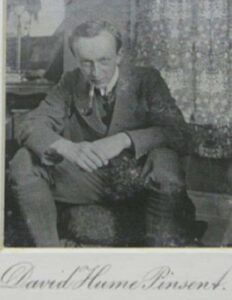
David Hume Pinsent: 1891 – 1918: GRO0163
Family Branch: Devonport
PinsentID: GRO0163
Click here to view close family members.
David Hume Pinsent was the eldest son of Hume Chancellor Pinsent by his wife Ellen Frances Pinsent (née Parker). He was born in Birmingham and educated, firstly at Lambrook School in Bracknell, Berkshire, and then at “Marlborough College”, a well-known English “Public” (private) school (Birmingham Mail: Friday 13th June 1913). While there in 1907, he won a senior scholarship. David, like his father before him, was a mathematician. He went up to Cambridge in 1910 and won the “Trinity College” prize for mathematics that year and he graduated as a “wrangler” in June 1913 (Birmingham Mail: Friday 13th June 1913).
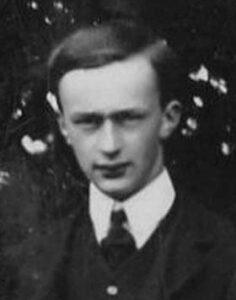
David signed up for a rhythm of speech experiment (whatever that was) in 1912 and through it met the Austrian philosopher Ludwig Wittgenstein. They shared a common interest in music and became friends. How close they were is debatable; however, they took a trip through Iceland together that summer – at Ludwig’s father’s expense. There is nothing in David’s diary to suggest that they were anything more than traveling companions but Ludwig was clearly obsessed with David. Whether the feelings were reciprocated, I do not know.
David’s life and relationship with Ludwig and their interactions with Bertrand Russell, John Maynard Keynes and other members of the “Society of Apostles” at Cambridge are described in diaries, which David kept from 1912 to 1914. These were edited by G. H. von Wright and published by “Blackwell Publishers” under the title of “A Portrait of Wittgenstein as a Young Man” in 1990. Among other things, the diaries describe a visit that Ludwig made to the Pinsent family home at “Lordswoods House”, in Harborne, Birmingham, after their joint holiday in Iceland. Evidently, he spent an amicable couple of days visiting with David’s father, Hume Chancellor, his mother Ellen Frances, and his sister Hester (wittgensteinchronology.com).

According to one of the diary entries: “On Monday 16th June 1913: Pinsent and those members of his family visiting Cambridge go to tea with LW (Ludwig Wittgenstein). He serves them tea in chemical beakers (as he always has his food – because ordinary crockery is too ugly for him!) and proves to be in good form, albeit somewhat preoccupied by his duties as host. Pinsent’s guests leave at 5.30 p.m., he stays and later goes for a walk with LW. LW talks to Pinsent about his character, proclaiming him ideal in every respect except that he fears that with people other than LW Pinsent is lacking in generous (i.e., sympathetic) instincts. Pinsent notes that he disagrees with this verdict, pointing out that LW knows little of his other friends. LW, Pinsent opines, is ‘so different from other people – he is if anything a bit mad – that one has to deal with him differently – superficially at any rate’. When they get back to Trinity Street they meet Pinsent’s family again, and LW is persuaded to dine with them at their lodgings. Pinsent records that LW ‘brightened up considerably during dinner and we had a very pleasant evening’. They all then go on the river again in canoes and a rowing boat. Afterwards, LW leaves them, and Pinsent returns to his own rooms and plays the piano there (Pinsent, pp.56-7). Wittgenstein undoubtedly had his quirks and David found him “trying a times” but they remained friends. Maybe they both had trouble relating to others, socially.
The following August, Wittgenstein unilaterally abandoned plans the two of them had made to visit Spain and, instead, took David to Norway. According to David’s diary, it seems as if Wittgenstein was frequently depressed, moody and unapproachable, and clearly their travels were not as enjoyable as they had been the previous year. David messed about in boats, fussed with his camera, studied his law books and played the piano. They arrived back in England on 1st October 1913. Shortly thereafter, Wittgenstein announced that he was going back to Norway to live! They parted company for the last time a few days later but continued to correspond.
David Hume had graduated with a “First with Special Distinction” in Part II of the “Mathematic Tripos” and he was now (probably reluctantly) studying for the bar at the family law firm, “Pinsent and Co.” David agreed to travel around Andorra with Ludwig the following year. However, they also discussed the Faroe Islands, and other locations. However, it was not to be. The war intervened and their correspondence came to an end towards the end of July 1914 wittgensteinchronology.com/6html).
David was dinged 10s and 8/6d costs at Slough Petty Sessions – possibly for failing to produce a driving license – in November 1914 (Windsor and Eton Express: Saturday 14th November 1914): perhaps he should have known better. He had just passed his bar exams in Criminal Law and Procedure in October 1914 (London Times: 31st October 1914).
When the war broke out, David was in Birmingham. His brother Richard Parker Pinsent joined the Warwickshire Regiment and was shipped overseas – where he died in the trenches in October 1915. David, for his part, tried to enlist twice but was rejected – either because of defective eyesight (Oxford Chronicle and Reading Gazette: Friday 17th May 1918) or slightness of build (depending who you believe.) Instead, he trained as a munitions worker at the “Birmingham Technical School” and worked for the “Ministry of Munitions” for while. However, in 1916, he was persuaded to join a very talented team of young engineers and scientists at the “Royal Aircraft Establishment” at Farnborough in Hampshire. At first, he was assigned to the factory there and he spent eight months working well below his competence level as a “fitter”.
However that ended when George Thomson and other Cambridge friends persuaded him (or more probably the powers that be?) that his mathematical training might be better applied in the field of aeronautical research. He was transferred to the establishment’s “Experimental and Research Department” in January 1917 (War of Guns and Mathematics: Catherine Goldstein: History of Mathematics Volume 42: Ed. David Aubin: 2014; see also Birmingham Daily Mail: 13th May 1918 & The World: 21st May 1918). Ironically, Wittgenstein had introduced him to the physics behind propeller-blades while on their tour of Iceland in 1912 (rsnr.royalsocietypublishing.org). David lobbied hard “that he should be trained as a pilot, so as to be able to conduct experiments in single-seated machines” (Oxford Chronicle and Reading Gazette: Friday 17th May 1918). Sadly, his wish was granted shortly before he made his last fateful flight.
David Hume Pinsent was a civilian copilot and observer flying with a Lieutenant Lutyens when their plane broke up in mid-air during a test flight over Surrey and Hampshire on 9th May 1918. The following day, the Aldershot Military Gazette (Friday 10th May, 1918) reported that plane’s petrol tank had exploded at 4,000 feet. Lieutenant Lutyen’s body was recovered almost immediately but David’s had fallen into the Basingstoke Canal and it was not found for over a week. At the inquest that followed the crash, witnesses claimed that the plane, an “Airco de Havilland D.H.4” 2-seater biplane, fell to ground in five pieces. The Coroner could find no particular cause for the crash and the jury returned a verdict of accidental death. Most newspapers noted the crash and loss of “David Hugh Pinsent”; however, one took the time to put together an obituary that shows his desire to fly (The World: 21st May 1918).
David Hume was buried in Wootton Church and there is a brass plaque to his memory below one dedicated to his brother, Richard Parker Pinsent who died serving with the Royal Warwickshire Regiment. It reads: “Also of his brother: David Hume Pinsent: Royal Aircraft Establishment: Farnborough: Killed while flying for the purpose of research into Aerodynamics: May 9th 1918: Aged 26: “Nec Propter Vitam Vivendi Perdere Causas”[From Juvenal: “No! Not for life lose that for which I live”]. David’s parents had lost both their sons.
Hume Chancellor Pinsent received administration of David’s estate, which amounted to £565 12s 1d later that month, and a further £94 14s 1d was returned to his mother in June 1920. Hume endowed a prize for mathematics at “Marlborough College” in David’s name (www.archive.Marlborough CollegeWWI). David was added to the “Trinity College Memorial Roll” although he was a civilian and he received no Military recognition.
George Thomson, one of David’s friends at Cambridge and the “Royal Aircraft Establishment” was later to say – when reminiscing about his time at the Royal Aircraft Establishment – that “Pinsent was a brilliant mathematician”, and that he was “the most brilliant man of my year (at Cambridge) and the most brilliant I have ever met”. That is no small praise from a “Nobel Prize” Laureate, albeit one who might have felt some responsibility for encouraging him to join the Establishment in the first place! After the war, Thomson published a substantial textbook on applied aerodynamics that included findings from their time together at Farnborough. Some of the results had been published previously in a series of “Advisory Committee for Aeronautics” reports but these had little circulation (Thomson, 1919). Thomson won the “Nobel Prize for Physics” in 1937 (War of Guns and Mathematics: Catherine Goldstein: History of Mathematics Volume 42: Ed. David Aubin: 2014).
David’s mother, Ellen Frances, knew of Ludwig Wittgenstein’s affection for her son and she wrote to him after his death saying: “I want to tell you how much he loved you and valued your friendship up to the last. I saw him the day before he was killed and we talked of you. He spoke of you always with great affection…” Wittgenstein is reported to have replied: “David was my first and my only friend. I have indeed known many young men of my own age and have been on good terms with some, but only in him did I find a real friend, the hours I have spent with him have been the best in my life, he was to me a brother and a friend. Daily I have thought of him and have longed to see him again. God will bless him (archive.org/details/ChapelofLonelyHearts). Wittgenstein dedicated his Tractatus Logico-Philosphicus “To the Memory of a Friend: David H. Pinsent”.
Family Tree
GRANDPARENTS
Grandfather: Richard Steele Pinsent: 1820 – 1864
Grandmother: Catherine Agnes Ross: 1830 – 1906
PARENTS
Father: Hume Chancellor Pinsent: 1857 – 1920
Mother: Ellen Frances Parker: 1866 – 1949
FATHER’S SIBLINGS (AUNTS, UNCLES)
Adolphus Ross Pinsent: 1851 – 1929
Richard Alfred Pinsent: 1852 – 1948
Edith Mary Pinsent: 1853 – xxxx
MALE SIBLINGS (BROTHERS)
Richard Parker Pinsent: 1894 – 1915
Please use the above links to explore this branch of the family tree. The default “Next” and “Previous” links below may lead to other unrelated branches.