Charles Pinsent

Vital Statistics

Charles Pinsent: 1762 – 1816  GRO1325 (Carpenter of St. Marylebone, and Soho, London)

Elizabeth Butter: 1762 – 1815
Married: 1791: Woodbury, Devon

Children by Elizabeth Butter:

Elizabeth Milton Pinsent: 1792 – 1839 (Married Thomas Scott, 1812)
Charles Thomas Pinsent: 1794 – 1795
Mary Pinsent: 1796 – xxxx
Anna Pinsent: 1800 – xxxx (Married Charles Muirhead Burgess, 1823)
Eleanor Pinsent: 1802 – xxxx (Married Henry George, Hartland, 1828)
Eleanor Pinsent: 1798 – 1801

Family Branch: Hennock
PinsentID: GRO1325

Click here to view close relatives.


According to LDS (Latter Day Saints) Film #0917202, Charles Pinsent was the youngest son of a a “Charles” and Eleanor Pinsent. However, this is wrong. His father was actually “Robert” Pinsent , a “serge cloth manufacturer and salesman” in Newton Abbot and one of Thomas Pinsent “the younger of Pitt”’s brothers.  It was Robert who had married Eleanor.
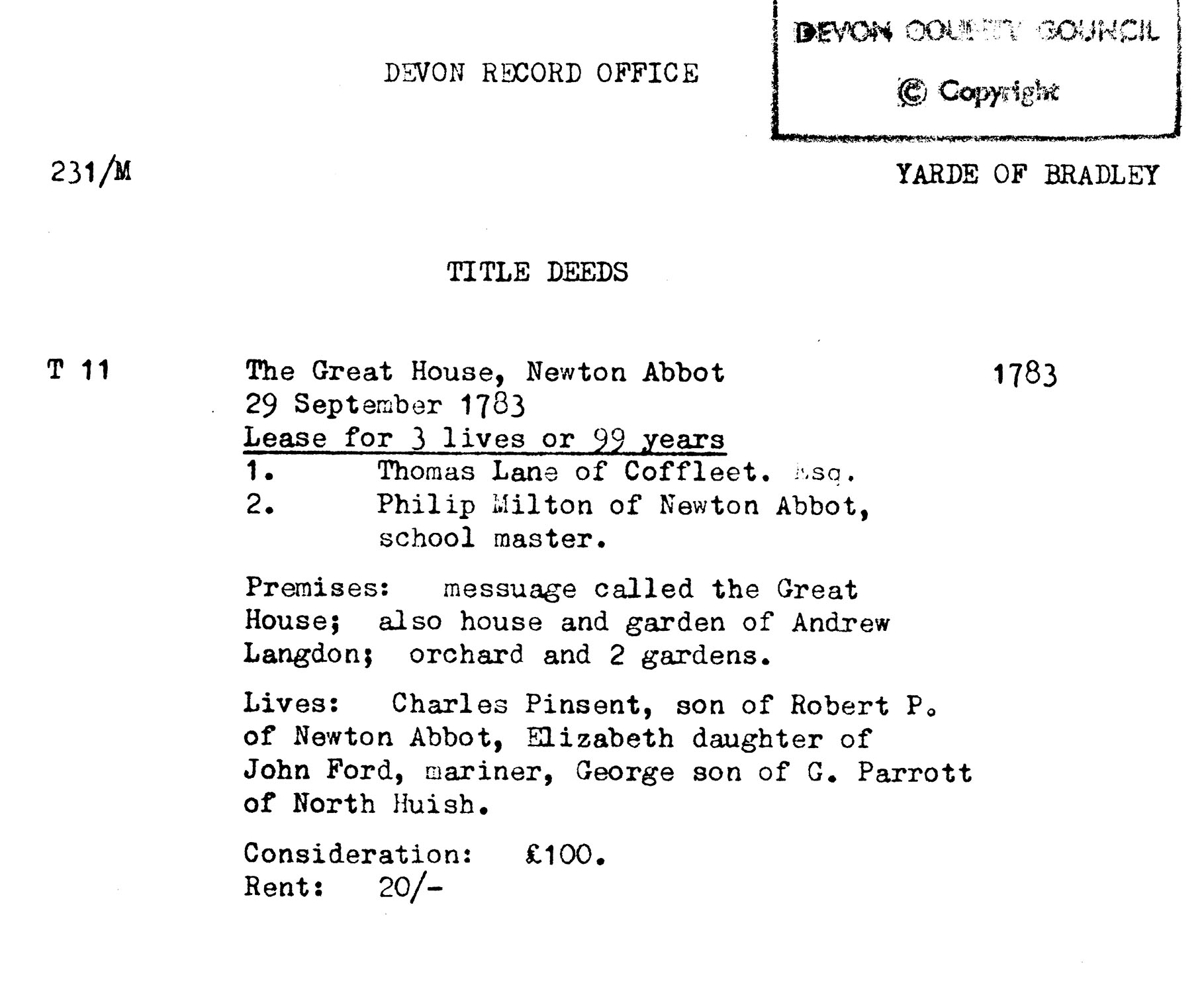
Typed record of a title deed on The Great House, Newton Abbot, dated September 29 1783. It describes the lease lasting for the lifetimes of three people or 99 years.
Title deed describing the lease for three lives, September 29, 1783, via the Devon Records Office.

Charles seems to have been brought up in Newton Abbot with at least one brother and been apprenticed to John Searle, a “carpenter” in Chudleigh in 1777 (Register of Duties Paid for Apprentices’ Indentures, 1710-1811). I do not known a lot about his life in Devon. However, the Devon Records Office has a “lease for three lives for 99 years” dated September 1783 that records the change in ownership of the “Great House,” Newton Abbot, from Thomas Lane of Coffleet, Esquire, to Philip Milton, Schoolmaster, for £100 “consideration” and 20s rent. The three lives mentioned are Charles, (son of Robert Pinsent of Newton Abbot), Elizabeth, daughter of John Ford, (mariner) and George (son of G. Parrott of North Huish). This type of land transfer was fairly common in those days. The idea was that if you choose three people covering a range in ages, then if one dies the other two can hold on to the property while they negotiate with the owner for the addition of a third name – and thus keep the property in one family almost indefinitely. Interestingly, Charles later named one of his children Elizabeth “Milton” (see below).
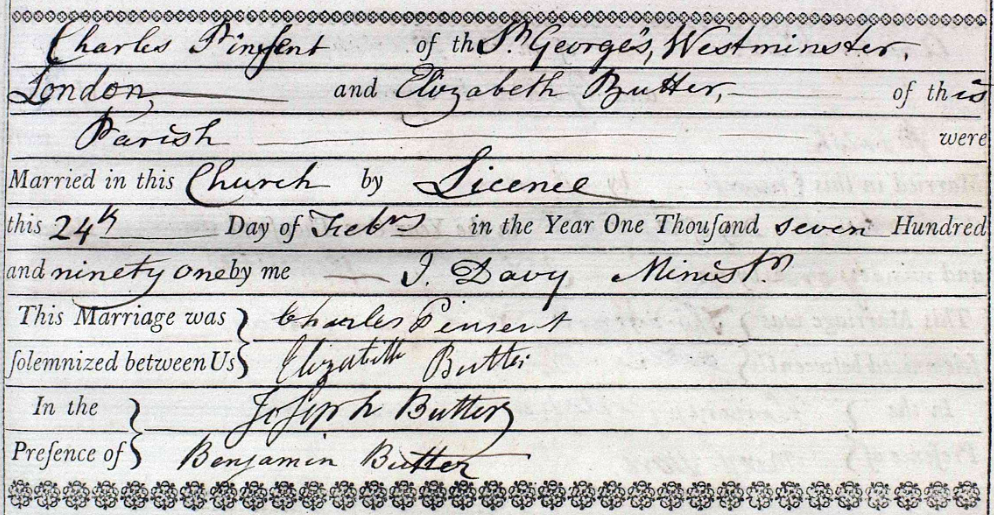
Handwritten record of Charles Pinsent's marriage to Elizabeth Butter
Charles Pinsent marries Elizabeth Butter in 1791.

Charles married Elizabeth Butter in Woodbury in Devon in 1791 and they headed up to London where they, appropriately enough, set up in business as “cheese-mongers”.  They moved to London shortly after Charles’s cousin, John Pinsent, who was a “baker” and they seem to have shared a property at “35 Edward Street, Portman Square” in St. Marylebone from 1792 to 1798 or, perhaps even later.  John was the son of John Pinsent and Susanna Pooke of Newton Abbot. They were both grandsons of Thomas Pinsent the elder of “Pitt” by his wife, Mary (nee Gale) and they both received small bequests from their uncle Thomas the younger of “Pitt” when he died in 1802.
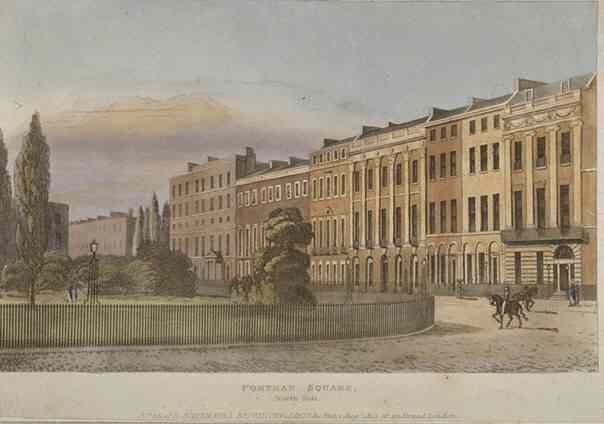
Faded illustration of rowhouses beside a park.
Portman Square in 1813.

There is a document in the London Metropolitan Archives that shows that “Charles Pinsent, cheese-monger” took out a “Royal and Sun Alliance” insurance policy on the Edward Street property in 1792. Charles and his cousin John were neighbours throughout the 1790s and they both had children baptized in St. Marylebone Parish church.
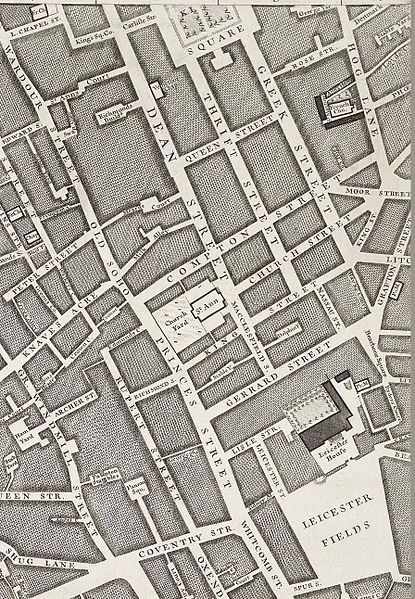
Inked map showing angled city streets.
Map of Dean Street in Soho, London, 1746. Via Wikicommons.

Charles paid approximately 12s 6d in rent and 2s 6d in tax annually from 1792 to 1798 for his part of the communal property on Edward Street from 1792 to 1798. Shortly thereafter, he moved to a more substantial property at “80 Dean Street, in St. Anne’s parish, Soho.” He paid around £7 in rent and taxes (it varied from year to year) between 1804 to 1815. Charles may have acquired #61 Dean Street at the same time, as he offered a lease of the premises which “contain(ed) two and three rooms on a floor, well fitted up, and now in the possession of Mr. Charles Pinsent, carpenter” for 20 years at a yearly rent of £60, land tax allowed (Oracle and Daily Advertiser: Monday 28th February 1803).
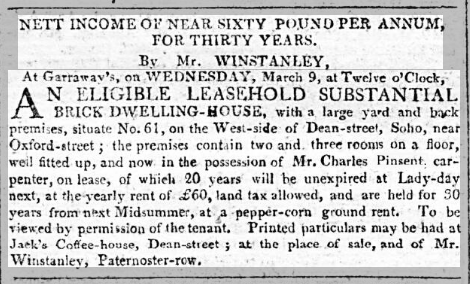
Newspaper clipping describing the leasing of the property.
Charles Pinsent leases the property on Dean Street,Oracle and The Daily Advertiser, February 28, 1803.

The move to Soho may well have been triggered by a switch in his career as he went back to using his carpentry skill and became a builder. He  would have needed a yard of his own as his cousin needed the Edward Street site for the commercial shipping business that he ran with his brother William in Newfoundland.

Four of Charles and Elizabeth’s children (Elizabeth Milton, Charles Thomas, Mary, Eleanor and Anna Pinsent) were baptized in St. Marylebone Parish between 1792 and 1800. The present day church was not built until 1817. However, the “Old Church” – which was built in 1760 – still remains as a Chapel of Ease. Charles and Elizabeth’s fifth child, Eleanor Pinsent, was born in Soho in 1802; however, she was baptized in her mother’s home parish of Woodbury, in Devon. Two of the children, Thomas Charles and the first Eleanor Pinsent died within a year of so of their birth.

It is not clear what happened to Mary; however, Elizabeth, Anna and Eleanor later married. However, before Anna and Eleanor did so they were named as beneficiaries in the will of their uncle, John Butter, of Woodbury, who was a Private in the 83rd Regiment of Foot. He left Anna a property called Haynes and Eleanor his interest in a farm called Hammetts. As they were then underaged, he left their respective interests in event of their death before the age of maturity to their mother, his sister Elizabeth. John Butter’s will was probated in 1815 (Inland Revenue Wills: 1815).
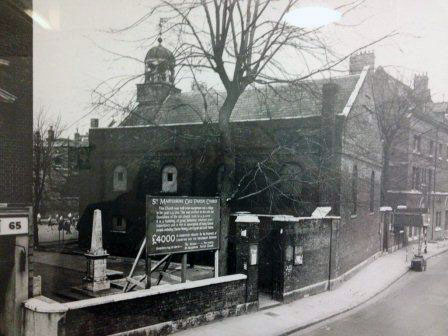
Faded black and white photograph of a stone building with a large sign out front.
Old St. Marylebone Church, 1760 – 1817.

A reference in “Burke’s Colonial Gentry” shows that Mr. Thomas Scott of Boode House, near Braunton, in Devon, married “Elizabeth Milton, daughter of —– Pinsent of Pitt House, near Chumleigh (sic), County Devon”. The connection to Pitt House (farm as it was then) is a bit of a stretch, although Elizabeth’s grandfather was certainly born there. Elizabeth was, technically, a “minor” when she married in St. Anne’s Church in Soho in 1812. The marriage suggests that Charles was doing reasonably well and he had made a good marriage for his daughter. Thomas and Elizabeth Scott had several sons. The first, born in 1814, was baptized Thomas Pinsent Scott. He went out to Australia where his family held property at “Benacre”, “Glen Osmond”, and “Mount Lofty” near Adelaide in South Australia. Another son, William Scott, also went out to Australia. He became a Warden of St. Paul’s College – at what is now the University of Sydney.

Charles’s daughter Anna Pinsent moved to Liverpool and married a local “merchant”, Charles Muirhead Burgess, in 1823. Charles’s youngest daughter, Eleanor Pinsent also skipped town – which was actually a sensible thing to do as London was not a particularly healthy place to be in those days. She married Mr. Henry George, a “bookseller” from Bath (in Somersetshire) in Hartland in North Devon in 1828. Coincidentally or probably otherwise, Elizabeth Milton (Scott) and her sister Eleanor (George) both ended up living in North Devon. Braunton and Hartland are just 30 miles (50 kilometres) apart! If the linkages are correct, their uncle John Pinsent who was a retired soldier may have moved to North Devon too. He lived in Great Torrington in later life.
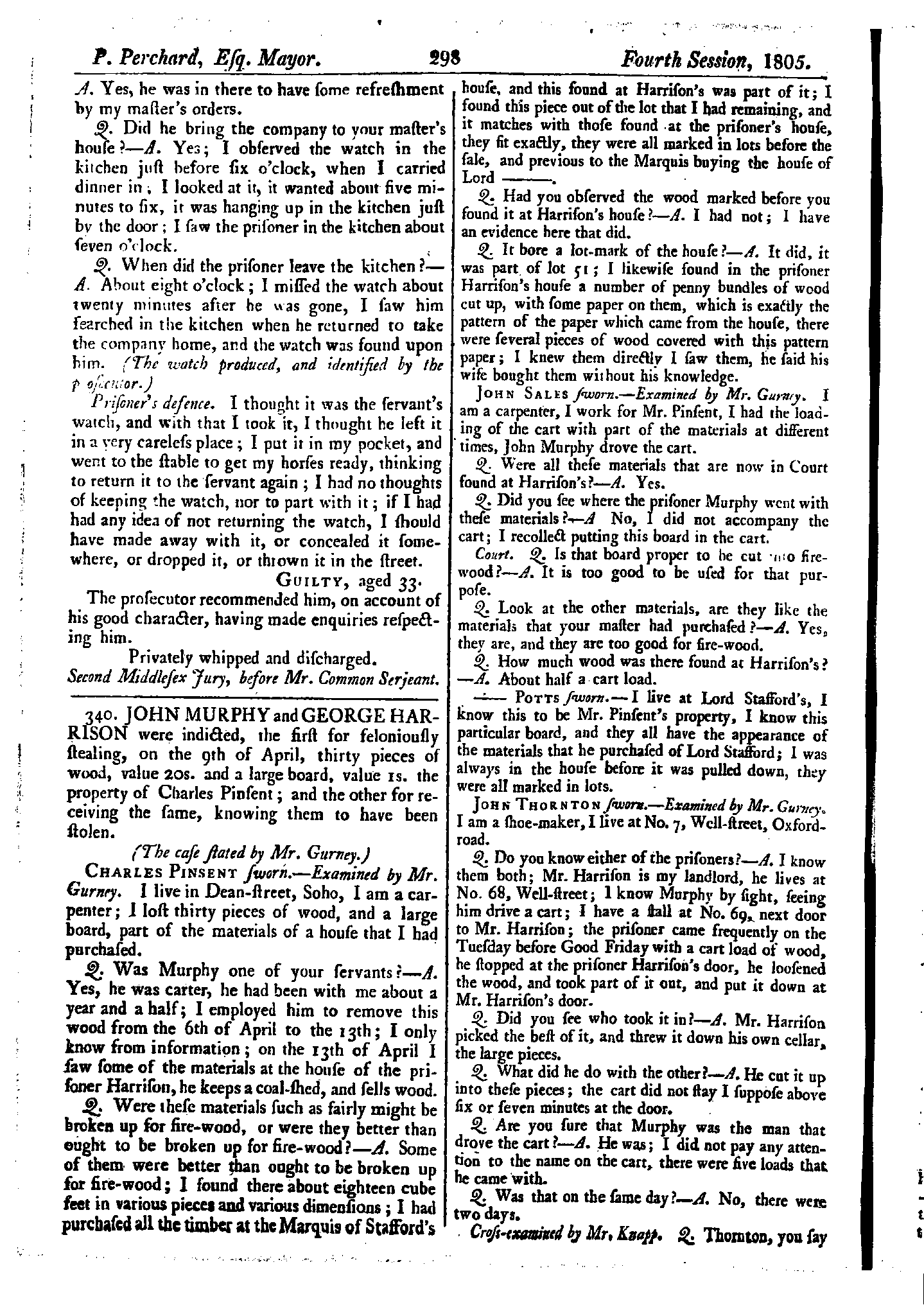
Testimony during the Charles Pinsent case.
Charles Pinsent testifies at the Old Bailey, 1805.

The records of the Central Criminal Court (Old Bailey) are now on-line and they show that John Pinsent (Charles’s cousin) was summoned for jury service on 1st July, 1790. He was appointed to the “First Middlesex Jury” of the “King’s Commission of Oyer and Terminer, and Goal Delivery”. He was also appointed to the “Second Middlesex Jury” on 17th February 1796 and on that occasion his cousin Charles Pinsent was appointed to the “First Middlesex Jury.” They fulfilled their civic duty.

There was a considerable amount or rebuilding going on in London in the early 1800s and Charles very sensibly recycled lumber. In 1805 he was back at the Old Bailey – this time as a plaintiff. Some salvaged wood was stolen from his yard shortly after he moved to Dean Street. The miscreants were caught and John Murphy and George Harrison were duly indicted for (respectively) stealing, and receiving 30 pieces of wood valued 20s.
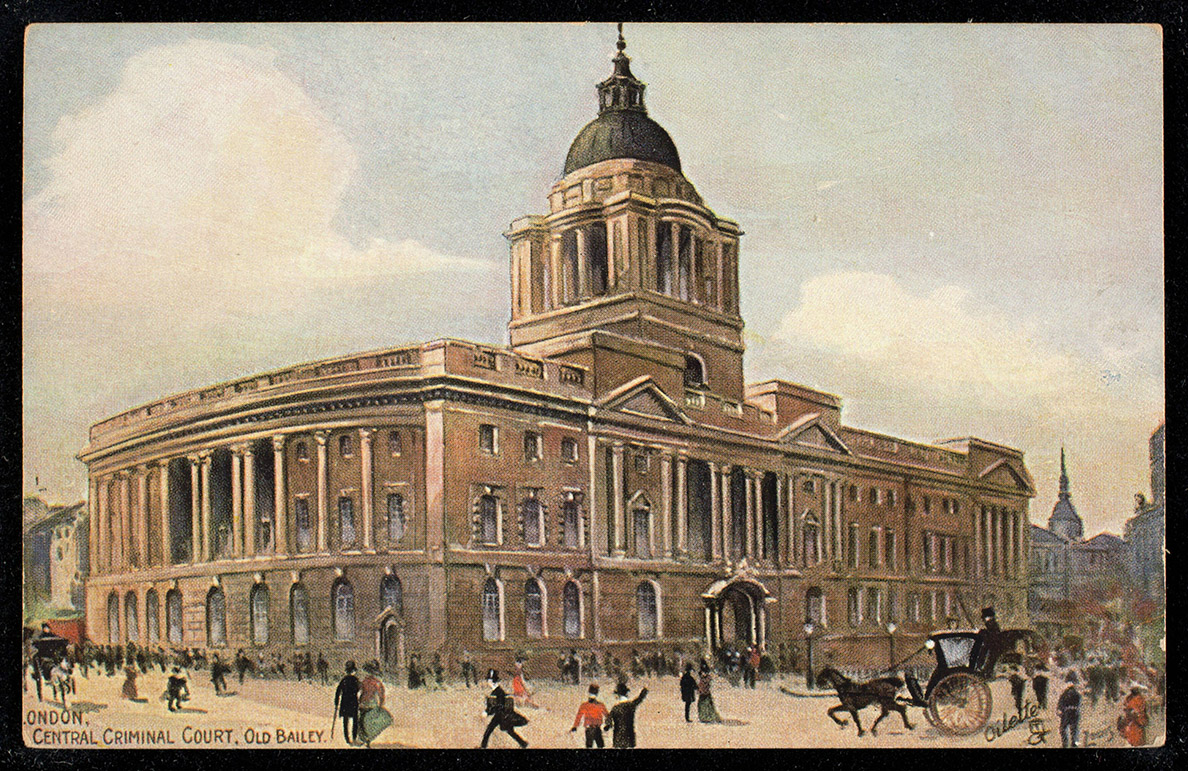
Painting of an ornate red stone court building. People crowd around below.
The Old Bailey in London.

They were tried at the Old Bailey on 24th April 1805. Charles testified that the wood in question came from the Marquis of Stafford’s old house and that some of the pieces still showed their purchase lot number. Other pieces had remnants of wallpaper attached that clearly matched pieces that were still in his possession! There is a lesson in there somewhere. Murphy was sentenced to transportation for seven years and Harrison for fourteen (Old Bailey Online).
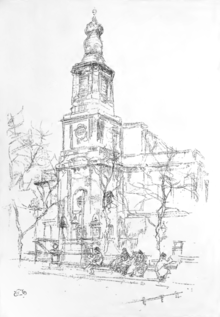
Illustration of a stone church building.
Sketch of St. Anne’s Church, Soho by James Abbot McNeill via Wikipedia.

Charles Pinsent died in 1816. He was buried in St. Anne’s Churchyard in Soho. He was predeceased by his wife Elizabeth. Interestingly, Charles still seems to have been operating out of Dean Street – albeit supposedly under the “Pinson” name several years later (Underhill’s Triennial Directory: 1822 – 1824). Who took over, I do not know. Sadly, it can not have been his son as he died young. 


Family Tree

Grandparents

Grandfather: Thomas Pinsent: 1691 – 1777
Grandmother: Mary Gale: 1690 – 1774

Parents

Father: Robert Pinsent: 1721 – 1783
Mother: Eleanor Shapley: 1720 – 1780

Father’s Siblings (Aunts, Uncles)

Thomas Pinsent: 1717 – 1802
Robert Pinsent: 1721 – 1783 ✔️
Gilbert Pinsent: 1724 – 1794
John Pinsent: 1728 – 1772

Male Siblings (Brothers)

Robert Pinsent: 1747 – 1748
Robert Pinsent: 1750 – 1786
Thomas Pinsent: 1754 – 1762
John Pinsent: 1757 – xxxx
William Pinsent: 1760 – xxxx
Charles Pinsent: 1762 – 1816 ✔️


Please use the above links to explore this branch of the family tree. The default “Next” and “Previous” links below may lead to other unrelated branches.
Charles Pinsent

Vital Statistics

Charles Pinsent: 1766 – 1826 GRO1187 (Yeoman Farmer and third owner of Pitt Farm, Hennock)

Mary Yeo: 1772 – 1844
Married: 1799: Lustleigh, Devon

Children by Mary Yeo:

Mary Pinsent: 1799 – 1830
Ann Pinsent: 1804 – 1881 (Married George Keddell, 1832, Hennock, Devon)
Thomas Pynsent: 1808 – 1887 (Married Jane Sparrow, 1843, St. Marylebone, London)

Family Branch: Hennock
PinsentID: GRO1187

Click here to view close relatives.


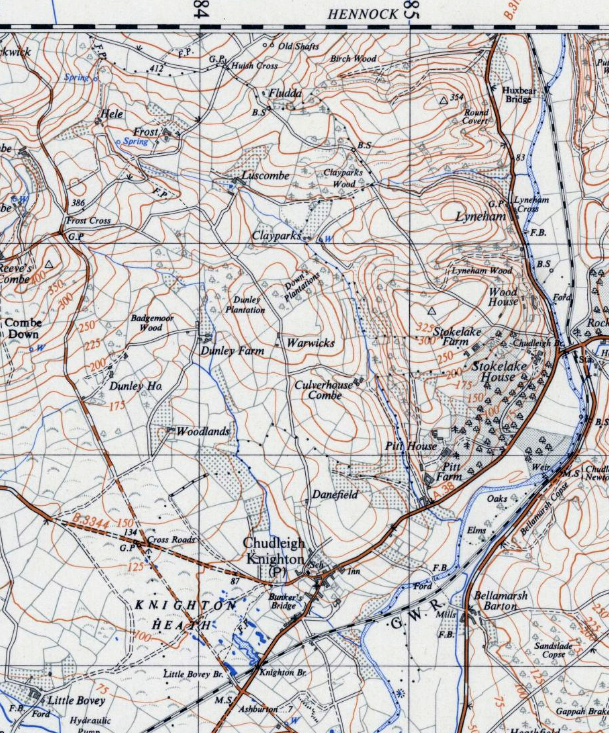
Topographical map showing Hennock and its environs.
Map of Hennock.

Charles Pinsent was one of the younger sons of John and Susanna Pinsent. He was born in Newton Abbot in 1766 and grew up there and, later, at Pitt Farm in Hennock. He inherited the farm from his uncle, Thomas “the younger” of Pitt, in 1802.

 His father, John, was a “merchant” in Wolborough (Newton Abbot). Sadly, both his parents died within days of each other in 1772 – while he was still quite young. John and Susanna’s four elder sons (John, Robert, Thomas and William) were essentially launched by then but Charles and three of his brothers (Gilbert, Samuel and Joseph) were left with out a home. They went to live with their elderly grandfather, Thomas Pinsent,  his son (their uncle) Thomas Pinsent and his wife (their aunt) Mary (née Mudge) at Pitt Farm in Hennock. The boys’ grandfather died in 1777 and the farm – which was a fairly large property – passed to their uncle Thomas. One of Charles’s brothers (Samuel) also died that year; which left three of John and Susanna’s younger boys living at Pitt with their uncle. Gilbert, Charles and Joseph grew up on the farm, helped out on it and eventually became farmers themselves.

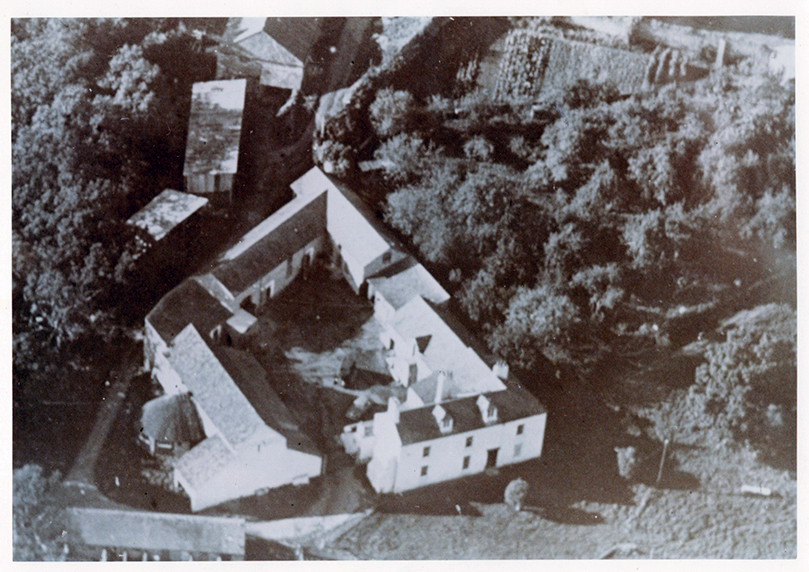
Cluster of large white building with dark roofs photographed from above.
Pitt Farm as photographed in the 1960s via Pitt Farm.

One of the elder brothers, Thomas Pinsent, still thought of Charles as being from “Newton Bushell” (part of Newton Abbot) when he appointed him (although he was still under-age at the time) to be the executor and principal beneficiary of the will he made on joining “H.M.S. Exeter” in 1779. Sad to say, Charles was called upon to execute the will in 1785. “H.M.S. Exeter” was a Royal Navy 64-gun “third-rater” that served with the British fleet and fought the French in the Indian Ocean in the 1780s. I do not know if Thomas died in action. Gilbert married Margaret Snow in Kingsteignton in 1790 and settled into a farm called “Ponswin” in the same parish. He became a successful tenant farmer. Joseph, meanwhile, probably worked with his brothers (John and William) in the Newfoundland fishery for a few years before settling in London as a “Shipping Agent”. Nevertheless, he too farmed – at Lettaford in North Bovey. Their lives are described elsewhere.

Transcript of excerpts from land tax records. Describes Charles Pinsent's payments from 1802 to 1813 across all properties.
Transcript of Land Tax Assessment records describing payments by Charles Pinsent.

Charles stayed on in Hennock and started to take responsibility for the management of the farm when his uncle was in his mid-70s. Land Tax Records show that Charles paid the £1 tax assessed on Pitt in 1791. The adjacent “Marshes” cost him an additional 10s. When Charles’s uncle Thomas (the second “of Pitt”) died in 1802, he left bequests for all his living nephews (see elsewhere); however, he made Charles his principal legatee.

Charles inherited “Pitt farm and the marshes”, a property in Teigngrace called “Diamond’s Delight” (10s land tax) and a farm in Kingsteignton called “Lower Albrook” (£1 6s 6d land tax). The latter, which is near Sandygate just to the north of Kingsteignton, had probably come to his uncle from the Mudge family. Charles was a significant land owner and a man of some note in Hennock. He signed the register in 1793, 1812, 1815 and 1818. Charles was also called upon to act as an executor to the will of a local worthy, Joseph Heaward, in 1819 and he was appointed Churchwarden in 1821 and 1822.

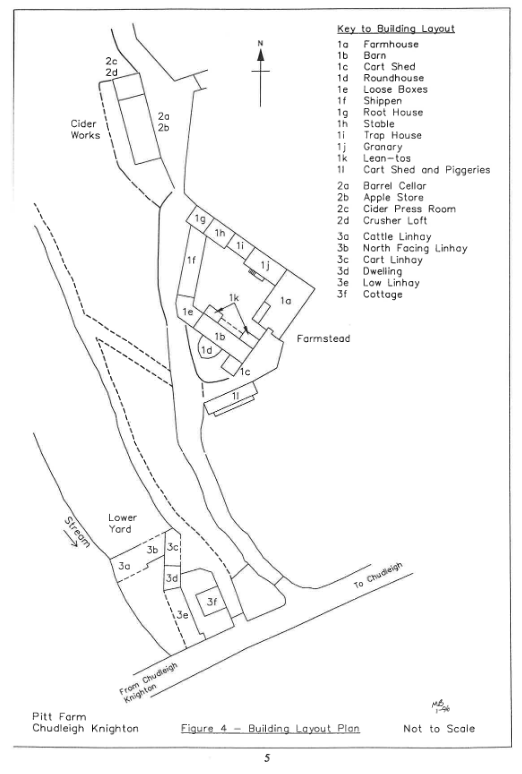
Simple map showing the layout of Pitt Farm. It is divided into small squares showing the farm house, barn, stables, and other buildings.
Map showing the building layout of Pitt Farm from 1996 via Devonshire Association.

Charles seems to have sold “Diamond’s Delight” shortly after his uncle died. However, he held on to “Lower Albrook” and “Pitt and the Marshes” (£1 10s 6d in land tax) and consolidated his position in Hennock by adding a number of small properties, “Collyers”, “Voyses”, “Underhays” etc. with a cumulative land tax of £1 17s. From 1804 onward, he also rented property in the neighbouring parish of Chudleigh (“Greenhill and St. Albans (£1 1s 10.5d land tax), Marshes”“late Frists” (£1 13s 3.25d land tax), “late Bickfords” (£1 13s 3.25d land tax), “Claypark Meadow (3s 9d land tax) and Marshes”, “late Newberry” (£1 13s 3.25d land tax). This patchwork may have been difficult to manage and the Clifford Family Archives in Ugbrooke contain documents that show that Charles negotiated a deal with James Templer of Stover that gave Mr. Templer access to his “Marshes over Teign” in exchange for several parcels of land in Hennock in 1810. When he died in 1826, Charles controlled land that was taxed at an aggregate value of £2 11s.

Transcript of the settlement examination. Joseph Hillman, mariner, talks about finishing his apprenticeship and going to Charles Pinsent for six months. He was dismissed after the two men exchanged words, but he was reinstated after three days. After two years, he went to Newfoundland and had lately returned.
Transcript of the settlement examination from 1821.

Charles paid land tax and parish rates and took some of the local children as apprentices to help work his property. He apprenticed Ann Walling and Elizabeth Kentisbeer for “Woolcomb’s Marsh” and “late Bickford’s Marsh”, respectively, in 1812. Joseph Hillman, a mariner, testified at a Settlement Examination (to determine if he was eligible to apply for support) in Bovey Tracey in 1821, that after he had served his apprenticeship in Bovey Tracey, he had gone to work for Charles at “Pitt” and was paid by the week for six months – until they “had words” and he was dismissed. However, he was reinstated after three days and he worked there for two year before going out to Newfoundland. Similarly, in 1808, Thomas Beer claimed he served out his apprenticeship in Kingsteignton and then moved to Hennock where he worked for Charles’s uncle Thomas until he died (in 1802). He then worked for Charles before marrying and returned to Kingsteignton. Such was life in the early 1800s.

Perhaps unsurprisingly, given the nature of his estate, the Devon Game Lists, (published annually in Trewman’s Exeter Flying Gazette) show that Charles purchased a “general certificate” (at a cost of approximately three guineas) more or less annually from 1805 to 1824. He probably shot ducks and geese on his “marshes” and “vermin” (pigeons, crows?) on his farm land. An entry in Hennock Churchwarden’s Accounts tells us that he (and seven other farmers) signed an agreement with the parish on a pay scale for killing birds, in 1816. The accounts also show that he was paid 7s 6d and 5s for killing them in 1822 and 1823 respectively.

Charles enrolled as a Volunteer in the Chudleigh Infantry Company in 1799 and, again according to the Ugbrooke Archives, he was a Quarter-master Sergeant in the Teignbridge/Chudleigh Yeomanry in 1808. This was during the Napoleonic Wars and a patriotic Charles was doubtless pleased to contribute £1 0s 0d to the “Waterloo Subscription” – a charitable organization in 1815 (Exeter Flying Post: Thursday 7th September 1815).

Charles married Mary Yeo in Lustleigh, Devon in 1799 and they had two daughters (Mary and Ann) and a son (Thomas) in the years that followed.  When Mary’s mother Ann Yeo of Northwood, in Chudleigh, died in 1819 she left her daughter Mary Pinsent £10, her grandson, Thomas Pinsent, £5 and her grand daughters, Mary and Ann Pinsent a guinea apiece (Inland Revenue: Stamp Act Wills: 1819 & Sheila Yeo: Yeo Society website).

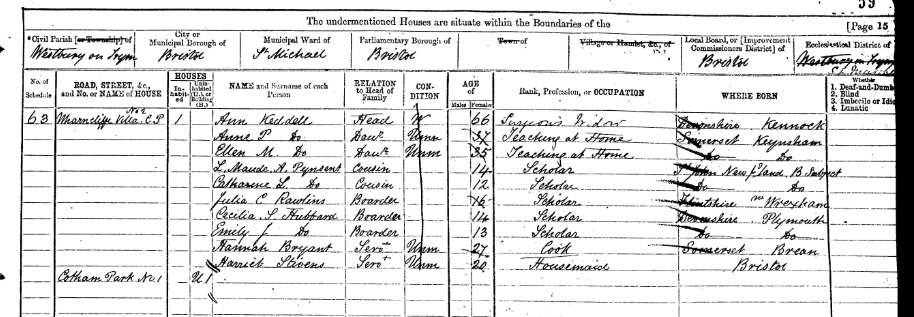
Handwritten census entry describing Ann Keddell as the head of the household at age 66.
Ann Keddell appears in the 1871 census records.

Mary, the elder of the two daughters, died unmarried, in Hennock, in 1830. Ann, who was the younger of the two, lived to marry George Keddell, a surgeon of Keynsham, in Somerset in 1832. They had a daughter, Ellen Maria Keddell who we will come across when discussing the life of (Sir) Robert John Pinsent, the barrister from St. John’s in Newfoundland (see elsewhere). Census Records show that Ann Keddell and her two daughters  lived in Westbury on Trym, in Bristol, in 1871 and ran a small school there where they tutored their young Newfoundland “cousins” Lucretia Maude and Catherine Louise Pinsent (Sir Robert’s daughters). Ellen Maria Keddell corresponded with Lucretia Maude Pinsent (who was, by 1891, Lady Abbess of St. Scholastica Abbey, in East Teignmouth) and Lucretia Maude described a visit from her on 11th July 1886 in her diary. The various branches of the family were well acquainted and their correspondence shows that their interest in family history seems to have passed down through the generations.

In her diary, Lucretia Maude says that Charles Pinsent’s son, Thomas Pynsent (see elsewhere) owned a painting of Sir William Pynsent of Urchfont, Wiltshire (the second baronet) and it was hanging in his house at Westwood Ho! Evidently, someone called Ellen Maria (??) sent Lucretia a photograph of the picture.  Lucretia goes on to says that Thomas’s “cousin” Elizabeth Satterley Splatt, (nee Pinsent) had “an excellent” copy of the picture at “The Elms” in Torquay. Lucretia Maude goes on to discuss Charles’s brother Joseph’s family and the loss of Pitt House. I do not have the diary but my grandfather, Francis Wingfield Homfray Pinsent, made notes from it while on a visit to his step-sister in Rome, in 1929. Francis also copied a photograph of a Prayer Book that had been endorsed by Leonora Ann Pynsent, Sir William’s only surviving daughter.

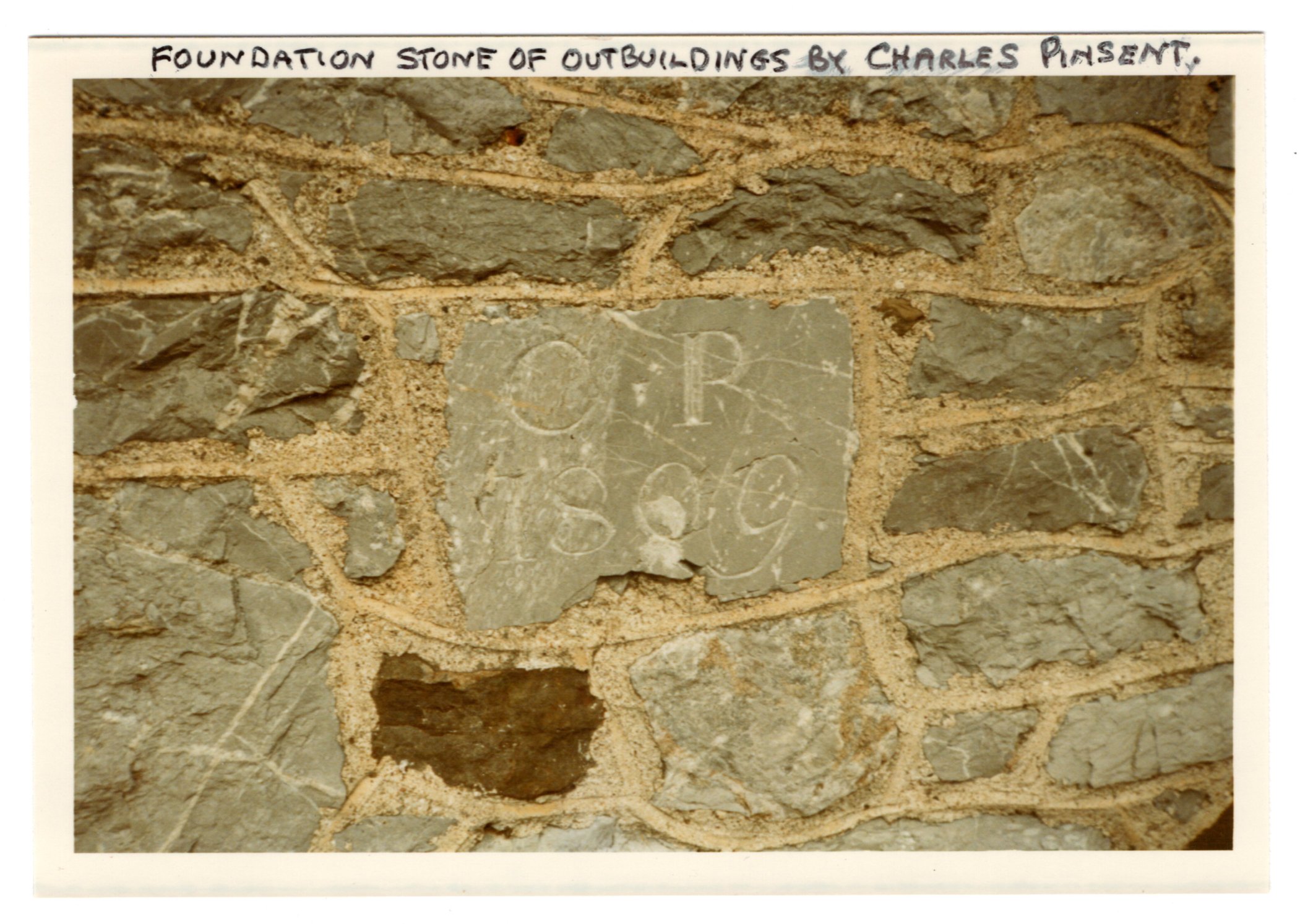
The letters C. P. 1809 are scraped into a stone sealed with mortar into a floor or wall.
The foundation stone displaying “C. P. 1809”.

In 1996, The Devonshire Association published a detailed report on the design, layout and architecture to be found at Pitt Farm. It showed that the outbuildings underwent a considerable amount of work in the early 1800s and notes that there was a date stone inscribed “CP 1809” built into the granary wall.

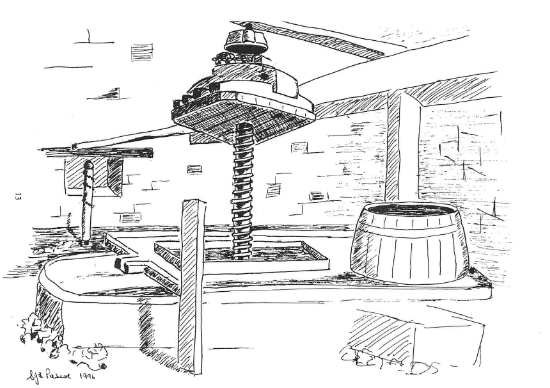
Pen illustration of a simple machine. It has a heavy, flat press at the top of a huge, sturdy screw.
Illustration of the Pitt Farm cider press via Devonshire Association.

It must have been around then that the cider house was rebuilt: – “The cider house seems to be overbuilt: When the farm was for let in 1842 the blurb stated that there “was cellarage arranged for 400 hogsheads of cider, being well adapted for a cider merchant” – at 54 gallons per hogshead, this work out at 21,600 gallons storage capacity. In an extremely good year, the apples form an acre of orchard might produce 10 hogshead of cider but 2 to 3 hogshead per acre was more usual (38) Around one hundred and fifty acres of orchards would be needed to guarantee a supply of apples. Pitt Farm had 28 acres in 1842.” There is no obvious reason for the discrepancy. Perhaps Charles planned to establish a custom processing facility. The principal house and its various outhouses – which were built and rebuilt around a central courtyard – were converted into separate cottages in the early 1990s.

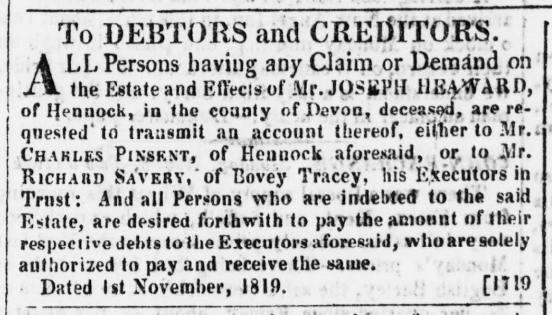
News clipping announcing that those with claim or demand on the estate of Joseph Heaward should tell Charles Pinsent, who was the man's executor. Dated November 1, 1819.
Charles Pinsent is advertised as Joseph Heaward’s executor.

Charles was a man of some stature in Hennock and he was appointed Philip Edwards appointed him trustee when he made out his will, which was probated in 1818 (Inland Revenue Wills: 1818). Similarly, a Mr. Joseph Heaward appointed both him, and a Mr. Richard Savery of Bovey Tracey, to act as executors when he died – which he did in 1819 (Exeter Flying Post: Thursday 11th November, 1819). Richard Savery may have been the brother of the Mary Savery who married Thomas Pinsent the upwardly mobile draper of the DEVONPORT family line in 1805. Certainly, she had a brother of that name. Charles Pinsent was later called upon to witness a transaction that occurred in 1820, when the executors of a Mr. John Mudge, who owned land in Hennock, Bovey Tracey and elsewhere, arranged for land to be transferred to the Gould family (Manor of Wreyland: H. M. Preskett (1970): Devon Record Office).

In his will, signed in 1814, Charles Pinsent appointed Stephen Endacott and Joseph Yeo as trustees of his estate. He left his wife a surprisingly small annuity (£35); arranged for the education of his children and left “Pitt farm” and his other property – including “Lower Albrooke” in Kingsteignton, which seem to have been valued at £3,400, to his young son, Thomas Pinsent. However, he specified that if Thomas should not wish to buy out his sisters shares when he came off-age, he could have a portion of it, or else it could all to be sold and once the annuity and other bequests had been was secured, the profits divided between the children.

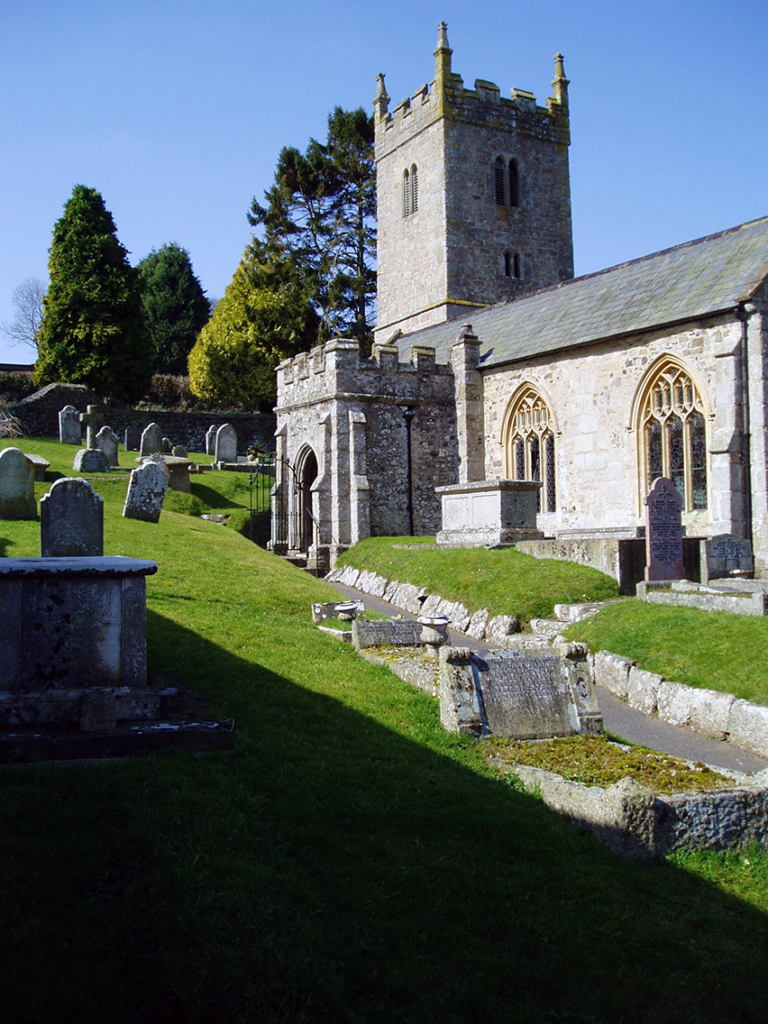
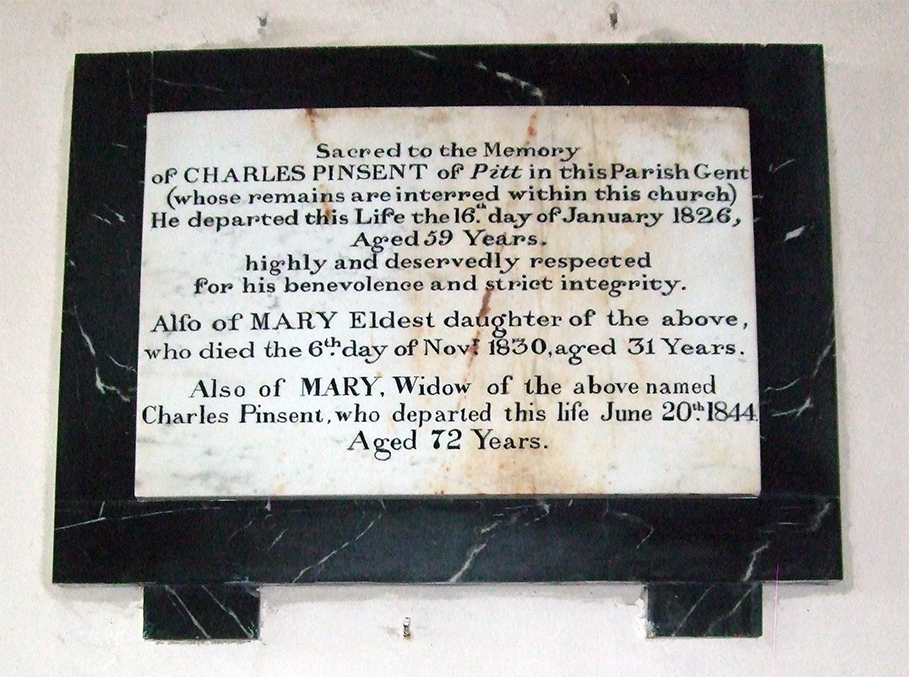
Charles died in 1826 and his elder daughter died, unmarried, a few years later. There is a memorial on the wall in St. Mary’s Parish Church in Hennock that  that “Charles Pinsent of Pitt, nephew of Thomas, died 16th January, 1826 aged 59,” that “Mary, eldest daughter of Charles died on 6th November, 1830, aged 31 years” and that “Mary, widow of Charles died 20th June, 1844, aged 72”.

Mary (née Yeo) was still living at “Pitt” with a young kinswoman, Maria Yeo, at the time of the Census in 1841. However, they seem to have moved to Keynsham in Somerset, shortly thereafter; presumably to be with Mary’s daughter Ann and her son-in-law, George Keddell. She died there in 1844. Maria Yeo notified the registrar.


Family Tree

Grandparents

Grandfather: Thomas Pinsent: 1691 – 1777
Grandmother: Mary Gale: 1690 – 1774

Parents

Father: John Pinsent: 1728 – 1772
Mother: Susanna Pooke: 1730 – 1772

Father’s Siblings (Aunts, Uncles)

Urith Pinsent: 1714 – 1751
Thomas Pinsent: 1717 – 1802
Julian Pinsent: 1719 – 1721
Robert Pinsent: 1721 – 1783
Gilbert Pinsent: 1724 – 1794
Julian Pinsent: 1726 – xxxx
John Pinsent: 1728 – 1772 ✔️
Mary Pinsent: 1731 – xxxx

Male Siblings (Brothers)

John Pinsent: 1751 – 1753
John Pinsent: 1753 – 1821
Robert Pinsent: 1753 – 1787
Thomas Pinsent: 1754 – 1785
William Pinsent: 1757 – 1835
Gilbert Pinsent: 1758 – 1835
Charles Pinsent: 1765 – 1765
Charles Pinsent: 1766 – 1826 ✔️
Samuel Pinsent: 1767 – 1775
Joseph Pinsent: 1770 – 1835


Please use the above links to explore this branch of the family tree. The default “Next” and “Previous” links below may lead to other unrelated branches.

Charles Pinsent

Vital Statistics

Birth: 1765
Marriage: N/A
Spouse: N/A
Death: 1765

Family Branch: Hennock
PinsentID: GRO1186

Click here to view close relatives.


Family Tree

Grandparents

Grandfather: Thomas Pinsent: 1691 – 1777
Grandmother: Mary Gale: 1690 – 1774

Parents

Father: John Pinsent: 1728 – 1772
Mother: Susanna Pooke: 1730 – 1772

Father’s Siblings (Aunts, Uncles)

Urith Pinsent: 1714 – 1751
Thomas Pinsent: 1717 – 1802
Julian Pinsent: 1719 – 1721
Robert Pinsent: 1721 – 1783
Gilbert Pinsent: 1724 – 1794
Julian Pinsent: 1726 – xxxx
John Pinsent: 1728 – 1772 ✔️
Mary Pinsent: 1731 – xxxx

Male Siblings (Brothers)

John Pinsent: 1751 – 1753
John Pinsent: 1753 – 1821
Robert Pinsent: 1753 – 1787
Thomas Pinsent: 1754 – 1785
William Pinsent: 1757 – 1835
Gilbert Pinsent: 1758 – 1835
Charles Pinsent: 1765 – 1765 ✔️
Charles Pinsent: 1766 – 1826
Samuel Pinsent: 1767 – 1775
Joseph Pinsent: 1770 – 1835


Please use the above links to explore this branch of the family tree. The default “Next” and “Previous” links below may lead to other unrelated branches.
Catherine Ann Pinsent

Vital Statistics

Birth: 1866
Marriage: 1898
Spouse: Edward Fawcett
Death: 1972

Family Branch: Hennock
PinsentID: GRO0120

Click here to view close relatives.


Catherine’s life is described briefly in her father’s entry: John Pinsent.


Family Tree

Grandparents

Grandfather: John Pinsent: 1799 – 1858
Grandmother: Ann Brock: 1811 – 1866

Parents

Father: John Pinsent: 1838 – 1916
Mother: Catherine Whidborne: 1840 – 1923

Father’s Siblings (Aunts, Uncles)

Anne Pinsent: 1833 – 1907
Martha Pinsent: 1834 – 1908
Eliza Pinsent: 1836 – 1837
John Pinsent: 1838 – 1916 ✔️
Gilbert Pinsent: 1840 – 1918
James Pinsent: 1842 – 1902
Henry Pinsent: 1844 – 1894
Albert Pinsent: 1846 – 1846
Emma Louisa Pinsent: 1848 – 1926
Mary Isabella Pinsent: 1850 – 1935
Harriet Carlotta Pinsent: 1853 – 1895

Male Siblings (Brothers)

John Pinsent: 1880 – 1925
George Whidborne Pinsent: 1882 – 1883


Please use the above links to explore this branch of the family tree. The default “Next” and “Previous” links below may lead to other unrelated branches.

Burton William Pynsent

Vital Statistics

Birth: 1856
Marriage: N/A
Spouse: N/A
Death: 1856

Family Branch: Hennock
PinsentID: GRO1196

Click here to view close relatives.


Family Tree

Grandparents

Grandfather: Joseph Pinsent: 1770 – 1835
Grandmother: Elizabeth Pinsent: 1777 – 1809

Parents

Father: Joseph Burton Pinsent: 1806 – 1874
Mother: Mary Bridget Fogarty: 1832 – 1875

Father’s Siblings (Aunts, Uncles)

Mary Anna Lambert Pinsent: 1802 – 1809
Joseph William Pitt Burton Pinsent: 1804 – 1805
Elizabeth Satterley Pinsent: 1805 – 1878
Joseph Burton Pynsent: 1806 – 1874 ✔️
John Robert Pinsent: 1807 – 1808

Mary Anna Pynsent: 1810 – 1875
Anna Lucretia Pynsent: 1812 – 1880
Harriet Cordelia Pynsent: 1814 – 1900
Maria Sophia Pinsent: 1815 – 1819
Robert Baring Pinsent: 1818 – 1833
Ferdinand Alfred Pynsent: 1822 – 1894
Charles Pitt Pynsent: 1824 – 1903

Male Siblings (Brothers, half-brothers)

Thomas Ogden Pynsent: 1839 – 1864

Burton William Pynsent: 1856 – 1856 ✔️
Burton Michael Pynsent: 1861 – 1876
Joseph William Pynsent: 1862 – 1926
Charles Pynsent: 1865 – 1878
Alfred Thomas Pynsent: 1869 – 1911


Please use the above links to explore this branch of the family tree. The default “Next” and “Previous” links below may lead to other unrelated branches.
Burton Michael Pynsent

Vital Statistics

Birth: 1861
Marriage: N/A
Spouse: N/A
Death: 1876

Family Branch: Hennock
PinsentID: GRO1446

Click here to view close relatives.


Family Tree

Grandparents

Grandfather: Joseph Pinsent: 1770 – 1835
Grandmother: Elizabeth Pinsent: 1777 – 1809

Parents

Father: Joseph Burton Pinsent: 1806 – 1874
Mother: Mary Bridget Fogarty: 1832 – 1875

Father’s Siblings (Aunts, Uncles)

Mary Anna Lambert Pinsent: 1802 – 1809
Joseph William Pitt Burton Pinsent: 1804 – 1805
Elizabeth Satterley Pinsent: 1805 – 1878
Joseph Burton Pynsent: 1806 – 1874 ✔️
John Robert Pinsent: 1807 – 1808

Mary Anna Pynsent: 1810 – 1875
Anna Lucretia Pynsent: 1812 – 1880
Harriet Cordelia Pynsent: 1814 – 1900
Maria Sophia Pinsent: 1815 – 1819
Robert Baring Pinsent: 1818 – 1833
Ferdinand Alfred Pynsent: 1822 – 1894
Charles Pitt Pynsent: 1824 – 1903

Male Siblings (Brothers, Half-brothers)

Thomas Ogden Pynsent: 1839 – 1864

Burton William Pynsent: 1856 – 1856
Burton Michael Pynsent: 1861 – 1876 ✔️
Joseph William Pynsent: 1862 – 1926
Charles Pynsent: 1865 – 1878
Alfred Thomas Pynsent: 1869 – 1911


Please use the above links to explore this branch of the family tree. The default “Next” and “Previous” links below may lead to other unrelated branches.
Beatrice Mary Homfray Pinsent

Vital Statistics

Beatrice Mary Homfray Pinsent: 1883 – 1965 GRO0091 (English Language Teacher, Buenos Aires, Argentina)

Family Branch: Hennock
PinsentID: GRO0091

Click here to view close relatives.


Beatrice Mary Homfray was the youngest daughter of Robert John Pinsent, a Justice of the Supreme Court of Newfoundland, by his second wife, Emily Hetty Sabine Homfray. She was born at her mother’s family home in Bintry, in Norfolk in 1883 – presumably while her parents were back on one of their periodic visits to England. She was born into an extended family; she had five half-siblings: (Lucretia Maude, Louisa Catherine, Robert Hedley, Charles Augustus and Alfred Newman) from her father’s first marriage and a sister (Mabel Louisa Homfray) and two brothers (Robert John Ferrier Homfray and Francis Wingfield Homfray) from his second. She was later to have a younger brother (Guy Homfray Pinsent) who arrived in 1889. Sadly, Louisa Catherine, Robert Hedley and Robert John Ferrier all died without having had children.

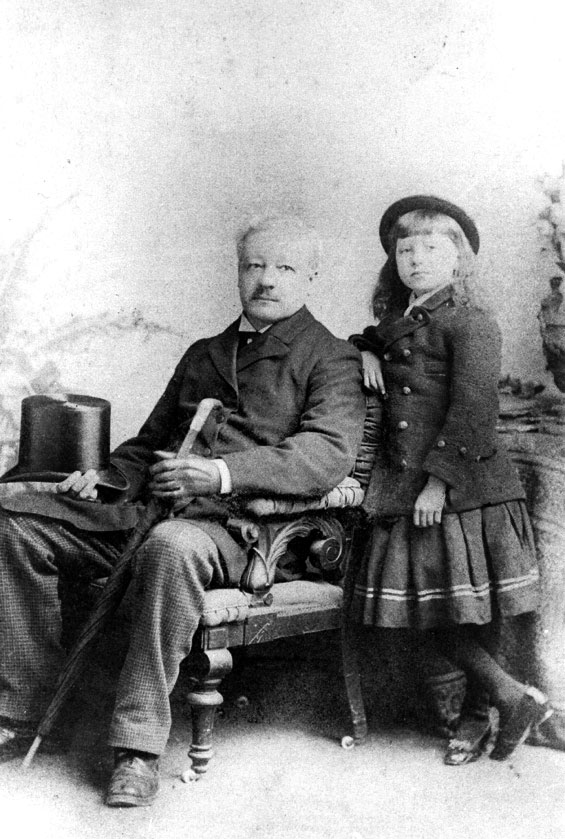
A faded black and white photograph of Robert John Pinsent, seated, as an older man. A young girl stands beside him.
Robert John Pinsent and “Trixie”.

The adjacent photograph of Sir Robert John Pinsent was probably, but not definitively, taken with Beatrice, or “Trixie” as she was known. She would have been about the right age when the photograph was taken.

Robert John Pinsent’s life is described elsewhere. He was an active member of the Supreme Court in Newfoundland and was notably busy in the 1880s dealing with the fall-out from a collapsed railway construction contract, and in establishing the rights of Newfoundland and French fishermen along the so-called “French Shore”. He felt that the French were only entitled to catch and process cod – and, what ever they said, they had no right to interfere with Newfoundlanders efforts to catch, process and can lobsters. He published an article entitled “French Fishery Claims in Newfoundland” (Nineteenth Century: Vol. 158, April 1890) in 1890. Robert made several visits to England and, in April 1885, he gave a talk to the “Royal Colonial Institute” entitled “Newfoundland, our Oldest Colony” (Colonies and India: Friday 17th April 1885.) He was a well-known and well-respected advocate for the Colony and Queen Victoria gave him the honour of a knighthood in 1890.

Sadly, Sir Robert died on a trip back to England in 1893. His death created a serious problem for Emily (or “Lady Pinsent” as she then was) as nearly all of the family’s assets in Newfoundland went to the children of his first marriage – most notably Charles Augustus Maxwell Pinsent. She was left with two teenage sons (Robert (19) and Frank (18)) in Newfoundland, a grown up daughter (Mabel (20)) and two young children, Beatrice (10) and Guy (4). Lady Pinsent stayed on in England and found employment first as “House Matron” at Harrow School and then as the “Matron” at Denstone School in Staffordshire.

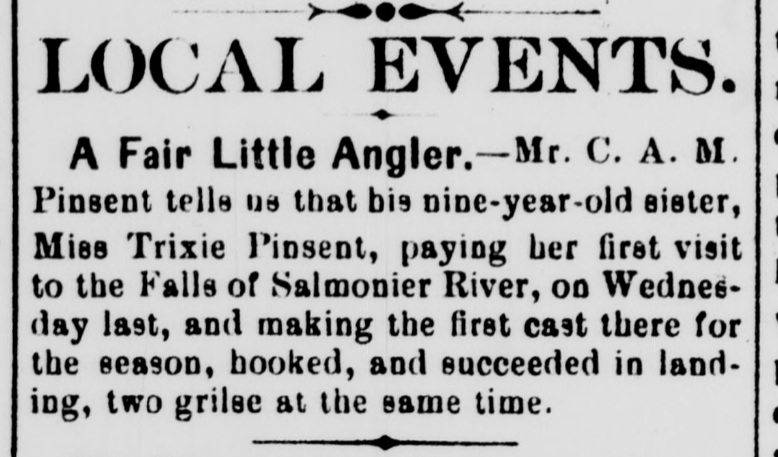
Lady Pinsent never returned to Newfoundland; however, she clearly missed the place,  particularly (I suspect) Salmonier and her fishing excursions to “Pinsent Falls” on the river there. It was one of the premier salmon fishing spots in Newfoundland.  As an aside, when Field Marshal Earl Haig made a post-war visit to the Colony in 1924 to thank the “Royal Newfoundland Regiment” for its contribution and losses (which had been severe), the Colonial Government arranged for him to spend a few days fishing there.  Needless to say: “FIELD MARSHAL LANDS HEAVIEST FISH OF THE SEASON: We have just received a message from Mr. J. Hannon, operator at Holyrood to the effect that Field-Marshal Earl Haig and party were at Pinsent Falls, and were already thoroughly enjoying themselves and having good luck. Last night Earl Haig landed five salmon, one of which was the largest fish caught at Salmonier for the season” (Evening Telegram: 5th July 1924). Okay, if you say so …

A short newspaper clipping reading, "Local Event. A fair little angler. Mr. C. A. M. Pinsent tells me that his nine-year-old sister, Miss Trixie Pinsent, paying her first visit to the Falls of Salmonier River, on Wednesday last, and making the first cast there for the season, booked, and succeeded in landing, two grilse at the same time.
Evening Telegram, June 25, 1892.

Lady Pinsent wrote two full articles for “The Field” Magazine on fly-fishing in Newfoundland and a shorter item (reprinted in an unspecified Quebec Newspaper) describing the time her nine-year old daughter Beatrice (“Trixie”) landed two small (well, slightly under three pounds each) salmon with a single cast of a trout rod. Trixie’s half-brother, Charles Augustus Maxwell – who was considerably older than she was – also made note of it in a contemporary item in the St. John’s press (Evening Telegram: 25th June 1892).

Black and white historical photo of a long building with walk-up entrances
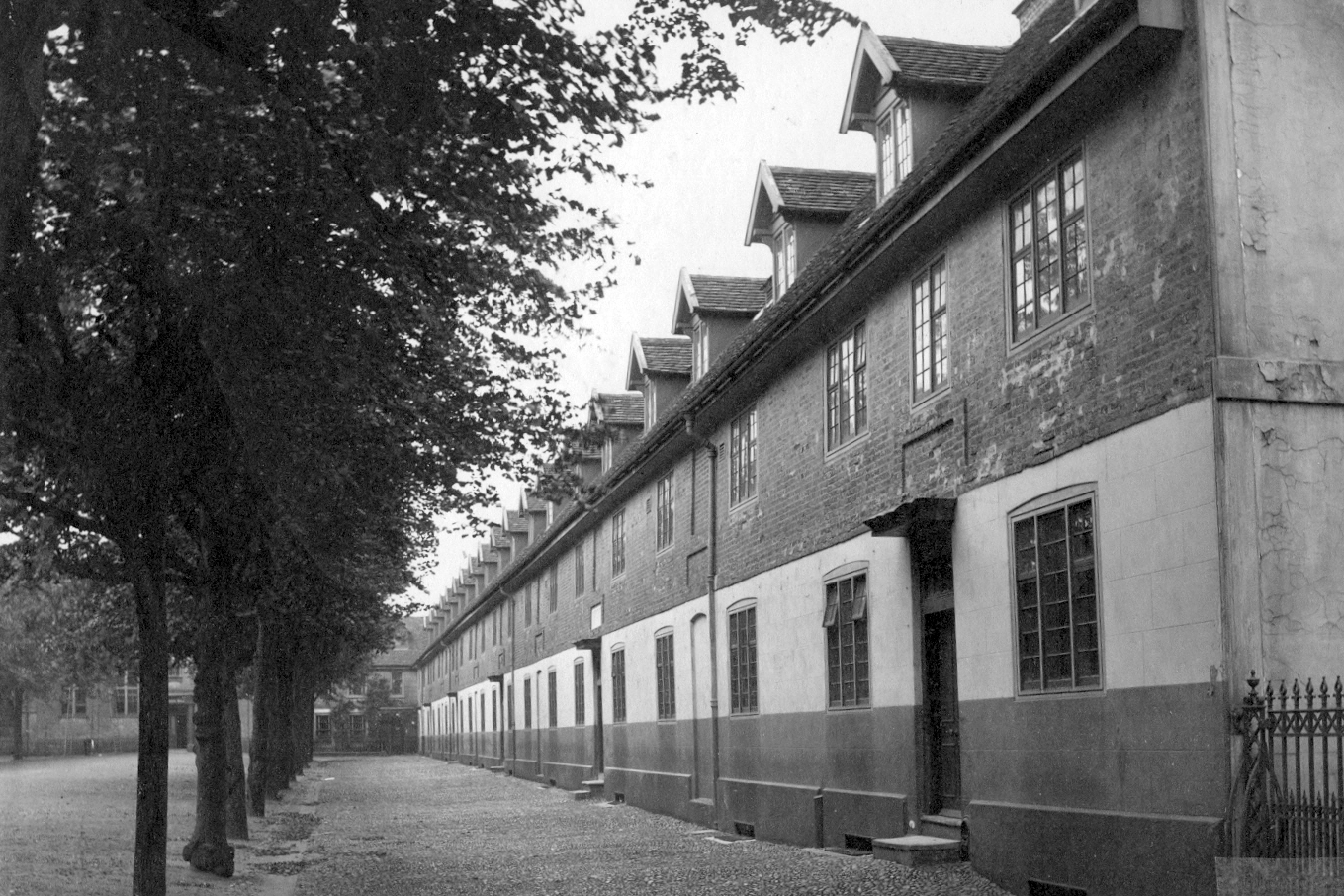
Christ’s Hospital occupied the Bluecoats site from 1682 to 1985. These ‘wards’ were demolished and replaced in 1904. Via Discover Hertford

Trixie’s life changed dramatically after her father died. She and her brother Guy were sent to the “Blue Coat School” in Hertford. This was a charitable foundation that had originally been based at “Christ’s Hospital” in London but had moved out to Hertford in the 1700s. I am not aware that either of them ever returned to Newfoundland.

A handwritten letter
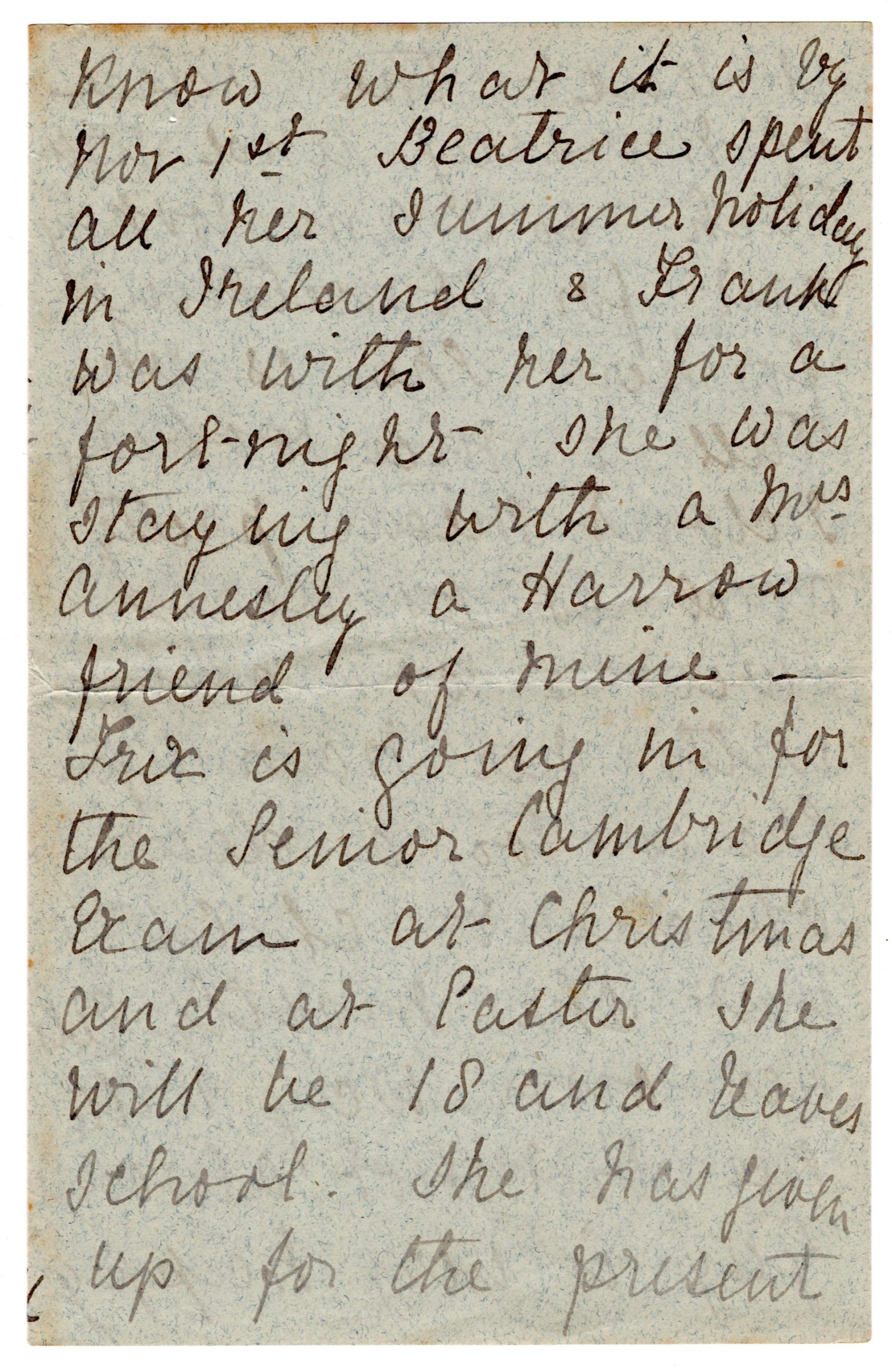
A handwritten letter Emily sent to Maude Pinsent, 1900.

Lady Pinsent found it difficult to bring up her children on her own. She wrote to her stepdaughter Lucretia Maude (the Lady Abbess in Rome – see elsewhere) in November 1899 saying: “Can you realize that she (Trixie) will be 17 in April! She has the way to make people like her & is a great favourite here & all from the headmaster to the maids look forward to her coming. The former always gives her £10 for a tip and when she remonstrated, he said he always should while she went to school. The truth is my heart is bound up in the child & my greatest sorrow is that I cannot see my way to giving her the 5 years medical training necessary for her to practice in India – if she wished to combine missionary work with it, I could get her a substantial studentship from the S.P.C.K. but she has no call that way – at least not at present.”  She wrote again the following October, saying “Trix. is going in for the Senior Cambridge Exam at Christmas and at Easter she will be 18 and leave school. She has given up, for the present at least, the idea of nursing and will teach, so I am looking out for something for her”.

I do not have a definitive photograph of Trixie; however, Lady Pinsent went on to say:  “she is very tall and nice looking. I don’t mean pretty and looks very sweet and womanly with her hair up. She is too a dear obedient child. But she mostly gets her own way with me, but not always”. Emily had hoped to get out to Rome to see Lucretia but it was not to be: “… perhaps some day we may manage it. Just now I have to provide a complete outfit for Trixie for Easter when she leaves off her school clothes”. It was not easy for her and time was marching on. In December 1901, Lady Pinsent wrote: Trixie’s exam in over but we do not know the result till March. If she has passed I hope by the aid of an Exhibition from her School to send her to a training college for a year. Her future gives me a good deal of anxiety just now.”

Lady Pinsent was bored stiff at Denstone and had plenty of time to write and keep up with friends, both in England and in Newfoundland. Among others, she corresponded with Judge W. D. Prowse, a friend of the family – and a great admirer of Sir Robert it would seem from his frequent references to him in the press. Judge Prowse arranged for the following to appear in a local St. John’s paper:Mr. Frank Pinsent: The numerous friends and admirers of the late Sir Robert and Lady Pinsent, will be very pleased to learn that their son, Mr. Frank Pinsent, who used to be in the Surveyor General’s Office, has passed a most creditable examination in London, and is now entitled to become a member of the Council of Surveyors for Great Britain. It was a very stiff examination—like all those held in London —and several members, five and ten years seniors to Frank, were plucked. Miss Trixie Pinsent has also passed with great credit the Senior Local Cambridge Examination, and is now studying for higher honours. D.W.P.” (Evening Telegram: 17th June 1901); she had passed!

Frank (Francis Wingfield Homfray Pinsent) had trained to be a surveyor in St. John’s and moved to London, to be nearer his mother and siblings in 1899. Lady Pinsent left Denstone and moved into a flat at #13 Stanley Crescent in Kensington. She lived there for several years; however, when Francis (“Frank”) joined the Civil Service as “District Valuer” she moved down to Devon to be with him. Trixie had, by then, become a “masseuse” who was living in the flat in Kensington when the census takers came calling in 1911.

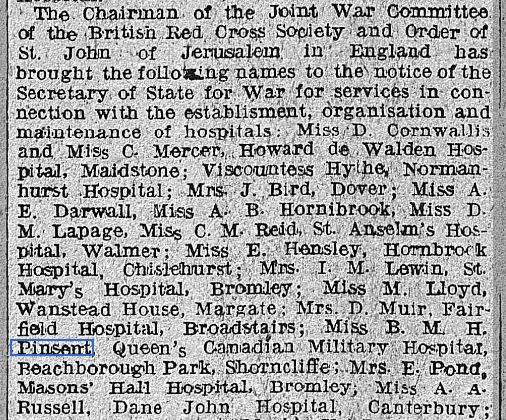
A newspaper clipping that reads, "The Chairman of the Joint War Committee of the British Red Cross Society and Order of St. John of Jerusalem in England has brought the following names to the notice of the Secretary of State for War for services in connection with the establishment, organization and maintenance of hospitals: Miss D. Cornwallis and Miss C. Mercer, Howard de Walden HOspital, Miadstone; Viscountess Hythe Normanhurrts Hospital; Mrs. J. Bird, Dover; Miss A. E. Darwall, Miss A. B. Hornibrook, Miss D. M. Lapage, Miss C. M. Reid, St. Anslem's Hosptial, Walmer; Miss E. Hensley, Hornbrook Hospital, Chistlehurst; Mrs. I. M. Lewin, St. Mary's Hospital, Bromley; Miss M. Lloyd, Wanstead House, Margate; Mrs. D. Muir, Fairfield Hospital, Broadstairs; Miss. B. M. H. Pinsent, Queen's Canadian Military Hospital, Beachborough Park, Shorncliffe; Mrs. E. Pond, Masons' Hall HOpsital, Bromley; Miss. A. A. Russell, Dane John Hospital, Canterbury
Telegraph, 17 August 1918.

Trixie served at the “Queen Caroline (Alexandra (?)) Military Hospital” during the “First World War” (British Army WWI Service Records) and her service was acknowledged when “The Chairman of the Joint War Committee of the British Red Cross Society and Order of St. John of Jerusalem in England (has) brought the following names to the notice of the Secretary of State for War for services in connection with the establishment, organization and maintenance of hospitals: … list includes … Miss. B. M. H. Pinsent, Queen’s Canadian Military Hospital, Beachborough Park, Shorncliffe” (Southeastern Gazette: Tuesday 20th August 1918). Soldiers wounded in France and Belgium were sent to Shorncliffe, assessed before being shipped to smaller hospitals throughout the country.

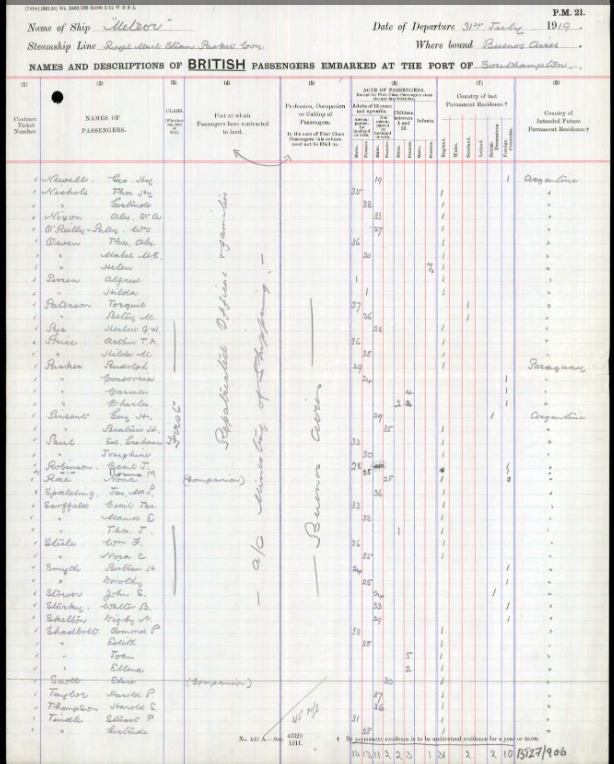
Scanned page of a passenger list of the Meteor
Passenger list of the S. S. Meteor, 1919, showing Guy and Trixie Pinsent.

Trixie’s younger brother Guy Homfray Pinsent had worked in a bank in Buenos Aires, in Argentina, before the war and he returned for a visit in 1919. Trixie went with him and, for some reason, decided to stay on. She became a “clerk” (possibly working for a British owned Railway Company (?)) in Buenos Aires, in 1928.  

Interestingly, her time there overlapped with that of at least two other branches of the Pinsent family. How well they knew each other – if at all – I don’t know. Certainly, there was a surprising degree of interaction within the Pinsent family in England at that time. Lady Pinsent made the most of her erstwhile husband’s English friends and his and her family, and other connections. It is probably no coincidence that Adolphus Ross Pinsent (from the DEVONPORT branch) was a director of the bank that Guy worked for before the war! “Ross” Pinsent also had railway company connections, so he may have helped Trixie out as well.

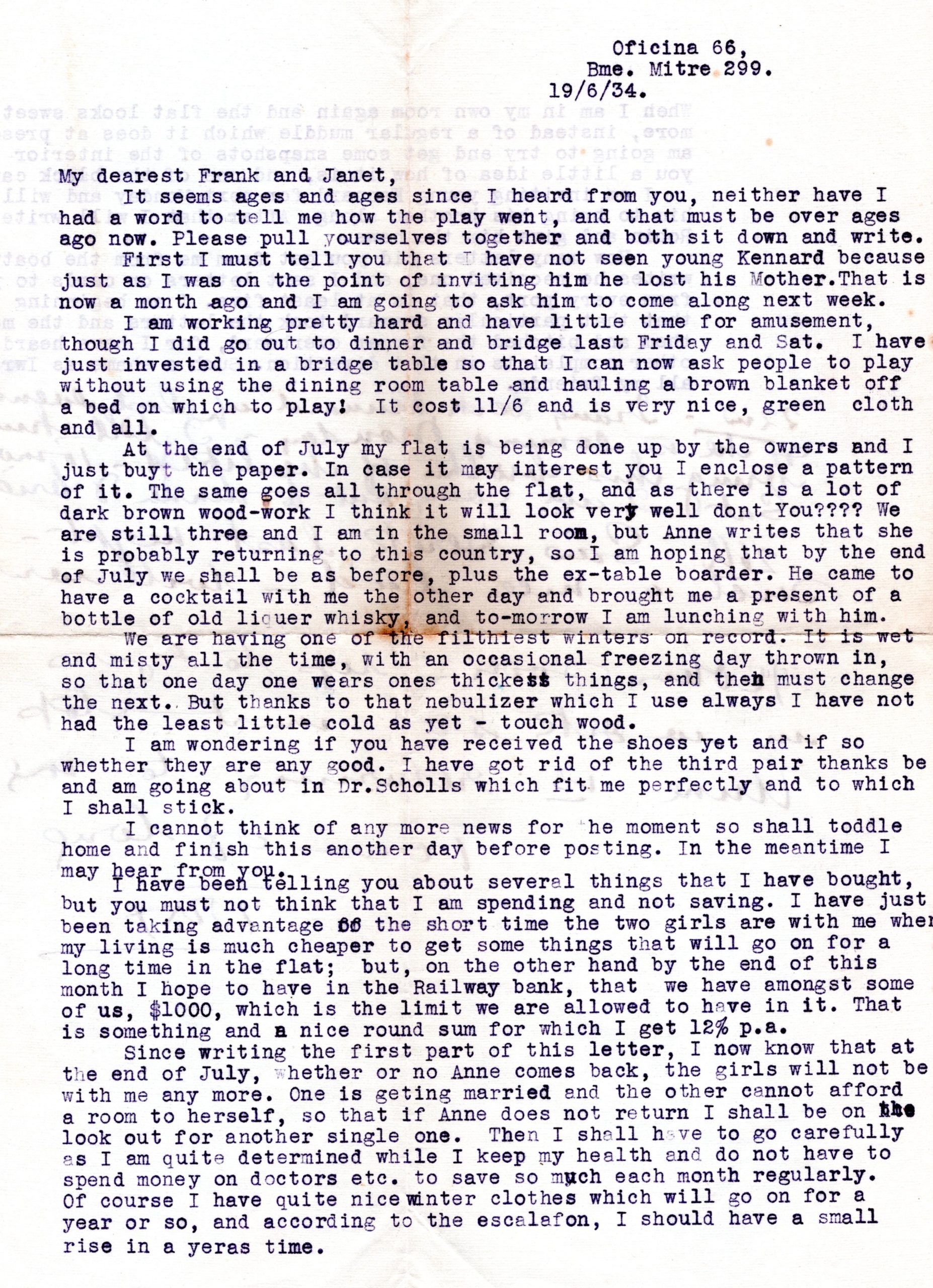
A long typewritten letter.
A typewritten letter from Trixie to Frank and Janet, dated June 19, 1934.

Incoming Passenger Lists show that Beatrice Homfray Pinsent returned to see her brothers in England in 1928 and 1933 and may have been back other times as well. She visited Francis and his wife, Janet, in Horrabridge. On the second of her visits, she also went out to Italy to see her half-sister, Maude (the Lady Abbess). She returned from Genoa on the Dutch ship “Johan Van Oldenbarevelt” which docked in Southampton on 17th December 1933. Trixie wrote to her brothers Guy and Frank from that boat (or it may have been the one she took back to Argentina) and later, in June 1934, wrote to Frank to inquire if her letters had been received. She rather suspected they might have been thrown overboard and the postage pocked by a steward!

Trixie was sharing a flat in Buenos Aires with two or three other women at the time, and she mentioned that one of them would be leaving shortly as she was getting married. However, she thought that her friend Anne (presumably) Stehrenberger) would be back fairly soon, and she hoped that she would take one of  the rooms in the flat.

Janet (née Cowtan), Frank’s wife died in February 1938 and he went out to Buenos Aires to get over the shock and see Trixie. It must have been a short visit as he arrived back in Southampton on the “Royal Mail Steamship Lines” vessel “Asturias” on 25th April 1938. Frank met Anne Marie Stehrenberger while he was there. She was a Swiss national who worked at the “Swiss Legation.” To what extent Trixie encouraged Frank’s subsequent marriage to Anne, I do not know; however, Trixie returned to England to see her brother in July 1938 and Anne Marie came over that August (U.K. Incoming Passenger Lists: Ancestry.com). She came down to Devon for a visit, and married Frank in Yelverton, in August 1939. Two years later they had a daughter – who is still living. Trixie returned to Buenos Aries, where she taught English.

Juan Peron took over in Argentina after the war and life must have changed for the English community. However, Trixie stayed on in Argentina and, in later years at least, gave English lessons. She was eighty-two years of age in 1965 when she died there. Her death was registered at the British Consular Office.


Family Tree

Grandparents

Grandfather: Robert John Pinsent: 1798 – 1876
Grandmother: Louisa Broom Williams: 1808 – 1882

Parents

Father: Robert John Pinsent: 1834 – 1893
Mother: Emily Hetty Sabine Homfray: 1845 – 1922

Father’s Siblings (Aunts, Uncles)

Mary Speare Pinsent: 1833 – 1833
Robert John Pinsent: 1834 – 1893 ✔️
Thomas Williams Pinsent: 1837 – 1890
Charles Speare Pinsent: 1838 – 1914
Louisa Williams Pinsent: 1841 – 1921
Mary Elizabeth Pinsent: 1844 – xxxx
William Burton Pinsent: 1846 – 1846

Male Siblings (Brothers, Half-brothers)

John Cooke Pinsent: 1861 – 1861
Robert Hedley Vicars Pinsent: 1862 – 1888
William Satterly Splatt Pinsent: 1864 – 1865
Charles Augustus Maxwell Pinsent: 1866 – 1910
Arthur Newman Pinsent: 1867 – 1946

Robert John Ferrier Homfray Pinsent: 1874 – 1899
Francis Wingfield Homfray Pinsent: 1875 – 1948
Guy Homfray Pinsent: 1889 – 1972


Please use the above links to explore this branch of the family tree. The default “Next” and “Previous” links below may lead to other unrelated branches.