Please use the above links to explore this branch of the family tree. The default “Next” and “Previous” links below may lead to other unrelated branches.
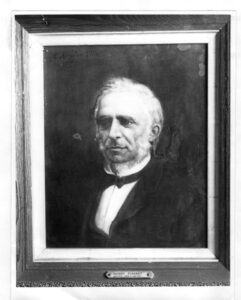
Savery Pinsent was the eldest surviving son of Thomas Pinsent and Mary (née Savery). He was born at #4 Stoke Terrace, Stoke Damerel in July 1815 and was brought up in Devonport, where his father owned a “drapery” business and at “Greenhill”, in Kingsteignton, where he owned a farm.
Savery was “apprenticed” to “John H. Terrell of Exeter, Solicitor” as a “clerk” in 1836 (LDS Film #0916878) and was noted to be such when he and Mr. Terrell prepared Jane Snell’s will later that year (Inland Revenue Wills: 1836). Two years later, in the spring of 1838, Savery applied for admission to the bar as an “Attorney.” He was living in London, near Russell Square, at the time (The News (London): Sunday 6th May 1838). By 1843, he was a fully fledged “solicitor” and entitled to practice law in London. That year, the firm of “Pinsent and Palk” (i.e. his father Thomas and his “brewery” partner Edward Palk) filed an action against Mr. John Furze, a “licensed victualler” of Paignton, in the “Court of Bankruptcy” and “Mr. Pinsent, of London” (i.e. Savery) represented them in Court (Public Ledger and Daily Advertiser: Saturday 20th May 1843). The same year, Savery was described as being a “Solicitor of #9 Bow Lane, Cheapside, London.” in one of London’s local directories (Robson’s London and Commercial Directory: 1843). There were several “Pinsent” related law-suits heard in London in the years that followed. Some, such as “Palk v. Kneebone,” and “Pinsent v. same” (Morning Herald (London): Tuesday 4th November 1845) must relate to the DEVONPORT family somehow but other like “Pinsent v. Hopper” (Morning Herald (London): Friday 15th November 1844) may not. Whether Savery was involved, is hard to tell.
Like his two grandfathers and his father before him, Savery was a committed Baptist and he took part when a “numerous and highly respectable meeting assembled at the Mermaid Tavern in Hackey” to discuss the work of The “Evangelical Voluntary Church Association” (The Patriot: Monday 25th April 1842). The chairman was particularly offended that Church of England Clergymen traveling throughout the country seemed to ignore the Baptists completely.
Two years later, the Morice Square (Devonport) Baptists’ made Savery Pinsent “of Devonport and Modbury” their delegate at a series of “Anti-State-Church” Conferences held in London in April 1844, May 1845, and May 1847. He helped draft a “Scheme of Organization” for the non-conformist community (London Nonconformist: Wednesday 7th May 1845) and was appointed to committee that was asked to prepare a petition to parliament in opposition to the third reading of the “Maynooth College Bill” in 1845 (The Patriot: 20th May 1845). It restricted the Baptists’ and favoured the Roman Catholics. Two years later, he was back working with the independents to oppose the Government’s “Education Scheme”- which did little to address their concerns (The Patriot: 16th April 1847).
Savery went out to the British Colony of Natal in 1849. I do not know why. He arrived on the (as we shall shortly see) not-so-good ship “John Gibson” in October (A Century of Progress in Natal, 1824-1924). Like most of his fellow travelers, he planned to set up a farm or a sugar plantation but on his arrival he seems to have heard that very few were successful and he seems to have changed his mind and set up in practice as a “solicitor”. The Natal Colony records show that, as one of his first duties, he wrote to the “Registrar of the District Court” from a house “on Mr. Clarence’s Farm, near Peel’s Drift on the Umgani” in 1851 concerning the death of a servant.
Life in Natal was precarious and although the Zulu and Boer wars were still many years off, British settlers were subjected to periodic outbreaks of native and Dutch unrest. The British had taken Natal from the Boers by force and had established a Colony there in 1843. At first, it had been administered through Cape Town (in South Africa); however, it gained a modicum of independence with the establishment of a “Legislative Council” in 1857. Unfortunately, the Council disagreed with its Lieutenant Governor over a spending bill in 1859, and it was temporarily dissolved by the “Colonial Office” in Westminster for this act of impertinence (Cape and Natal News: Wednesday 2nd March, 1859). Mr. Pinsent had warned the Council that there might be repercussions, and that the Queen might suspend its charter – but apparently they had not listened … The Australians f0llowed all this with considerable interest – in light of their own colonial status (The Melbourne Argus, 15th June 1859). Savery was elected a “City Councillor” of Durban and served from 1856 to 1859 and also in 1870. He was elected Mayor in 1857 and 1859. This was during a period of considerable political upheaval.
In 1860, Councillor Pinsent lobbied for an “endowment for the establishment of a high-school, college, and public library at the port” in D’Urban (Cape and Natal News: Wednesday 1st August 1860) and his wishes seem to have been met as the “Mechanics’ Institute” in Durban was split into a high school and a college (Port Natal: J. Malherbe, 1965). He later oversaw the founding of Durban’s Botanical Gardens.
Savery was one of three candidates who ran for one of Durban’s two seats on the Colony’s Legislative Council in 1869. He came third behind Mr. Goodricke who offered to resign in his favour – but the electors would have none of it and Mr. Goodricke join Mr. Churchill on the Council (Cape and Natal News: Monday 8th February 1869).
Operating a business in Natal, or any other newly established colony for that matter, provided considerable room for litigation and Savery seems to have spent much of his time sorting out the contradictions and conflicts that inevitably occurred between local values and British laws. He was actively involved in several commercial enterprises – including the local “not quite three miles long” railway line from the port to the town. He attended and helped run the annual general meeting in May 1864 and asked for the financial records and estimates to be printed and circulated (Cape and Natal News: Monday 16th May 1864). He also commented on the “Natal Railway Company’s” proposal to lease the “Government’s Umgeni line” the following year (Cape and Natal News: December 1st 1865). He noted several changes between the original deal and that then under discussion. Not least that the agreement as written only required approval of the Directors, as opposed to the shareholders as had been intended. At much the same time, he was caught up in a dispute in the “Supreme Court”, in London, between the “Natal Marine Insurance and Trust Company” and two of its shareholders who found themselves required to pay £6 per share on “calls” made by Company Directors (Cape and Natal News: Monday 2nd December 1867). Similarly, he attended a meeting of the “Natal Fire Assurance and Trust Company’s” creditors in 1870 and, in his capacity as an “advocate”, made an application to the “Supreme Court” to assist the company come to terms with its creditors (Cape and Natal News: Tuesday 25th January 1870).
Another inter-colonial issue of significance arose in 1867, when “the Bishop of Natal applied for an interdict restraining the Rev. J. H. Wills, chaplain to Bishop Twells of the (Orange) Free State, from holding services or otherwise officiating here, without having first received the license of the lawful bishop of the diocese, Dr. Colenso” (Brisbane Courier: Tuesday 26th November 1867). The thought of a Boer preaching in the Colony without a license was intolerable. The Bishop was at war with his Dean, the Very Rev. J. Green and his Archdeacon, the Ven. Rev. Archdeacon Fearne and the Rev. J. Walton, and he ordered them to appear at a “Court of Citation” charged with denial of his authority, brawling in the Cathedral Church and participating in the election of an alternative bishop! Savery, regardless of any disdain for the Anglican Church he may have felt, was brought in to argue the Bishop’s case and he seems to have won (John Bull: 29th June 1867). Dr. Colenso had at least been to Natal; he wrote a book about a visit he made in 1854. It was entitled “Ten Weeks in Natal: First Tour of Visitation Among the Colonists, Zulu Kafirs of Natal”. It had been published in London in 1855. The independents in Natal, who had no love of Dr. Colenso – who they considered far too Catholic – went about building their own Congregational Chapel in D’Urban. It was built on a “site was furnished by Mr. Pinsent at half-market value” and paid for by local activities and donations from England, and opened on 8th June 1856 (The Patriot: Wednesday 8th October 1856).
The Rev. William Taylor, in his book “Christian Adventures in South Africa” published in 1877 describes how Savery overcame a crisis of conscience. When, is not made clear. According to Rev. Mr. Taylor, “Mr. Pincent, of D’Urban, in Mr. George Cole’s judgement, though not an eloquent pleader, is the best law counsellor in South Africa” came to him and told him of his struggles, and said that although he was sick of sin he feared that he would never be forgiven. Mr. Taylor goes on to say that he finally persuaded Savery that he would be forgiven by using a legal analogy – that a penitent should trust in God just as a defendant should trust in his advocate. It all came down to trust in someone better qualified. Evidently, the crisis passed and “From that, Brother Pincent became decidedly active as a witness and worker for God, and very useful in leading poor sinners to Christ.” The Reverend gentleman went on to say that he had discussed “Pincent’s conversion in Cape Town” and had been chastised in the press for using his name. However, he was able to rebut the complaint by saying that it was by Mr. Pincent’s own authority that he made use of his name, he having said to me; “so much of my life has been wasted, that for the rest of it I wish my time, talents and testimony, all used in any way that will promote the glory of God and the salvation of sinners, and you are entirely at liberty to make any use of my name s you like for such purposes.”
Diamonds were found in the Vaal River near what is now Kimberley in 1867 and, although the Witwatersrand gold fields were not discovered until 1884, the political landscape in Southern Africa started to change. There may have been another Colonial controversy brewing in 1868 as the Speaker of the House of Commons in Westminster is reported to have read out a letter of petition from “Mr. Savery Pinsent of D’Urban, in the Colony of Natal” praying that a dispatch from the “Secretary of the Colonies” to the “Lieutenant Governor” be cancelled, in June 1868 (London Standard: 11th June 1868). What that was about, I do not know.
Savery was a practicing “attorney” throughout the 1860s and his fingerprints can be found on several letters and legal opinions in the colonies archives. The last noted was dated 14th December 1871 (Natal Archives, Deceased Estates). Evidently, a Mr. Nall had made a will in England before moving out to Natal and making his fortune there. His executors still lived in England and it was not clear what his legal representative in Natal had to do to receive authority to liquidate his assets. Savery dug into the precedents and determined that he had to apply to the Executors to become their “agent”. This was one of several occasions when he found himself trying to reconcile the objectives of the Imperial Government with the needs of the newly arrived colonists. There had been a similar case a few years previously where it had proved difficult to reconcile English and Colonial probate requirements (Cape and Natal News: Monday 22nd April 1867).
Savery must have returned to England, periodically, as the Natal Register of Immigrants shows he returned to Durban on the “Natal Star” on 1st February 1867. However, he made his final trip home to Devon shortly after his father, Thomas, died in 1872. Whether he had been expected back is unclear as his father’s executors were in the process of selling the family estate at “Greenhill”. Savery was not particularly land-rich but he must have been very well off. The “Returns of Owners of Land: 1873” shows that “Savery Pinsent, of Clifton, owned land with an estimated gross rental of L.17 0s 0d“.
On his return, Savery Pinsent became a member of the local “Liberal Association” and he supported the nomination of Mr. Seale-Hayne, as Candidate for the Kingsbridge Division at an upcoming parliamentary election, in 1885 (Western Times: Thursday 12th March 1885). Savery became a leading member of the Congregational Church in Newton Abbot. He was a “deacon” and “Sunday school teacher”, and one of the principal advocates for a “Union Conference on Scriptural Holiness” held by the Nonconformist community in Newton Abbot in November 1875. He was deeply suspicious of the then current idea of a “Reformed” Church of England, believing it to be a vehicle for Roman Catholicism. He complained bitterly about a recent “Mission” in Newton Abbot at which Nonconformists were invited to attend under (the false) assurance that their principles would not be brought into question. He complained that the children of “dissenters” who attended were taught that priests can forgive them their sins and that if they cross themselves it will ward off the devil! (Western Times: 14th December 1875.) He was not amused.
In 1878, a Mr. Cowey wrote to the editor of the Natal Mercury (Monday 25th February 1878) with a suggestion of what might be done with £50 that his firm held in trust for the, now defunct, Durban Branch of the “Religious Tract Society,” of which a James Blackwood had been treasurer and Mr. T. Pinsent hon. sec. Unless anyone else had any bright ideas, he proposed to give the money to the treasurer of the “Sailors’ Home.” The Mr. T. Pinsent he mentions was most likely Savery. I am not aware of another Pinsent in residence in Natal.
The back windows of the Congregational Church and an adjacent “bakery” in Kingsteignton were broken one night in August 1881 (Western Times: Friday 26th August 1881). This led to considerable discussion as to whether the act was a threat to the churchgoers or a protest against the rising price of bread. Mr. Pinsent put the matter in the hands of the police who concluded that it was neither. The “ill-disposed” persons responsible had been throwing stones at apples in a nearby orchard and had broken the windows accidentally.
Savery was appointed “Superintendent” of the “Congregational Sunday School”, He was an strong advocate of education and he added several rooms to the “British School” in Kingsteignton at a personal cost of £400. It considerably increased the school’s ability to handle all “classes” of people. The Rev. J. Sellicks (an Independent Minister) opened the extension in October 1880 and praised Savery for the philanthropic work he was doing in the community. He replied by acknowledging the work of others, including his father “in whose foot-steps he was proud to tread.” He just hoped that people would take advantage of the school … (Western Times: Tuesday 26th October 1880).
Savery must have been a well known figure in-and-around Kingsteignton and Newton Abbot in the 1870s and early 1880s. He had never married and had no immediate family, so we find him as an “annuitant” or pensioner lodging at “Town End” farm in Kingsteignton, the home of a Mr. Thomas Knowles, a cattle dealer and farmer, at the time of the 1881 Census. His death five years later was reported in the London Times (24th May, 1886) and Mr. Charles W. Freestone, of the “British School Newton Abbot”, sent a short notice concerning his death to Durban, where it was published in the Natal Mercury on 30th June 1886. In it, he notes that Savery had lived near the family residence of “Greenhill”, carried on his father’s philanthropic work and done what he could to counter the practices of the Episcopalian Church. His dying words were, “I am so happy, I feel God supremely precious to me…”.
The Calendar of Grants of Probate and Letters of Administration shows that Savery Pinsent, “late of Kingsteignton”, gentleman, died 18th May 1886. His will, which still exists — although I have not seen it (Hillary Preston, Personal Communication, 2009) – was proved in Exeter by Thomas Horton of #3 Tamar Terrace, Stoke Damerel, a “draper.” He was Savery’s nephew. His theological and other books were sold at auction, in London, in December 1886 (Morning Post: Saturday 18th December 1886). Among other items, Savery left “Cotty Meadow” in Kingsteignton to his trustees for the building of a non-sectarian elementary school. His personal estate was estimated at £8,628 10s 9d. He was buried with his sister, Anna, next to their parents in the Baptist Churchyard in Bovey Tracey.
Interestingly, the Western Times published a letter from a Natal friend of Savery’s on 18th August 1886. In it, Mr. W. E. Bale, of Martizburg wrote to describe his early experiences with Savery; saying that they sailed from London together on the “John Gibson” and arrived in Durban in October 1849 after a particularly wretched journey where they suffered from bad food and bad weather. He says that they, and others on the ship, had intended to farm; however, on arrival they discovered that there was no market for farm produce and they decided they would be better off pursuing their original trades and professions. That, presumably, is why Savery stayed a lawyer.
Savery was not completely forgotten in Natal. The Durban City fathers named a road after him. Among the “Final Names in the Irish Sweepstake Draw” of 11th October 1932 (Daily News: London), I find “Tsaka, 11 Pinsent, Road Durban, Natal.”
Please use the above links to explore this branch of the family tree. The default “Next” and “Previous” links below may lead to other unrelated branches.
Please use the above links to explore this branch of the family tree. The default “Next” and “Previous” links below may lead to other unrelated branches.
Please use the above links to explore this branch of the family tree. The default “Next” and “Previous” links below may lead to other unrelated branches.
Please use the above links to explore this branch of the family tree. The default “Next” and “Previous” links below may lead to other unrelated branches.
Please use the above links to explore this branch of the family tree. The default “Next” and “Previous” links below may lead to other unrelated branches.
Please use the above links to explore this branch of the family tree. The default “Next” and “Previous” links below may lead to other unrelated branches.
Please use the above links to explore this branch of the family tree. The default “Next” and “Previous” links below may lead to other unrelated branches.
Please use the above links to explore this branch of the family tree. The default “Next” and “Previous” links below may lead to other unrelated branches.
Christopher Roy Pinsent: 1922 – 2015 (Married Susan Mary Scorer, 1951) Michael Roy Pinsent: 1927 – 2019 (Married Stella Marie Priestman, 1952; Wife (GRO1556), 1992) Daughter (GRO0764)
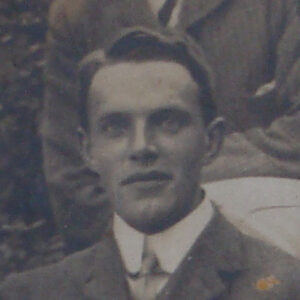
Roy Pinsent was Sir Richard Alfred Pinsent’s eldest son. He was born to Laura Proctor, née Ryland, in Birmingham in 1883 and he was brought up at “Selly Wick House” (“#47 Sellywick Road, Selly Park”) in King’s Norton. In fact, he was brought up with several younger brothers. It was a large house in a quiet residential area southwest of Birmingham. It had 16 rooms and, when the census was taken in 1911 (prior to the “First World War.”), the household included six servants. Roy attended “Marlborough College” a “Public” (private) school, at the same time as his cousin, Cecil Ross Pinsent, who was the son of Roy’s uncle Adolphus Ross. He then went to “University College” Oxford where he graduated with a degree in “jurisprudence” in 1905 (Nottingham Guardian: Monday 23rd October 1905).
Roy returned to Birmingham and – after completing several games of golf (Sutton Coldfield News: Saturday 20th July 1907 etc.) – was called to the bar, in August 1909. He went on to join his father’s law-firm as a “solicitor” and “junior partner” on 1st January 1910. He was only twenty-one years old! Roy seems to have focused on commercial law and, inevitably, the probating of wills. David Hume Pinsent another of Roy’s cousins (Hume Chancellor Pinsent’s son) also attended “Marlborough” school; however, as he was eight years younger I doubt if they overlapped. Nevertheless, the cousins clearly spent time together at “Pinsent & Co.” before David, who was a gifted mathematician, joined the “Royal Aircraft Factory” in Farnborough – and died there in a plane crash in 1918. David’s life is discussed elsewhere.
Roy had an active social life. He attended a “Hunt Ball” in Cheltenham in February 1912 (Cheltenham Looker-On: 3rd February 1912) and was “best man” to a friend, Mr. Philip Lloyd-Graeme, when he married in Bridlington later that year (Hull Daily Mail: 4th September 1912). He was appointed to a committee formed by the “Moseley League of Ladies” when they arranged a “Charity Ball” at the Grand Hotel in Birmingham in 1913 (Erdington News: Saturday 1st February 1913).
Roy married Marion Jordan Lloyd, the eldest daughter of a well-known “surgeon,” in Edgbaston, a few months later (London Standard: 23rd June 1913). However, their marriage was to be short-lived. Roy and Marion went to the Swiss Alps in the hope that the fresh mountain would help her to recover; however, sadly, it was not to be. She died of meningitis at a hotel in Davos the following January (Birmingham Daily Post: 21st January 1914).
Roy was a well established “solicitor & notary public“ at “Pinsent & Co” by then. The Company had its office at “#6 Bennett’s Hill, Birmingham” and Roy lived at “Little Wick”, on the south side of Selly Wick Road, at Selly Hill, Selly Oak Birmingham (Kelly’s Directory for Birmingham: 1915). It seems to have been a (relatively) small house built on his father’s considerable land holding at Selly Hill.
Roy Pinsent was appointed to a committee tasked with forming to a “Citizen Guard” for Birmingham when war broke out (Birmingham Gazette: 15th August 1914). He had been a cadet while at public school (Marlborough College) and had been promoted at the rank of Lance Corporal while at University College in Oxford (Oxford Review: 16th November 1904) so it was only a matter of time before he left to join the “Royal Engineers.” He joined the signals section in January 1916 and served as a “Second Lieutenant” in Egypt most of that year and the next. He was eventually promoted to full “Lieutenant” and transferred to Palestine, where he served out the rest of the war. By 1918, he was in charge of a signals company attached to a “2nd Heavy Artillery Unit”. Roy received the “British and Victoria Medals” for his service (British Army WWI Medal Rolls Index Cards).
Roy must have been back in England by July 1918 as he married Mary Tirzah Walls, a “doctor’s” daughter, in Burgh, in Lincolnshire. In theory, he shared “Selly Wick House” with his brothers John Ryland and Clive, however, as they were, to a large extent away on active, service (King’s Norton Absent Voters’ List: 1919), he must have had it to himself. Roy resigned his commission in 1919 and returned to the family law firm. His wife, Mary, seems to have played Hockey for the Edgbaston Hockey Club in 1920 (Ladies’ Field: 4th December 1920).
Roy and Mary (“Molly”) both came from large families that were widely known in and around both Birmingham and Cheltenham. Although they survived the war, it is safe to assume that many of their friends and relations did not, and it must have taken several years for some sense of normality to returned to the traditional “fashionable” social events, clubs and organizations as they came back to life. The minutes of the Midland Association of Mountaineers inaugural meeting, which was held on 24th March 1922, shows that Roy was one of its members (calmview.bham.ac.uk). How long that lasted I do not know. Roy and Mary also played golf (Birmingham Daily Post: 18th May 1939).
Mr. and Mrs. Roy Pinsent attended the “National Hunt Ball” in 1920 (Gloucester Echo: 11th March 1920) and they were seen at numerous “better-class” weddings and funerals in the 1920s and 1930s. On one occasion Roy was asked to “give away the bride” at a significant family wedding in Cheltenham, in 1934. It was between Mr. Robert Symons Burton and Miss Margaret Anne Willoughby – who was Roy’s second cousin through his mother, Laura Proctor Ryland (Gloucestershire Echo: 7th April 1934).
Roy had, as a young man in 1909, attended the wedding of his cousin, Miss Dorothy Helen Ryland, to a Mr. Edwin Charles Willoughby. He was a very distant “cousin” on the Pinsent side of the family. Mr. Willoughby’s mother, Margaret Jane Pynsent was the daughter of Thomas Pynsent, a successful “farmer” and “businessman” in Northam, on the North Devon coast, who belong to the HENNOCK branch of the family (Cheltenham Chronicle: 18th September 1909).
“Captain” Edwin Charles Willoughby, as the bridegroom became a few years later, was, sadly, killed at Gallipoli just a few days before Roy’s younger brother Laurence Alfred Pinsent met the same fate. Roy must have been one of Dorothy’s closest living male relatives. He also performed the same duty, and gave away her sister, Dorothy June Willoughby when she married in October 1938 (Gloucestershire Echo: 15th October 1938). The Rylands loomed large in Birmingham and in Roy’s life in the 1920s and1930s. When he was not attending their weddings, he was attending their funerals and/or probating their wills. His uncle Sidney Proctor Ryland died in September 1923 (Gloucester Journal: 22nd September 1923) and his uncle Henry Proctor Ryland died in July 1936 (Cheltenham Chronicle: 25th July 1936).
Both Roy and his father were committed to philanthropy, and they both gave small sums to charitable enterprises. For instance, Richard Alfred gave £10 and Roy £2 2s to the “Birmingham Cathedral Tower Restoration Fund” in 1910 (Birmingham Daily Post: Saturday 28th May 2910). However, Roy and his new bride, Mary Tirzah, both developed a deep commitment to social causes in the wake of the First World War. Roy was to become a major benefactor of the “Birmingham Boys’ and Girls’ Union” and in 1924 he helped them acquire 22-acres of woodland and meadow at a property that came to be known as the “Woodlands”, Bourne Vale Camp near Aldridge. It was needed for a campsite for around 60 children per week to visit and enjoy (woodlandsadventure.co.uk). In November 1927, he made an appeal on behalf of the “Boys’ and Girls’ Union” from the “Daventry 5GB Experimental (Broadcasting) Station” as part of its Sunday programming (Northampton Mercury: 4th November 1927).
Roy was to become a strong advocate of “Union” and he was “chairman” of the “Union Executive Committee” when the Duke of Gloucester, “President” of the “National Association of Boys’ Clubs” visited Birmingham to meet with the local organizers in 1932 (Evening Despatch: Friday 19th February 1932). Roy gave a speech in which he discussed the beginning of the movement in Birmingham. He said the organization had been founded twenty-five years before, and it now had a membership of 3,000 boys and girls and a staff of 300 trained volunteers. It was; however, dependent on private donations and they needed between £1,000 and £1,500 by the end of the financial year (Birmingham Daily Gazette: Friday 19th February 1932). To encourage donations, Roy offered to match (at least up to £1,000) the amount collected for the “Union” between July and the end of December. Approximately £600 had been given so far, and he said that if others came up with £300, he would throw in the extra hundred pounds himself (Birmingham Daily Gazette: Saturday 9th December 1933). They reached their target and, at the start of the new financial year, Roy’s wife, Mary, hosted a reception at “Little Wick” for those who ran stalls and undertook other activities on behalf of the “Union” aimed at fundraising (Birmingham Daily Gazette: Wednesday 25th April 1933). Roy and “Molly” also contributed small amounts to many other worthy causes both before and after the Second World War. Both of them were frequently named in “subscription lists” for this charity or that.
Roy and Mary Tirzah (née Walls) had three children who were born in “Selly Wick” in the 1920s. Their eldest son, Christopher Roy Pinsent, trained as an “artist” and became the third baronet on his father’s death. Roy’s second son, Michael Roy Pinsent, became a solicitor and joined the family law firm. Their lives are discussed elsewhere. Roy and Mary also had a daughter (GRO0764) who married in 1960.
Ship Manifests’ show that Roy and Mary took their children on several trips to Europe in the 1930s. They crossed over to Cherbourg with their son Christopher on the “Cunard Line” ship “Berengaria” in August 1930, and they traveled to La Coruna, in Spain, on the “Royal Mail Lines” ship “Arlanza” in June 1934. The whole family went out to Marseilles on the “Rotterdam Lloyd Dutch Mail” ship “Sibajak” in August 1936 only to return on the “Bibby Line” ship “Staffordshire” three weeks later.
Roy’s generosity was again called upon when he returned to Birmingham. The “Boys’ and Girls’ Union” building,“Kyrle Hall,” needed to be rebuilt. So, once again, he offered to match donations – this time up to and including £10,000 (Birmingham Daily Gazette: Monday 7th December 1936). The new building went up on the same site as the old one on Sheep Street and, at the start of construction, Roy laid a stone in commemoration of the old building (Birmingham Weekly Mercury: Sunday 6th December 1936). The new one had a major new innovation – a floodlit football field on its roof (Evening Despatch: Friday 26th November 1937). The Duke of Gloucester opened the “Union’s” new headquarters in November 1937 (Birmingham Daily Gazette: Saturday 27th November 1937).
Sir Roy (as he was by then) was a well-known children’s advocate and he was asked by the headmaster of Handsworth Grammar School to speak and present the prizes on its speech day (Birmingham Daily Post: Friday 17th March 1950).
Despite Roy’s contribution, the “Union’s” building still carried a mortgage and, by the early 1950s this became a problem. Once again the organization was badly in need of funds. In 1953, The “Lord Mayor” of Birmingham set up a “Save Kyrle Hall appeal” to help the underfunded institution and Sir Roy – whose family owned the investment company that held the mortgage – said that it would “forget” about it for five years (Birmingham Daily Gazette: Thursday 14th May 1953). The immediate crisis was thus averted and “Kyrle Hall” remained the “Union’s” home until 1968 when it was sold and took on a new life as part of the, recently formed, “University of Aston” (Birmingham Mail: Saturday 21st June 1997).
The “Union” needed a new home. Sir Roy had passed his interest in the “Boy’s and Girls’ Union” on to his son Michael Roy Pinsent by then, and in 1967 he became the “chair” of the committee that built the hall’s replacement. It was included in a leisure centre in down-town Birmingham (Birmingham Daily Post: Thursday 19th January 1967).
Sir Roy was a strong supporter of the “Birmingham Amateur Dramatic Federation” and he sponsored a “Challenge Shield” that was won by the girls of the “Shenley Fields School” in 1927 (The Stage: 17th March 1927). The shield was awarded annually and twelve teams competed for it the following year. The “Roy Pinsent Shield” for girls under the age of fifteen went to the “Dartmouth Street School” in 1935 and it was won by the “Handsworth, New School” Senior Girls’ Class – led by a Miss Kelly in 1939 (Birmingham Daily Post: 19th June 1939). She was an American who later described her successful production of “Daddy Longlegs” to a local newspaper (Birmingham Weekly Mercury: Sunday 8th May 1955). Moor Green Infants’ School won the shield for a dance-drama entitled “The Machine Stops” in 1983 (Birmingham Mail: Tuesday 1st March 1983). It went to a Lucinda McKee and her class at “Bromsgrove School” at the “Birmingham Festival of Acting and Musical Entertainment” in 2012 (www.bromsgroveadvertiser.co.uk). Presumably it is still being fought for.
Roy joined the board of the “Midland Employers’ Mutual Assurance Society” in September 1940 (Liverpool Journal of Commerce: Tuesday 10th September) and most likely joined the “Rotary Club. ” He was present when the “vice-president” of “Rotary International” opened a new building for its “Boys’ and Girls’ Club,” on Summer Lane, in February 1940 (Birmingham Daily Post: 5th February 1940).
Roy was appointed “Chairman” of the “Midland Local Price Regulation Committee” early on in the Second World War. It was to be a thankless task. The organization had been set up by the “Board of Trade” to deal with consumer complaints of price gouging and profiteering and there was constant bickering between the public and merchants and traders. Roy explained the workings of the committee at a “Birmingham Rotary Club” meeting in October 1940, (Litchfield Mercury: 18th October 1940): Apparently, even rabbit and onion prices were an issue (Worcester Journal: 19th October 1940)! Roy admitted that: “My Committee is expecting a good many headaches over the Purchase Tax,” – which was shortly to be raised about 33 percent on household items and 66 on luxury goods! Still, he stressed that up till then he had seen very little sign of profiteering in the Midlands (Birmingham Daily Gazette: 15th October 1940). Nevertheless, less than a month later – in November – he wrote a letter to the “Editor” of the “Birmingham Daily Post” warning retailers that, although his Committee had previously been lenient with regard to small infringements, the number of cases had risen to a point where it was no longer prepared to tolerate them. Henceforth, any future infringement would be severely punished (Wednesday 27th November 1940). In another letter published at much the same time, he acknowledged that public transport was not what it used to be and he appealed to those citizens who were entitled to drive private cars to help the less fortunate by offering lifts (Birmingham Daily Post: Thursday 28th November 1940). How that worked out, I am not sure.
In August 1941 Roy found himself trying to explain recent legislation (designed to cut out “middle men” and control prices) to the public, and he pleaded for public support in implementing it, saying: “the machinery is there; it depends upon traders and the public whether effective use is made of it.” Roy asked the public to help make prosecutions happen, but was criticized in the press for not making effective use of his powers (Birmingham Daily Post: 19th August, 1941). He threatened to prosecute traders who overcharged for cloth and “apparel” in April 1942, (Birmingham Mail: 20th April 1942) and, after running out of patience and feeling that an example had to be made, his Committee prosecuted several traders for overcharging. One was fined £100 for charging 1s 9d over the legal price for a pair of Wellington boots! Presumably that particular trader had a reputation (Birmingham Daily Gazette: 22nd January 1943).
In the meantime, Roy’s wife, Mary, collected blankets for the victims of air raids (Birmingham Daily Post: Friday 15th November 1940). Roy, meanwhile, served as an “Air Raid Warden” (1939 Register) and felt the full force of war-time “Civil Service” bureaucracy. His frustrations came out in a series of letters (related to “Dad’s Army”) published in the “Birmingham Daily Post” in February 1942. He took issue with the “chairman” of the local “Civil Defense Committee” for insisting that voluntary wardens “must” perform a minimum of 48 hours of duty per month – despite the absence of any immediate threat of air raid or invasion. He also objected to the detailed attendance forms that he and other wardens had to fill out. Roy complained that this bureaucratization of an essentially volunteer organization was completely at odds with the spirit of patriotism that had induced the wardens to volunteer in the first place! (One newspaper respondent suggested that if fire or air raid wardens had nothing to do in the suburbs, perhaps they should help out in the City Centre, which was an intrinsically more dangerous place to work). How it ended, I am not sure (Birmingham Daily Post: 2nd, 5th and 7th February 1942).
After the war, Roy and his father (Sir Richard Alfred Pinsent) donated a 5,200 square yard freehold site facing the Pershore Road to the “War Memorial Appeal” of the Selly Park, Birmingham, Branch of the “British Legion“. It was for a memorial that was to include a new branch headquarters and a club for the families of ex-servicemen (London Times; 31st January 1946). It was expected to cost approximately £25,000. Richard Alfred died in1948 and it was left to his son, Sir Roy Pinsent (as he then became), to see the plan implemented.
Sir Roy’s father had owned a large property in the Selly Park area of Birmingham and Roy and his family seem to have lived in a smaller house next door at “Little Wick” which must have had an impressive garden of its own. Certainly, Roy had won several awards at the “Alpine Gardens Society’s” show when it was held at the “Birmingham Botanical Gardens” in 1933 (Birmingham Daily Gazette: Thursday 27th April 1933). Despite the war, Roy and Mary seem to have maintained a productive greenhouse and garden at “Little Wick” into the 1940s . Its Alpine House was opened to the public in March 1940 – in aid of a war-time charity in support of “comforts for Barrage Balloon people” (Birmingham Daily Post: 14th March 1940).
In the mid-1930s, “Pinsent & Co.” opened a London office and Roy and Mary kept a flat in Curzon Street in Central London for use while while they were there. The Office was initially in Lincoln’s Inn Fields, in the Chancery District; however, it was later moved to (presumably larger) set of quarters at “Clements Inn, London W.C. 2” in 1937. Roy commuted between Birmingham and London until around 1942, when his father Sir Richard Alfred Pinsent, the senior partner in the family firm, retired from the family firm and he was needed back in Birmingham.
The family owned a small oasis of greenery in Selly Wick, which, even in those days, attracted foxes. It became a haven for foxes and in June 1947, Roy and his father stood watch over their domain and shot one of three that had had the audacity to take up uninvited residence (Birmingham Daily Gazette: Saturday 28th June 1947). Foxes are commonplace in British cities suburbs, these days.
Post industrial revolution Birmingham was not the cleanest of cities and even I remember the periodic blankets of it smog, smoke and pollution that came from its light and heavy industries (and houses) before the passing of the “Clean Air Act” in the Britain in 1956. Some of it must have reached out to the “upper-class” residential district of Selly Park. Perhaps that was, in part, why Roy moved to Jaynes Court, in Bisley, near Stroud, in Gloucestershire shortly after the war. There, he was doubtless surrounded by foxes which were, – in contrast to their city cousins – fair game for hunting! The air must of been cleaner and there was undoubtedly space for a proper garden. Nevertheless, it was hard to find qualified staff after the war, and it is hardly surprising that Roy place an advertisement for a “Keen head Gardener” placed in the Sussex Agricultural Express on 20th July 1945 and, as staff were difficult to find, he offered an inducement – a “comfortable lodge.”
Roy continued to support various boy’s clubs, while living near Stroud and in April 1948 he was elected a “vice-president” of the “Gloucestershire Association of Boy’s Clubs” (Cheltenham Chronicle: 24th April 1948).
Sir Roy and his brothers kept their family home at Selly Hill after their father (Sir Richard Alfred Pinsent) died. Sir Roy’s nephew, John Ryland’s son, John Laurence Pinsent, seems to have looked after part of it in the 1950s. While living in Stroud, Sir Roy seems to have retained a flat there for use while in Birmingham on business. Sir Roy had wide-ranging interests and he gradually stepped back from “Pinsent & Co”. Nevertheless, the firm continued to grow and, after merging with the Leeds firm of “Simpson, Curtis” in 1995 and taking on board “Biddle” in 2001, it merged with “Masons” to form the now internationally known firm of “Pinsent – Masons LLP”.
In 1954, Sir Roy resigned his position as a director of the “Midland Employers’ Mutual Assurance Limited” after fourteen years involvement (Evening Despatch: Tuesday 18th May 1954) and left the “British Law Insurance” local board in Birmingham the following year (London Times: 16th May 1955). He spent more time in London and eventually acquired a flat at Hyde Park Place in London where he lived with his daughter (GRO0764).
Sir Roy seems to have been deeply affected by what he saw and experienced during two wars and as noted above he, with his elderly father, had donated a plot of land in Selly Park to the British Legion for use as a community centre and War Memorial (Evening Despatch: Wednesday 12th September 1945). Roy felt that what was needed in the world was a type of social discipline that neither the Church or the State seemed to provide. In a letter to the editor of the Birmingham Post (dated 18th December, 1945) he praised a book entitled “A Time for Greatness” by Mr. Herbert Agar, and suggested that the route to happiness lay through austerity and discipline. His social values led him to support the campaign for “Moral Rearmament” proposed by Dr. Frank Buchman, in Oxford in 1938. He corresponded with Buchman in the late 1940s and in 1950 he sent a letter to the editor of Birmingham Daily Post in which he discussed a radio broadcast that Dr. Buchman had given in Germany (Birmingham Daily Post: Wednesday 31st May 1950).
“Moral Rearmament” promoted moral values and stressed peaceful coexistence. It became an international movement in the 1950s, and Roy and Mary traveled extensively in its support. They sailed for New York on the S.S. “Britannic” in May 1948, and they flew from London to Toronto in May 1951. Whether these were purely social trips or were fully related to his support of the cause is not clear. However, Sir Roy (as he had become on the death of his father in 1948) had “name recognition” and he helped to publicize the movement and he also gave it considerable financial support.
In a nod to reconciliation, he invited Mr. Tetsu Katayama (Japan’s first post-war Prime Minister) to dinner, while he was on a fact-finding visit to Britain in July 1949 (Birmingham Daily Gazette: Friday 22nd July 1949). It was a bold move at the time. The following year, he admitted that he had offered to pay sixty percent of the claims of the trade creditors of “Thomas’s Publications” – which was then in liquidation – because he felt that one of its publications would do a lot to help bring “Moral Rearmament” to public attention (Birmingham Daily Gazette: Friday 1st September 1950). He was always generous. Sir Roy saw a need for social change, and in 1950 he wrote an article entitled “Productivity in Industry” which was reviewed by a committed Christian (“Observer”) in the Perthshire Advertiser on Saturday 11th March 1950. Sir Roy posited that increased productivity was essential to social well being, and that in a few notable cases it could be found where there was good will and a common sense of purpose among workers and managers. The Scottish “Observer”, sad to say, was not convinced. He felt that – in reality: “This is still a world in which for one Good Samaritan there are several who avert their eyes and hurry away from the stark necessities of the human situation.”
Nevertheless, Sir Roy stayed true to the aims of “Moral Rearmament” and he attended countless functions in its support. He gave numerous speeches – including one at St. Martin’s Men’s Forum in 1950 (Birmingham Daily Post: Tuesday 14th November 1950).
Sadly, Sir Roy’s his wife, “Molly” (Lady Mary Tirzah Pinsent) died at Bisley in 1951 (Birmingham Daily Post: Wednesday 11th April 1951). Her husband and their younger son were granted administration of her estate. Sir Roy moved to Charlton Park Gate, in Cheltenham, later that same year in (Cheltenham Chronicle: Saturday 4th August 1951) and lived there for a few years.
Sir Roy maintained his support for “Moral Rearmament”. He sponsored a “World Unity” event in Birmingham Town Hall in 1950 and said: “We are living in an age when greatness is required of us, and when the time is five minutes to midnight.” The ideals of Moral Rearmament, he went on, “had crept into the hearts of increasing numbers of people”. He added that he could “understand that the philosophy of Karl Marx had attractions for some people. But he believed that they, too, could find in Moral Rearmament a more satisfying way of life than they had known before” (Birmingham Daily Post Monday 5th June 1950).
In August 1951 he wrote to the editor of the Birmingham Daily Post (16th August 1951) to advocate for “Moral Rearmament” and to warn against Russian propaganda – in form of a “Festival of Youth” it was then putting on in Berlin. Clearly, he was no lover of communism. Later that year he attended the “World Assembly of Moral Rearmament” in Caux and wrote to the same editor to tell the public that the world was looking for leadership from Britain (Birmingham Daily Post: Monday 8th October 1953).
Sir Roy attended an event at the Royal Festival Hall in London in June 1952 (Sydenham, Forest Hill and Penge Gazette: Friday 13th June 1952) – and he wrote an article on the subject in 1953. In it, he claimed that among the benefits of “Moral Rearmament” : “Communism goes down, Production up, and Absenteeism goes down” (Denis Delay Papers: Trades Union Congress: 2/N/44).
However, he lived in a highly polarized world and many people questioned the movement’s overtly “western” policies and wondered about the source of the organizations’ funding. Sir Roy remained committed and traveled far and wide in support of the movement. Ahead of a meeting in South African, a newspaper, quoted Sir Roy as saying – in London – that “I have transferred one-third of my capital and invested it in M.R.A., and I wouldn’t give much for my other investments in 10 years time unless we get our message across” (Advance: 19th November, 1953). In December, he took a “Union Castle Line” ship, the “Rhodesia Castle”, out to South Africa.
On his return, he wrote a letter to the “Editor” of the “Birmingham Daily Post” describing what he had seen in South Africa and how he felt that “good-will” on all sides was the only way to solve racial and cultural conflicts. He said he had seen how helpful it could be (Birmingham Daily Post: Saturday 17th July 1954). He described people in authority throughout the world who had changed their positions when faced with the logic of their values. The letter garnered considerable comment. Much of it was supportive; however, there were those who thought that he was being incredibly naïve (Birmingham Daily Post: Friday 27th August 1954).
In September that year, 1954, Sir Roy gave a speech at another international meeting in Caux, Switzerland (the European Headquarters of the Movement) and said that: “every country needs a new quality of leadership, involving decision humility, commitment and the training available to every man at Caux” (Northern Whig: 6th September 1954). Shortly thereafter, Sir Roy went out to America on the “United States Line” ship “United States”, seemingly to attend a “Moral Rearmament” meeting in California (Desert Sun: 28th March 1955). While he was there, Congressman Charles B. Deane called for “Moral Rearmament” to be enshrined in American Government policy and, back in England, a Member of Parliament, Mr. John McGovern, called for its acceptance as Britain’s national and international policy (Birmingham Daily Post: Saturday 15th January 1955).
Sir Roy returned from another Conference at Caux in 1971, and gave his impressions of the place and event to a reporter for the Westminster & Pimlico News (Friday 1st October, 1971). Along with much else, he said: “Seventy years ago, at the age of 18, I spent a marvellous winter holiday at the lovely Palace Hotel, Caux, in Switzerland. It is perched precipitously between Montreux and the towering Rochers de Nez and looks right down on the lake of Geneva. In the years during and between the First and Second World Wars, this fashionable resort fell on evil days and finally at the end of the Second World War was on the brink of being pulled down. At this point a group of farseeing Swiss citizens purchased it for a fraction of its original cost and refashioned it as a unique conference centre for the Moral Re- Armament of the world. I little knew on my first visit that from 1948 onwards I should often be revisiting this heavenly spot to take part in the international gatherings which are held there.”
Meanwhile, back in England in 1956, he promoted a film made of a play entitled “Freedom” that had been written and produced by Nigerian members of the movement (Birmingham Daily Post: Friday 16th March 1956). Sir Roy attended yet another showing of the firm – about an African nation’s struggle for freedom – in March 1958 (Portsmouth Evening News: Monday 24th March 1958) and he left England for Lagos and another meeting two months later.
Despite all his travels, he presumably made it home for his daughters wedding in 1960. Perhaps his flight to Hamilton, Bermuda (on PAN AM Flight 137 on 17th December 1961) was for a holiday. By then he would have been seventy-eight years old and sorely in need of one. Nevertheless, he kept going. He entertained the chairman of the Mitsui Foundation of Toyko when he made a return visit to Birmingham on “Moral Rearmament” business in May 1963 (Birmingham Daily Post: 22nd May 1963. And a few months later he wrote a letter to the editor questioning whether the government accepted responsibility for the “moral fibre” of the nation (Birmingham Daily Post: Wednesday 4th September 1963). Sir Roy kept up his interest in the “Moral-Rearmament” movement and he continued to traveled and attend their meetings. For instance, he was there for one at a “Moral Rearmament” training centre in Maharashtra State in India, in March 1969 (Westminster & Pimlico News: Friday 14th March 1969).
Sir Roy’s public exposure was a blessing and a curse. In February 1962 he felt compelled to ask the “East Kent Times and Mail” (Wednesday 28th February 1962) to inform its readers that he had absolutely no connection with the “Uma Puppet Studios” in Broadstairs and its usage of his name as a “Director” was completely unauthorized.
At some point Sir Roy moved to St. George’s Square in London where he either formed or joined the “Over 70’s Housing Association” and set about converting a five story building at #5 St. George’s Square Pimlico into self-contained flats with a communal dining area to provide “a gracious but challenging living for elderly people of limited means” (Westminster and Pimlico News: Friday 6th November 1964). After a couple of years he moved in and set about improving the surrounding neighbourhood. Sir Roy was elected to the “Executive Council” of the “Westminster Council of Social Services” – an organization that coordinated the work of existing social service organizations (Chelsea News and General Advertiser: Friday 9th July 1965). He formed a local branch of the “Friends of the Westminster Theatre” (Westminster & Pimlico News: Friday 10th November 1967) and he manned a garden supplies stall at the International Fair in aid of the “Westminster Memorial Trust” at Kensington Town Hall in November 1968. The proceeds were to benefit the “Westminster Theatre Arts Centre” (Westminster & Pimlico News: Friday 28th November 1968).
Sir Roy was a lawyer, and he wrote a letter to the London Times (7th June 1967) regarding a provision in the “Leasehold Reform Bill” that was then going through Parliament, as it seemed to be detrimental to charitable organizations. The same year, he co-wrote a letter with Rear Admiral Sir Edward Cochrane (London Times: 3rd November 1967) lobbying for the tidying up of the small gardens in London’s Squares. The two of them suggested providing tasteful railings around the smaller parks, and they pointed to a pilot project that the St. George’s Square local housing association was then working on.
Sir Roy had brought his love of gardening to Pimlico. There is a photograph of him with some of the flowers on his balcony in the Westminster and Pimlico News (Friday 7th July 1967). He was chair of the “St. George’s Square Gardens Committee” and personally encouraged the residents to grow plants in window boxes by offered two prizes of £15 for the best results (Chelsea News and General Advertiser: Friday 23rd June 1967). The initial response was not great, but the idea took root and Mr. and Mrs. Donald Archer at #98 won one of the prizes in 1968. She said: “Sir Roy Pinsent wrote me a charming letter and said that the entry had been judged by an official of the London Garden’s Society, and it had obtained top marks. He then awarded me a special prize, which we were very pleased to receive” (Chelsea News and General Advertiser: Friday 16th August 1968).
Sir Roy then moved on to improving the look of the communal garden in the centre of St. George’s square. It had been let go over the years and certainly couldn’t compete with the best of the well-laid out City of London squares – which were, of course, in a different jurisdiction. Some of his grandchildren agreed to give him sections of steel railing for Christmas (Westminster & Pimlico News: Friday 17th November 1967) and later signed a legal covenant to that effect (Westminster & Pimlico News: Friday 9th February 1968). Sir Roy, was, a lawyer – after all!
He sent out a public plea for charitable donations and the firm of “Bayliss, Jones and Bayliss” sensed an advertising opportunity and offered to supply and erect the fencing free of charge (Westminster & Pimlico News: Friday 1st December 1967). Unfortunately it did not happen. As Miss P. M. Wright, 22 St. George’s House, St. George’s Square, S.W. I pointed out, the garden was the legal responsibility of the freehold landowners (Chelsea News and General Advertiser: Friday 24th November 1967)! They seemed unmoved and, despite the angry complaints of the residence that locks placed on the gates were routinely broken, children played football there in the evenings and vagrants slept in it over night nothing was done (Westminster & Pimlico News: Friday 27th June 1969).
The residents were extremely alarmed when “London Transport” started work on a shaft for a new Underground Station at Pimlico and it looked as if some of the trees in and around the garden would be impacted. However, Sir Roy met with the transport authorities and later told the “News” that he “attended a special meeting to discuss this work and the officials agreed that the trees have got to be preserved while the work is going on. In fact, they changed their plans with this object in view.” He then added: “We have got to put up with this work and move with the times, and I think the London Transport Board will play their part. I am also hoping that when the work is finished they might be generous enough to put some nice railings round this part of the square for which I have been campaigning for some time. I am quite happy the situation at present” (Westminster & Pimlico News: Friday 29th August 1969). It was good news for a change.
It took a few years but, being the lawyer he was, Sir Roy created a charitable organization (“St. George’s Square Garden Society Limited”) to held finance the work required around the square and ride herd on the freehold owners. As he said, “I have evolved this because of the tiresome and irritating position which arises from having a local enforced garden committee of enthusiastic residents trying in vain to get an obscure and unapproachable landlords’ agents to take a real interest in the gardens and agreeing to hand over the management of the gardens to the committee” (Westminster & Pimlico News: Friday 13th February 1970. Even this caused some discussion as it was not entirely clear what a “public square” was. Was it a square that was owned by the public? – or a private one accessible to the public? (Chelsea News and General Advertiser: Friday 3rd April 1970). At one meeting, the angry residents were told that it would cost L.2,000 a year or more to repair the damage and maintain the garden and that what happened to it was largely up to the leaseholders. (Westminster and Pimlico News: Friday 19th June 1970). At issue was, were the new railings to keep the public out or the owners in? – the latter apparently (Chelsea News and General Advertiser: Friday 4th August 1972).
After considerable discussion, the issue was resolved and London Transport replaced the railings as they had promised. Not that that was the end of it. Westminster City Alderman Hugh Carside grumbled that they had “lethal spikes” and children climbing over might get hurt (Westminster & Pimlico News: Friday 21st July 1972). The residents were not impressed. The whole point was to prevent entry into a private site. According to one, the “poor little souls – our hearts bleed for them” (Westminster & Pimlico News: Friday 4th August 1972).
Sir Roy had seen the affects of the war and post-war period and he was troubled by what he saw as the decline of the nation. One issue that concerned him was the apparent increase in divorce, and he penned another missive to the Westminster & Pimlico News (Friday 15th January 1971) giving his recipe for happiness. He also pleaded with the the Government not allow General Amin (the despot in Uganda who was then in the process of expelling Asian Ugandans) to turn a tense situation into a violent one. He called for a return to a “Time of Greatness” (Westminster & Pimlico News: Friday 1st September 1972). It was a theme he revisited the following year when he made yet another attempt to influence public opinion – and reassert Britain’s place in the world. He quoted William Penn and, interestingly, William Pitt (the “Great Commoner” who received a major bequest of land from Sir William Pynsent in 1765 and promptly left the House of Commons and moved into the House of Lords) as saying: “England has saved herself by her choice, and I trust will save the world by her example” (Chelsea News and General Advertiser: Friday 14th December 1973).
The following February, the Chelsea News and General Advertiser published an illustrated cartoon 90th “Birthday Card” drawn by the scenic designer at the “Westminster Theatre” that depicted Sir Roy in the pose of St. George on a charger, facing down a dragon with branding irons representing his sundry interests, Moral Rearmament, gardening, St. George’s Square, Westminster theatre etc. As the paper pointed out: “He has always worried about the world, though he himself had wealth, a lovely home and family; But always wondered what kind of world the children were going to grow up in. He is a great believer in Edmund Burke’s words “for evil to triumph it only remains for good men to do nothing”“(Chelsea News and General Advertiser: Friday 15th February 1974).
Sir Roy suffered from arthritis but gave at least one interview before he died on the 16th December 1978, at the age of 95 years. In it, he re-iterated his faith in “Moral Rearmament” and his affection for St. George’s Square (Westminster & Pimlico News: Friday 29th July 1977). He had had an impressive life. There were tributes to him in the Daily Telegraph and Birmingham Daily Post on 19th December 1978, and the Westminster and Pimlico News gave an affectionate look back at one of their district’s most esteemed characters on Friday 12th January 1979. They had a lot of ground to cover! The National Probate Calendar shows that Sir Roy (of “5 St. Georges Square, London”, had his will probated on 3rd August 1979 valued at £43,239. The baronetcy passed to his eldest son, Sir Christopher Roy Pinsent.
Please use the above links to explore this branch of the family tree. The default “Next” and “Previous” links below may lead to other unrelated branches.