Thomas Pinsent

Vital Statistics

Thomas Pinsent: 1633 – 1701 GRO1755 (Tanner of Slade, Hennock)

Julian Wilmeade: xxxx – xxxx
Married: 1657: Hennock

Children by Julian Wilmeade:

(?) Thomas Pinsent: 1657 – 1696 (Tanner of Slade, Married Ann Waters, 1678: Bovey Tracey)

Family Branch: Devonport
PinsentID: GRO1755

Click here to view close family


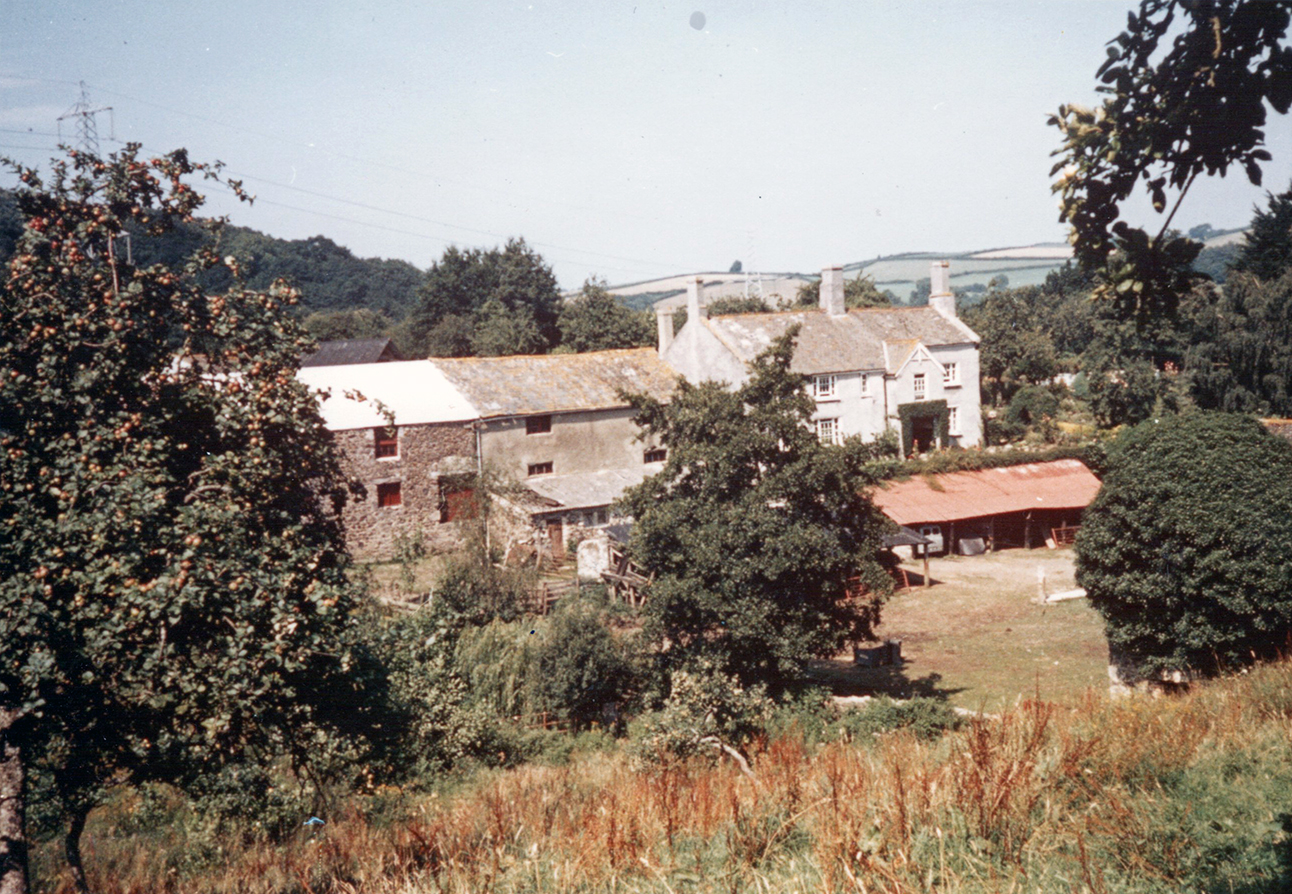
Old stone buildings adjacent to an attractive, white multi-storey house.
Huxbeare Barton in the 1960s.

Thomas was the third (surviving) son of Thomas Pinsent of Huxbeare in Hennock by his wife, Julian Stidstone. His father was a substantial farmer who managed to hold on to his property during the English Civil Wars. When Thomas “senior” died, in 1649, his elder sons, Robert and John, took over the family farms at “Huxbeare” and “Knighton” respectively: Thomas, being the third son, was out of luck!

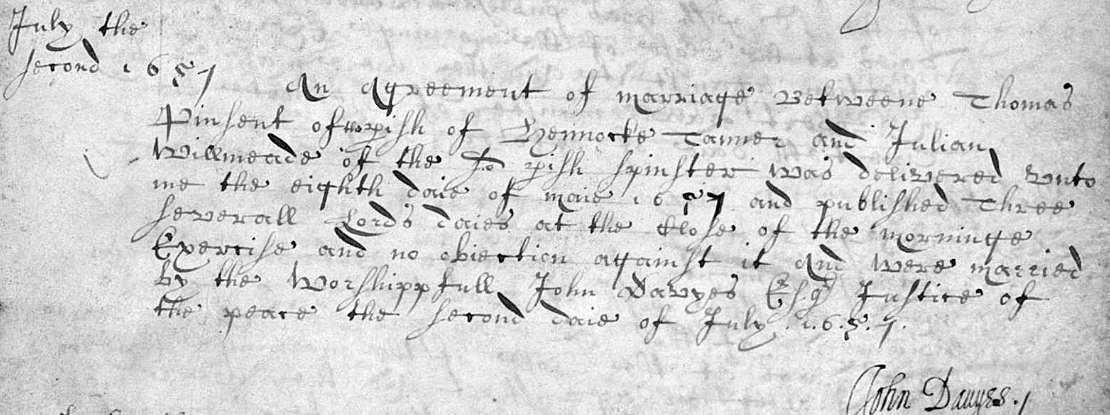
Handwritten document describing Thomas's marriage to Julian Wilmeade
Thomas marries Julian Wilmeade in 1657.

However, he was a good catch and he married Julian Wilmeade in 1657 and, through her, acquired a “tannery at Slade.” Hennock’s parish records tell us that “An agreement of marriage between Thomas Pinsent of the pish of Hennock, tanner, and Julian Willmeade of the sd. pish, spinster, was delivered to me the eighth daie of Maie 1657 and published three several Lords daies at the close of the morning exercise, and no objections against it and were married by the Worshippfull John Davyes, Esq., Justice of the peace the second day of July 1657.” From this we learn that Thomas was already a “tanner” by profession. He probably worked at Julian’s grandfather’s tannery at Slade Cross, on the A382 north of Bovey Tracey.

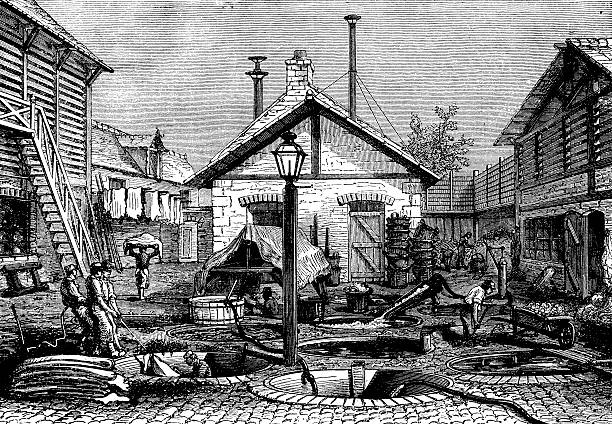
Black and white illustration of a small white building.
A tannery.

Tanning was a traditional country craft best carried out away from towns and cities as it required soaking hides in vats rich in lime to loosen the fat and hair, cleaning them and then re-soaking them in a tannin-rich fluid that commonly contained animal dung and urine as well as wood bark. The smell must have been awful. The hide was then rubbed with tallow or some such grease and then laid out. The whole process took months.

Julian Wilmeade’s grandfather, Michael Meardon, named her as the “reversionary” recipient of the tannery and 100 acres of meadow, pasture and heath land at “Poole Mill Down” on the death of Elizabeth Wrayford (née Wilmeade) – his erstwhile daughter-in-law. “Pool Mill Down” is, likely, on the low lying hill east of Slade Cross and between it and Pool Mill Cross – which is on Beadon Brook at the south end of what is now Trenchiford Reservoir. Elizabeth Wrayford was Michael’s son John Meardon’s widow and had a “life interest” in the property – on the clear understanding that she would pass to Julian when she died.

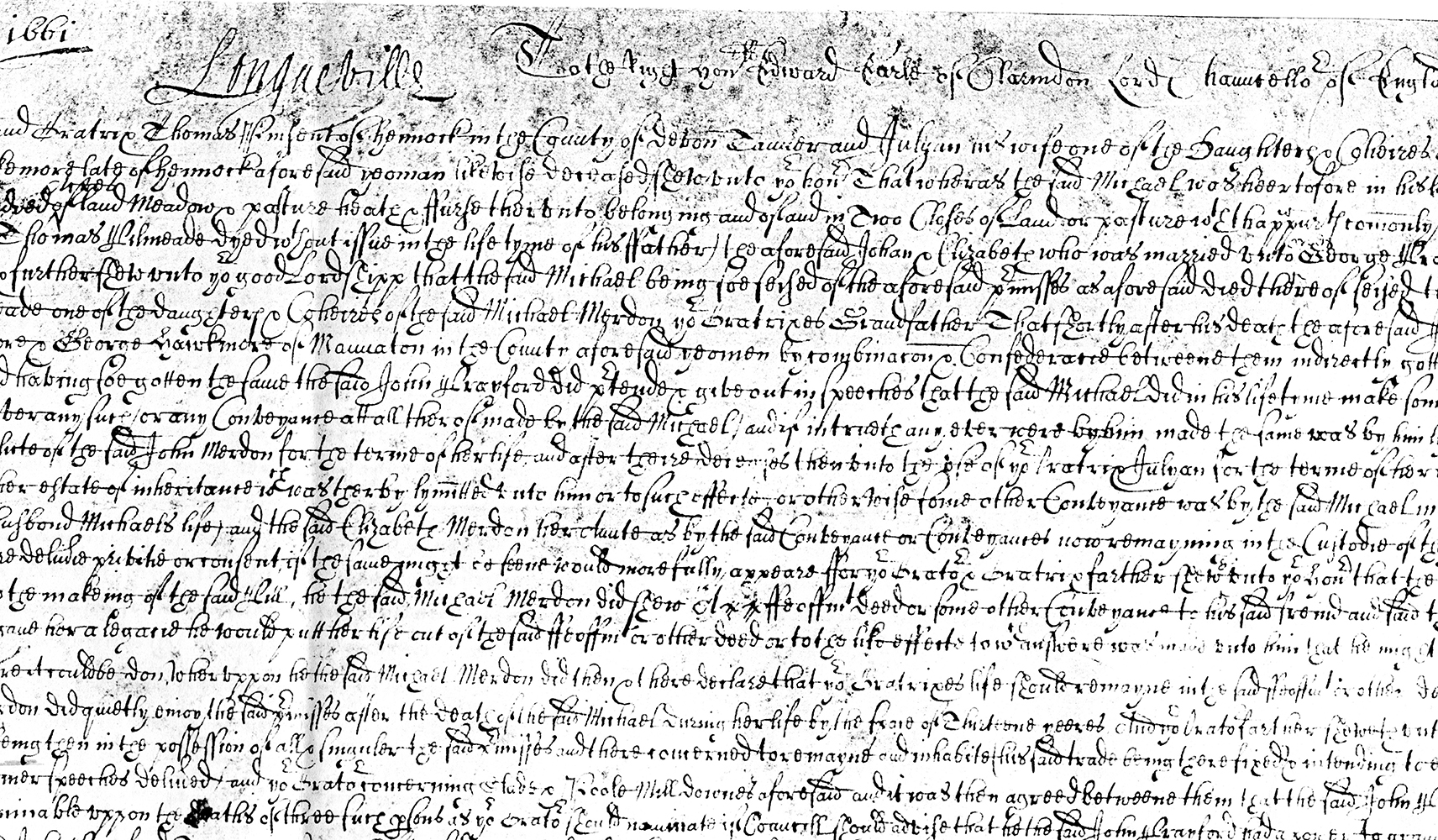
Cramped handwritten document describing the complaint.
Chancery case documenting the complaint in 1661.

Perhaps predictably, Elizabeth’s son from a second marriage (John Wrayford) was reluctant to part with the tannery when the time came – and it took a suit in “Court of Chancery” to settle the issue in Julian’s favour [C9/409-244, 1661]. Michael Meardon also had a daughter Johanne (John Meardon’s sister)  who married Elizabeth Wrayford’s brother Thomas Wilmeade and he had managed the tannery before he died. Given the Wilmeade involvement, it must have made sense to pass the “reversion” back to Thomas’s daughter Julian.

To complicate matters; one of Thomas Pinsent’s sisters seems to have married into the Meardon family; however, I can find no records and I do not know which sister it was. What I do know, is that a John Meardon in his Will proved in 1676 (Moger Abstract of Devon Wills): “desired (his) three brothers in law, Thomas Pinsent of Hennock, tanner, Jonas Pridham and John Pridham (of Bovey Tracey, clothier)” to act as “over-seers in trust” and guardians for his under-age sons, Thomas and Michael Meardon.

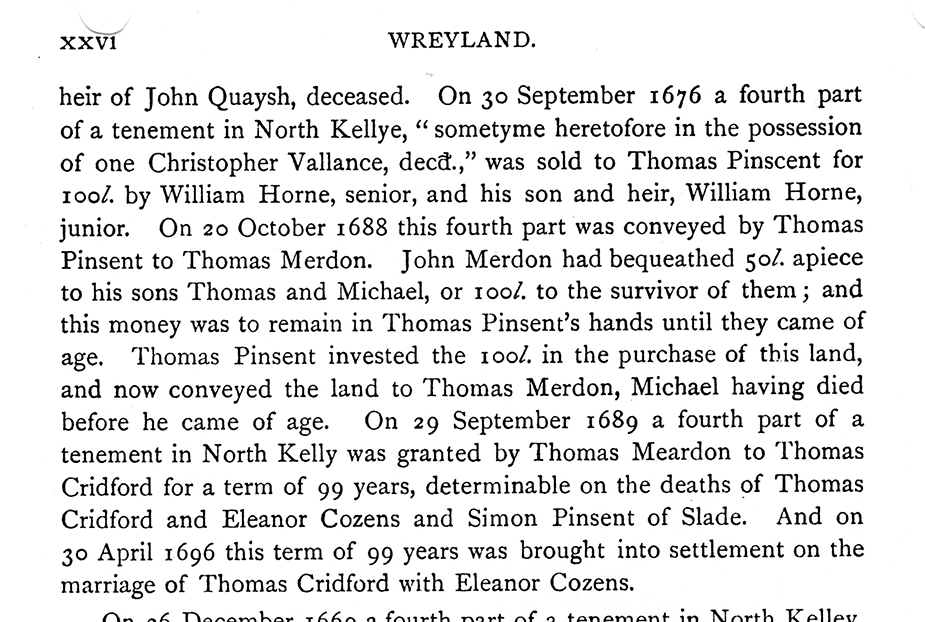
Typed document describing the sale to Thomas Pinsent (spelled "Pinscent").
Thomas “Pinscent” described in the Wreyland documents.

According to a later document transcribed by Cecil Torr (Wreyland Documents, 1910), Thomas Pinsent invested £100 from John Meardon’s estate in the purchase of “1/4th part of a tenement in North Kelly” from William Horne and his son, and conveyed the same to John Meardon’s surviving son, Thomas Meardon, in 1689. “Wreyland Documents” also show that as part of the same deal, Thomas Meardon granted the land to Thomas Cridford for a term of 99 years, determinable on the deaths of Thomas Cridford, Eleanor Cozens and “Simon Pinsent of Slade”. Thomas Cridford married Eleanor in 1696, so that makes sense.

Simon was probably Thomas’s eldest son, although that needs to be confirmed (see elsewhere). Interestingly, there was a Symon Pinsent baptized in Bovey Tracey in 1652 – which was five years before Thomas married Julian Wilmeade. It is a late (non-contemporaneous) entry in the parish record and it could, I suppose, have been inserted as 1652 instead of 1657 by mistake.

Leases “on three lives” were fairly common in the 15th, 16th and 17th Centuries. They were long-term leases whereby the main leaser of the property accepted the terms of a land deal on the understanding that if he died one or other of the named individuals would inherit the lease (subject to transfer fees and rents) and a new, presumably younger, relative would be introduced to make up the number of “lives”. It was a way of maintaining continuity.

Typed reference to Thomas Pinsent.
Thomas Pinsent appears in the Wreyland documents in 1696.

Thomas Pinsent “of Slade” took on apprentices as he and the Hennock parish “guardians” required. However, he seems to have bought his way out of one particularly unsatisfactory contract: According to Rev. R. Medley Fulford, in his review of the parish in the “Transactions of the Exeter Diocesan Architectural Society” the parish: “Received, the 21st of April 1679, of Thomas Pynsent of Slade, by consent of the Justices, Wardens & Overseers, to be freed from his apprenticeship until his turn comes again according to the rule of the parish, the sum of £2 0s 0d.” There are later references to Thomas Pinsent “of Slade” and Cecil Torr refers to a Thomas “of Slade” in 1696 while discussing local tanners in “Wreyland Documents (1910).” Whether this is Thomas “senior”, or Thomas “junior” is unclear.

Unfortunately, there are tantalizing breaks in the Hennock and Bovey Tracey parish records in the mid 1600s and, although Thomas and his wife, Julian (née Wilmead) probably had children I have yet to find any record of their births and that is a problem!

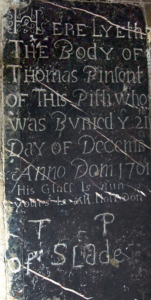
Memorial stone for Thomas Pinsent

The couple likely had at least one son, Thomas Pinsent, who was born around 1658 or 1659 and married Ann Waters in 1678. They lived in Bovey Tracey and had children. This Thomas worked with his father at “Slade” and the two are hard to differentiate. However, I suspect Thomas Pinsent “junior” predeceased his father, and died in 1696. A stone in the floor of Hennock Church records Thomas Pinsent (presumably the “elder” of Slade’s) passing, in 1701. It reminds us that: “His glass is run: yours is almost done”:  true, but very depressing.

In the absence of a birth record, I have made Thomas Pinsent “junior” the founding father of the HENNOCK Branch of the family. His and their lives are discussed elsewhere. The current batch of Pinsents (of which I am one) descend from Thomas Pinsent “junior’s” son, another Thomas Pinsent, who seems to have owned and then sold “Slade” and farmed at “Pitt” in Hennock.

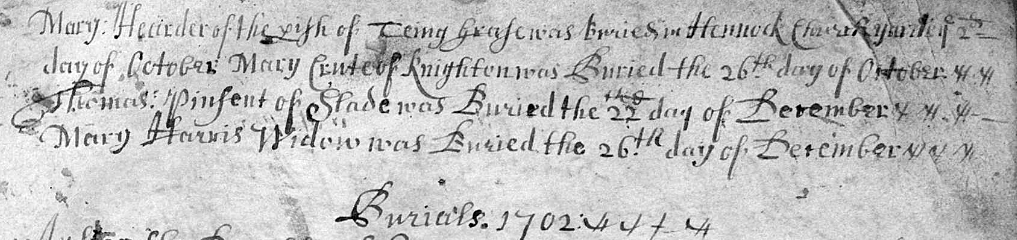
Handwritten document describing the burial of Thomas Pinsent.
Thomas Pinsent is buried in 1701.

Family Tree

Grandparents

Grandfather: Robert Pinsent: 1562 – 1626
Grandmother: Dorothy Carpenter: 1565 – 1643

Parents

Father: Thomas Pinsent: 1597 – 1649
Mother: Julian Sidstone: xxxx – 1663

Father’s Siblings (Aunts, Uncles)

Simon Pinsent: 1587 – xxxx
Robert Pinsent: 1589 – 1650
Dorothy Pinsent: xxxx – 1590
William Pinsent: 1591 – 1591
Helen Pinsent: 1592 – xxxx
Thomas Pinsent: 1597 – 1649 ✔️
George Pinsent: 1599 – xxxx
John Pinsent: xxxx – 1600

Male Siblings (Brothers)

Robert Pinsent: 1624 – 1671
John Pinsent: 1626 – 1663
Thomas Pinsent: 1633 – 1701 ✔️
William Pinsent: 1638 – xxxx


Please use the above links to explore this branch of the family tree. The default “Next” and “Previous” links below may lead to other unrelated branches.
Thomas Pinsent

Vital Statistics

Thomas Pinsent: 1597 – 1649 GRO1746 (Huxbeare Barton and Knighton, in Hennock)

Julian Sidstone: xxxx – 1663
Married: 1617
: Hennock

Children by Julian Sidstone:

Helen Pinsent: 1618 – 1618
Joan Pinsent: 1619 – xxxx
Mary Pinsent: 1622 – xxxx
Robert Pinsent: 1624 – 1671 (Married Urith Woolcombe, 1650, Huxbeare)
John Pinsent: 1626 – 1663 (Married Philippa Wilmeade, xxxx, Knighton)
Julian Pinsent: 1628 – xxxx
Margaret Pinsent: 1630 – xxxx
Thomas Pinsent: 1633 – 1701 (Married Julian Wilmeade, 1657, Slade)
William Pinsent: 1638 – xxxx

Family Branch: Devonport
PinsentID: GRO1746

Click here to view close family members.


Thomas Pinsent was one of Robert Pinsent and Dorothy née Carpenter’s younger sons. He was born at “Huxbeare” and grew up there with two known surviving brothers (Simon and Robert). He married Julian Stidstone, a widow from Dartington, in Hennock, in 1617. Some online sources suggest that her maiden name was “Gill.”

Record of marriage.
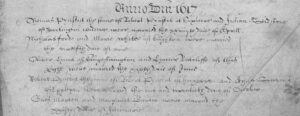
Record of Thomas and Julian’s marriage in 1617.

Thomas’s elder brother, Simon, seems to have predeceased his father and Robert Pinsent, the next in line, had moved to Bovey Tracey by the time his father died in 1626. Thomas had the good fortune to inherited the bulk of the family estate in Hennock. I am not aware of his having a brother, Richard Pinsent; however, there was a farmer of that name in the parish around then. In 1623, Thomas and Richard Pinsent of Hennock, “husbandmen” were summoned to appear at the Quarter Sessions for Devon in a case related to the paternity of a “base child begotten on the body of Gillian Lambshead, which is not yet delivered” [DRO 48/26/10/6 – 1623]. What that was about, beyond the obvious, I do not know.

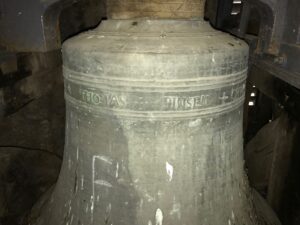
“Huxbeare Barton” was a large mixed farm and, through his father’s efforts and his own, Thomas became a man of some standing in the local community. He was a “Church Warden” in Hennock in 1637 when the tenor bell was recast. The inscription on it reads: “RICHARD BALL THOMAS PINSEN CHURCHWARDENS T P 1637” (hennock.org.uk). The T.P. stands for Thomas Pennington, the man who cast the bell.

Photo of a massive church bell.
Photograph of the bell and its inscription.

There are breaks in the parish record and “Churchwardens’ Accounts” however, the latter show that Thomas not only paid the rates for “Huxbeare” but he also paid for “Downend tenement in Knighton, Warmhill and also ‘that which was Pinsents’” in 1648 – shortly before he died.

Thomas had had the unenviable job of managing the family’s property during the English Civil War(s). What he made of it all, I do not know. However, he (along with George and Richard Pinsent) signed off on the “39 Articles of Faith” agreed to by the Bishops, in 1562, when asked of them in the parish church in 1645.

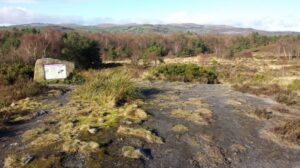
A scarred, muddy field , where a plaque is mounted on a large rock.
Bovey Heath battlefield.

It must have been a delicate task trying to balance off the two sides when they came demanding food, “taxes,” and billets for their soldiers. Thomas lived to see the Parliamentarians, under Cromwell and Fairfax, rout a Royalist army camped on Bovey Heath in January 1646. Evidently, the Cavalier Officers were caught by surprise playing cards and they abandoned their stake money as a way of distracting the Parliamentary soldiers. Thomas’s farm at “Knighton” was right next door to the heath. Thomas died shortly after King Charles I was beheaded by the Parliamentarians in London, in 1649. That ended the first round of hostilities.

Thomas Pinsent was 52 years old when he died. According to J. P. Jones in “Hundred of Teignbridge”, (~1845) there was once a monument to him (“Here lyeth the body of Thomas Pinsett of Huxbeare; Mar. 1646”) in the church. However, it is no longer visible. In fact, Thomas died on 12th March, 1648/9 and his widow, Julian (née Stidstone) was granted administration of his will in the “Prerogative Court of Canterbury” (LDS #916908). She took responsibility for paying the parish rates for “Huxbeare” and for “four tenements” (houses), and continued to make them (sometimes with her son, Robert) until 1658. Julian then retired. She was growing old herself and from then on she seems to have been periodically “in receipt” of parish funds until in 1663, when she died.

Thomas Pinsent and Julian had four sons, (Robert Pinsent, John Pinsent, Thomas Pinsent and William Pinsent) and five daughters (Helen Pinsent, Joan Pinsent, Mary Pinsent, Julian Pinsent and Margaret Pinsent) who were born and baptized in Hennock between 1618 and 1638. A completely unrelated couple, Thomas Pinsent [GROxxxx xxxx] “sailor” and his wife, Julian Pinsent [GROxxxx xxxx] were having their children baptized in the parish at around the same time but the parish clerk, helpfully, spelt out which child belonged to Thomas and Julian Pinsent of “Huxbeare” and which belonged to Thomas Pinsent “sailor”. The lineage of the latter has yet to be defined. It is a useful reminder that the “Huxbeare” Pinsents were not alone and they have to be teased out of a much larger overall family.

The “Churchwardens’ Accounts” tell us that Julian’s sons, Robert Pinsent and John Pinsent signed indentures prepared by the parish “guardians” in 1652. The documents are long gone but John got married around then, so the documents may have been to do with a formal break up of their father’s estate.

Thomas Pinsent’s eldest son Robert Pinsent married Urith Woolcombe, of Chudleigh, in Chudleigh in 1650. He farmed “Huxbeare” and “Cressida Down” and took full control of both properties when his mother retired. His younger brother, John Pinsent, married a girl called Philippa Wilmeade and took over two, presumably smaller, farms at “Knighton” and “Warmhill” in around 1653. Their younger brother Thomas Pinsent married Phillipa’s sister Julian Wilmeade in 1657 and, through her, acquired a tannery at Slade in Hennock. What happened to the youngest brother, William Pinsent is uncertain. I suspect he moved out of the district but we will return to him later as he may have founded another major family line – based out of TIVERTON. The descendants of these brothers comprise the vast majority of modern day British Pinsents. The descent of each will be examined in turn.

Thomas Pinsent “senior’s” wealth when he died is uncertain. However, he held all or part of two small manor farms at “Huxbeare” and “Knighton” and his holdings may have extended beyond the parish of Hennock into the neighbouring parishes of Bovey Tracey and Chudleigh. He appears to have left “Woodhouse Down” to a nephew, Robert and Agnes’s son Thomas Pinsent.

Thomas appears to have been a wealthy “yeoman,” but he would not have formally qualified as a “gentleman.”  The Magna Britannia shows that “the advowson of the vicarage (of Hennock) had gone to the Washer family after the Reformation and had later passed to the Pinsent family, and Southcotes before being bought by the Chamber of Exeter for £400 in 1615 for the endowment of a lectureship in the City of Exeter”. However, another source disputes this. It says that the Abbot of Torre, at Torquay, sold the advowson to John Southcote Esquire in 1553 and it remained in his family until it was sold to the City of Exeter in 1631 (Ecclesiastical Antiquities of Devon: G. Oliver and J. P. Jones 1928). The latter seems more likely.

There was a well-off merchant called Mr. John Pynsent living in Chudleigh in the early years of the 17th Century and his family had the highest profile in the district. Mr. John’s son (also called John) became a “Prothonotary” (“Senior Clerk”) of the “Court of Common Pleas” during the English Civil War. He founded “Pynsent’s Free School” in Chudleigh when he died in 1668. His story is told in “The Pynsent Baronetcy: The Trials and Tribulations of a Litigious Family: 1687-1765”.

When Thomas Pinsent died, his estate was split. His widow Julian Pinsent and his eldest son (another Robert Pinsent), paid the parish rates for “Huxbeare” and “Cressida Down”; while a younger son John Pinsent paid for “Knighton”, and a nephew, Thomas Pinsent seems to have made the payments for “Woodhouse Down”.

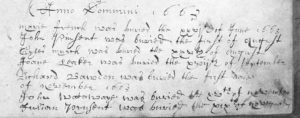
Record of burial.
Record of Julian Sidstone’s burial in 1663.

Family Tree

Grandparents

Grandfather: William Pinsent: 1527 – 1601
Grandmother: Joan Unknown: 1535 – 1590

Parents

Father: Robert Pinsent: 1562 – 1626
Mother: Dorothy Carpenter: 1565 – 1643

Male Siblings (Brothers)

Simon Pinsent: 1587 – xxxx
Robert Pinsent: 1589 – 1650
William Pinsent: 1591 – 1591
Thomas Pinsent: 1597 – 1649  ✔️
George Pinsent: 1599 – xxxx
John Pinsent: xxxx – 1600


Please use the above links to explore this branch of the family tree. The default “Next” and “Previous” links below may lead to other unrelated branches.
Thomas Pinsent

Vital Statistics

Birth: 1682
Marriage: N/A
Spouse: N/A
Death: 1702

Family Branch: Devonport
PinsentID: GRO1744

Click here to view close family


Family Tree

Grandparents

Grandfather: John Pinsent: 1626 – 1663
Grandmother: Philippa Wilmeade: 1631 – xxxx

Parents

Father: Thomas Pinsent: 1652 – 1711
Mother: Catherine Parker: 1655 – 1686

Father’s Siblings (Aunts, Uncles)

Thomas Pinsent: 1652 – 1711 ✔️
Julian Pinsent: 1654 – xxxx
John Pinsent: 1656 – 1656
Joan Pinsent: 1657 – xxxx
John Pinsent: 1659 – xxxx
Robert Pinsent: 1661 – 1729

Male Siblings (Brothers)

Julian Pinsent: 1677 – 1721
John Pinsent: 1680 – 1704
Thomas Pinsent: 1682 – 1702 ✔️
Robert Pinsent: 1684 – 1685


Please use the above links to explore this branch of the family tree. The default “Next” and “Previous” links below may lead to other unrelated branches.
Thomas Pinsent

Vital Statistics

Thomas Pinsent: 1652 – 1711 GRO1735 (Knighton, Hennock)

1. Catherine Parker: 1655 – 1686
Married: 1677
: xxxx, xxxx

Children by Catherine Parker:

Julian Pinsent: 1677 – 1721
John Pinsent: 1680 – 1704
Thomas Pinsent: 1682 – 1702
Robert Pinsent: 1684 – 1685

2. Margaret Ball: xxxx – xxxx
Married: 1689
: Lustleigh

Family Branch: Devonport
PinsentID: GRO1735

Click here to view close family


Thomas Pinsent was the eldest son of John Pinsent by his wife, Philippa Wilmeade. He was brought up on the family farm at “Knighton” (near what is now Chudleigh Knighton) at the south end of Hennock parish. His father died in 1663, when he was eleven years old, so his mother married two years later. Philippa and her new husband, John Soper, managed the family farm until Thomas came off-age. Hennock’s “Churchwardens’ Accounts” show that Philippa paid the parish rates for “Knighton” – at least until she remarried in 1665. Mr. Soper presumably paid them from then on. He must have also taught Thomas how to run the family farm.

Thomas married Catherine Parker in 1677 (Exeter Marriage Licenses) and they had four children, three boys and one girl in the years that followed. Their daughter, Julian Pinsent may have survived childhood. However, sadly, none of his sons did. John Pinsent, Thomas Pinsent and Robert Pinsent all died young. Robert was still an infant when he died; John was twenty-four when he died and Thomas was twenty. None had time to marry and have children, so the family’s connection to the farm came to an end when Thomas “senior” died in 1711.

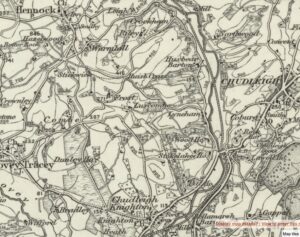
Old map of Chudleigh Knighton and environs.
Map of Chudleigh Knighton and environs.

Interestingly, there seems to have been a very significant die-off in Hennock and the neighbouring parishes around the turn of the century. The three “Knighton” boys may have suffered from the same affliction that killed-off their cousins at “Huxbeare,” another family farm. The heirs to both died out within a few years of each other. Nevertheless, some of the land at “Knighton” seems to have been back in Pinsent hands a few years later (see Thomas Pinsent of “Pitt”). The latter Thomas was a fairly distant cousin from a related branch of the family.

Catherine died in 1686 – either from sickness, or in childbirth and Thomas Pinsent was left with a young family to look after. He married Margaret Ball in Lustleigh in 1689. I am not aware of any children by this marriage. Thomas Pinsent of “Knighton,” died in 1711 leaving no obvious heir. He could have left “Knighton” to his brother Robert Pinsent; however, he had already received a significant legacy (a “halfendeale” of land and a soap boiling operation in South Kelly) from his grandfather, Thomas Wilmeade, in 1677 and was well established at “South Kelly” (see elsewhere). In an ideal world,  he could have passed the farm back to his late uncle Robert Pinsent’s offspring at “Huxbeare”; however, they too had fallen prey to premature death, and the last Robert Pinsent “of Huxbeare” died in 1711 – just  a few months after Thomas.

The death of Thomas Pinsent “of Knighton” is not quite the last reference to the farm being in Pinsent hands in the Hennock parish records though. There are one or two other tantalizing references, including the death of Julian Pinsent and the birth of Robert Pinsent  at “Knighton” in 1721. They seem to be the children of a different Thomas Pinsent – by his wife, Mary Gale. They are from the “HENNOCK” branch of the family. When Thomas “of Knighton” died in1711, he may have passed at least some of his land to his late uncle Thomas Pinsent’s family – where there was a young second cousin, Thomas Pinsent working in a tannery and then contemplating his forthcoming marriage. Julian Pinsent and Robert Pinsent “of Knighton” were his children.

This transfer would have pleased both the Pinsents and the Wilmeades, as Philippa’s family’s contribution to the Pinsents well-being a generation back would have gone to her sister, Julian’s descendants. Thomas seems to have moved his family into “Pitt Farm”, which is essentially next door to “Knighton Farm”. Thomas Pinsent “of Pitt”, is the head of a major subsidiary branch that broke off from the “DEVONPORT” family. His descendants are still around today – as I can attest.

Hennock’s “Churchwardens’ or Overseers of the Poor Accounts” suggest that the original Pinsent farm at “Knighton” had been split in two at some point and the Voisey family held part of it in the 1680s and 1690s. Each family paid for its “Pte. of Knighton.” The account book that ends in 1692 makes no specific mention of “Pitt.” However, the next extant ledger, which starts in 1732 does and it makes no mention of “Knighton.” The two farms are, or were, near the hamlet of Chudleigh Knighton on the north side of the main road (now the A38) between Exeter and Plymouth (Donn’s (1 inch to 1 mile) map) and the farm at “Knighton” may have eventually been subsumed into the village of Chudleigh Knighton.

Sabine Baring-Gould (1908) describes the life of a notable Devonshire cleric, the Rev. W. Davy in an article entitled “Devonshire Characters and Strange Events.” Evidently, he had an aptitude for solving architectural and engineering problems. In it, she mentions that he was born of respectable parents in Tavistock in 1743, and that “they moved whilst he was still an infant to a farm belonging to them, Knighton, in the parish of Hennock”. Perhaps this was near the village.

The name “Pitt” in this case most likely refers to a hole in the ground – probably where someone extracted either marl for dressing fields or stone for building. It has nothing to do with William Pitt, Earl of Chatham – although he figures in the family’s story as the beneficiary of an eccentric Pinsent baronet, Sir William Pynsent, who died in 1765. The saga of the Pinsents of Combe and Chudleigh, and the rise of the Pynsent baronetcy is described elsewhere on this website [The Pynsent Baronetcy: The Trials and Tribulations of a Litigious Family: 1686 – 1765].

It is worth noting that the original farm at “Knighton” was once a separate manor beside a small tributary of the River Teign, close to what is now known as “Knighton Heath.” It was underlain by better quality potter’s clay than used to make tiles and bricks elsewhere in the parish (Western Times: 19thJanuary 1850) and Chudleigh Knighton – which grew to service a commercial pottery business (perhaps by the mid-1700s) may have absorbed much of what had once been the family farm. The manor still existed until the end of the 18th Century as there is a report “Of a Peramulation of the Manor of Knighton made on September 27th 1798”  in the Devon Archives [Southwest Heritage Trust: (5421A/PB/1/f/1)].


Family Tree

Grandparents

Grandfather: Thomas Pinsent: 1597 – 1649
Grandmother: Julian Sidstone: xxxx – 1663

Parents

Father: John Pinsent: 1626 – 1663
Mother: Philippa Wilmeade: 1631 – xxx

Father’s Siblings (Aunts, Uncles)

Helen Pinsent: 1618 – 1618
Joan Pinsent: 1619 – xxxx
Mary Pinsent: 1622 – xxxx
Robert Pinsent: 1624 – 1671
John Pinsent: 1626 – 1663 ✔️
Julian Pinsent: 1628 – xxxx
Margaret Pinsent: 1630 – xxxx
Thomas Pinsent: 1633 – 1701
William Pinsent: 1638 – xxxx

Male Siblings (Brothers)

Thomas Pinsent: 1652 – 1711 ✔️
Julian Pinsent: 1654 – xxxx
John Pinsent: 1656 – 1656
John Pinsent: 1659 – xxxx
Robert Pinsent: 1661 – 1729


Please use the above links to explore this branch of the family tree. The default “Next” and “Previous” links below may lead to other unrelated branches.
Thomas Pinsent

Vital Statistics

Thomas Pinsent: 1726 – 1757 GRO1719 (Thomas of Leigh, Hennock and of Kingsteignton)

Mary Gildon: 1730 – xxxx
Married: 1752: Kingsteignton, Devon

Children by Mary Gildon:

Mary Pinsent: 1753 – 1772 (Married Robert Pinsent, 1771)
Elizabeth Pinsent: 1754 – xxxx (Married John Collins, 1774)
Margaret Pinsent: 1756 – 1757

Family Branch: Devonport
PinsentID: GRO1719

Click here to view close family members.


Thomas Pinsent (1726 – 1757) was the younger of John Pinsent and Margaret Luscombe’s two sons. He was baptized in Hennock in 1726. He was eleven years old when his father died and he presumably moved to Crediton with his mother when she married Ambrose Rackett the following year. Thomas’s elder brother, John Pinsent, inherited their father’s soap boiling operation at Kelly and Thomas received his father’s tenement at Leigh. Two weeks before he married Mary Gildon, the daughter of Richard and Mary Gildon, in May 1752, Thomas conveyed Leigh, which was then described as being “2 messuages, 5 gardens, 8 acres of (arable) land, 4 acres of meadow, 5 acres of pasture, 2 acres of wood, and 3 acres of furze and heath.” to John Marsh (Wreyland Documents: Cecil Torr, 1910). This may have been part of a complex marriage settlement that saw Thomas acquire Gildon property in Kingsteignton. Thomas and Mary seem to have lived there.

Thomas and Mary had three daughters—Mary Pinsent, baptized in 1753;  Elizabeth Pinsent, baptized in 1754; and Margaret Pinsent, who was christened in 1756 but died the following year. They had no sons. Thomas Pinsent died in 1757 and his widow, Mary (née Gildon), married George Bennett, an Inn Keeper in Kingsteignton, in 1762.

Thomas’s Will was destroyed in the bombing of the Exeter Probate Registry. However, we know that he left his two surviving daughters as coheirs. They seem to have split the income derived from Leigh and any land he may have had in Kingsteignton. The arrangement may have worked well while the girls were young but when they came of age to marry, the land had to be either sold or split. When the time came, their trustees decided to keep Leigh within the family. Wreyland Documents show that “On 2nd November 1771, one half of this property (Leigh) was brought into settlement on the marriage of Mr. Robert Pinsent of Tiverton with Mary Pinsent, one of the two daughters and co-heirs of Thomas Pinsent. And on 2nd October 1775, this half of the property was sold for L.165 0s 0d by the said Robert Pinsent to John Pinsent. On the same day, 2nd October 1775, the other half of this property was also sold to John Pinsent for L.165 0s 0d by Elizabeth Pinsent, the other daughter and co-heir of Thomas Pinsent”. Thus the ownership reverted to their uncle John Pinsent, who was by then living in Moretonhampstead. John Pinsent probably acquired the Gildon property in Kingsteignton in a similar manner as we find that his grandson and principal heir Thomas Pinsent held “Gildons” when he died in 1782.

It is not clear exactly who the above-mentioned Robert Pinsent was! Apparently he came from Tiverton, and one would have thought he belonged to that branch of the family; however, there is no obvious candidate. John either sold Leigh or passed it on to his heir, Thomas Pinsent, who coincidentally or otherwise lived in Kingsteignton. It had been sold by 1838. The “Agreement for the Commutation of Tithes in Hennock” shows that Leigh was owned by the Vicar, Sir Lawrence V. Palk, and occupied by a John Soper. The farm was approximately 59 acres in size, and it was assessed at a rent charge of £5 10s 2d. It included a piece of arable land covering 3 acres, roods and 20 perches that was, even then, known as “Pinsent’s Park”.


Family Tree

Grandparents

Grandfather: Robert Pinsent: 1661 – 1729
Grandmother: Elizabeth Delve: 1665 – 1729

Parents

Father: John Pinsent: 1690 – 1737
Mother: Margaret Luscombe: xxxx – xxxx

Father’s Siblings (Aunts, Uncles)

Julian Pinsent: 1686 – xxxx
Elizabeth Pinsent: 1688 – xxxx
John Pinsent: 1690 – 1737
Mary Pinsent: 1697 – 1711
Sarah Pinsent: 1701 – xxxx

Male Siblings (Brothers)

John Pinsent: 1723 – 1800
Thomas Pinsent: 1726 – 1754


Please use the above links to explore this branch of the family tree. The default “Next” and “Previous” links below may lead to other unrelated branches.
Thomas Pinsent

Vital Statistics

Birth: 1823
Marriage: N/A
Spouse: N/A
Death: 1825

Family Branch: Devonport
PinsentID: GRO1044


Family Tree

Grandparents

Grandfather: Thomas Pinsent: 1754 – 1841
Grandmother: Elizabeth Pridham: 1763 – 1821

Parents

Father: John Pinsent: 1799 – 1870
Mother: Mary Ann Todd: 1799 – 1874

Father’s Siblings (Aunts, Uncles)

Anna Thomasin Crout Pinsent: 1777 – 1799
Thomas Pinsent: 1779 – 1779
Thomas Pinsent: 1782 – 1872
Elizabeth Pinsent: 1789 – xxxx

Maria Pinsent: 1797 – 1864
John Pinsent: 1799 – 1870
William Pinsent: 1808  – xxxx
Charles Pinsent: 1812 – 1863
George Pinsent: 1814 – 1894

Male Siblings (Brothers)

Thomas Pinsent: 1823 – 1825
William Pinsent: 1825 – xxxx
John Pinsent: 1826 – 1914


Please use the above links to explore this branch of the family tree. The default “Next” and “Previous” links below may lead to other unrelated branches.
Thomas Pinsent

Vital Statistics

Thomas Pinsent: 1782 – 1872 GRO1036 (Draper of Devonport and Greenhill, Kingsteignton, Devon)

Mary Savery: 1780 – 1859
Married: 1805: Stoke Damerel, Devon

Children by Mary Savery:

Mary Savery Pinsent: 1806 – 1884 (Married Rev. Thomas Horton, 1826; had children with Pinsent in their name)
Thomas Pinsent: 1807 – 1826
Anna Pinsent: 1809 – xxxx (Married Henry Milford, a barrister at Clifford’s Inn, Fleet Street, in London, 1874)
Elizabeth Savery Pinsent: 1811 – xxxx (Married Thomas Gammon, a glass manufacturer from Small Heath, Birmingham, 1840)
Sarah Savery Pinsent: 1812 – 1813
Savery Pinsent: 1815 – 1886 (Solicitor & Mayor of Durban, Natal, South Africa in 1857, 1859)
Sarah Pinsent: 1817 – 1847 (Married Thomas Smith James, solicitor, Harborne, Birmingham, 1847)
John Ball Pinsent: 1819 – 1901 (Brewer and Spirit Merchant in Newton Abbot; Married 1841)
Richard Steele Pinsent: 1820 – 1864 (Linen and Woollen Draper; Married Catherine Agnes Ross, 1850)
Emma Pinsent: 1823 – 1831

Family Branch: Devonport
PinsentID: GRO1036

References

Newspapers
Wills
Letters
Land documents

Click here to view close family


Thomas Pinsent and Ann Ball’s only surviving son, Thomas Pinsent, was born in Wolborough (Newton Abbot) in 1782. He was still a teenager when his grandfather, Mr. John Pinsent of Moretonhampstead died in 1800. Thomas was his eldest grandson and the recipient of much of his real and personal estate. Why Mr. John passed over his own son Thomas (Thomas’s father) is unclear, but it may have been because he married twice and had an illegitimate daughter by his second wife before they married (see elsewhere). Mr. John left Thomas “junior” four hundred pounds and a property called “Caphills”, which had a Land Tax of £2 5s 0d per year. The latter was subject to an annual payment to his father (see elsewhere). He also received “Court Tenement”, which had a Land Tax of 12s per annum “in trust for his Cousin, Mary Pinsent during the lifetime of her father (another John Pinsent). Mr. John Pinsent gave his grandson Thomas and his father a joint two-thirds interest in the lease of his haematite iron mine in South Kelly. The other third went to his (three) grandaughters’ trustees, Moses Savery of Bovey Tracey and Joseph Wills of Ilsington.

Thomas Pinsent “junior” was still a young man when he married Moses Savery’s daughter, Mary, by License, in Stoke Damerel on 16th May 1805. Moses was a “serge manufacturer” who doubtless knew the cloth trade in-side out and helped his son-in-law set up what was to become a very successful drapery business on Market Street in Devonport. Moses died in 1809, leaving three of his children, Mary Pinsent (née Savery), and Richard and Susannah Savery as his executors. Some time later, Josias Coniam asked Thomas Pinsent to witness his will, which was probated in 1815. It also refers to Moses and Richard Savery [Inland Revenue Wills: 1815].

Thomas and Mary had four sons and six daughters between 1806 and 1823. Like his father and grandfather before him, Thomas was a Baptist and their births and baptisms are to be found in non-conformist registers. Their first daughter Mary Savery Pinsent was born in March 1806 and their first son Thomas Pinsent, in April 1807. They were baptized in Hope Baptist Chapel, in Devonport, in April 1813. Mary later married a non-conformist minister, Reverend Thomas Horton and had several children, most of whom had “Pinsent” in their name. Thomas died young. According to Hillary Preston (personal communication), he was buried in Bovey Tracey (Baptist?) Churchyard in 1826. However, I have yet to find his gravestone, although I have found his parents’.

Thomas and Mary also had a daughter Anna Pinsent who was born at #4 Stoke Terrace, Stoke Damerel in September 1809. She married late, after dutifully looked after her mother and father until they died in 1859 and 1872 respectively. Anna married Henry Milford, a barrister at Clifford’s Inn in London in 1882. Sadly, it was a short-lived marriage as Anna was a widow when she, herself, died two years later. She was buried in the Baptist Churchyard at Bovey Tracey alongside her parents, in 1884. The couples’ third daughter, Elizabeth Savery Pinsent was born and baptized in Stoke Damerel in March 1811. She grew up in Devon and married Thomas Gammon, a glass manufacturer from Small Heath, Aston (in Birmingham). They were married in the Salem Chapel in Newton Abbot in August 1840 (The Patriot: Monday 24th August 1840).

Thomas and Mary may also have had a short-lived daughter, Sarah Savery Pinsent who was born in 1812 and buried the following year. However, if they did, I know very little about her. They certainly had a daughter of the same name (Sarah Savery Pinsent) in Stoke Damerel in 1817. Sarah Savery’s baptismal record helpfully confirms that she was the granddaughter of Moses Savery. Sarah “of Greenhill, in Kingsteignton”, married Thomas Smith James, a solicitor from Harborne in Birmingham, in the Salem Chapel in Newton Abbot in August 1847 (The Patriot: Monday 16th August 1847). Her husband was the son of an independent minister. The Gentleman’s Magazine tells us that she died later the same year, 1847. Thomas and Mary had one other daughter, Emma Pinsent. She was born in 1823 and, again – according to Hilary Preston – was buried in the Baptist Church yard at Bovey Tracey when she died in 1831.

Thomas and Mary’s second son Savery Pinsent was born in Devonport. He trained as a solicitor and went out to the relatively-newly established British Colony of Natal in 1849. He never married. Savery returned to Devon after his father died in 1872. Their third son, John Ball Pinsent took over the management of a brewery his father had acquired. The fourth son, Richard Steele Pinsent, was free to help run the drapery business in Devonport. The lives and of the married sons are described elsewhere.

Thomas Pinsent was one of several trustees mentioned in an “assignment” of a lease for the Particular Baptist Chapel in Morice Square, Devonport, in 1814 and – as Thomas Pinsent of “Greenhill”, Kingsteignton – he seems to have been a trustee in an “assignment” of a lease for the “Union Street Baptist Chapel in Stonehouse” some twenty years later.

An item is the Western Times in October 1839 singles out Thomas Pinsent of “Greenhill” for his financial contribution to the building of the “Salem” Dissenting Chapel in Newton Abbott. Evidently, it was “an elegant and commodious chapel” that cost £1,000 (The Patriot: Thursday 10th October 1839). This Thomas was probably the drapery Thomas’s father (of the same name). However, he died in 1841; so when the newspapers acknowledged another Thomas Pinsent’s contribution to the rebuilding of the New Independent Chapel in Kingsteignton in September 1866, they were referring to someone else – Thomas Pinsent of Devonport. According to a decidedly Independent newspaper – “The Patriot” – the “village has a very handsome church, for the country since its renovation, but, unfortunately, the services performed in it are tinted with the prevailing practices of the day, and savour very much of Romanism.” The Dissenter of Kingsteignton would have none of it and they built their chapel in protest! (The Patriot: Thursday 27th September 1866).

The Dissenters were a close-knit group and they supported each other in sickness and health. As early as 1818, “T. Pinsent of Dock” contributed to a subscription being made in London to held a Mr. Hone and his family as they faced prosecution for their views (Champion: Sunday 11th January 1818). Similarly, when Mr. Legier of the Scripture Readers Society died suddenly in 1863, Thomas arranged for a subscription (whip-around) for the widow and her near destitute family (Western Daily Mercury: Wednesday 28th October 1863). He was committed to the chapel.

The development of the railway system in the west of England in the 1840s and 1850s helped with trade and communication throughout the country and it is hardly a surprise to find Messrs. Pinsent, Vicary, Ford and other “gentleman largely interested in the trade of the district” lobbying for a railway between Newton Abbot and Torquay (Morning Herald (London): Thursday 24th October 1844). Thomas Pinsent, Esq. of Greenhill was appointed to a committee to look into the matter (Herapath’s Railway Journal: Saturday 11th October 1845). The “South Devon Railway”, which was to service the docks in Plymouth was completed and opened in April 1849. Presumably it was Thomas who attended the opening, but it could have been one of his sons (Morning Herald (London) Saturday 7th April 1849).

There were several prominent “independently minded” families living in the Midlands at this time (the Priestley and Wedgwood families come to mind) and the arrival of the railway helped to unite England’s commercially minded “Dissenters” into a close-knit inter-connected community. In 1859, Thomas and one of his sons attended the funeral in Birmingham of Rev. John Angell James – who was one of the leading lights of the “dissenting community” and his deceased daughter Sarah’s erstwhile father-in-law (The Patriot: Thursday 13th October 1859). The Midland connection was maintained over the years and Thomas’s grandsons, (Sir) Richard Alfred Pinsent and Hume Chancellor Pinsent, moved to Birmingham to study and practice law (see elsewhere).

Thomas was a community leader and a retrospective look at the first election for aldermen in the new established borough of Devonport in 1836 shows that Thomas Pinsent was one of the Aldermen elected (Western Morning News: Friday 5th November 1886).

Thomas was also a noted reformer. Contemporary newspapers show that he supported Lord Ebrington, a Whig politician who believed in religious toleration in the 1830s. Thomas took an active part in a “Meeting of Protestant Dissenters of the Independent and Baptist Denominations” in Devonport in December 1833. The attendees resolved that they should not have to pay Anglican church rates and taxes; – that they should not have to marry according to the rites of the Church of England – or be excluded from seats of learning because of their faith; – and that a non-denominational system of recording births, marriages and deaths was absolutely necessary. They decided that  the Government should be made aware of their concerns and Thomas was elected to a subcommittee tasked with sending their grievance to the Right Hon. Earl Grey (The Patriot: Wednesday 25th December 1833). He was politically active, too – attending a diner “of friends and supporters in this district of Sir J. Buller, Bart. M.P., and of Conservative principles” in Ashburton (Albion and Star: Thursday 19th February 1835). 

The Independents were particularly concerned about what they saw as the “Romanization” of the educational system and “To counteract this growing evil, the London Congregational Fund Board, established in 1752 the Western Academy ….” Inevitably, it required support and a hundred years later we find T. Pinsent “of Greenhill”, making a £20 contribution to it’s well being (The Patriot: Thursday 11th November 1852).

The local newspapers also show that Thomas was elected vice-president of the “Devonport and Stonehouse Mechanic’ Institute” (which housed a library) in 1825, and that he served on committees for the “Newton District Reform Association” in 1835. Thomas gave £20 to the “South Devon and East Cornwall Public Hospital” the same year and was a steward on hand when His Royal Highness Prince Albert laid the foundation stone of a new “Infant Orphan Asylum” at Wanstead in July 1841 (Morning Herald (London): Tuesday 20th July 1841).

When Devonport held its first-ever Municipal Election in 1837, Thomas was one of the two Councillors elected to serve in Morice Ward. He chaired a talk entitled “Complete Suffrage Movement” by a Mr. Vincent in Newton Abbot in 1843. Presumably it was religious suffrage he was talking about. Thomas was, however, a businessman at heart and he objected strongly to a proposal to build a new and expensive “Pauper Lunatic Asylum” in 1835 as he felt there was adequate coverage elsewhere in the county. What his grandson Hume Chancellor’s wife, (Ellen Frances Pinsent), would have thought about that sixty years on does not bear thinking about! (see elsewhere). Thomas was, with others, a co-proprietor of a newspaper entitled the Plymouth and Devonport Weekly Journal and General Advertiser for Devon, Cornwall, Somerset, and Dorset, (published) in Plymouth, in the county of Devon” that, presumably, supported the reform movement. The partnership was disbanded in 1851 (Morning Herald (London) Wednesday 26th February 1851).

Thomas Pinsent operated his main drapery business out of #34 Market Street in Devonport; however, he had a temporary outlet at #34 Catherine Street in 1840-1841. He seems to have acquired it through the purchase of the business of a bankrupt draper – Mr. Edward Blake (West Briton and Cornwall Advertiser: Friday 29th January 1841). Thomas seems to have had an eye for purchasing cheap stock from bankrupt drapers, and the local papers contain numerous advertisements showing how “Pinsent & Company” had just acquire a massive amount of stock that it just had to dispose of at ridiculously low prices … (Western Courier, West of England Conservative, Plymouth and Devonport Advertiser: Wednesday 20th September, 1837, etc.).

In the early days, there seem to have had sleeping partners in “Pinsent & Company.” Thomas’s partnership with Isaac Sparke ended by mutual consent in December 1821 (Mirror of the Times: Saturday 23rd March 1822) and his partnership with Robert Lee Warren ended in March 1836. It too was by mutual consent (The News (London): Sunday 20th March 1836). Warren was, presumably, retiring from of the business as he died not long afterwards. Needless to say, Thomas bought Warren’s share of the stock (West Briton and Cornwall Advertiser: Friday 2nd February 1838) and advertised yet another exciting sale, while at the same time taking the opportunity to inform the public at large of “Pinsent & Co.’s” appreciation of its patronage. Thomas clearly knew about public relations and the power of advertising (Western Courier, West of England Conservative, Plymouth and Devonport Advertiser: Wednesday 31st January 1838). He added staff in 1840. Thomas arranged his third and final partnership agreement with Joseph Nicholson and William Martin; however, it ended in 1843 (Western Courier, West of England Conservative, Plymouth and Devonport Advertiser: Wednesday 12th April 1843). By then, Thomas had decided that he and, later, his youngest son, Richard Steele Pinsent could run the business perfectly well by themselves. By the 1840s, the firm styled itself: “Pinsent & Co., Wholesale, Retail Drapers, Silk Mercers, Hosiers, Haberdashers”. It was quick to advertise the variety of their merchandise and the troubles they had gone through to acquire it: “Pinsent and Co. … beg again to announce their return from Ireland and Scotland and London, Lancashire and Yorkshire markets…” (Western Courier, West of England Conservative, Plymouth and Devonport Advertiser: Wednesday 11th October 1843).

Like other retail businesses, “Pinsent and Co.” was an obvious target for petty theft and contemporary newspapers recount numerous stories of attempts that had gone wrong. For instance, at the Devon Lammas Assizes in 1838, two children, George and Elizabeth Fraser, were charged with stealing a roll of silk and their father, William Fraser, was charged with receiving the stolen goods. They were convicted. Similarly, in February 1841, two ladies, “Bouverie de al Haussaye and Ariana Parkinson” were arrested after leaving the premises at #34 Catherine Street (shortly before it was sold off) with lace and kid gloves that they were seen sweeping off a sales counter. Later, they were found to have stolen goods from another store and they were convicted on charges relating to the latter occurrence (Western Courier, West of England Conservative, Plymouth and Devonport Gazette: Wednesday 3rd February 1841 and Wednesday 3rd March 1841).

That year, 1841, Thomas’s father, Thomas Pinsent, died leaving the family’s farm at “Greenhill” in Kingsteignton to be attended to. The census, taken in June after his death, shows that Thomas’s wife Mary (née Savery) and his daughter Anna Pinsent were living there, while he was with his daughter Mary Savery Horton and her husband, the Rev. Thomas Horton, in Devonport – presumably still looking after the drapery.

Although most Commercial directories published before 1830 refer to “T. Pinsent” as the owner and operator of the drapery business, from then on it was more commonly described as being in the hands of “Pinsent and Co.” (See Directories from 1844 onward). This change probably reflects the fact that Thomas was stepping back from the business, allowing his son Richard Steele Pinsent to run the drapery. Thomas returned home to Kingsteignton after his father died, but he remained senior partner in “Pinsent and Co.” until December 1859, a month after his wife Mary died. Richard Steele died in 1864 five years later, but the firm continued on under the ownership of Richard Steele’s nephew, Thomas Pinsent Horton. He kept the name of “Pinsent and Co.” and the business was profitable until at least 1904. According to Hilary Preston (personal communication), it was taken over by Boold’s Ltd. in 1909. Thomas Pinsent Horton must have also inherited the Pinsent family’s old home at #4 Stoke Terrace, Stoke Damerell as he seems to have died there in April 1921.

Edward Palk bought out a partner in the Mill-lane Brewery in Newton Bushel (Newton Abbot) sometime in the 1830s and took Thomas Pinsent on as a junior partner in the late 1830s. They were running the firm of “Palk and Pinsent, Brewers of East Teignmouth and Newton Abbot” together when they put their malt house in East Teignmouth up for sale in 1839 (Exeter and Plymouth Gazette: Saturday 9th March 1839). It was part of a plan to consolidated their activity in Newton Abbot. Thomas’s active involvement in the partnership was short lived as the London Gazette shows that he delegated his share of the management to his young son John Ball Pinsent in January 1841. Thomas left his son to learn the business and he took full control when Mr. Palk sold out, in 1844. John Ball ran the firm of “John Pinsent & Co.: Brewers & Wine & Spirit & Coal Merchants”, presumably under his father’s watchful eye.

This left Thomas free to develop “Greenhill” Farm and manage his other land-holdings, which were spread out in several parishes. Most were owned freehold; however, some of his land was leased for 99-years (on three lives) from Lord Clifford of Chudleigh. When his father died, Thomas Pinsent, “the draper”, paid Lord Clifford, the Lord of the Manor of Kingsteignton “Chief rent for Greenhills, part of Gildon’s and part of Blindwells”. From then (1841) on, that is where his main interests lay. However, it was not long before he was co-opted into community life.

When Thomas Pinsent resigned as a Guardian of the Poor of Wolborough, in April 1851, the committee passed the following resolution: “That this meeting, while it expresses regret at the resignation of Mr. Pinsent, who kindly took the office of guardian of the poor in an emergency, and who for many years past has carried out its duties very faithfully, now desires to return him their best thanks for the same, and express their best wishes for his future health and prosperity” (Exeter & Plymouth Gazette: Saturday 5th April 1851).

Perhaps health was becoming an issue, as Thomas would have been 69 years old in 1851. Thomas resigned from his position as a Director of the “Devon and Cornwall Banking Company” (a nice little earner with an annual pay-out of 7 ½ percent) at much the same time, and the same year he also stepped down from his position as a member of the “Teignmouth Harbour Commission”. His son, John Ball appears to have taken his place. 1851 was a critical year for the Commission, as it had to decide whether or not to dredge Teignmouth Harbour. It eventually concluded that it was not worth the cost—particularly if Exeter City was going to continue to impose tolls on imports coming into the city through Teignmouth.

Thomas was a successful farmer and he was elected a member of the “Royal Agricultural Society” in April 1850, shortly before he suffered from the “imposition” that caused him to resign as parish Guardian. Old age was catching up with him but he was, nevertheless, able to attend a meeting at “Beazley’s Globe Hotel” in November 1853 (Morning Herald (London): Friday 11th November 1853). He wasn’t alone either. “Mr. J. Pinsent” (probably John Pinsent of “Ware Barton” from the Hennock Branch) was also there.

Thomas needed a considerable amount of help managing “Greenhills farm” by then. In 1851, William Frost sued him in County Court for failing to pay a bill for services rendered in 1847. Apparently, Mr. Frost had been called in by one of Thomas’s staff to “drench” (give medication to) a sick calf and later to treat some of his sheep for “scab”. Thomas felt Frost had inflated the number of visits he had made and overpriced the medication. Frost owed John Ball Pinsent, Thomas’s son, some money so Thomas sent him there to reconcile his account. However, as it transpired, John Ball had recently taken Frost’s mother to court on some issue or other and the fight was largely brought about by ill feeling between the various parties. The “paper trail” Thomas had created left much to be desired and their Lordships were not impressed (Western Times: Saturday 11th October 1851).

By 1854, Thomas had decided to scale back and, despite winning a prize for good farming: “For the best ten acres of green crops, one acre at least to be mangold wurzel, and the remainder common turnips and Swedes, a prize of £2 2s, the gift of Thomas Wills, Esq.,” at the “Newton Abbot Agricultural Association” meeting that year, he arranged to sell off a portion of his stock: “a very important sale of shorthorn cattle, etc. took place at the seat of Mr. Pinsent of Greenhill, Devonshire, who was compelled to relinquish an admirably conducted farm in consequence of indisposition. A number of breeders from all parts of the county were present, and the cattle fetched high prices. For instance, a splendid cow, six months gone in calf, named the “The Gay Lass” fetched 75 guineas, and was purchased by a gentleman of Ashburton” (Hampshire Telegraph & Sussex Chronicle etc.: Saturday, January 6th 1855). The auctioneer also had “200 tons of prime globe and long red mangold wurzel, and about 70 tons of swedes and common turnips” to knock down.

Even in old age (he was 77 years old in 1859), Thomas was a committed reformer and not one to put up with any perceived injustice. He had been a member of the “South Devon Liberal Association” since the 1830s and he was irate at what he saw as vote buying, through bribery and “treating”, by the sitting Member of Parliament in May 1859 – during the run-up to the General Election. It was so bad that Mr. Thomas Pinsent and Mr. Brooking Soady petitioned Parliament to have a Select Committee review the handling of the election in Ashburton and (if appropriate) declare the results null and void (Morning Post: Wednesday 27th July 1859). Witnesses were duly heard and their depositions were sent to Westminster.

Thomas nearly came to blows with the “Newton Abbot Board of Guardians” over a matter of sewage disposal in 1867. The Board had approved what it must have felt was a reasonable plan for sewage waste management; however, it would have created an outlet on Thomas’s property near his house. He filed an injunction in “Court of Chancery” to prevent it from happening (Exeter & Plymouth Gazette: Friday 30th August, 1867). Eventually, a committee of the Board visited the site and, according to the same source (27th September) accepted that “it would prove a great nuisance to him”. The case of “Pinsent v. Vestry of the Parish of Kingsteignton” was heard in over the winter of 1868 and into the new year (Morning Herald (London): Wednesday 24th February 1869) and that April the parishioners of Kingsteignton were asked to pay a supplementary rate of 2s, in part to help defray the Vestry’s costs in the action. Needless to say, Thomas objected to paying his portion, which amounted £6 6s 3d! The issue was discussed at the local “Petty Sessions” that December and it was decided that Thomas should pay up and bring his own action against the parish “Overseers” in the County Court to recover the payment. What became of it all, I do not know.

Thomas put his house at “Greenhill”, his horse and carriage (“a clever cob horse, accustomed to be driven in a carriage, very quiet and well suited for an invalid or elderly person to drive”), and most of his remaining farm implements and up for sale in August 1868 and he and his daughter Anna moved to Torquay, where he died in January 1872. Thomas was buried with his wife at the back of the Baptist Churchyard in Bovey Tracey. His headstone reads: “The resting place until the time of the resurrection of all things of Thomas Pinsent of Greenhill, Kingsteignton, born January 17th, 1782, died January 21st, 1872, and Mary, his wife, daughter of Moses Savery of this place, born February 20th, 1780, died November 29th, 1859 “them all which sleep in Jesus will God bring with him””. The adjacent stone reads: “In memory of Anna, widow of Henry Milford and daughter of Thomas Pinsent of Greenhill, Kingsteignton, who died at Torquay, July 8th, 1884, aged 75 years “Quietness and Assurance for ever”, also of Savery Pinsent, brother of the above who died at Kingsteignton, May 18th, 1886, aged 70 years”.

Thomas wrote his Last Will and Testament in December 1869 and his daughter Anna Milford, his son John Ball Pinsent, and Rev. Evan Edwards, a “dissenting minister”, proved it. In addition to his property at “Greenhill” and “Gildon’s” in his home parish of Kingsteignton, Thomas owned land at “Potworthy” (Pawtrey?) and “Barramore Bridge” (Bridge?) in North Bovey, and at “Yate”, in Torbryan. He also owned a farm in Ashburton called “Goodstone”. Thomas’s father-in-law, Moses Savery had left “Goodstone” to his son Richard Savery in 1809, but it must have passed from him to his sister, Mary (née Savery), Thomas’s wife (Devon Records: 63/2/1/1/673). According to Hilary Preston (personal communication), the tithe records show that Richard Savery owned “Goodstone” as late as 1830, so it must have come to Thomas and Mary after that. Thomas also held a leasehold property in Stoke Damerel that he gave to his son-in-law, Rev. Thomas Horton. He requested his executors wind up his estate and distribute the proceeds between his surviving children and his grandchildren—with the proviso that John Ball, who then occupied the family brewery business in Highweek should have a right of first refusal to buy those parts of it he did not already own, and Anna and her sister Elizabeth (Gammon) should have similar rights of first refusal on his land in Kingsteignton. At probate, his estate was valued at £25,000. It was difficult to subdivide some the properties equitably, and the executors contacted Lord Clifford to see if he would be prepared to exchange a plot of land “formerly held by Thomas on lease for lives but adjoining Greenhill” for other freehold plots owned by the deceased (Ugbrooke Archive). It would have helped to consolidate the holding.

One complication arising from the Will was that he left “his faithful servant” Mary Gill an annuity of £10 out of unspecified lands at “Greenhill” and “Gildon”, and the executors had to exempt any land of this charge before it could be sold. In 1911, Pidsley and Sons, Solicitors, prepared a legal abstract relating to the transfer of “New Park” field (an area of one acre and six perches) to J. Whidborne for the construction of what was later to become “Fairfield Cottage”. The document (obtained from Sheila Yeo of Kingsteignton; personal communication) is a schedule that lists numerous documents that would shed light on Thomas’s land holdings – if they still exist. They include leases, transfers and wills etc. Unfortunately, none are described in detail. They would add considerable insight into the history of a small part of “Greenhill” estate between 1805 and 1833.

The catalogue refers to Indentures of Lease and Release between Thomas Pinsent “the younger” (as he was then), Moses Savery and Charles Luxmoore dated November 1805 (a few months after Thomas’s marriage to Moses’s daughter Mary, and indentures drawn up between “Betsey” Pinsent, (Thomas Pinsent “the younger’s” sister), her intended husband Westcott Doble Wyatt, Samuel Dark, Thomas Bartlett, Moses Savery and Thomas Pinsent “the younger” in May 1808 – at the time of her marriage. Similarly, it refers to indentures drawn up between Westcott Doble Wyatt and Thomas Pinsent “the younger” in 1810. “Betsey” had inherited a partial interest in “Greenhill” from her sister Anna Thomasin Croat (Joseph Pinsent’s first wife) in 1799. It looks as if Thomas had been trying to tie up loose ends.

The schedule also lists “Indentures of Lease and Release” between Joseph Pinsent from the HENNOCK branch and Thomas Pinsent (?) signed in January 1822. These may relate to a farm at “Lettaford” in North Bovey parish that Thomas owned that was immediately adjacent to one that Joseph owned (“Lower Jurston”) across the parish boundary in Chagford. In May 1829, there seems to have been an agreement signed by J. Pinsent, Joseph B. Pinsent and Eliz. Pinsent and Thomas Pinsent (?). Joseph B. and Elizabeth are, presumably, Joseph’s children by Thomas Pinsent “the younger’s” cousin and Joseph’s second wife, Elizabeth Pinsent. Life gets complicated. They were born in 1806 and 1805, respectively. Perhaps Joseph returned some residual interest in “Greenhill” acquired from his first wife, Anna, for a title to the farm at “Lettaford”.

In the spring of 1833, several more “Indentures” were drawn up: one was between Richard Savery (Moses’s son and Mary Pinsent’s brother) and John Foster, Thos. Pinsent “the younger” and Mary his wife, (of the second part) and “the said Thomas Pinsent, the younger of the third part”. This was followed the next day by another between Mary Pinsent and Richard Savery, and Thomas Pinsent; and immediately thereafter by “indentures of lease and release” between John Noseworthy and Thomas Pinsent (whether the elder or younger is unclear). These most likely relate to the “Goodstone” property discussed above. A month or so later, in June, Thomas Pinsent and Mary, his wife, signed an “indenture” with William Terrell. The most notable aspect of these legal abstracts is that Thomas Pinsent “the younger” was the principal signatory for “Greenhill” and not his father, although the latter lived and presumably managed the estate until 1841.

Thomas’s executors put his farms at “Higher and Lower Goodstone”, in Ashburton (298 acres), “Potworthy” and “Bridge”, in North Bovey (136 acres) and “Higher and Lower Yate”, in Torbryan (91 acres) up for auction with sitting tenants in July 1872. At the same time, they attempted to auction off numerous small plots of land scattered in and around Kingsteignton on 6th August (Exeter Flying Post: Wednesday 17th July, 1872).

The executors then turned their attention to the house at “Greenhill” and put its contents up for auction on 3rd and 4th July 1873 (Exeter Flying Post: Wednesday 25th June, 1873). The house and grounds followed; they were put for auction in June 1876 but failed to reach the reserve price of £8,000 (Western Times: 23rd June 1876). The executors tried again in 1880 and this time they sold, albeit for less than what must have been hoped for: “The property comprises rather more than 40 acres of rich pasture land, pleasure grounds and orchards; with residence surrounded by terrace walks and pleasure gardens laid out at considerable cost; and planted with many valuable trees, shrubs, &c., an Italian garden with fountain; a moat, lake, with islands of local stone; an extensive range of conservatories, large kitchen garden and well-stocked orchards. The stabling and outbuildings are well arranged, substantially built, and sufficiently roomy for small hunting establishment and stock farm. Many of the buildings having been erected by Pinsent, a former owner, for the accommodation of a small herd of shorthorns. The property is well situated for hunting and fishing, and makes a pleasance of many charms well suited for a gentleman fond of rural pursuits. The auctioneer announced that the purchaser might take the timber at £50, or by valuation. The property was put up in one lot, and started at £4,000. The bidding lay between Mr. Symons (Rendell and Symons, land agents and auctioneers, Totnes) and Mr. W. S. Borton, of Totnes, and after a spirited competition the latter became the purchaser at the very satisfactory price of £5,550” (Taunton Courier and Western Advertiser: Wednesday 28th April 1880). Presumably neither of Thomas’s then living sons, Savery and John Ball, felt they could afford to maintain such a property.

Thomas’s daughter Anna Pinsent stayed home and looked after her parents until they died. However, she was then free to marry and she married a barrister, Henry Milford of Clifford’s Inn in Bloomsbury in  London in 1874 (Australian and New Zealand Gazette: Saturday 28th February 1874). He died in 1882 and she died two years later. She was buried next to her parents in the Bovey Tracey Baptist Church graveyard. Her stone reads: “In memory of Anna, widow of Henry Milford and daughter of Thomas Pinsent of Greenhill, Kingsteignton, who died at Torquay, July 8th, 1884, aged 75 years “Quietness and Assurance for ever.”” Her brother Savery joined her there in 1886.


Family Tree

Grandparents

Grandfather: John Pinsent: 1723 – 1800
Grandmother: Elizabeth Puddicombe: 1719 – 1795

Parents:

Father: Thomas Pinsent: 1754 – 1841
Mother: Anne Ball: 1747 – 1794

Father’s Siblings (Aunts, Uncles)

Elizabeth Pinsent: 1743 – xxxx
John Pinsent: 1745 – 1804
Mary Pinsent: 1748 – 1749
Mary Pinsent: 1751 – 1773
Thomas Pinsent: 1754 – 1841 ✔️
Sarah Pinsent: 1759 – 1782

Male Siblings (Brothers, Half-Brothers)

Thomas Pinsent: 1779 – 1779
Thomas Pinsent: 1782 – 1872

John Pinsent: 1799 – 1870
William Pinsent: 1808  – xxxx
Charles Pinsent: 1812 – 1863
George Pinsent: 1814 – 1894


Please use the above links to explore this branch of the family tree. The default “Next” and “Previous” links below may lead to other unrelated branches.
Thomas Pinsent

Vital Statistics

Birth: 1779
Marriage: N/A
Spouse: N/A
Death: 1779

Family Branch: Devonport
PinsentID: GRO1035


Family Tree

Grandparents

Grandfather: John Pinsent: 1723 – 1800
Grandmother: Elizabeth Puddicombe: 1719 – 1795

Parents

Father: Thomas Pinsent: 1754 – 1841
Mother: Anne Ball: 1747 – 1794

Father’s Siblings (Aunts, Uncles)

Elizabeth Pinsent: 1743 – xxxx
John Pinsent: 1745 – 1804
Mary Pinsent: 1748 – 1749
Mary Pinsent: 1751 – 1773
Thomas Pinsent: 1754 – 1841
Sarah Pinsent: 1759 – 1782

Male Siblings (Brothers, Half-Brothers)

Thomas Pinsent: 1779 – 1779
Thomas Pinsent: 1782 – 1872

John Pinsent: 1799 – 1870
William Pinsent: 1808  – xxxx
Charles Pinsent: 1812 – 1863
George Pinsent: 1814 – 1894


Please use the above links to explore this branch of the family tree. The default “Next” and “Previous” links below may lead to other unrelated branches.
Thomas Pinsent

Vital Statistics

Birth: 1836
Marriage: N/A
Spouse: N/A
Death: 1838

Family Branch: Devonport
PinsentID: GRO0843


Family Tree

GRANDPARENTS

Grandfather: Thomas Pinsent: 1754 – 1841
Grandmother: Elizabeth Pridham: 1763 – 1821

PARENTS

Father: Charles Pinsent: 1812 -1863
Mother: Mary Fullick: 1812 – 1852

FATHER’S SIBLINGS (AUNTS, UNCLES)

Maria Pinsent: 1797 – 1864
John Pinsent: 1799 – 1870
William Pinsent: 1808 – xxxx
George Pinsent: 1814 – 1894

MALE SIBLINGS (BROTHERS)

Thomas Pinsent: 1836 – 1838
Charles Pinsent: 1837 – 1862
George Pinsent: 1840 – 1875
Alfred Pinsent: 1848 – 1919
Henry James Pinsent: 1850 – 1853
Frederick Pinsent: 1852 – 1929


Please use the above links to explore this branch of the family tree. The default “Next” and “Previous” links below may lead to other unrelated branches.
Thomas Pinsent

Vital Statistics

Thomas Pinsent: 1842 – 1889 GRO0831 (Brewer, Newton Abbot)

Emma Anthony: 1840 – 1914
Married: 1875: Marldon, Devon

Family Branch: Devonport
PinsentID: GRO0831

References

Newspapers

Click here to view close family members


Thomas Pinsent, the eldest son of John Ball Pinsent by his wife, Hannah Davie (née Swain) was born and presumably brought up and educated in Newton Abbot. However, the first we hear of him he was living in Birmingham with his younger brother, William Swain Pinsent. The 1861 Census tells us that they were both clerks working in a general merchant’s office and lodging on the Hagley Road. Their mother was there for a visit.

The family’s connection with Birmingham seem to have started with their grandfather, Thomas Pinsent, who was a devout Baptist and a friend of several members of the influential “dissenting” community there. Two of Thomas’s daughters, Elizabeth Savery Pinsent and Sarah Pinsent, married into the Birmingham non-conformist community and Thomas attended the funeral of the Rev. John Angell James, his then deceased daughter Sarah’s father-in-law, which was a major event in Birmingham in 1859 (Birmingham Gazette: Monday 10th October 1859). Thomas had come up from Newton Abbot, presumably by train, with one of his sons. It may well have been John Ball Pinsent who took the opportunity to arrange for his sons to be employed or apprenticed in Birmingham while he was there.

Thomas “junior” as he still was until 1872 (while his grandfather was still alive) came of age in 1863 and returned to Newton Abbot where he presumably joined brewery staff and reconnected with the local community. There had been a break in the annual running of the Newton Abbot races for several years and he joined a committee set up in 1863 restart them (Exeter and Plymouth Gazette: Friday 26th June 1863). They went well that year and Thomas was back on the committee the following year; this time acting as subtenant for the ground, which potentially put him on the hook for £40 (Western Times: Friday 22nd July 1864). A few years later, he was appointed “Clerk of the Weights” (Exeter and Plymouth Gazette: Friday 2nd August 1867).

Exactly what Thomas’s role was in the brewery in those days is not clear, as much of the business was conducted by an unspecified “Mr. Pinsent” and his father seems to have had a hands-on approach to the production of the beer. For a more detailed look at the foundation and early days at the brewery, I suggest going back to Thomas’s father (John Ball Pinsent). However, as we shall see shortly, there is a suggestion that Thomas, or “Tom” as he was known, was mainly concerned with outlying sales and distribution. In June 1864, the House of Commons discussed a proposal for new railway to run up the Teign Valley and, although one might have expected the brewery to support such a proposal, Thomas’s father was one of several local gentlemen who argued against the line. They claimed that it would injure their personal estates and that there would not be enough traffic to justify the expense (Western Daily Mercury: Thursday 2nd June 1864). There was a community meeting on the subject in August and, after considerable venting and complaint about the South Devon Company’s present service to the community, a committee was formed to look into the desirability of promoting the new line. Thomas was appointed to the committee (Exeter and Plymouth Gazette: Friday 26th August 1864). The idea was eventually rejected. For one thing, it was hard to see how the various railway lines could safely cross one another given the proposed routes. Doubtless much relieved, the directors of the Moretonhampstead and South Devon Railway company gave a luncheon for the principal inhabitants of Newton, including Thomas Pinsent, in June of 1866 (Exeter and Plymouth Gazette: Friday 29th June 1866).

Thomas was still living at home with his parents at that time; however, he was undoubtedly an eligible young man. He attended the County Ball at the Globe Hotel in Newton Abbot in February 1866. Thomas’s political leanings are not specifically spelled out; however, they may be inferred from the following notice that appeared in the Exeter and Plymouth Gazette on 25th September 1868: Political Gossip: We are desired to state that the Mr. Pynsent, who was so insolent to Sir S. Northcote at Barnstaple and Bideford, is not Mr. Pinsent, a respectable hay and straw vendor, Market-place, Bideford, but his cousin Thomas, who has changed the “i” into “y” and is now called Thomas Pynsent, Esquire, Mr. White, who seconded Mr. Pynsent, is not Mr. E. M. White, of Bideford, the architect who built Bideford Church, but Mr. White, a respectable tailor, Mill street, Bideford. Tom was a businessman and most likely the vendor who submitted the notice. He was a Conservative (like Sir Stafford Northcote, who was elected to Parliament for North Devon that year and then appointed President of the Boards of Trade). Near the end of his life, in December 1886, we find Thomas attending a meeting to mark the opening of a new chapter of the Conservative Club in Ipplepen (Exeter and Plymouth Gazette: 18th December 1886). The Thomas Pynsent that Tom was trying to distance himself from was a very distant cousin indeed, who then lived in Northam, near Bideford. He had decidedly more Liberal leanings. Thomas may well have known his namesake, or at least known of him as he was a nephew of the Joseph Pinsent who had married into the Devonport branch of the family not once but twice in the early 1800s. He crops up elsewhere in the database.

Thomas Pinsent married Emma Revell, a widow, in Marldon near Totnes in March 1875. She was the daughter of a local farmer, Richard Anthony (Western Times: Thursday 18th March 1875). The couple set up house at #1 Belmont in the Courtenay Park area in Newton Abbot and may well have purchased the property when it came up for sale—with them as sitting tenants—two years later (Western Times: Friday 27th July 1877). According to the 1881 Census, Thomas [40] was a “spirit merchant” born in Newton Abbot, and Emma [40], his wife who was born in Totnes, were still living there a few years later. The household included an unmarried “general servant”, Mary S. King [17] who came from Staverton. They were there in 1883; however, they had moved to #2 Alpha Cottage, Brunswick Place by 1886. Thomas and Emma had no children, so never needed a sprawling house the size “Minerva House”.

To what extent Thomas was a “spirit merchant” is unclear. The Pinsent family brewery owned and leased several “tied” houses in Newton Abbot and elsewhere in the Teign valley and one of Thomas’s jobs may have been to keep on top of the evolving laws and regulations. Someone had to humour the magistrates who regularly reviewed licenses and had the final say over who could, or could not, act as a landlord. Licensing usually went smoothly but there could be complications if there were breaks between resident landlords. Then, the family had to step up and take responsibility for the license.

In January 1877 the landlord of the “Saracen’s Head” in Fairfield Terrace fell sick and had to leave, so the magistrates temporarily transferred the license to Thomas (Exeter and Plymouth Gazette: 5th January 1877) until a suitable replacement could be found. They later transferred it to a Mr. Henry Creot, who became the new proprietor. “Mr. Pinsent” (who ever he was in any particular case) was involved in several similar transfers over the ensuing years. Sometimes, it may have been his father or one of his brothers stood in for the publican. However, we know that later in Thomas’s life, the magistrates gave him the license for the “Jolly Sailor Inn” in Newton Abbot after Eliza Fragile vacated the premises (Western Times: 5th November 1886). Similarly, two years later, they returned him the license for the “Clifford Arms”, in Shaldon (Totnes Weekly Times: 25th August 1888); however, a few months later they switched it to Edward Henly French (Western Times: 10th January 1889).

Not all the licensing went smoothly. In May 1875, Mr. Robert Hole, who leased a “tap”or side-bar at the “White Hart Hotel” in Moretonhampstead from its proprietor, a Mr. Pollard, was charged at the local petty sessions for illegally selling cider to two Inland Revenue Agents. As we saw with Thomas’s father (John Ball Pinsent above), the problem was that he was only licensed to sell beer, which came from the Pinsent family brewery. The question was: whose license was Mr. Hole operating under—that of Mr. Pollard, or of Mr. Pinsent? A witness at the trial claimed that he had seen a memorandum book containing an agreement between the defendant and Thomas Pinsent. He claimed that it showed that Mr. Hole had let the “tap” to Thomas Pinsent for a weekly amount, payable monthly. However, the agreement was neither signed nor sealed and he did not know who drew it up, or where it was. In later discussion there was some suggestion that it might have been burnt. He had only seen it once. When questioned, Mr. Thos. Pinsent said he was a brewer, residing at Newton. He knew the defendant Robert Hole but he had never entered into any agreement with him regarding rent and he had never paid him anything. However, Hole used to pay him 6s a week. He took the 6s because Mr. Pollard asked him to (presumably it offset part of his own payment to the brewery for running the White Hart). He did not give Mr. Hole a receipt for the 6s (East and South Devon Advertiser: 9th January 1875) and the justices concluded that Mr. Hole was guilty as charged.

Thomas and his brother John Ball Pinsent “junior” appear to have been members of the South Devon Hunt. They attended a meeting together in February 1877 (Western Times: Thursday 22nd February 1877). That is if, in fact, the J. Pinsent mentioned is John Ball “junior” as seems likely. However, there were other J. Pinsents in the district at the time. They belonged to other branches of the family. Thomas may also have been a member of the local Morning Star, 1396, Lodge of the Masonic Order. Certainly, a T. Pinsent attended the funeral of William Uglow, a well-respected member of the organization, and Bro. T. Pinsent was appointed and invested “organist” a few years later (East and South Devon Advertiser: 16th June 1877). How much musical talent that required I am not sure.

In July 1886, several local gentlemen, farmers and merchants, including T. Pinsent, met in Newton Abbot to discuss the desirability and, doubtless, the cost of hosting the Devon County Agricultural Association annual meeting in 1887. It was to be the year of Queen Victoria’s Golden Jubilee, and they were looking to put on a good show. They decided to proceed (presumably with the unqualified support of the brewery) and an invitation was duly drawn up and submitted and accepted (Totnes Weekly Times: Saturday 3rd July 1886). Later that year Thomas attended a dinner put on by the Chudleigh District Agricultural Society (Western Times: Friday 15th October 1886).

When 1887 came, it was not the year the family hoped for, as Thomas’s mother, Hannah Davie (née Swain) died towards the end of December. Probate was granted to her “son and sole executor”, John Ball Pinsent. Why him, I am not sure. Perhaps her oldest son, Tom, was already showing signs of failing. The Western Times (Wednesday 24th April 1889) tells us that “Mr. Tom Pinsent, the eldest of the three sons of the well-known firm of Pinsent and Sons, brewers, of Newton Abbot, died yesterday after a short illness: Deceased’s loss will be felt by a wide circle of acquaintances.” His funeral at Highweek was reported to have “caused quite a sadness among the parishioners generally, who showed their respect for him by partially closing their shops and drawing their blinds during the hour of sepulture. Mr. L. Bearne was the undertaker; Mr. Colwill, of the Commercial Hotel, supplied the open hearse and coaches, and the men employed by the firm acted as bearers. The Rector (Rev. S. G. Harris) officiated” (Western Times: Saturday 27th April 1889).

In the absence of children, Thomas Pinsent left his entire Personal estate, valued at £2,942, to his widow, Emma. The census records show that she stayed on in Newton Abbot and was living on the Highweek Road with a companion in 1891. A decade later, in 1901, she was visiting with friends in Torquay. However, she was back in Newton Abbot, living at #22 Mt. Pleasant Road, in 1911. She was living at #9 Park Crescent, Paignton shortly before she died in Totnes in November 1914. Her estate was valued at £3,476. She had been a widow for twenty-five years.


Family Tree

Grandparents

Grandfather: Thomas Pinsent: 1782 – 1872
Grandmother: Mary Savery: 1780 – 1859

Parents:

Father: John Ball Pinsent: 1819 – 1901
Mother: Hannah Davie Swain: 1815-1887

Father’s Siblings (Aunts, Uncles)

Thomas Pinsent: 1807 – 1826
Savery Pinsent: 1815 – 1886
John Ball Pinsent: 1819 – 1901 ✔️
Richard Steele Pinsent: 1820 – 1864

Brothers (Male Siblings)

Thomas Pinsent: 1842 – 1889 ✔️
William Swain Pinsent: 1843 – 1920
John Ball Pinsent: 1844 – 1890
Frederick Richard Steele Pinsent: 1855 – 1856


Please use the above links to explore this branch of the family tree. The default “Next” and “Previous” links below may lead to other unrelated branches.