Please use the above links to explore this branch of the family tree. The default “Next” and “Previous” links below may lead to other unrelated branches.
Alfred Sidney Pinsent was the only son of Alfred Charles Pinsent and Sarah Ann Pinsent (née Dyer). He was born in Walthamstow in 1909. I do not know very much known about his early life; however, he was a “tinsmith” when he married in 1932. Alfred Sidney was living with his parents on Church Street in Dunstable (Bedford, England, Electoral Registers, 1832 – 1986) at the time. He married Gladys Ivy Bleaney, a “book-binder”, in Luton and they had a daughter Rita Ivy Pinsent shortly thereafter. They would later add two sons Ivor Barry Pinsent and Michael Edward Pinsent. The family was living at #12 Drury Lane, in Luton when the 1939 Register was compiled. Alfred Sidney gave his profession as “construction erector” at the time, so he had presumably followed his father into the construction business.
Alfred Sidney died in 1983. His widow, Gladys, stayed on in Luton – presumably to be near her sons and she died there in 1996, at the age of 84 years.
Please use the above links to explore this branch of the family tree. The default “Next” and “Previous” links below may lead to other unrelated branches.
Alfred’s family lived on Edith Terrace on Glyn Road in Hackney, and he attended the “Sidney Road School” for at least a few months in 1888 (London, England, School Admissions and Discharges: 1840-1911). What he did when he left is unclear; however, he was said to be an “engineer” when he married in 1904. By this, it probably meant that he operated heavy machinery. The term seems to have had a broader meaning back then than it does today. Alfred married Sarah Ann Dyer, a “bookbinder,” in Walthamstow, in 1904.
Alfred and Sarah moved from Walthamstow to Dunstable, in Bedfordshire, where they had two daughters in quick succession – Winifred Sarah Pinsent in 1905 and Lillian Violet Pinsent in 1906. Their only son, Alfred Sidney Pinsent was born back in Walthamstow in 1909. At the time, Alfred was described as being a “coffee stall keeper” —presumably he had moved back to Walthamstow to help his father with his business. Dunstable and Luton are approximately thirty-five miles northwest of Walthamstow, so Alfred was never very far from his parents.
When the next Census was taken, in 1911, Alfred was lodging in Brighton, in Sussex. However, his wife Sarah and their three children were still living at #53, St. Mary Street in Dunstable. Alfred was described as being a “boiler-riveter” at the time. His work must have taken him away from home.
Alfred Charles signed on with the “Royal Engineers” (Regt. No. 332051) during the First World War and was assigned to its “I. W. & D.” (Inland Water and Docks) Section, where he held the rank of 2nd Corporal. What the unit did, I am not sure, but several internet sites suggest that it prefabricated infrastructure for use in France. After the war, Alfred became an “erector” for a building firm in Dunstable; which makes sense in this context. He eventually became a steel frame construction worker. Sarah and her children lived at #49 Church Street, in Dunstable, throughout the war.
Alfred and Sarah were still living on Church Street when the census takers came around in 1921. He was a “steel fitter” by then employed by “Bagshaw & Co. Engineers & Chain Makers,” in Dunstable. She had house duties to attend to. Their eldest daughter, Winifred Sarah, had left school and was employed by “Gross & Co.” a “lace paper” manufacturer. She married Francis Gurney in 1925 (Luton News and Bedfordshire Chronicle: Thursday 31st December 1925). Her sister, Lillian Violet, meanwhile, worked for a grinding engineer at “Bagshaw and & Co.” She married Frederick B. Herbert in Luton in 1928. Their younger brother, Alfred Sidney Pinsent was still at school in 1921. He married Gladys Ivy Bleaney a few years later.
Alfred Charles Pinsent and his wife Sarah stayed on in Church Street after their daughters left and in 1932 they were still there with their son Alfred Sidney Pinsent (Bedfordshire, England, Electoral Registers, 1832 – 1986). In 1939, when the war-time register was compiled, Alfred Charles was listed as a “constructional steel erector” and his wife Sarah had “unpaid domestic duties” to attend to. They could still be found on Church Street. However, they seen to have moved back to St. Mary Street, in Dunstable, shortly before Sarah died in October the following year. Why the alternating addresses I am not sure – perhaps it had been her family home.
Alfred passed away in Hendon, in London, in August 1942. According to the Luton News and Bedfordshire Chronicle (Thursday 20th August, 1942) he had been a prominent member of the local “Conservative Club”. Evidently, he had worked for the “Associated Portland Cement Co.”, in Houghton Regis, for several years before his death and he had been living with his daughter and son-in-law (Mr. and Mrs. Gurney), in Dunstable, for some time before he died in Colindale Hospital, after a long illness.
Please use the above links to explore this branch of the family tree. The default “Next” and “Previous” links below may lead to other unrelated branches.
Stanley Arthur Pinsent: 1903 – 1985 (Building Contractor, Surbiton, London; Married Evelyn Hilda Lawrence, 1926) Charles Alfred Pinsent: 1905 – 1961 (Soldier and Policeman; Married Mary Beirne, 1935) Winifred Mabel Pinsent: 1906 – xxxx (Married George Arthur Sharp, 1925) Harold William Pinsent: 1910 – 1967 (Building Contractor, Surbiton; married (1) Frances Mary English, 1936, and (2) Mary Swain Robinson, 1945) Gladys Pinsent: 1912 – 1959 (Married Frank Frederick George Lock, 1933) Rosetta Mary Pinsent: 1914 – 2004 (Married John Edward Romaines, 1940) Eva Violet Pinsent: 1922 – 1990 (Married David Stuart Jones, 1946)
Alfred Charles Pinsent was the youngest child and only son of Alfred Pinsent by his wife, Matilda (née Churched). He was born in Hackney, in London, in 1877 and followed his father into the building trades. He became a “carpenter”.
Alfred married Mabel Winifred Davis in 1902, while he was still a young man living on Clarkson Road in Walthamstow, in Essex. The couple moved to #53 Somerset Road, in Walthamstow, before the census was taken, in 1911. The house had five rooms, and Alfred Charles’s father Alfred Pinsent, had the use of one of them. His second wife Charlotte (née James) had died the previous year and Alfred had decided to join his son in Walthamstow.
Alfred and Mabel had four children,Stanley Arthur Pinsent, Charles Alfred Pinsent,Winifred Mabel Pinsent and Harold William Pinsent in 1903, 1905, 1906 and 1910 respectively. This was before the 1911 census. They added three more girls, Gladys Pinsent, Rosetta Mary Pinsent and Eva Violet Pinsent in the years that followed (1912, 1914 and 1922). All seven children married and stayed on in the Greater London area. The boys’ lives are discussed elsewhere. As for the girls, Winifred Mabel went to school in Thames Ditton and made her mark. She can second in a “housewifery” competition in 1919 (Surrey Comet: 22nd March 1919) and also came second in a “spoon and potato race” later that year (Surrey Comet: 23rd July 1919). Winnifred married an “engineer’s fitter” at Kingston Registry Office in 1925; Gladys married as “salesman” in Epsom in 1933; Rosetta also married an “engineer’s fitter”, in Putney, in 1940 and Eva married in 1946. I am not sure what her husband did for a living.
In 1915, Lord Derby introduced a recruitment scheme whereby fit eligible men were encouraged to make a commitment to serve in the armed forces if they were needed – which, of course, they were. The following year, the government felt obliged to introduce conscription to fill its all too rapidly depleting ranks. Alfred Charles was one of many who signed up to the Derby Scheme. However, he may have felt that he was a little old as he lied about his age — saying that he was born in 1879, not 1877.
Alfred Charles gave his profession as “carpenter” and his home address as #14 Alexandra Road, in Thames Ditton, in Surrey. He joined the “Royal West Surrey Regiment” on 16th August 1916 and became a private (Regt. No. 8783). He was described as being 5ft 7in tall at the time. He weighed 128 lbs, and had a 38-inch chest capable of 3-inches of expansion. Alfred Charles survived the war and was discharged on 9th December 1919.
Alfred returned to his family who were living on Alexander Terrace, in Thames Ditton, in Surrey. They were still there when the next census was taken, in 1921, he was employed as a “carpenter” by “Hartfree Builders” of New Malden and his eldest son, Stanley, was working with him as a “carpenter’s improver.” His second son, Charles, was, meanwhile, working as a “commercial clerk” with “George A. Touche & Co. Chartered Accountants” at Basildon House, in Central London. Alfred’s wife, Mabel, was saddled with house-hold duties and Harold, Gladys and Rosetta were still at school. As for Winnifred Mabel, who was only fourteen years old; she was a “domestic servant” employed by Harry Thorne, the “manager” at “A. D. Dawney & Sons Ltd.”, a local construction engineering company.
I hope Alfred was at home when his daughter Rosetta received the prize of a doll dressed up as a fairy at Christmas 1921. It was for being the girl who had made the greatest progress at “Long Ditton Council School” that year (Surrey Advertiser: Saturday 24th December 1921). According to the local directories, the Pinsent family stayed on in Thames Ditton until at least 1930 (Kelly’s Directory: 1930).
Alfred moved to “Stanley Cottages”, in Surbiton when he retired as a “builder’s carpenter.” He probably wanted to be closer to his sons who were planning to form a construction company there. Alfred Charles was living in Surbiton when the war-time Register was compiled in 1939, and his death was recorded in Richmond in 1948. His widow, Mabel Winifred Pinsent stayed on in Surbiton after his death. She was living at #32 Moor Lane, Hook, Surbiton when she died the following year, 1949. Administration of her estate was granted to her eldest son, Stanley Arthur Pinsent, who was a “builder”. Her effects were valued at £205.
Please use the above links to explore this branch of the family tree. The default “Next” and “Previous” links below may lead to other unrelated branches.
Alfred Pinsent was the third surviving son of Charles Pinsent, a “cheese-monger” who lived in St. John’s Wood in London by his first wife, Mary Fullick. He grew up there and also in St. Marylebone where his father had a shop at #8 Queen’s Terrace. Alfred’s mother died in 1852 and his father had a devastating brush with bankruptcy the following year. He would have been six years old when his father remarried in 1854. An impoverished Charles and his second wife, Georgiana Caroline Pinsent, (née Henly) moved to #15 Little Norris Street in Hoxton in London.
Alfred’s elder brothers, Charles Pinsent and George Pinsent joined the “British East India Company Army” and shipped out to Bombay in 1859. Charles had died there in October 1862. His name appears on a casualty list issued in January 1863 (IOR Reference L/MIL/12/116). Perhaps that was too much for their father. He committed suicide in August 1863. Alfred, was a teenager living with his parents when it happened – as was a younger brother, Frederick and a half sister Georgiana Caroline Pinsent (from the second marriage).
Alfred became a “plasterer” and sometime “bricklayer” at a time when London was expanding rapidly to keep pace with the Nation’s growth in empire and its industrial revolution. There was a considerable amount of rebuilding too, now that the City father’s had been shamed into rebuilding the sewage system after the year of the “Great Stink” – 1858 – when the Thames ran low and waste accumulated on its banks. There was no shortage of work for people in the construction business.
Alfred married Matilda Churched in 1870. She was a “policeman’s” daughter. Interestingly, his brother George must have been back in London as signed the register as a witness. Elizabeth Pinsent did too. I am not sure who she was! Perhaps it was Charles’s widow, Eliza (née Holmes); however she had remarried in India several years earlier. Alfred and Matilda had a daughter, Mary Caroline Pinsent, a couple of months after the wedding and three more children in the years that followed. Matilda Pinsent, Amelia Elizabeth Pinsent and Alfred Charles Pinsent were born in 1873, 1875 and 1877 respectively.
The Census records shows that the family lived in Somers Town, in London in 1871 and that they had another son – “William C. Pinsent” – who would have been born in 1866. He could be an premarital son of Alfred’s; however, I think it is more likely that he was an illegitimate or earlier legitimate son of Matilda’s. I can find no other record of him.
Alfred’s middle daughter, Matilda, died at birth but his other daughters survived. They both attended “St. Andrew’s school” in Camden in 1881 (London, England, School Admissions and Discharges: 1840-1911: Ancestry.com]. According to that year’s Census records, Alfred was a “time keeper” for a builder, and he was living on Charles Street in the Hatton Garden area of London. Mary Caroline married a “cabinet-maker” in St. Barnabas Church in Homerton in March 1891.
Her sister Amelia Elizabeth, meanwhile, went on to become a “box-maker” in the mid 1890s. She had an illegitimate daughter, Ellen Matilda Pinsent at Hackney Infirmary in London in April 1897, but married Frederick Emmett, a “paper-hanger” two years later. Whether or not Ellen was Frederick’s daughter, I do not know. She drops out of sight; presumably having been absorbed into Mr. Emmett’s family.
Matilda (née Churched) died in 1888 and Alfred married Charlotte Carson (née James) two years later. She was in her early fifties so there were no children. The 1901 Census shows that Charlotte was a “tailoress” and that the couple lived on Cambridge Road in the Bethnal Green, in London. They had moved to Conyers Street, also in Bethnal Green, by 1910; which is when she died (London, England, Electoral Register 1847-1965: Ancestry.com).
Alfred is variously described as being a “general labourer”, a “carpenter”, a “plaster” and a “bricklayer”. Presumably he possessed all these skills and he passed some of them on to his son Alfred Charles Pinsent – who followed him into the construction trades. Alfred Charles settled in Walthamstow in Essex and his father joined him there after his second wife died. He was part of his son’s family when the Census takers came round in 1911. Alfred Pinsent died at the Union Infirmary at Kingston, in Surrey, in July 1919. His son’s life is discussed elsewhere.
Please use the above links to explore this branch of the family tree. The default “Next” and “Previous” links below may lead to other unrelated branches.
Please use the above links to explore this branch of the family tree. The default “Next” and “Previous” links below may lead to other unrelated branches.
Adolphus Ross was the eldest son of Richard Steele Pinsent by his wife, Catherine Agnes (née Ross). He was born and brought up in Devonport, and went out to Uruguay while still a young man – evidently intent on making his fortune. According to his grandson, Neville James Quintus Pinsent (personal communication), “Ross,” as he was known, left for South America shortly after his father’s drapery business failed; however, I am not aware that it ever did so. His father died in 1864 (when he was thirteen years old) and he passed it to his nephew Thomas Pinsent Horton who retained the name “Pinsent and Co.” and kept the business going for many years. There must have been some other reason.
Neville also said his grandfather became a successful “tobacconist” in Uruguay and returned to England a wealthy man. This is may be true; Mullhall’s Handbook of the River Place (1885) contains a Directory of Montevideo that shows that “Pinsent and Mathews” were “importers” at “#134 Misiones, Montevideo.” Uruguay was a pastoral country with a large English merchant community focused on the export of wool, beef (“Fray Bentos” Corned Beef comes to mind) and hides (“Fray Bentos” again). In those days, the “well-to-do” must have got their tobacco from somewhere.
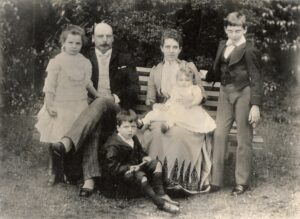
Adolphus Ross photographed with his family in the summer of 1889. Pictured: Frances, Ross, Cecil, Alice, Gerald and Sidney Pinsent.
Adolphus married Alice Mary Nuttall, “daughter of the late John Nuttall Esquire, merchant”, in Montevideo in 1877 (Pall Mall Gazette: 6th December 1877) and they had four children: Sidney Hume Pinsent, Frances Maude Pinsent, Cecil Ross Pinsent and Gerald Hume Saverie Pinsent who all did very well for themselves. Sidney Hume settled in South America and became a “mechanical engineer;” Cecil Ross was a well-regarded “landscape architect” in Italy between the wars and Gerald Hume a well respected “Civil Servant”. Sidney and Gerald married and had children. Frances and Cecil remained single.
Adolphus Ross returned to England in 1889 and settled in Hampstead, near London. There is a remarkable photograph of the family (Ross, Alice, Frances, Sidney, Cecil and Gerald) in the Robert Ewell Photograph Collection at the Royal Institute of British Architects. Somehow it made its way into one of Cecil Ross’s photograph albums.
Ross capitalized on his South American experience and became a “businessman” and a “director” of several companies with South America interests. One of his first directorships was with the “Buenos Aryes and Pacific Railway,” which he joined in August 1891: “Mr. M. H. Moses and Mr. William Rodger having retired from the Board, the Directors have elected Mr. Thomas C. Clarke, M. Inst. C.E., formerly general manager of the Buenos Ayres and Rosario Railway, and Mr. Ross Pinsent, who has recently returned from the River Plate after a long residence there, to fill the vacancies” (Herapath’s Railway Journal: Saturday 1st August 1891).
Ross’s wife, Alice Mary, died in March 1901 and Ross married Ethel Philomena Whitelaw, “daughter of the late Rev. G. Whitelaw, Clerk in Holy Orders” the following year. According to the 1891 Census, she had been his children’s governess since their returned to England. They had a son, Basil Hume Pinsent, who later became a “solicitor”.
Adolphus Ross Pinsent was good with numbers (as were so many in his extended family) and he knew Uruguay intimately; so it is hardly surprising that he joined a Committee formed in Britain to collate financial data pertinent to Uruguay. The results were reported in the “22nd Annual Report of the Council of the Corporation of Foreign Bondholders, for the Years 1894”. He probably served a similar function at other times, and he was certainly on a “Committee of Holders of Uruguayan Bonds” in 1929 – the year he died.
Ross was elected a Director of the “Mogyana (Railway) Company, of San Paulo, Brazil” and he supervised the lottery system used by the Company to determine who, annually, could redeem its five per cent £100 debenture bonds. A total of 129 numbers were drawn at the “British Bank of South America (Limited)” in London in 1891 and those bonds were solicited for redemption (London Daily News: 3rd October 1891). A further 157 numbers were drawn in 1895 (London Standard: 4th October 1895).
Ross joined the Board of the “Buenos Ayres (New) Gas Company” in 1891 and his appointment was ratified at the following annual general meeting, when it was held at “#1, East India Avenue, London” in June 1892. They were challenging times, and the chairman was quick to point out that although the Company had made a profit selling gas and coke, it was difficult operating in Argentina and there were important political and currency related issues to be taken into consideration. He added that, although the Company had asked Mr. Pinsent to join the Board, the remuneration paid to the directors would stay the same – it would just be divided among more people. What the other directors thought of that development I am not sure! The Chairman added that he himself had not drawn a penny from the Company this past year as “he thought the money might be wanted for the benefit of the Company” (Gas World: Volume 6: p659).
Presumably the company survived the “challenging times” as Ross was still a director when it floated a prospectus for debenture stock in London in 1897 (Pall Mall Gazette: 12th July 1897), and also when it negotiated a contract to supply gas in 1908. Nevertheless, in accordance with the terms of an agreement it made with the “Primitive Gas and Electric Lighting Company of Buenos Ayres, Limited”, dated December 2nd 1909, it issued a final dividend and it went into voluntary liquidation the following year a couple of years later (Evening Standard: Friday 22nd April 1910). Ross must have moved across to the latter company as he is later referred to as being a director of the “Primitiva Gas Company of Buenos Aires, Limited” (Yorkshire Post and Leeds Intelligencer: 14th December 1912).
Adolphus Ross was kept busy looking after the interests of British-managed firms with interests in South America; however, he seems to have retained his own company there too, as a list of British Exhibitors at an “Argentine Centenary Exhibition” in 1910 refers to the firm of “Pinsent, Mathews and Co.” Presumably it was his early venture in Montevideo.
Beyond that, there were plumbing as well as gas issues to be dealt with! Adolphus was on the board of the “Province of Buenos Ayres Waterworks Company Limited”(London Evening Standard: Wednesday 15th March 1911) and the “South Barracas (Buenos Ayres) Gas and Coke Company, Limited” – both of which were promoted and fronted by Mr. Conrad im Thurn. Ross’s son, Sidney Hume Pinsent lived in Buenos Aires and must have been invaluable to his father. Sidny was appointed Technical Director to the local boards of the “South Barracas Gas and Coke Co. Ltd.” and the “Province of Buenos Aires Water Works Construction Syndicate”.
Adolphus Ross was a director of the “British Bank of South America, Limited (Head Office, 2a Moorgate Street, London, E.C.)” in 1906 (Investor’s Monthly Manual: Volume 36: 1906) and he represented the firm at a Banquet held to honour General Roca – a past president of the Argentine Republic – when he visited London that year (Railway News: Saturday 21st July 1906).
Ross was elected a director of the “Consolidated Water-Works of Rosario Limited” (Journal of Gas Lighting, Water Supply & Sanitary Improvement: Volume 104: p693: 1908) in 1908. He joined the board of the “Bahia Blanca Gas Works (Construction) Syndicate Limited” and, in his capacity as chairman, wrote a letter published in the London Gazette (London Gazette: 29th November 1907) to inform shareholders that an Extraordinary meeting of the Company had been held at the Company Office at “No. 1 East India Avenue, London,” on 7th Nov. 1907, and the decision had been made to voluntarily wind up the company under provisions of the “Companies Acts 1862 to 1907” – and convert its outstanding shares into those of the “Bahia Blanca Gas Company”, according to a schedule laid out by the liquidator.
In his capacity as a “Director” of the “British Bank of South America,” Ross supervised the random drawing of bonds of the “Cantareira Water Supply and Drainage Company of the City of Sao Paulo” at the “British Bank of South America.” The lucky winners were entitled to present their 5 per cent bonds for redemption (London Evening Standard: Tuesday 9th September 1913). As with the “Mogyana (Railway) Company of Sao Paulo” this was not a one-off event. It seemed to have happened again the following year.
Interestingly, another Pinsent turns up working for the “British Bank of South America, Limited” shortly before the “First World War”. While reviewing the state of the company after the war, the “President” regretted the loss of 13 members of staff reported dead or missing and he mentioned that two had been held as prisoners of war. He also referred to two ex-employees who had been awarded the Military Cross and one who had been awarded a Distinguished Service Medal. Lieutenant G. H. Pinsent, M.C., (Guy Homfray Pinsent) must have worked in the Buenos Aires branch of the bank before enlisting (The Times: 20th April 1917). He belongs to the HENNOCK branch of the family. Guy’s mother, Lady Pinsent moved in the same social circle as Ross and very probably twisted his arm!
Although I know very little about Ross and Alice’s early life in Montevideo; it is clear that they made at least one trip home to visit family and (presumably) conduct business in the 1880s. On the 3rd April 1881 (the night of the census), Ross was in Erdington, near Birmingham, while his wife, Alice Mary (née Nutall) and his son eldest son Sidney Hume Pinsent were visiting with Ross’s mother, Catherine Agnes (née Ross) at “#107 Edith Road, Fulham, in London”. Ross’s brothers, Richard Alfred Pinsent and Hume Chancellor Pinsent were also there but Richard Alfred’s wife, Laura Proctor (née Ryland) was missing. She was visited a sister. The Census taker erroneously described Ross as being “unmarried” but accurately referred to him as a being “A River Plate Merchant”.
Ross’s two brothers (Richard Alfred and Hume Chancellor) were solicitors in Birmingham, so it is hardly surprising that Ross initially chose to stay in Birmingham when he returned to England. He was living at “#40 Wellington Road, Bristol Road Birmingham” (Kelly’s Directory of Birmingham 1890) in 1890. However, it was a short stay as he purchased a house at “#22 Maresfield Gardens, in St. John’s, Hampstead”, and he was living there with his wife and children Frances M. (Maud) (9), Cecil R. (Ross) (6) and (Gerald) Hume (Saverie) (2) when the National Census was taken in 1891. Alice and her children were “British Subjects born in Montevideo, Uruguay”. Ross’s eldest son, Sidney Hume Pinsent, was presumably away at school. Alice Mary died at Maresfield Gardens, in May 1901 (London Standard: 26th May 1901) and Ross remarried the following year.
Ross may have taken a business trip to the United States shortly after settling back in England. The “S.S. Britannic‘s” ship’s manifest shows that he left Liverpool for New York and arrived there on 6th July 1889 (New York Passenger Lists: 1820-1957: Ancestry.com). How he got on, I do not know; however, Ross returned to North America with his brother Richard Alfred Pinsent a few years later. They left Southampton for New York on the “U.S.M.S. New York” (Anglo American Times: 2nd June 1894) and passed through Winnipeg, Manitoba, while heading toward the west coast by train (The Daily Nor’Wester: 14th May 1894). The “Trans Canada Railway” had been completed in 1885 but the Canadian west was still largely untouched and Ross may have sought business opportunities. I am not aware that anything in particular came out of the trip. The brothers’ wives stayed home with their children. Meanwhile Ross retained his business interests in South America and still had family out there. He seems to have made several trips to Argentina in the 1890s.
There were, of course, business opportunities in England. Richard Alfred Pinsent (Ross’s brother) helped the firm of “Hinks and Company” to apply for a patent for “an improvement in lamps for burning paraffin oil and other volatile liquid hydrocarbons” in 1877 (Birmingham Daily Post: 25th January 1877). He probably introduced his brother to the Company principals, and they appointed him a director of the firm of “James Hinks and Son Limited” in the late 1890s. This appointment was confirmed annually between 1902 (Leamington Spa Courier: 27th June 1902) and 1908 (Leamington Spa Courier: 22 may 1908). It was Ross who was responsible for notifying the directors of the death Captain Hinks (the son of Mr. Joseph Hinks, J.P., the chairman of the board of directors) in May 1902 (Birmingham Mail: Wednesday 14th May 1902). He had, sadly, been killed in action in South Africa during the Boar War.
The firm made “Duplex” oil lamps and electrical light fittings for the domestic and overseas markets. It was a tough business to be in and the firm was clearly under stress from both German and American competition (Yorkshire Post and Leeds Intelligencer: 28th may 1904) in the early 1900s. Richard Alfred Pinsent probated Mr. James Hinks, the company president’s will when he died in 1906. Interestly, he had, at one time, been president of “Aston Villa Football Club” (Leamington Spa Courier: 23rd February 1906) which was a very successful Birmingham-based soccer team in the 1890s. Unfortunately, it was less so when I lived in Birmingham in the 1960s. Ross was reelected as a director of “James Hinks and Son, Limited” in 1913 (Birmingham Mail: Friday 16th May 1913).
In the early 1920s, Ross and his second wife, Ethel Philomena (née Whitelaw) moved to “#52 Woodbury Park Road, Tunbridge Wells, Kent” (British Telephone Books 1880 – 1984: Tunbridge Wells: 1923). It was to be their home well into old age. It was there that they entertained their South American son, Sidney Hume Pinsent, and his children when they were back for visits, and it was from there that he took responsibility for both his own son, Basil Hume and his South American grandsons, while they attended school in England. Ross and Ethel were well known in the local community and they (like their relations in Birmingham) attended numerous “fashionable weddings” – as well as a like number of funerals. Ross appears to have indulged himself playing chess and he seems to have been a keen amateur player (Chess Amateur, Volume 4-5: 1910; British Chess Magazine: Volumes 74-75: 1954).
Mr. Ross Pinsent, of “52 Woodbury Park Road” died at Molyneux Park in Tunbridge Wells on 18th August 1929. He was interred at the “Borough Cemetery” after a Roman Catholic service (Kent and Sussex Courier: 23rd August 1929). Probate of his estate was granted to Ethel Mary Philomena Pinsent (widow), Roy Pinsent, “solicitor” (nephew), and Gerald Hume Saverie, “civil servant” (son). His “Effects” were initially given as £60,592 5s 6d and were later “re-sworn” as £60,581 9s 6d. Ethel Mary Philomena Pinsent stayed on in Tunbridge Wells until at least 1949. She died at Sanderstead, in Surrey, on 14th May 1955.
Ross’s daughter Frances Maude was born in Montevideo in 1882 and returned to England with the family in 1890. She was educated in England and census records show that she was visiting a cousin, Marion Radford, in Buckland Monarchorum in Devon, in 1901. Her grandfather (Richard Steele Pinsent’s) children seem to have kept in close contact in the late 1800s and early 1900s and their descendants are pretty close today. Interestingly, Buckland is very close to Horrabridge, where the aforementioned Guy Pinsent’s family lived after the “First World War”. Guy’s brother was Francis Wingfield Homfray Pinsent – a land valuer who then worked in Plymouth.
Eight years later (1909), Frances and her brother, Gerald , were caught in a snowstorm on the Matterhorn while vacationing in Switzerland. They were with a group of tourists who were forced to shelter in a hut until rescued by a search party from Zermatt. “The hut was full of ice”, Miss Pinsent said, but they “made a little fire” and escaped unharmed, “save for a few frozen fingers and toes” (Leeds Mercury: Monday 23rd August 1909). Frances was extremely fortunate that she was not seriously injured as she was to become an accomplished musician and music teacher.
Frances was taught by Professor Xavier Scharwenka (“Professor and Pianist to the Court of Prussia”), Carlo Albanesi and others and was a “Sub-Professor” at the “Royal Academy of Music” before she took over the teaching role of a Miss Newton, who had given music lessons in small communities (Aylesbury, Beaconsfield, High Wycombe etc.) around London.
Frances lived with her parents in “Maresfield Gardens, Hampstead” until 1914; she then moved into a flat with her brother Gerald Hume Saverie at “265a Portsdown Road, London”. He was an “Assistant” to the “Prime Minister” at “#10 Downing Street” at the time; however, he soon left to join the army. She stayed on until around 1919 (London Electoral Registers: 1847 – 1965). Frances gave lessons in pianoforte, singing and harmony and prepared students for their L.R.A.M. and A.R.C.M. examinations (Bucks Herald: 30th September 1911). It was a role she performed with considerable success. The local papers frequently refer to her student’s successes: “in the recent school examinations of the Associated Board of the Royal Academy of Music and Royal College of Music, Elsie Grange, a pupil of Miss F. M. Pinsent passed the intermediate stage” (Bucks Herald: 11th May 1912).
Frances Maude’s ability was recognized in 1913, when we find that: “At the meeting of the Directors of the Royal Academy of Music held recently, Miss Francis M. Pinsent, L.R.A.M., was unanimously elected as Association of the Institute (A.R.A.M.) in recognition of her teaching. This is an honorary distinction, not obtained by examination, which is sometimes conferred on past students who have distinguished themselves” (Bucks Advertiser and Aylesbury News: Saturday 8th November 1913). The following week she placed an advertisement in the same newspaper stating that she could be contacted at 256a Portsdown Road in London … and that she was prepared to visit Aylesbury, Risborough, Beaconsfield, Wendover and High Wycombe to give lesson in pianoforte, singing etc. Her various students passed their exams and she had considerable success developing a local girls’ choir. It won first prize at an annual competition organized by the “Social Institutes Union” in London several years in a row (Bucks Herald: 27th May 1916).
One of her choirs was quite exceptional: “Miss Pinsent’s Singing Class: At a competition held in London last week, Miss Pinsent’s Singing Class gained the cup for singing 3-part unaccompanied glees, with full marks (100). The chief adjudicator remarked that he would have to exhaust his vocabulary of adjectives to describe the excellence and perfection of their performance. In the duets and solos competitions, Miss Pinsent’s pupils came out second (in duets) and third (in solos) and gained two 1st class certificates (over 90 marks) and three 2nd class certificates (over 80 marks)” Bucks Advertiser & Aylesbury News: Saturday 9th May 1914.
Frances Maude never married. She largely drops out of sight in the 1920s after becoming a “sister in religion.” According to the 1921 census, she was one of 33 nuns, most of whom came from France, Spain or Portugal, who ran a “Club for poor little girls” through “Lealix, Convent of the Sacred Heart in Hertford.”
When the wartime Register was taken in 1939, she was at “Kingswood Lodge of the Convent of the Handmaiden, on Cooper’s Hill, in Englefield Green, in Surrey” -and she died there in 1953. Sofia Altuna probated her estate, which amounted to £1,583 (England and Wales National Probate Calendar: 1858-1966: Ancestry.com).
Please use the above links to explore this branch of the family tree. The default “Next” and “Previous” links below may lead to other unrelated branches.
Proposed Presentation to Mr. and Mrs. H. C. Pinsent: We have already announced that Mr. and Mrs. Hume C. Pinsent are leaving Birmingham to take up their residence in the South of England. That is the reason why Mrs. Pinsent recently resigned her seat on the City Council as a Unionist representative of Edgbaston Ward. For many years, both Mr. and Mrs. Pinsent have taken an active part in the public work of the city. Mr. Pinsent has identified himself with the University as governor and treasurer, and his advice and unobtrusive support have been of incalculable value to the Council, more particularly during the early life of the institution. The works undertaken by Mrs. Pinsent with a thoroughness and perseverance that have impressed everyone had been in a cause that does not easily attract help. Her devotion to the care of the defective and cripped children had extended over years and has necessitated great self-sacrifice, involving service on committees, the City Council, the Education Committee, and a Royal Commission, in addition to much work done for individual cases quite unknown to the public. It is felt that the man friends of Mr. and Mrs. Pinsent, and all who know them through their public work, would like to show their appreciation of their services. It is therefore proposed to present to them some gift of a personal character which would remind them of the work they have done and the esteem in which they are held by Birmingham people. With this object a circular has been issued asking for subscriptions, the maximum amount being fixed at wo guineas. A meeting of the subscribers will be held at the Council House on Thursday next to decide on the form of the gift. The names of the subscribers, but without mentioning the amount of their subscription, will be set out in a book to be handed to Mr. and Mrs. Pinsent. The circular is signed by the Lord Mayor (Lieutenant Colonel Martineau), the vice-Chancellor of the University (Mr. Gilbert Barling), Sir George Kenrick, Councilor D. Davis, Mrs. Beale, Mrs. Dale, Mrs. Bennett, Messrs. A. Blackwell, A. H. Coley, R. Cary Gilson, A. Flavell, and the Town Clerk (Mr. E. V. Hiley).
Transcribed in whole or part from scanned originals: Presented with or without modified text and punctuation. For absolute accuracy refer to the original newspapers. Source: The British Newspaper Archive