Cecil Ross Pinsent

Vital Statistics

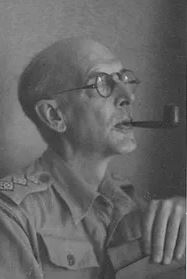
Older balding man in a military shirt smoking a pipe.
Captain Cecil Ross Pinsent via The Monuments Men Foundation Collection.

Cecil Ross Pinsent: 1884 – 1963

Family Branch: Devonport
PinsentID: GRO1100

References

Newspapers

Click here to view close family members.


Cecil Ross Pinsent was Adolphus Ross’s second son by Alice Mary (née Nuttall). He was born in Montevideo, Uruguay, in 1884 but his parents returned to England, so he grew up there. He was educated at “Marlborough College” in Wiltshire, where he was a contemporary of his cousin, Roy Pinsent. Cecil won a bursary to the “Architectural Association School” in London and later became a highly regarded “garden architect” in Italy.

His life is described in a book entitled “An Infinity of Graces” written by Ethne Clarke (published by W. W. Norton & Company, New York and London, 2013). I admit, I have not yet read it. Michael Spens, who reviewed the book, (www.studiointernational.com) and an observation on the “Foundation for the Preservation of Art” website tells us that Cecil was accepted into the “Royal Academy of Architecture” in 1905. The “Royal Institute of British Architects” has in its possession in its “British Architectural Library,” Cecil’s photograph albums for the years 1904 and 1905. I have not seen the albums, but I have one photograph – a family grouping – see attached. The albums they are said to contain several other family-related photographs, as well as numerous architectural studies. Cecil’s cousin, Clive Pinsent, is specifically mentioned (Worldcat.org: – OCLC No:943157680). He was of a similar age and shortly to join the Royal Navy.
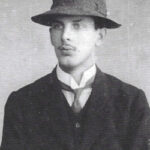
Man in Edwardian attire and a slightly crumpled hat.
Cecil sits for his passport photograph in 1906.

Cecil traveled to Florence to study classical Italian architecture in 1906. He visited the “Villa Gamberaia” and was strongly influenced by the symmetry of structure and design of its Renaissance garden. While in Florence, he met Edmond Houghton, an elderly British gentleman and his wife Mary and, if R. Terry Schnadelbach in his book “Hidden Lives – Secret Gardens: The Florentine Villas Gamberaia, La Pietra …”  is to be believed, he entered into a ménage à trois with them – to the point where he was commonly referred to as their “adopted son”. Houghton gave him his first architectural contract – designing his sister’s home in Bournemouth.
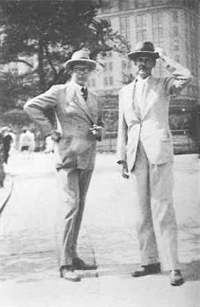
Two dapper-looking men in casual suits in 1950s clothes.
Cecil Ross Pinsent and Geoffrey Scott, date unknown.

However, Cecil’s first major contract came from American art historian Bernard Berenson and his wife, Mary, in 1909. Cecil Pinsent and Geoffrey Scott (another Englishman) were hired to design and rebuild their “Villa I. Tatti”, near Florence. The garden is among Cecil’s best-known architectural achievements. Monty Don (a modern-day authority on garden design) describes his geometric designs and clever usage of trees and hedges. Evidently, any flowers that might have existed in an Italian Renaissance garden were long gone by the time Cecil arrived on the scene (BBC: Monty Don’s Italian Gardens: Episode 2: 2011; www.siteandinsight.com/tag/cecil-pinsent/). Bernard Berenson donated the villa to “Harvard University” in the 1950s and it is still in its hands.

Cecil was in Florence at the start of the “First World War,” and he joined the “British Red Cross” and ran a “Mobile X-ray Unit”. He probably stayed on in Florence as he organized the scenery and lighting for a charity performance put on in aid of the English Branch of the Red Cross in Villa Medici, Fiesole, near Florence in November 1915 (The World: 30th November 1915). After the war, he joined a group of like-minded, artistic ex-patriots in Florence and continued his work on Italian gardens.

Cecil visited New York for about a month in 1929. Whether he was visiting friends or making contacts (or both) is unclear. The relevant ships’ manifests (findmypast.com, ancestry.com) describe him as being a “broker” on the way out to America and an “architect” on the way back to England. Either way, contracts soon followed. He was hired by a wealthy American, Iris Origio to redesign and rebuilt “La Foce” in the Val D’Orcia southwest of Florence. He built on his reputation for designing Italian-Renaissance style gardens using blocked out shapes and hedging but, at her request, added more colour. Evidently, he had an eye for fitting gardens into their natural landscape and he was elected a “Fellow” of the “Royal Institute of British Architects” in 1933. Monty Don describes the garden at “La Foce” in his BBC review of Florentine Gardens. The current owner – who knew Pinsent when she was young – describes him as being a tall man with a dry, English, sense of humour. He worked at “La Foce” throughout the 1930s. He had only just finish it before the “Second World War” broke out.

Cecil had retired to Warborough, in Oxfordshire, and he signed on there as an “Air Raid Warden” when the time came (1939 Register). When filling out the forms, he noted his profession and ability to speak Italian and, although he might have hoped for peace and quiet in Oxfordshire, it was not to be. He was called into service in 1943 and became one of Britain’s “Monuments Men” (Monuments, Fine Arts and Archives personnel). He must have lived a similar sort of life as that portrayed by George Clooney, Matt Damon and Bill Murray (perhaps without the heroics) in the film of that name, released in 2014.

“Captain” Cecil Ross Pinsent worked with the American Army as it fought its way through Tuscany and his typed field reports are held by the “American Commission on the Protection and Salvage of Artistic and Historic Monuments in the War Area” (www.Fold3.com – Robert Commission: 1943 – 1946). He describes the damage done by the departing Germans (and, presumably, by allied artillery and bombers) – including the destruction of the bridges in Florence, and he comments on the architectural significance of the various antiquities that were either damaged or lost.

On 24th September 1944, Capt. C. R. Pinsent, MFA&A, AMG, wrote a letter regarding “Complication in Protection of Antique” (United States Army in World War II: Special Studies: Civil Volume 8: by Harry L. Coles: p. 424: City of Florence, to Perkins, ACC Files, 10000/145/71). In it, he describes the work of “U.S. Army Engineers” and local workers in saving the facades and a tower in “Via Guicciardini” and “Via Por Santa Maria” and goes on to explain that he has been to assess damage at local villas and found that many have been neglected for so long or been rebuilt to such an extent that they do not warrant an “Off Limits” notice, as any damage would be irremediable. One had been used as a stable. After the war, he continued to work in Italy for a while, but he eventually returned to England.

He had fully “retired” by the time he took another trip to New York in 1950 (New York Passenger Lists: Ancestry.com). He later moved to Switzerland, where he died at Hilterfingen, Thunersee, in 1963. His will was probated in London the following year: his effects were valued at £29,439.

I have not read her book, but Spens quotes Ethne Clarke as saying that Cecil was an attractive man with many female suitors and that he pursued other women. However, Schnadelbach (above) makes it clear that he was bisexual. The Police Constable who charged four young men, including Cecil, of “causing an obstruction” walking around “Leicester Square” in London arm in arm after a concert in 1913 probably knew what he was looking at. On that occasion, however, the Magistrate felt the Constable had been overly aggressive and rejected the charge (Sheffield Evening Telegraph: 30th October 1913). Cecil never married.


Family Tree

GRANDPARENTS

Grandfather: Richard Steele Pinsent: 1820 – 1864
Grandmother: Catherine Agnes Ross: 1830 – 1906 

PARENTS

Father: Adolphus Ross Pinsent: 1851 – 1929 
Mother: Alice Mary Nuttall: 1855 – 1901

FATHER’S SIBLINGS (AUNTS, UNCLES)

Richard Alfred Pinsent: 1852 – 1948
Edith Mary Pinsent: 1853 – xxxx
Hume Chancellor Pinsent: 1857 – 1920 

MALE SIBLINGS (BROTHERS, Half-Brothers)

Sidney Hume Pinsent: 1879 – 1969
Gerald Hume Saverie Pinsent: 1888 – 1976 

Basil Hume Pinsent: 1911 – 2000 


Please use the above links to explore this branch of the family tree. The default “Next” and “Previous” links below may lead to other unrelated branches.

Basil Hume Pinsent

Vital Statistics

Basil Hume Pinsent: 1911 – 2000 GRO0085 (Solicitor, London)

Patricia Arbery Mary Atteridge: 1921 – 1997
Married: 1942: London

Children by Patricia Arbery Mary Atteridge:

Son (GRO0164)
Daughter (GRO1362)
Daughter (GRO0678)

Family Branch: Devonport
PinsentID: GRO0085

Click here to view close family members.


Basil Hume was the only son of Adolphus Ross Pinsent by his second wife, Ethel Mary Philomena Whitelaw. He was born in Hampstead in 1911 and he grew up in Tunbridge Wells in Kent. Basil attended a Catholic “preparatory” school called Ladycross in Seaford in Essex in the early 1920s, and was there when the 1921 census was taken.

He moved from Ladycross to “Downside” a major Catholic “Public” (private) school in Somerset. It was an interesting choice – bearing in mind that two of his half-brothers, (Sidney Hume and Cecil Ross Pinsent) had gone to “Marlborough College” in Wiltshire and another, (Gerald Hume Saverie Pinsent), had been sent to “King’s School Canterbury” in Kent – which is at the heart of the Anglican Church! Perhaps his mother was a Roman Catholic; or perhaps Ross just found it convenient to send Basil to the same school that his Catholic South American grandsons were going to.

Basil was part of the chorus when the school performed the Gilbert and Sullivan’s opera “Iolanthe” in December 1927 (Western Daily Press: 1st December 1927). However, that was not to be his principal claim to fame. The following year he left the school with a “Higher Certificate Distinction” in “Ancient History” (Bath Chronicle and Weekly Gazette: 8th December 1928) and with the school’s prestigious “Gregory Medal” – which he received in person (Bath Chronicle and Weekly Gazette: 7th December, 1929). This led to a “Major Classical Scholarship” at “Trinity Hall,” in Cambridge in 1929. 

Time-lines and relationships get complicated in this branch of the family. Basil was two years older than his father’s eldest grandson (Harold Ross Pinsent), who was Basil’s half-brother Sidney Hume Pinsent’s eldest son! Harold’s parents lived in South America and he, along with his younger brothers, stayed with their grandfather (and Basil) between school terms. Harold’s time at “Downside” must have partially overlapped with Basil’s.

Basil’s father, Adolphus Ross Pinsent, died in August 1929 but his mother stayed on in the family home at “#52 Woodbury Park Road, Tunbridge Wells.” Basil returned there from university and he must have spent a considerable amount of time there with Sidney Hume’s children.

The Pinsents were well-known in and around Tunbridge Wells, and they were frequently invited to high-profile weddings and other social events in the 1930s. Basil retained his interest in Catholicism throughout his life and he returned to “Downside” on several occasions. He witnessed the enthronement of two Abbots, the first in 1933 (Bath Chronicle and Weekly Gazette: 30th December 1933) and the second in 1939 (Kent and Sussex Courier: 20th January 1939. He studied law at Cambridge and passed the “Law Society’s” preliminary examination in July 1935 (Yorkshire Post and Leeds Intelligencer: 20th July 1935). He finished his degree just before the onset of the “Second World War”.

Basil Hume had been a “Cadet Sergeant” in the “Officers Training Corp.” at school, and he was gazetted a “Second Lieutenant” in the “Royal Army Service Corps.” in September 1939. During the war, he served as a “Staff Captain,” where, I am not sure. After the war, he stayed on in the “Territorial Army,” and was awarded a “Territorial Efficiency Decoration” in 1952 (London Gazette 18th March 1952). Basil stepped down with the honorary rank of “Captain” when he reached the army’s mandatory retirement age in 1966 (London Gazette; 15th March 1966).

Basil trained as a “solicitor” and was in private practice when he paid tribute to the Hon. Miriam B. Pearse, “Inspector of Factories,” when she presented her last case in Birmingham Police Court before leaving Birmingham for Wolverhampton in 1938 (Evening Despatch: Friday 13th May 1938).

On another occasion, in court in 1947, he argued that “Derby Cables Ltd.” was unaware of the danger posed by one of its machines, and said that it admitted guilt in not having fully protecting an employee from injury. He went on to say that the problem had now been rectified (Derby Daily Telegraph: 10th October 1947) … leniency, please! He also pleaded for mercy when “Smith’s Crisp Company” was charged with selling a cooked earwig in one of its packages (Staffordshire Sentinel: Tuesday 21st January 1969) – and also when they sold underweight packages in 1969 (I am sure I bought some). He explained that the weighing machines were hard to calibrate and, besides, they sometimes sold overweight bags – so it evened out (Birmingham Daily Post: Saturday 9th August 1969).

Basil was a partner in the firm of “Warren, Murton & Co.,” Solicitors of “45 Bloomsbury Square, London W.C.1”, (London Gazette: 11th July 1952), a firm that seems to have probated a lot of wills. The London Gazette contains numerous requests for persons having claims against the estates of recently deceased testators to bring it to his attention – if they wished to be considered for payment by the estate. Basil was never a member of “Pinsent & Co.”; however he did (on at least one occasion) conduct business with his cousin, Sir Roy Pinsent. “Warren, Murton & Co.” submitted a petition to the “High Court of Justice (Chancery Division)” relating to the winding up of a company, “K. & B. Motors (Newcastle) Limited” on behalf of its solicitors, “Pinsent & Co., of 6 Bennett’s Hill in Birmingham” in November 1963 (London Gazette: 26th November 1963). When Basil’s half brother, Gerald Hume Saverie Pinsent died in 1976, it fell to Basil Hume and Clive James Gordon Lewis of “Warren, Murton and Co.”, (by then of Harley Street in London) to handle his estate.

Basil Hume Pinsent married Patricia Arbery Mary Atteridge in London during the war. He was a young army officer and she was the daughter of a “physician” and “surgeon” who was working as a “volunteer nurse”. They had two children while living at “85 Ladbrooke Grove W.11.,” in London after the war; a son, who is now a retired businessman, and a daughter. The family had moved to Chelsham, near Croydon, before their second daughter was born n 1947.

Basil was an active member of Chelsham parish council in the late 1950s (Surrey Mirror: Friday 15th May 1959) and was its chair in 1967. He wrote a disapproving letter to the Regional District Council in November that year for their proposing to put an approved school in Chelsham – despite the objections of the community. It was to be between a mental hospital and a primary school (Surrey Mirror: Friday 17th November 1967). My father, Dr. Robert John Francis Homfray Pinsent, corresponded with Basil while he was in Chelsham in the late 1960s and 1970s.

Basil and Patricia moved to Lingfield, in Surrey, at some point. Patricia became the “community care secretary” there, and she was actively involved in discussions regarding an expensive (£50,000) new community centre (East Grinstead Observer: Thursday 28th October 1978). It was badly needed, but how would the costs be met? In 1980, she headed an appeal for volunteers to come and visit with, and assist, elderly people in the district (East Grinstead Observer: Thursday 24th January 1980). There was a lot to be done in the district and she was grateful for a £250 grant from “Tandridge District Council later in the year. It would help provide greater mobility in the area.

Lingfield could now “include increased transportation facilities to take people to hospital and visit sick relatives. General secretary of community care, Mrs. Pat Pinsent of 3 Star Cottages Church Close, Lingfield, described the work of the association. We are literally the safety net of the community she said. It becomes a local citizens advice bureau. She added that requests could range from people needing a babysitter or push chair to washing machine. One of the main roles of community care is to provide transport especially for people to visit relatives in hospital. Mrs. Pinsent said that at the moment she had a list of nearly 30 volunteer drivers. …” (East Grinstead Observer: Thursday 10th July 1980). Some time later, she put out a call for deckchairs and benches for the community centre’s garden (Caterham Mirror: Friday 4rh July 1986) and a few years after that she, and a Miss Nicola Matthews, the district chiropodist, inspected the local “Day Centre” to see if it would be a suitable site for a chiropody centre (Horley & Gatwick Mirror: Thursday 24th March 1988).

Lingfield was a small community and she was well regarded, both for her community work and for her governorship of Lingfield Primary School. When she died in 1997, the villagers installed a Memorial lectern in St. Bernard’s Catholic Church inscribed with her initials and her date of birth (East Grinstead Observer: Wednesday 20th May 1998).

Basil evidently enjoyed country life. In 1999, he wrote a letter to the editor of the Spectator regarding what he felt was a “hanging offence”: “Sir: I always enjoy ‘Country Life’; I was surprised, however, to see that Leanda de Lisle (16th October) may have allowed her young son to eat the partridge on the day he shot it. It would have been very bland”: Signed: Basil H. Pinsent, Ridgeway Manor, Oxted, Surrey. He had good taste and as well as partridge he liked rare and valuable books. He was the owner of some interesting items – included in a “Catalogue of Valuable Printed Books, Autographs Letters and Historical Documents” prepared by “Sotheby’s Auction House” for sale in 1974 (www.livre-rare-book.com). Basil died in 2000. His children are now married with families of their own.


Family Tree

GRANDPARENTS

Grandfather: Richard Steele Pinsent: 1820 – 1864
Grandmother: Catherine Agnes Ross: 1830 – 1906 

PARENTS

Father: Adolphus Ross Pinsent: 1851 – 1929
Mother: Ethel Mary Philomena Whitelaw: 1869 – 1955 

FATHER’S SIBLINGS (AUNTS, UNCLES)

Richard Alfred Pinsent: 1852 – 1948
Edith Mary Pinsent: 1853 – xxxx

Hume Chancellor Pinsent: 1857 – 1920

MALE SIBLINGS (BROTHERS, Half-Brothers)

Sidney Hume Pinsent: 1879 – 1969
Cecil Ross Pinsent: 1884 – 1963

Gerald Hume Saverie Pinsent: 1888 – 1976


Please use the above links to explore this branch of the family tree. The default “Next” and “Previous” links below may lead to other unrelated branches.

Arthur Edwin Pinsent

Vital Statistics

Birth: 1871
Marriage: 1898
Spouse: Annie Louisa Brennan
Death: 1939

Family Branch: Devonport
PinsentID: GRO0077

References

Newspapers


Family Tree

Grandparents

Grandfather: Charles Pinsent: 1812 -1863
Grandmother: Mary Fullick: 1812 – 1852

Parents

Father: George Pinsent: 1840 – 1875
Mother: Mary Ann Louisa Payne: xxxx – xxxx

Father’s Siblings (Aunts, Uncles)

Mary Ann Elizabeth Pinsent: 1833 – 1868
Thomas Pinsent: 1836 – 1838
Charles Pinsent: 1837 – 1862
George Pinsent: 1840 – 1875
Amelia Pinsent: 1842 – 1901
Alice Pinsent: 1844 – xxxx
Eliza Pinsent: 1846 – 1847
Alfred Pinsent: 1848 – 1919
Henry James Pinsent: 1850 – 1853
Frederick Pinsent: 1852 – 1929

Georgiana Caroline Pinsent: 1854 – xxxx
Eliza Maria Pinsent: 1856 – 1857

Male Siblings (Brothers)

George Augustus Pinsent: 1866 – 1921
Charles Alfred Pinsent: 1866 – 1914
Frederick Henry Pinsent: 1868 – 1937
Arthur Edwin Pinsent: 1871 – 1939
Harold Edmund Pinsent: 1872 – 1872


Please use the above links to explore this branch of the family tree. The default “Next” and “Previous” links below may lead to other unrelated branches.

Annie Mary Louisa Pinsent

Vital Statistics

Birth: 1869
Marriage: N/A
Spouse: N/A
Death: 1951

Family Branch: Devonport
PinsentID: GRO1230


Family Tree

Grandparents

Grandfather: Charles Pinsent: 1812 – 1863
Grandmother: Mary Fullick: 1812 – 1852

Parents

Father: George Pinsent: 1840 – 1875
Mother: Mary Ann Louisa Payne: xxxx – xxxx

Father’s Siblings (Aunts, Uncles)

Mary Ann Elizabeth Pinsent: 1833 – 1868
Thomas Pinsent: 1836 – 1838
Charles Pinsent: 1837 – 1862
George Pinsent: 1840 – 1875
Amelia Pinsent: 1842 – 1901
Alice Pinsent: 1844 – xxxx
Eliza Pinsent: 1846 – 1847
Alfred Pinsent: 1848 – 1919
Henry James Pinsent: 1850 – 1853
Frederick Pinsent: 1852 – 1929

Georgiana Caroline Pinsent: 1854 – xxxx
Eliza Maria Pinsent: 1856 – 1857

Male Siblings (Brothers)

George Augustus Pinsent: 1866 – 1921
Charles Alfred Pinsent: 1866 – 1914
Frederick Henry Pinsent: 1868 – 1937
Arthur Edwin Pinsent: 1871 – 1939
Harold Edmund Pinsent: 1872 – 1872


Please use the above links to explore this branch of the family tree. The default “Next” and “Previous” links below may lead to other unrelated branches.

Anne Pinsent

Vital Statistics

Birth: 1779
Marriage: N/A
Spouse: N/A
Death: 1790

Family Branch: Devonport
PinsentID: GRO1397


Family Tree

Grandparents

Grandfather: John Pinsent: 1723 – 1800
Grandmother: Elizabeth Puddicombe: 1719 – 1795

Parents

Father: John Pinsent: 1745 – 1804
Mother: Anne Heard: xxxx – 1780

Father’s Siblings (Aunts, Uncles)

Elizabeth Pinsent: 1743 – xxxx
John Pinsent: 1745 – 1804
Mary Pinsent: 1748 – 1749
Mary Pinsent: 1751 – 1773
Thomas Pinsent: 1754 – 1841
Sarah Pinsent: 1759 – 1782

Male Siblings (Brothers)

Thomas Heard Pinsent: 1769 – 1794
John Pinsent: 1773 – xxxx


Please use the above links to explore this branch of the family tree. The default “Next” and “Previous” links below may lead to other unrelated branches.