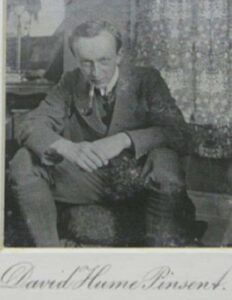
Donovan Henry Douglas Pinsent was the elder of William Henry Pinsent’s two sons by Minnie Gertrude Pearse. He was born in Teignmouth in 1901 and lived there while his parents made an unsuccessful attempt to run a seaside boarding house. He first comes to our attention in 1908 when he helped in a collection drive in support of the Teignmouth Lifeboats (Teignmouth Post and Gazette; Friday 14th August 1908). He managed to collect 16s. Donovan was interested in song and dance and was in the chorus when the “Teignmouth School of Art” put on an “Old English Fair” at Bitton (Teignmouth Post and Gazette: Friday 18th June 1909).
When he was eleven years-old, in 1912, Donovan saw his father forced into bankruptcy (see, William Henry Pinsent) – which must have been traumatic. His father later claimed that one of the reasons for his predicament was that he was trying to keep up appearances, and that meant that paying school fees (Exeter and Plymouth Gazette: Friday 16th February 1912). William seems to have sent his sons to Wallingbrook, an expensive “private (Public) school” at Chumleigh, in North Devon. I can not say definitively that Donovan was there in the mid-1910s; however, his brother, Gerald Swain Pinsent was certainly there in the early 1920s.
On leaving school, in 1918, Donovan was apprenticed to the “Great Western Railway Company”. Its records show that he was trained as a “fitter” and a “turner” in its “Locomotive, Carriage & Wagon Department”, in Newton Abbot between 2nd December 1918 and 1st December 1921 (Great Western Apprentices and Prospectives: 1893 – 1924). Perhaps he lived at “Minerva House” with his grandfather, William Swain Pinsent. If so, he may have been the “Donald” Pinsent who is said to have witnessed a case of dangerous driving in Newton Abbot and given evidence against a motor-cyclist, William Parkhurst, at “Newton Abbot Police Court” (Brixham Western Guardian: Thursday 27th May 1920). I know of no other likely candidate. Donovan was living in Newton Abbot when his grandfather died in September 1920 and, along with his father William Henry and his uncle John Douglas Pinsent, he was listed as one of the principal mourners at the funeral (Western Times: Friday 10th September 1920).
Donovan was an “engineer” by the time he married Vera Gweneth Salter in Paignton in 1924. She was the daughter of a “caterer.” They had two sons, John Henry Pinsent born in 1925 and Clifford Frederick Pinsent in 1927. The marriage did not last. Unlike his father and younger brother, Donovan was not particularly passionate about sports; he had other interests. In 1927, he competing in the “Western Counties Dancing Championships” in Torquay and, with a Miss McColgan, came in seventh (Western Morning News: Monday 25th April 1927).
That same year, 1927, Vera Gweneth Pinsent (née Salter) applied to the Torquay Magistrates for a separation order against her husband. She claimed that he had recently taken a job as a “live-in chauffeur” in Croydon, near London, and was earning £2 10s per week – while she was left to look after his children at her parents’ house in Torquay. The Magistrates granted her legal custody of the children and issued an order for her to receive 25s a week (Western Morning News: Tuesday 20th December 1927). Donovan failed to comply and he was arrested on a warrant served in Bognor, in Sussex, the following year. It stated that he was in arrears for £37 10s. Donovan appeared in “Torquay Police Court” and admitted to the facts of the case. However, he claimed that although he had been out of work for quite a while, he had recently found employment as a “driver” in Brighton. He was now earning 48s per week – but he had to pay 34s 6d for his keep. The Chairman gave him ten days to pay £4 and ordered him to pay 10s a week until he was in a better financial position (Western Morning News: Wednesday 5th December 1928).
Donovan and Vera never reconciled. Vera filed for a divorce in 1931 (Public Record Office: J77/2973/1853). She claimed that her husband had left her without warning in 1927. The divorce was granted based on evidence of his “misconduct at a London hotel” (Exeter and Plymouth Gazette: Friday 17th June 1932). I leave that to your imagination. Vera continued to bring up her children at her parent’s home on Bamfylde Road, in Torquay. She went into “sales” and was selling “gowns” when the War-time Register was made, in 1939. She stayed on in Torquay throughout the war and could be found running a stall at Torre’s “Christmas Bazaars” in 1949 and 1950. She attended other events, including a “Tor Parish Garden party” in 1952 (Torquay Times and South Devon Advertiser, Friday 24th November 1950 etc.). Vera never remarried. She died in Taunton Deane in Somerset in 1986.
Vera’s son, John Henry Pinsent, was educated at Torquay Grammar School. He joined the “Royal Air Force Volunteer Reserve” at the outbreak of the “Second World War” and became a “Flight Engineer” assigned to “170 Squadron, Bomber Command” at RAF Hemswell, in Lincolnshire. Sadly, he was killed on a night raid over Stuttgart on 7th/8th January 1945. His Lancaster bomber is said to have collided with another plane on route to the same target. His fate was unknown for a while, and he was initially reported missing (Torquay Times and South Devon Advertiser: Friday 14th December 1945). “Flight Srgt.” John Henry Pinsent [#1852125] died and was buried at Durnbach War Cemetery (aircrewremembered.com). He was only 19 years old and unmarried. His mother, Vera Gweneth Pinsent, applied for Letters of Administration for his effects, which were valued at £192 4s 11d. John’s name was added to the Grammar School’s memorial rostrum which was unveiled in May 1952 (Torquay Times and South Devon Advertiser: Friday 2nd May 1952).
Her younger son, born in 1927, survived the war, married, and had at least one daughter. I am not aware of any death notice so he could, conceivable, still be alive.
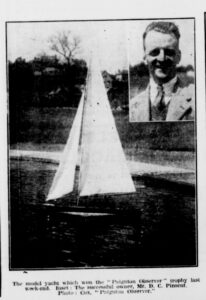
Donovan, meanwhile, married Flora Helen Hales, of Lancing in Sussex, at Worthing Registry Office on 6th August 1937. They lived in Paignton, where Donovan had found a new passion – building and sailing model yachts. He was hon. treasurer of the “Paignton Model Yacht Club” by 1936 (Paignton Observer and Echo: 12th March 1936) and become its official measure-er. In other words, he checked that competitive yachts were up to “Model Yacht Association” specifications (Torquay Times and South Devon Advertiser: Friday 26th May 1939).
Donovan and his winning yacht in the Paignton Observer and Echo, 1936.
Donovan built yachts; so, we find that when the “10-rater” category competed for the “Studdy Cup” in Paignton in 1938, the “Dolores” (owned by R. Perryman) “sailed by its late owner and builder, Mr. D. Pinsent, showed to advantage” – and won (Paignton Observer and Echo: 15th December 1938). Donovan’s yacht “Imp” had represented the club at an event held in Plymouth the previous year (Western Morning News: Monday 23rd August 1937). Donovan built a “Marblehead” class yacht named the “Black Widow” in 1939. It was a convention for the class that they all be named after insects (Paignton Observer and Echo: 29th June 1939). Donovan was active in the yacht club up to and immediately prior to the Second World War.
A ship manifest, meanwhile, shows that Flora Pinsent (an English housewife from Stoke Gabriel in Devon, aged 36) returned from Trinidad on the “Hamburg-Amerika Line” ship “Cordillera,” which arrived at Plymouth on 23rd June 1938 (UK, Incoming Passenger Lists: Ancestry.com). What she had been doing in the West Indies is uncertain; perhaps she had family there.
At the outset of the war, Donovan was said to be an “Engineer” and a “Master Boat Builder” (1939 Register) who lived with his wife on Pines Road in Paignton. However, they had moved to #2 Barcombe Road by 1942, and they lived there until the 1970s. During the war, Donovan put his three-wheeler (two-cylinder) “Morgan Aero” motorcar up for sale (Western Morning News: Saturday 24th January 1942). What he replaced it with, I do not know but he kept on driving. Flora, his wife, was fined £1 at Paignton Police court later that year for driving without her licence (Paignton Observer and Echo: 18th June 1942), and they were both fined £1 (with 4s costs) for miss-using their car two years later. Donovan’s lawyer said that his client was involved in “priority Admiralty work” and was entitled to drive to Teignmouth, but in this case he had actually driven to Paignton Harbour instead—to talk over some business. He had his wife with him; however, it was only a small infraction as he had only used “enough petrol to make a hankerchief smell.” The court considered that here was a principle involved … (Western Morning News: Thursday 14th September 1944; Paignton Observer and Echo: 14th September 1944).
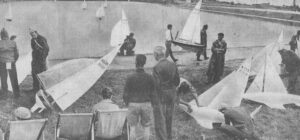
Donovan and others at the beach with their model yachts for a race.
After the war, Donovan applied for, and was granted a licence – at a price of around £250 – to operate two speed-boats from the southern end of Paignton beach for five years (Paignton Observer and Echo: 24th March 1949). He also returned to model yacht racing and, being a seasoned member of the “Paignton and District Model Yacht Club”, he was nominated “Officer of the Day” when the club met for the final contest of its “Marblehead Cup” competition in 1948. Perhaps his own entry (if he had one) had been eliminated (Torbay Express and South Devon Echo: Monday 15th November 1948).
Donovan’s “Trixie” sailed well in various competitions in May and June the following year (Torbay Express and South Devon Echo: Tuesday 28th May 1949) and did even better on land. “Trixie” won first prize in the “Racing Yacht Category” at the “Devon Industries Fair Model Exhibition” (Torbay Express and South Devon Echo: Saturday 10th September 1949).
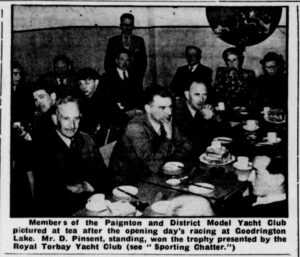
Donovan and other members of the yacht club in the Paigntom Observer and Echo, April 1950.
The Paignton Club regularly competed both internally and with teams from other communities and the results were invariably reported in the press. The reports refer to the “Paignton Observer Cup”; the “Studdy Cup”; the “Joy Cup”; the “Marblehead Cup”; the “Chamber of Commerce Shield” and many other trophies, and Donovan was always a contender. For instance, at one match – against the Exeter Club – Paignton lost by 120 to 105 points after 45 separate races. Mr. D. Pinsent (Paignton) did well, though. He came second at the event (Western Morning News: Tuesday 30th May 1950). “Mr. D. Pinsent, Paignton model yachtsman, won six cups this season (1950). He was runner up in the only other competition he entered. Among the trophies he has won is the only cup offered for competition by Exeter Model Yacht Club. Mr. Pinsent is a member of both the Exeter and Paignton Model Yacht clubs” (Paignton Observer and Echo: 10th August 1950).
Yacht Racing was a popular spectator sport and when the Paignton Club arranged for the “Trixie” and “Dolores” to be displayed in the window of the “South Western Gas Board” showroom in April 1952, it did so in hopes of attracting new recruits to the sport – “The club loan the yachts for display every two or three years but this year the object of exhibiting them was to capture the interest of the public and obtain recruits to the club. When the club commenced in 1952 sailing season at Goodrington on April 6 Trixie won the Royal Torbay Yacht Club’s silver rose bowl for the third year in succession. Those interested in joining the club should contact Mr. D. Pinsent, 2 Barcombe Road, Paignton” (Paignton Observer and Echo: 17th April 1952). Donovan was, by then, the “Commodore” of the Paignton Model Yacht Club (Paignton Observer and Echo: 10th January 1952).
It was Donovan’s yacht “Trixie” that placed first in the “Gosport Model Yacht Club” competition held for the “Trojan Cup” (Portsmouth Evening News: Monday 30th August 1954). This may, infact, have been “Trixie II” as she had raced at the “British Open” class “A” model yacht championship meet at Gosport a couple of weeks earlier (Portsmouth Evening News: Wednesday 11th August 1954). Donovan sailed on throughout the 1950s and won the “Model Yachting Association’s South-Western District Championship” in 1959 (Portsmouth Evening News: Monday 18th May 1959). His yacht “Trixie II” did not fair quite so well when it came to the “Nyria Cup” two days later, and his wife, doing the honours, presented Mr. R. Gardner with the trophy for his “Serenade” after it won the “Gosport Model Yacht Club’s” premier event at Walpole Lake (Portsmouth Evening News: Wednesday 20th May 1959).
Donovan was a “refrigeration engineer” by then and he seems to have driven extensively to race his yachts and perhaps also conduct his business. There were no motorways in those days and he was, unfortunately, involved in a motorcar accident, in Tolpuddle, in Dorset in 1950. The local rector there, Rev. Henry Knight, failed to hear him coming and died from injuries received when hit a glancing blow by Donovan’s car. Donovan was called as a witness at the “Coroner’s Inquest” held at Dorchester in November 1950 and was exonerated (Paignton Observer and Echo: 23rd November 1950). The Coroner returned a verdict of “death by misadventure” (Western Morning News: Friday 17th November 1950).
Flora must have been fairly sick in November 1953, as her doctor visited her a couple of times while she was in a Nursing Home. He sent Donovan a bill for 18 guineas for his services which he refused to pay – saying that he had no record of the visits and the sum should have been included in the over-all cost of Flora’s stay at the nursing home! The Judge at Torquay County Court sided with the doctor on that one (Torquay Times and South Devon Advertiser: Friday 12th March 1954; Paignton Observer and Echo: 18th March 1954).
Flora Helen Pinsent (née Hales), presumably, had business interests of her own as she was awarded £500 in damages when she took a local chartered accountant to court over a disputed sale. He was trying to make a quick sale of the “Manor Club” at Preston, which had been put into receivership. The accountant came to an oral agreement with Mrs. Pinsent’s solicitors to the effect that she would buy the property for £1,500. However, he then responded to another offer to purchase the property at the same price and sold it before her paper work was completed. Mr. Justice Devlin determined that the original contract should have been honoured (Paignton Observer and Echo: 12th November 1959).
Flora died in 1976 and Donovan married (for a third time) two years later. He married Gladys Parsons somewhere in the Torbay area in the spring of 1978. Donovan Henry Douglas Pinsent died in June 1980. His will was probated in Paignton. His net personalty was valued at £86,888. Gladys Pinsent died in Totnes, a few years later. Her will was probated in Bristol. She had assets valued at “not exceeding £40,000”. I am not aware of Donovan having had children by either Fora or Gladys.
Please use the above links to explore this branch of the family tree. The default “Next” and “Previous” links below may lead to other unrelated branches.
Dennis Pinsent was the younger of Stanley Arthur’s two sons. When he was 24 years old, his motor cycle crashed into a car and he received head and facial injuries (Esher News and Mail: Friday 28th May 1954). However, he seems to have recovered and followed his father into the construction trades.
Dennis was a “heating engineer” when he married Rita Martha Schaub, in Esher, in October 1955. They seem to have had two daughters. The family lived on Faraday Road in West Molesey (British Telephone Books: 1880-1894). Dennis likely took over the family construction company in 1985 but died the following year. Whether the firm continued on without him, I do not know. Administration of his estate, valued at £92,226, was granted in Winchester in August 1986 (Staines & Ashford News: Wednesday 31st December 1986). His widow, Rita Martha Pinsent died in Sutton, in Surrey in 1995. I am not aware of any sons from their marriage.
Please use the above links to explore this branch of the family tree. The default “Next” and “Previous” links below may lead to other unrelated branches.
Please use the above links to explore this branch of the family tree. The default “Next” and “Previous” links below may lead to other unrelated branches.
David Hume Pinsent was the eldest son of Hume Chancellor Pinsent by his wife Ellen Frances Pinsent (née Parker). He was born in Birmingham and educated, firstly at Lambrook School in Bracknell, Berkshire, and then at “Marlborough College”, a well-known English “Public” (private) school (Birmingham Mail: Friday 13th June 1913). While there in 1907, he won a senior scholarship. David, like his father before him, was a mathematician. He went up to Cambridge in 1910 and won the “Trinity College” prize for mathematics that year and he graduated as a “wrangler” in June 1913 (Birmingham Mail: Friday 13th June 1913).
David signed up for a rhythm of speech experiment (whatever that was) in 1912 and through it met the Austrian philosopher Ludwig Wittgenstein. They shared a common interest in music and became friends. How close they were is debatable; however, they took a trip through Iceland together that summer – at Ludwig’s father’s expense. There is nothing in David’s diary to suggest that they were anything more than traveling companions but Ludwig was clearly obsessed with David. Whether the feelings were reciprocated, I do not know.
David’s life and relationship with Ludwig and their interactions with Bertrand Russell, John Maynard Keynes and other members of the “Society of Apostles” at Cambridge are described in diaries, which David kept from 1912 to 1914. These were edited by G. H. von Wright and published by “Blackwell Publishers” under the title of “A Portrait of Wittgenstein as a Young Man” in 1990. Among other things, the diaries describe a visit that Ludwig made to the Pinsent family home at “Lordswoods House”, in Harborne, Birmingham, after their joint holiday in Iceland. Evidently, he spent an amicable couple of days visiting with David’s father, Hume Chancellor, his mother Ellen Frances, and his sister Hester (wittgensteinchronology.com).
According to one of the diary entries: “On Monday 16th June 1913: Pinsent and those members of his family visiting Cambridge go to tea with LW (Ludwig Wittgenstein). He serves them tea in chemical beakers (as he always has his food – because ordinary crockery is too ugly for him!) and proves to be in good form, albeit somewhat preoccupied by his duties as host. Pinsent’s guests leave at 5.30 p.m., he stays and later goes for a walk with LW. LW talks to Pinsent about his character, proclaiming him ideal in every respect except that he fears that with people other than LW Pinsent is lacking in generous (i.e., sympathetic) instincts. Pinsent notes that he disagrees with this verdict, pointing out that LW knows little of his other friends. LW, Pinsent opines, is ‘so different from other people – he is if anything a bit mad – that one has to deal with him differently – superficially at any rate’. When they get back to Trinity Street they meet Pinsent’s family again, and LW is persuaded to dine with them at their lodgings. Pinsent records that LW ‘brightened up considerably during dinner and we had a very pleasant evening’. They all then go on the river again in canoes and a rowing boat. Afterwards, LW leaves them, and Pinsent returns to his own rooms and plays the piano there (Pinsent, pp.56-7). Wittgenstein undoubtedly had his quirks and David found him “trying a times” but they remained friends. Maybe they both had trouble relating to others, socially.
The following August, Wittgenstein unilaterally abandoned plans the two of them had made to visit Spain and, instead, took David to Norway. According to David’s diary, it seems as if Wittgenstein was frequently depressed, moody and unapproachable, and clearly their travels were not as enjoyable as they had been the previous year. David messed about in boats, fussed with his camera, studied his law books and played the piano. They arrived back in England on 1st October 1913. Shortly thereafter, Wittgenstein announced that he was going back to Norway to live! They parted company for the last time a few days later but continued to correspond.
David Hume had graduated with a “First with Special Distinction” in Part II of the “Mathematic Tripos” and he was now (probably reluctantly) studying for the bar at the family law firm, “Pinsent and Co.” David agreed to travel around Andorra with Ludwig the following year. However, they also discussed the Faroe Islands, and other locations. However, it was not to be. The war intervened and their correspondence came to an end towards the end of July 1914 wittgensteinchronology.com/6html).
David was dinged 10s and 8/6d costs at Slough Petty Sessions – possibly for failing to produce a driving license – in November 1914 (Windsor and Eton Express: Saturday 14th November 1914): perhaps he should have known better. He had just passed his bar exams in Criminal Law and Procedure in October 1914 (London Times: 31st October 1914).
When the war broke out, David was in Birmingham. His brother Richard Parker Pinsent joined the Warwickshire Regiment and was shipped overseas – where he died in the trenches in October 1915. David, for his part, tried to enlist twice but was rejected – either because of defective eyesight (Oxford Chronicle and Reading Gazette: Friday 17th May 1918) or slightness of build (depending who you believe.) Instead, he trained as a munitions worker at the “Birmingham Technical School” and worked for the “Ministry of Munitions” for while. However, in 1916, he was persuaded to join a very talented team of young engineers and scientists at the “Royal Aircraft Establishment” at Farnborough in Hampshire. At first, he was assigned to the factory there and he spent eight months working well below his competence level as a “fitter”.
However that ended when George Thomson and other Cambridge friends persuaded him (or more probably the powers that be?) that his mathematical training might be better applied in the field of aeronautical research. He was transferred to the establishment’s “Experimental and Research Department” in January 1917 (War of Guns and Mathematics: Catherine Goldstein: History of Mathematics Volume 42: Ed. David Aubin: 2014; see also Birmingham Daily Mail: 13th May 1918 & The World: 21st May 1918). Ironically, Wittgenstein had introduced him to the physics behind propeller-blades while on their tour of Iceland in 1912 (rsnr.royalsocietypublishing.org). David lobbied hard “that he should be trained as a pilot, so as to be able to conduct experiments in single-seated machines” (Oxford Chronicle and Reading Gazette: Friday 17th May 1918). Sadly, his wish was granted shortly before he made his last fateful flight.
David Hume Pinsent was a civilian copilot and observer flying with a Lieutenant Lutyens when their plane broke up in mid-air during a test flight over Surrey and Hampshire on 9th May 1918. The following day, the Aldershot Military Gazette (Friday 10th May, 1918) reported that plane’s petrol tank had exploded at 4,000 feet. Lieutenant Lutyen’s body was recovered almost immediately but David’s had fallen into the Basingstoke Canal and it was not found for over a week. At the inquest that followed the crash, witnesses claimed that the plane, an “Airco de Havilland D.H.4” 2-seater biplane, fell to ground in five pieces. The Coroner could find no particular cause for the crash and the jury returned a verdict of accidental death. Most newspapers noted the crash and loss of “David Hugh Pinsent”; however, one took the time to put together an obituary that shows his desire to fly (The World: 21st May 1918).
David Hume was buried in Wootton Church and there is a brass plaque to his memory below one dedicated to his brother, Richard Parker Pinsent who died serving with the Royal Warwickshire Regiment. It reads: “Also of his brother: David Hume Pinsent: Royal Aircraft Establishment: Farnborough: Killed while flying for the purpose of research into Aerodynamics: May 9th 1918: Aged 26: “Nec Propter Vitam Vivendi Perdere Causas”[From Juvenal: “No! Not for life lose that for which I live”]. David’s parents had lost both their sons.
Hume Chancellor Pinsent received administration of David’s estate, which amounted to £565 12s 1d later that month, and a further £94 14s 1d was returned to his mother in June 1920. Hume endowed a prize for mathematics at “Marlborough College” in David’s name (www.archive.Marlborough CollegeWWI). David was added to the “Trinity College Memorial Roll” although he was a civilian and he received no Military recognition.
George Thomson, one of David’s friends at Cambridge and the “Royal Aircraft Establishment” was later to say – when reminiscing about his time at the Royal Aircraft Establishment – that “Pinsent was a brilliant mathematician”, and that he was “the most brilliant man of my year (at Cambridge) and the most brilliant I have ever met”. That is no small praise from a “Nobel Prize” Laureate, albeit one who might have felt some responsibility for encouraging him to join the Establishment in the first place! After the war, Thomson published a substantial textbook on applied aerodynamics that included findings from their time together at Farnborough. Some of the results had been published previously in a series of “Advisory Committee for Aeronautics” reports but these had little circulation (Thomson, 1919). Thomson won the “Nobel Prize for Physics” in 1937 (War of Guns and Mathematics: Catherine Goldstein: History of Mathematics Volume 42: Ed. David Aubin: 2014).
David’s mother, Ellen Frances, knew of Ludwig Wittgenstein’s affection for her son and she wrote to him after his death saying: “I want to tell you how much he loved you and valued your friendship up to the last. I saw him the day before he was killed and we talked of you. He spoke of you always with great affection…” Wittgenstein is reported to have replied: “David was my first and my only friend. I have indeed known many young men of my own age and have been on good terms with some, but only in him did I find a real friend, the hours I have spent with him have been the best in my life, he was to me a brother and a friend. Daily I have thought of him and have longed to see him again. God will bless him (archive.org/details/ChapelofLonelyHearts). Wittgenstein dedicated his Tractatus Logico-Philosphicus “To the Memory of a Friend: David H. Pinsent”.
Please use the above links to explore this branch of the family tree. The default “Next” and “Previous” links below may lead to other unrelated branches.
Please use the above links to explore this branch of the family tree. The default “Next” and “Previous” links below may lead to other unrelated branches.
Please use the above links to explore this branch of the family tree. The default “Next” and “Previous” links below may lead to other unrelated branches.
Please use the above links to explore this branch of the family tree. The default “Next” and “Previous” links below may lead to other unrelated branches.
Please use the above links to explore this branch of the family tree. The default “Next” and “Previous” links below may lead to other unrelated branches.
The eldest, Roy, who was clearly destined to be a lawyer like his father may have signed up out of a sense of patriotic duty; however, his brothers John and Clive joined the armed forces before the war, seemingly with the clear intention of becoming career officers. What the two younger brothers, Laurence and Philip, would have done with their lives, had they had the chance is, sadly, a moot point. They died on active service. Laurence as a young officer in the “North Staffordshire Regiment” killed at Gallipoli in 1915, and Philip, as member of the “Royal Flying Corps” shot down over France the following year.
Clive attended “Clifton College” school in Bristol (U.K. Census: 1901) before joining the “Royal Navy”. His record of service, kept at the “National Archives” (ADM 196/50), shows that his first posting was as a “cadet” on the cruiser “H.M.S. Andromeda,” in August 1902. He was promoted to “midshipman” later that same year. He then served on two heavy cruisers, “H.M.S. Bacchante” and “H.M.S Leviathan” in the Mediterranean before being raised to the rank of “sub-lieutenant” on 15th December 1905. Clive took his navigation and pilotage exams in December 1906 and was promoted to full “lieutenant”. He was then assigned to the cruiser “H.M.S. Powerful” for the first part of his “gunnery” and “torpedo” training. The ship was operating in the Far East – in and around Australia and he seems to have been reassigned to another cruiser, “H.M.S. Cambrian” while out there. He returned home in October 1909.
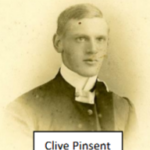
Clive Pinsent via The Radford Sisters Project.
Lieutenant Pinsent did very well as a young officer and, fairly early in his training, he was given a reward of books and nautical instruments. However, more importantly, he garnered considerable praise from his instructors. They all judged him to be extremely “zealous” and “capable”.
Clive had a particular friend in Denham Bedford, a fellow cadet at Dartmouth, who was almost certainly a young relation (son? Nephew?) of Admiral Sir Frederick Bedford K.C.B. – the then Governor of the State of “Western Australia” On attaining the rank of Lieutenant, Bedford was sent out there for a visit and Clive (Lieutenant Pinsent) seems to have been sent out with him – to keep him company.
The young men arrived in Perth on a civilian ship “R.M.S. Himalaya” on 9th July 1907 and spent the next two weeks at “Government House” in Western Australia (The West Australian: 10th July 1907). It must have been quite an experience for them. While there, they accompanied the “Governor” to Geraldton, a town in the state, where Sir Frederick opened its newly built Town Hall with a silver key (Western Mail: 27th July 1907). The young men left the Governor in Perth on 23rd July and headed for Sydney to rejoin the “Australian Squadron” on the “R.M.S. Moldavia” (The West Australian: 24th July 1907). The Admiral came down to the dock to wave them off – which must have impressed the locals. Clive was back in Perth later that year as a “supernumerary officer” undergoing training aboard the cruiser, “H.M.S. Powerful” (Western Mail: 26th October 1907) which was the flag-ship of Vice Admiral Sir Richard Poore, Bart, C.V.O., the commander of the “Australian Squadron’s” (Auckland Star: 6th June 1908).
Clive transferred to the cruiser “H.M.S. Cambrian” on 22nd April 1908 and was in Sydney, “New South Wales” – fully enjoying the life of a young officer in a smart naval uniform a year later. He attended the wedding of a fellow officer from “H.M.S. Powerful,” in Sydney, in September 1908 (Evening News: 26th September 1908) and attended “one of the most successful balls of the season” while there in October (Sunday Times: 11th October 1908).
Among his other accomplishments, Clive was a fair shot with a rifle and he was part of team from “H.M.S. Cambrian” that competed against local teams and representatives from other Ships. For instance, “H.M.S. Cambrian” competed against the “Auburn Rifle Club” in the nearby community of Parramatta. Each team consisted of eight men who fired seven shots at 200, 300 and 500 yards respectively. The sailors won that one (Cumberland Argus and Fruitgrowers Advocate: 7th November 1908)! Clive also competed in a similar match against the “Taranaki Rifles” the following Christmas, while his ship was on a “goodwill” visit to New Zealand. The “Jack Tars” won that one too (Taranaki Herald: 2nd January 1909). Similarly, he was also involved in a match against the “Pongaroa Rifle Club” two weeks later (Dominion: 18th January 1909). These contests seem to have been a regular feature of coastal community life. The ship put into Adelaide, in “South Australia” in October that year (The Register: 19th October 1909) and Clive was sent home.
Back home in England, Clive transferred to “H.M.S. Cochrane” which was, Conveniently, part of the “Home Fleet,” thus he was able to see his family and have a proper social life. Although Clive missed his cousin Dorothy Helen Ryland’s wedding to Edwin Charles Willoughby in Cheltenham in May 1909 (Cheltenham Chronicle: 18th May 1909); his brothers made sure that he contributed to their joint present! Lieutenant Clive Pinsent was best man at the wedding of a fellow Lieutenant from “H.M.S. Cochrane”, in June 1910 (Globe: 8th June 1910).
In August 1910, Clive moved from the “Cochrane” to “H.M.S. Excellent” (a shore station) to complete his “gunnery” training. He qualified as “Lieutenant (G)” in September 1911 and from there had short assignments on “H.M.S. King Alfred” and “H.M.S Sutleigh” before going to the cruiser “H.M.S. Berwick” as a fully fledged “gunnery” Lieutenant in September 1912. The ship was part of Britain’s “Fourth Cruiser Squadron”. Clive was still attached to “H.M.S. Berwick” when the “First World War” broke out – and he remained on its books until November 1915, when he was transferred to “H.M.S. Excellent” for a few more months of training.
After that, the Navy sent him out to Malta on the “Peninsular and Orient” ship “Malta,” and he took command of “H.M.S. Euryalus”, an old “cruiser” that was part of the “East Indies Squadron,” in January 1916.He took the ship south through the Suez Canal, joined up with the rest of the squadron and spent most of the next two years protecting the shipping lanes in-and-around the Red Sea. Lieutenant Commander Clive Pinsent (as he then was) transferred to “H.M.S. Northbrooke”, a “troop carrier and guard ship” that also operated in and around the Red Sea in November 1917. He was there for “staff duty” which, in this case, seems to have meant obtaining experience in ship management. As the war was coming to a close, he was asked to take over the “cruiser” “H.M.S. Venus” – the flagship of the “East Indies Squadron”. Lieutenant Commander Pinsent was promoted to the rank of a full Commander in December 1918.
Throughout his career, Clive was highly regarded by his superior officers. In May 1914, the Navy received “Expression of appreciation by Governor General of Canada of the trouble and care (he had) taken in the training of Canadian mid-shipmen in (the) “Berwick Invention of (the) Spotting Table”: (this) appreciation of zeal and ingenuity (was) conveyed to him 13th November, 1915”. Elsewhere, Clive was described as being “Highly recommended, most able, keen, zealous (and) useful; inspires confidence in those who work under him: deserves bigger ship and early promotion” (April: 1915) and a “clever officer, he has been of great assistance to me; his ship (is) except(ionally) clean and well disciplined; tactful with officers and men; recommend for war staff duties” (April: 1919). These are representative comments.
Clive’s assignments after the war are less clear; however, he appears to have been assigned to various shore-stations, including “H.M.S. President” (again as a “supernumerary” Cdr. (G))“for duty on Sub commission of Naval … Inter-Allied Commission of Control” between 26th June 1919 and 7th July 1921. According to the 1921 census, he was then based in Berlin.
He also seems to have been attached to “H.M.S. Pembroke” and later “H.M.S President” – “for duty in trade division (?)” between 1st April 1922 and 11th November 1924. For an active officer, Clive may or may not have found shore work particularly satisfying. He was placed on the retired list at his own request on 11th August 1924. He was awarded the “Star”, “Victory” and “British” War Medals for his war-time service.
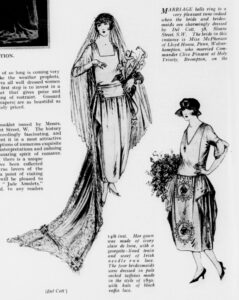
Sketches of Kathleen’s wedding dress and that of her bridesmaids.
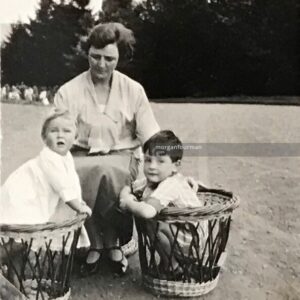
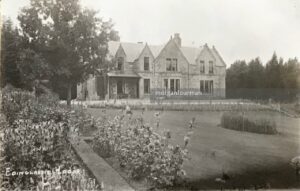
Clive was thirty-two years old when the war ended, and he was back in England and able to contemplate marriage. Clive Pinsent, of “Selly House”, Selly Wick in Kings Norton, became engaged to Kathleen Jane Macpherson, daughter of George Macpherson, a director of the “London and North West Railway”, in February 1921 (Staffordshire Advertiser: 26th Feb. 1921). They married at Holy Trinity Church, in Brompton, Kensington, London, on 14th July 1921. He had married into a wealthy family. His father-in-law, – in addition to being a “company director” was also the “Laird” of a modest (90 acres) but impressive estate at Edinglassie, near Huntly, on the border between the counties of Banff and Aberdeen. The Morganfourman.com website includes a description of a family visit to Edinglassie in 1727. The item includes photographs of the house, Clive and Kathleen and their children Andrew and James. Three of them are included here. They are much appreciated!
Clive and Kathleen had three sons. The eldest, Andrew Clive Macpherson Pinsent was born in 1922, while Clive and Kathleen were living in Gerrards Cross, in Buckinghamshire. Andrew went on to join the “Royal Navy” but, sadly, was invalided out after a diving accident. His brother, James Macpherson Pinsent, was born in 1925 which was after the family had moved to Stevenage, in Hertfordshire. He also joined the “Senior Service” (as the Navy was then called – presumably as a nod to its importance in British history). James retired in 1954 as a “Lieutenant Commander” and joined a firm of financiers. He later became a “Member of the Stock Exchange”. Clive’s youngest son, Ewen Macpherson Pinsent followed his brothers into Navy – the submarine service – but left after a few years to take “Holy Orders”. All three married and had children and their lives are discussed elsewhere.
Kathleen crouches with Andrew and Jim.
George Macpherson died in May 1924 (Aberdeen Press and Journal: 23rd May 1924) and left his estate at “Edinglassie,” near the village of Glass in Aberdeenshire, to Kathleen. Clive then resigned his commission – possibly because he was needed to run the estate. However, “Edinglassie” was to be a second home as the couple had bought a house, “Whitegates”, in Stevenage, in Hertfordshire in 1925 and it was their principal residence. Kathleen and her family, nevertheless, managed to spend a considerably amount of time at “Edinglassie” in the 1930s and 1940s
Edinglassie lodge, date unknown.
Clive was a “seaman,” but he was also interested in plants. He was a leading member of the “Stevenage Horticulturists Gardeners’ Mutual Improvement Society” for many years between the wars (Hertfordshire Express and General Advertiser: Saturday 5th February 1927). Commander and Mrs. Pinsent were on-hand when the delightfully named “Mr. Cutbush” gave his lecture on “Roses” (presumable how to prune them …) in March 1927 (Hertfordshire Express and General Advertiser: Saturday 26th March 1927). Perhaps predictably, the president of the society was a “Mr. H. G. Rose” (Hertfordshire Express and General Advertiser: Saturday 2nd February 1929). Commander and Mrs. Pinsent were both active when it came to fund raising and managing shows and they took part in related social events. Kathleen was keen on flower arrangement and submitted plants and flowers. Clive was the vice-chairman of the horticulturalists’ in 1930 and its Chairman in 1935 (Hertfordshire Express and General Advertiser: Saturday 9th February 1935).
Clive’s love of gardening shows through in article in the Quarterly Bulletin of the “Alpine Garden Society” (Vol. 68 (2000)). It shows that Clive and Clarence Elliott, a well-known and respected “horticulturalist” and founder of the “Alpine Garden Society,” purchased three acres of meadow near Stevenage. This was, presumably, what came to be known as Elliott’s “Six Hills Nursery”. Elliott specialized in rock plants and he named one, a successful saxifrage-crosses “Kathleen Pinsent” in honour of Clive’s wife. Writing in the Birmingham Daily Post (Friday 25th March 1955), Mr. Elliott said “The hybrid varied Called Kathleen Pinsent originated at my nursery in Stevenage many years ago, a most valuable and attractive break, with flowers of a pale soft pink.” The nursery’s land was used for food production during the “Second World War” and, sadly, it never recovered its pre-war prominence.
I am not sure of Clive’s level of involvement in the Nursery; however, he was clearly interested in what it produced! In 1938, the women of the “Glass W.R.I.” (“Womens’ Rural Institute”) were invited to explore the rock garden at “Edinglassie” while they attended for their annual garden party (Aberdeen Journal: 7th Oct. 1938). Clive was “vice-president” of the “Stevenage Horticultural Society” in 1938, and 1939 (Hertford Mercury and Reformer: 17th Feb 1939).
Clive had always been physically active. He had joined the “Welwyn Garden City Cricket Club” after retiring from the Navy and played for it in 1925 and perhaps also in later years (Hertford Advertiser: 18th July). He was elected “hon. vice president” of the “Huntly Cricket Club” in 1937, so may have played cricket in Scotland as well (Aberdeen Journal: 15th Feb 1937).
While in Stevenage, Clive focussed his attention on the management of the local hospitals. He was appointed “President” of the “Hertfordshire Hospital Council” in 1936 and had the pleasure of thanking “H.R.H. Duchess of Gloucester” for coming to Hitchin to open a new ward at the “North Herts. and South Beds. Hospital” that year. After the ceremony, he had the honour of escorting her around the building (Biggleswade Chronicle: 17th January 1936). While speaking at the Council’s annual general meeting the following year, he discussed the possibility of adding still more wards (Biggleswade Chronicle: 21st May 1937) and, in May 1939, was pleased to announce that there was now enough money available for them to add another and he hoped that work on a new maternity ward would start shortly (Hertford Mercury and Reformer: Friday 26th May 1939).
Clive’s wife, Kathleen, was also involved in local affairs. She was an active member of the “British Legion” and helped organize its poppy appeal in 1928 (Hertfordshire Express and General Advertiser: Saturday 16th February 1929). Kathleen was a member of the “Hitchin and District V.A.D.” (“Voluntary Aid Detachment”), an offshoot of the “Red Cross Society” responsible for improving access to medical care and, in 1929, she was a member of the team that won a competition to decide which branch would represent Hertfordshire in the “Stanley Shield Competition” (Hertfordshire Express and General Advertiser: Saturday 2nd March 1929).
Kathleen was the V.A.D’s “Commandant” and in February 1939 – before the war – and she gave a talk at a local “Women’s Volunteer Service” meeting for “Civil Defence” in which she stressed the need for a “British Red Cross” Unit in Stevenage. She went on to explain that if enough people took and passed a “home-nursing class” at the welfare centre they would be able to form a unit. Approximately 40 people volunteered (Hertford Mercury and Reformer: 24th February 1939). I hope enough of them passed.
The following year (1940), her husband rejoined the “Royal Navy” and was attached to “H.M.S. Drake”, the shore station at Devonport, as a gunnery officer attached to the staff of “C. in C. Western Approaches.” In fact, he was more than that. He was responsible for mine-sweeping and the safety of convoys along a considerable length of coast (Huntly Express: 20th August 1948). He may have been reluctant to talk about his war-time experience but he did, occasionally, give talks . He gave the people of Huntly a lecture on the role of mine-sweeping during the war. Clive retired from the Navy “for medical reasons” on 15th July 1943.
Clive and Kathleen moved to Plymouth where Kathleen volunteered to help out at a “free buffet” set up for service men and women at “North Road Station” by the “Plymouth’s Welfare Services.” It provided hot drinks and cake to service (and other related) personnel in transit through the station (Western Morning News: Friday 2nd February 1940). Kathleen probably did far more than this under the alias of “Mrs. Pinsent”. However, there were other “Mrs. Pinsents” around at the time and they may also have contributed to the war effort so I cannot be sure!
Nevertheless, I strongly suspect that Kathleen was the “Mrs. Pinsent” appointed “deputy centre organizer” of the “Plymouth Volunteer Service” in October 1941. In discussing “Mrs. Pinsent’s” appointment, the principal organizer mentioned that she had served in a “Voluntary Aid Detachment” during the last war – which rings true for Kathleen (Western Morning News: 3rd October 1941). After the war, Kathleen was to give a talk to the Auchindown W.R.I. (Scotland’s “Women’s Rural Institute”) on the work of the W.V.S. in Plymouth during the air-raids (Dufftown News and Speyside Advertiser: Saturday 23rd November 1946, see also Banffshire Journal: 19th November 1946).
On another occasion, her husband gave an illustrated talk on his “Naval Reminiscences” to the Women’s Guild (Dufftown News and Speyside Advertiser: Saturday 13th March 1948). Whether they harked back to his time at sea during and after the first world war, or concentrated on the second, I do not know.
Kathleen and her family spent a considerable amount of time at “Edinglassie Lodge,” near Huntly, in the early 1930s it must have seemed obvious to the ladies of the Glass “S.W.R.I.” (“Scottish Women’s Rural Institute”) that they should approach her – as wife of the “laird” – to see if she would take on the role of “president” when the then incumbent left the area in 1932 (Aberdeen Journal: 30th May 1932). She agreed to do so, and she held the post the mid into the 194os. Kathleen was a committed member of the “Institute” and one of her first acts was to invite the ladies to visit “Edinglassie” – where “Commander Pinsent gave an enjoyable talk on the Navy, illustrated by lantern slides” (Aberdeen Journal: 26th September 1932). Doubtless she had laid out an impressive Scottish tea for them. These visits to “Edinglassie” grew to become an annual event – often a picnic – for the “S.W.R.I.” during the 1930s, and Commander Pinsent or one of his sons occasionally presented a “cinematograph display.”
The institute allowed for the women to meet and discuss local issue, take part in competitions (best six eggs, best two-person supper available for sixpence, best green gooseberry jelly, best stitching etc.), play games, entertain guests from other chapters of the rural institute and even perform sketches and sing. There were prizes for everything. The “monthly” meetings were, to a lesser or greater extent, written up in the Aberdeen Journal and the Huntly Express. They invariably ended with votes of appreciation for the principal participants, the prizewinners, the ladies who supplied the tea and, not infrequently, Mrs. Pinsent for providing the prizes!
1935 was a typical year: the Aberdeen Journal shows that Mrs. Pinsent was re-elected as President of “Glass W.R.I.” (14th June 1935). The institute held a cookery demonstration and competition for strawberry-jam making for which Mrs. Pinsent gave prizes (21st August 1935). It held its (by now) annual “Garden Party” at “Edinglassie Lodge”, hosted by Mrs. Pinsent. There was a treasure hunt, a “guessing competition” (how many peas in the jar sort of thing), a cinema show presented by “Mr. Pinsent” (presumably one of her elder sons) and tea: prizes were handed out by the president’s youngest son Ewan Macpherson Pinsent who would have been approximately five years old at the time. The family was “warmly thanked for their Kindness by Mrs. Duncan, vice-president” (23rd September 1935). The following week, the institute held its cake and candy sale (30th September 1935). In October, “Glass W.R.I.” celebrated its 13th birthday with a whist drive and singing. Mrs. Pinsent, once again, gave prizes (Aberdeen Journal: 21st Oct. 1935).
A couple of years later, Mrs. Pinsent gave a talk on “how to protect one’s self against gas poisoning in air raids.” This was in January 1937 (Aberdeen Journal: 25th January 1937)! The talk seems somewhat prescient two years before the war. However, it is not that surprising that the issue of chemical warfare was important in the depths of Aberdeenshire as the ladies would have been very sensitive to the subject. Their fathers and/or husbands may well have served in France with the “Gordon Highlanders” during the “First World War” (Aberdeen Journal: 25th Jan 1937).
The “W.R.I.” continued to function after the start of the Second World War, in 1939, although once again many of the women’s husbands may well have been away on active service. The “Glass W.R.I.” was one of many local organizations that helped raise money for war-related charities. In 1943, Mrs. Pinsent was invited to open a , “Girls’ Club” toy and Christmas gift sale. She “praised the club for their efforts on behalf of the British Sailor’s Society and the Children’s League of Pity”. The sale raised £58 (Aberdeen Weekly Journal: 16th December 1943). The following August, Clive Pinsent applied (under the “War Charities Act”) to form a “Glass District Welcome Home Fund” to provide assistance and support for men and women discharged from war-service (Aberdeen Journal: 25th August 1944).
However, it was not all stress and worry. When their son, Lieutenant Andrew Pinsent, returned to Scotland with his new bride, Clive and Kathleen invited their tenants and the employees at “Edinglassie” to a dinner to meet the happy couple. The tenants gave them a clock as a wedding present (Aberdeen Weekly Journal: 30th August 1945).
Glass “S.W.R.I.” continued its philanthropic work after the war. It held whist drives and dances, organized jumble sales and arranged for dramatic performances in aid of returned “Prisoners of War” and the “District Nursing Association”. Kathleen’s children helped out when they could; so when Andrew and Gloria had their first child, the ladies of the institute “presented to Mrs. Pinsent a gold pin – for presentation to her (newly arrived) infant grandson”. She thanked them on behalf of the parents (Huntly Express: 26th April 1946). Her two elder sons were established in the armed forces by then and her third was about to join them. At a party for children held before Christmas, 1946 “Cadet Ewan Pinsent presented each child with gift from the Christmas tree he had decorated. They also got a bag of sweets and a sixpence” (Huntly Express: 17th January 1947).
Commander Clive and Mrs. Pinsent supported other local initiatives. They gave money towards the “Lord Provost’s Appeal” for a new hospital in Huntly (Aberdeen Journal: 9th November 1928) in 1928, and they supported a sale held on behalf of the “Glass & Cabrach Nursing Association”, (albeit from a distance: – they must have been “down south” when it was held, in April 1936). The money was for a car (Aberdeen Journal: 24th April 1936). Mrs. Pinsent was, however, around when the “Glass & Cabrach Nursing Association” held its sale the following year. On that occasion, Kathleen introduced Mrs. P. C. Garson, of Craigmore, who officially opened the sale. Ewan Pinsent was there to help. The Sale raised £33 for the cause (Aberdeen Journal: 11th October 1937).
In February 1946,when the “Glass Church Guild” held its inaugural meeting in the “Parish Hall,” Kathleen was elected “Hon. President” (Huntly Express: 22nd February 1946). The Guild seems to have had similar goals to the “S.W.R.I.”, but with more emphasis on religious instruction.
“Edinglassie” had a “Home Farm” or “Steading” where Clive bred Aberdeen Angus cattle and (probably) grew barley. His estate came with a well-known grouse moor where the “gentry” would come and shoot on and after the “Glorious Twelfth” (12th August – when the season started). Grouse were an important part of the local economy and the quantity and quality of the birds available in any given year was a matter of some concern: not only to the gentry that made up the “shooting parties” staying in the stately homes, but also to the restaurants in London. The birds were sent south by train.
In 1930, the grouse were thought to be plentiful; which must have pleased Commander Pinsent as he planned to lead a party on his moor at “Edinglassie” that year (Yorkshire Post and Leeds Intelligencer: 6th August 1930). Four years later, he is shown in a photograph entitled “A Grouse Shoot in Morayshire” printed in the “Tatler” newspaper (Tatler: 29th August 1934). Perhaps this was a return visit.
The “Scotsman” published an article discussing the quality and quantity of grouse available a few days before each season began, and it made up lists of those who planned to shoot, and where. It mentions that Clive Pinsent “of Stevenage” and a Dr. A. M. Cowie of Glenrinnes Lodge, Dufftown, would be shooting at Auchindoun in 1938 (Scotsman: 25th July 1938). The following year, when the prospects were thought to be good despite there having been a drought in the hatching season it reported that the Commander and Dr. Cowie planned to be back on the same moor – along with several other parties (Scotsman: 29th July 1939). Unfortunately, the shooting started for real in Europe a few weeks later and for the next six years people had other things on their mind. The birds must have appreciated the break.
Clive and his brother, John Ryland Pinsent, returned to administrative positions in their respective units in 1939. At some point Clive and Kathleen, perhaps reluctantly decided that, after the war, they would have to sell up and move south. In the meantime, the lodge needed some work. Mrs. Pinsent arranged for a contractor, a plasterer, who subcontracted the tiling of the kitchen and bathroom to a firm in Aberdeen. The latter set about the job and got it done. Mrs. Pinsent and her architect were, however, horrified by their shoddy job – particularly of the tiling on the kitchen floor – which had to be redone (Highland News: 23rd March 1940). The contractor and sub-contractor squabbled over the cost in the Sheriff’s Court in Inverness and he held for the plasterer (Highland News: 19th October 1940). The Aberdeen Journal tells us that Mrs. Pinsent put some “superior household furniture and furnishings” (including several mahogany items) up for auction in 1940 (Aberdeen Journal: 22nd May 1940).
Clive and Kathleen put the farm at “Edinglassie” up to let in 1943, which was about the time he retired from the Navy . It was said to consist of “42 acres of arable and 45 acres of rough pasture, a good dwelling house and steading” (Aberdeen Journal: 5th April 1943). Clive had, presumably, realized that he could no longer run the estate by himself. The steading came with a herd of beef cattle and Commander C. Pinsent won second prize for one of his Aberdeen Angus bulls at a competition held in Aberdeen. He sold it for 180 guineas (Dundee Courier: 7th February 1948).
The family held onto the Lodge and the estate buildings – although Kathleen was finding it increasingly difficult to hire domestic staff. She advertised for both a “cook” and a “house or parlour maid” for “Edinglassie” in February 1948 (Aberdeen Journal: 10th February 1948) a few months before her husband, Commander Clive Pinsent, died. He died 18th August 1948, and probate of his will was granted to his widow, Kathleen, and his elder brother, Sir Roy Pinsent (of the firm of Pinsent and Co. in Birmingham). His estate was reported to be worth approximately £138,000 (London Times: 10th February 1949).
It was time to go: The following notice appeared in the Aberdeen Journal on 2nd May 1949: “Village Houses in Estates Sale: Villagers in the hamlet of Haugh of Glass are likely to find their homes under new ownership soon. The village is part of the estates of Edinglassie and Glenmarkie, on the borders of Aberdeenshire and Banffshire, which is for sale. The estate also includes a well-known grouse moor and salmon and trout fishings on the River Deveron. Edinglassie House, which stands in fifteen acres of policies, is the home of Mrs. Pinsent, widow of the late Commander Clive Pinsent, R.N.”. Mrs. Pinsent had decided to put the estate on the market and, as another sign of abandonment, she sold the family car, a 1938 Morris 12 (Aberdeen Journal: 14th April 1949).
Mrs. Pinsent was much in demand before she left. She opened a “Grand Fete and Sale” in the school on 30th July. It was to raise funds to improve the village hall: Everything was for sale, from cakes to cattle. There were to be slideshows. There was to be a “Fortune-teller”. There was an auction and, of course, tea, and a dance to follow (Aberdeen Journal: 23rd July 1949). In August, Kathleen was invited to open the “Dufftown Horticultural Society’s” 71st Annual show and her address was published in the local paper (Dufftown News and Speyside Advertiser: Saturday 20th August 1949).
The people of Glass clearly appreciated what Mrs. Pinsent had done for them -giving donations and supporting charities and spending her time organizing and opening sales and fetes throughout the district and they must have been sorry to see her go. As a parting gift the parishioners gave her an album of pictures and paintings of classic views of Glass and Edinglassie, and the Kirk Sessions gave her a Bible. The tenants and household staff at Edinglassie gave her a leather sewing attache case (Huntly Express: 7th October 1949). Miss Gwen Bateson a.k.a. “Nanny Pinsent” was also honoured, as she too was leaving Edinglassie. She had been an active member of the W.R.I. and had regularly attended the monthly meetings. Miss Bateson, was presumably a long-standing retainer at Edinglassie. She may well have been a “nanny” when she first arrived.
In 1951, Kathleen moved to Petersfield in Hampshire, Presumably she wanted to be close to her sons and their families while they were growing up. Later, in about 1961, she moved up to Princes Gate, in London S.W.7 and lived there for several years before joining one of her sons in Chichester. She died there in the summer of 1974.
Please use the above links to explore this branch of the family tree. The default “Next” and “Previous” links below may lead to other unrelated branches.
Please use the above links to explore this branch of the family tree. The default “Next” and “Previous” links below may lead to other unrelated branches.