Frederick Pinsent was the youngest son of Charles Pinsent by his first wife, Mary (née Fullick). He was born at #8 Queen’s Terrace, in St. John’s Wood, London, in August 1852. This was shortly before his father was forced into bankruptcy. To make his father’s predicament worse, his mother died a couple of months later. Charles, who was a “cheese-monger” by profession married Georgiana Caroline Henley two years later and he arranged to be discharged from bankruptcy the following January (1855). The family then moved to #15, Little Norris Street, in Shoreditch, where Georgiana looked after Frederick and his siblings, and the two daughters she had by Charles.
Frederick’s father was clearly extremely stressed by his financial difficulties, and he committed suicide in 1863. His widow, Georgiana Caroline, was only twenty-six years old when he died and she had several young children to deal with. She remarried. She married James Murphy, who was a “carpenter,” in St. John’s Triangle Catholic Church in Hackney, in May 1864. This probably explains why Charles’s two younger sons, Alfred Pinsent and Frederick Pinsent went into the construction trades. His two older sons, Charles Pinsent and George Pinsent had long since left home, joined the “East Indian Army” and taken off for India in 1859.
Frederick Pinsent married Hannah Jane Oliver, the widowed daughter of Thomas Jenner, a Baptist minister, in June 1876. Both fathers were present at the wedding and signed the marriage certificate. Hannah brought two stepsons, Joseph East (9) and William (7) East, and one stepdaughter, Hannah East (4) into the marriage; however, they appear to have kept their own surname and are no cause for confusion in the family. Frederick and Hannah (and family) moved to Harrington Hill in Hackney, where they had five children of their own over the next eight years. Their eldest son, Frederick Charles Pinsent seems to have been born in Hackney almost a year before they married and their second, Thomas Benjamin Pinsent, a few months after their wedding. He died within a year. Their third child, Alice Amelia Pinsent arrived in 1878 and their next, a son, Alfred Charles Pinsent came after the Census had been taken in 1881. Their final child, Eliza Maria Pinsent was born in Hackney in 1883. However, she too was short lived.
Frederick was a bricklayer and his eldest son Frederick (16) was said to be a bricklayer’s labourer when the census was taken in 1891. The two younger children, Alice (11) and Alfred C. (8) were students. The family was then living at #16 Northwold Road, Hackney. Ten years on, in 1901, we find Frederick and Hannah Pinsent living at #106 Harlington Road in Walthamstow, in Essex, with their daughter Alice A. (22) who was then a waitress, and their son Alfred C. (20) who was a cook in a restaurant. Alice married in July, shortly after the census was taken.
Frederick and Hannah’s son Frederick Charles had married Jessie Maud Berrill and become a “coffee stall keeper” by the time the 1911 census was taken. The couple lived at #105 Forest Road, in Walthamstow, with Frederick Charles’s father and mother who had moved in with them. His father, Frederick, was said to be a “coffee stall assistant”. At the age of fifty-nine years, he had had enough of lugging bricks around!
Frederick and Hannah had moved out and they could be found at on Ridley Road, in Hackney in 1920, and at #73 Dalston Lane in Hackney in 1921. That was when the next set of census takers caught up with them. He as then said to be a “caterer’s assistant” who was employed by “F. C. Pinsent” – his son – “Caterer,” who lived next door at #71 Dalston Lane.
Hannah Pinsent died in Hackney in June 1926 and her husband Frederick died in West Hampstead, in Essex, in March 1929. Their sons lives are described elsewhere.
Please use the above links to explore this branch of the family tree. The default “Next” and “Previous” links below may lead to other unrelated branches.
Please use the above links to explore this branch of the family tree. The default “Next” and “Previous” links below may lead to other unrelated branches.
Please use the above links to explore this branch of the family tree. The default “Next” and “Previous” links below may lead to other unrelated branches.
Please use the above links to explore this branch of the family tree. The default “Next” and “Previous” links below may lead to other unrelated branches.
Please use the above links to explore this branch of the family tree. The default “Next” and “Previous” links below may lead to other unrelated branches.
Please use the above links to explore this branch of the family tree. The default “Next” and “Previous” links below may lead to other unrelated branches.
Ewen Macpherson Pinsent was the third and youngest son of Commander Clive Pinsent by his wife Kathleen Jane Macpherson. He was born in Hitchin in Hertfordshire in 1930. Ewen was five years younger than his brother James Macpherson Pinsent, and eight years younger than his brother Andrew Clive Macpherson Pinsent. The boys grew up in Stevenage in Hertfordshire and at their mother’s family home in “Edinglassie”, near Huntley – or at least they did until she sold the estate after her husband died in 1948. The family was “well connected” and Ewen found himself carrying the train of Hon. Elizabeth Blade’s gown when she married Capt. Hon. Guy Russell, R.N., son of Lord Ampthill, in St. Margaret’s Westminster, in February, 1939 (Northampton Mercury: 24th February 1939).
Ewen missed the “Second World War” but he came from a naval family and he, somewhat predictably, followed his father and brothers into the “Royal Navy”. He was a “Cadet” at “Dartmouth Naval College” in 1946 and a “Cadet Captain” by July 1947 (Western Morning News: 29th July 1947). It must have been quite a journey traveling from Plymouth, in Devon, to Aberdeen, in Scotland, and back by rail in the aftermath of the war; however, he dutifully returned to “Edinglassie” at Christmas in 1947 and helped his mother organize a party for the local children: “Cadet Ewen Pinsent presented each child with a gift from the Christmas tree, which he (had) decorated. They also got a bag of sweets and a sixpence” (Huntly Express: January 17th 1947).
The “Royal Navy List” shows that Ewen graduated and joined its ranks as a “Cadet” in May 1948. He was promoted to “Sub-Lieutenant” in May 1950, and to “Lieutenant” in December 1952. He was assigned to the “silent-service” (submarines) and stayed underwater until around 1956 – when he retired with the rank of “Lieutenant Commander”.
Ewen had at least one run-in with the law whilst in the navy. British roads can be a trial at the best of times and after the second world war some of them certainly needed work in terms of lay-out and design. “Sub-Lieutenant” E. M. Pinsent was sued by the “Liss and District Omnibus Company” for driving dangerously while he was stationed at Portland in Hampshire in 1951. He hit and damaged one of its buses while it was turning into its depot. On examination, the Judge determined that the bus had to cross over onto the “wrong” side of the road and turn to make entry and it had turned at right angles across the front of Ewen’s car as it crested a blind hill. Sub-Lieutenant Pinsent had done all that he could to avoid the collision. His Honour was not amused and he dismissed the suit! (Portsmouth Evening News: Saturday 29th September 1951).
After leaving the Navy, Ewen went to Eastern Uganda at the invitation of the Bishop of the Upper Nile, Bishop Usher-Wilson, to help with Christian youth (Western Mail: Monday 27th September 1956). Then, on his return, he joined “Her Majesty’s Overseas Civil Service” (H.M.O.C.S) and went back out to Africa – Northern Rhodesia (Zambia, as it is now) as a “District Administrator”. He sailed for Cape Town on the “S.S. Bloemfontein Castle”, on 21st October 1958 and was the District Officer in Fort Rosebery in the early 1960s (Dundee Courier: 17th November 1964).
Ewen returned home in December 1961 and was back in Scotland for his marriage to Jean Grizel McMicking, the only daughter of Major-General and Mrs. Neil McMicking, D.S.O., M.C., a senior Officer in Scottish Command. They married in Dunkeld Cathedral, in Perthshire in May 1962. The Dundee Courier describes and provides photographs of what was clearly a “society wedding” on 30th March & 28th May 1962. Ewen and Jean returned to Zambia shortly afterwards and Jean’s parents came out for a visit in 1963, shortly before her father died (Dundee: 26th April 1963). Jean returned home to have her children, including the middle two, twins, a boy and a girl, in 1964 (Dundee Courier: 17th Novemer 1964). Ewen retired from the “Overseas Civil Service” the following year and the family returned home to Scotland, where Ewen started to train for “Holy Orders”.
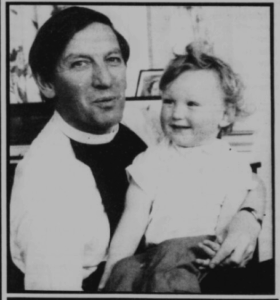
Ewen and baby Matthew appear in the Southern Reporter, August 13, 1992.
Ewen and Wife (GRO1372) had a fourth child while he attended the “Theological College,” in Rosebery Crescent, in Edinburgh, and as “curate” at Holt, in Norfolk. His first three children (including Thomas Neil Pinsent) were born in Scotland; however, his youngest, Matthew Clive Pinsent was born in Norfolk.
Reverend Ewen Macpherson Pinsent was appointed “Rector” of St. Andrew’s Church in Kelso in 1972, and he moved his family back to Scotland. While there, he read one of the lessons at the Duke of Roxburghe’s funeral service in St. Mary’s Cathedral in Edinburgh (The Times: Tuesday 8th October 1974). Ten years on, Rev. Ewen was assigned to three Anglican churches (Holy Trinity, Blendworth; St. Michael’s Chalton and St. Hubert’s Idsworth) near Portsmouth and he returned to England.
Ewen’s eldest son, Thomas Neil Pinsent, died of leukemia in 1984 and his father placed a bas-relief of St. Thomas in the organ loft of Holy Trinity church as a memorial. He also created a charitable trust in his son’s name. The “Thomas Pinsent Fund” received part of the proceeds of a two-day country fair held in Holkham in 1984 (Lynn Advertiser: Tuesday 4th December 1984).
The vicar faced another crisis two years later when a 70ft. fir tree crashed through the roof of Holy Trinity Church during a windstorm (Portsmouth Evening News: 1st February 1986). He called in the local builders for quotes and, presumably, arranged for the damage to be repaired.
Life moved on. Ewen served his parishioners well and was thanked by many of them for his sympathy in their time of bereavement (Portsmouth Evening News: 6th October 1986). He was also very active in the local community. Ewen was well aware of the plight of the elderly and, in February, 1986, he chaired a meeting of representatives of organizations hoping to reactivate an “Age Concern Group” (Portsmouth Evening News: 29th January 1986). A few months later, he joined and encouraged his congregation to take part in Bob Geldorf’s Sports Aid sponsored “Race against time” at Horndean (Portsmouth Evening News: 21st May 1986). He was later to ask the Parochial Church Council to find a replacement minibus for the Friday Knights youth group (Portsmouth Evening News; 16th July 1992).
The Reverend Ewen was a strong believer in ecumenical relationships and he went out his way to support Christians of other faiths. Approximately 100 local parishioners carried a six-foot cross in driving rain from St. Edmund’s Catholic to Holy Trinity Anglican church at Easter in 1986. The Rev. Ewen gave a blessing on its arrival (Portsmouth Evening News: 29th March 1986). He also encouraged the local Methodists when they set a a new “mainstream” Methodist fellowship group in the Horndean area (Portsmouth Evening News: 2nd December 1986).
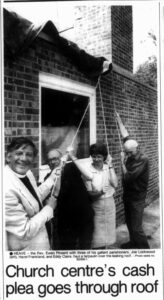
Rev. Ewen Pinsent and his parishioners in the Portsmouth Evening News in June 1990.
I wasn’t aware that Horndean is particularly wet and windy; however the Rev. Ewen Pinsent was back in touch with the local buildings in July 1990, when the Blendworth Church centre needed a new roof. Its flat roof had leaked for six years but it was now beyond repair. It needed a new pitched roof – at a cost of £30,000 (Portsmouth Evening News: 28th July 1986). The parish councillors acknowledged that the building acted as a community as well as a religious centre, and it stumped up £5,000 (Portsmouth Evening News: 29th August 1990). Needless to say, the parish formed an appeal committee! If that was not bad enough; thieves stole a Roland keyboard, valued at £900, from Blendworth Church the following year.(Portsmouth Evening News: 11th May 1991). It was being used as a replacement while the main organ was being rebuilt.
The Reverend Ewen had a strong affinity with the military – having served in the Royal Navy, and he led a well-attended reef laying ceremony at Horndean War Memorial service to honour “The Few” who took to the skies and defended the nation during the “Battle of Britain” in 1940 (Portsmouth Evening News: 11th September 1990).
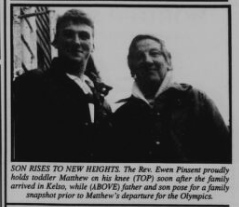
Matthew and his father pose for the Southern Reporter, 13 August 1992.
I do not, as a rule, refer to living people by name; however, it is difficult to do Reverend Ewen and his wife justice without some acknowledgement. Matthew Clive Pinsent (now Sir Matthew Clive Pinsent, C.B.E.) hardly needs any introduction. He has had an amazingly successful career, firstly as outstanding oarsman and secondly as a broadcaster for the BBC. He married Demetra Koutsoukos in 2002 and they have three children.
Matthew came to prominence and a fixture in the English press in the 1980s and 1990s as Steven Redgrave’s partner rowing in the un-coxed pairs at World and Olympic Games. The Portsmouth Evening News was one of many newspapers who followed his career in considerable detail and were delighted when Matthew won a gold medal and at the Barcelona Olympics, promptly returned to Blendworth for his sister’s wedding – escorted her down the aisle – and then headed back to Barcelona for the closing ceremonies (Portsmouth Evening News: 7th August 1992). Unfortunately for the community of Horndean, their pleasure and excitement was decidedly marred by the announcement of the murder of a local teenage girl (Portsmouth Evening News: 5th August 1992). As the Rev. Ewen put it: “obviously, I was very sad that the day Horndean was rejoicing over Matthew’s great success there was this awful deed being done,” and “It reminds one that there is evil the world as well as good.” …
The whole family went out to Atlanta in 1996 for the next games, and while there, his parents were interviewed by a reporter for the Evening News. They admitted their nervousness beforehand. According to his father said: “You always knew that if they rowed to their potential then they would be justifiable favourites, but there is always the thought that they might not row to their potential or that one or two of the other crews might row a great race. I don’t think you can ever be overconfident.” They also spoke of their relief when it was over and Steven and Matthew had added another gold medal to their tally. “How lovely that everything worked out well,” his mother said. “We were biting our fingernails. I was so pleased they got off to a good start, but there was so much tension in the late 500m.” (Portsmouth Evening News: 29th July 1996).
Ewen served in the Portsmouth area until 1992 and then moved to Child Okeford, in Dorset. In Child Okeford, Rev. Ewen came “under the tutelage” of one of the village “bell-ringers,” Michael Marshal. According to Michael’s obituary, published in “ringingworld.co.uk” in 2015, he was an “engineer” and “steam train” enthusiast, and he helped Ewen make a “1 1/4 inch steam train” for his grandchildren. The parish magazine tells us that the following year Rev. Ewen set about writing a short community play entitled “St. Nicholas, The Man From the Sea” for the local school children.
Rev. Ewen kept up with friends and he officiated at the thanksgiving service held to honour Gervais Clay, in North Cheriton, Somerset, in May 2009. Evidently Gervais had “also served in H.M.O.C.S. in Northern Rhodesia” (spanglefish.com/gervaisclay/index).
Matthew caused quite a stir in the Pinsent household over the Christmas holiday in 2004 when, having kept quiet for some time, he allowed his mother to open a letter from Downing Street that in part read … “Her Majesty may be graciously pleased to approve that the honour of Knighthood be conferred upon you.” (The Times 31st December 2004). If you are looking for more on him, I suggest you follow his career as described in countless articles and items in “The Times” and other newspapers, go on-line or look for his autobiography entitled “A lifetime in a Race”, published by Edbury Press in 2004.
Ewen Macpherson Pinsent died in Child Okeford in 2020. I am sure he will be missed.
Please use the above links to explore this branch of the family tree. The default “Next” and “Previous” links below may lead to other unrelated branches.
Please use the above links to explore this branch of the family tree. The default “Next” and “Previous” links below may lead to other unrelated branches.
Please use the above links to explore this branch of the family tree. The default “Next” and “Previous” links below may lead to other unrelated branches.
Please use the above links to explore this branch of the family tree. The default “Next” and “Previous” links below may lead to other unrelated branches.