Please use the above links to explore this branch of the family tree. The default “Next” and “Previous” links below may lead to other unrelated branches.
Please use the above links to explore this branch of the family tree. The default “Next” and “Previous” links below may lead to other unrelated branches.
Please use the above links to explore this branch of the family tree. The default “Next” and “Previous” links below may lead to other unrelated branches.
Please use the above links to explore this branch of the family tree. The default “Next” and “Previous” links below may lead to other unrelated branches.
Please use the above links to explore this branch of the family tree. The default “Next” and “Previous” links below may lead to other unrelated branches.
Please use the above links to explore this branch of the family tree. The default “Next” and “Previous” links below may lead to other unrelated branches.
Please use the above links to explore this branch of the family tree. The default “Next” and “Previous” links below may lead to other unrelated branches.
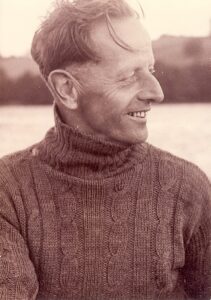
Gerald Swain Pinsent was the younger of William Henry Pinsent’s sons by his wife Minnie Gertrude (née Pearse). He was born in Teignmouth where his parents had tried, unsuccessfully, to set up and run a seaside boarding house. The project failed (William Henry Pinsent) and William was faced with bankruptcy in 1912. One of the reasons he gave for his financial distress was that he had to pay school fees (Exeter and Plymouth Gazette: Friday 16th February 1912). The fact that he had mismanaged the boarding house and had not wanted his father – a well known “brewer” in Newton Abbot – to know of his predicatment was probably also relevant.
It seems likely that William Henry sent his two sons Donovan Henry Douglas Pinsent and Gerald Swain Pinsent to “Wallingbrook School”, in Chumleigh, in North Devon in the mid-1910s and early-1920s. However, I have no direct evidence for his elder son ever being there. The “Pinsent” at “Wallingbrook” between 1921 and 1923 was probably Gerald Swain Pinsent. Donovan would have left by then. The English Private (“Public”) Schools traditionally referred to their boys by their surname alone, and add suffixes such as “Major” and “Minor” if there was more than one of them. In the absence of a suffix, “Pinsent” was probably Gerald. While at “Wallingbrook”, “Pinsent” took an active interest in sport. He played cricket and evidently bowled well—taking eight out of ten wickets in a match against “Barnstaple Grammar School 2nd XI” on one occasion in 1921 (North Devon Journal: Thursday 23rd June 1921).
He also took an active interest in track and field. “Pinsent” came second in the 440 yards race for boys over 14 years at the school sports day in July 1923 (Western Times: Friday 20th July 1923). “Pinsent” seems to have kept up his association with the school as he won the “Old Boys’ 100 yards sprint” (Exeter and Plymouth Gazette: Friday 24th July 1925) two years later, and he came third in the same event the following year (Exeter and Plymouth Gazette: Friday 23rd July 1926). He kept coming back! In July 1933, “Pinsent” won both the 100 yards and 220 yards sprints (Western Times: Friday July 21st, 1933). Gerald Pinsent was an active member of the “Paignton Amateur Athletic Club” – which may account for his continued success – and for my conviction that the “old boy” is, in fact, Gerald. Gerald evidently specialized in track and field and he did well in the 100 yards handicap, the 220 yards handicap, and the 220 yards hurdles at a sports day held in conjunction with the “Paignton Lifeboat Day Celebration” (Western Morning News: Thursday 9th August 1928). Similarly, he came in second in the final of the 220 yards “open” handicap at the “Babbacombe Sports Meet” when it was run the following year (Exeter and Plymouth Gazette: Monday 12th August 1929). He also won the Men’s Hurdles at the Paignton Club’s home event in September that year (Torbay Express and South Devon Echo: Thursday 12th September 1929). In the early 1950s, The Paignton Observer and Echo ran a segment with clipping “from the Paignton Observer of 25 years ago.” Gerald must have been amused to see the results from his races in 1928 and 1929 come back to haunt him – as they did on 24th September 1954 and 15th July 1954 (and other dates).
Gerald represented the “Paignton Club” in 100 yards and 220 yards, “open” handicap races at events held in Harberton, Torquay, Exeter and Brixham the following year, in 1930. He came in first in the former and third in the latter at Brixham (Exeter and Plymouth Gazette: Tuesday 26th August 1930). In 1931, it was a similar story, as it was also, although to a lesser extent, in 1932. That year, he won the 440 yards “open” handicap in Paignton (Western Morning News: Thursday 14th July 1932).
Gerald Swain Pinsent probably played soccer (“football”) for the “Paignton Rovers” while living in Paignton in the mid-1920s. However, it was actually “Pincent” who took to the pitch (Western Morning News: Wednesday 17th February 1926). Oddly enough, his daughter was later to acknowledge this alternative spelling. Nevertheless, Gerald’s later and most enduring interests seems to have been tennis and golf. He played both singles and doubles tennis matches competitively from 1937 through to at least 1950. In 1937, he partnered with J. Harvey to win the “Men’s Double Handicap” at the “Teignmouth Tennis (Hard Court) Tournament” (Western Morning News: Thursday 10th July 1937). From then on, at least up to the start of the war, he entered both men’s single and also mens’ doubles and mixed doubles competitions on a fairly regular basis – doing well in some and less well in others. In the winter months, he threw in the odd game of squash as well (Western Morning News: Tuesday 13th December 1938).
Gerald appears in the Torbay Express and South Devon Echo, 18 June 1951.
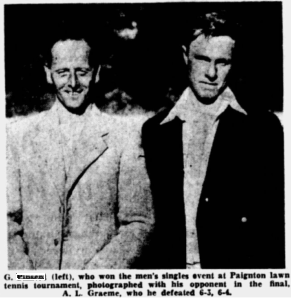
After the war, Gerald returned to tournament play and his name crops up fairly frequently in descriptions of match results. The Torquay Times and South Devon Advertiser (Friday 8th June 1951) noted the presence of two “prominent local players , C. E. Ware and G. Pinsent” when the “Paignton Lawn Tennis Tournament” was held in 1951, and the Torbay Express and South Devon Echo (Monday 18th June 1951) tells us that Gerald won the singles event and says that “Pinsent played very steadily and seemed to be the complete master of the conditions and of the ball. The final was less of a battle and Pinsent was a worthy winner …”. For some reason, he stopped playing competitive tennis the following year and his retirement was deemed worthy of note (Torbay Express and South Devon Echo: Monday 9th June 1952).
Gerald had played squash to keep his eye in and occasionally represented the “Torquay Imperial Squash Rackets Club” (Western Morning News: Thursday 17th April 1947), and if that were not enough, he played golf at the “Newton Abbot Golf Club” (Western Morning News: Thursday 31st March 1949) and later at the “Churston Golf Club” in Paignton. He played well and won the Churston Club’s “Presidents Cup” in 1958 (Paignton Observer and Echo: 11th December 1958). He was still playing in 1962.
Gerald Swain Pinsent was a “clerk” for a wine and spirit merchant when he married Dorothy James, in June 1928. He may have been either living or visiting with his father at “Riverside Bungalow” on the Ashburton Road, in Totnes at the time. Gerald and Dorothy had a daughter, Margaret Mary Pinsent in October that year.
Margaret had a different take on physical activity. She studied dance under Miss Hazel Hexter (M.I.S.T.) at the Hazlemere School of Dancing in Paignton, and was one of the younger members when her pupils gave “a really splendid display of classical dancing” in 1938 (Paignton Observer and Echo: 18th May 1938). This was one of many performances that Miss Hexter’s pupils gave prior to, during and after the war. Margaret achieved Grade III at the Spring Session of the Royal Academy of Dance examinations in May 1941 and featured in another performance the pupils gave in August 1941 (Paignton Observer and Echo: 29th May & 14th August 1941). She was. awarded a Grade V (Higher Division) certificate with honours in 1943 and achieved full certification in September. 1945 (Paignton Observer and Echo: 27th May 1943 & 27th September 1945).
Hazel Hexter, the principal of the Hazlemere School of Dancing, took on two of her erstwhile students, Nancy Dodd and Margaret Pincent (sic) as assistants the following spring. Margaret taught at the school and performed through to at least May 1947 (Paignton Observer and Echo: 29th May 1947).
Margaret left Paignton around then. She married a United States Serviceman, Joseph Albert Beaulieu [SKD3, U.S. Navy, No. 7518214] in 1947 and emigrated to the United States as a “war bride”. Gerald and Dorothy went out to see her in 1949. Embarkation records show that they left for New York on the “Cunard White Star Liner Queen Elizabeth” on 2nd December 1949 and returned a few weeks later. They went out again in 1954, and 1956, perhaps to inspect grandchildren (?). Gerald and Dorothy had no other children of their own – that I am aware of.
Gerald Swain and his wife lived in Paignton but attended the “Dart Vale Harriers Hunt Ball” in Totnes, in January 1929 (Western Times: Friday 11th January 1929). Gerald was back in Totnes a couple of months later visiting his father, and was present when the latter had his laundry stolen (see William Henry Pinsent)! Apparently, his father had given a vagrant permission to sleep in his barn and he had taken off with a bag of laundry that William had left collection. The vagrant sold the clothes to a woman who turned him in to the police (Western Times: Friday 15th March 1929).
Gerald had met the magistrates a few years earlier. Gerald (then of “Woodcot,Morin Road”, in Paignton) had, unfortunately, knocked over an aristocratic Dutch visitor (Baroness Van der Werff) while riding his firm’s motorcycle through Torquay. The car in front of him had slowed down to allow a couple of pedestrians to cross the road ahead of it – so that they could catch a tram that was going in the other direction – and Gerald had misread the situation. He had tried to overtake by cutting through between the car and the tram — and had collided with the Baroness. He was charged with dangerous driving, although he claimed to have being going at no more than 12 and 15 miles per hour. His lawyer suggested that “the law had too long been inclined to regard the pedestrian as always being in the right and the motorist in the wrong. In that case the defendant had been taken by surprise. His vision was obscured by the motor-car, and the fact that he pulled up in two or three yards showed that he was not travelling at an excessive speed” (Torquay Times, and South Devon Advertiser: Friday 29th July 1926). The magistrates, nevertheless, fined him 40s and asked for £3 10s in costs for damage to the tram, and they endorsed his license (Western Morning News: Tuesday 6th July 1926). One has to wonder if the status of the victim – who does not seem to have been hurt – influenced the magistrates.
Gerald was living on Tarraway Road in Paignton when called to give evidence at a “Coroner’s Inquest” in Ashburton in June 1929. The Newspapers tell us that he had been a passenger in a car that had (the misfortune – you should try it!) of following two lorries (trucks) along a narrow Devon road. His colleague, who was driving, testified that they were so incensed that one of the lorry drivers appeared to be drunk that they stopped the car when passing through Buckfastleigh and told a policeman about it. The constable joined them in the car and they drove off after the lorries. They caught up with them at the “Half Moon Inn” near Ashburton and saw the second lorry crash into the back end of the first, which was, by then, parked. Unfortunately, its driver had been standing behind his vehicle and he had been killed in the crash. The inebriated driver of the second lorry had killed the sober driver of the first! For some reason, the “Coroner” called it an “Accidental Death” (Western Times: Friday 28th June 1929).
Gerald had another brush with the powers-that-be during the early months of the war when he fell afoul of some recently imposed blackout regulations while living in Newton Abbot running an “Off-Licence” at 103 Queen Street (1939 Register). His grandfather would, doubtless, have approved of his profession. Perhaps the outlet had originally been attached to the family brewery. It seems that Gerald failed to notice that there was a light on in a room when he left his house and he had not got back in time to turn it off. P.C. Holland made a note of the infraction and dutifully entered the house by means of a ladder to turn of the light. Gerald was fined 10s (Torbay Express and South Devon Echo: Tuesday 17th October 1939).
Gerald later became a “wine and spirit merchant” in Dartmouth (?). Gerald and Dorothy lived in Dittisham, and then in Brixham in the 1950s and early 1960s. However, it seems likely that they moved up to Ruislip, near London, to be near their daughter, Margaret, who had returned to England with her familly. The Electoral Registers show that Gerald and Dorothy were living on Ickenham Close in Ruislip in 1964 and 1965. Sadly, Margaret’s young son Gerald Albert Beaulieu, an American by birth aged 13 years old, died there in 1967.
The couple finally settling in Maidenhead, in Berkshire, in 1968. Dorothy Pinsent died there in 1986 and Gerald returned to Devon. He was back living in the Torbay area when he died in 1993.
Please use the above links to explore this branch of the family tree. The default “Next” and “Previous” links below may lead to other unrelated branches.
Gerald Hume Saverie was the third and youngest son of Adolphus Ross Pinsent by his wife Alice Mary (née Nuttall). He was born in Montevideo, Uruguay, in 1888. His parents returned in England in 1890 and Gerald and his brothers, Sidney Hume Pinsent and Cecil Ross Pinsent grew up in Hampstead in London. His father was a business man and company director who, initially at least, focused on South American.
Gerald’s elder brothers, Sidney Hume and Cecil Ross Pinsent, were educated at “Marlborough College” but Gerald was – for some reason or other – sent to another “Public” (private) school – The “King’s School Canterbury”. Perhaps it was because he received a “Junior Scholarship” there in 1903. Like so many of his family, Gerald was a talented mathematician. While at “King’s”, he edited the school paper, was “President of the Debating Society” and he was “Captain of School” in 1906/7 (King’s School Canterbury Register). I admit, that is a far better showing than I was able to achieved while there in the 1960s!
Gerald was awarded a major scholarship and moved on to “Trinity College” in Cambridge to study mathematics. He did well in the “Mathematical Tripos” examinations in 1907 and 1908 and was listed among the “Wranglers” when the results of his final exams were announced in June 1910. Where he came in the “Mathematical Tripos” ranking is not stated. Unlike in previous years, the results were released in alphabetic order that year – not by marks achieved (Birmingham Mail: Tuesday 14th June 1910). Gerald graduated from Cambridge with a B.A. and received an M.A. in 1914 (London Evening Standard: Monday 11th May 1914).
Gerald and his elder sister, Frances Maude Pinsent, had taken an ill-fated trip to Switzerland the previous summer and were fortunate to have survived. They found themselves among a group of tourists snowbound on the Matterhorn (Leeds Mercury: 23rd August 1909). Fortunately, they were rescued and (apparently) came away none the worse for the experience.
While at Cambridge, Gerald was a friend of Rupert Brooke, the poet – “If I should die, think only this of me; that there’s some corner of a foreign field that is forever England … ” . Rupert was, of course, just one of many of his generation killed on active service.
Gerald came first in the “Civil Service (Entrance) Examination” held in 1911 and, being a mathematician, was appointed to H. M. “Treasury”, although, one of his first assignments was at “No. 10 Downing Street” where he served as the “Prime Minister” (Herbert H. Asquith’s) private secretary (Belfast Weekly Telegraph: Saturday 29th November 1913). Only three of the 93 successful Civil Service candidates that year had Indian names and the colonial papers grumbled that only a few of the better candidates were likely to sign on for service in India (India: Friday 29th September 1911). Perhaps they were right.
The “P.M.O.” or “Prime Minister’s Office” – as it is now known – was far less sophisticated and well organized in the early 1900s than it would (or perhaps should) be today. In 1975, Gerald reminisced about his time there, and his observations were published in a book entitled “At Power’s Elbow: Aides to the Prime Minister from Robert Walpole to David Cameron” by Andrew Blick and George Jones (Biteback Publishing: 2013). Gerald (erroneously called “Giles” in the book!) describes how important Prime Ministerial patronage was to governance. He says he was frequently asked to assess the views of “parsons” being proposed to livings, and to review the lives of candidates (poets, artists, historians, scientists etc.) who might be eligible for “Civil List” pensions.
Gerald must also have written countless “brush-off” letters on behalf of the Prime Minister. One he wrote was to Lord Clinton. It was published in the Exeter and Plymouth Gazette on 10th February 1914 and informed his Lordship that the Prime Minister saw no need for the “Royal Commission into the Disposition of Land” that he proposed; and he strongly implied that the P.M. felt parliament was perfectly capable of dealing with matters of this kind on its own – thank you very much! Similarly, a few days later, the Derby Daily Telegraph (18th February 1914) released a letter that Gerald wrote on Asquith’s behalf to a delegation from the “Northern Men’s Federation for Women’s Suffrage.” After downplaying the Prime Minister’s inability to meet with them, Gerald pointed out that Mr. Asquith’s position on the subject was well known and he had nothing new to add. In neither case did the newspaper get Gerald’s name and initials right, but they were close enough! Gerald had made quite an impression on the “Prime Minister,” and he was invited to dinner at #10 Downing Street on 9th February 1914 (London Times: 10th February 1914) to be presented to His Majesty, King George V (London Times: 18th February 1914).
Gerald left Downing Street and took leave from the “Treasury” in November 1914 and obtained a commission in “His Majesty’s Armed Forces”. He joined the “Royal Garrison Artillery” as a “Second Lieutenant” and went to France the following February and was attached to “No. 2 Mountain Battery” when he married in December 1915 (Ilsington Gazette: 23rd Decembr 1915). Gerald was promoted to (temporary) “Lieutenant” and was mentioned in dispatches (London Gazette: 15th June 1916) in 1916; although I do not know what for, and he was officially “demobed” in 1919. He was awarded the “Victory” and “British Medals” and the “(1915) Star Medal” for his wartime service (British Army WWI Service Records).
After the war, Gerald Hume Saverie returned to the “Treasury” where he was “private secretary” to the Right Hon. Austen Chamberlain, M.P., the “Chancellor of the Exchequer” (London Times: 18th January 1919). A note placed in the “Pall Mall Gazette” informed its readers that Gerald, who had been ill for several weeks that spring returned to work in June (Wednesday 18th June 1919). Presumably he had lost his position with Mr. Chamberlain as he was transferred back to the “Treasury Department” (Westerham Herald: Saturday 9th August 1919).
Gerald was attached to several British delegations between the wars, including one sent to the “International Relief UnionInternational Conference” in Geneva in 1927 (London Times: 6th July 1927). I gather nobody was prepared to speak at the first meeting and that the British Government “entertained grave doubts about the merits of the proposal” (Daily News: (London): Tuesday 5th July 1927). Gerald also attended the “Hague Conference on Economic Reparations” in Paris in 1929 (London Times: 16th December 1929).
The issue of German debt relief dragged on and, in July 1931, we find “financial experts representing Great Britain, Belgium, France, Germany, Italy, Japan and the United States met at the Treasury (this morning) to examine the outstanding questions regarding the methods of giving effect to President Hoover’s proposal for one year’s suspension of war debt and reparation payments.” They agreed that Sir Frederick Leith Ross should chair a meeting of Ministers on the matter, and that Mr. Pinsent and Mr. Peroine, should serve as “secretaries” (Civil & Military Gazette: (Lahore): Monday 20th July 1931).
On the domestic front; Gerald had the extreme misfortune to crash into the back of a stationary police car containing an officer of Scotland Yard’s “Flying Squad” that October! He was charged with driving “without due care and attention.” The officer; however, was forced to admit that his car’s rear light was not actually at the off-side but nearer the middle – which might have caused some confusion at night on a poorly lit street. Gerald, in his defense, said that he applied his brakes when he realized he was close to the police car – but by then it was too late. He was fined 20s and 10s 6d costs (Westminster and Pimlico News; Friday 30th October 1931).
Gerald, or “Jerry” as he was commonly known was loaned to “His Majesty’s Ambassador” in Berlin as a “financial adviser” in 1932 and he lived in Germany through to 1939 (Who’s Who: 1971-1980). While there, he watched the rise of Hitler and the “National Socialist Party” with growing concern. In the summer of 1934, Germany imposed import and currency controls on British businesses and Gerald was temporarily “recalled to London” – always a clear sign of annoyance at the host country – for meetings that were to lead to a high-level discussion on the “German debt problem” that September (Dundee Courier: 22nd September 1934).
Gerald had been one of Sir Frederick Leith Ross’s “private secretaries” at a conference convened in London in July that year to discuss President Hoover’s proposal to defer Germany’s (First World) war debt repayments for a year. The current financial crisis arose from the collapse of trade brought about by the “Great Depression” (Coventry Evening Telegraph: Friday 17th July 1934). The Germans argued that they could not possibly finance future trade if they were hamstrung by past debt (Coventry Evening Telegraph: Wednesday 19th September 1934). Perhaps they had a point.
Several of Gerald’s letters, reports and memoranda can be found in the “Public Record Office” at Kew. Paul N. Hehn, in his book “A Dishonest Decade: The Great Powers, Eastern Europe and the Economic Origins of World War II, 1930-1941”, notes that “Michael” (sic) Pinsent thought “it was probable …in actual fact that the economic recovery (seen in Germany between the wars) has been stimulated less by public works properly so-called than by special factors: viz: rearmament and the revival of the motor trade” (the removal of the tax on cars). Elsewhere, he states: “They have severely limited their own capacity to export by the armament program. Their desire for more raw materials is in fact created by their armament program, and not by the intention of raising the Germans standard of living”. Gerald was appointed a C.M.G. (“Companion of the Most Distinguished Order of St. Michael and St. George”) in June 1935 (The London Times: 3rd June 1935).
When the war with Germany finally came, Gerald was assigned to the “British Embassy” in Washington where he worked with the Americans, including their “Secretary of State” Hull and “Secretary” Morgenthau, to block the sale and/or transfer of German assets (Treasury Department: Inter Office Communication: May 20th 1940: FDRLibrary). He also helped Sir Frederick Phillips, the head of the “British Mission” to negotiate and then implement the “Lend-Lease Bill” (The London Times: and Coshocton Tribune 7th December 1940).
The “United States Congress” passed the bill in February/March 1941. It was a hastily designed agreement by which the Americans agreed to supply the British and other allies with materiel in support of the war effort. They did so in exchange for access to the allies military bases and for unspecified “future considerations”. It was left to Sir Frederick and the “Secretary of State”, Henry Morgenthau Jr. to work out the details. This was no easy task, as can be seen from Morgenthau’s diaries and other documents filed in the “National Archives” in Washington (and now available on line). For instance, when Gerald and a colleague suggested that a British company (“Courtalds”) would prefer to use its shares in its American affiliate (“Viscose”) as co-lateral for a loan, rather than sell them outright (Morgenthau Diaries: February 15th 1941) they received a testy response to the effect that Morgenthau felt that it would be politically impossible for him to “sell” the idea in “Congress”.
When the Americans asked Gerald why the British Government did not just requisition the shares and sell them, he pointed out that it was not British Government policy to take over public companies. Morgenthau revisited the issue at a staff meeting on 11th March (Morgenthau Diaries: March 11th 1941). After discussing Britain’s financial position and need for a bailout in considerable detail, Morgenthau insisted that “I cannot go on the Hill and try to explain on this appropriation bill why the English Government has not been able to sell one of its many hundreds of factories in this country. I can’t explain it.” He instructed his staff to tell the British that there would be no more negotiations until the British backed down. The Americans were determined to have their pound of British flesh. In his book “The Juggler: Franklin-Roosevelt as Wartime Statesman” Warren F. Kimball mentions a memorandum that “Joel Pinsent” (British Financial Counselor) sent to Acheson at the State Department on the 27th March, 1941. Why Gerald’s name gave so many writers so much trouble I am not sure!
In 1942, Gerald moved to Ottawa as “Chief of the British Food Mission” – an agency that purchased food from the “Canadian Government” and arranged for it to be shipped to England. He remained there until April 1943, when he returned home to be “Principal Assistant Secretary to the Board of Trade”. He was promoted to “Principal Secretary” the following year and took on the job of “Comptroller-General” of the “National Debt Office” from 1946 to 1951 (Who’s Who: 1971-1980). It must have been a particularly thankless task, given the state of the economy.
“Second Lieutenant” Gerald had married Katherine Kentisbeare (“Kitty”) Radford, the daughter of a “solicitor” and “Member of Parliament” (Sir George Heynes Radford), in London in December 1915, shortly after joining the Army. The Pinsent and Radford families had been well known to each other for quite some, time as Gerald’s aunt Edith Mary Pinsent had married John Heynes Radford in 1880. You can find more about the Radfords on-line at the ‘Radford Sister Project’. They were an artistic family and it is perhaps not surprising that Kitty performed in a comic play entitled “Christopher Walks” that entertained soldiers in the Winchester area in early 1916 (Hampshire Chronicle: 19th February 1916).
Gerald and Katherine’s elder daughter Chloe Pinsent was born in London in 1920. The census taken the following year shows that Gerald was a “Principal Clerk” employed by “H.M. Treasury” in Whitehall, S.W.1 and that he lived on Heathcote Street with his wife Katherine and their infant daughter, Chloe. They employed a young “domestic nurse and housemaid.” Gerald’s younger daughter, Audrey Jane Pinsent was to be born in Paris in 1925.
Katherine Radford’s family was from Devon and she lived in Exeter while her husband was abroad in the 1930s. Sadly, their marriage ended in divorce in 1938 – probably in part because of Gerald’s interest in Margot von Bonin. Katherine never remarried. She moved to a small house “suitable for a family of three and two kept servants” in Exeter (Exeter and Plymouth Gazette: 4th February 1938). and lived there with her daughter Audrey, who was still a schoolgirl. Katherine provided “Auxilliary Transport” during the war (1939 Register) and may have done other war-work under the title of “Mrs. Pinsent.”. Katherine was fined £1 for failing to “observe traffic signals” on one occasion in 1945 while living on Magdelene Road, in Exeter (Torbay Express and South Devon Echo: Wednesday 10th October 1945). She died in Exeter in March 1949 (Western Morning News: 25th March 1949).
Gerald’s elder daughter, Chloe, studied German at “Girton College” in Cambridge (Birmingham Daily Post: Monday 17th June 1940). She probated her mother’s estate when she died in 1949 and married Ian Douglas Morton, a New Zealander, the same year. They had three children in the 1950s. Chloe was a member of the “Institute of Linguistics” in 1978. She died in Harpenden, in 2013. Her younger sister, Audrey Jane, studied biochemistry at “Newnham College” in Cambridge and graduated with a B.A. degree in 1946, and with a Ph.D. in 1949. Audrey visited the United States in 1949; however, she was back in time to marry Quentin Howieson Gibson, a “medical practitioner” and “physiologist” in Sheffield, in 1951. They had four children and emigrated to the United States in the early 1960s. Audrey Jane lectured at “Pennsylvania University” and became a full “Professor at Cornell University” in 1966. She died in 2008 (Memorial Notice: Cornell University).
Gerald married Margot Von Bonin in April 1939. She was the daughter of George Von Bonin, a “Major” in the German army. She had formerly been the wife of a Wolfgang Muller Clemm. They married in the “Kensington Registry Office” on 26th April and a week later sailed for New York on the “Cunard White Star” liner, “Queen Mary.” Gerald was traveling on a diplomatic passport for the express purpose of joining the “British Diplomatic Mission” in Washington. They had no children.
The couple took a flight to Miami on 29th December 1941. Perhaps there was a diplomatic purpose to the trip, but Gerald paid for the tickets himself and it seems more likely that they were heading down to South America to see Gerald’s brother Sidney Hume Pinsent. The deeply suspicious officials in Miami describe Gerald as being 53 years old, 6 ft 1 in tall, of fair complexion, blue eyes and graying hair. They noticed that he had two damaged fingers on his left hand. One wonders if they were from frostbite or from damage received while on active service during the “First World War” (Index to Alien Arrivals by Airplane at Miami, Florida: 1930 – 1942: Ancestry.com).
Gerald returned home to England for a visit after his stint in Washington and then flew back to New York, en route to Ottawa, to take up his new position. He took an “American Export Air Lines” flight from Foynes, in Ireland to New York on 14th September 1942. The Immigration Officials in New York provide a similar physical description to that of their Miami counterparts. However, they also note that he was a married “Civil Servant” and helpfully add that he was “Chief of Food Mission of Ottawa” and then “in transit to Canada.” (New York Passenger Lists: 1820-1957: Ancestry.com).
Gerald and Margot returned to England in April 1943 and settled in Warwick Square, in London. “Jerry” resumed his work for the “Treasury”. He was made a “Companion of the Order of the Bath (Civil Division)” in 1949. I am sure it was well-earned! Gerald and Margot lived in London until July 1950, when Margot died. Gerald retired as “Secretary and Comptroller of the National Debt Office” the following year.
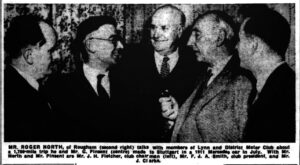
Gerald (centre) talks with Roger North and other members of the Lynn and District Motor Club, via the Lynn Advertiser, 9 November 1962.
Gerald maintained his adventurous spirit in retirement. He joined a friend, Mr. Roger North of Rougham, in driving Mr. North’s completely rebuilt a 7 1/2 litre 1911 Mercedes 28/60 car to a Rally in Stuttgart in July 1962 (Lynn Advertiser: Tuesday 10th July 1962). It was an eventful journey of about 1,700 mile and the two of them gave the “Lynn and District Motor Club” a talk about it the following November. The Lynn Advertiser (Friday 9th November 1962) not only describes the talk but it provides a photograph of the car and drivers.
Gerald may have enjoyed driving, but he must have regretted a trip he took in November the following year as he was slightly injured in a two-car collision on the Gayton Road in Lynn (Lynn Advertiser: 12th November 1963). The collision occurred when Mrs. Mason, who was driving the other car, realized that she was about to collide with a car ahead of her that was slowing on a narrow road. She swung out into the oncoming lane and, presumably hit Gerald. She had her license endorsed for causing the crash (Lynn Advertiser: Friday 31st January 1964). There was no fault attributed to Gerald.
“Jerry” was involved in another collision later that year. This time, he was held responsible; his license was endorsed and he was fined £10 and ordered to pay another £10 in costs. The defending counsel said it was “a very unfortunate accident due to Mr. Pinsent putting a wrong interpretation on the signal he saw given by Mr. Harrowing.” He had assumed that the “bubble car” he saw ahead of him was trying to overtake a slower vehicle whereas it was slowing down in order to make a right turn. He had rear-ended the car and sent it, the driver, his wife, mother and year-old baby into a ditch. Fortunately, no-one seems to have been hurt. Gerald told the court: “that he had been driving fairly continuously since 1912 in England, the Continent, the U.S.A. and Canada” (Lynn Advertiser: 17th November 1964). Yes, he probably had. Nothing daunted, he and Mr. Roger North set out on yet another Rally drive in the rebuilt 1911 Mercedes the following May. This time it was closer to home. They drove from Lynn to Windermere, in the Lake District “without the slightest hitch” (Lynn Advertiser: Friday 25th June 1965).
Gerald Hume Saverie Pinsent of Narford Hall married for a third time in 1971. He married the widow of Sir Lionel Fletcher (Luba Schaposchnikoff) in East Dereham, in Norfolk and they lived in Saffron Walden until Gerald died, aged 87, in February 1976. His half-brother, Basil Hume Pinsent, who was a “solicitor”, probated his estate. He left an estate valued at £41,859 net (Herts and Essex Observer: Thursday 27th May 1976). Luba, or Lubov as she was, perhaps, more rightly known, had been born in Tanzania, which was then a German Colony. She did not acquire British Citizenship until June 1971 (HO/334/1486/19103). She died in London in January 1979.
Please use the above links to explore this branch of the family tree. The default “Next” and “Previous” links below may lead to other unrelated branches.
Gerald Arnot Pinsent was the only son of Charles Pinsent by his wife, Henrietta (née Perraton). Gerald was born in Edmonton, Alberta, some time after his family moved there to be close to Henrietta’s parents. Gerald’s older sister, Doris Sybil Pinsent, was born in Cardiff, in Wales, before they emigrated.
Gerald was educated in Edmonton. He joined the “Royal Canadian Air Force” and met and married Elsie Louise Smith in December 1942, while serving in Victoria, British Columbia, during the “Second World War”. They had two daughters, both of whom were born in Edmonton. They both married and are probably still alive. After the war, Gerald returned to Edmonton and he qualified as a “dental surgeon” in 1950. After that, he returned to the coast and set up a family oriented dental practice in North Vancouver (www.legacy.com/obituaries).
Gerald wrote a letter to “North Vancouver City Council” in March 1955 complaining of an accident hot-spot in their jurisdiction. It was, perhaps predictably, forwarded to the “Traffic Committee.” One hopes that they did something to address his complaint …
My father wrote to him at some point and told him that I was living in Vancouver. He had small boat and he invited me to go salmon fishing in Georgia Strait with some of the family in the early 1970s.
Gerald’s wife, Elsie, died in 1980 and he married again; although I am not sure when or where. I am not aware of any children from the second marriage. Gerald died in North Vancouver in 2013.
Please use the above links to explore this branch of the family tree. The default “Next” and “Previous” links below may lead to other unrelated branches.