Vital Statistics
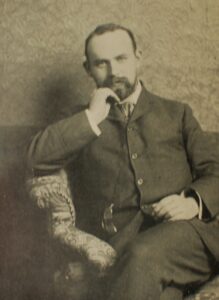
Hume Chancellor Pinsent: 1857 – 1920 GRO0435 (Solicitor, Birmingham, Warwickshire)
Ellen Frances Parker: 1866 – 1949 (Novelist and Mental Health Advocate)
Married: 1888: Mitford, Surrey
Children by Ellen Frances Parker:
David Hume Pinsent: 1891 – 1918 (Civilian Observer, Royal Aircraft Factory)
Richard Parker Pinsent: 1894 – 1915 (Second Lieutenant, Royal Warwickshire Regiment)
Hester Agnes Pinsent: 1899 – 1966 (Married Dr. Edgar Douglas Adrian, Master of Trinity College, 1923)
Family Branch: Devonport
PinsentID: GRO0435
Click here to view close family members.
Hume Chancellor Pinsent was the third and youngest son of Richard Steele Pinsent and Catherine Agnes (née Ross). He was born in Devonport and educated in Birmingham at “Edgbaston Proprietary School.” He later attended “Amersham Hall”, a “Public” (Private) school near Reading in Berkshire. He was a good student who excelling in mathematics (like so many in his family), and also achieved distinction in Religious studies and English. He was awarded a “sizarship” (maintenance grant) that was worth £60 over two years by “St. John’s College, Cambridge” in 1874 (Reading Mercury: 4th April 1874). Another boy, named Ryland, was also awarded a “sizarship” at St. John’s at the same time (Hour: Saturday 10th 1874). Who he was, I am not sure, but Hume’s brother Richard was later to marry into the Ryland family (1878).
Hume continued his study of mathematics and matriculated at “London University” later in 1874. He came first in honours and was awarded a “Foundation” Scholarship. Hume Chancellor then moved to “St. John’s College” in Cambridge where he became a joint fourth “Wrangler” in its prestigious annual “Great Mathematical Tripos” in 1877 (Leeds Mercury: 26th January 1878). Hume received his “Bachelor of Arts” in 1877 and was elected a “Fellow of St. John’s College” in 1879. Two years later, he received his “Master of Arts” degree (Bury and Norwich Post: 10th May 1881). At some point, he also found time to study law! How he managed that, I am not sure. Hume Chancellor, was “admitted solicitor” in May 1882 and “Called to the Bar” at the “Middle Temple” in London in November 1882 (Morning Post: 18th November 1882).
Hume Chancellor worked at the “Chancery Bar” in London until 1888, at which point he returned to Birmingham and join his brother (Richard Alfred Pinsent) as a partner in the firm of “Smith, Pinsent and Co.,” (Birmingham Daily Gazette: Friday 23rd January 1920). Later that summer, he married Ellen Frances Parker, the daughter of a Lincolnshire “clergyman” (Birmingham Daily Post: 30th July 1888). They probably met through her brother, Robert John Parker, who was at “King’s College” in Cambridge at the same time that Hume was at “St. John’s”. Robert was another successful lawyer. He was later to become a Judge of the “Appeal Court” and a peer of the realm – Baron Parker of Waddington.
According to Daniel J. Kevles (“In the Name of Eugenics”: 1985), Hume Chancellor, Robert John Parker and his sister Ellen Frances Parker were all members of the Cambridge “Men and Women’s Club” founded Karl Pearson, a friend of the Parkers’. Karl was another brilliant mathematician. He was third “Wrangler” in 1879. Like Hume, he went up to London and studied for the bar. However, he never practiced as his main interest was in applied mathematics. Pearson was a protégé of Sir Francis Galton, who founded the “eugenics” movement, and Karl applied statistics to Galton’s ideas on heredity. Pearson was later appointed to the Chair of a “Department of Eugenics” at “London University” funded by Galton’s estate.
Karl Pearson seems to have been none too pleased when Ellen Frances and Hume Chancellor became engaged! He is reported to have said: “I suppose Miss Parker will now devote herself to housekeeping and possibly the piano. She might have done excellent work, if she had had the ordeal of getting her own living by some profession for a few years, instead of passing from home to home.” Perhaps he was bit jealous. He had yet to marry. As we shall see, Ellen Frances Parker – Mrs. Hume Pinsent as she became – was to make a very considerable contribution to the world of mental health. She was, in fact, honoured for it.
Hume’s role in the family firm, which may have been known as “Smith, Pinsent, Pinsent, and Freeman” for a few years in the early 1890s (East End News and London Shipping Chronicle: Tuesday 20th January 1891) is less obvious (at least through the press) than that of his elder brother, Richard Alfred. He may have spent more time working behind the scenes on contract law, while his brother, who was more active in cases requiring arbitration became the face of the company. However, he did occasionally make it into court. For instance, we find him in “Court of Chancery” in 1888 calling for an injunction against a local “publisher” who plagiarized the plaintiff’s “Birmingham A.B.C. Railway Time Tables.” The parties agreed on a sum for damages (Birmingham Daily Post: 3rd March 1888).
Elsewhere, we know that Chancellor joined the firm “as a solicitor, a notary and commissioner for oaths, and also a commissioner for affidavits for Newfoundland” (Kelly’s Directory: 1903). How much business he got from Newfoundland, I am not sure! However, he did witness several “United States Patent Applications” between 1894 and 1907 (U.S. Patent, Trademark Office Patents 1790-1909 (Ancestry.com). He also represented his clients (Birmingham Water Annuitants) at probably very boring “Government Board Meetings” (Birmingham Daily Post: 14th December 1893).
Hume served as a director on a number of small local companies (“Webster’s Brickworks Limited” etc.: Coventry Telegraph: 20th December 1900). He may have invested in others (“Sharpness Chemical Company”: Gloucester Citizen: 29th December 1903) and been more active in the Courts than is shown – as “Mr. Pinsent” (Richard or Hume?) frequently turns up in support of barristers active in commercial suits. There was no doubt about it. Birmingham was a major centre for commerce in the late 1800s.
Hume and Ellen had two sons and one daughter. Their eldest son, David Hume Pinsent (a friend of the Austrian philosopher Ludwig Wittgenstein), was a civilian “observer” at the “Royal Aircraft Factory” at Farnborough when he died during a test-flight in 1918. Apparently the plane, piloted by a “Lieutenant” Lutyens, broke up in mid-air. The couple had previously lost their second son – during the “First World War.” Richard Parker Pinsent, was a “Second Lieutenant” in the “Royal Warwickshire Regiment” killed on active service in France in the summer of 1915. Their lives are discussed elsewhere.
Hume and Ellen’s daughter, Hester Agnes Pinsent, was one of 132 female students, staff, visitors and servants at Somerville College, in Oxford when the census was taken in 1921. She lived to take up her mother’s interests and also to marry a future “Nobel Prize” winner, Dr. Edgar Douglas (later Lord) Adrian, the “Master” of “Trinity College”, Cambridge.
The Pinsents lived at “#18 Greenfield Crescent” in Edgbaston, Birmingham, for a few years and then moved to “#6 Church Road”, in Harborne (Kelly’s Directory of Birmingham 1897). They lived there while their children were young and it is from there that Ellen Frances posted the following advertisement after the delivery of her second son: “A LADY wishes to recommend her Lady-Nurse as NURSE to children out of arms, or as Nursery Governess, or as Companion: Highest personal testimonials. Mrs. Hume Pinsent: (Guardian: Wednesday, May 9th, 1894).
The family eventually settled into “Lordswood House”, on Lordswood Road in Harborne, Birmingham. Ellen ran the house with the help of five servants (1901 Census). It is now (or was until recently) a “Group Medical Practice Centre”. The family lived there until December 1913 when Hume retired from “Pinsent and Co.” and Ellen Frances resigned from her position on “Birmingham City Council”. While living in Birmingham, Hume and his wife were well respected members of the community and they could be relied upon to support local initiatives that frequently relied on upper-middle class charity. It is not surprising to see that Hume and Ellen contributed to the “Appeal of the City Aid Society” (Birmingham Mail: Monday 19th October 1908).
Hume tended his garden while living on “Lordswood Road” and was quite competitive about it. He won first prize for his “Twelve Pots of Begonias” at the “Birmingham Chrysanthemum Show” in 1910 (Sutton Coldfield News: Saturday 12th November 1910) and for “12 Bunches of Border Flowers” at the “Birmingham Floral Fete” in July 1912 (Birmingham Mail: Friday 19th July 1912). He also did well at the “King’s Heath Flower Show” the following month (Birmingham Mail: Monday 5th August 1912) – but only came in second with his beets at the “West Birmingham Show” that year (Sports Argus: Saturday 24th August 1912). The following year he came third in the “group of plants arranged for effect” category at the “Mosely, King’s Heath and Balsall Heath Horticultural Society” show (Birmingham Mail: Monday 4th August 1913). He liked his garden but, nevertheless, retired – perhaps for health reasons – to “Glenfield”, Foxcombe Hill, near Oxford in 1914. Perhaps it had a better one.
Richard Alfred and Hume Chancellor (and their wives for that matter) were strong supporters of scientific and educational establishments in Birmingham. Hume was elected to serve on the Council of the “Midland Institute” in 1898 (Birmingham Mail: Friday 14th January 1898) and was appointed a vice-president the following year (Birmingham Mail: Tuesday 10th January 1899). In 1900, Hume offered the use of the Institute’s library to “Birmingham Archaeological Society” as a place to meet and also to keep and study their various treasures (Birmingham Daily Post: 25th January 1900). Richard Alfred, was appointed a “Life Governor” of “Mason University College,” in Birmingham, at the same time as his brother joined the council “ (Birmingham Daily Post: 19th January 1900). The college was one of several institutions that formed the nucleus of “Birmingham University” and “Pinsent and Co.” contributed £1,000 0s 0d to assist in its foundation (Birmingham Daily Mail: Monday 4th July 1989).
After the amalgamation, Hume Chancellor was appointed “Treasurer” of the first “Board of Governors of Birmingham University” and he held the position until he left the City in 1913 (Birmingham Mail: Saturday 5th July 1913). It was a young institution, one of Hume’s principal duties was to build its endowment fund and help set remuneration levels. In February 1913, he pointed out that the University “could only be carried on by very substantial grants from the nation and from the immediate locality” (Birmingham Mail: Wednesday 12th February 1913). When the University appealed for funds in 1909, Hume Chancellor and his brother Richard Alfred Pinsent contributed £750 (Birmingham Mail: Thursday 18th February 1909).
Hume was a appointed to the “University Council” in 1907 (Birmingham Mail: Monday 11th February 1907) and shortly afterwards to a committee looking into the establishment of a Hall of Residence on Hagley Road for “a small number of female students” (Birmingham Mail: Thursday 20th June 1907). He was a“vice president” in 1910 (Coventry Evening Telegraph: Tuesday 1st March 1910). When the Vice-Chancellor died in 1913 and his replacement had been selected, it fell to Hume to formally nominate Dr. Barling to fill the position – and to ceremoniously conduct him to his chair of office (Birmingham Mail: Wednesday 12th February 1913).
Hume and Ellen were no stranger to ceremony and they were both invited to attend a luncheon held when the King and Queen visited Birmingham and its University in 1909 (Birmingham Mail: Wednesday 7th July 1909). Hume was, needless to say, among the “distinguished company” that assembled to witness the unveiling of the stature of King Edward that now stands by the Council House (Birmingham Mail: Wednesday 23rd April 1913). He resigned when left the city in 1913/4 – as he felt that it would be difficult to carry out the task at a distance. Nevertheless, he ultimately agreed to remain on the “Council” (Birmingham Daily Post: 20th February 1914). As it turned out; however, the war intervened and he returned to Birmingham to help his then badly understaffed brother run “Pinsent and Co”. While he was there, Hume and Ellen lived at “Little Wick”, a house on the grounds of his brother’s property, “Selly Wick House” (Chapel of Lonely Heart).
Hume had joined the “Council” of the “Midland Institute” in 1897 (Birmingham Daily Gazette: Friday 23rd January 1920) and when it put on a lecture series through its affiliation with “Birmingham University,” in October 1914, he gave a talk entitled “The War: It’s Origin, the Justice of Cause and the Issues at Stake”. In it, he said that, although there had been considerable tension in Europe for many years, the blame for the outbreak of war should lie with “those who ultimately controlled the policy of the German Empire — that was, the leaders of the military caste — who had made up their minds that the time had come to risk a war, and that the Austrian grievance against Serbia was a convenient pretext for doing so. They decided, therefore, to force Russia either fight or to accept humiliation which would have outraged the feelings of her people, paralyzed her influence among the Slav nations in the Balkans, and left Austria supreme mistress there.” In response to the question, “Why must England fight?” he said “England must fight, and must join with the other independent European States in fighting the foe which threatened to crush the weaker nations, and to stifle and trample upon the free development of all the other peoples, socially, ethically, and intellectually. Hence our arrangements and undertakings with France and Russia. Hence the moral obligation we had undertaken toward the former not to stand by and see her overcome by Germany” (Birmingham Daily Post: Tuesday 6th October 1914). The talk was well received. Sadly, Hume lost both of his sons to the war. His younger son, Richard Parker Pinsent was killed on the Western Front the following year and his elder son David Hume Pinsent was killed on a test flight at the “Royal Aircraft Factory”, at Farnborough, in May 1918.
Hume Chancellor Pinsent died at “Glenfield”, Foxcombe Hill and was buried in Wootton in Berkshire (London Times; 22nd January). The “Calendar of Grants of Probate and Letters of Administration” show that his widow, was granted probate – and that his effects amounted to £46,405 5s 10d – later re-sworn as £45,582 12s 10d. Among other donations, he left a bequest (£250) to “Cambridge University” (The Times: March 29th 1920). His shares in “Great Western Railway” passed to his widow. Predictably, “Pinsent and Co.” saw to the probate of the will and the transfer of the shares.
In 1924, Dame (as she was by then) Ellen Frances Pinsent and Sir Horace and Lady Emma Darwin gave £5,000 to “Cambridge University” to promote research into problems caused by “mental defects, diseases or disorders” (The Times: October 15th 1949). They made the donation in memory of her husband, Hume Pinsent, Erasmus Darwin and her sons David Pinsent and Richard Pinsent who were all “Scholars” or “Exhibitioners” of “St John’s and Trinity Colleges” (Cambridge) and “Balliol College” (Oxford). Some of them had been lost during the war. Apparently, news of David Hume Pinsent’s death … received at Salzburg railway station … precipitated such a hysterical fugue in his close friend Ludwig Witttgenstein (1889-1951) that he dedicated his Tractatus Logico-Philosophicus (1921) to (David) Pinsent (History of Neuroscience and Psychiatry: www.psychiatry.cam.ac.uk). The funds were used to create the “Pinsent-Darwin Studentship in Mental Heath” at the “Graduate School of Life Sciences” at Cambridge University. Ellen and her children’s lives are discussed elsewhere.
Family Tree
GRANDPARENTS
Grandfather: Thomas Pinsent: 1782 – 1872
Grandmother: Mary Savery: 1780 – 1859
PARENTS
Father: Richard Steele Pinsent: 1820 – 1864
Mother: Catherine Agnes Ross: 1830 – 1906
FATHER’S SIBLINGS (AUNTS, UNCLES)
Mary Savery Pinsent: 1806 – 1884
Thomas Pinsent: 1807 – 1826
Anna Pinsent: 1809 – xxxx
Elizabeth Savery Pinsent: 1811 – xxxx
Sarah Savery Pinsent: 1812 – 1813
Savery Pinsent: 1815 – 1886
Sarah Pinsent: 1817 – 1847
John Ball Pinsent: 1819 – 1901
Emma Pinsent: 1823 – 1831
MALE SIBLINGS (BROTHERS)
Adolphus Ross Pinsent: 1851 – 1929
Richard Alfred Pinsent: 1852 – 1948
Please use the above links to explore this branch of the family tree. The default “Next” and “Previous” links below may lead to other unrelated branches.