John Pinsent

Vital Statistics

John Pinsent: 1690 – 1737 GRO1716 (Soap Boiler, Kelly and Leigh in Hennock)

Margaret Luscombe: xxxx – xxxx
Married: 1720: Exeter

Children by Margaret Luscombe:

Sarah Pinsent: 1721 – 1805 (Married James Wreaford, 1741, Hennock)
John Pinsent: 1723 – 1800 (Married Elizabeth Puddicombe, 1742, Crediton)
Thomas Pinsent: 1726 – 1757 (Married Mary Gildon of Kingsteignton, 1752; Inherited Leigh from his father).
Mary Pinsent: 1728 – xxxx
Elizabeth Pinsent: 1732 – 1804 (Married Joseph Wills, 1754; Her stepfather, Ambrose Rackett of Crediton, was a witness).

Family Branch: Devonport
PinsentID: GRO1716

Click here to view close family members.


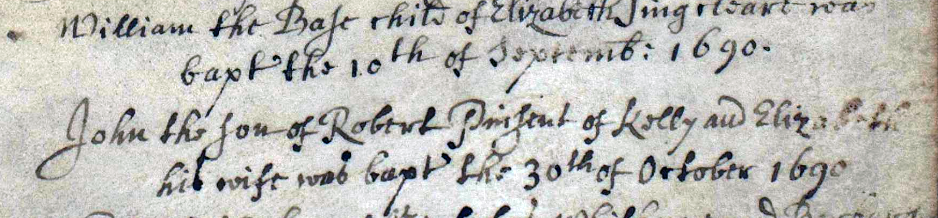
Handwritten note of John's baptism. Son of Robert Pinsent of Kelly and Elizabeth, his wife, was baptized the 30th of October 1690.
John is baptized in 1690.

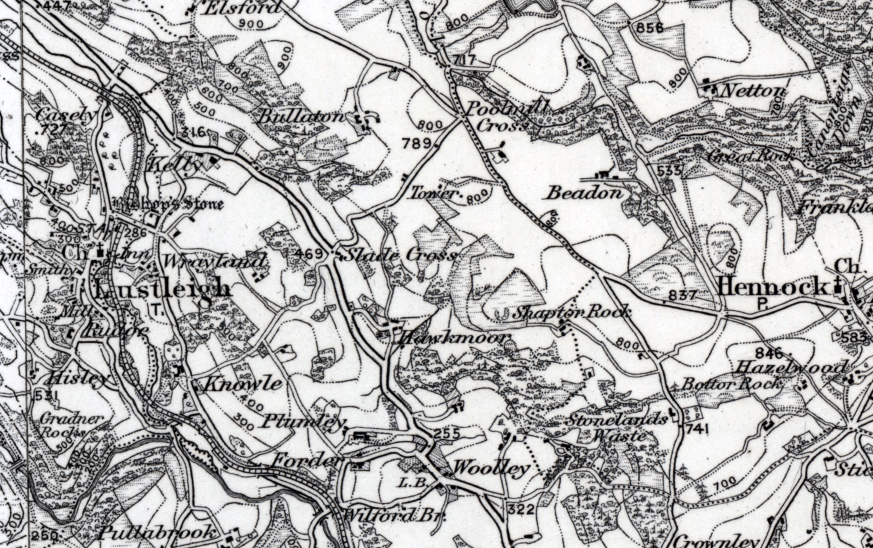
John Pinsent (1690 – 1737) was the son and sole heir of Robert Pinsent and Elizabeth (née Delve) of “South Kelly” in Hennock.  His father was a soap boiler and he was brought up in the family business. John married Margaret Luscombe, of Chudleigh, in Exeter in February 1720 (Exeter Marriage Licenses) and they had two sons and three daughters between 1721 and 1732. Three of them — Sarah Pinsent, Thomas Pinsent and Elizabeth Pinsent — were baptized in Hennock but the other two John Pinsent and Mary Pinsent were christened in Lustleigh, which was a far more convenient church and one whose jurisdiction would later be extended to include Kelly. Interestingly, Robert Pinsent Collings was baptized in Lustleigh a few months before John. Presumably, his mother was Mary Pinsent of Huxbeare – who had married Mr. Joseph Collings in 1700.

Cluttered black and white map displaying Hennock and Lustleigh close together.
Map of Lustleigh near Hennock.

According to Cecil Torr, in “Wreyland Documents: 1910”, John took over his father’s soap boiling business as part of his marriage settlement in February 1719/1720. His father retired from the production side of the business but retained “the shopp, the shopp chamber and the entry chamber through the garden next adjoining to the high way leading from Bovey Tracey to Moretonhampstead, parcel of the premises called South Kelly” for himself (as discussed elsewhere). Presumably Robert and Elizabeth still enjoyed being a shopkeepers.

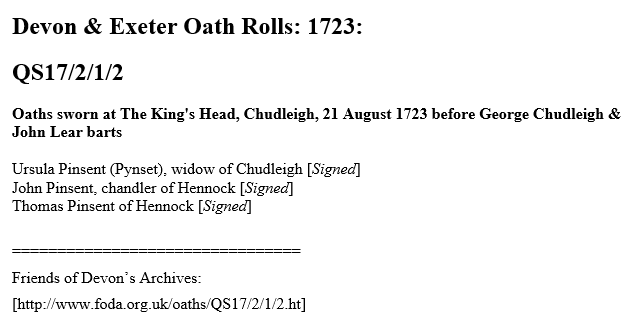
Transcript of a document reading "Devon & Exeter Oath Rolls: 1723: QS17/2/1/2 Oaths sworn at The King's Head, Chudleigh, 21 August 1723 before George Chudleigh & John Lear barts. Ursula Pinsent, widow of Chudleigh, John Pinsent, chandler of Hennock, Thomas Pinsent of Hennock." All three signed their names.
John swears an oath at The King’s Head in 1723.

It must have been a successful business as John took on apprentices. He was the “tallow chandler” who took on Thomas Luscombe of Chudleigh (probably one of his wife’s relatives) in 1721 and added Thomas Ellis in 1729 (Apprentices of Great Britain 1768-1774). He was also the “chandler” of Hennock who signed the “Devon and Exeter Oath Roll” in 1723. It was a declaration against “transubstantiation” aimed at limiting the job prospects of Roman Catholics – “Transubstantiation” being an article of faith for Roman Catholics and an anathema to the protestant church!

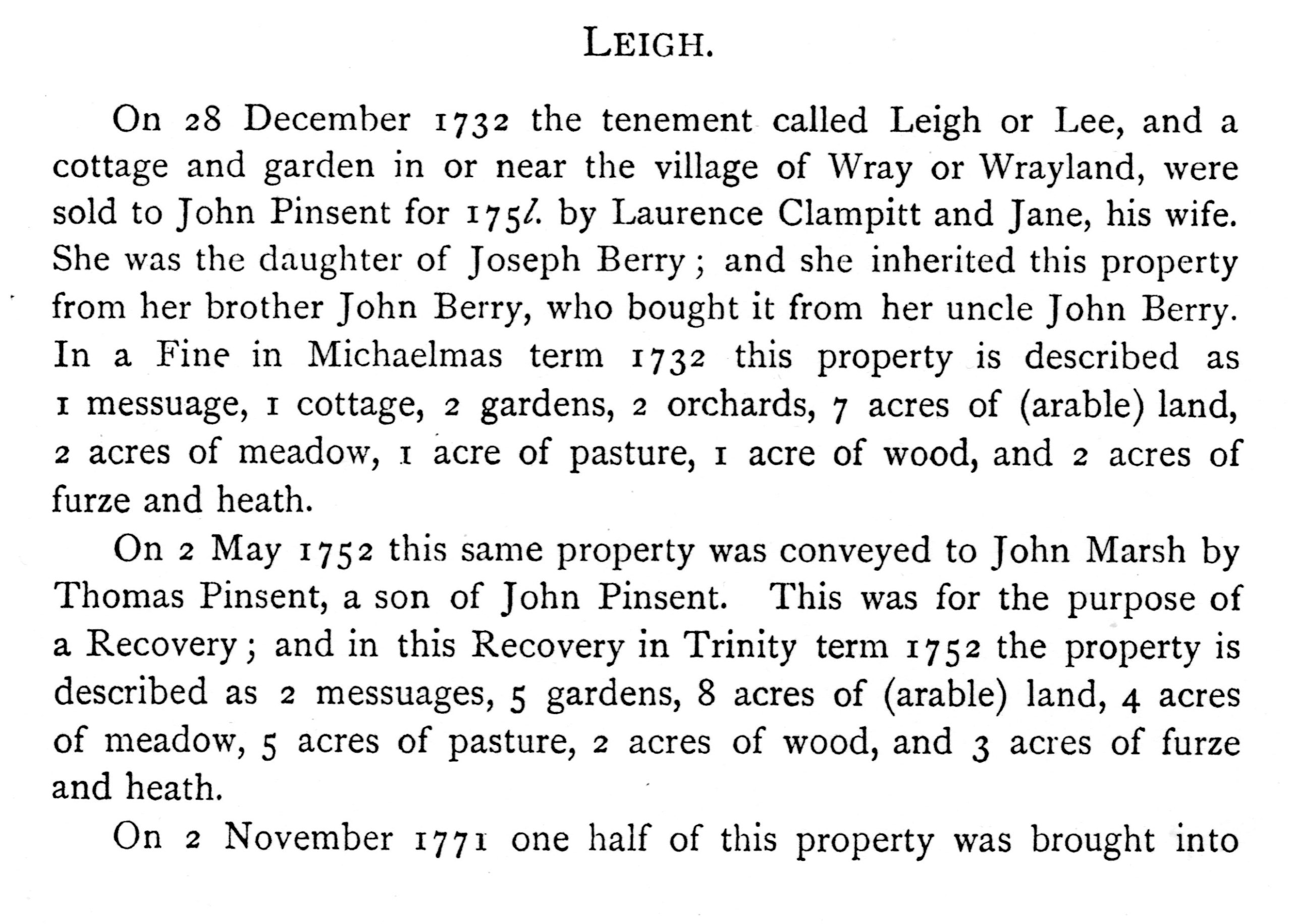
Excerpt describing the sale of a tenement called Leigh or Lee on December 28, 1732 to John Pinsent. On May 2, 1752, the same property was conveyed to John Marsh by Thomas Pinsent, a son of John Pinsent.
John’s purchases the tenement at Leigh in December of 1732.

John Pinsent paid parish rates of between 1/- and 1/6d for his land in Hennock between 1728 (when records resumed after a break) and 1738, the year after he died (Hennock “Church Wardens’ Accounts”). Then, as now, it can take time for the bureaucrats to catch up. He also appears on a list of Hennock “Devon Freeholders” that was compiled before his death, in 1737.

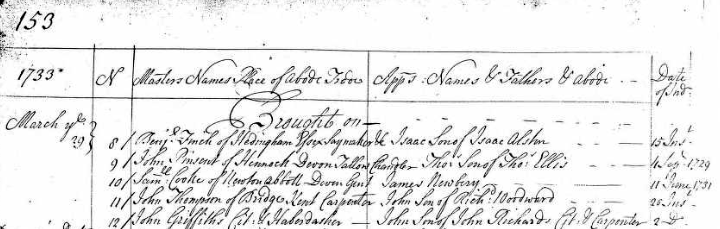
Entry dated March 29, 1733 listing John Pinsent of Hennock, tallow chandler
John appears in the UK Register of Duties Paid for Apprentices’ Indentures for March 1733.

John seems to have served on the “Manor Court Jury” in Wreyland periodically between 1711 and 1725 and he was, specifically, “presented” for non-appearance in 1727 (Wreyland Documents: Cecil Torr, 1910). He must have been elected “Church Warden” in 1736, as he approved the Hennock “Church Wardens Accounts’” that year. This was shortly before he died.

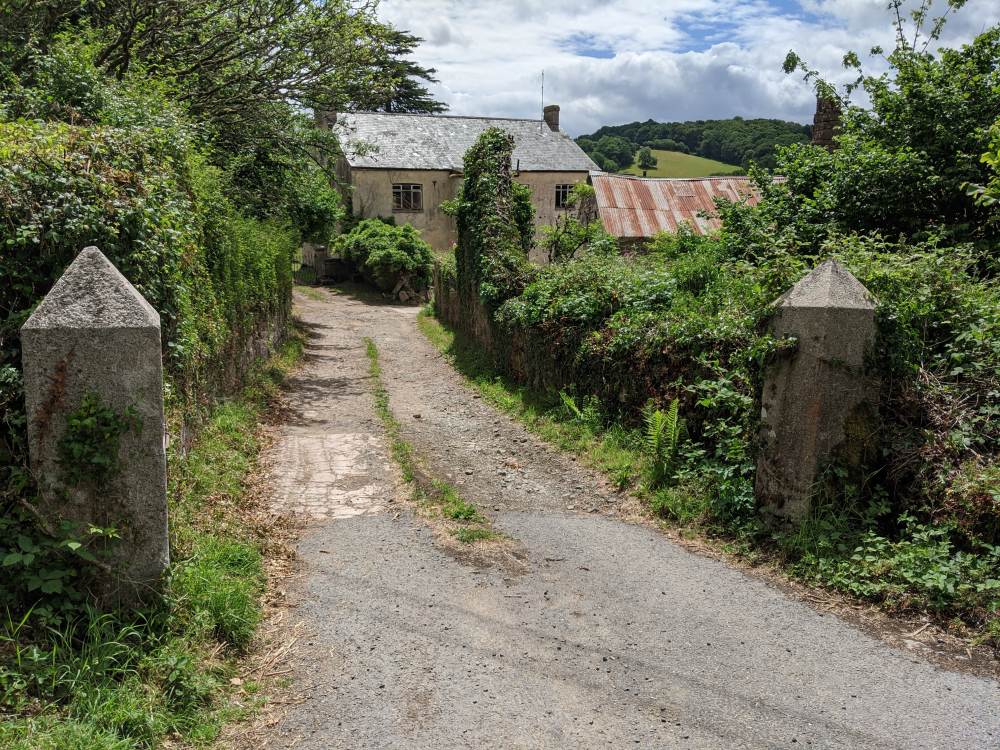
Modern photograph of stone farm buildings at the end of a road.
Kelly Farm as it looks today.

John purchased a tenement called “Leigh”, from Laurance Clampitt and his wife on 28th December 1732. It was near Wreyland Cross, just to the east of the village of Lustleigh. “Leigh” was contiguous with and down slope from, “Kelly.” At the time, it was described as “1 messuage, 1 cottage, 2 gardens, 2 orchards, 7 acres (arable) land, 2 acres meadow, 1 acre pasture, 1 acre wood, and 2 acres of furze and wood”. He later passed it to his younger son, Thomas, and the latter conveyed it to John Marsh on 2nd May 1752 (Cecil Torr: Wreyland Documents). This is not the first time that the Pinsent family owned land at “Kelly” and “Leigh”. According to Cecil Torr, Court Roll documents show that a Roger Pynsant held “one messuage and half a furlong of land in Calwelegh” (“Kelly with Leigh”) in 1437. Whether this Roger’s line made it through to the eighteenth century is not known.

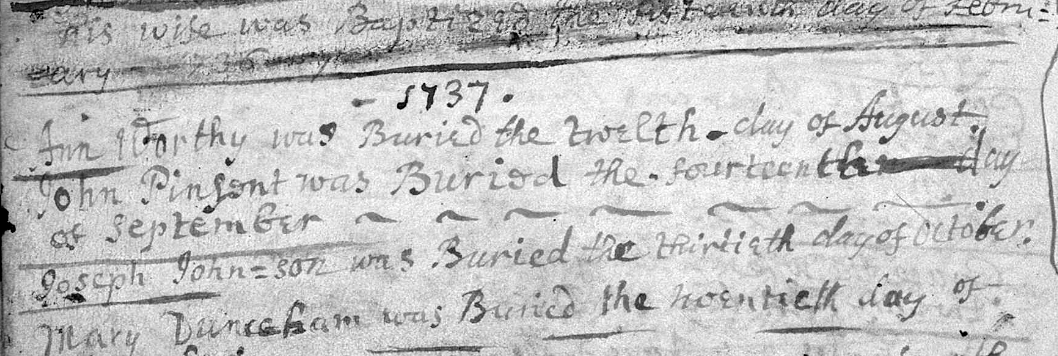
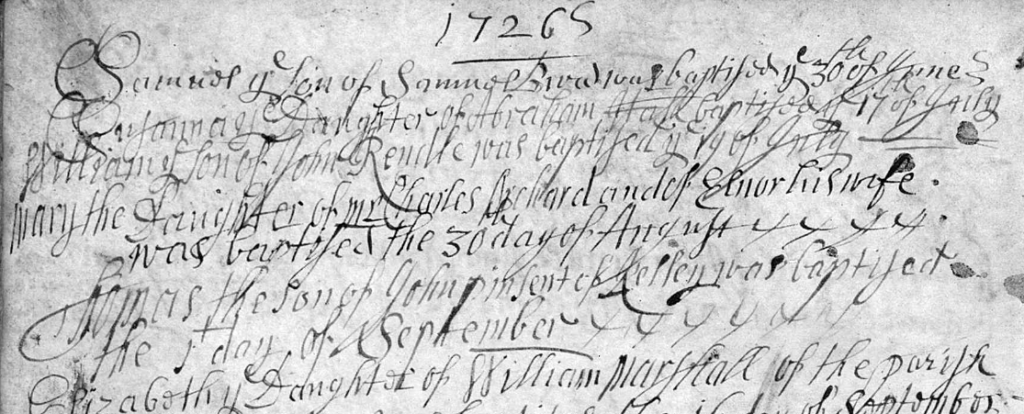
Handwritten note of John Pinsen'ts burial on September 14, 1737.
John is buried on September 14, 1737.

John Pinsent “senior” died in 1737 leaving his widow with several relatively young children to look after. He left a Will (“Calendar of Devonshire Wills and Administrations”); however, it was destroyed when the Exeter “Probate Registry” was bombed during the Second World War: its contents are unknown.  

Handwritten notice of Ambrose Rackett's marriage to Margaret Pinsent in March 1738.
Margaret marries Ambrose Rackett in March of 1738.

John’s widow, Margaret, was left with four (or possibly five) young children to look after. The following March, she married Ambrose Rackett, a “tanner” and moved her family to Crediton where his father was a “licensed victualler” (innkeeper). Ambrose managed the Pinsent “soap” and “tallow” boiling business for his stepson until he was old enough to take control. It may have been leased out for some of the time.

John Pinsent “junior” married Elizabeth Puddicombe in 1742. His life is described elsewhere; however, he worked at Kelly for a while and then set up a similar “tallow” boiling business in Moretonhampstead. He was there by 1762 and fully established by 1771. Ambrose, meanwhile, seems to have kept on managing the Hennock part of the business. He appears as a “Freeholder” in Hennock in 1741 (QS7/20/Teignbridge), and also in 1762 (QS7/36/Teignbridge) and 1771 (QS7/44/Teignbridge). 

John and Margaret’s younger son, Thomas Pinsent married Mary Gildon of Kingsteignton and most likely farmed a tenement called “Gildons” that was, many years later, still owned by his brother’s great-grandson – another Thomas Pinsent. John and Margaret’s eldest daughter, Sarah Pinsent, seems to have married James Wreaford in Hennock in 1741. Her sister Elizabeth Pinsent married Joseph Wills of Lustleigh in 1754. On that occasion, her stepfather, Ambrose Rackett, signed the Register as a witness. What happened to John and Margaret’s third daughter, Mary Pinsent, is uncertain.


Family Tree

Grandparents

Grandfather: John Pinsent: 1626 – 1663
Grandmother: Philippa Wilmeade: 1631 – xxxx

Parents

Father: Robert Pinsent: 1661-1729
Mother: Elizabeth Delve: 1665 – 1729

Father’s Siblings (Aunts, Uncles)

Thomas Pinsent: 1652 – 1711
Julian Pinsent: 1654 – xxxx
John Pinsent: 1656 – 1656
Joan Pinsent: 1657 – xxxx
John Pinsent: 1659 – xxxx
Robert Pinsent: 1661 – 1729 ✔️


Please use the above links to explore this branch of the family tree. The default “Next” and “Previous” links below may lead to other unrelated branches.
John Pinsent

Vital Statistics

John Pinsent: 1723 – 1800 GRO1400 (Soap boiler, Kelly in Hennock and in Moretonhampstead)

Elizabeth Puddicombe: 1719 – 1795
Married: 1742: Crediton, Devon

 Children by Elizabeth Puddicombe:

Elizabeth Pinsent: 1743 – xxxx (Married William Tucker in 1767, or alternatively William Stevens (?) in Moretonhampstead in 1769)
John Pinsent: 1745 – 1804 (Soap boiler in Plymouth; Married Anne Heard, 1768)
Mary Pinsent: 1748 – 1749
Mary Pinsent: 1751 – 1773
Thomas Pinsent: 1754 – 1841 (Merchant in Newton Abbot; Married 1) Anne Ball, 1777, and 2) Elizabeth Pridham, 1799)
Sarah Pinsent: 1759 – 1782 (Married John Studdy, 1781, Moretonhampstead?)

Family Branch: Devonport
PinsentID: GRO1400

References

Newspapers

Click here to view close family members


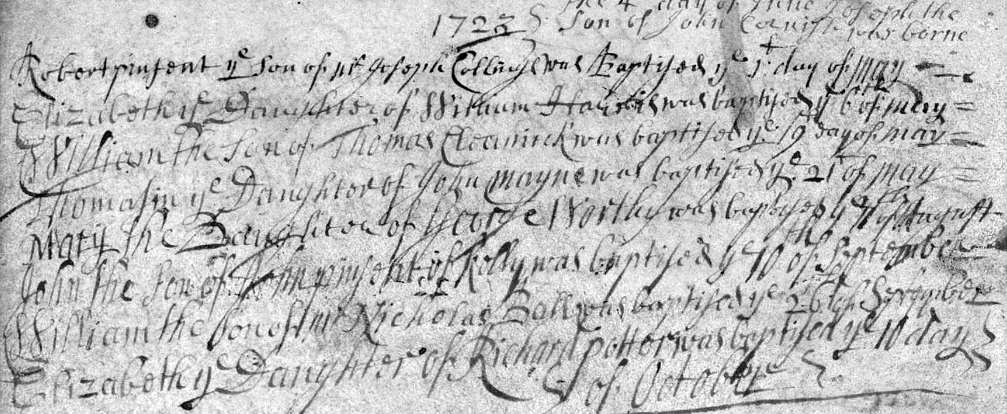
John Pinsent (1723–1800) was the elder son of John Pinsent of “South Kelly” in Hennock, by his wife Margaret (née Luscombe). He was baptized in Lustleigh (which is now the home parish for “South Kelly”) in September 1723. He was a teenager when his father, a “soap boiler,” died in 1737. His mother married Ambrose Rackett, a “tanner”,  and moved to Crediton the following year. Ambrose seems to have taken over the management of his father’s soap boiling operation and – although his family clearly came from Crediton – he is mentioned in the list of Hennock “Devon Freeholders” in 1744, 1762, and 1771. The records show that he remained active in Hennock until at least 1777. Nevertheless, the soap business would have passed to John when he came of-age and he most likely took control of it after his marriage to Elizabeth Puddicombe in October 1742.

John Pinsent was ambitious and he set up a similar “soap” and “tallow” boiling operation in Moretonhampstead in the 1750s. It seems to have been a bigger operation than at “South Kelly” and he regularly took on apprentices. They signed on in 1752, 1754, 1759, 1776, 1777, and (x2) in 1783 (Apprentices of Great Britain 1710-1762). By 1767, John was a man of some standing in the community and he signed an affidavit on behalf of his friend, Thomas Sesse of Moretonhampstead, stating that he was too sick to travel to Exeter to appear as a defendant at an upcoming, Easter meeting, of Devon Quarter Sessions. What the case was about, I do not know. In 1777, he leased a plot of land with several buildings, some of which were “in decay”, from Margaret Noseworthy for a year at five shillings and a “barley corn” as rent. He later bought the property for £58 pounds [DRO B/T/M103-105]. Presumably, the business was still growing.

Hennock’s “Land Tax” records show that John assumed control of his father’s land holdings in Hennock and Cecil Torr (Wreyland Documents: 1910) tells us that John Pinsent, “son and heir of John and Margaret Pinsent (soap-boiler) of South Kelly”, conveyed a tenement called “South Kelly” described as being “1 messuage, 4 linhays, 3 gardens, 30 acres (arable) land, 6 acres meadow, 6 acres pasture, 6 acres of wood, 6 acres of furze and heath and 5 acres of moor” to Joshua Banks on 21st May, 1785. This was for the purpose of a recovery. The property was assessed a land tax of £1 3s 4d and was occupied by Mr. Wreyford between 1780 and 1789, by John Pinsent himself from 1790 to 1791, and by a Mr. Hollier from 1792-1796. The following year, at the age of seventy-four, John sold the property to Mr. George Wills, of Rudge in Lustleigh, for £2,152 10s 0d.

John must have retained some of his land in Hennock as the “Church Wardens’ Accounts” show he and his son paid between 1s and 1s 6d for “the Kelly” between 1778 and 1804. Still, in 1805, Mr. Wills paid for “three Kelly’s” and for “Late Pinsent’s Kelly”. Mr. Wills was busy consolidating his holdings and he picked up John’s piece when he died in 1800. Mr. Wills held all four parts in 1818. Subdivided property was difficult to stitch back together again.

John and Elizabeth had their first child, Elizabeth, in Crediton in 1743. This was before they moved to Moretonhampstead. Their second child, another John Pinsent, was born in Moretonhampstead and learnt the “soap-boiling” trade from his father. John “junior” was later to run his own business in Plymouth, until the unfortunate death of his wife, Anne (née Heard), bankruptcy and the needs of his then aging father brought him back to Moretonhampstead.

John and Elizabeth had a short-lived daughter Mary Pinsent in 1748. They tried again, in 1751, and their second daughter of that name. Mary Pinsent, lasted longer but she too died relatively young – in 1773. She was buried in St. Andrews’ Churchyard in Moretonhampstead and a memorial stone describes her as being her parent’s “little daughter”: although at twenty one years of age she was, perhaps, not quite so little. Their elder daughter Elizabeth most likely married in the late 1760s; however, whether it was to William Tucker in 1767 or William Stevens in 1769 is not clear. Perhaps it was both in succession!

Their fifth child, Thomas Pinsent, was born in 1754. He was a soap and candle “salesman”, or “chandler”, and later a significant landholder in Newton Abbot. He married twice; firstly to Anne Ball of North Bovey and secondly to Elizabeth Pridham of St. Mary Church. The second marriage, or perhaps the timing of it — coming as it did after siring an illegitimate daughter by Elizabeth — seems to have upset his father and it may have influenced the distribution of his estate. Mr. John Pinsent was a devout Baptist and he took religion seriously enough that he left a small annual bequest to the “Deacon or Leader of the Tabernacle in Moretonhampstead” when he died. In 1775, John entertained a traveling preacher – and came in for some complimentary comments in the latter’s Diary (Rev. Henry Tanner, of Exeter: Extract from Mr. Tanner’s Diary: Google.co.uk).  

Finally, John and Elizabeth had a daughter, Sarah Pinsent, born in 1759 who probably married John Studdy in 1781 and died, as Sarah Studdy, the following year. John’s wife, Elizabeth (née Puddicombe) died in 1795 and John Pinsent, or Mr. John Pinsent “senior” as he came to be known, died after a long illness in October 1800 (Silvester Treleaven’s Diary).

John’s father had bequeathed a tenement in Hennock called “Leigh” to John’s brother, Thomas Pinsent, and Thomas had, in turn, left the property to his two daughters, Mary Pinsent and Elizabeth Pinsent, when he died in 1757. They split the rental income until 1771 when Mary contracted to marry Robert Pinsent. He was from another branch of the family but, coincidentally or otherwise, also a “tallow chandler” in Newton Abbot. Robert would have acquired Mary’s half interest in her father’s property through the marriage and this could have created long-term difficulties. According to Wreyland Documents, the girls’ trustees resolved the problem by selling their respective half-interests to their uncle, Mr. John Pinsent. In October 1775, he gave each of them £165 0s 0d for their respective interests. Mary’s younger sister Elizabeth most likely married John Collins in Wolborough in August 1774. Some years later, in 1787, we find that Ann Lamble was apprenticed to John Pinsent of Moretonhampstead for “Lee estate”, “in Bovey Tracey” (sic). John added to it. He purchased “a spot of land or meadow, about a quarter of an acre more or less, lying on the lower side of Leigh House” from Nelson Beveridge Gribble for 8 guineas on 16th November 1789.

Shortly after selling his land in “South Kelly” (including the cider press) and at “Leigh” (including the “spot of land”) to George Wills of Rudge for £2,152 10s 0d in 1797 (see above), John leased “a certain mine of black lead or some other mineral substance” in “South Kelly” for a period of 21 years. The mine produced a glittering micaceous hematite (or “shining ore”) from a vein that varied from two inches to three feet wide (Philosophical Magazine: January 1st 1904). The ore would have been used to make paint. The mine closed in 1951. However, some of the surface buildings remain and the “Kelly Mine Preservation Society” is slowly restoring them. The London Times shows that John Pinsent may have had other mining interests as he was clearly identified as the viewing agent for the Vitifer Mine “on the Tavistock Road, six mines from Moretonhampstead” in 1798. The “Dartmoor Mining and Smelting Company” had put it up for sale. It was a tin mine approximately 1.0 kilometre east of the “Warren House Inn” on what is now the B3212. It had thirteen shafts at one point and was a going concern employing forty men in 1796.

Land Tax Records show that John Pinsent owned a house in Moretonhampstead with an annual Land Tax value of 12s per annum and he rented properties called “Bugged Down”, “Caphills”, and “Court Tenement” (taxed at an approximate value of £2 14s 0d) from Lord Viscount Courtenay throughout the 1880s and 1890s.

Mr. Sylvester Treleaven, a gentleman who lived in Moretonhampstead, kept a diary in which he described day-to-day life in the town between 1799 and 1830. It has survived, and can be seen on the “Moretonhampstead Historical Society” website. In it, he describes the Pinsent family’s last few years in residence in the community. Among other things, he mentions that George Harvey, an apprentice bound to John in March 1799 caused quite a stir when he accused a fellow apprentice, George Hamlin, of stealing candles and selling them to a local shopkeeper. The Diary refers to Mr. Pinsent’s death,“after a long illness” and mentions the “great numbers” who attended his Methodist funeral. Mr. Pinsent’s household goods were, evidently, sold off in April 1801.

Mr. John Pinsent, “Soap-boiler of Moretonhampstead” signed his Last Will and Testament in August 1800 and died the following October. Unlike so many Devonshire Wills, a copy of his has survived [PRO IR 26/333/74]. It’s content is also summarized in the “Durham, Ely, Exeter and Oxford Death Duty Registers for 1796-1811”. When Mr. John died, he was living in Moretonhampstead with his son John Pinsent and his three granddaughters Mary Pinsent, Sarah Pinsent and Elizabeth Pinsent. His son seems to have been fairly ill himself, so John appointed his granddaughters joint executrixes. In it, he left his son, John “junior” his “utensils belonging to the soap boiling trade … for as long as he shall have an occasion to use them” with a reversion to his granddaughters — presumably to sell off. He left two-thirds of his interest in the mine at Kelly to his son “Thomas of Newton and Thomas his son” for the duration of the term of the lease (then around nineteen years) and he gave the remaining one third to Savery Moses and Joseph Wills to hold in trust for his granddaughters. The girls were also to receive the residue of his stock in trade, bonds and other securities — after payment of his debts and bequests.

John largely ignored his two sons, either because he had made previous arrangements with them, or perhaps because he knew his son John’s days were numbered (he died in 1804) and he had quarreled with Thomas! For whatever reason, he appointed his only (then-living) grandson Thomas Pinsent (son of his son Thomas Pinsent) his principal beneficiary — even though he was only eighteen years old. John left him four hundred pounds and the estate called “Caphills” referred to earlier “subject to an annual payment to his father of sixteen pounds”. He also left him the leasehold of the property called “Court Tenement” in Moretonhampstead “subject to a payment of thirty two pounds to Moses Savery of Bovey Tracey … Serge-maker and Joseph Wills the younger of … Ilsington” which was to be held in trust for John’s granddaughter Mary Pinsent “during the life of her father” and, if she was to die before her father, then in trust for her younger sisters Sarah and then Elizabeth. Unfortunately for Mary, her father (John “junior”) died four years later.

Moses Savery’s daughter, Mary Savery, married Mary’s cousin Thomas Pinsent in 1805 and Moses appears to have helped him set up and run a “drapery” in Devonport. John left his granddaughters wealthy women and he was adamant that the bequests were for them alone and not for the use of any future husband. This was probably a wise precaution.

Mr. John Pinsent made several minor cash bequests to be taken out of the profits from “Court Tenement”. For instance, he gave an annual bequest of six pounds per year for seven years to the “Deacon or Leader of the Tabernacle in Moretonhampstead”. He also gave “ten guineas of gold” to his son Thomas’s daughter Elizabeth Pinsent (presumably the “Betsey” described elsewhere) — which was to be paid to her when she became twenty one and, importantly, he left his infant “grandson John Pinsent, son of Thomas Pinsent of Newton” the sum of sixty guineas in gold to be paid him if and when he reach the age of twenty one years. Thomas’s first wife, Anne (née Ball), had died in 1794 and Thomas had married Elizabeth Pridham in St. Mary Church a few years later. They had a son John Pinsent baptized in Wolborough on 11th October 1799, shortly before his grandfather died. This John lived to collect and, as we shall see elsewhere, took off for America. Thomas and Elizabeth had an illegitimate daughter, Maria Pinsent, in 1797 before their marriage and she was notably left out of the will. Mr. John Pinsent was a man of standing in the Community )and a Baptist at that) and he was probably none too pleased (see also “Yeo society” website).

John Pinsent’s granddaughters probated his will in November 1800 and their cousin Thomas took control of “Court Tenement” and “Caphill”. Land Tax data show that he kept them both until 1806, and that he continued to pay tax for a house in Moretonhampstead until 1814.


Family Tree

Grandparents

Grandfather: Robert Pinsent: 1661 – 1729
Grandmother: Elizabeth Delve: 1665 – 1729

Parents

Father: John Pinsent: 1690 – 1737
Mother: Margaret Luscombe: xxxx – xxxx

Father’s Siblings (Aunts, Uncles)

Julian Pinsent: 1686 – xxxx
Elizabeth Pinsent: 1688 – xxxx
John Pinsent: 1690 – 1737 ✔️
Mary Pinsent: 1697 – 1711
Sarah Pinsent: 1701 – xxxx

Male Siblings (Brothers)

John Pinsent: 1723 – 1800 ✔️
Thomas Pinsent: 1726 – 1757


Please use the above links to explore this branch of the family tree. The default “Next” and “Previous” links below may lead to other unrelated branches.
John Pinsent

Vital Statistics

Birth: 1773
Marriage: N/A
Spouse: N/A
Death: N/A

Family Branch: Devonport
PinsentID: GRO1395


Family Tree

Grandparents

Grandfather: John Pinsent: 1723 – 1800
Grandmother: Elizabeth Puddicombe: 1719 – 1795

Parents

Father: John Pinsent: 1745 – 1804
Mother: Anne Heard: xxxx – 1780

Father’s Siblings (Aunts, Uncles)

Elizabeth Pinsent: 1743 – xxxx
John Pinsent: 1745 – 1804
Mary Pinsent: 1748 – 1749
Mary Pinsent: 1751 – 1773
Thomas Pinsent: 1754 – 1841
Sarah Pinsent: 1759 – 1782

Male Siblings (Brothers)

Thomas Heard Pinsent: 1769 – 1794
John Pinsent: 1773 – xxxx


Please use the above links to explore this branch of the family tree. The default “Next” and “Previous” links below may lead to other unrelated branches.
John Pinsent

Vital Statistics

John Pinsent: 1745 – 1804 GRO1391 (Soap boiler, Plymouth, Devon)

Anne Heard: xxxx – 1780
Married: 1768: Moretonhampstead, Devon

Children by Anne Heard:

Thomas Heard Pinsent: 1769 – 1794
Mary Pinsent: 1773 – 1828 (Married William Tucker, 1806; Had children with Pinsent in their name)
John Pinsent: 1773 – xxxx
Sarah Pinsent: 1775 – 1812 (Married John Germon, 1805; Had children with Pinsent in their name)
Elizabeth Pinsent: 1777 – 1809 (Married 1800; second wife of Joseph Pinsent, Ship Broker of London and Lettaford, North Bovey)
Anne Pinsent: 1779 – 1790

Family Branch: Devonport
PinsentID: GRO1391

References

Newspapers

Click here to view close family members


John Pinsent was the eldest son of Mr. John Pinsent by his wife, Elizabeth (née Puddicombe). He was born in Moretonhampstead and brought up in-and-around his father’s “tallow” and “soap boiling” operation. He learnt the trade and, his father set him up in his own business in Plymouth in 1768, when he married Anne Heard. John and Anne had six children (two boys and four girls) over ten years or so, and had them baptized in Batter Street Presbyterian Chapel in Plymouth. Sadly, Anne “wife of John Pinsent, Junior” died in 1780, while the children were still young. There is no indication that John ever remarried and it is not clear who looked after them during their childhood. John’s first-born son, Thomas Heard Pinsent died at the age of 24 years, before he married. The second son, another John Pinsent, was baptized in 1773 and probably died young. Had he been alive in 1800, he would almost certainly have been mentioned in his grandfather’s will. This twig on the “DEVONPORT” Pinsent branch appears to have ended – at least on the male side.

John Pinsent and Anne (née Heard) eldest, Mary Pinsent, was baptized in 1773. She lived with her father until he died in 1804 and then, two years later, married William Tucker, a local “Grammar School Teacher”. According to the marriage record, one of the witnesses was called Ann Tucker. She was probably William Tucker’s sister and also the lady who married Joseph Pinsent (from the “HENNOCK” branch of the family) in Drewsteighton in 1809.

Ann Tucker became Joseph’s third wife. He was a “ship’s broker” in London and also a “farmer” near Chagford on Dartmoor. They had children. Joseph has the distinction of marrying not one but two of Mr. John Pinsent’s granddaughters (in addition to Ann Tucker). He first married Anna Thomasin Crout Pinsent – the daughter of John’s son Thomas Pinsent, in 1799 and, after she died childless later that year, her cousin Elizabeth Pinsent.  was John “junior’s” third daughter. That marriage took place in Moretonhampstead in June 1800, shortly before the family patriarch Mr. John Pinsent died. They had children. Elizabeth, sadly, died of “a lingering sickness which she bore with great resignation” in 1809 (Exeter Flying Post: March 16th 1809) and so Joseph married Ann Tucker. Joseph Pinsent’s life – and the lives of his descendants are described elsewhere.

John and Anne’s second daughter Sarah Pinsent was baptized in 1775. She also lived with her father until he died in 1804. She married John Germon, an officer in the “Moretonhampstead Volunteers” (a militia unit raised to defend the homeland during the Napoleonic Wars) the following year. They married in East Teignmouth. Interestingly, an Exeter law firm, “R. T. & H. Campion” appealed to the public for a copy of their marriage certificate through an advertisement in the Exeter and Plymouth Gazette on 3rd March 1905, a century later. Perhaps there was an inheritance at stake! John’s daughters, Mary and Sarah both used “Pinsent” as a Christian name for their children. For instance, Mary had a daughter Elizabeth Pinsent Satterly Tucker who was born in Moretonhampstead in December 1809 (Parish Records), and Sarah had a son, John Pinsent Germon who became a Lieutenant in the “Indian Army” in Madras (IOR/LMIL/11/053).  The youngest sister, Elizabeth, had no need to include the name! She married Joseph Pinsent. John and Anne (née Heard) had a fourth daughter, Anne Pinsent baptized in Plymouth in 1797; however, she too probably died young, as she does not seem to have been around in the early 1800s.

John Pinsent “junior” was (like his father) a Baptist and, in 1780, the year his wife died, he subscribed to a poem entitled “Life Review’d” (reflections upon the silent inhabitants of the Chuchyard at Truro, Cornwall) by Elizabeth Smith. The subscription (purchaser) list calls him a “soap boiler from Plymouth”. Unfortunately, his business failed. The London Gazette (22nd February 1785) tells us that the “Commission of Bankruptcy” was to hold meetings at the Prince George Inn, in Fox-hole Street, Plymouth on the 1st, 3rd and 9th April to establish his assets, examine his creditors claims, and come to an equitable financial arrangement. A fortnight later, the local newspapers advertised the forthcoming sale of John’s “household furniture, stock in trade and utensils … at his dwelling house in Old Town Plymouth”. The Stock and utensils consist of (among other items) “six iron furnaces, several beams and scales one of which will weigh off a ton at an end, several soap frames, about a ton and half of ‘barilla’ (either the salt-rich plant or the ash from it RHP), a quantity of rock salt, about 300 tons soda ashes, a quantity of lees, a pound to break ‘barilla’ in, two good cart horses, a good hackney horse, two carts and harnesses etc.” (The Exeter Flying Post: 21st April 1785).  

John’s father was in his sixties by then, and John appears to have taken his family back to Moretonhamstead to help him with his, presumably more successful, “soap” and “tallow” boiling operation. When Mr. John Pinsent “senior” died in 1800 he left his utensils to his son “for as long as he might have need of them”. After that, they were to be put to the use and benefit of his granddaughters — John’s daughters — Mary, Sarah and Elizabeth. One of John’s erstwhile apprentices bought the business.

Sylvester Treleaven left a diary describing life in Moretonhampstead at around this time, and tells us that the business was nearly destroyed by fire in May 1803 when a boy went into a room full of wick and cotton yarn and, accidentally, started a blaze.  Fortunately , it was quickly extinguished. Nevertheless, John Pinsent (“junior” as he was still called) had had enough. In the absence of a suitable male heir, he conveyed the “soap and tallow” business to George Harvey in March 1804. John and his unmarried daughters Mary and Sarah moved to “Court House” shortly thereafter and he died there a couple of weeks later. That August, the girls downsized still further. According to Mr. Treleaven, they left “Court House” and moved into to a smaller house on Court Street. Presumably this was because their grandfather had left “Court House” and most of his other property in Moretonhampstead to their cousin Thomas Pinsent.


Family Tree

Grandparents

Grandfather: John Pinsent: 1690 – 1737
Grandmother: Margaret Luscombe: xxxx – xxxx

Parents

Father: John Pinsent: 1723 – 1800
Mother: Elizabeth Puddicombe: 1719 – 1795

Father’s Siblings (Aunts, Uncles)

Sarah Pinsent: 1721 – 1805
John Pinsent: 1723 – 1800 ✔️
Thomas Pinsent: 1726 – 1757
Mary Pinsent: 1728 – xxxx
Elizabeth Pinsent: 1732 – 1804

Male Siblings (Brothers)

John Pinsent: 1745 – 1804 ✔️
Thomas Pinsent: 1754 – 1841


Please use the above links to explore this branch of the family tree. The default “Next” and “Previous” links below may lead to other unrelated branches.
Johanna Pinsent

Vital Statistics

Birth: 1626
Marriage: N/A
Spouse: N/A
Death: 1627

Family Branch: Devonport
PinsentID: GRO1772


Family Tree

Grandparents

Grandfather: Robert Pinsent: 1562 – 1626
Grandmother: Dorothy Carpenter: 1565 – 1643

Parents

Father: Robert Pinsent: 1589 – 1650
Mother: Agnes Stevens: xxxx – 1655

Father’s Siblings (Aunts, Uncles)

Simon Pinsent: 1587 – xxxx
Robert Pinsent: 1589 – 1650
Dorothy Pinsent: xxxx – 1590
William Pinsent: 1591 – 1591
Helen Pinsent: 1592 – xxxx
Thomas Pinsent: 1597 – 1649
George Pinsent: 1599 – xxxx
John Pinsent: xxxx – 1600

Male Siblings (Brothers)

John Pinsent: 1620 – 1629
Simon Pinsent: 1622 – 1643
Thomas Pinsent: 1624 – 1655


Please use the above links to explore this branch of the family tree. The default “Next” and “Previous” links below may lead to other unrelated branches.
Joan Pinsent

Vital Statistics

Birth: 1657
Marriage: N/A
Spouse: N/A
Death: N/A

Family Branch: Devonport
PinsentID: GRO1740


Family Tree

Grandparents

Grandfather: Thomas Pinsent: 1597 – 1649
Grandmother: Julian Sidstone: xxxx – 1663

Parents

Father: John Pinsent: 1626 – 1663
Mother: Philippa Wilmeade: 1631 – xxxx

Father’s Siblings (Aunts, Uncles)

Helen Pinsent: 1618 – 1618
Joan Pinsent: 1619 – xxxx
Mary Pinsent: 1622 – xxxx
Robert Pinsent: 1624 – 1671
John Pinsent: 1626 – 1663 ✔️
Julian Pinsent: 1628 – xxxx
Margaret Pinsent: 1630 – xxxx
Thomas Pinsent: 1633 – 1701
William Pinsent: 1638 – xxxx

Male Siblings (Brothers)

Thomas Pinsent: 1652 – 1711
Julian Pinsent: 1654 – xxxx
John Pinsent: 1656 – 1656
John Pinsent: 1659 – xxxx
Robert Pinsent: 1661 – 1729


Please use the above links to explore this branch of the family tree. The default “Next” and “Previous” links below may lead to other unrelated branches.
Joan Pinsent

Vital Statistics

Birth: 1619
Marriage: N/A
Spouse: N/A
Death: N/A

Family Branch: Devonport
PinsentID: GRO1749


Family Tree

Grandparents

Grandfather: Robert Pinsent: 1562 – 1626
Grandmother: Dorothy Carpenter: 1565 – 1643

Parents

Father: Thomas Pinsent: 1597 – 1649
Mother: Julian Sidstone: xxxx – 1663

Father’s Siblings (Aunts, Uncles)

Simon Pinsent: 1587 – xxxx
Robert Pinsent: 1589 – 1650
Dorothy Pinsent: xxxx – 1590
William Pinsent: 1591 – 1591
Helen Pinsent: 1592 – xxxx
Thomas Pinsent: 1597 – 1649 ✔️
George Pinsent: 1599 – xxxx
John Pinsent: xxxx – 1600

Male Siblings (Brothers)

Robert Pinsent: 1624 – 1671
John Pinsent: 1626 – 1663
Thomas Pinsent: 1633 – 1701
William Pinsent: 1638 – xxxx


Please use the above links to explore this branch of the family tree. The default “Next” and “Previous” links below may lead to other unrelated branches.