Judith Ann Pinsent

Vital Statistics

Birth: 1948 (née Judith Ann Gordon-Rae)
Marriage: 1972
Spouse: Husband GRO1086
Death: 1978

Family Branch: Devonport
PinsentID: GRO1087


Please use the above links to explore this branch of the family tree. The default “Next” and “Previous” links below may lead to other unrelated branches.
Joyce Veronica Pinsent

Vital Statistics

Birth: 1918
Marriage: 1948
Spouse: Neville Walker Dunn
Death: 1997

Family Branch: Devonport
PinsentID: GRO1094


Family Tree

Grandparents

Grandfather: Adolphus Ross Pinsent: 1851 – 1929
Grandmother: Alice Mary Nuttall: 1855 – 1901

Parents

Father: Sidney Hume Pinsent: 1878 – 1969
Mother: Beatrice Elena Le Bas: 1882 – 1956

Father’s Siblings (Aunts, Uncles)

Sidney Hume Pinsent: 1879 – 1969
Frances Maude Pinsent: 1882 – 1953
Cecil Ross Pinsent: 1884 – 1963
Gerald Hume Saverie Pinsent: 1888 – 1976

Basil Hume Pinsent: 1911 – 2000

Male Siblings (Brothers)

Harold Ross Pinsent: 1913 – 1988
Paul Desmond Pinsent: 1915 – 1997
Roger Philip Pinsent: 1916 – 1997
Neville James Quintus Pinsent: 1921 – 2013


Please use the above links to explore this branch of the family tree. The default “Next” and “Previous” links below may lead to other unrelated branches.
John Ryland Pinsent

Vital Statistics

John Ryland Pinsent: 1888 – 1957 GRO0528 (Army Officer, Teacher, Mayor of Winchester)

Kathleen May Boyce: 1894 – 1969
Married: 1915: Birmingham

Children by Kathleen May Boyce:

John Laurence Pinsent: 1916 – 2014 (Married Margaret Molyneux Favell, 1940)
Mary Kathleen Pinsent: 1919 – 1919
Richard Alan Pinsent:  1931 – 2019 (Married Wife (GRO1376))

Family Branch: Devonport
PinsentID: GRO0528

References

Newspapers


John Ryland was  Sir Richard Alfred Pinsent’s third son by his wife Laura Proctor, née Ryland. He was born at “Selly Wick House” (#47 Sellywick Road), Selly Park in August 1888 and was baptized in Selly Hill Church. “Selly Wick” was a large, suburban property in a residential district on, what was then, the outskirts of Birmingham.

John was sent to “Winchester College”, a “Public” (private) school, in 1902 and he moved to the “Royal Military Academy” at Woolwich in 1907. Cpl. J. R. Pinsent won a prize for signaling, which perhaps explains why his ultimately destination was to be the “Corps of Royal Engineers” (Army and Navy Gazette: Saturday 4th September 1909). John Ryland was one of several “Gentleman Cadets” who left to join His Majesty’s forces as “Second Lieutenants” in August 1909.  He must have been recognized to be a talented young officer, and “2nd Lt. J. R. Pinsent” was one of many presented to His Majesty the King at a Levee held at St. James Palace in March 1910. His name had been submitted to the the Lord Chamberlain’s Office by the Inspector General of the Armed Forces (Morning Post: 2nd March 1910). On who’s recommendation I am not sure. John owned a car while at Aldershot, and relied on E. McGrath & Co. in Gillingham to keep it running – which was quite a challenge in those day! He wrote them a letter of appreciation on leaving Aldershot in September 1911: “As I am leaving Chatham, I should like to say how pleased I have been in all my dealings with your firm. Not only are your charges low, but the work has been well done and done by the day for which your promised it. Yours truly, J. R. Pinsent” (Chatham, Rochester and Brompton Observer: 30th March 1912).

John Ryland was promoted to full “Lieutenant” in the “Corps” in January 1912, and he probably returned to Aldershot for duty with “A” Signal Company that December (London Evening Standard: Tuesday 24th December 1912).

John Ryland was physically active throughout his early life. In fact, how he found time for military training I am not sure! The army seems to have given him considerable latitude when it came to sport. He was good team player and sport was to become an important part of his life. John (and a couple of colleagues) won the 450 yards relay race for first year students at Woolwich in March 1908 (Evening Mail: Wednesday April 1908), and he was on the “Woolwich Military College” cricket team when it played “Sandhurst” – another military college – in June the following year. It must have been a hard fought match. Sandhurst won (Cricket: Thursday 1st July 1909).

The “Royal Corps of Engineers” were based in Chatham, in Kent, and “Second Lieutenant” John Ryland was sent there in August 1909 (Evening Mail: Wednesday 25th August 1909). When he arrived, he picked up his bat and started started playing for the “Engineers.” The papers show that he played in a cricket match against a touring team from Canada (Zingari Tour Group) in July 1910, and for the “Sappers” (as the Engineers were known) in a drawn two-day match against the “Yorkshire Gentlemen” a year later (Lloyd’s Weekly: Sunday 25th June 1911).

John Ryland  also playing field hockey in the winter months. He was extremely good at it and he played as a forward for the “Royal Engineers” and for the Kent “County” team. He helped the latter beat “Sussex” at Worthing Sports Ground in January 1911 (Bexhill on Sea Observer: 28th January 1911; Daily Mirror: Wednesday 1st February 1911). He also selected to play for the Army against the Navy the following month (Westminster Gazette: Friday 10th March 1911.) John Ryland continued to play for the“Engineers” and two years later he was, once again, asked to attend the Army’s hockey trials at Aldershot (Pall Mall Gazette: 14th January 1913). I do not know if he was selected.

If that were not enough, John played soccer for the “Army Officers” against the “Household Brigade” at Chelsea in March 1914 – this appears to have been a warm up for a match against a team of Dutch Army officers scheduled to be played at the Hague (Sporting Life: 14th March 1914). How that match went, I do not know; however, a couple of weeks later he played in the Army Cup – semi-final at Aldershot. After that match, the Army selected its team for a game that was shortly to be play against a similar Army team from Ireland. Lieut. J. R. Pinsent (R.E.) was named as reserve (Sporting Life: Monday 23rd March 1914). This is pretty good for a young man who had, almost certainly been brought up playing rugby football at school!

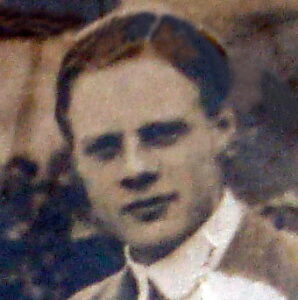
Cropped photo of a young man.
John Ryland as a young man.

Before the war, John Ryland was called upon to represent the “Royal Engineers” in several cricket matches. He suited up against the “Household Brigade” at “Burton’s Court” in Chelsea, and against the “M.C.C.” (“Marylebone Cricket Club”) at their home ground at “Lords” during “Military Week” in the Summer of 1913 (Yorkshire Post and Leeds Intelligencer: 23rd & 24th July 1913). Many English school-boy cricketers dream of playing at “Lords;” few actually do! John Ryland played in a match against the “King’s Liverpool Regiment” in June and the “11th Hussars” the following summer (Sporting Life: Friday 19th June & 8th July 1914). His team lost to the “Royal Artillery” in July 1914 (Sporting Life: Monday 27th July 1914) but drew against “Aldershot Town” a few days later(Sporting Life: Friday 31st July 1914).

Sadly, his life, and that of his friends and sporting foes was about to change. In June 1915, “Sporting Life” published a list of well-known sportsmen who had signed up. It included “Pinsent, Lieut. J. R., R.E. – Played hockey for R.E. and Army, and cricket for R.E. Second in long jump at last Aldershot R.E. Meeting” (Sporting Life: Thursday 24th June 1915). The “First World War”  changed everything. He was one of the lucky ones. He survived.

Lieutenant John Ryland Pinsent went to France with the “British Expeditionary Force” in 1914; however, before he left he had his “silver hunter watch and a metal watch chain, together of the value of £5”, stolen and there was that issue to be dealt with. Fortunately for him, it was found in an officer’s servants’s kit bag and he, and another sticky-fingered officer’s servant, were prosecuted at Alresford Petty Sessions and then at the Hampshire Assizes. The servant charged with stealing the watch pleaded “not guilty” and he was acquitted after it was determined that the other soldier, who shared his tent at Tichborne in Hampshire was clearly responsible for similar thefts. The prosecuting lawyer “observed he could not resist the conclusion that (the guilty) prisoner must have placed the articles in the other man’s bag” (Hampshire Chronicle: 27th June 1914).

John Ryland was promoted to “Captain” the following August (Civil and Military Gazette (Lahore): Saturday 2nd October 1915) and was back in England and had able to marry Kathleen May Boyce, the daughter of Ernest Joseph George Boyce, a “Colonel” in the “Royal Engineers,” by special licence a month later. They married in Edgbaston in Birmingham (Birmingham Daily Post: 17th September 1915). Interestingly, two of John’s brothers, Roy and Philip R. Pinsent signed the marriage licence. I do not know if Richard Alfred and Laura Proctor made it to the wedding. John and Kathleen seem to have started their family before he returned to France. Their eldest son, John Laurence Pinsent, was born in Birmingham in June 1916.

Captain Pinsent was mentioned in dispatches several times during the war and the French Government awarded him the “Legion of Honour Croix d’Officier” for meritorious service, in May 1917. John Ryland was promoted to “Major” and it was as “Major John Ryland Pinsent” that he received the “D.S.O.” (“Distinguished Service Order”) from His Majesty the King in March 1918 (Evening Mail: 11th March 1918). Whether this was for the same action that so impressed the French, I am not sure.

John Ryland Pinsent served out the remainder of the war as an “Acting Major” in the “Royal Engineers (5th Army H.Q., Sig. W. RE.)”. When it was over, he was sent to Command “D” Company, “Royal Engineer’s Signals Section” in Biggleswade, Bedfordshire John Ryland Pinsent (nominal) retired as a “Brevet Major” and was added to the list of “Reserve Officers”, in 1919 (London Gazette: 1st May 1919). Despite this, he seems to have remained on active service and he organized the transfer of “D” Company from Biggleswade to Maresfield Park, in Sussex, in August 1919. Biggleswade had been home to the “Signal Section” since 1915 and it must have been a blow for the local community when they left (Biggleswade Chronicle: 1st August 1919).

In November, 1920, John Ryland formally rejoined the army, not as a “Major” but as a “Captain” in the newly formed “Royal Corps of Signals” – which seems to have been spun out of the “Royal Engineers.” Date of rank was all important in the army in those days and he returned “with seniority back to August 1915”. It was not long before he regained the rank of “Major.”

Major John Ryland Pinsent and his wife, Kathleen May were living at Manor Cottage in Piltdown, in Sussex, in 1921, when the census was taken. He was serving with the “Royal Corps of Signals” at Maresfield Park and she was in charge of “home duties” and had a live-in “parlour maid”. The couple had a short-lived daughter, Mary Kathleen Pinsent not long after moving to Maresfield Park. However, she died shortly thereafter, at her grandfather’s home in “Selly Wick”, in Birmingham.

The Sussex Agricultural Express (19th November 1920) tells us that John had at least one minor scare while living at Maresfield Park. He accidentally ran into one of several small boys who were playing at the entrance to a Mr. Flint’s yard. One of them ran across the road with his hoop and was knocked down by the wing of the Major’s car. John promptly took the lad to the local “Cottage Hospital”. Fortunately, he had only received a slight concussion and bruises on the forehead and leg and his injuries were not considered serious.

Major Pinsent was, once again, able to indulge in his interest in competitive sport. The Mid Sussex Times (9th March 1920) tells us that he played rugby football for the “Signals Section” at Maresfield in the spring of 1920, and the Sussex Agricultural Express (12th November 1920) shows that he played field hockey for the “County of Sussex” the following autumn. At year’s end, the sports critic for the Daily Mirror noted that “It is a tribute to the advance of Services hockey that six Army and Navy players find places in the Southern trial. Of these Commander Manners (centre forward), Commander Harbottle (full back) and Major Pinsent (centre forward) have been much to the fore in county games” (Daily Mirror: Tuesday 28th December 1920). Major Pinsent (“R. E.”)  attended an invitational “Sussex County” hockey trial match in Brighton in February 1921 (Worthing Herald: Saturday 5th February 1921). Whether he was chosen or not, I do not know. I would have thought that there would have been younger men to call on. According to the local papers, John Ryland played golf at the “Piltdown Golf Club” – how he found the time I have no idea!

Major Pinsent played cricket for the “Royal Corps of Signals” against the “M.C.C.” when they played at Maresfield in the summer of 1921 (Kent and Sussex Courier: 17th June 1921) and he still played into 1923; however, opportunities for team sport declined when he joined the “Royal Signals Unit Staff” in March 1923. Still, he was able to squeeze in the odd game of golf.  Major J. R. Pinsent and Captain H. A. Parsons represented the “United Services Club” in the “Bath Club Challenge Trophy” matches in 1924 (The Sportsman: Saturday 26th April 1924). They did well, but it was the pair from the “Royal Automobile Club” that won.

John Ryland  Pinsent was thirty-six year sold when he retired from the Army with the rank of “Brevet Major.” in 1924. He cut back on most of his sporting activities but continued to play golf. He was a member of the “Hockely Golf Club” (Hampshire Advertiser: Saturday 23rd September 1933) by 1933 and he played an occasional round with his teenage son, John Laurence Pinsent. For instance, they played in July 1935 (Hampshire Advertiser: Saturday 20th July 1935).

John Ryland and Kathleen bought a house called “Prior’s Barton” in Winchester and and they lived there for the rest of their lives. Ever active, John returned to his old school, “Winchester College,” as an “Assistant Master.” He was there from 1926 to 1933. I do not know what subjects he taught – but I am sure he was an asset to the sports programme. John’s second son, Richard Alan Pinsent, who was fifteen years younger than his elder brother, John Laurence, was born in Winchester in 1931.

John Ryland was politically active. He may have belonged to the “Southampton Labour Party” as he seems to have been appointed to the “Executive Committee of Freemantle Ward” in 1930 (Hampshire Advertiser: Saturday 1st February 1930). However, he was certainly considered to be a possible “Independent Candidate” for St. Thomas’s Ward seat on the “City of Winchester Council” the following year (Hampshire Advertiser: Saturday 31st October 1931). He ran for the seat unopposed in 1934 (Hampshire Advertiser: Saturday 27th October 1934).

His experience as a teacher would have been useful to the Council, as the “City Education Committee” was trying to decide whether or not to raise the school leaving age (Hampshire Advertiser: 30th June 1934). Among the other issues, the Council had to deal with parking! An exasperated Colonel Pinsent (interesting promotion there!) said “that they had never been given a reason why one-side parking was not possible. He suggested a time limit on parking in the streets” (Hampshire Advertiser: Saturday 14th July 1934). Winchester was slowly moving into the modern world.

John Ryland Pinsent was raised to the level of “Alderman,” and elected “Mayor” in 1936 (Portsmouth Evening News: 9th November 1936). As an “Old Wykamist” and erstwhile school teacher, it is hardly surprising that he promoted the city’s “Education Committee”. “I feel sometimes,” he said at his investiture, “that the Education Committee is the Cinderella of the council, and that except for a faithful band of followers, is more shunned than sought after. No one can be blamed for this, as that committee demands more time from its members than any other committee and the great bulk of the work is concerned with small matters of routine. Yet, from time to time, questions of policy of the most vital importance have to be decided” (Hampshire Advertiser: Saturday 14th November 1936). He made his move to improve the school system two years later!

As Mayor, he had his fair share of both social and official duties to perform: a week after his election (13th November), he was presiding over the “Winchester Chrysanthemum Show”. The following day he was welcomed to the “Bench” in his capacity as “Chief Magistrate”. He said he had the experience the administering justice at “Courts Martial” and that if there was anything to inheritance, he thought he should be able to learn the duties as his aged father, who was now 85, had for many years been chairman of the “Discipline Committee of the Law Society” (Portsmouth Evening News: 14th November 1937).

There was a considerable amount of ceremony associated with the opening of the “Assize Courts” in those days. The Mayor, accompanied by Members of the Council and the Town Clerk escorted by the Head Constable and a Police escort waited on “Their Lordships” at the Judges’ lodgings in the Close, and escorted them to the Castle, where the Assize took place as the Cathedral bells rung out in salute (Portsmouth Evening News: 13th July 1937). John’s wife, Kathleen, the “Lady Mayoress”, was also kept busy. There were patients to visit (Hampshire Advertiser: Saturday 2nd December 1937) and civic dinners to attend (Hampshire Advertiser, Saturday 9th January 1937).

In December 1936, the “Mayor” and “Mayoress” organized a Christmas party for 1,200 elementary school children. There was a film presentation for some of the the older ones and “1,600 new three-penny pieces for the younger children who could not be got into the theatre.” The Mayor also handed out 95 dozen packets of chocolate (Portsmouth Evening News: 26th December 1936). John (like his brother Roy in Birmingham) was a strong supporter “Boy’s Clubs” and he chaired a meeting of the “Hampshire Association of Boy’s Clubs” at the Abbey House in Winchester in February 1937. It’s first annual report showed that there were 37 clubs in the county, with a combined membership of 2,274.

The Headmaster of “Winchester College” wrote a “special foreword” – most likely with the strong encouragement of the Mayor (Portsmouth Evening News: 4th February 1937)! In April 1937, 20 boys from Portsmouth “Y.M.C.A. Boys’ Club” ran a relay from the Guildhall in Portsmouth to the Mayor’s residence in Winchester. They carried a letter of greeting from Portsmouth’s Mayor to his inland counterpart. John Ryland was there in the late afternoon ready and waiting to receive it. He replied with a letter of his own, which called for the “health and happiness of our young people and, may those who carry this letter continue and prosper in their good work” (Portsmouth Evening News: 1st and 3rd April 1937.

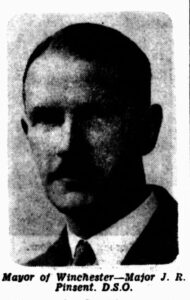
Portrait of a man with a mustache.
John Ryland as the Mayor of Winchester in the Hampshire Advertiser, 14 November 1936.

John Ryland was Winchester’s Mayor during the pre-war constitutional crisis caused by King Edward VIII’s insistence on marrying a divorced American woman – Wallis Simpson. King Edward decided to abdicate in favour of his younger brother, Albert (later to be known as King George VI), on 10th December 1936. What John Ryland thought of the matter isn’t on record. Nevertheless, when it came to the Coronation, it was Albert and not Edward who he watched being crowned in Westminster Abbey the following May. He there as a Civic official representing Winchester (Hampshire Advertiser: Saturday 15th May 1937).The City went through its traditional Coronation observances – including a Royal Salute “fired” on the Cathedral bells. However, it did so in the absence of its Mayor.

There were numerous foreign dignitaries in attendance at the Coronation including a group of French army officers who were also invited to attend a “Coronation Tattoo” at Aldershot. Later, they were to be the guests of the Mayor of Winchester, and he entertained them and showed them around the city (Lancashire Evening Post: 29th May 1937). I hope they were impressed by his “Legion of Honour Croix d’Officier” and by the fact that he addressed them in French (Hampshire Advertiser: Saturday 19th June 1937).

The Officers were also there to witness an “Empire Air Day” display put on by the “Royal Air Force” at “Worthy Down.” One of the main features was a demonstration of plane -to-plane radio usage during formation flying (Hampshire Advertiser: Saturday 29th May 1937).  This was a skill that the “Royal Air Force” was shortly to make considerable use of in the conflict that was shortly to follow.

The RAF Base at “Worthy Down” had recently added a golf course to its amenities and it was officially opened by Air Commodore C. H. B. Blount, O.B.E., M.C. in September 1937. John Ryland and his son Laurence teed off against the Air Commodore and Squadron Leader Hayward and (tactfully) allowed them to win (Hampshire Advertiser: Saturday 11th September 1937).

In 1937, there were growing concerns about Germany and the threat of war was being felt in many different ways. At a meeting of the “City Council” that August, the Mayor explained that a proposed sewerage scheme would have to wait, as the steel pipe required for the project had been taken to meet the Navy’s re-armament needs. He did not expect to be getting replacement pipe any time soon (Portsmouth Evening News: 6th August 1937). Meanwhile, there were Regimental Dinners to attend: at a “Hants” (Hampshire) Regiment reunion the Mayor of Winchester. Major J. R. Pinsent “recalled the Regiment’s fine service in the Great War when battalions served on every theatre of war except one …” (Hampshire Regiment: Friday 12th November 1937).

John had the option of staying on as Mayor, but decided not to. He stepped down in favour of Councilor Richardson in November. It had been a particularly hectic year and Major and Mrs. Pinsent must have been relieved to see someone else take over. In “Referring to the retiring Mayor, Councilor Sankey said that Councilor Pinsent was a gentleman and a sportsman. He had declined to serve a second year but had indicated his willingness to take office again if his services were required” (Hampshire Advertiser: Saturday 13th November 1937).

John reverted to being a councilor; however, as there was a vacancy on the “Aldermanic bench” he was promptly re-elected and upgraded to “Alderman” (Portsmouth Evening News: 9th November 1937). The vacancy that that left on Council was filled by a by-election that December.

John Ryland’s term may have ended; however, there was still work to do.  “Alderman John Ryland Pinsent, D.S.O.” was named to the “Land Tax Commission” for the County of Southampton (London Gazette: 22nd April 1938). Also, as he had retained his position as “Chairman of Winchester’s Education Committee” he had the unenviable task of telling the electorate that, although that year’s rate was set at 10s 6d in the pound, “additional expenditure would have to be met next year, and would probably lead to an increase in the rate” (Hampshire Advertiser: 5th March 1938).

The reason for this came clear in December when he presented to Council the scheme for reorganizing the city’s “Senior Elementary Schools” that he had hinted at at his investiture in 1936. The changes were expected to cost approximately £30,000 – which would account for his earlier statement about the rates. The plan called for the closure of some schools and construction of others with the help and support of the “County Education Authority” and the “Church of England” (Portsmouth Evening News: 8th December 1938). The Church was to receive a 75 per cent capital grant towards the rebuilding of some of their schools (Hampshire Advertiser: Saturday 7th May 1938). The City “Council” approved the plan but, in the light of the political climate, I am not sure it was ever implemented.

Sport and recreation were a priority with John Ryland and sometime in the 1930s he donated “Pinsent Camp” a six-acre site at Crabwood, just outside Winchester, to the “Boy Scouts”. t was meant for camping and related activities. The camp fell into disuse after the Second World War but regained relevance when the Winchester Scouts went looking for a site to build a year-round Scout training centre (Aldershot News: Friday 2nd April 1965). I am sure he would have approved of the centre. He had been refereeing “Boy Scouts'” sports events as early as 1934, while still a member of Winchester’s “Education Committee” (Hampshire Advertiser: Saturday 15th September 1934). How he found the time, I am not sure.

“Alderman Major J. R. Pinsent” lobbied hard for the construction of a covered swimming pool with adjoining squash and badminton Courts before the war, and in his capacity as “Chairman” of the “Juvenile Organizations Committee” he helped organized a boxing tournament in Winchester (Hampshire Advertiser Saturday 4th and 29th March 1939).

As “Chairman of the Winchester Education Committee,” John Ryland was responsible for looking after the billeting of boys evacuated to the city (Portsmouth Evening News: 9th September 1939). They, of course, increased the number of boys in the community and he felt they increased the need for more playing fields. In his capacity as chairman of the “Hampshire and Isle of Wight Playing Fields Association,” Major Pinsent lobbied hard for more – but was prevented from attending a critical meeting in June 1940 “by war work.” (Hampshire Advertiser: Saturday 1st June 1940). I doubt if he got any – my understanding is that many of the existing playing fields were converted into military camps or dug up and planted.

“Major J. R. Pinsent” had reached the age limit of liability for recall to the Army by the time the war started and he had been dropped from the “Reserve Officers’ List” (Yorkshire Post and Leeds Intelligencer: 13th August, 1938). Technically, he was a civilian and could have remained one; however, he rejoined anyway and was appointed “Officer Commanding” at “Royal Corps of Signals Officer Cadet Training Unit” (“O.C.T.U. 152”) at Catterick, in Yorkshire. His wife, Kathleen, stayed on in Winchester and opened up their house at “Prior’s Barton” to evacuees, and assisted in other “evacuation duties” (1939 Register).

John Ryland later spent several years in Command of a “War Office Selection Board” (“W.O.S.B.”) at Watford, in Hertfordshire. Between 6,000 and 7,000 men passed through his hands. Most were British; however, the board also processed 400 allied officers and approximately 600 Americans – who were sent to Watford to study psychological warfare before “D-day” (Yorkshire Post and Leeds Intelligencer: 20th February 1945).

According to Richard A. Chapman (The Civil Service Commission: 1855 – 1991) Colonel Pinsent (as he was then) received a visit from Sir Percival Waterfield towards the end of the war. He was looking for ways to improve the hiring process to be used by the “Civil Service” after the war. He was impressed by what he saw and, when the time came, he appointed Colonel Pinsent to head Britain’s first “Civil Servants Selection Board” (“C.S.S.B”).

There was considerable criticism of the selection method in 1948 as some (presumably the  parents of “Public School” candidates who expected their children to be accepted through the “Old Boy Network System” ) felt that “many promising young men and women have their careers destroyed because they fail to pass the psychological tests (they take) at a week-end house party.” The “C.S.S.B” process was condemned by Lord Cherwell and others in the “House of Lords” (Daily News (London): Tuesday 28th May 1848). Nevertheless, other people, when they looked into it, thought it worked rather well (Daily News (London): Monday 24th May 1948.

One of the board’s successful candidates, John Godley, breached protocol and came to Colonel Pinsent’s defense. In an article published in the Daily Mirror (1st June 1948) he described the whole harrowing process. Apparently, Colonel Pinsent would entertain prospective candidates for a week-end at a Tudor manor house in Stoke D’Abernon, near Cobham, in Surrey. While there, the candidates were interviewed and monitored and given a wide range of simple and complex tasks to perform, and tests to complete. The Colonel deliberately created a high-pressure environment that was designed to show the candidates leadership qualities, tact and ability to work with others and think on his or her feet. The process ended with a probing interview before a panel of senior “Civil Servants”. Evidently, only 17 per cent of candidates passed – so it was not quite the joke that Lord Cherwell had implied.

After John Ryland’s death in 1957, one of his erstwhile colleagues had this to say about him: “John Pinsent’s experience as a soldier, a schoolmaster, as Commandant of an O.C.T.U. and president of a W.O.S.B., had given him a wide experience of young men and had left him with a judgment of character that was both penetrating and charitable. He was not to be convinced by opinions that were not backed by solid evidence and if, occasionally, he stretched a point in favour of the man with a gallant war record, his reports never concealed from the Final Selection Board where the risk might be.” He also noted that in a speech in the “House of Lords” on 26th May 1948, Lord Pakenham, the Chancellor of the “Duchy of Lancaster”, replying for the Government in a debated on “C.S.S.B.”, said: – “I cannot conclude this part of my account without expressing my strong personal admiration for the way in which the techniques of selection, whatever its merits or demerits in principle, had been applied and developed by the C.S.S.B. team under the wise, the Rhadamanthine presidency of Colonel Pinsent. … I myself found a fairness, a zeal, a humility and also a lack of fanaticism and dogma about their methods which I am sure will make a deep impression on any member of the House who is to visit them:” (The Times: 8th October 1957). Colonel Pinsent was appointed a “Commander of the British Empire”  (C.B.E.) in the New Years’ Honours in 1948. He retired from the “Civil Service Selection Board” in 1950 and returned to Prior’s Barton, in Winchester. While there, in 1954, he joined the board of an engineering company (“Birfield Limited”).

John Ryland tended his garden: apparently, he was a great advocate of chicken manure and he gave a talk on the subject to the “Hampshire Group of the Soil Association” in June 1951 (New Milton Advertiser: Saturday 23rd June 1951). His home at Prior Barton was no ordinary site. It consisted of five acres of what had once been the home farm of the Priors of Winchester Cathedral. It was partially wooded and had a steam, and a sunken garden around the “Winchester Stone” – a pre-Norman cross-base. John and his wife, Kathleen, opened the garden to the public under the “National Gardens Scheme of the Queen’s Institute of the District of Nursing” in 1950 (New Milton Advertiser: Saturday 22nd April 1950), and after his death she allowed visitors most years through to at least 1965 (Aldershot News: Friday 9th April 1965).

Colonel John Ryland Pinsent, C.B.E., D.S.O., died at “Prior’s Barton”, in Winchester, on the 2nd October 1957 (Portsmouth Evening News: Friday 4th October 1957) and a memorial service was held for him in the Chapel of “Winchester College” the following week. It was well attended. Probate was granted to his widow, Kathleen May Pinsent, and to his sons, John Laurence Pinsent and Richard Alan Pinsent.

John Ryland’s eldest son, John Laurance Pinsent was born in 1916. He served in the armed forces, trained as a “lawyer” and joined the family firm of “Pinsent & Co.” as a solicitor. He then wen back to Devon to farm. His life is discussed elsewhere. His younger brother, Richard Alan Pinsent, was born in Winchester in 1931 and grew up at “Prior’s Barton”. He studied agriculture and, after spending time in the Bahamas, married in Dorset in 1954. His life is also discussed elsewhere.


Family Tree

Grandparents

Grandfather: Richard Steele Pinsent: 1820 – 1864
Grandmother: Catherine Agnes Ross: 1830 – 1906

Parents

Father: Richard Alfred Pinsent: 1852 – 1948
Mother: Laura Proctor Ryland: 1855 – 1931

Father’s Siblings (Aunt, Uncles)

Adolphus Ross Pinsent: 1851 – 1929
Richard Alfred Pinsent: 1852 – 1948
Edith Mary Pinsent: 1853 – xxxx
Hume Chancellor Pinsent: 1857 – 1920

Male Siblings (Brothers)

Roy Pinsent: 1883 – 1978
Clive Pinsent: 1886 – 1948
John Ryland Pinsent: 1888 – 1957
Laurence Alfred Pinsent: 1894 – 1915
Philip Ryland Pinsent: 1897 – 1916


Please use the above links to explore this branch of the family tree. The default “Next” and “Previous” links below may lead to other unrelated branches.

John Laurence Pinsent

Vital Statistics

John Laurence Pinsent: 1916 – 2014 GRO0525 (Farmer)

Margaret Molyneux Favell: 1918 – 2010
Married: 1940: London

Children by Margaret Molyneux Favell:

Daughter (GRO0614)
Daughter (GRO0642)
Daughter (GRO1119)
Daughter (GRO0238)
Son (GRO1120)

Family Branch: Devonport
PinsentID: GRO0525

Referenced

Newspapers

Click here to view close family members.


John Laurence (or Laurance) Pinsent was the eldest of son of John Ryland Pinsent C.B.E., D.S.O. by his wife Kathleen May (née Boyce). He was born in Birmingham in 1916 and presumably moved around with his parents as his father’s postings changed during and after the “First World War”. He grew up in-and-around army camps at Biggleswade, in Bedfordshire and Maresfield Park, in Sussex before going to “Horris Hill” preparatory school in 1925.

John Laurence was, for some reason, living at the home of a “domestic nurse in Eastbourne, in Kent, when the 1921 census was taken. I do not know why. Perhaps he was getting ready to go to school. John Laurence was at “Horris Hill” until 1929. From there, he went to his father’s old school of “Winchester College”  (The Trusty Servant: Winchester College). It was a “Public” (private) schools that prepares its students for university.

Richard was accepted at “Trinity College” in Cambridge in 1935. While there, he attended hunt balls (Hampshire Telegraph: Friday 25th December 1936) and played golf.  “Jock,” as he was generally known, won the “Hockley Golf Club’s Tank Cup” after a tie-break in April 1937 (Hampshire Advertiser: Saturday 10th April 1937). He also played with his father – the then Major of Winchester – at Worthy Down Aerodrome when its golf course was officially opened later that year. They were paired off against Air Commodore Blount O.B.E., M.C. and Squadron Leader Hayward and tactfully allowed them to win the first round on their new home course Hampshire Advertiser (Saturday 11th September 1937).

At the outbreak of the Second World War, John Laurence obtained a commission in the “Royal Artillery” and found himself assigned to an anti-aircraft division that served in the United Kingdom. He spent time in Tenby in South Wales, and also in the Orkney Islands off the north coast of Scotland. Presumably he watched over the home fleet anchored at Scarpa Flow. Whether he met my father Robert John Francis Homfray Pinsent, a “Captain” in the “Royal Army Medical Corps.” while there, I will never know. My father was also there. He was a doctor looking after Italian prisoners of war. John Laurance later became a “gunnery instructor” and he was de-mobed with the rank of “Major”, in 1946.

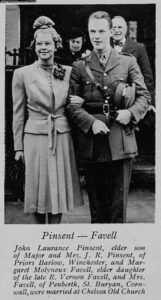
A British soldier and a woman in smart-looking clothes pose for their photo.
John Laurance and his new wife photographed in The Bystander, 21 February 1940.

Second Lieutenant John Laurence Pinsent married Margaret Molyneux Favell, the eldest daughter of Dr. and Mrs. Favell of Penberth, St. Buryan (near Penzance) in Cornwall, at Chelsea Old Church, in London, in February 1940. This must have been shortly before a promotion, as he was a full “Lieutenant” in August when he contributed to the “Penzance Spitfire Fund” (Cornishman: 22nd August 1940). According to an on-line discussion of the Favell family (“The Favells at Penberth”) “Jock” had been a friend of Margaret Favell’s brother at “Winchester” and at “Trinity College,” and he had introduced John Laurence to his family when their paths crossed on a skiing holiday in Switzerland in the 1930s.

One of the (many) advantages of being home-based during the war was that Jock and my father were both able to start a family while still in uniform. Jock and Margaret’s three eldest daughters were born during the war and lived with Margaret’s family in Penberth. The fourth sister arrived after the war. Jock’s son was born in Cornwall in the early 1950s.

After the war, Jock qualified as a solicitor and joined his grandfather, Sir Richard Alfred Pinsent’s law firm, (“Pinsent & Co.”). His uncle, Sir Roy Pinsent took over as “Senior Partner” when Sir Richard died in 1948 and John Laurence left the firm to study farming shortly afterwards. The family lived at “Little Wick” part of the family’s estate at Selly Wick, in King’s Norton, while it was in Birmingham.

John Laurence studied farming at Trengwainton, near Penzance – which was – conveniently, close to his wife’s family home. Their son was born there in 1950, shortly before John and Margaret moved in to “Higher Ludbrooke” farm, in Erminghton, in South Devon. The farmhouse was, according to the “Favells at Penberth”, somewhat run-down and it took considerable effort on the part of the new comers to turn it into the home it was, eventually, to become. When Margaret advertised for domestic help in 1950, she felt it necessary to state that there was an “Aga” cooker and electric light (Western Morning News: 1st June 1950)! Jock had yet to get established on the farm, and the local papers show that he sold off the grass that year (Western Morning News: 12th April 1950).

“Higher Ludbrooke” was a typical Devonshire mixed farm of approximately 100 acres of land. John Laurence gradually added sheep and built up a herd of “South Devon” cattle (good for high-fat milk and beef). However, he later switched to “Guernsey” and then “Friesian” cows, presumably because of the quality of their milk.

Margaret bred Dartmoor ponies and won a special prize for the yearling she showed at the “Dartmoor Pony Society’s” annual show at Princetown in 1956 (Express and Echo: Thursday 23rd August 1956). The Favell account tells us that she loved to ride and she rode with both the “Dartmoor” and the “East Cornwall Hunts” up until the mid 1960s – when she was appointed “Master” of the “Modbury Harriers”. Her family also rode and one of her daughters raced for the club. Margaret later became a “District Commissioner” for the “Dartmoor Pony Club”. At risk of introducing the lives of their children, I will mention that one of her daughters won the main trophy at the “Chudleigh Hunter Trials” in April 1965.

Jock renovated a cottage at “Lower Ludbrook” in the mid-1960s and, by the looks of it, found the bureaucracy challenging! The architectural plans are filed in the “Plymouth and West Devon Records Office”. Perhaps this is “Warren Cottage”, which was to be their home when the eventually retired.

Margaret died in 2010 and Jock followed in 2014. The “Winchester School Magazine” (“The Trusty Servant”) tell us that he was a self-taught wood carver and he left many beautiful works for posterity. He retained his interest in golf and, after a gap of 30 years, he reduced his handicap down to six.


Family Tree

GRANDPARENTS

Grandfather: Richard Alfred Pinsent: 1852 – 1948
Grandmother: Laura Proctor Ryland: 1855 – 1931

PARENTS

Father: John Ryland Pinsent: 1888 – 1957
Mother: Kathleen May Boyce: 1894 – 1969

FATHER’S SIBLINGS (AUNTS, UNCLES)

Roy Pinsent: 1883 – 1978
Clive Pinsent: 1886 – 1948
Laurence Alfred Pinsent: 1894 – 1915
Philip Ryland Pinsent: 1897 – 1916

MALE SIBLINGS (BROTHERS)

Richard Alan Pinsent: 1931 – 2019


Please use the above links to explore this branch of the family tree. The default “Next” and “Previous” links below may lead to other unrelated branches.

John Henry Pinsent

Vital Statistics

Birth: 1925
Marriage: N/A
Spouse: N/A
Death: 1945

Family Branch: Devonport
PinsentID: GRO0523


Family History

Grandparents

Grandfather: William Henry Pinsent: 1874 – 1949
Grandmother: Minnie Gertrude Pearse: 1872 – 1937

Parents

Father: Donovan Henry Douglas Pinsent: 1901 – 1980
Mother: Vera Gweneth Salter: 1905 – 1986

Father’s Siblings (Aunts, Uncles)

Henry Douglas Pinsent: 1897 – 1897
Donovan Henry Douglas Pinsent: 1901 – 1980
Gerald Swain Pinsent: 1904 – 1993


Please use the above links to explore this branch of the family tree. The default “Next” and “Previous” links below may lead to other unrelated branches.

John Douglas Pinsent

Vital Statistics

John Douglas Pinsent: 1872 – 1936 GRO0520 (Bank Manager, Portsmouth, Hampshire)

Mary Elizabeth Watts: 1886 – 1942
Married: 1906: Plymouth, Devon

Children By Mary Elizabeth Watts:

Leslie Grahame Pinsent: 1910 – 1988 (Civil Servant, Portsmouth; Married Edna Kate May Stuttard, 1934; Elsa Laura Christine Nellthorp, 1948)

Family Branch: Devonport
PinsentID: GRO0520

Reference

Newspapers

Click here to view close family members


John Douglas Pinsent was the eldest son of William Swain Pinsent by his wife  Harriet Eliza (née Cookson). He was born in Newton Bushel (Highweek Parish) in what is now Newton Abbot in 1872 and lived at “Pool Park” in Highweek until the family moved to “Rose Hill”, a house on Mill Lane, in the early 1880s. He had two older sisters and one younger brother.

John was educated at “Newton College”, where we find him playing cricket for the “Second Eleven” in 1889 (Totnes Weekly Times: Saturday 1st June 1889) and “rugby football” for its “Second Fifteen” a few months later (Tiverton Gazette: Tuesday 26th November 1889). In those days “rugby football” was invariably referred to as “football”. John Douglas played more regularly for the “College” in 1890 (East and South Devon Advertiser: Saturday 25th October 1890). “Football” was a  favoured sport in the family and John’s younger brother William Henry Pinsent in Newton Abbot played it to a high level. They both played “back” for their respective teams a defensive position requiring speed, agility, an ability to kick the ball and to think and move fast. Interestingly, their cousin Robert Maye Pinsent played “back” for his Totnes team in the early 1900s.

John, or “Douglas” as he seems to have been known, moved to Axminster, in Somerset, in around 1891 and at first played rugby for the Wiveliscombe village team (Exeter and Plymouth Gazette: Monday 16th February 1891). However, Axminster formed its own club in 1893 (Chard and Ilminster News: Saturday 17th June 1893) and he transferred to it. The team played one of its first matches against Crewkerne – they lost but at least “some good play on the part of Pinsent, the Axminster back prevented the visitors from scoring for a time” (Pulman’s Weekly News and Advertiser: Tuesday 10th October 1893).  He played another good match against Sidbury in December: “Eventually Pinsent, the captain of the Axminster team, from a pass by Gerrish, put in a splendid kick, sending the ball into touch in neutral ground … … Pinsent was a tower of strength at back and his long kicks told with effect on the visitors” (Pulman’s Weekly News and Advertiser: Tuesday 19th December 1893). Clearly he was a valuable player and he was re-appointed Captain the following year (Western Chronicle: Friday 15th June 1894).  The Axminster XV played teams from Honiton, Chard, Yeovil and elsewhere as well as Crewekerne (Weymouth Telegram: Tuesday 16th January 1894).

The following year, he took time out to play at least one game for Newton Abbot— alongside his brother, William Henry Pinsent. It was against a team from Wellington in Somersetshire. The East and South Devon Advertiser (Saturday 16th November 1895) informed its readers that William Henry was joined by: Douglas Pinsent his brother, who played for the first time for the season (and) worked well at three-quarters.” They could not both play “back”! This game was a return engagement for the brothers as William Henry had filled in on the Axminster team in a game against Chard Rovers in November 1893 (Chard and Ilminster News: Saturday 2nd December 1893). Just to complicate matters, John Douglas occasionally played for Chard. He played at “back” for them against Langport in October 1894 (Chard and Ilminster News: Saturday 3rd November 1894). They brothers seem to have played for the love of the game.

John Douglas was the “School Attendance Officer” in Axminster, and he not infrequently gave evidence in court “proving” the case against offending truants. In April 1893 he proved that two of Samuel Wiley’s children had only attended on 66 out of 114 days. Samuel was fined the princely sum of 2s 6d (Pulman’s Weekly News and Advertiser: Tuesday 18th April 1893). Perhaps he considered that a cost of doing business – it was cheaper than hiring a workman. Samuel was one of several who were repeat offenders (Pulman’s Weekly News and Advertiser: Tuesday 1st May 1894).  Douglas (or his alter ego “George Pinsent”) ensured that Thomas House was fined for not sending his son to school (Pulman’s Weekly News and Advertiser: Tuesday 16th May 1893). He was another repeat offender. In the years that followed, the parents of several other children found themselves in court as well. Most just accepted the fine but one or two attempted to excuse their child’s absence. Abraham Newbury blamed it on the prevalence of measles in the district: “The schools had been closed, and since their re-opening he had not hurried his children to attend, as the disease was still prevalent: Fined 5s for each child” (Pulman’s Weekly News and Advertiser: Tuesday 11th December 1894). The following month Douglas was called to give evidence at “Axminster Petty Session.” A local lad had only attended school three days out of forty and the-powers-that-be were none too pleased! The magistrates fined the boy’s father 5s (Exeter and Plymouth Gazette: Wednesday 30th January 1895).

John had refereed a rugby match between a Combe St. Nicholas village team and an “Axminster Junior” team earlier that month (Taunton Courier and Western Advertiser: Wednesday 23rd January 1895). However, by then his time in Axminster was running out. In March, members of the “Football Club” met at the “New Commercial Hotel” to make a presentation to their captain, “Mr. J. D. Pinsent” who was leaving town. They gave him a “handsome oak liquor stand” inlaid with a silver plate bearing the inscription: “Presented to J. Douglas Pinsent, captain of the Axminster Football Club, by a few of his football friends, on his leaving Axminster, March 1895” (Exeter Flying Post: Saturday March 9th 1895).

John Douglas moved to Plymouth, where we find him boarding with a Mrs. Mary Bannerman at a lodging house near Plymouth Hoe at the time of the 1901 census. By then, he had become a “cashier” in a bank. While he was living in Plymouth, he seems to have met and married Mary Elizabeth Watts. The couple moved to Exeter and they had an infant son, Leslie Grahame Pinsent (1910 – 1988), when the census takers next came calling, in 1911. They were living on Blackall Road in St. Winifred’s parish. John was then a “cashier” for the “Wiltshire and Dorset Bank Limited”.

In 1916, we find J. D. Pinsent, Esq., putting several items of furniture in a house in Ashburton Road in Southsea, near Portsmouth in Hampshire, including: “brass and brass-mounted bedsteads, oak ditto, satin walnut bedroom suites, Chesterfield, settee, mahogany inlaid drawing room suite, upright iron-framed pianoforte in rosewood case, by Keman, fumed oak dining room appointments, oak writing desk, walnut hall stand, over-mantels, easy and occasional chairs, Axminster and other carpets, and linoleums, electroplate, china, glass, men’s bicycle, wringing machine, bassinette, and numerous other effects” up for auction (Portsmouth Evening News: Tuesday 8th February 1916). Why is not clear. It is quite possible that the house and its contents were an inheritance that had been passed down to his wife. There was some family connection, as John Douglas moved his family to Southsea shortly thereafter.

When his father William Swain Pinsent died in 1920, John Douglas Pinsent of “2, Southsea Terrace Southsea” was appointed an executor of his Will (Western Times: Monday 18th October 1920). He was also one of the principal beneficiaries and this may have helped when he move to “37 Auckland Road, East, Southsea, Portsmouth” shortly afterwards. According to Kelly’s Directory for Hampshire and the Isle of Wight, he was living there in 1925. It was to be his home for the rest of his life.

Mr. John Douglas Pinsent was a “retired bank official” when he died in Portsmouth in 1936. His Will was processed by a firm of solicitors (“Woollcombe, Watts and Scrivenor”) from Newton Abbot; either because he had residual interests there or, perhaps more likely, because the firm was somehow linked to Mary Elizabeth (née Watts), his widow. His Will was proved in the “Exeter District Registry of the Probate Division of His Majesty’s High Court of Justice”, and probate was granted to the executors, Gerald Douglas Woollcombe, Rosina Blanche Pittard and his son, Leslie Graham Pinsent. His estate was valued at £7,893 (net) (Portsmouth Evening News: Thursday 17th September 1936). His widow, Mary Elizabeth (née Watts) died in Portsmouth in 1942.


Family Tree

Grandparents

Grandfather: John Ball Pinsent: 1819 – 1901
Grandmother: Hannah Davie Swain: 1815 – 1887

Parents

Father: William Swain Pinsent: 1843 – 1920
Mother: Harriet Eliza Cookson: 1846 – 1892

Father’s Siblings (Aunts, Uncles)

Thomas Pinsent: 1842 – 1889
William Swain Pinsent: 1843 – 1920 ✔️
John Ball Pinsent: 1844 – 1890
Frederick Richard Steele Pinsent: 1855 – 1856

Male Siblings (Brothers)

John Douglas Pinsent: 1872 – 1936 ✔️
William Henry Pinsent: 1874 – 1949


Please use the above links to explore this branch of the family tree. The default “Next” and “Previous” links below may lead to other unrelated branches.

John Ball Pinsent

Vital Statistics

John Ball Pinsent: 1819 – 1901 GRO0518 (Brewer, Highweek, Newton Abbot, Devon)

Hannah Davie Swain: 1815 – 1887
Married: 1841: Bridport, Dorset

Children by Hannah Davie Swain:

Thomas Pinsent: 1842 – 1889 (Spirit Merchant in Newton Abbot; Married Emma Anthony, 1875)
William Swain Pinsent: 1843 – 1920 (Spirit Merchant and Brewer; Married Harriet Eliza Cookson, 1868)
John Ball Pinsent: 1844 – 1890 (Wine and Tea Merchant; Married Jane Coles in 1877 and Jane Maye in 1880)
Frederick Richard Steele Pinsent: 1855 – 1856

Family Branch: Devonport
PinsentID: GRO0518

References

Newspapers

Click here to view close family members


John Ball Pinsent was the the second surviving son of Thomas Pinsent and Mary (née Savery). He was born at #4 Stoke Terrace in Stoke Damerel (Devonport), and was brought up there and in Kingsteignton, where the family owned a farm. He was the elder of two sons who married and had children. His father Thomas Pinsent was a successful “draper” who also had other interests. He partnered with a Mr. Edward Palk and took an interest in the “Old Brewery” in Mill Street in Newton Bushel (Newton Abbot) in the 1830s. Thomas’s father (another Thomas) had held an interest in the Brewery in 1781, and that may have been what sparked his interest.

Thomas had probably bought in with a view to passing the business along to his son, John Ball Pinsent and he set his son to work in the brewery and learn the trade. The London Gazette shows that Thomas transferred his interest to his son a few months before he, John Ball, married Hannah—the third daughter of William Swain, Esquire, a “merchant” in Bridport, Dorset in 1841 (The Patriot: Monday 24th May 1841).

Mr. Palk retired in 1844 (Morning Herald (London): Wednesday 29th May 1844), leaving John Ball, who was still a young man, to run the brewery. It would have taken more than a few textbooks to learn the business; however he had the benefit of “The Theory and Practice of Brewing by William Little Tizzard” to fall back on. John wrote a testimonial for its second edition, that came out in 1846. “Newton Bushell, Devon (Mill Lane Brewery) “We do most approve of your Treatise on Brewing, and have met with other brewers who have been very much pleased with the work. Wishing you success in your second edition, we have to beg pardon for our delay”: “Palk & Pinsent.” John presumably learnt the business under his father’s watchful eye.

The transfer from “Palk” to “Pinsent” may have caused some concern locally as, shortly thereafter, the brewery was forced to issue the following statement: “Messrs. Pinsent and Co. deny that the late extensive seizure of deleterious drugs, and other prohibited articles, which was made about a week since in a Brewery at Newton Abbot were found and taken from the Mill Lane Brewery, Newton Bushel;” contrary to “It having been industriously reported by some designing persons” (Exeter and Plymouth Gazette: Saturday 12th October 1844). What that was about, I have no idea. Still, public relations mattered even then. In the event, the brewery proved to be a profitable business. According to “A History of Newton Abbot” (quoted by Hilary Preston: personal communication) it had a competitive advantage over other brewers as it used soft (carbonate and contaminant free) water from a spring feeding into the Mill Leat (an aqueduct or trench) at Bradley Manor.

John Ball Pinsent was, like his father and grandfather a before him, a “dissenter,” so it is not surprising that he married Hannah in an “Independent Meeting House” in Bridport Harbour, in Dorset. However, he seems to have been less religious than either of them (or his elder brother Savery Pinsent for that matter);  nevertheless, he signed his name to a list of horrified “dissenters” who attended a “Great Protestant Meeting” held in Newton Abbot on January 26th 1852, that called for a petition to Parliament in protest against “concessions to Romanism” (Exeter and Plymouth Gazette: Saturday 31st January 1852).

John Ball and Hannah had four sons, Thomas Pinsent, William Swain Pinsent, John Ball Pinsent and Frederick Steele Pinsent. Of these, Frederick Steele, the youngest died an infant. The other three survived childhood. They stayed on in Newton Abbot, married and were gradually brought into the management of the family firm: “John Pinsent & Co. brewers & wine & spirit & coal merchants, Mill Lane Brewery and Market Place, Newton Abbot” (Kelly’s Directory: 1856). By the 1870s, it was also known as “Messrs. Pinsent and Sons.” The sons’ activities are discussed elsewhere. However, it is worth noting that the elder two, Thomas and John Ball “junior” died before their father and it was left to William Swain to help his out father in his old age, and to take over the brewery when he died. John Ball “junior’s” activities are hard to differentiate from his father as they share a common name. He most likely took over the running of the liquor store in Newton Abbot.

John Ball “senior” spent his life working on all aspects of the brewery business, from dealing with contractors and staff to buying ingredients, ensuring quality control, arranging transportation of barley, hops and beer and negotiating sales either to independent or “tied” houses. However, we see him at his best in Court, squabbling over costs or recovering money from recalcitrant purchasers, dealing with issues of theft or, increasingly over time, fighting to maintain licenses for his public houses. Licensing became more difficult as “Temperance Societies” grew in power and influence and the Government decided it had better ratchet up its control of outlets. It is hardly surprising that John Ball Pinsent paid less attention to community matters than his father, Thomas Pinsent, or for that matter, his son, William Swain Pinsent. He did not have the time.

The “Old Brewery” business on Mill Lane that Thomas Pinsent had bought into and later expanded was located along the bank of the Lemon River (a tributary of the Teign River) in the parish of Highweek. It is worth noting that Newton Abbot consisted of two separate communities in those days: Newton Abbot (per se) was in Wolborough parish. It was contiguous with Newton Bushel, which was in the neighbouring parish of Highweek. The two communities merged into one, also called Newton Abbot, in the early 1900s. Technically, John Ball Pinsent and his family lived on Highweek Street in Newton Bushel. The brewery was not large. he ran it with a permanent staff of twenty in 1851 and twenty-one in 1881 (Census records). I imagine there were a considerable number of ancillary day-labourers working there as well.

The early 1800s was the age of steam in England and the arrival of the “South Devon Railway” in Newton Abbot in 1846 must have been very helpful for the brewery. From then on, John Ball could source his barley and hops from anywhere in the country. He could also move his product around by rail—although, in truth, most if it seems to have been consumed locally. Delivery must have been a big issue. “Pinsent and Co.,” like brewers throughout the country relied on “wagons” pulled by large carthorses and “drays” pulled by even larger draught-horses to make their deliveries. The brewery must have had a large stabling capacity. Fifty-four gallon “hogsheads” of beer would have been extremely difficult to transport along Devon’s notoriously narrow and high-sided roads. How the original firm of “Palk and Pinsent” managed to supply “The Palk Arms” in Hennock I cannot imagine! It is near the top of a hill and a challenge to get there even today.

Parked wagons were a problem in towns and cities just as parked cars and trucks are today and downtown parking was discouraged, even in John Ball’s day. Two of the Company’s workers were charged with leaving their wagons unattended for longer than absolutely necessary to load and unload while making deliveries in Torquay in 1858 (Western Times: Saturday 25th September 1858). They got off … after all, who is to say how long is too long? Although I am sure that most of the firm’s fleet of horses were well behaved, the Exeter Flying Post (Thursday June 17th 1858:) tells us that a worker in the stables had an arm badly bitten while cleaning a disgruntled horse. Even they had their limits. At a later date, a Mr. Hunt, who delivered coal for the company, died of blood poisoning before he could be taken to Newton Cottage Hospital to have his arm amputated (Western Times: Wednesday 7th December 1892): Presumably he was injured on the job. The item is not clear on that point.

Needless to say, accidents occurred in the handling of barrels in and around the brewery, and on the road. For example, a barrel rolled over a worker at the brewery in September 1864 and severely bruised his legs (Western Times: Friday 23rd Sept. 1864). In another incident, a worker unloading sacks in the rail-yard slipped and fell under the wheels of a wagon loaded with 50 sacks of barley weighing in aggregate two tons (Exeter & Plymouth Gazette; Friday 11th December 1868). Needless to say, he was badly injured. Mr. Wonnacott, who was an “assistant brewer” fell over some stairs and broke his leg at the brewery in 1877 (Western Times: Wednesday 30th March 1877).

Physical injury was one thing; the ongoing threat of fire was another. It could be devastating. There was a fire at Messrs. Pinsents’ malt house on Bearne’s Lane, in Highweek, in 1875; however, it was put out with buckets of water before the fire engine arrived. Only a few sacks and some flooring were damaged (Western Times: Friday 24th December 1875). The firm also got lucky when some hay in a loft at the “Ship Inn” in Alphington, in St. Thomas (near Exeter), caught fire. It was also extinguished fairly quickly and it did relatively little damage—other than to the hay, of course (Western Times: Thursday 17th July 1890).

It was no accident, but a deliveryman named George Skinner hanged himself at the brewery in 1876. It must have traumatized his young son who had the misfortune to find him. Mr. Skinner was known to be an alcoholic and the Coroner pointedly condemned the policy of brewers who allowed their men to drink an unlimited amount of beer at work, and he also regretted the willingness of landlords to give delivery men a free drink after making their deliveries (Exeter and Plymouth Gazette: Friday 19th May 1876).

Sadly, in another accident a man named Walter Hunt died of injuries he received when he was thrown from one of the firm’s wagons while making a delivery. His horse bolted going down a steep hill near Bishopsteignton (Western Times: Saturday 18th July 1857). In a similar vein, the Exeter and Plymouth Gazette (Friday 11th January 1867) describes how a gentleman’s coachman narrowly escaped being run over near Kingskerswell. Apparently, he met two of Mr. Pinsent’s wagons and, although the first passed him successfully, the second locked its wheels with his coach and he fell with his head between the wheels when it jolted to a halt. Fortunately, he was only cut and bruised. A horse pulling a wagon loaded with bags of chaff belonging to “Messrs. Pinsent and Sons, Brewers”, also threw its driver and bolted into a flock of sheep in Kingsteignton, injuring several of them (Exeter and Plymouth Gazette: Friday 7th October 1870).

One has to sympathize with one horse, drawing a wagon, that took fright at seeing a couple of elephants belonging to Mrs. Edmond’s “Menagerie” as it entered Keingsteignton (Western Times: Friday 26th July 1872). No one had told it what to expect! In some cases one has to question the condition of the roads. Mr. Carpenter, the proprietor of the “Globe Hotel” in Chudleigh, was thrown from his trap in front of Mr. Pinsent’s brewery after his horse slipped (on ice?) and gave a lurch. He was unconscious for a while and then taken home (Exeter and Plymouth Gazette: Saturday 2nd February 1895). The “Globe Hotel” was a tied-house that belonged to the brewery. It had been substantially rebuilt a few years previously and now boasted an assembly room that could seat 150 people, and it had a drill hall suitable for the local “corps of volunteers” (East and South Devon Advertiser: Saturday 19th May 1890).

The worst accident of all however, happened in 1879. John Ball Pinsent’s wife Hannah Davie and his daughter-in-law, John Ball “junior’s” wife Jane (née Coles), were driving through Devon Square in Newton Abbot in their pony and trap when the animal was frightened by some boys riding a grocery truck, and bolted. Crossing Queen Street, the carriage came in contact with the curb and corner of the house belonging to Mr. King, against which the ladies were thrown with considerable force and sustained serious injuries. They were immediately removed to their respective residences, and promptly attended to by Drs. Gage and Scott. Young Mrs. Pinsent has been unconscious ever since, owing to concussion of the brain, and her condition gives her friends great anxiety. Mrs. Pinsent, senior, had a collar-bone broken and was insensible for some time, but has since shown some signs of amendment” (Exeter Flying Post: Wednesday 30th April 1879). Jane died on the 3rd May 1879 leaving John Ball “junior” with an infant daughter. He remarried the following year.

On a lighter side, the firm’s wagons were periodically put to better use than carting beer: Mr. Pinsent lent a wagon to take the “Salem Chapel Band of Hope” for a “Sunday School” annual picnic (Western Times: Tuesday 20th July 1869). The firm also provided transport for the “Baptist Sunday-School Anniversary Treat” in 1890 (East and South Devon Advertiser: Saturday 14th June 1890). Presumably they also did so in other years.

The stables attracted miscreants and over the years there were several examples of theft, both from the stables and from the main brewery. For instance, P.C. Squires noticed Eliezer Phillips leaving Mr. Pinsent’s premises with a bag that was later found to contain seven pints of oats. He was charged at the local “Petty Sessions” (Exeter and Plymouth Gazette: Friday 3rd September 1869). Similarly, William Pickett “senior” and his son, William Pickett “junior” were charged at “Devon Intermediate Sessions” with stealing and receiving 30 lbs of malted barley. Presumably it was for use in home-brewing. Mr. Pickett was a casual worker at the brewery. He said he had been filling in for a sick friend and that he had given him the key to the malt house. He admitted to giving a bag of barley to his son who was seen leaving the premises. Mr. Pickett was sentenced to six months of hard labour, and his son four months (Exeter Flying Post: Wednesday 17th February 1875). Punishment was punishment in those days.

The banking system in the 1800s was far less sophisticated than it is today (or than it was in the 20th Century, for that matter). There were banks and large transaction could be made using cheques or “drawn notes”; however, many of the brewery’s transactions were for small sums and they used cash—bank notes, gold sovereigns and silver coins. Theft was an ongoing issue here as well, and the brewery’s trust in its employees was occasionally misplaced. For instance; William Ridgway, who had been employed to collect money and receive orders around Torquay for over two years was charged with embezzling £12 13s on one occasion and £3 on another – when his accounts were finally tallied. This seems to have been done infrequently. He was sentenced to four months imprisonment (Western Times: Saturday 24th March 1849).

That, however, was nothing compared to the audacity of Mr. King, the man who literally got away. He absconded to the “diggings” (in Australia) with either £90, £35 or £30 (depending on which newspaper you believe) in gold and silver coins that he had been instructed to pay to one of the company’s creditors (Exeter Flying Post: Thursday October 21st 1852). He just took off! Still, although some mistakes were clearly made wittingly, others may have been accidental. Book-keeping was far from perfect and the brewery did not win all its court cases. For instance, it hired a Mr. Bury on salary and commission and he sued the brewery for withholding between £200 and £300 that he felt he was owed. The matter eventually went to arbitration and was settled out of court (Western Times: Saturday 28th 1855)—much to the annoyance of the local populace who were dying to know what he received.

From here on in, Court Cases loom large in John Ball’s life. Some cases were settled more easily than others. In 1864, he arranged to purchase six ricks of hay from a Mr. White of Chudleigh. Unfortunately, the two of them nearly came to blows over the purchase price that they had (verbally) agreed to. Mr. Pinsent said it was £5 10s per ton and Mr. White said £6. It was a case of he-said, he-said and in this particular case, the magistrates established the going rate was £6 and gave for Mr. White (Exeter & Plymouth Gazette: Friday 2nd December 1864). John Ball had horses to stable and feed. Some years he may have been short on hay; however, other years he seems to have had more than enough. He put a rick of about 40 tons up for sale in January, 1876 (Western Times: Tuesday 11th January 1876), and two ricks of about 60 tons “prime hay” in May the following year (Western Times: Friday 18th May 1877).

Brewers are picky when it comes to barley—for them, grain-size does matter—and the quality of a batch affects its price. In January 1859, John Ball lost a case in the “County Court”.  He had agreed, through one of his employees, to purchase 90 bags of barley from a farmer from Staverton called Skinner. However, when the consignment arrived he rejected it. He offered to pay Mr. Skinner a reduced price but he had held out for the agreed amount and their Lordships agreed with him. Mr. John Ball Pinsent was instructed to honour his contract (Exeter Flying Post: Thursday 27th January 1859).

On another occasion, John Ball attempted to recover £64 for 76 sacks of barley that he had bought from a farmer called Mugford in November 1874. On arrival, he found the barley unsuitable and he arranged with Mr. Mugford to resell it. Mr. Mugford claimed he sold the barley to a miller called Stockman but, five years on, the latter denied it. Once again, the paper trail was woefully inadequate. Stockman blamed Mugford for the poor paperwork but witnesses proved that Stockman had indeed received the barley and the jury gave for “Pinsent and Sons” (Exeter Flying Post: Wednesday 30th July 1879).

In another case, the “Great Western Railway Company” sued Mr. W. A. Hawke, a “merchant” in Dartmouth, to recover £14 for carriage of his goods. Mr. Hawke counter-claimed. He stated a shipment of barley he had sent to Mr. Pinsent in 1880 had arrived wet and been rejected. He claimed that his 40 sacks of barley meal had been damaged in transit and it had cost him £3 per sack. (Exeter and Plymouth Gazette: Friday 2nd March 1883.) He felt that the Railway Company was culpable and he did not think he owed them anything. However, his Honour demurred, saying that unless he could show intent on the part of the Company, it was not “wilfull damage” and he had no case against them.

Nobody had the audacity to question John Ball’s ability to assess the quality of grain. In fact, for several years in the mid-1860s and early 1870s, Mr. Pinsent of Newton and Mr. West of the “Tamar Brewery” were invited to judge the “Malting Barley” competition held at the “South Devon Agricultural Society’s” annual show (Western Times: Friday 2nd November 1866; see also Western Times: Tuesday 31st October, 1865 and Western Times: Thursday 5th October 1871).

In 1876, the “West of England Sack Company” sued “Pinsent & Sons” of Newton Abbot in the County Court for un-returned sacks to the value of £120 17s 6d. The dispute was founded on sloppy bookkeeping on all sides and a propensity for third parties to charge their sacks to the brewer’s account—in order to keep them off their own books. The Judge gave for the defendant (East & South Devon Advertiser: Saturday 9th December 1876). The following year, the same company sued a Mr. Hobson for the return of 50 sacks. He claimed miss-management on their part and said he forwarded the sacks to “Pinsent and Co.” in Newton. Mr. Pinsent’s foreman, Mr. Avery, testified that he received them and that he had, in due time, delivered them to the sack company’s depot. In this case, it seems as if “Pinsent and Co.” had erroneously received the credit for the sacks (Exeter Flying Post: Wednesday 11th April 1877). According to the Census records, John Ball Pinsent employed 21 men, in 1881. The brewery was profitable but even it had its problems.

Bankruptcies were painful for everyone and creditors were careful to ensure that a bankrupt’s assets were not spirited away, or otherwise disposed of, before an inventory could be taken and their value assessed. In 1851, John Ball Pinsent sold 50 bushels of malt worth £15 to Robert Duke, an “Inn Keeper” in Chudleigh, and he seems to have tried to recover the malt on the day that Mr. Duke’s goods were put into assignment. The other creditors were incensed as they thought the malt qualified as an asset and they all should get a share of the value (Western Times: Saturday 27th Dec. 1851). When Albert Lethbridge, an “Inn Keeper” from Totnes entered bankruptcy in 1862, Mr. Pinsent, of Newton Abbot was left with a bill of sale for goods valued at £200 (Torquay Chronicle and South Devon Advertiser: Saturday 5th April 1862).

Similarly, when a William Godfrey of St. Thomas (Exeter), died owing  £790 in 1978, it appeared to his Executors and Trustees that he had sold his house to “Messrs. Pinsent and Co.” shortly before declaring bankruptcy. They sued “Pinsent and Co.” for the value of the assets on behalf of Mr. Godfrey’s other creditors. The Company claimed that it had actually purchased Mr. Godfrey’s house long before he died and that they had only allowed the debtor to stay on in his home until they could find another tenant (Exeter and Plymouth Gazette: Friday 13th December 1878): if you say so.

Mr. Pinsent frequently found himself in the County Court trying to recover small payments for beer, spirits and/or coal supplied to customers who were either reluctant or unable to pay. Hardly a year went by without him having to press for payment from someone. Most shop and inn keepers accepted their fate and either paid up or went to jail: For instance, an inn keeper called Addams from Kingsteignton was committed for 30 days for non-compliance with an order to pay £3 14s for debt (Western Times: Saturday 1st Feb 1851). Similarly, an inn-keeper called How said he could have paid his bill and that “Pinsent has been foolish to put him into Court”; however, as he refused to attend the Court and present his case, he was convicted in absentia for not paying for goods valued at £17 10s (Exeter and Plymouth Gazette: Saturday 31st March 1855). “Pinsent and Co.” also sued a former public house keeper in Totnes for £3 5s (Exeter & Plymouth Gazette: Saturday 7th June 1856). We hear no more about it, so presumably he paid up.

Individuals seem to have been more imaginative in their defense: When a widow called Passmore was sued for her late husband’s debt of £16 for wine and spirit, she claimed all her husband’s assets came to her through a marriage settlement and, by the wording of the settlement, she was not liable for his debts (Western Times: Saturday 7th December. 1850). Nice try: I doubt that she got away with it. Even nominal family members refused to pay up! When John Ball Pinsent tried to recover from John Pinsent of Bovey Tracey, the latter’s wife appeared and said she had bought the beer for her master, a Mr. Steer, who was now dead … (so presumably the Company should sue the estate). His Lordship must have felt that he was in no position to say otherwise (Western Times: Saturday 23rd September 1854). No prizes for guessing who drank the beer.

Beer consumption in Britain peaked in 1875 but stayed at a relatively high level until the outbreak of the First World War (Highs and Lows of Drinking in Britain: James Nichols, 2014 see historyandpolicy.org). It dropped rapidly thereafter; in part because many of the boys failed to return and in part because of a growing temperance movement. “Pinsent and Co.” operated in a very competitive business environment that was growing increasingly difficult to handle as legislation tightened licensing requirements and Temperance Societies applied social pressure.

Interestingly, John Ball put the “Old Brewery” (site of the superintendents’ house plus brew-house and cellars and also malt-house etc. along the River Lemon and also the house and shop fronting Wolborough Street) up for sale by auction at the “Globe Hotel” in Newton Abbot, in 1861 (Exeter Flying Post: Wednesday 25th December 1861). By then, the main buildings had long since been relocated. The firm’s office address was now #21 Highweek Street, Highweek, Newton Abbot (East and South Devon Advertiser: Saturday 1884). Mr. and Mrs. J. B. Pinsent lived nearby, at #7 Highweek Street. The “Returns of Owners of Land: 1873” shows that John Ball Pinsent owned land in Highweek Parish (presumably associated with the brewery) with a gross estimated rental of £161 0s 0d.

Like other breweries, “Pinsent and Co.” bought or leased and serviced “tied” public houses throughout their local area and they also supplied beer (and possibly also wine and spirits) to independent taverns and inns. The number of establishments the firm owned and/or leased must have varied over the years as the company bought and sold outlets and acquired and surrendered leases. An inventory of John Ball’s holdings in 1872 shows that he then had seven establishments and an off-license (“Victory Inn”, in West Teignmouth; “Turks Head”, in Newton Abbot; “Bell Inn”, in Bovey Tracey; “King of Prussia”, in Bovey Tracey; “Church House”, in Denbury; “New Inn”, in Newton Bushell; “Clifford Arms”; in Shaldon and a wine and spirit store in Newton Abbot: (Register of Licenses: Teignbridge: 1872)). A Parliamentary Census of “On-Licenses” for Devonshire conducted almost twenty years later, in 1891, shows that the company then either owned or leased 13 hostelries in Teignbridge Hundred (Newton Abbot and surrounding area) and 3 in the neighbouring Hundred of Wonford (Exeter and surrounding area) (Western Times: Friday 20th March 1891).

Each establishment had to have a “license” held by a qualified person at all times, and John Ball Pinsent regularly appeared before the magistrates on “Licensing Day” at the local “Petty Session”—either arranging approvals for a new pub or transferring an existing license (to-or-from) a landlord: the Pinsents would have been well known to all the local police, magistrates, lawyers, court officials and others, as they went about the business of managing their fleet of hostelries. It was an uneasy relationship!

The Newspapers contain numerous references to “Pinsent and Co.” and, later, “Pinsent and Sons”, requesting the transfer of licenses. For instance, the license of the “Church House Inn”, in Denbury was transferred from Mr. Willcocks to Mr. Wm. Taylor in 1871 (Western Times: 2nd March 1871). Mr. Taylor died a few years later and Mr. Pinsent applied for a temporary transfer to Mrs. Taylor, his widow (Western Times: Friday 29th January 1875). Similarly, in 1869, John Ball asked the magistrates to transfer the license for the “Plymouth Inn” in Newton Abbot from the firm itself to a William Saunders “who had managed it for two years” (Western Times: Friday 1st October 1869).

The “Kings Arms” in Chagford was put to let by “Messrs. Pinsent and Sons”, in December 1879 (Western Times Monday 22nd December 1879) and the “Clifford Arms” in Shaldon was transferred from Mr. Pinsent, the owner, to Edward Henly French in 1889 (Western Times: Thursday 10th January 1889). For some reason, a Mr. James Rowe, who had been the landlord of the “Town Arms” at Churston Ferrers, applied to have his license temporarily transferred back to the owner, Mr. J. B. Pinsent, in 1880. It is not clear why (Western Times: Thursday 4th November 1880). The transfer went through easily enough; however, John Ball was caught out by a technicality and fined £1 in December of that year because he forgot to change the name of the licensee on the sign above the door of the pub (Western Times: Thursday 30th December 1880)!

Not all of the Company’s applications went so well: when the Newton Abbot magistrates were asked for a transfer of the license of the “Turk’s Head” in Newton Abbot to a Mr. Avery, the “magistrate’s clerk” (Mr. Flamank) objected on his own behalf as Mr. Avery had previously held a license for the “Rising Sun” (also owned by Mr. Pinsent) and had kept a “disreputable house”. Inspector Barker acknowledged that he had seen prostitutes there when he visited … (Western Times: Saturday 31st Jan 1852). Try as they might, it was hard for the company to ensure that all its licensees stuck to the letter of the law.

Many years later, a Mr. Hole, who was the landlord of the “Turk’s Head” in Newton Abbot, was fined at “Moretonhampstead Petty Sessions” for selling cider to two “Inland Revenue Officers” without having the appropriate license. They had been served the drink in a “Taproom” (sub-let adjunct to the main bar) that Mr. Hole also ran at the “White Hart Inn” in Moretonhampstead. The question was, whose license was operating under? Was he sub-contracted by the licensee of the “White Hart Inn”, or by “Pinsent and Co.,” who supplied the establishment with beer? There was no written contract and there was nothing to show that he was actually working for the licensee of the Inn at the time. He was fined £10 in each case (East and South Devon Advertiser: 9th January 1875). The “White Hart Inn” was a typical coaching inn in Moretonhampstead. It is still in business today.

The Company owned and/or leased several public houses in Newton Abbot, including two on one street. We find Mr. Pinsent applying for a license for Mr. John Henry Best to run the “Sun Inn” on East Street in 1885 (Western Times: Wednesday 15th April 1885) and we also find him applying to transfer the license of the “Jolly Sailor Inn” in East Street to Aaron Beavis in 1878. On the latter occasion he was refused. However, the Newton Abbot magistrates were willing to grant Mr. Pinsent a temporary license for the “Sun Inn” until he could find another tenant (Western Times: Friday 25th October 1878). Ten years later, we find the license of the same premises was temporarily transferred from Eliza Fragile to John Ball’s son, Thomas Pinsent (Western Times: Friday 5th November 1886). Who received it next is unclear.

In 1890, “Messrs. Pinsent and Sons” informed the magistrates, through their lawyer, that Mr. Pinsent (presumably John Ball Pinsent) was aware of the complaints that had been made regarding the “Jolly Sailor Inn.” He had given the occupier notice and he had agreed to comply with any recommendations the Court might make. Evidently, Mr. Pinsent had lined up a tenant of good character and experience and he was expected to take over shortly; however, Mr. Pinsent would appreciate having the license in his own name until the new landlord arrived. The magistrates agreed to visit the property and decide (Western Times: Wednesday 27th August 1890). The visit must have gone well as the police withdrew their objection—whatever it was—and, after vetting the proposed tenant, the license was transferred to James Sanders of Dartmouth (East and South Devon Advertiser: Saturday 4th October 1890).

What had gone on at the “Jolly Sailor Inn” is left to the reader’s imagination; however, when John Drew, the landlord of “Star Inn”, in Torquay, was charged with running a disorderly house it was explained in court that he had permitted: “his licensed premises to be the habitual resort of women of ill fame, and allowing them therein to remain longer than was necessary for obtaining reasonable refreshment”. The magistrates fined him £2 and endorsed his license. Mr. Pinsent, who owned the premises, gave notice that he would arrange for Mr. Drew’s removal at once—as he was disqualified from holding a license for five years. To complicate matters, the “Star Inn” had its license revoked for two years as well (Exeter and Plymouth Gazette: Friday 23rd October 1885).

That same year, Mr. J. Pinsent was called as a witness when one of his land-lords, Mr. Hole  at the “Turk’s Head” in Newton Abbot (who was “known to the police”) was accused of selling liquor during prohibited hours. A policeman had, apparently, seen some men near the back door of the pub. One of them claimed that he rented an orchard and vegetable patch behind the pub that Mr. Pinsent also owned, and he and his friends had passed by the back door of the “Turk’s Head”  and stopped to talk to Mr. Hole on the way out. The magistrates found no convincing evidence of criminal activity and the case was dismissed (East and South Devon Advertiser: Saturday 5th September 1885).

In 1864, “Pinsent and Co.” asked for the license for the “Victory Inn” in Teignmouth to be transferred from John Ball Pinsent to a Mrs. Shooter (Western Times: 5th August 1864). The pub was later demolished to make way for a tunnel needed by the Great Western Railway and “Messrs. Pinsent and Co.” built a bigger and better establishment nearby, quite reasonably expecting to get it licensed. However, when they applied at the appropriate Petty Session, they found that the “Church of England Temperance Society” objected on the grounds that there were already 30 licensed houses in Teignmouth serving a population of 7,000. Presumably much to John Ball’s chagrin, the license was refused (Western Times: Friday 30th September 1881). On another occasion, it was the “Baptists” who were accused of inteferring in the sale of liquor in Teignmouth. The landlord of the “Royal Oak” public house sued the owners of the recently built Baptist Chapel for blocking his light. Mr. Acland, a “traveler” for the Newton Abbot brewers, “Pinsent and Sons”, testified that he had been able to settle his bill in the bar under natural light, but that was no longer possible (Teignmouth Post and Gazette: Friday 26th July 1889).

The local newspapers also show that “Messrs. Pinsent and Co.” applied to the magistrates to let the “Golden Lion Inn” on Union Street in Torquay in 1850 (Western Times: Saturday 22 June 1850). The Company must have held the property leasehold for quite some time and been pleased with it, as Mr. Pinsent bid £1,000 for it’s purchase when it came up for auction in 1876. The owner had, unfortunately, placed a reserve price of £1,500 on it, and it did not sell (Exeter and Plymouth Gazette Daily Telegrams: Wednesday 20th September 1876). Presumably Mr. Pinsent’s existing lease remained in place.

Other properties were sold out from under them: The firm may have lost the “The Half Way House” (adjoining the turnpike road between Moretonhampstead and Chagford) in 1868. On this occasion, the building was put up for sale before their tenancy expired (Western Times: Friday 8th May 1868). Perhaps they put in a bid. The “Sandy Park Public House” and other related properties in Drewsteignton, near Chagford “in the occupation of Messrs. Pinsent and Son and/or their tenants” were put up for sale by auction in 1897 (Exeter and Plymouth Gazette: Tuesday 14th September 1897) and the “Town Arms” and other property in Higher Brixham also “under the occupation of Messrs. Pinsent and Son and their sub-tenants” were up for sale by auction a couple of years later (Western Times: Thursday 24th August 1899).

Accidents happen; the thatched roof of a cottage adjacent to the “Ship Inn” at South Knighton – approximately three miles from Newton – caught fire and did considerable damage to three buildings before the Fire Brigade was able to reach the scene. A young woman who tried to retrieve a box from one of the cottages was bady burnt and two others received lesser injuries. Fortunately for the pub’s land-lord, he had his furniture covered by the “Atlas Insurance Company” (Totnes Weekly Times: 13th March 1897).

Mr. Pinsent (presumably John Ball) bought the “Punch Bowl Inn”, in Moretonhampstead, at auction, for £330 (Exeter Flying Post: Wednesday 6th October 1880). Interestingly, this property was known as the “New Inn” when his great grandfather, Mr. John Pinsent bought it as a private residence for Mr. John Coles (“a soap boyler”) in 1858. It reverted to being an Inn, known as the “Punch Bowl Inn”, in 1798 (Moretonhampstead Historical Society). Mrs. Bruce ran it for Mr. John Pinsent until April 1800. Mr. John Steer, a “farmer”, took it over when she quit (Silvester Treleavens’ Diary). This early acquisition was probably the start of the Pinsent family’s involvement in the brewery business. It seems that not all “dissenters” objected to the sale of intoxicating liquors!

John Ball Pinsent’s relations with his “tied-house” landlords did not always go well. In October 1876, he sued a Mr. Stranger who had lately occupied the “Temple Bar” beer-house on Queen Street, in Newton Abbot, claiming that he had bought fixtures for the house for £100 and that Mr. Stranger was obliged to pay him back £60, in installments of £4 per month. The rest was considered “good will”. The landlord said that he paid £36 and the brewery did not ask for more until he was leaving. He denied any further liability and said he had passed the beer-house to his brother who sold the fixtures for £50. His Honour was not impressed with Mr. Pinsent’s level of book keeping, but doubted that he would commit perjury for £30 or £40 (Exeter and Plymouth Gazette: Friday 20th October 1876)!

“Pinsent and Sons” may have had the ‘Temple Bar” sold out from under them in 1880, when the beer-house, which contained “a bar, bar parlour, wash house, four bedrooms and necessary offices” was included in a bundle of leasehold houses and shops put up for auction by Messrs. Rendell and Symons. (Western Times: Friday 23rd July 1880). However, they still had their lease and the license for the property in 1893, when the “Temple Bar” and an adjoining house and shop in Queen Street “held by Messrs. Pinsent at a yearly rent of £60 and sublet to Mrs. Terrell and Mr. T. B. Combe respectively” were again put up for auction (Western Times: Friday 20th October 1893). There were no bidders for the property (East and South Devon Advertiser: Saturday 21st October 1893).

John Ball Pinsent “senior” had plans made up for a new public house called the “Mirror” on Queen Street in Newton Abbot. He applied for a spirit license in 1869 but Mr. Magor, the owner or manager (?) of the nearby “Commercial Hotel” objected as Mr. Pinsent already controlled the “Plymouth Inn” on Queen Street. The magistrates turned him down (Exeter and Plymouth Gazette: Friday 3rd September 1869). They were; however, prepared to accept the premises as an off-license. John Ball did not act on this; instead, he reapplied the following year. This time the “Newton Total Abstinence Society” objected, saying that there were already eleven licensed houses between the Commercial Hotel and the Railway station and enough was, surely, enough! Again, the magistrates refused the application (Exeter and Plymouth Gazette: Friday 2nd September 1870).

The following year, the company reapplied but again failed for lack of “pressing need” – and also because the magistrates seemed uncertain about the ramifications of certain changes in the legislation. John Ball read the signs and tactfully withdrew his application (Western Times: Friday 1st September 1871). By 1873, he seems to have lowered his expectations. He only applied for a limited off-license for the Queen Street establishment; however, this too was rejected—albeit on a technicality! He had not advertised his application in the court paper for fourteen clear days before the hearing (Western Times: Friday 29th March 1873). John Ball Pinsent reapplied later the same year. This time, he reminded the magistrates that he owned and operated several establishments in the town. He had a good record, and he promised he would to conduct his houses better than other people did. He pointed out that he had a similar license in Newton Bushel and he only wanted to sell liquor in small amounts. It was all to no avail. The “Good Templars” objected and the magistrates, yet again, turned him down (Exeter and Plymouth Gazette: Friday 3rd October 1873).

The following year, his own license for consumption at the Newton Brewery was reduced “by consent of the owner” to six days a week and 10 o’clock closing in October the following year (East and South Devon Advertiser: Saturday 3rd October 1874). There was growing concern about alcoholism in the 1870s, even before the coroner made his pointed remarks about the availability of beer at the brewery following the suicide of Mr. Skinner in 1876.

John Ball Pinsent did eventually establish a wine and liquor store Queen Street in Newton Abbot. It was an “Off Premise” that may have also sold tea and other grocery items. John Ball Pinsent, or more likely his son, John Ball Pinsent was the local agent in Newton Abbot for the sale of “Ind, Coope, and Co.’s Mild” and “Strong Burton” and “East India Pale Ales” (Western Times: Tuesday 22nd December 1885) and also of “Pilsner Lager” beer (East and South Devon Advertiser: Saturday 24th December 1887). Presumably it came down from the Midlands by rail.

Local Directories show that John Ball Pinsents (likely “the younger”) also signed on as an agent for the “Commercial Insurance Company”. The wine and liquor store is mentioned in a description of the town as it was decked out for Christmas in 1885 (Western Times: Thursday 24th December 1885). The writer remarks on the well-stocked shops and stores in Newton Abbot and, after describing the “delicacies” on display at Mrs. Towell and Mrs. Hodges’ place on Courtenay street, he goes on to say “it was a kind of relief to take a glance at the bottle store of J. B. Pinsent and in imagination sip the “nectar” to be found in that well arranged establishment”. A bit over the top but it suggests a well-stocked storefront window.

Although Mr. Pinsent was usually in Court pleading his own case, he sometimes supported other people’s applications; for instance, in 1877, he supported Harriet Elizabeth Tippet’s application when she applied for a liquor license at “Totnes Petty Session”. The magistrates turned her down, so she appealed at the next sitting of the “Devon Quarter Sessions” claiming that the magistrates in Totnes had been unreasonable when they refused her the license of the “Bridge Inn” in Littlehempston after her had father died, as he had built the place. Mr. Pinsent’s evidence was discounted as being, most likely, self-serving and it probably was—despite her protestations to the contrary. Nevertheless, the bench agreed to make the transfer (Western Times: Thursday 5th July 1877). John Ball also supported a Mr. Boon’s application for an “occasional license” to sell liquor at a Newton Abbot flower show in 1874. However, the application went nowhere; the magistrates pointedly remarked that they had always rejected flower show requests before and this time was no different (Western Times: 2nd September 1874).

If running the brewery and the wine and spirit store were not enough, John Ball also built a coal yard by the River Lemon. He bought the business from a Mr. Templar in 1851 and retained William Cruse, one of Mr. Templar’s managers, to run it. The arrangement worked reasonably well until the two attempted to balance their books in 1853. John Ball found that a few of the 200 plus accounts had been paid to Mr. Cruse but not to him, and he charged Cruse with embezzlement. The latter’s lawyer suggested that, although mistakes may have been made, there had been no intent to defraud and the jury determined that he was not guilty (Exeter Flying Post: Thursday March 24th 1853).

The firm brought coal in by sea from Newcastle and London and barged it up the Lemon to a site on the “Teign Marshes”. The site was convenient but prone to flooding. In November 1852, approximately 150 tons of coal was washed down the river (Exeter and Plymouth Gazette: Saturday 13th November 1852) and more was lost in January 1866 (Exeter and Plymouth Gazette: Friday 19th January 1866). By contrast, the amount he lost to theft seems trivial. A labourer called Spires was charged with stealing a “bag of coal” from Mr. Pinsent in 1855 (Western Times: Saturday 4th August 1855) and John Bowden was convicted of stealing “24 lbs of coal” at Devon Intermediate Sessions in 1853. He was sentenced to six weeks imprisonment (Exeter and Plymouth Gazette: Saturday 17th September, 1853).

The company may have supplied the railway with coal, but the number of small accounts suggest that most of it was for domestic use. For many years the firm held a contract from the Guardians to supply coal to the workhouse: In July, 1856, the Board of Guardians accepted John Ball’s tender for 50 tons of Newport (Wales) coal at 18s 3d/ton and 50 tons Newcastle coal at 19s 3d/ton (Exeter and Plymouth Gazette: Saturday 12th July 1856). The following week the Guardians specified that the coal be weighed at “The Marshes” while the Master of the Work House was present. One could not be too careful. Substitutions were not allowed. In August 1862 the Guardians complained that the coal it received was not from the “Red Ash Coal Company” as then specified in their contract and, although Mr. Pinsent showed them a certificate saying it was the same quality, they insisted on the real stuff (Western Times: Saturday 30th August 1862). Prices rose over time. In 1865, John Ball supplied the Guardians with 90 tons of Newport coal at 20s 3d per ton and 6 tons of red ash coal at 23s 3d per ton (Western Times: Friday 21 July 1865).

In 1880, The Company contracted four bargemen to convey two barges containing 30 tons of coal each from the “Fanny” at Teignmouth up the river to its coal yard at “Teign Marshes”. The bargemen left the barges unattended at Combe Cellars overnight, intending to return the following morning to continue upstream on the tide. Witnesses later said they saw twelve tons of coal, six from each barge, secretly off-loaded onto a lighter owned by a John Frost and conveyed by a local coal dealer, Walter Morely, to a cellar owned by George Martin. There, they saw the coal being offloaded. Police established that the coal was of the same type and texture as that remaining in the main barges, and the men were charged. The case was one of considerable interest when it came up at the local assizes (Western Times: Wednesday 29th December 1880).

The River Teign was an important artery for commerce; however, it regularly silted up and it was both difficult and expensive to keep the “Teignmouth Bar” open for shipping. In 1850, John Ball Pinsent and his father Thomas Pinsent were elected members of a Commission formed to decide what to do about it. The Commission studied a report by Captain Washington and Captain Splatt but eventually concluded that, as long as the City of Exeter charged dues on products coming in through Teignmouth yet refused to contribute its fair share of the maintenance costs, it was not worth paying for dredging (Western Times: Saturday 26th October 1850). John Ball was reelected to the Commission in 1856 (Western Times: Saturday 20th September 1856) and also in 1877. The commission consisted of four ship owners and seven ratepayers (Exeter and Plymouth Gazette: Friday 21st September 1877).

Mr. J. B. Pinsent “senior” does not seem to have been overly political; however both he and and his son, Mr. J. B. Pinsent “junior”, attended a speech by Mr. W. J. Harris, M.P. (a Conservative) at a meeting of the Constitutional Club, in Newton, in 1885 (Exeter and Plymouth Gazette: Saturday 30th May 1885). He also had at least one of his sons on hand when he attended a meeting of the Devonshire Branch of the “County Brewers’ Society” to discuss an upcoming report on the proposed Local Government Bill in 1888. After much debate, it was agreed on this occasion that no decision would be made on the matter before the actual publication of the bill (Western Times: Saturday 24th March 1888). John Ball’s business acumen was, however, put to good use elsewhere. We find that Mr. John Ball Pinsent and Mr. Ruby of Berry Mills were appointed trustees of the effects of Richard Osborn of the “Royal Oak Inn”, Marldon, and they were tasked with settling his creditors’ claims (Western Times: Friday 19th May 1871). Similarly, he presided over a meeting of creditors of Nicholas Ball, of Starcross, an Innkeeper with debts amounting to £998 14s 6d. Predictably in this case, the creditors recommended bankruptcy (Exeter and Plymouth Gazette Daily Telegrams: Saturday 24th May 1880).

Mr. J. B. Pinsent lived at, #7 (now called #2) Highweek Street in Newton Abbot. Minerva House still stands. It is an elaborate Georgian townhouse that once had an impressive lead statue of the goddess Minerva in its portico. It was stolen in the mid-1980s. Minerva house is described in considerable detail in an unidentified newspaper article (possibly from the Mid-Devon Times) prepared by Ms. Edith Wheeler in the 1960s. By then, it had been subdivided and was being used by several local businesses. The building now belongs to the “Teignbridge District Council.” It is (or a few years ago was) a little the worse for wear (www.minerva-georgian-house.co.uk). According to “A Book of Newton Abbot” by Roger Jones, Minerva House had a beautiful garden with a lake that was fed by a small channel cut from the Mill Leat. According to the East and South Devon Advertiser (Saturday 26th September 1891) Mr. J. B. Pinsent’s garden was one of the best in town and he had recently found a monster apple, “being 15 inches in circumference and weighing 21 ounces” on his “Warren King” apple tree (probably Warner’s King, a cooking apple): So it probably had an orchard. Ms. Wheeler tells us that “Newton Abbot Urban District Council” converted the garden into a Cattle Market in the 1930s. Neither John Ball Pinsent, nor his son William Swain Pinsent – who inherited the property – would have approved.

John Ball and his wife and their family lived at Minerva House with two or three in-house servants (1851 – 1881 Census Records) for over forty years. John Ball’s wife, Hannah Davie (née Swain), died there of acute bronchitis in December 6th 1887. The Western Times (9th December 1887) reported theDeath of Mrs. Pinsent: After a short illness this estimable lady, wife of Mr. John Ball Pinsent, senr. partner in the firm of Pinsent and Sons, died on Tuesday last: deeply regretted.” John Ball was a widower when the census takers came calling in 1891. He died of old age on January 16th 1901.

Although John Ball Pinsent was from a “dissenting” family, he was less committed to that chapel that his brother Savery and his sons were all married by Anglican clergymen. This was despite the fact that non-conformists had had the legal right to marry in their own faith since 1836. He was also much less involved in community life than either his father was, or his son William Swain Pinsent would become. That is hardly surprising, given the range and extent of his business interests.

John Ball was, in fact, not always amenable to community interests. When a committee looking for a site to build a public wash house in Newton Abbot (in honour Her Majesty’s Jubilee in 1887) identified a site on the Kingsteignton Road, he told them they should look elsewhere (East and South Devon Advertiser: Saturday 2nd April 1887). Nevertheless, he was a respected member of the community and in old age was part of its collective memory. In 1895, he was called in as a witness in a high-profile case in the “Newton Abbot County Court” in which Mr. George Bond, of Buckland Barton Farm in Coombeinteignhead sued Mr. William Dobson of Newton Abbot for 1s for damages and for unlawfully removing a gate on what the plaintiff claimed was his private road. Several witnesses including Mr. J. B. Pinsent, “wine merchant” were called. He said “he knew the road from Penn Inn to Buckland Farm, and also to Hackney Lane. His knowledge extended over the past 55 years.” The witnesses all said that, as a far as they were concerned, it had always been a public road (Western Times: Tuesday 15th January 1895).

John Ball Pinsent’s workload at the brewery would have increased dramatically after his sons Thomas Pinsent (1889) and John Ball Pinsent “junior” (1890) died. Sadly, “Pinsent and Sons” had become “Pinsent and Son”. William Swain Pinsent must have taken over the running of the business as his father grew elderly and went blind. With age, came the loss of old friends. In 1880, Mr. J. B. Pinsent and his sons Mr. J. Pinsent and Mr. T. Pinsent attended the funeral of Mr. John Rendell, senior partner in a local firm of auctioneers J.P. (Western Times: Friday 12th March 1880). He, and they, attended many other funerals over the years. Eventually, it was his turn. The local papers tell us that John Ball Pinsent, “senior partner of the firm of Messrs. Pinsent and Son, brewers of Newton Abbot” who was an octogenarian and “had been in failing health for a long period and had latterly been confined to his bed” died on 16th January 1901 (Western Times: Friday 18th January 1901). They also tell us that: “(… were deposited in the family vault the remains of the late Mr. J. B. Pinsent, head of the firm of Pinsent and Sons, brewers, of Newton Abbot, and who was the oldest tradesman of the town. The esteem in which deceased was held was testified to by the very large number of people who joined in the funeral possession and were around the graveside. The chief mourners were his only surviving son (William Swain Pinsent) and four grandchildren” Western Times: Tuesday 22nd January 1901). They were supported by countless friends and, doubtless, customers.

The Calendar of Grants of Probate and Letters of Administration shows that John Ball Pinsent of Newton Bushell, Devonshire, “brewer and maltster and wine and spirit and coal merchant” died 16th January 16th, 1901 and probate was granted to Arthur Stephen Rendell, surveyor, and Francis Watts, solicitor, for effects worth L 2,044 1s 6d. Rendell and Symons held an auction of Mr. J. B. Pinsent’s high-quality household furniture and effects at Minerva House, Highweek Street, Newton Abbot, in April the same year. The firm published a list of the principal items in a catalogue, priced at 3d (Western Times: Friday 19th April 1901). The house passed to his son, William Swain Pinsent, who presumably by then had his own furnishings.


Family Tree

Grandparents

Grandfather: Thomas Pinsent: 1754 – 1841
Grandmother: Anne Ball: 1747 – 1794

Parents

Father: Thomas Pinsent: 1782 – 1872
Mother: Mary Savery: 1780 – 1859

Father’s Siblings and Stepsiblings (Aunts, Uncles)

Anna Thomasin Crout Pinsent: 1777 – 1799
Thomas Pinsent: 1779 – 1779
Thomas Pinsent: 1782 – 1872 ✔️
Elizabeth Pinsent: 1789 – xxxx

Maria Pinsent: 1797 – 1864
John Pinsent: 1799 – 1870
William Pinsent: 1808  – xxxx
Charles Pinsent: 1812 – 1863
George Pinsent: 1814 – 1894

Male Siblings (Brothers)

Thomas Pinsent: 1807 – 1826
Savery Pinsent: 1815 – 1886
John Ball Pinsent: 1819 – 1901 ✔️
Richard Steele Pinsent: 1820 – 1864


Please use the above links to explore this branch of the family tree. The default “Next” and “Previous” links below may lead to other unrelated branches.

John Ball Pinsent

Vital Statistics

John Ball Pinsent: 1844 – 1890 GRO0517 (Brewer, Newton Abbot)

1. Jane Coles: 1853 – 1879
Married: 1877: Axminster, Devon

Children by Jane Coles:

Edith Jane Pinsent: 1878 – 1940 (Married Herbert Parker, 1903, Wolborough, Devon)

2. Jane Maye: 1847 – 1884
Married: 1880: Staverton, Devon

Children by Jane Maye:

Robert Maye Pinsent: 1881 – 1944 (Merchant, Plymouth; Married Mildred Adams, 1908, Bilston Staffordshire)
Charles Pinsent: 1883 – 1937 (Brewer, Edmonton, Canada; Married Henrietta Perraton, 1905, Cardiff, Glamorganshire)

Family Branch: Devonport
PinsentID: GRO0517

References

Newspapers

Click here to view close family members


John Ball Pinsent was the youngest surviving son of John Ball Pinsent by his wife Hannah Davie Swain. He grew up in the Newton Bushell, or Highweek Parish, part of Newton Abbot with his two brothers Thomas Pinsent and William Swain Pinsent. Their father owned a brewery that employed approximately twenty-one men at the time of the 1851 Census. The boys were, at that time, listed as “scholars”. A decade later, Thomas and William were in Birmingham with their mother, and John Ball was at home with his father. They lived in a large house on Highweek Street, near the family brewery. The household included two or three live-in servants. John Ball Pinsent “junior” was, predictably, “engaged in the brewery” by 1871.

John Ball married Jane (“Jessie”) Coles, who was the daughter of a dairy farmer from Chardstock, near Axminster, in August 1877 (Western Times: Wednesday 22nd August 1877). They had a daughter Edith Jane Pinsent the following year. Sadly, their marriage was short-lived as Jane died after a carriage accident that took place on 24th April 1879 .

The local newspapers tell us that while Jane was driving through “Devon Square” in Newton Abbot, her pony took fright at two boys who were driving a grocery “truck” (sic)—a horse-drawn cart. Her horse bolted and her carriage caught its wheel on a curb and crashed into the corner of a building. Jane and her mother-in-law were thrown against the wall of the building with considerable force and were rendered unconscious. They were immediately taken to their respective homes and attended to. Jane never regained consciousness. She died on 3rd May 1879. Her mother-in-law, Hannah Davie Pinsent suffered a serious concussion and broke her collarbone but eventually recovered (Western Times: Friday 25th April 1879; Exeter Flying Post: Wednesday 30th April 1879).

The Coroner felt that the two boys were not entirely to blame and that, once the pony had been startled, the carriage was just too much for the ladies to handle. The jury returned a verdict of  “accidental death” (Western times: Friday 9th May 1879). Nevertheless, a witness claimed to have seen Richard Luscombe, a draper’s boy (sic), and George Bridgeman drive the “truck” down the road into the Square at a “furious pace” and Richard was charged with dangerous driving at the local Petty Sessions. The witness said she thought the noise of the “truck” had startled Mrs. Pinsent’s pony and caused it to bolt. A police sergeant who later examined the cart said that it had no brakes and the magistrates imposed a penalty on the boy of 15s or 14 days imprisonment (Western Times: Friday 23rd May 1879).

John Ball had an infant daughter to look after. She seems to have been taken in by her grandparents, John Ball Pinsent “senior” and Hannah Davie (née Swain). At the time of the 1881 Census, when Edith Jane Pinsent was all of three years old, she was described as being a member of their household. Where her father was at that point is uncertain. Ten years later (1891), Edith was still with her grandparents; however, her father had recently died and the contents of her erstwhile family home at “West Holt”, on Powderham Road in Newton Abbot, were being sold off. At Census time in 1901, Edith Jane Pinsent was living “on her own means” on the Gloucester Road with Mary Curtis, a long-time family retainer. She married Herbert Parker, the son of a local building contractor, two years later.

Edith’s father, John Ball Pinsent “junior” remarried. He married Jane Maye, the daughter of a “gentleman”, in Staverton in August 1880 (Brief: Friday 27th August 1880). They moved into a house called “Bucklands” on Wolborough Hill with Jane’s mother Mrs. A. Maye. The newly weds had two sons (East and South Coast Advertiser: Saturday 19th May 1883). Robert Maye Pinsent who was born in 1881 and Charles Pinsent who arrived in 1883. Presumably they were brought up with their half-sister, Edith – for the next few years at least.

John Ball’s marriage to Jane (née Maye) was also short lived. She committed suicide at “Buckland” on 10th January 1884. According to the local papers, Jane took “prussic acid after she had over-drawn her account and her brother had come to the house to see her about it” (Morning Post: Saturday 12th January 1884. She had been called down from her room when her brother first arrived with his wife, and she had said she would be down shortly; however, when she did not appear, a servant went upstairs and found her bedroom door locked from the inside. A concerned Mr. May used a ladder to enter his sister’s room through a window and he found her dying with a bottle of the poison beside her. At the inquest, Mr. Maye explained that he was a trustee of his sister’s marriage settlement, and that she was overdrawn on her account; however, their mother (who lived with the Pinsents) had settled the bill and it was not a serious problem. He said that: “his sister had a peculiar temperament, but her husband was kindness itself to her.” One of the servants said she had “never seen any unpleasantness between Mr. and Mrs. Pinsent, or Mrs. May”. John Ball Pinsent had been out that afternoon. Giving evidence under considerable emotion, he said: “he left about five minutes to three; his wife was then upstairs nursing the baby. She had shown no difference in her manner latterly. They had been married three and a half years. There was nothing on her mind at all that he knew of, and he knew nothing whatever of the business Mr. May came upon. His wife had not mentioned to him the subject of having overdrawn her account at the Bank” (Western Times: Saturday 12th January 1884).

On exploring further, the Coroner determined that the poison came from a Chemist shop on Queen’s Street and that Mrs. Pinsent had purchased it with other items saying that she had been given a dog that she did not care for, and she wished to dispose of it. The chemist claimed that he asked her “if he could safely trust her with it. She smiled at the remark, and said she would not let it out of her hands.” The jury returned a verdict of suicide by poisoning “during a fit of temporary insanity” (Western Times: Saturday 12th January 1884). The Chemist, Mr. Bibbings, was later summoned for contravening the Pharmacy Act for selling the prussic acid without obtaining the customer’s signature or completing the requisite paperwork. He pleaded guilty at “Newton Abbot Petty Sessions” and explained how shocked he was by the turn of events (Western Times: Thursday 24th January 1884). Jane was buried in Staverton on 26th January (Totnes Weekly Times: Saturday 26th January 1884). Probate of her will was granted to two family friends, Arthur Stephen Rendell, an auctioneer, and George Perkins Henry Rowell, a retired wine merchant. Her effects were valued at £104 13s 6d. Shortly thereafter, John Ball moved his family to “West Holt” (East and South Coast Advertiser: 12th July 1884). Under the circumstances, it is not hard to see why he would want to move.

John Ball Pinsent “junior’s” roll in the family firm is hard to determine as he and his father, who was clearly the man in charge, shared the same name. However, he was referred to as a “tea dealer” of Queen Street when his wife died in 1884 (Western Times: Friday 11th January 1884). This suggests that in the 1880s, at any rate, he was responsible for the firm’s “Off-license” on Queen Street. A journalist describing Newton Abbot as it was decked out for Christmas in 1885 remarked on several well-stocked shops and stores and, after waxing lyrical over the “delicacies” on display at Mrs. Towell and Mrs. Hodges’ place on Courtenay street, goes on to say “it was a kind of relief to take a glance at the bottle store of J. B. Pinsent, and in imagination sip the “nectar” to be found in that well arranged establishment”. Definitely over the top, but it does suggest a well-run establishment (Western Times: Thursday 24th December 1885).

The “Off-License” portion of the shop was the local outlet for “Ind, Coope Co.”. It sold the Company’s “Mild and Strong Burton” and its “East India Pale Ales” (Western Times: Tuesday 22nd December 1885), and also its “Pilsner Lager beer” (East and South Devon Advertiser: Saturday 24th December 1887). Presumably it was brought down from the Midlands by rail. I doubt if the Pinsents’ own beer travelled very far. It seems to have been available through local outlets.

Devon Directories show that John Ball Pinsent “junior” was an agent for the “Commercial Insurance Company”. His father was growing elderly by the late 1880s and he may well have called on his youngest son to help his brother William Swain Pinsent to run the brewery. For instance, we find that it was Mr. Pinsent, “spirit merchant” who put in the winning bid for the freehold of the “Commercial Inn” in Highweek Street when it came up for sale in April 1887 (Western Times: Friday 29th April 1887).

J. B. Pinsent “junior” and his father J. B. Pinsent “senior” both attended a speech by Mr. W. J. Harris, M.P. given at the “Constitutional Club” at Newton in 1885. It was an election year, and Mr. Harris was the local Conservative Candidate. John Ball “junior” may, in fact, have been fairly active in the “Newton Conservative Association” (Exeter and Plymouth Gazette: Saturday 30th May 1885)—if we accept that his father’s days of attending meetings were just about over.

John Ball Pinsent “junior” was less active in local issues than his hyperactive brother William Swain Pinsent. Nevertheless, in 1887 he appears to have been appointed to a committee to co-ordinate local celebrations for Queen Victoria’s upcoming jubilee (East and South Devon Advertiser: Saturday 7th May 1887). Like many another gentlemen in those days, he made a token effort to compete in local shows. His dog “Jack II” came in first in “Division 2: Dogs not used in field sports: 46: Toys – Dogs or Bitches (not exceeding 7 lbs in weight)” at the “Devon County Agricultural Show” in Torquay in 1882. However, realistically, he could never compete with his brother. William Swain Pinsent’s Dorking cock and hen did well on that occasion, coming in first in their class (Western Times: Friday 19th May 1882). The brothers shared the honours and presumably remained on speaking terms. John Ball’s main love was probably his greenhouse and garden.

John Ball Pinsent “the younger” of “West Holt”, Powderham Road, in Newton Abbot, died on 15th December 1890 (London Gazette: 21st April 1891). Arthur Stephen Rendell and George Perkins Henry Rowell, who had dealt with wife’s wife’s estate in 1884, probated his will. His personal estate was estimated at £2,352 11s 5d, but later re-sworn at £2,452 11s 5d in January 1894 (PCC Wills and Administration Summaries 1858-1947). John Ball left three young children. Two of them, Edith Jane (his daughter by his first marriage) and Charles (his younger son from the second) went to live with their grandfather, John Ball Pinsent “senior” despite his relatively advanced age and the fact that his wife had recently died. They were living with him at the time of the 1891 Census. Robert Maye Pinsent (John Ball’s elder son from the second marriage) went to live with his uncle, Thomas Maye, who was a “cider” and beer merchant” in Totnes. Why is not clear. 

Shortly after he died, John Ball’s executors decided to sell his assets. They started with the contents of his greenhouse. The plants were sold by auction on 18th January 1891 (East and South Devon Advertiser: Saturday 10th January 1891). His furnishings, which included two cottage pianofortes, about 100 oz of plate, superior plated goods, oil paintings, prints and water colours including “108 framed (political and satirical) cartoons from the St. Stephen’s Review”, Minton, Worcester, Dresden, Wedgewood and other china etc. followed a month or so later, on the 19th and 20th February. The full catalogue was available for 6d (East and South Devon Advertiser: Saturday 14th February 1891). Presumably the cartoons had a Conservative twist to them.

After his youngest son’s death, John Ball Pinsent, “senior” was left with one remaining son. It would be up to William Swain Pinsent to help his father out and to take over when he died; which he did in 1901. William Swain does not seem to have paid much attention to the business until the unfortunate loss of his two brothers. However, from 1890 onward, he stepped up and helped his father.


Family Tree

Grandparents

Grandfather: Thomas Pinsent: 1782 – 1872
Grandmother: Mary Savery: 1780 – 1859

Parents

Father: John Ball Pinsent: 1819 – 1901
Mother: Hannah Davie Swain: 1815 – 1887

FATHER’S SIBLINGS (AUNTS, UNCLES)

Mary Savery Pinsent: 1806 – 1884
Thomas Pinsent: 1807 – 1826
Anna Pinsent: 1809 – xxxx
Elizabeth Savery Pinsent: 1811 – xxxx
Sarah Savery Pinsent: 1812 – 1813
Savery Pinsent: 1815 – 1886
Sarah Pinsent: 1817 – 1847
John Ball Pinsent: 1819 – 1901
Richard Steele Pinsent: 1820– 1864
Emma Pinsent: 1823 – 1831

MALE SIBLINGS (BROTHERS)

Thomas Pinsent: 1842 – 1889
William Swain Pinsent: 1843 – 1920
John Ball Pinsent: 1844 – 1890
Frederick Richard Steele Pinsent: 1855 – 1856


Please use the above links to explore this branch of the family tree. The default “Next” and “Previous” links below may lead to other unrelated branches.

John Pinsent

Vital Statistics

Birth: 1854
Marriage: N/A
Spouse: N/A
Death: N/A

Family Branch: Devonport
PinsentID: GRO1244


Family Tree

Grandparents

Grandfather: John Pinsent: 1799 – 1870
Grandmother: Mary Ann Todd: 1799 – 1874

Parents

Father: William Pinsent: 1825 – xxxx
Mother: Clara E. T. Unknown: xxxx – xxxx

Father’s Siblings (Aunts, Uncles)

Elizabeth Pinsent: 1822 – 1896
Thomas Pinsent: 1823 – 1825
William Pinsent: 1825 – xxxx
John Pinsent: 1826 – 1914

Male Siblings (Brothers, Half-Brothers)

John W. Pinsent: 1854 – xxxx

William Pinsent: 1873 – xxxx:
Charles Pinsent: 1874 – xxxx
Frank Pinsent: 1875 – xxxx


Please use the above links to explore this branch of the family tree. The default “Next” and “Previous” links below may lead to other unrelated branches.