William Pinsent

Vital Statistics

William Pinsent: 1757 – 1835 GRO1173 (Merchant, Port de Grave, Newfoundland)

Amy Richards: xxxx – 1841
Married: 1798: Port de Grave

Children by Amy Richards:

William Pinsent: 1818 – 1840

Family Branch: Hennock
PinsentID: GRO1173

Click here to view close relatives.
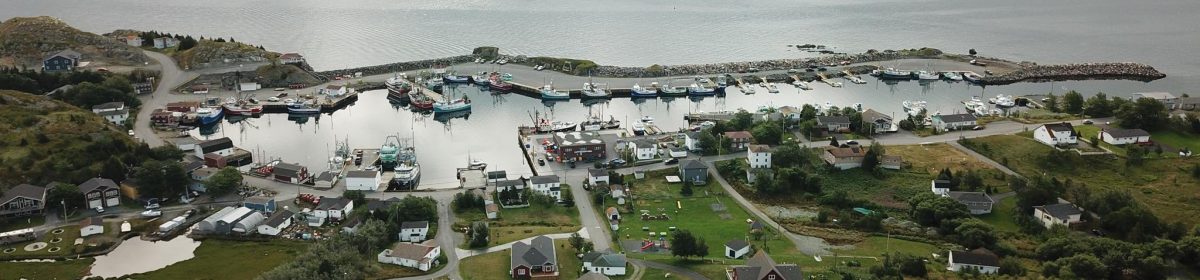

A panorama drone photograph of modern Port de Grave
Port de Grave: by Joyce Morgan, Port de Grave Peninsula Heritage Inc. Society: NF-2017

William Pinsent was the second to eldest surviving son of John and Susanna (née Pooke). He was born in Wolborough (Newton Abbot) where his father was a “merchant” (probably a “stapler” or wool merchant) who may also have had links to the Newfoundland cod fishery.  Even if he did not, he would have known men who did –  as Newton Abbot was a major supply and recruitment centre for sailors and fishermen working in the  fishery (“Soe longe as there comes noe women,” W. Gordon Handcock, 1989). 
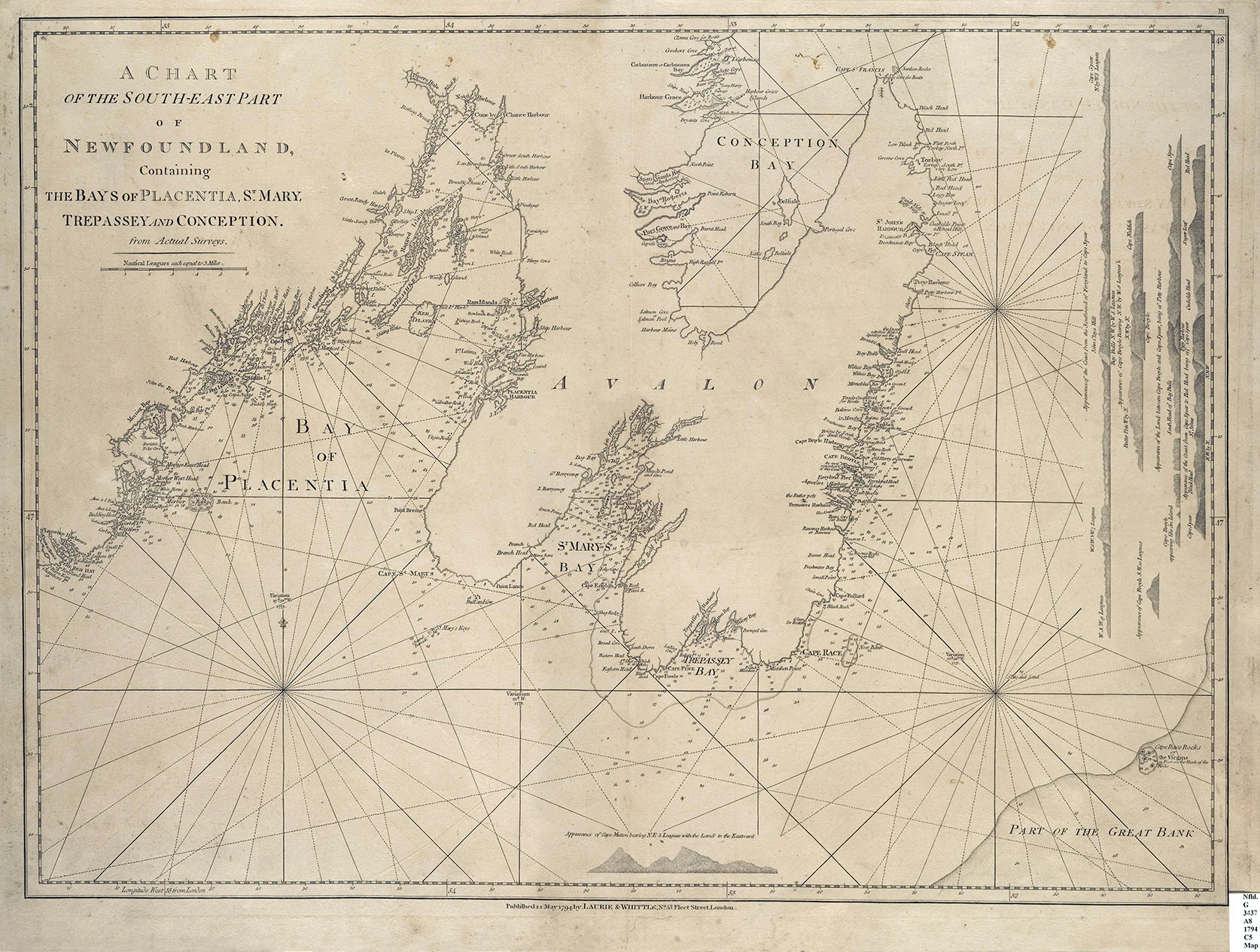
A yellowed map of the south-east portion of Newfoundland, showing Conception Bay. The land itself is labeled Avalon.
Map of the southeastern part of Newfoundland, 1794, via the Memorial University of Newfoundland.

William was brought up and educated in Newton Abbot but he was still a teenager when his parents died in 1772. He seems to have hired on as an “agent” for the firm of “Newman and Roope” in Port de Grave – a small settlement near the head of Conception Bay – and worked for the firm throughout the “American War of Independence” (1776 – 1783) while, at the same time, also building up a business of his own.
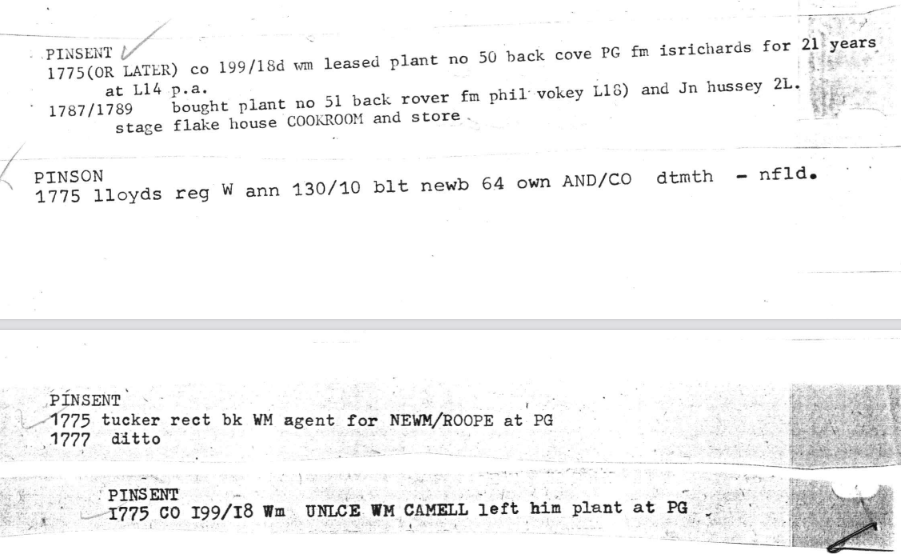
Typed notes, written in shorthand, describe Pinsent leasing a plantation in 1775, then buying a second plantation in 1787.
Name Snippets by Name and Date: Keith Matthews Name File: MHA

In the 1970s and 1980s, Dr. Keith Matthews studied the rise and fall of the Newfoundland fishery and built up a large, paper-based, “Name File” that is now in the “Maritime History Archive” at Memorial University, in St. John’s. It contains numerous references to William (and his brother John and, later, his nephew Robert John Pinsent). The references are in snippet form and come from the “Conception Bay Plantations Books,” “Lloyd’s Owners Registers” and other sources. There are abbreviations galore but they are, for the most part, intelligible. Together, they track William’s life both as a merchant and a ship-owner. However, it is worth noting that they contain occasional references to other Williams  and Johns – so each entry needs to be taken in context.
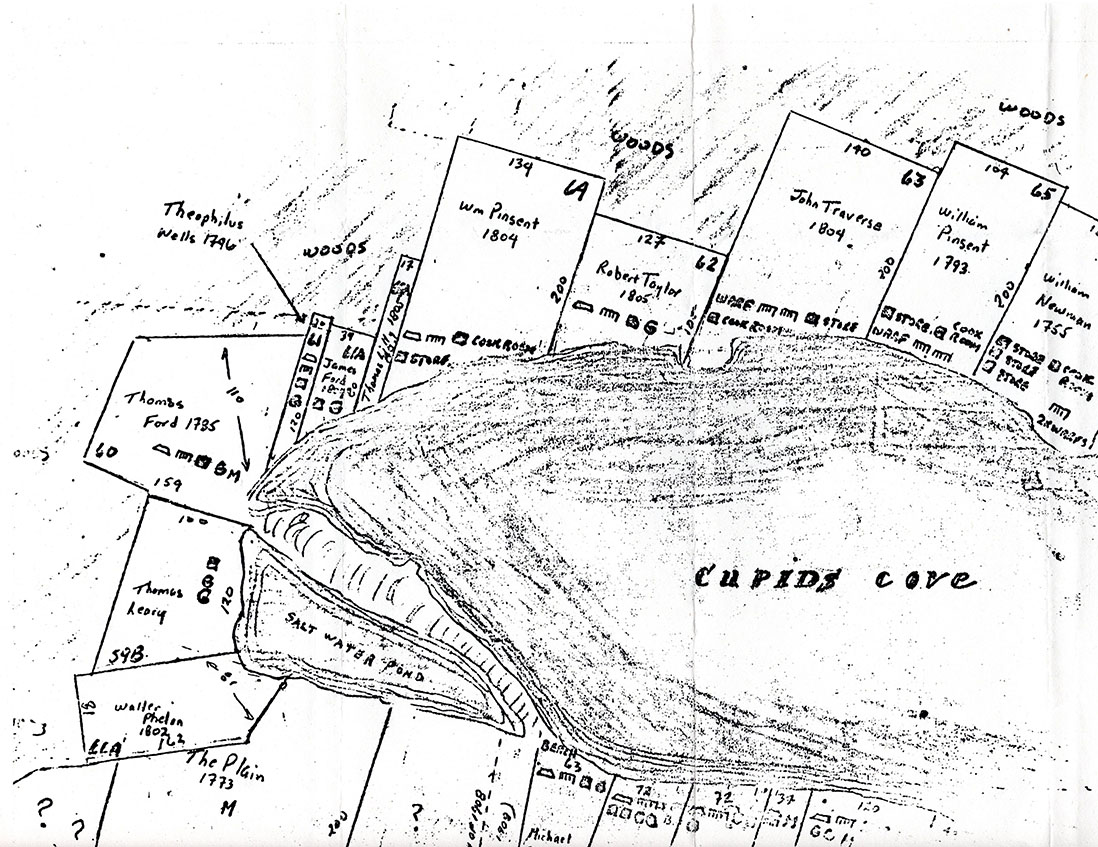
A hand-drawn map illustrating a series of properties around Cupid's Cove.
A hand-drawn map showing the locations of plantations around Cupid’s Cove.

The snippets show that William inherited a shore-side property or “plantation” in Port de Grave from an “uncle”, William Carnell (?) in 1775. Who Mr. Carnell was I do not know! William may also have acquired three plantations at Ship Harbour, Port de Grave from “a merchant called Campbell” that same year (1775) (Encyclopaedia of Newfoundland and Labrador: Volume 5: p163). Perhaps they were one and the same.

William lived at Hussey’s Cove near Port de Grave and developed his business throughout the 1770s with Peter Ezekiel as his principal “agent.”  They did well together, and William leased a second plantation (#50) at Hussey’s Cove at a cost of £14 per annum in 1777. The lease came, interestingly, from his future father-in-law, Isaac Richards! Ten years later, he bought a third plantation in Port de Grave from Philip Voisey for £18, and two years after that he acquired still more land from John Hussey for £2. His holdings were reported to include a substantial duplex house, several stores and a wharf in Hussey’s Cove. By the end of the 1780s William was a well established “Merchant of Port de Grave, Newfoundland.”

The business must have benefited from the growth in population that occurred in Newfoundland during and immediately after the Napoleonic wars (1799 – 1815). During the war, few fishermen were willing to attempt the annual migration from England to and from the fishing grounds and the era of seasonal fishing convoys came to an end. After the war, fishermen (and their wives) settled in the out-ports (Handcock, 1989) and needed goods that local merchants supplied on credit. In the spring they gave local fishermen whatever they needed for the summer cod and salmon fisheries and took cash or fish back in return in the autumn.
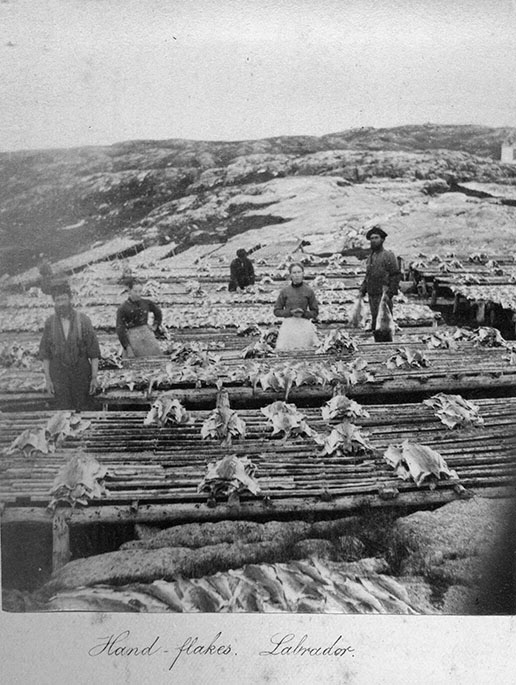
A faded, blurry black and white photograph. People stand amid low wooden structures, like tables. Salmon are sliced open and drying on the wood.
Workers stand among salmon flakes, via the Memorial University of Newfoundland.

By the early 1800s, the fishery was either conducted from “bankers” – larger vessels that took bye-boatmen out to the “Grand Banks”, or from smaller vessels that fished  near shore. In either case the fish were gutted and split, washed, slightly salted and left to dry on flat platforms called “flakes” before being taken back to Europe in the autumn. In the early 1800s, the industry relied on sail; however, in William’s nephew Robert John and his son’s time – later in the same century – the larger boats (particularly any that also took part in the seal hunt) were, at least in part, powered by steam. By 1910, nearly all the bigger vessels were “steamers.” Coal was, by then, king.   
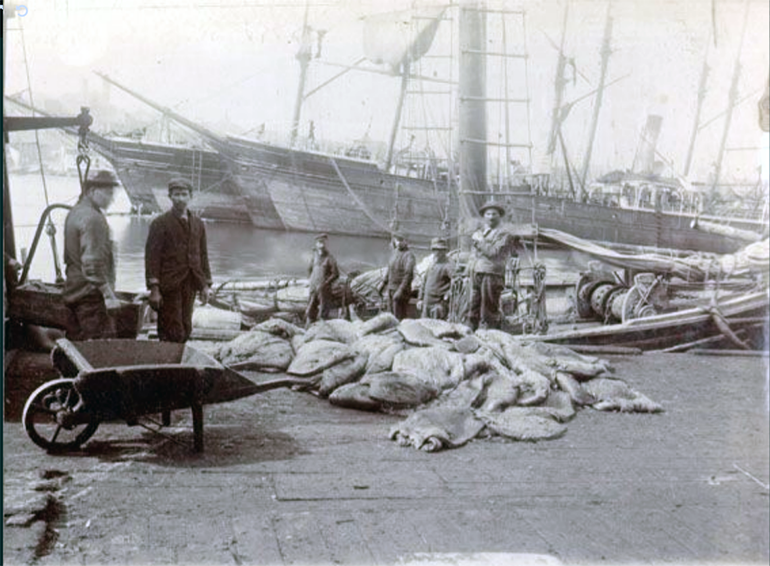
Men stand on the docks in a black and white photograph. There's a heap of dead seals beside them, and a wheelbarrow waiting to carry them off.
“Landing seals,” 1905, via the Memorial University of Newfoundland.

After the merchants had balanced their books, they supplied the fisherman’s needs for the seal hunt – and for his family’s subsistence over the winter. The fisherman’s accounts were adjusted accordingly. This “truck” system of payments worked well during good years (such as during the war) when fish prices were high, but it was, of course, open to abuse. When the cod and/or seal “fisheries” were poor, there could be considerable tension between a near destitute fisherman and his merchant – who was not infrequently himself in debt to one of the larger banks. A listing of the 154 households in Port de Grave on 27th September 1817 shows that W. Pinsent supplied at least 30 relatively “well off” families.  It was a tenuous business. Prices could fall – even in the good times – and ships could sink during a storm or fall victim to the French in time of war. The “truck” system contributed to the Colony’s economy crash in 1894 (see Charles Speare Pinsent).

William’s youngest brother Joseph seems to have acted as one of his early “fish buyers” and/or “brokers” before setting himself up as a London “shipping agent” in his own right. William set up a more formal business arrangement with his elder brother John, the “baker” of Portman Square, in London. In 1791, John Pinsent of Edward Street, Portman Square advertised a “brig” [MARY JEMIMA, 88 tons] for sale in Dartmouth. Would-be purchasers were invited to “contact him, the master, Captain Thomas Silly or a Mister Gilbert Doke of Newton Abbot”. Whether John spent time at sea I am not sure. A John Pinsent is reported to have captained a newly acquired “brig” called the FERDINAND in 1793 and 1794, so he may have. There are a few years unaccounted for on John’s resume – between the likely end of his apprenticeship as a baker and his settling in London – so he may have played an active role in the business.
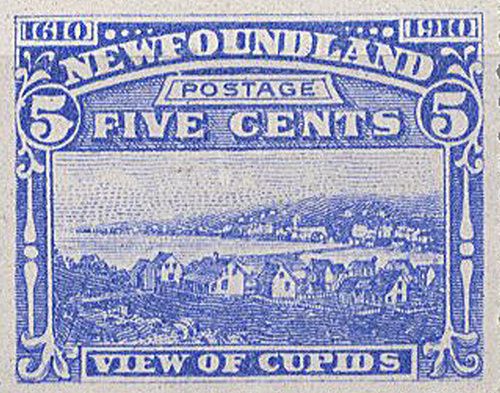
A blue postage stamp reading Newfoundland Postage Five Cents, View of Cupids. The illustration is a small drawing of a town on the water.
A Newfoundland five cent stamp showing a view of Cupids, 1910.

William acted as an “agent” for “Newman and Roope” once again in 1793. However, his own operation in Port de Grave had grown substantially since then and the brothers needed more land. They purchased and cleared “Lot #182” at a place called Cupids (on the other side of Conception bay from Port de Grave) – where the conditions were better suited for handling larger ships. The Cupids establishment included a farm and a seal factory, and the brothers built some of their own ships there. The Cupids site eventually outgrew their original operation at Hussey’s Cove. The “plantation” map shows that they added still more land in 1804.

The firm of “J. and W. Pinsent, Merchants, Edward Street, Portman Square, London” operated throughout the 1790s and early 1800s and its activities are well documented in Colonial Records, Newman’s Journal, Lloyds Register of (Ship) Owners and other sources abstracted by the late Dr. Keith Matthews of the Maritime History Archive of Memorial University, Newfoundland. Between them, they show that John and William Pinsent purchased the ‘brig” FERDINAND [1793-1794] (approximately 127 tons, 11ft draught, built at Cowes (Isle of Wight) in 1790) in 1793 and used it to transport 3,000 quintals of fish (one quintal is approximately 50 kilograms) from Harbour Grace to “Leghorn” (Livorno, Italy) in the Mediterranean. John Pinsent is described as captain; however, as he was a “baker” by trade it is not clear if he went to sea. He was certainly the ship’s owner. At other times, Thomas Silly is described as the ship’s captain. In 1794, the two brothers acquired the ADVENTURE, [1794-1804] “brig” (40 tons, 8ft draught, built in Newfoundland in 1794). It was captained by Thomas Ryshe and used to trade with England.

Business during the Napoleonic wars (1799 – 1815) was predictably unpredictable and West Country English and Newfoundland merchants frequently lost ships to France and Spain as they attempted to land fish in Europe. Prior to 1811, most of the Colony’s catch (salted and dried cod) entered through Oporto, in Portugal, so the French blockaded it. In 1798, twenty-three Newfoundland ships and crew were lost off Oporto Bar! To make matters worse for both merchants and sailors, even if the French did not capture and eventually ransom the ship’s crews, the Royal Navy had a nasty habit of pressing them into the service of the Crown.

Several Newfoundland merchants and countless fishermen were bankrupted by the war and Newfoundland Court Records show that William Pinsent sued Elias Antle, Simon Sparacklin and John Partridge for non-payment of debts in the fall of 1796. That same year, the court appointed William to examine the accounts of Bartholomew Corban and Edward French, who had also been bankrupted.
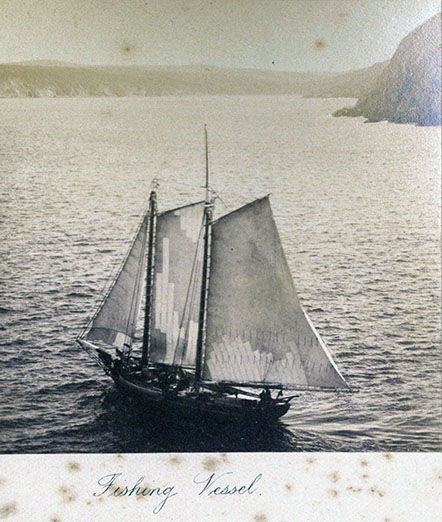
An old, mold-spotted black and white photograph of a fishing vessel with tall white sails.
A Newfoundland fishing vessel, via the Memorial University of Newfoundland.

Whether the FERDINAND survived until 1797 is uncertain. However, the brothers retained the ADVENTURE through to 1804. Over much of its life it was captained either by John Newell or by xxxx Winsboro. William and John acquired the ELIZABETH, [1797-1800] a ship, (345 tons, 15ft draught, built in Hull, 1789) in 1797 and sailed it between London and Martinique under the command of Captain xxxx Matthews. Armament was definitely needed in those days! it was fitted with nine four-pound guns. The brothers may also have owned the EXPERIMENT [1797-1798] “schooner” (91 tons, 9ft draught, built in Nova Scotia in 1790) captained by J. Worth and used for trade between London and Newfoundland. However, the latter ship could have belonged to Andrew and William Pinson of Dartmouth who also owned a considerable fleet around then. It is sometimes difficult to sort out which ships belonged to which of the two family firms. Surnames were not not always spelt consistently!
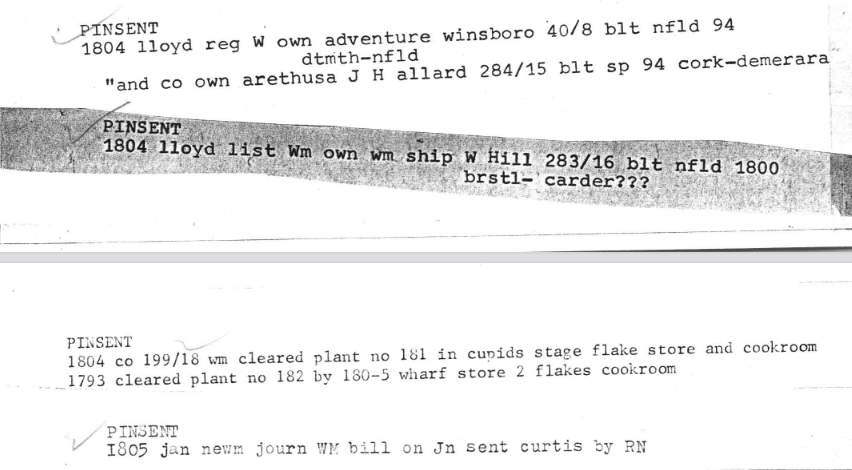
Typed notes written in shorthand. Describes the ship the Adventure and Pinsent's salmon flake cookrooms.
Name Snippets by Name and Date: Keith Matthews Name File: MHA

The two brothers certainly owned the AMEY [1798], captained by John Newell. It was  one of the ships caught off Oporto Bar in 1798. It was taken into Bayonne with 25,000 quintals of fish as a prize. The following year the brothers added the DILIGENCE [1799-1804] “snow-brig”, (150 tons, 12ft draught, built in Sweden). It was captained by J. Pike and used on the London run. The WILLIAM AND JOHN [1800] was almost certainly another of their ships. Sadly, it was driven onto flats at Sandwich in a gale on 23rd January 1800. It was wrecked and filled with water (Lloyd’s List: 28th January 1800). Clearly, there was weather to deal with, as well as the French!
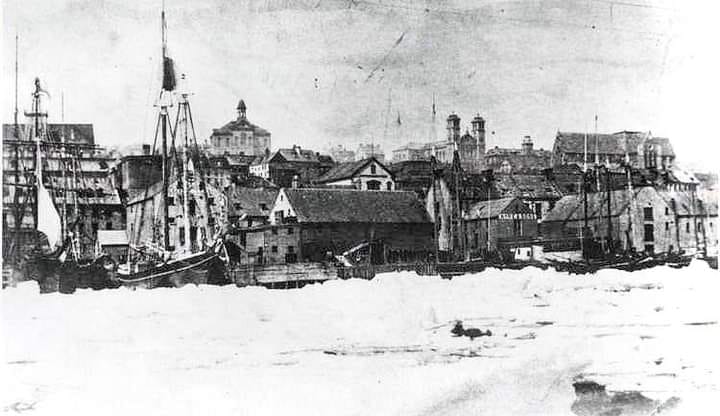
A faded black and white photograph of the wharves at St. John's, Newfoundland, seemingly locked in with ice and snow.
Ayre and Son’s Wharves, St Johns, 1870s.

In 1800, John and William Pinsent fitted out a new, locally built, privateer, the ship WILLIAM [1800-1804] of 283 tons and mounting twelve cannonades. It was captained by William Hill and had a crew of 25 men. It received “letters of marque” against France, Spain and the United Provinces (D’Alberti Papers, Vol. 11, 1800). This meant that it could act aggressively against enemy ships and not just defensively.
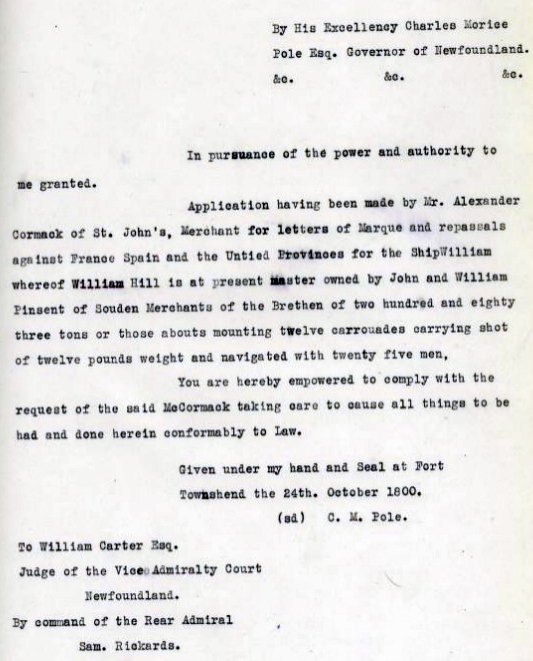
A typed document reading as follows: "By his Excellency Charles Meriee, Pole Esq. Governor of Newfoundland. In pursuance of the power and authority to me granted. Application having een made by Mr. Alexander Cormack of st. John's, Merchant for letters of Marque and repassals against France, Spain and teh United Provinces for the Ship William whereof William Hill is at present master owned by John and William Pinsent of Souden Merchants of the Brethren of two hundred and eighty three tons or those abouts mounting twelve carrouades carrying shot of twelve pounds weight and navigated with twenty five men, you are hereby empowered to comply with the request of the said McCormack taking care to cause all things to be had and done herein comfortably to Law. Given under my hand and seal at Fort Townshead the 24th October 1800. C. M. Pole. To William Carter Esq. Judge of the Vice Admiralty Court Newfoundland. By command of the Rear Admiral Sam Rickards.
The typed letter granting the brothers their letters of Marque, October 1800.

It is not clear how it fared, but the brothers seem to have done reasonably well during the war. In 1800, William Hill was the captain of their brig ROEHAMPTON [1800], (106 tons and 11ft draught fitted with six three-pound guns). It  could have been a war prize as it had been built in America in 1792. It was also used on the London – Newfoundland run. The same year, the brothers also owned the DOLPHIN [1800-1804], a “schooner” captained by J. Ford (102 tons and 9ft draught, built in France). Presumably it too was a prize. It may have been cheaper to buy prizes than to build new ships.

In 1804, William Pinsent purchased and cleared yet another plantation (Lot #181) at Cupids and doubled the size of his fishery operation. The brothers were doing well in the early 1800s. They were reported to have had eight ships. In addition to the ADVENTURE, DILIGENCE, DOLPHIN and WILLIAM, they either owned or co-owned the “brig” (?) JOHN AND WILLIAM [1804] (237 tons and 15ft draught, built in Newfoundland), captained by John Packby; the “brig” (?) BROTHERS [1804-1810], (95 tons and 9ft draught, built at Cupids in 1801) captained by J. Jefferies; the “brig” MINERVA [1804] (150 tons and 12 ft draught, built in America in 1795) captained by John Seager; and the “brig” (?) ARETHUSA [1804], (284 tons and 15ft draught) which had been was built in Spain in 1794. Its captain was J. H. Allard. John Seager may be the same man who co-owned with William Long and Joseph Pinsent – William and John’s younger brother – the “brig” RESOLUTION (126 tons, taken from the Dutch). Regrettably, it was captured by, the French, in 1796.
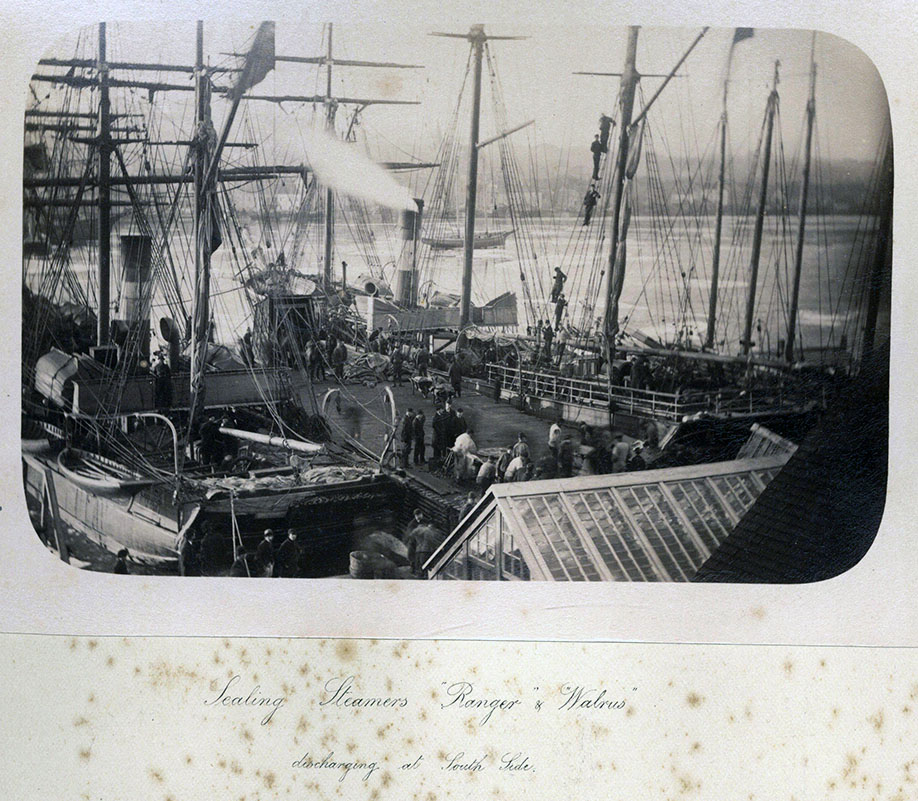
A faded black and white photograph of a dock surrounded by fishing ships. The dock is crowded with people.
Sealing steamers “Ranger” and “Walrus” discharging at South Side, via the Memorial University of Newfoundland.

The brothers’ sailed their ships from Newfoundland to Dartmouth; from London to Leghorn (Livorno); from London to the Azores; from Bristol to Carder (?); from London to Surinam and – of course – from London to Newfoundland. They also sailed from Cork to Demerara. The routes reflect the usual pattern of trade for merchants in those days. They took materiel from England to Newfoundland, cod into the Mediterranean, assorted goods in casks to the Caribbean and – from there – brought molasses and rum north to Newfoundland. The only difference between William and John and their peers was that they operated out of London – as opposed to one of the West Country ports (Dartmouth, Bristol, etc.). Over time, trade with Ireland increased and in the 1800s transportation of emigrants became an important part of the business.

The two brothers seem to have hit a bad patch towards the end of the first decade of the 1800s. They appear to have cut back to two vessels. In 1807, they owned the “brig” (?) BROTHERS [1804-1810] and the “schooner” DART [1807-1821] (64 tons and 9ft draught). The former was used to trade with Ireland. The latter was built at Cupids in 1804 and it continued to carry fish into the Mediterranean. They were captained, interchangeably, by Thomas Silly, William Ellis, Thomas Owen, and others. The Newfoundland fishing industry, which had done surprisingly well early in the Napoleonic wars, suffered from over-supply and lower prices later on, and William and John had to sue their neighbours in the “Harbour Grace Surrogate Court” to recover the money they were owed. The brothers were involved in at least fifteen court cases between 1813 and 1821. For instance, the archives show that William and John sued Thomas Moore for £7 19s 9d in December 1920 (Box 005 Harbour Grave 1820 -1821). Still, they survived.

One outcome of the war was that the centre of gravity of the fishery moved to Newfoundland. There was less to do in London and when John died there in 1821 his son, Robert John, wound up the London end of the business and moved out to Port de Grave to help his then aging uncle. The firm then went under the name of “Wm. and R. J. Pinsent”.   

In 1820 William and John appear to have replaced the original ship BROTHERS with another of the same name. The latter BROTHERS [1820-1830], (115 tons, built at Cupids) and captained by Richard Heath was, after John died, owned by William Pinsent of Ebford/Wolborough, merchant, and his niece, John’s daughter Mary Speare Pinsent of Collumpton, spinster, who administered her father’s  estate. Sadly, the vessel was lost in 1830.

According to “The Story of Port de Grave” by Gerald W. Andrews, William and Robert John Pinsent owned a “schooner” called the ELIZABETH (84 tons) captained by John Hussey between 1828 and 1830 and a “schooner” known as the SUCCESS (56 tons) mastered by William King in 1832.

In 1833, John Warford of Cupids mortgaged a fishing plantation at Cupids that he had recently inherited to William and Robert John Pinsent for £99, to be paid back in annual payments of £33. Whether he repaid the mortgage or not, I do not know (members.fortunecity.com/dawefamilytree/transcriptionsofwills). Cupids, which was on a small but deep water bay near Port de Grave, was the site chosen by John Guy in 1610 for the first (admittedly unsuccessful) attempt at colonization of Newfoundland: hence the postage stamp!

The British Government did what it could to limit settlement in Newfoundland in the 17th and 18th Centuries (“Soe longe as there comes noe women” by W. Gordon Hancock, 1989), as it saw the annual migration to and from Newfoundland as a useful way of training-up sailors it would need at time of war. It had abandoned the policy by 1791 and the population thereafter kept growing.

William Pinsent married Amy Richards, the daughter of Isaac Richards, another Port de Grave merchant, in 1803. He was over 40 years old and may have had an earlier marriage that I do not know about. If so, there were no living children from it. William and Amy had a son in 1818 “the first pledge of their conjugal affection after fifteen years happy union” (according to the Newfoundland Mercantile Journal) – a statement that gives the lie to any thought that Robert John might have been his son.
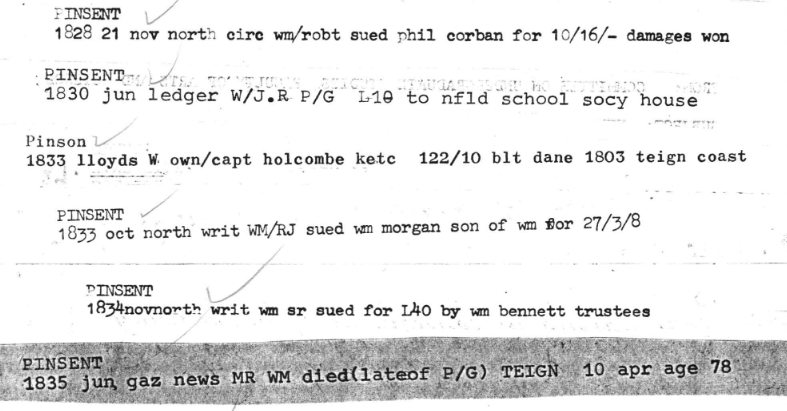
Typed notes written in short hand. Describes William's death in 1835.
Name Snippets by Name and Date: Keith Matthews Name File: MHA

William “senior’s” son, William Pinsent “junior,” was still a boy when his father retired to East Teignmouth in Devon in 1828 and William was getting on in year, so he appointed his wife, Amy, and a Newfoundland merchant as executrix and executor of his will. In it, he left one half of his fishing and shipping business in Port de Grave in trust for his wife and the other for his under-age son (Estate Duty Office Wills [1078/IRW/P913 – Date: 1835]). William died in Teignmouth on 16th April 1835 and was buried in Wolborough Churchyard. The local newspapers referred to the death of William Pinsent “Merchant of Teignmouth, late of Port de Grave, Newfoundland” (Exeter Flying Post: Thursday, April 23rd, 1835).

Snippet from a newspaper reading 'April 10, at Teignmouth, Mr. W. Pinsent, merchant, late of Port de Grave, Newfoundland, aged 78.
Excerpt of William’s death announcement from the Exeter Flying Post, April 23, 1835.

William’s widow, Amy and William’s nephew Robert John Pinsent ran the business for a few years – presumably in expectation that Amy’s son, William, would take over when he came of age and had enough experience. Sadly, it was not to be. William “junior” died in 1840, aged 22 years (Bristol Mercury: Saturday 16th January 1841). Amy and Robert John sold their Ship’s Cove business in 1839, and part of Cupids went the following year.

Amy died in 1841, aged 64, and left the rest of the family property to her nephew, Robert John Pinsent, who was, by then, a magistrate in Brigus: “I give and bequeath to Robert John Pinsent, esquire, of Brigus, Magistrate, his heirs and assigns all that part of the rooms and premises formerly belonging to my late husband and his brother John (under the firm of John and William Pinsent) situated at Port de Grave and Cupids, Newfoundland, which I possess or to which I have or may have any claim or title whatsoever. And, whereas there are some unsettled accounts existing between the said Robert John Pinsent and myself and my late husband and my lately deceased son, I will and declare that I fully acquit and discharge him the said Robert John Pinsent, his heirs, executors and administrators from all claims and demands whatsoever on account of the same” (Newfoundland Probate Office).

Robert John was soon to be appointed a “Stipendiary Magistrate” in Harbour Grace, so he leased out and eventually sold: “A very commodious House, Shop, Stores and Mercantile Premises, situate at Port de Grave and Cupids formerly occupied by the subscriber, and very recently by the late Mr. William Pinsent. These premises are now advertised for lease in consequence of the decease of Mr. William Pinsent in November last. A most eligible opportunity is offered to any respectable person inclined to engage in a moderate-sized mercantile business, in a desirable Outport, as the dealers and other connections in the trade of the late occupant are still available to a successor, and the whole Premises as also the necessary utensils of business, are in perfect good order and condition. Further particulars may be obtained by application to Messrs. McBride & Kerr, and the Rev. Charles Blackman, St. John’s, or to the Subscriber at Brigus: Robert John Pinsent: (Public Ledger: 16th April 1841). His life is described elsewhere.


Family Tree

Grandparents

Grandfather: Thomas Pinsent: 1691 – 1777
Grandmother: Mary Gale: 1690 – 1774

Parents

Father: John Pinsent: 1728 – 1772
Mother: Susanna Pooke: 1730 – 1772

Father’s Siblings (Aunts, Uncles)

Urith Pinsent: 1714 – 1751
Thomas Pinsent: 1717 – 1802
Julian Pinsent: 1719 – 1721
Robert Pinsent: 1721 – 1783
Gilbert Pinsent: 1724 – 1794
Julian Pinsent: 1726 – xxxx
John Pinsent: 1728 – 1772 ✔️
Mary Pinsent: 1731 – xxxx

Male Siblings (Brothers)

John Pinsent: 1751 – 1753
John Pinsent: 1753 – 1821
Robert Pinsent: 1753 – 1787
Thomas Pinsent: 1754 – 1785
William Pinsent: 1757 – 1835 ✔️
Gilbert Pinsent: 1758 – 1835
Charles Pinsent: 1765 – 1765
Charles Pinsent: 1766 – 1826
Samuel Pinsent: 1767 – 1775
Joseph Pinsent: 1770 – 1835


Please use the above links to explore this branch of the family tree. The default “Next” and “Previous” links below may lead to other unrelated branches.
William Pinsent

Vital Statistics

Birth: 1825
Marriage: N/A
Spouse: N/A
Death: 1854

Family Branch: Hennock
PinsentID: GRO0892

Click here to view close relatives.


Family Tree

Grandparents

Grandfather: Gilbert Pinsent: 1758 – 1835
Grandmother: Margaret Snow: 1756 – 1843

Parents

Father: William Pinsent: 1797 – 1882
Mother: Jane Crockwell: 1792 – 1855

Father’s Siblings (Aunts, Uncles)

Thomas Pinsent: 1790 – 1804
Mary Snow Pinsent: 1793 – 1890
William Pinsent: 1797 – 1882 ✔️
John Pinsent: 1799 – 1858

Male Siblings (Brothers)

William Pinsent: 1825 – 1854 ✔️
John Pinsent: 1829 – xxxx
Thomas Pinsent: 1833 – 1851
Charles Henry Crockwell Pinsent: 1835 – xxxx


Please use the above links to explore this branch of the family tree. The default “Next” and “Previous” links below may lead to other unrelated branches.
William Pinsent

Vital Statistics

William Pinsent: 1797 – 1882 GRO0888 (Farmer, Salesman, Teigngrace, Modbury and Newton Abbot)

Jane Crockwell: 1792 – 1855
Married: 1822: Coffinswell, Devon

Children by Jane Crockwell:

William Pinsent: 1825 – 1854
Jane Pinsent: 1825 – 1828
Margaret Pinsent: 1826 – 1888 (Married James Thomson, St. Pancras, London, 1849)
Jane Pinsent: * 1828 – xxxx (Married Edward Farrar, Paddington, London, 1855)
John Pinsent: 1829 – xxxx
Mary Anne Pinsent: 1831 – xxxx
Thomas Pinsent: 1833 – 1851
Charles Henry Crockwell Pinsent: 1835 – xxxx (Married (1) Mary Ann Cann, Plymouth, Devon, 1858; (2) Sarah Staines, Newton Abbot, Devon, 1868)

* Jane had an illegitimate daughter, Emma M. Pinsent, in Exeter, Devon, in 1850.

Family Branch: Hennock
PinsentID: GRO0888

Click here to view close relatives.


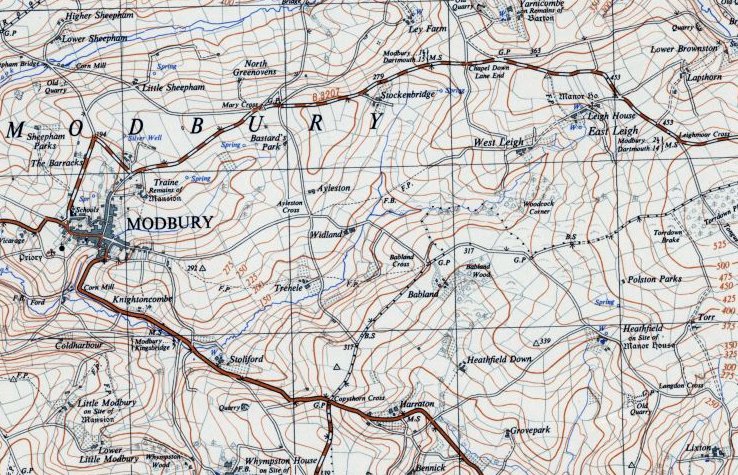
A topographical map of Modbury and its environs.
Map of Modbury and West Leigh taken from the 1945-1969 Ordnance Survey, via the Library of Scotland.

William was the eldest surviving son of Gilbert Pinsent by his wife, Margaret (née Snow). He had an elder brother, Thomas, who died at the age of fourteen years in 1804 and a younger one, John Pinsent, who was two years his junior. He also had an sister, Mary Snow Pinsent, who survived and later went on to marry. Their father was a successful tenant farmer and they grew up on his farm at “Ponswin” in Kingsteignton.

William’s father brought him up to be a farmer and he moved to a farm at “Twelve Oaks” in the nearby parish of Teigngrace after marrying Jane Crockwell, in Coffinswell, in 1822. She was probably the daughter of Henry Crockwell, niece of the Richard Crockwell who died in 1835, and the sister of the Ann Crockwell, who died in Newton Abbot in 1846 respectively. If so, Richard left her ten pounds and Ann L. 20 in their respective wills (Stamp Office: Inland Revenue Wills 1835 & 1846). William’s farm, which was owned by Mr. George Templer Esquire, must have been fairly large as it straddled the parish boundary with Highweek. William paid a land tax of £2 5s 0d for the Teigngrace section and £1 8s 8d, for the Highweek portion. At the same time, he also appears to have rented “two parts of Leggers” in Teigngrace – which, between them, had a combined tax burden of £1 1s 11.5d. He also controlled land at “Greenhill” in the same parish at an additional cost of  1s 6d. This must have amounted to a considerable land holding!

Interestingly, the Land Tax Records show that the Highweek portion of the property was nominally (or possibly mistakenly?) rented to Thomas Pinsent in 1825, 1826, 1828 and 1829. I am not sure which Thomas this was! The most likely candidate (in Gilbert’s immediate family) would seem to be his cousin Thomas Pynsent (son of Charles Pinsent) who was then farming at “Pitt” in Hennock. However, it may, alternatively, have been sublet to Thomas Pinsent of “Greenhill”, in Kingsteignton, who was a major land owner in the region. This latter Thomas was from the DEVONPORT branch of the family.

In 1828, John Pinsent (presumably William’s younger brother) managed “Shilston (200 rentals)”, in the village of Modbury for a Splatt, Esquire. It had a land tax of £11 9s 9d. William seems to have surrendered most of his farmland around then and he replaced his brother and took over the Shilston rentals the following year. He moved his family to Modbury and his last four children were baptized there. The Modbury Parish indenture records show that William took on apprentices in 1829 and 1834.

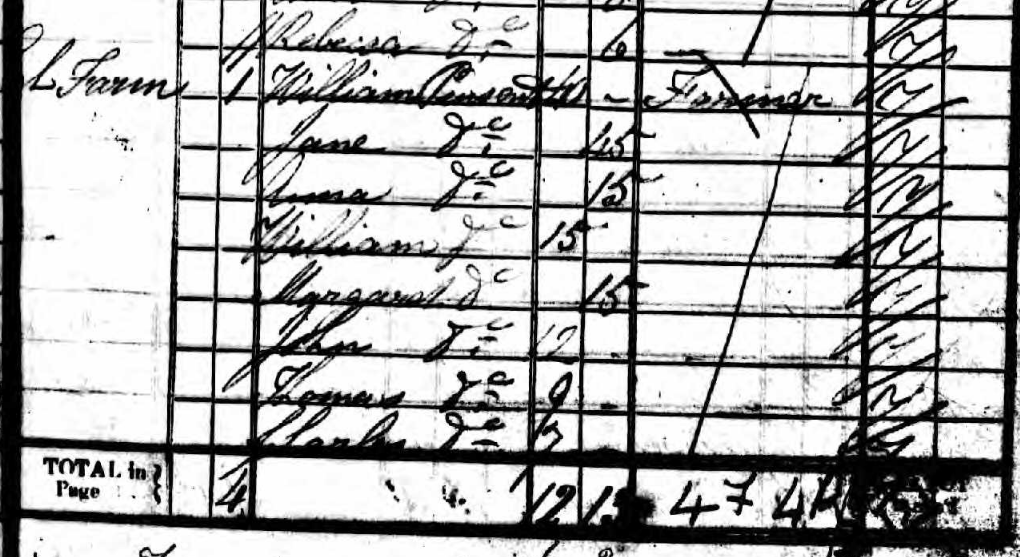
Handwritten census records showing .
William is described in the 1841 census records.

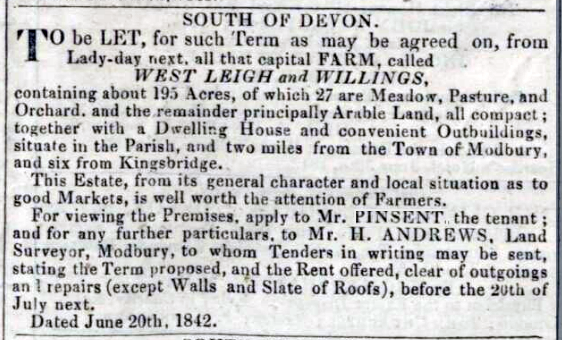
William managed the rental property until 1831 and then signed on to run “West Leigh farm” for W. Praede Esquire. It must have been another large land-holding as it had a land tax of £6 8s 8d. According to the County Electoral Roll, William lived at “West Leigh” in 1832 and 1834, and the 1841 Census shows that he was still there into the early 1840s. However, a notice in the Western Times (Saturday 2nd July 1842) tells us he was then looking to move out. Farmers interested in renting “West Leigh” and “Willings” (“195 acres, of which 27 are meadow, pasture, and orchard, and the remained principally arable land”) were advised to contact Mr. Pinsent, the sitting tenant.

Newspaper advertisement describing the West Leigh and Willings farm for lease.
Advertisement listing West Leigh and Willings to let, Western Times, July 2, 1842.

William had surrendered the farm by the time the next census was made and his own family was starting to disperse. For all his apparent success, he does not appear to have been particularly committed to farming and from then on he seems to have tried his hand at other things. He is described as being a “butcher” at the time of his daughter Margaret’s wedding in London in 1849.

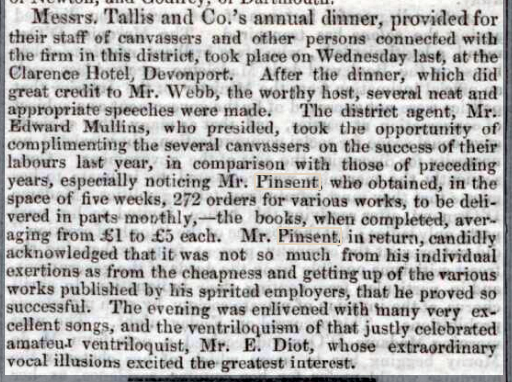
Excerpt from a newspaper describing the Tallis and Co.'s annual dinner at which William's work is acknowledged.
William Pinsent is acknowledged at an annual dinner, Western Times, January 24, 1852.

The 1851 Census, meanwhile, tells us that he was as a “commercial traveller” and a “book-seller” staying at the Carlyon Arms Inn, in St. Neots, Cornwall. He must have been good at it as his employers, “Tallis and Co.”, singled him out at its staff dinner in 1852: “Mr. Pinsent, (who) obtained, in the space of five weeks, 272 orders for various works, to be delivered in part monthly, – the books, when completed, averaged from £1 to £5 each. Mr. Pinsent, in return, candidly acknowledged that it was not so much from his individual exertions as from the cheapness and getting up of the various works published by his spirited employers, that he proved so successful” (Western Times: Saturday 24th January 1852).

Despite this evidence of change, he was once again described as being a “farmer” when his daughter Jane married Edward Farrar, a “plumber” in London, in 1855. This Jane, who was the second of this name, had had an illegitimate daughter, Emma, in Exeter in 1850. The child was living with its grandmother Jane (nee Crockwell) and uncle Charles Henry Crockwell Pinsent in Plymouth when the Census was taken the following year. Emma’s mother was missing. She was probably already up in London.

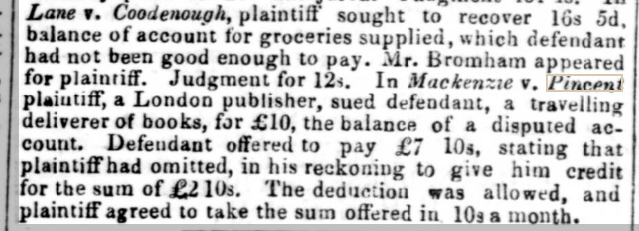
Newspaper excerpt describing the lawsuit filed against William Pinsent by his employer.
William Pinsent faces a lawsuit, Western Times, December 13, 1862.

William was back to being a “commercial traveller” when his son Charles married in 1858. Three years later, at the time of the 1861 Census, he was a “book traveller (selling) weekly and monthly prints.” On that occasion, he was on the road again, staying at the Ebrington Inn, in Plymouth. The following year, William was sued in the County Court by his then employer, a Mr. Mackenzie of London for £10 balance on a disputed account. The defendant offered to pay £7 10s, stating that the plaintiff had omitted to give him credit for £2 10s (Western Times: Saturday 13th December 1862). By then William was a widowe. His wife had died in Plymouth in 1855.

William claimed to be a “merchant” when his son Charles married for a second time, in 1868, and was a “poulterer” staying with a lodging-house keeper in St. Columb Major in Cornwall at the time of the 1871 Census. Perhaps he was still acting as a “travelling salesman” of some sort. William was in lodgings in Newton Abbot when the Census takers returned in 1881 and he died in the Union Workhouse there, aged 85, the following year. Sadly, he does not seem to have had been as successful as his father (Gilbert Pinsent) or, for that matter, his brother (John Pinsent). Their lives are described elsewhere.

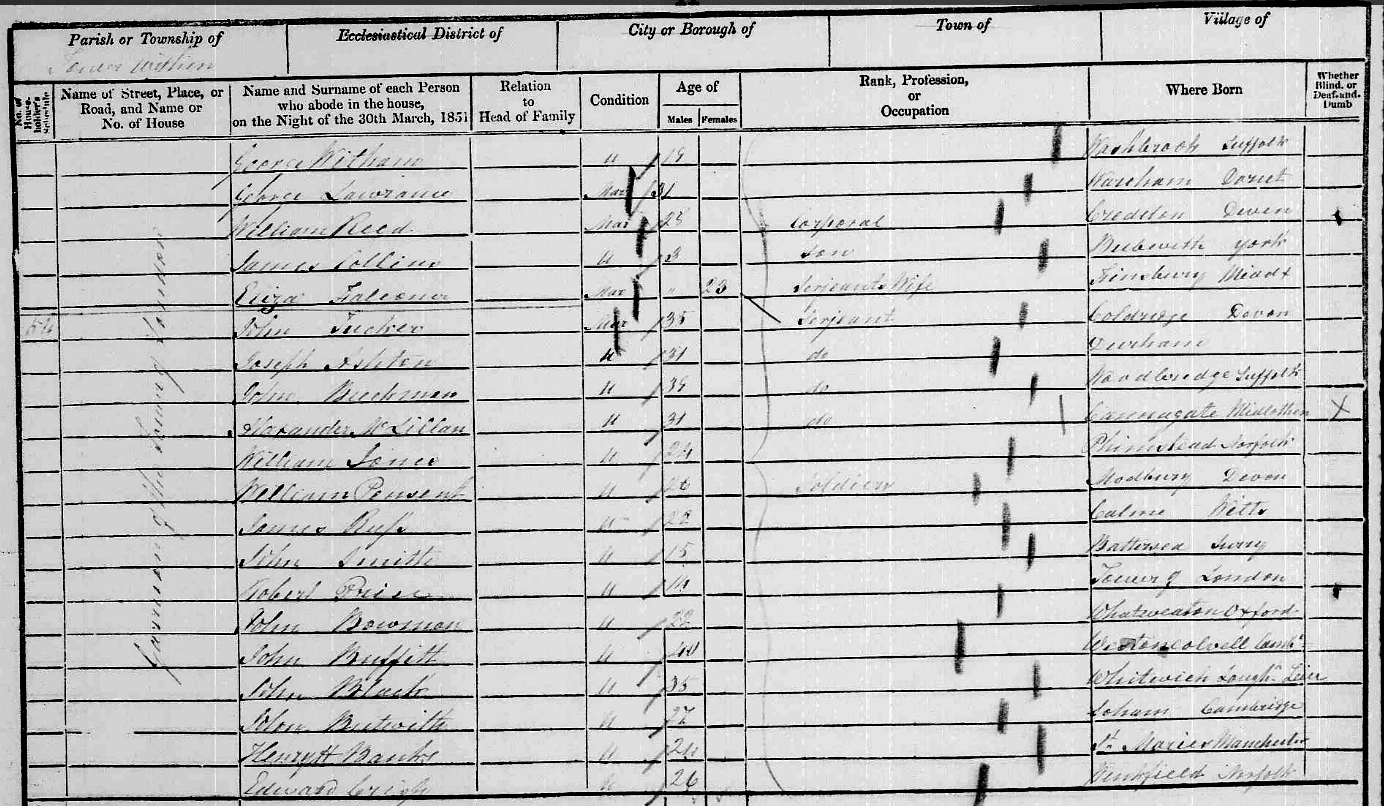
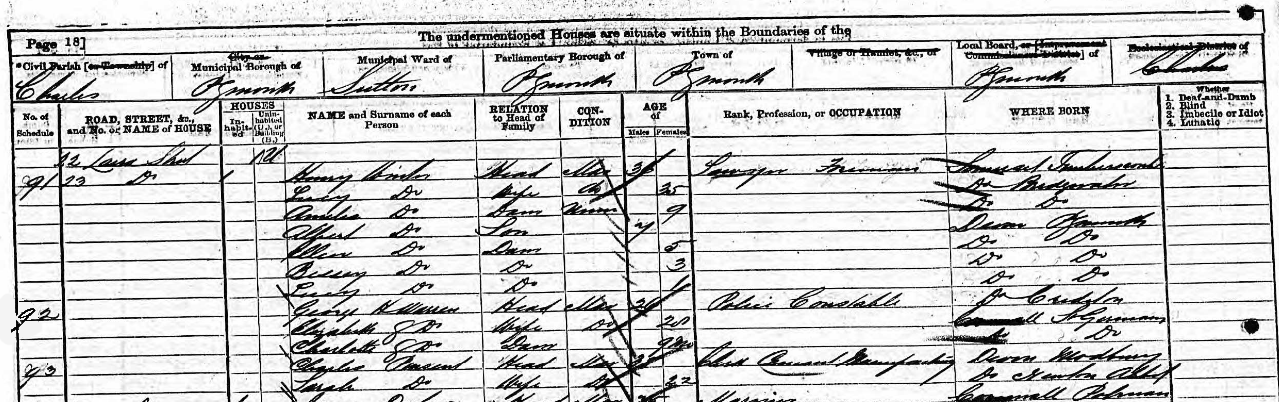
Handwritten census record showing William Pinsent as a soldier.
William Pinsent appears in the 1851 England, Wales & Scotland census records.

William and Jane (née Crockwell) had four sons and four daughters; however, there is not a lot known about any of them. Their eldest son, another William Pinsent, appears to have been a soldier in the Tower of London Garrison at the time of the 1851 Census. He was a “Sergeant” in the Coldstream Guards. He never married and, sadly, died of tuberculosis in London, in 1854. I have no information on their second son, John Pinsent. He may have died young or emigrated. Their third, Thomas Pinsent, was almost certainly the eighteen-years old young man who died at #2 Martin Lane in Plymouth in February 1851. His mother and his brother were living on the same street when the Census takers made their rounds a few months later.

William’s fourth and youngest son, Charles Henry Crockwell Pinsent, was a teenager living with his mother, in Plymouth in 1851 and a “cellar-man” living in Park Street, Plymouth when he married Mary Ann Cann, a girl from Horrabridge, in 1858. They stayed on in Plymouth and a few years later we find that Charles was a “store-keeper” in East Stonehouse. The 1861 Census does not specify the type of store but he was reported to be a “draper” when his wife, Mary Ann Pinsent died, in Torquay, in April 1868. Sadly, there were no children.

Handwritten census record showing Charles Pinsent as head of his household.
Charles appears in the records of the 1871 census.

Charles was a “widowed clerk” when he married Sarah Staines in the Wesleyan Chapel in Newton Abbot a few months later, and a “clerk in general manufacturing” when the census takers came to call in 1871. I can find no sign of either Charles or Sarah in England after that. Perhaps they emigrated in the 1870s.

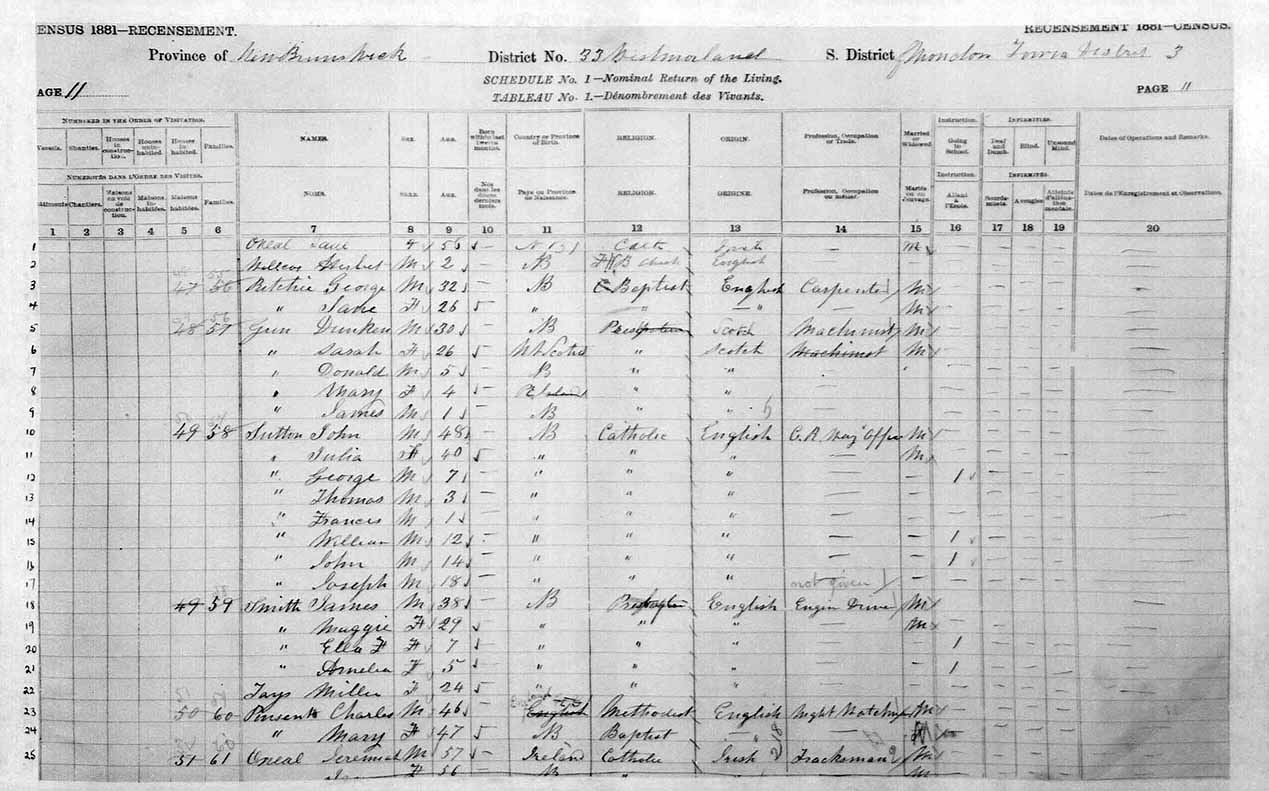
Handwritten census record showing Charles and Mary Pinsent.
Charles and Mary appear in the census records of New Brunswick, Canada.

There was a Charles Pinsent who was a Methodist of the right age and born in England acting as a “Night Watchman” in Moncton, New Brunswick at the time of the 1881 Canadian Census. This could be the same man; however, if so, his wife had probably died and he must have married to a local girl, Mary (unknown). Perhaps he just emigrated and remarried. Charles Henry Crockwell Pinsent does not seem to have had children in England, at any rate.

William and Jane’s eldest surviving daughter, Margaret Pinsent, married a “baker,” James Thomson, in London in 1849. They were living in St. Pancras, at the time of the 1851 census and Margaret’s still unmarried sister, Jane Pinsent – who had been a “scholar” in Modbury in 1841 – was living with them. She had had an illegitimate daughter, Emma M. Pinsent, in Exeter in 1850 but had left it with her mother, Jane (née Crockwell) and her younger brother Charles Henry Crockwell Pinsent in Plymouth while she was up in London. Jane married a “plumber”, in Paddington, London in 1855 and her daughter presumably joined her at some point. Emma Pinsent, was a “scholar” visiting a family in Exeter at the time of the 1861 Census; however, she was in domestic service with a retired pharmacist in St. Mary’s Parish, Lambeth in London ten years on from that. I do not know if she married.

William and Jane’s third daughter, Mary (Anne) was a “scholar” in Modbury in 1841 and a “child’s maid” in service with a draper in Newton Abbott at the time of the 1851 census. It is not clear what happened to her. For all that William and Jane had eight children, including four boys, it does not seem as if their male line continues.


Family Tree

Grandparents

Grandfather: John Pinsent: 1728 – 1772
Grandmother: Susanna Pooke: 1730 – 1772

Parents

Father: Gilbert Pinsent: 1758 – 1835
Mother: Margaret Snow: 1756 – 1843

Father’s Siblings (Aunts, Uncles)

John Pinsent: 1751 – 1753
John Pinsent: 1753 – 1821
Robert Pinsent: 1753 – 1787
Thomas Pinsent: 1754 – 1785
William Pinsent: 1757 – 1835
Gilbert Pinsent: 1758 – 1835 ✔️
Charles Pinsent: 1765 – 1765
Charles Pinsent: 1766 – 1826
Samuel Pinsent: 1767 – 1775
Joseph Pinsent: 1770 – 1835

Male Siblings (Brother)

Thomas Pinsent: 1790 – 1804
William Pinsent: 1797 – 1882 ✔️
John Pinsent: 1799 – 1858


Please use the above links to explore this branch of the family tree. The default “Next” and “Previous” links below may lead to other unrelated branches.
Vernon Pynsent

Vital Statistics

Birth: 1845
Marriage: N/A
Spouse: N/A
Death: 1845

Family Branch: Hennock
PinsentID: GRO0861

Click here to view close relatives.


Family Tree

Grandparents

Grandfather: Charles Pinsent: 1766 – 1826
Grandmother: Mary Yeo: 1772 – 1844

Parents

Father: Thomas Pynsent: 1808 – 1887
Mother: Jane Sparrow: 1809 – 1891

Father’s Siblings (Aunts, Uncles)

Mary Pinsent: 1799 – 1830
Ann Pinsent: 1804 – 1881
Thomas Pynsent: 1808 – 1887 ✔️

Male Siblings (Brothers)

Vernon Pynsent: 1845 – 1845 ✔️


Please use the above links to explore this branch of the family tree. The default “Next” and “Previous” links below may lead to other unrelated branches.
Urith Pinsent

Vital Statistics

Birth: 1754
Marriage: N/A
Spouse: N/A
Death: 1757

Family Branch: Hennock
PinsentID: GRO1338

Click here to view close relatives.


Family Tree

Grandparents

Grandfather: Thomas Pinsent: 1691 – 1777
Grandmother: Mary Gale: 1690 – 1774

Parents

Father: Gilbert Pinsent: 1724 – 1794
Mother: Rebecca Collins: 1719 – 1788

Father’s Siblings (Aunts, Uncles)

Urith Pinsent: 1714 – 1751
Thomas Pinsent: 1717 – 1802
Julian Pinsent: 1719 – 1721
Robert Pinsent: 1721 – 1783
Gilbert Pinsent: 1724 – 1794 ✔️
Julian Pinsent: 1726 – xxxx
John Pinsent: 1728 – 1772
Mary Pinsent: 1731 – xxxx

Male Siblings (Brothers)

Gilbert Pinsent: 1748 – 1748
Robert Pinsent: 1758 – xxxx


Please use the above links to explore this branch of the family tree. The default “Next” and “Previous” links below may lead to other unrelated branches.
Urith Pinsent

Vital Statistics

Birth: 1714
Marriage: 1743
Spouse: Henry Hearder
Death: 1751

Family Branch: Hennock
PinsentID: GRO1310

Click here to view close relatives.


Family Tree

Grandparents

Grandfather: Thomas Pinsent: 1657 – 1696
Grandmother: Ann Waters: xxxx – xxxx

Parents

Father: Thomas Pinsent: 1691 – 1777
Mother: Mary Gale: 1690 – 1774

Father’s Siblings (Aunts, Uncles)

Susannah Pinsent: 1678 – xxxx
(?) Simon Pinsent: xxxx – 1744
Elizabeth Pinsent: 1682 – xxxx
Thomas Pinsent: 1684 – 1685
Ann Pinsent: 1686 – xxxx
Thomas Pinsent: 1691 – 1777 ✔️
Robert Pinsent: 1693 – xxxx
Unknown Pinsent: 1696 – 1696

Male Siblings (Brothers)

Thomas Pinsent: 1717 – 1802
Robert Pinsent: 1721 – 1783
Gilbert Pinsent: 1724 – 1794
John Pinsent: 1728 – 1772


Please use the above links to explore this branch of the family tree. The default “Next” and “Previous” links below may lead to other unrelated branches.
Unknown Pinsent

Vital Statistics

Birth: 1696
Marriage: N/A
Spouse: N/A
Death: 1696

Family Branch: Hennock
PinsentID: GRO1798

Click here to view close relatives.


Family Tree

Grandparents

Grandfather: Thomas Pinsent: 1633 – 1701
Grandmother: Julian Wilmeade: xxxx – xxxx

Parents

Father: Thomas Pinsent: 1657 – 1696
Mother: Ann Waters: xxxx – xxxx

Male Siblings (Brothers)

(?) Simon Pinsent: xxxx – 1744
Thomas Pinsent: 1684 – 1685
Thomas Pinsent: 1691 – 1777
Robert Pinsent: 1693 – xxxx
Unknown Pinsent: 1696 – xxxx
Unknown Pinsent: 1696 – xxxx ✔️


Please use the above links to explore this branch of the family tree. The default “Next” and “Previous” links below may lead to other unrelated branches.
Unknown Pinsent

Vital Statistics

Birth: 1696
Marriage: N/A
Spouse: N/A
Death: 1696

Family Branch: Hennock
PinsentID: GRO1797

Click here to view close relatives


Family Tree

Grandparents

Grandfather: Thomas Pinsent: 1652 – 1711
Grandmother: Catherine Parker: 1655 – 1686

Parents

Father: Thomas Pinsent: 1657 – 1696
Mother: Ann Waters: xxxx – xxxx

Male Siblings (Brothers)

(?) Simon Pinsent: xxxx – 1744
Thomas Pinsent: 1684 – 1685
Thomas Pinsent: 1691 – 1777
Robert Pinsent: 1693 – xxxx
Unknown Pinsent: 1696 – xxxx ✔️
Unknown Pinsent: 1696 – xxxx


Please use the above links to explore this branch of the family tree. The default “Next” and “Previous” links below may lead to other unrelated branches.
Thomas Williams Pinsent

Vital Statistics

Thomas Williams Pinsent: 1837 – 1890 GRO1156 (Collector of Water Rates, St. John’s Newfoundland)

Sophia Milroy: xxxx – 1885
Married: xxxx. xxxx, xxxx

Children by Sophia Milroy:

Arthur Alfred Pinsent: 1885 – 1890

Family Branch: Hennock
PinsentID: GRO1156

Click here to view close family members.


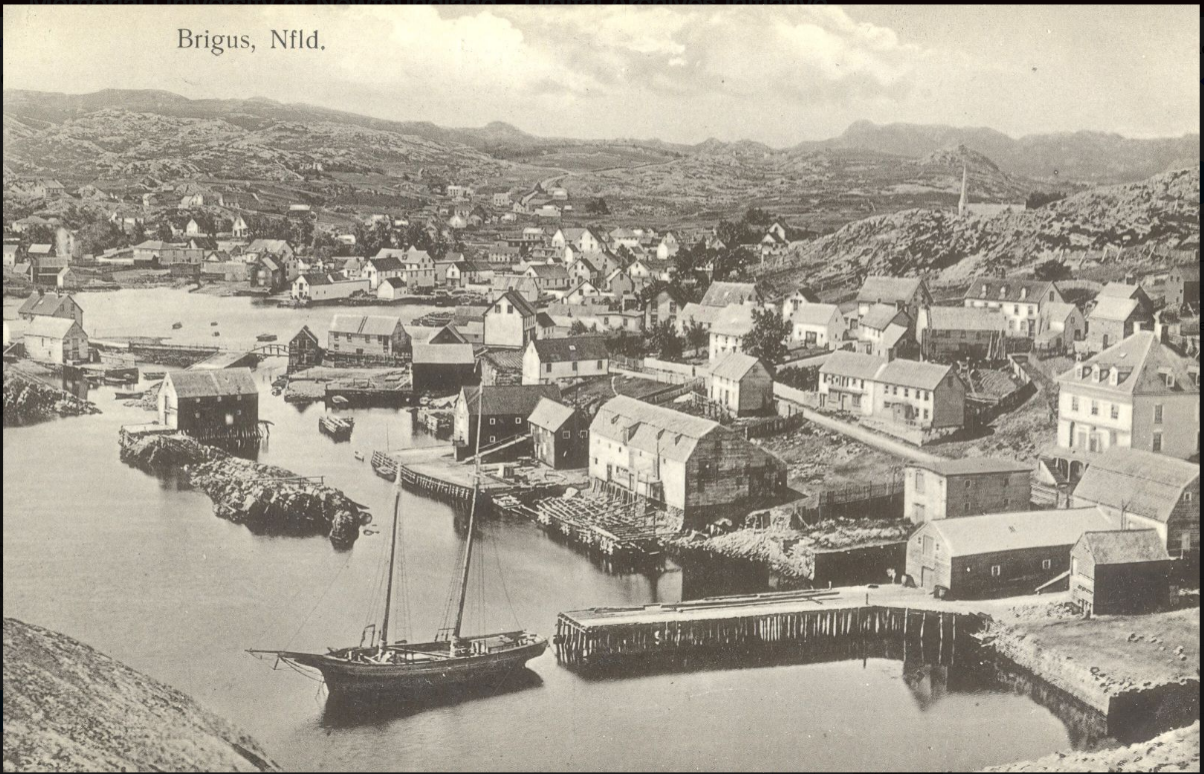
A black and white photograph of the waterside town of Brigus
Brigus, Newfoundland, via Memorial University of Newfoundland

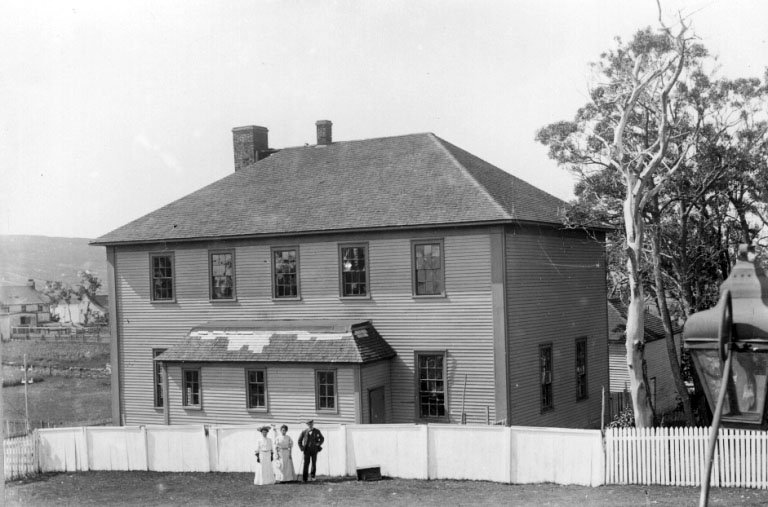
Thomas Williams Pinsent was the second eldest son of Robert John Pinsent, a Magistrate in Brigus, Newfoundland, by his wife, Louisa Broome Williams. He was born in 1837 and grew up alongside two brothers (Robert John and Charles Speare Pinsent) and two sisters (Louisa Williams and Mary Elizabeth Pinsent. The boys were educated at Harbour Grace Grammar School and went onto successful careers in St. John’s. Their lives are discussed elsewhere.

A simple two-story rectangular schoolhouse. Three people in Victorian garb stand outside.
Harbour Grace Grammar School, 1845-1902.

Thomas trained as an accountant and worked for the “General Water Co., of St. John’s” in the 1870s. He had the awkward responsibility of collecting the local water rates – which, unfortunately, did nothing to endear him to his friends, or the public at large.

A tiny news clipping whimsily describing Thomas Pinsent and water taxmen.
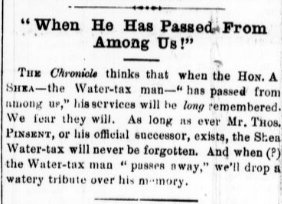
Evening Telegram, July 6, 1880.

A wistful item published in the Evening Telegram (6th July 1880) states: The Chronicle thinks that when the Hon. A. Shea—the Water-tax man—”has passed from us,” his services will be long remembered. We fear they will. As long as ever Mr. Thos. Pinsent, or his official successor exists, the Shea Water-tax will never be forgotten. And when (?) the Water-tax man “passes away”, we’ll drop a watery tribute over his memory.”   

Thomas’s family’s adherence to the temperance movement may have caused  some (one hopes good-natured) ribbing too. An item placed in the “Patriot” newspaper (Monday 24th December 1877) made doubtful comparisons between Mr. Thomas W. Pinsent’s watery and unsophisticated grog and the “expressed juice of the sugar cane!”

Small newspaper clipping describing Thomas Pinsent being bitten by a dog.
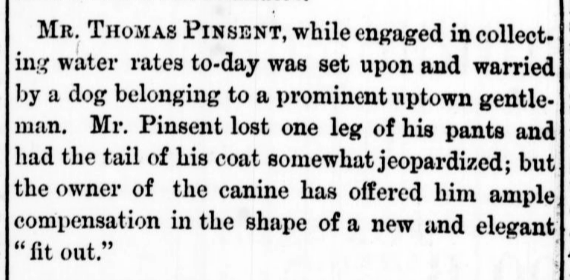
Evening Telegram, June 18, 1881.

The position was not without its dangers either as: Mr. Thomas Pinsent, while engaged in collecting water rates today was set upon and worried by a dog belonging to a gentleman. Mr. Pinsent lost one leg of his pants and had the tail of his coat somewhat prejudiced; but the owner of the canine has offered him ample compensation in the shape of a new and elegant “fit out”. (Evening Telegram: 18th June 1881). Thomas was not impressed; he sued the gentleman for $200 (Evening Telegram: 20th June 1881) but eventually settled for $25 (Evening Telegram: 26th November 1881).

A small newspaper clipping describing a phrenology lecture.
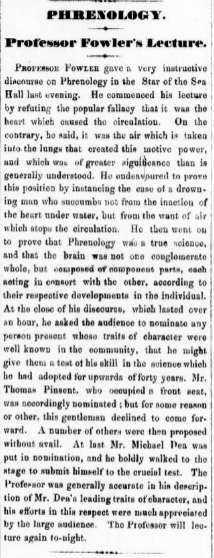
Evening Telegram, May 19, 1882.

In a world where there were only limited entertainments available, public lectures were far more popular that they are today and Thomas attended a series on “Phrenology” put on by a Professor Fowler in May 1882. Unfortunately, he made the mistake of sitting in the front row: At the close of his discourse, which lasted over an hour, he (Professor Fowler) asked the audience to nominate any person present whose traits of character were well known in the community, that he might give them a test of his skill in the science which he had adopted for upwards of forty years. Mr. Thomas Pinsent who occupied a front seat, was accordingly nominated; but for some reason or other, this gentleman declined to come forward. A number of others were then proposed without avail. At last Mr. Michael Dea was put in nomination, and he boldly walked to the stage to submit himself to the crucial test” (Evening Telegram: 19th May 1882). I am sure Thomas had his reasons! 

In another wistful look – this time back to the 1860s, the Evening Telegram mentions the “water question” and the authorities seizing property for non-payment and concludes that nowadays “Mr. Thomas Pinsent is the tax gatherer, and they say he is the best dun in the country” (Evening Telegram: 8th October 1883).  A “dun” is, by definition, someone who makes demands for payment. Yet another somewhat poetic item in the Evening Telegram (28th February 1885) goes “There, like dew from nature’s still, or Water from our hydrant’s rills, It flows for all (see Pinsent’s bills), Or Ask at Devon Row.”

Black and white photograph of a simple white church building.
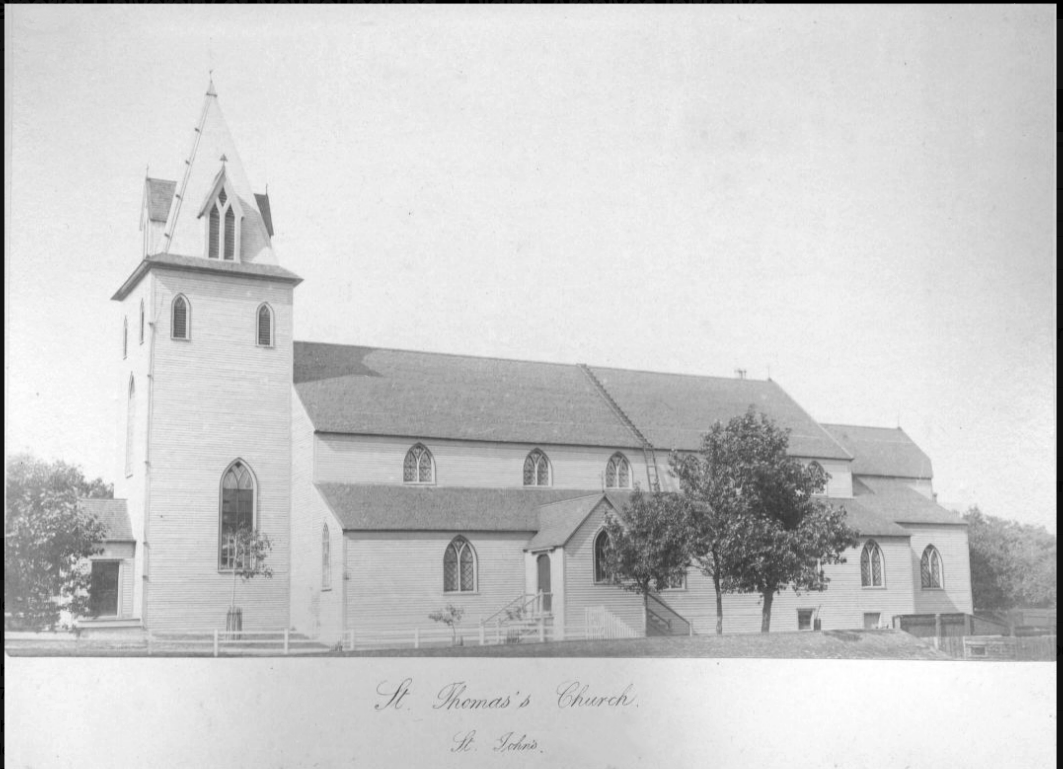
St. Thomas’s Church, St. John’s, via the Memorial University of Newfoundland.

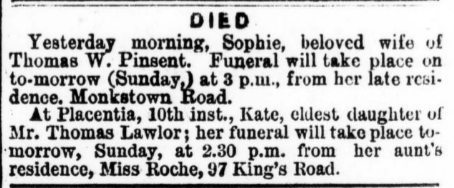
Thomas was living with his father (Lovell’s Newfoundland Directory, 1871) in Cochrane Place,on Military Road while working for the water board. He married Sophia Milroy – although I do not know where or when – and they moved to Catherine Row on Monkstown Road, in St. John’s and had a child, Arthur Alfred Pinsent on 12th June 1885. Sadly, Sophia died in childbirth. It was too much for Thomas and he decided to move house. His furniture was auctioned off on 20th June the same year. His son survived and was baptized in St. Thomas’s Parish Church on 28th June 1885.

A small newspapr clipping describing the death of Sophie Pinsent and her scheduled funeral.
Evening Telegram, June 13, 1885.

Thomas continued to collect water taxes – and to meet periodic resistance that was generally good-natured but occasionally otherwise. On one occasions he visited a “Senor Morey” – A Mexican resident who offered to pay part of his bill in Mexican silver dollars. Thomas was having none of it. He considered the debt unpaid and arranged for the foreign gentleman’s water to be cut off. Senor Morey wrote to the manager of the “General Water Company” saying that he was joking and that he was more than willing to adjust the value of the currency according to the current rate of exchange. However, as he had been insulted, he would insist that he pay in Mexican dollars (Evening Telegram: 14th February 1887). Judge Conroy resolved the issue in the Central District Court. The Water Company got its money but it had to accept some of it in Mexican dollars (Evening Telegram: 16th February 1887)! Perhaps the citizens would have been less flippant about their water taxes if they had realized that approximately three quarters of the city – including the cathedral and the Duckworth and Water Street commercial centre was to be destroyed by a fire in July 1892.

Thomas died of bronchitis in January 1890 and his household furnishings on Queen’s Road were sold off in April (Evening Telegram: 15th April and 22nd April 1890). His son, Arthur Alfred Pinsent was five years old when he died of diphtheria, in October that year (Evening Telegram: 22nd October 1890). Thomas’s younger brother, another accountant, Charles Speare Pinsent administered the estate (Evening Herald: Tuesday 26th August 1890.)


Family Tree

Grandparents

Grandfather: John Pinsent: 1753 -1821
Grandmother: Susanna Speare: 1766 – 1830

Parents

Father: Robert John Pinsent: 1798 – 1876
Mother: Louisa Broom Williams: 1808 – 1882

Father’s Siblings (Aunts, Uncles)

Mary Speare Pinsent: 1794 – 1882
Susanna Speare Pinsent: 1795 – 1819
John Pinsent: 1796 – xxxx
Robert John Pinsent: 1798 – 1876 ✔️
Elizabeth Pinsent: 1801 – 1828
Sophia Speare Pinsent: xxxx – 1805

Male Siblings (Brothers)

Robert John Pinsent: 1834 – 1893
Thomas Williams Pinsent: 1837 – 1890 ✔️
Charles Speare Pinsent: 1838 – 1914
William Burton Pinsent: 1846 – 1846


Please use the above links to explore this branch of the family tree. The default “Next” and “Previous” links below may lead to other unrelated branches.
Thomas Ogden Pynsent

Vital Statistics

Thomas Ogden Pynsent: 1905 – 1980 GRO1206 Hennock (Lorry Driver, Sydney, New South Wales)

Lillian Mary May Clough: 1914 – 1994
Married: 1931: Canterbury, New South Wales

Children by Lillian Mary May Clough:

Daughter (GRO1624)
Nellie Pynsent: xxxx – 1933
Daughter (GRO1625)
Daughter (GRO1688)
Son (GRO1689)
Norman Michael Pynsent: 1943 – 1997
Rosemary Pynsent: 1945 – 1953
Daughter (GRO1691)
Thomas Henry Pynsent: 1937 – 1937

Family Branch: Hennock
PinsentID: GRO1206

Click here to view close relatives.


Thomas Ogden Pynsent (II) was the fourth and youngest son of Joseph William Pynsent by his wife Nellie (née Garland). He was born at Bondi, in Sydney shortly before his father took up a farm and dairy (later called Pynsent’s Dairy) in Marrickville, another suburb of Sydney. He was part of a large, Catholic, family and grew up with ten siblings (three brothers and seven sisters), all of whom married.

Thomas worked in the family dairy as a “carter” and he later became a “lorry” (truck) driver. Sydney’s Electoral Rolls tell us that he was living with his brother Charles and his mother, Nellie (née Garland) on Duke Street in Canterbury in 1930. He married Lillian Mary May Clough the following year and then moved to Rogers Street, in Lang (near Sydney) sometime before 1936. They started their family there, and moved to Parramatta. The Electoral Rolls show that Thomas was a “depot hand” living on Bowden Street in Parramatta in 1943. Six years later, he was a “milk carter” on Francis Road in Bennelong. The family finally settled on Peggy Street in Merrylands West (an outer suburb of Sydney) in 1954. By then Thomas was firmly established as a “lorry driver.” He was still living in Merrylands in 1980.

Thomas and Lillian appear to have had a large family (three boys and six girls) but I am unable to supply the birth dates or even birth order for all of the children. One of the girls, Rosemary Pynsent, died at the age of eight in 1953. Her death was announced as follows: Death: Pynsent: Rosemary: February 16th, 1953, at hospital; beloved daughter of Lillian and Thomas Pynsent of 1 Peggy Street, May’s Hill and dear sister of [Daughter (GRO1624)], Nellie, [Daughter (GRO1625)] … …  aged 8 years. See Wednesday’s “Herald” for funeral notice (Sydney Morning Herald: Tuesday 17th February 1953). Their son Thomas Henry Pynsent also died young. He died within a week of birth and was buried with his grandmother, Nellie (née Garland) in 1937.

I do not know what happened to the other two sons Norman Michael Pynsent and Son (GRO1689). However, Norman seems to have died in Kington in New South Wales. Whether he had had a family or not, I do not know. His brother (GRO1689) is an enigma. Perhaps he married. I know nothing about him. Similarly, the girls may have married and had children. 

Thomas Ogden Pynsent (II) died on 18th November 1980, aged 75 years and his widow, Lillian Mary May Pynsent died on 20th May 1994, at the age of 80 years. They were buried in Rookwood Catholic Cemetery, in Cumberland, New South Wales, alongside their predeceased daughter Rosemary Pynsent and close to other deceased relations.


Family Tree

Grandparents

Grandfather: Joseph Burton Pinsent: 1806 – 1874
Grandmother: Mary Bridget Fogarty: 1832 – 1875

Parents

Father: Joseph William Pynsent: 1862 – 1926
Mother: Nellie Ellen Garland: 1864 – 1933

Father’s Siblings and half-siblings (Aunts, Uncles)

Thomas Ogden Pynsent: 1839 – 1864

Mary Ann Theresa Pynsent: 1856 – xxxx
Burton William Pynsent: 1856 – 1856
Elizabeth Ellen Pynsent: 1858 – 1841
Burton Michael Pynsent: 1861 – 1876
Joseph William Pynsent: 1862 – 1926 ✔️
Charles Pynsent: 1865 – 1878
Alfred Thomas Pynsent: 1869 – 1911

Male Siblings (Brothers)

Joseph Burton Pynsent: 1890 – 1968
Charles Pitt Pynsent: 1893 – 1975
Alfred Francis Pynsent: 1896 – 1981
Thomas Ogden Pynsent: 1905 – 1980 ✔️


Please use the above links to explore this branch of the family tree. The default “Next” and “Previous” links below may lead to other unrelated branches