Please use the above links to explore this branch of the family tree. The default “Next” and “Previous” links below may lead to other unrelated branches.
Please use the above links to explore this branch of the family tree. The default “Next” and “Previous” links below may lead to other unrelated branches.
Please use the above links to explore this branch of the family tree. The default “Next” and “Previous” links below may lead to other unrelated branches.
Beatrice Mary Homfray was the youngest daughter of Robert John Pinsent, a Justice of the Supreme Court of Newfoundland, by his second wife, Emily Hetty Sabine Homfray. She was born at her mother’s family home in Bintry, in Norfolk in 1883 – presumably while her parents were back on one of their periodic visits to England. She was born into an extended family; she had five half-siblings: (Lucretia Maude, Louisa Catherine, Robert Hedley, Charles Augustus and Alfred Newman) from her father’s first marriage and a sister (Mabel Louisa Homfray) and two brothers (Robert John Ferrier Homfray and Francis Wingfield Homfray) from his second. She was later to have a younger brother (Guy Homfray Pinsent) who arrived in 1889. Sadly, Louisa Catherine, Robert Hedley and Robert John Ferrier all died without having had children.
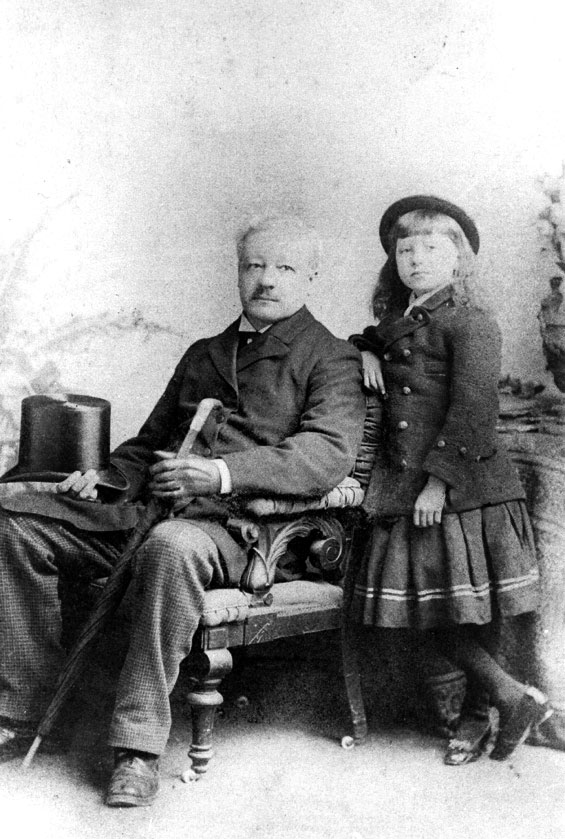
Robert John Pinsent and “Trixie”.
The adjacent photograph of Sir Robert John Pinsent was probably, but not definitively, taken with Beatrice, or “Trixie” as she was known. She would have been about the right age when the photograph was taken.
Robert John Pinsent’s life is described elsewhere. He was an active member of the Supreme Court in Newfoundland and was notably busy in the 1880s dealing with the fall-out from a collapsed railway construction contract, and in establishing the rights of Newfoundland and French fishermen along the so-called “French Shore”. He felt that the French were only entitled to catch and process cod – and, what ever they said, they had no right to interfere with Newfoundlanders efforts to catch, process and can lobsters. He published an article entitled “French Fishery Claims in Newfoundland” (Nineteenth Century: Vol. 158, April 1890) in 1890. Robert made several visits to England and, in April 1885, he gave a talk to the “Royal Colonial Institute” entitled “Newfoundland, our Oldest Colony” (Colonies and India: Friday 17th April 1885.) He was a well-known and well-respected advocate for the Colony and Queen Victoria gave him the honour of a knighthood in 1890.
Sadly, Sir Robert died on a trip back to England in 1893. His death created a serious problem for Emily (or “Lady Pinsent” as she then was) as nearly all of the family’s assets in Newfoundland went to the children of his first marriage – most notably Charles Augustus Maxwell Pinsent. She was left with two teenage sons (Robert (19) and Frank (18)) in Newfoundland, a grown up daughter (Mabel (20)) and two young children, Beatrice (10) and Guy (4). Lady Pinsent stayed on in England and found employment first as “House Matron” at Harrow School and then as the “Matron” at Denstone School in Staffordshire.
Lady Pinsent never returned to Newfoundland; however, she clearly missed the place, particularly (I suspect) Salmonier and her fishing excursions to “Pinsent Falls” on the river there. It was one of the premier salmon fishing spots in Newfoundland. As an aside, when Field Marshal Earl Haig made a post-war visit to the Colony in 1924 to thank the “Royal Newfoundland Regiment” for its contribution and losses (which had been severe), the Colonial Government arranged for him to spend a few days fishing there. Needless to say: “FIELD MARSHAL LANDS HEAVIEST FISH OF THE SEASON: We have just received a message from Mr. J. Hannon, operator at Holyrood to the effect that Field-Marshal Earl Haig and party were at Pinsent Falls, and were already thoroughly enjoying themselves and having good luck. Last night Earl Haig landed five salmon, one of which was the largest fish caught at Salmonier for the season” (Evening Telegram: 5th July 1924). Okay, if you say so …
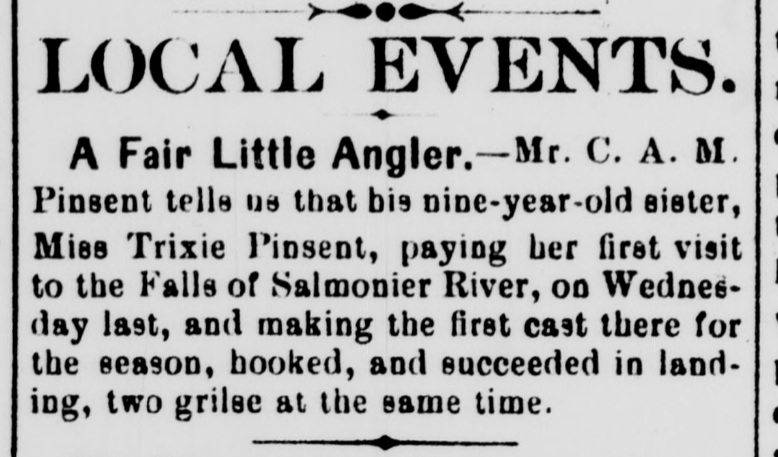
Evening Telegram, June 25, 1892.
Lady Pinsent wrote two full articles for “The Field” Magazine on fly-fishing in Newfoundland and a shorter item (reprinted in an unspecified Quebec Newspaper) describing the time her nine-year old daughter Beatrice (“Trixie”) landed two small (well, slightly under three pounds each) salmon with a single cast of a trout rod. Trixie’s half-brother, Charles Augustus Maxwell – who was considerably older than she was – also made note of it in a contemporary item in the St. John’s press (Evening Telegram: 25th June 1892).
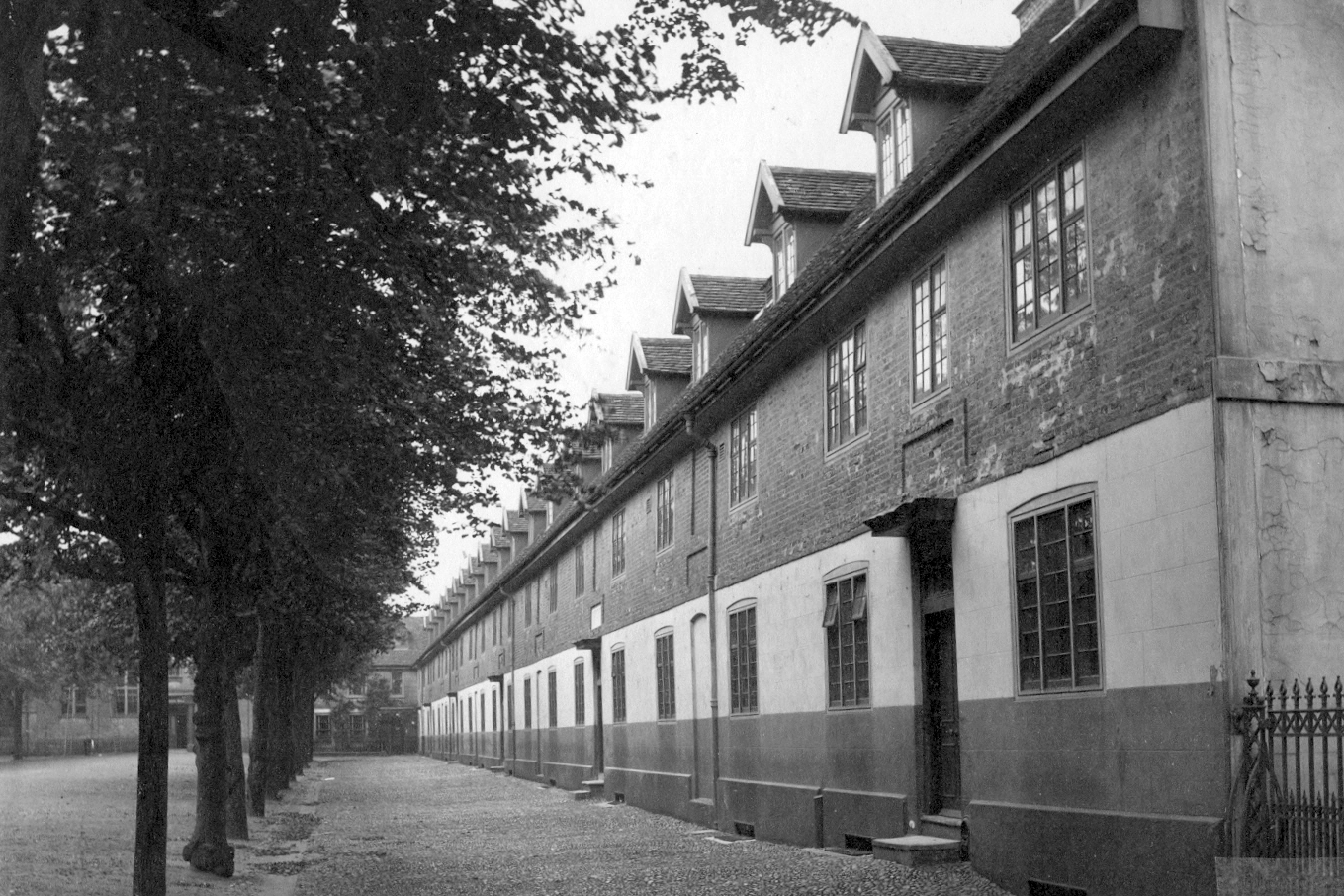
Christ’s Hospital occupied the Bluecoats site from 1682 to 1985. These ‘wards’ were demolished and replaced in 1904. Via Discover Hertford
Trixie’s life changed dramatically after her father died. She and her brother Guy were sent to the “Blue Coat School” in Hertford. This was a charitable foundation that had originally been based at “Christ’s Hospital” in London but had moved out to Hertford in the 1700s. I am not aware that either of them ever returned to Newfoundland.
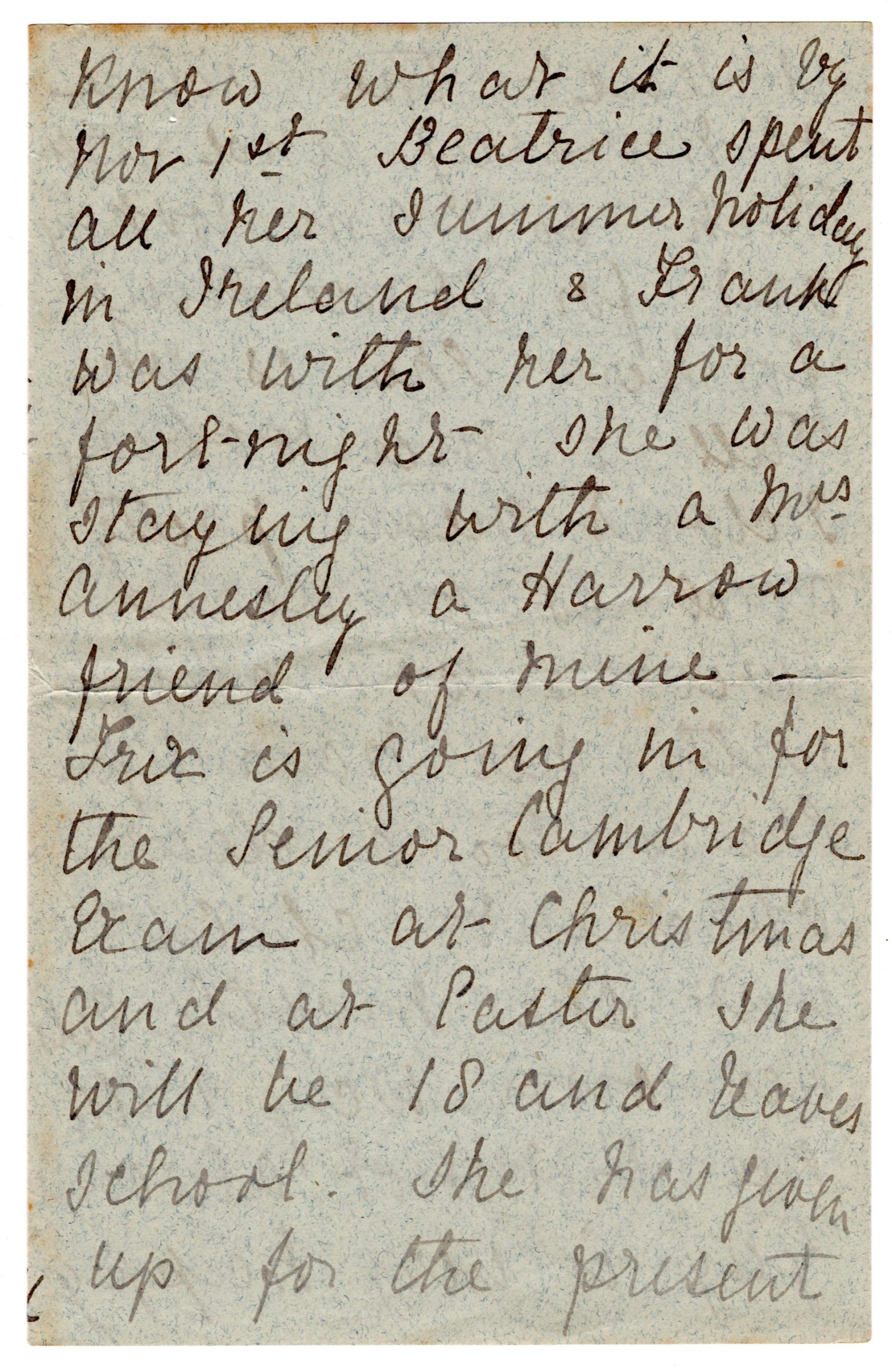
A handwritten letter Emily sent to Maude Pinsent, 1900.
Lady Pinsent found it difficult to bring up her children on her own. She wrote to her stepdaughter Lucretia Maude (the Lady Abbess in Rome – see elsewhere) in November 1899 saying: “Can you realize that she (Trixie) will be 17 in April! She has the way to make people like her & is a great favourite here & all from the headmaster to the maids look forward to her coming. The former always gives her £10 for a tip and when she remonstrated, he said he always should while she went to school. The truth is my heart is bound up in the child & my greatest sorrow is that I cannot see my way to giving her the 5 years medical training necessary for her to practice in India – if she wished to combine missionary work with it, I could get her a substantial studentship from the S.P.C.K. but she has no call that way – at least not at present.” She wrote again the following October, saying “Trix. is going in for the Senior Cambridge Exam at Christmas and at Easter she will be 18 and leave school. She has given up, for the present at least, the idea of nursing and will teach, so I am looking out for something for her”.
I do not have a definitive photograph of Trixie; however, Lady Pinsent went on to say: “she is very tall and nice looking. I don’t mean pretty and looks very sweet and womanly with her hair up. She is too a dear obedient child. But she mostly gets her own way with me, but not always”. Emily had hoped to get out to Rome to see Lucretia but it was not to be: “… perhaps some day we may manage it. Just now I have to provide a complete outfit for Trixie for Easter when she leaves off her school clothes”. It was not easy for her and time was marching on. In December 1901, Lady Pinsent wrote: “Trixie’s exam in over but we do not know the result till March. If she has passed I hope by the aid of an Exhibition from her School to send her to a training college for a year. Her future gives me a good deal of anxiety just now.”
Lady Pinsent was bored stiff at Denstone and had plenty of time to write and keep up with friends, both in England and in Newfoundland. Among others, she corresponded with Judge W. D. Prowse, a friend of the family – and a great admirer of Sir Robert it would seem from his frequent references to him in the press. Judge Prowse arranged for the following to appear in a local St. John’s paper:“Mr. Frank Pinsent: The numerous friends and admirers of the late Sir Robert and Lady Pinsent, will be very pleased to learn that their son, Mr. Frank Pinsent, who used to be in the Surveyor General’s Office, has passed a most creditable examination in London, and is now entitled to become a member of the Council of Surveyors for Great Britain. It was a very stiff examination—like all those held in London —and several members, five and ten years seniors to Frank, were plucked. Miss Trixie Pinsent has also passed with great credit the Senior Local Cambridge Examination, and is now studying for higher honours. D.W.P.” (Evening Telegram: 17th June 1901); she had passed!
Frank (Francis Wingfield Homfray Pinsent) had trained to be a surveyor in St. John’s and moved to London, to be nearer his mother and siblings in 1899. Lady Pinsent left Denstone and moved into a flat at #13 Stanley Crescent in Kensington. She lived there for several years; however, when Francis (“Frank”) joined the Civil Service as “District Valuer” she moved down to Devon to be with him. Trixie had, by then, become a “masseuse” who was living in the flat in Kensington when the census takers came calling in 1911.
Telegraph, 17 August 1918.
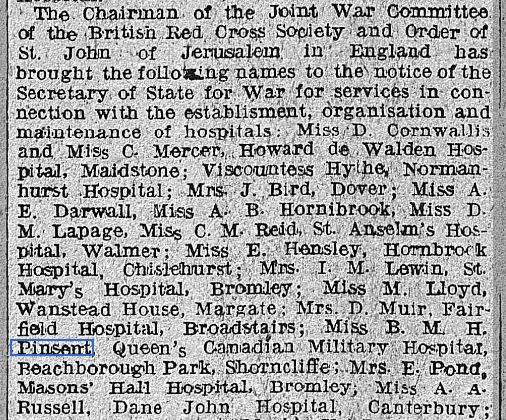
Trixie served at the “Queen Caroline (Alexandra (?)) Military Hospital” during the “First World War” (British Army WWI Service Records) and her service was acknowledged when “The Chairman of the Joint War Committee of the British Red Cross Society and Order of St. John of Jerusalem in England (has) brought the following names to the notice of the Secretary of State for War for services in connection with the establishment, organization and maintenance of hospitals: … list includes … Miss. B. M. H. Pinsent, Queen’s Canadian Military Hospital, Beachborough Park, Shorncliffe” (Southeastern Gazette: Tuesday 20th August 1918). Soldiers wounded in France and Belgium were sent to Shorncliffe, assessed before being shipped to smaller hospitals throughout the country.
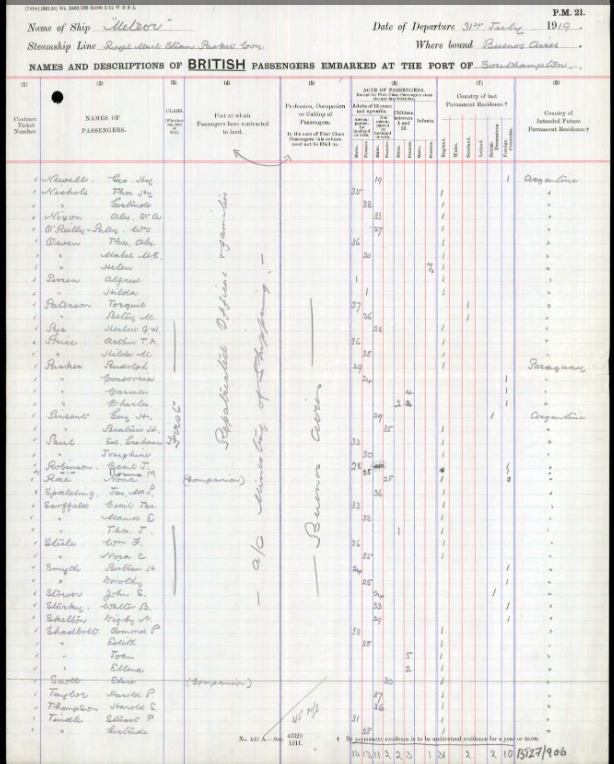
Passenger list of the S. S. Meteor, 1919, showing Guy and Trixie Pinsent.
Trixie’s younger brother Guy Homfray Pinsent had worked in a bank in Buenos Aires, in Argentina, before the war and he returned for a visit in 1919. Trixie went with him and, for some reason, decided to stay on. She became a “clerk” (possibly working for a British owned Railway Company (?)) in Buenos Aires, in 1928.
Interestingly, her time there overlapped with that of at least two other branches of the Pinsent family. How well they knew each other – if at all – I don’t know. Certainly, there was a surprising degree of interaction within the Pinsent family in England at that time. Lady Pinsent made the most of her erstwhile husband’s English friends and his and her family, and other connections. It is probably no coincidence that Adolphus Ross Pinsent (from the DEVONPORT branch) was a director of the bank that Guy worked for before the war! “Ross” Pinsent also had railway company connections, so he may have helped Trixie out as well.
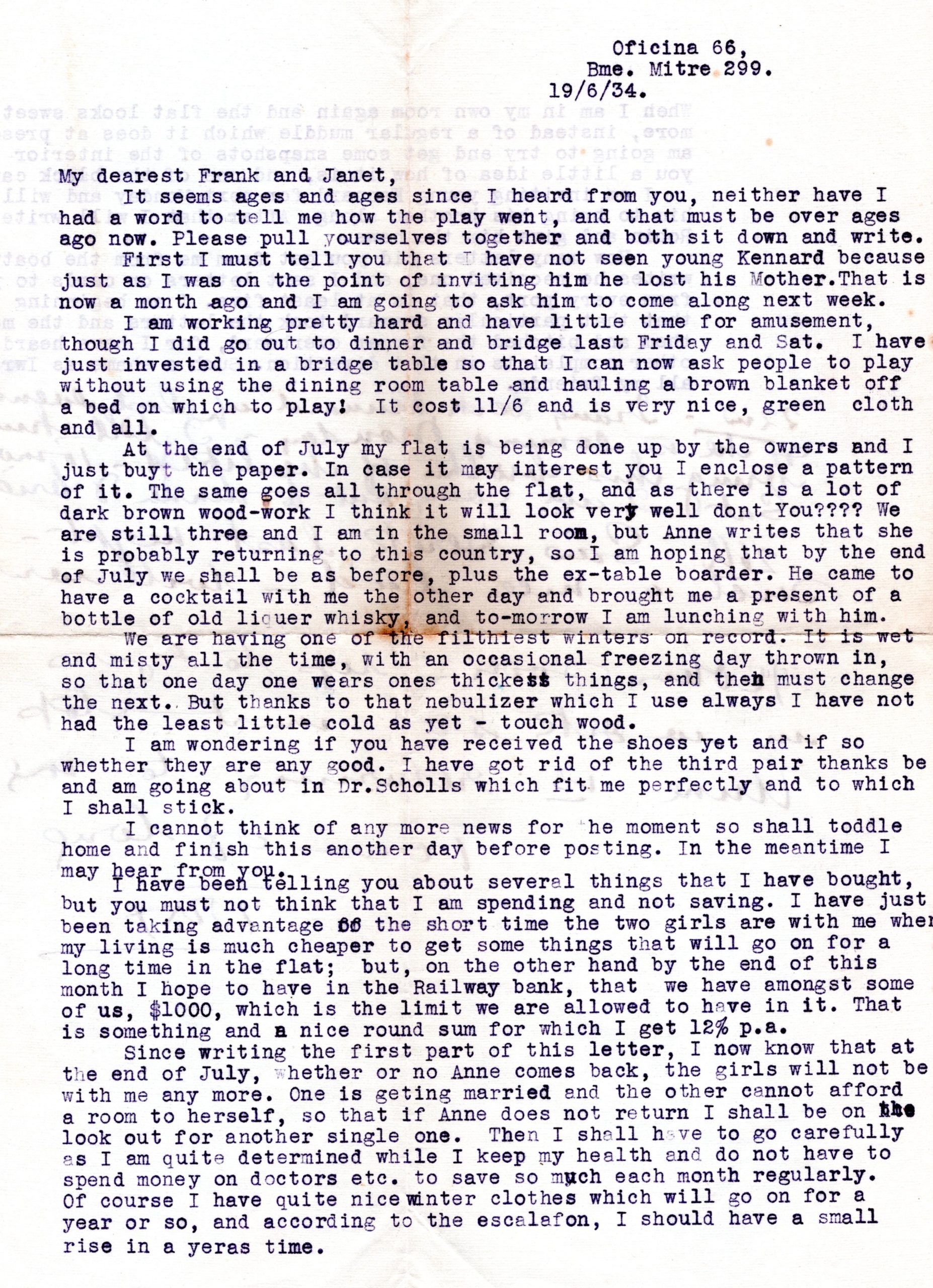
A typewritten letter from Trixie to Frank and Janet, dated June 19, 1934.
Incoming Passenger Lists show that Beatrice Homfray Pinsent returned to see her brothers in England in 1928 and 1933 and may have been back other times as well. She visited Francis and his wife, Janet, in Horrabridge. On the second of her visits, she also went out to Italy to see her half-sister, Maude (the Lady Abbess). She returned from Genoa on the Dutch ship “Johan Van Oldenbarevelt” which docked in Southampton on 17th December 1933. Trixie wrote to her brothers Guy and Frank from that boat (or it may have been the one she took back to Argentina) and later, in June 1934, wrote to Frank to inquire if her letters had been received. She rather suspected they might have been thrown overboard and the postage pocked by a steward!
Trixie was sharing a flat in Buenos Aires with two or three other women at the time, and she mentioned that one of them would be leaving shortly as she was getting married. However, she thought that her friend Anne (presumably) Stehrenberger) would be back fairly soon, and she hoped that she would take one of the rooms in the flat.
Janet (née Cowtan), Frank’s wife died in February 1938 and he went out to Buenos Aires to get over the shock and see Trixie. It must have been a short visit as he arrived back in Southampton on the “Royal Mail Steamship Lines” vessel “Asturias” on 25th April 1938. Frank met Anne Marie Stehrenberger while he was there. She was a Swiss national who worked at the “Swiss Legation.” To what extent Trixie encouraged Frank’s subsequent marriage to Anne, I do not know; however, Trixie returned to England to see her brother in July 1938 and Anne Marie came over that August (U.K. Incoming Passenger Lists: Ancestry.com). She came down to Devon for a visit, and married Frank in Yelverton, in August 1939. Two years later they had a daughter – who is still living. Trixie returned to Buenos Aries, where she taught English.
Juan Peron took over in Argentina after the war and life must have changed for the English community. However, Trixie stayed on in Argentina and, in later years at least, gave English lessons. She was eighty-two years of age in 1965 when she died there. Her death was registered at the British Consular Office.
Please use the above links to explore this branch of the family tree. The default “Next” and “Previous” links below may lead to other unrelated branches.
Please use the above links to explore this branch of the family tree. The default “Next” and “Previous” links below may lead to other unrelated branches.
Please use the above links to explore this branch of the family tree. The default “Next” and “Previous” links below may lead to other unrelated branches.
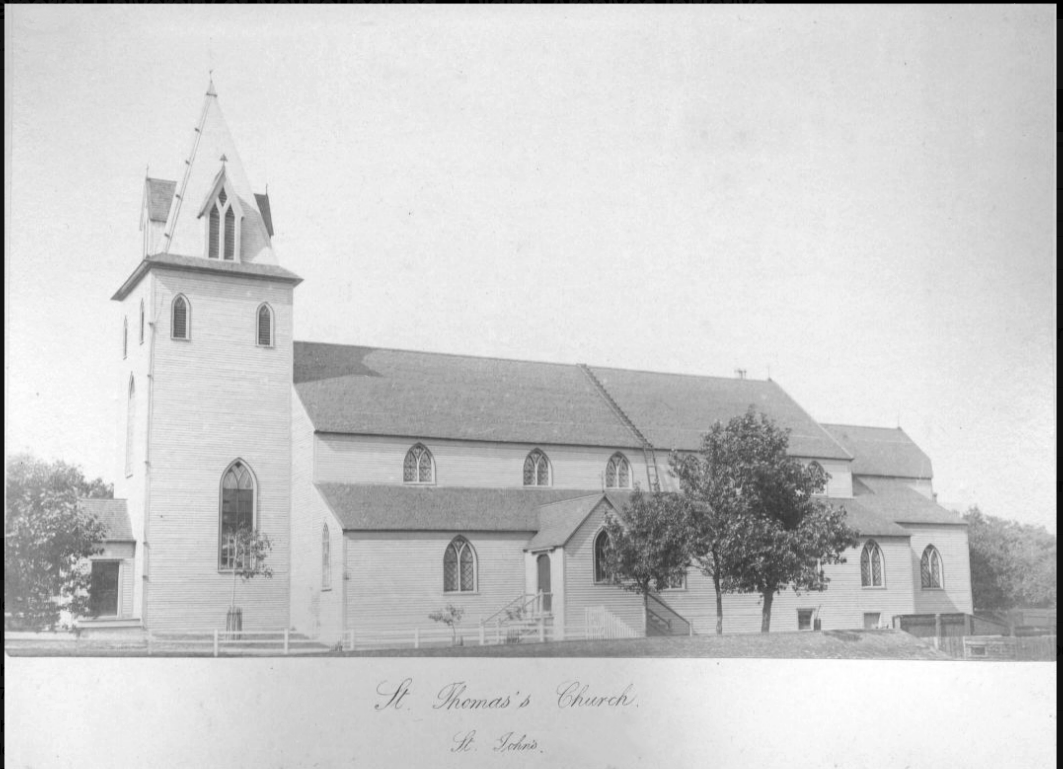
Arthur Newman was the youngest son of Mr. Robert John Pinsent by his first wife, Anna Brown (née Cooke). He was born in St. John’s Newfoundland and baptized in St. Thomas’s Church in 1867. Arthur grew up in St. John’s with two sisters, (Lucretia Anna Maude and Louisa Catherine Pinsent) and two brothers (Robert Hedley Vicars and Charles Augustus Maxwell Pinsent).
His parents divorced in 1870 and the children were left in the care of their father. He married Emily Hetty Sabine Homfray two years later and Robert John started a second family. Arthur was to have three younger stepbrothers (Robert John Ferrier Homfray, Francis Wingfield Homfray and Guy Homfray Pinsent) and two younger stepsisters (Mabel Louisa Homfray and Beatrice Mary Homfray Pinsent). He born near the middle of a blended family that had an age spread of thirty-two years! He seems to have been largely brought up and schooled in Newfoundland; however, some of his siblings seem to have received at least some of their education in England and he may have too.
Arthur’s stepmother, Emily, came from Norfolk and the she made periodic trips back to England with her husband and children to see her family in Bintry (Bintree) and visit children then at school there. They took one such trip in December 1877 per. Allan Steamer “Nova Scotian.” The ship’s manifest refers to Mr. and Mrs. R. J. Pinsent and their sons, Charles, Arthur, Robert and Francis Pinsent.
While he was still in his teens, his father arranged for him to take a position as an apprentice clerk with the Hudson Bay Company – presumably with the thought that he would rise in the company over time. The company’s employment records tell us that he signed an initial contract to work for “The Bay” until 1888 in 1882. He was based at Esq Bay (?).
Nevertheless, when he turned twenty-one, in August 1888, Arthur gave his eldest brother Charles Augustus Maxwell Pinsent power of attorney over his estate – and he transferred to him any interest he had in his father’s and his divorced mother’s family’s estate (Newfoundland Archives: Pinsent Collection). What his father thought of that I do not know! Certainly his step-mother was not impressed.
A handwritten letter from Emily to Maude dated December 16, 1900.
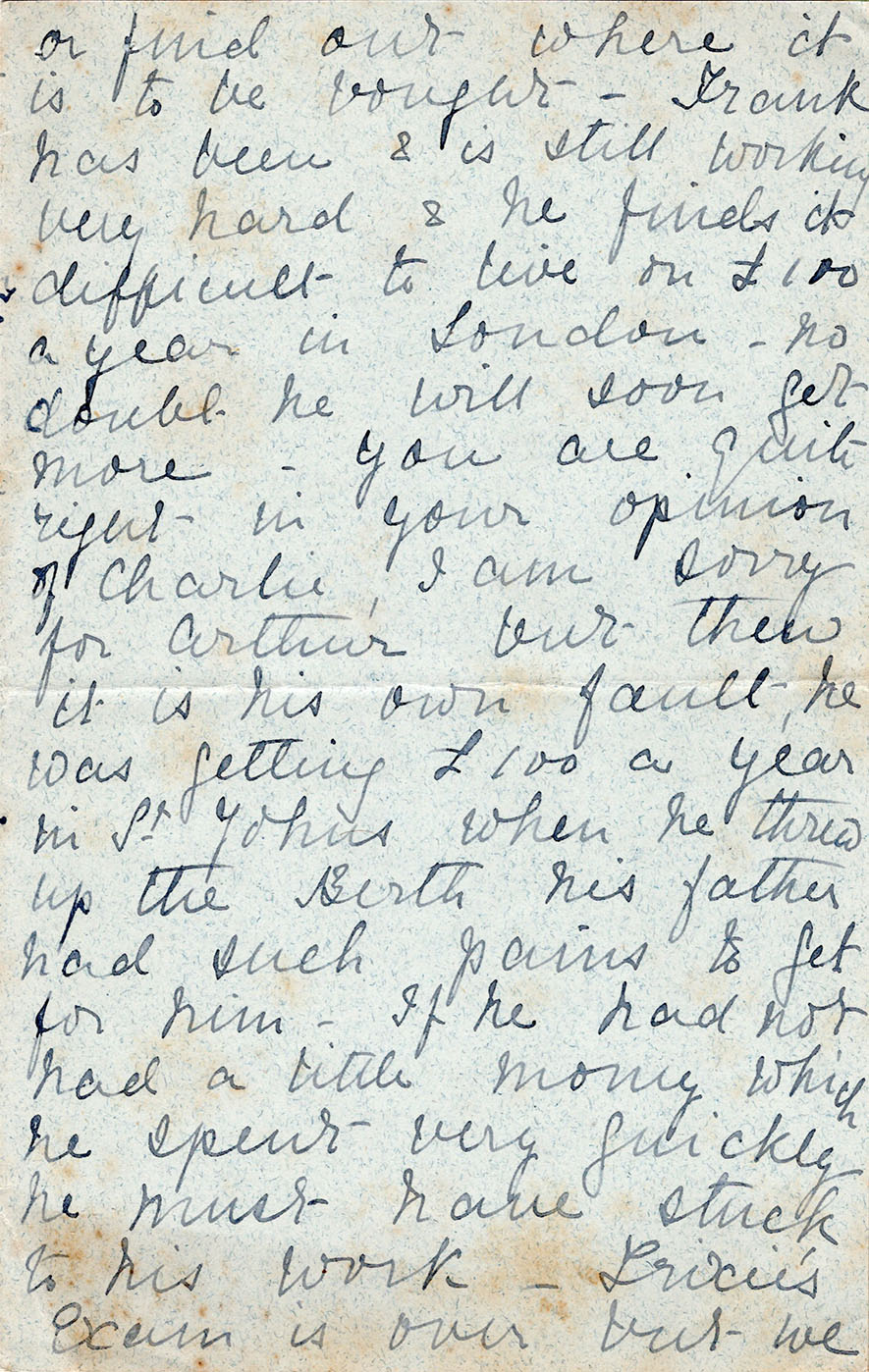
One of his father’s notices of obituary suggests that Arthur moved to the United States and farmed there (Daily Tribune: Saturday 20th May 1893); however, a letter that his stepmother wrote to his elder sister Lucretia Maude (who was then Abbess of a convent in Rome) suggests that Alfred was living in Winnipeg (Manitoba) in 1900. Emily told her that: “I generally write to poor Arthur about 3 times a year. He seems to be settled down now in Winnipeg.” Why “poor” Arthur, she does not say; however, in another letter to Lucretia she sent the following year (both in my possession), she says: “I am sorry for Arthur but then it is his own fault he was getting £100 a year in St. John’s when he threw up the berth his father had such pains to get for him. If he had not had a little money, which he spent very quickly, he must have stuck to his work.” I rather fear that Arthur left Newfoundland to get away from his brother Charles who – as Lady Pinsent well knew – was an alcoholic and occasionally abusive.
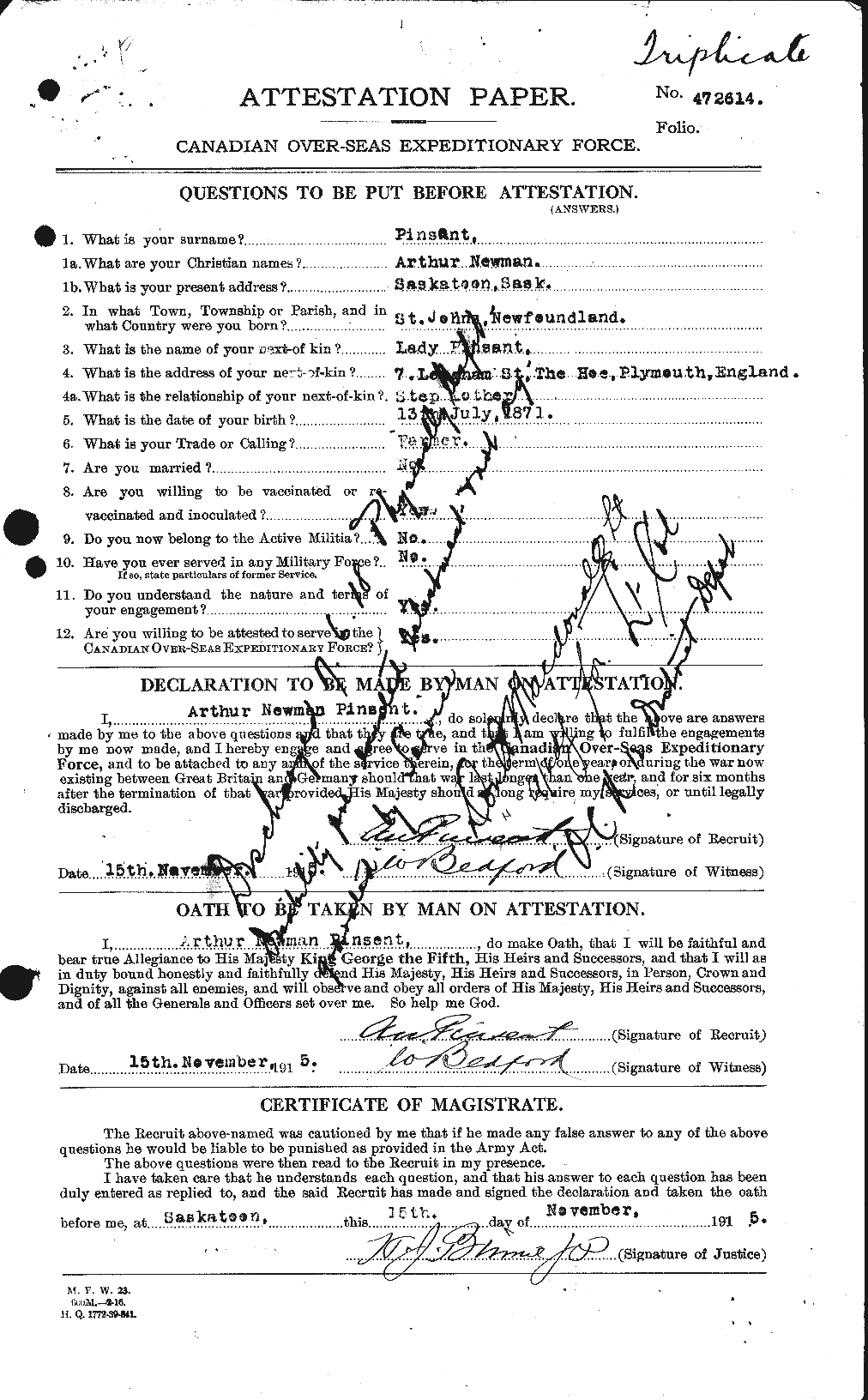
Arthur Newman’s attestation paper.
By 1915, Arthur Newman had become a farmer in Saskatchewan. Nevertheless, he elected to join the Canadian Army. According to the “Attestation Paper for the Canadian Over-seas Expeditionary Force” – he signed on 15th November 1915 – he was a single farmer living in Saskatoon, Saskatchewan. He was 5ft 5ins tall, had a girth (when fully expanded) of 35 ins. (range of expansion 1.5 ins.). He had grey hair and hazel eyes – in case you were wondering! I have yet to find his photograph.
He claimed to have been born in St. John’s on 13th July 1871 (sic), whereas he was actually born on the same day in 1867. The powers that be probably did not care that much. Although why he signed up for active service at the age of 48 years and 4 months is a mystery!
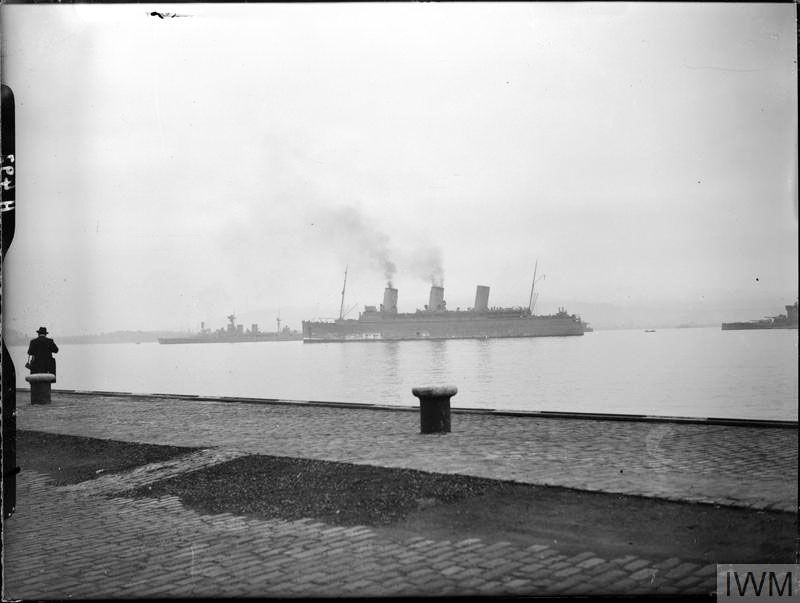
The ship the Empress of Britain via the Imperial War Museum.
Arthur gave his religion as Church of England and named his stepmother, Lady Pinsent as his next-of-kin. She was then living with her son Francis at #7 Leigham Street on “The Hoe” in Plymouth. Arthur was considered fit for service and he swore both allegiance to King George V and (doubtless with his fingers crossed!) to the truthfulness of his “attestation”. Private Pinsent was assigned Regimental Number 472614 and sent off to join the 65th Battalion, which sailed for England on the “S.S. Empress of Britain” on 18th June 1916.
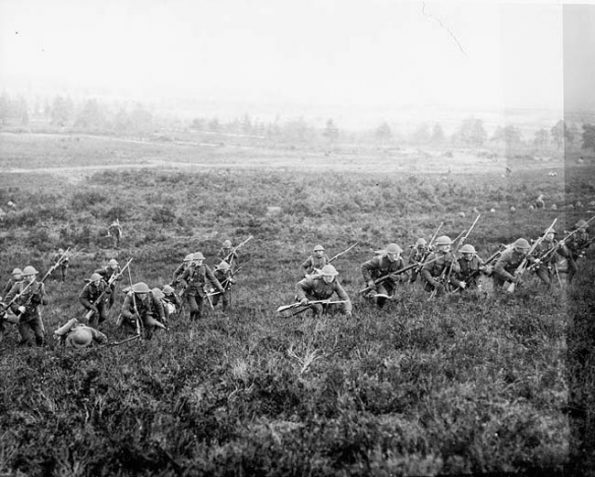
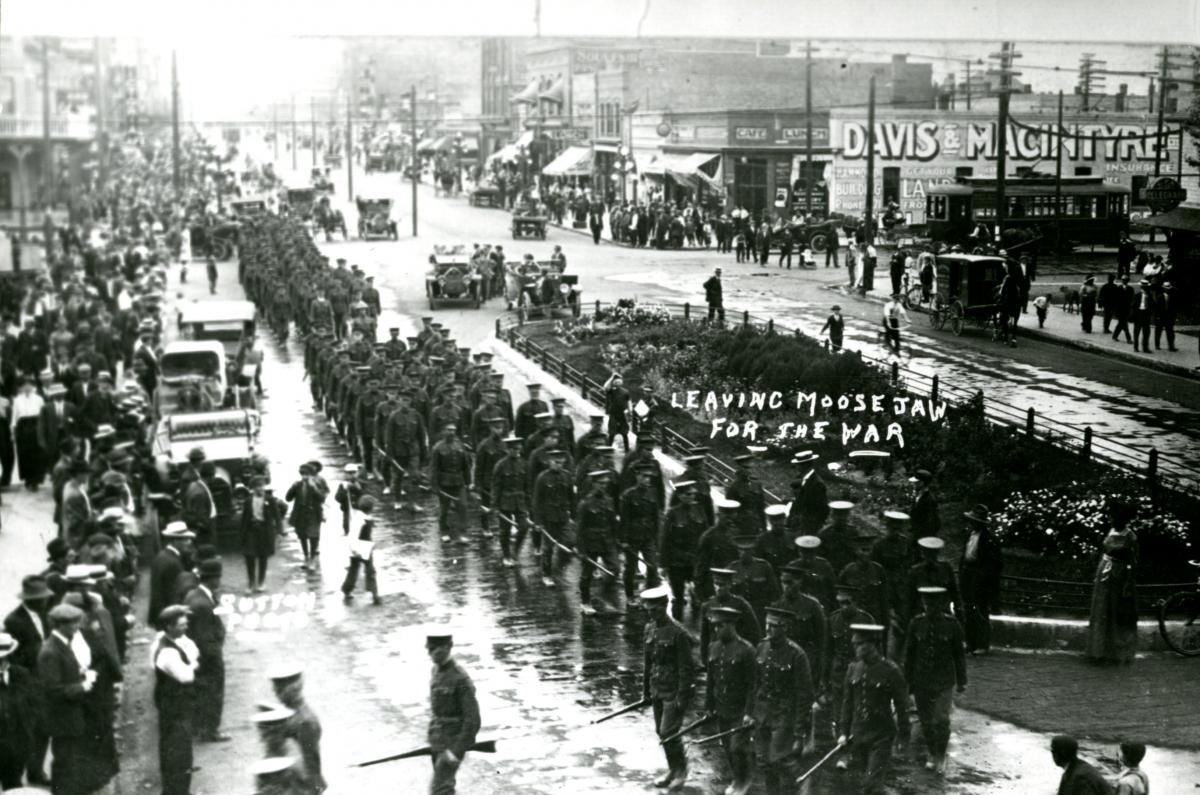
World War 1: The 9th Reserve in Bramshott
On his arrival, Arthur was transferred to the 46th Battalion at Bramshott, in Hampshire. However, he was unable to complete a route march in July 1916 and was found to have a high blood pressure – not a good sign for a foot soldier! It must have been around then that the Army first started to question his age. The grey hair might have been a clue. Nevertheless, he was sent to France and he served there for seven months before being returned to England in December 1917 suffering from rheumatic fever and myalgia.
Arthur was, perhaps, fortunate. It was not for nothing that the 46th Battalion (South Saskatchewans) earned the nick-name “The Suicide Battalion”. It suffered combined casualties (dead and wounded) of over 90 per cent. Arthur seems to have been transferred to the “1st Can. Pioneers” as a “sapper” and been stationed at Canadian bases at Bramshott and Purfleet in Essex, and also other camps (and hospitals) until it finally dawned on the Military how over-age he actually was. There is an exasperated note in his personnel file that shows “He is fifty three years of age and looks it …”
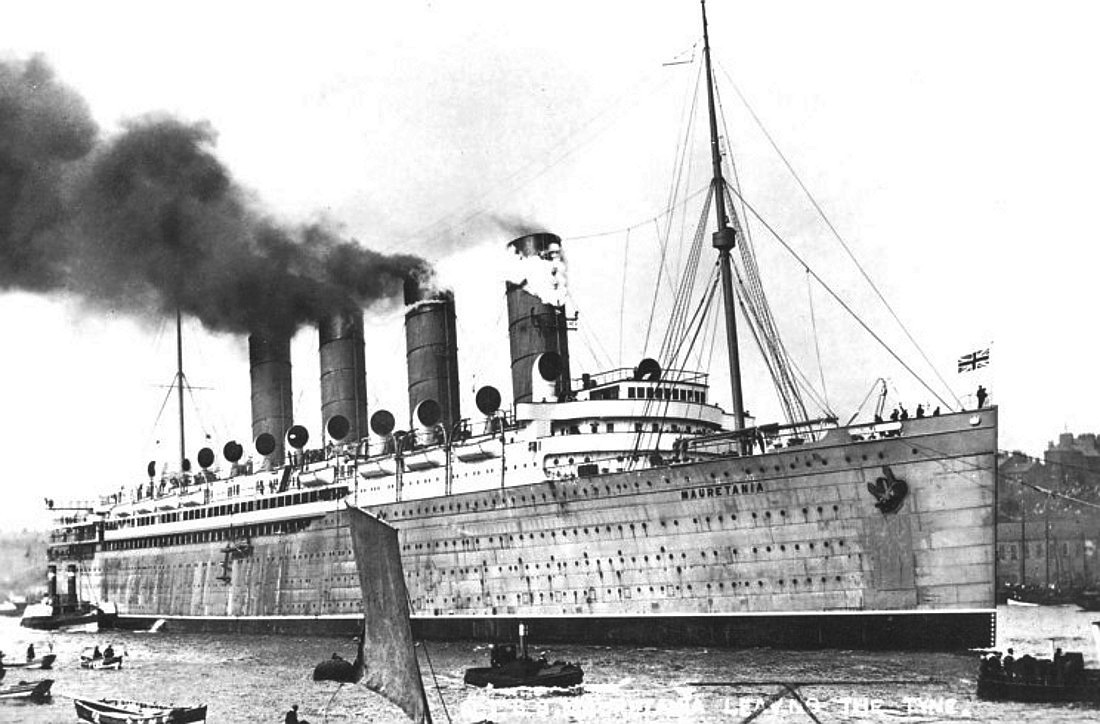
RMS Mauretania on the River Tyne in 1907, via Wikimedia.
Arthur was shipped back to Canada on the “S.S. Mauritania” in a party of “Medically Unfit Soldiers” slated for discharge. He arrived back in Saskatoon in May 1918. Arthur had been granted a few days leave before returning home. Perhaps he went down to Devon to see his stepmother, who was then living with his step-brother Frank at “Hillsborough” in Horrabridge. If he did so, he probably met my father who would have been two years old at the time. On his return to Canada, the Army denied responsibility for his medical condition. It was adamant that his “disability predated Attestment and (it was) not aggravated by service”. He was “Discharged 17th June 1918: Physically Unfit” (Canada WW1: CEF Personnel Files: 1914 -1918). It was old age and not chlorine gas that was the problem!
What happened to Arthur after his return to Saskatchewan, I am not sure. I would have thought he was too sick to farm; however, he applied for and received a Canadian “Soldier Homestead Grant” in April 1927. This entitled him – as a returned soldier – to receive 160 acres. In his case it was at “NW: 32: 44: 6: W3” – [Grant #15717: Section 32, Township 44, Range 6, Meridian 3]. This is (I think) some distance due north of Saskatoon and west of North Battleford. Arthur was sixty years old. Saskatchewan Residency Lists show that he lived at Blaine Lake in Saskatchewan from 1920 to 1929.
Arthur Newman was probably the “A. Pensent” who lived on River Street East in Moose Jaw, Saskatchewan in 1945 (Canada Voters List: 1940 – 1972). His army records tell us that he died on 14th December 1946. Arthur may have left some residual estate in Newfoundland as an “Arthur Pinsent” had his will probated in St. John’s Newfoundland in 1949 (Newfoundland Wills Book: Volume 20: page 517). I have not seen it.
Arthur Newman never (to the best of my knowledge) married. He has no known descendants.
Please use the above links to explore this branch of the family tree. The default “Next” and “Previous” links below may lead to other unrelated branches.
Please use the above links to explore this branch of the family tree. The default “Next” and “Previous” links below may lead to other unrelated branches.
Please use the above links to explore this branch of the family tree. The default “Next” and “Previous” links below may lead to other unrelated branches.
Please use the above links to explore this branch of the family tree. The default “Next” and “Previous” links below may lead to other unrelated branches.
#/media/File:Mauretania,1907_on_Tyne.JPG)