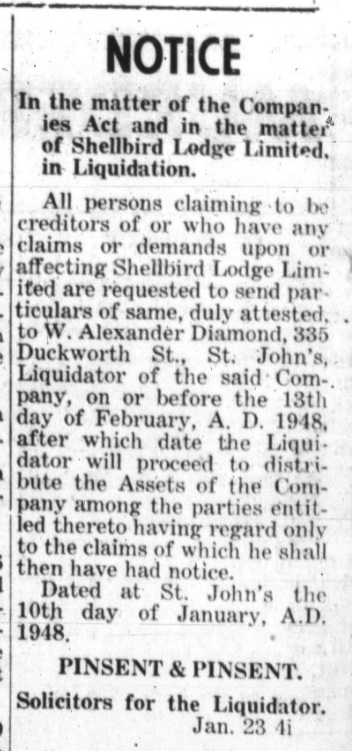
Notice signed “Pinsent & Pinsent” seeks creditors for a bankrupt company. Western Star, February 6, 1948.
Charles Douglas was the only son of Earl Speare Pinsent and Augusta Beatrix (née Dickinson). He was born in St. John’s Newfoundland, and attended “Bishop Feild (sic) College” – where he developed a passion for ice-hockey and other sports. On leaving school, he went to “King’s College” in Windsor, Nova Scotia. The College had been affiliated with “Dalhousie University,” in Halifax, since a fire had destroyed much of its own infrastructure in 1920. Charles Douglas (“Douglas” or “Doug” Pinsent) studied law and, in October 1937, returned to St. John’s to article under his father. He was called to the bar in St. John’s in October 1943 (Daily News: 19th May 1953). Father and son practiced law together under the title of “Pinsent and Pinsent, Solicitors” of Royal Bank Chambers, Water Street, St. John’s. The partnership was later expanded to include Mr. W. G. Adams; however, the firm of “Pinsent, Pinsent and Adams” (Daily News: 15th April 1953) only lasted for about a month as Douglas died young. His father and Mr. Adams carried on.
“Mr. Douglas Pinsent” became engaged to Olive Drew in Calgary in December 1943 (Calgary Herald: Thursday 16th December 1943) and they, evidently, planned to marry in St. John’s on 4th January 1944; however, there is nothing to suggest that they did. They seem to have thought better of it. A letter that Douglas’s aunt Annie (nee March) wrote to by father and mother (Robert John Francis Homfray and Ruth McKechnie Pinsent) in 1946 implies that the marriage never took place. She refers to “Douglas who is not married yet – though he took several steps in that direction about a year ago.” When it came to it, Charles Douglas married Madeline Waterman in Seattle, in Washington State, in December 1948 (Washington, U.S., Marriage Records: Ancestry.com). What he had been doing out west or where he met her, I do not know! They had a single child, a son, Kenneth Pinsent, in April 1953.
Douglas was “Secretary of the St. John’s Progressive Conservative Party” and decidedly alarmed by post-war reports that the British Government hoped to push Newfoundland into confederation with Canada. Doug and his father were among “(T)he undersigned members of the Bar of Newfoundland” who signed a cable sent to the British Government insisting that the only choice that could be made for Newfoundland was between “Responsible Government” and “Commission Government,” and that only once that decision had been made and the financial implications been assessed, could confederation be considered (Western Star: Friday 13th February 1948). Despite this, “Confederation with Canada” was a third option placed on the “Confederation Referendum” when it was held and it was chosen. Newfoundland joined Canada on 31st 1949.
Doug ran as a “Tory” (Conservative) candidate in the Fortune-Hermitage riding when Newfoundland held its first provincial election two months later and – like many other “Tory” candidates – lost by a considerable margin to a well-known, and highly regarded “Liberal” opponent. The Conservatives election campaign seems to have been poorly managed! (“Canadians at Last: The Integration of Newfoundland as a Province”: by Raymond B. Blake, 1994) and Mr. Smallwood became the first “Premier” of Newfoundland and Labrador. It was he who was to join Douglas on the head table at a “Rotary Club” banquet given to honour the “President of the Rotary International” in 1950. Douglas was the “President of the St. John’s Lions Club” at the time. He attended with his wife, Madeleine.
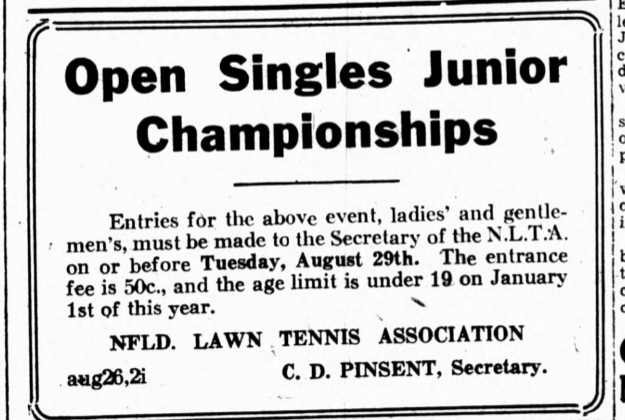
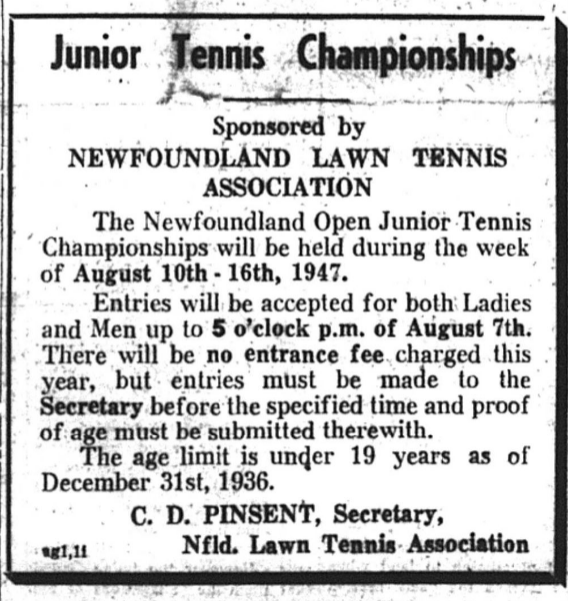
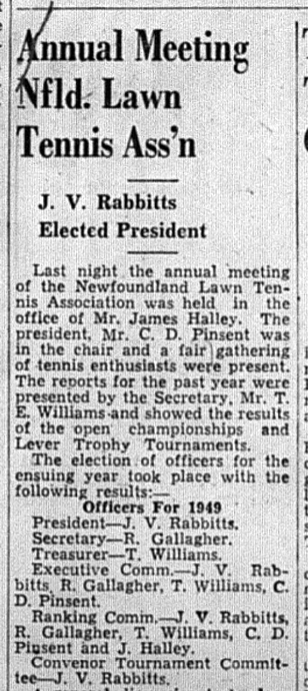
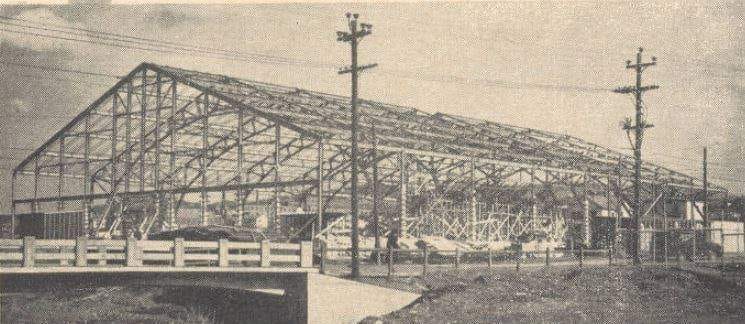
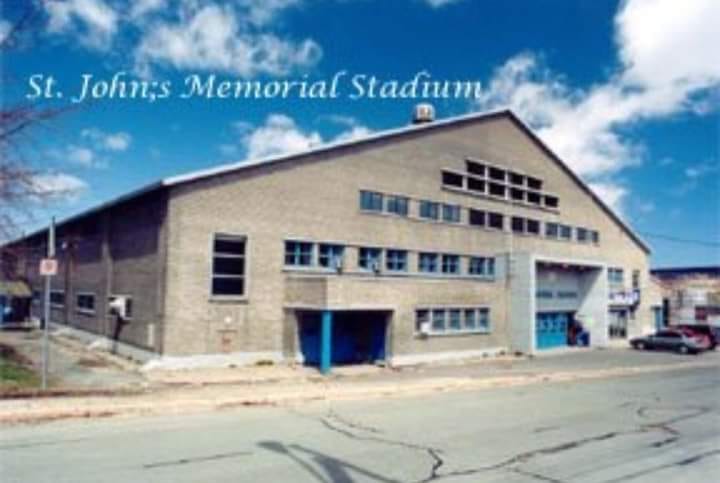
Douglas was an all-round athlete. He had played on the “Feildians” inter-collegiate and Senior Hockey teams between 1934 and 1939, and for the St. John’s “Royals” from 1940 to 1948. He was president of the “St. John’s Hockey League” when he died, and was well known in St. John’s for promoting and developing a variety of sports in the province. He helped found the “Riverdale Tennis Club” and was a tireless member of the “Regatta Committee”. He was appointed president of the “Lions Club” and he was instrumental in getting the city a new ice-rink after their old one burnt down (Daily News: 19th May 1953). He wrote an article, entitled “Let’s Build a Stadium,” that was published in the October 1950 edition of “The Magazine of Newfoundland.” Two years earlier, the “National Film Board of Canada” had filmed him escorting Canada’s 1948 Olympic Figure Skating Champion Barbara Ann Scott as she laid the corner stone of the new stadium in June 1950. It can still be found on-line.
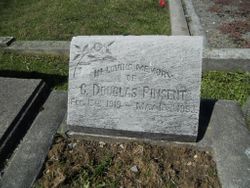
Charles Douglas Pinsent’s grave site at Anglican Cemetery, St. John’s, Newfoundland via findagrave.com.
Douglas Pinsent died in May 1953 and Mr. F. M. O’Leary, the “President of the St. John’s Memorial Stadium Council” said “If I may digress for a moment – mention of the old St. John’s Stadium Company brings to our mind one of the members who played a very prominent part in the early efforts to provide a Stadium for St. John’s. I refer to the late Douglas Pinsent and the present Stadium Council would like to record its very deep regret on his passing and pay a tribute to a very fine sportsman and public spirited citizen” in a radio address (Daily News: Saturday 23rd May 1953).
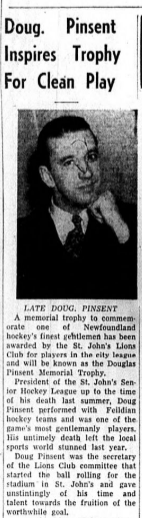
“Doug” Pinsent is commemorated with a trophy for clean play. Daily News, January 18, 1954.
The following year, the St. John’s Lion Club instituted an annual award or trophy, to the known as the “Douglas Pinsent Memorial Trophy.” It was to be awarded at the end of each season “to the player considered the most gentlemanly while being most valuable to his team”. The winner will be selected by a committee consisting of the coaches of city teams who will submit names to a trio of selectors – a member of the Lion’s Club, a member of the hockey executive and a member of the referees board” (Daily News 18th January 1954). The “Doug Pinsent, Memorial Trophy” was still being awarded in 1963 (Daily News: 31st May 1963).
Mrs. Douglas Pinsent and Mrs. Art Hamlyn, “the wives of former hockey stars who have departed,” were invited to attend the Ceremony that accompanied the opening of the 1955 hockey season in St. John’s new arena and Madeleine was asked to make the first drop of the puck. The match was (appropriately enough) between the “Feildians” and “St. Bon’s” teams (Daily News: dated 18th January 1955). John M. Tobin, another hockey stalwart in St. John’s died in 1956 and the Daily News (10th October 1956) noted that he, “along with the late Doug Pinsent, helped in no uncertain way to keep hockey alive in St. John’s when our arena was burnt down”.
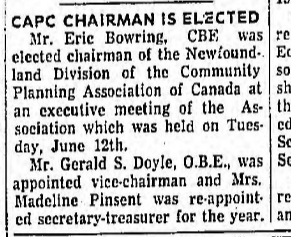
Madeline Pinsent is reappointed secretary-treasurer of the Community Planning Association of Canada. Daily News, June 15 1956.
Douglas and Madeline’s son, Kenneth Douglas Pinsent was born in April 1953, a matter of weeks before his father died. So, sadly, Kenneth, never got to know his father. Madeleine was left with a very young child to rear. She became “Secretary-Treasurer” of the “St. John’s Planning Association” and was called upon to present a report at its annual general meeting (Daily News: 31st May 1955). She was also “Secretary-Treasurer” of the “Community Planning Association of Canada” (Daily News: 15th June 1956) – which seems to have been a full-time job.
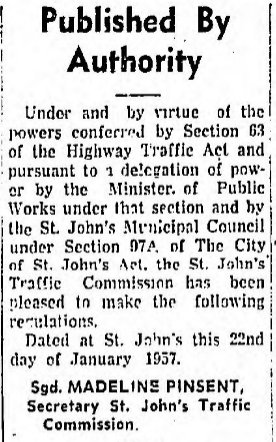
Secretary Madeline Pinsent’s byline appears in the newspaper. January 30, 1957.
The City was growing and Madeleine was responsible for notifying the public of changes in the regulations regarding traffic flow in St. John’s. The changes could be substantial and some of the notifications came with maps as well as explanations (Daily News: 24th August 1956). The changes may not always have been appreciated by motorist or pedestrian. However, they doubtless appreciated having the snow cleared (Daily News: 19th February 1959).
Madeline was an American by birth, however, her mother lived in Vernon in British Columbia and she moved there in 1959. Three years later, she moved down to Los Gatos, in California; where she worked for “IBM” for twenty-five years before retiring at the end of March 1987 (Correspondence with R. J. F. H. Pinsent).
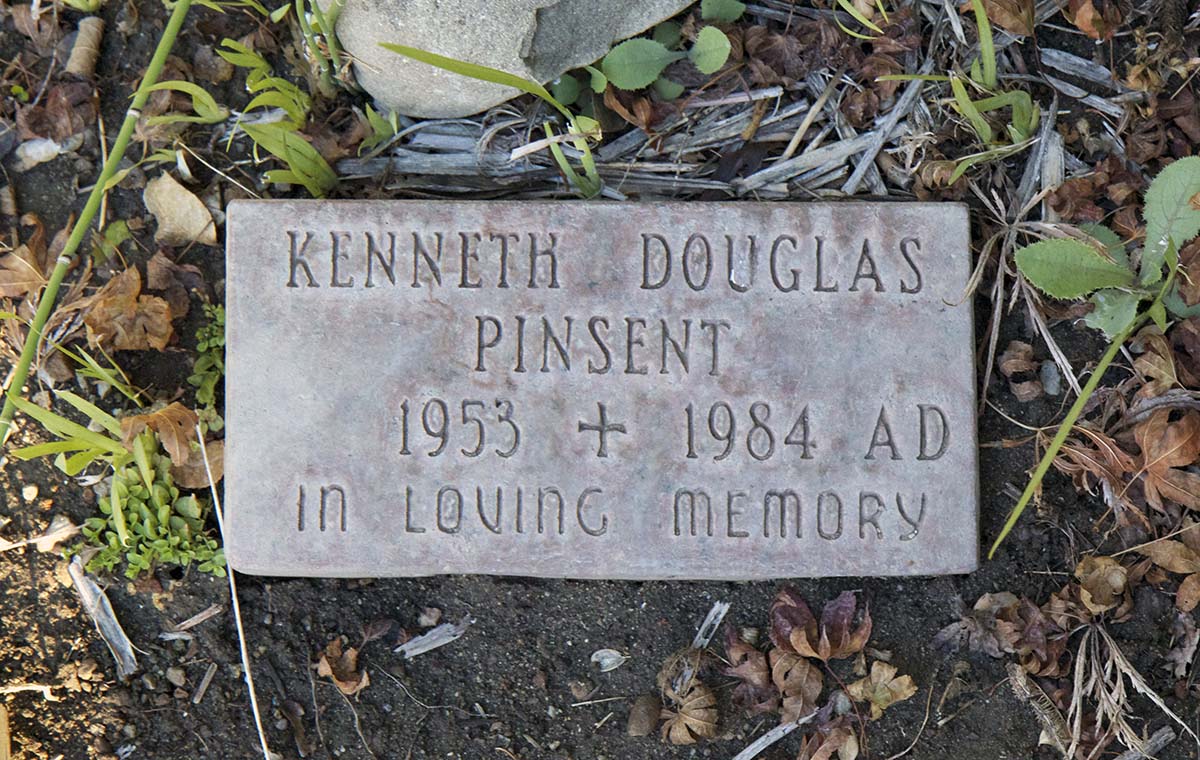
Kenneth Douglas Pinsent dies in 1984. Saint Luke’s Episcopal Church Columbarium, Los Gatos, Santa Clara County, California, USA. Findagrave.com
Her son Kenneth Douglas Pinsent was educated at “Los Gatos High School”, in Santa Clara, California (U.S. School Books: MyHeritage.com). He trained as a lawyer and both he and his wife to be appear to have been working for the firm of “Boston, Petrini & Conron” in 1982 (Bakersfield, California, City Directory: 1982). Kenneth married Wife (GRO1381) in May 1973. However, I am not aware of them having had children.
Kenneth was a junior partner when killed in a motorcycle accident two years later. He was 31 years old. Kenneth was buried at St. Luke’s Episcopal Church in Los Gatos.
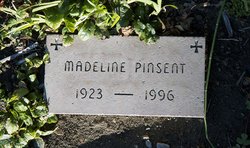
Madeline Pinsent dies in 1996. Saint Luke’s Episcopal Church Columbarium, Los Gatos, Santa Clara County, California, USA. Findagrave.com
According to Madeline, his widow (Julie) remarried in Missouri in 1987. However, she seems to have been back living in Bakersfield, California in 1991. Madeline died in Los Gatos in March 1996.
Please use the above links to explore this branch of the family tree. The default “Next” and “Previous” links below may lead to other unrelated branches.
Charles Burton Pynsent was the only son of Robert Burton Pynsent by his wife Mary Isobel (née Addie). He was born in London in 1907 and moved to Eastbourne, in Sussex, with his family in around 1910. After his parents divorced in 1916, he went to live with his mother in Datchet, in Buckinghamshire.
Charles was at school, in the care of the Rev. Trevor Hubert Edwards when the 1921 census was taken. He was a “boarder” at “St. Felix School”, in Southwold, Suffolk. He later attended “Courtenay Lodge School” in Sutton Courtenay in Berkshire and rowed in its coxed four at the local regatta in June 1924 (Reading Observer: Saturday 21st June 1924).
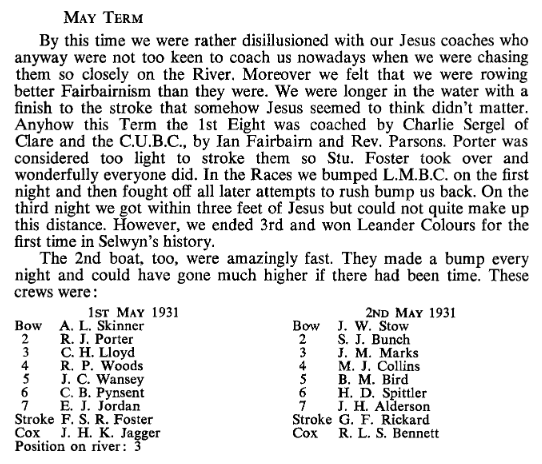
C. B. Pynsent is among the rowers on May 1, 1931.
From there, he went up to Cambridge. Charles Burton Pynsent attended Selywn College in Cambridge between 1929 and 1932 and graduated with a B.A (Cantab). While at Cambridge, he joined the College rowing club and, in his book “A Personal History of the Selwyn College Boat Club” Mr. A. P. McEldowney (www.sel.cam.ac.uk/history-selwyn-boat-club) describes his changing role. Charles was Honourary Secretary in 1929/30 and 2nd Captain in 1930/31. He rowed in the College VIII – as Stroke (immediately in front of the Cox) in 1929, as #2 (second from the back) in 1929/30 and as #6 in 1930/31. All in all, his career did not match that of Sir Matthew Pinsent in the 1990s and 2000s but it was, nevertheless, a commendable undertaking.
My father (Dr. Robert John Francis Homfray Pinsent) went up to Selywn College a few years later and I never thought to ask “why there?” My grandfather (Francis Wingfield Homfray Pinsent) was on friendly terms with Charles’s father, Robert Burton Pynsent – and it is quite possible that “Cousin Bob” recommended the college. I gather from a letter my father wrote to Robert Burton’s grandson – another Robert Burton Pynsent – (27th April 1964) that his grandfather had “helped him” while he was at University. Some of the help could have been financial.
Charles obtained a B.A. (Cantab) and set sail for Ceylon (Sri Lanka) on the P. & O. Steam Ship “Maloja” on 11th January 1933. From there, he must have taken a steamer to Karachi in present-day Pakistan, as he married Lorna Ruth Tasman Moss, at Lahore, in the Punjab (Bengal Presidency) in April 1933 (British India Office Ecclesiastical Returns: Findmypast.com). The marriage certificate says that he was then in “business”. What he was actually doing I do not know but the couple did not for long stay in India. They arrived back in London on “R.M.S. City of Marseilles”, on 3rd April 1934.
Charles and Lorna developed an interest in flying on their return, and we find that “Mr. C. B. Pynsent, of Lynwood House, Woodstock Road, Strood” was appointed secretary to the Rochester Flying Club when it was first formed in October 1936. He admitted that “he knew practically nothing about flying, but (said) he would work to the best of his ability to further the interests of the club and its members”. The club had the support of the Mayor and Council of Rochester and one of Britain’s of the major aircraft manufacturers – Short Bros, so there was considerable excitement in the air. … (Chatham, Rochester and Brompton Observer: 2nd October 1936).
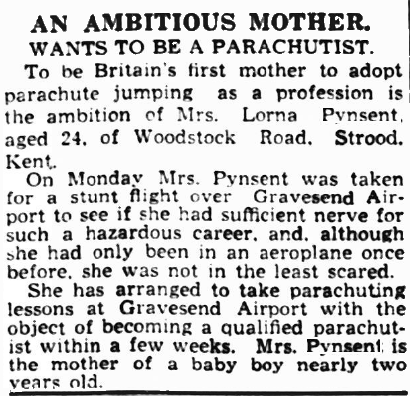
Lorna Pynsent’s sky-high adventures appear in the Belfast Telegraph, November 3, 1936.
Around then, Lorna decided to take parachute lessons at Gravesend Airport. She was 24 years old at the time and had a two-year-old boy. The papers tell us that she was not the least bit scared when she made her first drop, so I assume she achieved her goal of becoming qualifying as a parachutist (Belfast Telegraph: Tuesday 3rd November 1936)! According to my father (Robert John Francis Homfray Pinsent), her unnamed son “is thought to have gone out to Canada”. However, I know nothing about him and he is not included in the database.
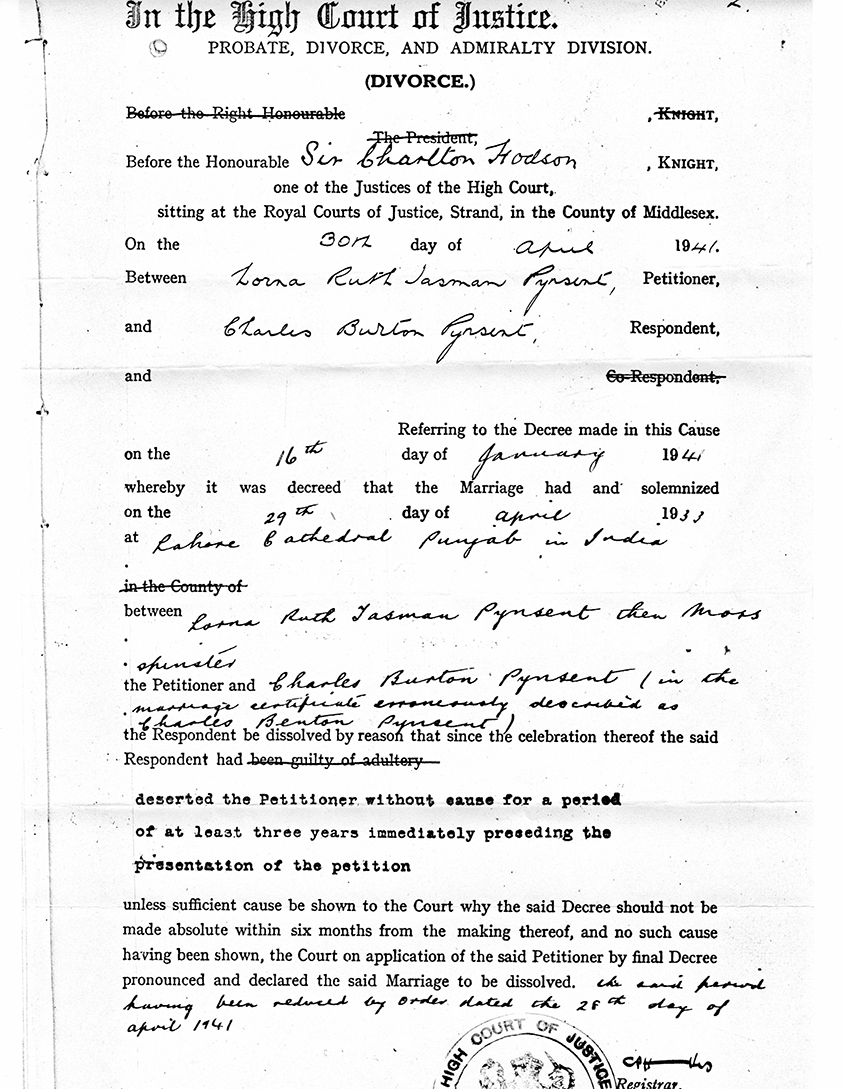
Charles and Lorna divorce in April 1941.
Charles was the Director of an Aero-hire Service and a “Special Constable in Croydon when the wartime Register was compiled in 1939. His wife was noticeable absent. She was a “Land Girl” living with a farmer near Maidstone, in Kent. Two years later, Lorna petitioned for a divorce from Charles on grounds of desertion – and it was granted in April 1941. My grandfather kept a copy of the document. Lorna married a Canadian “architect” and Captain in the Hamilton Light Infantry, John Turner Bell, in Aldershot, in Hampshire the following month. Their marriage documents tell us that Lorna came from a military family and her father was a structural Engineer who had retired from the Indian Service of Engineers. I assume she took her unnamed son out to Canada. Perhaps he changed his name to Bell.
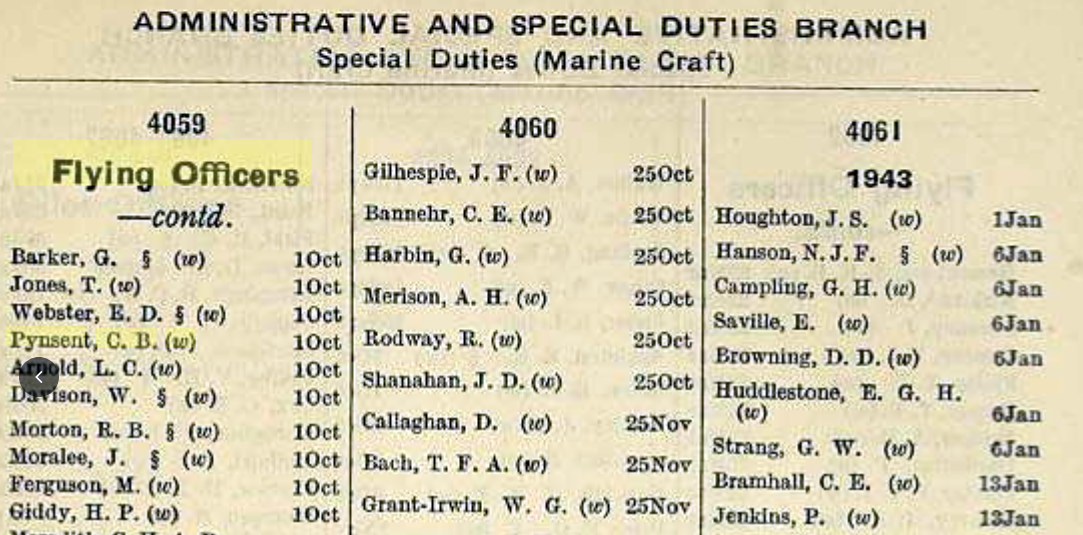
C. B. Pynsent appears as a Flying Officer in the Administrative and Special Duties Branch, 1943.
Charles, meanwhile, married Bessie Florence Hunt, a clerk working for the Ministry of Labour, at Windsor Registry Office, in July 1942. According to her son Robert Burton Pynsent’s obituary (The London Times: 8th April 2023), she was the “graphic designer” who later created the original wrappers for the “Mars Bar”,“Poppets” and “Maltesers” chocolate confections. At the time of their wedding, Charles was described as being both a “Company Director” and a “Pilot Officer” in the Royal Air Force. Charles Burton had joined the Royal Air Force Volunteer Reserve as an “Acting Pilot Officer” (on probation) in August 1941 and been promoted to “Pilot Officer” in October that year. He advanced to “Flight Officer” (on probation) in October 1942 (British Army, Navy & Air Force Records: 1921 – 2000) and stayed on as a “Flight Officer” until he relinquished his commission “on account of medical unfitness for Air Force Service” in December 1945. He was allowed to retain his rank (London Gazette: 11th January 1946). Robert Burton’s obituary adds that he worked for the Royal Air Force Air Sea Rescue Service.
Charles and Bessie had two sons in the 1940s: the first was born at Milliken Park, in Renfrewshire, while Charles was serving in Scotland in 1943, and the second came while he was based in Caterham, in Surrey, in 1945. The family stayed on in Caterham until at least 1959 (British Telephone Books). However, they had moved to Speldhurst, near Tonbridge Wells, in Kent, by 1964. Charles Burton died in Croydon the following year.
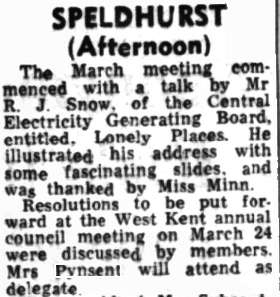
Bessie Pynsent appears in the Kent & Sussex Courier, March 21, 1975.
Charles’s widow, Bessie stayed on in Speldhurst and she was a stalwart member of its Women’s Institute (Kent and Sussex Courier: 21st March 1975) until shortly before she died in 1996. Suffice it to say that her eldest son, Robert Burton Pynsent, became a well-known “Professor of Slavic Studies” and her second became an equally well-known “Director of Orthopedic Training” in Birmingham. Both co-authored, edited and wrote numerous articles in their respective fields. Sadly, Robert Burton died in December 2022. His life is described elsewhere.
Please use the above links to explore this branch of the family tree. The default “Next” and “Previous” links below may lead to other unrelated branches.
Charles Augustus Maxwell Pinsent was the eldest surviving son of a “barrister” in Newfoundland, Robert John Pinsent. He came from Robert John’s marriage to Anna Brown, née Cooke. Their family consisted of three girls and five boys but, sadly, only the eldest girl, Lucretia Maude and two of the boys, Charles Augustus and Arthur Newman outlived their father.
Charles’s mother was the daughter of a “merchant” with strong links to Portugal. In 1864, she had taken a trip to England to visit the English side of her husband’s family. She had taken two of her daughters (Lucretia (7) and Catherine (6)) and her four-month-old “baby,” William. However, her son, Hedley (2) had been left at home with his father. Anna kept a diary while in England. In it, she seems to show that she missed her husband and her life in St. John’s: “July 26th: Tomorrow will be dear R’s birthday and we must drink his health in a little of the old Port… “. Unfortunately their relationship did not last. Robert and Anna had two more sons after she returned (Charles and Arthur), but their relationship seems to have come to an end shortly after Arthur was born.
Robert John Pinsent filed for divorce in “Her Majesty’s Court for Divorce and Matrimonial Matters” in London in 1869, claiming that his wife had left him in St. John’s and moved to England – where she was nominally looking after their children who were at school in Bristol. While there, she had (or, more likely, she continued) an affair with Charles Mesham, a married Newfoundlander.
The 1871 Census tells us that Anna’s son Robert Hedley Vicars Pinsent (or “Hedley” as he was known) was at “Ebernezer House School” and her daughters, Lucretia Anna Maude and Catherine Louisa Pinsent, were living with and were being schooled by the Keddle sisters in Westbury on Trym. The Keddles were family relations. The case wound its way through the Court and adultery was eventually proved. In January 1870 the divorce was finalized (National Archives (J77/84 File 796) and Mr. Mesham paid £3,000 in damages for his involvement. However, he was out the picture by then – perhaps he had gone back to his wife and family – so Anna married John Lee Statham in April.
Anna and Robert John negotiated an out of court financial settlement and Robert took control of the children. They were still young and the settlement took some time to implement. Family papers, now in the Newfoundland Archives, show that in 1884 Robert John gifted his country house, “Woodlands” at Salmonier, and most of his property in St. John’s, including (in part) his house called “Hillsboro,” to his eldest son, Charles Augustus Maxwell. He did so in exchange for a release from an obligation to keep his life insured for $3,000.00.
“Hedley,” meanwhile, died and Robert John’s second son, Arthur Newman Pinsent sold his interest in the family’s estate to his older brother Charles and received $1,860.00 in cash. He was later to leave St. John’s and head west into Canada, where he ended up in Saskatchewan. His life is discussed elsewhere.
Robert John Pinsent married Emily Hetty Sabine Homfray in Froxfield in Wiltshire in April 1872. Why they married in Froxfield and not Emily’s home church in Bintry (a.k.a “Bintree”) in Norfolk (where her father was the Vicar) is unclear. Perhaps divorce came with a stigma back then and it was strategically better to marry elsewhere. The couple soon started a second family that was to be made up of four daughters and three sons. Sadly only two of each sex outlived their father. Their lives are also discussed elsewhere.
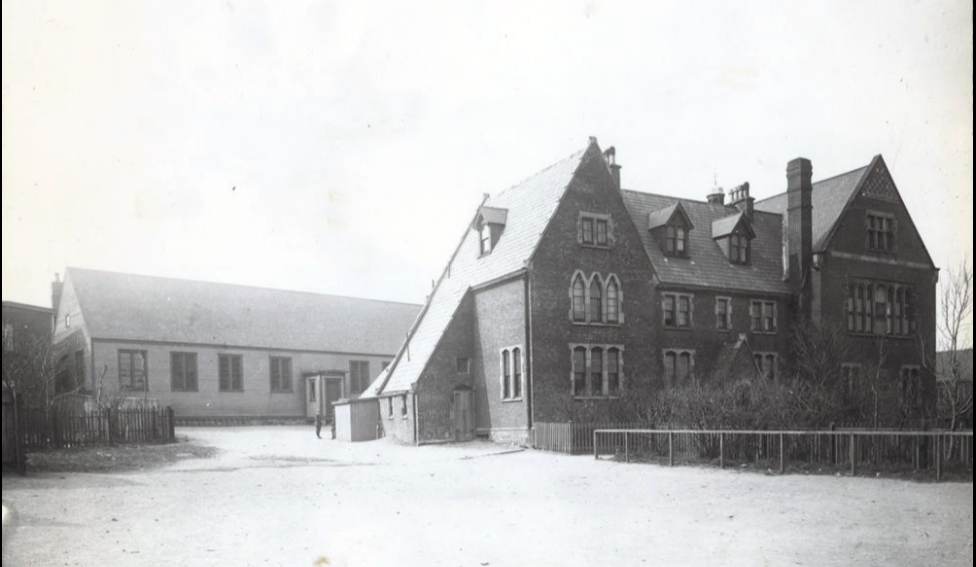
Bishop Feilds School, St. John’s.
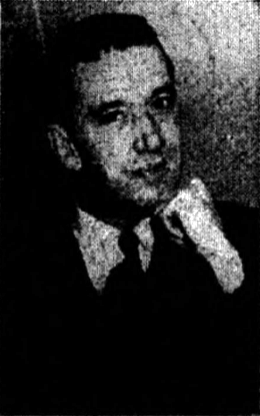
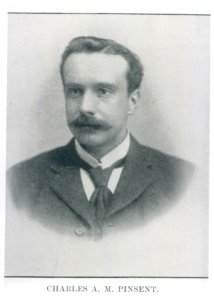
Back to Charles, who would have been six years old when his father married for the second time. There is a short biography of Mr. Charles Augustus Maxwell Pinsent in a book entitled “Newfoundland Men: Biographical Sketches” edited by Henry Youmans Mott, in 1894. It includes the portrait photograph above. It tells us that Charles was educated at the Church of England Academy (later known as “Bishop Feilds School”) – the premier Anglican “public” (i.e. “private”) school in St. John’s – and the Methodist Academy in St. John’s, Newfoundland, and also at a Norfolk County School in England. Most of the schooling in Newfoundland in those days was based around religious denominations. The Norfolk school was, presumably, near his step-mother’s home at Bintry.
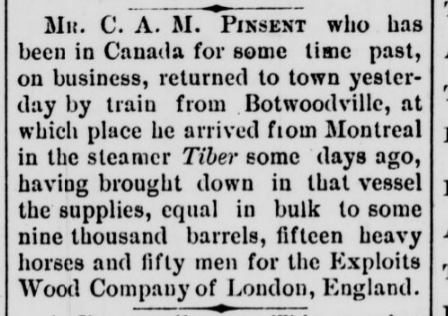
C.A.M. returns from Montreal as part of his work with Exploits Wood Company of London, England. Evening Telegram, October 14, 1893.
Charles was, presumably, taken on as a “clerk” by one of his father’s mercantile friends in St. John’s when he left school. We hear little about him for a few years – until he comes to the fore again in his early twenties.
The “Sketch” alluded to above shows that he worked for “C. H. Bennett and Co., of St. John’s,” for a few years before branching out and becoming the Newfoundland representative of “Exploits Wood Co. of London.” He was later to become an agent of “Underwriting and Agency Associates of London” and manager of “Sun Life Assurance Co. of Canada”. Charles was also the “Vice Consul for Portugal” for several years [almost certainly a result of his mother’s family’s mercantile interests – RHP].
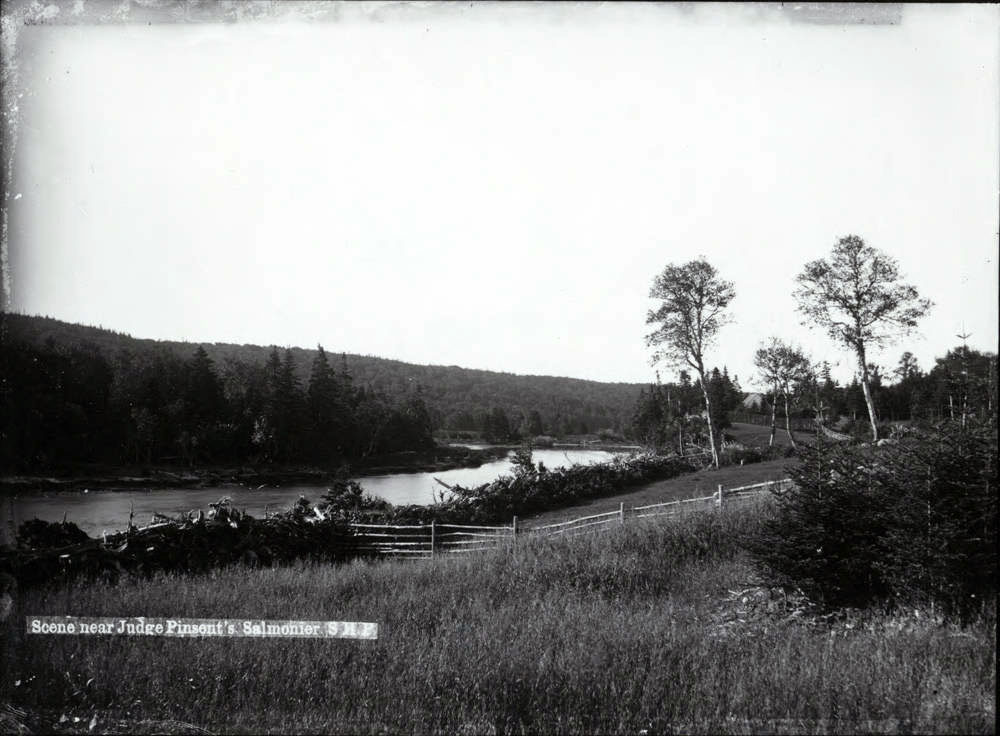
Robert John and his second wife Emily Pinsent lived at “Hillsboro’” in St. John’s while he was growing up and they owned a strategically placed country cottage called “Woodlands” on the Salmonier River near Holyrood. Robert and his family loved to hunt and fish and the family spent as much of its time as possible at “Woodlands” (a.k.a “Salmonier”). In fact, Charles and his brothers (presumably Hedley and Frank) are reputed to have cut the first trail from the main road to “Pinsent’s Falls” – which was one of the best salmon fishing-spots on the Salmonier River.
Charles had a predilection for hunting: “Mr. Charles Pinsent has just returned from Salmonier where, in company with a guide, he spent three days in the woods – camping out in the tilts being attended with beautiful weather. They saw two stags, a doe and a fawn. They wounded the two stags both mortally but one escaped. The head of the animal secured is massive with antlers of good size for the season” (Evening Telegram: 24th March 1885). A “tilt” is an angled roof built on site for protection from the weather. Charles was out hunting again the following Christmas: “We are informed that Mr. C. Pinsent, junr., who spent Christmas Day at Woodlands, Salmonier, visited the deer marshes next day and, with his accustomed luck returned with two deer. This young sportsman has brought to town four deer within the year, having been fortunate on every occasion he has visited the Salmonier parks” (Evening Telegram: 29th December 1885).
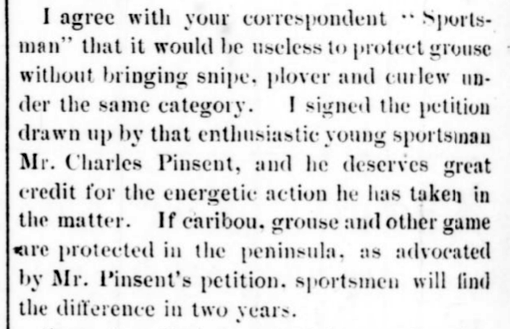
A letter to the editor referencing C.A.M. Evening Telegram, March 11, 1886.
Charles was hardly an environmentalist, but he circulated a petition calling for better controls on hunting on the Avalon Peninsula and it received some interest in the press: Mr. Langrishe Mare wrote: “I signed the petition drawn up by that enthusiastic young sportsman Mr. Charles Pinsent, and he deserves great credit for the energetic action he has taken in the matter” (Evening Telegram: 11th March 1886). Many people must have agreed with him but not everybody was convinced: “It is the voice of every sportsman that signed Mr. Pinsent’s petition, “give us the same law as last year, all shooting to begin 1st September” (Evening Telegram: 16th April 1886).
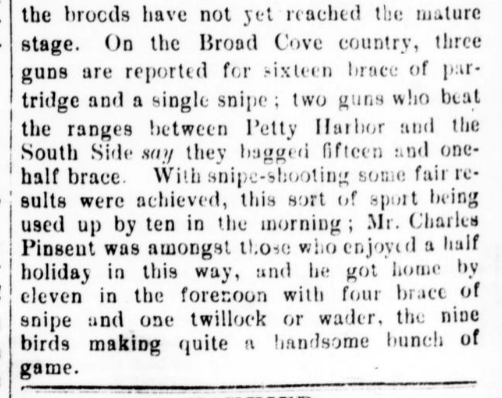
Report on the local hunting scene. Evening Telegram, September 16, 1887.
The following year, the country correspondent at the Evening Telegram breathlessly reported that “Mr. Charles Pinsent was amongst those who enjoyed a half holiday in this way, and he got home by eleven in the forenoon with four brace of snipe and one twillock or wader, the nine birds making a quite a handsome bunch of game” (Evening Telegram: 16th September 1887). Yes, in Newfoundland “twillock” does refer to a wading bird. It is not a derogatory term as it once was in English English! Who can complain if “Mr. C. A. M. Pinsent opened the shooting season with a good bag of birds, He shot fifteen snipe and a bittern before breakfast” (Evening Telegram: 16th September 1889).
To give credit where it was due, “Mr. C. A. M. Pinsent tells us that his nine-year-old sister, Miss Trixie Pinsent, paying her first visit to the Falls of Salmonier River, on Wednesday last, and making the first cast there for the season, booked, and succeeded in landing, two grilse at the same time” (Evening Telegram: 25th June 1892). This also impressed her mother, Lady Pinsent (as she then was) and she published an article in an unspecified Quebec newspaper in May 1893. I have a clipping she made of the item. Evidently Trixie was fishing for trout and caught the first on a “silver doctor” and the other on a “small trout fly”. A grilse (while we are at it) is an Atlantic salmon that has only had one year at sea.
When he was not out in the Newfoundland bush, Charles was, presumably working in St. John’s; however his work-life is not so well documented. He had a social life as well, of course. In January 1886, and again in February 1887, he served on the Committee that put on a “Charity Ball” on behalf or the Ladies of the St. Vincent de Paul Society (Evening Telegram: 23rd January 1886; 5th February 1887). Nevertheless, Charles did not marry until 1897.
Charles’s father, Robert John Pinsent, was appointed to the Supreme Court of Newfoundland in April 1880 and he spent several years dispensing justice “on circuit” around the Island’s out-ports. It gave him a unique perspective on the issues facing the Colony and he was well-placed to raise these issues in St. John’s. He also spent a considerable amount of time in England, where he also tried to and have them understood and addressed by the Mother Parliament. Queen Victoria honoured him with a Knighthood in 1890. For practical reasons, it probably made little sense to keep both his city residence and his country “cottage” open all the time – when one or other would do so they were not infrequently advertised for let. Lady Pinsent was quite happy to live at “Woodlands.”
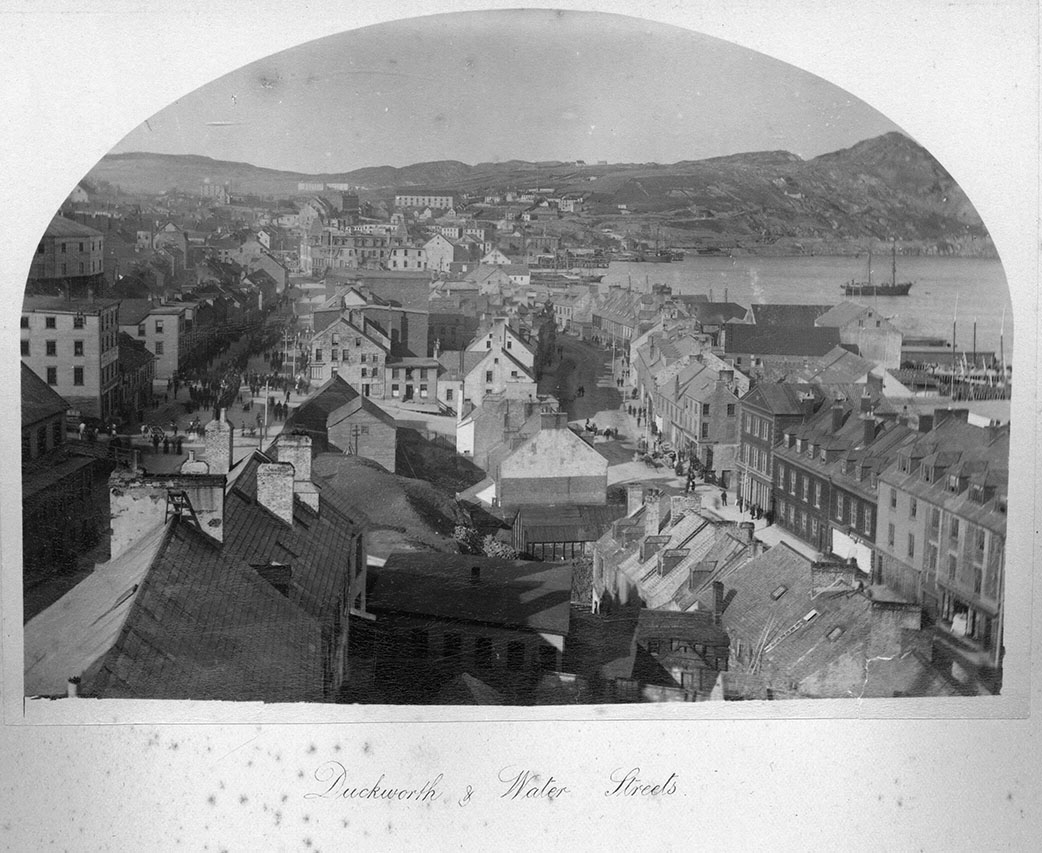
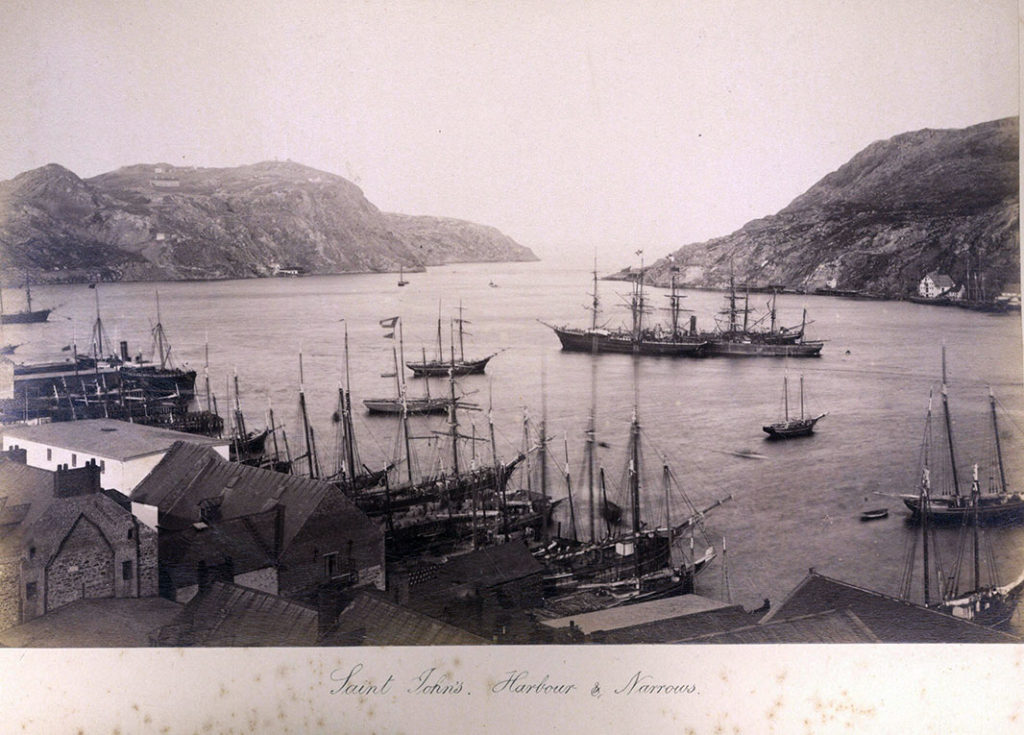
Photograph of Duckworth and Water Streets in St. John’s, circa 1880s.
In April 1888, Charles advertised “Hillsboro’; having Conservatory and flowers, hot and cold water, and garden and stabling, with man-servant’s house, if required.” as available to let for the summer months (Evening Telegram: 30th April 1888). He did so again the following year: “TO BE LET, For the summer months of this year, or for a term, fully furnished, hot and cold water, gas and all other conveniences, HILLSBORO, King’s Bridge Road, commanding views of Signal Hill and Quidi Vidi Lake, with fine garden, stables, coach and manservants house attached, conservatory, &c” (Evening Telegram: 29th April 1889). It was the same story in 1890 (Evening Telegram: 12th May 1890) and 1892 (Evening Telegram: 15th June 1892). It was clearly more than a “cottage.” The latter year Charles also advertised a number of building lots in St. John’s for lease for 99 years. Whether it was family property – or he was just acting as agent for the owner, I do not know (Evening Telegram: 30th September 1892). It is clear that by the mid-1880s Charles was essentially in charge of much of the family business. A good deal of the property belonged to him anyway.
Life in the Pinsent family changed radically in 1893. Sir Robert and Lady Pinsent took a leave of absence and went to England where their younger children were still at school. While there, they took a trip out to Italy to see Sir Robert’s eldest daughter by his first wife, Lucretia Maude Pinsent – who was (as discussed elsewhere) – the Lady Abbess of a Benedictine convent in Rome. Sir Robert and Lady Pinsent returned to London in April and Lady Pinsent traveled back to her family in Bintry, in Norfolk.
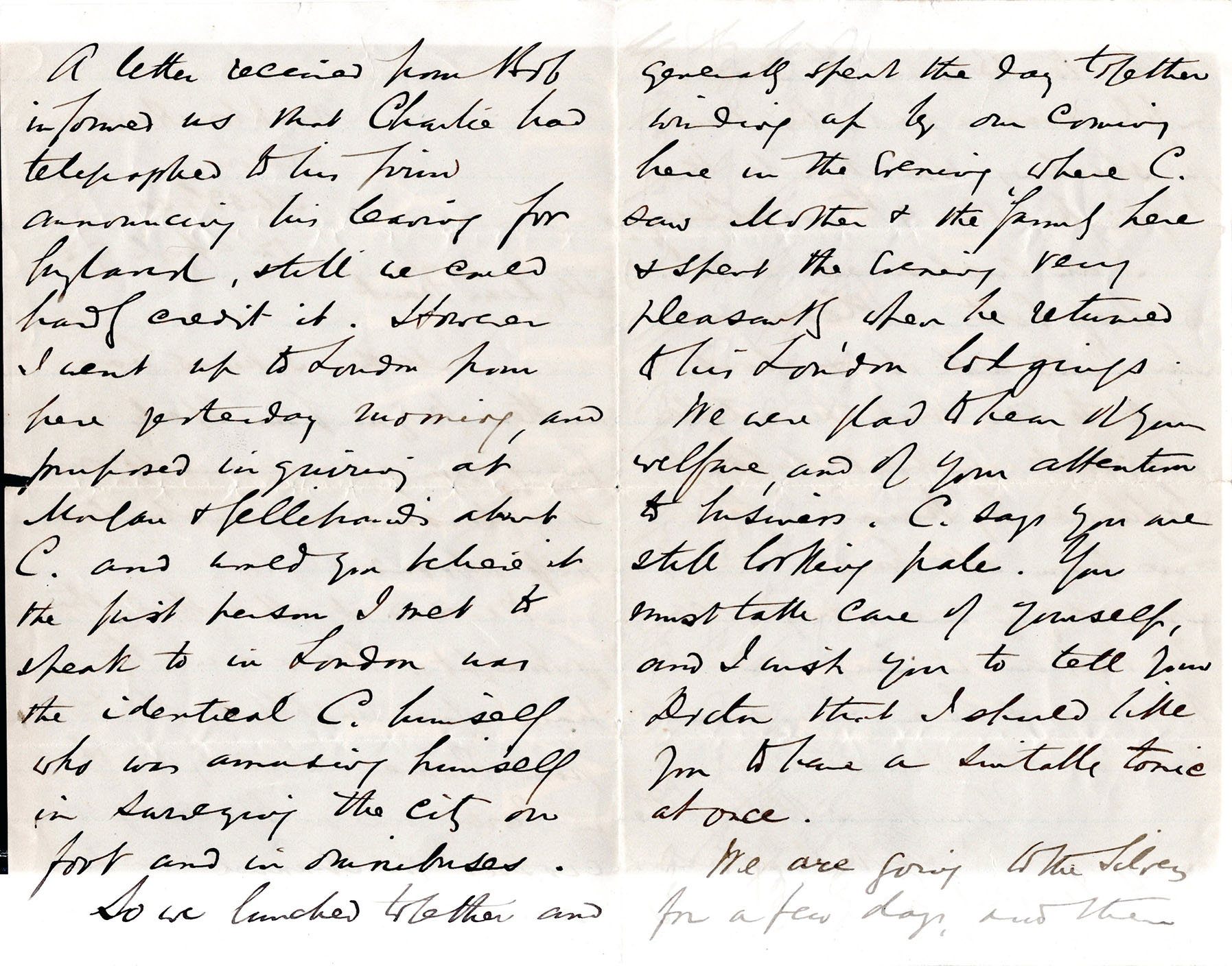
Excerpt from a letter written by Sir Robert to his son Francis, April 12, 1893.
Sir Robert stayed on in London to conduct business. For one thing, he wanted to ship some trees out to Newfoundland to plant at “Woodlands.” In a letter he wrote to his son Francis he asked him to handle the shipment when it arrived. Evidently, he had arranged for Charles to do this – but he had turned up unexpectedly in London! “A letter received from Rob. Informed us that Charlie has telegraphed to his firm announcing his leaving for England, still we could hardly credit it. However, I went up to London from here yesterday morning, and proposed inquiring at Morgan & Jellinghams about C. and would you believe it the first person I met to speak to in London was the identical C. himself, who was amusing himself in surveying the city on foot and in omnibuses”. Charles had left St. John’s, bound for Halifax and then London on 28th March (Evening Telegram: 28th March 1893).
Perhaps it was fortuitous that he was there as Sir Robert took sick with pneumonia shortly after and he went up to Bintry. His daughter Mabel (the Lady Abbesses’ half-sister) wrote to Lucretia in Rome on 20th April saying: “You will be most sorry to hear dear father is very poorly today. Mr. Dashwood has been to see him. He says he has had a relapse but not in any danger. Dear mother is pretty well. We are having most lovely weather now, so I hope father will soon be stronger”. Lady Pinsent added a postscript: “Your dear father is a little better today but he is very weak. We are dong our best for him and the doctor says there is no danger. Poor darling, he has got so thin”. Sadly, the doctor was wrong. Sir Robert died on 27th April 1893. He was buried at Bintry.
The loss of a Judge of the Supreme Court caused quite a stir in Newfoundland and Charles, who was Sir Robert’s eldest son and the executor of his will returned to Newfoundland on the Allan Line’s S.S. “Corean,” which left Liverpool on 9th May 1893 (Passenger Transcripts: Findmypast). Lady Pinsent and her daughter Mabel and her younger children (Guy and Trixie) stayed on in England. There was plenty to be done in Newfoundland, particularly given the existence of his two families.
The legal processes got underway in June with the usual call for creditors to make themselves known to his son, the executor (Charles A. M. Pinsent, of St. John’s, Commission Merchant), “PURSUANT TO THE PROVISIONS OF the Act passed in the forty-first year of the of her present Majesty, entitled “The Trustees’ Act, 1878,” (Evening Telegram 7th June 1893). It was a busy time. In the same issue, Charles advertised “Salmonier: For Sale, or to Let for the season, or for a longer period, in good order and entirely furnished, that well-known property (through which the Salmonier River passes), “Woodlands,” Salmonier, belonging to the estate of the late Sir Robert Pinsent and also, if required, horse, carriage, cow and other requisites which are on the premises.” The presence of a cow is interesting! Whether the property was actually meant for “sale”, I doubt. Charles loved the place and Lady Pinsent and his brothers may well have had a retained interest in it.
Charles seems to have conducted other business that same day: He was the sole executor of Catherine Wrey of Twillingate and he had her will to probate as well as his father’s – and he had to arrange for her property to be let out (Evening Telegram: 7th June 1893). Perhaps she had died while he was abroad.
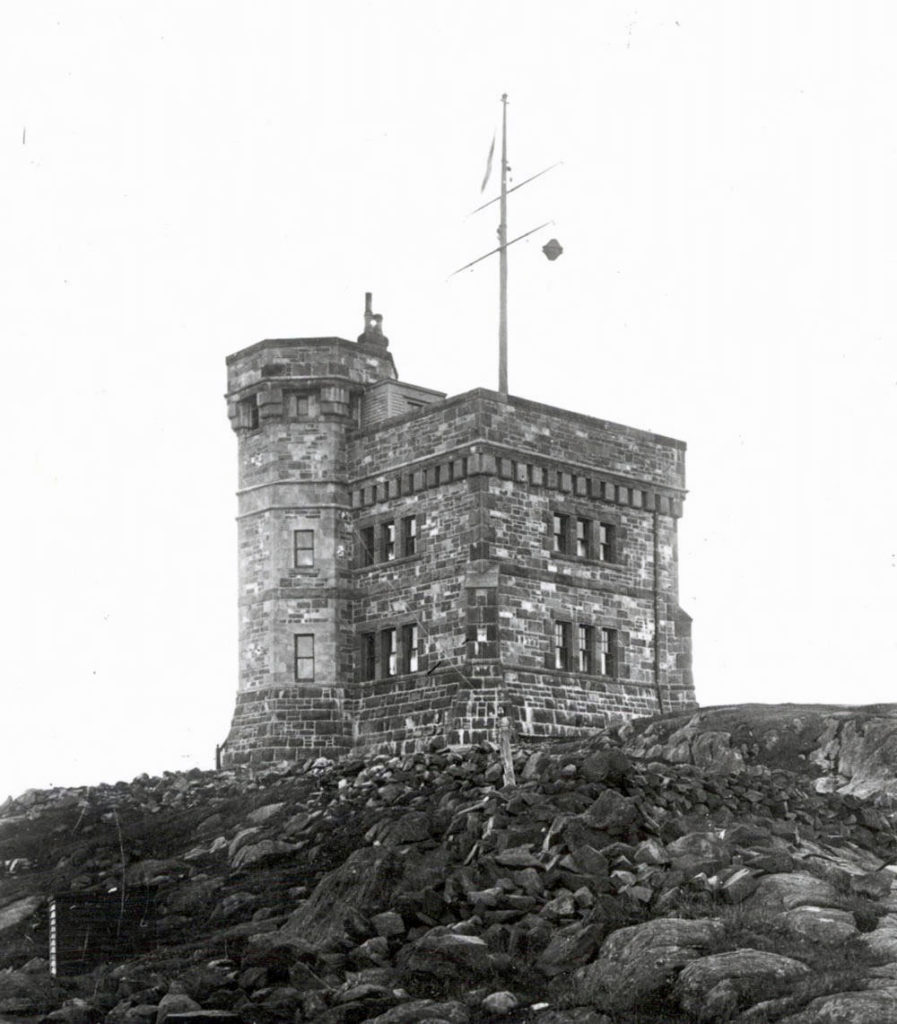
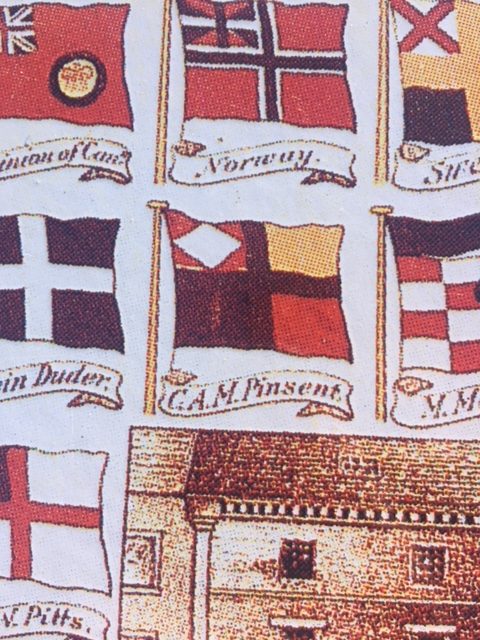
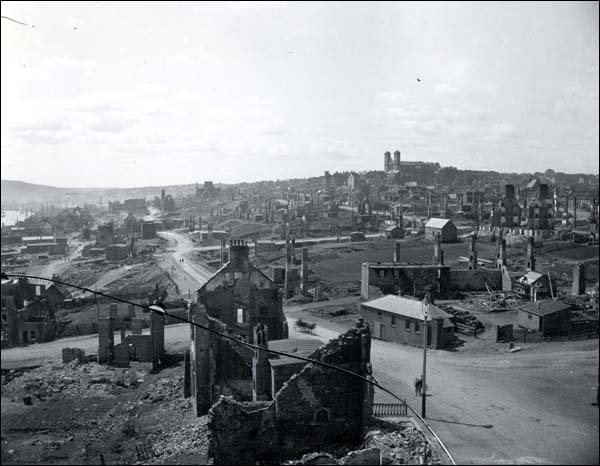
Interestingly, Charles may have inherited a residual interest in his grandfather Robert John Pinsent’s old shipping business as his name is (or was) attached to one of the Merchant House flags on display in the Cabot Tower on Signal Hill in the 1980s. There had been a disastrous fire in July 1892 that had destroyed most of down-town St. John’s and Charles was well placed to benefit from the rebuild – which inevitable required the importation of goods from England, the United States and Canada.
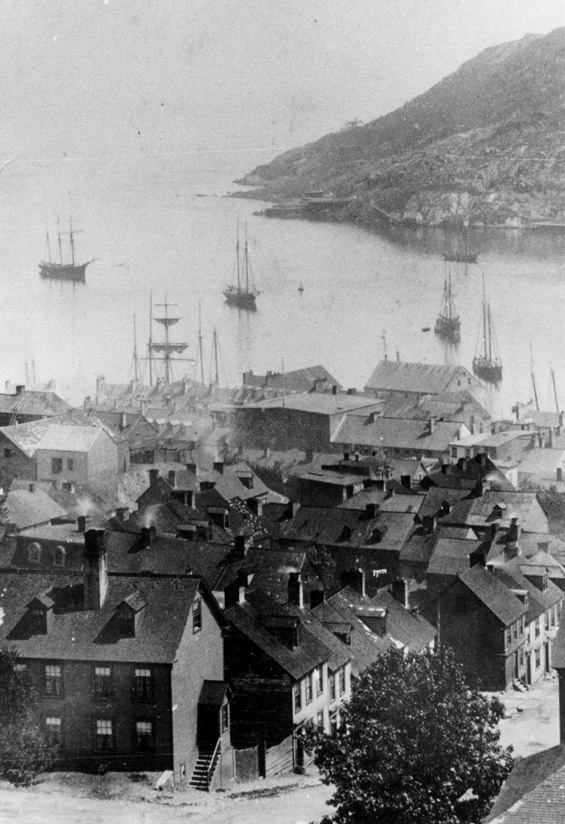
St. John’s after the fire, 1892
Charles had not only taken leave from the company he worked for prior to going to England in 1893, but he seems to have quit the firm – intending to work for himself. On the same day in June proudly announced: “Notice by the undersigned, is hereby given that he has been appointed Agent for the Exploits Wood Co., Ltd. of London, England in place of Messrs. Goodday, Benson and Co., of Quebec, who have resigned: Charles A. M. Pinsent” (Evening Telegram: 7th June 1893). The lumber needed to rebuild the town started to arrive from Montreal at the end of May (Evening Telegram: 29th May 1893) and it kept on coming in the ensuing months. For instance: “Lumber from Quebec: The Marie Vigilante, 14 days from Quebec, lumber laden, is consigned to Mr. C. A. M. Pinsent” (Evening Telegram: 29th May 1893) and “LUMBER FOR Sale: A cargo, whole or part of 2 and 3 inch pine lumber now landed at A. M. McKay’s Wharf, per schr. “Hyacinth” for particulars apply to C. A. M. Pinsent”(Evening Telegram: 1st September 1893).
Business was looking up and Charles took a trip to Montreal to report in and negotiate contracts that autumn. He left St. John’s for Halifax on 24th August on the S.S. “Carthaginian” (Evening Telegram: 24th August 1893) and, from there he headed up to Montreal. Clearly he was there to drum up business and he was not above using his father’s name to his advantage. He arranged an interview with the Montreal Gazette that was was reprinted in the St. John’s Evening Herald on 22nd September 1894. In it, he claimed that he was a proud Newfoundlander and anti-Confederation-ist. Among much else he said: “I am not an active politician … (and) … although my father took quite a prominent part in the political affairs of Newfoundland for many years. However, I have a deep interest in the political and commercial welfare of the colony and with such as the Hon. Mr. Goodridge, Hon. Mr. Monroe, Hon. A. R. Morine and Hon. W. B. Grieve steering the ship of state Newfoundland must be prosperous and the hour of confederation put back for several years”. Evidently, he felt that, given its fishing industry, its mines and forests Newfoundland would be well able to look after itself – at least in the short term. He was in Montreal, he said, “purchasing supplied for the men in the camps of the Exploits Wood Co., of London, England, and have already purchased here 7,000 barrels of pork, flour, and peas. Botwoodville, Nfld, had the largest lumbering mill in the colony, and exports three inch pine deal to Liverpool, London, Glasgow and Hull. It is managed by Morgan Gillibrand & Co. of London, Eng., and is a most valuable property. And all races and creeds live together in harmony.”
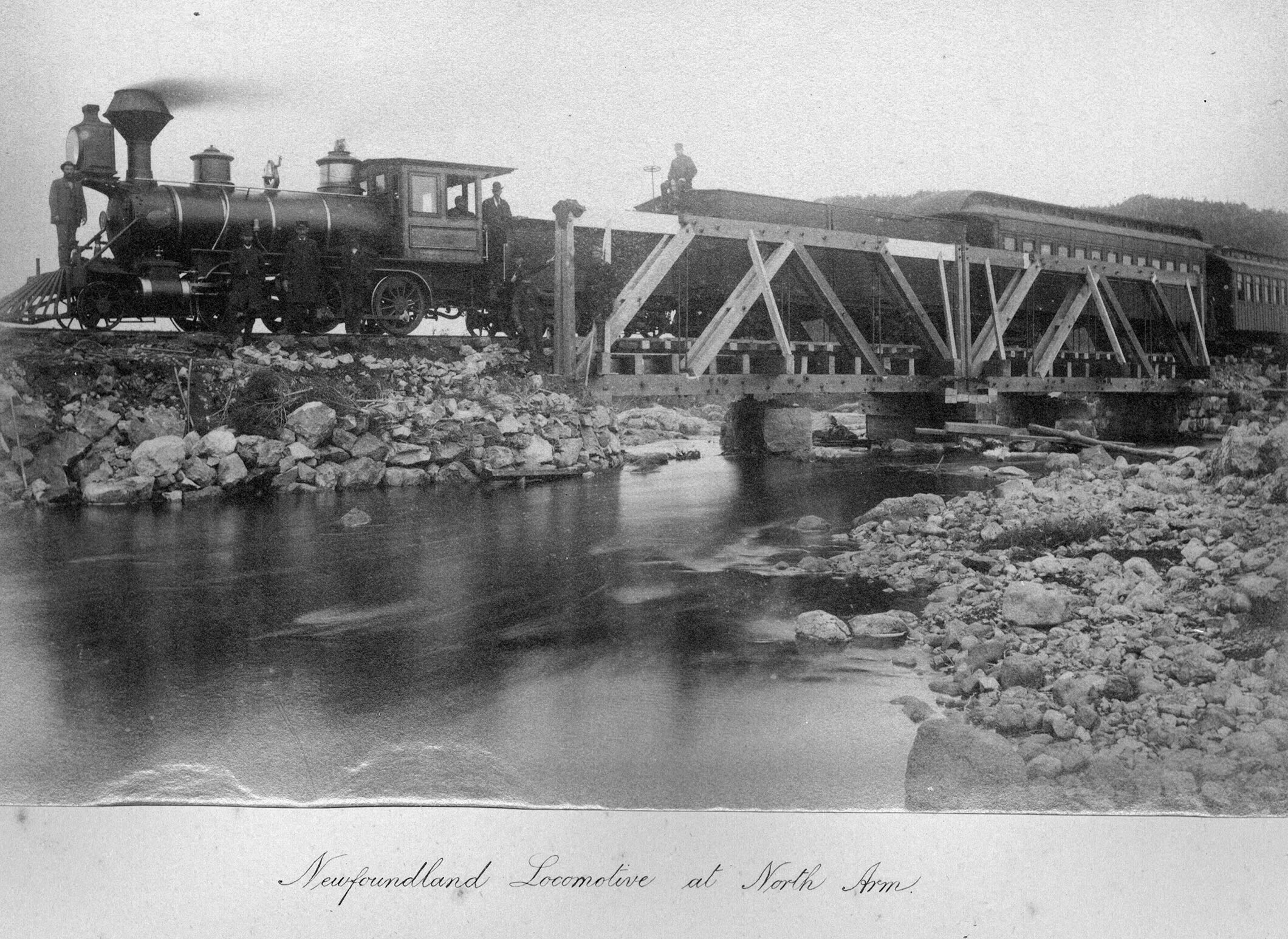
Charles went on to Ottawa and returned to Newfoundland on the S.S. “Tiber” in October with “supplies, equal in bulk to some nine thousand barrels, fifteen heavy horses and fifty men for the Exploits Wood Company of London, England” (Evening Telegram: 14th October 1893). The Company was clearly actively exploring and logging in the Colony. This may be around the time that Charles’s half-brother, Robert John Ferrier Homfray Pinsent made his ill-advised venture into the logging business in Newfoundland (“In the Pinewoods of Newfoundland:” (Undated article in “The Field Magazine:” see: elsewhere).
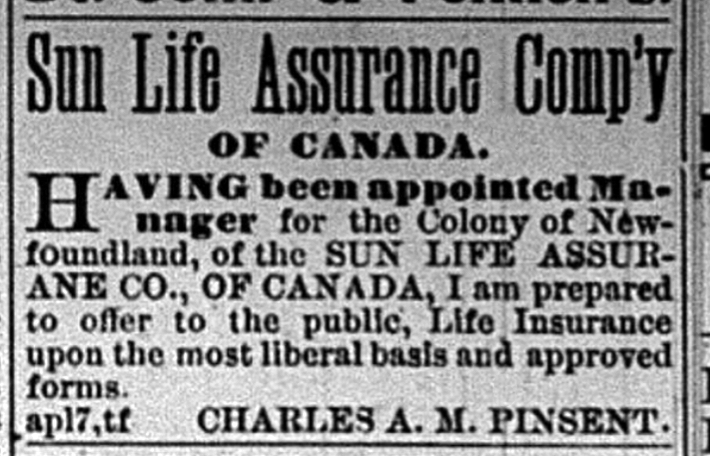
Newspaper clipping advertising C.A.M.’s hiring with Sun Life Assurance Company via the Evening Herald, April 7, 1894.
Business was looking good for Charles and he was appointed “Vice Consul for Portugal” (Evening Telegram: 28th February 1894) and manager of the “Sun Life Assurance Company of Canada” in the Colony in April (Evening Telegram: 7th April 1894). He proudly announced that: “I am prepared to offer to the public Life Insurance upon the most liberal basis and approved forms” and the paper remarked: “We congratulate Mr. Pinsent upon the appointment and feel sure the company will profit by such a representative.” Charles’s maternal grandfather John Richard McGuire Cooke was a merchant with Portuguese trading interests. He also seems to have brokered land sale transactions as well: “For Sale or to Let: That valuable piece of Fee Simple property situate almost immediately opposite the C. E. Orphanage, Military road, for particulars apply to C. A. M. Pinsent of Frank D. Lilly, Solicitor “ (Evening Telegram: 14th April 1894).
This is not to say that Charles did not still enjoy country pursuits, as the Evening Telegram tells us (14th February 1894) “Mr. Charles A. M. Pinsent left by this morning’s train for Woodlands, Salmonier, where he intends spending a couple of days, being the last of the season, on the deer grounds, within the peninsula of Avalon.” He even purchased a race-horse “… a good blood 2.40 pacer by the S.S. “Tiber.” It is a dandy; see it” (Evening Telegram: 26th February 1894).
Charles may have regretted having given such a public interview in Montreal. The fishery failed that year and in December two of Newfoundland’s three banks crashed – which totally destroyed the colonial economy. The fishery had, for generations, been run on the “truck” system whereby out-port merchants provided the materiel needed by the fishermen at the start of the season and received payment when the season ended. They then supplied materiel for the seal “fishery” and received payment when it was over. It was a precarious system that was untenable when the fishery failed. It did not help that many of the St. John’s merchants who ran the banks abused their position and that the Colony was on the hook for the construction of the Newfoundland Railway. There was a run on the banks and the “Commercial Bank” collapsed on 8th December 1894. This caused a run on the other banks and the “Union Bank” went down a short time later.
Embarrassingly, Charles’s uncle Charles Speare Pinsent was the manager of the “Union Bank” (see elsewhere) and his name was on the currency – which was now pretty well (o.k. not quite) worthless! The Colonial Government took a look at the finances and behaviour of the Bank’s “Board of Directors” and charged them with misrepresenting its finances. Charles Speare was also charged; however, he turned states-evidence and testified for the prosecution when the trial began in the fall of 1895. His evidence was not particularly damning and no major convictions were made. It took considerable assistance from Canadian Banks to rebuild the Newfoundland Economy.
In the meantime, there was the fall-out to deal with. Many Companies either left the Colony or collapsed completely. “NOTICE: ALL persons having accounts against the Exploits Wood Co. Ltd. of London, will please hand the same in at the office of the undersigned at once, where due payment will be made. CHARLES A. M. PINSENT, Agent” (Evening Telegram: 2nd February 1895).
Charles was, of course, still the Newfoundland agent for the “Sun Life Assurance Company of Canada”, which, reacted by providing a grace period for receipt of this payments (Evening Herald: Saturday 19th January 1895). It survived the crash, and now (and frequently thereafter) announced that it “Having been favoured with a large share of Life Assurance by the public last year, I would now remind them that the same most LIBERAL Policies are issued by the above Company. Information in connection with kinds and conditions of Policies can be had at the office of CHARLES A. M. PINSENT” (Evening Telegram: 24th May 1895).
Other Insurance companies also recognized an opportunity and one, the “Northern Fire Insurance Company, of London, England” hired Charles and offered the ”Lowest current rates of Premiums. Risks taken upon all sorts of Insurable Property, and valid losses promptly settled with liberality without reference to Home Office: Charles A. M. Pinsent, Agent for Newfoundland” (Evening Telegram: 18th May 1895). Presumably there was no conflict of interest between the two.
Charles still had “Woodlands”, although even it was advertised for “Sale or Let” for the summer months “furnished and with all conveniences and in perfect order, “Woodlands” Salmonier, the residence of the late Hon. Mr. Justice Sir Robert J. Pinsent. Fine salmon and trout fishing close at hand; also deer, partridge, snip and rabbit shooting” (Evening Telegram: 18th May 1895). He lived in St. John’s but I suspect he would have been loathe to see “Woodlands” go as he was now able to travel by rail from St. John’s to Holyrood – the nearest railway station – and back to town fairly easily. The train was still a bit of a novelty and the papers published the names of select people as they came and went: “Returned by Train: —Then returned by evening train: Archdeacon Botwood, from Topsail; Messrs. C A. M. Pinsent and A. O. Hayward, from Salmonier. The latter two had been trouting and procured fair catches” (Evening Telegram: 3rd April 1895).
Charles lived on Military Road in St. John’s and owned at least one piece of potential building land which he put up “For sale or to let: All that piece or parcel of freehold and unencumbered property, situate on the south side of Military Road and nearly opposite the Church of England Orphanage, and at present vacant, belonging the undersigned. For particulars, apply at the office of Chas. A. M. Pinsent” (Evening Telegram: 18th May 1895). He seems to have held and attempted to sell other property as well; however, he may have been acting as an “agent” for some other party.
Times were hard. He sold his horse – “For Sale: On Easy Terms: that brown blood mare “Ruby Stanton,” registered No. 9 in the La Huron Stock Book, may be examined, and tried in carriage, cart or saddle, also one first class prize Winsor dog cart, new; harness and saddle complete: Charles A M. Pinsent:” Evening Telegram: 6th July 1895) and he took to selling small quantities of imported consumable products – such as butter “… For Sale: 50 Tubs choice Canadian fine creamery butter (best quality)” and, more significantly, cigars: “Cigars: 13,000 Choice cigars of different brands and of really good quality. Will be sold cheap to close shipment: Call and see them: Charles A. M. Pinsent” (Evening Telegram 18th May 1895).
In September 1895, Charles put his business in St. John’s to one side for a while and returned to England to see his stepmother and her family, and doubtless cast around for business ventures (Evening Telegram: 21st September 1895). How he and Lady Pinsent got on I do not know, but there must have been some tension in the family as Charles, who was from Sir Robert’s first family received most of his estate and Lady Pinsent received very little. She had had to take on job as “matron” at a “Public” (i.e. “Private”) school and she was disappointed that she would not be able to give her children the education she felt they deserved. As discussed elsewhere, Trixie would not be able to go to medical school. It cannot have been made any easier knowing that Charles’s uncle (Charles Speare Pinsent) – her brother-in-law -was then still embroiled in the “Bank Scandal.”
Nearly every one in the family wrote articles for publication. Sir Robert, for instance, wrote (among other things) about the “French Shore Question” in the “Nineteenth Century Magazine” and Lady Pinsent wrote a couple of articles on Fishing in Newfoundland in “The Field Magazine” (see elsewhere). Her son Robert John Ferrier Homfray Pinsent, meanwhile published an article entitled “In the Pinewoods of Newfoundland” in the same magazine. It was about a failed forestry venture. Her son Francis Wingfield Homfray Pinsent wrote a (probably unpublished) discussion of a hunting expedition “How I shot & lost my first Stag.” I now have it.
Charles was not to be outdone: He wrote a long letter to the Editor of the Evening Telegram detailing his experiences in England and Scotland and included a story about how the S.S. “Corean” had narrowly escaped a collision travelling up river to Glasgow in dense fog. He was impressed by the architecture he saw in Glasgow but admitted that Edinburgh had an edge in its Universities, art and literature (Evening Telegram: 17th October 1895). Specifically what he was doing in Scotland, I am not sure.
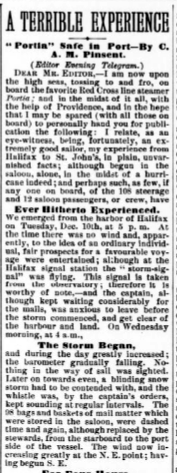
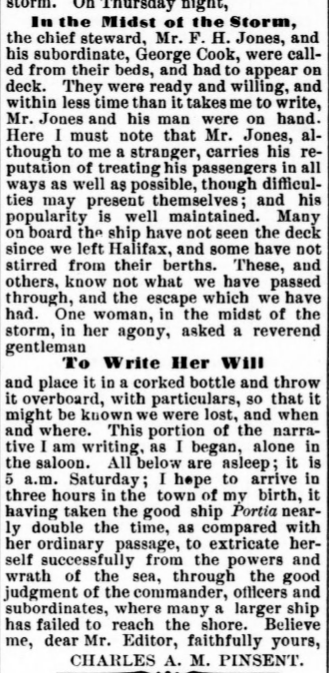
The journey back to North America was not particularly eventful. However, his ship, the S.S. “Portia”, got caught in a storm on leaving Halifax on its trip back to St. John’s. Charles dropped by the office of the Evening Telegram shortly after he disembarked, and gave them a gripping account of the trip (probably the tail-end of a major hurricane that had come up the U.S. Coast.) “I relate, as an eye-witness, being, fortunately, an extremely good sailor, my experience from Halifax to St. John’s, in plain, unvarnished facts; although begun in the saloon, alone, in the midst of a hurricane indeed; and perhaps such, as few, if any one on board, of the 108 steerage and 12 saloon passengers, or crew, have Ever Hitherto Experienced”. It must have been quite the trip. “At 2 a.m., Thursday, it became worse, and the deck load forward had become loose, consisting of many iron-bound casks of petroleum, and the captain, for protection of life, the ship, and property, gave distinct orders, and rightly so, as it turned out afterwards, “to clear the deck forward;” and, in consequence, to have a clean deck, oil and other things were tossed into the seas”. Later he adds, “One woman, in the midst of the storm, in her agony, asked a reverend gentleman To Write Her Will and place it in a corked bottle and throw it overboard, with particulars, so that it might be known we were lost, and when and where. This portion of the narrative I am writing, as I began, alone in the saloon” (Evening Telegram: 14th December 1895).
Charles had passed through Montreal on his way back to St. John’s and he had had a follow-up interview at the Montreal Gazette. His analysis was reprinted in the Evening Telegram on 16th December 1895. In it, he conceded that the financial crash had caused considerable damage but he now considered the prospects for the colony in better shape than ever! “I am not a politician, but there is no knowing when I may enter into the political arena. As regards Confederation, my natural feelings are opposed to it for several reasons. In the first place we enjoy to-day home rule in its entirety, and the feeling of the masses in the old colony is that we should retain it. It is only natural that we should and keep our present position of Practical Independence. I feel confident that, if our resources were developed, no doubt would exist, with good government, as to the colony retaining its independence.” As to the banking scandal, all he could say given that his uncle was the manager of the Union Bank was “In regard to the bank scandals, I would much prefer not to express an opinion, being personally acquainted with all connected in those matters, but I will say that any impartial mind, having a full conception of the past business workings of the colony, as a whole, would not attach any direct criminal blame to the directors of the institutions implicated.” Well they did ask.
Back in St. John’s Albert Ellis sued the “Sun Life Insurance Company” claiming that he had given Charles a cheque for $50 on 18th December 1894 in good faith and Charles had accepted it at full value despite the fact that the bank was then failing. The Company had refused to honour his policy and he now (not unreasonably) wanted his money back – in real dollars – as given – not in devalued ones! The judge evidently thought he had a point (Evening Telegram: 10th January 1896). Charles did what he could to make ends meet in the months that followed – moving back and forth from “Hillsboro” to “Woodlands” like a pendulum. In fact, the Evening Telegram’s travel correspondent was quick to point out that “We hardly know whether our good friend Mr. C. A. M. Pinsent lives in town or out of town these stirring times; but this much we do know, namely: that he arrived in town again this afternoon” (Evening Telegram: 4th April 1896). A month or so later, he reported that: “Mr. C. A. M. Pinsent has left to enjoy the ozone from the waters of Conception Bay, as a respite from business worry” (Evening Telegram: 15th June 1896). Clearly, things were not going well. However, he may have had more than business on his mind.
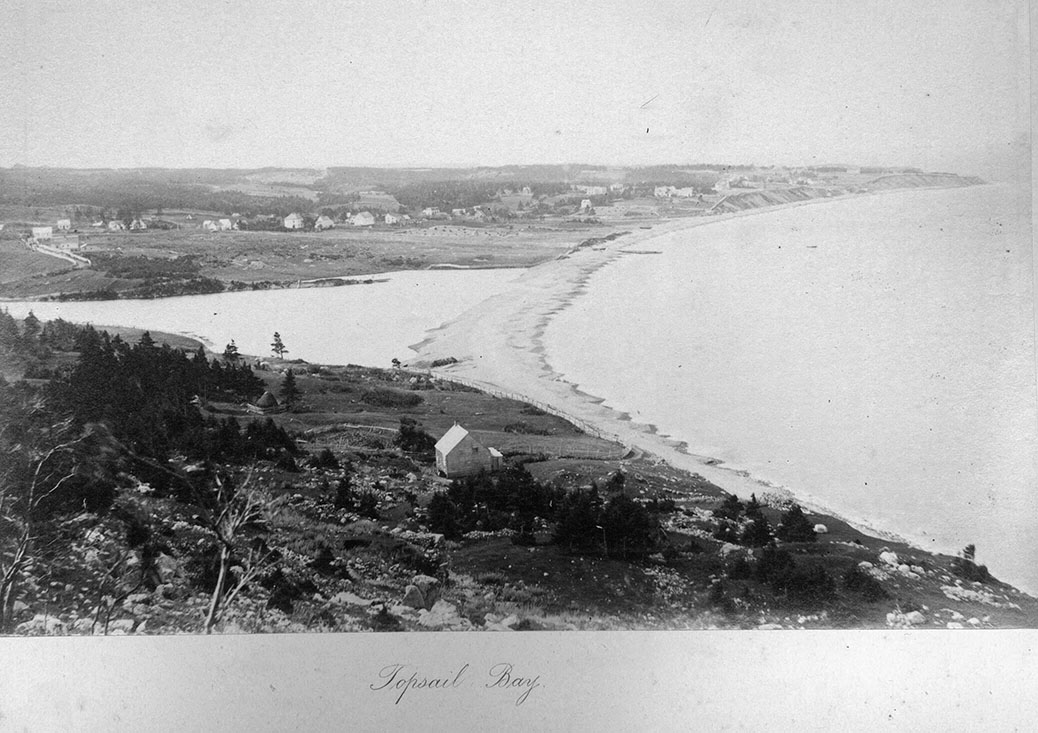
Charles had, in amongst all his travel and hunting and fishing, found time to marry. He married Fanny Sophia Colley, the daughter of Canon Francis Worthington Colley, a well-known Anglican Minister in the out-port community of Topsail. They were married in Topsail in January 1897 (Evening Telegram: 7th January 1897). Charles was supported by his brother Francis W. Pinsent who was also in charge of the (photographic) pictures. Sadly, I have none of them. News of the wedding circulated throughout the empire (Colonies and India: Saturday 6th February 1897).
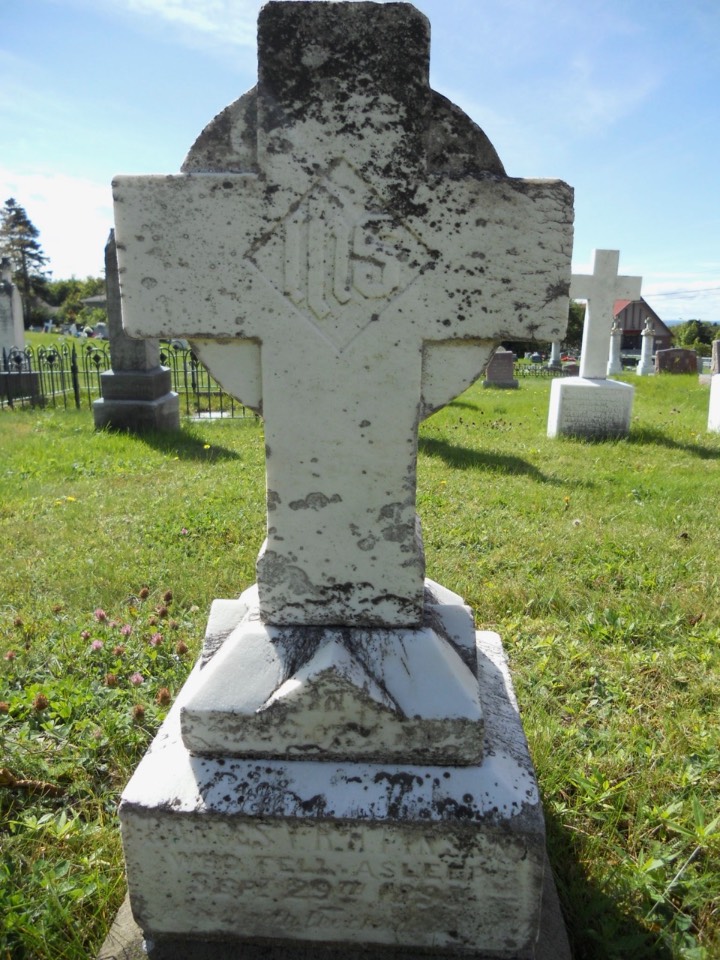
The gravestone of Frances V. R. H. Pinsent, who died in 1898.
Charles and Fanny had a daughter, Frances Vicars Raleigh Hoyles Pinsent that November but she was to be short lived. She died in Topsail in September 1898 when only 10 months old.
Charles sold odds and ends, turkeys and dentist’s chairs at one point and also acted as an estate agent – being, for instance, he was involved in the sale of the late Hon. C. F. Bennett’s (the brewer’s) not inconsiderable estate in St. John’s and Goulds (Evening Telegram: 27th April 1897). He moved his office to the Commercial Chambers on Water Street (Evening Herald: 5th July 1897) and proceeded to sell bulk items, such as flour, butter tea and cigars by auction (Evening Herald: 24th January 1898).
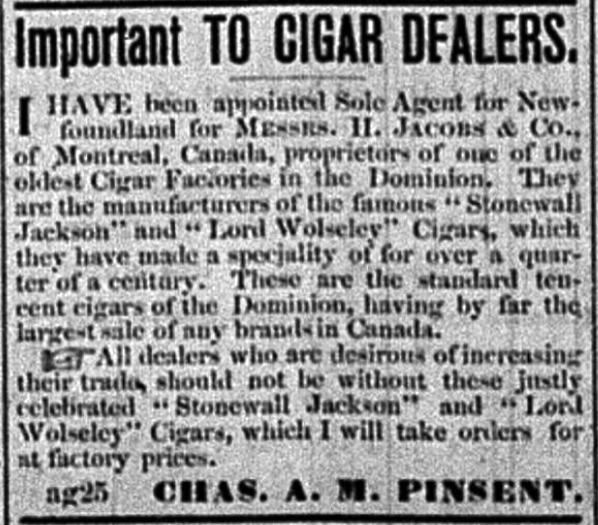
C.A.M. announces his appointment as Sole Agent for Newfoundland for Messers. H. Jacobs & Co. of Montreal, Canada. The Evening Herald, September 1, 1897.
He proudly announced that he had been appointed “sole agent in Newfoundland” for “Messrs. H. Jacob’s & Co. of Montreal” the manufacturers of the “famous “Stonewall Jackson” and “Lord Wolseley” Cigars, which they have made a speciality of for over a quarter of a century. These are the standard ten-cent cigars of the Dominion, having by far the largest sale of any brands in Canada” (Evening Herald: Wednesday 1st September 1897) and this appears to have been his principal sales line in the years that followed.
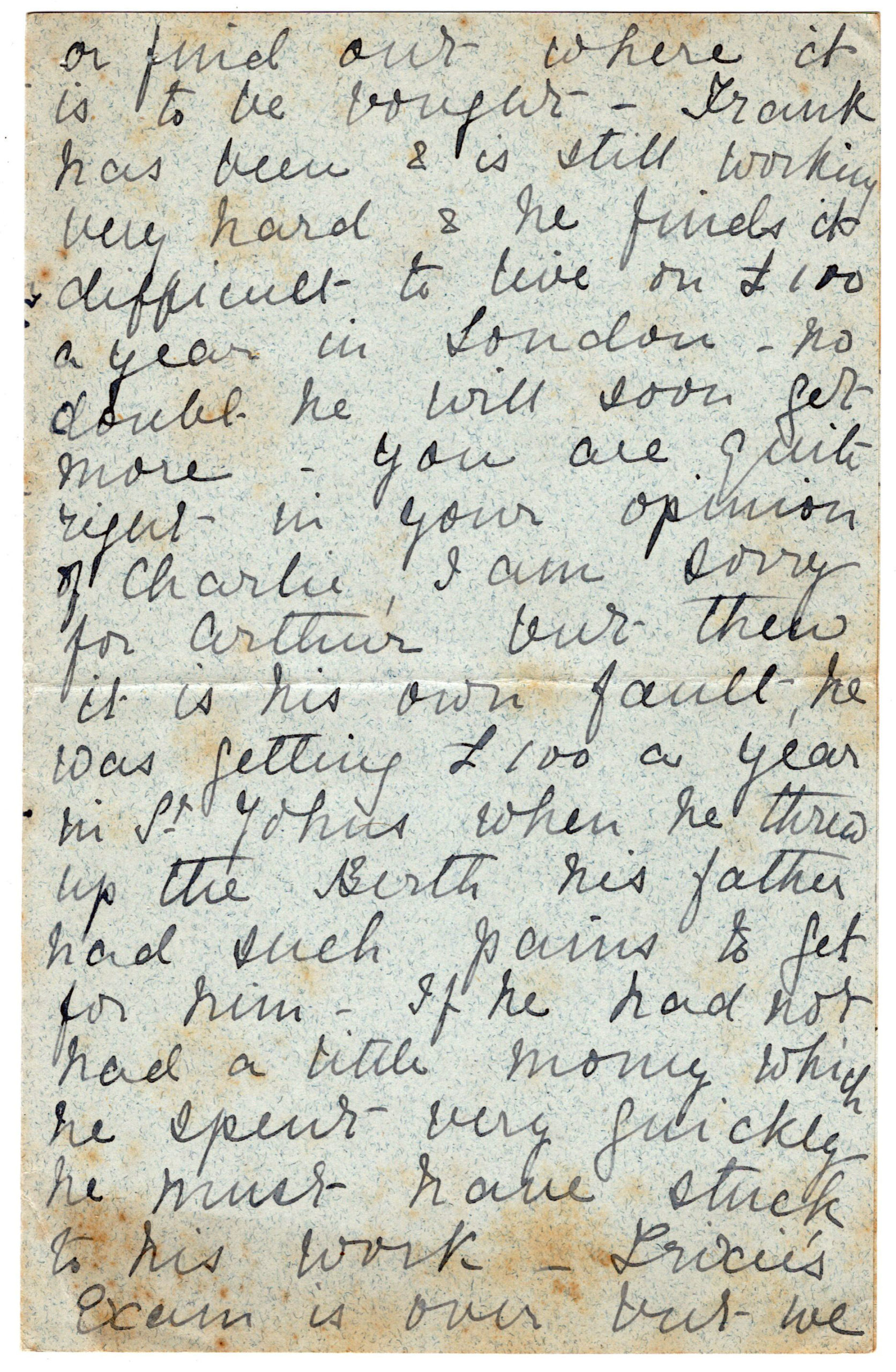
Lady Pinsent’s eldest son, Robert John Ferrier Homfray Pinsent gave up his job in Montreal and returned to Newfoundland to recuperate from a bout of tuberculosis in August 1897. He stayed at “Woodlands” and wrote to his mother in England. He asked lovingly after her and the rest of the family. He was very complimentary about his brother Frank (who was soon to leave for England) but much less so about his half-brother, Charles Augustus Maxwell who dropped by for a visit. Robert thought that he resented his being there. Robert goes on to says that Fanny was “very nice but very quiet and reserved, but at present she is not very well which no doubt accounts for it.” She would have been pregnant at the time. Robert goes on to say that the house (“Woodlands”)“is but a rag of what it was” as it had been stripped of most of its contents, and he feared that it might be difficult to sell. They were not at all well off; however, his health had been improving and his wife, Annie (née March), had applied for a school (teaching) position in St. John’s.
The assault case is reported in the newspaper. Evening Telegram, November 19, 1898.
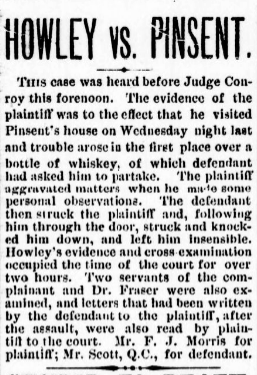
The loss of his child may have affected Charles deeply, coming as it did after four financially very difficult years. At any rate, his world unraveled further in 1898. In November he was in the Central District Court on a charge of assault on E. St. J. Howley. The evidence of the plaintiff was to the affect that “he visited Pinsent’s house on Wednesday night last and trouble arose in the first place over a bottle of whiskey, of which defendant had asked him to partake. The plaintiff aggravated matters when he made some personal observations. The defendant then struck the plaintiff and, following him through the door, struck and knocked him down, and left him insensible” (Evening Telegram: 17th November 1898). Or, as the Evening Herald would have it (19th November 1898): ”The plaintiff was the first to be put on the witness stand and detailed the facts of the altercation up to the point when he was hit by Pinsent and felled and afterwards kicked in the stomach, when he became unconscious. Since the assault some letters have been addressed to the plaintiff and his wife. They were taken in testimony, but most of them were of an extremely ludicrous and nonsensical nature, bringing the remark from His Honor that he was holding a court of lunacy”
This was not a good start; however, the press sensationalized the proceedings to such an extent that even Mr. St. J. Howley’s solicitor, felt that he had to intervene and set the record straight. Mr. Pinsent had NOT “kicked the plaintiff in the stomach as he lay unconscious” (Evening Telegram: 21st November 1898).
Newspaper announcement of the sale. The Evening Telegram, September 14, 1899.
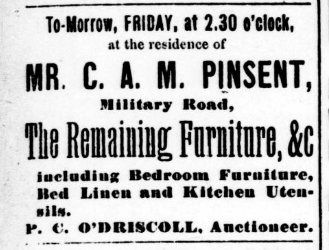
How the verdict came down, I am not sure; however Charles sold his household furnishings on Military Road by auction the following on September (Evening Herald: 4th, 14th and 21th September 1899). The house on Military Road “then in the occupancy of Geo. E. Bearns” was put to auction later that month (12th September 1899).
Handwritten letter from Lady Pinsent to Maude Pinsent, December 16, 1900.
By November 1899, there was no disguising Charles’s drinking problem. In a letter to her stepdaughter Lucrectia Maude Pinsent in Rome, Lady Pinsent says: “I am most glad to have Frank here as I was always in terror for him on account of Charlie, he is little better then a madman now, is quite so when he is drunk & people are terrified if he goes near them. He is very angry with me because I refuse to give him my signature to sell Salmonier, for his own benefit & I feared he would vent his anger on Frank. I am acting on Mr. M. William advice. He is a solicitor, Charlie’s wife (Miss Colley) is in England but she is so afraid of his finding her she will not give either Frank or myself her address, we write through her sister.” Whether it was his failure in business or the loss of the child we will never know but it was not looking good.
Charles lost his position as Portuguese Vice-consul in March 1900 (Evening Telegram: 24th March 1900) and he drops out of sight around then – his career essentially over. The Misses Short may have sued him in April 1901. However, the plaintiff in that case was “Charles Pinsent” so he may have been entirely innocent: there were other “Charles Pinsent’s” around (Evening Telegram: 11th April 1901. He was (somewhat surprisingly) invited to dinner at Government House along with the members of the Legislative Council in April 1905 (Evening Telegram: 5th April 1905).
C.A.M.’s obituary. The Evening Herald, May 26, 1910.
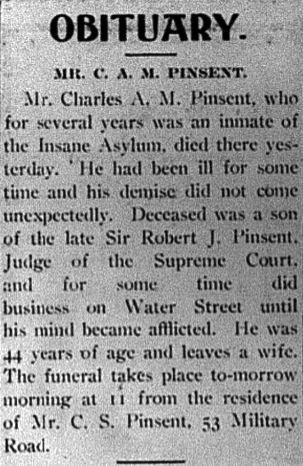
Nevertheless, he ended up in the Lunatic Asylum (presumably suffering from some form of dementia) and died there on 25th May 1910 (Evening Telegram: 26th May 1910). He was forty-four years old. His uncle, Charles Speare Pinsent took charge of the funeral arrangements.
Fanny (née Colley) lived in fear of her husband and fled to England sometime after the death of her daughter. Presumably she was living there when her father Rev. Edward Colley died in 1905. He left her a modest bequest in his will, which must have helped. Fanny had settled in Ruthin in North Wales and she, presumably, made contact with her step-mother-in-law after her husband Charles died in 1910.
Fanny raise funds for the Ruthin “Red Cross Hospital” during the First World War (Denbighshire Free Press: 18th November 1916) and was, among other things, the Secretary of a committee formed to put on a whist drive and dance in aid of funds for “providing Comforts for Soldiers” in December 1916 (Denbighshire Free Press: 30th December 1916). The committee’s work continued throughout the war and into the peace that followed. However, the Ruthin “Comforts for Soldiers” working party announced in April 1919 that it would, in future, direct its attention to other local charities (Denbighshire Free Press: 5th April 1919). It was about this time that she placed an advertisment in the Morning Post (15th May 1919) seeking a live-in help for two ladies who lived with three maids at “Woodlands” in Ruthin.
Fanny lived on Castle Street in St. Meugan’s Llanrhydd, Ruthin at least from the 1940s (British Telephone Books: 1880-1984) and she died there in 1954. Later that year, Kathleen Winifred Davis probated her estate, valued at £1,348. I do not know who Kathleen was; however, it is worth noting that Fanny and Mrs. Gertrude Martha Denim Davis had been the joint executrixes of the will of the Rev. Canon Edwin Davis twelve years previously (Halifax Evening Courier: Friday 24th July 1942).
Please use the above links to explore this branch of the family tree. The default “Next” and “Previous” links below may lead to other unrelated branches.
Please use the above links to explore this branch of the family tree. The default “Next” and “Previous” links below may lead to other unrelated branches.
According to LDS (Latter Day Saints) Film #0917202, Charles Pinsent was the youngest son of a a “Charles” and Eleanor Pinsent. However, this is wrong. His father was actually “Robert” Pinsent , a “serge cloth manufacturer and salesman” in Newton Abbot and one of Thomas Pinsent “the younger of Pitt”’s brothers. It was Robert who had married Eleanor.
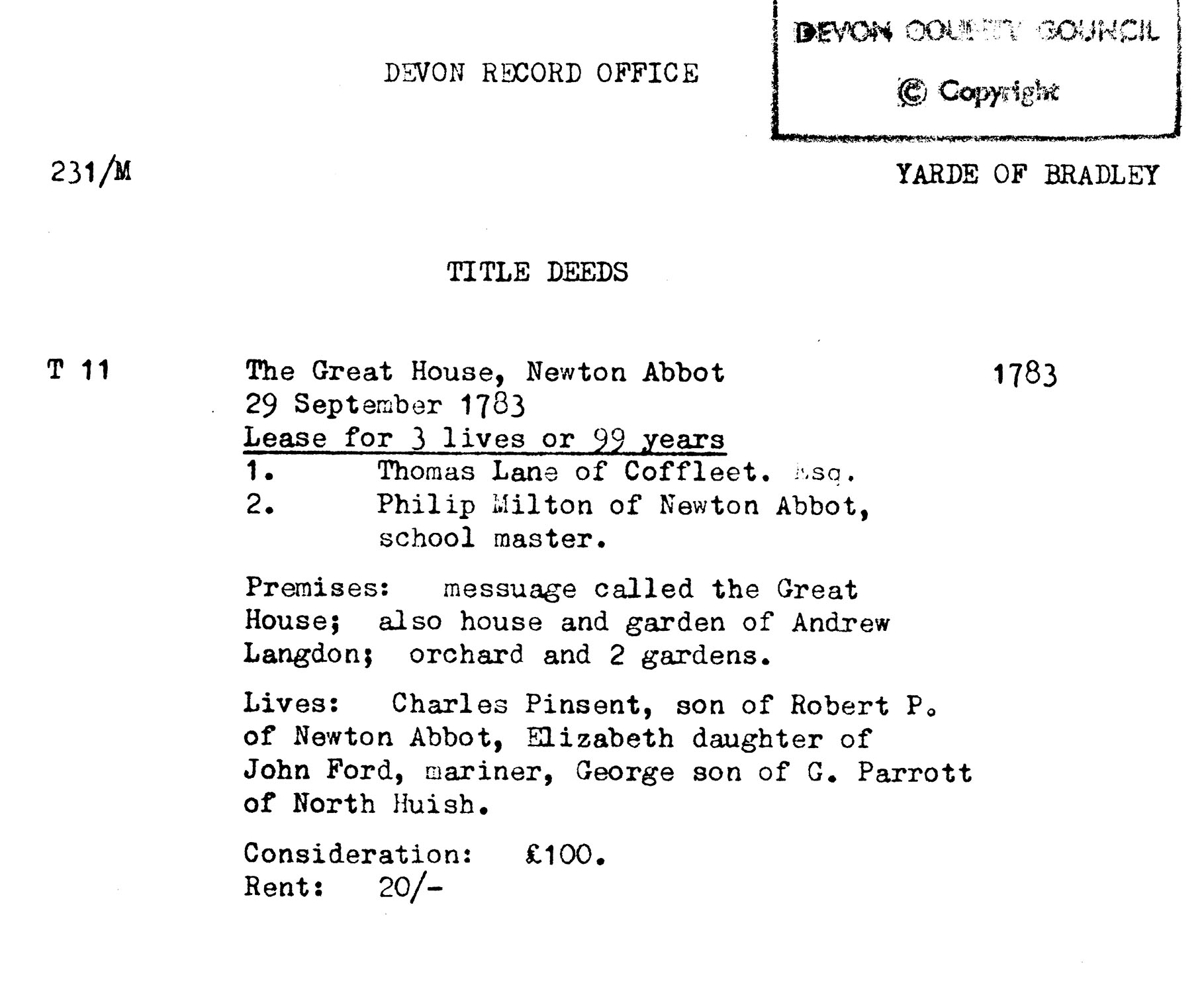
Title deed describing the lease for three lives, September 29, 1783, via the Devon Records Office.
Charles seems to have been brought up in Newton Abbot with at least one brother and been apprenticed to John Searle, a “carpenter” in Chudleigh in 1777 (Register of Duties Paid for Apprentices’ Indentures, 1710-1811). I do not known a lot about his life in Devon. However, the Devon Records Office has a “lease for three lives for 99 years” dated September 1783 that records the change in ownership of the “Great House,” Newton Abbot, from Thomas Lane of Coffleet, Esquire, to Philip Milton, Schoolmaster, for £100 “consideration” and 20s rent. The three lives mentioned are Charles, (son of Robert Pinsent of Newton Abbot), Elizabeth, daughter of John Ford, (mariner) and George (son of G. Parrott of North Huish). This type of land transfer was fairly common in those days. The idea was that if you choose three people covering a range in ages, then if one dies the other two can hold on to the property while they negotiate with the owner for the addition of a third name – and thus keep the property in one family almost indefinitely. Interestingly, Charles later named one of his children Elizabeth “Milton” (see below).
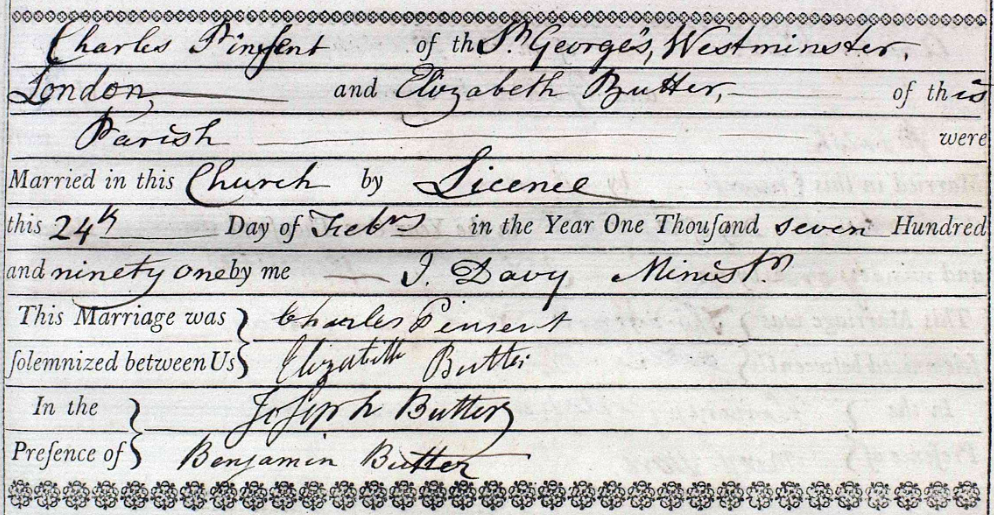
Charles Pinsent marries Elizabeth Butter in 1791.
Charles married Elizabeth Butter in Woodbury in Devon in 1791 and they headed up to London where they, appropriately enough, set up in business as “cheese-mongers”. They moved to London shortly after Charles’s cousin, John Pinsent, who was a “baker” and they seem to have shared a property at “35 Edward Street, Portman Square” in St. Marylebone from 1792 to 1798 or, perhaps even later. John was the son of John Pinsent and Susanna Pooke of Newton Abbot. They were both grandsons of Thomas Pinsent the elder of “Pitt” by his wife, Mary (nee Gale) and they both received small bequests from their uncle Thomas the younger of “Pitt” when he died in 1802.
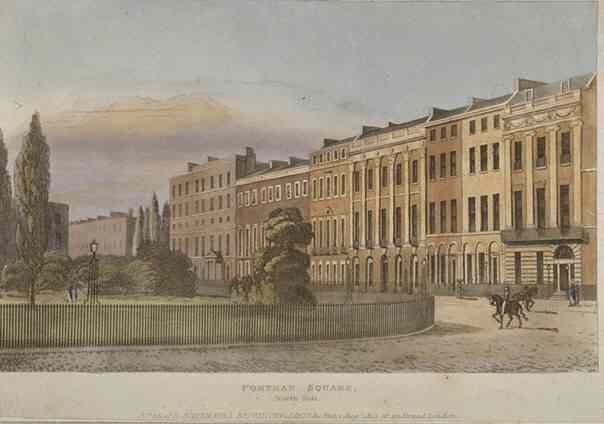
Portman Square in 1813.
There is a document in the London Metropolitan Archives that shows that “Charles Pinsent, cheese-monger” took out a “Royal and Sun Alliance” insurance policy on the Edward Street property in 1792. Charles and his cousin John were neighbours throughout the 1790s and they both had children baptized in St. Marylebone Parish church.
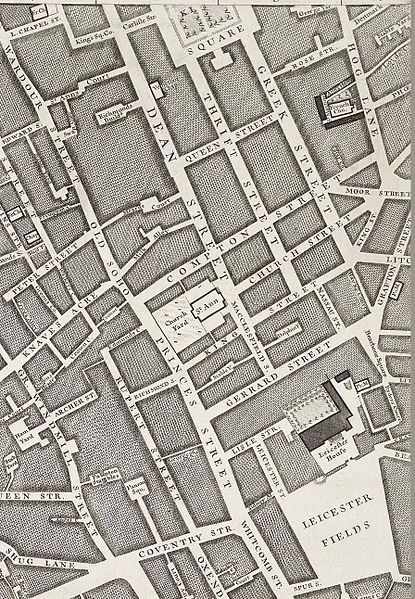
Map of Dean Street in Soho, London, 1746. Via Wikicommons.
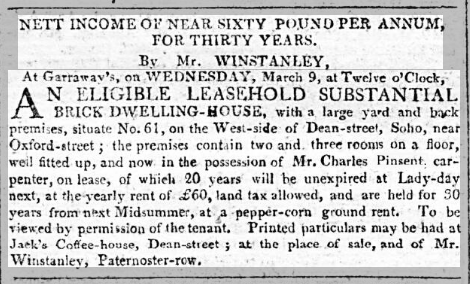
Charles paid approximately 12s 6d in rent and 2s 6d in tax annually from 1792 to 1798 for his part of the communal property on Edward Street from 1792 to 1798. Shortly thereafter, he moved to a more substantial property at “80 Dean Street, in St. Anne’s parish, Soho.” He paid around £7 in rent and taxes (it varied from year to year) between 1804 to 1815. Charles may have acquired #61 Dean Street at the same time, as he offered a lease of the premises which “contain(ed) two and three rooms on a floor, well fitted up, and now in the possession of Mr. Charles Pinsent, carpenter” for 20 years at a yearly rent of £60, land tax allowed (Oracle and Daily Advertiser: Monday 28th February 1803).
Charles Pinsent leases the property on Dean Street,Oracle and The Daily Advertiser, February 28, 1803.
The move to Soho may well have been triggered by a switch in his career as he went back to using his carpentry skill and became a builder. He would have needed a yard of his own as his cousin needed the Edward Street site for the commercial shipping business that he ran with his brother William in Newfoundland.
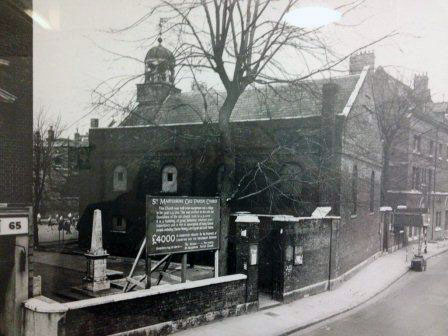
Four of Charles and Elizabeth’s children (Elizabeth Milton, Charles Thomas, Mary, Eleanor and Anna Pinsent) were baptized in St. Marylebone Parish between 1792 and 1800. The present day church was not built until 1817. However, the “Old Church” – which was built in 1760 – still remains as a Chapel of Ease. Charles and Elizabeth’s fifth child, Eleanor Pinsent, was born in Soho in 1802; however, she was baptized in her mother’s home parish of Woodbury, in Devon. Two of the children, Thomas Charles and the first Eleanor Pinsent died within a year of so of their birth.
It is not clear what happened to Mary; however, Elizabeth, Anna and Eleanor later married. However, before Anna and Eleanor did so they were named as beneficiaries in the will of their uncle, John Butter, of Woodbury, who was a Private in the 83rd Regiment of Foot. He left Anna a property called Haynes and Eleanor his interest in a farm called Hammetts. As they were then underaged, he left their respective interests in event of their death before the age of maturity to their mother, his sister Elizabeth. John Butter’s will was probated in 1815 (Inland Revenue Wills: 1815).
Old St. Marylebone Church, 1760 – 1817.
A reference in “Burke’s Colonial Gentry” shows that Mr. Thomas Scott of Boode House, near Braunton, in Devon, married “Elizabeth Milton, daughter of —– Pinsent of Pitt House, near Chumleigh (sic), County Devon”. The connection to Pitt House (farm as it was then) is a bit of a stretch, although Elizabeth’s grandfather was certainly born there. Elizabeth was, technically, a “minor” when she married in St. Anne’s Church in Soho in 1812. The marriage suggests that Charles was doing reasonably well and he had made a good marriage for his daughter. Thomas and Elizabeth Scott had several sons. The first, born in 1814, was baptized Thomas Pinsent Scott. He went out to Australia where his family held property at “Benacre”, “Glen Osmond”, and “Mount Lofty” near Adelaide in South Australia. Another son, William Scott, also went out to Australia. He became a Warden of St. Paul’s College – at what is now the University of Sydney.
Charles’s daughter Anna Pinsent moved to Liverpool and married a local “merchant”, Charles Muirhead Burgess, in 1823. Charles’s youngest daughter, Eleanor Pinsent also skipped town – which was actually a sensible thing to do as London was not a particularly healthy place to be in those days. She married Mr. Henry George, a “bookseller” from Bath (in Somersetshire) in Hartland in North Devon in 1828. Coincidentally or probably otherwise, Elizabeth Milton (Scott) and her sister Eleanor (George) both ended up living in North Devon. Braunton and Hartland are just 30 miles (50 kilometres) apart! If the linkages are correct, their uncle John Pinsent who was a retired soldier may have moved to North Devon too. He lived in Great Torrington in later life.
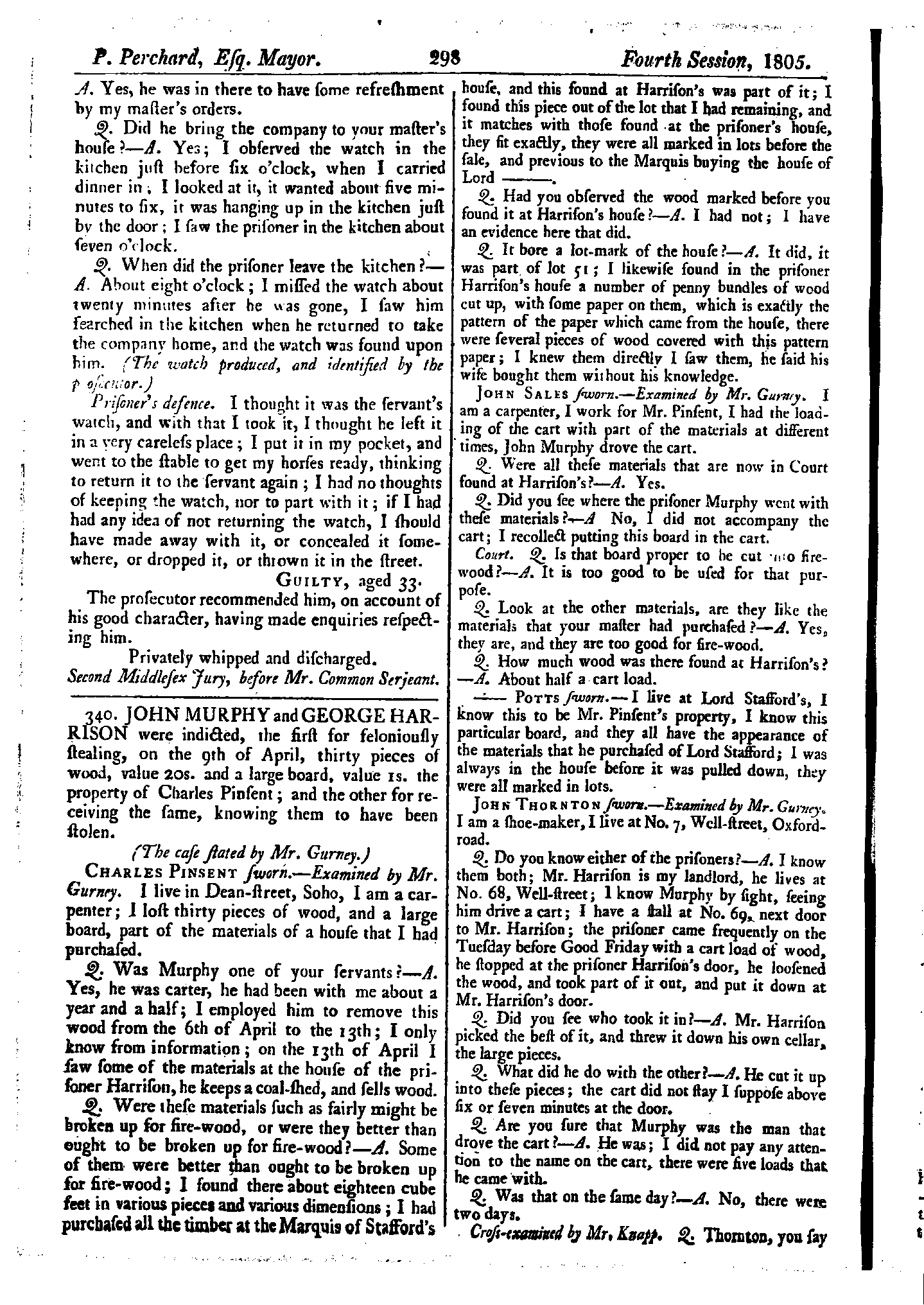
Charles Pinsent testifies at the Old Bailey, 1805.
The records of the Central Criminal Court (Old Bailey) are now on-line and they show that John Pinsent (Charles’s cousin) was summoned for jury service on 1st July, 1790. He was appointed to the “First Middlesex Jury” of the “King’s Commission of Oyer and Terminer, and Goal Delivery”. He was also appointed to the “Second Middlesex Jury” on 17th February 1796 and on that occasion his cousin Charles Pinsent was appointed to the “First Middlesex Jury.” They fulfilled their civic duty.
There was a considerable amount or rebuilding going on in London in the early 1800s and Charles very sensibly recycled lumber. In 1805 he was back at the Old Bailey – this time as a plaintiff. Some salvaged wood was stolen from his yard shortly after he moved to Dean Street. The miscreants were caught and John Murphy and George Harrison were duly indicted for (respectively) stealing, and receiving 30 pieces of wood valued 20s.
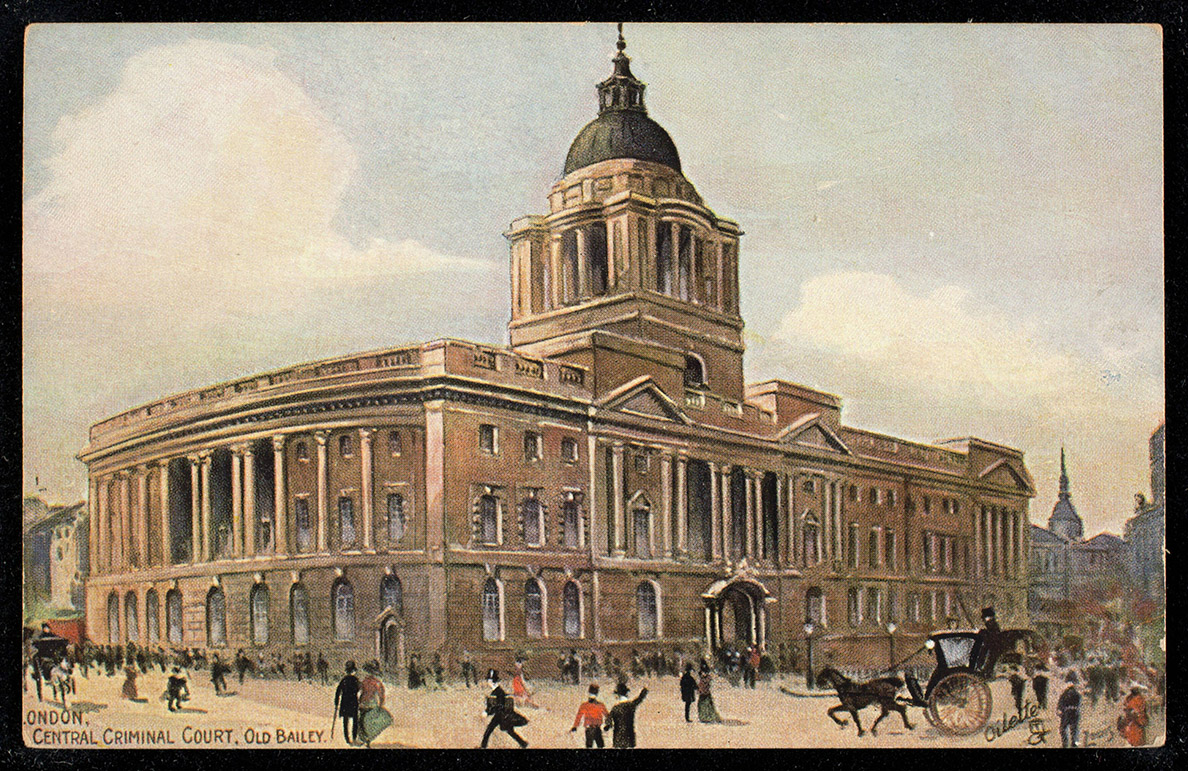
The Old Bailey in London.
They were tried at the Old Bailey on 24th April 1805. Charles testified that the wood in question came from the Marquis of Stafford’s old house and that some of the pieces still showed their purchase lot number. Other pieces had remnants of wallpaper attached that clearly matched pieces that were still in his possession! There is a lesson in there somewhere. Murphy was sentenced to transportation for seven years and Harrison for fourteen (Old Bailey Online).
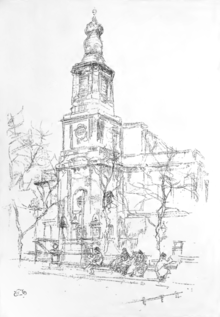
Sketch of St. Anne’s Church, Soho by James Abbot McNeill via Wikipedia.
Charles Pinsent died in 1816. He was buried in St. Anne’s Churchyard in Soho. He was predeceased by his wife Elizabeth. Interestingly, Charles still seems to have been operating out of Dean Street – albeit supposedly under the “Pinson” name several years later (Underhill’s Triennial Directory: 1822 – 1824). Who took over, I do not know. Sadly, it can not have been his son as he died young.
Please use the above links to explore this branch of the family tree. The default “Next” and “Previous” links below may lead to other unrelated branches.
Mary Pinsent: 1799 – 1830 Ann Pinsent: 1804 – 1881 (Married George Keddell, 1832, Hennock, Devon) Thomas Pynsent: 1808 – 1887 (Married Jane Sparrow, 1843, St. Marylebone, London)
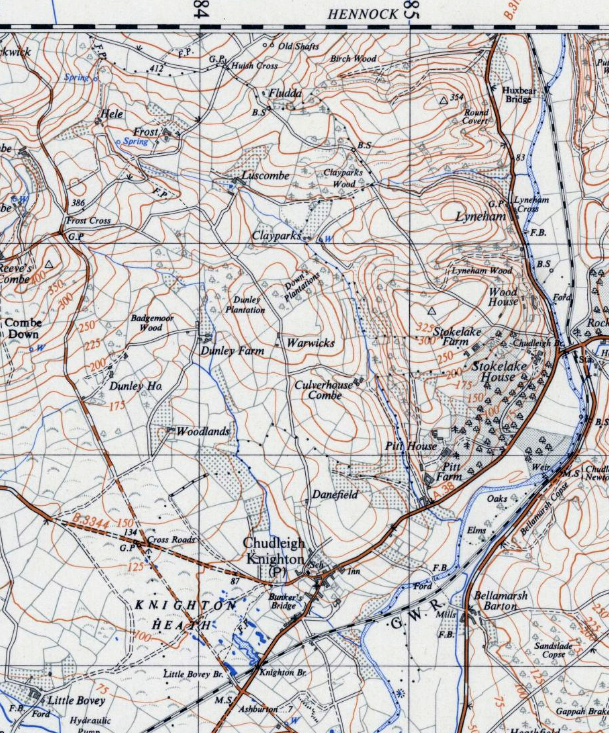
Charles Pinsent was one of the younger sons of John and Susanna Pinsent. He was born in Newton Abbot in 1766 and grew up there and, later, at Pitt Farm in Hennock. He inherited the farm from his uncle, Thomas “the younger” of Pitt, in 1802.
His father, John, was a “merchant” in Wolborough (Newton Abbot). Sadly, both his parents died within days of each other in 1772 – while he was still quite young. John and Susanna’s four elder sons (John, Robert, Thomas and William) were essentially launched by then but Charles and three of his brothers (Gilbert, Samuel and Joseph) were left with out a home. They went to live with their elderly grandfather, Thomas Pinsent, his son (their uncle) Thomas Pinsent and his wife (their aunt) Mary (née Mudge) at Pitt Farm in Hennock. The boys’ grandfather died in 1777 and the farm – which was a fairly large property – passed to their uncle Thomas. One of Charles’s brothers (Samuel) also died that year; which left three of John and Susanna’s younger boys living at Pitt with their uncle. Gilbert, Charles and Joseph grew up on the farm, helped out on it and eventually became farmers themselves.
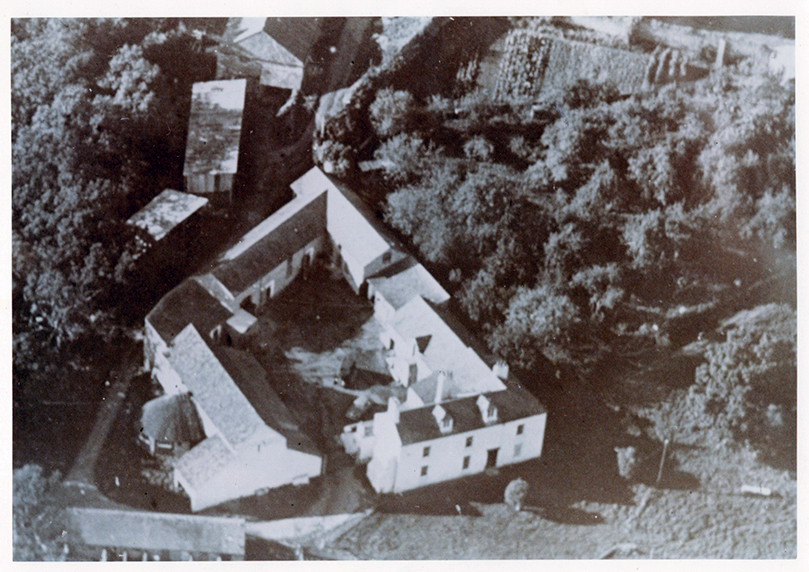
Pitt Farm as photographed in the 1960s via Pitt Farm.
One of the elder brothers, Thomas Pinsent,still thought of Charles as being from “Newton Bushell” (part of Newton Abbot) when he appointed him (although he was still under-age at the time) to be the executor and principal beneficiary of the will he made on joining “H.M.S. Exeter” in 1779. Sad to say, Charles was called upon to execute the will in 1785. “H.M.S. Exeter” was a Royal Navy 64-gun “third-rater” that served with the British fleet and fought the French in the Indian Ocean in the 1780s. I do not know if Thomas died in action. Gilbert married Margaret Snow in Kingsteignton in 1790 and settled into a farm called “Ponswin” in the same parish. He became a successful tenant farmer. Joseph, meanwhile, probably worked with his brothers (John and William) in the Newfoundland fishery for a few years before settling in London as a “Shipping Agent”. Nevertheless, he too farmed – at Lettaford in North Bovey. Their lives are described elsewhere.
Transcript of Land Tax Assessment records describing payments by Charles Pinsent.
Charles stayed on in Hennock and started to take responsibility for the management of the farm when his uncle was in his mid-70s. Land Tax Records show that Charles paid the £1 tax assessed on Pitt in 1791. The adjacent “Marshes” cost him an additional 10s. When Charles’s uncle Thomas (the second “of Pitt”) died in 1802, he left bequests for all his living nephews (see elsewhere); however, he made Charles his principal legatee.
Charles inherited “Pitt farm and the marshes”, a property in Teigngrace called “Diamond’s Delight” (10s land tax) and a farm in Kingsteignton called “Lower Albrook” (£1 6s 6d land tax). The latter, which is near Sandygate just to the north of Kingsteignton, had probably come to his uncle from the Mudge family. Charles was a significant land owner and a man of some note in Hennock. He signed the register in 1793, 1812, 1815 and 1818. Charles was also called upon to act as an executor to the will of a local worthy, Joseph Heaward, in 1819 and he was appointed Churchwarden in 1821 and 1822.
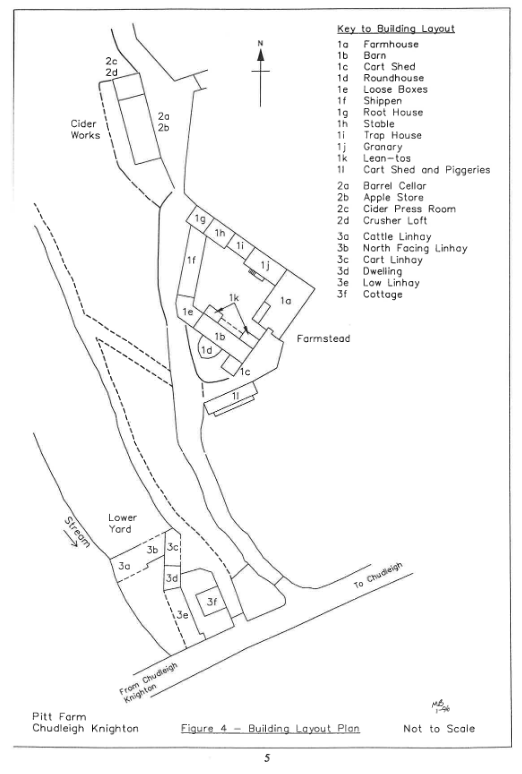
Map showing the building layout of Pitt Farm from 1996 via Devonshire Association.
Charles seems to have sold “Diamond’s Delight” shortly after his uncle died. However, he held on to “Lower Albrook” and “Pitt and the Marshes” (£1 10s 6d in land tax) and consolidated his position in Hennock by adding a number of small properties, “Collyers”, “Voyses”, “Underhays” etc. with a cumulative land tax of £1 17s. From 1804 onward, he also rented property in the neighbouring parish of Chudleigh (“Greenhill and St. Albans (£1 1s 10.5d land tax), Marshes” – “late Frists” (£1 13s 3.25d land tax), “late Bickfords” (£1 13s 3.25d land tax), “Claypark Meadow (3s 9d land tax) and Marshes”, “late Newberry” (£1 13s 3.25d land tax). This patchwork may have been difficult to manage and the Clifford Family Archives in Ugbrooke contain documents that show that Charles negotiated a deal with James Templer of Stover that gave Mr. Templer access to his “Marshes over Teign” in exchange for several parcels of land in Hennock in 1810. When he died in 1826, Charles controlled land that was taxed at an aggregate value of £2 11s.
Transcript of the settlement examination from 1821.
Charles paid land tax and parish rates and took some of the local children as apprentices to help work his property. He apprenticed Ann Walling and Elizabeth Kentisbeer for “Woolcomb’s Marsh” and “late Bickford’s Marsh”, respectively, in 1812. Joseph Hillman, a mariner, testified at a Settlement Examination (to determine if he was eligible to apply for support) in Bovey Tracey in 1821, that after he had served his apprenticeship in Bovey Tracey, he had gone to work for Charles at “Pitt” and was paid by the week for six months – until they “had words” and he was dismissed. However, he was reinstated after three days and he worked there for two year before going out to Newfoundland. Similarly, in 1808, Thomas Beer claimed he served out his apprenticeship in Kingsteignton and then moved to Hennock where he worked for Charles’s uncle Thomas until he died (in 1802). He then worked for Charles before marrying and returned to Kingsteignton. Such was life in the early 1800s.
Perhaps unsurprisingly, given the nature of his estate, the Devon Game Lists, (published annually in Trewman’s Exeter Flying Gazette) show that Charles purchased a “general certificate” (at a cost of approximately three guineas) more or less annually from 1805 to 1824. He probably shot ducks and geese on his “marshes” and “vermin” (pigeons, crows?) on his farm land. An entry in Hennock Churchwarden’s Accounts tells us that he (and seven other farmers) signed an agreement with the parish on a pay scale for killing birds, in 1816. The accounts also show that he was paid 7s 6d and 5s for killing them in 1822 and 1823 respectively.
Charles enrolled as a Volunteer in the Chudleigh Infantry Company in 1799 and, again according to the Ugbrooke Archives, he was a Quarter-master Sergeant in the Teignbridge/Chudleigh Yeomanry in 1808. This was during the Napoleonic Wars and a patriotic Charles was doubtless pleased to contribute £1 0s 0d to the “Waterloo Subscription” – a charitable organization in 1815 (Exeter Flying Post: Thursday 7th September 1815).
Charles married Mary Yeo in Lustleigh, Devon in 1799 and they had two daughters (Mary and Ann) and a son (Thomas) in the years that followed. When Mary’s mother Ann Yeo of Northwood, in Chudleigh, died in 1819 she left her daughter Mary Pinsent £10, her grandson, Thomas Pinsent, £5 and her grand daughters, Mary and Ann Pinsent a guinea apiece (Inland Revenue: Stamp Act Wills: 1819 & Sheila Yeo: Yeo Society website).
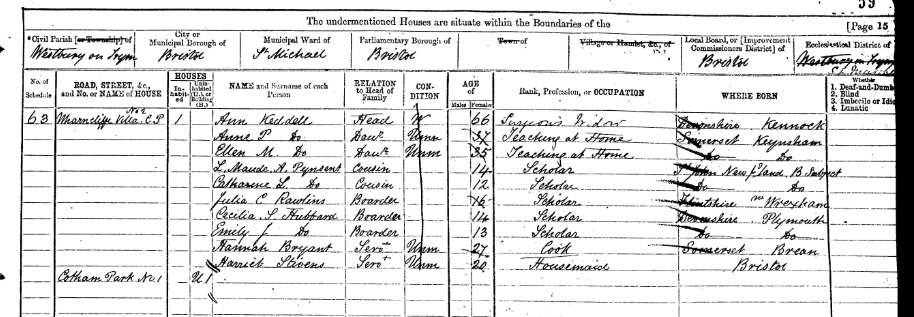
Ann Keddell appears in the 1871 census records.
Mary, the elder of the two daughters, died unmarried, in Hennock, in 1830. Ann, who was the younger of the two, lived to marry George Keddell, a surgeon of Keynsham, in Somerset in 1832. They had a daughter, Ellen Maria Keddell who we will come across when discussing the life of (Sir) Robert John Pinsent, the barrister from St. John’s in Newfoundland (see elsewhere). Census Records show that Ann Keddell and her two daughters lived in Westbury on Trym, in Bristol, in 1871 and ran a small school there where they tutored their young Newfoundland “cousins” Lucretia Maude and Catherine Louise Pinsent (Sir Robert’s daughters). Ellen Maria Keddell corresponded with Lucretia Maude Pinsent (who was, by 1891, Lady Abbess of St. Scholastica Abbey, in East Teignmouth) and Lucretia Maude described a visit from her on 11th July 1886 in her diary. The various branches of the family were well acquainted and their correspondence shows that their interest in family history seems to have passed down through the generations.
In her diary, Lucretia Maude says that Charles Pinsent’s son, Thomas Pynsent (see elsewhere) owned a painting of Sir William Pynsent of Urchfont, Wiltshire (the second baronet) and it was hanging in his house at Westwood Ho! Evidently, someone called Ellen Maria (??) sent Lucretia a photograph of the picture. Lucretia goes on to says that Thomas’s “cousin” Elizabeth Satterley Splatt, (nee Pinsent) had “an excellent” copy of the picture at “The Elms” in Torquay. Lucretia Maude goes on to discuss Charles’s brother Joseph’s family and the loss of Pitt House. I do not have the diary but my grandfather, Francis Wingfield Homfray Pinsent, made notes from it while on a visit to his step-sister in Rome, in 1929. Francis also copied a photograph of a Prayer Book that had been endorsed by Leonora Ann Pynsent, Sir William’s only surviving daughter.
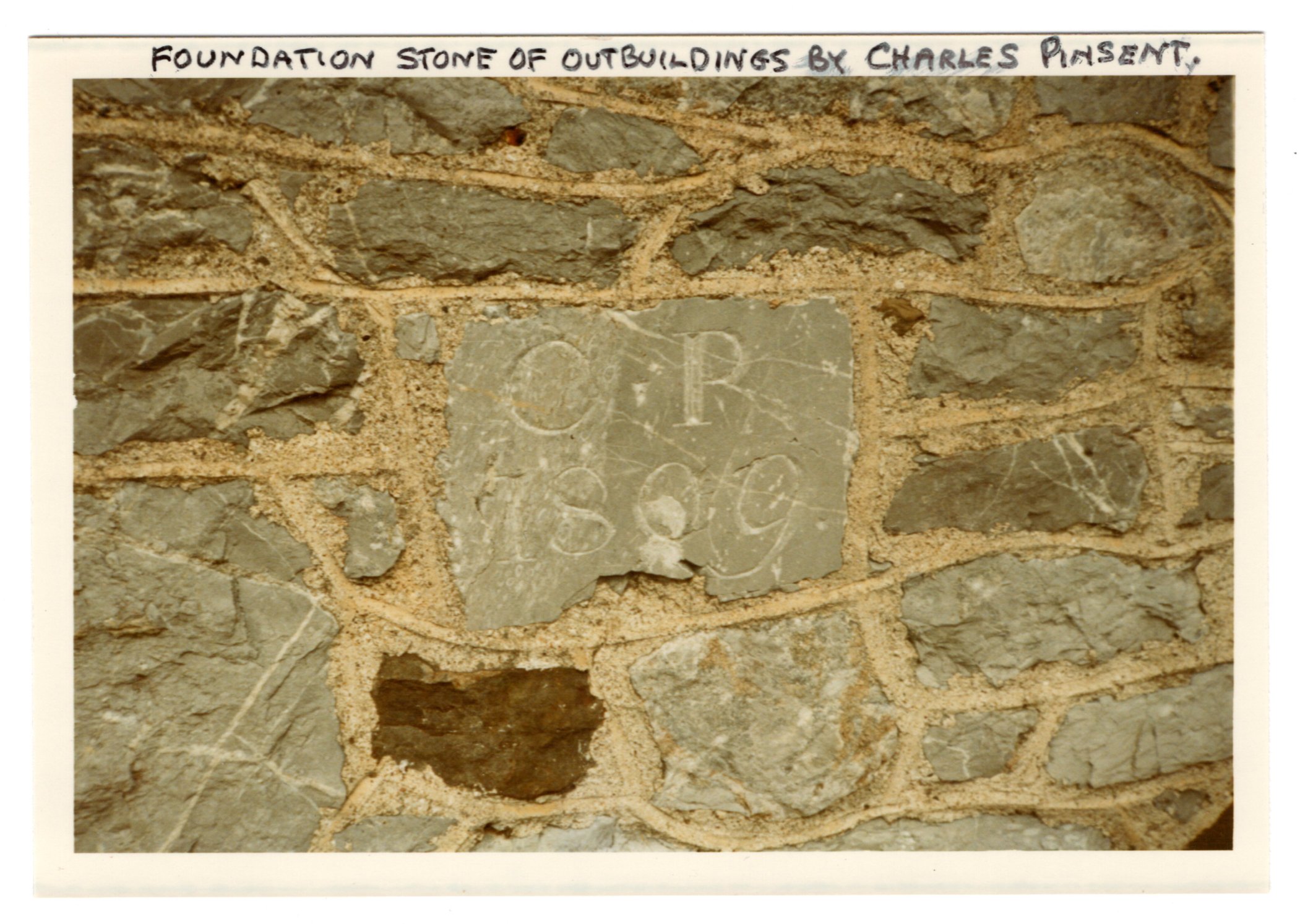
The foundation stone displaying “C. P. 1809”.
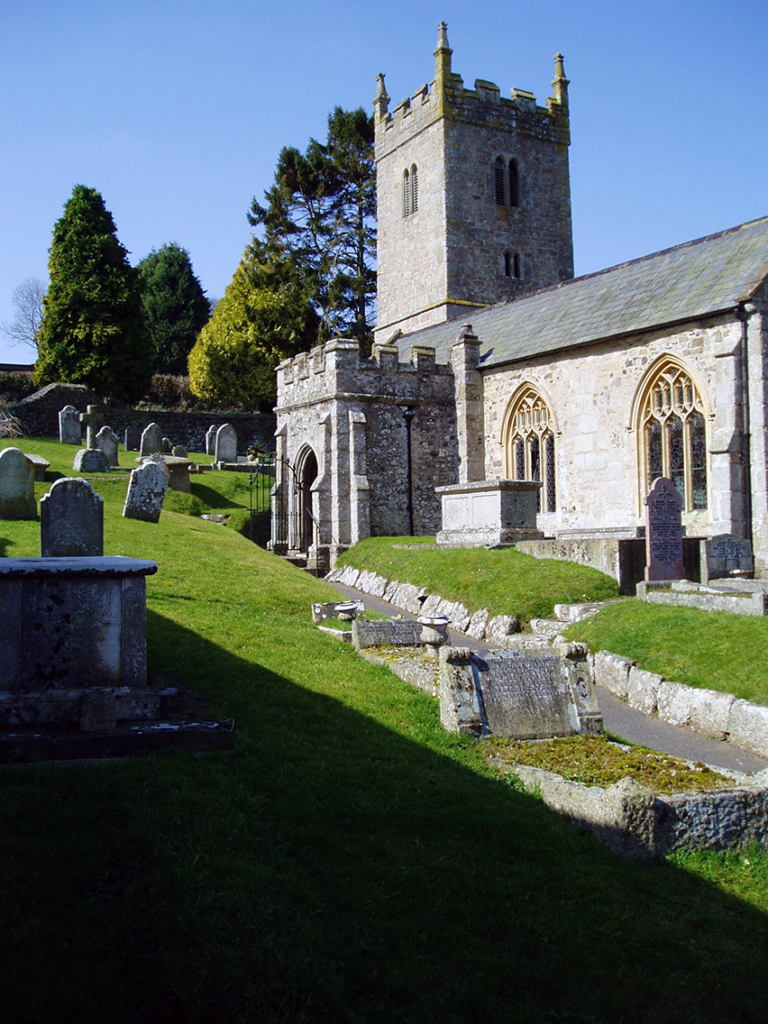
In 1996, The Devonshire Association published a detailed report on the design, layout and architecture to be found at Pitt Farm. It showed that the outbuildings underwent a considerable amount of work in the early 1800s and notes that there was a date stone inscribed “CP 1809” built into the granary wall.
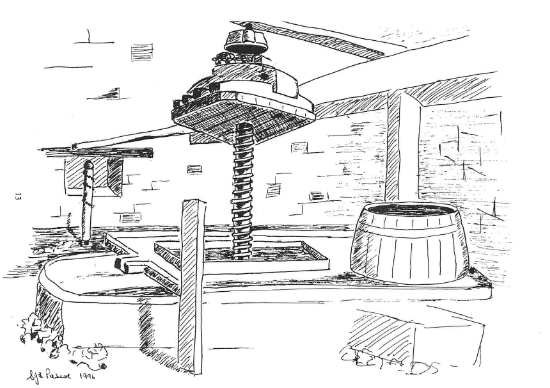
Illustration of the Pitt Farm cider press via Devonshire Association.
It must have been around then that the cider house was rebuilt: – “The cider house seems to be overbuilt: When the farm was for let in 1842 the blurb stated that there “was cellarage arranged for 400 hogsheads of cider, being well adapted for a cider merchant” – at 54 gallons per hogshead, this work out at 21,600 gallons storage capacity. In an extremely good year, the apples form an acre of orchard might produce 10 hogshead of cider but 2 to 3 hogshead per acre was more usual (38) Around one hundred and fifty acres of orchards would be needed to guarantee a supply of apples. Pitt Farm had 28 acres in 1842.” There is no obvious reason for the discrepancy. Perhaps Charles planned to establish a custom processing facility. The principal house and its various outhouses – which were built and rebuilt around a central courtyard – were converted into separate cottages in the early 1990s.
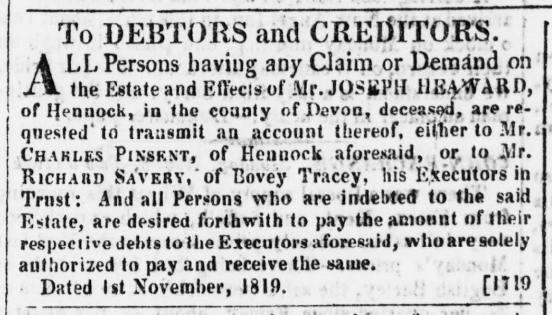
Charles Pinsent is advertised as Joseph Heaward’s executor.
Charles was a man of some stature in Hennock and he was appointed Philip Edwards appointed him trustee when he made out his will, which was probated in 1818 (Inland Revenue Wills: 1818). Similarly, a Mr. Joseph Heaward appointed both him, and a Mr. Richard Savery of Bovey Tracey, to act as executors when he died – which he did in 1819 (Exeter Flying Post: Thursday 11th November, 1819). Richard Savery may have been the brother of the Mary Savery who married Thomas Pinsent the upwardly mobile draper of the DEVONPORT family line in 1805. Certainly, she had a brother of that name. Charles Pinsent was later called upon to witness a transaction that occurred in 1820, when the executors of a Mr. John Mudge, who owned land in Hennock, Bovey Tracey and elsewhere, arranged for land to be transferred to the Gould family (Manor of Wreyland: H. M. Preskett (1970): Devon Record Office).
In his will, signed in 1814, Charles Pinsent appointed Stephen Endacott and Joseph Yeo as trustees of his estate. He left his wife a surprisingly small annuity (£35); arranged for the education of his children and left “Pitt farm” and his other property – including “Lower Albrooke” in Kingsteignton, which seem to have been valued at £3,400, to his young son, Thomas Pinsent. However, he specified that if Thomas should not wish to buy out his sisters shares when he came off-age, he could have a portion of it, or else it could all to be sold and once the annuity and other bequests had been was secured, the profits divided between the children.
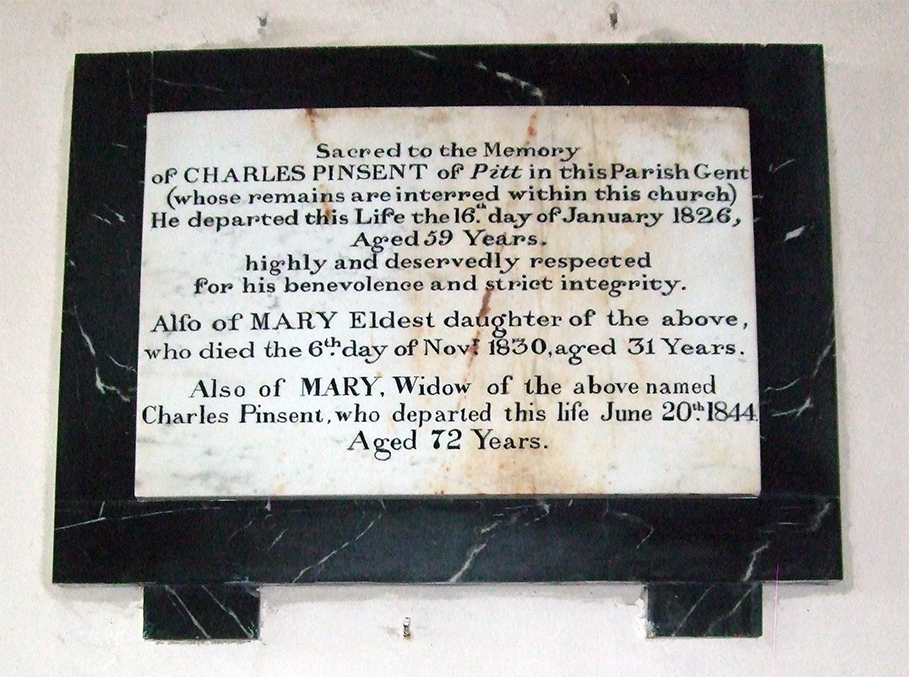
Charles died in 1826 and his elder daughter died, unmarried, a few years later. There is a memorial on the wall in St. Mary’s Parish Church in Hennock that that “Charles Pinsent of Pitt, nephew of Thomas, died 16th January, 1826 aged 59,” that “Mary, eldest daughter of Charles died on 6th November, 1830, aged 31 years” and that “Mary, widow of Charles died 20th June, 1844, aged 72”.
Mary (née Yeo) was still living at “Pitt” with a young kinswoman, Maria Yeo, at the time of the Census in 1841. However, they seem to have moved to Keynsham in Somerset, shortly thereafter; presumably to be with Mary’s daughter Ann and her son-in-law, George Keddell. She died there in 1844. Maria Yeo notified the registrar.
Please use the above links to explore this branch of the family tree. The default “Next” and “Previous” links below may lead to other unrelated branches.
Please use the above links to explore this branch of the family tree. The default “Next” and “Previous” links below may lead to other unrelated branches.
Please use the above links to explore this branch of the family tree. The default “Next” and “Previous” links below may lead to other unrelated branches.
Please use the above links to explore this branch of the family tree. The default “Next” and “Previous” links below may lead to other unrelated branches.
Please use the above links to explore this branch of the family tree. The default “Next” and “Previous” links below may lead to other unrelated branches.