Please use the above links to explore this branch of the family tree. The default “Next” and “Previous” links below may lead to other unrelated branches.
Please use the above links to explore this branch of the family tree. The default “Next” and “Previous” links below may lead to other unrelated branches.
Please use the above links to explore this branch of the family tree. The default “Next” and “Previous” links below may lead to other unrelated branches.
Please use the above links to explore this branch of the family tree. The default “Next” and “Previous” links below may lead to other unrelated branches.
Please use the above links to explore this branch of the family tree. The default “Next” and “Previous” links below may lead to other unrelated branches.
Charles Speare Pinsent was the third and youngest son of Robert John Pinsent, a justice of the peace in Brigus, Newfoundland, by his wife, Louisa Broome (née Williams). He was the youngest of three brothers. Robert John (later Sir Robert Pinsent) was the eldest and Thomas Williams Pinsent was the middle child. His brother’s lives are discussed elsewhere.
The boys were educated at Harbour Grace Grammar School; however, they may also have been schooled in England. The two younger boys seem to have been particularly good at arithmetic (Weekly Herald: 22nd December 1947). Charles spent his teenage years in Harbour Grace where – he (doubtless pressured by his abstemious father) paraded with the “Cadets of Temperance” when they put on an entertainment in July 1853 (Weekly Herald: 27th July 1853).
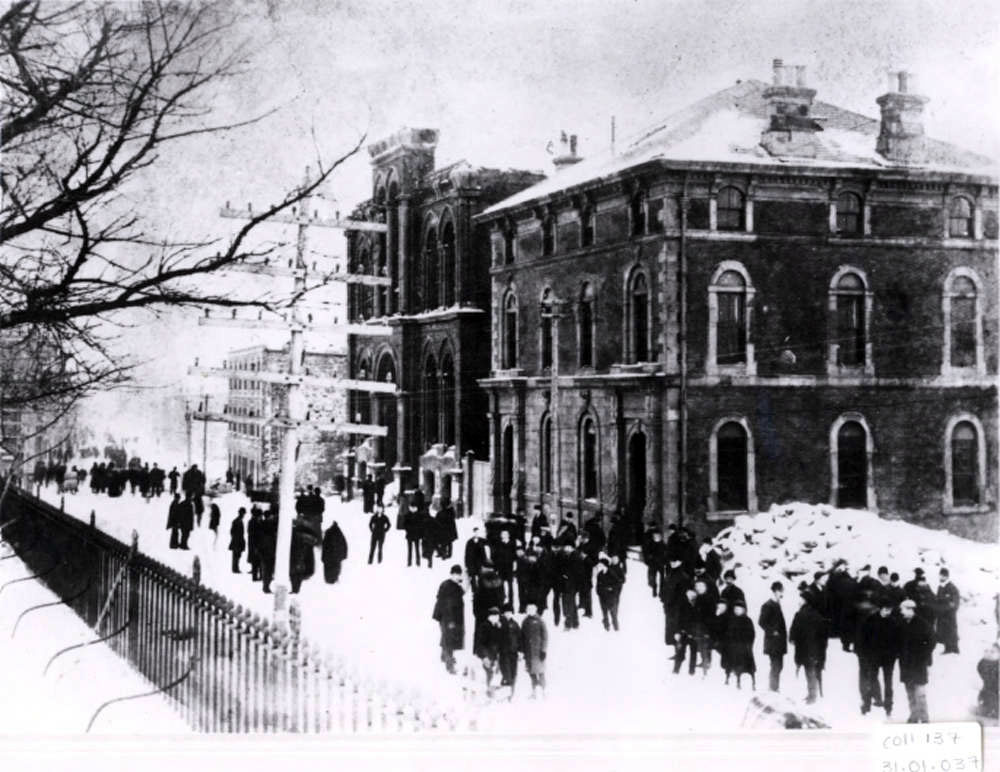
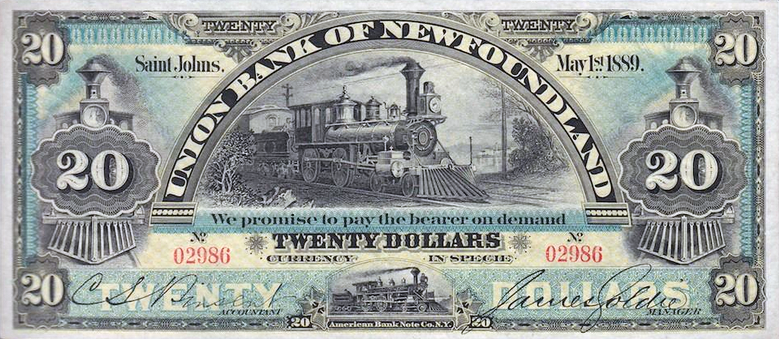
Charles studied accountancy and moved to St. John’s where, according to City Directories, he was a clerk at the “Union Bank of Newfoundland” on Duckworth Street by 1864. He rose through the ranks and was the bank’s provisional manager in June 1894 (Evening Telegram: 7th June 1894). The previous manager, Mr. Goldie, had retired and gone back to Scotland and Charles was formally confirmed in the top job a couple of months later.
Charles lived with his (by then retired) father and his other brother (Thomas Williams Pinsent) at #4 Cochrane Place, Military Road in St. John’s in 1871. However, his parents returned to England later in the 1870s and his brother left when he got married so Charles move out in around 1880. He advertised the house for rent as of May 1882 (Evening Telegram: 2nd May 1881).
As a young man, Charles was active in the “Artillery Section of the City’s Volunteer Force” – according to his friend and colleague, H. W. LeMessurier, J.P. – who wrote an article on the unit in the “Newfoundland Quarterly” 1914-15 – Charles was gazetted as an ensign in 1865, a Lieutenant in 1867 and Captain in 1869. Perhaps he was fortunate to be able to join the Volunteers in the first place – if, indeed, he was the Mr. Charles Pinsent who, with a Miss Cowan, was thrown from his carriage when their horse took fright and bolted in downtown St. John’s in 1863. If this was our Charles, his “injuries are said to be of a dangerous nature, (and he) had to be conveyed to the residence of Dr. Fraser” (Evening Telegram: 15th July 1863).
Charles’s brother Robert John Pinsent divorced his first wife, Anna Brown (née Cooke) in London in 1870 and Charles, as the family’s principal man of figures and accountant in the family, was on-hand to witness the signing of the separation agreement on 31st March 1870. Robert remarried a few years later. His life is discussed elsewhere.
Charles was a Director of the “Notre Dame Mining Company” in the early 1870s. The company sunk a shaft at Burton’s Pond on the northwest shore of Notre Dame Bay and successfully mined a small amount of copper ore before shutting down. He would have done better investing in the nearby Betts Cove property! It held a far larger and longer lived deposit.
Charles married Blanche Brown in St. John’s in 1883. She was the daughter of the “Comptroller of Her Majesty’s Customs” in Harbour Grace. It is worth noting that the Brown family introduced the Pinsents to New Zealand. Blanche had a sister (Fanny) and a brother (Douglas James Brown – yes it was a Scottish family). The former married in Newfoundland and went out to New Zealand in around 1865 and the latter married in New Zealand in 1876. Blanche’s niece (Mary Elizabeth Pinsent – daughter of Robert John Pinsent, the Magistrate in Harbour Grace) was to marry in Christchurch a few years later, in 1882).
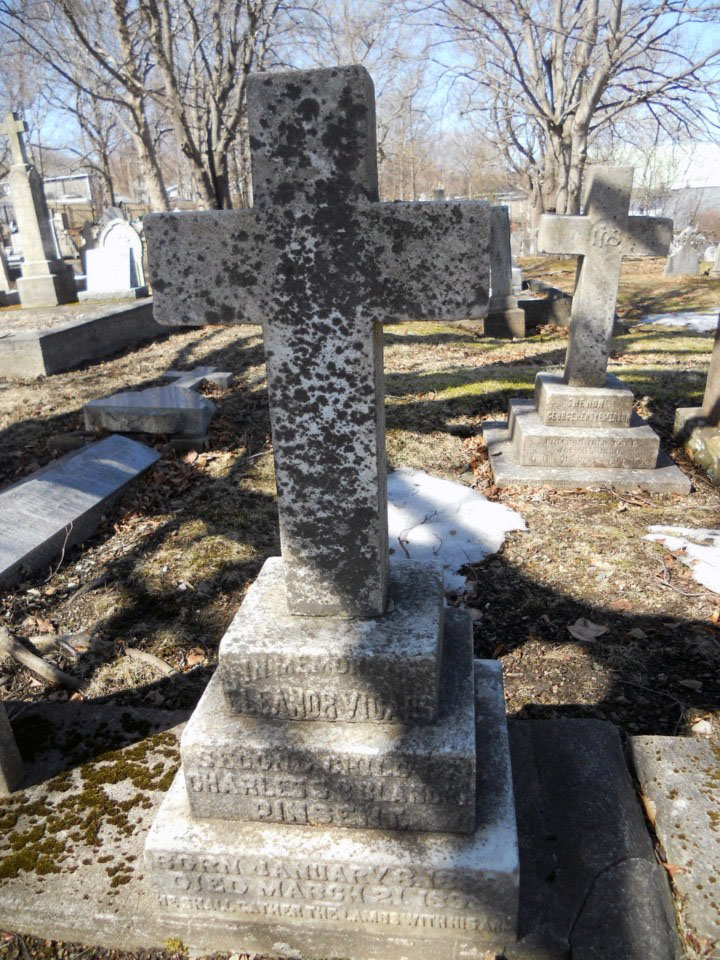
Eleanor Vicars Pinsent’s 1898 gravestone.
Blanche was an impressive amateur artist and a bound album of her paintings – entitled “The Wild Flowers of Newfoundland” (dated 1882) was recently put up for sale on-line by “Attic Books” of London, Ontario. The couple had one surviving son (Earl Speare Pinsent) and two surviving daughters (Constance Douglas and Frances Isobel Pinsent). Sadly, a second daughter, Eleanor Vicars Pinsent died at the age of twelve.
The 1880s were a good time for the family: Robert John was appointed to the “Supreme Court” in 1880, Thomas Williams was busy collecting water rates in St. John’s and Charles Speare was working away at the “Union Bank”. The families met socially – on one occasion on board “H.M.S. Tenedos”, which was having an “At Home” (Evening Telegram: 18th January 1884). They all lived in the same world; they attended levees at Government House and elsewhere, made donations to the usual charities and took a strong interest in the Anglican Church.
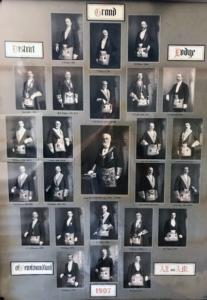
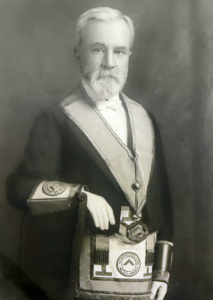
Collection of portraits of Masons, including Charles Speare Pinsent.
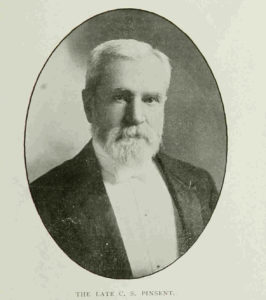
In another article in the “Newfoundland Quarterly” in 1914-15 (a memorial or obituary [that includes the above photograph] of Charles), Mr. LeMessurier tells us that Charles was initiated a Mason in “St. John’s Lodge, No. 579” 1863 and that he worked his way up the hierarchy. He was “Worshipful Master” of the lodge in the early 1870s and “when Sir. W. V. Whiteway succeeded Mr. J. S. Clift as Grand Master of the “District Grand Lodge,” Mr. Pinsent became his Deputy, and after Sir William’s death he acted as District Grand Master until the appointment of the present incumbent of the office Mr. J. A. Clift”. Charles was “Past Deputy District Grand Master R. F.” the oldest “Past Master,” and the oldest member of St. John’s Lodge of the order when he died in St. John’s in 1914.
There were three Freemason Lodges in St. John’s Newfoundland around this time: St. John’s Lodge, affiliated with England; Tasker Lodge, affiliated with Scotland and – from 1876 onward, Shannon Lodge, which was affiliated with Nova Scotia. The “Proceedings of the Seventh Annual Convocation of the Royal Arch Chapter Masons of Nova Scotia [1876]” contains correspondence between its secretary and thirty-seven Companions of the “Grand Chapter of Royal Arch Masons of England” who prayed for dispensation to open a break-away Chapter in St. John’s aligned with them, to be called the Shannon Chapter. Charles Speare was one of the signatories. He was said to be its “Scribe.” Why the need for new Chapter, I do not know! The companions claimed to have separated from their parent Lodge on amicable terms. The Nova Scotians gave their dispensation for “Shannon Lodge, No. 9”. Charles was an active member throughout his life – although he was later affiliated with the over-arching “District Lodge”.
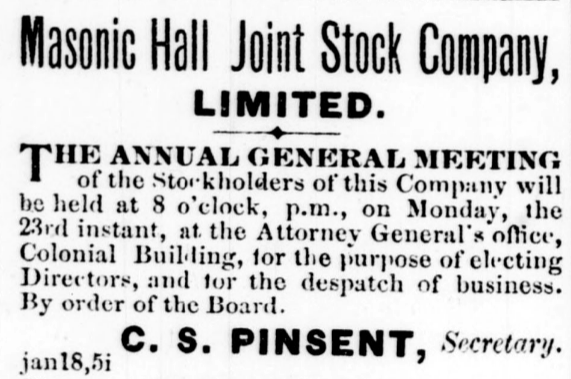
Advertisement from Evening Telegram, January 20, 1893
Back in St. John’s, Charles was “Secretary” of the “St. John’s Masonic Mutual Insurance Company Limited” and he kept the books into the 1900s. In January 1883 he was able to assure the members that they were in good shape. At the same time, he informed the shareholders that there had been three deaths since the last annual meeting – Brothers Pinsent (William Pinsent – a ship’s captain from the TEIGNMOUTH Branch of the family), Searle and Warren and their claims had been promptly paid (Evening Telegram: 18th January 1883). Two year’s later he was installed as “treasurer” of Shannon Chapter and he was one of several shareholders in the “Masonic Hall Joint Stock Co. Limited” to call on a Mrs. Pilot to thank her for her work in organizing a bazaar for them (Evening Telegram: 28th October 1886). Charles was appointed “Secretary” and later “Treasurer” of the “Masonic Hall Joint Stock Co.” (which included members of all the Lodges) and was, for several years, responsible for organizing its “Annual General Meetings” – which were usually held in January or February (e.g. Evening Telegram: 20th January 1893).
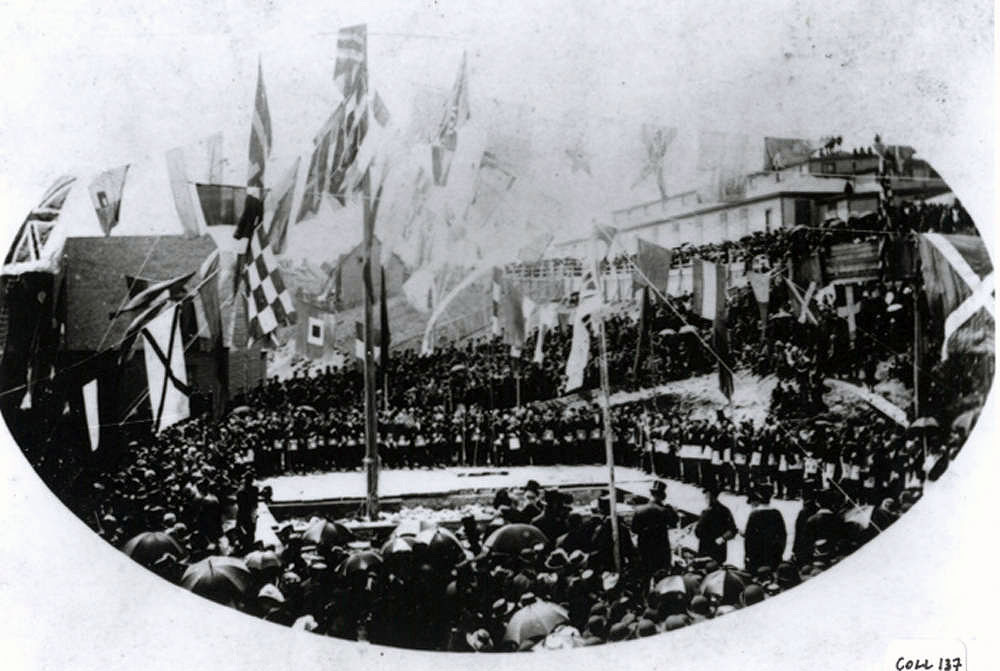
The early 1890s were a particularly busy time as the lodges were growing fast, however a great fire destroyed their Hall – along with much of the downtown core of St. John’s in 1892! The Masons decided it was time to build an impressive new Temple. Charles called several extraordinary meetings of the “Joint Stock Company” to discuss possible sites and plans for the edifice (Evening Telegram: 23rd September 1892 and Evening Telegram: 7th May 1894). The cornerstone was laid on 23rd August 1894.
Charles was among the presiding officers when Shannon Lodge installed its officers at the “Annual General Meeting” held in January 1893 (Evening Telegram: 20th January 1893), and – as “District General Secretary” and a “Past Master” – he was called on to assist the “Deputy Grand Master” (Rt. Hon. Sir William V. Whiteway) to install St. John’s Lodge’s slate of officers when it held its “Annual General Meeting” (Evening Telegram: 29th December 1892). One way or another, he performed these task many times in the years that followed.
All went well in St. John’s until December 1894, when the “Commercial” and then the “Union” banks collapsed. Charles (the “Manager”) and the directors of the latter were charged with issuing fraudulent financial statements in 1893 and 1894, and of issuing dividends while knowing full well that the bank would be unable to pay (Evening Telegram: 23rd July 1895). The “Union Bank” unquestionably did declare a six percent dividend “by order of the Board, Chas. S. Pinsent, Manager” on 6th December 1894 (Evening Telegram: 6th November 1894) – just days before the bank collapsed. The “Union” and “Commercial” banks failed on “Black Monday” 10th December 1894. Charles attempted to right the ship in the weeks following. When asked what caused the Union Bank to go down, he replied: “Because the Commercial had not opened its doors, because exchanges of that Bank had been dishonored, and because the Savings Bank had made a demand upon them for the specie; they were therefore compelled, in the interest of all to suspend” (Evening Herald: 2nd January 1895). Sadly, there was little he could do.
Notice of the charges were reported throughout England (Gloucester Citizen: 22nd July, 1895 etc.) and the Empire at large, including Australia (Newcastle Morning Herald and Miners’ Advocate: Tuesday 10th September 1895) and New Zealand (Daily Telegraph: 19th September 1895). The directors were released on $36,000 bail and two additional sureties of $18,000 each. “Manager Pinsent” was released on a somewhat less stringent bail terms; however, he agreed to testify and a few days later the Crown dropped his charges (Dundee Courier: Friday 2nd August 1895). This development was, I suspect, less well advertised!
Charles had had the misfortune to be appointed manager of the “Union Bank” in August 1894 (Newfoundland Daily News), just before the financial crisis which was essentially triggered by a London bank calling on the “Commercial Bank” for a payment. The cod fishery had been unreliable for several years and several well-known merchant firms that supplied out-port fishermen with credit through the fishing season (under the historic “truck” system – whereby payment was expected at the end of the season) were hurting and drawing heavily on the banks.
To make matters worse, some of the principal merchants were on the boards of the banks and they had borrowed heavily (sometimes questionably) to keep themselves afloat. The “North Adams Transcript” (a Massachusetts newspaper (23rd July 1895)) went so far as to say that they had appropriated between four and five million dollars to their own accounts. There were other contributing factors too. A great fire that had consumed half of St. John’s in 1892 had impacted trade and commerce and the Government had found itself on the hook for the bulk of the cost of constructing the railway across the Island.
The Crown case opened with testimony from bank staff designed to elicit how the bank’s statements had been determined in 1893 and 1894. The principal take-away being that the Mr. Goldie, the previous manager, was responsible for the former and that the 1894 balance, although signed by Mr. Pinsent, was largely based on Mr. Goldie’s work (Evening Telegram: 6th August 1895). Mr. Goldie had, perhaps conveniently, retired back to Scotland. The witnesses also testified as to the bank’s dealings with the various directors. However, this seemed to raise more questions than answers.
Mr. Pinsent’s evidence was given under oath over a period of almost a month, starting on Tuesday 20th August (Evening Telegram: 24th August 1895). He was subjected to direct and cross examination, followed by a second round of re-direct and re-cross examination. The Newfoundland newspapers covered the case in excruciating detail – up to and including analysis of the financial details. It is hardly surprising that even Charles found it hard to keep track: “In my statement of transfer of the shares, on Friday, I overlooked Sir Robert Thorburn’s account, as trustee. He had 18 shares as trustee, and sold in August 1887, to James Goldie, trustee, Twelve Shares; A. G. Smith, 3 shares; Sept. 1891, R. J. Moore, 1 share; C. Nichols, 2 shares. In another account he had 15 shares, as trustee, which he also sold in 1887 to A. G. Smith. Mr. Goldie never had any shares of his own” (Evening Telegram: 27th August 1895). A month later, “Mr. Pinsent Corrects His Previous Testimony: I wish to explain referring to the figures I gave yesterday respecting the liability of the Government of Newfoundland to the bank, on the 31st of May, 1893, and on the 10th of December, 1894. Instead of being indebted, as I said, to the bank on May 31st, 1893, in $73,484.55, they were in credit $112,183.40, owing to the credit balance at the customs, which I overlooked in Giving that Statement” (Evening Telegram: 25th September 1895).
One of the Telegram’s correspondents went so far as to say: “Dear Sir. — I notice so many alterations, amendments, discrepancies and counter-statements in Mr. Pinsent’s evidence re: “The Bank Scandal” that I should fancy, if the examination continues much longer, the poor, bewildered man won’t know whether he is standing on His Head or His Heels — what he has sworn to and what not. In fact I shouldn’t be a bit surprised if they got another dozen or two of lawyers on to him whether he wouldn’t be induced to swear that the bank is able to pay “one hundred cents on the dollar” and that it has never been smashed at all (Evening Telegram: 28th September 1895).
Eventually, it came time for the directors to respond – and several did by quoting Mr. Pinsent who, in truth, had not presented particularly damning evidence against them – at least with respect to their handling of the bank. For instance, The Hon. H. W. Harvey notes that “Mr. Pinsent, the principal Crown witness, testifies (Sept. 2) to the fact that it was the duty of the manager, and the practice also, to compile the annual statement from the balance-sheet of the books of the bank, and to submit it to the Directors with a recommendation as to the disposal of the funds, and to draw up the annual report. Mr. Pinsent states that he assisted Mr. Goldie in preparing the statement of 1893, and that Mr. Goldie suggested what appropriations should be made for bad and doubtful debts, dividends, and bonuses, and the amount to be taken from reserve to allow the usual dividend to be declared.” Elsewhere, “Referring to that statement of 1893, Mr. Pinsent says, I have no doubt now that it was a correct statement, from the information he had at the time. I Believe the Statement and report drawn up by Mr. Goldie to be true in every particular, and the directors adopted them without any alteration. (Evening Telegram: 12th November 1895). The trial came to an end and the directors were allowed to walk.
The damage had been done though, and Newfoundland was left without a reliable currency. Those beautiful “Union Bank” notes with Charles Speare Pinsent’s signature on them were now of questionable value. Eventually, the Bank’s $10.00 bill was reduced to an effective value of $8.00. Charles Speare must have regretted his appointment as “manager”; however he stayed as one of the bank’s trustees and helped wind it up.
The Canadian banks moved in and, over time, they helped to stabilize the economy. The financial crisis had brought down the Government in 1894 but, after a period of turbulence during which he was convicted of an unrelated act of corruption, the Rt. Hon. Sir William V. Whiteway returned to power on a “Pro-confederation” platform. Sir William was the most senior Freemason in Newfoundland at the time and Charles had been his friend and deputy for years, so it is perhaps not so surprising that he arranged for Charles Speare to be appointed “Gentleman Usher of the Black Rod” in 1898 (Evening Herald: Thursday 2nd April 1914). He was said to be an “accountant” living at #2 Devon Row, Ducksworth, in St. John’s at the time.
An undated and unattributed newspaper clipping made by Lady Pinsent (wife of Sir Robert John Pinsent, 1834 to 1898, see elsewhere) states: “his reign (at the bank) was all too short, but to him, at least, no blame can be attached for the unfortunate closure. His life was spent in the service of the Bank, and it seems a cold irony of fate when, having achieved the highest step, the rude awakening shattered his hopes and destroyed so promising a prospect.” It goes on to say, “Mr. Pinsent, as Usher of the Black Rod, will worthily maintain the honours, dignity and traditions of the office.” He was present in that capacity when the Legislature opened on 19th February 1902 (Western Star: Wednesday 26th February 1902) and served from then on until his death.
His reputation restored, Charles Speare and his wife Blanche were invited to attend an “at home” at Government House (Evening Telegram: 21st April 1904) and Blanche took at least one of the daughters (“Miss Pinsent” presumably Constance) on a trip to England. They arrived back in St. John’s from Liverpool on the “R.M.S. Buenos Ayrean” in September that year (Evening Telegram: 13th September 1904). Charles and Blanche also attended other social functions, with or without their growing children (Earl, Constance and Frances). For instance, there was that “Brilliant Ball” at Government House with British and French naval officers in attendance to which they took Constance (Evening Telegram: 13th September 1905). She was twenty-one years old. Similarly, there was the dance of “H.M.S. Calypso” a month later (Evening Telegram: 12th October 1905) and another “at home” at Government House the month after that (Evening Telegram: 17th November 1906). In August 1909, they attended the “Society Wedding” of Miss Muriel Winter to a Mr. Ryland of Warwickshire, England (Evening Telegram: 12th August 1909). One has to wonder if they knew of the DEVONPORT Pinsents’ link to the Rylands through their own English relatives. Sir Richard Alfred Pinsent had married Laura Proctor Ryland in August 1878. The Reverend Earnest Birchby, an English born “Clergyman” who was a “Curate” at St. Thomas’s Church in St. John’s was present at the service.
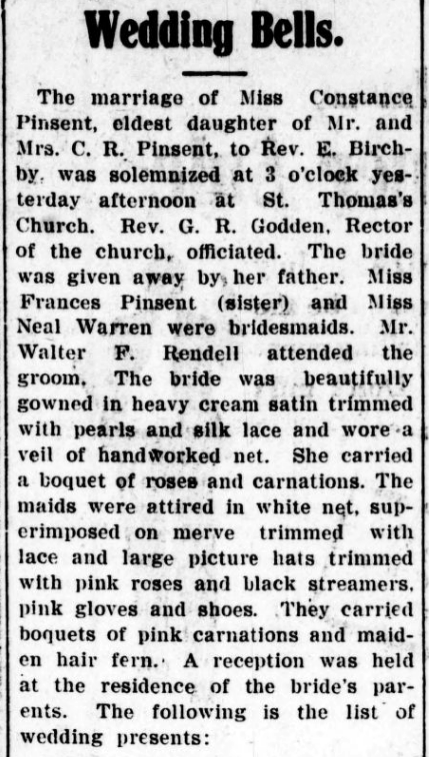
Wedding announcement for Constance Pinsent, Evening Telegram, July 13, 1911
Constance married Rev. Birchby at St. Thomas’ Church in St. John’s on 12th July 1911. She was given away by her father and Frances, her sister, was one of the bridesmaids. The attendees included just about anyone who was anyone in St. John’s (Evening Telegram: 13th July 1911) and the present list was extensive! The Pinsent family seem to have colluded: Lady Pinsent and her daughter Beatrice gave a set of silver teaspoons and sugar tongs; her son and daughter-in-law, Mr. and Mrs. F. W. H. Pinsent (Frank and Janet) gave a silver tea pot. They were living in England by then. Constance’s sister Frances gave a tea cloth and Mrs. R. H. Pinsent (Ann) a Japanese tea cosy. Her father and mother came up with a cheque – and an old blue china dish. Mr. Birchby, who had been on the staff of the Church, accepted a position in the United States shortly thereafter, and the couple moved to Pennsylvania. Their first son was born in the States in March 1913 (Indiana State Board of Health: Ancestry.com).
Meanwhile, after they came of age, Earl and Frances joined the rest of the family in attending the city’s social events in St. John’s. For instance, the whole family attended the “at home” held at Government House in October 1910 (Evening Telegram: 5th October 1910) and the Coronation Garden party held there the following June (Evening Telegram: 24th June 1911). Presumably Frances must have been the “Miss Pinsent” who accompanied Charles and Blanche to events like the reception at Government House held to honour the King’s Birthday on 3rd June 1913 (Evening Telegram: 4th June 1913). Her elder sister had married by then. In July of the following year, we find Frances and her brother Earl attending a garden party at “Government House” at which they were introduced to H.R.H. the Duke of Connaught (Evening Telegram: 17th July 1914). Charles had died and Blanche was probably down in the United States by then.
Frances had been educated at Bishop Spencer College in St. John’s – the girls equivalent of Bishop Feilds College. She passed her primary “Council of Higher Education” exams in 1903 (Evening Telegram: 8th September 1903) and her final exams five years later, in 1908 (Evening Telegram: 1st September 1908).
Frances seems to have been musical and was among a group of young ladies who gave a concert at the Asylum in May 1905 (Evening Telegram: 29th May 1905), and she assisted Miss Hutchings in putting on an entertainment for the children in the “Feild College Kindergarten” in December that year (Evening Telegram: 20th December 1905). She played the piano and received an intermediate grade certificate from “Trinity College of Music” in June 1906 (Evening Telegram: 16th June 1906) and a higher grade certificate from the same institution in June 1908 (Evening Telegram: 25th June 1908). Frances was artistic too. She seems to have also won a prize for silk embroidery at an Art Exhibition held in St. John’s in April 1908 (Evening Telegram: 9th April 1908) – and was given a handbag as a prize for her work at the end of the year (Evening Telegram: 24th December 1908). She was also an actress. The young people of the town put on a performance of “Miss Elizabeth’s Prisoner” at the Casino Theatre in December 1913. It was a romantic comedy set during the American war of independence. Frances played the part of “Molly” (Evening Telegram: 27th November 1913). What she had to say and how well she said it is not recorded.
When His Excellency the Governor invited the cadets onboard “H.M.S. Cornwall” to a dance at Government House the “Misses Pinsent” (Constance and Frances) were among the young ladies who were also invited (Evening Telegram: 8th October 1910).
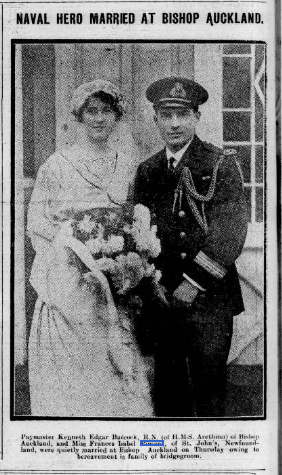
Frances and her husband pose for a wedding photo, North Star (Darlington), January 1st, 1916
Frances Isobel married Paymaster Kenneth Edgar Badcock, R.N., of “H.M.S. Arethusa” during the “First World War.” He was from Bishop Auckland, in the north of England, and they married quietly there on 30th December 1915. The event was more subdued than her sister’s had been as Major Stanley E. Badcock had recently died in France. Kenneth, who was Secretary to Commodore Reginald Y. Tyrwhitt of the Light Cruiser Squadron, had received a “mention in the dispatches” for his conduct during the battle of Heliogland, when his ship had sunk the “Bleucher” (Evening Telegram: 15th January 1916). Sadly, his own ship “H.M.S. Arethusa” struck a mine and sank in the North Sea the following month. Presumably he was on shore at the time. One way or another, Kenneth survived. He was awarded the D.S.C. (Distinguished Service Cross) the following year – “though for what services we have not been informed” (Evening Telegram: 27th September 1927).
Charles was a committed Anglican who attended the biennial sessions of the “Dioceses of Newfoundland Church Synod” and was appointed to its “Education Committee” in 1891 (Evening Telegram: 4th July 1891) and the “Board of Directors of the Church of England College” in 1896 (Evening Telegram: 15th July 1896). He held the latter position for many years – frequently reading its biannual report at the Synod. The institution later became known as “Bishop Feild College” (Evening Telegram: 28th June 1900) and Charles’ son Earl went there in the early 1900s. What he thought of it when his father turned up in his official capacity on Speech day, I do not know.
In 1908, Charles also attended the Synod as a member of the “Lord’s Day Alliance”, an organization that was trying to extend religious reach into the Colony’s outports: “Mr. C. S. Pinsent referred briefly to the desirability of forming branches in the outports and read a letter from the organ of the Alliance, The Lord’s Day Advocate, on the prospects in England. In reply the Bishop welcomed the deputation and said it was a source of pleasure and gratification to receive it. He believed that our people are anxious that there should be no encroachment on the Sabbath rest” (Evening Telegram: 29th September 1908). At the following Synod, he was elected as “Lay Secretary”, while also reporting on College matters and lobbying for the “Alliance” (Evening Telegram 16th June 1910). A few days later he attended the Methodist Conference on behalf of the “Alliance” (Evening Telegram: 21st June 1910). He put in his last appearance in June 1912.
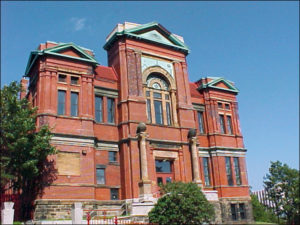
Masonic Temple, St. John’s, NL, via Heritage Newfoundland and Labrador
The bank failure was embarrassing but the Masons did not seem to be unduly concerned by financial or political scandals. The Masons’ new temple opened with great pomp 23rd January 1897. Members of all three lodges processed through the streets in full regalia and entered the temple carrying salt, corn, wine and oil and conducted the appropriate ceremonials (Evening Telegram: 23rd January 1897). Charles played his part – Bro. C. S. Pinsent carried the oil in a silver vase and responded to a toast proposed by Bro. Past Master Mott of Avalon Lodge to the “Representative of the Grand High Priest, R.A. Masonry, N.S.” at the dinner afterwards.
The Masons processed again on Jubilee Day in June that year. Around 300 dressed in full regalia marched through the streets to Government House where “District Grand Master” Pinsent delivered an address to be given to the Governor and sent to Queen Victoria. They then returned to the Temple where they lined up for photographs (Evening Telegram: 26th June 1897).
Charles kept up his routine handling of the Annual General Meetings of the “Masonic Joint Stock Co. Ltd.” and he either installed or assisted in the installation of officers of the three St. John’s Lodges throughout the early 1900s. In addition, he was also called upon to handle special events. The three lodges in St. John’s hosted 12 members of the “Grand Lodge of Massachusetts” in 1903 (Evening Telegram: 3rd September 1903) and a couple of months later the members of St. John’s Lodge received “a handsome cup that had been given to them by the visiting American brethren” (Evening Telegram: 29th December 1903).
Charles was getting on in years but there is no sign that he cut back on his Masonic duties. M. E. Comp. Black, who was visiting “Shannon” Chapter presented R. E. Comp. C. S. Pinsent, R.G.H.P. “with a beautiful gold jewel, the gift of the Grand Chapter”. In making the presentation, he made “complimentary reference to the services rendered by R. E. Comp. Pinsent during his long tenure of office” (Evening Telegram: 27th April 1906). Three years later, when the “District Grand Lodge” held its convocation in November 1909, “Past Master” C. S. Pinsent was “presented with an address and a piece of solid silver plate in recognition of his services as District Grand Master after the death of the D. G. M., Sir W. V. Whiteway (in 1908). Brother Pinsent has the honour of being the oldest Past Master of St. John’s Lodge, and he was also Deputy to the late District Grand Master 10 years. The presentation was made by District Grand Master Clift in a suitable speech, to which Mr. Pinsent made an appropriate reply” (Evening Telegram: 23rd November 1909). Sir William died in July 1908, just a few days before he was to officiate at the opening of yet another lodge, “Avalon Lodge,” and it fell to Charles, as his deputy (and later replacement) to perform the rites (Evening Telegram: 30th June 1908).
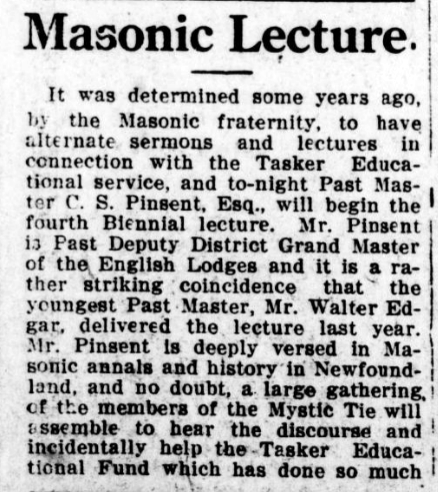
Announcement of Charles Speare Pinsent’s lecture, Evening Telegram, March 3rd, 1913.
The year 1913 was a particularly busy one for Charles. In March he gave the “Fourth Biennial Lecture” in connection with the “Tasker Educational Service.” According to the Evening Telegram: “Mr. Pinsent is the oldest Past Deputy District Grand Master of the English Lodges and it is a rather striking coincidence that the youngest Past Master, Mr. Walter Edgar, delivered the lecture last year. Mr. Pinsent is deeply versed in Masonic annals and history in Newfoundland, and no doubt, a large gathering, of the members of the Mystic Tie will assemble to hear the discourse and incidentally help the Tasker Educational Fund which has done so much for Education here, its beneficiaries belonging to all denominations. We feel sure the lecturer will be greeted by an audience large as to number, appreciative as to sentiment and confident as to the interesting matter they will hear” (Evening Telegram: 3rd March 1913).
Charles’s was getting on in years; however, he was still able to open a new Masonic Lodge at Botwood in Newfoundland on 22nd September 1911. During the opening, Bro. Pinsent gave an address which was printed in full in the Evening Telegram (22nd September 1911). In it, he touched on the origins and principles of Freemasonry and he specifically mentioned the two charities that the organization supported – the “Tasker Educational Fund” and the “Masonic Benevolent Fund”. He also commented on the lay-out of the “Masonic Hall,” and explained its symbolism with respect to the Freemason Hierarchy. When the lodge had been duly established, the officers were installed. In 1913, Charles was back in Botwood to see a new slate of officers installed in its new and “beautiful hall” (Evening Telegram: 23rd September 1913). Similarly, he was involved in the consecration of a new lodge on Bell Island in December 1913 (Evening Herald: 12th December 1913). Freemasonry was not exactly in the shadows. It was thriving.
In December 1913, “St. John’s Lodge No. 579” honoured Charles on the occasion of his 50th anniversary as a member of the lodge. He had been admitted on 5th December 1863 and had risen to the top ranks in the craft. The lodge presented him with a “handsomely illustrated address on silk” (Evening Herald: Saturday 6th December 1913). He was its oldest member. A week or so later, when the members of the Scottish affiliate, “Tasker Lodge No. 545,” met to honour their “Past District Grand Master”, John Cowan, they also elected Charles an “Honorary Member of Tasker Lodge” noting that: “Although a member of the English Branch, he presided over “Tasker Lodge” some years ago.” Mr. Pinsent replied to the many kind expressions of appreciation. The brethren then proceeded to the Banqueting Hall, and an enjoyable time was spent until midnight (Evening Telegram: 13th December 1913).
Painting of Charles Speare Pinsent in his Masonic attire.
Charles’s health had been failing and he had been forced to cancel a few engagements; nevertheless, his death – and the nature of it- still came as a shock to the whole community: “he left his home on Military Road for the Masonic Temple, as he rarely missed a function of the Order, and doubtless in the heavy snow and with the high wind his heart was overstrained, tho’ he contrived to open the door of the building and enter the hallway, but as he did he collapsed and death was instantaneous”. The masons contacted his family and his son Earl (who was also a mason) and others laid him out in the reading room covered by the Lodge Flag.
The evening’s event, the installation of Officers of yet another lodge – “Whiteway Lodge No.3541”) – was cancelled and, sometime after midnight the “Grand Master” of the lodge and other brethren took him home to his family (Evening Herald: 2nd April 1914 and Evening Telegram: 2nd April 1914). An “enlarged portrait of the late D.D.G.M. Brother Charles S. Pinsent, who died suddenly on April 1st 1914, when entering the Temple was unveiled. It is a peaking likeness of a brother beloved” was unveiled when the “Whiteway Lodge” again met to elect officers a year later (Evening Herald Saturday 3rd April 1915). The lodge, which was named after Sir William, had been formed in 1911.
Charles Speare Pinsent left his estate, worth $10,600, to his wife “for the benefit of herself and my child or children in such manner as she may deem desirable” and he appointed her as his executrix. The St. John’s Daily Star tells us that Blanche and her son Earl Speare Pinsent returned to St. John’s after spending the winter of 1914/1915 in the United States with Mr. and Mrs. Birchby and at least one of their children on 21st May 1915.
Rev. Ernest and Constance Birchby lived at Hughesville in Pennsylvania. He died there in 1922 and Constance and her children moved to Kensington, in Maryland. I am not sure why. When her mother Blanche went down for a visit in 1916, she predictably gave her son, Earl Speare, as her “home” contact and her daughter, Constance, as her intended destination (Canada-U.S. border Crossings: 1916). She returned from Halifax in dense fog on the “S.S. Florizel” on 27th July 1916 (Evening Telegram: 27th July 1916). Constance died in Maryland in 1927.
Blanche’s son, Earl Speare Pinsent, had qualified as a lawyer by the time he married Beatrice Dickinson in September 1916 (Evening Telegram: 7th September 1916). His life is discussed elsewhere. When he married and moved out of the family home, his mother sold off the furnishings at #53 Military Road in St. John’s (Evening Telegram: 2nd November 1916) and went to live with her daughter Constance (Mrs. Birchby) in the United States.
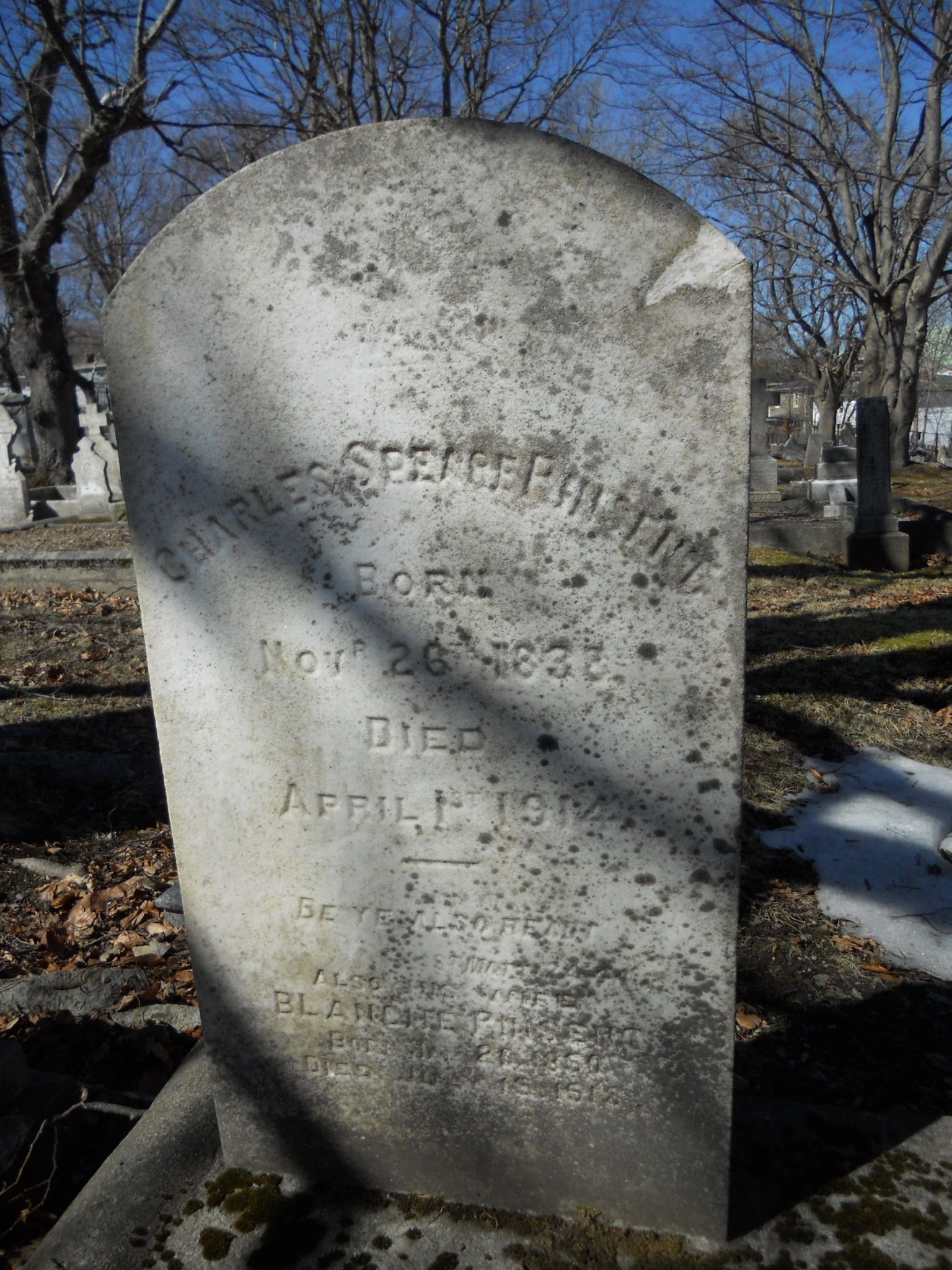
Blanche died in Hughesville in the United States and her body was returned to St. John’s for burial by rail (Evening Telegram: 23rd July 1918). She was buried with her husband at the “Church of England Cemetery” (St. John’s Daily Star: 24th July 1918). Earl arranged for her interment. Blanche left her estate to her three children, Constance, Earl and Frances. Her Will shows that most of her effects were still to be found at “Earl’s house”. Clearly, she had left them with him when she moved to the United States. Blanche gave her family portraits, her old china, the contents of a work box, and an old Bible that had (apparently) belonged to “Oliver Cromwell’s Secretary” to Constance, and her diamond ring and much of her silver to Frances. Her daughters split her financial assets. Earl received his father’s watch, bookcase and books, silver masonic tray and furniture (Newfoundland Probate Office). Her estate was valued at $7,760.41 after probate.
Please use the above links to explore this branch of the family tree. The default “Next” and “Previous” links below may lead to other unrelated branches.
Charles Pitt Pynsent (II) was the second to eldest son of Joseph William Pynsent by his wife Nellie (née Garland). He was born in Waverley, east of down-town Sydney in New South Wales. His father had a small dairy farm at Bondi. He grew up with three brothers and (eventually) seven sisters. In 1907, the family moved to a, presumably larger, dairy farm at Marrickville (Canterbury) south west of Sydney City Centre. Charles and his brothers worked on the farm and delivered milk as “carters”.
Charles Pitt’s father died in 1926 and Sydney’s Electoral Rolls show that in 1930 he was living with his mother and a younger brother, Thomas Ogden Pynsent (II) on Duke Street in Canterbury. Charles married Margaret (“Peggy”) O’Donnell there the following year.
The Electoral Rolls also tell us that Charles was a “milk carter” and that he was living with his wife on Chalmers Road in South Parkes, Strathfield, in 1936. Nevertheless, they seem to have found more permanent lodgings in Northcote Road, in Bankstown North, the following year and they were there until at least 1943. After the war, Charles and Margaret moved to Waterloo Road in Blaxland, Bankstown East. This was still their home in 1949. There was not much call for “carters” after the war and the Electoral Rolls tell us that Charles was now a “labourer”.
Charles Pitt and Margaret were still living on Waterloo Road in 1954. However, by then they had been joined by a Joseph William Pynsent. He was most likely a son who had been born shortly after the couple married in 1931 and had now come off-age. He was a “painter” – presumably of houses. Charles, Margaret and Joseph William were living on Jesmond Avenue, in Dulwich Hill, Parkes in 1963. Joseph William had become a “taxi-driver” by then. The three of them moved to Yanderra Street in the Condell Park suburb of Sydney a few years later -in 1968.
Charles Pitt Pynsent “aged 81 or 82, late of Campsie and Condell Park” died on 20th March 1975 (Sydney Morning Herald: 21st March 1975) and was buried among his forebears in the Catholic Mortuary at Rookwood Cemetery. His widow, Margaret, had moved to Biara Avenue in Campsie by 1980. According to the Sydney Daily Telegraph (24th May 2006): “Pynsent, Margaret (Peg) … aged 94, late of Greenacre” died on 20th May that year.
Charles Pitt and Margaret (née O’Donnell) seem to have had a daughter Marie Theresa Pynsent as well as their son Joseph William Pynsent (II). Marie Theresa married James Noonan in Sydney in 1995. Joseph William, for his part, married Lyn “Unknown”. I am not sure when or where. They seem to have had three children – a son and two daughters – who are, as far as I know, alive and well. Joseph William Pynsent, “aged 55, late of Oakdale, died on 22nd October 1987” (Sydney Morning Herald: 24th October 1987). He too was buried at Rookwood Cemetery.
Please use the above links to explore this branch of the family tree. The default “Next” and “Previous” links below may lead to other unrelated branches
Charles Pitt Pynsent was the youngest son of Joseph Pinsent by his third wife, Ann (née Tucker). He was born at “Lower Jurston,” the small farm near Chagford in Devon that his father, a “ship and insurance broker” had retired to after leaving London. Joseph had indulged in a torrid correspondence with the great and powerful in Whitehall in the early 1820s, and he had retired after being soundly rebuffed! Later, the family moved to Joseph’s, larger, contiguous, farm at “Lettaford” which was across the parish boundary in North Bovey. Joseph continued his battle over political economy from there well into the 1830s.
Charles was eleven years old when his father died and he was brought up by his mother, Ann (née Tucker) and her family, and also his elder half-sister, Mary Anna Pinsent (Pynsent). Mary Anna later became a “school mistress” in the nearby parish of Manaton: “Manaton Preparatory School for Young Gentlemen: Established 1843: Conducted by Miss Pynsent, who receives and educates a limited number of boys, under ten years of age, whose happiness and improvement it is her constant endeavour to promote, by a strict but affectionate discipline. The locality is proverbially healthy and invigorating and the surrounding scenery picturesque and beautiful. The very highest testimonials from the parents of former pupils: Terms most moderate, and to be had on application to Rev. G. Jenkins, Manaton Rectory, Moretonhampstead” (Exeter Flying Post: Thursday 15th July 1859). Mary Anna never married. She died at Lettaford in 1875.
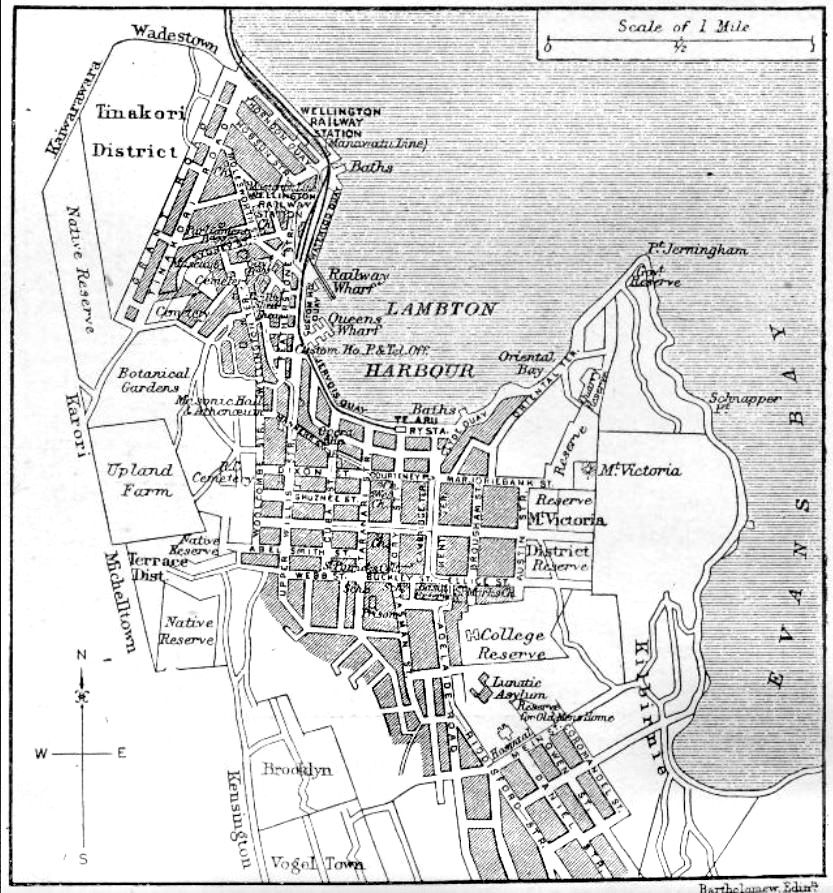
Map of Wellington, New Zealand.
The following biographies show that Charles Pitt Pynsent and his half-sister Elizabeth both spent time in Melbourne, in Australia. Elizabeth and her husband, William Francis Splatt went out to run a sheep station and Charles went out to work for them. He was still a young man and he was to marry there and later to return to England a rich man. He spent over twenty years living in England and traveling on the Continent with a cousin (Thomas Pynsent) and his wife. However, he never settled in England and he took his family out to Wellington, in New Zealand in 1880. The following is an extract from “Cyclopaedia of New Zealand: 1897.”
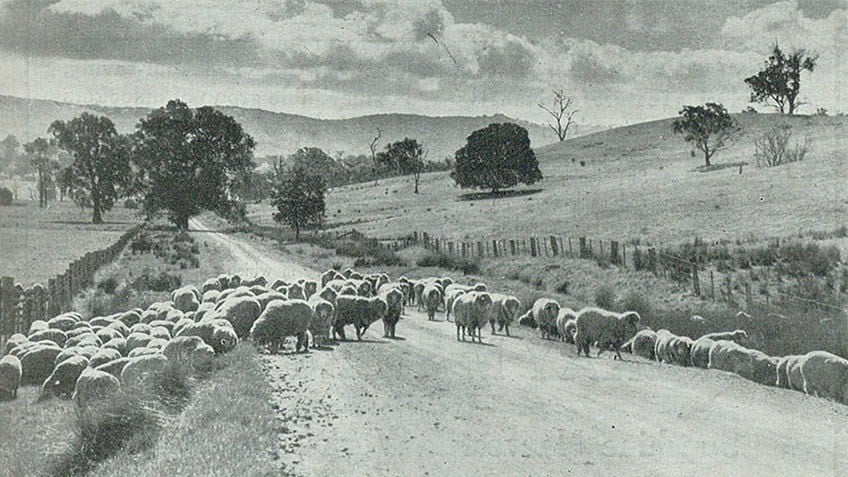
Sheep in Victoria, Australia.
“Mr. Charles Pitt Pynsent, whose house and grounds are situated in Hobson Street, was born in Devonshire in 1829 (actually 1824, RHP). His father, Mr. Joseph Pynsent was a Devonshire landed proprietor. His son (Charles Pitt Pynsent: RHP) went to Victoria when quite young. Mr. Pynsent engaged in sheep farming from his earliest days and on attaining manhood took up a squatting lease on the Wimmera River from the Victorian Government. His venture proving successful, he obtained an additional lease having a total area of land from two hundred to three hundred square miles of territory. His sheep numbered 60,000 and for some years he led a happy squatter’s life.
In 1854 he left Victoria and returned to England where he remained several years. Later he spent some time in various parts of the continent, including France, Belgium, Italy and Switzerland. Mr. Pynsentcame to New Zealand in 1880 on account of his health, arriving in Wellington on Christmas Day in that year per. S.S. Northumberland, commanded by Captain Babot, and has reason to be thankful for improved health during the period in which he has lived in the Empire City.”
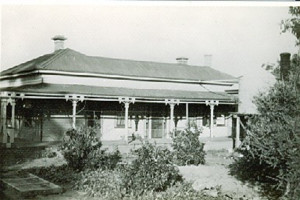
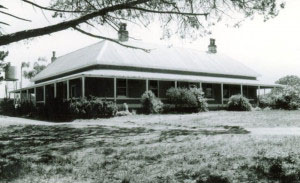
The South Wonwondah Homestead.
Also, Jim Heard, in a history of “Wonwondah Station” that he presented at the Annual Dinner of the Western Victorian Association of Historical Societies on 20th March, 1999, (http://home.vicnet.au/-wvahs/wonwondah.htm) tells us that:
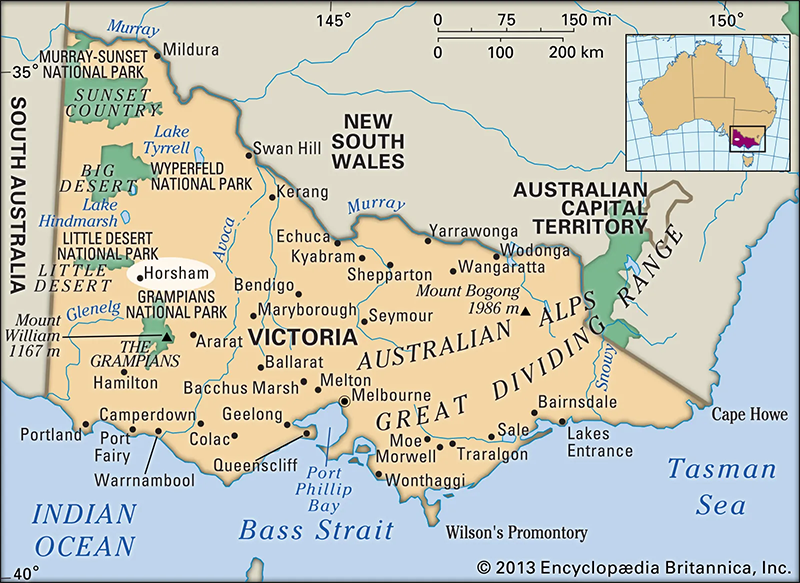
“Charles Pitt Pynsent and William Francis Splatt purchased Wonwondah Station and its livestock from Messrs Brodie and Cruikshank in August, 1845. The station then covered 140,000 acres (15 miles south of Horsham on Norton Creek in the Wimmera River area) and ran approximately 20,000 sheep. It was bordered by six other ill-defined “runs” and, as was common at the time, the boundaries were disputed, in 1847. Pynsent and Splatt were related by marriage (Splatt had married Pynsent’s step-sister). Both were influential in the founding of Horsham and later had streets named after them.
Charles Pitt Pynsent occupied Wonwondah Station in 1845 and, a few years later, (in either 1851 or 1852), he married Georgina Helen Ball, in Melbourne (a.k.a. Georgiana). He does not appear to have stayed in Australia very long. He returned to England around 1854. William Splatt was elected to the first Victorian Legislative Council in 1851. However after selling Wonwondah to John Quarterman in 1854, he also returned to England, where he became Mayor of Torquay and a Devonshire Magistrate for 28 years. He (William) died in 1893. In later life (1880), Charles Pitt, either for health reasons or “in pique because income tax was set at 6d in the pound” went out to New Zealand, where he died in 1903. His memorials include a Hotel in (Melbourne) Victoria, a street in Nairobi (Kenya), a waterfall in New Zealand and a small plant! “.
Not to quibble with Mr. Heard, but the Hotel in Victoria belonged to the AUSTRALIA branch of the “Pinsent” family and the small plant is probably the hybrid-saxifrage “Kathleen Pinsent” developed by an English gardener and named in honour of a member of the DEVONPORT branch in 1934. However, I digress.
The immediate question is: Why Charles Pitt Pynsent and not Charles Pitt Pinsent? It seems that Charles’s father, Joseph Pinsent, was obsessed with William Pitt, “The Great Commoner” under whose guidance Britain had been so successful during the “Seven Years War” (1756-1763). Joseph’s interest in Pitt was probably peaked by the fact that an eccentric baronet, Sir William Pynsent, had left his estates in Somerset (“Burton Pynsent”) and Wiltshire (“Erchfont” or “Urchfont”) to Pitt when he died in 1765. After receiving the bequest, Pitt abandoned the gentlemen in Commons and joined the aristocracy as William Pitt, “Earl of Chatham:” So much for the “Great Commoner.” The story is laid out in another part of this website: “The Pynsent Baronetcy: The Trials and Tribulations of a Litigious Family: 1687 – 1765.” Pitt built Burton Steeple, an imposing monument at “Burton Pynsent” in gratitude for the bequest. It still stands looking out over Sedgemoor. Joseph’s fascination with Pitt led him to name two of his children Joseph BURTON Pinsent and Charles PITT Pinsent.
The obsession was evidently contagious as Joseph’s nephew Thomas Pinsent – the relatively young but “senior” member of an upwardly mobile branch of the Pinsent family picked up on Joseph’s interested. Thomas checked the parish records to see if he could establish a link to the extinct baronetcy; however he failed and, to do him credit, he never claimed the link. He did, nevertheless, formally changed his name to “Pynsent” two days before his marriage to Jane Sparrow in 1842. Thomas convinced several of his cousins from Joseph’s marriages to Elizabeth Pynsent and Ann Tucker (see here and elsewhere) to change their surnames as well. This explains why we find “Charles Pitt Pynsent” running sheep in Australia in the 1850s.
Charles went out to Australia with his half-sister Elizabeth and her husband William Francis Splatt in 1841. Charles’s obituary notice, which was written in 1903, tells us that he went out after attending college in England. Perhaps he did, but he was only seventeen when he emigrated. Charles worked with Mr. Splatt and later took over as part owner and managing partner of his uncle’s sheep station at “Wonwondah.” This was when he came off age, in 1845.
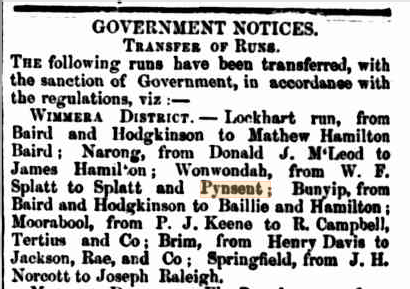
The transfer is noted in the Geelong Advertiser, August 2, 1851.
The sheep run was officially transferred from W. F. Splatt to “Splatt and Pynsent” in August 1851 (Geelong Advertiser: 2nd August 1851. Mr. Splatt had recently been appointed to the Victoria Legislative Assembly and he needed Charles to manage the family’s sheep run at “Wonwondah.” A few years later, William Francis and his wife (Elizabeth, née Pinsent) returned to England. They had had enough excitement. They left Charles to manage their Marino sheep business. However, shortly before William left, the partners acquired another major sheep run at Lexington, near Horsham in Victoria.
Horsham in Victoria, Australia via Encyclopedia Britannica.
In “The Currency Lad” a book by T. S. Willis Cooke, there is a copy of a letter written by Mr. Splatt to the previous owner, It states: “Dear Sir, I agree to purchase your stock and stations at the price and terms described in your offer of the 23rd October inst (copy of which is annexed hereto) and I hereby authorize my partner, Mr. Charles P. Pynsent, to draw on me on sight payable to your order for the sum of £2,000 being the deposit money mentioned in your offer. Mr. Pinsent is also authorized to take delivery of the stock and stations at your convenience and on your handing me his receipt for the same and your making the usual transfer, I will grant you my acceptances for £4,000 and £2,000 as stipulated and also a mortgage over the entire property to secure the one payment of the said acceptances and also the residue of the purchase money with the interest thereon in conformity with your offer. I have only to add that if Mr. Pynsent should make any further purchases of you either of live or dead stock the same will be a binding, one, Dear Sir, Yours very Truly, Wm. F. Splatt:
The Lexington Homestead.
P.S. As Mr. Pynsent takes an equal interest with me in this purchase and will take the active management I shall of course readily acquiesce in all his arrangements: W.F.S.” The previous owner had, evidently, over extended himself and as “It became impossible to get enough servants and farm hands as people headed for the diggings, in October 1852 (just over a year after moving into his ‘Mansion’), he was forced to sell Lexington to William Francis Splatt and Charles Pitt Pynsent on the basis of a ‘walk in – walk-out’ for the huge sum of £35,000 on mutually agreeable terms: the property was 120,000 acres, or 187 square miles” The letter included an inventory of contents; including 28 or 29,000 sheep. Lexington is approximately 95 km (59 miles) southeast of Horsham.
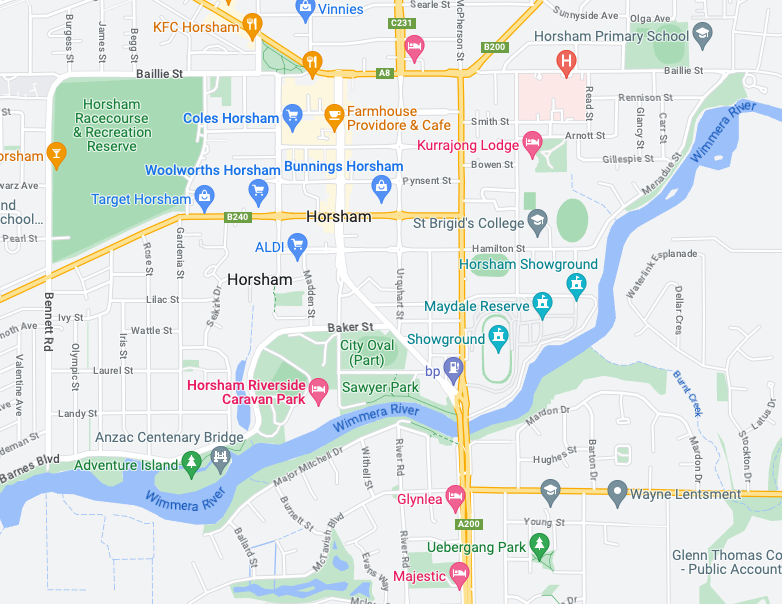
Pynsent Street, Horsham, via Google Maps.
Charles was twenty-eight years old. By 1856, Splatt and Pynsent held a total of 19 Licenses (including those at “Wonwondah”; “La Rose” and “Lexington”) near Horsham, in Victoria. They had made their mark in the district and their presence is memorialized in two of Horsham’s Street names, Splatt Street and Pynsent Street.
Charles Pitt Pynsent Esq. of “Wonwondah” married Georgina Helen, the second daughter of George Palmer Ball Esq. of St. Kilda, at St. Kilda, on 8th September 1852 (Melbourne Argus: 9th September 1852). She had been born in Tasmania. They married roughly a year after the discovery of placer gold at Ballarat, in Victoria, and while Melbourne was suffering from the shock of a full fledged gold rush.
This was the moment that Charles’s half-brother, Joseph Burton Pynsent – doubtless encouraged by his half-brother and Mr. Splatt – shut down his grain importation business in Bristol and went out to Australia to join them. He sailed for Australia with his son (Thomas Ogden Pynsent) on the “S.S. Great Britain” in November 1852. Interestingly, he took his young son but not his wife. Perhaps she had heard about the reality of frontier life in Victoria! Alternatively, their relationship may have been somewhat strained by then. Mr. Splatt helped Joseph Burton,“Burton” as he was commonly known, set up in business as a “general merchant”(“Burton Pynsent & Co.”) with a store on Elizabeth Street in Melbourne and a branch outlet at “the Diggings”. It was one of the last things That Mr. Splatt did before returning to England with his wife Elizabeth. He left his two brothers-in-law to fend for themselves. Joseph Burton’s (very interesting) life is documented elsewhere in this website.
Charles and Georgina had a daughter, Frances Elizabeth Pynsent in 1953, while living at Lexington House at “Wimmera” (Bristol Mercury: Saturday 31st December 1853). Perhaps being a father was one of the reasons why Charles decided to follow his half-sister and her husband back home to England the following year. In 1854, Charles and Mr. Splatt (his silent partner) offered up 24,000 sheep for sale when “depasturing” Lexington: “These sheep have never been diseased and are considered second to none in this colony for weight of fleece and carcases” (Geelong Advertiser and Intelligencer: Saturday 1st April 1854). One sold sheep by the thousand in those days!“Lexington” was, of course, just one of their runs. They still had “Wonwondah”.
In a retrospective look at the life of a Mrs. Pickford, who died in 1912, the Horsham Times (Tuesday 12th November 1912) reflects on how she and her husband had been enticed out to “Wonwondah” by Splatt and Pynsent in 1851/2. It was shortly after their marriage in Bristol. Her husband had previously worked for Charles’s half-brother Burton Pynsent in Melbourne and he had agreed to come out as a station hand while she became a cook. They stayed on at “Wonwondah” after it was sold to Quartermain and Rutherford. Conditions were a little rough in those days. Mrs. Pickford recollected having to cook breakfast for the famous bushranger “Captain Moonlight”.
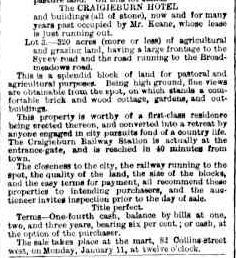
News clipping describing the hotel property, now available for sale. The Argus, December 17, 1874.
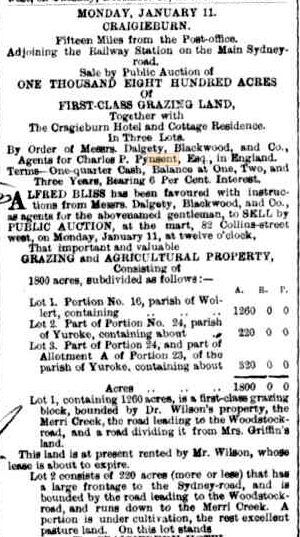
I am not sure precisely when Charles left for England with his young wife and daughter (Frances Elizabeth Pynsent) but it was probably in 1854 – about three years after the current Homestead was built. Charles was a rich man by then and he still owned property in Victoria when he left. He owned a Hotel at Craigieburne near Melbourne. Perhaps he thought he might return someday.
Charles P. Pynsent continues to list his property for sale. The Argus, December 22, 1874.
Back in England, Charles became a Fellow of “Queen’s College” Cambridge on 22nd January 1855. Later that year, while visiting his half-sister, Elizabeth Splatt (née Pynsent), in Gittisham, in Devon Charles Pitt prepared a Will. It is now in the Devon Records Office. In it, he refers to his wife, Georgina Helen Pynsent and his sisters, Mary Anna Pynsent, Anna Lucretia Pynsent and Harriet Cordelia (Partridge) – with whom he must have only recently reconnected after his time in Australia. Charles was still a relatively young man when he prepared the will and it included provision for as yet unborn children. He requested that the various bequests and legacies be paid out of his estates in Craigieburne. This document was to be superseded by a will he wrote in Wellington, New Zealand, in 1899.
Charles had another daughter (Mary Emily Pynsent) while staying with his half-sister Elizabeth. However, I gather she died young (personal correspondence sent to my father Robert John Francis Homfray Pinsent). I do not have the details.
Charles Pitt Pynsent and William Francis Splatt dissolved their partnership as the principal “stockholders at Wonwondah and Lexington in the Colony of Victoria” on 9th June 1856 (Government Gazette) and they went their respective ways. Charles had his signature witnessed by his cousin, Thomas Pynsent, of “Corfield House” in Weston-super-mare. Like his cousin, he too was by then a very rich man.
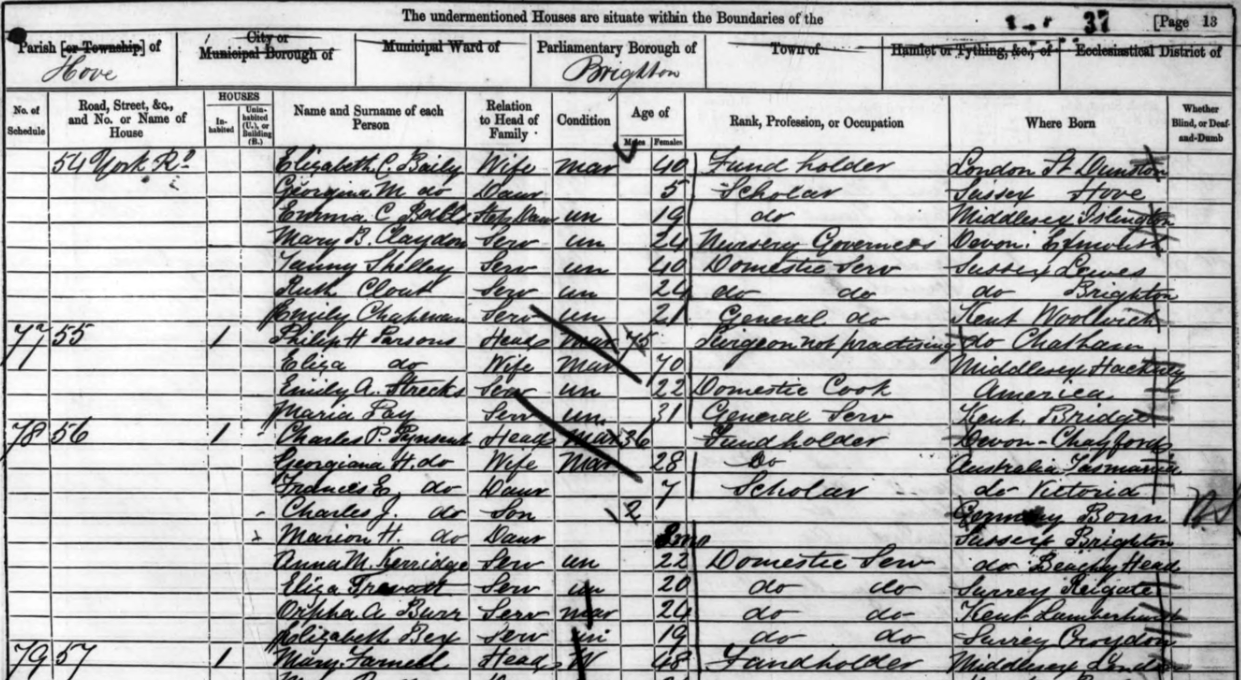
Charles Pitt Pynsent appears in the 1861 census.
Thomas Pynsent had sold the family farm at “Pitt”, in Hennock a few years earlier and invested the money. He thought of himself as a “gentleman of leisure”. His life is described elsewhere. However, Thomas and his wife (Jane née Sparrow) and young children enjoyed traveling and they lived on the Continent for a while. Charles and Georgina (née Ball) made several trips with them and also spent time abroad. They had two daughters: Frances Elizabeth Pynsent who was born in Melbourne in 1853 and Mary Emily Pynsent who was born in Devon in 1855. They added a son Charles Joseph Pynsent in Bonn, Germany, in 1858 and on their return to England they settle in Hove, in Sussex and had their third and fourth daughters Marion Haslewood Pynsent and Florence Edith Pynsent in 1860 and 1862 respectively. When the Census takers caught up with the family while they were there in 1861, Charles said he was a “fund holder”: read independently wealthy.
The two families seem to have been particularly fond of Italy and they even had some Italian investments. William Francis Splatt of London and Charles Pitt Pynsent of Turin were both elected onto the Board of Directors of the “Italian Irrigation Company” (Canal Cavour) – which was based in Turin. This was after a managerial shake up in 1866 (London Daily News: Friday 23rd November 1866).
Charles and Georgina had a second son, Robert Burton Pynsent in Heidelberg, in Germany in 1869. Their first-born son, Charles Joseph Pynsent, was to die in Stuttgart the following year and Robert Burton was to become his father’s principal heir. According to the New Zealand Observer, Charles had a third son as it shows “the engagement of Mr. W. Pynsent, son of Mr. C. P. Pynsent, Hobson Street, and Miss Violet Deane, daughter of Major Deane, of England.” (New Zealand) Observer, Volume XXIII, Issue 21, 7th February 1903. However, this is wrong and other papers show that it was Robert Burton Pynsent who became engaged to Violet Deane. The Graphic Magazine: 31st July 1903, is right in referring to “Mr. R. Pynsent, the only son of C. P. Pynsent …” Robert Burton never actually married Violet – as far as I know. Interestingly, the announcement came a few months before Charles Pitt Pynsent died in Wellington, in July 1903, and Robert, who had been in London, had promptly gone out to New Zealand to handle his father’s estate. Perhaps that is what ended the engagement. Robert Burton Pynsent is the only son mentioned Charles Pitt’s will.
Charles’s eldest daughter Frances Elizabeth was (either formally or more-likely informally) “adopted” by her uncle and aunt (Mr. and Mrs. Splatt), and she was living with them in Devon when she married Francis Hawkins Hathaway (Captain of the 62nd Regiment), in Ermington, in 1872 (Belfast Newsletter: Monday 13th May 1872). Unfortunately, she died in November the following year. Perhaps as yet another a casualty of childbirth.
By 1874, Charles Pitt realized that he would not be going back to Australia, so he put his property there up for auction. It included “1,800 acres of first class grazing land; together with The Craigieburn Hotel and a Cottage Residence.” His agents, Messrs. Dalgety, Blackwood and Co., offered the land to the public in three lots; the grazing land; the hotel (with its frontage onto the Sydney Road) and the cottage residence area where there was valuable land “having a large frontage to the Sydney road and the road running to the Broad meadows road: This is a splendid block of land for pastoral and agricultural purposes. Being high ground, fine views are obtainable from the spot, on which stands a comfortable brick and wood cottage, gardens, and outbuildings. This property is worthy of a first-class residence being erected thereon, and converted into a retreat by any one engaged in city pursuits fond of a country life.” It was said to be adjacent to the railway station and within 40 minutes of “town” (Melbourne Argus: Saturday 19th December 1874). The lots were sold by auction at the Mart, 82 Collins Street, Melbourne, at 12.0 o’clock on Monday 11th January 1874. I hope he got a good price for them. The land would be worth a fortune today.
For some reason, Charles decided to live in New Zealand instead of Australia. He and Georgina and their family (Mary Emily Pynsent, Marion Haslewood Pynsent, Florence Edith Pynsent and Robert Burton Pynsent) emigrated and settled there in 1880. The traveled out on the “S.S. Northumberland” “First Saloon Class” and arrived in Wellington in November 1880 (Australian and New Zealand Gazette: Saturday 30th October 1880). Mary Emily Pynsent may have followed her parents out, as I have her travelling alone between Melbourne and New Zealand in September 1881 (Melbourne Argus: Thursday 8th September 1881). On arrival, Mary seems to have advertised for a position as a companion or house-keeper for a Lady, “salary not so much an object as a comfortable home” (Lyttelton Times: 23rd September 1881). Why she was not welcome in the family home, I do not know! Perhaps she just felt the need for independence. There are a few references for a Miss E. Pynsent – probably Mary Emily but possibly Florence Edith – attending concerts and playing the pianoforte in 1884 (New Zealand Mail: 22nd February and 6th July 1884), and the Misses Pynsent are referred to after the death of their married sister, Florence Edith, so they may have both been around. Nevertheless, I do not know what happened to Mary Emily. She seems to have married or died by 1888.
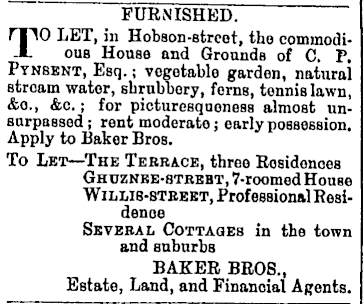
C. P. Pynsent lists his property to let in the Evening Post, February 18, 1888.
Charles and Georgina settled into a large house called “Clifton” on Hobson Street. It was near the main railway station on the north side of Lambton Harbour. The couple seem to have had only one daughter in residence by the time they let their house (Evening Post: 18th February 1888) and returned to London for a visit in May 1888 (Auckland Star: 4th May 1888). The house may have been a hotel when it was first built. It was an impressive building: “containing 10 rooms, besides bath, scullery larger pantry and storeroom, the superior residence of C. P. Pynsent, Esq. Grounds tastefully laid out, natural stream, water, ferns, shrubbery, tennis lawn, kitchen garden etc. For picturesqueness almost unequaled” (Lyttleton Times: Wednesday 22nd February 1888). Clearly, it had a lovely view out over the water.
Ironically, the best description of the garden is given in the New Zealand Graphic on 6th December 1911 – several years after Georgina left for England: : “One of the few beautiful gardens left in Wellington was the scene of a very enjoyable party on Thursday when Mrs. Fitzherbert and her daughters entertained their friends. In addition to a fine lawn overlooking the bay there is—in the Pynsent place which Mrs. Fitzherbert has been occupying for some time—a most picturesque gully with winding paths, where fern trees, native bush and flowering rhododendrons all grow thickly. So, the surroundings are ideal for a garden party. Afternoon tea, strawberries and cream, and teas on the lawn were much appreciated, and there was some inspiriting music from a string band. …”. It sounds lovely.
How long the family intended to be back to England for in 1888, I do not know. However, Charles made his way back to New Zealand on the “S.S. Tainui” in March 1890 (Auckland Star: 14th March 1890). Perhaps he had his family with him, however, if so they are not mentioned and they may have returned on another ship. The local Newspapers frequently refer to one, or some, of the Pynsents traveling by ship to the South Island or Australia. However, it is not always clear who they are referring to.
Charles, Georgina and family were rich and they very quickly slotted into the “fashionable” social scene in Wellington – which is at the south end of the North Island of New Zealand. Charles attended “levees” given at Government House to honour the Queen’s birthday almost annually in the 1880s and 1890 (New Zealand Mail: 27th May 1882) and Mrs. Pynsent and her two daughters (Florence and Marion), who were musical, attended attended concerts together (New Zealand Mail: 22nd February 1884). Florence Edith moved to Invercargill after she married in July 1884, but her sister Marion stayed on in Wellington and socialized with her mother both before and after she married in 1893. They attended musical, and other, events together.
The Pynsents built up a list of “fashionable” friends and acquaintances, and were invited to countless gardens parties and other social functions. Hardly a week went by when there was not some social function; a reception at Government House perhaps (New Zealand Mail: 17th June 1893), an Oriental Bazaar (New Zealand Mail: 12th September 1884), an “At Home” given at Bishop’s Court given by Mrs. Wallis (New Zealand Graphic: 19th October 1895) a “garden party” for the Diocesan Synod given by Mrs. Tolhurst (New Zealand Mail: 15th October 1896), a “Fairwell Conversazione” given for the Earl and Countess of Glasgow at the end of their term of office as Governor (New Zealand Graphic: 13th February 1897 or an afternoon aboard the “H.M.S. Wallaroo” when it was in port (New Zealand Graphic: 14 February 1903).
These social events were, in the 1890s at least, carried out under the watchful and critical eye “Ignota” and “Violet” in the New Zealand Mail and “Ruby”, “Ophelia” and occasionally “Meye” and “Clarisa” who wrote letters to “Dear Bee” – the society correspondent at the New Zealand Graphic. They focused on the ladies’ dresses and for the most part made no mention of the their male partners. Presumably they were there, some of the time. At the dances, at least. The Wellington dress-makers must have made a good living. Mrs. Pynsent, I gather, favoured black and mauve.
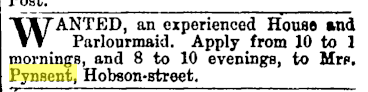
Mrs. Pynsent seeks a new employee in the Evening Post, January 31, 1887.
Georgina ran the household and placed numerous advertisements in the local papers pleading for “experienced house and parlour maids” (Evening Post: 31st January 1887 etc.) or for a “respectable young woman as cook” (Evening Post: 22nd April 1896 etc.). Good servants seem to have been hard to come by.
Charles and Georgina returned to England periodically. For instance, they left Tilbury en route for Melbourne on the “R.M.S. Oruba” on 20th November 1891. On this occasion, they were traveling with one of their daughters (The Colonies and India: 21st November 1891). They may well have been back in England to see their son Robert Burton who would have been settling into his law studies at Cambridge (The Times: 12th October 1891).
Georgina’s daughters fulfilled the social obligations of their social class and position. They contributing to concerts and did charitable work – while their mother kept an eye open for suitable husbands. Marian painted and received a bronze medal for her work in October 1888 (Evening Post: 20th October 1888).
Charles, meanwhile, bought property in down-town Wellington and at one point acquired a farm. However, he seems to have remained a “property owner” at heart. He went to Melbourne in Australia in January 1887 (Otago Daily Times: 1st February 1887 etc.) and Lyttleton, on the east coast of the South Island of New Zealand in December that year (Press: 21st December 1887, etc.). He traveled on his own. What these and other trips were about, I am not sure; however I suspect they were business related. Charles Pitt seems to have handed over the running of the farm he bought to his son Robert Burton in around 1894 – shortly after he returned from England with his law degree. It was probably an inducement for him to stay.
C. P. Pynsent is listed as a member of the jury in the Evening Post, January 20, 1886.
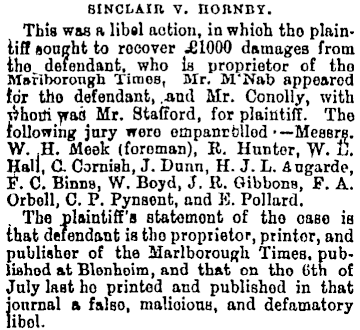
Quite early in his life in Wellington, Charles was appointed to the “Music and Ceremonial Committee” when the Wellington elite met to discuss the forthcoming “New Zealand Exhibition” (Evening Post: 3rd August 1885). Among other civic duties, Charles was empaneled as a juror for the Supreme Court hearing of “Sinclair v. Hornby” in January 1886 (Evening Post: 20th January 1886). It was a libel action, in which the plaintiff sought to recover £1,000 from the proprietor of the “Malborough Times”, claiming that there were inaccuracies in an article it had published regarding a land transaction.
Charles and Georgina made the appropriate donations to hospitals (Evening Post: 25th June 1897) and social service charities (Evening Post: 13th June 1903). They were both interested in the “Society for the Prevention of Cruelty to Animals” and Charles served on its founding committee, in October 1884 (Evening Post: 4th October 1884). He remained actively involved in it for several years. The “SPCA” examined numerous cases in and around Wellington, including one in which a man called Smith kept a mutant sheep as an exhibit. It had six legs, two of which grew out of its abdomen and were eight inches long and covered with sores. The vet said that he did not have the authority to kill the animal and he recommended the committee prosecute the owner (Evening Post: 3rd June 1885). Other cases were more predictable and less noteworthy. Charles dropped off the committee in the 1890s but Georgina still contributed to its annual subscriptions (Evening Post: 27th April 1897 etc.).
Florence Edith Pynsent, Charles’s youngest daughter, married Augustus Carr, a bank manager at Invacargill in 1884. One of her sisters were bridesmaids: “The bride wore a dress and square train of ivory white brocaded and plaid satin, trimmed with Brussels lace and wreaths of orange blossoms, also a gold necklet and diamond locket, a gift from the father of the bridegroom. The bridesmaids appeared in cream coloured suvat dresses and sapphire blue velvet bonnets, trimmed with pearls and hyacinths, while each also wore a brooch, a present from the bridegroom” (Evening Post: 17th July 1884).
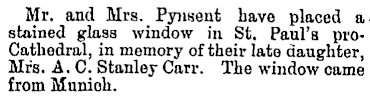
The commemorative stained glass window appears in the Evening Post, February 13, 1892.
Sadly, Florence died in 1889. Her parents placed a stained-glass window to her memory in St. Paul’s Cathedral, in Wellington (Evening Post: 13th February 1892).
Florence’s sister Marion Haslewood Pynsent studied at the “Wellington School of Design” in 1886 and 1887, and (as noted above) was awarded a bronze medal for a painting in October 1888 (Evening News: 20th October 1888). She picked up another bronze the following year for a picture of foliage (Evening Post: 15th March 1890). Her father was one of many who contribution to the “Building Fund” for the “New Zealand Academy of Fine Art” (Evening Post: 7th December 1892).
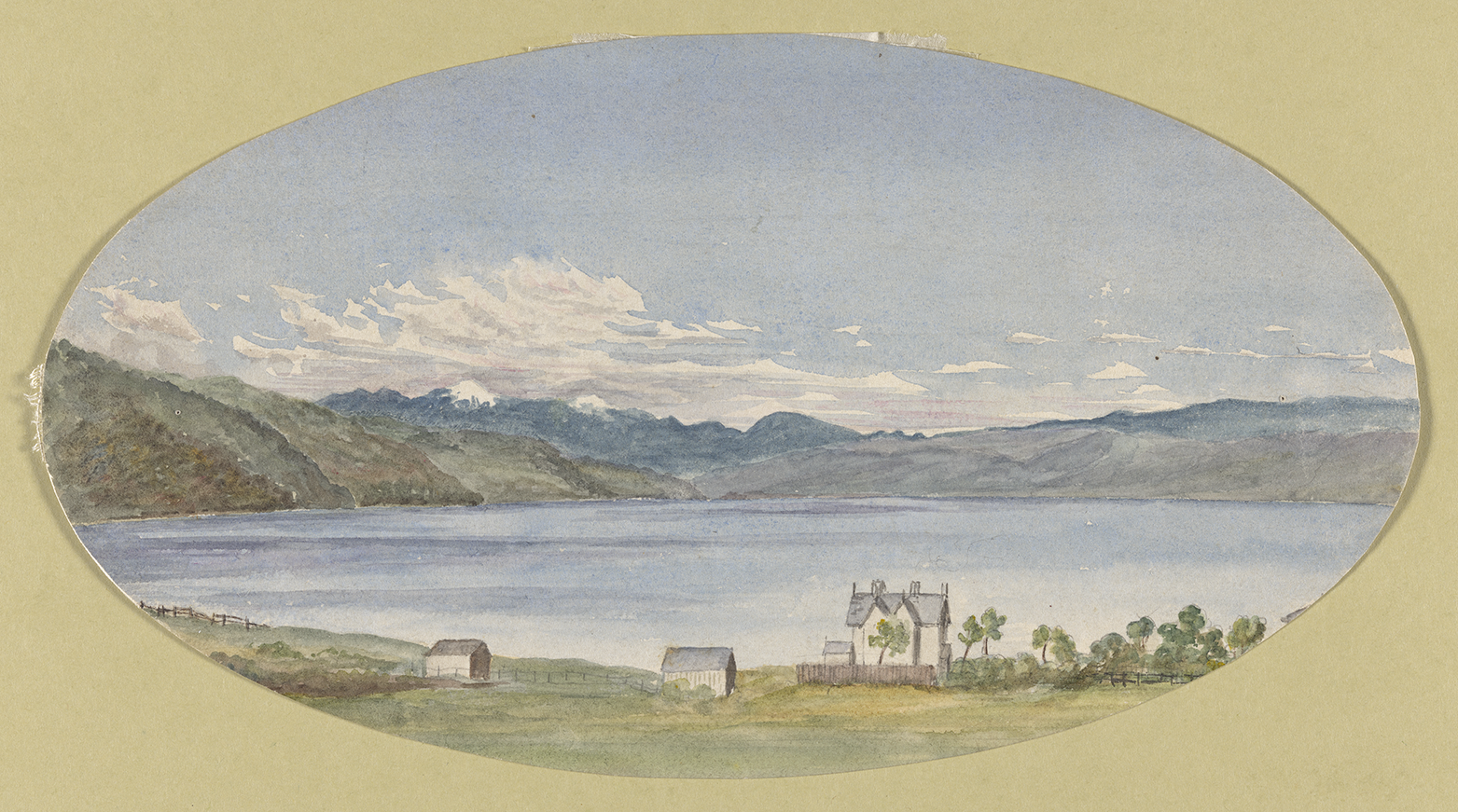
On the back, the painting reads: From window in Princess Hotel at top of Molesworth St w. Mrs Bannantyne’s later Pynsents in Hobson St. “Port Nicolson, New Zealand. Watercolour by Arthur Thomas Bothamley. [ca 1869]. Ref: A-032-016. Alexander Turnbull Library, Wellington, New Zealand.”
The Pynsent household on Hobson Street acquired a telephone in 1892 (Evening Post: 15th June 1892) – which must have been a boon to Marion and her mother (Mrs. and Miss Pynsent) who seem to have been ever-present on the social scene throughout the 1890s. The local papers make mention of the events they attended and, not infrequently, of the clothes they wore. For instance, Mrs. Pynsent wore a “prune” coloured creation and Miss Pynsent a “green and gold” dress at Lady Glasgow’s reception at Government House in June 1892 (Observer: 2nd July 1892). On other occasions, they attended concerts (Manuwatu Herald: 11th February 1896) and “At Homes” and played croquet (Press: 22nd February 1896).
Charles attended some of these events but he also had other interests. It is perhaps worth noting that when Mr. and Mrs. and Miss Pynsent attended a “Birthday Ball” at Government house in May 1893. There was also a single man named Mr. B. Goring in attendance (Evening Post: 25th May 1983). Barry was not single for long – Barry Yelverton Goring married Marion in December that year . The wedding is described in detail in an article in the New Zealand Mail (8th December 1893).
Barry and Marion Goring had their first child in November 1894: “Quite a large gathering assembled at Mr. C. P. Pynsent’s house last Friday afternoon by invitation of Mr. and Mrs. Barry Goring, who are staying there, the occasion being the christening of Mr. and Mrs. Goring’s baby, who appeared in very fine robes, and amid much state, received the congratulations of its numerous friends. The cake was cut and the health of the infant drunk with champagne: the name chosen being “Dorothy Edith” (Manuwatu Herald: 24th November 1894).
Marion and her mother remained close and they frequently attended social functions together. However, it is worth noting that Barry’s mother was still around and two there were two “Mrs. Gorings” in Wellington. Fortunately the sharp eyed correspondents reporting to the press frequently, but not invariably, differentiated between the two. Mrs. Pynsent and Mrs. B. Y. Goring attended events together. For instance, they attended the “Annual Spring Flower Show” in November 1894 (Manawatu Herald: 17th November 1894).
Mrs. Goring (as Marion was then) had two daughters. Dorothy Edith Goring was born in 1894 and Barbara Yelverton Goring was born in 1897. Sadly, the newspapers tell us that Marion “who has been in delicate health for some time past, died yesterday whilst on a visit to Mrs. Russell, at Palmerston North” She died in 1898 (Evening Post: 14th December 1898). Marion’s death left Barry Goring with two very young daughters and Charles Pitt and Georgina determined to look after them. From here on, Georgina was also on the look out for “nursery governesses” (Evening Post: 17th October 1904).
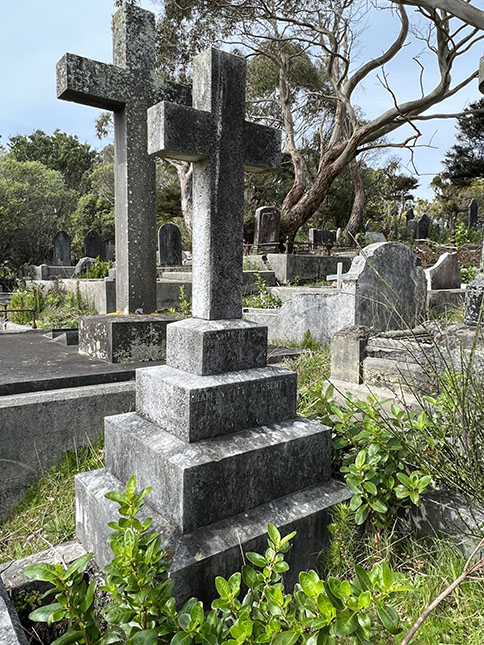
Charles Pitt Pinsent’s gravesite at Karori, New Zealand.
Charles died in Wellington on 31st July 1903 and was buried in Karori Cemetery after a service in St. Paul’s Cathedral (Evening Express: 28th August 1903). He was seventy-eight years old and, as the following obituary shows, an “old time” pioneer in the eyes of many Australians: “News has been received of the death in New Zealand of Mr. Charles P. Pynsent who was one of the earliest pioneers of the Wimmera. The name of the deceased (has) been immortalized in Horsham by the naming of “Pynsent Street” in honour of deceased. The late Mr. Pynsent, though he left this district about 54 years ago is still very favorably remembered by some of the pioneers, including Mrs. Healey, of Hamilton Street, Horsham. That lady and her late husband and two children lived at Mr. Pynsent’s Wonwondah station for some time, and Mrs. Healey speaks in highest terms of praise of deceased, who was a justice of the peace in the Wimmera “He was a real good, honourable man” remarked Mrs. Healey when spoken to about Mr. Pynsent’s demise. Upon his leaving the district, Wonwondah station sold to Mr. Rutherford. A brother-in-law of the deceased was Mr. Splatt, whose name is also perpetuated by a street in the borough being named in his honour. At one time Pynsent held between 200 and 300 square miles under lease from the Victoria Government” (Horsham Times: Friday 7th August 1903”.
Charles Pitt Pynsent’s last will and testament in 1903.
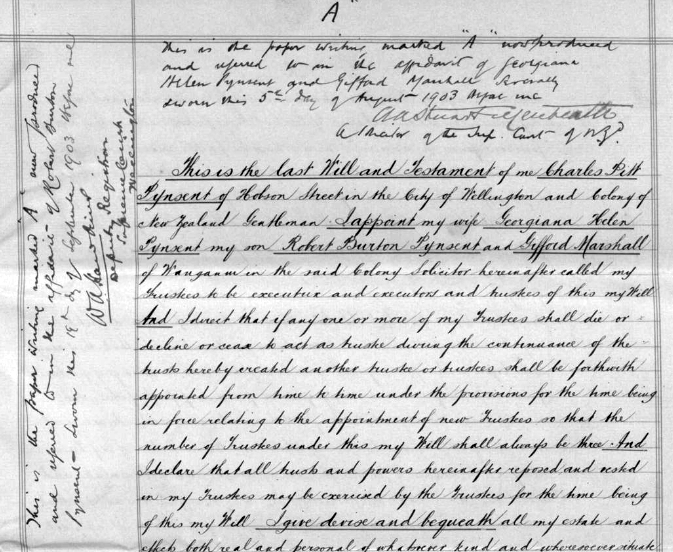
Charles Pitt Pynsent had written his “last” will and testament in 1899. He appointed his wife Georgina, his son Robert Burton and a local solicitor, Gifford Marshall as his executors. Robert was in England at the time, but he hurried home. He arrived in Wellington on 17th September 1903 (Evening Post: 17th September 1903). The will was probated in Wellington in August 1903 and it was then sent to England, where Charles have also held assets, for ratification.
Charles Pitt Pynsent asked that his executors use his investments to generated one thousand pounds a year of annual income for his wife, and allot money for his granddaughters’ (Dorothy Edith Goring and Barbara Yelverton Goring) education – the amount to be taken out of their respective twelve thousand pound legacies on their coming of age. Georgina was to have his house and garden in Hobson Street, in Wellington, for life, and, as for the rest of his real and personal estate, including his farm near Wanganui (now known as Whanganui), it was to go to his son, Robert Burton Pynsent (Probate Records: Wellington Court: 1903 P8439/03-P8500/03).
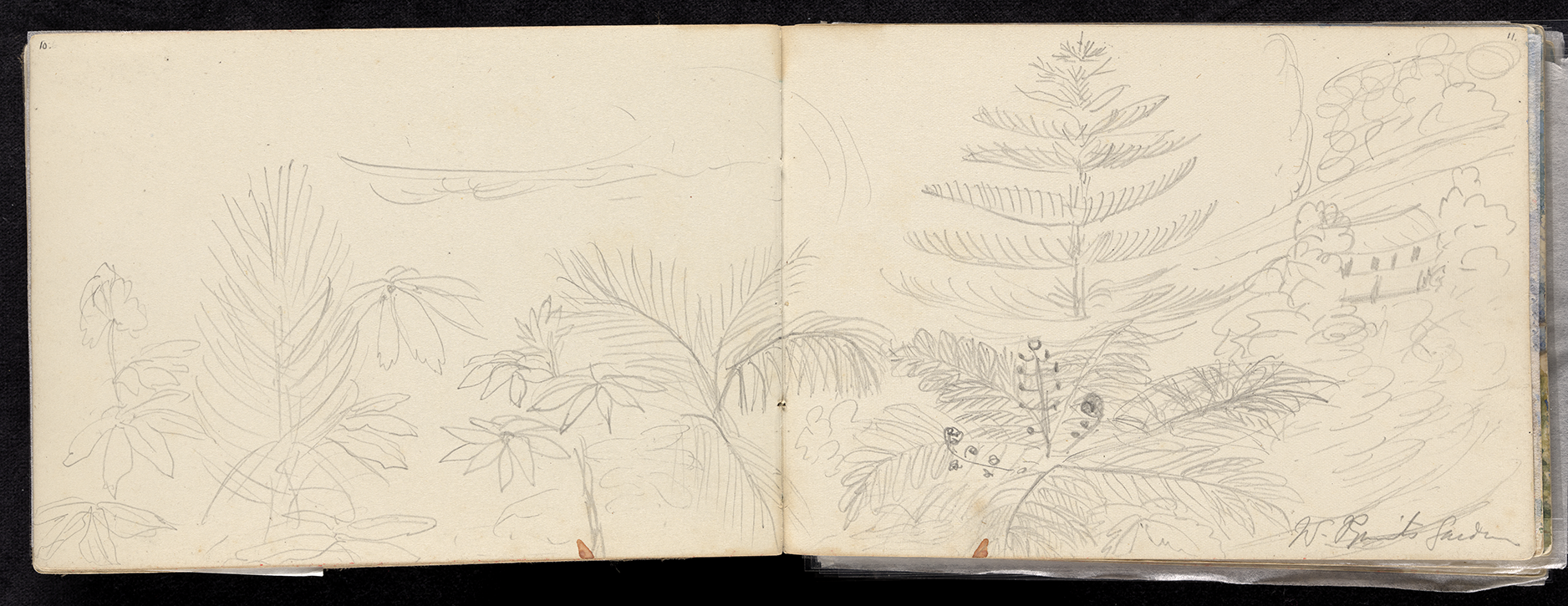
Mr Pynsent’s garden. Drawing by Medley, Mary Catherine. [ca 1893]. E-346-2. [Medley, Mary Catherine] 1835-1922 :Sketch book. Ref: E-346-2-010/011. Alexander Turnbull Library, Wellington, New Zealand.
The Supreme Court of New Zealand granted probate on the 6th day of August 1903 (The Times: 12th January 1904). Charles had his estate in New Zealand valued at £104,097 (Wanganui Herald: 1st December 1903). A tidy sum! The will was processed in London on 2nd February 1904. Charles’s effects in England amounted to £32,797 16s 11d. A later entry states that probate was granted to Robert Burton Pynsent, “barrister at law” in London, 15th February 1904.
Georgina was left on her own with her son-in-law and her granddaughters and, as it was now clear that her son Robert had decided to stay on in England as a “barrister”, she decided to join him. If she took granddaughters back, they could get a “proper” English education. Presumably Barry agreed to all this. He also made plans to move to England. Georgina took the girls back, quite possibly to check out schools, around the time of King Edward VII’s Coronation. It was a two-stage journey in those days. You took a steamer from Wellington to Sydney and then took another from Sydney to London. The Sydney Mail and New South Wales Advertiser (Saturday 8th March 1902) tells us that Mr. R. Pynsent, Mrs. Pynsent and Misses D. and B. Goring had taken the Imperial German Mail Steamer “Bremen” from Sydney to London in March 1902. Similarly, the Lyttleton Times: Monday 15th December 1902 shows that “Mrs. Pynsent and two children” bound for New Zealand had recently arrived in Fremantle on the “S. S. Oruba.”
New Zealand press announced that: “Mrs. Pynsent leaves very shortly for England, where she will reside for the next few years to enable her grandchildren (to live with?) her – whilst they are being educated” in March 1905 (Otago Witness: 15th March 1905). Georgina rented out the family home on Hobson Street and the family left for Sydney en route to London on the “S.S. Moeraki” (Evening Post: 23rd March 1905).
When Georgina and her granddaughters said good by to Wellington, they may not have wished to admit that they would not be back. “Mrs. Pynsent and the Misses Goring leave by the Moeraki for Sydney on. route for England (writes our Wellington correspondent). They travel by the North German line, and will be away for two years, probably making their headquarters at St. Leonards” (New Zealand Graphic: 1st April 1905)..
Georgina enrolled her granddaughters at “Cheltenham Ladies College” (Free Lance: 31st March 1906) and took a house in the town while they were to be there. What the girls’ father (Barry Goring) made of it, I am not sure. I think he went with them as he had siblings of his own living in England. The children were by no means the first “Pynsents” to go to “Cheltenham Ladies College”. Charles’s cousin Thomas Pynsent had sent his daughters there in the 1850s. One of them later married into the Willoughby family and stayed on in the Cheltenham area. She had sent her daughter there as well. The Willoughby’s were connected to the DEVONPORT Branch “Pinsents” by marriage and they had sent their children there too. Presumably the Willoughbys and Pinsents recognized the Gorings among their many cousins.
As far as I know, Georgina never went back to New Zealand. She was a widow, living on her “own means,” looking after her (then) teenage grandchildren, Dorothy and Barbara Goring, with the help of four servants when the Census takers came knocking on her door in Hunsdon Road, in Torquay, in 1911.
During the war, Georgina moved to Bexhill in Sussex – where she, somewhat unfortunately, fell afoul of the blackout restrictions in October 1915. Evidently, there was light showing through a skylight. Georgina “Selina” (as she was named in the newspaper) was fined 10s 6d for the infraction (Bexhill on Sea Chronicle: Saturday 2nd October 1915). The following April, Mrs. Pynsent donated a “puzzle” to the local hospital which was, by then, dealing with “sick and wounded soldiers of the expeditionary forces” (Bexhill on Sea Chronicle: 1st April 1916).
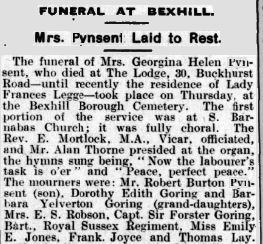
Georgina Pynsent’s funeral is reported in the Bexhill-On-Sea Chronicle on November 4, 1916.
Sadly, Georgina Helen Pynsent died at “The Lodge” Buckhurst Road in Bexhill in October 1916. Her funeral was well attended by family and friends. Her two granddaughters, Dorothy Edith Goring and Barbara Yelverton Goring were there, and her Willoughby and Reynolds-Reynolds relations from Cheltenham sent wreaths (Bexhill on Sea Chronicle: Saturday 4th November 1916). Georgina’s son, Robert Burton Pynsent was granted probate of effects valued at £3,735 15s 8d. Robert Burton sold the family’s home and other property in New Zealand and stayed on in England – where there was more scope for his legal training. His nieces also stayed on in England. Barbara married into the Lambert family in 1922. Dorothy Goring, however, never married. She corresponded with my father in the 1960s.
Please use the above links to explore this branch of the family tree. The default “Next” and “Previous” links below may lead to other unrelated branches.
Please use the above links to explore this branch of the family tree. The default “Next” and “Previous” links below may lead to other unrelated branches.
Please use the above links to explore this branch of the family tree. The default “Next” and “Previous” links below may lead to other unrelated branches.