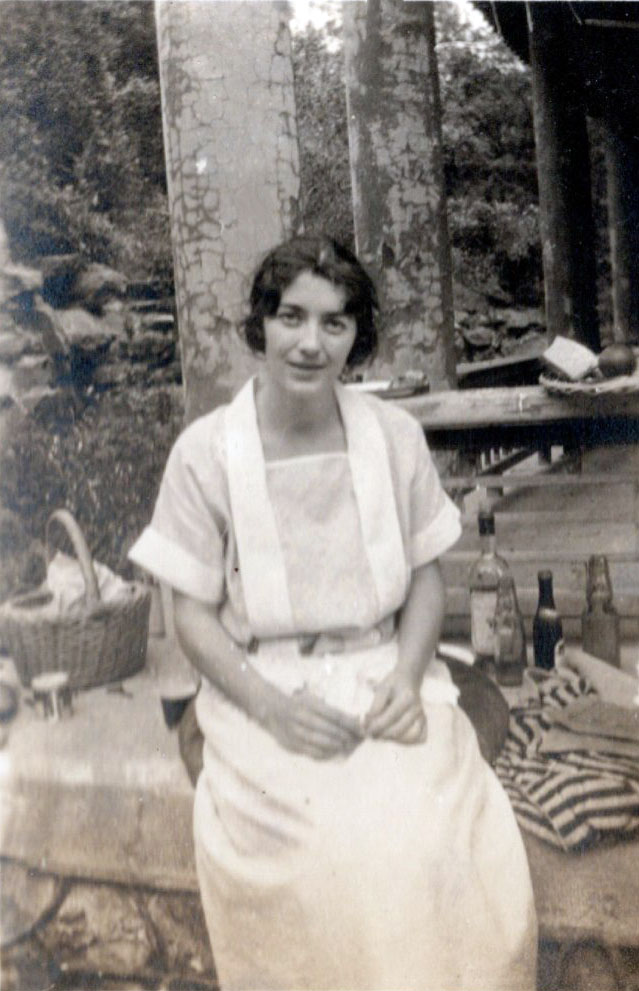
Appears to be the illegitimate daughter of Mary Pinsent.
Please use the above links to explore this branch of the family tree. The default “Next” and “Previous” links below may lead to other unrelated branches.
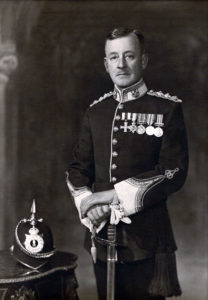
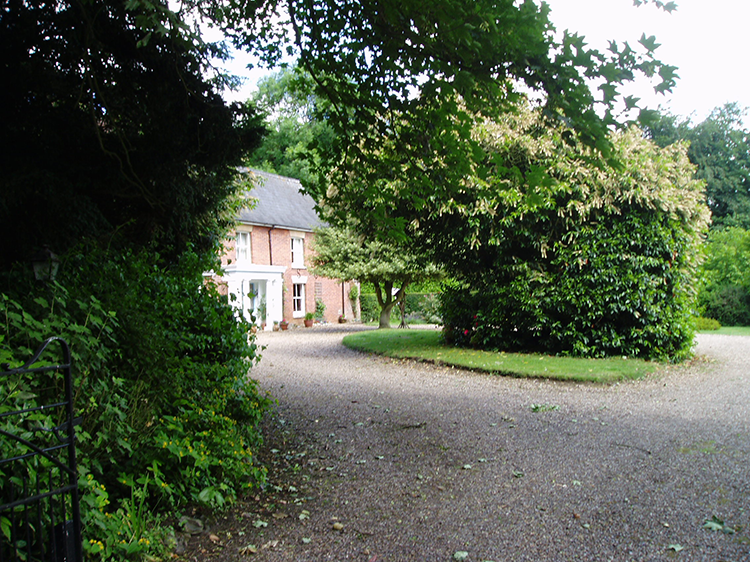
Guy Homfray Pinsent was the youngest son of Sir Robert John Pinsent, a Justice on the Supreme Court of Newfoundland, by his second wife, Emily Hetty Sabine (née Homfray). He was born into an extended family with five half-siblings: (Lucretia Maude, Louisa Catherine, Robert Hedley, Charles Augustus and Alfred Newman) two sister (Mabel Louisa Homfray and Beatrice Mary Homfray) and two brothers (Robert John Ferrier Homfray and Francis Wingfield Homfray). He was born at his mother’s family home in Bintry (Bintree), in Norfolk, in July 1889.
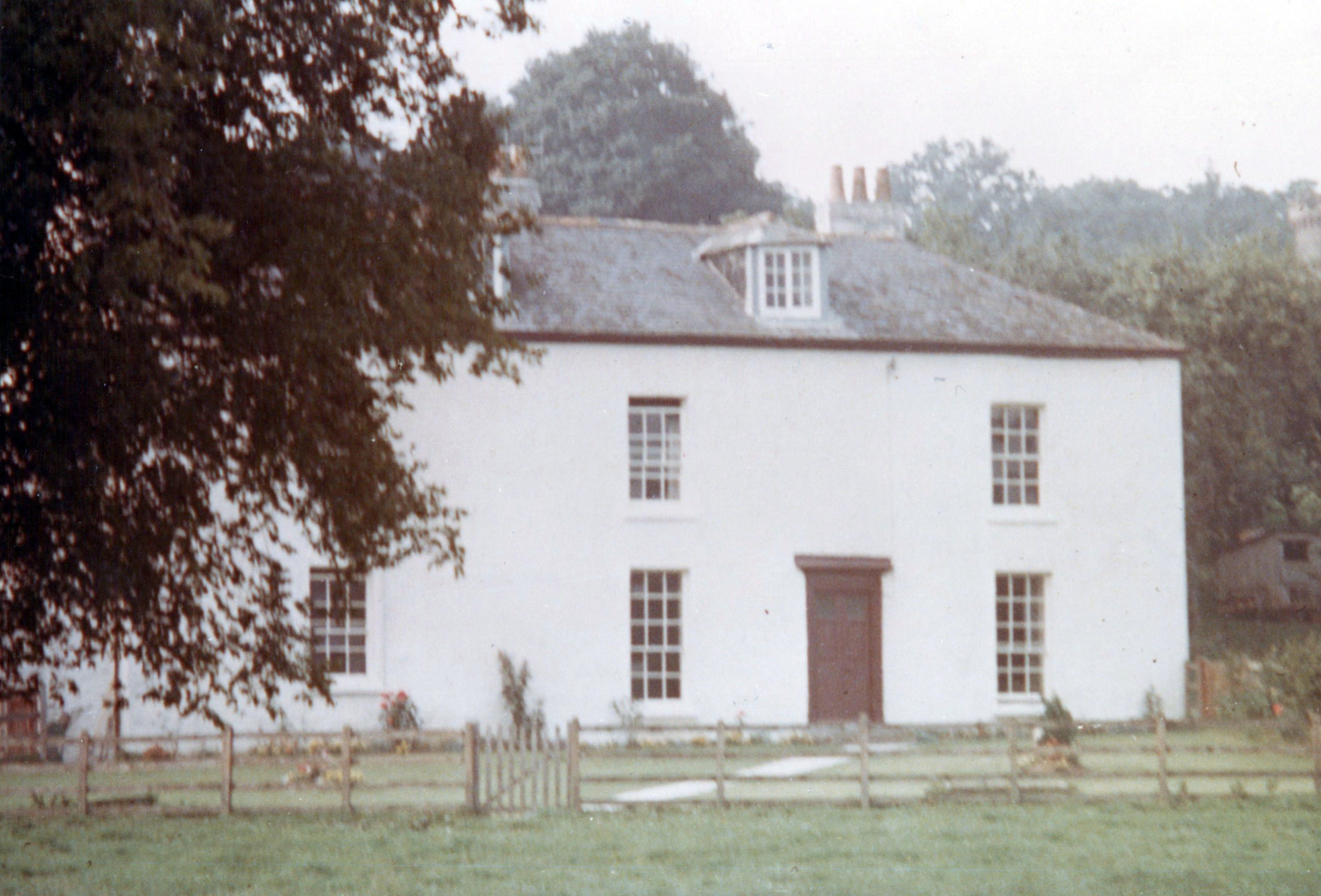
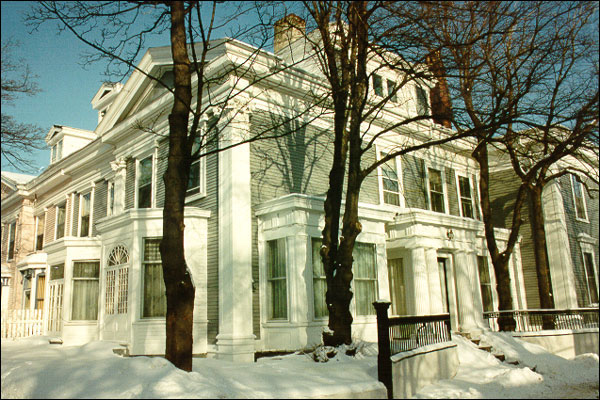
Bintry Rectory, 2005.
Guy spent a few years in St. John’s but would have no recollection of it. His mother – who had always enjoyed fishing and had written articles about it in the “Field Magazine” – recollected in one (published in July 1892) that “We are certainly a sporting family, from the oldest son, who can count up to twelve or fourteen deer shot within a few miles of our home, to the little toddler of three already asking for a fishing rod and a gun”. He returned to England with his family in 1893 and, as far as I know, never returned.
His fathr’s life is described elsewhere. In the 1880s, he was notably busy dealing with the fall-out from a collapsed railway construction contract, and in figuring out the rights of French and Newfoundland fishermen along the so-called “French Shore”. He maintained that the French were only entitled to catch and process cod – and they (what ever they said to the contrary) had no right to interfere with Newfoundlanders efforts to catch, process and can lobsters. He published an article entitled “French Fishery Claims in Newfoundland” (Nineteenth Century: Vol. 158, April 1890). Robert made several visits to England (he gave a talk to the “Royal Colonial Institute” entitled “Newfoundland, our Oldest Colony” in April 1885 (Colonies and India: Friday 17th April 1885)) and was a well known as an advocate for the Colony. Queen Victoria honoured him with a knighthood in 1890.
In 1893, Sir Robert and Lady Pinsent took their younger children to England and, leaving them there, then they went out to Italy to see Guy’s eldest half-sister, Lucretia Maude, who was setting up a Benedictine convent in Rome. Sadly, Sir Robert died of pneumonia soon after they returned. His death created problems for his wife, Emily, as most of the family’s assets in Newfoundland went to the children of his first marriage – most notably his eldest son Charles Augustus Maxwell Pinsent. She was left with two teenage sons (Robert (19) and Frank (18)) in Newfoundland and a grown up daughter (Mabel (20)) and two younger children, Beatrice (10) and Guy (4) with her in England. Lady Pinsent stayed on in England and took employment first as a “House Matron” at Harrow School and then as the principal “Matron” at Denstone School in Staffordshire.
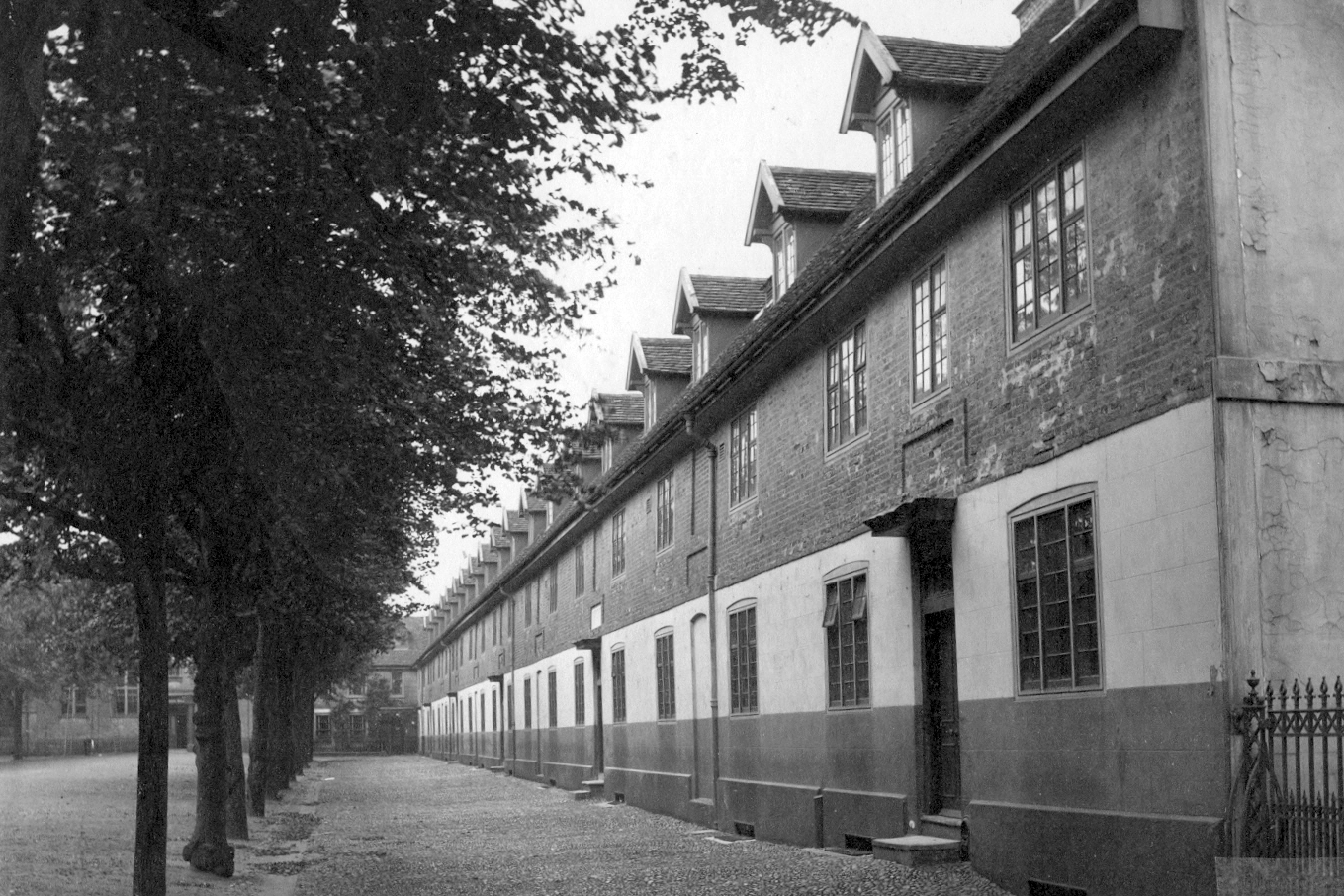
Christ’s Hospital occupied the Bluecoats site from 1682 to 1985. Via Discover Hertford.
Guy and his older sister Beatrice (“Trixie”) were sent to the “Blue Coat School” in Hertford. This was a charitable foundation that was technically based at “Christ’s Hospital” in London; but had had part of its operation in Hertford since the 1700s. Some of the letters Guy’s mother, Emily, wrote to Lucretia Maude have survived. The first, dated November 1899, shows how relieved she was to have her other son, Frank (Francis Wingfield Homfray), back in England and how she regretted not being able to afford to give Beatrice the medical training she wanted. As for Guy, she said: “Little Guy is very happy & I feel now as if he had a father again in Frank.” In October 1900, she went on to say “Guy will soon be leaving Hertford. In the London School he was fortunate in the holidays to make friends with the London Head Master, Dr. Lee.” Guy was still living in Hertford (where the younger boys were taught) when the census was taken in 1901. He must have moved up to the main school, in London, sometime after that.
Lady Pinsent was concerned about what to do with Guy after he left school – particularly as, as she was to point out to Lucretia Maude in December 1901, she thought that “Guy is a dear little fellow & very good but not I am afraid, clever. I don’t think that matters so much as steadiness & the power of work”. To be fair, it would have been hard to follow Sir Robert.
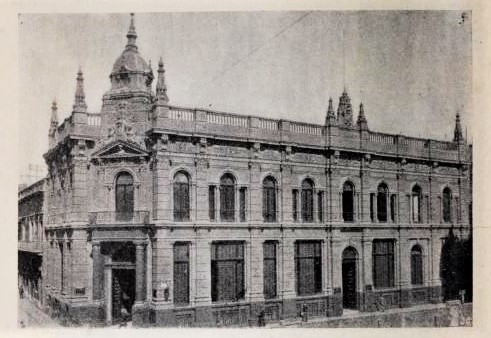
Banco Británico de la América del Sud, via Wikipedia.
Contacts were important: it seems likely that Lady Pinsent persuaded Adolphus Ross Pinsent, who was from the DEVONPORT branch of the family, to take him on as a clerk in the “British Bank of South America Limited” in Buenos Aires. He was a Director of the Company (see elsewhere: DEVONPORT). Guy went out to South America in around 1910 – perhaps at around the time that his mother and brother Frank moved down to Plymouth. A wartime item in The Times (20th April 1917) describes the contribution to the war effort made by the Buenos Aires-based staff of the “British Bank of South America Limited.” It, inevitably, lists fatalities but then goes on to mention the Military Cross awarded to Guy Homfray Pinsent. He seems to have worked there and returned to England to enlist in late 1914. He received his commission as a temporary Lieutenant in October. (Civil and Military Gazette (Lahore): Saturday 14th November 1914).
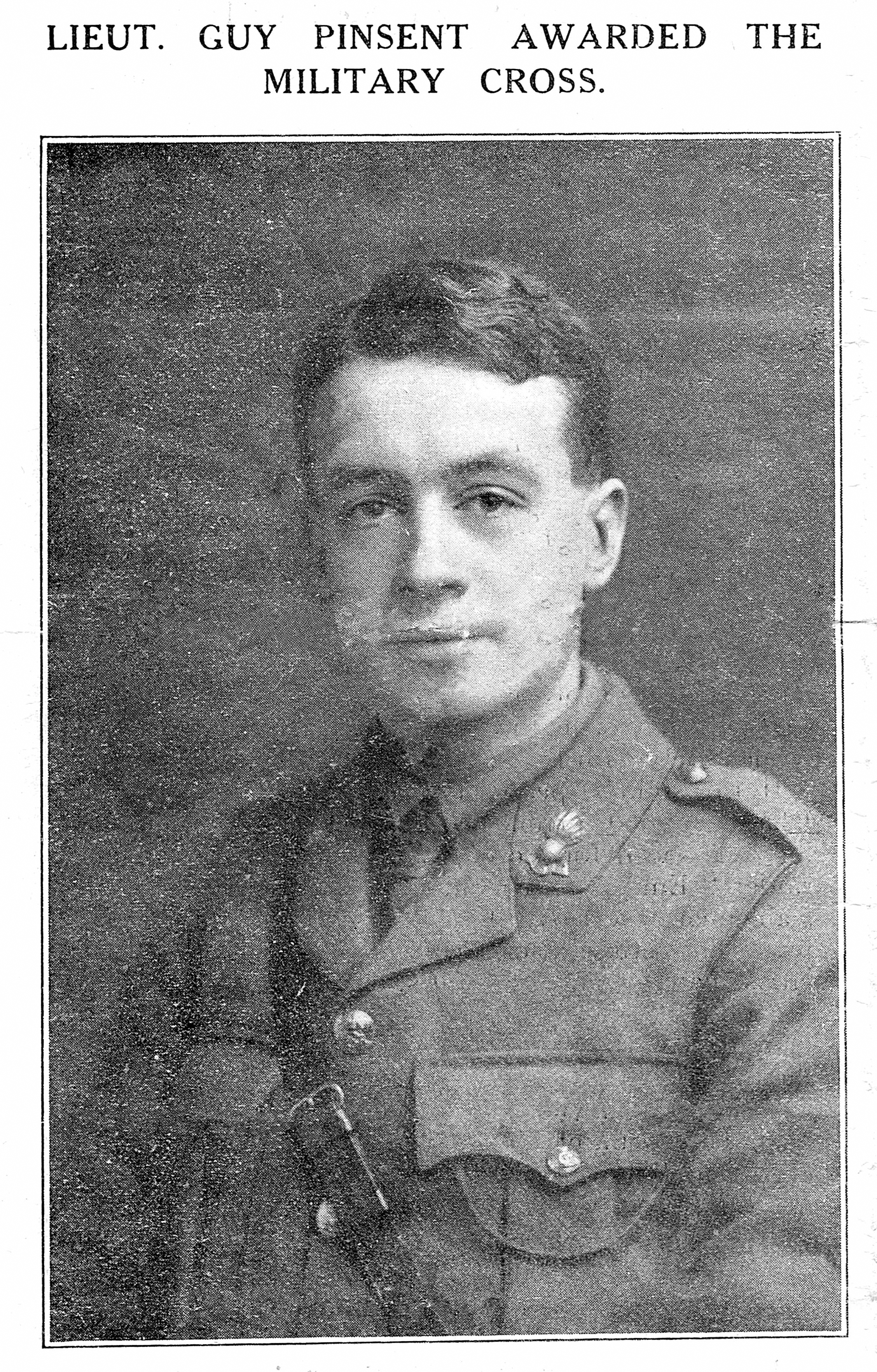
On reaching Britain, Guy joined the “Royal Field Artillery” as a Temporary Second Lieutenant. He was deployed to France in July 1915 and served with his unit during the battle of the Somme in 1916. He was awarded a “Military Cross” for gallantry under fire. The London Gazette (20th October 1916) describes the incident: “2nd Lt. Guy Homfray Pinsent, R.F.A., 33 spec. Res: For conspicuous gallantry: When the order was given for the detachments to be withdrawn owing to heavy shell fire, it was found that one detachment had been buried in the gun-pits. 2nd Lts. Coulesley and Pinsent at once collected a party, and, after half an hour’s working under very heavy fire, they got the men out.”
Lt. Guy Pinsent as photographed in The Zodiac.
The “ Zodiac” describes the incident in more detail: Guy H. Pinsent, R.F.A. “received his commission 10th October, 1914 and was promoted Lieutenant 9th June, 1915. He was wounded at Montanbar on 8th August 1916.” Evidently, he served for fourteen months at the front and was awarded a Military Cross for bravery in rescuing men when under heavy shell-fire: “Owing to the illness of his senior officers, he took a battery into action and held his position for over a fortnight before the enemy discovered the whereabouts of his battery. One day an enemy aeroplane, flying very high, apparently spotted his position, and that night the battery was bombarded heavily for eight hours, and one of the four guns was damaged. At the commencement of this severe “straffing” a shell destroyed the earthworks and six men were buried. Lieut. Pinsent called for volunteers, and they set to work to dig out the unfortunate men. In spite of their exertions, some of the men perished. It was during this “digging out” that Lieut. Pinsent was wounded by shrapnel in the shoulder. With great fortitude he held on at his post, and after the bombardment had ceased he kept the battery in action for four hours, no doubt much to the surprise of the Huns, who probably thought the battery was no longer in existence!” Guy was patched up in France and then sent to Queen Alexandra’s Military Hospital at Millbank. Oddly, the hospital records show that he was in for a gunshot wound in the hand or shoulder and not for shrapnel (British Armed Forces: Soldiers’ Medical Records: Findmypast).
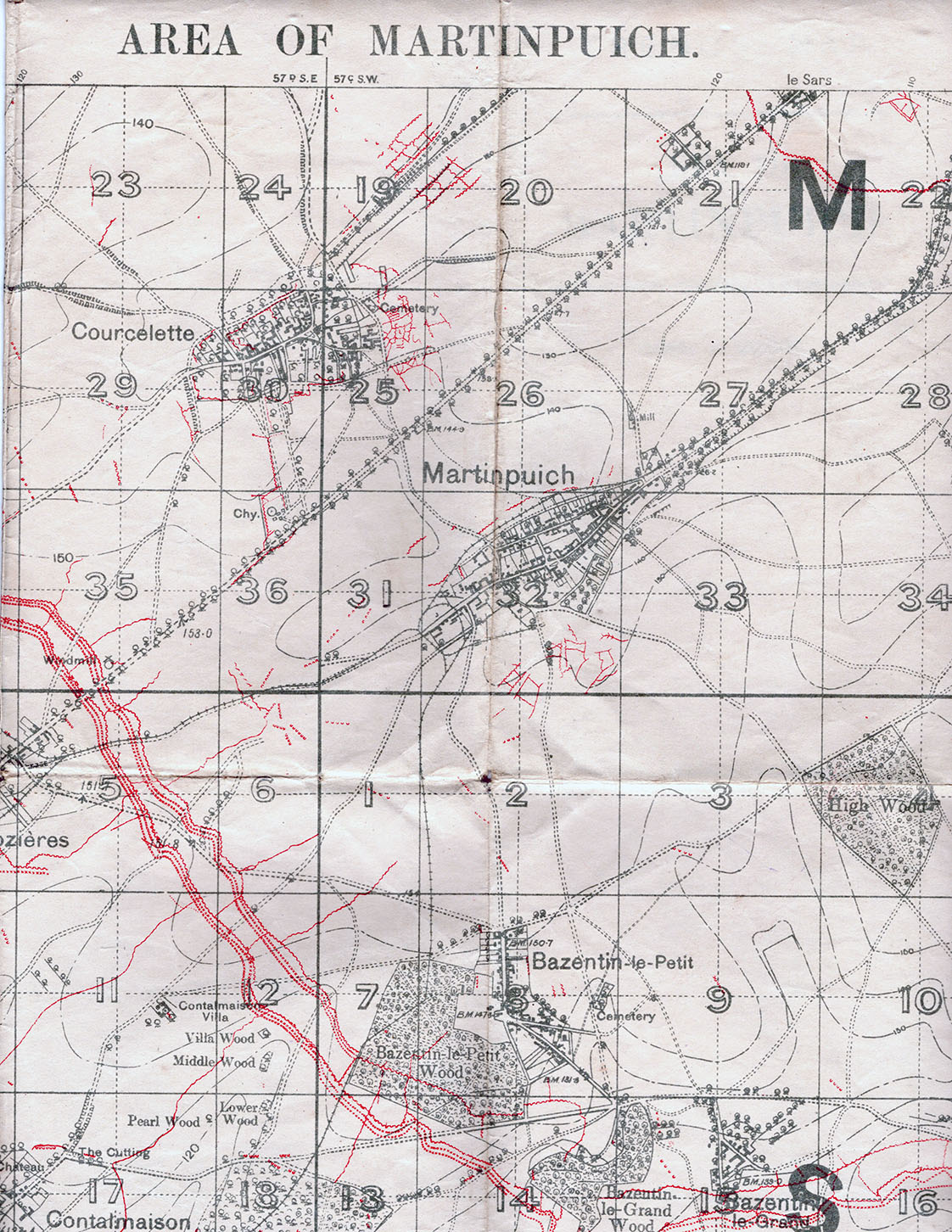
Guy’s map of the trenches at Martinpuich from 1916.
The “Montanbar” referred to was probably “Montauban” which was in the thick of the fighting in the Pas de Calais (north east of Amiens) during the then raging Battle of the Somme. Despite the horrors of the 1st of July (which practically wiped out the “Newfoundland Regiment” (among others) a few miles northwest, the allies had made some progress and managed to advance slightly beyond Montauban by 14th July. They reached Bazentin by 15th September. For some reason, Guy kept a trench map for Martinpuich (a few miles to the north of Montauban).
After the war, Guy Homfray returned to Buenos Aires as part of a contingent of repatriated Officers and their families. They arrived on the Royal Mail Steam Packet, “Meteor,” in August 1919. Guy’s sister, Beatrice went with him and for some reason stayed on. Guy presumably tidied up his affairs and returned to England to continue his military career.
Correspondence his mother had post-war with the War Office regarding his medals, shows that “Bimbashi” (soldier) G. H. Pinsent, M.C., had been assigned to the “Arab Maxim Battery Corp.” He joined them in 1918 and likely saw service with them through to 1920, as he relinquished his commission on 1st April 1920 (London Gazette). In addition to the Military Cross that Guy received from the King, at Buckingham Palace, he also received the normal suite of “First World War” service medals (1915 Star, British and Victory). His mother later wrote to the War Office about his eligibility for the 1914 Star and discovered that he was ineligible as he had not yet been abroad. Guy did, however, received the “Africa General Services Medal and Clasp” for his time with the “Arab Maxim Battery” (U.K. Military Campaign Medals and Awards, 1793-1949: Ancestry.com).
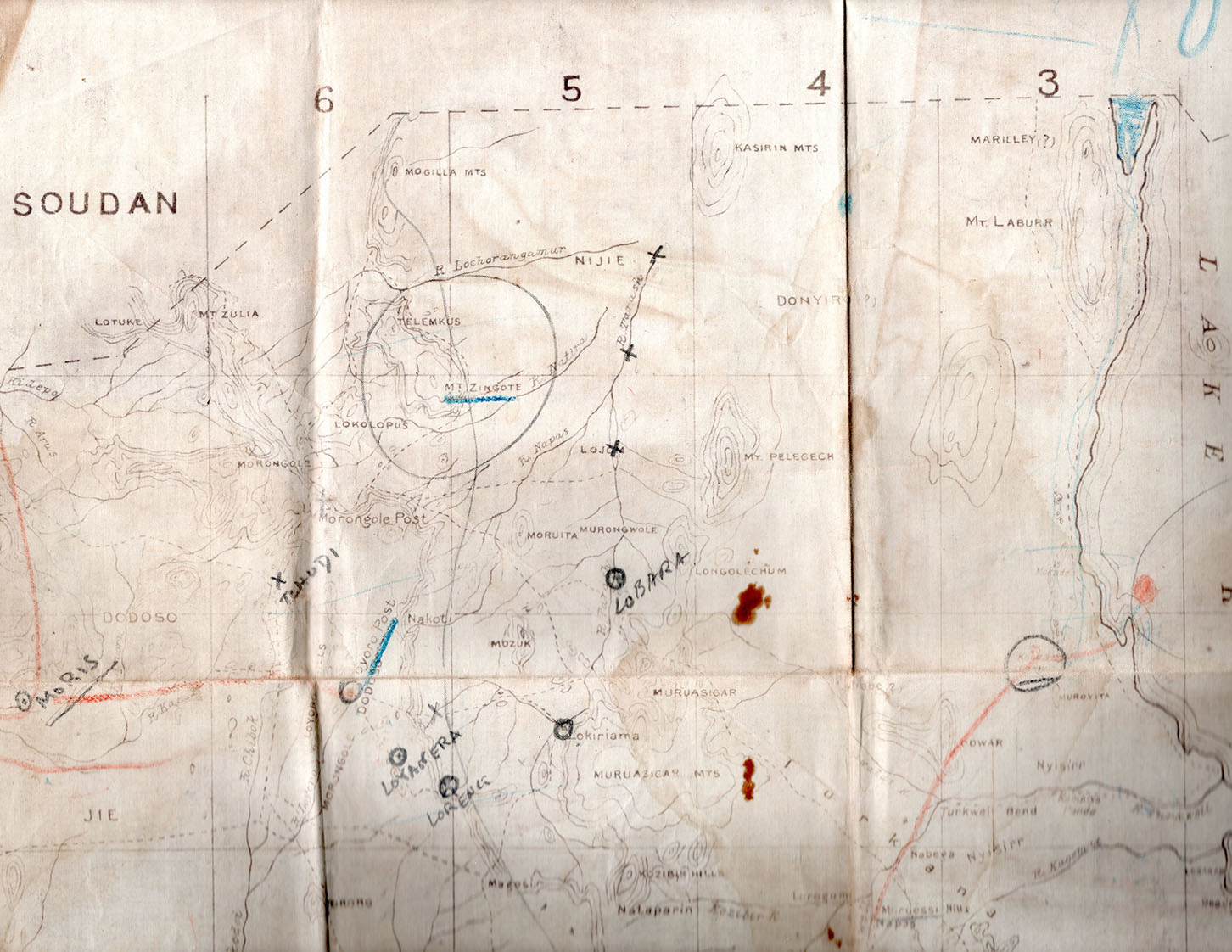
Guy’s map from his time in Sudan.
Guy returned to England and re-joined the army, and in May 1921 received a Commission as a Lieutenant in the 1st Battalion the “Loyal”(“North Lancashire”) Regiment. His seniority was dated back to 1st January 1917. The regimental magazine “The Lancashire Lad” tells us that he was taken on for duty in Constantinople – presumably because he spoke some Arabic. In fact, he was posted to Southern Sudan where he served as a “Government Officer”. It was a relatively short assignment. “Incoming Passenger Lists” show that Lieutenant Guy Pinsent, aged 31, returned to Plymouth from Port Said on the “Devanha” in December 1921. He re-joined his regiment and was promoted to Captain on 1st January 1923 (London Gazette). While he was in North Africa, he led a patrol into the headwaters of the White Nile River, in the East African rift valley west of Lake Rudolf (Lake Tukana). The area was then split between the British protectorates of Kenya and Uganda. He kept his map of the area and I now have it. I would have loved to have a diary.
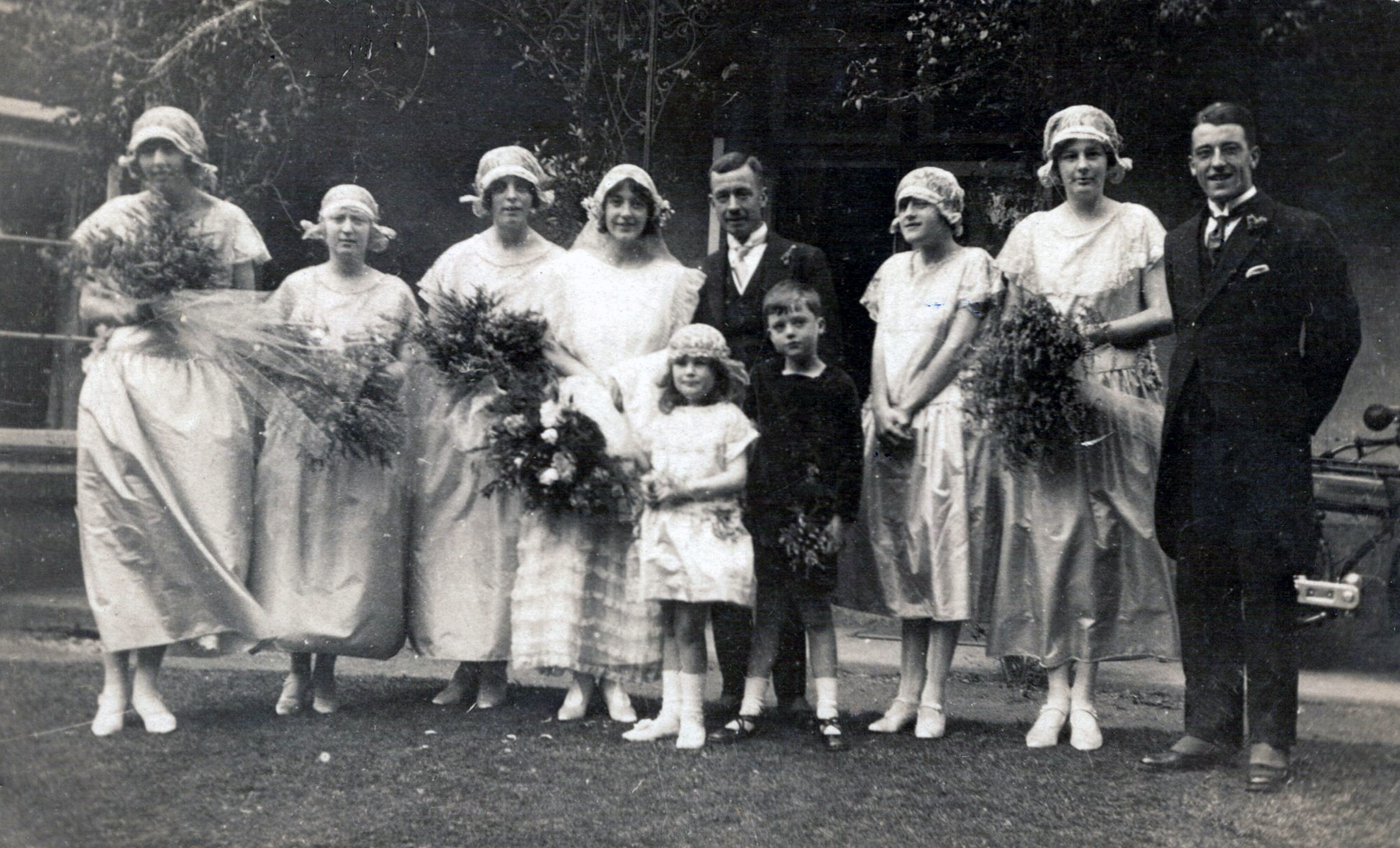
Photo of the wedding party taken at Guy and Betty’s wedding in 1923.
Captain Guy Homfray Pinsent’s engagement to Ethel “Betty” Brittan, daughter of Charles Edward Brittan – a well-known Devonshire landscape artist – was announced in March 1922 (Western Morning News: Saturday 4th March 1922). Sadly, his mother, Lady Pinsent, died a couple of months later and she did not live to see them married at Sheepstor, on the edge of Dartmoor, in September 1923 (Western Morning News: Friday 21st September 1923). The wedding was a significant local event and it was well documented (down to and including the presents: among which was “an autographed silver salver” from the Officers of the 1st Battalion that I also have.) After the reception, Captain and Mrs. Pinsent left for London, Paris and Rome for their honeymoon (Western Morning News: Friday 21st May 1923). Presumably they met up with his half-sister, the Lady Abbess.
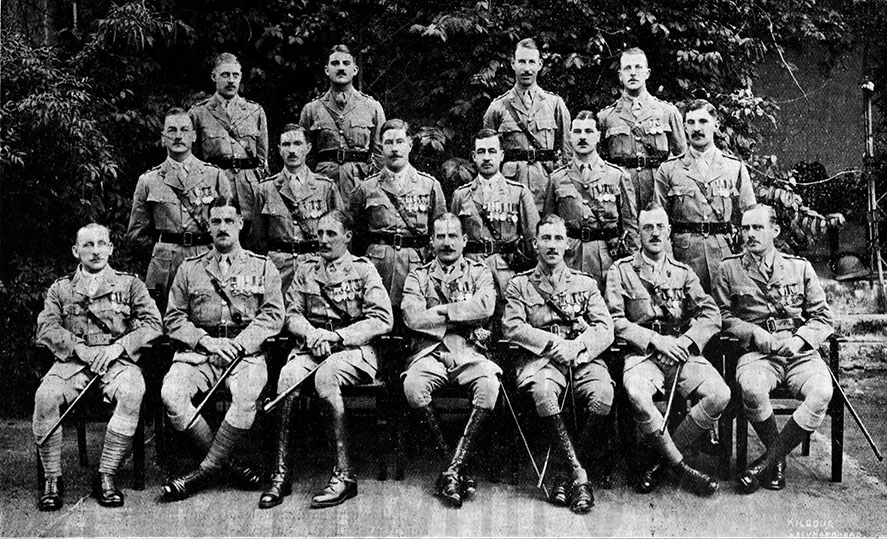
Officers in Tientsin in China, 1926
The couple went out to China with the “Loyal” Regiment in 1924/5. The regiment was sent to Peking (“Beijing”) to protect the British Legation during the long civil war that followed the overthrow of the Quin Dynasty in 1912. The war lasted until 1928. While the regiment was there, it acquired a number of howitzers and it fell to Guy, who had experience of gunnery, to train up volunteers so that they could actually be used – if needed. A small detachment from the Royal Artillery eventually arrived to take over (Lancashire Lad: 1925). Whilst in China, Guy and the Regiment also looked after the international settlements in Tientsin, Canton and Shanghai.
Betty Pinsent in China, 1920s.
Betty never took to China. She fell ill and her husband resigned his commission. They returned to England in December 1926 (London Gazette: 7th December 1926) and by 1931 they had settled in the Home Counties. That was the year that Captain and Mrs. Guy Pinsent gave Miss B. R. Allen and Mr. A. M. Leith a cut glass cigarette box on the occasion of their wedding in Bexhill on Sea (Bexhill On Sea Observer: Saturday 11th July 1931).
While the Pinsents were living at: “Red Lynch House” in Ascot, Betty was summoned at Windsor Petty Sessions for not reporting a minor collision she had with a van while she was driving through a congested section of Peascod Street, in Windsor. However, the Chief Constable on the stand said that the charge should have been for “damage” caused, rather than for not reporting an “accident” and, as there was conflicting evidence given in court, the magistrates dismissed the case on a payment of £1 in costs (Wokingham Times: Friday 3rd May 1935).
Guy and Betty moved around a lot. They lived at “Idle Way” in Sunningdale, near Ascot, from 1935 -1937, “The Squirrels” in Sunningdale in 1938 – 1939, “Rose D’Or” in Egham in 1940 and at “Bennebroek”, in Chobham (Surrey) from 1941 onward (British Telephone Books: 1880-1984). My father met up with his Uncle Guy in London in 1937 and in a letter home mentions that Guy was fit, and also that he had just sold “Idle Way”.
I gather (from family sources) that the reason they moved around so much was that they bought, re-decorated and sold their houses. Perhaps it helped having a connection with the Cowtan family (through Guy’s brother Frank) as “Messrs. Cowtan and Sons Ltd.” were high-class decorators, upholsterers and cabinet-makers in Belgrave Square, in London S.W.1. The Cowtan firm, which was founded in 1790, was particularly well known for its quality wallpaper (London Metropolitan Archives).
Capt. Guy Homfray Pinsent M.C., “having attained the age limit of liability to recall ceases to belong to the Res. of Off.” (London Gazette: 25th July 1939) was removed from the Army’s recall list in July 1939. Whether this was the reason, or not, I am not sure; however, “The Lord Chamberlain is (was) commanded by Their Majesties to summon Captain and Mrs. Guy Pinsent to a Court at Buckingham Palace on Thursday, 13th July 1939 at 9.30 o’clock, p.m.”. Interestingly, it was not a typical garden party. Guy also attended the “47th/81st Dinner Club” annual dinner when it was held at the Naval and Military Club in Piccadilly in 1952.
Guy served with the Home Guard during the Second World War. Guy and Betty Pinsent had settled down in Chobham, in Surrey, by then and they had “Cousin Bob” (Robert Burton Pynsent) living with them long enough in 1945 for him to be added to the electoral roll. Bob had returned from New Zealand and settled in London at the same time as Guy’s mother (Lady Pinsent) and his elder brother (Frank) had done so in the early 1900s. He was a distant relation but a fellow colonial. Bob had left Chobham by 1946.
The 1939 Register compiled at the beginning of the Second World War tells us that Guy was a “Wholesale Manager for Wine and Spirit Merchants” – and that he was “awaiting orders from Sudan Government Administration Authority” which, presumably never came. I am not aware that he went back to Sudan. However, he took Betty on a trip to Casablanca and Morocco in August 1953 (Passenger lists: Findmypast) so he may still have had a hankering for the North Africa. They had gone out to Madeira a couple of years earlier.
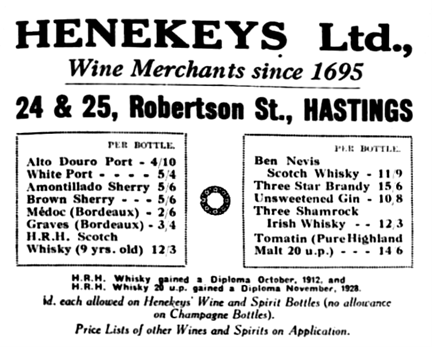
Advertisement for Henekey’s Ltd, wine merchants, taken from a newspaper. Via Hastings Pub History.
After the war, Guy became a director of “Henekey’s Limited” (The Times: 16th August 1945). The company was a wine and spirits importer and liquor distributor owned by Clement Callingham. Among other things, it ran a series of up-market public houses such as “French’s” in Hastings. I imagine Guy kept a good cellar. The product prices have probably gone up a little …
Guy played an important role in the development of this database. In late 1957 or early 1958, he received a letter from Joey Smallwood, the man who ushered Newfoundland into confederation with Canada, asking about Sir Robert John Pinsent – he was looking for information that he could include in what would become his seven-volume “Dictionary of Newfoundland”.
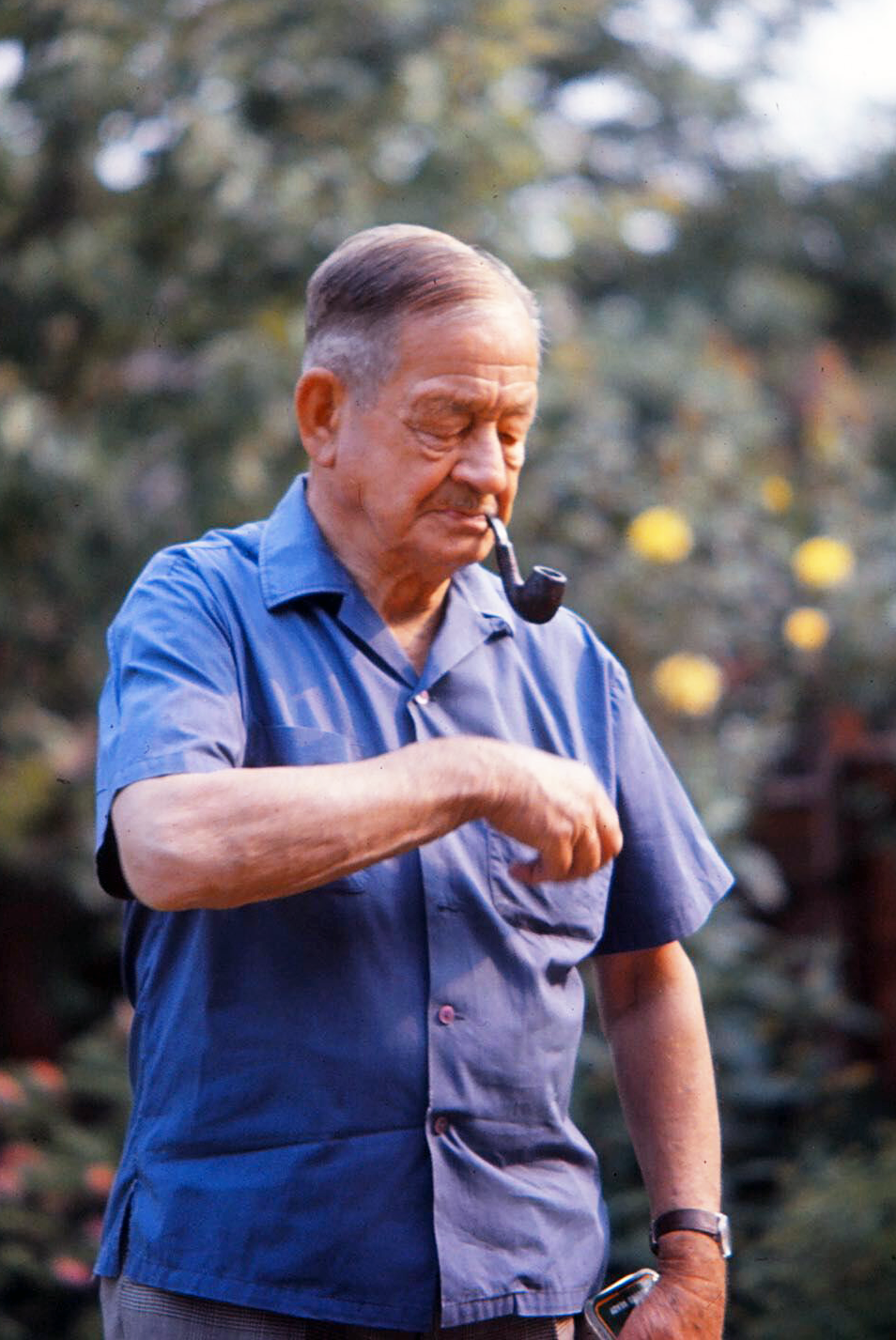
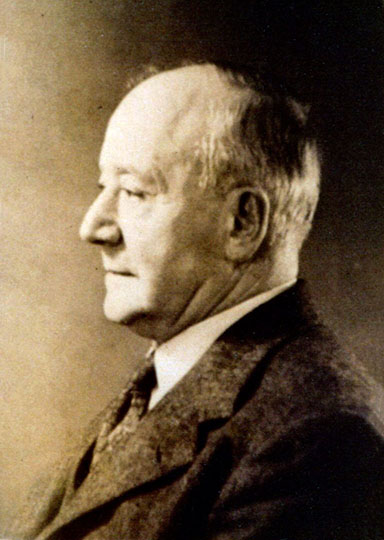
Guy as an older man.
Guy recruited my father and they went through the documents they had in their possession and sent Mr. Smallwood those that they thought were relevant. The correspondence led my father, Dr. Robert John Francis Homfray Pinsent, to think that the time was right to start on a major review of our family’s history. Sadly, he was a generation too early. However, the job is (for now) just about done. There are children around. It will have to be undated.
Guy stayed on in Chobham and died at “Bennebroek”, in November 1972. Betty remained there for a while but eventually moved into a nursing home close to her husband’s family in Devon. She died there in 1986. They had had no children.
Please use the above links to explore this branch of the family tree. The default “Next” and “Previous” links below may lead to other unrelated branches.
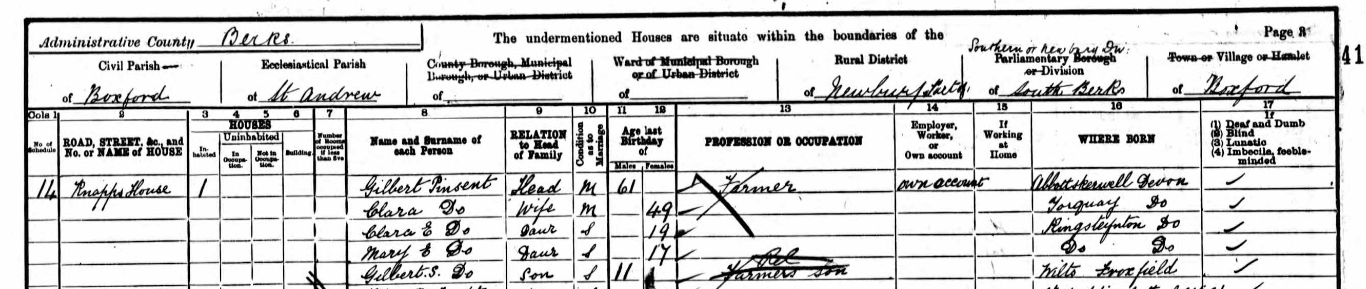
Gilbert S. Pinsent is listed with his parents in the 1901 census.
Gilbert Soudon was the only son of Gilbert Pinsent by his wife Clara (née Bridgman). The couple farmed at “Ware Barton” in Kingsteignton in the 1870s and had two daughters there. They then moved to “Scrope” Farm, near Hungerford in Berkshire, and it was there that their son Gilbert was born. Gilbert and Clara went to live in Newbury while he was still a young boy, so Gilbert Soudon was the first of his line to miss out on farm life. The census records show that the family lived at “Knapps House,” in Bloxford, in 1901. Boxford is four miles northwest of Newbury. It also tells us that Gilbert Soudon was “a farmer’s son,” which was true enough.
Gilbert Soudon Pinsent attended the“British School” in Newbury and was, by all accounts, a diligent student. He was listed among those boys who only missed two days of school in 1899. He missed one more the following year and was allowed to choose from a selection of prizes (Newbury Weekly News and General Advertiser: Thursday 18th May 1899 and Thursday 31st May 1900). Gilbert also did well in the locally held Trinity College Certificate examinations held in 1901 (Marlborough Times: 12th October 1901).
He was good at music and, in 1901, received a prize for his pianoforte playing: “The highest marks were gained by two candidates in the preparatory division, Theodora Reeve-Smith, aged 6, and Gilbert S. Pinsent, aged 12, tying with 88 marks each; the prize had consequently to be divided between them in accordance with the roles in the local prize regulations” (Newbury Weekly News and General Advertiser: Thursday 10th October 19o1).
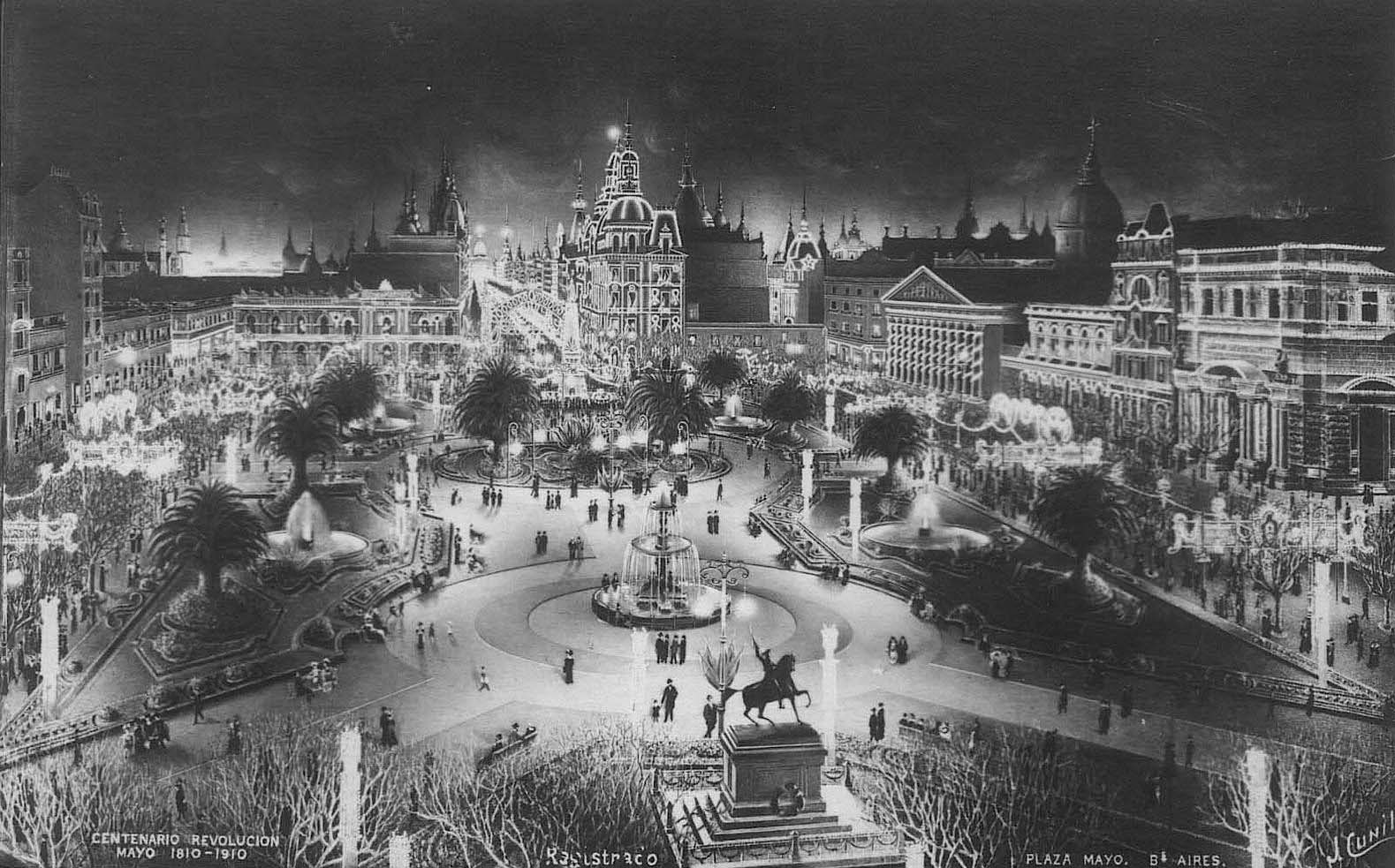
Buenos Aires at night circa 1910.
Gilbert Soudon was away from home when the census takers called in 1911 and I cannot find him in the United Kingdom – quite possibly because he had gone out to Argentina. Gilbert Soudon was one of several Pinsents living in Buenos Aires before the First World War. He seems to have worked in a bank there. Whether they were aware of each other, I do not know but they may have.
One of the other Pinsents was also working in the banking sector. An item in The Times (20th April 1917) describes the contribution to the war effort made by the Buenos Aires-based staff of the “British Bank of South America Limited.” It lists fatalities but also goes on to mention the Military Cross awarded to Guy Homfray Pinsent. He returned to England to enlist in 1914. Gilbert and Guy are both from the HENNOCK branch of the family. Adolphus Ross Pinsent – who comes from the DEVONPORT branch of the family – was a Director of the “British Bank” and he had a son, Sidney Hume Pinsent who was an engineer living in Buenos Aires.
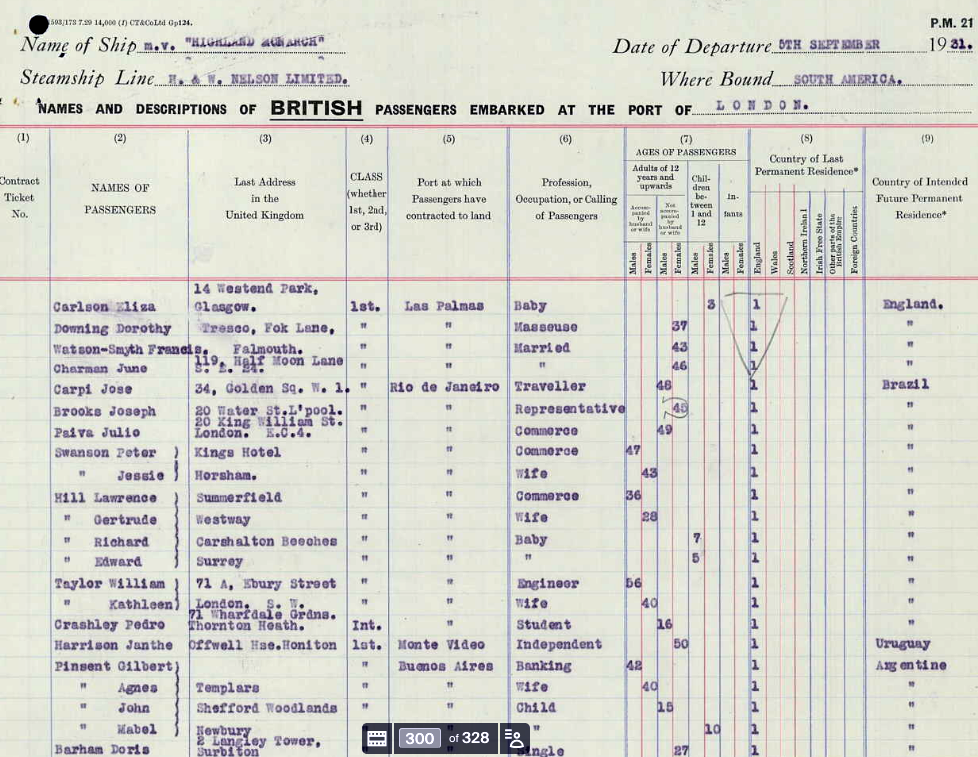
Gilbert and his family appear in the passenger list of the S.S. Highland Monarch.
Gibert Soudon Pinsent married Agnes Mabel Broome, the daughter of a British engineer in Buenos Aires in November 1914 and they had a son, John Soudon Pinsent, in Argentina, in 1916. However, they returned to England for the birth of their second child, a daughter Mabel Sheila Pinsent in September 1920. Ship’s manifests show that they returned to Buenos Aires on “S.S. Halizones”, which left Liverpool on 23rd December. They traveled first class.
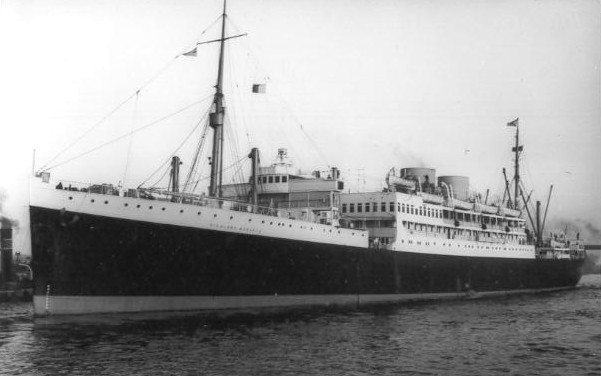
The S. S. Highland Monarch.
The family also returned to England on the “S.S. Highland Monarch” in June 1931. Gilbert and Agnes had their two children – John Soudon (aged 14) and Mabel Sheila (aged 10) with, and they probably intended to drop John off at school in England, as they returned to Buenos Aires on the same ship without him that.
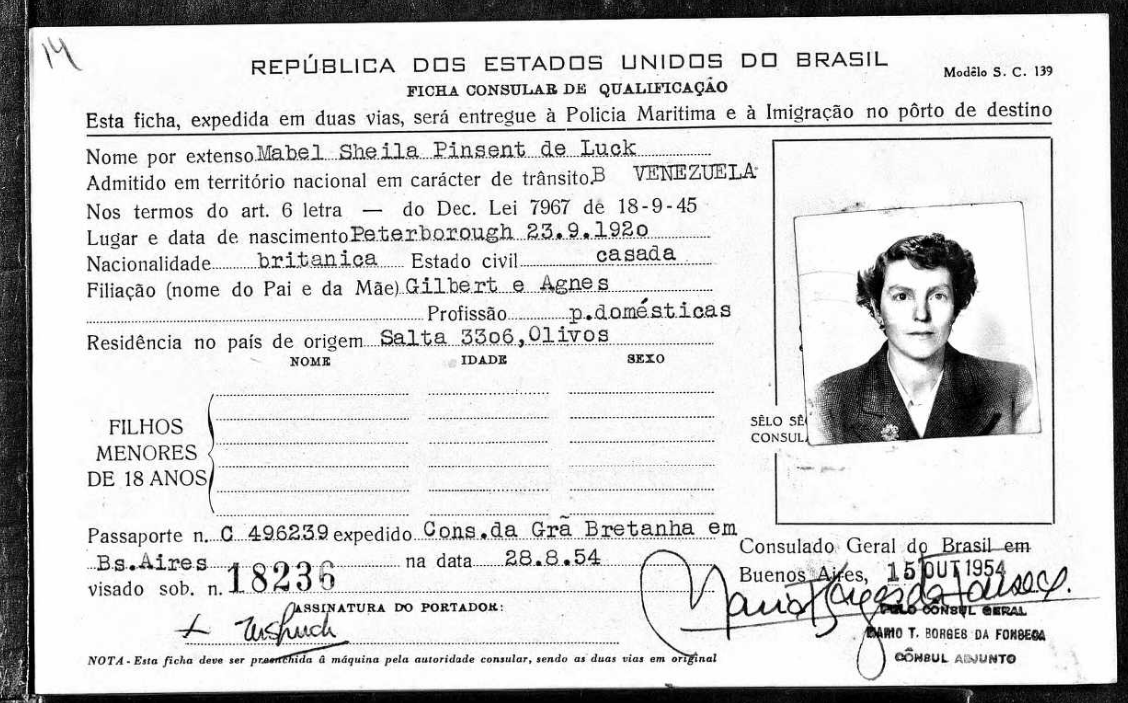
Mabel Sheila Pinsent de Luck’s immigration card from the Consulado Geral do Brasil.
Gilbert Soudon and his wife presumably died in Argentina; however, I have yet to find when or where. Mabel Sheila probably married out there too. She was certainly there in the 1950s, as “Mabel Sheila Pinsent de Luck” applied to the Brazilian Consulate in Buenos Aires for an immigration card and received in in August 1954.
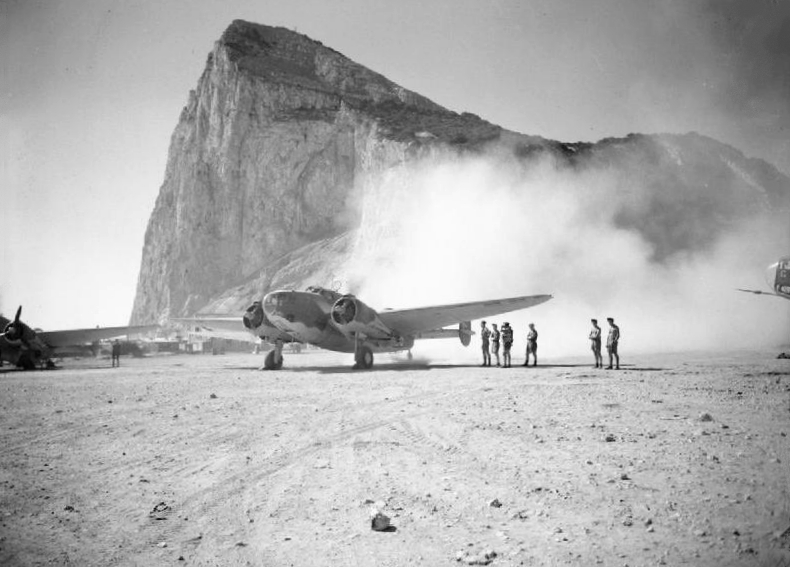
A Lockheed Hudson from the No. 233 Squadron of the RAF via Wikimedia.
John Soudon Pinsent was educated at “St. George’s College”, which is a private Anglican college at Quilmes in Argentina. He was one of several British Argentinians who signed on to fight for the allies during the Second World War. He returned to England and joined the Royal Air Force. He was assigned to “#233 Squadron”, which flew Lockheed Hudson light bombers out of Gibraltar. Sadly, his plane (AM634) was shot down over the Mediterranean in December 1941.
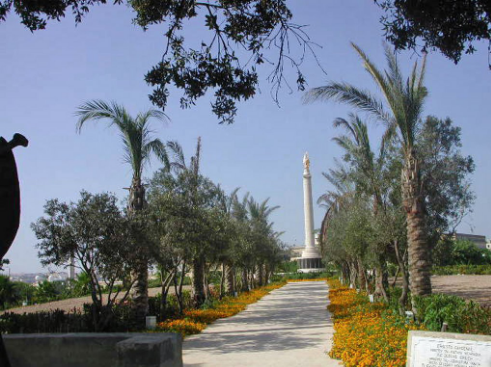
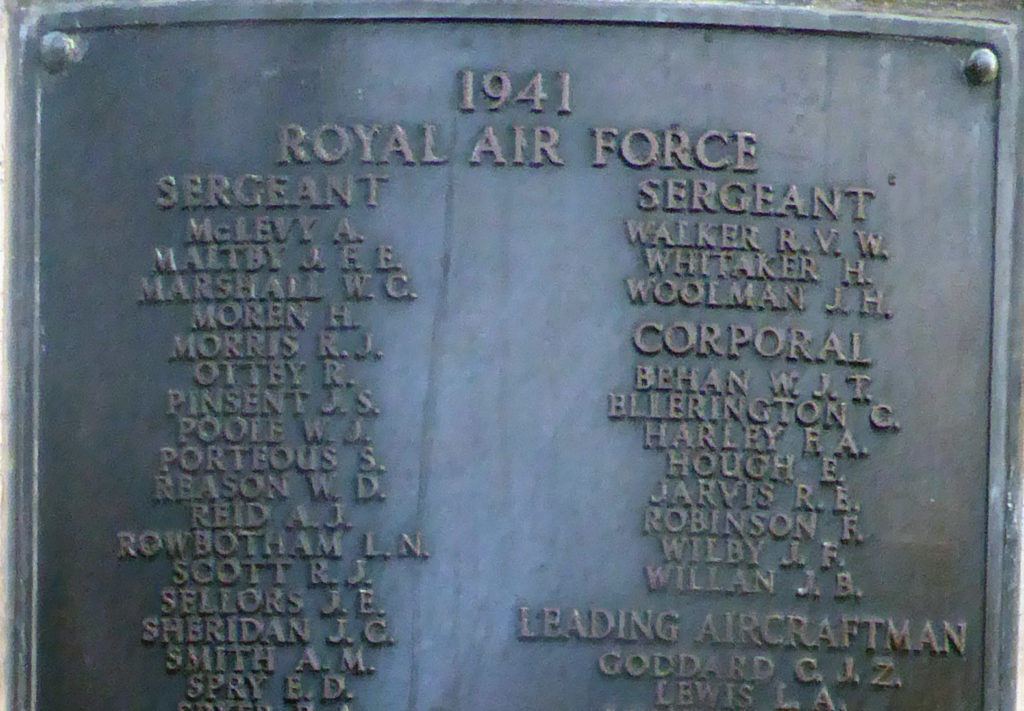
Exactly what happened to Flight Sergeant John Soudon Pinsent and his (three) crew-mates is unclear. Documents in the National Archives state that they were presumed to be shot down when they failed to return from a flight on 11th December 1941. The Argentine British Community Council Memorial website states that the plane went missing in action while attacking a German U-boat and the “Commonwealth War Graves Debt of Honour” site says that it was “shot down in error by a FAA Fulmar during a transit flight from Gibraltar to Malta”. Suffice it to say, he died in defense of Malta and his name appears on a plaque on the Valletta, Malta RAF Memorial. He never married.
Please use the above links to explore this branch of the family tree. The default “Next” and “Previous” links below may lead to other unrelated branches.
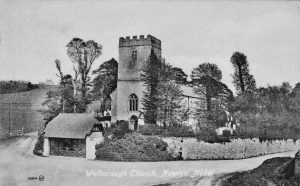
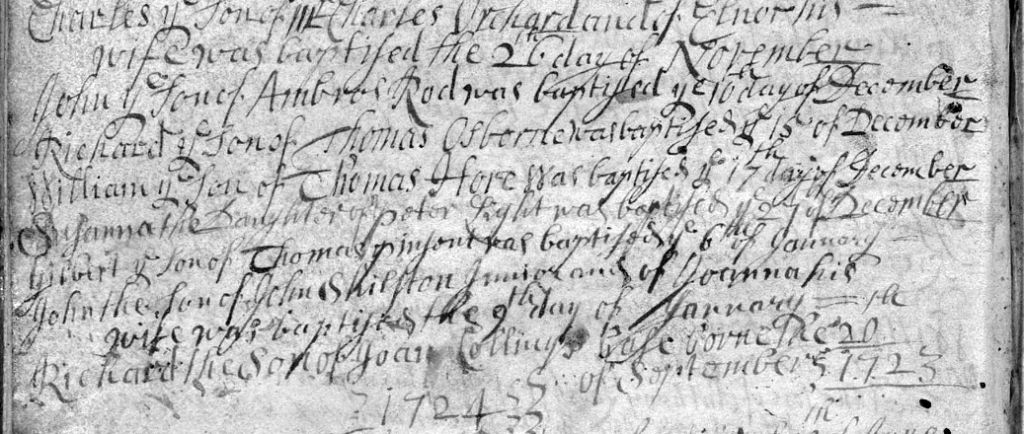
Gilbert Pinsent was the third eldest son of Thomas Pinsent of “Pitt Farm” in Hennock by his wife, Mary (nee Gale). He was baptized in Hennock on 6th January 1724 and buried “aged 70 years” in Wolborough Parish (Newton Abbot) in 1794. His birth record is difficult to read on microfilm (Film #0917142), and some sources suggest that it was a “Robert” Pinsent who was baptized that year. However, that must be a transcription error – as the baptismal date is consistent with Gilbert’s age of death. My grandfather (Francis Wingfield Homfray Pinsent) seems to have read the baptism as “Gilbert” when he saw the original record and I concur.
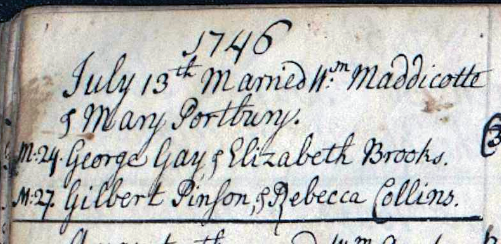
Gilbert Pinsent married Rebecca Collins in Wolborough in 1746 and had a large family that included at least six girls. Sadly, two of them, Urith and Julian, died of smallpox on the same day, in 1757. Anne and Rebecca are unaccounted for but the eldest, Mary, and youngest, Elizabeth, are known to have married. Mary may have had two illegitimate children (born in 1769 and 1771 respectively) before her marriage to Andrew Narramore in 1772. They may have been Mr. Narramore’s children. Elizabeth married William Blackhall in 1780.
Gilbert’s first son, another Gilbert, died an infant and his second, Robert, was not mentioned in his uncle Thomas “the younger” of “Pitt’s” will and he may have died by 1791. All of Thomas’s other then (known to be) living nephews were mentioned by name.
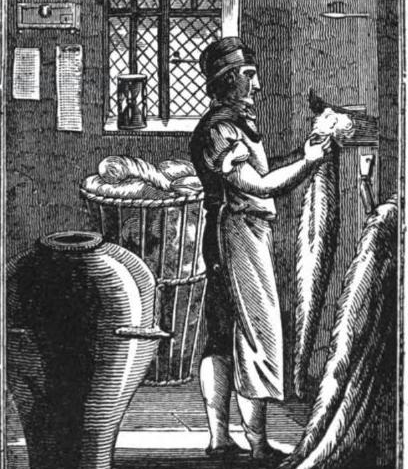
A woolcomber from The Book of English Trades and Library of Useful Arts by J. Souter, 1818.
Gilbert, as a third son, had few expectations with regard to inheritance and he started out as a “woolcomber.” This may have seemed like a good idea at the time as the “East India Company” bought and exported cloth from Devon in the 1700s and it was a thriving, if modest, cottage industry. Sadly, it turned out to be a poor choice as the industrial revolution was starting to take hold in the North of England – and the process of woolcombing was becoming increasingly mechanized. The cloth industry in the Southwest of England was into its terminal decline and it was all but over by the 1830s. He took to gardening in the 1760’s.
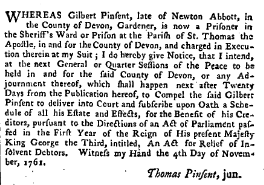
London Gazette, November 3, 1761.
Gilbert’s family clearly became somewhat irritated by his endless financial problems. The London Gazette for 3rd November, 1761 (Issue 10154) shows that “whereas Gilbert Pinsent, late of Newton Abbott, in the County of Devon, Gardener, is now a Prisoner in the Sheriff’s Ward or Prison at the Parish of St. Thomas the Apostle, in and for the County of Devon, and charged in Execution therein at my Suit; I do hereby give Notice, that I intend, at the next General or Quarter Sessions of the Peace to be held in and for the said County of Devon, or any Adjournment thereof, which shall happen next after Twenty Days from the Publication hereof, to Compel the said Gilbert Pinsent to deliver into Court and subscribe upon Oath a Schedule of all his Estate and effects, for the Benefit of his Creditors, pursuant to the Directions of an Act of Parliament passed in the First Year of the Reign of His present Majesty, King George the Third, entitled, An Act for Relief of Insolvent Debtors. Witness my Hand the 4th Day of November 1761: Signed Thomas Pinsent, jun”. Presumably, this was his brother Thomas, who was later to be the second owner of “Pitt Farm”.
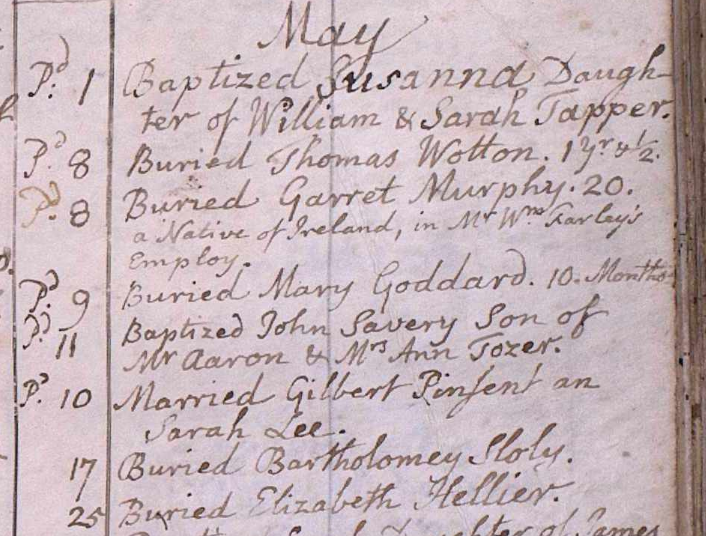
Gilbert and Sarah marry on May 10, 1791.
Gilbert continued to have financial problems all his life. His wife, Rebecca, died in the “Workhouse” in Wolborough, in 1788. Gilbert married Sarah Lea in 1791, but died a few years later.
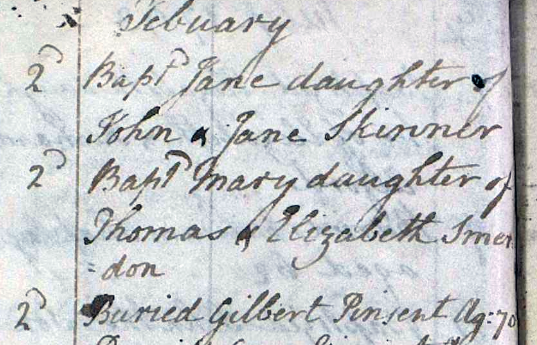
Had he lived, Gilbert was to have received an annuity when his brother Thomas died; however, he died first. The Sarah Pinsent “aged 71 years” who died in Wolborough in 1811 was probably his widow. In the absence of known surviving sons, Gilbert seem unlikely to have left Pinsent descendants.
Please use the above links to explore this branch of the family tree. The default “Next” and “Previous” links below may lead to other unrelated branches.
Thomas Pinsent: 1790 – 1804 Mary Snow Pinsent: 1793 – 1890 (Married George Wills, 1832, Abbotskerswell, Devon) William Pinsent: 1797 – 1882 (Farmer & Bookseller; Married Jane Crockwell, Coffinswell, Devon, 1822) John Pinsent: 1799 – 1858 (Farmer; Married Ann Brock, Abbotskerswell, Devon, 1831)
Gilbert Pinsent was the third eldest of John Pinsent and Susanna (née Pooke’s) surviving sons. His birth record seems to be missing but, if his age at death was 77 years as reported, he would have been born in around 1758. He was probably born in Newton Abbot. Both of his parents died in 1772 and Gilbert and his younger brothers (Charles, Samuel and Joseph Pinsent) went to live with their grandparents Thomas Pinsent and Mary (née Gale) at “Pitt Farm” in Hennock.
Gilbert’s grandmother and his grandfather died in 1744 and 1777 respectively; so the brothers were in fact brought up by his son, their uncle, Thomas Pinsent, and his wife, Mary (nee Mudge). They had no children of their own and were probably very pleased to have them around. It is worth noting that Gilbert and William Pinsent (possibly his son?) were called upon to witness the will and codicil of Samuel Mudge, Gent., of Lindridge Hill in Kingsteignton, in 1821 (Inland Revenue Wills: 1821).
Whether Gilbert was formally apprenticed to work at “Pitt” I do not know; but he was certainly brought up to be a farmer seems to have been very successful at it. Gilbert had moved out by the time his uncle, Thomas Pinsent of “Pitt”, died. When he did so, he left £50 apiece to the five “sons of (his brother) John Pinsent.” Gilbert’s younger brother Charles had the good fortune to inherit “Pitt.” His life is described elsewhere.
Gilbert had married Margaret Snow by license in Kingsteignton in 1790 and had three sons; of whom two (William Pinsent and John Pinsent) lived to maturity, married and had children of their own. They also had a daughter, Mary Snow Pinsent who also married.
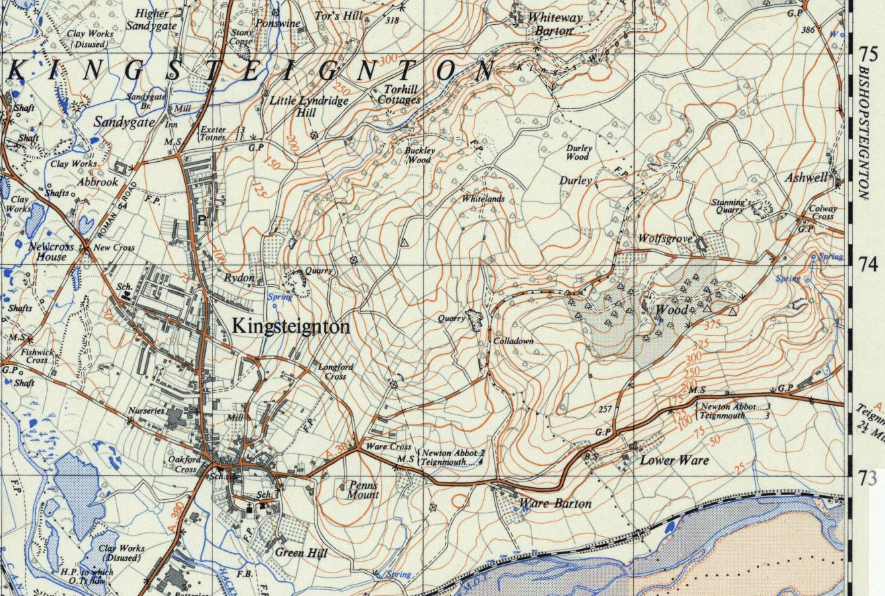
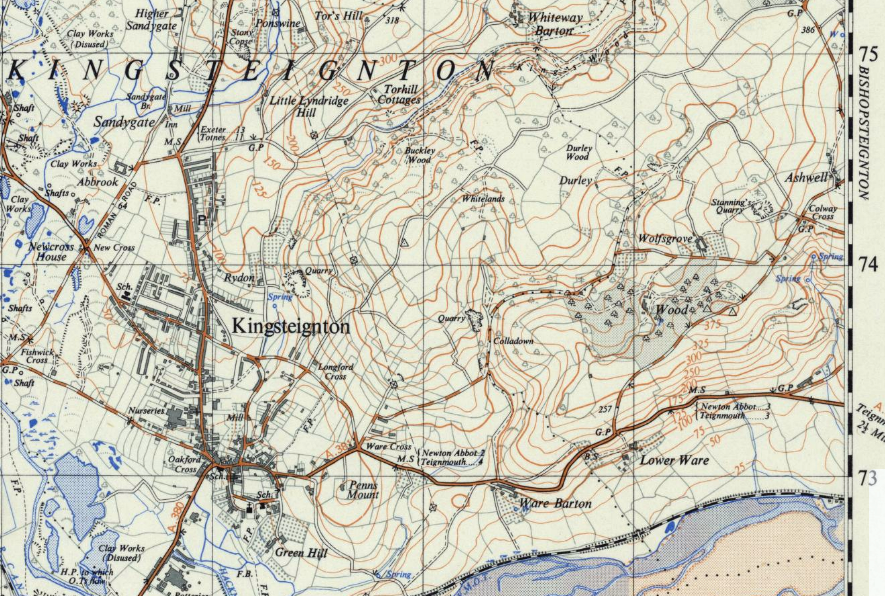
Map showing Ponswine Farm near Kingsteignton.
Gilbert was a tenant farmer at “Ponswin”, east of Stoney Copse in Kingsteignton from 1797 (if not earlier) to 1824, and paid £1 13/4d in Land Tax annually for the privilege. While there, he was assigned apprentices by the local parish guardians. Some, such as Thomas Carnell (in 1805) and George Joslyn (1818) were for work on the farm at “Ponswin;” however, others, such as James Tapp (1811) and Sally Stephens Towell (1818) were given for nearby by properties at “Lindridge Hill” and “Church Gate Estates.” Gilbert had probably added to his rental holdings (Kingsteignton Apprentice Register: 1775-1823).
Gilbert also apprenticed an eleven-year old girl called Elizabeth Carnell (Thomas Carnell’s sister?) as an apprentice in 1812 and Deborah Cass uses a transcript of the original, signed, indenture in her book “Writing your Family History: A Practical Guide” (Crowood: 2012) to illustrate how these documents were worded – at least in Devon in the early 1800s. It was a two-way commitment. Elizabeth was expected to learn about and help with the housekeeping and husbandry, and Gilbert was to look after her until she reached the age of 21-years or, with his permission, married earlier.
Gilbert and his younger brother Charles (who owned land at “Lower Albrook” – north of the village of Kingsteignton) were contemporaries of Thomas Pinsent (the DEVONPORT draper – see elsewhere) who farmed at “Greenhills” on the southern outskirts of Kingsteignton. They were all men of influence in the district and Gilbert, along with his son (?) William, were called upon to witness the will and codicil of neighbour, Samuel Mudge of “Lindridge” in 1820 (Inland Revenue: Stamp Act Wills: 1820). Gilbert was politically active; that same year he supported the nomination of a Mr. E. P. Bastard for Member of Parliament (Exeter Flying Post: Thursday 16th March 1820).
Gilbert and Margaret’s eldest son, Thomas Pinsent, died young. Their second child, Mary Snow Pinsent, lived and married a widower, George Wills, in Ilsington in 1832. He was an affluent farmer. Their third child, William Pinsent, started out as a farmer but later in life drifted into other less lucrative professions. He died in the Newton Abbot Union Workhouse in 1882. His life, and that of his younger brother John Pinsent – who stuck with farming and took over their father’s farm on his death in 1835 – are also discussed elsewhere.
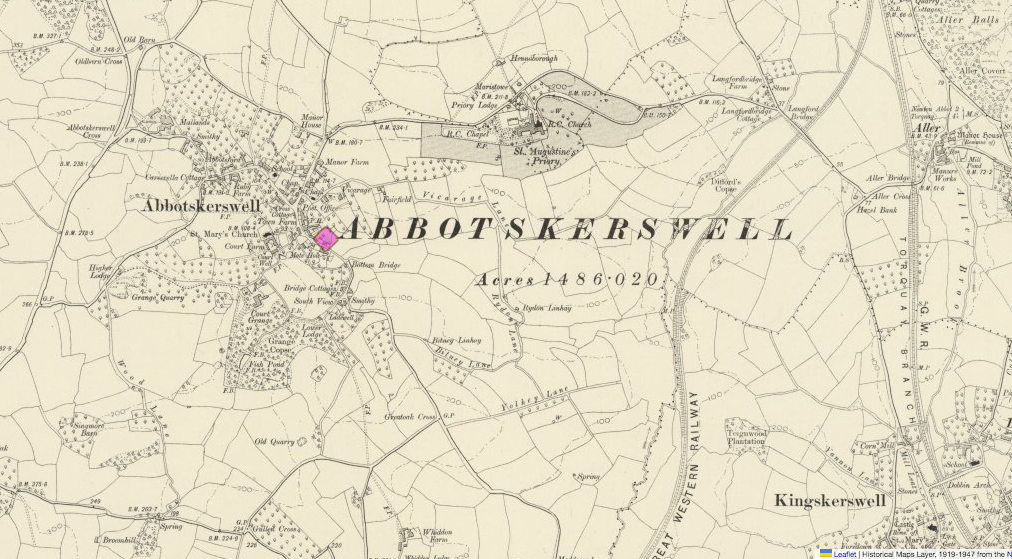
Map of Abbotskerswell marking the location of “Aller Barton”.
In 1824, Gilbert left “Ponswin” and moved to “Aller Barton”, a farm owned by Rev. G. Baker of South Brent on the eastern boundary of Abbotskerswell parish. “Aller” was valued at £24 16s per annum in Land Tax and Gilbert shared the property with Richard Turner until around 1829, and with William Bickford up until at least 1831 – when the tax records come to an end. While living there, Gilbert also farmed “Lang Bridge” (valued at £1 10s) in the same parish and “Brent” in nearby Kingskerswell (valued at 7s 7d). They too belonged to Rev. Baker. Gilbert also shared “Mudgery Down” and “Catslades”, in Marldon (owned by a Mrs. Easterley) with other farmers from 1826 to 1831. He may have farmed the “Catslades” portion, which was taxed at 13s 9d by himself in 1829. In 1830, Gilbert added “Goldmoors” in Wolborough, owned by Robert Codners, to his holdings at a land tax of £1 7/4d. He was a busy man! However, he had two sons and they, presumably, helped him manage his holdings.
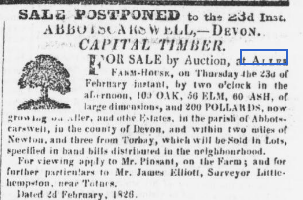
Advertisement for the sale of timber, Exeter Flying Post, February 16, 1826.
The Rev. Baker retained the timber rights for his properties and offered 100 oak, 56 elm and 60 ash trees “of large dimensions” for sale by auction on 23rd February 1826 (Exeter Flying Post: Thursday 16th February 1826). Prospective purchasers were advised to see Mr. Pinsent at “Aller”. Trees were a valuable resource – particularly oaks as they were much prized by the Royal Navy. By that date Gilbert had probably handed the day-to-day running of the farm to his son, John.
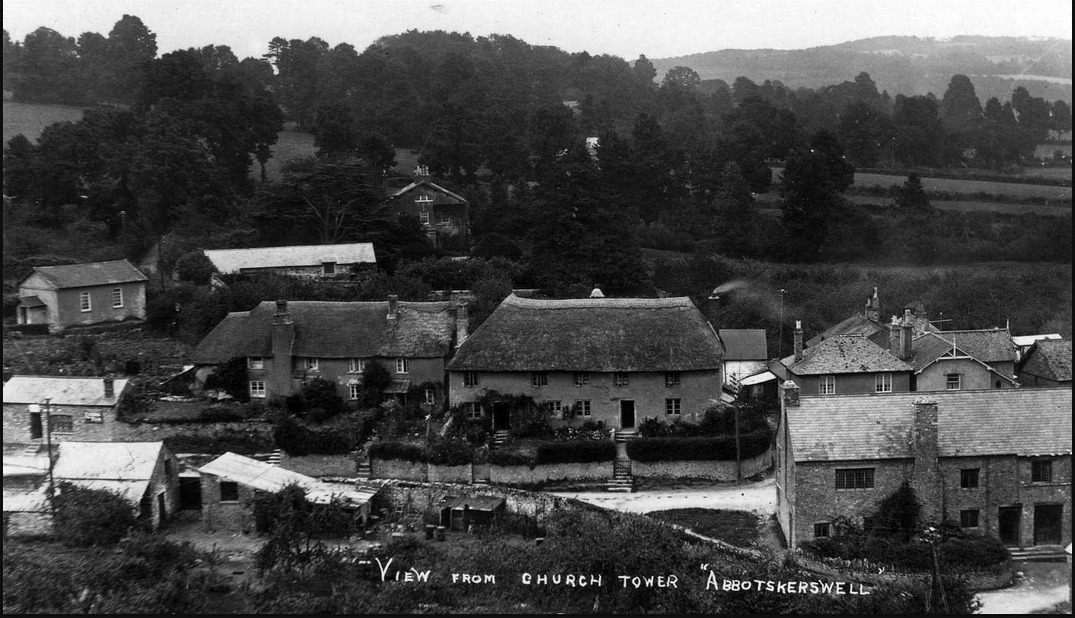
Abbotskerswell as photographed from the church tower.
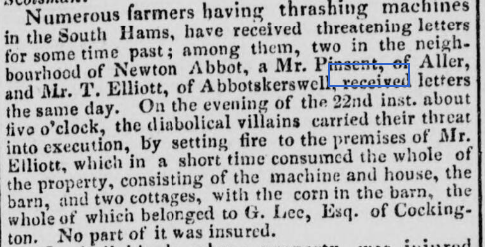
Gilbert was a wealthy farmer at a time when the rural economy in England was in crisis – it was an issue that his brother Joseph Pinsent regularly complained about in the press. Grain prices were low because of cheap imports and farmers were forced to mechanize to reduce costs. Gilbert and his son John, and another farmer named Mr. T. Elliott, were seen to be using threshing machines and they received threatening letters that accused them of putting people out of work.
Newspaper excerpt describing the arson, Hampshire Telegraph, January 3, 1831.
In the event, Gilbert’s farm was spared but Mr. Elliott’s farmhouse, his infrastructure, his barns and threshing machine were burnt down on the 22nd December 1830. Unfortunately for Mr. Elliott, they were not insured. The likely culprits had been seen lurking in the village but there is no indication that anyone was ever caught or convicted (Hampshire Telegraph and Sussex Chronicle: Monday 13th January 1831).
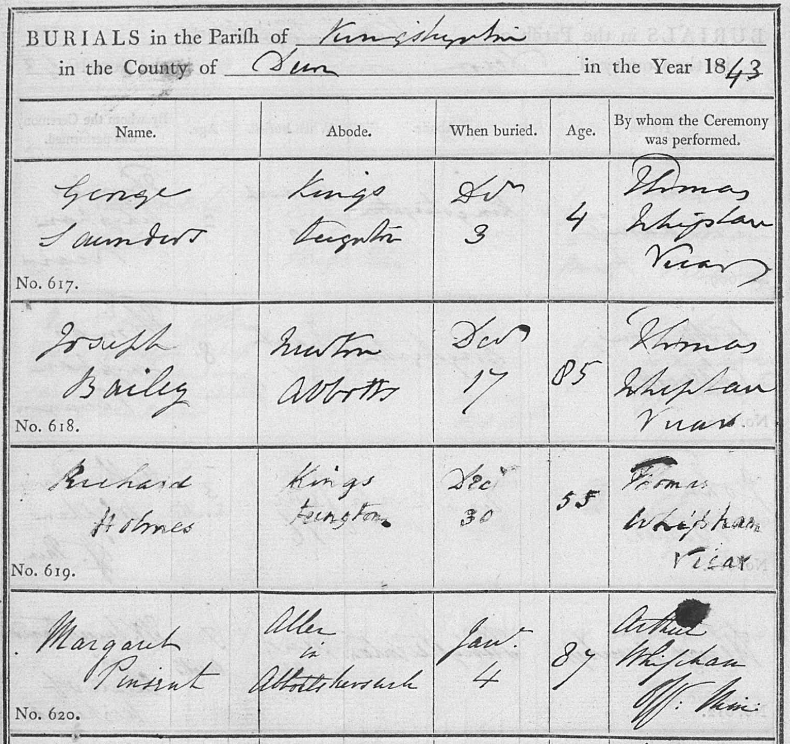
Entry describing Margaret Pinsent’s burial plot.
Gilbert died at “Aller Barton” and was buried in Kingsteignton in November 1835. His son John continued to work the farm and his mother, Gilbert’s widow, Margaret (née Snow) is described as being “independent” in the 1841 Census, so she retained some wealth and standing in the community. She died in Abbotskerswell in December 1843 and was buried in Kingsteignton early in January 1844.
Her son, John surrendered “Aller” back to its owner and “Kelly’s Directory of Devon” suggests that much of it had fallen into the hands of the “Aller Vale Fine Arts Pottery Co.” by 1902. The area had long been known for its clay deposits and that was where the future lay. John moved to “Ware Barton”, a farm in Kingsteignton, in 1847. His life is discussed elsewhere.
Please use the above links to explore this branch of the family tree. The default “Next” and “Previous” links below may lead to other unrelated branches.
Clara Ellen Pinsent: 1881 – 1942 (Married Frederick Dopson New, 1925, Great Shefford, Berkshire) Mary Eliza Pinsent: 1883 – 1945 (Married Frederick Gotelee, 1916, Newbury, Berkshire) Gilbert Soudon Pinsent: 1889 – xxxx (Married Agnes Mabel Broome, Buenos Aires, Argentina, 1914)
Gilbert was the second son of John Pinsent by his wife, Ann (née Brock). He was brought up at “Ware Barton” in Kingsteignton and he helped his elder brother, John Pinsent, and his mother to run the family farm after his father died in 1858. John left to marry in 1865 and his mother died the following year – so it fell to Gilbert to pick up the tenancy. He ran the farm with the help of his two younger brothers James Pinsent and Henry Pinsent until they too took off. Henry married in 1870 and James went out to Australia sometime in the 1870s.
The Pinsents were “nonconformists” and they attended a chapel in Kingsteignton that was largely built through the generosity of a very distant relative from the DEVONPORT branch of the family. Mr. Thomas Pinsent and his sons ran a drapery business in Devonport and a brewery in Newton Abbot and both were well known in South Devon.
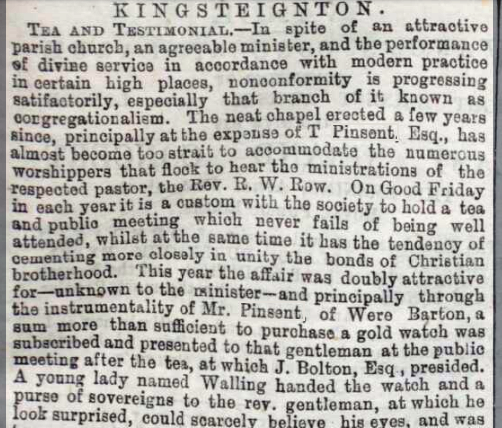
Gilbert Pinsent finances a gift for the pastor. Western Times, April 22, 1870.
Gilbert was an active member of the congregation and arranged for a gold watch to be presented to the dissenting minister on Good Friday in 1870 (Western Times: Friday 22nd April 1870). He also treated “six-score children” to a tea at the farm later that summer (Western Times: 19th July 1870). Unfortunately, good deeds are rarely rewarded and the farm was infected by “foot and mouth disease” in the autumn (Totnes Weekly Times: Saturday 8th October 1870). Farm to farm infections were a serious problem before the age of antibiotics. A few years earlier, in August 1866, one of Mr. Pinsent’s employees, Benjamin Burnett, had been convicted at the Petty Sessions for “removing a calf” without the necessary certificates. He was fined 1s (Exeter and Plymouth Gazette: Friday 24th August 1866). It seems to have been deemed to be a serious offense at the time.
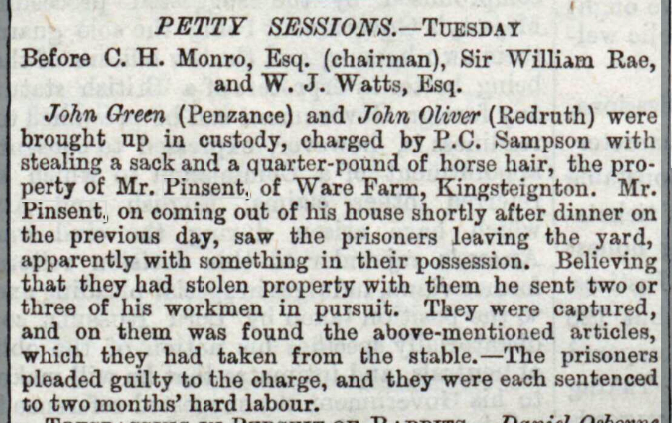
Gilbert Pinsent testifies against two men who had stolen horse hair from his farm. Exeter and Plymouth Gazette, October 20, 1865.
Towards the end of Queen Victoria’s reign, cheap imports from the Continent and elsewhere caused a good deal of suffering among farm works and it is, perhaps, not entirely surprising that a small amount of pilfering went on. Some cases came before the magistrates at the local Petty Sessions. For instance, two Cornish men were charged with theft in Newton Abbot in October 1865 after Mr. Pinsent saw them coming out of the stable with a sack and a quarter-pound of horsehair. They were captured and pleaded guilty (Exeter and Plymouth Gazette: Friday 20th October 1865). They were at least “foreigners”.
In 1870, two locals were brought up at Newton Petty Sessions for stealing some of Gilbert’s turnips. It led to two weeks in prison for one, Mary Horsham (who was probably the wife of one of Gilbert’s workers) and one week for the other, John Efferd (Western Times: Friday 28th October 1870). They were probably good turnips too, as Mr. Pinsent of Ware had received 1st prize for “the best crop of common turnips” at the “Newton Agricultural and Labourers’ Friend Society” meeting in 1868 and knew how to grow them.
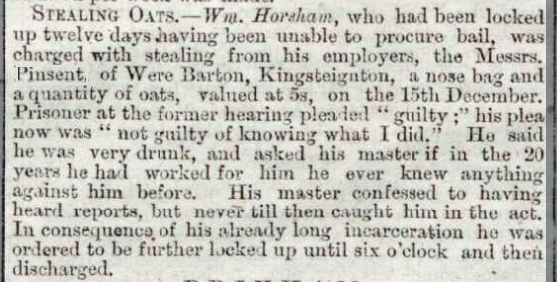
William Horsham changes his plea in the charge of stealing Gilbert Pinsent’s oats.
On another occasion, Gilbert’s brother James Pinsent caught William Horsham stealing oats from the farm – although he claimed he was too drunk to know what he was doing. At the Petty Sessions, he asked James if, “in the 20 years he had worked for him, he had known anything against him? (James) confessed to having heard reports but never – till then having caught him in the act” (Western Times: Thursday 29th December 1870).
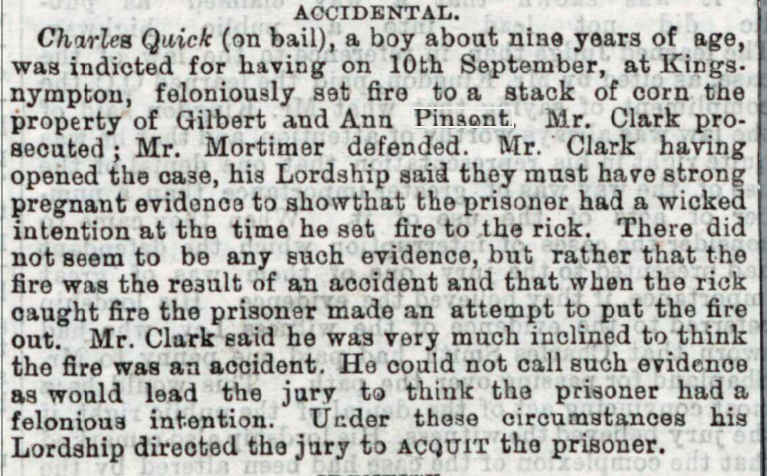
The young boy is charged with arson. Western Times, March 16, 1869.
“Ware Barton” seems to have attracted miscreants. In September 1868, Gilbert had thirteen ricks of wheat and two of oats burned down. The fire caused £400 to £500 in damage that was, fortunately for Gilbert, covered by insurance (Exeter and Plymouth Gazette: Friday 11th September 1868). The two young lads who had been seen running away were later caught, and the elder of the two, aged 9, committed for trial. When the time came, his Lordship managed to convince himself that it must have been an unfortunate accident and the jury returned a verdict of “Not Guilty” (Western Times: Friday 16th March 1869).
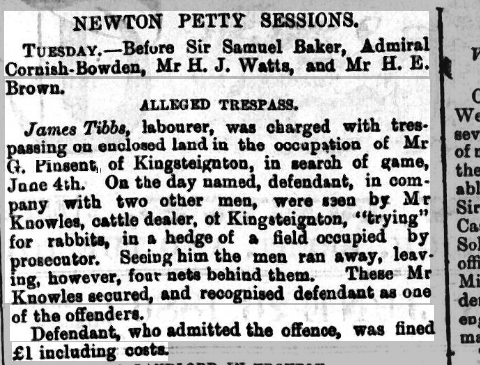
An accused poacher is fined for hunting rabbits. Totnes Weekly Times, June 26, 1886.
A few years later (in 1873) Samuel Lang pleaded guilty to stealing apples from Gilbert’s orchard (Exeter and Plymouth Gazette: Friday 29th August 1873) and in 1876 Thomas Causley was convicted of trespass in pursuit of conies (rabbits) (Western Times: Friday 23rd June 1876. Thomas Lang (a relation of Samuel’s perhaps?) was nabbed for a similar offense – going after rabbits at “Broad Aller” – in March 1881 (Western Times: Wednesday 9th March 1881). Perhaps there was a particular attractive warren on the farm. Even as late as 1886, James Tibbs and two others were charged with using a ferret and nets to try and catch rabbits along a hedge at “Ware Barton” (Western Times: Friday 25th June 1886).
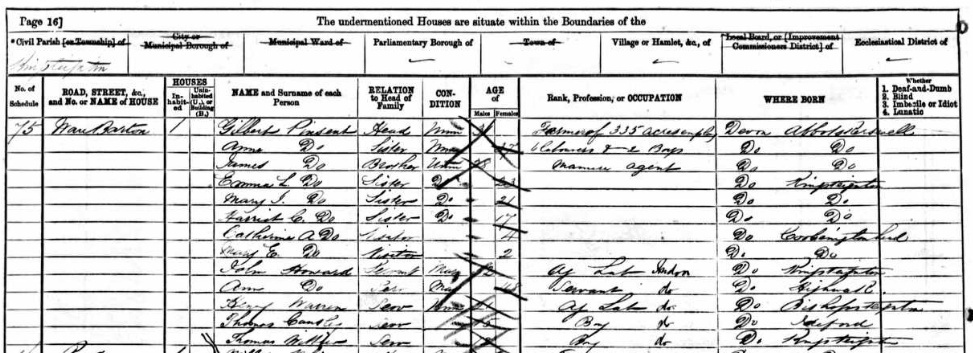
Gilbert Pinsent appears in the 1871 census.
The 1871 Census shows that Gilbert was farming 335 acres with the help of his brother James and his then unmarried sisters Anna, Emma L., Mary I. and Harriet C. Pinsent. The farm also employed six day-labourers and two boys. James had a side-line. He worked for “Lawes”, a firm that distributed guano (bird droppings) and manufactured chemical fertilizers. He was quaintly referred to as being a “manure agent”. At the time of the census (1871), two of Gilbert’s nieces (his brother, John’s daughters Catherine A. and Mary E.) were visiting the farm.
Gilbert and his brother John were well known in the Newton Abbot area, although perhaps not as well known as their brewing counterparts from the DEVONPORT branch, and members of both families attended community events, such as the “Newton Abbot Agricultural and Labourers’ Friend Society” annual meetings. Both families were non-conformist and also attended Chapel services and occasionally wound up on Committees together. When it came to local and national politics, they both seem to have had a preference for the Liberal party. Gilbert was appointed to the committee of a “Parochial Liberal Association” in March 1885 (Totnes Weekly Times: Saturday 14th March 1885). However, he left the area a few years later.
Gilbert and his brother John sometimes picked up a prize or two at the annual meetings of the “Agricultural and Labourers’ Society” and they almost invariably attended the dinners. In 1871, John’s ploughman came in fourth and one of Gilbert’s servants, Ann Howard, received 15s for her twenty-seven years and four months of service to the Pinsent household at Ware (Exeter Flying Post: Wednesday 1st November 1871). Three years later, she was the second-longest serving servant in the district. Another of Gilbert’s “old timers” was found accidentally drowned the following January (Exeter and Plymouth Gazette: Monday 22nd January 1872). It was surmised that he had wandered from the path as he approached a bridge over the River Lemon.
Gilbert was elected to serve on the “Newton Abbot Board of Guardians” in 1868 (Exeter and Plymouth Gazette: Friday 2nd April 1869). It oversaw local contracts and was responsible for the management of the Workhouse. It also saw to the distribution of aid and education to paupers. He was on the Board for many years and was still active in 1882 (Western Times: Thursday 20th April 1882). His brother Henry seems to have joined Gilbert on the Board in 1883.
Gilbert married relatively late in life, and this seems to have been a source of amusement to his friends. When Lord Clifford, the Lord of the Manor of Kingsteignton, gave a dinner for his tenants on the occasion of his son’s coming of age, in 1873, Gilbert was asked to respond to the toast to the Ladies. He did so: “Mr. G. Pinsent, in responding, was not altogether hard upon the ladies – perhaps he was rather cowed at the presence of so many. Although he had not as yet entered the blissful state, he would not exclude them from meetings of that sort because he believed their presence would have a tendency to make the men a little more sociable” (Western Times: Tuesday 7th January 1873). He was probably right. Gilbert finally succumbed and married Clara Bridgeman, the daughter of a Torquay grocer. They married at the Congregational Chapel in Newton Abbot, in 1880.
Gilbert was a law-abiding farmer. When a stray, unmarked, white-faced cow wandered onto his land in November 1872, he put an advertisement in the paper (Western Times: Friday 15th November 1872). Presumably it was claimed. He did, however, eventually get on the wrong side of the magistrates now and then. In 1878 the local road surveyor summoned him for not pruning his hedges. Gilbert argued that he had done so, and that he profoundly disagreed with the surveyor as to how high they should be! He claimed they were not a hazard. Regardless, he was ordered to get the overhangs pruned. The surveyor also charged him with obstruction for leaving bundles of brushwood by the side of the road (which presumably gives the lie to his not having cut the hedges) but, as he had given Gilbert no notice of this particular offense, it was dismissed (Western Times: Friday 13th December, 1878). The trials of a Devonshire farmer! Anyone who had been down a Devon lane will know about its deceptive walls and hedges. Gilbert must has smiled when he was asked at the Kingsteington Vestry meeting on Ladyday (25th March) 1885 to serve on a Committee of Surveyors for the repair of roads (Exeter Flying Post; Tuesday 1st April 1885).
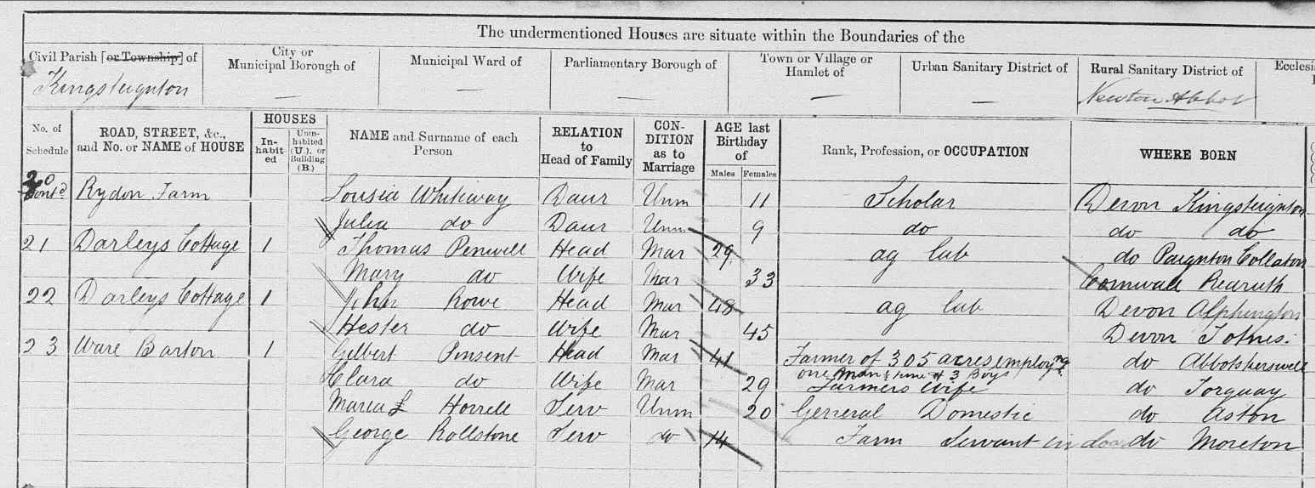
Gilbert and Clara appear in the 1881 census.
Gilbert and Clara were still working the farm at “Ware Barton” at the time of the 1881 Census. It was then said to cover 305 acres. James had gone out to Australia by then and Gilbert and his newly acquired wife were running it on their own, with the help of two domestic servants and, presumably, day-labourers. Their daughters, Clara Ellen and Mary Eliza Pinsent were born at “Ware Barton” in 1881 and 1883 respectively.
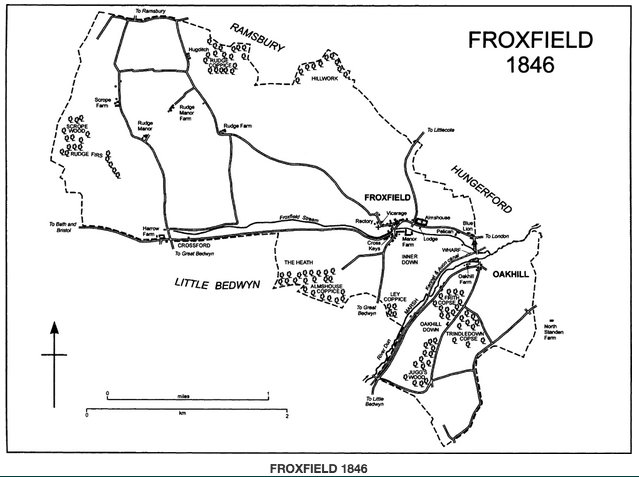
Map of Froxfield Parish including Scrope Farm.
Gilbert’s brother, John Pinsent left “Roccombe” in Combeinteighhead and moved to “Gambledown Farm”, near Romsey, in Hampshire in 1884 and Gilbert decided to follow in 1887. He moved his family to “Scrope Farm” which is south of the River Kennett near Rudge a larger predominantly open-field farm to the north of what is now the “A4” road west of Froxfield, near Hungerford in Wiltshire. Strangely, the village of Froxfield was where Gilbert’s distant relation (they shared a common great-great-grandfather) Robert John Pinsent (later Sir Robert John Pinsent) married his second wife, Emily Hetty Sabine Homfray in 1872!
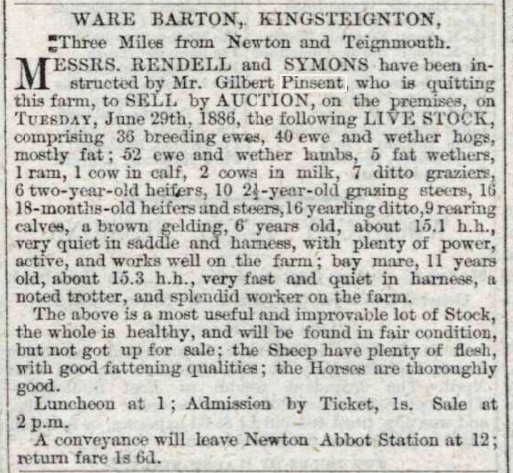
The auction is announced for June 29, 1886. Exeter and Plymouth, June 25, 1886.
Rendell and Symons were commissioned to auction off Gilbert’s livestock at “Ware Barton”. It included “36 breeding ewes, 40 ewe and wether hogs, mostly fat; 52 ewe and wether lambs, 5 fat wethers, 1 ram, 1 cow in calf, 2 cows in milk, 7 ditto graziers, 6 two-year-old heifers, 10 2 1/2-year-old grazing steers, 16 18-months-old heifers and steers, 16 yearling ditto, 9 rearing calves, a brown gelding, 6 years old, about 15.1 h.h., very quiet in saddle and harness, with plenty of power, active, and works well on the farm; bay mare, 11 years old, about 15.3 h.h., very fast and quiet in harness, a noted trotter, and splendid worker on the farm” on Tuesday 29th June 1886 (Exeter and Plymouth Gazette: Friday 25th June 1886). The firm later sold the residual grass on 86 acres for grazing (Exeter and Plymouth Gazette: Friday 8th October 1886) and disposed of his remaining assets – including a few cows, pigs and chickens, eight ricks of clover and hay and faggots of wood. He also disposed of some household furniture (Western Times: Friday 23rd September 1887. Gilbert and Clara left for Wiltshire a few days later, at Michaelmas (29th September).
Gilbert was up and running and back in business the following year, 1888. He sold some fat ewes for a good price (45s – 48s) in June 1889 (Devizes and Wiltshire Gazette: Thursday 6th June 1889). Gilbert and Clara had a son, Gilbert Soudon Pinsent at “Scrope” shortly thereafter; which might explain why two of his nieces, Catherine A. and Ada Pinsent were living on the farm when the 1891 Census was taken. They were probably there to help Clara with the baby and to assist a resident school governess with the two young girls.
Gilbert Pinsent is pinned beneath a cart. Reading Mercury, March 19, 1892.
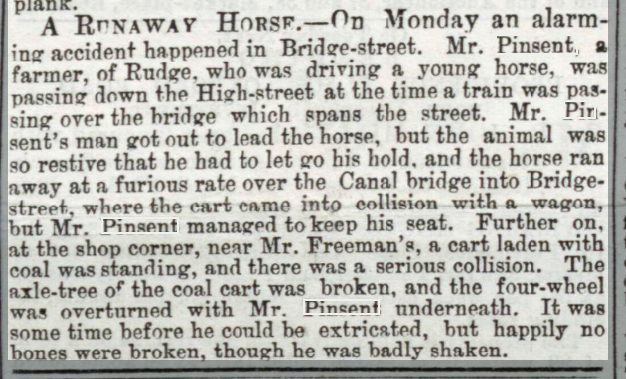
The Census records say that Gilbert was a “lame farmer” in 1891 – why I am not sure; however, I do know that he was involved in a painful accident in March the following year. His farm at “Scrope” was near Hungerford and he had the misfortune to be driving a horse and cart into town as a train passed nearby and spooked his horse. It careening down the street and crashed into a wagon-load of coal. after He survived with his bones in tact but he was badly shaken (Reading Mercury: Saturday 19th March 1892).
Perhaps indisposition was why he gave up the farm the following year. It was advertised to let in August 1893: “Scrope Farm, comprising 206 acres arable (including sanfoin), 8 acres pasture, 14 acres wood with house, homestead and 2 cottages with in 4 miles of rail and Hungerford” (North British Agriculturalist: Wednesday 9th August 1893. Gilbert went looking for something more manageable: “Wanted to Rent: A house with 5 or 10 acres of meadowland: Apply to G. Pinsent, Froxfield, Hungerford” (Newbury Weekly News and General Advertiser: Thursday 7th September 1893).
Gilbert is charged for moving a pig. Swindon Advertiser and North Wilts Chronicle, January 13, 1894.
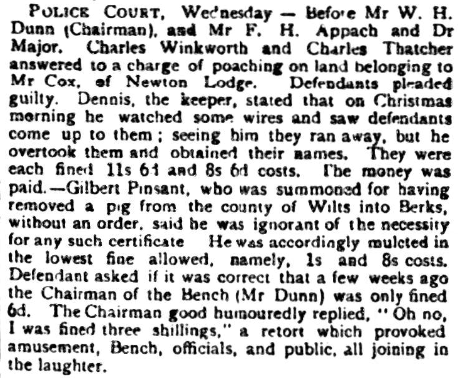
Shortly afterwards, “Mr. Pinsent late of Scrope Farm Bridge” was summoned before Hungerford Petty Sessions for moving a pig across the county line from Wiltshire to “his new farm” in Berkshire without a license. Gilbert claimed ignorance of the offense. He said that he had not sold the pig; it was his and he was just moving it to a new farm. Nevertheless, he was fined 1s with 8s costs! (Swindon Advertiser and North Wilts Chronicle: Saturday 13th January 1894).
Gilbert had moved to “Falkland Farm”, at Wash Common, near Newbury (Kelly’s Directory of Berkshire, 1899), which had been the site of the First Battle of Newbury, in 1643. The farm house is now surrounded by houses but still remains as “Falkland Garth” on Essex Road. While living there, Gilbert and Clara were involved in a wagonette crash that occurred when the main pin holding the shaft gave way as they traveled down Wash Hill into town. Gilbert attempted to check the horse but it careened through the town for quite a distance before it could be stopped. Neither was seriously hurt but Clara had managed to jump clear and received quite a shock (Newbury Weekly News and General Advertiser: Thursday 5th November 1896).
Gilbert, his wife and three children were living at Knapps House, Boxford, in Newbury when the census takers next came around in 1901. He was shortly to retire from farming and was living “on his own account.” Although he was partially crippled by then – possible as a result of his earlier crash, he was still able to drive a carriage and he, unfortunately, did so in May 1903. This time, his horse took fright and bolted in Newbury and he was much shaken by the time it was brought under control near the Town Hall (Marlborough Times: 9th May 1903). Gilbert’s livestock – largely cattle – and his farm implements were sold off by auction in October 1904 (Marlborough Times: 15th October 1904).
Gilbert and Clara had taken on a boarding house on Craven Street, in Newbury, by 1907 (Local Directories) and the census shows they were still there in 1911. Clara and her daughter, Clara Ellen, ran the house, which had ten rooms. The “Miss Pinsent” who helped collect funds for Dr. Bernado’s Homes in Newbury in 1907 (Newbury Weekly News and General Advertiser: Thursday 3rd January 19070 was probably Clara Ellen too; however that could have been her sister. Clara Ellen married a “corn merchant” in Great Shefford, Berkshire, in 1925 and Mary Eliza, her sister, who was a “stationers’ shop assistant” in 1911 married a “master ironmonger” in Newbury in 1916. Gilbert and Clara’s son, Gilbert Soudon Pinsent, seems to have had little interest in farming. He was not at home in 1911 when the census was taken. He went out to Argentina as a young man and may have already done so.
Clara Pinsent dies on December 11, 1932.
Gilbert Pinsent died in Newbury aged 78, in 1918 and was given an impressive funeral service prior to internment at the Old Cemetery in Newbury. The Marlborough Times (17th May 1918) describes the coffin and cortage and reminds us that Mr. Gilbert was a committed non-conformist and held strong Liberal views. The Calendar of Grants of Probate and Letters of Administration shows that his “effects” were valued at £200. In the absence of Gilbert’s son, who was in Buenos Aires, they were granted to his widow, Clara, who went to live with her daughter Clara Ellen and her husband, Frederick Dopson New, on Buckingham Road in Newbury. Clara Ellen received Letters of Administration for her mother after she died in 1932.
Please use the above links to explore this branch of the family tree. The default “Next” and “Previous” links below may lead to other unrelated branches.
Please use the above links to explore this branch of the family tree. The default “Next” and “Previous” links below may lead to other unrelated branches.
Please use the above links to explore this branch of the family tree. The default “Next” and “Previous” links below may lead to other unrelated branches.
John Pinsent: 1880 – 1925 George Whidborne Pinsent: 1882 – 1883 ✔️
Please use the above links to explore this branch of the family tree. The default “Next” and “Previous” links below may lead to other unrelated branches.
Francis Wingfield Homfray Pinsent (or “Frank” as he was generally known) was one of Robert John Pinsent’s older sons by his second wife, Emily Hetty Sabine (née Homfray). He was born in St. John’s into an extended family that eventually included five half-siblings: (Lucretia Maude, Louisa Catherine, Robert Hedley, Charles Augustus and Alfred Newman), two sisters (Mabel Louisa Homfray and Beatrice Mary Homfray) and two brothers (Robert John Ferrier Homfray and Guy Homfray).
3 Devon Place, Frank’s childhood home in St. John’s via Heritage Newfoundland & Labrador.
Francis’s father was a Judge on the Supreme Court of Newfoundland in the 1880s. His life is discussed in some detail elsewhere. He was a busy man, in addition to his routine day-to-day legal work, he had to deal with the fall-out from a major collapsed railway construction contract and also figure out the relative rights of French and Newfoundland fishermen along the so-called “French Shore.” In the latter case he found that the French were entitled to catch and process cod – but said they had no right what so ever to interfere with Newfoundlanders’ efforts to fish or acquire bait, and/or catch, process and can lobsters – what ever they might say to the contrary. He laid out his reasoning in an article entitled: “French Fishery Claims in Newfoundland” published in the “Nineteenth Century Magazine” (Nineteenth Century: Vol. 158, April 1890).
Robert John made several visits to England over the years (he gave a talk to the “Royal Colonial Institute” entitled “Newfoundland, our Oldest Colony” in April 1885 (Colonies and India: Friday 17th April 1885) and was a well known and respected advocate for the Colony. Queen Victoria honoured him with a knighthood in 1890.
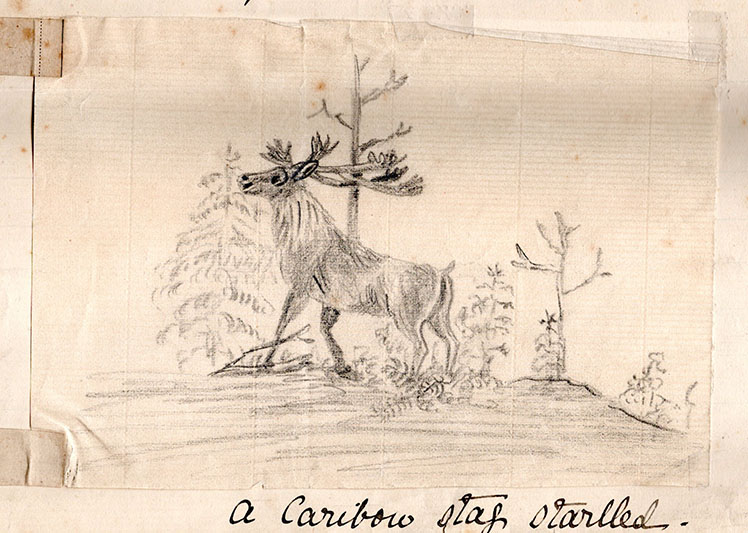
Frank’s childhood drawing of “A Caribou Stag Startled”.
Francis and his elder brother (another Robert) and their half-brothers were brought up in St. John’s and at the family’s second home at “Woodlands” which was on the Salmonier river, in rural Newfoundland.
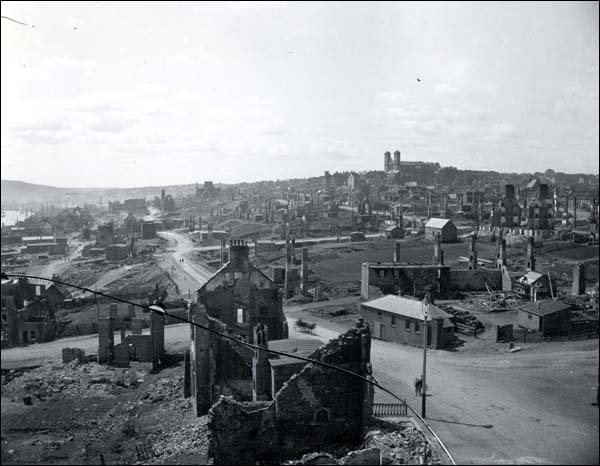
They were not just city dwellers. They saw themselves as country boys and Francis wrote and illustrated a short story entitled: “How I shot & Lost My First Stag.” This was at around the time his father died, in 1893. It describes a particularly wet hunting expedition he took with a friend while waiting for his school to reopen – after it burnt down! Unfortunately, a large portion of down-town St. John’s, including its Anglican Cathedral and Commercial Centre had gone up in flames in July 1892.
Frank refers to his disappointment at hitting but failing to fell an impressive-looking stag. I have a hand written copy of the story that may have been intended for his mother – who had stayed on in England after her husband’s death and must have missed St. John’s – or it may have been meant for publication. Either way, it is another example of the family’s love of writing short stories. Frank’s father, (Sir) Robert John Pinsent, wrote about Newfoundland history and described one of his trips around Newfoundland dispensing justice in the out-ports; Lady Pinsent wrote about fishing in “The Field” magazine and his elder brother Robert John Ferrier Homfray Pinsent wrote about a failed logging venture in Quebec for the same magazine. Frank’s son, Robert John Francis Homfray Pinsent, would later write about his fishing exploits. As for me – I write about the family.
In 1893, Sir Robert and Lady Pinsent took some of their children (but not Frank) to England and left them with Emily’s parents in Norfolk while they went on to Rome to see Frank’s eldest half-sister, Lucretia Maude, who was in the process of setting up an English-speaking Benedictine convent. The trip went well – I believe they had an audience with the Pope – but Sir Robert contracted pneumonia shortly after returning to England and he died at Bintry (Bintree) a few days later.
His death created immediate problems for Emily, as most of the family’s assets in Newfoundland were committed to the children of his first marriage – most notably Charles Augustus Maxwell Pinsent – and she was left with two teenage sons (Robert (19) and Frank (18)) in Newfoundland, and a grown up daughter (Mabel (20)) and two younger children, Beatrice (10) and Guy (4) in England to launch on her own. Presumably, it did not help that a large part of St. John’s had recently burnt down and two of the major banks in Newfoundland (including one managed by Sir Robert’s brother Charles Speare Pinsent) were to crash in December 1894. Such assets she had in St. John’s would have been severely reduced in value. Lady Pinsent stayed on in England and took employment as a “House Matron” at Harrow School and then as the “Matron” at Denstone School in Staffordshire. Guy and Beatrice (“Trixie”), who were with her in England, also stayed on. Their lives are discussed elsewhere.
Francis was educated at Bishop Feild (sic) and the Methodist Colleges in St. John’s and also – in part – privately under Reverend T. W. Temple of St. Pierre and Miquelon. Perhaps that was after his school burnt down! He joined the “Newfoundland Department of Agriculture and Mines ” in 1892 (McAlpine’s 1898 Directory, St. John’s). However, he was later (in 1899) to resign his position as 2nd Clerk ($700.00 p.a.) and to move to England to be with his mother, and the rest of his immediate family. This came as a great relief to Lady Pinsent who was well aware that one of her step-sons, Charles, was a heavy drinker and prone to violence. She wrote to the Lucretia Maude (the Lady Abbess in Rome) in November 1899 saying: “I am most glad to have Frank here as I was always in terror for him on account of Charlie, he is little better then a madman now, is quite so when he is drunk & people are terrified if he goes near them. He is very angry with me because I refuse to give him my signature to sell Salmonier, for his own benefit & I feared he would vent his anger on Frank.” Her fears, fortunately, seem to have been overblown as Frank and Charles managed to co-exist fairly amicably. Frank was best-man at Charles’s wedding to Fanny Colley, in Topsail in January 1897 (Evening Telegram: 7th January 1897).
Lady Pinsent’s older son in Newfoundland, Robert John Ferrier Homfray Pinsent did not get on quite so well with Charles. He wrote to his mother in August 1897 describing his meeting with Charles at “Woodlands” – where he had gone to recuperate from a bout of tuberculosis. In his letter, Robert is highly complementary about “Good old Frank” but much less so about Charles. He felt that Charles clearly resented him being there: “… when Frank asked him the other day if I could use his rifle which is out here he refused and requested that I would not even look at it. If Frank himself wanted it, he would lend it to him etc., but to no one else in the world. He also said to Frank that he did not want me to touch one iota on the place – which I think a very unkind & unmanly insinuation to a brother in my place.”
In the autumn of 1897, Robert and his wife Annie, and Robert’s brother Frank went out to Colorado – presumably to get away from the dampness of the Newfoundland winter and to take advantage of its dryer air. The “Massachusetts, U.S. Arriving Passenger and Crew lists, 1820 – 1963 (Ancestry.com)” tell us that they left Hawkesbury in Nova Scotia on 22nd October and arrived in Boston three days later. I image they took the train west from there. When they returned, I am not sure. Sadly, Robert never fully recovered. He died in 1899 and Frank took-off for London shortly thereafter.
Lady Pinsent had, through Monier-Williams family contacts, managed to find Frank a position with the firm of “Messrs. Viquers & Co., Chartered Surveyors, of #4 Frederick’s Place in London”. Having references signed by both the Attorney General and the Chief Justice of the Supreme Court of Newfoundland may have helped him get the placement.
Lady Pinsent was bored at Denstone. There was none of the social interaction she had so enjoyed at Harrow. She eventually left and moved to London where she bought a flat at #13 Stanley Crescent in Kensington – so as to be with Frank when he arrived from St. John’s. The Electoral Registers show that they both lived there for a few years. Frank passed the “Surveyor’s Institute” Fellowship Examination in 1901 and Lady Pinsent, who still corresponded with friends in Newfoundland arranged for Judge Prowse (the young friend of her husband’s who wrote a “History of Newfoundland” in 1895) to insert the following in a local paper: “Mr. Frank Pinsent: The numerous friends and admirers of the late Sir Robert and Lady Pinsent, will be very pleased to learn that their son, Mr. Frank Pinsent, who used to be in the Surveyor General’s Office, has passed a most creditable examination in London, and is now entitled to become a member of the Council of Surveyors for Great Britain. It was a very stiff examination — like all those held in London — and several members, five and ten years seniors to Frank, were plucked. Miss Trixie Pinsent has also passed with great credit the Senior Local Cambridge Examination, and is now studying for higher honours. D.W.P.” (Evening Telegram: 17th June 1901).
Frank was elected a “Fellow of the Surveyor’s Institute” in 1908 and went on practice with a partner under the banner of “Worthington and Pinsent, Surveyors, of Cannon Street in London.” Presumable, his strength was in land valuation. He was not particularly political; however, he did take time out in 1909 to write a scathing letter to the “Daily Telegraph” describing the detrimental impact that various land-tax changes proposed by Mr. Lloyd-George would have on land values!
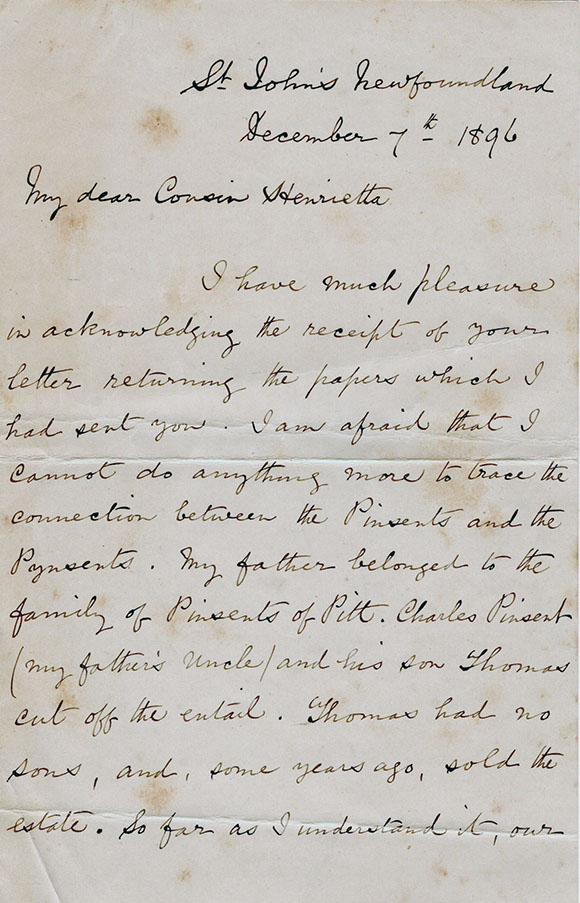
An excerpt from correspondence with “Cousin Henrietta”.
While in St. John’s in 1896, Frank had corresponded with a “Cousin Henrietta” (whoever she was) about the origins of the family and its connection to the “Pynsent family.” He had not been able to tell her much about them then, but he doubtless learned more when he connected with a distant cousin, Robert Burton Pynsent when he arrived in London. Robert’s life is described elsewhere. He was, like Frank, a recently returned colonial. His father (Charles Pitt Pynsent) – who had been a friend of Thomas Pynsent of Pitt House and Northam, Westwood Ho! (see elsewhere) had lived in Australia and eventually settled in New Zealand. Robert Burton was back from there to study and practicing law. They doubtless had contacts in common.
Robert Burton married Mary Isobel Addie, in Northaw, in Hertfordshire in 1906 and Frank became one of the two trustees of their Marriage Settlement. The trustees opened an account in Robert’s name and deposited a considerable sum in stocks and bonds. They then arranged for Mary to receive two hundred pounds sterling per annum out of the proceeds. Sadly, the marriage did not last (see elsewhere). The couple divorced – somewhat acrimoniously – in 1916.
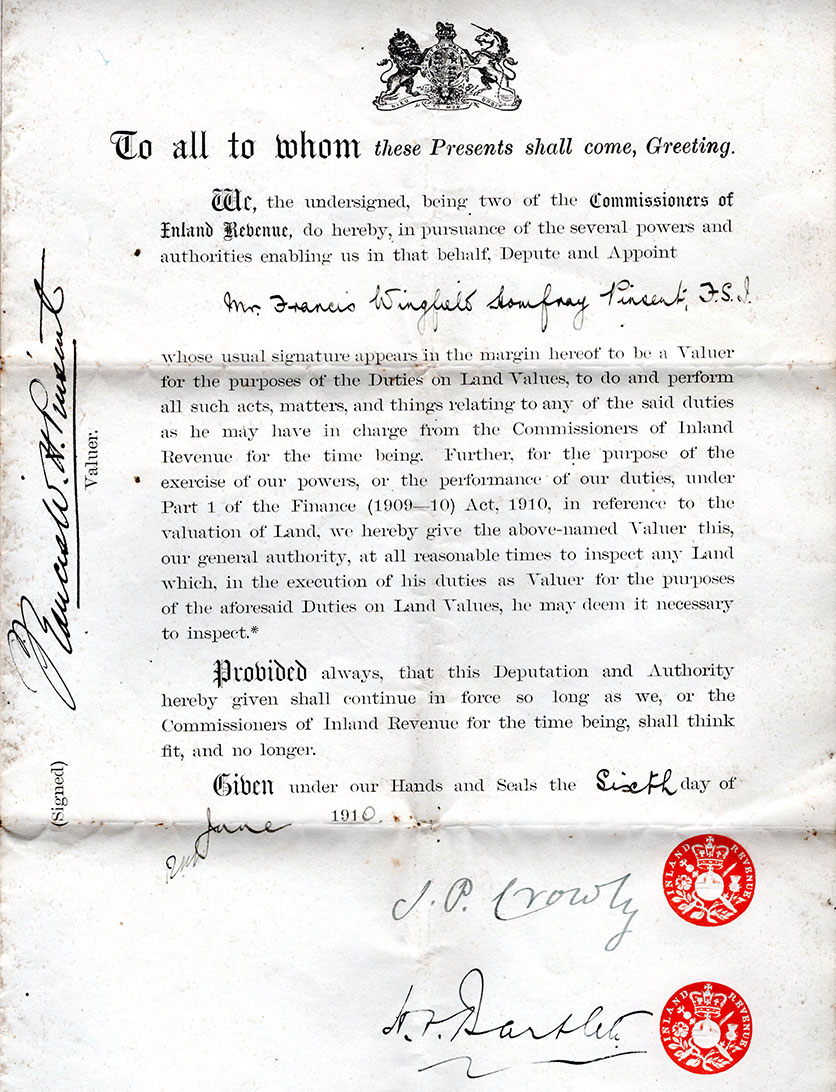
Frank’s certificate acknowledging him as a land valuer.
Frank later joined the Civil Service as “District Valuer” for the “Inland Revenue Service” in Plymouth. So, by this round-about route the family returned to its roots. He and Lady Pinsent moved down to Devon, where they were boarding in Plymouth at the time of the 1911 census. They may have been were down there looking for a permanent home while also preparing for Frank’s upcoming wedding. Lady Pinsent’s daughter Trixie moved into the flat in Kensington.
King Edward VIII came to the throne that year (1911) and Lady Pinsent wrote to the Prime Minister’s Office in St. John’s Newfoundland in a vain attempt to get tickets for the coronation out of the Colony’s allocation.
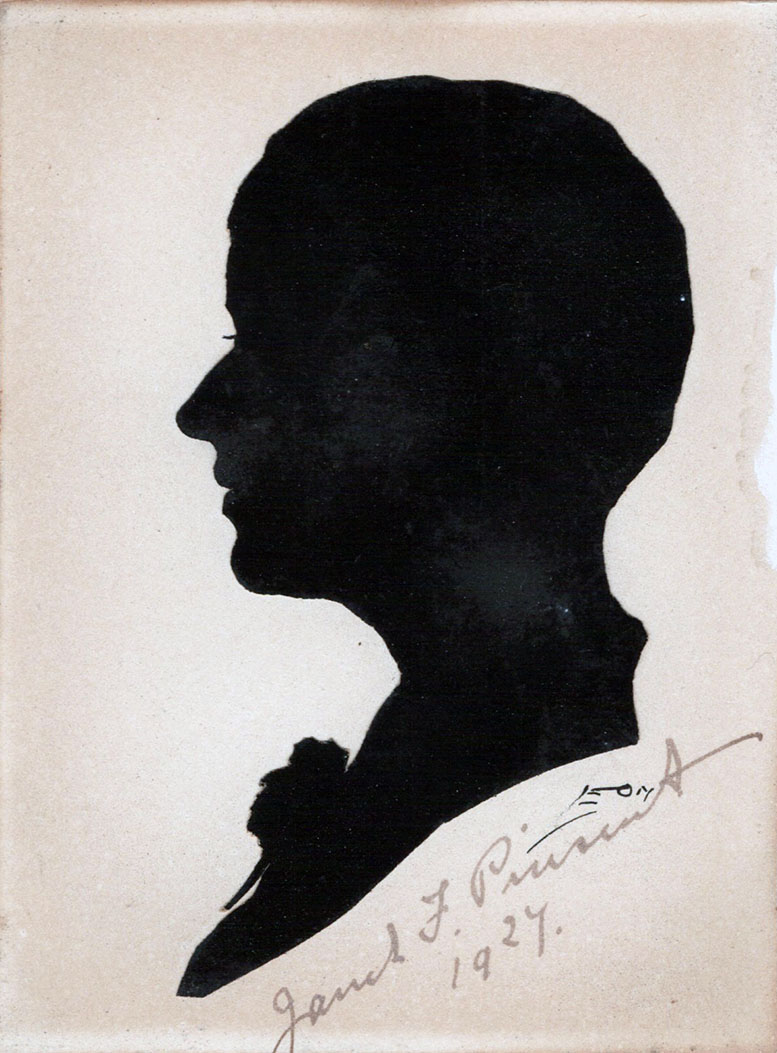
A silhouette of Janet Pinsent painted in 1927.
Frank married Janet Frances, the eldest daughter of Frank Cowtan of Aubrey Road Camden Hill at St. Mary Abbot’s Church in Kensington in April 1911 (London Daily News: 25th April 1911). Her father belonged to “Messrs. Cowtan and Sons Ltd.” – high-class “decorators, upholsterers and cabinet-makers” in Belgrave Square, in London S.W.1. The firm, which had been founded in 1790, was particularly well-known for selling quality wallpaper (London Metropolitan Archives). It was an artistic family. The attached painting of Janet as girl of around fifteen was painted by her sister, Mary Cowtan. Janet was a water colour artist in her own right and her paintings are among my prized possessions.
The Pinsent family (including Lady Pinsent) moved into a house called “Hillsborough” near, but downhill, from the railway station at Horrabridge – a small village on the edge of Dartmoor, approximately 12 miles (19 km.) north of Plymouth. Frank commuted into Plymouth by rail. The name “Hillsborough” was that of his one-time family home in St. John’s. It is also the name given by Mr. Thomas Pynsent (“late of Pitt House” in Hennock), to one of his homes in Westward Ho! in north Devon in the 1860s and 1870s.
Hundreds of young Newfoundlanders signed up for active service at the outbreak of the First World War and an early contingent arrived in Plymouth on the “S.S. Florizel” on 20th October 1914. One of them, Lieutenant Owen William Steele, kept a diary that describes the history of the “(Royal) Newfoundland Regiment” up to its near obliteration at Beaumont Hamel on 1st July 1916 – during the battle of the Somme. He documents the regiment’s activities at Gallipoli, its refurbishment and its later disembarkation in Plymouth. He tells us that: “A Mr. Pinsent introduced himself to the Colour Party as a Nflder”. Evidently Frank had not forgotten his roots. Sadly, Lieutenant Steele was killed going “over the top” at Beaumont Hamel – as, indeed were Privates Stanley Stewart Pinsent of Musgrave Harbour and Stewart Pinsent from Dildo, Newfoundland – two unrelated Pinsents who joined up and arrived in England sometime later. The “Florizel” met with its own tragic end. It sank after striking a reef while on route from St. John’s to Halifax on 23rd February 1918. Fortunately, Jacob Pinsent from Greenspond in Newfoundland, one of the ship’s carpenters, survived. There were, and still are, a lot of Pinsents in Newfoundland!
Francis Wingfield Homfray Pinsent joined the “Sir Francis Drake Lodge” of the Freemasons in Plymouth in February 1915. I am not sure how active he was; however, his uncle Charles Speare Pinsent (who had died in St. John’s the previous year) was a senior member of the order in Newfoundland and he would have doubtless been expected to join. Frank regularly attend “Devon and Cornwall Surveyor’s Institute” functions before, during and after the First World War. He was elected vice-chairman in November 1922 (Western Times: Friday 3rd November 1922) and chairman the following year (Western Times: Friday 2nd November 1923).
Frank was active throughout the “Plymouth Rent Tribunal” discussions held in 1923 (Western Evening Herald: 15th September 1923) and he was not infrequently called upon to estimate or arbitrate on the value of land and property. He can take some credit for the improvement in infrastructure in South Devon. For instance, Frank was involved in the cost-arbitration of 12 acres adjacent to a Torquay beauty sport – the “Bishop’s Walk” – in 1929 (Torquay Times and South Devon Advertiser: Friday 18th January 1929). He was also on hand when Ilsham Marine Drive at Torquay was formally opened (Torquay Times, and South Devon Advertiser: Friday 7th March 1924).
Most of his assessments seem to have been accepted; however, predictably, not everyone agreed with his valuations. For instance, a Mr. Hosking objected to the value he placed on a field near Ashburton needed for building purposes. The owner felt that the valuation did not take into account a significant vein of umber which, he insisted, must put the price up to at least L.2,000. Frank disagreed and the District Council looked to be heading to arbitration (Brixham Western Guardian: Thursday 8th April 1920). Similarly, the owner of the a strip of land needed for road widening at Knowle came up with far higher valuation than Frank and the issue went to arbitration in 1924 (Torquay Times, and South Devon Advertiser: Friday 7th March 1924). On another occasion, he advised the Minister of Health that the owners of the Rockend Estate had significantly overvalued their property (Torbay Express and South Devon Echo: Wednesday 26th October 1927).
After the “Rating and Valuation (Apportionment) Act” of 1928 came into effect, Frank was frequently called upon to pacify local landowners outraged by the classification (industrial, agricultural or freight-transport) given to their properties – which greatly effected that their ability to get Land Tax rebates. In July 1929 there were around 300 complaints before the “Plymouth Assessment Committee”. When these issues went to court, it was Mr. Pinsent who argued the case for the rating authority and the “City Treasurer” who argued for the local authority (Western Morning News: 13th Jul 1929). Some of the tougher cases lingered on into the early-1930s as it was not always clear whether a particular land “usage” met the test for an “industrial-use exemption” (Western Morning News: Friday 25th April 1930). The timber sector was a particular head-ache (Western Morning News: Friday 25th April 1930). Then there were land-use zoning issues to be dealt with … (Western Morning News: Wednesday 9th March 1932).
When it came to land needed for public use, Frank frequently found himself dealing with arbitration panels (Exeter and Plymouth Gazette: Friday 23rd January 1931). In 1932 the owners of land on Primley Hill in Paignton complained that he had grossly undervalued some land that Paignton Urban District Council needed to widen a road. They insisted on arbitration (Torquay Times and South Devon Advertiser: Friday 6th May 1932). This was just one of Frank’s valuations that was tested.
Sometimes, valuations changed for some reason or other. In January 1936, he wrote to the “Brixham Urban Council” to inform them that the valuation he had given for “Berry Head” (which they hoped to acquire as open space) was no longer operative. Perhaps it had timed out. He would be happy to provide a revised estimate (Exeter and Plymouth Gazette: Friday 10th January 1936). In another case, Frank valued a 4-acres property in a prime location on flat ground near the sea that the Corporation of Torquay wished to make into a public park. The land was owned by the “Devon Rosery and Fruit Tree Co. Ltd.” and it felt that Frank had grossly undervalued it. The company brought in its own arbitrator, from Birmingham (Torquay Times and South Devon Advertiser: Friday 28th February 1936). Presumably the two parties came to an acceptable compromise.
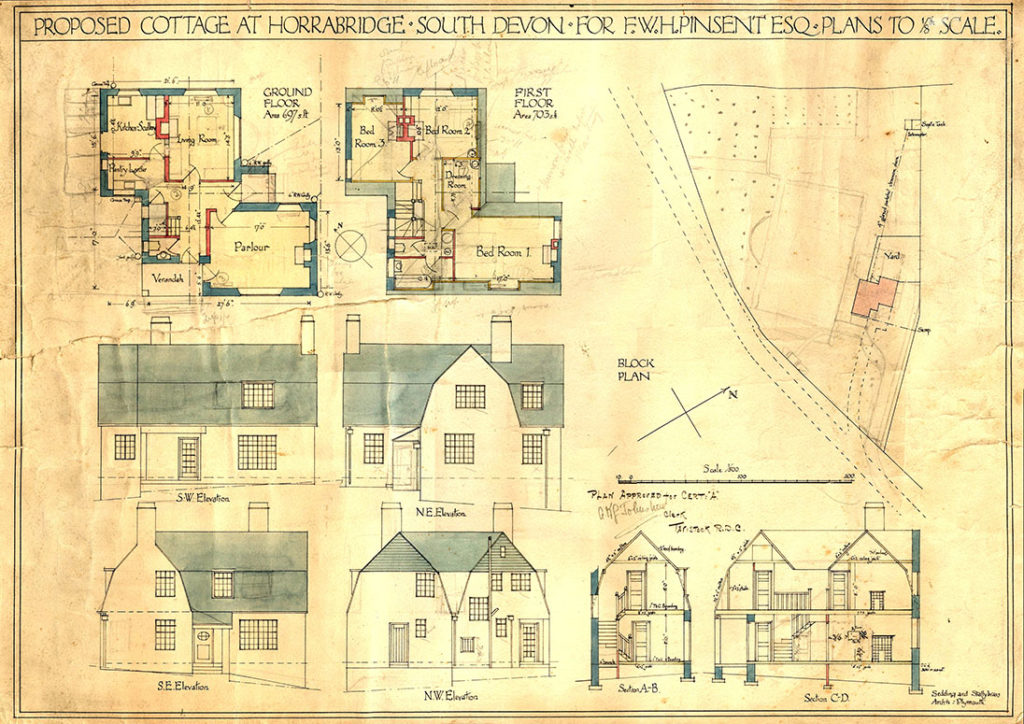
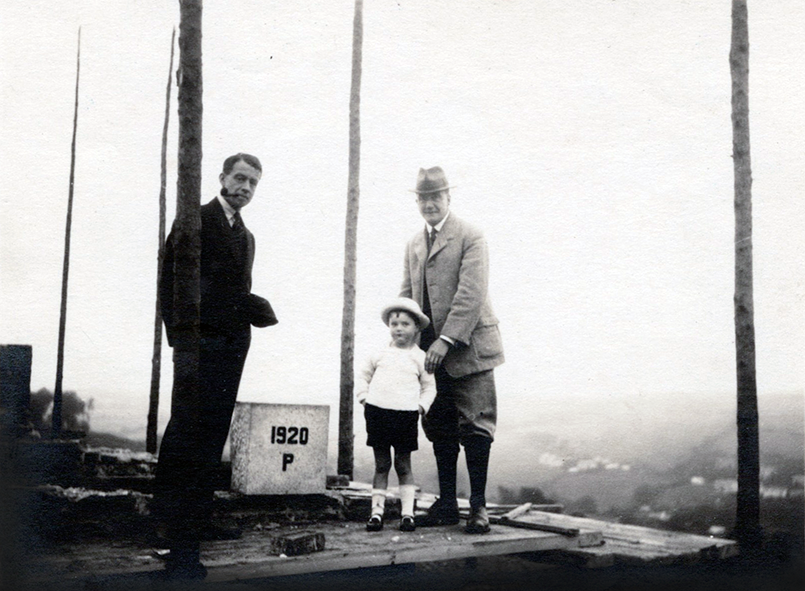
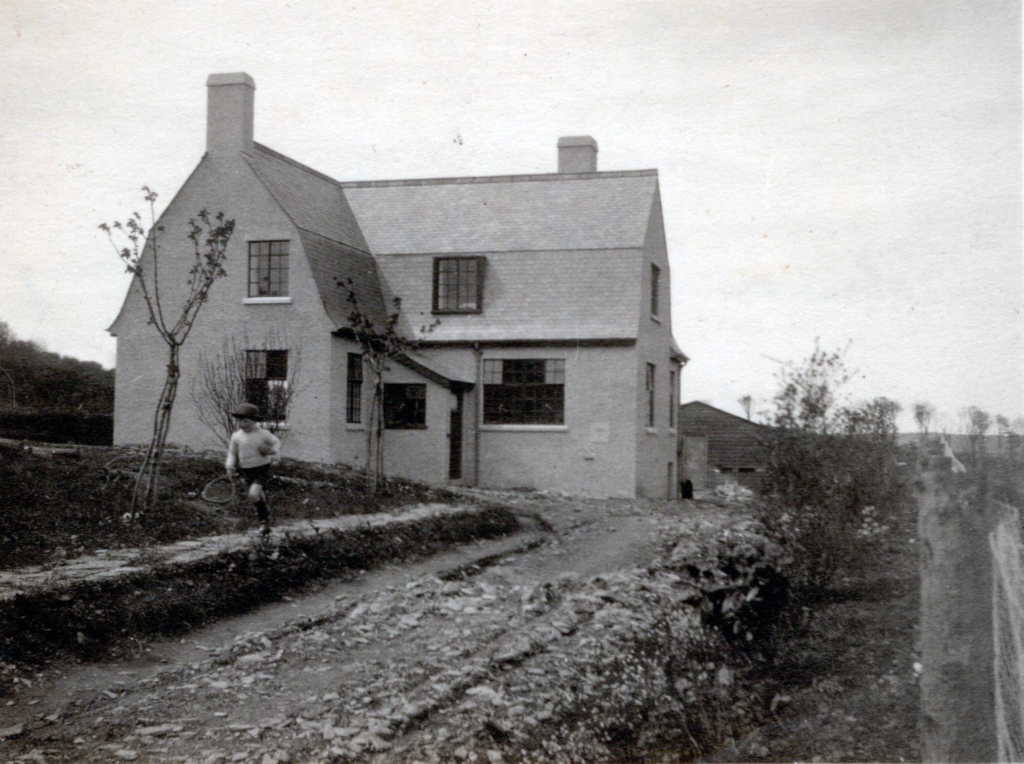
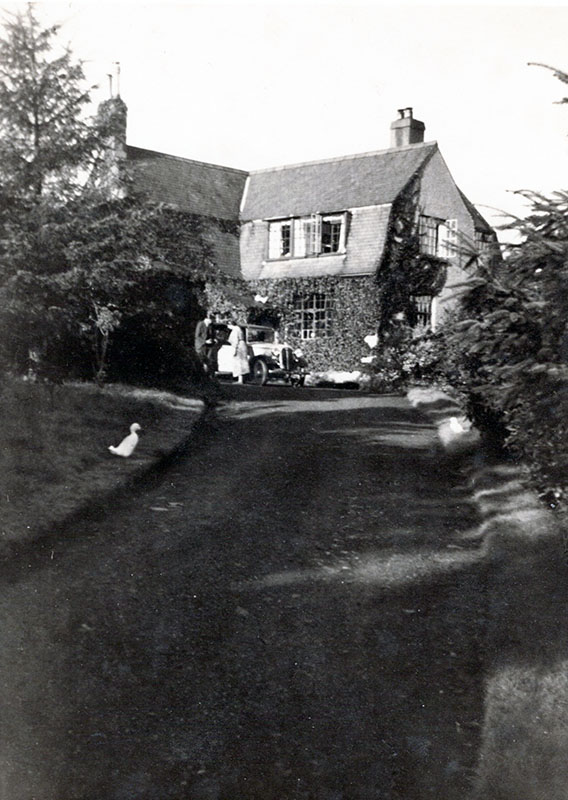
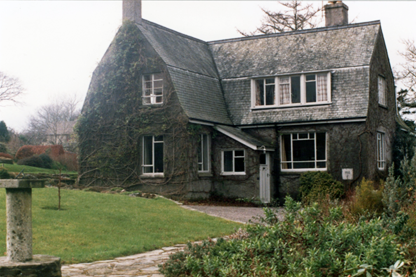
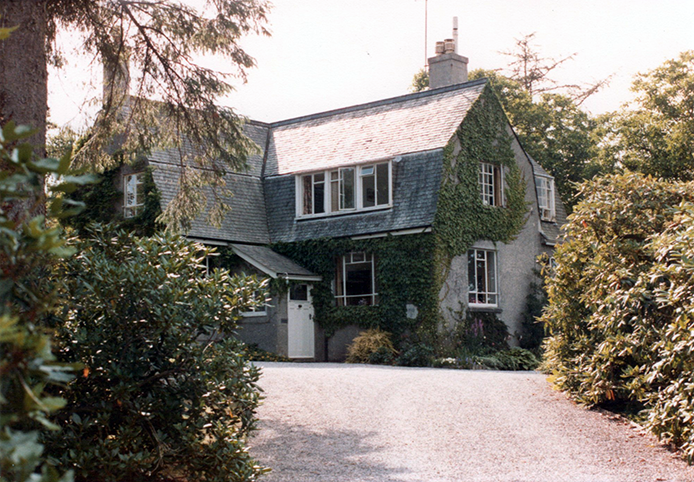
Faded architectural plans for the construction of Higerfield.Frank and little Robin lay the first brick during the construction of Higherfield.Robin, a young boy, runs along the low wall outside his home at Higherfield.Higherfield photographed in 1935.Higherfield.Higherfield photographed in 1983.
It was not all work. Frank and Janet’s only son Robert John Francis Homfray Pinsent was born at “Hillsborough” in 1916 and Frank decided to build a small house above the railway station at Horrabridge. He purchased three fields (approximately 3 acres) on the edge of Roborough Down above the station and built a small house, called “Higherfield ” in 1920. He was still able to commute to his office in the Barclay’s Bank building on Princess Square in Plymouth by rail. The family was, with the notable exception of Lady Pinsent (Emily Hetty Sabine) – who was visiting friends (Elizabeth Julie and Margaret Florence Francis) in Watford – residing at Higherfield by the time the census was taken the following year (1921). Frank, Janet and their son Robert were there with Agnes Marion Macnab, a family friend and companion, and a live-in servant girl, Beatrice Angell. The house had a detached cottage/garage that was inhabited by James Trembeth and his wife. He helped out in the garden and she was the family cook.
There was room for an orchard and a garden – and space in one of the fields for a Dartmoor pony for their son “Robin”. It came 2nd in its class at the Yelverton Horse and Pony Show in July 1924 (Western Morning News: Thursday 17th July 1924).
Frank’s brother Captain Guy Homfray Pinsent, M.C., married a local girl, Ethel Betty Brittan, the daughter of a well-known landscape Artist (Charles E. Brittan) in Sheepstor, near Burrator, in 1923 (Western Morning News: Friday 21st September 1923). Lady Pinsent had died the previous year but Robert Burton Pynsent (“Cousin Bob”) attended the wedding. Guy and “Betty” went out to China with the 1st Battalion North Lancashire Regiment; however, he later resigned his commission and the couple settled in the London area. His life is discussed elsewhere.
Janet and Frank stand outside a doorway, 1929.
Francis and Janet traveled in France and went out to Italy to visit Frank’s half-sister Lucretia Maude in Rome in 1929. She was a “Sister in Religion” and a “Lady Abbess” prior to a dust up with the Roman Catholic authorities in the early 1900s (see elsewhere). Incoming Passenger Lists show them returning from Genoa on a “Netherlands Royal Mail” vessel, the “Christiaan Huygens” – which docked in Southampton on 12th June. In Rome, they discussed the family’s history and Frank wrote up some of his half-sister’s comments about their great grandfather’s brother Joseph Pinsent and his three wives – two of whom had come from the DEVONPORT branch of the family. They also discussed the distribution of family portraits.
Frank and “Cousin Bob” (Robert Burton Pynsent) remained friends and I gather from a letter Bob sent Frank in December 1932 that he had sent his son “Robin” (Robert John Francis Homfray Pinsent) a book on birds. He inquired after Robin’s “strong suits” at school. Robin was at “The King’s School Canterbury” by then (see elsewhere). Frank also corresponded with Edith Mary Radford (née Pinsent) about family matters. She wrote to him in March 1931. Edith was the daughter of Richard Steele Pinsent, the Devonport draper, and was from the DEVONPORT branch of the family (see elsewhere). She and her husband lived in London.
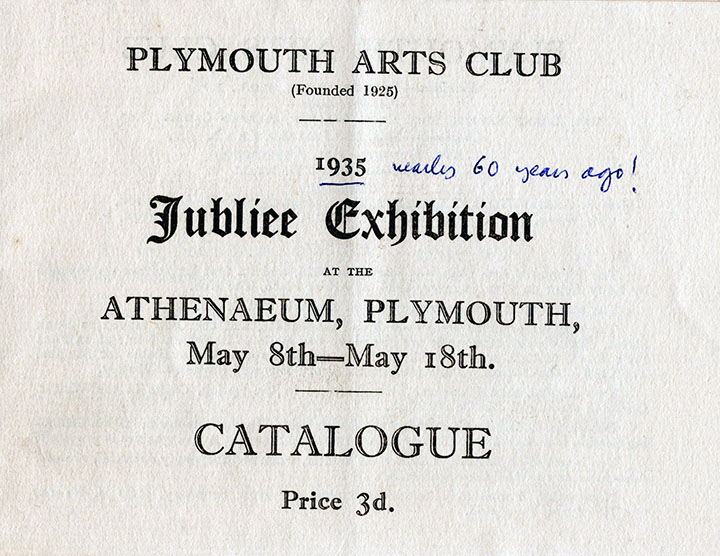
The catalogue for works shown at the Plymouth Arts Club’s 1935 Jubilee Expedition.
Frank attended professional dinners and Frank and Janet both attended annual New Year’s Balls and Summer Receptions and dances sponsored by the “Lord Mayor” of Plymouth (Western Morning News: Wednesday 7th January 1931; Western Morning News Wednesday 8th July 1931 and other dates). They played bridge and tennis and enjoyed their garden.
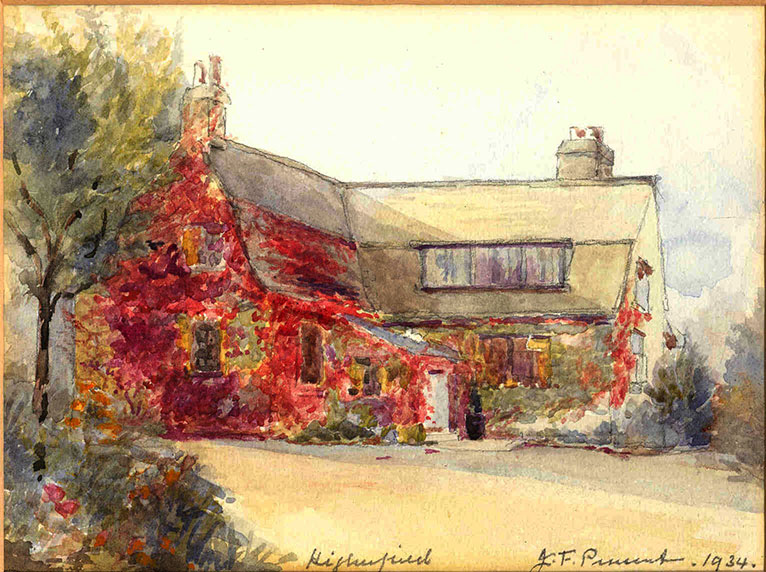
Janet also painted and two of her works. One entitled “From the Cottage Door” and the other “Denham Bridge” were shown at “Plymouth Arts Club: 1935 Jubilee Exhibition.” The latter is on a wall in my hallway.
A painting of Higherfield by Janet Pinsent, 1934
Janet Frances Pinsent died at “Higherfield” on 14th February 1938 and was buried in the family plot at St. John’s in Horrabridge. Her will was probated with “effects” of £2,744 2s 10d. She owned “Higherfield” and left it to her son – my father.
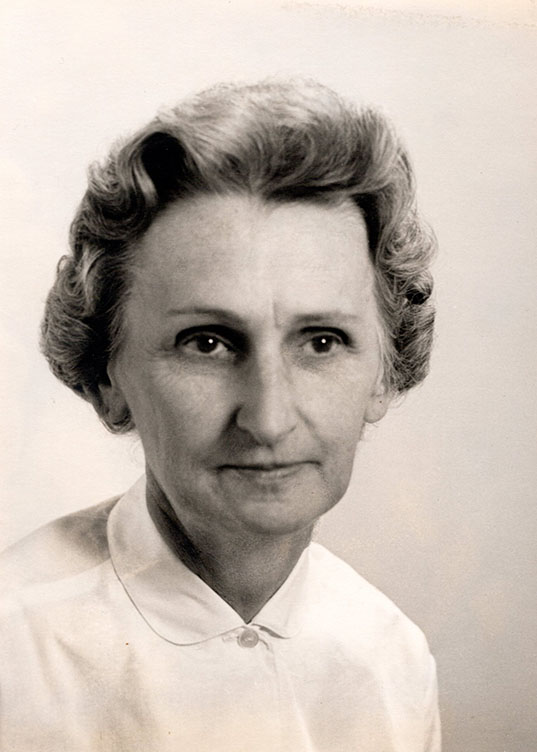
Ann Pinsent (née Stehrenberger)
Shortly after Janet’s death, Frank Pinsent went out to Buenos Aires to see his sister, Beatrice Mary Pinsent (“Trixie”). It must have been a relatively short trip as he arrived back in Southampton on the “Royal Mail Steamship Lines” vessel “Asturias” on 25th April 1938. While he was there, Frank met Anne Marie Stehrenberger, a friend of Trixie’s who worked for the Swiss Legation in Buenos Aires. I do not know how much Trixie had to do with their subsequent marriage but she returned to England to see her two brothers (Frank and Guy) in July 1838 and Anne Marie came over a few weeks later (U.K. Incoming Passenger Lists: Ancestry.com).
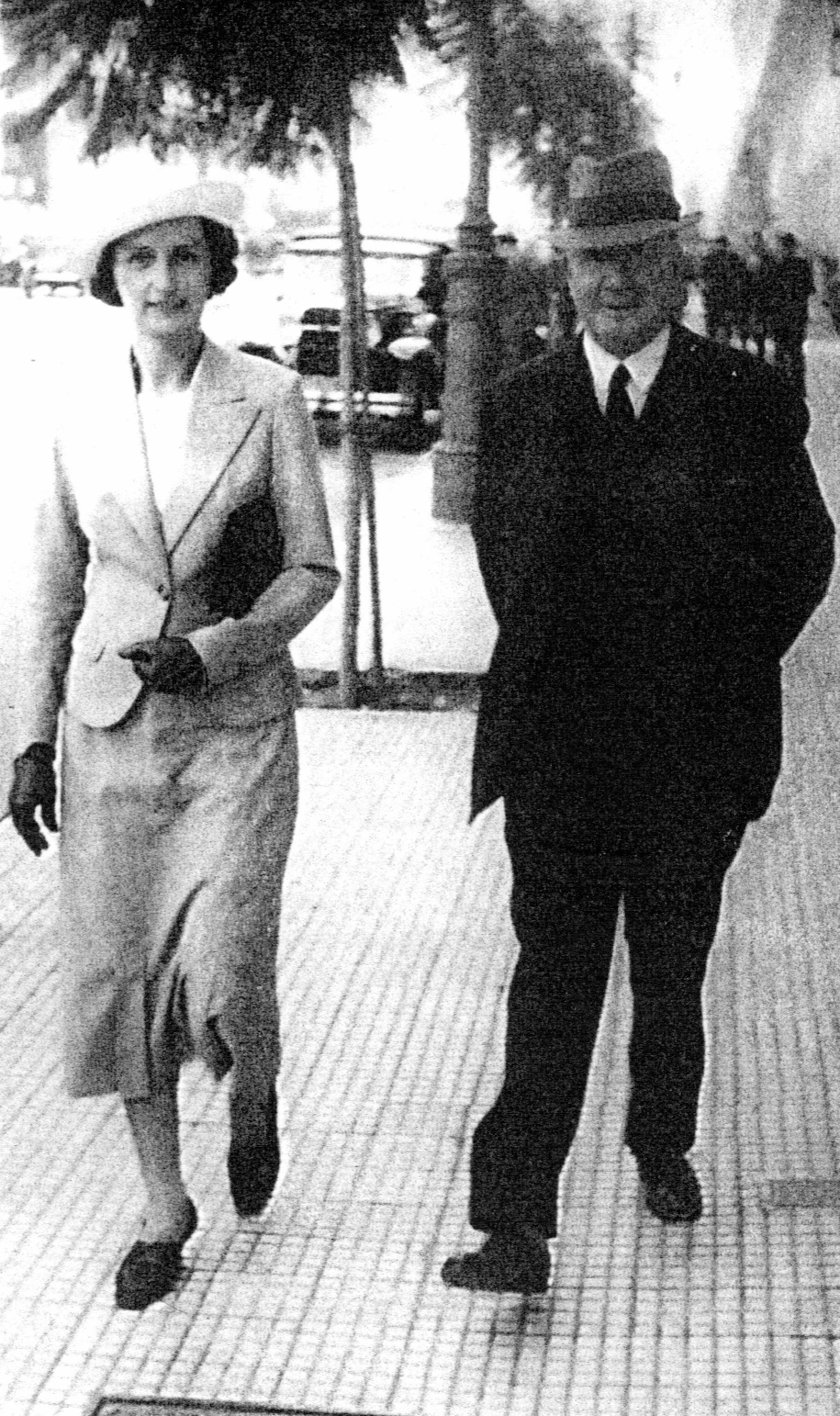
Frank and Anna stroll through Buenos Aries in 1939.
Frank and his son, “Robin” attended the wedding of one of Janet’s cousins, Lieut F. Conway Morgan (R.N.) of “H.M.S. Excellent” (a shore station) to Miss J. E. Cunningham – the daughter of a Rear Admiral – at Bathampton in August 1938 (Western Morning News: 1st August 1938) and they then returned to Devon to prepare for Frank’s wedding to Anne Marie. The couple were married in the Roman Catholic Church in Yelverton (near Horrabridge) later that month. The Wartime Register, compiled in 1939, confirms that they lived at “Higherfield” – which is where their only daughter was born in 1941.
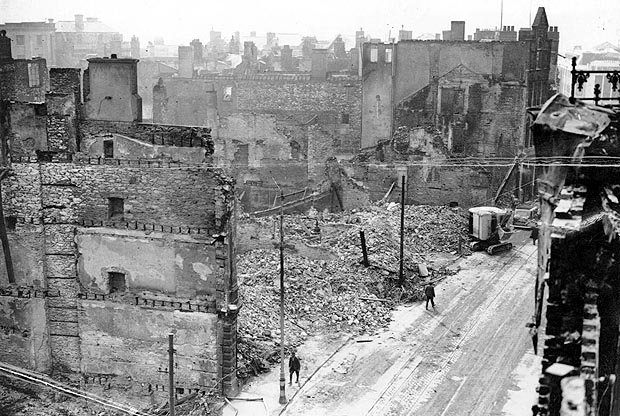
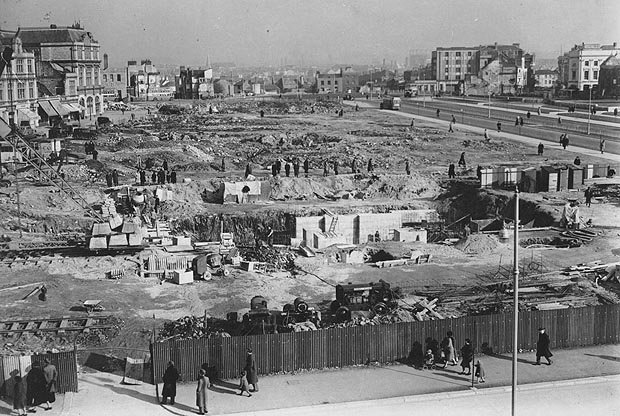
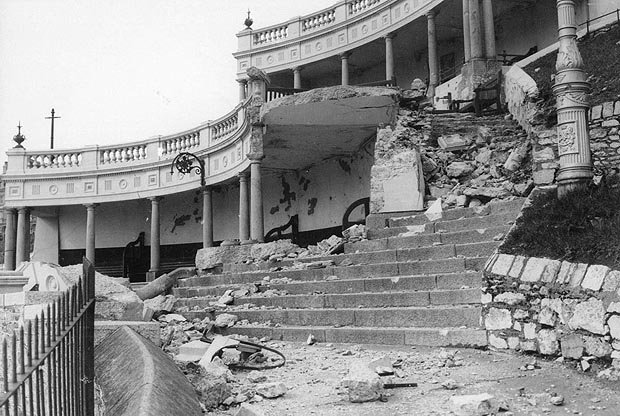
Plymouth destroyed during the Blitz, via @WMNPictures on TwitterPlymouth destroyed during the Blitz, via @WMNPictures on TwitterPlymouth destroyed during the Blitz, via @WMNPictures on Twitter
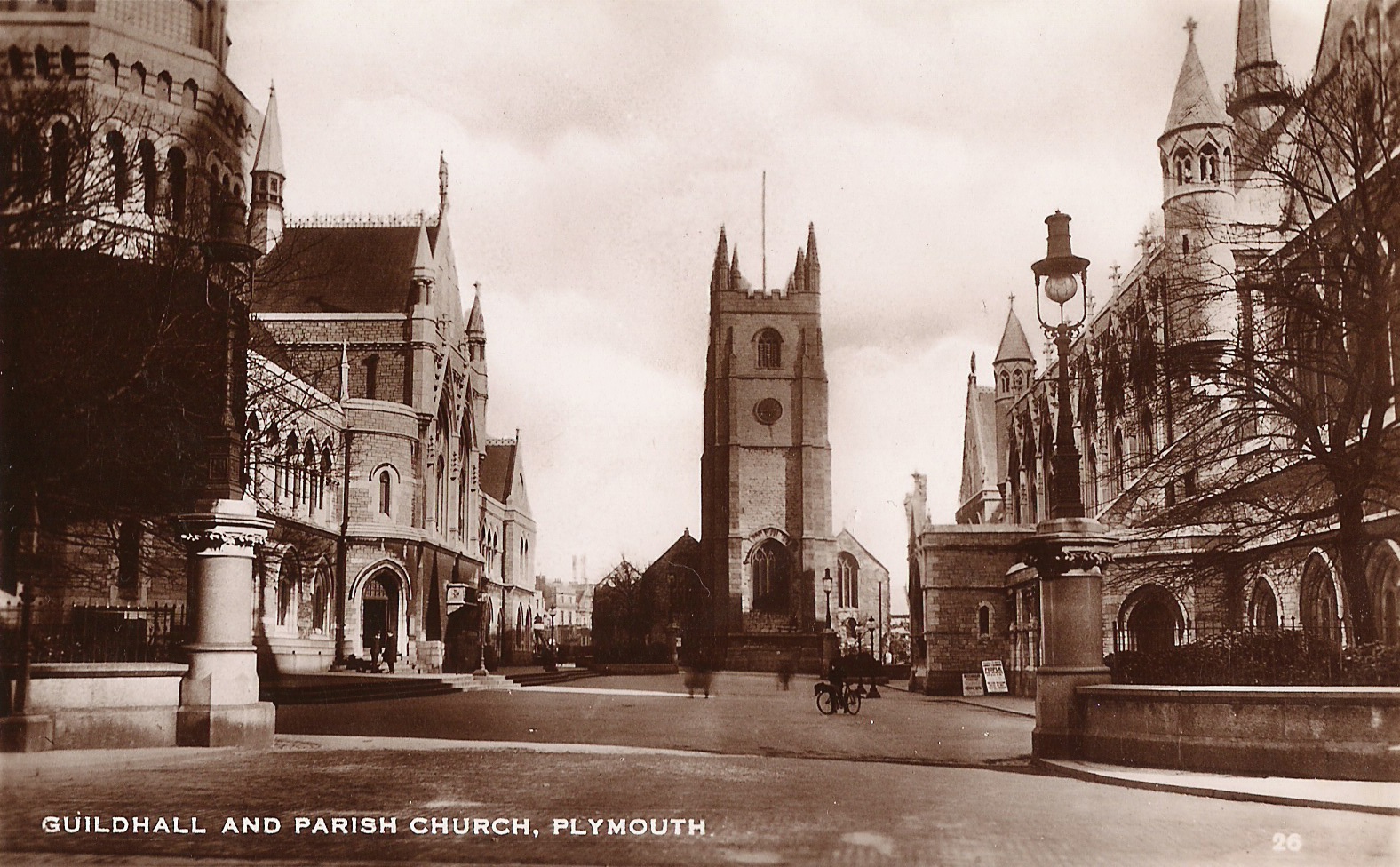
The Devonport dockyards were heavily bombed during the Second World War and much of Plymouth’s downtown core was flattened. It needed to be rebuilt after the war, which meant that property values had to be assessed and compensation paid before any rebuilding could take place. It was a monumental task and the “Valuation Office” needed as much information as it could get. I gather (from Frank’s daughter) that it bought up all the postcards and photographs of the City it could find so as to see what it had actually looked like before the war! The planning and rebuilding was done in record time and the city was well on its way to being rebuilt by 1952 (The Sphere: 4th October, 1952). Frank had formally retired from the “Valuation Department of the Inland Revenue” at the end of December 1943; however, given the circumstances – he had stayed on in a consultative capacity.
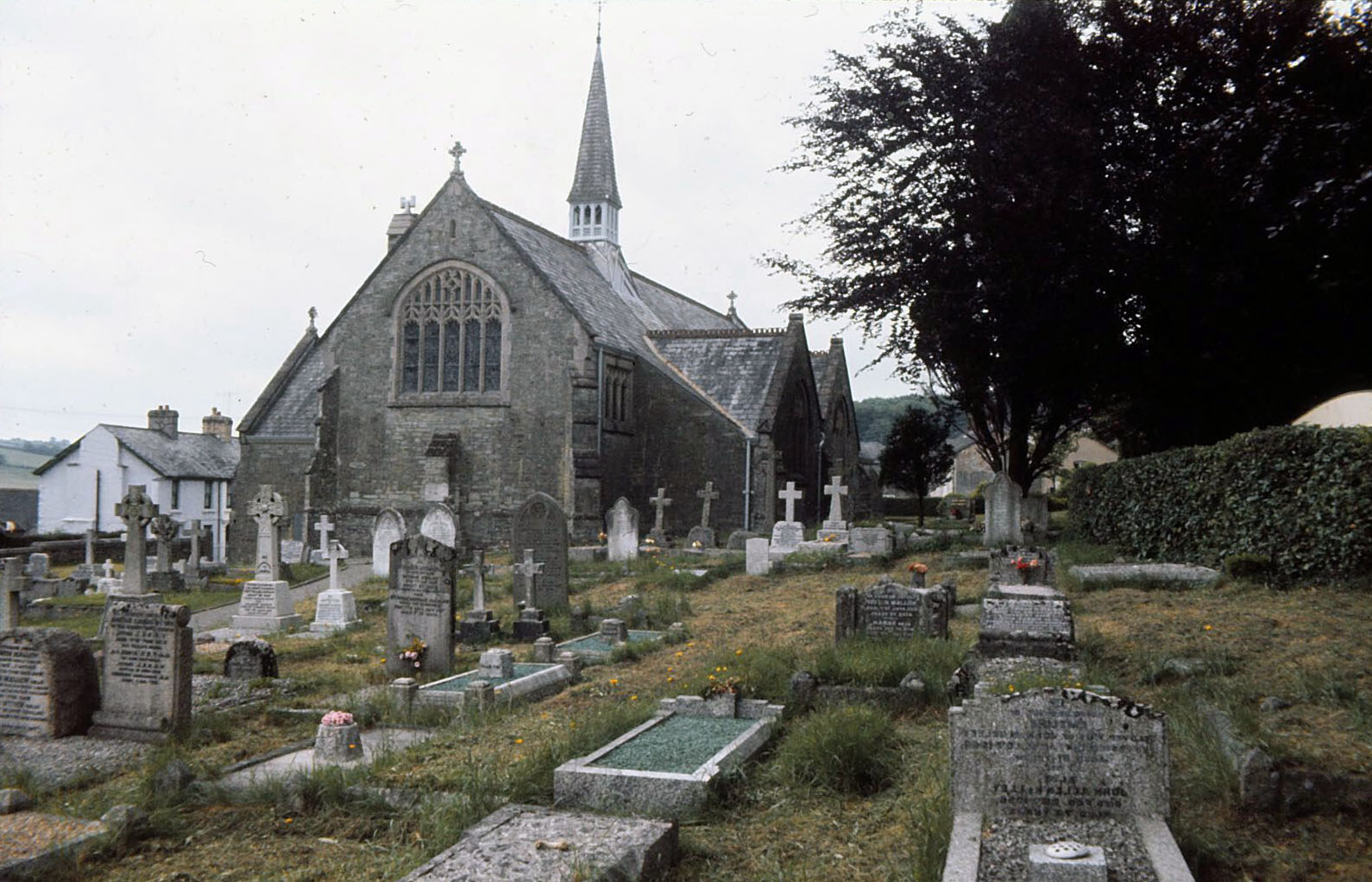
Horrabridge Church, Frank’s burial place.
Francis Wingfield Homfray Pinsent died at “Higherfield” in 1948. In his will (prepared in 1941) he appointed his only son, Robert John Francis Homfray Pinsent, as one of his two executors, and as the guardian of his then “infant” child. He left his wife, Anne Marie (née Stehrenberger) money “and such articles of furniture and plate, and such other articles or effects of domestic or household use or ornament as she shall, within three calendar months from my death, select”. The residue (after payment of just debts etc.) went to his son. Probate was granted in Exeter in July 1948 (England & Wales, National Probate Calendar, 1858-1966).
A letter written by Anne Marie’s daughter, in 1988, [in my possession: RHP] tells me that Robert already owned “Higherfield,” as it had been part of his mother’s estate. It also shows that Anne Marie Pinsent stayed on at “Higherfield” until 1952 and then moved back to her hometown of St. Gallen, in Switzerland. She died there in 1984. Her daughter joined her in Switzerland for part of her education but later returned and settled in England, married and had children of her own. She is still living.
Please use the above links to explore this branch of the family tree. The default “Next” and “Previous” links below may lead to other unrelated branches.