Please use the above links to explore this branch of the family tree. The default “Next” and “Previous” links below may lead to other unrelated branches.
Please use the above links to explore this branch of the family tree. The default “Next” and “Previous” links below may lead to other unrelated branches.
Please use the above links to explore this branch of the family tree. The default “Next” and “Previous” links below may lead to other unrelated branches.
Please use the above links to explore this branch of the family tree. The default “Next” and “Previous” links below may lead to other unrelated branches.
Please use the above links to explore this branch of the family tree. The default “Next” and “Previous” links below may lead to other unrelated branches.
Please use the above links to explore this branch of the family tree. The default “Next” and “Previous” links below may lead to other unrelated branches.
John Pinsent was the eldest son of John Pinsent of Wolborough (Newton Abbot) by his wife Susanna (née Pooke). He was born in Newton Abbot in 1753 and was apprenticed to Mary Speare, a “baker” in St. Thomas Parish (in Exeter), in 1767. His parents died while he was still quite young – in 1772.
John married Susanna Speare, in Newport, in Hampshire, in 1793. She was, probably, Mary Speare’s daughter; however, I need confirmation of that. There was a marriage settlement and it is (or at least was) in the Devon Records Office (“Exeter Dean and Chapter documents Bundle 7153”). I have not seen it. Why John waited until he was around forty to marry, and what he was doing in Hampshire, I am not sure!
John Pinsent appears in the land tax records in 1796.
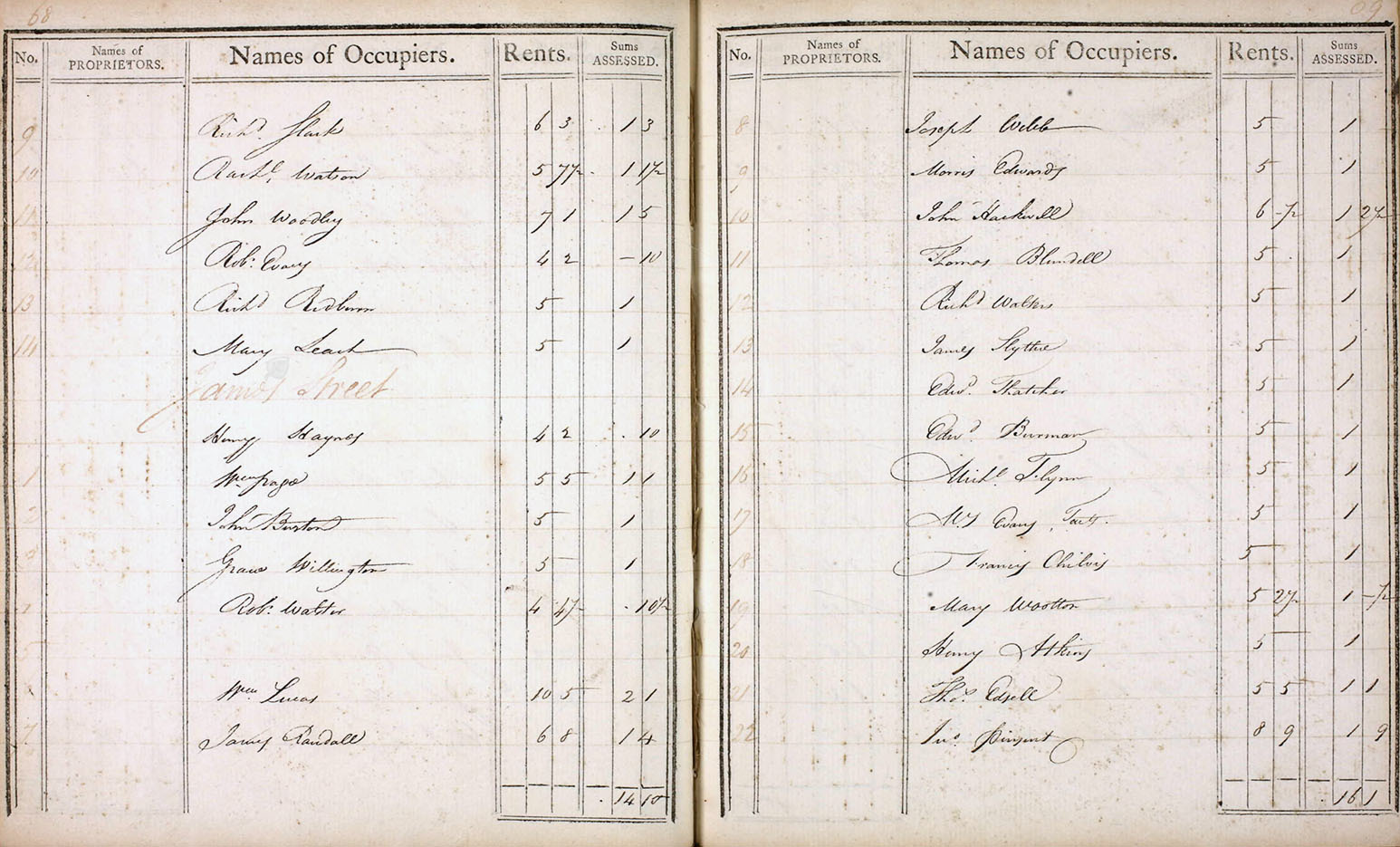
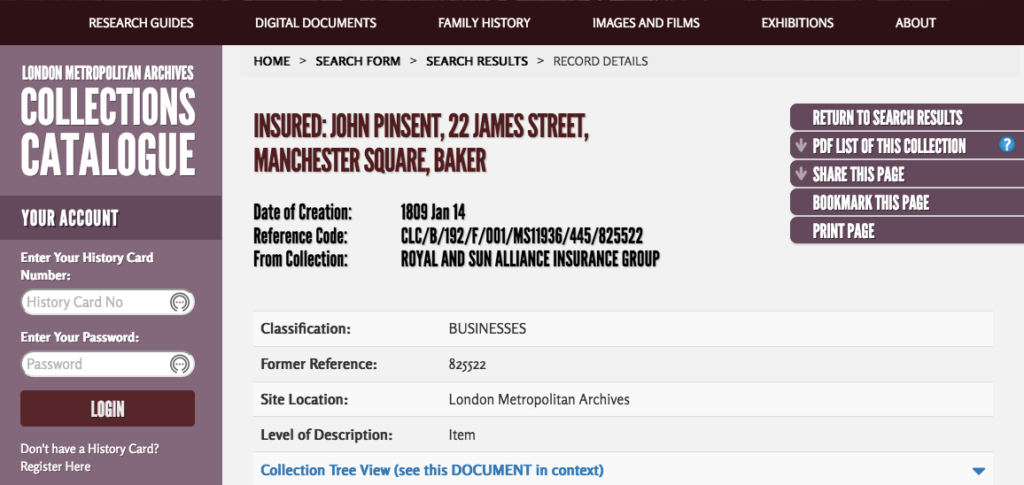
London’s Land Tax Records show that he lived at (or at least payed the taxes for) a house at 22 James Street (between Gray and Bird Street) in St. Marylebone parish from 1784 until he died in 1821. The “Sun Fire Insurance Company” issued John Pinsent “baker” a policy on the same property in 1809. He may have also held some interest in a property on Park Street in the early 1800s as anyone interested in renting a house “fit for the reception of a small family; fitted up with a degree of superior elegance, and commanding a most beautiful view of Hyde Park” was advised to apply to Mr. Pinsent, Baker, No. 88 Park Street in 1801 (Morning Post: 6th June 1801).
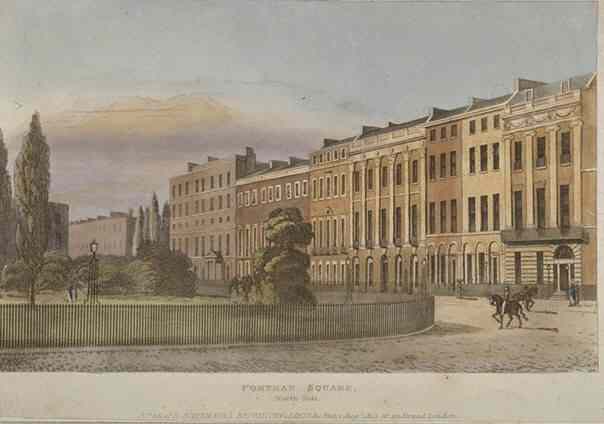
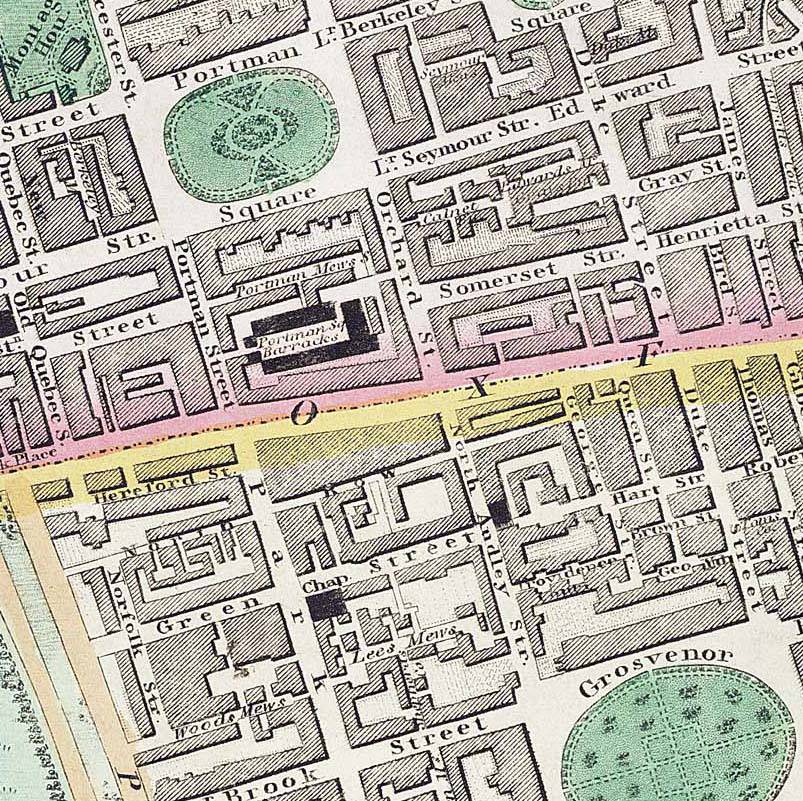
John seems to have run his business out of No. 35 Edward Street – which in those days – was, sadly, not a particularly salubrious part of London! However, it was close enough to Portman Square (which was a lot more up-market) that he included that in the address! John’s brother Robert was living at “No. 35 Edward Street, Portman Square” when he wrote his Will in 1786. Presumably the property was somewhere near today’s “Edward’s Mews.”
Map of Mayfair (south) and Marylebone (north), c. 1830. The square is top left. Wikimedia.
London’s Directories show that John had broader interests than baking and he ran the London side of a shipping business (“William and John Pinsent of Portman Square”) he had set up with his brother William in Port de Grave, in Newfoundland. John coordinated European sales and arranged shipping out of London and William dealt with day-to-day operations in Newfoundland (1792-1821).
John’s younger brother, Joseph Pinsent, may have helped out now and then, both before and after he became an accredited (City of London) shipping agent; however, there is no sign of their having a particularly deep or on-going working relationship. Joseph advertised a quantity of cod “just imported in excellent order” in March 1806. It is not clear if it came off one of his brothers’ ships (Public Ledger and Daily Advertiser: Monday 3rd March 1806). He also dealt with the sale of the hull and contents of the “William and John” which was driven on shore near Lymington in a gale in June 1806 (Public Ledger and Daily Advertiser: Wednesday 11th June 1806). I fear that this was one of the family’s ships! I hope it was insured.
John and William first show up in the Newfoundland records as partners in 1791, when they sue “Thomey for £23 debt.” It is worth noting that a “John Pinsent” captained one of the firm’s ships in 1793 and 1794 – so John may have taken a hands-on approach to the business in the early days. Perhaps he was not just pushing paper. The brothers’ ship “Pinsent” (Captain Wells) was among a list of vessels reported to be at anchor in the River Tagus (Portugal) in April 1803 (Oracle and Daily Advertiser: Tuesday 8th November 1803). The same ship unloaded cargo at Newry (Ireland) and was en route from Lisbon to Liverpool the following January (Oracle and Daily Advertiser: Wednesday 11th January 1804). It docked in Cork with the rest of the “Surinam Fleet” in April 1805. The “Pinsent” was on its way back to London (Royal Cornwall Gazette: Saturday 6th April 1805). These movements are probably fairly representative. The business is described more fully under William’s name.
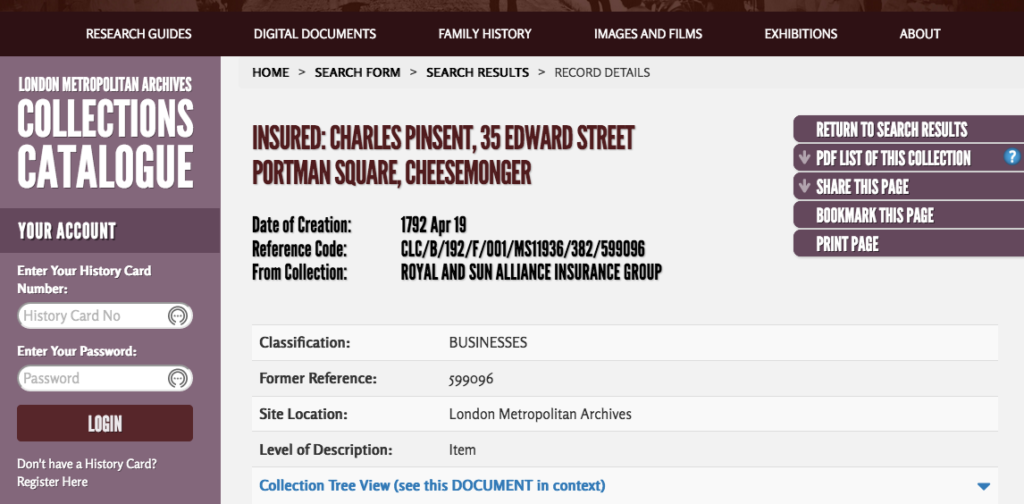
John shared the Edward Street property with his cousin Charles Pinsent from 1792 to 1798 (or, perhaps, later). Charles was the son of John’s uncle Robert Pinsent by his wife Eleanor Shapley (see elsewhere). Charles married (the very appropriately named) Elizabeth Butter in Devon in 1791 and set up as a “cheese-mongers” in Edward Street. It made sense, I suppose, bread and cheese. A document in the London Metropolitan Archives shows that “Charles Pinsent, cheese-monger” took out a “Royal and Sun Alliance” insurance policy on the Edward Street property in 1792 – so he may have had the first claim to the premises.
John and “cousin” Charles were neighbours throughout the 1790s and their children were baptized at St. Marylebone Parish Church. They would have been christened in what is now known as the “Old Church” – which had been built in 1760. It rapidly became too small for the parish and it was replaced by the new one in 1817. John would have been around to see the latter built.
Charles gave up on selling cheese in the late 1790s. He moved into the construction business and relocated to the nearby parish of Soho. His life is described elsewhere. Just to complicate matters, there was to be another Charles Pinsent “cheese-monger” living in London in the mid 1800s. However, he was not yet born, so there is no confusion.
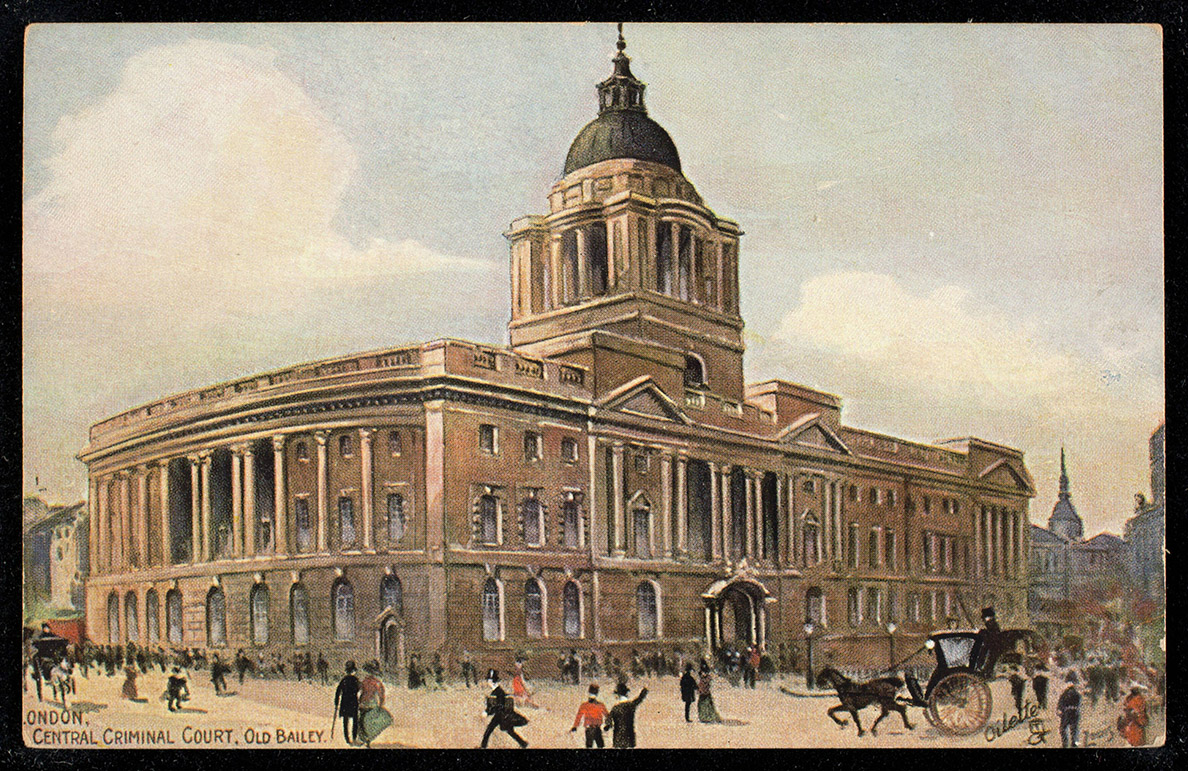
The Old Bailey in London.
John Pinsent was, (according to the records of the “Central Criminal Court” (“Old Bailey”) that are now available on-line) summoned for jury service on 1st July, 1790 and was appointed to the “First Middlesex Jury” of the “King’s Commission of Oyer and Terminer, and Goal Delivery.” Sometime later (on the 17th February 1796) he was appointed to the “Second Middlesex Jury.” On that occasion, his cousin Charles Pinsent was appointed to the “First Middlesex Jury.” They both fulfilled their civic duty.
Interestingly, Charles was back in court as a plaintiff in 1805, when thieves stole a cart load of lumber from his work-yard. It came from a house demolition project and the perpetrators failed to notice that some of it still had wallpaper attached that could be matched to similar paper still adhering to lumber in his yard!
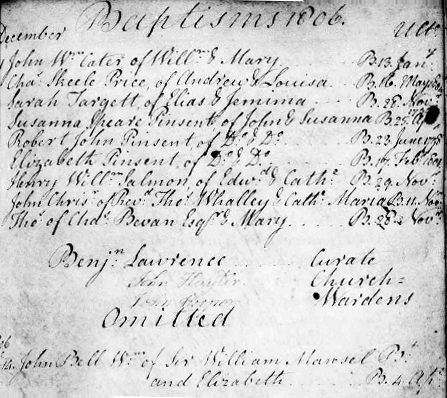
Baptism entries for John Pinsent’s children.
One of John’s daughters, Sophia Speare Pinsent, died in London in 1805. How old she was I am not sure as John and Susanna seem to have been slow to have their children baptized. Her sister, Susanna Speare, was born about 1795 but wasn’t christened until after a still younger sister, Elizabeth Speare, and a brother, Robert John Pinsent, were born in 1798 and 1801 respectively. All three were baptized in 1806.
In all, John and Susanna had four daughters and two sons; however, only three daughters and one of the sons survived. Infant mortality was very high in London in those days as the drinking water came from communal pumps in the street and it was easily contaminated. Diseases such as cholera and typhoid spread rapidly throughout the city. The situation did not improve much until London had its sewage and drinking water system rebuilt in the late 1850s.
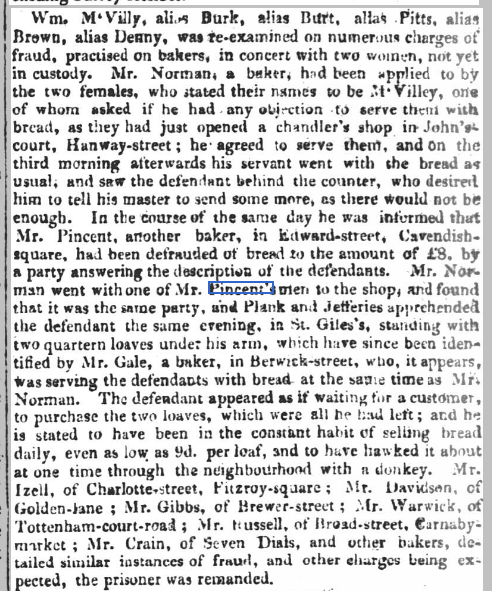
Article describing the fraud case against William McVilley, Public Ledger and Daily Advertiser, February 2, 1818.
In 1818, John was, in his capacity as a baker, caught up in a fraudulent scheme that led to Wm. McVilley (alias Burk and/or countless other names) facing charges at Marlborough Street Court. Evidently, Mr. McVilley had arranged for a couple of women to visit the bakers in the district and con them into providing bread for resale at a chandler’s shop that they had – supposedly – just opened in St. John’s Court, Hanway Street. The bakers were (of course) to be reimbursed later. Needless to say, the money was not forthcoming. Mr. Pinsent was defrauded of £8’s worth of bread. Unfortunately for Mr. McVilley, the bakers talked amongst themselves and contrived to have the culprit caught (floury handed) with two stolen loaves that he was attempting to sell on the street (London Packet and New Lloyd’s Evening Post: Monday 2nd February 1818).
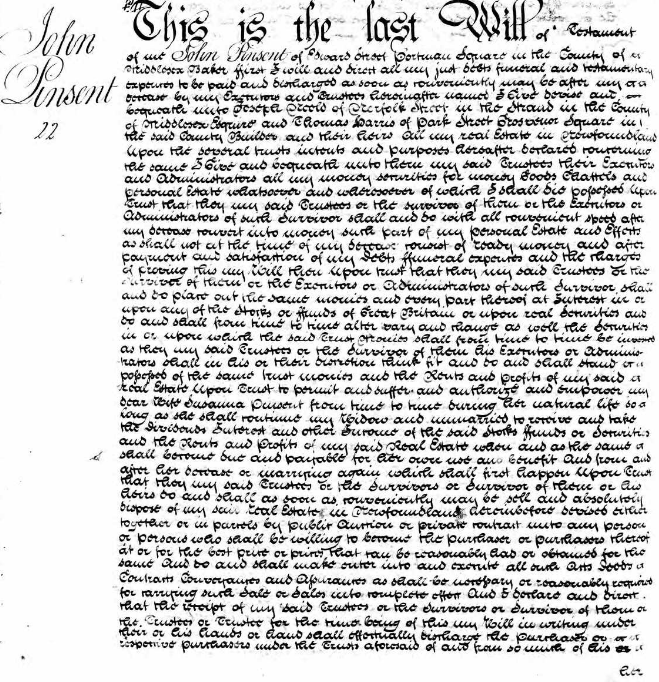
First page of John Pinsent’s last will and testament, 1821.
John died in London in 1821 and was buried in St. Marylebone parish churchyard. He arranged for trustees to look after his estate and appointed his unmarried eldest daughter, Mary Speare Pinsent, as his administratrix. Presumably she had a head for business as she ran a millinery business out of No. 109 New Bond Street with her younger sister Elizabeth Pinsent (London Directories).
The business was insured by the “Sun Fire Insurance Company” in 1823. John asked his assignees to divide his assets between his wife and four children – albeit he gave his son (Robert John Pinsent) the right of first refusal to buy out his mother and sister’s Newfoundland shipping interests.
After her father’s death, Mary Speare seems to have kept some exposure to the family shipping business. She became a co-owner, with her uncle William Pinsent and her father’s estate of the ship BROTHERS (115 tons, built in Cupids, Conception Bay, in 1820). Unfortunately, the vessel was lost in 1830. How or why, I am not sure. Presumably the the trustees sold the bakery and, over time, Robert John exercised his right of purchase of the shipping business. He took off for Newfoundland in 1827 – as his uncle William was getting on in years and needed his help.
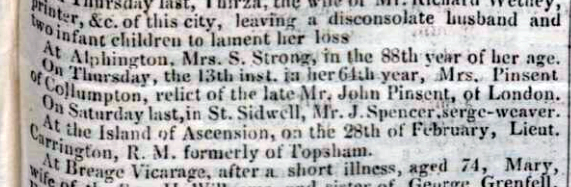
Newspaper notes Susanna Pinsent’s death in 1830. Exeter & Plymouth Gazette.
The family had maintained its Devon roots while it lived in London and Susanna and her daughters moved back there, after John’s death. Susanna’s daughter, Susanna Speare, seems to have preceded them as she was described as being “of Kingscarswell” when she died (aged 24) in 1819. Elizabeth died in Cullompton in 1828, “after two years of illness” and Susanna, herself, died in Totnes in 1830.
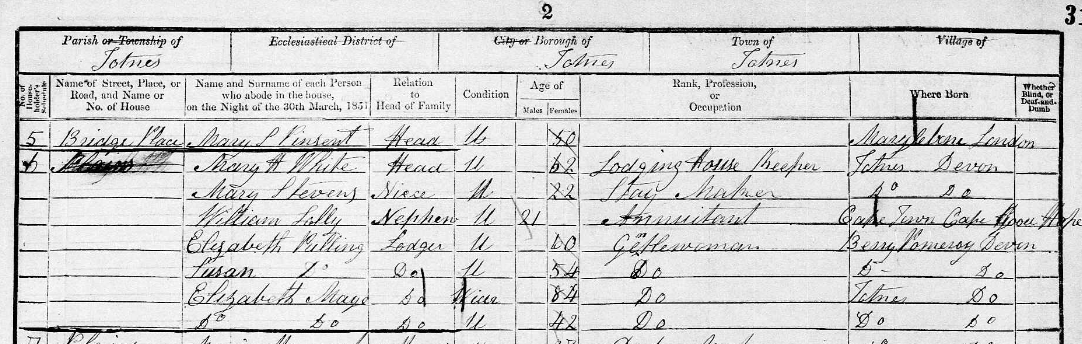
Mary Speare Pinsent is listed in the 1851 census.
None of John’s daughters married. Mary Speare leased a property called Long Park, in Clyst Honiton owned by the Exeter Cathedral Chapter, in 1831 and periodically renewed her lease (Archives: Exeter Cathedral). While she was living there, she became entangled in a dispute between two of her neighbours. Apparently, she had sold a house and nine acres of land to a local gentleman in 1865 and, appropriately enough, had notified the sitting tenant. All should have been well; however, there was a long and ongoing dispute between the new owner and the tenant over the maintenance of a hedge between their adjoining properties and the tenant haughtily disputed the new owners right to the property. He wrote to her questioning his new landlord’s signature. The dispute made its way to the Local Assize – much to the benefit of the lawyers, but, one suspects, no one else (Western Times: Tuesday 13th March 1866).
Mary Speare Pinsent died in December 1882 at the age of eighty-eight. She had been living off her investments for many years. The Calendar of Grants of Probate and Letters of Administration shows that Mary Speare Pinsent, late of Totnes, spinster, had her will proved by Emma Derry of Paignton, “one of the executors”. Her effects were valued at £121 5s 0d.
National Probate Calendar entry for Mary Speare Pinsent, 1882.
Please use the above links to explore this branch of the family tree. The default “Next” and “Previous” links below may lead to other unrelated branches.
Please use the above links to explore this branch of the family tree. The default “Next” and “Previous” links below may lead to other unrelated branches.
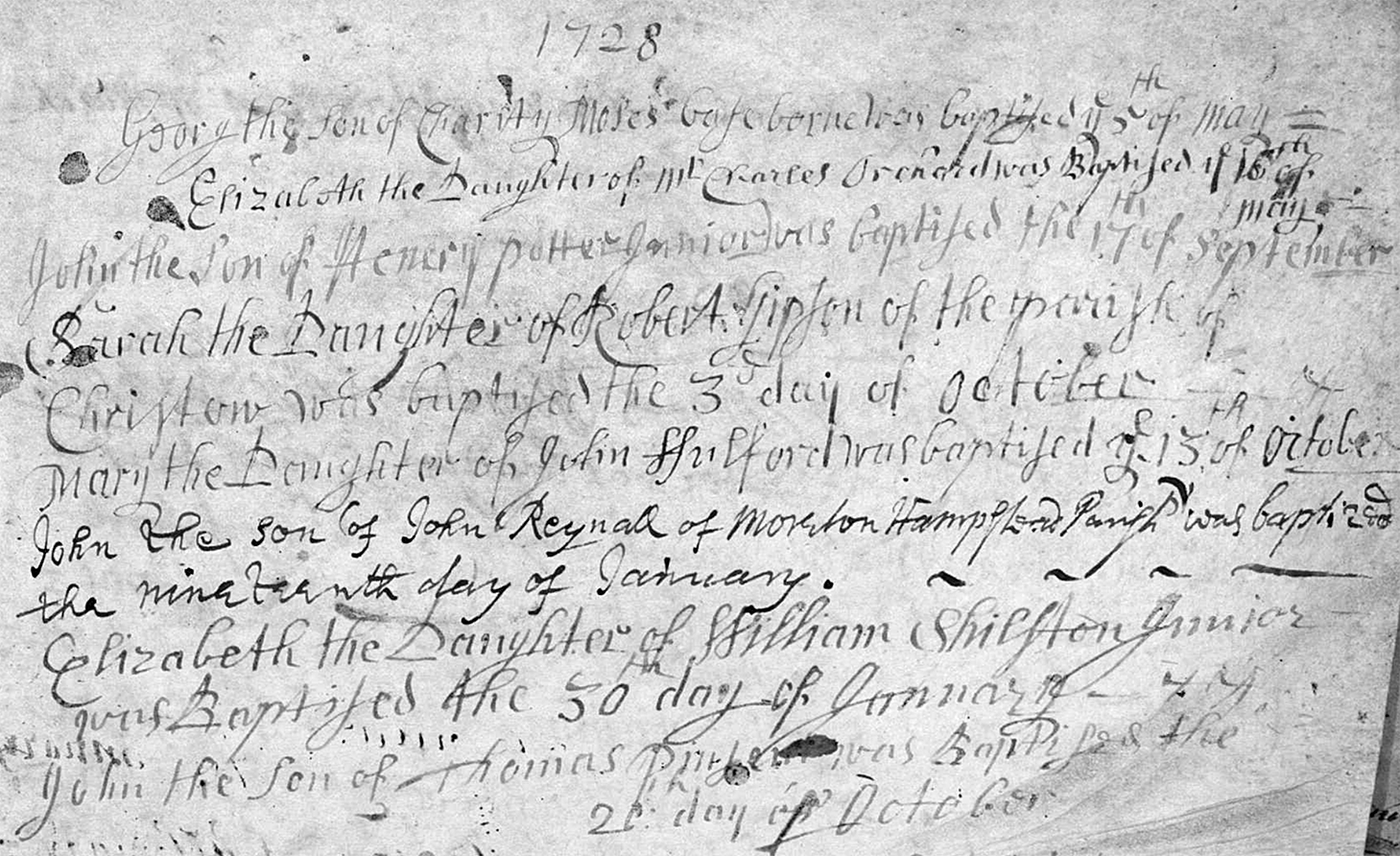
Handwritten record of John Pinsent’s baptism in 1728.
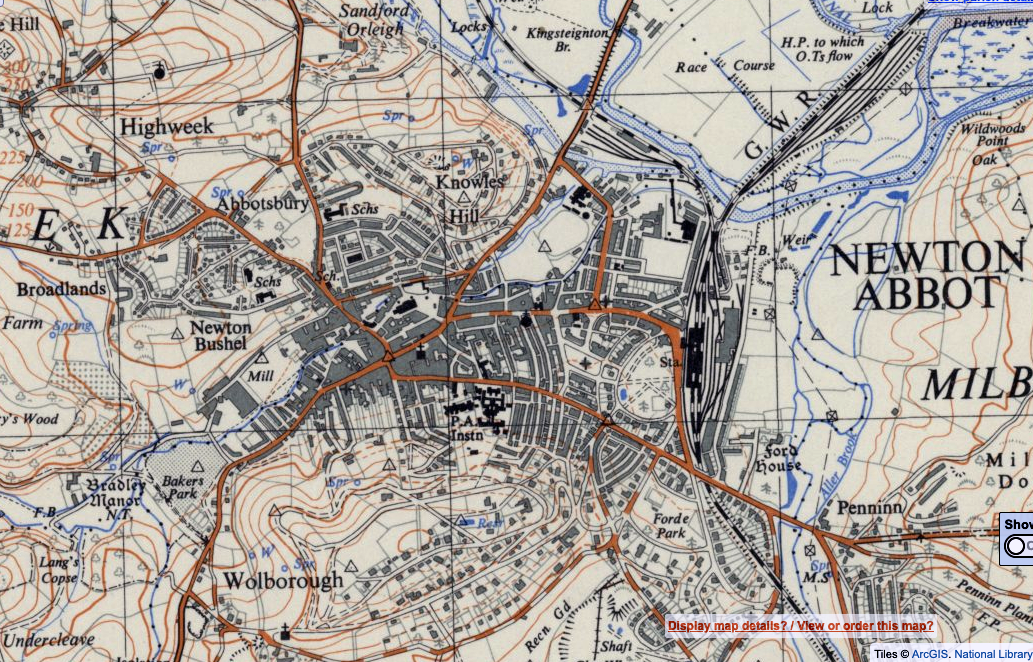
John Pinsent was the youngest of the surviving sons of Thomas “the elder” of “Pitt Farm”. He grew up in Hennock and later became a “merchant” in Wolborough (Newton Abbot). According to his son Joseph’s application for membership of the “Patternmaker’s Guild” (submitted in 1800 in order to become eligible to become a “Freeman of the City of London”), his father was a “Stapler” (i.e. he traded in wool). This makes sense as John’s brothers Robert and Gilbert, who also moved to Newton Abbot, were serge weavers and woolcombers. Sadly, they both arrived as the Devonshire cloth industry was starting to decline. Newton Abbot was, however, growing into a major recruitment and administrative centre for the Newfoundland cod fishery and it is quite possible that John had interests there too.
Map of Newton Abbot.
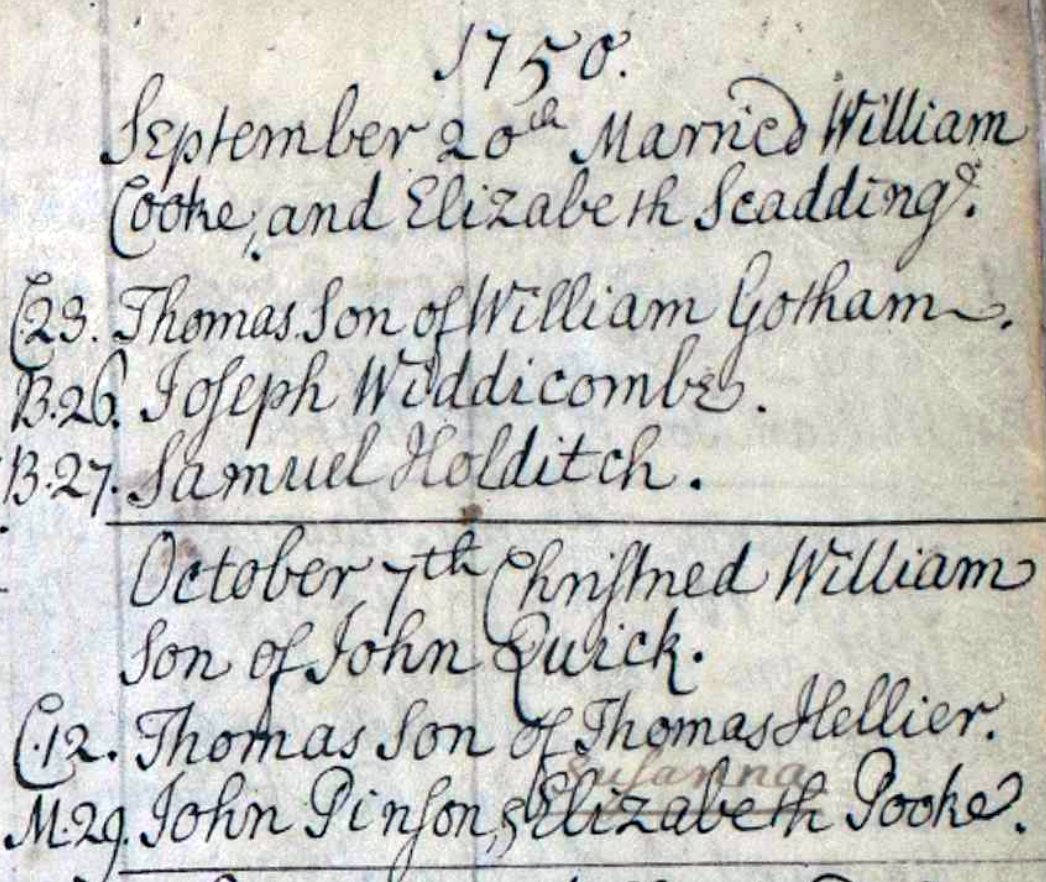
John Pinsent marries Susanna Pooke in 1750.
John married Susanna Pooke in 1750 and they had a family of eight (surviving) boys, of whom five were to grow up, marry and have children. This discussion (see elsewhere) follows the male line of descent of three of them down to the 1960s and it tracks the descent of two others as far as they are known to go. I am a direct descendant of John’s eldest married son, John Pinsent (1753-1821); my distant “cousins”Edward Humphrey and John Pinsent are descended from Gilbert Pinsent (1758-1835) and my other “cousins”Robert Burton and GRO0710 (and also several Australians) are descended from Joseph Pinsent (1770-1835). All three, and Charles Pinsent (1766-1826) too, have female-line descendants as well; however, they are not discussed.
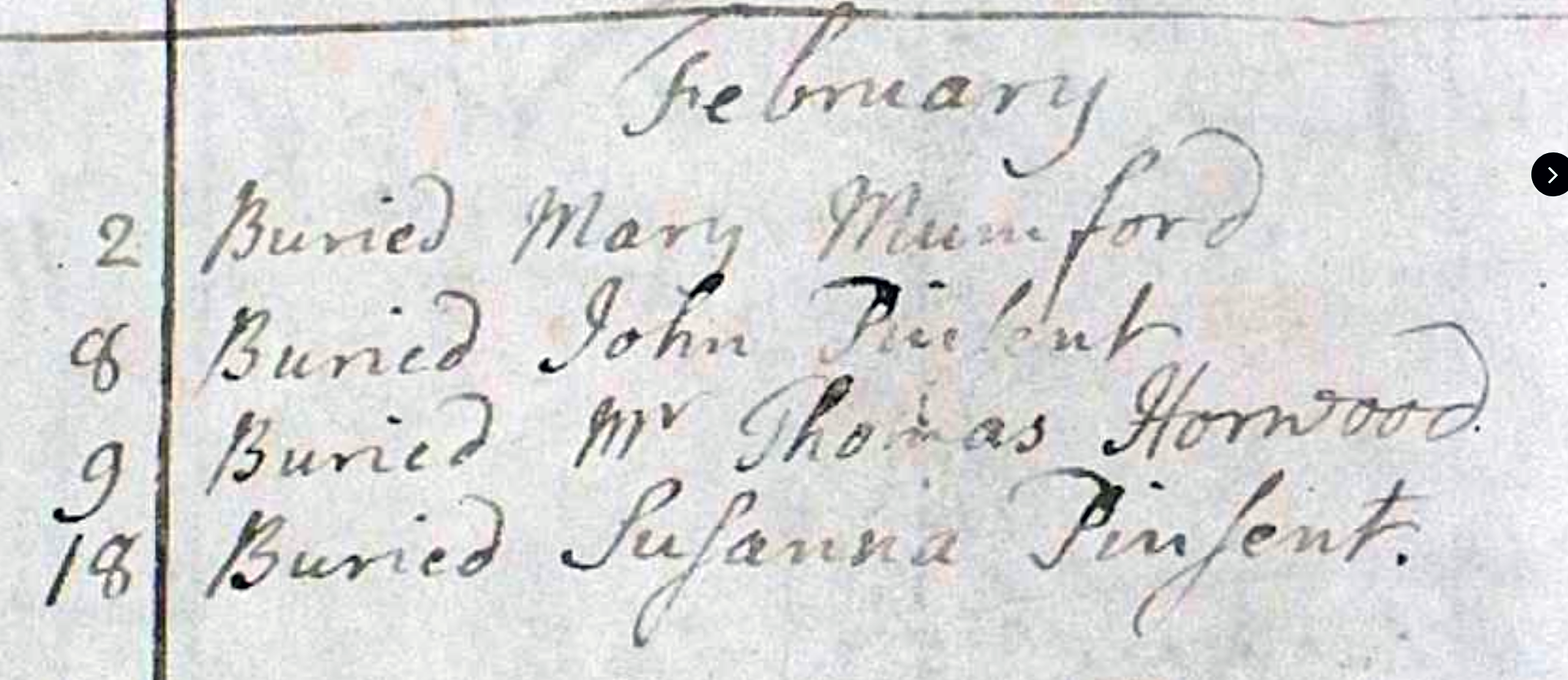
John and Susanna die within days of each other in the February of 1772.
John Pinsent (44) and his wife Susanna (42) died within days of each other in 1772. They were relatively young, so they presumably succumbed to a pandemic of some sort.
They had launched their elder sons but their four young boys (Gilbert, Charles, Samuel and Joseph) were still in needed of a home. They seem to have been sent to live on their grandfather Thomas at Pitt in Hennock. He would have been getting on by then and the farm was probably being run by the boys’ uncle, Thomas Pinsent“the younger of Pitt.” He had no children of his own and must have been pleased to have them. Gilbert, Charles and Joseph almost certainly learned to farm while at “Pitt”. Presumably their brother Samuel did too; however, he died young.
St. Mary’s church in Wolborough via geography.org.uk.
Their lives are described elsewhere. There is a memorial in Hennock Church that shows that Charles took over the running of the farm at “Pitt” and inherited it in 1802, when his uncle died. Gilbert had, in the meantime, become a well-known tenant farmer in the Teign valley.
Charles’s brother Joseph had gone up to London and become a shipping agent and insurance broker (not a “patternmaker”!). Nevertheless, he returning to Devon in the 1820s to farm at Lettaford, in North Bovey. He is notable for marrying not just one DEVONPORT branch Pinsent, but two (see elsewhere)! Sadly, both died young. He ended up with children from his second and third wives.
John and Susanna’s four elder sons (John, Robert, Thomas and William) were apprenticed by the time their parents died. The eldest, John Pinsent, was apprenticed to Mary Speare, a baker in St. Thomas Parish in Exeter, around 1767. He later married her daughter (?) Susana Speare and moved up to London.
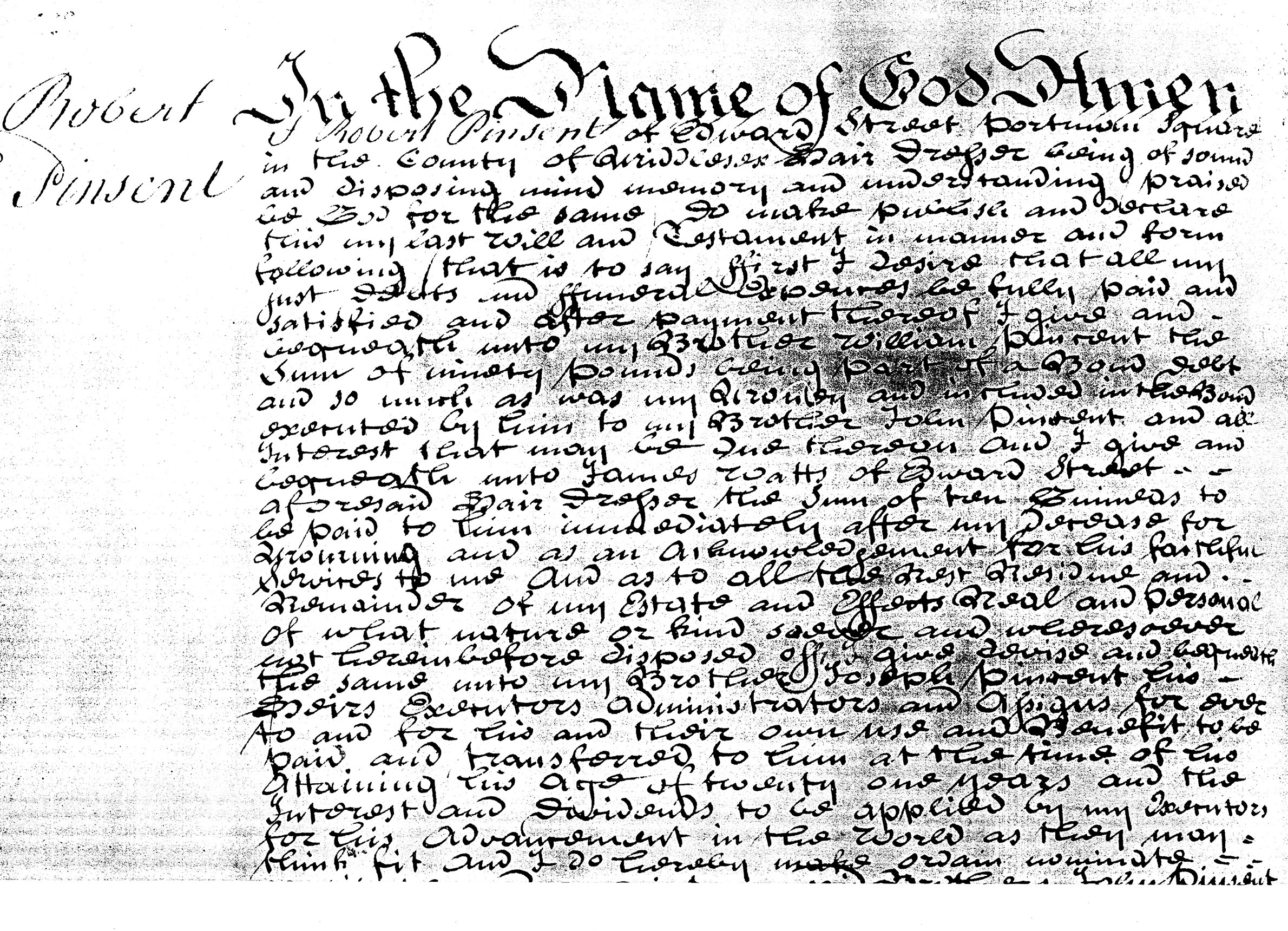
Robert Pinsent’s will was probated in 1787.
Robert Pinsent was apprenticed to a peruk (“wig” maker) named Anthony Stoker in Totnes in 1769. He also went up to London and he was living with his brother John, on Edward Street near Portman Square, in 1786, when he wrote his last Will and Testament. In it, he repaid a bond he owed to his brothers John and William (whom he made his co-executors) and after other bequests he left the residue of his estate to his brother Joseph, who had yet to turn twenty-one. The Will was proved in the Prerogative Court of Canterbury in 1787.
It seems likely that their brother Thomas joined the Royal Navy and died young. When Thomas “the younger of Pitt” wrote his Will, he refers to all his nephews by name except Thomas, so he had probably died before it was written, in 1791.
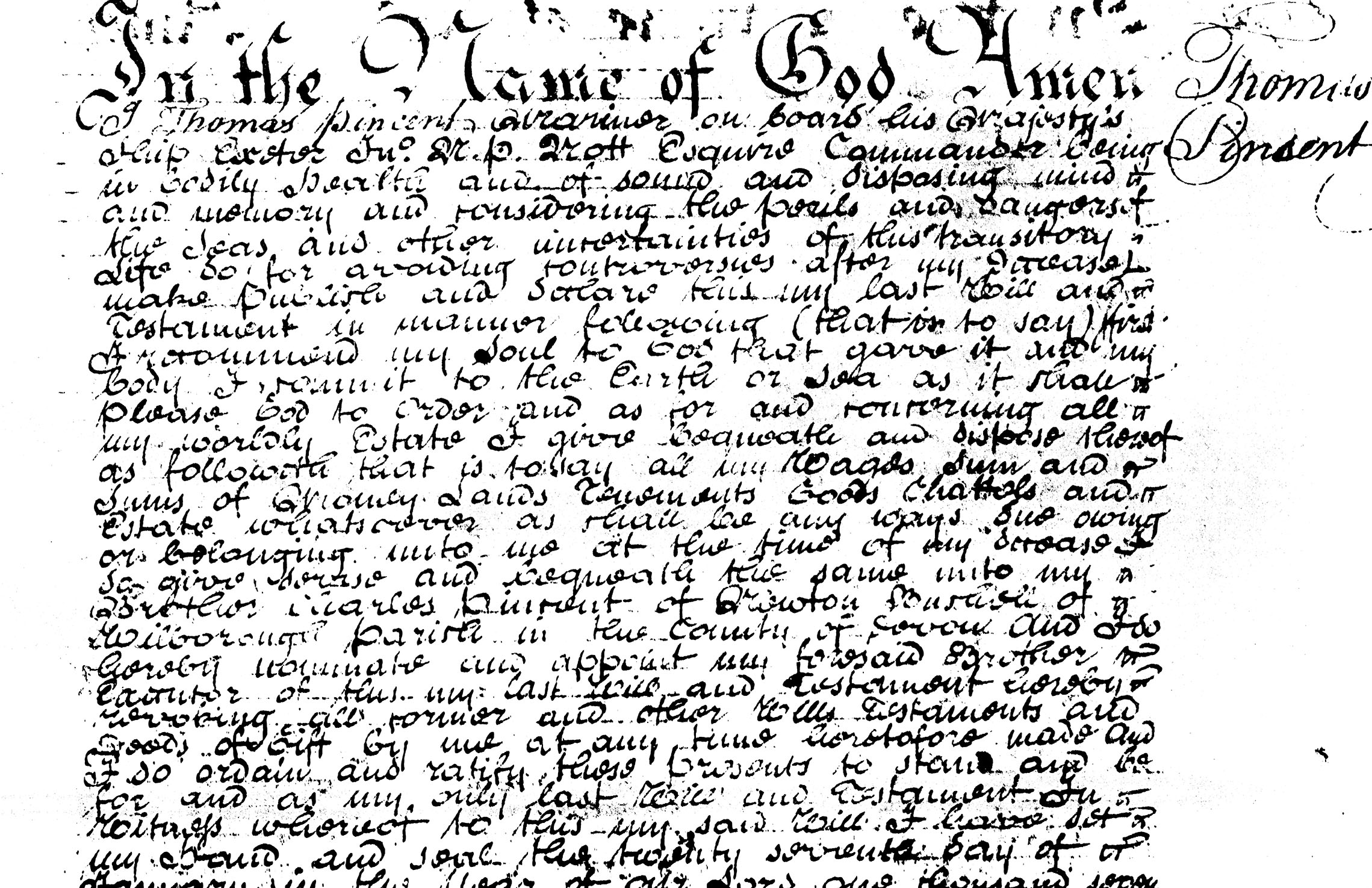
Thomas Pinsent wrote his will in 1779.
The younger Thomas may well have been the Pinsent who served on H.M.S. Exeter and wrote his will in 1779, presumably on joining the Navy. In it, he left his “wages, sums of money, lands, tenements, goods, chattels and estate” to his brother, Charles Pinsent. He probated the will in the Prerogative Court of Canterbury in 1785. Charles later went on to inherit “Pitt” from his uncle.
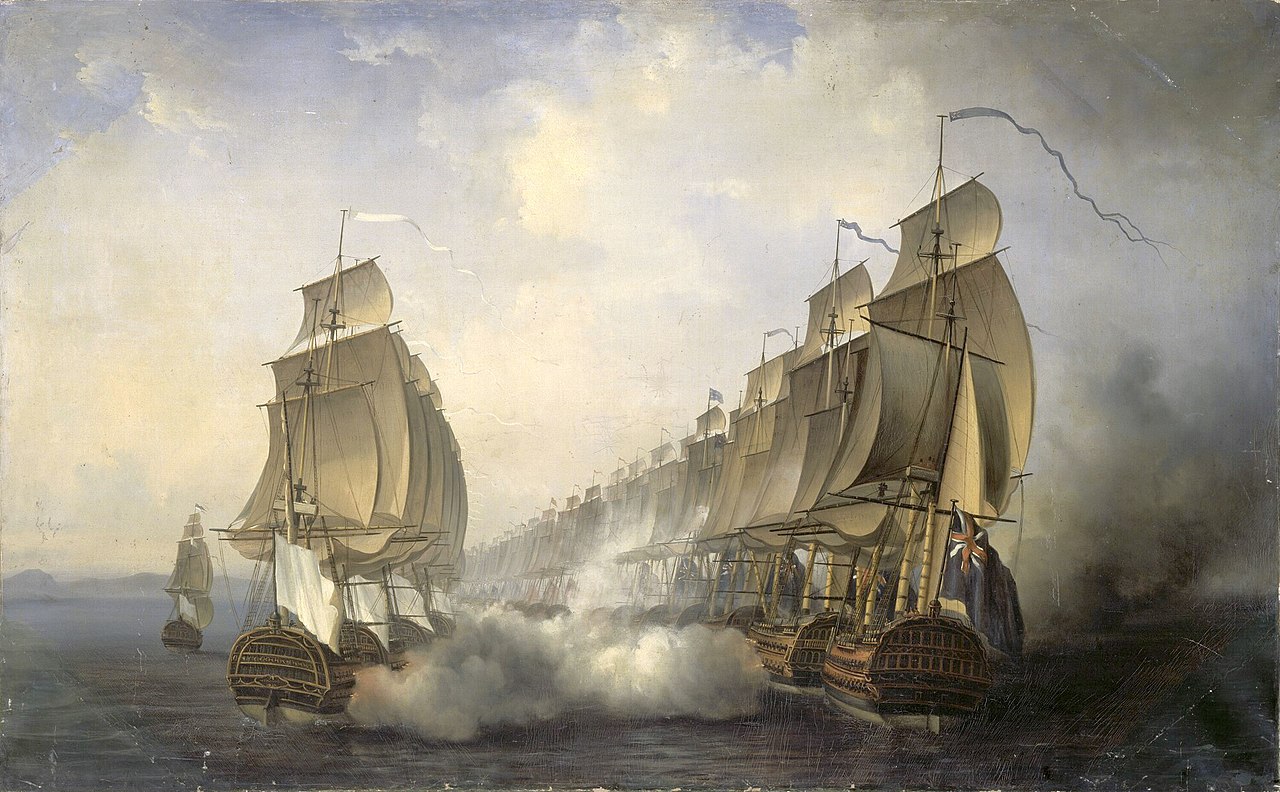
The H.M.S. Exeter at the Battle of Cuddalore, 1783, via Wiki.
How and when Thomas actually died, I do not know. It is worth noting that H.M.S. Exeter was a 64 gun “third-rater,” commissioned in 1763, that served with the British fleet in the Bay of Bengal during the American Revolutionary War. It fought five engagements with the French in 1782 and 1783 (Sadras, Providien, Nagapatam, Tricomalee and Cuddalore) and it is quite possible that he died in action. Alternatively, he could just as easily have succumbed to malaria or some other tropical disease. His affairs would not have been wrapped up until the fleet returned home.
John and Susanna’s son, William, went out to Newfoundland as an “agent” for a mercantile firm around 1777 and (as discussed elsewhere) stayed on in Port de Grave where he established a shipping business which he ran with his elder brother, John. William returned to England late in life, and died in Teignmouth in 1834.
Gilbert doesn’t have a known birth record but, from his death notice, he must have been born around 1758. He probably worked on his uncle’s farm until he found one for himself. As discussed elsewhere, he turned out to be a very successful tenant farmer.
Please use the above links to explore this branch of the family tree. The default “Next” and “Previous” links below may lead to other unrelated branches.
John Pinsent was the youngest son of Gilbert Pinsent by his wife Margaret (née Snow). John grew up on a farm in Kingsteington called “Ponswin” with two elder brothers Thomas Pinsent (who died in 1804, aged 14 years) and William Pinsent, and an elder sister, Mary Snow Pinsent.
In 1824, when John was still young and unmarried, his father moved to a larger farm called “Aller Barton” in Abbotskerswell. John seems to have gone with him. However, he may have spent a year managing some rental property in Modbury in 1828, before passing that particular task on to his brother William. His father was getting on in years, so John took over the farming at “Aller Barton.” While there, he seems to have rented land at “Sandford Marsh”, in Teigngrace, in his own name. It was owned George Templar Esquire (Earl of Somerset) and valued £1 0s 0d per annum. He held it in 1830 and 1831 (and possibly later – the tax records end around then).
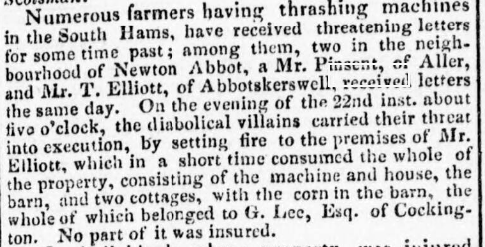
“Diabolical villains” burn a neighbouring property. Hampshire Telegraph, January 3, 1831.
John must have been running “Aller Barton” in all but name by 1831 when he married Ann Brock. Nevertheless, it was his father’s farm and it was Gilbert Pinsent who split the £24 16s 0d property land tax with William Bickford. This was a considerable amount. Presumably, they co-owned a considerable amount of land.
It was cheaper to import grain than to grow it in those days and there was considerable resentment, amongst unemployed “agricultural labourers” of affluent farmers who used machinery at the expense of manual labour. In 1831, John and Gilbert received threatening letters from people who clearly objected to their using a threshing machine. They were not alone. One of their neighbours received a similar letter and actually had his farm burnt down. “Aller Barton” was, at least, spared that fate (Hampshire and Sussex Chronicle: Monday 13th January 1831).
The Electoral Roll for the County shows that it was John (as opposed to his father) who was eligible to vote in 1832 and also in 1834. John formally took over the rental of the farm after his father died the following year. John Pinsent of “Aller Barton” applied for a Game Certificate in 1839. It cost him £3 13s 6d (North Devon Journal: Thursday 17th January 1839).
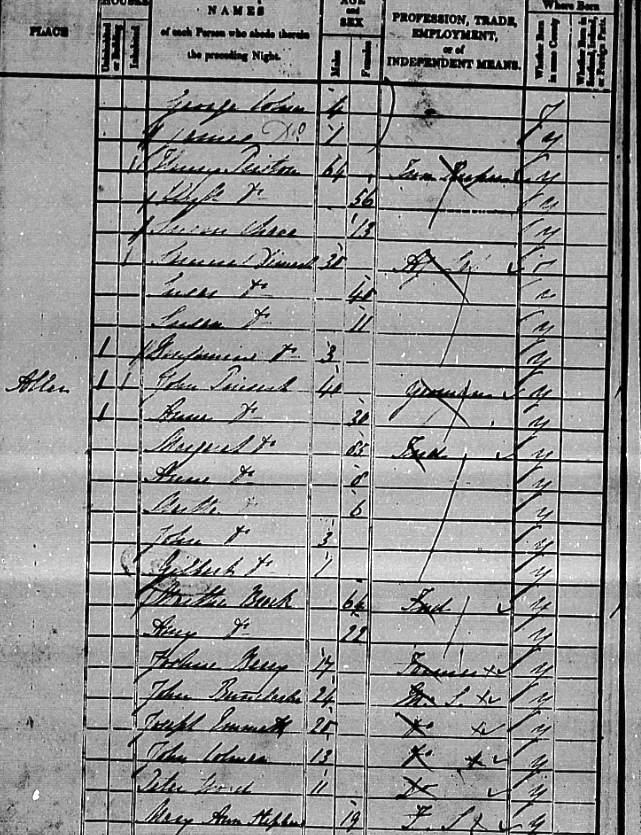
John Pinsent appears in the 1841 England, Wales & Scotland Census.
John and Ann had eleven children (five boys and six girls) over a period of twenty years and four of them (Anne, Martha, John and Gilbert) were living with them at the time of the 1841 Census. John’s mother (Margaret née Snow) and Martha and Amy Brock (two of his wife’s relations) were also in residence, as were eight servants. It was a substantial farm!
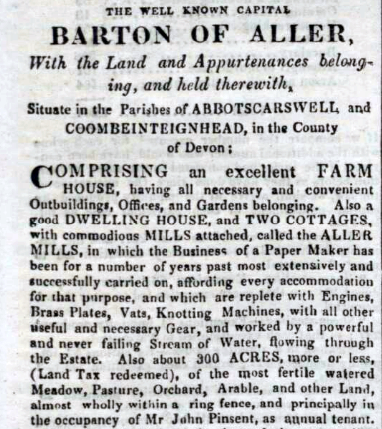
The Reverend George Baker, who owned the farm, put “Aller Barton”, “the well known Capital Barton of Aller, with the lands and appurtenances belonging …” up for sale by auction in June 1841 with Mr. John Pinsent as the sitting tenant.
Aller Barton is listed for sale. Sherborne Mercury, May 10, 1841.
The property was described as having “an excellent farm house, having all necessary and convenient outbuildings, offices and gardens …” two cottages, 73 acres (or thereabout) of water meadow, 47 of fertile pasture, 8 of orchard “famed for their superiority of fruit and cyder … ” and 172 acres of arable land. The property had a near “inexhaustible quantity of Potter’s Clay” that was suitable for brick manufacture and, presumably, paper manufacture as the property included an active paper making business at “Aller Mills” (Sherborne Mercury: Monday 10th May 1841). Despite its many assets, the property did not sell – and the trustees of the late Reverend Baker decided to subdivide it. In 1847, they put “Aller Barton” up for sale as thirteen lots (Daily News: July 2nd 1847). Presumably it sold that time and the farm seems to have been subsumed into a large pottery business by 1902. It was time for John and Ann to move on.
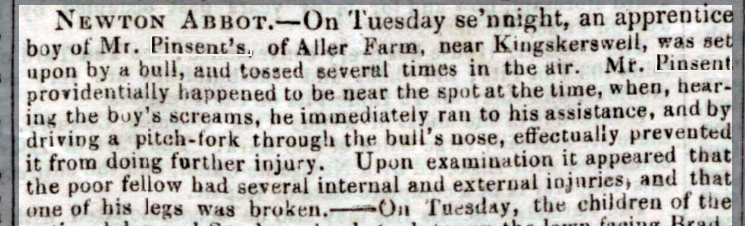
John Pinsent skewers a bull after a worker is badly injured. Western Times, August 5, 1843.
Accidents can occur on any farm and in 1843 one John’s apprentices’ at “Aller” was severely gored by a bull. John successfully distracted the beast by driving a pitchfork through its nose (Western Times: Saturday 5th August 1843). That would have got my attention too! There no mention of what the boy had said or done to the bull. John was a man of considerable standing in the local farming community and his ploughmen competed and did well in local, ploughing matches (Western Times: Saturday 1st March 1845). In his last year at “Aller” (1846) he was appointed one of Abbotskerswell’s Churchwardens. This is a surprise as he was probably a dissenter! Certainly, his wife Ann was a non-conformist and their daughters had chapel weddings.
Sadly, 1846 was not a good year for the family as Ann took ill and John had to have her admitted to to Bowhill House, a lunatic asylum near Exeter. She was admitted in July 1846 “rather feverish but in pretty good health” on grounds of “hereditary insanity.” She was discharged in June in the following year (Devon Heritage Centre: 3992F/H20/1: Findmypast). Presumably it was a temporary breakdown as there are no other indications of ill-health. Perhaps the loss of a son, Albert Pinsent – who was born in February and died in August 1846, and the stress of the upcoming move were too much for her.
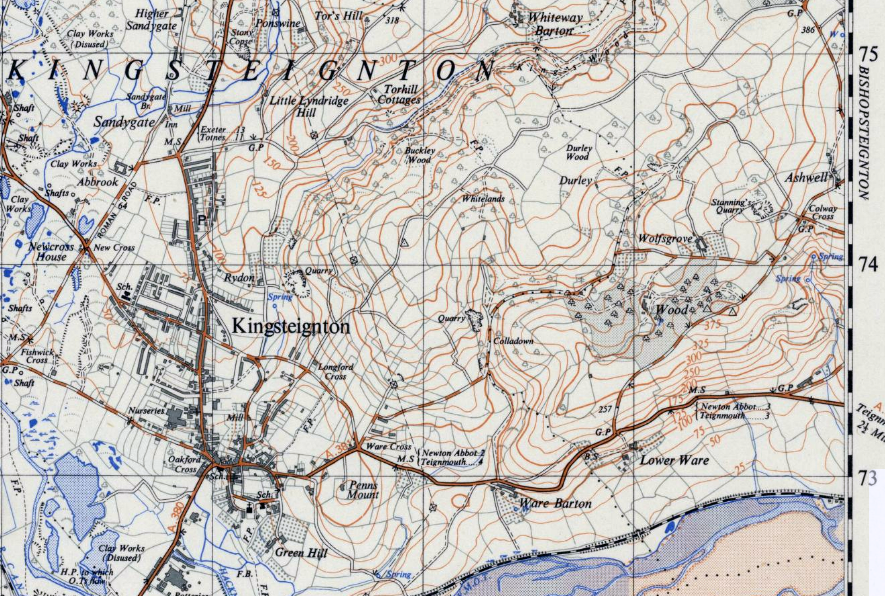
Ware Barton near Kingsteignton via the National Library of Scotland.
John and Ann moved to “Ware Barton” (a.k.a “Wear Barton), a farm owned by Lord Clifford of Chudleigh, in Kingsteignton, in 1847. It backed onto the Teign River estuary a few miles east of Kingsteignton. On his arrival, probably as an act of good-will, he offered to host the eleventh annual ploughing match of the “Newton Abbot, Agricultural and Labourers’ Friendly Society” (Western Times: Saturday 26th August 1848). Perhaps he took his ploughman with him from “Aller” and felt that he could hold his own. The event seems to have gone well, and it was followed by a slap-up dinner at the Globe Hotel in Newton Abbot (Flindell’s Western Luminary: 7th November 1848). John served as a juror on the Manor Court at Kingsteignton in 1848 and again in 1851.
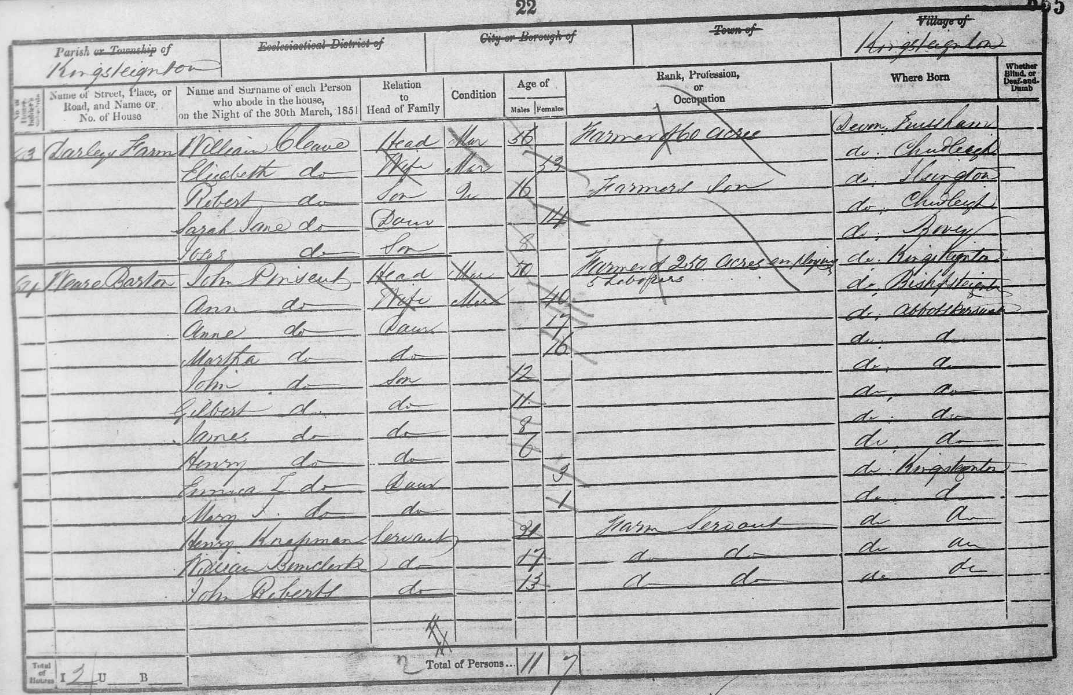
John Pinsent and family appear in the 1851 England, Wales & Scotland census.
One of John’s sisters-in-law, Martha Vooght, died in Bishopsteignton in 1849 leaving his wife Ann as was one of her beneficiaries (Inland Revenue Wills: 1849). The 1851 Census data shows that “Ware Barton” covered 250 acres and that John and Ann worked it with the help of their elder children Martha, John, Gilbert, James and Henry Pinsent – all of whom were born in Abbotskerswell. There were also three resident servants and five other outside-workers. John and Ann’s three younger daughters, Emma Louisa, Mary Isabella and Harriet Carlotta were born and baptized in Kingsteignton.
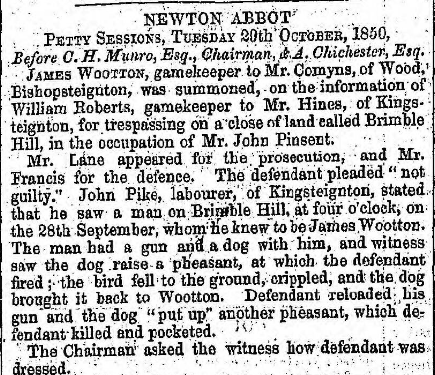
Pike testifies in court. Exeter Flying Post, October 31, 1850.
In 1850, Mr. Pike, one of John’s outside workers, gave evidence against a Bishopsteignton gamekeeper who had been summoned for trespassing and shooting pheasants on “Brimble Hill” on Mr. Pinsent’s land. After considerable discussion, the local magistrates plumped for “mistaken identity” and told Mr. Pike to be sure of his identification next time (Exeter Flying Post: Thursday 31st October 1850)! I do not know who the gamekeeper worked for, but perhaps his employer had clout.
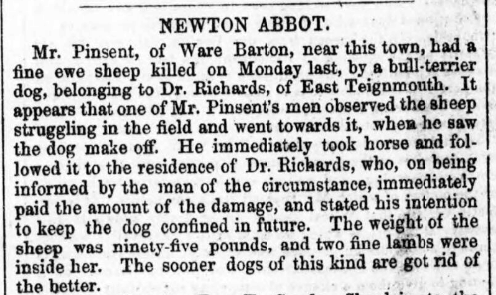
John Pinsent confronts the owner of the murderous dog. Exeter Flying Post, February 13, 1851.
The following year, one of John Pinsent’s workmen saw one of the farm’s pregnant ewes being attacked by a bull terrier. He followed the dog home to Teignmouth where he discovered that it was owned by Rev. Dr. Richards. The sheep died, and the embarrassed Reverend gentleman dutifully paid up (Exeter Flying Post: Thursday 13th February 1851). John lost another sheep a month later, this time to a dog owned by Mr. Sanders of Kingsteignton. It was the third ewe that this dog had killed and compensation was not enough, it was put down (Exeter and Plymouth Gazette: Saturday 8th March 1851).
Letters in Lord Clifford’s archives at Ugbrooke show that John and his Lordship corresponded in 1846 over a parcel of land needed by the South Devon Railway Company. The point at issue seems to have been the amount of land he would loose to a sloped embankment. The line open as far as Teignmouth by then but under construction further west. It was slated to run from Exeter to Plymouth and would prove to be a valuable addition to the regional transit system. It was not all bad news. The farm remained productive. 1853 must have been a good year and the Exeter and Plymouth Gazette (Saturday 13th August 1853) tells us, with hint of relief, that “a field of wheat belonging to Mr. John Pinsent, of Ware Barton in this parish, has been cut and saved in good condition …”
By 1854, John had obtained enough standing in the farming community to be asked to participate as one of three judges at the sixteenth annual ploughing match of the “Newton Abbot Agricultural and Labourers’ Friend Society”. After receiving a vote of thanks at the Annual Dinner at the Globe Hotel, Mr. Pinsent expressed “a hope that in their awards and prizes (the judges) had given general satisfaction” (Western Times: Saturday 4th November 1854. John was appointed to the Newton Abbot Board of Guardians, which looked after the Workhouse and administered social services in 1857 (Exeter and Plymouth Gazette: Saturday 13th June 1857).
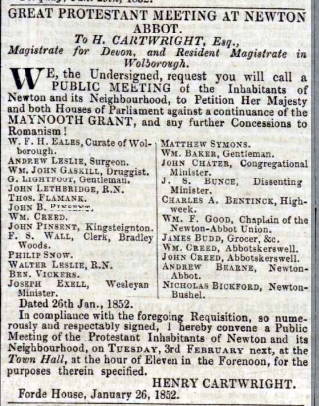
John Pinsent joins the call to fight concessions to “Romanism.” Exeter and Plymouth Gazette, January 31, 1852.
John was a chapel-goer, and he attended the “Great Protestant Meeting” when it was convened in Newton Abbot in January 1852. It was held to encourage people to sign a Petition to “Her Majesty and both Houses of Parliament against a continuance of the Maynooth Grant, and any further Concessions to Romanism” (Exeter and Plymouth Gazette: Saturday 31st January 1852). The Maynooth Grant was a highly contentious cash grant that the British Government made to a seminary in Ireland in 1845. John was not alone in signing the petition. John Ball Pinsent – the son of John’s neighbour, Thomas Pinsent of “Greenhill” in Kingsteignton – another wealthy farmer also signed it. They were Baptists belonging to the DEVONPORT branch of the family.
John had died a few years before the 1861 Census. However, his widow, Ann (née Brock) had evidently stayed on and continued to run the farm with the help of her unmarried sons (John, Gilbert, James and Henry Pinsent), and also her daughters (Anne, Martha, Emma, Mary and Harriet Pinsent). According to the census, “Ware Barton” covered 300 acres. There were five resident servants and two day-labourers working there.
Ann received letters of administration for her husband from the Prerogative Court of Canterbury in 1859; however, there were still matters outstanding in 1866 and her eldest son, John Pinsent, acquired additional letters relating to his father’s estate in 1868. By then, John had married Catherine Whidborne and had moved to a nearby farm called Middle Rocombe in Combeinteignhead. Later, he moved out of the County and farmed in Sherfield English, in Hampshire. This seems to have been the county his wife had come from.
John’s brother Gilbert Pinsent stayed on at “Ware Barton” after his parents died and was granted letters of administration for his mother’s estate in 1866. He (eventually) married Clara Bridgman in 1880; he was forty years old. They started their family in Kingsteignton but later moved to a farm in Newbury, in Berkshire. Henry Pinsent, John and Gilbert’s younger brother, may have acquired “Whitstone” farm in Bovey Tracey when he married Mary Langmead in 1870. The lives of all three of them are described elsewhere.
James Pinsent witnessed Wm. Horsham, steal a nosebag containing a quantity of oats valued at 5s while working at Ware Barton in December 1870. Mr. Horsham was brought up before the magistrates at Newton Petty Sessions and, after initially pleading “guilty,” he changed his plea to “not guilty, as he was too drunk to know what he was doing”. He then asked “his master (in this instance James) if, in the 20 years he had worked for him, he ever knew anything against him before. His master confessed to having heard reports, but never till then, having caught him in the act. In consequence of his already long incarceration (12 days), he was ordered to be further locked up until six o’clock and then discharged” (Western Times: Thursday 29th December 1870).
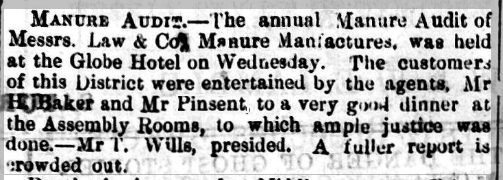
John Pinsent hosts a “manure audit” and much fun was had by all. East & South Devon Advertiser, November 27, 1875.
James Pinsent worked at “Ware Barton” but also had a sideline as a “manure agent” (fertilizer salesman). In the 1870s, he was the local agent for “Messrs. Law and Co. Manufacturers”. It was a sales position that had the side benefit that he got to attend annual meetings and dinners of the “Newton Abbot Agricultural and Labourers’ Friend Society” (Exeter and Plymouth Gazette: Friday 28th October 1870). James and a colleague also hosted the firm’s clients to a fancy meal at one or other of the Newton Abbot hotels every year (East and South Devon Advertiser: Saturday 27th November 1875). At one of them he was teased mercilessly for still being single. He ran for it! As far as I know, he never married.
James Pinsent is charged in Australia. New South Wales Police Gazette, February 18, 1885.
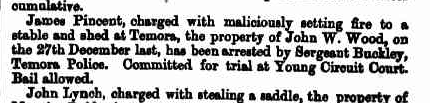
James seems to have gone out to Australia, however, exactly when, I am not sure. I suspect he was the “J. Pinsent” who belonged to the Australian Jockey Club in Sydney in the late 1870s. If so, he raced a brown gelding named “Partisan” at, among times and places, the August track meet at Tattershall in August 1877 (Sydney Morning Herald: Friday 2nd March 1877). He was probably also James Pincent apprehended by the police for setting fire to a stable and shed at Temora, New South Wales, on the 27th December 1885 (New South Wales Police Gazette: February 18th, 1885). The Attorney General, for some reason, declined to prosecute. What that was all about, I have no idea. James would have been forty-three years old at the time.
John Pinsent dies without a will. Northern Miner, January 23, 1902.
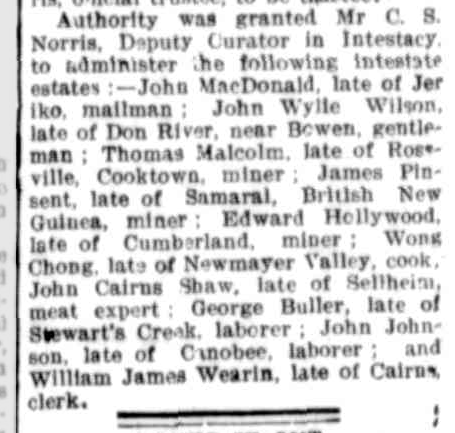
James went on to become a miner in what is now Papua New Guinea. He died intestate (without a will) on Samarai Island in British New Guinea in 1902. The Deputy Curator for Intestacy processed his estate in the Northern Supreme Court (The Northern Miner: Thursday 23rd January 1902) and the Queensland Gazette shows that the State carefully invested his money while they sought a deserving legatee. The account had accumulated to £243 4s 2d by 15th September 1905.
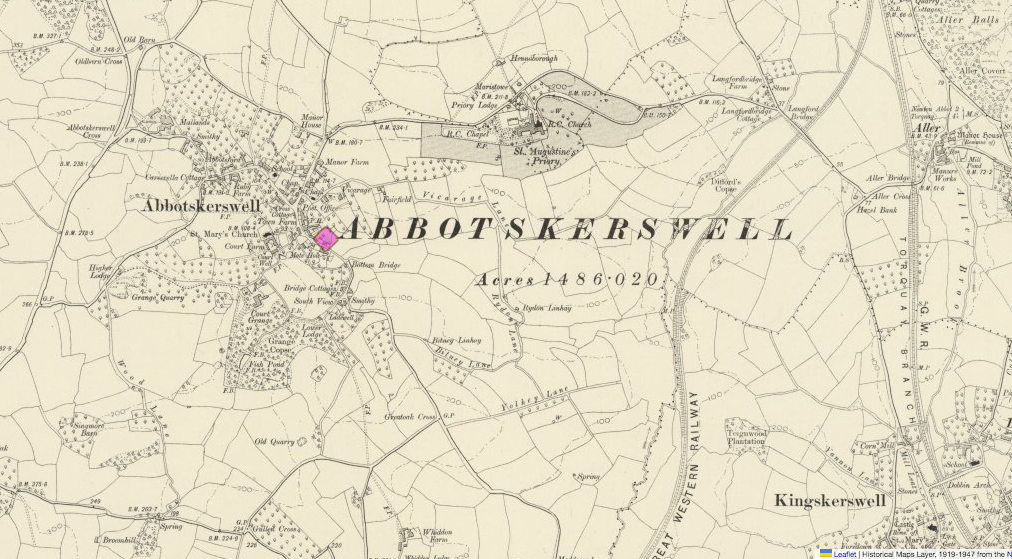
Map of Abbotskerswell.
John and Ann (née Brock’s) had six daughters but one, Eliza, died in infancy in 1837. The other five grew up in Abbotskerswell and Newton Abbot and were married in the Independent Chapel in Kingsteignton. The girls were well known in and around Kingsteignton and Newton Abbot in the 1860s and 1870s – and it is not always possible to distinguish which did what or attended any given event!
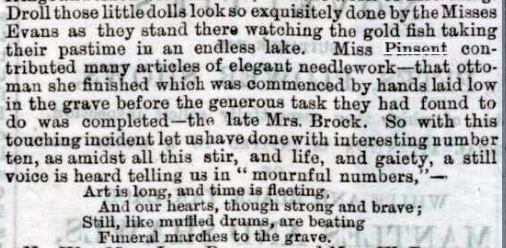
An unknown Miss Pinsent’s craftiness is memorialized in the newspaper. Western Times, May 26, 1865.
For instance, which “Miss Pinsent” was it that “contributed many articles of elegant needle work” at a Wesleyan Bazaar held in the Royal Public Rooms in Exeter in May 1865 (Western Times: Friday 26th May 1865)? Doubtless any one of them could have. Similarly, which was it that “kindly presided at the trays” at a Harvest Thanksgiving tea given to the locals at a chapel in Kingsteignton in November 1867 (Exeter and Plymouth Gazette: Friday 1st November 1867)? Also, which one of them served the tea at the testimonial celebration given to honour the Rev. R. W. Row on Good Friday in April 1870? We do know that the money collected to purchase a gold watch for him was “principally through the instrumentality of Mr. Pinsent of Were Barton” (Western Times: Friday 22nd April 1870)? This was probably the late John Pinsent’s son Gilbert Pinsent .
Anne married a dentist, Thomas John Hawkins Westall, in Newton Abbot, in 1876; Martha married a grocer, John Soudon Bridgman, from Torquay, in 1868; Emma Louisa married a farmer, Frederick Lewis Crabb, from Wellington in Somerset, in 1872; Mary Isobella married a draper, George Bowers Lansdale, from Newton Abbot in 1871 and Harriet Carlotta married a chemist, John Henry Bibbings, in Newton Abbot, in 1880. Their choice of chapel over church marriages almost certainly reflects the family’s Methodist leanings.
Please use the above links to explore this branch of the family tree. The default “Next” and “Previous” links below may lead to other unrelated branches.