Please use the above links to explore this branch of the family tree. The default “Next” and “Previous” links below may lead to other unrelated branches.
Please use the above links to explore this branch of the family tree. The default “Next” and “Previous” links below may lead to other unrelated branches.
Please use the above links to explore this branch of the family tree. The default “Next” and “Previous” links below may lead to other unrelated branches.
Please use the above links to explore this branch of the family tree. The default “Next” and “Previous” links below may lead to other unrelated branches.
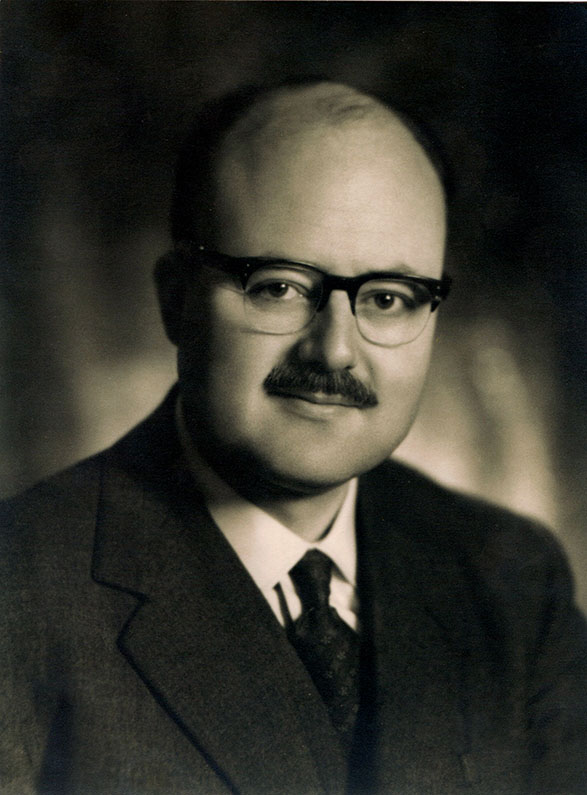
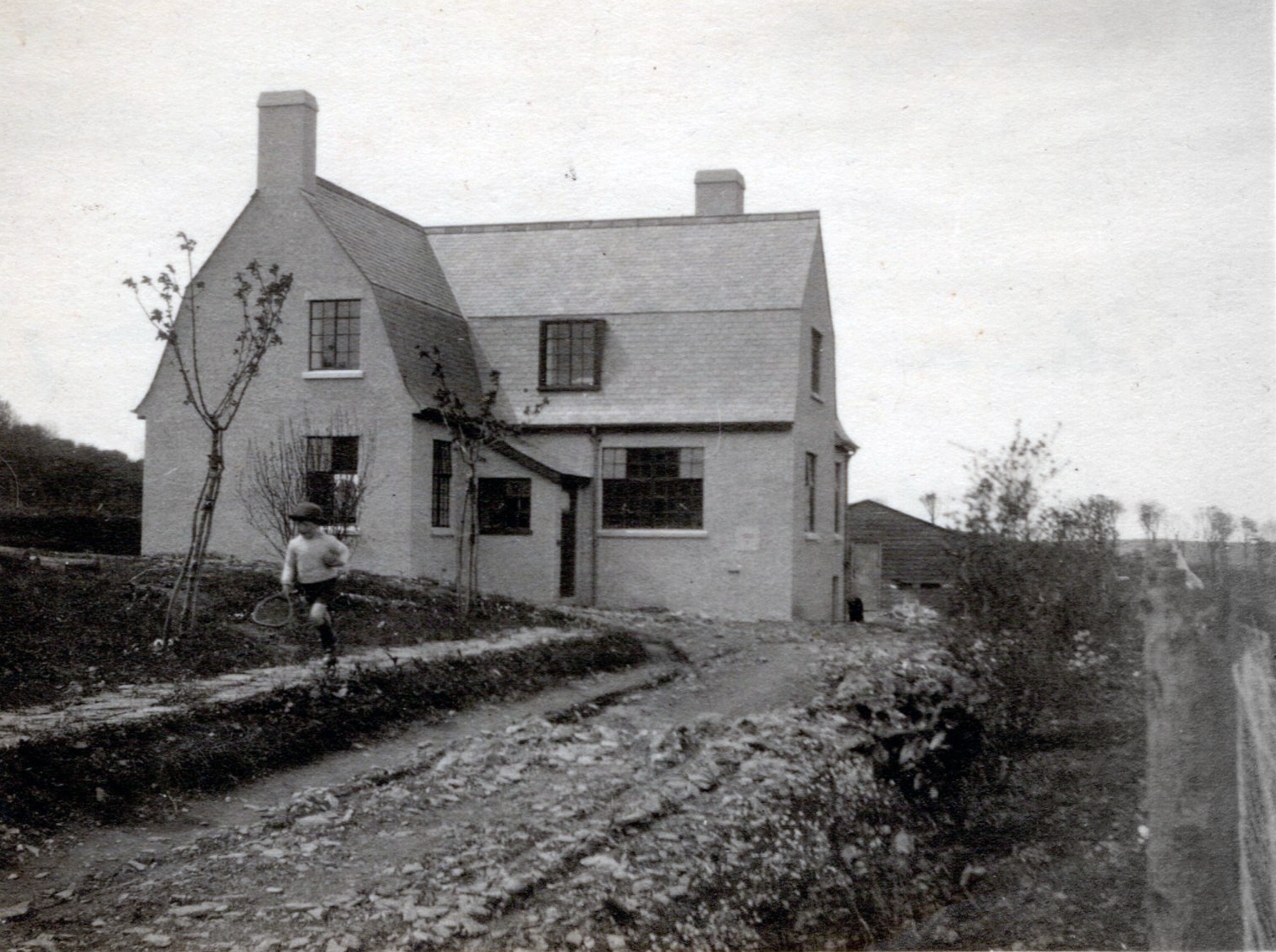
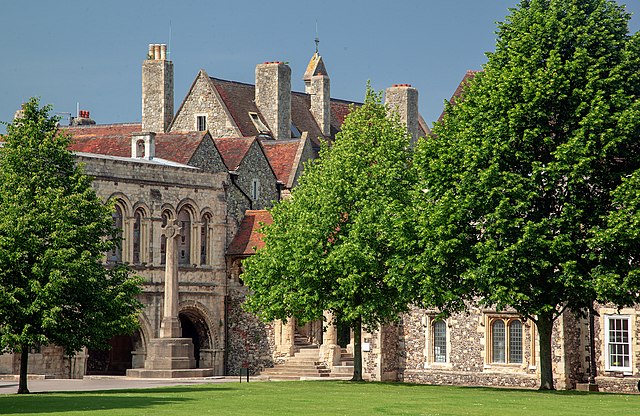
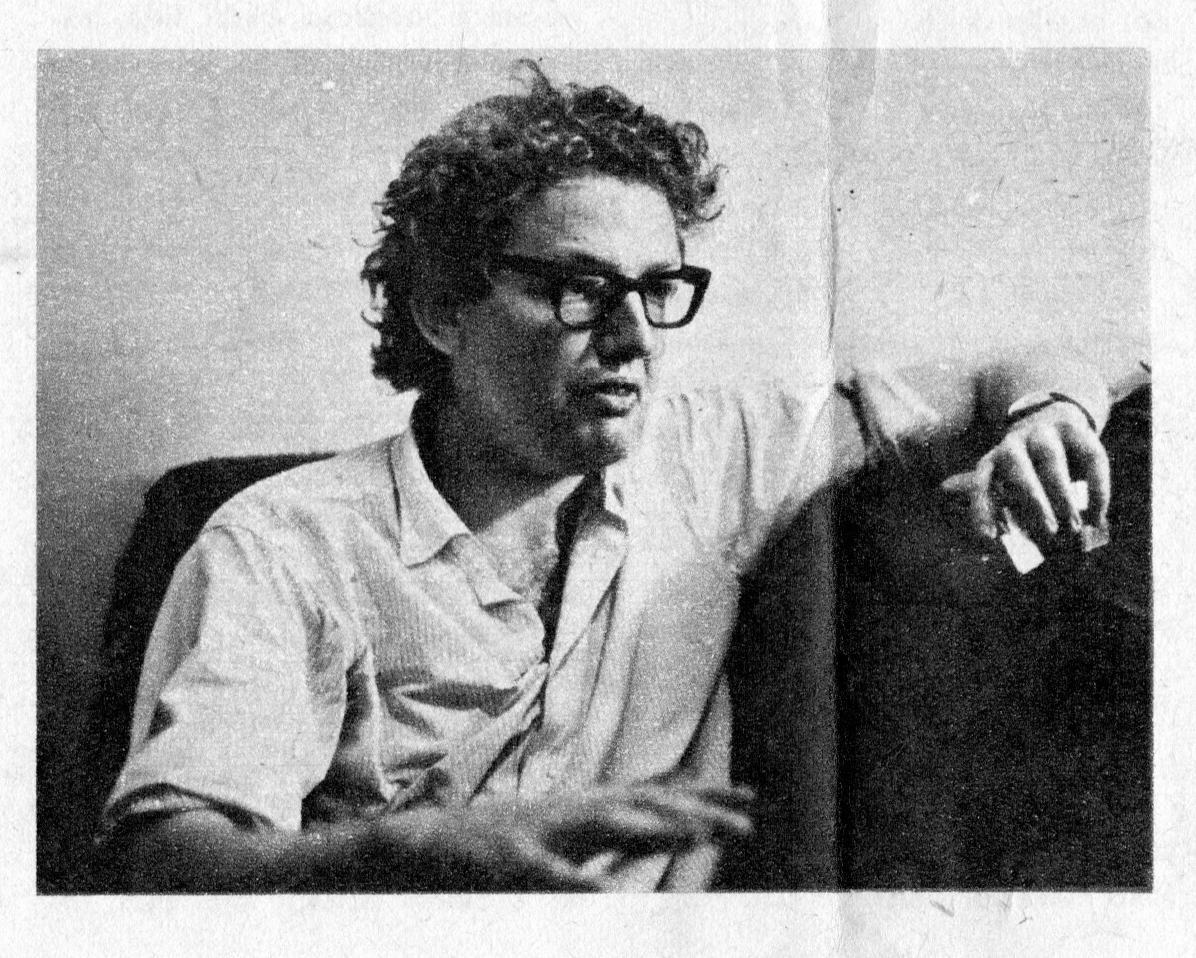
Robert John Francis Homfray Pinsent (“Robin”) was the only son of Francis Wingfield Homfray Pinsent by his first wife, Janet Frances Cowtan. He was born in Devon at “Hillsborough” in Horrabridge, in 1916, but grew up in a nearby house that his father built on the edge of Roborough Down in 1920. Robin helped to lay the foundation stone. He was educated at the “Dragon School” in Oxford and at the “Kings School Canterbury”, in Kent.
Young “Robin” runs along the wall outside Higherfield.
Robin was very much a country boy. He took a keen interest in natural history and wrote to the Western Morning News (5th May, 1933) to report his sighting of a swift. The following year, he won a silver medal for an essay he submitted to the “Royal Society for the Protection of Birds” (Dover Express: Friday 29th June 1934). In it, he described the preferred nesting sites of six species of bird. He did well at “Kings Canterbury;” although he does seem to have missed Devon, his dog and his pony. The latter was called “Someday” – as he had had to wait for it …
From “King’s,” Robin went up to “Selwyn College” in Cambridge to study medicine and to fish – he took his rods with him. The Cambridge correspondent of the “King’s School Canterbury Old Boys Association” wrote a letter to the Editor of the “Cantuarian,” (vol. 13 March 1933 – December 1934), and remarked that “R. J. F. H. Pinsent of Selwyn, enjoys the climate of Cambridge. Its general dampness and wetness is good for fishing”. The following year, the same sharp eyed correspondent reported seeing “this grand old sportsman returning home of an evening, tired but triumphant, after a single-handed encounter with a giant dace. He keeps the splendid victims of his rod in his rooms, neatly packed away in match boxes.” Perhaps this is a little unfair. Robin kept meticulous diaries in which he noted what he caught, when, where and how. The Western Morning News somehow learnt that he caught a 10 lb. salmon on the “Buckland Water” on the Tavy River, in Devon, in July 1937 (Western Morning News: Friday 16th July 1937). I doubt if you will find many of those there today. Robin was probably the “Mr. Pincent” who “brought home a nice brown trout of 3 lbs” from the Richmond Alms Hotel water in Banffshire in April 1938 (Banffshire Journal:
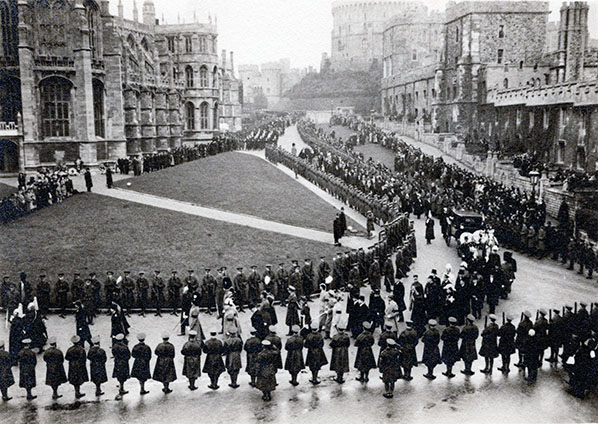
Robert and the Officer Training Corps stand at attention for King George V’s funeral.
Robin joined the signals section of the “Officers Training Corps” while he was at Cambridge – partly (I gather) because it enabled him to indulge in one of his other passions, riding. Robin was one of 150 Cambridge University “Officer Training Corps” cadets selected to line the route taken by King George V’s cortege as it passed through King Henry VIII gate into Windsor Castle on its way to the Chapel on 28th January 1936. He wrote home describing the event. In his letter, he included a photograph from the London Times and a couple of small sketches that certainly show he could draw. He was one of the cadets facing away from the camera “presenting arms” near the chapel entrance. I do not know which one! The Cambridge cadets were also involved in the celebration of King George VI’s Coronation, which took place in Westminster Abbey, in London, on 10th May 1937. On that occasion they camped out in Kensington Gardens. Again, Robin wrote to his parents describing the event.
Robin finished his training with a stint at “Charing Cross Hospital” in London. While he was there, he, perhaps fortuitously as it turned out, transferred his O.T.C. [Officers Training Corp.] membership to the “London Division” of the “Corps of Signals.” By doing so, the army listed his seniority as a 2nd Lieutenant from November 1936 – which was to become extremely important during the war. He had rank seniority over anyone who came later.
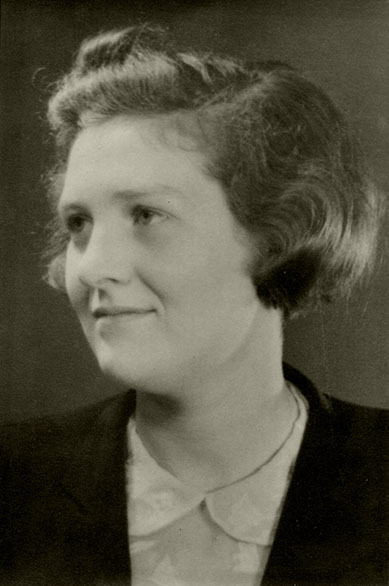
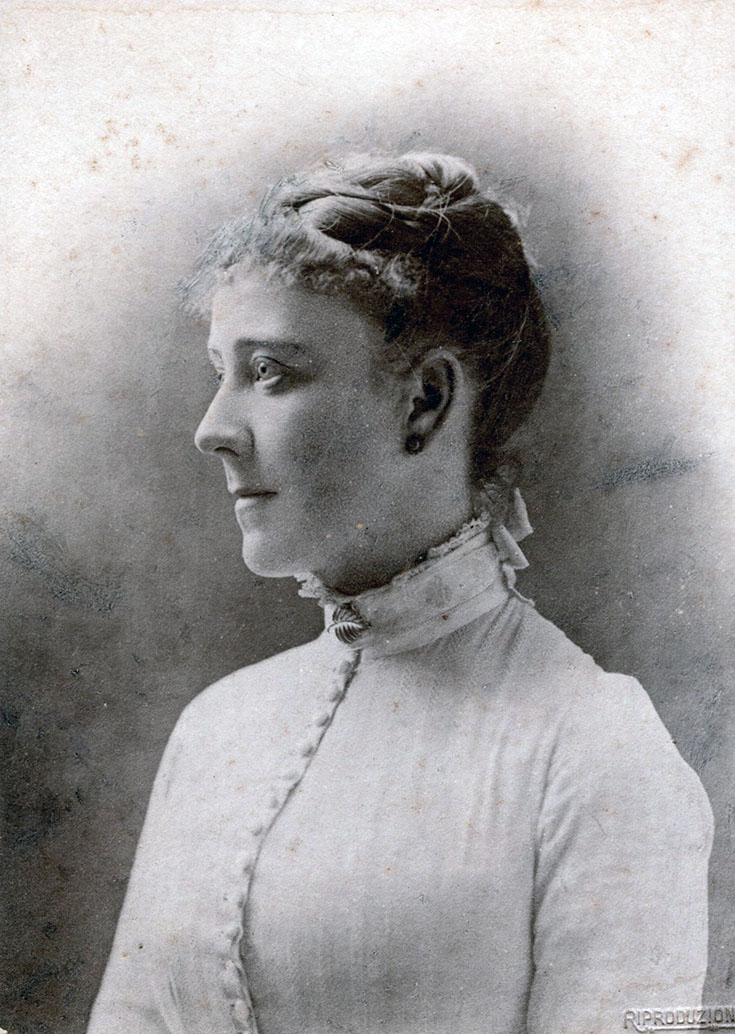
Ruth as a young woman.
Robin met Ruth McKechnie Morrison while he was living in London. She had graduated from her home-town university of St. Andrews, in Scotland, and come down to London to attend a “Secretarial College.” The war-time register compiled in 1939 shows that she was, by then, “Secretary to the Manager of Ascot Gas Water Heaters” – a firm based in Wembley.
Ruth and Robin were in London in September 1940 during the early days of the blitz. Writing home, Robin describes watching in awe from Hampstead Hill as the docks in East London burnt on the 7th September 1940. A few days later, he wrote home (from the safety of a bomb-shelter during an air raid) describing this, his 57th air raid, and the trouble he was having getting Ruth’s mother, Mrs. Morrison, on a train back to the safety of Scotland. He was disappointed that he had missed Churchill’s “threat of invasion” speech on the 11th September – in which every Englishman was exhorted “to do his duty.” Although still a student, he worked in the “Casualty Department” at Charing Cross, stitching up victims of bomb blasts. He marveled at their continued good humour.
In one of his letters, Robin relates meeting up with his uncle, Guy Homfray Pinsent and “Cousin Bob” – Robert Burton Pynsent (as distant relation who had met up with Robin’s family in the early 1900s after returning from New Zealand). Robin’s father Francis Wingfield Homfray Pinsent was newly arrived from Newfoundland. They were both colonials returned to the “mother country” and they both lived in Kensington. On another occasion, Robin, quite reasonably, explained to his parents how difficult it was to study for exams with formations of German bombers flying overhead and releasing their bombs.
Robin heard the same sound while at home in Devon too. In a short article in the “Yelverton and District Local History Society Newsletter” published in May 1986, he describes how he made it back to Horrabridge for a week of leave the following spring (1941) and arranged to go fishing with a friend along the Abbey Waters on the River Tavy. It was to be night-time fly-fishing for “peal” (a sea-run trout). Unfortunately, the night they chose was the 21st April 1941, the first night of the Plymouth blitz and the night of the “Buckland Bomb!”. When the searchlights came on (on the bank above them) their initial concern was that the light would scare the fish; however, their priorities changed when the first tracer bullets smacked into the water beside them as the Germans tried to extinguish the lights. They headed home. After the war, the fishing warden – who knew they were there – told my father that the locals in a nearby pub were convinced that his car (seen passing through Buckland) was being driven by a spy who was signaling to the Germans. The warden kept quiet!
Robin eventually transferred to a Hospital at Ashridge, near Berkhamstead and Ruth moved to Warwick, where she worked as a “Civil Servant” with the “Gas Board (?)” and also undertook “Warden” duty in the Castle. They married in the “Scotch National Church” in Westminster, in September 1941. Ruth quit her job in Warwick – as was the convention of the day – and returned to St. Andrews.
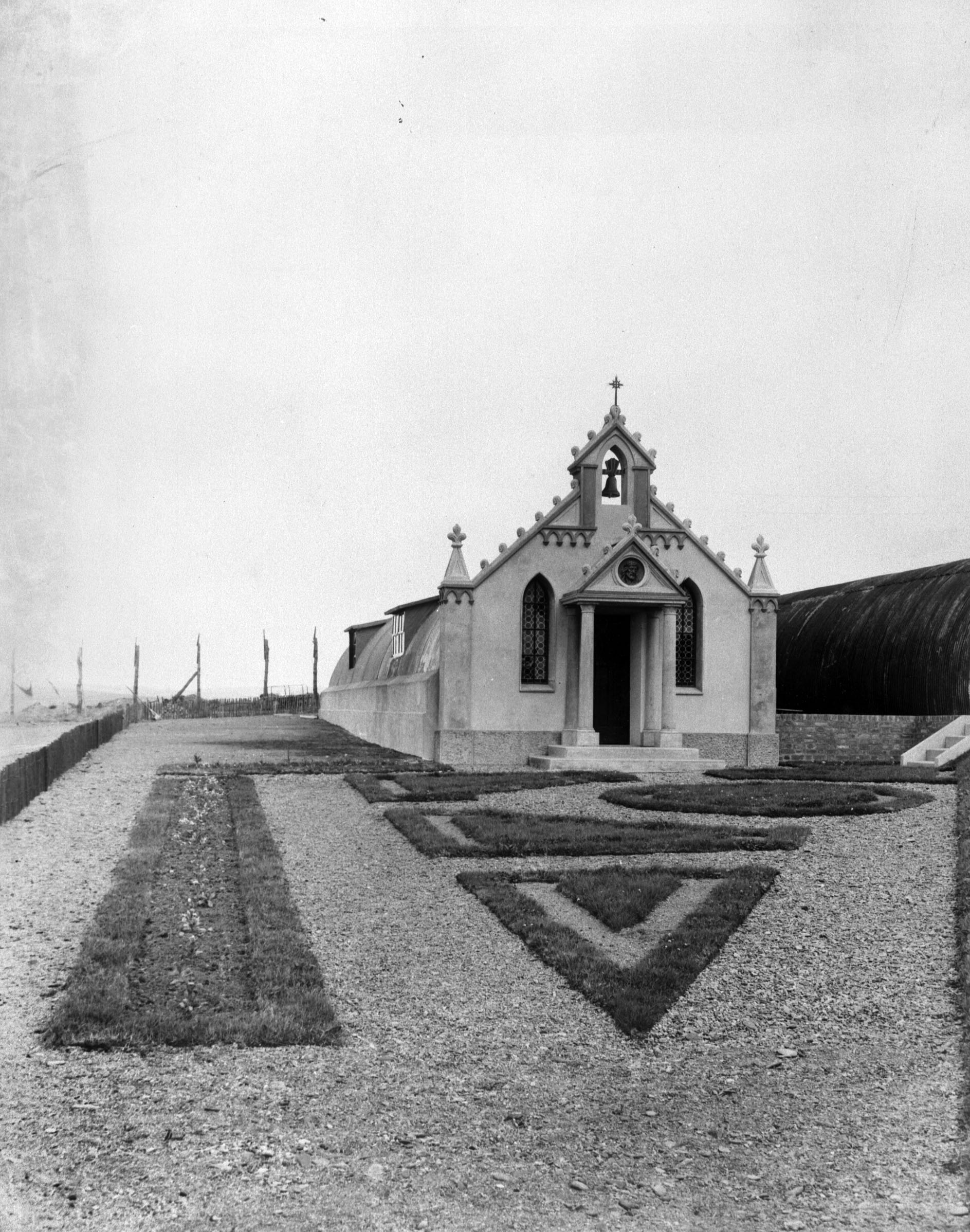
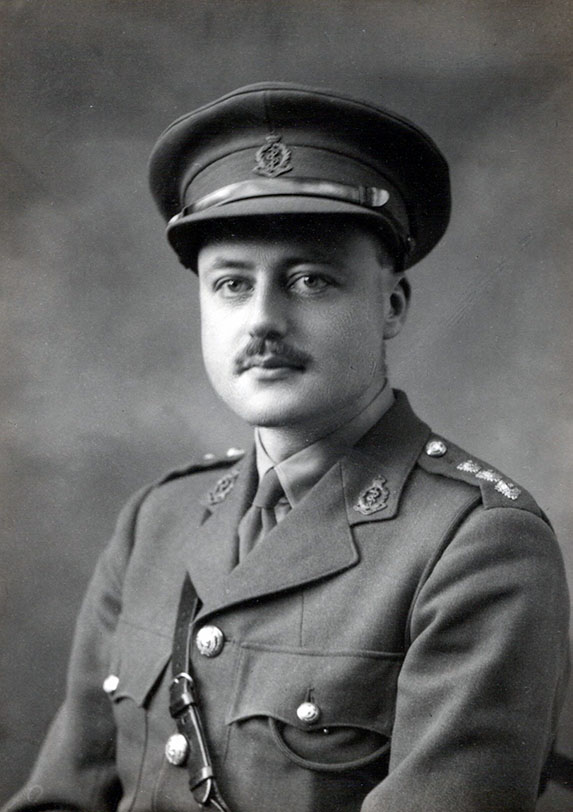
Robin graduated in October 1942 and transferred to the Royal Army Medical Corp. He was destined for India but failed the medical examination – as far as over-seas postings were concerned because of an eye complaint. He knew the Army would post him as far from home as they possibly could and, hearing he was from Devon, they somewhat predictably sent him to “Scottish Command” – which was fine with him as his wife was in St. Andrews. Robin had an early posting near Roscobie Loch, in Angus – not a bad spot for a fisherman – and then, after moving around, spent the later part of war in the Orkney Islands looking after Italians prisoners of war. They were there because there was no possibility of escape and they could be employed in building causeways (a.k.a. “Churchill Barriers”) between some of the smaller islands around the Royal Navy base at Scarpa Flow.
The Italian Chapel built by Italian prisoners of war, via Orkneyology.
While there, the Italians converted a Nissan hut on Lamb Holm Island into an ornate Roman Catholic Church. It is still there and much as it was, although it has been renovated. For my father, there was plenty of time for fishing and shooting, and for creatively adapting military service and medical supplies to the more immediate and practical needs of a fisherman.
Captain Robin Pinsent in his military uniform.
With Ruth back in St. Andrews, they were able to start their family during the war. Their two elder daughters and I were born in Scotland. When the war in Europe came to an end, Robin and many other home-based army doctors were transferred to Germany and (presumably) elsewhere to spell-off their counterparts who had seen active service. A letter that my mother Ruth received from Robin’s Aunt (Annie née March) in January 1946 mentions that “I hear you are now separated for a time. I suppose the wives do not accompany their husbands to Germany”.
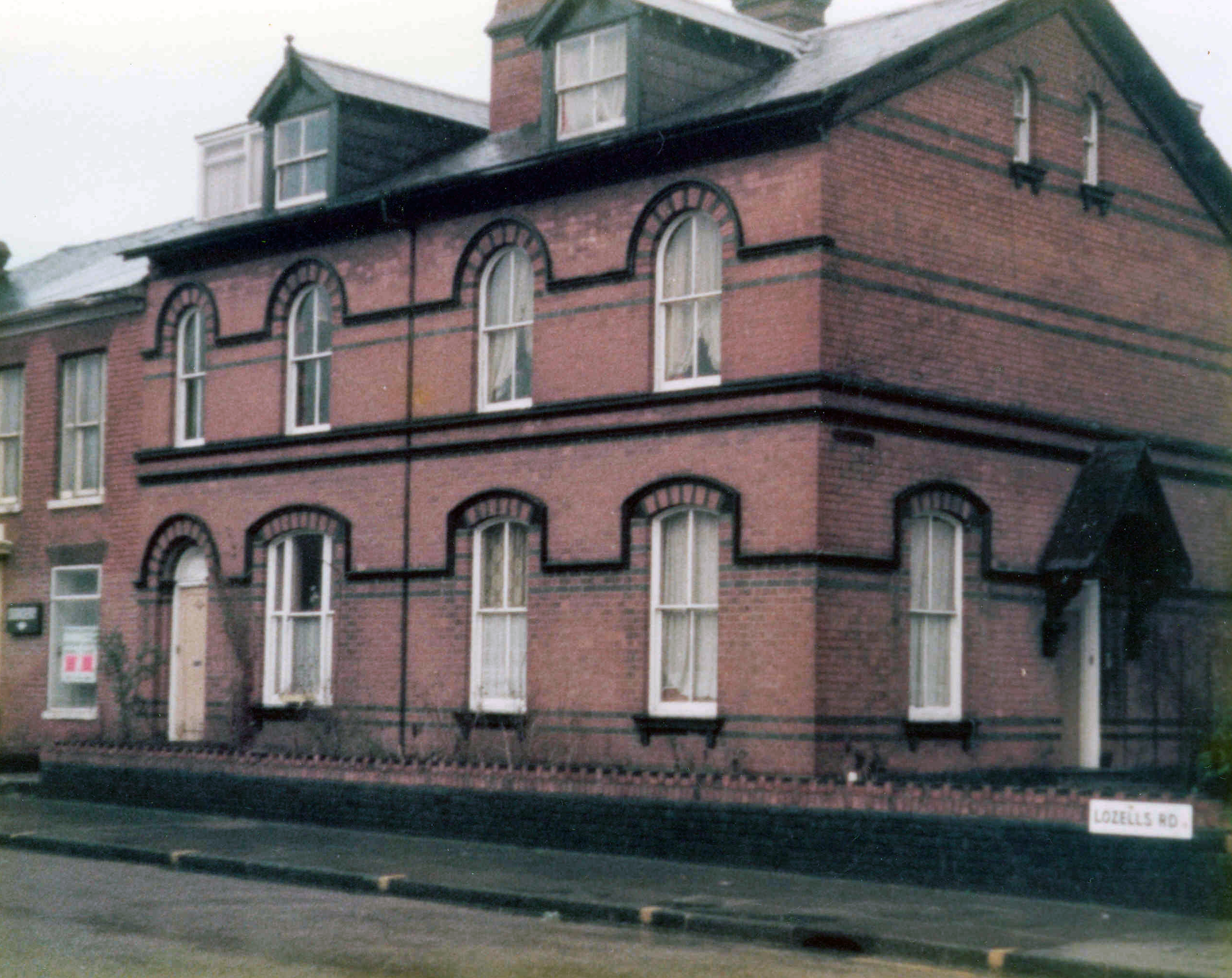
Robin wasn’t released from the army until 1947 – and, although he looked, he was unable to find the quiet country medical practice he had hoped for. Instead, he joined a practice on Lozells Road in Handsworth in Birmingham and brought Ruth and the family down to the midlands. It was an epic rail journey during which, to the acute embarrassment of my mother, at least one of her three children made unmistakable signs of having whooping cough! A fourth child was spared the journey. She was born in Birmingham.
Lozells Road in Birmingham.
In Birmingham, my father restructured his home-based medical practice from a “drop-in” system to a more efficient “appointment” and “telephone” based model. It still meant doing his rounds every morning and conducting morning and evening surgeries – to say nothing of welcoming babies into the world at two in the morning. Sometime later he was to float the idea of “Flying Nurses” as an alternative to having “general practitioners” make unnecessary house calls. He suggested a two-tier system whereby the nurses could contact a doctor by short-wave radio in the event of an emergency (Birmingham Mail: Saturday 19th September 1970). Two years later, he told the “Post” that “the demands on a doctor are getting so great that they have to be used selectively, and the present system of using them to deal with trivial emergencies is completely un-selective”. With Dr. Brian Peacock, of the Department of Engineering Production at Birmingham University, he, once again, proposed: “that flying quads of nurses and drivers using estate cars with facilities to take stretcher cases should be on call for emergencies. If the nurse thought a doctor was needed, one would be contacted through her radio link with a central control point” (Birmingham Daily Post: Tuesday 16th July 1972). The whole idea of “house calls” seems quaint these days.
After the war, Robin developed his own ideas on family practice and submitted them as a MD thesis at Cambridge in November 1948, a matter of months after the inauguration of the N.H.S. (National Health Service). He saw a need for better communication within the medical profession, and wrote letters to the editor of the “British Medical Journal” that were, on occasion, picked up by the local press. I don’t think I have ever had Bornholm’s disease (a chest infection); however, there was a lot of it around in the summer of 1951 (Evening Despatch: Saturday 3rd November 1951).
Robin had no love of routine paperwork. One of his early suggestions – aired in the “Lancet” medical journal – was for a redesign of the “National Insurance Certificate” to give it a tear-off “Notice to Informant” section for a legitimate patient to hand to his employer to account for his or her time off work. If the employer needed more, perhaps it should make a token payment (10 s 6d) for it. That, he thought, would help lessen the insatiable demand of employers for “weekly” notes. Apparently, the municipal authorities were the worst offenders – they asked for one if even one shift was missed (Birmingham Daily Post: 6th April 1951). This was an ongoing issue and he submitted a letter to the “Birmingham Medical Review” a year later complaining about the “Miserable Traffic” in doctor’s signatures: “Doctor” or “Clerk”? That was the question (Birmingham Daily Post: Thursday 24th March 1952). He estimated that a quarter of the patients who attended his surgery displayed no physical complaint but came for a signature to explain time off from work. As he said: “It is not unreasonable that a man who misses his work because of illness should not lose his pay or his job, or that the employer should ask for proof of the man’s illness before making up his pay. But how is a doctor to distinguish, after the event, between the man whose stomach was genuinely upset for a day and the man who went to a football match? If he has his suspicions and refuses to sign a certificate that man has been ill, he may lose his patient or do him a serious injustice and lose the man his job.” It is worth mentioning here that his practice included Villa Park – home of Aston Villa Football Club. He would have preferred to spend his time with legitimate patients.
He returned to the issue of time wastage and “unnecessary visits” made to receive “certificates” at a talk he gave to a “British Medical Association” Conference in Canterbury, in April 1961 (Nottingham Evening News: Saturday 15th April 1961). While there, he had a chance to revisit his old school (Kings School Canterbury) and check up on his son, yours truly, who had, for better or worse, been dropped off there the previous autumn.
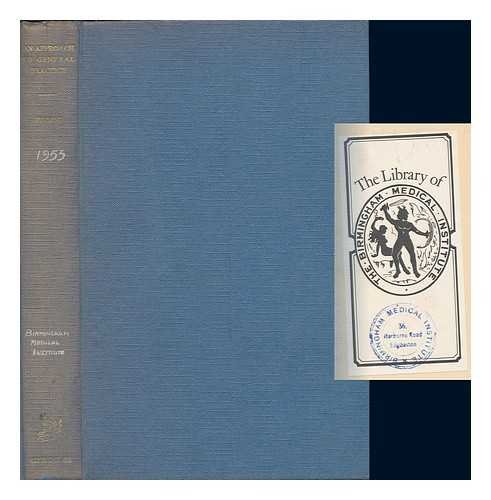
An Approach to General Practice, 1953.
Robin’s thesis emphasized the need for systematic note-taking and collective research within the profession. He later published his ideas in a book entitled “An Approach to General Practice” that was put out by Williams and Wilkins in 1953. One of the downsides of a home-based practice in those days was that the doctor’s wife, Ruth in his case, was inevitably tied to the telephone. On occasion, even the children were brought in to help out. I remember being co-opted to make up bandages during one of the practice’s mass polio vaccination campaigns.
Dr. Pinsent later integrated his practice with those of two of his neighbours, Dr. Laurie Pike and Dr. Roger Morgan and they built a joint family practice centered on Birchfield Road, in Handsworth, in the 1960s. It was looking for a clerical assistant in January 1974 (Birmingham Mail: Tuesday 22nd January 1974). Once the practice centre was up and running, Robin and Ruth felt able to move across town to Croftdown Road, in Harborne. They were there from 1970 (Birmingham Mail: Thursday 1st January 1970) until Robin achieved his longtime ambition of retiring back to Higherfield, in Devon.
In 1951, Drs. John (later, Lord) Hunt and Fraser Rose wrote a letter to the “British Medical Journal” and to the “Lancet” advocating for the formation of a “College of General Practitioners”. My father wrote a letter of support in the “Lancet” saying that “while 75 per cent of the country’s illness is handled by general practitioners, there is no co-ordinating machinery for making known the great learning acquired in that work” and that it was a “natural and inevitable evolution and development of general practice” (Birmingham Daily Post: Saturday 22nd December 1951). There was a positive response nationally, and, thanks to the efforts of a steering committee (of which my father was a member), it became a reality in November the following year.
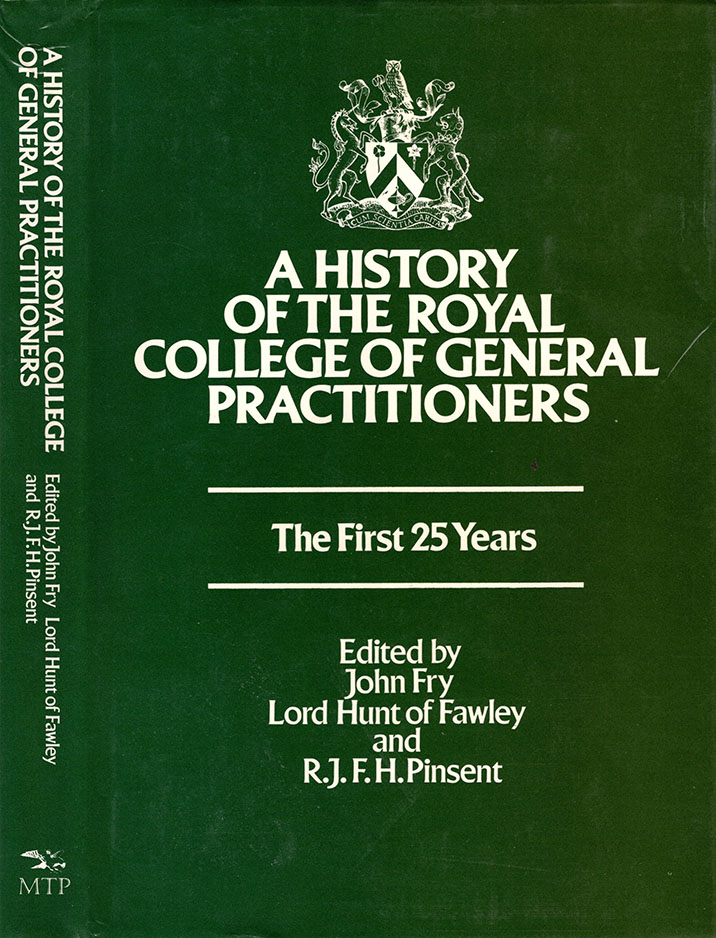
A History of the Royal College of General Practitioners: The First 25 Years, 1983.
Robin liked working with wood, and I remember him turning out the first college gavel on his lathe in the workshop. Sadly, he had little time for such distractions. He was invited to join the “Foundation Council” and he was appointed chair of its “Research Committee”. The latter held its first meeting on 23rd March in 1953. Robin was an active member of the college and his practice work was eventually subsumed into “college work.” The College was granted its Royal Charter in 1972 and he co-edited an early retrospective look at the “college” entitled of “A History of the Royal College of General Practitioners: The First 25 Years” with John Fry and Lord Hunt of Fawley. It waspublished in 1983.
Robin served on numerous ad hoc committees and, although he was more of a facilitator than a research scientist, he wrote articles on a wide range of conventional (flu epidemics etc.) and not so conventional (homeopathy) topics that were published in the journals of the day. He would sit in his chair with a clip-board on his knees and write and then glue together pages, creating rolled up scrolls that would have done his medieval fore-bears proud.
He was appointed “Research Advisor and Director” to the College and edited its “Research News Letters” until the “British Journal of General Practice” came into being and became its principal vehicle for professional papers. After working out of his home for many years, my father helped to set up a “Research Unit” at the Birmingham Regional Hospital Board headquarters, in Harborne with Dr. Donald Crombie. Perhaps inevitably, it outgrew out of the space available. Its value was eventually recognized and it received a sizable grant to assist it to find new quarters in 1972. It then went looking for £2 million for an endowment fund for, according to his colleague Dr. Watson, studying such issues as the waxing and waning of natural immunity to influenza and the long-term of effects of taking aspirin, tranquilizers and tobacco (Birmingham Daily Post: Friday 26th May 1972).
In December 1958, Robin and Ian Grant replied to an article in “The Times” that complained about the lack of visible progress in the study of morbidity. They responded by pointing out that the College had spent the last four years developing a universal classification system for disease and it was slowly figuring out how to report and process the information doctors obtained (The Times: Monday 22nd December 1958). “National Morbidity Surveys” were becoming a possibility by then, as communication was gradually improving and computers were increasingly able to handle large volumes of data – if the necessary funds were made available. The College had data from a Measles Survey conducted in 1955 but had no one to punch up the computer cards! Letters to the press were one way to reach the public and Robin caused quite a stir when he pointed out the teenage girls that wore “roll-on girdles” might find that they later had difficulty in childbirth (Daily News: Thursday 26th February 1959). This was too much for Mrs. Chettle from Nottingham, who wrote to say that she had worn them all her life and had no problem what so ever … (Daily News: Tuesday 3rd March 1959).
Robin encouraged education as well as research and suggested that the “Medical Recording Service” purchase a tape-recorder and experiment with recording talks for circulation. They later tried distributing gramophone records (Dr. J. Graves: Journal of the Royal College of General Practitioners: June 1977).
Later, as part of his developing interest in genealogy and family history, Robin set up a pilot project designed to look at causes of death in specific families using birth, marriage and death data collected and stored in the General Records Office in London since 1837. It was predicated on the idea that some families might be more susceptible to some forms of disease than others. The results were described the “Journal of Biosocial Sciences” in August 1970 (The Times: Tuesday 11th August 1970). Unfortunately, the limited size of the study meant that the results were inconclusive. However, by choosing to study his own family name, he obtained useful information for one of his hobbies!
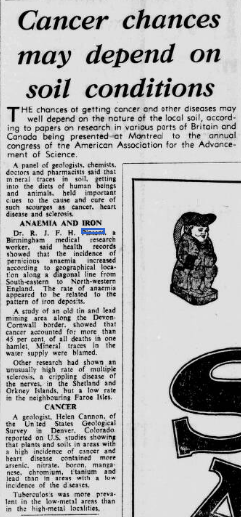
News article describing Robert’s work on cancer and soil conditions.
In 1964, Robin attended an “American Association for Advancement of Science” meeting in Montreal and gave a talk on some work he had done with Dr. Harry Warren of the Geology Department at the University of British Columbia, in Vancouver. The results showed that pernicious anaemia was prevalent in a swath of country extending from southeast to northwest of England that it correlated with low levels of iron in the soil overlying carbonate rich rocks (Nottingham Evening Post: Tuesday 29th December 1964).
Similar work showed that soils collected near old mine sites near the headwaters of tributaries to the Tamar River (between Devon and Cornwall) were frequently found to contain anomalously high levels of metallic trace elements – and that in at least one case it correlated with an above average incidence of death by cancer in a village downstream (Brandon Sun: 30th December 1964). It must have been about then that he tried to persuade doctors all over the world to grow lettuce from a stock seed, then reduce it to ash and check it for heavy metal content. He had clearly been talking to Harry Warren! Biogeochemistry is now a routine and recognized tool in mineral exploration.
The idea that the trace element content of soil was, perhaps, important did, eventually, take hold in the planning community; however, not without some resistance. Robin was called to give evidence at a inquiry into a proposed development at Beaumont Leys, near Leicester in 1971 (Leicester Daily Mercury: Tuesday 28th October 1971). Presumably it went ahead.
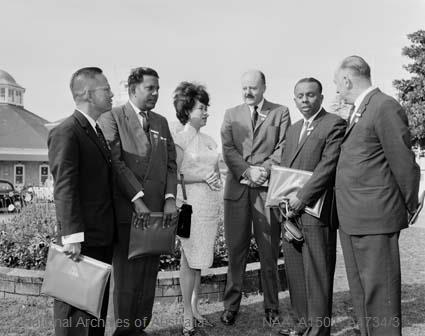
Robin, center, poses with doctors from around the world. Via the National Archives of Australia, NAA: A1501, A4734/3.
The College actively encouraged similar work by its over-seas affiliates in the United States, Canada, New Zealand and Australia. These independent bodies built on and added to the work done by the Royal College. In October 1963, Robin was appointed an Honorary Fellow of the “Royal Australian College of General Practitioners” and was invited to visit Australia. It was an opportunity for Robin and Ruth to travel abroad, something that they had only rarely had time to do while busy with work and family.
In 1968, Robin suffered a setback. He contracted cancer – probably at least in part from smoking a pipe while in the army – and he had his larynx (voice box) removed. Thereafter, he exhaled through a hole in his neck. What people thought when the saw puffs of water vapour emanating from it on cold winter days, I have no idea! Robin was required to learn a completely new way of speaking. It was a skill he mastered so well that most people were completely unaware of it – even when he was called upon to give speeches. Robin retired from medical practice in 1977 but maintained his connection with the College and assisted Sir John Hunt and Dr. Fry in editing the college history. He gave the “First Blackie Memorial Lecture,” (on homeopathy) in Edinburgh, in 1983.
Robin’s work for the College and the medical community was recognized. In 1970, Dr. R. J. F. H. Pinsent, M.R.C.S, L.R.C.P was awarded the O.B.E. (Order of the British Empire) in the New Year’s Honours (Birmingham Daily Post: Thursday 1st January 1970).
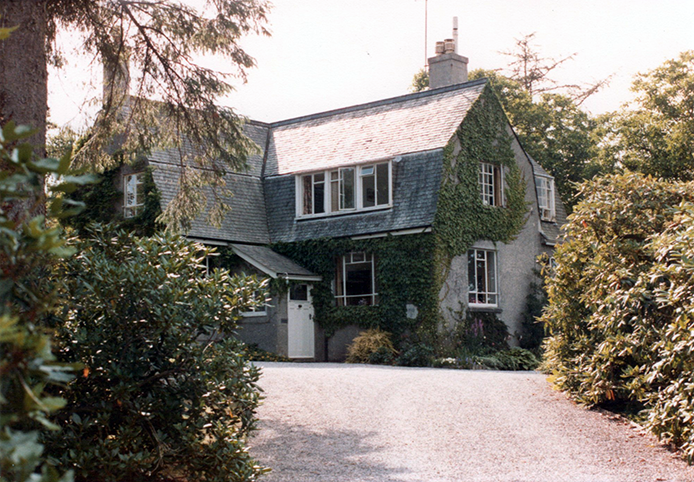
Higherfield, in a photo taken in the 1980s.
Throughout his time in Birmingham, Robin hankered to get back to his family home in Devon. His father had died in 1948 and “Higherfield” had been rented out since his stepmother Anne had returned to Switzerland in 1952. It was let to the Admiralty as a short-term billet for naval officers for a while, but the family was, occasionally, able to take a holiday there between leases. It was a constant source of regret to my father that the house was not being properly looked after. With all due respect to the Admiralty, a bullet hole in the mantle-piece and weed-killer in the kitchen garden did not go over very well! He regained control of the property in the early 1970s and started to convert it into the home he had always hoped it would be. Ruth and Robin officially retired there in 1977.
While living in Birmingham, Robin had had very little time for country pursuits but, now and again, he managed to get away for a few days with John Rundle, a friend from his youth. They caught six brown trout weighing 20lbs in two hours while fishing at Grantown on Spey in May 1950 (Sunday Post: Sunday May 28th, 1950). I am sure they were well documented in diaries. At other times, I remember seeing ducks hanging in the pantry.
Most of the fish he (or I) saw in those days lived in a collection of tanks in his surgery – some died when an electrical short led to a fire that caused one of the tanks to burst (Birmingham Daily Gazette: Tuesday 20th January 1953). Needless to say, the fire-brigade came to the rescue: “Half a dozen burly firemen in helmets and water-proofs crawled round the floor fishing in the puddles. Every few moments one of them would shout: “Here’s a another still alive!” (Evening Despatch: Monday 19th January 1953. A male sword-tail survived the experience of flapping around on the floor and lived on for years with a noticeably broken tail. Robin had developed a particularly impressive line in lace-tail guppies.
Back in Devon, Robin renewed his contacts and resumed his life-long passion for fishing – albeit from the shore as, given his laryngectomy, it would have been foolhardy to fish from a boat. He went back to keeping fishing diaries – a practice he had started in 1936. I hoped they would contain insight into his life during the war. Sadly, they are singularly lacking in contemporary colour. Most entries are limited to what, when, where and with what. Great for a fisherman but not so useful for a family historian. Nevertheless, to make up for this, he wrote a series of five articles entitled “The Making of a Fisherman”, “The Return Begins”,“The Remaking of a Fisherman”, “Natural History” and “Return to Fly-dressing” in the early 1980s. I doubt if they were ever published. They describe his introduction to fishing (tickling trout in a brook near Sheepstor) and his subsequent growth as a fisherman. As his friend John Rundle pointed out, by the time he retired a lot had changed since he had fished during the war.
These articles are reminiscent of ones written by his father Francis Wingfield Homfray Pinsent on hunting, his uncle Robert John Ferrier Homfray Pinsent on a failed logging venture and his grandmother on fishing in Newfoundland. She had articles published in “The Field” magazine in 1890 and 1892. Robin’s grandfather, Sir Robert John Pinsent, wrote learned articles about the “French Fishery Question” and on a somewhat lighter note on a court circuit he made dispensing justice in the out-ports of Newfoundland in 1892. I do not know if the latter was ever published.
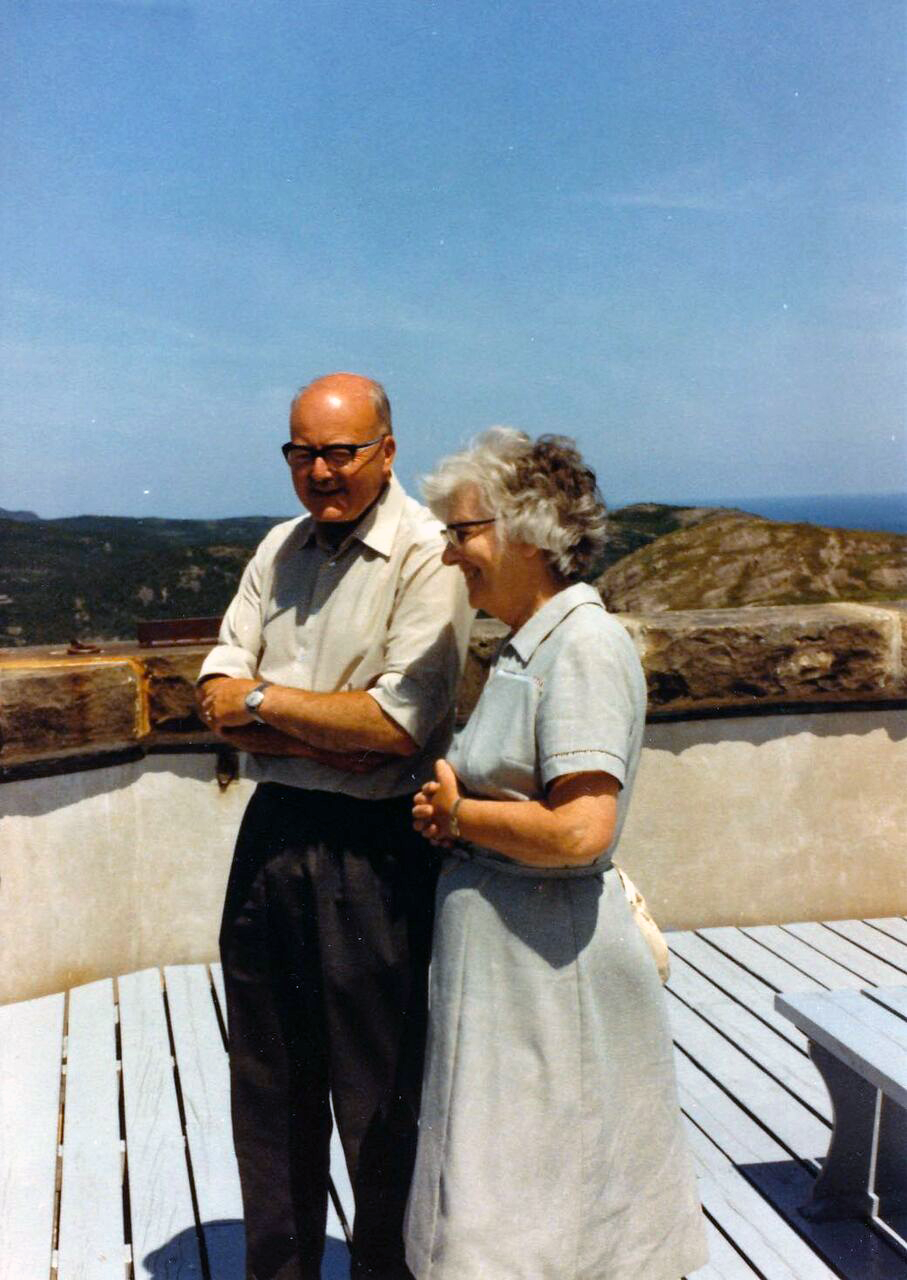
Robin and Ruth stand in the sun.
“Higherfield,” being the house and home it was, became a magnet for the family and Ruth and Robin probably saw more of their growing family there than they would have had they stayed in Birmingham. Ruth stayed on at “Higherfield” for a couple of years after Robin’s death in 1987 and then moved back to the Midlands, to live out the rest of her life beside her eldest daughter. Ruth and Robin had four children all of whom are alive today. His daughters married and have families living in England and Scotland, and his son has his own family here in Vancouver, in British Columbia, Canada.
In the late 1950s, Joey Smallwood, the then Premier of the Province of Newfoundland in Canada, wrote to Robin’s Uncle Guy to ask for information on Guy’s father, Sir Robert John Pinsent. It was for an “Encyclopaedia of Newfoundland” that he was then working on. This triggered my father’s interest in genealogy and he set about compiling information for the definitive family history. He was a generation too early but he made a start.
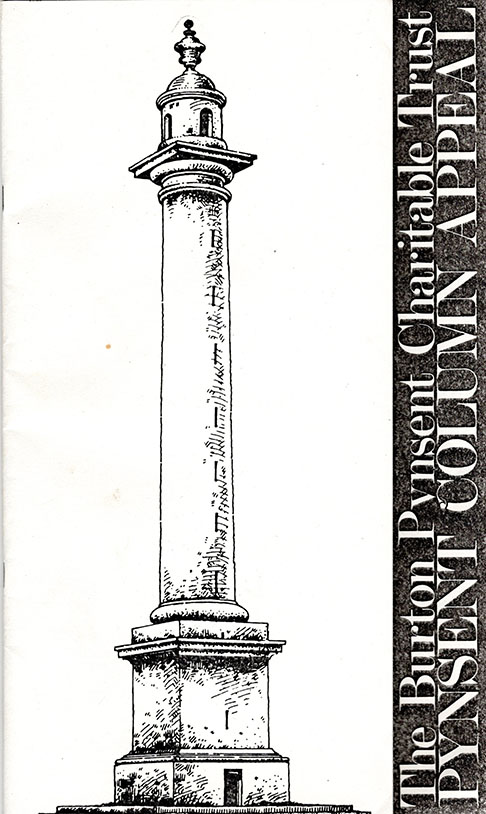
A pamphlet created for the Pynsent Column Appeal.
Robin, his uncle Guy Homfray and a distant “Cousin”John Pinsent (Dr. John Pinsent, “Lecturer in Classics” at the University of Liverpool – who was a descendant of Gilbert Pinsent) – compiled a considerable amount of birth, marriage, death and general anecdotal data over the years. Robin wrote to numerous co-lateral Pinsents and Pynsents and quietly worked behind the scenes on the campaign that was started in the 1980s to find the funds needed to repair the Burton Steeple in Somerset – a monument to Sir William Pynsent. Finding himself without heirs in 1765, this elderly baronet passed his not inconsiderable estate to William Pitt, Earl of Chatham – who built the monument to acknowledge the bequest! The repair work was completed in the 1990s. In retirement, Robin helped catalogue material archived at the Plymouth and West Devon Records Office.
My father took me to Hennock to see the parish registers in 1962 and the Rector allowed us to examine them on his dining room table. This sparked my interest and ensured that the project continued after my father’s death. This current work is truly a family effort.
Please use the above links to explore this branch of the family tree. The default “Next” and “Previous” links below may lead to other unrelated branches.
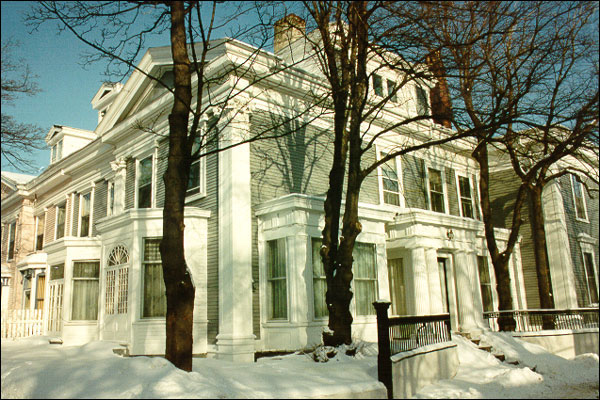
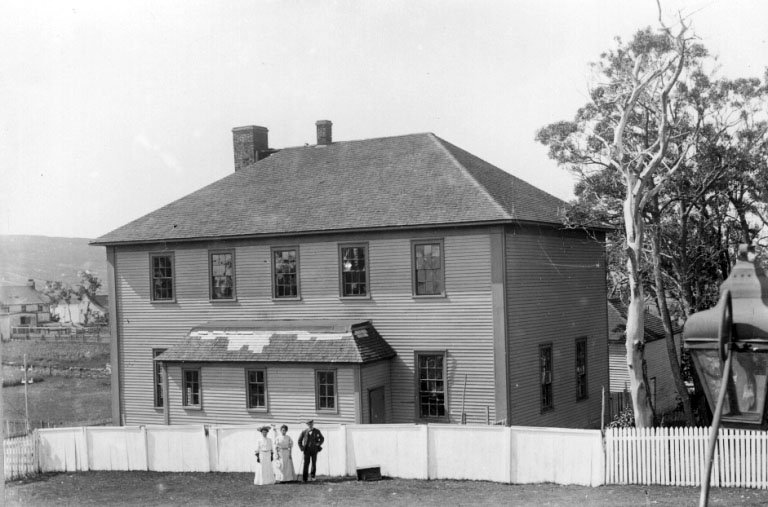
Devon Place, 3 Forest Road, St. John’s via Heritage Newfoundland & Labrador.
Robert John Ferrier Homfray Pinsent was the eldest son of Robert John Pinsent (a senior barrister and Queen’s Counsel in Newfoundland) by his second wife, Emily Hetty Sabine (née Homfray). His father’s first marriage, to Anna Brown (née Cooke), had ended in divorce in 1870 and Robert John had assumed responsibility for the maintenance and education of their five then living children (Lucretia Ann Maude, Louisa Catherine, Robert Hedley Vicars, Charles Augustus Maxwell and Arthur Newman Pinsent) – all of whom are discussed elsewhere. They were still quite young at the time – between the ages of 3 and 14 years.
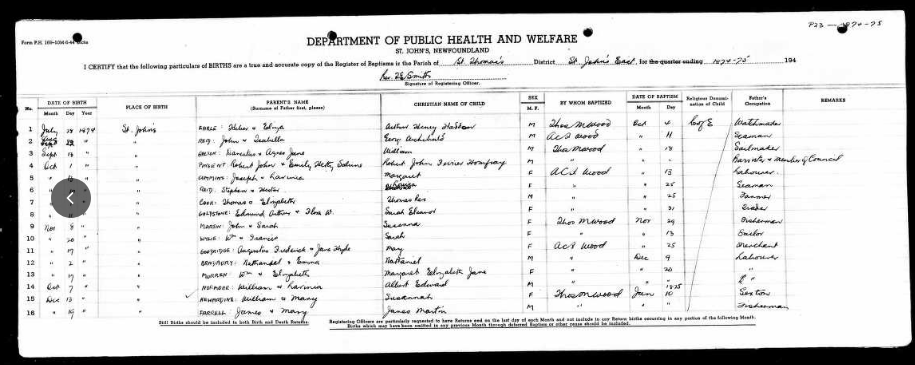
Robert Pinsent’s birth noted in the Department of Public Health and Welfare records.
Robert was the second of five surviving children (Mabel Louisa Homfray, Robert John Ferrier Homfray, Francis Wingfield Homfray, Beatrice Mary Homfray and Guy Homfray Pinsent) from the second marriage.
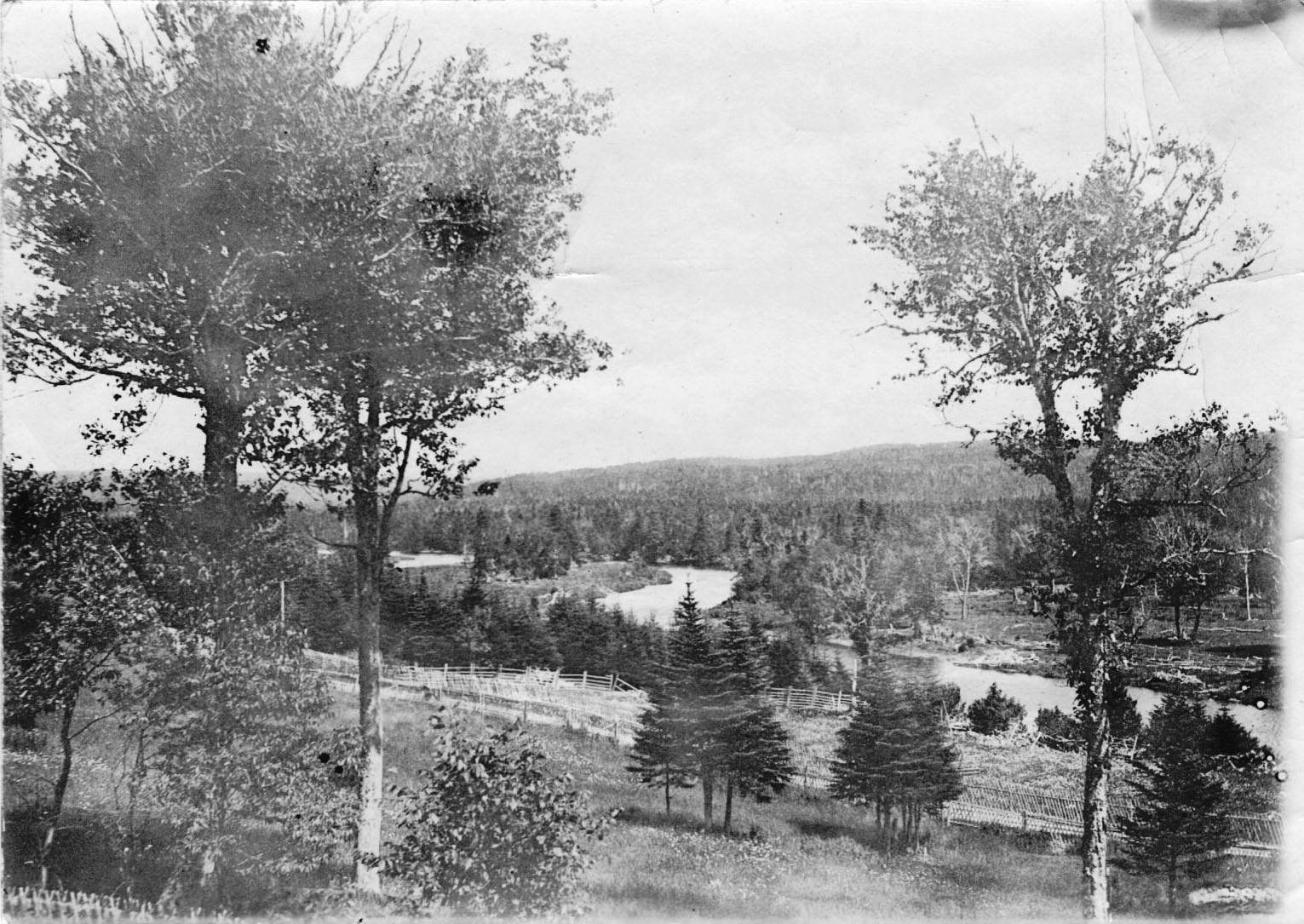
Salmonier River at Woodlands, Newfoundland.
He grew up in St. John’s and at Salmonier in Newfoundland in a decidedly blended family that was dominated by the children from the first marriage. Interestingly, the family already had a child named Robert when Robert John Ferrier Homfray was born – which shows considerable devotion to the name that I, three generations later, now bear. Conveniently, Robert Hedley Vicars Pinsent was universally known as “Hedley,” so confusion was averted. He died in 1888, which eliminated the problem. Robert John Ferrier Homfray Pinsent went by “R. H. Pinsent.”
Robert John and Emily took some of their boys (Charles, Arthur, Robert and Francis) to England on the S.S. “Nova Scotian” in December 1877. Doubtless that was to see family but it may also have been to take the older children to school. I cannot speak for all of them but some of older ones (from the first marriage) certainly spent time there – as did some the younger ones from the second. Emily came from Bintry in Norfolk and it is interesting to note that she advertised in Newfoundland behalf of a school in East Dereham in Norfolk: “Board and good Education in a pleasant part of England is offered to a few young ladies; every advantage and comfort; terms moderate. Reference is kindly permitted to Lady Pinsent, also to Mrs. John Tessier, St. John’s, Newfoundland” (Evening Telegram: 6th July 1891). Perhaps some of her children had gone there.
Robert writing in The Field, October 13, 1894.
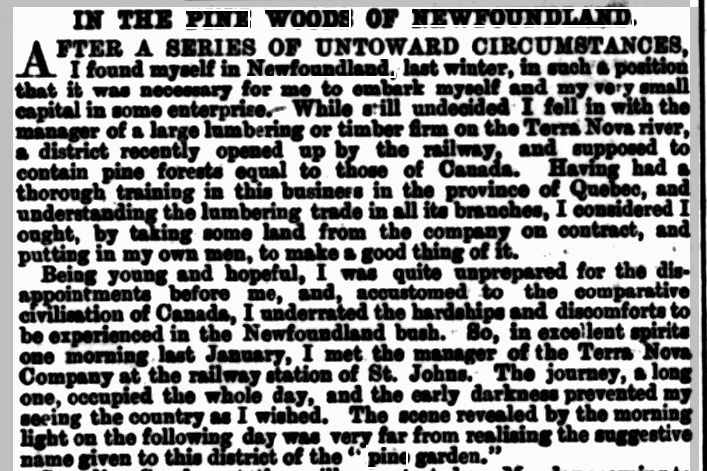
Robert was 19 years old when his father died and, according to one of Sir Robert’s obituaries, he was then “engaged in the lumbering industry on the St. Lawrence” (The Daily Tribune: Saturday 20th May 1893). How long he had been there, I do not know but it can not have been very long. Nevertheless, he felt confident enough to branch out on his own. He went searching for lumber in Newfoundland. His venture failed but he wrote about it anyway and had an article (entitled “In the Pine Woods of Newfoundland”) published in “The Field” magazine (The Field: Saturday 13th October 1894). It was later reprinted in an unidentified Newfoundland newspaper and Lady Pinsent kept a cutting of it with her papers.
In those days, Canadian and Newfoundland lumber mills were fed by trees felled and brought to them by private contractors who worked through the winter and used horses to sled the logs to the nearest navigable river. The logs were floated down river to the mill when the ice went out the following spring. In the early 1890s, Canadian Companies were looking for new sources of pine and the Terra Nova Company had set up a mill on the Terra Nova River north of St. John’s. The company was looking for contractors to supply the mill and Robert decided to try his luck. First, he had to find a suitable stand of pine. He went “cruising” (as it is called) up the Terra Nova River and after much searching located a likely stand that seemed to extend for some considerable distance back from the river. It had taken longer than he hoped and he (foolishly as it turns out) headed home before properly checking it out. He knew that he had to arrange for a crew and supplies for a logging camp and set them to work as fast as he could.
The winter was getting on and the weather had changed by the time he returned with men, materiel and a horse and he found his progress severely hampered by warm weather – which softened the snow and ice. It was the last thing he needed! Nevertheless, he eventually got his camp installed and started work – only to find to his horror that the stand of trees he was cutting was much smaller than he had thought and it would not pay his costs. He had to find more. He explored up river and did, eventually, find a better block; however, it was too late in the season to move camp and the new site would have to wait until the next season. In the meantime, he had to move his camp back to the mill through the wet snow and slush. It was a trial in itself. Sadly, he had failed to make his fortune and he moved back to Montreal.
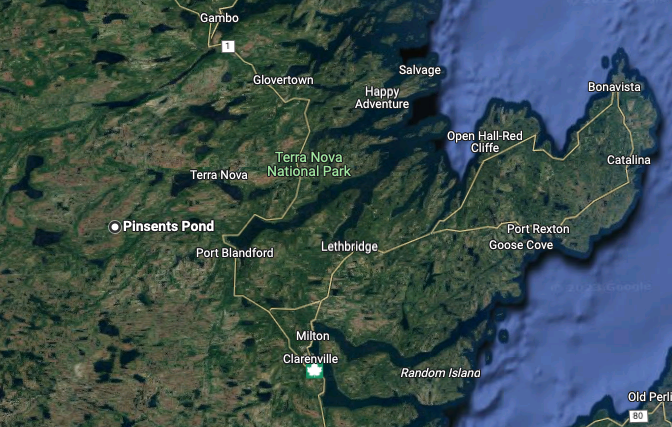
Google Map extract showing Pinsents Pond near Port Blandford and Terra Nova National Park.
It is interesting to note that the Terra Nova River flows to the northeast into Bonavista Bay and there is a lake approximately 50 kilometres up-river from Terra Nova National Park and the coastal community of Charlottetown called “Pinsent’s Pond.” This may hark back to Robert’s venture; however, several generations of unrelated “Pinsents” have logged in this part of the world in more recent times, so it is not necessarily a reflection of his time there.
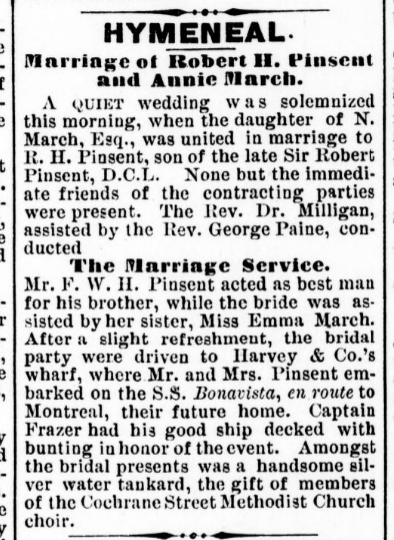
An excerpt taken from the Evening Telegram, May 18, 1896, about the marriage of Robert Pinsent and Annie March.
Robert John Ferrier Homfray Pinsent married Annie March in St. John’s in May 1896. He was working in Montreal at the time and he came back for the wedding on the S.S. “Bonavista,” arriving on the 16th May – having dodged the icebergs in the St. Lawrence. The onboard staff knew of his upcoming marriage and “The ship’s saloon has been done up in first-class style by the steward, Mr. Rankin” (Evening Telegram: 16th May 1896). The ceremony itself was a quiet affair: “None but the immediate friends of the contracting parties were present.” There were at least a couple of reasons for this – firstly the colony was still reeling from the effects of the financial crisis that occurred a couple of year earlier, and secondly it was an inter-faith marriage. Robert belonged to the Church of England and Annie was a Methodist, and a committed member of the Cochrane Street Methodist Church Choir. The latter had clubbed together to give her a “handsome silver water tankard’. They resolved the problem by having the ceremony performed in the bride’s home. Robert’s brother Francis served as “best man.” After the wedding, the happy couple were returned to Harvey & Co.’s wharf and embarked on the “S.S. Bonavista” for the voyage back to Montreal. The ship (which was gaily decorated) left that afternoon – but returned soon afterwards “owing to fog and ice” (Evening Telegram: 18th May 1896). They finally got back to Montreal they took up residence on Hutchinson Street.
Robert contracted tuberculosis while in Montreal and, after suffering there for several months in 1897, he returned to St. John’s to recuperate. His mother was in England at the time and his half-brother Charles Augustus Maxwell Pinsent (who had married in January 1897) controlled the family’s country house, called “Woodlands,” by the Salmonier river. Robert had grown up at “Woodlands” and he and Annie went there to recuperate. Unfortunately, the initial visit did not go well. Charles came to see them and seemed to resent them being there.
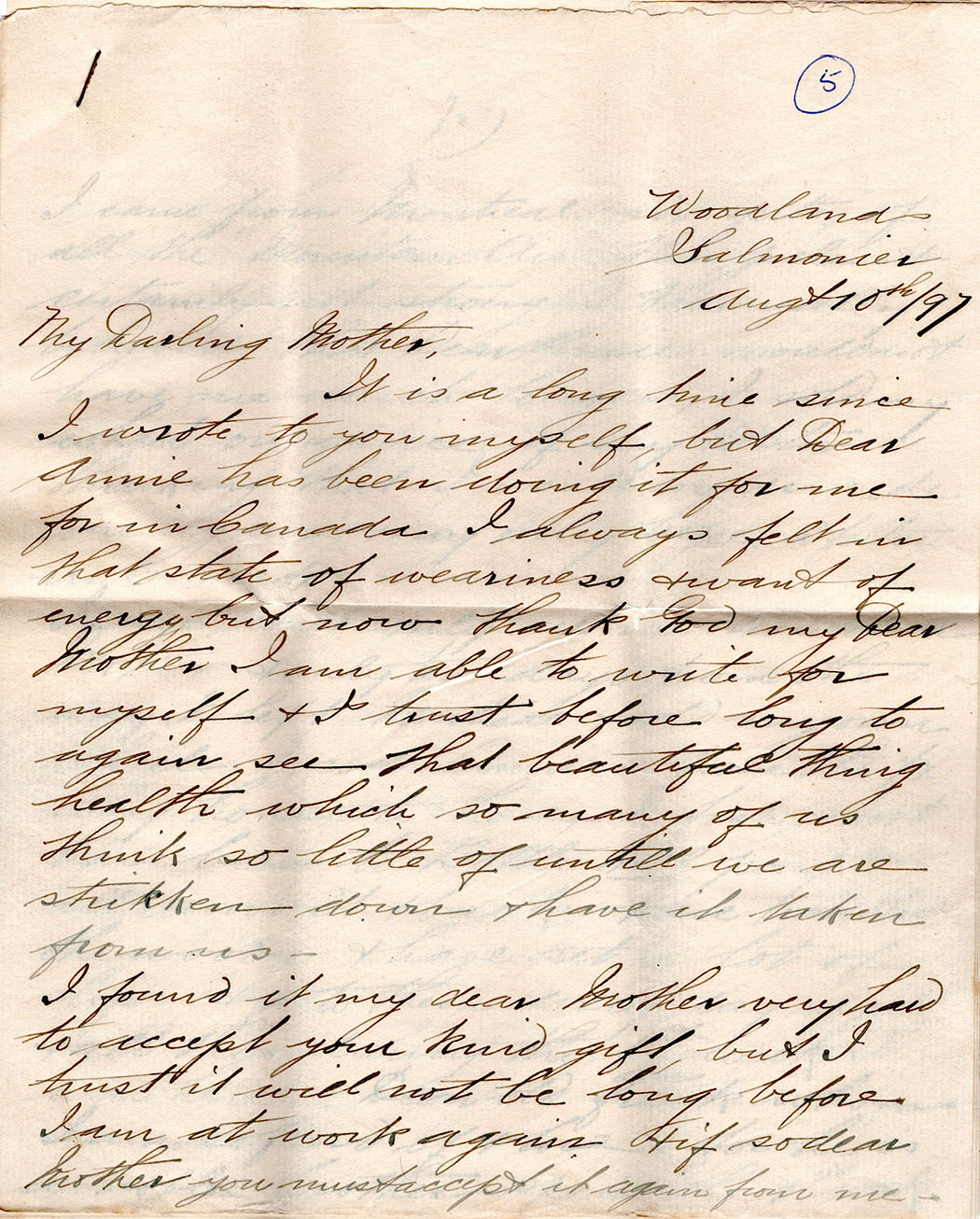
Robert writes to his mother Emily. August 1897.
Robert wrote a letter to Lady Pinsent on 10th August. In it, he expressed his relief at seeing some improvement in his health and his disgust at the state of the family home: “Poor old Salmonier is but a rag of what it was, & I assure you the way the house is stripped will make a great difference in the price far above the value of what is taken from it & make the sale of the place very difficult.” He was also hurt by the fact that Charles had told Frank (“Dear old Frank”)“that he did not want me to touch one iota on the place – which I think a very unkind & unmanly insinuation to a brother in my place – who six weeks ago hardly knew if he would live to see him.” He had hoped to hunt and fish – as he had in his youth – but Charles refused to let him use his rifle and he “ask me to favour him by accepting no favour from Mrs. Carew, etc., who I may add has been very kind, brings in my parcels, sends us lettuce, butter & eggs, and the use of their boat at any time. I can hardly then, when I want friends especially, sacrifice friends like this for a whim of C’s.” Robert told his mother that his firm had been good to him; however, money was tight and Annie was looking for work as a schoolmistress in St. John’s. It was a difficult time.
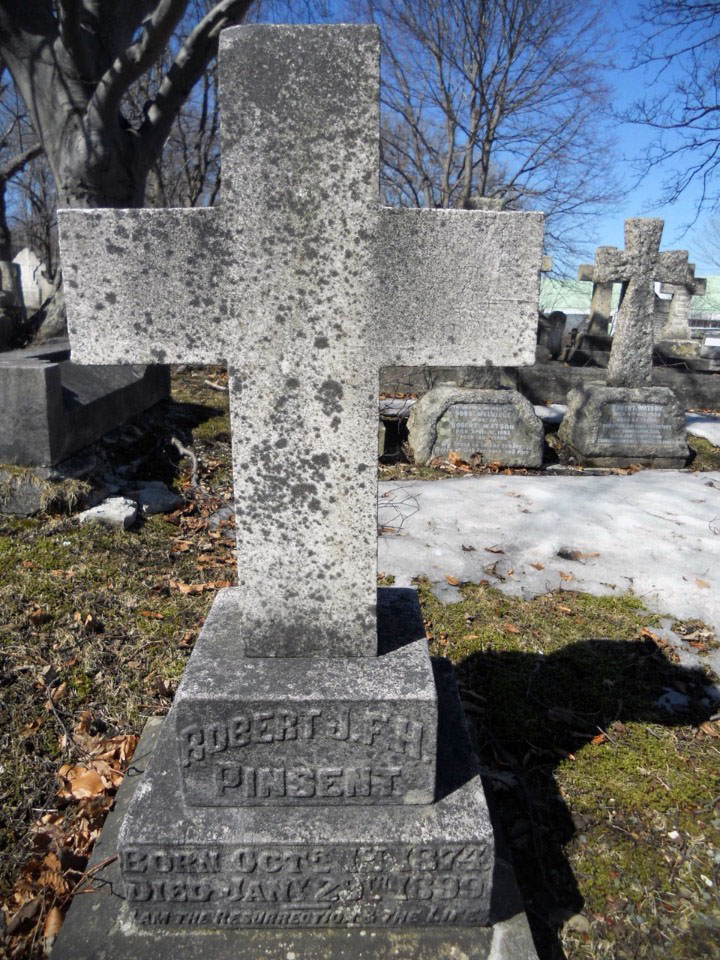
Robert Pinsent’s headstone, 1899.
Sadly, Robert John Ferrier Homfray Pinsent never fully recovered. He lived on Logy Bay Road in St. John’s and tried this hand as a “commission merchant” (McAlpine’s 1898 Directory, St. John’s) for as long as he could. He died of consumption in January 1899 and was buried in Forest Road Cemetery in St. John’s, near to where his uncle Charles Speare Pinsent and his wife Blanche would later be buried. Robert was only twenty-four years old. He had been married for less than three years and he had no children. His widow, “Mrs. R. H. Pinsent” auctioned off part of the couple’s household furniture on Le Marchant Road a short time later (Evening Herald: Wednesday 8th February 1899) and went back to live with her family.
Annie (née March) was twenty-four years old when her husband died but she never remarried. Presumably, she found work teaching in St. John’s and rejoined the Cochrane Street Methodist community. She became interested in its missionary work and attended the First Convention of the “Women’s Missionary Society” when it was held in Newfoundland in 1902 (Evening Telegram: 16th May 1902). In October the following year, she was accepted for Missionary training in Ontario (The Globe (Toronto), 31st October 1903). One of Lady Pinsent’s (un-named and undated) newspaper clippings describes her departing for Toronto with the blessing “her co-workers in the Sunday School and choir of Cochrane Street Methodist Church.”
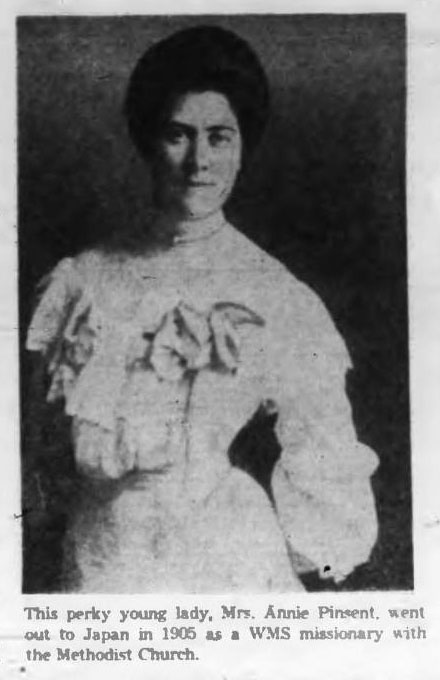
Anne March, a “perky young lady, is profiled in the newspaper for her trip to Japan.
Meanwhile, an article on Cochrane Street Church in the “Newfoundland Quarterly, July 1905,” proudly states that Mrs. A. Pinsent, who was one of their own, was to leave for Japan in August as a missionary in the field. They were right in this as The Winnipeg Free Press noted her passage (presumably by rail) heading west on 11th August. This was a big step for her; however she seemed to thrive on it. The photograph comes from the Victoria (British Columbia) Daily Colonist on 6th January 1962.
In a discussion on “Temperance,” Strachan, E. S. and Ross, E. W. (The Story of the Years: A History of the Woman’s Missionary Society of the Methodist Church of Canada: 1906-1916) published in 1917: “Temperance. One of the numerous forms of effort was the publication of the “Children’s Herald,” which, under the able management of Mrs. Pinsent and her Japanese assistant, had a circulation in 1908 of 6,500 copies monthly. The following year the editing of this paper was passed over to the department of the World’s W.C.T.U. in Tokyo, as there was now a “Y” missionary in residence there. A Temperance Legion was formed among the boys who considered themselves too big for Sunday School”. Annie was based in Shizuoka prefecture, on the coast of Honshu – near Mount Fuji.
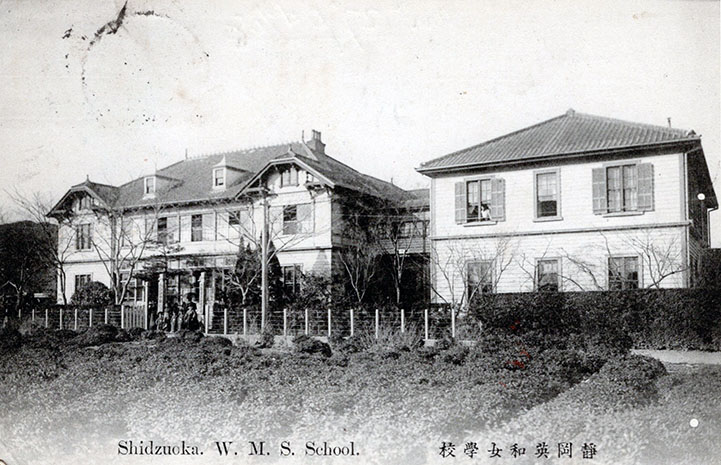
Shidzuoka School, Japan, 1908.
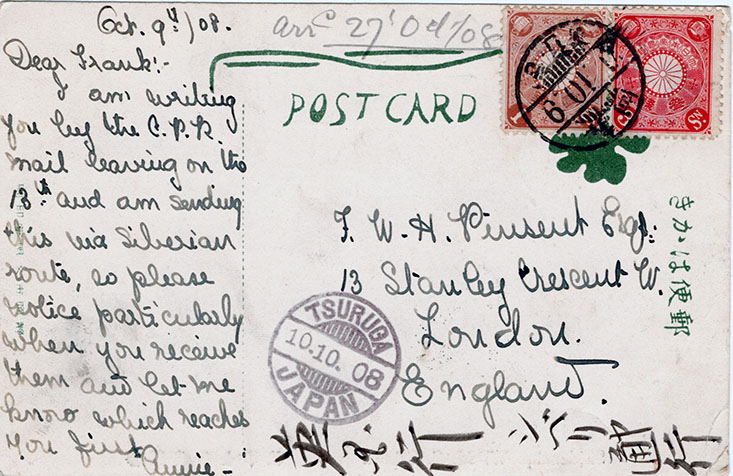
Annie’s handwritten postcard, 1908.
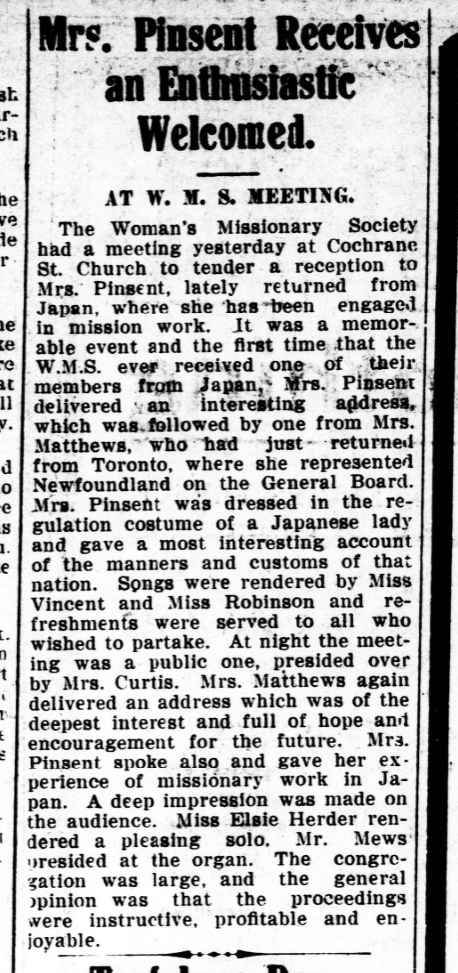
Annie returned to Newfoundland for a visit in October 1910 and the Women’s Missionary Society held a meeting to her mark return: “Mrs. Pinsent appeared as a Japanese lady and spoke about her work in Japan and of their customs …” (Evening Herald: Saturday 22nd October 1910).
Evening Telegram, October 22, 1910.
She gave several other talks over the next few months, including a more formal (illustrated lecture) in the Methodist College Hall in March the following year 1911. On this occasion she was joined by her sister Miss Gertie March and “Little Miss Mathews” suitably attired as a Japanese family: Mrs. Pinsent then told the story of her three (actually five) years life in Japan. It was realistic and held the undivided interest of the audience to the last. Mrs. Pinsent has a command of a choice vocabulary, is fluent and easily controls her audience (Evening Herald: Thursday 16th March 1911). It must have been quite an experience for people with little or no knowledge of Japan and its people.
While back in St. John’s she joined her Pinsent relatives, including Charles Speare, Earl Speare, their wives and the “Misses Pinsent” (presumably Charles’s daughters) in attending a “levee” at Government House that was given to celebrate the Coronation of King George V. (Evening Herald: Saturday 24th June 1911). That August, she returned to Japan: “Mrs. Pinsent, the Japanese Missionary, left by yesterday’s express to return to her missionary life in Japan. She has already spent five years in Japanese mission field and now proposes to devote the next seven years of her life to the same calling. She will stay at Toronto for a short time en route to Japan. As our readers are aware, Mrs. Pinsent is a daughter of Mr. and Mrs. Nathaniel March of this city (Evening Herald: Wednesday 9th August 1911).
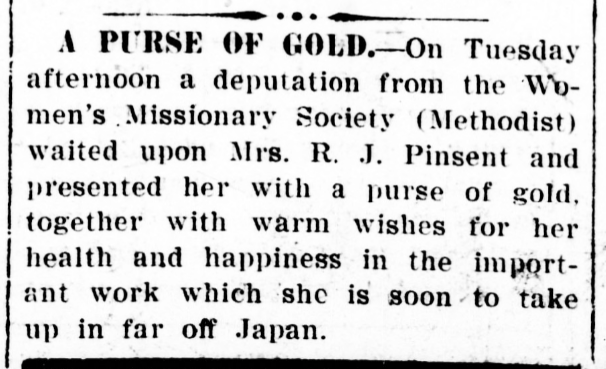
Evening Telegram, August 10, 1911.
Before she left, a deputation from The Women’s Missionary Society “waited upon Mrs. R. H. Pinsent and presented her with a purse of gold, together with warm wishes for her health and happiness in the important work which she is soon to take up in far off Japan” (Evening Telegram: 10th August 1911).
Annie spent the First World War in Japan and, true to her word, returned to Newfoundland to see her family and friends in August 1918: “Mrs. R. H. Pinsent, is a daughter of the late Mr. N. March and sister of Major J. W. Marsh, M.C. After spending a month here with relatives, Mrs. Pinsent will go to London, Ontario, and thence possibly back to the foreign mission field. Seven years ago, Mrs. Pinsent returned to Newfoundland from Japan and instead of taking the usual Pacific route, crossed Siberia, Europe and the Atlantic Ocean” (Evening Telegram: Friday 16th August 1918).
Needless to say, Annie “our own missionary from Japan” was much in demand while back. She gave another talk at Cochrane Street Centennial Church in May 1919. In it, “she told of her experiences in the teaching of Japanese children, the difficulties in regard to the language and the marked success that attended the work. She instances the cases of several Japanese who had become faithful Christians. One kept a fish shop and Mrs. Pinsent described the surroundings of that place, the large variety of fish, and the methods of sale” (Evening Telegram: 19th May 1919). At another meeting of the Women’s Ministry Society the following month she “addressed the Branch in her most cheerful style, speaking chiefly on the kindergarten work in Japan and the wonderful results by the faithful staff of missionaries there” (Evening Telegram: 5th June 1919).
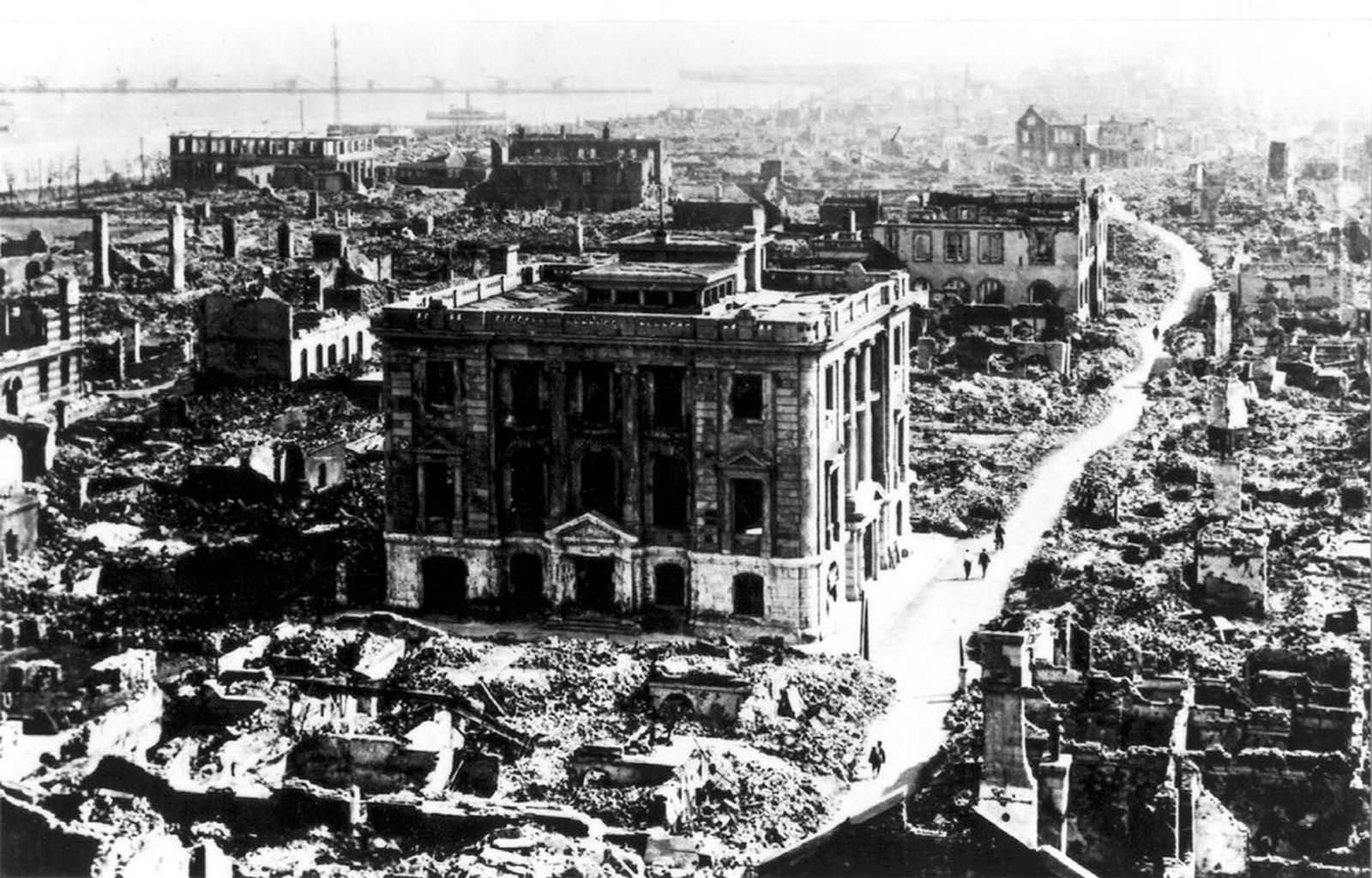
Annie returned to Japan and was there during the “Great Kanto earthquake” that struck the Island of Honshu on 1st September 1923. The quake and fires that followed caused considerable damage and Methodists in Newfoundland were much relieved to hear that: “Missionaries in Japan Escaped Destruction: A message received yesterday from Mrs. Lavelle, President of the Women’s Missionary Society of the Methodist Church of Canada stating that all the missionaries in Japan are safe. Amongst those devoting their lives to missionary work in Japan is Mrs. Pinsent, formerly Miss March, of this city” (Evening Telegram: 10th September 1923).
Annie took time out and visited England in 1926. Lady Pinsent had died in 1922, but she probably met up with her husband’s brothers Frank (“Good Old Frank”) in Devon and Guy – who she may not even have met before – in Surrey. She certainly must have met up their sister Mabel (Mrs. Eden). She may even have seen one of Charles Speare’s daughters, Frances (Mrs. Badcock). Annie Left Liverpool on 7th September 1926 and returned to Newfoundland on the S. S. “Nova Scotia” (Passenger Lists: Findmypast.co).
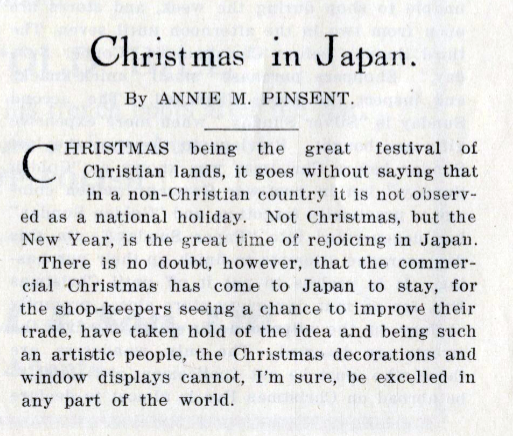
Annie writes in The Veteran, V. 10, No. 2, 1934.
Like so many other members of the family, Annie liked to write about her experiences and an article of hers entitled “Christmas in Japan” appeared in “The Veteran: 1934: Vol. 10. No. 2, (December).” In it, she says “… Christmas is not celebrated but the Christian Church in Japan has introduced the idea into the population through its Kindergartens and Sunday Schools and it is often the children who are left to explain its meaning to their elders. For many it is the “Westerner’s New Year” … The Japanese have a prolonged and colourful celebration around then full of events and competitions – the stores are decorated and the firemen bring out their ladders and entertain the crowds …” It was so very different from Newfoundland.
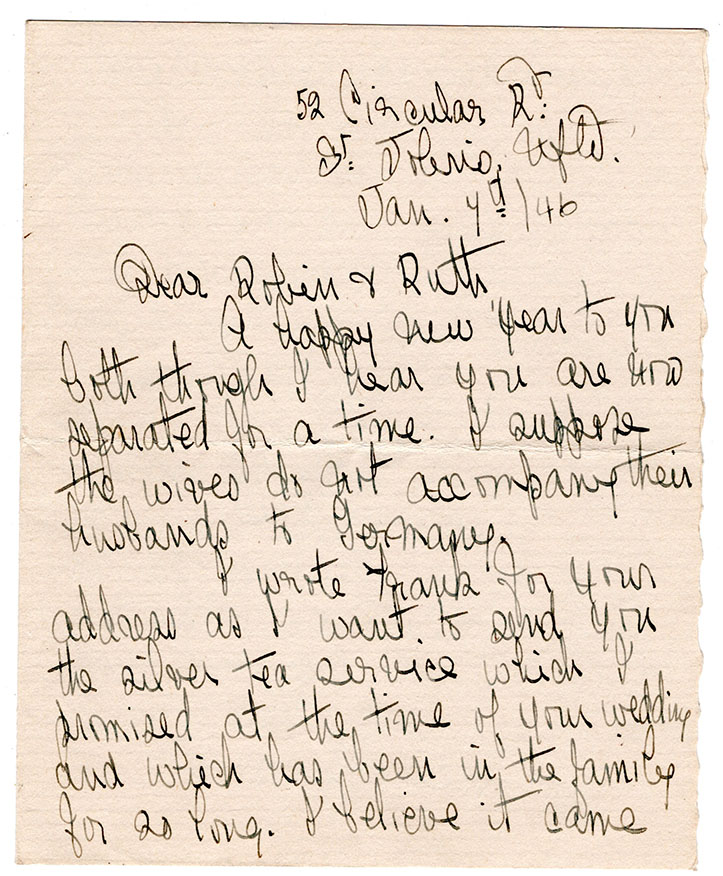
Annie writes to Ruth and Robin, 1946.
Annie was in St. John’s throughout the Second World War; however, she kept in contact with the family and, corresponded with my parents. In January 1946, she sent my parents a silver tea service that she had received from Lady Pinsent’s mother as a wedding present. She thought it must have been in the family for over 100 years.
In 1947, she sent bars of chocolate to my elder sisters. Sadly, I was too young to benefit. Annie died in St. John’s in 1950 and her will was probated there.
Please use the above links to explore this branch of the family tree. The default “Next” and “Previous” links below may lead to other unrelated branches.
Please use the above links to explore this branch of the family tree. The default “Next” and “Previous” links below may lead to other unrelated branches.
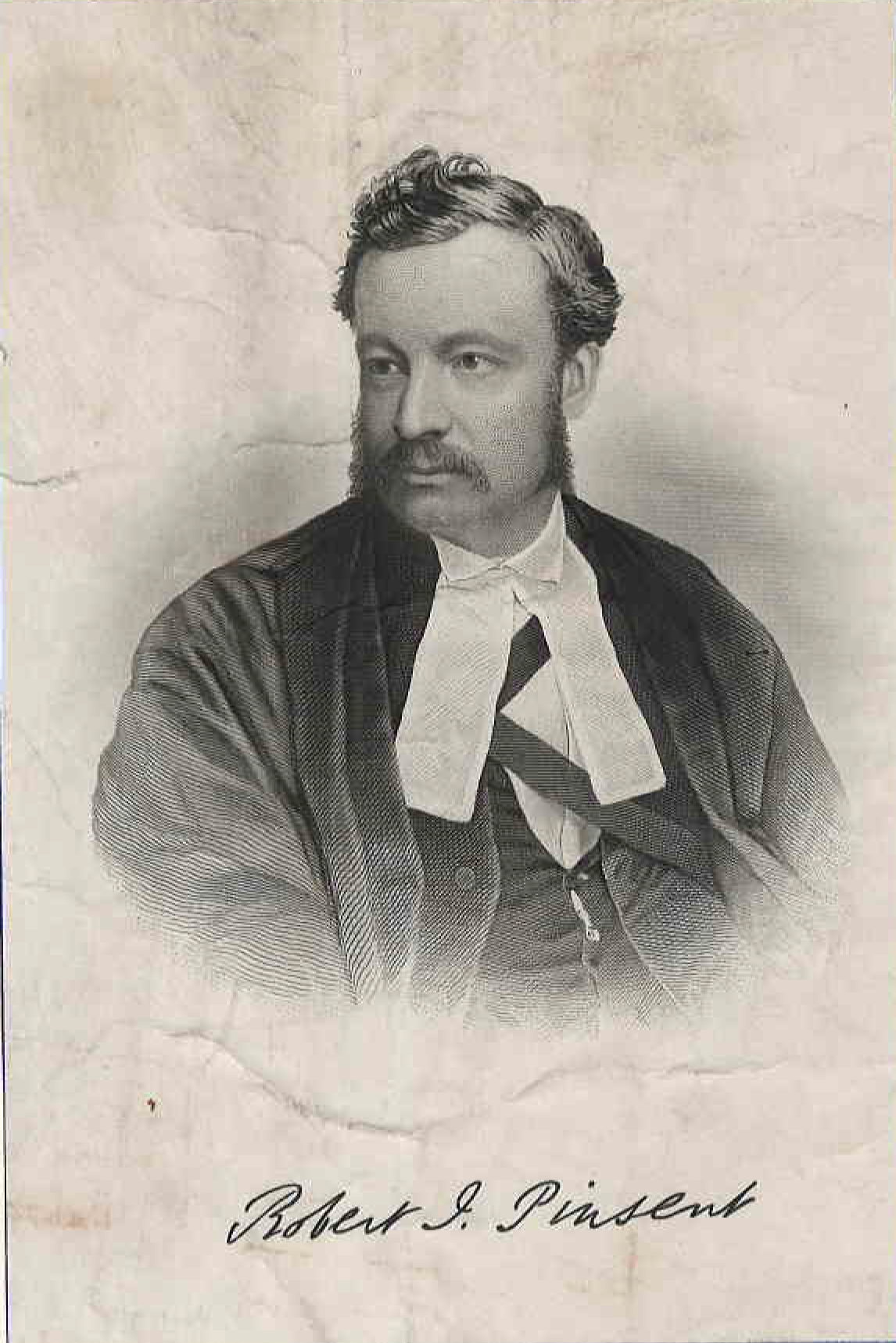
Robert John Pinsent “junior” was the eldest son of another Robert John Pinsent, by his wife, Louisa Broom Williams. He was born in Port de Grave in Newfoundland and brought up there, and in Harbour Grace with two brothers and two sisters. His father had come out to Newfoundland in the late 1820s to assist his elderly uncle, William Pinsent, run a shipping business. He had been born in London.
Robert John “senior” had married in St. John’s in 1828 and been appointed a magistrate in Brigus in 1832. He was later to be appointed a Judge of the Labrador Court and to dispense justice in the out-ports along the Labrador coast between 1863 and 1874. His life is discussed elsewhere. Perhaps it is not surprising that his son, Robert John “junior” (later Sir Robert) entered the legal profession.
The Newfoundland Evening Telegram published “A Biographical Sketch of Hon. Mr. Justice Pinsent, D.C.L.” in its Christmas edition (19th December 1888). It provides a summary of his life to that date; however, he still had four eventful years to go! I have extracted exerts from this “sketch” and they are given in italics inter-mixed with information from other sources. Robert John’s life is well documented and herein it is divided into two parts. The first (Part I) covers the period from his birth to 1870 – the year he divorced his first wife. The second (Part II) continues through until his death in 1893.
The “Sketch” includes a brief description of Robert John’s connections to the Williams, Vicars, Broom and other Newfoundland families and it shows that “he was educated at Harbour Grace Grammar School and entered his legal studies in St. John’s, under Mr. (afterwards Sir Bryan) Robinson, Q.C., and in 1855 and 1856 was admitted respectively Solicitor and Barrister. He was an able lawyer and was appointed to the Legislative Council in 1859 (see also St. James’s Chronicle: Thursday 6th October 1859) [Letters patent in my possession – RHP]. It was a position he held until 1865, which was the year that “Mr. Pinsent was called to the Inner Bar, as a Queen’s Counsel”. The Duke of Newcastle had “presented” him (to the Queen?) at a Levee in London two years earlier (Morning Herald (London): 27th February 1863). He was a man on the rise.
Robert John was fully settled in St. John’s by then. He had bought a house on Kingsbridge Road from John Fox in 1860 and he is said to have acquired a second (adjoining) house – on the corner of Forest and King’s Bridge Road known as “Devon Place” – a few years later. I believe they are now co-joined and part of the “Captain’s Quarters” hotel.
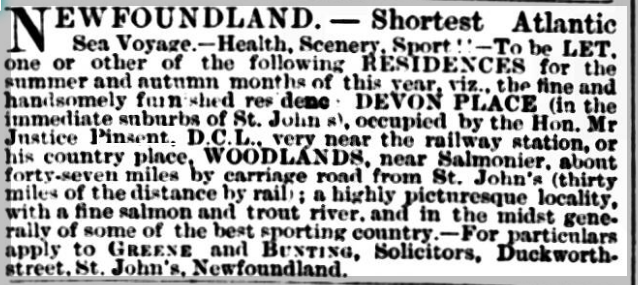
A website describing the latter building’s history shows that it started out as a duplex (http://www.captainsquarters.ca/viewpage.php?vu=1&id=2) . Robert John, perhaps informally, referred to his home as “Hillsborough” but it was, perhaps, more generally known as “Devon Place” – as when it was offered up for Let for a few months in 1882 (The Field: 4th February 1882).
The Field, February 4, 1882.
The name “Hillsborough” was probably a nod to his English relation, Thomas Pynsent, who had built and sold “Pitt House” in Hennock and moved to a very smart property of that name in Westward Ho! in north Devon (see elsewhere). Robert John seems to have lived at “Hillsborough” for the rest of his life. However, he had passed a substantial portion (7/8th) of it over to his son Charles Augustus Maxwell Pinsent in 1888.
St. John’s was a relatively small town in the 1860s and Robert John quickly made his mark. One of his early successes was in the prosecution of a magistrate who had pocketed around 80 doubloons from a cache he had found on a Spanish ship that had come aground in his jurisdiction. He claimed he had taken the doubloons for “expenses” that he and his family had incurred in rescuing the crew. Robert John argued on behalf of the owners, Marristan y Elias, and showed that the claim was excessive. The jury forced Mr. Simms to return £45 (The Patriot: 14th July 1859). Robert John was appointed Queen’s Council in August 1865.
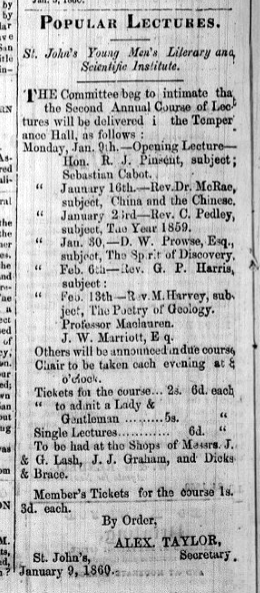
Advertisement for a lecture, the St John’s Patriot, January 9th, 1860
St. John’s was a growing community and there were relatively few opportunities for “further education,” so the “Young Men’s Literary and Scientific Institute” organized a lecture series that was held annually shortly after the New Year. Robert John not only helped organize the lectures but he quickly made his mark as an excellent speaker on subjects that displayed his interest in history. He lectured on “Sebastian Cabot” in 1860 (The patriot: 9th January 1860) and “Westminster Abbey” the following year (The Patriot: Monday 21st January 1861). Incidentally, I am sorry I missed the Rev. M. Harvey’s talk on “The Poetry of Geology.” Robert John had other interests too. Perhaps surprisingly, he was a strong proponent of agriculture in the Colony. According to the “Sketch” he was “President” and later “Vice-President” of the “Agricultural Society.” He was also “a member of the Synod of the Church of England from its foundation, and one of the Executive of that body under three successive Bishops.” Clearly, he was active in the community!
Confederation with Canada was a hot topic in 1865: “during the ongoing debate over Confederation with Canada, he resigned his Legislative Council position and was elected representative for his home constituency of Brigus and Port de Grave. In 1869, he acted as Attorney General while negotiations were being conducted in Canada. In the ensuing election on the question of Confederation that autumn, he was soundly beaten as the inhabitants of Brigus and Port de Grave were (by then) strongly against the idea.” Apparently the electorate now “feared they would be taxed to death” if Newfoundland were to join Canada.
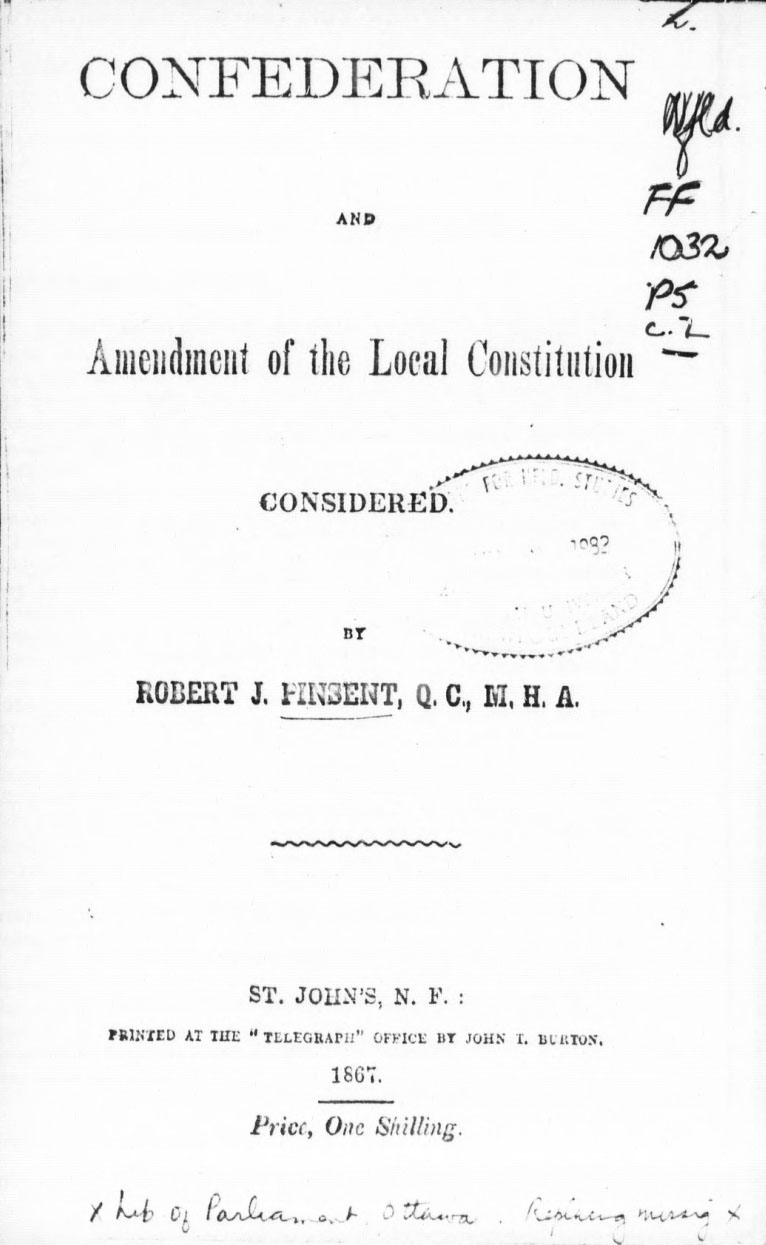
The cover of the pamphlet considering the amendment of the local Constitution, via Hathi Trust.
Robert produced a pamphlet entitled: “Confederation: Amendment of the Local Constitution – considered by – Robert J. Pinsent, Q.C., M.H.A.” in 1867. It was all perfectly logical but doomed his political future. Support for confederation had dwindled by the time he came up for reelection in 1869 – to the point where the magistrate at Port de Grave wrote to the returning officer at Brigus and informed him that “it was unsafe for the supporters of R. J. Pinsent to go out at night” and that the “antis” would prevent them from voting unless a strong police force was provided – G. W. Andrews, “Heritage of a Newfoundland Out-port”.
The issue of Confederation reemerged periodically and caused considerable anxiety. The Evening Telegram (12th February 1887) argued that the public was now far better educated than it had been in 1867, when “Judge Pinsent” (as he now was) published his “considerations” on confederation and was better able to evaluate the pros and cons. It encouraged discussion and one correspondent wrote: “I propose to write a series of letters upon the question of “Confederation;” and the title “Confederation Reconsidered” is intended as an allusion to that able pamphlet published in 1869 by the present Mr. Justice Pinsent, D.C.L., entitled “Confederation Considered.” Portions of that enduring monument of the author’s literary genius and statesmanlike perspicuity have recently been republished by you and have not only served to excite our admiration of Judge Pinsent’s prophetic and patriotic foresight, but also to concentrate public attention upon the subject which they so ably propounded eighteen years ago” (Evening Telegram: 15th February 1887). Mr. Justice Pinsent, as a Judge, was no longer able to dabble in politics and he said nothing. This attempt to drum up interest in confederation came to nothing. However, Newfoundland did eventually join Canada – in 1949.
After his defeat in 1869: “Mr. Pinsent was then reappointed to the Legislative Council [1870 Warrant in my possession – RHP] where he maintained his support for Confederation with the opposition party, led by Carter and Shea, until 1873 – when he severed his connection with them over some political controversy. Thereafter, he ran for the elective assembly a couple of times but was not elected.” The tide was against him. While in the (appointed) Legislative Assembly in 1870, Robert John wrote to the “Colonial Office” in London forcefully objecting to the British Government’s decision to remove its military garrison from St. John’s, arguing that the colony’s position at the west end of the trans-Atlantic cable system gave it strategic importance and, besides, it was still subject to unrest – particularly (as he knew all too well) at election time (The London Times: Friday 16th September 1970). A month later he received a formal letter informing him that “Lord Kimberley regrets … “ – Her Majesty’s Government had made up its mind on the matter (Exmouth Journal: Saturday 15th October 1870).
Mr. Pinsent was a barrister at heart and he was one of four (Messrs. Carter, Whiteway, Pinsent and Prowse) commissioned to produce a compendium of Newfoundland’s laws. The Patriot (Monday 21st November 1870) was not impressed: “Of the intrinsic merits of this volume, lawyers will be the judge, but a more slovenly, ill-printed and ugly quarto – abounding in typographical and other errors – never came under our notice.” I doubt if the lawyers had much to do with the printing but it is true to say that Robert John had other things on his mind around then. We will leave his professional career at this point and pick it up again in Part II of this discussion.
Stepping back in time, Robert John Pinsent Q.C. (who was an Anglican and member of the Church Synod), married Anna Brown Cooke at the home of a Wesleyan Minister (S. W. Sprague) in St. John’s Newfoundland on 28th April 1856. The location is somewhat surprising as Anna was the daughter of John Richard Maguire Cooke of Figueroa in Portugal and probably a Roman Catholic. Her eldest son Charles Augustus Maxwell Pinsent was later to become the Portuguese Vice-Consul in St. John’s. It was a notably low-key wedding (given the status of the two families) and the choice of minister was probably a comprise – given both family’s expectations.
In his will, written on the 24th July 1862, Anna’s father appointed David Steward Rennie Esquire and his son-in-law Robert John Pinsent as his executors, and he devised his real and personal estate to them in trust for his three principal legatees – who were to receive a third each. They were (1) his wife Mary (Cooke) whose portion was later to be passed on to one of his daughters; (2) his daughter Anna Brown Pinsent, wife of the Honourable R. J. Pinsent during her life and after her death to her children – in equal amounts and (3) his other daughter and after her, to her children – again in equal parts. By then, Robert John Pinsent and Anna Brown had three living children. However, they were later to add two more.
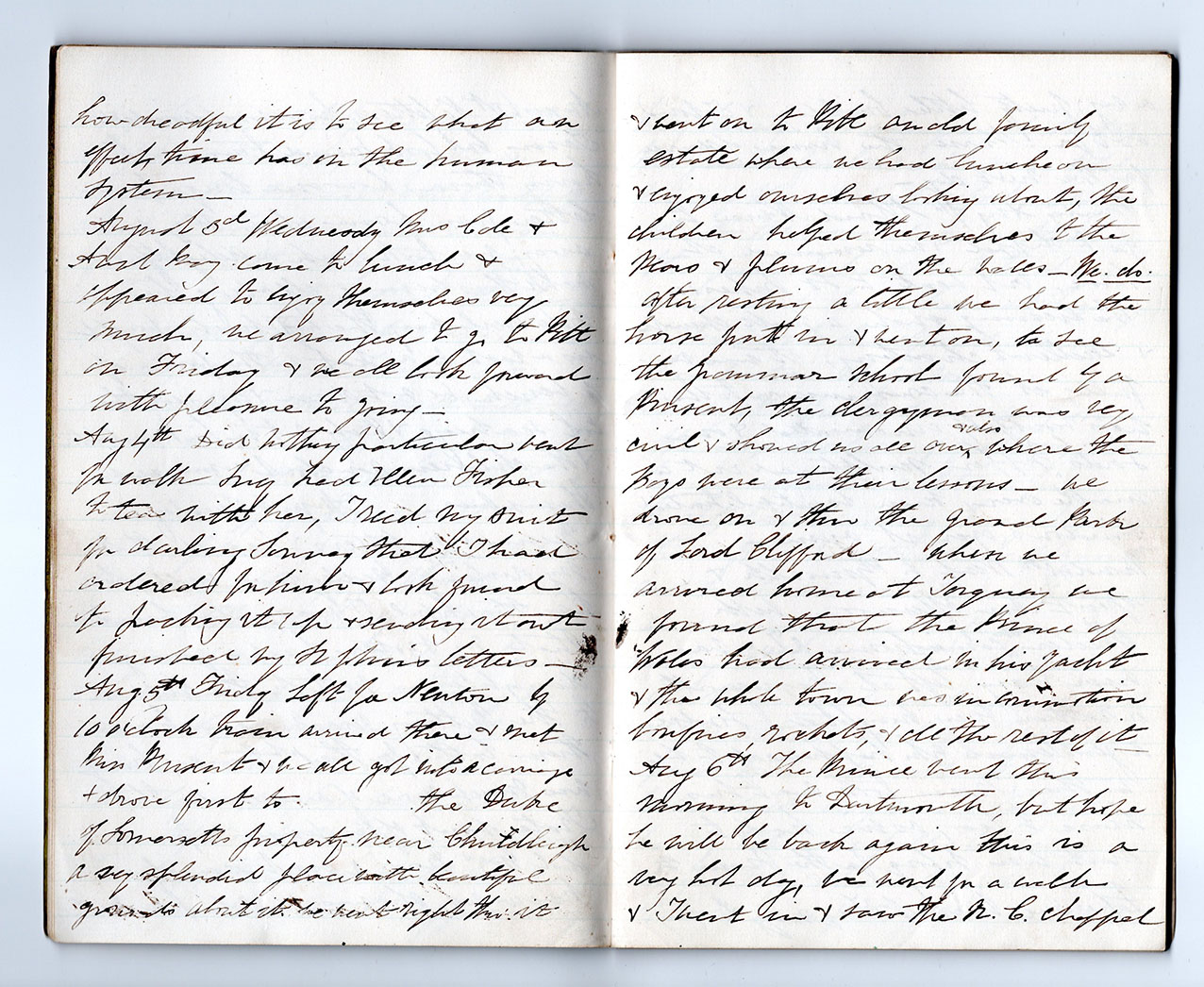
Excerpts from Anna Pinsent’s diary, August 1864.
Anna Brown Pinsent and a nurse took three of her children Lucy (7), Kate (6) and “baby” Willie to England, in 1864. Why she left her son Robert Hedley (2) behind I am not sure. Perhaps she feared the “terrible twos” would upset the sensibilities of her English relations. While she was in England, she wrote a diary. The entries from Saturday 23rd July to Sunday 25th September describe her life in Torquay, where they were entertained by Mrs. Elizabeth Satterley Splatt (née Pinsent); at Woolwich Arsenal, in London where she visited her Aunt, Mrs. Col. Collington, and later in London – where she saw the sites. She describes daily happenings; she complains about the cost of living and talks about Sunday Church services, family visits and outings, and letters from home. She was clearly missing her husband and her son (Hedley (2)). Mrs. Splatt was the daughter of Joseph Pinsent who was one of Anna’s husband’s grandfather’s many English brothers! She had returned from Victoria in Australia where her husband, William Francis Splatt, had made his fortune running sheep and as a merchant in Melbourne.
Anna makes the following observations: “July 27th, Dear Robin’s birthday, I wish he were here….”. “July 30th. Baby [William Satterly Splatt Pinsent – clearly named in honour of their hostess – of whom more later] is 4 months old today: raining in the morning and I employed myself in writing a letter to Mrs. Keddell [one of Charles Pinsent of Pitt’s daughters] and Miss Pinsent”, who must have been one of Charles’s granddaughters none of whom were yet married. My guess is Margaret Jane Pynsent. She would have been twenty and an appropriate age to escort Anna and her children around. “July 31st… Good news from dear R. and my precious boy”. August 1st, No letters, how disappointed I am, but look forward tomorrow to having them…”.
August 5th: Left for Newton by 10 o’clock train and met Miss Pinsent and we all got into a carriage, and drove first to the Duke of Somerset’s property near Chudleigh, a very splendid place with beautiful grounds about it.” The Duke of Somerset’s Castle was actually in Berry Pomeroy, some distance from Chudleigh. Perhaps she went to Lord Clifford’s house at Ugborough, near Chudleigh and confused the two. “We went right through it and went on to Pitt, an old family estate where we had luncheon and enjoyed ourselves looking about; the children helped themselves to the pears and plums on the walls.”
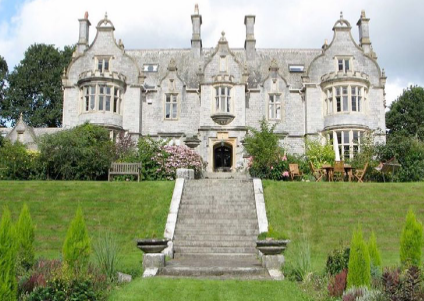
Pitt House in Hennock.
This suggests that Pitt House and farm were still in the family’s possession; however, it had been sold by then and they must have been the guests of the new owner. “After resting a little we had the horse put in and went on to see the grammar school founded by a Pinsent; the clergyman was very civil and showed us all over and also where the boys were at their lessons….”. [The school was founded by Mr. John Pynsent who was a local boy who became a Prothonotary (senior official) in the Court of Common Pleas. He founded the school in 1668]
August 17th, “… read NFL letters, good news, only Master Hedley opened the door of my bird cage and let it out”. August 18th, “We left Torquay … at Newton, dear Lucy and Tom got out and changed for Ivy Bridge … took a train for Woolwich … where my Aunt Mrs. Col. Collington lived… Darling Hedley’s Birthday”. August 27th, “… Lucy, dear little soul, she is learning to play croquette, Kate has been over nearly all day playing with Ella Swan”. September 13th “ … had a telegram from Liverpool saying S. was dying, did not quite believe it. Received letters from my dear husband and good news, I thank God for it”. September 15th, “Woolwich to London … drive off to Paddington for Lucie and Tom … dear Lucie looked so glad for me to be there …”. The Tom in this case was probably Charles Pinsent’s son Thomas who changed his name to Pynsent when he married in 1843. Tom had lived at Pitt Farm. He built Pitt House but sold it and the Pitt estate a few years later. Margaret Jane Pynsent was his daughter. They were doing their duty by their Newfoundland relations!
The family spent several days in London seeing the traditional tourist sites (Saint Paul’s, Hyde Park, Westminster Abbey, British Museum, Covent Garden, Madam Tussaud’s, Regent’s Park and several churches – what the children thought of it all, I have no idea) and shopping (school books, boots, gloves). On 18th September, the family spent the day in Hyde Park and enjoyed seeing the parade of young people out in the open space.
Anna, meanwhile, ponders on youth and mortality. “Dear me, when I look back, here I was in this very room [she may have been staying with her mother and sister in law: RHP] a year and a half ago and have crossed the broad Atlantic twice in that time”. “Such is life a constant change and yet to live it, Oh how strange””. September 24th, “My birthday, the advanced age of 27 years. Today, I wonder if I shall be alive next anniversary to record it. Oh My! It seems yesterday I was sweet 15 and here I am an ancient with four children. Old Father Time, you have no mercy”. September 25th, “… after tea heard the children read their scripture and read to them; much as I appear to think of the world, I would rather leave it all and go to God if I were sure my children were safe too, and my husband, dear old Robin. I wonder what you are doing at this minute, exactly nine o’clock at night, Sunday evening in the year of Our Lord, 1864”. [There is nothing in the diary to suggest that Anna Brown was unhappy in her marriage, although she does not seem completely fulfilled. She comes across as a compassionate person and a devoted mother and loving wife: RHP]
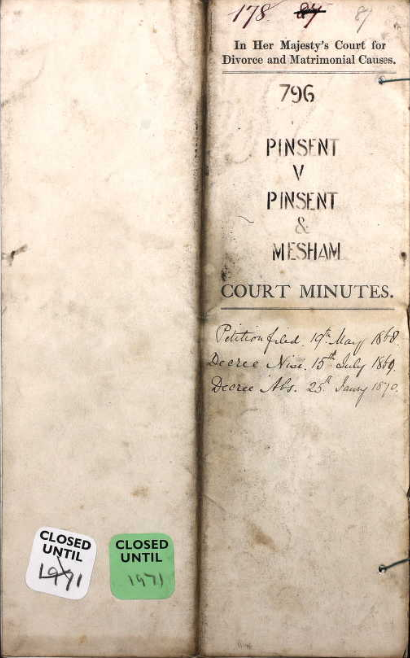
The court minutes for Pinsent v Pinsent & Mesham.
Unfortunately, notwithstanding the arrival of two more children, the marriage failed. Anna returned to England in December, 1867 – ostensibly to enroll two of her children in school and Bristol. However, she stayed on and met up with Charles Mesham in London. Robert claimed they may have spent some time in France together and lived together in Weymouth on their return to England. Some of their hotel stays were easy to document and may have been choreographed so as to establish adultery in England – and thus simplify the divorce proceedings. Robert John Pinsent was named as the Petitioner v. Anna Brown Pinsent Respondent and Charles Mesham as co-respondent in a petition filed in the “Court of Divorce and Matrimonial Causes” when it was filed in May 1868 (Morning Herald (London): Tuesday 8th December 1869, The Albion: Monday 19th July 1869, and other papers). “Court Documents” show that Robert had not heard from his wife since February 1868 and that he was not then aware as to her whereabouts. Mesham denied the allegation of adultery but up no defence.
Charles Mesham was an officer in the “Newfoundland Army and aide de camp and private secretary to the Governor” (Morning Herald (London) Monday 19th July 1869). He was a married man and had a family of his own. Although the affair may have formerly started in December 1867; however, I have an undated, intensely crumpled note that Anna wrote to her husband – probably sometime before going to England. In it, she “asks your forgiveness dear, dear Robert for leaving you in the way I did tonight. It went against my heart to do so, and I would not if I had not been told to treat (?) it with indifference by another person who noticed it, not that that is any excuse but Oh Robert I feel so very sorry.”
The Judge, in summing up, “observed that there was no trace of any surmise that the marriage had been otherwise than happy. In fixing the amount of damages, the jury ought to consider the position of the petitioner, as well as the co-respondent’s means of payment. It also appeared that the respondent, availing herself of a letter from her husband, had obtained goods from drapers at Woolwich to the extend of £250.” (Weekly Times and Echo (London): 18th July 1869).
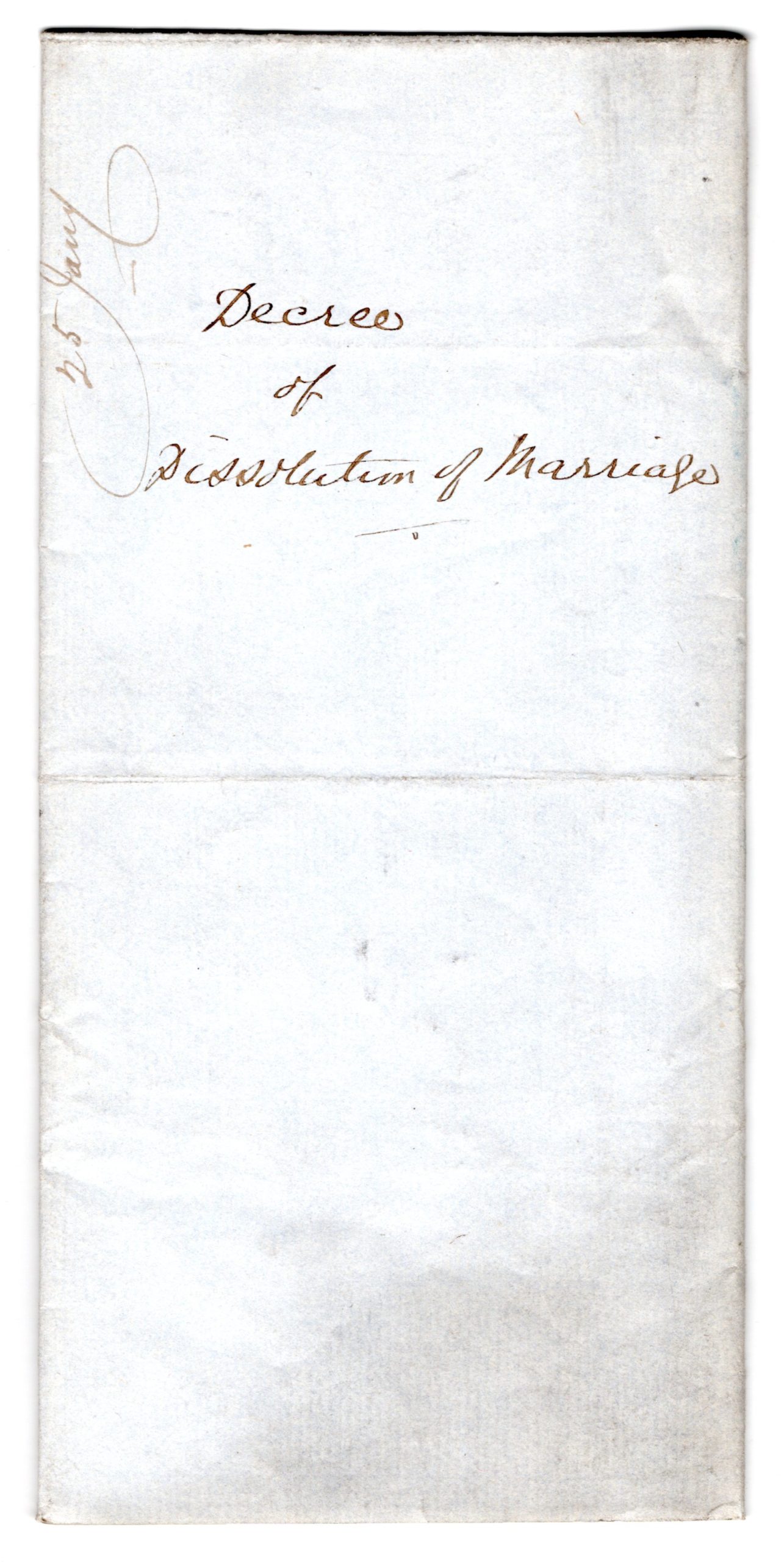
Charles Mr. Mersham, presumably reluctantly, paid the legal costs and stumped up £3,000 in damages! Robert John obtained a “Decree of Dissolution of Marriage” on 15th July 1869 but the divorce was not finalized in open court at Westminster until 25th January 1870. The marriage was dissolved by reason of adultery between the respondent and co-respondent. The The relevant documents are in the National Archives (J77/84 File 796). The scandal, such as it was, was only half-heartedly covered by the British press; which was, doubtless, what they hoped for.
Robert John Pinsent’s decree of dissolution of marriage, 1870.
Robert John Pinsent’s divorce led to a separation agreement that was signed 31st March 1870 [in my possession – RHP]. Robert John agreed to pay Mrs. Anna B. Pinsent for the remainder of the term of her natural life – as from the first day of January 1869 – an annuity of one hundred pounds sterling. And Anna Brown Pinsent on her part agreed to accept the said annuity and, in consideration of the payment thereof, acquit Robert John Pinsent from all further charge and from all claims whatsoever. She also signed over to him her interest and income arising from the estates of the late Lucretia Dickson and John R. Cooke to be used for support and education of his children by her. The deed was witnessed by Charles S. Pinsent and Louisa W. Pinsent (Robert John’s brother and sister) and others.
Robert John set about reorganizing the family’s estate in January 1869. In a Document of “Transfer and Division of Properties” [in my possession – RHP] he seems to have transferred much of his landed property to his children (Charles Augustus Maxwell, Gentleman, of St. John’s Newfoundland (23); Arthur Newman (22); Louisa Catherine (Kitty) Shea (wife of George Shea, Esquire of St. John’s, Newfoundland) aged (31) and Lucretia Maude (in religion Dame Mechtildis of St. Scholastica’s, Teignmouth, Devon) aged (32)). The transfer was complicated by the recent death of Robert and Anna’s third son, Robert Hedley Vicars Pinsent, of whose estate Robert John was both executor and legatee. The lives of all of them (except Louisa Catherine) are discussed elsewhere.
Robert John’s children ended up with fractional interests in several properties, including two houses on the east side of Barnes Lane in the City of St. John’s called “Cathedral Place”, premises called “Hillsboro’” on the Kings Bridge Road, St. John’s and leasehold properties on Military Road. He appears to have kept “#2 Cochrane Place”, Military Road, St. John’s, Newfoundland in his own name.
This reorganization took a while to fully implement and other papers in the “Newfoundland Archives” show that Robert John gifted his country house at “Woodlands” at Salmonier to his eldest son Charles Augustus Maxwell in 1884. He also granted him much of his remaining property, including “Hillsboro’”, in St. John’s in exchange for a release from an obligation to keep his life insured for $3,000.00. Robert John’s second son, Arthur Newman Pinsent appears to have sold his interest in the family’s estate to his brother Charles Augustus Maxwell Pinsent for $1,860.00 in cash and headed west into Canada. The name “Hillsboro'” for the family home is interesting as it mirrors that of Tom Pinsent (mentioned above). He settled in Northam on the coast near Bideford in North Devon and invested in farm land that he later sold for hotels and houses as Westward Ho! developed into a destination resort (complete with a golf course) in the 1870s. He made a bundle in the process.
Five of Robert John Pinsent’s eight children by Anna Brown Cooke were living at the time of the divorce. Sadly, only one of them, Charles Augustus Maxwell, produced a grandchild. He had a short-lived daughter. Arthur Newman never married – as far as I am aware – and thus there are no male descendants from Robert John’s first family.
English census records show that Robert John’s son Hedley V. Pynsent [8] (sic) was a scholar boarding at Ebenezer House C. Park School, in Westbury on Trym in Bristol, in 1871. It notes that he was born in Newfoundland and that his sisters L. Maude A. Pinsent [14] and Catherine L. Pinsent [12] were living nearby. In fact, they were living with Ann Keddle (a.k.a. Keddell) [66] at “#2 Mearncliffe Villa C. P., Westbury on Trym, Bristol. ” She was the sister of the Thomas Pynsent of Pitt in Hennock and (later) Northam in North Devon mentioned above. By then, she was a surgeon’s widow who living with her unmarried daughters, Anne P. [37] and Ellen M. [35] Keddle who had both been born in Keynsham, which is in Somerset. They were “teaching at home” and L. Maude and Catherine L. Pinsent were listed amongst their “scholars”. Both of the girls were correctly described as being “British Subjects born in Newfoundland”.
Robert Hedley Vicars Pinsent, or “Hedley” as he was generally known, went out to New Zealand as a young man but took sick and returned to Newfoundland via London in May 1889 (The Sydney Mail and New South Wales Advertiser (N.S.W.: 1871 – 1912): Saturday 14th May 1887). He died, unmarried, aged 25, soon after his return (New Zealand Herald: 30th April 1888). His brother, Arthur Newman Pinsent, farmed in Saskatchewan and served in the “Canadian Armed Forces” during the “First World War.” He died in Saskatchewan in 1946. Interestingly, there is a will for an Arthur Pinsent in the St. John’s Archives. However, it is dated 1949 (Newfoundland Wills Book: Volume 20: page 517). Perhaps he had residual property there.
Lucretia Anna Maude Pinsent, (“Lucy”) and, confusingly also (“Maude”) Pinsent converted to the Church of Rome and returned to Devon. Maude Pynsent [24] (sic) was an unmarried “associate” (nun) “engaged at domestic offices and needlework” at St. Scholastic Abbey on the Dawlish Road in East Teignmouth when the Census was taken in 1881. Ten years later, she was the “Lady Abbess” of the institution and responsible for approximately forty nuns and lay sisters. She then moved to Rome (see elsewhere).
Anna Brown married John Lee Stathem, a dentist she had first met in London while on her visit to England in 1864, in April 1870. What had become of Charles Mesham I am not sure! Perhaps he paid up and high-tailed it back to his wife and family in Newfoundland. Anna’s aunt Susan Rennie of Hastings in Sussex published a will, in 1877, in which she left an annuity of 50 pounds per year, to Anna Brown Stathem “formerly the wife of Robert John Pinsent” and gave Kate (i.e. Louisa Catherine Pinsent: above), Anna’s daughter by Robert John Pinsent a bequest of 20 pounds.
Anna Stathem died at Yandina, on the coast of New South Wales, in Australia, in 1882 and Susan Rennie added a codicil to her will in 1884. In it, she transferred Anna’s annuity to Catherine “during her life, until such time as she shall become the inmate of a Roman Catholic Convent, or marry with Robert John Pinsent’s consent”. Perhaps she was concerned that Catherine (“Kitty”) might follow her sister Maude into the Roman Catholic Church. She didn’t.
Louisa Catherine Pinsent (Shea)
Catherine married George Shea, an aspiring politician in Newfoundland. His family’s firm “Shea and Co.” were shipping agents for the “Royal Mail Steamship Line”, the “Allan Line” and the “Ross Steamship Line”. Sadly, she died giving birth to her first child, in 1890. Mr. Shea later remarried and became a successful politician in the early 1900s.
For all that Anna Brown and Robert John had five sons, none produced sons of their own and to the best of my knowledge there are no male descendants on that side of the family.
After the divorce, Robert John was left to pick up the pieces and carry on. He had two young daughters and three sons (the youngest of which was only three years old) to look after. For more on his life, I suggest you move to Part II.
Please use the above links to explore this branch of the family tree. The default “Next” and “Previous” links below may lead to other unrelated branches.
Robert Hedley Vicars Pinsent was the eldest surviving son of (Sir) Robert John Pinsent by his first wife, Anna Brown Cooke. He was born and baptized in St. John’s Newfoundland in 1862 and he was educated both there and also in England.
Anna Brown Pinsent and a nurse took three of her children Lucy (7), Kate (6) and “baby” Willie to England, in 1864. Why she left her son Robert Hedley (2) behind I am not sure. Perhaps she feared the “terrible twos” would upset the sensibilities of her English relations. While she was in England she wrote a diary – part of which is in my possession. In it she describes daily happenings; she complains about the cost of living and talks about Sunday church services, family visits and outings, and letters from home. She was clearly missing her husband and her son (Hedley) and enjoyed letters from home: August 17th, “… read NFL letters, good news only Master Hedley opened the door of my bird cage and let it out”. Boys will be boys. The following day: August 18th, “We left Torquay … at Newton, dear Lucy (Lucretia Maude Pinsent) and Tom (probably Pynsent) got out and changed for Ivy Bridge … took a train for Woolwich … where my Aunt Mrs. Col. Collington lived… Darling Hedley’s Birthday”: … It is worth noting here that Robert Hedley Vicars was almost invariably referred to as “Hedley.”
Anna and her husband had eight children in all (five boys and three girls) between 1857 and 1867 but only three of the boys (Charles, Hedley and Arthur) survived and only one of them (Charles) married and had children. He had a daughter that died in infancy.
Sadly, Anna’s marriage to Robert John did not last. According to testimony given in Her Majesty’s Court for Divorce and Matrimonial Causes in London, Anna was in London with Charles Mesham in December 1867 and she failed to return to her family. Robert John Pinsent initiated divorce proceedings the following year and, as discussed elsewhere, their divorce was finalized in 1870. This allowed Anna to remarry – not Mr. Mesham (who was already married) but John Lee Statham (a London “dentist”). They married in St. Marylebone Parish Church in April 1870.
Anna’s school-age children were living in Bristol at the time. The 1871 Census tells us that Hedley V. Pynsent (sic) was a scholar at Ebernezer House School at Cotham Park, Westbury on Trym, Bristol. He was eight years old and one of thirteen young boys aged between 5 and 12. The Census also tells us that his older sisters L. Maude A. Pinsent [14] and Catherine L. Pinsent [12] were living at “#2 Mearncliffe Villa C. P., Westbury on Trym, Bristol” with Ann Keddle (a.k.a. Keddell) [66] the sister of their cousin Thomas Pynsent, of Pitt in Hennock and (later) Northam in North Devon. His extraordinary life is discussed elsewhere. It comes with an explanation for the Pynsent name! Ann Keddle was a surgeon’s widow who set up a small school with her unmarried daughters, Anne P. [37] and Ellen M. [35] Keddle; both of whom were born in Keynsham, in Somerset. The sisters were “teaching at home” and L. Maude and Catherine L. Pinsent were listed amongst their “scholars”. Both were correctly described in the Census as being “British Subjects born in Newfoundland”.
Robert John Pinsent remarried two years later and started a second family with Emily Hetty Sabine (née Homfray). They had seven children between 1873 and 1889; Robert John had to simultaneously juggle the needs of his two families.
Hedley was not a particularly engaged student and his father was unquestionably exasperated when he received his school report while on a visit to London in January 1878. He wrote of his frustrations to his (second) wife, Emily, who was at her family home in Bintry in Norfolk: “From the school report of Hedley I received today I am inclined to think that one six pence more spent in an attempt at his education will be money thrown away” (Letter: Robert John Pinsent to Emily Pinsent: 14th January 1878). She must have tried to settle him down as in his next letter he discusses possibly sending him to “Institution Piquet” near Paris. The problem, as he saw it, was that Hedley, who was now around sixteen years old, was by no means ready to be recommended for employment with “one of his mercantile friends” – even if they should offer. Whether Hedley was actually sent to France, I do not know. Presumably he returned to Newfoundland. However, he did not stay there.
Hedley Vicars Pinsent joined the “North West Mounted Police” in Calgary, Alberta but I do not know when. However, some of his later medical records are still preserved in Canada’s “National Archives”. Evidently, Constable H. V. Pinsent served as an “assistant quartermaster” in Calgary until he contracted tuberculosis. He stayed on doing light duties for a while but was invalided out of the service in January 1885. Presumably he headed home to Newfoundland.
In the meantime, Hedley’s aunt (Mary Elizabeth Pinsent) had married a “clergyman”, Rev. Joseph Hatch, in Christchurch, New Zealand, in 1882. What she was doing there I have no idea but it is worth noting that her brother Charles Speare Pinsent was to marry Blanche Brown the following year. She was, the sister of a “Mining Engineer” (Douglas James Brown) who was then based in New Zealand – so the family had connections there.
Hedley must have gone out to New Zealand shortly after his return from Western Canada. Perhaps he went out because the climate was thought to be more favourable for his condition. He joined the “Government Survey Office” in Nelson, and spent a couple of years as a “Clerk in the Registrar’s Office.” Sadly, his tuberculosis returned and he left Auckland for Sydney on “S.S. Wairarapa” on 25th April 1887 (NSW Unassisted Immigration Lists). From there, he traveled to London on “R.M.S Orizaba” in May 1887 (The Sydney Mail and New South Wales Advertiser: Saturday 14th May 1887). Presumably he was on his way back to Newfoundland.
Robert Hedley Vicars Pinsent died at his father’s home at “Hillsbro,” in St. John’s in February 1888 (Twillingate Sun: Saturday 24th March 1888). The newspaper tell us that he was 25 years-old and unmarried, and that he died “after a lingering illness.” Notice of his death was forwarded to the New Zealand press – which suggests that he still had friends and/or relatives out there (New Zealand Herald: 30th April 1888).
Hedley made his will a few weeks before he died. He appointed his father as his executor and he left him his limited estate, excepting only £200 that he gave to his sister “Kitty” (Louisa Catherine Pinsent) – who was to marry George Shea in St. John’s a few months later (Newfoundland Wills (1830-1962).
Please use the above links to explore this branch of the family tree. The default “Next” and “Previous” links below may lead to other unrelated branches.
Robert Burton Pynsent was the eldest son of Charles Burton Pynsent by his wife Bessie Florence Hunt. He was born at Milliken Park, in Johnston, Renfrewshire in 1943, while his father was serving as a Flight Officer in the Royal Air Force. His younger brother was born in Caterham, in Surrey in 1945.
Robert attended the Hawthorn “preparatory” school in Bletchingley in Surrey in 1955 and, evidently, made a positive impression as Queen Elizabeth I’s “jealous Leicester” in the school play that year, which was entitled: “The Queen of Hearts” (Surrey Mirror: Friday 14th December 1955). Presumably he went to one of other of the public schools from there – I do not know which. He then went to Churchill College in Cambridge to read German, Czech and Slovak. He completed his doctorate in Czech literature in 1970 and joined University College of London’s School of Slavonic and Eastern European Studies (SSEES) in 1972 (The London Times: 8th April 2023). He remained there throughout his professional life and retired from there in 2009.
“Questions of Identity: Czech and Slovak ideas of nationality and personality” by Robert B. Pynsent.“Julius Zeyer” by Robert B. Pynsent.
Robert was a critical thinker, and a prolific editor and writer. For example, he wrote: “Julius Zeyer: The Path to Decadence:” R. B. Pynsent: 1973; and helped edit “Czech Prose and Verse: A Selection with an Introductory Essay: London East European Series”: R. B. Pynsent: 1979; “Decadence and Innovation: Austro-Hungarian Life and Art at the Turn of the Century”: R. B. Pinsent: 1989; and “Questions of Identity: Czech and Slovak Ideas of Nationality and Personality:” by R. B. Pynsent in 1994. He wrote and contributed to countless other works that have been published in English and Czech. I can claim no familiarity with the field!
Robert writes to “Captain” Pinsent to ask after the family history.
My father’s uncle (Guy Homfray Pinsent) corresponded with Robert’s father on family matters in the early 1960s and Robert Burton wrote my father in 1964, asking if anything had yet been published. Sadly, he was sixty years too soon. Robert Burton was a student at Cambridge at the time while I, Robert Hugh Pinsent, was at Aberdeen University. I met him once, around then – at an inter-university get-together. He recognized the incongruity of it all and mentioned it to my father in one of the family-related letters he wrote him.
Robert makes the news in the 1960s.
In another letter, probably dating from 1967, he enclosed a cutting from a Czech newspaper that seems to refer to a talk and some poetry he read in Prague. I will leave it to you to decipher what it says! Robert seems to have been bemused by the attention that he (as a young graduate student) was receiving. Referring to the coat of arms shown in the cutting he says: from “the crest or rather the arms, they think I’m a rather strange version of the English lord which always turn up here in jokes.” Nevertheless, he developed quite a few followers there, and he wondered if my youngest sister would like a Czech pen-pal. There must have been precious few Brits taking an interest in Czech and Slovak literature in those days. Robert Burton must have become used to the attention – it seems to have followed him throughout his career.
Robert’s family lived in Speldhurst in Kent, where his mother was a prominent member of the Women’s Institute. The Kent and Sussex Courier tells us that “Robert Burton Pynsent, of Brook House, Speldhurst” was dinged £5 for a parking offence in 1966 (Friday 21st October 1966). His father, Charles Burton Pynsent, died the following year but his mother stayed on in the house at Speldhurst and it passed to Robert when she died in 1996.
Robert’s obituary is published in 2023.
Robert married Rosita Rosien, who taught German, in 1969 and they had a daughter who was to marry in 2003. Sadly, Rosita died in 2009. Robert elected to retire back to his family home in Speldhurst (The London Times: 8th April 2023). Nevertheless, he remained active in Slavonic studies; and he remained on the books of University College of London’s as an Emeritus Professor of Czech and Slovak Literature until he died in December 2022.
St. Mary’s church in Speldhurst via Adam Swaine on Flickr.
Robert Burton Pynsent: 1943 – xxxx Brother (GRO0710)
Please use the above links to explore this branch of the family tree. The default “Next” and “Previous” links below may lead to other unrelated branches.