Charles George Pinsent

Vital Statistics

Birth: 1862
Marriage: N/A
Spouse: N/A
Death: 1863

Family Branch: Devonport
PinsentID: GRO1570


Family Tree

Grandparents

Grandfather: Charles Pinsent: 1812 – 1863
Grandmother: Mary Fullick: 1812 – 1852

Parents

Father: Charles Pinsent: 1837 – 1862
Mother: Eliza Holmes: xxxx – xxxx

Father’s Siblings (Aunts, Uncles)

Mary Ann Elizabeth Pinsent: 1833 – 1868
Thomas Pinsent: 1836 – 1838
Charles Pinsent: 1837 – 1862
George Pinsent: 1840 – 1875
Amelia Pinsent: 1842 – 1901
Alice Pinsent: 1844 – xxxx
Eliza Pinsent: 1846 – 1847
Alfred Pinsent: 1848 – 1919
Henry James Pinsent: 1850 – 1853
Frederick Pinsent: 1852 – 1929

Georgiana Caroline Pinsent: 1854 – xxxx
Eliza Maria Pinsent: 1856 – 1857


Please use the above links to explore this branch of the family tree. The default “Next” and “Previous” links below may lead to other unrelated branches.
Charles Alfred Pinsent

Vital Statistics

Charles Alfred Pinsent: 1905 – 1961 GRO0128

Mary Beirne: 1909 – 1992
Married: 1935: Fulham, London

Children by Mary Beirne

Son (GRO0132)
Daughter (GRO0676)
Daughter (GRO0489)
Daughter (GRO0058)

Family Branch: Devonport
Family Summary: Devonport
PinsentID: GRO0128

Click here to view close family members.


Charles Alfred was Alfred Charles Pinsent’s second son by his wife, Mabel Winifred (née Davis). He was born in Walthamstow, in Essex in 1905. He joined joined the Territorial Army when he was eighteen years old. It was for a three year term under its “Voluntary and Direct Enlistment Programme”. He then enlisted as a Private (Regt. No. 6135760) in the “East Surrey Regiment.” At that time, in April 1922, he was 5 ft. 7 ¾ in. tall, he weighed 128 lbs., had a pale complexion, brown hair and hazel eyes. His chest measurement was 34 in. with 2 in. of expansion. Somehow, he had managed to acquire an identifying scar above his right knee (findmypast.com.). On the completion of his three year term, Charles stayed on in the Regular Army and had been promoted to Lance Sergeant by the time he returned from Gibraltar on the “Pacific and Orient” ship, “Naldera”, in October 1928.  He was probably on his way back from India, where the “East Surrey Regiment” had been stationed for the past two years.

Charles was attached to “D” Company of the 5th Battalion, the Territorial Unit of the East Surrey Regiment from 1932 until 1935, when he left to rejoin the 2nd Battalion at Shorncliffe. The Territorials put on a parting dinner for him in January 1935 (Sutton and Epsom Advertiser: Thursday 24th January 1935). Charles evident found time to marry Mary Beirne, the daughter of a “farmer”, in St. Augustine’s Roman Catholic Church in Fulham later that year.

Given his military experience, Charles had risen to the rank of “Company Sergeant Major” in the “1st Battalion of the East Surrey Regiment” by the time it arrived in France with the “British Expeditionary Force” in September 1939. He was listed as a “casualty” on 23rd May 1940 – only a week or so before the battalion was taken off the beach at Dunkirk, on 2nd June (British Army Casualty List: findmypast.com.). The nature of his injury is not stated; however, he seems to have recovered enough to rejoin the Regiment. The First Battalion took part in the “Torch Landings” in North Africa and then fought its way up the Italian peninsula; however, it is possible that his injury precluded further active service.  He may have stayed home as his third child was born while the battalion was in Italy.

Charles and Mary had one son and three daughters. Charles had left the army and joined the “police force”. He was a “Police Constable” when his youngest daughter was born in 1946. Charles was a 56-years old “Police Sergeant with the War Department” when he died in Shoeburyness, near Southend-On-Sea in 1961. He was buried in Saint Andrew’s churchyard in Shoeburyness. His estate was valued at £1,051 and administration was granted to this widow, Mary, who stayed on in Essex. She died there in 1992. She was buried with her husband.

All four of Charles’s children grew up and married in the 1960s and 1970s. They are probably still alive today and their lives are not discussed.


Family Tree

GRANDPARENTS

Grandfather: Alfred Pinsent: 1848 – 1919
Grandmother: Matilda Churched: 1844 – 1888

PARENTS

Father: Alfred Charles Pinsent: 1877 – 1948
Mother: Mabel Winifred Davis: 1882 – 1949

FATHER’S SIBLINGS (AUNTS, UNCLES)

William C. “Pinsent”: 1866 – xxxx
Mary Caroline Pinsent: 1870 – 1945
Matilda Pinsent: 1873 – 1873
Amelia Elizabeth Pinsent: 1875 – xxxx 

MALE SIBLINGS (BROTHERS)

Stanley Arthur Pinsent: 1903 – 1985
Harold William Pinsent: 1910 – 1967 


Please use the above links to explore this branch of the family tree. The default “Next” and “Previous” links below may lead to other unrelated branches.
Charles Alfred Pinsent

Vital Statistics

Birth: 1866
Marriage: N/A
Spouse: N/A
Death: 1914

Family Branch: Devonport
PinsentID: GRO1229


Family Tree

Grandparents

Grandfather: Charles Pinsent: 1812 – 1863
Grandmother: Mary Fullick: 1812 – 1852

Parents

Father: George Pinsent: 1840 – 1875
Mother: Mary Ann Louisa Payne: xxxx – xxxx

Father’s Siblings (Aunts, Uncles)

Mary Ann Elizabeth Pinsent: 1833 – 1868
Thomas Pinsent: 1836 – 1838
Charles Pinsent: 1837 – 1862
George Pinsent: 1840 – 1875
Amelia Pinsent: 1842 – 1901
Alice Pinsent: 1844 – xxxx
Eliza Pinsent: 1846 – 1847
Alfred Pinsent: 1848 – 1919
Henry James Pinsent: 1850 – 1853
Frederick Pinsent: 1852 – 1929

Georgiana Caroline Pinsent: 1854 – xxxx
Eliza Maria Pinsent: 1856 – 1857

Male Siblings (Brothers)

George Augustus Pinsent: 1866 – 1921
Charles Alfred Pinsent: 1866 – 1914
Frederick Henry Pinsent: 1868 – 1937
Arthur Edwin Pinsent: 1871 – 1939
Harold Edmund Pinsent: 1872 – 1872


Please use the above links to explore this branch of the family tree. The default “Next” and “Previous” links below may lead to other unrelated branches.

Charles Pinsent

Vital Statistics

Birth: 1874
Marriage: N/A
Spouse: N/A
Death: N/A

Family Branch: Devonport
PinsentID: GRO1249


Family Tree

Grandparents

Grandfather: John Pinsent: 1799 – 1870
Grandmother: Mary Ann Todd: 1799 – 1874

Parents

Father: William Pinsent: 1825 – xxxx
Mother: Louisa Unknown: 1846 – xxxx

Father’s Siblings (Aunts, Uncles)

Elizabeth Pinsent: 1822 – 1896
Thomas Pinsent: 1823 – 1825
William Pinsent: 1825 – xxxx
John Pinsent: 1826 – 1914

Male Siblings (Brothers, Half-Brothers)

John W. Pinsent: 1854 – xxxx

William Pinsent: 1873 – xxxx:
Charles Pinsent: 1874 – xxxx
Frank Pinsent: 1875 – xxxx


Please use the above links to explore this branch of the family tree. The default “Next” and “Previous” links below may lead to other unrelated branches.

Charles Pinsent

Vital Statistics

Charles Pinsent: 1812 – 1863 GRO0127 (Cheese monger, St. John’s Wood, London)

1. Mary Fullick: 1812 – 1852
Married 1833: London

Children by Mary Fullick:

Mary Ann Elizabeth Pinsent: 1833 – 1868
Thomas Pinsent: 1836 – 1838
Charles Pinsent: 1837 – 1862 (East India Co., Sapper; Married Eliza Holmes, 1859, London)
George Pinsent: 1840 – 1875 (East India Co., Soldier; Married Mary Ann Louisa Payne, 1865, Bombay)
Amelia Pinsent: 1842 – 1901 (Married George Henry Pinsent, 1874, London)
Alice Pinsent: 1844 – xxxx
Eliza Pinsent: 1846 – 1847
Alfred Pinsent: 1848 – 1919 (Building Trades Worker; Married Matilda Churchyard, 1870, London; Charlotte James, 1890, London)
Henry James Pinsent: 1850 – 1853
Frederick Pinsent: 1852 – 1929 (Hannah Jane Jenner, 1876, London)

2. Georgiana Caroline Henly: 1838 – xxxx
Married: 1854: xxxx, xxxx

Children by Georgiana Caroline Henly:

Georgiana Caroline Pinsent: 1854 – xxxx (Married Joseph Edward Cant, 1874, London)
Eliza Maria Pinsent: 1856 – 1857

Family Branch: Devonport
Family Summary: Devonport
PinsentID: GRO0127

Click here to view close family members.


Charles Pinsent was the third son of Thomas Pinsent by his second wife, Elizabeth Pridham. He was born in Devon and brought up at “Greenhill” in Kingsteignton, where his father lived. It would have been his home until 1841, when his father died and it passed to his half-brother, Thomas Pinsent, the “draper” from Devonport.

Charles’s elder brother, John Pinsent ran a “tallow chandlery” in the Goswell Road in London before taking off for American with his wife, Mary Ann Todd, in 1832. Mary Ann left their daughter, Elizabeth, in the doubtless capable hands of her married brother, William Todd, who was a “cheese-monger” in the Finsbury district of central London. Presumably he helped Charles set himself up as a “cheese-monger” and “poulterer” in St. Marylebone in the early 1830s.

Charles married Mary Fullick, in St. George’s Parish, Hanover Square in 1833 and they had a large family comprised of ten children, six boys and four girls, over a period of twenty years. The Census records show that Charles and his young family were living on Buckingham Street, in St. Marylebone, in 1841 with an “independent” lady and her son, and with George Payne, a young “cheese-monger”. He was probably Charles’s employee or apprentice. The family had grown to include four sons Charles (13), George (12), Alfred  (3) and Henry (6 months) and two daughters Amelia (9) and Alice (8) by the time the 1851 census was taken. In those days, the household also included a young female servant, and a young male “porter”. There was also a seventeen year-old, unmarried, female “visitor,” Georgie Henly in residence.  How she fitted in is not clear; however, she was probably there to help Mary cope with the children.

The family had moved to #8 Queen’s Terrace, St. Marylebone Parish, London (Watkin’s Directory: London: 1852) by then. Whilst there, Charles applied for a license to deal in Game (Morning Herald (London): Tuesday 29th February 1848) so, I like to imagine that he strung pheasants and rabbits up in his shop window – like so many other trades-people into the mid 1900s. The shop acted as a drop-box for the local gentry. A “help wanted” advertisement in the London Times (Monday 9th December 1850) tells us that a gentleman with a substantial household was looking for a competent nurse and applicants should contact C. L. care of Mr. Pinsent, Poulterer, on Queen Street in St. John’s Wood.

Unfortunately, Charles may have over-extended himself when he made his move to, presumably larger, premises at Queen’s Terrace. In the spring of 1853 he was summoned before the “Court For Relief of Insolvent Debtors” and he was intermittently imprisoned for debt over the next couple of years. The London Gazette and other newspapers contain numerous references to hearings as his case wound its way through the legal process. The “Provisional Assignee’s” evaluation was finally ready to be entered into Court on 19th December 1854 (London Gazette: 5th December 1854).

To make life interesting, Charles’s detaining creditor (who presumably did not want the embarrassment of appearing in court) sent him a discharge the night before his appearance and set him free. Charles considered the whole process vexatious and insisted on being brought up before the Commissioner anyway. The poor Commissioner was unsure what to do – as Charles had already been legally discharged (County Courts Chronicle: Monday 1st January 1855)! Charles never got his “day in court.” However, it was two years of his life that he would never get back. It must have been it a traumatic experience.

To add to Charles’s woes, his wife Mary died, in October 1852, while he was still going through the court proceedings. It looks as if Georgie Henly had stayed on with the family to look after his younger children and Charles married her in May 1854. They had a daughter, Georgiana Caroline Pinsent before he received his finally discharge, and another, Eliza Maria Pinsent two years later. The latter was, unfortunately, short-lived. Charles must have lost his business, so the the family moved to #15 Little Norris Street, in Shoreditch, and that is where the Census takers found Charles (48) and Georgiana (26), and the younger children, Alice (16), Alfred (12), Frederick (9) and Georgiana (6) in 1861.

Charles still worked as a “cheese-monger” but he was a broken man. He was obsessively worried about his finances, and he may well of have been upset at seeing two of his sons, Charles Pinsent and George Pinsent join the “East India Company Army” and ship out to Bombay in 1860. His son Charles died in India in October 1862 and his father hanged himself in his bedroom on 29th August 1863 (Dial: Saturday 5th September 1863). He had recently quarreled with his wife, so perhaps it was all too much for him. At the inquest, the Coroner heard that he had been depressed and had threatened to commit suicide several times, saying “That the Regent’s Canal would be his bed”—unless his circumstances mended, and he had told one of his sons “That he should not live till night.”  The jury returned a verdict of “Suicide while of unsound mind” (London Evening Standard: Tuesday 1st September 1863). Georgiana was still young. She married James Murphy, in Hackney, London, in May 1864, and he, presumably, helped her look after the younger children.

Four of Charles’s sons (Charles, George, Alfred and Frederick) married. Their lives are discussed elsewhere. His daughter, Amelia, from his first marriage married her cousin George Henry Pinsent, in Stepney, in 1874. Her life is described with her husband’s. Georgiana from the second, married a “mason”, Joseph Edward Cant in Bethnal Green in 1874. He was the son of  a “mason” and unlike Georgiana, illiterate. He signed the Register “by mark”.


Family Tree

Grandparents

Grandfather: John Pinsent: 1723 – 1800
Grandmother: Elizabeth Puddicombe: 1719 – 1795

Parents

Father: Thomas Pinsent: 1754 – 1841
Mother: Elizabeth Pridham: 1763 – 1821

Father’s Siblings (Aunts, Uncles)

Elizabeth Pinsent: 1743 – xxxx
John Pinsent: 1745 – 1804
Mary Pinsent: 1748 – 1749
Mary Pinsent: 1751 – 1773
Thomas Pinsent: 1754 – 1841
Sarah Pinsent: 1759 – 1782

Male Siblings (Brothers)

Thomas Pinsent: 1779 – 1779
Thomas Pinsent: 1782 – 1872

John Pinsent: 1799 – 1870
William Pinsent: 1808  – xxxx
Charles Pinsent: 1812 – 1863
George Pinsent: 1814 – 1894


Please use the above links to explore this branch of the family tree. The default “Next” and “Previous” links below may lead to other unrelated branches.

Charles Pinsent

Vital Statistics

Charles Pinsent: 1883 – 1937 GRO0125 (Brewer, Newton Abbot and Edmonton, Alberta, Canada)

Henrietta Perraton: 1883 – 1968
Married: 1905: Cardiff, Glamorganshire

Children by Henrietta Perraton:

Doris Sybil Pinsent: 1906 – 1963 (Married Harold Ward Turner, Strathcona, Alberta, 1929)
Gerald Arnot Pinsent: 1917 – 2013 (Dental Surgeon, North Vancouver, British Columbia, Canada; Married Elsie Louise Smith, xxxx; Married Shirley Gruerin, xxxx)

Family Branch: Devonport
PinsentID: GRO0125

References

Newspapers

Click Here to view close family members


Charles Pinsent was the younger of John Ball Pinsent “junior’s” sons by his second wife, Jane Maye. He was born at “Buckland” in Newton Abbot and was only a few months old when his mother committed suicide, in January 1884. His father, understandably, moved house shortly thereafter. Both of  John Ball Pinsent‘s wives died tragically so he never remarried. Charles probably spent his early years living with his father, his brother Robert Maye Pinsent, their older half sister, Edith Jane Pinsent and a bevy of servants at “West Holt”, on the Powderham Road in Newton Abbot.

John Ball Pinsent “junior” died in December 1890 and his family was disrupted, once again. According to the 1891 Census, Edith Jane (13) and Charles Pinsent (7) went to live with their widowed grandfather John Ball Pinsent in his house on Highweek Street, and their brother Robert Maye (9) went to Totnes to live with his aunt Mary Maye and her husband, Thomas Maye. He was a prosperous “cider and beer merchant”. From this point on, the brothers lives diverged dramatically. Robert was sent to “Blundell’s School”. He became a well-known sportsman in-and-around Totnes and joined “South African Constabulary” towards the end of the “Second Boer War.” On his return to England, he bought into a “green grocery” in Plymouth but he had trouble adjusting to commerce and the business failed (see elsewhere).

Charles, on the other hand, stayed on in Newton Abbot. He was educated at “Wellingborough”, a “Public” (private) School in Northamptonshire (Personal Communication: Dr. G. A. Pinsent) and later helped his uncle William Swain Pinsent manage the family brewery. In 1901, the Census takers describe him as being a seventeen year-old “brewer” who was, at that point, lodging in Plymouth.

Charles left the brewery and moved to Wales, where he married Henrietta Perraton, the daughter of a “confectioner” at Cardiff Registry Office in July 1905. They had a daughter, Doris Sybil Pinsent, the following year. Charles and Henrietta managed a grocery store on Station Road in Radyr (a suburb of Cardiff) in 1910 (Kelly’s Directory: South Wales) but Charles may still have hoped for employment in a brewery as the census takers described him as being  a “disengaged brewer,” living in Cardiff, when they came calling in 1911.

For whatever reason, Charles had left his uncle William Swain Pinsent to handle the decline of the family brewery and negotiate its sale to the Exeter firm of “Heavitree Breweries” in 1920. Charles and one of his brother Robert Maye’s brothers-in-law were appointed trustees of a marriage settlement agreed to when Robert married Mildred Adams in 1908. However, Charles, Henrietta and their daughter Doris emigrated to Canada in 1911 and he was not around to help his brother out when he got himself into financial difficulties in 1912.

Henrietta’s father and mother had emigrated to Canada sometime before she married, and she went out to see them in Edmonton (Alberta) shortly after her wedding, which was in July 1905. She crossed the U.S. Border, heading for New York and her ship home in January 1906. Henrietta was pregnant at the time. Based on her visit, Charles and Henrietta decided to join her family in Edmonton and they left Liverpool on the “S.S. Victorian” with their daughter Doris on 9th June 1911. They arrived in Montreal a week later and traveled out to Alberta where Charles became a Civil Servant. He was working as a “clerk” for the “Postal Service” when the Canadian Census was taken in 1921. By then, the family had settled near to the Perraton home in Edmonton and Charles and Henrietta had had a son, Gerald Arnot Pinsent.

Charles seems to have made a trip back to England and returned to Montreal on the “S.S. Ascania” on 14th September 1929. Why he went back then and why by himself is not clear. The following year, Charles took his family down to Vancouver. He returned to Edmonton via the United States and crossed the border into Idaho with his mother-in-law in tow on 1st July 1930. The American officials described Charles as being 5ft 10 ½” tall, with medium complexion, dark brown hair and brown eyes. He gave his address as #109 48th Street, Edmonton, Alberta.

Charles died in Edmonton and the Edmonton Bulletin published his obituary on 1st July 1937. It tells us that he arrived in the city and joined the civil service as a postal clerk in 1911. He was promoted to senior clerk in charge of registration in 1919. It also tell us that he was a very enthusiastic hockey fan. There is a photograph of his memorial stone shown on the “Find a Grave” website. It confirms his dates and confirms that he was born in Newton Abbot. It has a banner with the Latin tag “sidus adsit amicum.” engraved on it. The tag, which harks back to a coat of arms used by Sir William Pynsent (an eccentric Somerset gentleman who died in 1765), has been much used in the family although it should have died with Sir William. It is ( I admit) on my ring – which has come down several generations. His son, Gerald Arnot Pinsent, served in the “Royal Canadian Air Force” during the “Second World War” and then qualifying as a “dental surgeon”. He settled in North Vancouver in the early 1950s. His sister, Doris Sybil Pinsent married Harold Turner in 1929 and they too moved down to the coast. Doris lived in West Vancouver and her mother came down to join her in around 1952. Doris died in West Vancouver in 1968.


Family Tree

Grandparents

Grandfather: John Ball Pinsent: 1819 – 1901
Grandmother: Hannah Davie Swain: 1815-1887

Parents

Father: John Ball Pinsent: 1844 – 1890
Mother: Jane Maye: 1847 – 1884

Father’s Siblings (Aunts, Uncles)

Thomas Pinsent: 1842 – 1889
William Swain Pinsent: 1843 – 1920
John Ball Pinsent: 1844 – 1890 ✔️
Frederick Richard Steele Pinsent: 1855 – 1856

Male Siblings (Brothers)

Robert Maye Pinsent: 1881 – 1944
Charles Pinsent: 1883 – 1937 ✔️


Please use the above links to explore this branch of the family tree. The default “Next” and “Previous” links below may lead to other unrelated branches.

Charles Pinsent

Vital Statistics

Charles Pinsent: 1837 – 1862 GRO0122 (East India Company Army Sapper & Miner, India)

Eliza Holmes: xxxx – xxxx
Married: 1859: London

Children by Eliza Holmes

Mary Eliza Pinsent: 1860 – xxxx (Married John Thomas Calvert, 1879, Poona, India)
Charles George Pinsent: 1862 – 1863

Family Branch: Devonport
PinsentID: GRO0122

Click here to view close family members.


Charles Pinsent was the eldest son of a “cheese-monger,” Charles Pinsent, by his first wife, Mary (née Fullick). He was born in the Strand in the City of Westminster, in 1837. He trained to be a “clerk” but, perhaps seeing no future selling cheese – particularly as he had witnessed his father going through bankruptcy proceedings in the early 1850s, he enlisted in the “East India Company Army.” He signed on with the Engineers as 1st Corporal in the “Sappers and Miners” division (troops that blew things up) for a period of twelve years (IOR Reference L/MIL/12/116) in February 1859. His younger brother, George Pinsent signed on a few months later, so it was presumably a joint decision.

Charles married Eliza Holmes, the daughter of another “cheese-monger”, in St. Marylebone Parish in London in July 1859. They were sent out to India shortly afterwards and arrived in Bombay on the “S. S. Monteagle” in April 1860 (IOR Reference L/MIL/12/116).

It was a sensitive time for the East India Army. It had had to face down a serious rebellion of its “Sepoys” (Indian soldiers) in 1857.  The “Indian Mutiny”, as it was called in England (or “First War of Independence” as they termed it) was stamped out in June 1858. When the dust had settled, the British Government took the opportunity to nationalize the “East India Company’s” possessions in India and take over its army. Charles was based at Poona (Pune), southeast of Bombay (Mumbai), on the northwest coast of India. While there, he transferred to “General Service,” sometime in 1861. By 1862, Charles was formally a member of “Her Majesty’s Bombay Sappers & Miners”.

Charles and Eliza had two children. The first, a daughter named Mary Eliza Pinsent (a.k.a. Eliza Mary Pinsent) was born in Poona in 1860. She grew up in India and married John Thomas Calvert, in Bombay in 1879.  The second was a son, Charles George Pinsent who was born in September 1862. Charles died a month later, and his son had succumbed within a year. Clearly, India was not a particularly healthy place to be. Charles’s widow, Eliza Mary Pinsent married a Railway Engineer, John McFarlane, in January 1864.


Family Tree

GRANDPARENTS

Grandfather: Thomas Pinsent: 1754 – 1841
Grandmother: Elizabeth Pridham: 1763 – 1821

PARENTS

Father: Charles Pinsent: 1812 – 1863
Mother: Mary Fullick: 1812 – 1852 

FATHER’S SIBLINGS (AUNTS, UNCLES)

Anna Thomasin Crout Pinsent: 1777 – 1799
Thomas Pinsent: 1779 – 1779
Thomas Pinsent: 1782 – 1872
Elizabeth Pinsent: 1789 – xxxx 

Maria Pinsent: 1797 – 1864
John Pinsent: 1799 – 1870
William Pinsent: 1808  – xxxx
Charles Pinsent: 1812 – 1863
George Pinsent: 1814 – 1894 

MALE SIBLINGS (BROTHERS)

Thomas Pinsent: 1836 – 1838
Charles Pinsent: 1837 – 1862
George Pinsent: 1840 – 1875
Alfred Pinsent: 1848 – 1919
Henry James Pinsent: 1850 – 1853
Frederick Pinsent: 1852 – 1929


Please use the above links to explore this branch of the family tree. The default “Next” and “Previous” links below may lead to other unrelated branches.

Cecil Ross Pinsent

Vital Statistics

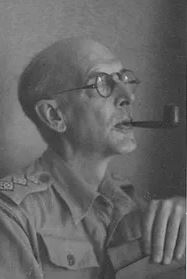
Older balding man in a military shirt smoking a pipe.
Captain Cecil Ross Pinsent via The Monuments Men Foundation Collection.

Cecil Ross Pinsent: 1884 – 1963

Family Branch: Devonport
PinsentID: GRO1100

References

Newspapers

Click here to view close family members.


Cecil Ross Pinsent was Adolphus Ross’s second son by Alice Mary (née Nuttall). He was born in Montevideo, Uruguay, in 1884 but his parents returned to England, so he grew up there. He was educated at “Marlborough College” in Wiltshire, where he was a contemporary of his cousin, Roy Pinsent. Cecil won a bursary to the “Architectural Association School” in London and later became a highly regarded “garden architect” in Italy.

His life is described in a book entitled “An Infinity of Graces” written by Ethne Clarke (published by W. W. Norton & Company, New York and London, 2013). I admit, I have not yet read it. Michael Spens, who reviewed the book, (www.studiointernational.com) and an observation on the “Foundation for the Preservation of Art” website tells us that Cecil was accepted into the “Royal Academy of Architecture” in 1905. The “Royal Institute of British Architects” has in its possession in its “British Architectural Library,” Cecil’s photograph albums for the years 1904 and 1905. I have not seen the albums, but I have one photograph – a family grouping – see attached. The albums they are said to contain several other family-related photographs, as well as numerous architectural studies. Cecil’s cousin, Clive Pinsent, is specifically mentioned (Worldcat.org: – OCLC No:943157680). He was of a similar age and shortly to join the Royal Navy.

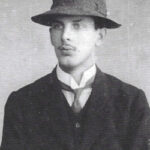
Man in Edwardian attire and a slightly crumpled hat.
Cecil sits for his passport photograph in 1906.

Cecil traveled to Florence to study classical Italian architecture in 1906. He visited the “Villa Gamberaia” and was strongly influenced by the symmetry of structure and design of its Renaissance garden. While in Florence, he met Edmond Houghton, an elderly British gentleman and his wife Mary and, if R. Terry Schnadelbach in his book “Hidden Lives – Secret Gardens: The Florentine Villas Gamberaia, La Pietra …”  is to be believed, he entered into a ménage à trois with them – to the point where he was commonly referred to as their “adopted son”. Houghton gave him his first architectural contract – designing his sister’s home in Bournemouth.

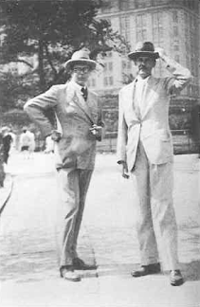
Two dapper-looking men in casual suits in 1950s clothes.
Cecil Ross Pinsent and Geoffrey Scott, date unknown.

However, Cecil’s first major contract came from American art historian Bernard Berenson and his wife, Mary, in 1909. Cecil Pinsent and Geoffrey Scott (another Englishman) were hired to design and rebuild their “Villa I. Tatti”, near Florence. The garden is among Cecil’s best-known architectural achievements. Monty Don (a modern-day authority on garden design) describes his geometric designs and clever usage of trees and hedges. Evidently, any flowers that might have existed in an Italian Renaissance garden were long gone by the time Cecil arrived on the scene (BBC: Monty Don’s Italian Gardens: Episode 2: 2011; www.siteandinsight.com/tag/cecil-pinsent/). Bernard Berenson donated the villa to “Harvard University” in the 1950s and it is still in its hands.

Cecil was in Florence at the start of the “First World War,” and he joined the “British Red Cross” and ran a “Mobile X-ray Unit”. He probably stayed on in Florence as he organized the scenery and lighting for a charity performance put on in aid of the English Branch of the Red Cross in Villa Medici, Fiesole, near Florence in November 1915 (The World: 30th November 1915). After the war, he joined a group of like-minded, artistic ex-patriots in Florence and continued his work on Italian gardens.

Cecil visited New York for about a month in 1929. Whether he was visiting friends or making contacts (or both) is unclear. The relevant ships’ manifests (findmypast.com, ancestry.com) describe him as being a “broker” on the way out to America and an “architect” on the way back to England. Either way, contracts soon followed. He was hired by a wealthy American, Iris Origio to redesign and rebuilt “La Foce” in the Val D’Orcia southwest of Florence. He built on his reputation for designing Italian-Renaissance style gardens using blocked out shapes and hedging but, at her request, added more colour. Evidently, he had an eye for fitting gardens into their natural landscape and he was elected a “Fellow” of the “Royal Institute of British Architects” in 1933. Monty Don describes the garden at “La Foce” in his BBC review of Florentine Gardens. The current owner – who knew Pinsent when she was young – describes him as being a tall man with a dry, English, sense of humour. He worked at “La Foce” throughout the 1930s. He had only just finish it before the “Second World War” broke out.

Cecil had retired to Warborough, in Oxfordshire, and he signed on there as an “Air Raid Warden” when the time came (1939 Register). When filling out the forms, he noted his profession and ability to speak Italian and, although he might have hoped for peace and quiet in Oxfordshire, it was not to be. He was called into service in 1943 and became one of Britain’s “Monuments Men” (Monuments, Fine Arts and Archives personnel). He must have lived a similar sort of life as that portrayed by George Clooney, Matt Damon and Bill Murray (perhaps without the heroics) in the film of that name, released in 2014.

“Captain” Cecil Ross Pinsent worked with the American Army as it fought its way through Tuscany and his typed field reports are held by the “American Commission on the Protection and Salvage of Artistic and Historic Monuments in the War Area” (www.Fold3.com – Robert Commission: 1943 – 1946). He describes the damage done by the departing Germans (and, presumably, by allied artillery and bombers) – including the destruction of the bridges in Florence, and he comments on the architectural significance of the various antiquities that were either damaged or lost.

On 24th September 1944, Capt. C. R. Pinsent, MFA&A, AMG, wrote a letter regarding “Complication in Protection of Antique” (United States Army in World War II: Special Studies: Civil Volume 8: by Harry L. Coles: p. 424: City of Florence, to Perkins, ACC Files, 10000/145/71). In it, he describes the work of “U.S. Army Engineers” and local workers in saving the facades and a tower in “Via Guicciardini” and “Via Por Santa Maria” and goes on to explain that he has been to assess damage at local villas and found that many have been neglected for so long or been rebuilt to such an extent that they do not warrant an “Off Limits” notice, as any damage would be irremediable. One had been used as a stable. After the war, he continued to work in Italy for a while, but he eventually returned to England.

He had fully “retired” by the time he took another trip to New York in 1950 (New York Passenger Lists: Ancestry.com). He later moved to Switzerland, where he died at Hilterfingen, Thunersee, in 1963. His will was probated in London the following year: his effects were valued at £29,439.

I have not read her book, but Spens quotes Ethne Clarke as saying that Cecil was an attractive man with many female suitors and that he pursued other women. However, Schnadelbach (above) makes it clear that he was bisexual. The Police Constable who charged four young men, including Cecil, of “causing an obstruction” walking around “Leicester Square” in London arm in arm after a concert in 1913 probably knew what he was looking at. On that occasion, however, the Magistrate felt the Constable had been overly aggressive and rejected the charge (Sheffield Evening Telegraph: 30th October 1913). Cecil never married.


Family Tree

GRANDPARENTS

Grandfather: Richard Steele Pinsent: 1820 – 1864
Grandmother: Catherine Agnes Ross: 1830 – 1906 

PARENTS

Father: Adolphus Ross Pinsent: 1851 – 1929 
Mother: Alice Mary Nuttall: 1855 – 1901

FATHER’S SIBLINGS (AUNTS, UNCLES)

Richard Alfred Pinsent: 1852 – 1948
Edith Mary Pinsent: 1853 – xxxx
Hume Chancellor Pinsent: 1857 – 1920 

MALE SIBLINGS (BROTHERS, Half-Brothers)

Sidney Hume Pinsent: 1879 – 1969
Gerald Hume Saverie Pinsent: 1888 – 1976 

Basil Hume Pinsent: 1911 – 2000 


Please use the above links to explore this branch of the family tree. The default “Next” and “Previous” links below may lead to other unrelated branches.