John Pinsent

Vital Statistics

Birth: 1659
Marriage: N/A
Spouse: N/A
Death: N/A

Family Branch: Devonport
PinsentID: GRO1741

Click here to view close family members


Family Tree

Grandparents

Grandfather: Thomas Pinsent: 1597 – 1649
Grandmother: Julian Sidstone: xxxx – 1663

Parents

Father: John Pinsent: 1626 – 1663
Mother: Philippa Wilmeade: 1631 – xxxx

Father’s Siblings (Aunts, Uncles)

Helen Pinsent: 1618 – 1618
Joan Pinsent: 1619 – xxxx
Mary Pinsent: 1622 – xxxx
Robert Pinsent: 1624 – 1671
John Pinsent: 1626 – 1663 ✔️
Julian Pinsent: 1628 – xxxx
Margaret Pinsent: 1630 – xxxx
Thomas Pinsent: 1633 – 1701
William Pinsent: 1638 – xxxx

Male Siblings (Brothers)

Thomas Pinsent: 1652 – 1711
Julian Pinsent: 1654 – xxxx
John Pinsent: 1656 – 1656
John Pinsent: 1659 – xxxx ✔️
Robert Pinsent: 1661 – 1729


Please use the above links to explore this branch of the family tree. The default “Next” and “Previous” links below may lead to other unrelated branches.
John Pinsent

Vital Statistics

Birth: 1656
Marriage: N/A
Spouse: N/A
Death: 1656

Family Branch: Devonport
PinsentID: GRO1739


Family Tree

Grandparents

Grandfather: Thomas Pinsent: 1597 – 1649
Grandmother: Julian Sidstone: xxxx – 1663

Parents

Father: John Pinsent: 1626 – 1663
Mother: Philippa Wilmeade: 1631 – xxxx

Father’s Siblings (Aunts, Uncles)

Helen Pinsent: 1618 – 1618
Joan Pinsent: 1619 – xxxx
Mary Pinsent: 1622 – xxxx
Robert Pinsent: 1624 – 1671
John Pinsent: 1626 – 1663 ✔️
Julian Pinsent: 1628 – xxxx
Margaret Pinsent: 1630 – xxxx
Thomas Pinsent: 1633 – 1701
William Pinsent: 1638 – xxxx

Male Siblings (Brothers)

Thomas Pinsent: 1652 – 1711
Julian Pinsent: 1654 – xxxx
John Pinsent: 1656 – 1656 ✔️
John Pinsent: 1659 – xxxx
Robert Pinsent: 1661 – 1729


Please use the above links to explore this branch of the family tree. The default “Next” and “Previous” links below may lead to other unrelated branches.
John Pinsent

Vital Statistics

John Pinsent: 1799 – 1870 GRO1041 (Tallow Chandler in London and Confectioner in New York)

Mary Ann Todd: 1799 – 1874
Married: 1821: London

Children by Mary Ann Todd:

Elizabeth Pinsent: 1822 – 1896
Thomas Pinsent: 1823 – 1825
William Pinsent: 1825 – xxxx (Confectioner, New York, U.S.A.; Married 1) Clara E. T. Unknown and 2) Louisa Unknown)
John Pinsent: 1826 – 1914 (Confectioner, New York; Married Sophia Jane Fisher)

Family Branch: Devonport
PinsentID: GRO1041

Click here to view close family members


John Pinsent was the eldest son of Thomas Pinsent by Elizabeth Pridham, his second wife. He was born in Newton Abbot and was just one year old when his grandfather, Mr. John Pinsent, a wealthy “soap boiler” from Moretonhampstead and the unquestioned patriarch of the Pinsent family died in October 1800.

Thomas and his father had unresolved issues – possibly because the former had had an illegitimate daughter Maria Pinsent (John’s elder sister) before he married John’s mother. Mr. John Pinsent was a committed Baptist and this could well have offended his sensibilities. At any rate, when he prepared his will, Mr. John by-passed his younger son (John’s father, Thomas) and left the bulk of his not-inconsiderable fortune to his eldest living grandson, Thomas Pinsent, who was John’s older half-brother. Little John was, however, legitimate, and his grandfather saw fit to leave him “sixty guineas in gold” – should he come off age. Not every child did in those days. John’s three younger brothers had yet to be born and they, of course, got nothing! By by-passing his son, Mr. John ensured that the bulk of his estate went to Thomas’s first family. The second was effectively cut out.

Thomas Pinsent was a “tallow chandler” (“salesman”) in Newton Abbot when his father died and left his “soap” and “tallow” boiling business to (Thomas’s elder brother) John Pinsent. He ran it for a few years but died in 1804. Thomas seems to have had no interest in taking over the business when his brother died and it was sold to an erstwhile apprentice. Thomas; however, gave up his own sales outlet and moved to “Greenhill” farm, in Kingsteignton with his second wife, Elizabeth (née Pridham). The farm, had been in the family since 1780 or earlier. How it came into the family, I am not sure but Thomas may have acquired it from his brother, Mr. John Pinsent, when he died in 1804.  Thomas’s own, legitimate son, Thomas Pinsent “junior” was just starting to build up a “drapery” business in Devonport so he was probably quite happy to let his father have the run of it if it had come to him. When his father died, Thomas Pinsent “junior” returned to Kingsteignton and took over the family farm.

John Pinsent grew up at “Greenhill” farm with his sister Maria and his younger brothers William Pinsent, Charles Pinsent and George Pinsent as they came on the scene. Their mother, Elizabeth, died in 1821 and Thomas was left with a relatively young family to look after. It is not clear how they were brought up, but it must have been obvious to them that there would be no place for them in Newton Abbot when their half-brother reclaimed his inheritance. For whatever reason, John and his siblings all left the county.

Maria Pinsent married Roger Yeo in 1814 and went out to Australia. With the help of their father, meanwhile, her brother John, set up in business as a “wax and tallow chandler” in Ratcliffe Terrace, on the Goswell Road in London (London Directories). He inherited the “sixty guineas in gold” left him by his grandfather in October 1821 and married a girl called Mary Ann Todd shortly thereafter. She was from Barningham, in Yorkshire (now County Durham), and her brother was a “cheese-monger” who also worked in London. John and Mary Ann had a daughter, Elizabeth Pinsent in 1822, and then three sons, Thomas Pinsent, William Pinsent and John Pinsent in 1823, 1825 and 1826 respectively. Their first-born son died in 1825, but the others survived. It must have been a busy household: “Mr. Pinsent (“Tallow Chandler”) corner of Powell Street West and Goswell Street Road” advertised for a, “active young woman” as a “nursemaid” to look after his young family in 1827 (London Times: 11th June 1827) and for “cook” for the household in 1829 (London Times: 3rd February 1829).

John’s brother-in-law, William Todd, was, as previously noted, a “cheese-monger” and John’s brother Charles Pinsent (coincidentally or otherwise) took up the trade when he, too, arrived in London. Charles married Mary Fullick in Hanover Square in 1833. John’s youngest brother, George Pinsent, also came up to London where he became a “tailor.” George married Elizabeth Leatt – although I am not sure when or where. Their other brother, William Pinsent seems to have taken to the sea as he was a “mariner” when he married Margaret Sayle in Liverpool in 1835.

John and Mary Ann sold up and sailed for America in 1832. They arrived in New York on the “S.S. Wellington” on 26th September. On their arrival, John told the immigration officials he was a “soap boiler” who planned to settle in the United States (New York Passenger Lists: 1820-1957: Ancestry.com). He almost immediately applied for  U.S. Citizenship. Interestingly, the couple took their seven-year old son William with them but left their ten-year old daughter Elizabeth and their six-year old son John behind! Perhaps this was because of their schooling. The children were left in the care of their uncle William Todd, the London “cheese-monger” whose true home was in Barningham.

Mary Ann (née Todd) brought her son William Pinsent back to England for a visit in 1836 and we find them returning to New York on the “S.S. Montreal” on 3rd January the following year. When the 1841 Census was taken a few years later, John Pinsent “junior”  was a pupil ensconced at a school in Gainford, a village in County Durham. He would have been fifteen years old at the time so he may have stayed on in England to continue with his education; however, it begs the question as to why his brother, who was only a year older, was educated in America. Ships’ manifests show that Mary Ann Pinsent returned to England periodically to visit her family in London and Yorkshire, and to check up on her children. John Pinsent “junior” eventually rejoined his parents in New York and took out U.S. Citizenship in 1845. His sister Elizabeth, meanwhile, stayed on in England. I do not know why. She never married so marriage was not the reason.

In 1842, John Pinsent “senior” was caught up in  the murder trial of James Low, a man accused of killing a farmer, Isaac Winans, at Rathay, near New York. Low deposed in Court that he had planned to buy a farm near Elizabethtown from Dr. Geo Chetwood and that he had gone there with“Pensant” to discuss terms. He said he hoped “Pensant” would “get the money to buy the farm.” What he meant by that I am not sure! The Doctor asked for $3,600 but as “Pensant” though that was excessive they parted company. Low later met Isaac Winans, a man whose farm was for sale, and he told a Mrs. Howarth at the place were he lodged that he and “Pensant” had “partly engaged to buy Isaac Winan’s place.”

A few days later, Low was seen hanging around Mr. Winan’s farm with his dog and a double barrelled shot gun – ostensibly looking for woodcock. No immediate suspicions were raised when shots were heard – as Low had told people that Winans had gone to New York to arrange for the transfer of the property. Nevertheless, when Mr. Winan’s body was found buried and his money belt was gone, and Low claimed  ownership of the property, he became the principal suspect. The evidence suggested premeditation, so the jury brought in a verdict of “Guilty of Murder in the First Degree” (Pennsylvania Inquirer and National Gazette: 1st July 1842.)

When called to testify, John Pinsent “senior” said that he had been employed as a “customs house and shipping clerk” for the firm of “John B. Morewood & Co.” of 52 South Street in New York for the last four years. He had lived in New York for ten years and had two sons, the elder of the two (William) was a “clerk” aged 16 years and living with him in New York. The younger (John) was aged 14 years and lived in London. John said he was “secretary” of the “Odd Fellows” and had known Low about three and a half years; however, he had never discussed buying a farm with him and had never met him at Elizabethtown. Doctor Chetwood deposed that “Low asked him the price of my farm, and I said $4,000 but would take $3,800; never knew Pinsent till I was introduced to him on the first day of the trial” (New York Spectator: Saturday 23rd July 1842). It did not look good for Mr. Low.

American Census records show that John Pinsent “senior” switched from clerical work to making “soap” (if he ever did that) sometime in the 1840s and thereafter promptly changed to making “sweets”. He opened a confectionery at #350 Bowery but suffered an early setback when the jewelry store next door – at #352 – caught fire on 13th March 1848. The fire spread, and John lost his upper floor and roof to the flames. He also lost his stock-on-hand to water damage (New York Herald: 14th March 1848).

John was to be found living in the 15th Ward in New York with his wife, his son John Pinsent “junior” and three young servants when the census was taken in 1850. He was to become a well-known “confectioner”. The family’s shop at 350 ½ Bowery was at least memorable. Looking back at his childhood, the American novelist Henry James waxes lyrical about the treats available to a small boy of around ten years old: Pynsent’s was higher up in the row in which Forest’s had its front – other and dearer names have dropped from me, but Pynsent’s adheres with all the force of the strong saccharine principle. His principle, at its highest, we conceived, was embodied in small amber-coloured mounds of chopped cocoanut or whatever other substance, if a finer there be; profusely lusciously endued and distributed on small tin trays in the manner of haycocks in a field. We acquired, we appropriated we transported, we enjoyed them, they fairly formed perhaps, after all, our highest enjoyment; but with consequences to our pockets – and I speak of those other than financial, with an intimacy; a reciprocity of contact, at any or at every personal point, that I lose myself in the thought of” (A Small Boy and Others: Henry James: University of Virginia Press 2011). He may have got the spelling wrong, but who can question his choice of treat? The fire was doubtless a blow to all the little boys in the neighbourhood.

At the time of the next, 1855, New York Census, John and Mary were living in a brick house in the 15th Ward. It was valued at $15,000, which was a considerable sum back then. Both of their sons had moved out but they lived with a servant and two “apprentice confectioners”, so John was clearly still active in the business.

In June 1855, John was elected “Manager” of the “Odd Fellows” (a fraternal charitable organization) so he must have been a merchant of some standing in the community. John and his wife returned to England in 1859. Presumable they came back to visit Mary Ann (née Todd’s) relations and their own daughter Elizabeth, who was still lived with them. They returned to New York on the “S.S. City of Baltimore”, which arrived arriving on 29th September. Interestingly, they traveled “main steerage class” not “saloon” – despite their financial success in America, John was still a frugal businessman! By then, both of his sons were married and they were starting to take over the “confectionary” business. New York City’s Directory for 1857 shows that John Pinsent “junior” was a “confectioner” living at #350 ½ Bowery, and John Pinsent (presumably “senior”) and William Pinsent were “confectioners” who lived at #217 Sixth Avenue, New York. As an interesting sideline, an item in the New York Daily Times (23rd May 1854) tells us that the Sixth Avenue site was also an agency for the sale of lottery tickets and cigars!

The Inland Revenue Service charged John for a license to trade at #370 Bowery, New York. A Class B. 56 License cost him $6.67 in 1863, but it had gone up to $10 by following year (IRS Tax Assessment Lists 1862 – 1918: Division 3, Collection District 6 Annual Lists 1862 – 1864).

John Pinsent and Mary Ann were living with William and his family when the Federal census was taken in June 1870. By then, William and John “junior” had pretty well taken over the running of the business. Their father, died a couple of months later (31st August) and John’s friends and relatives were invited to attend his funeral at the Church of the Memorial, on the Corner of Hammond Street and Waverley Pace on the following Sunday. The Members of “Warren Lodge” of the “Odd Fellows” met to pay their last respects to P. G. John Pincent, on the morning of the internment (New York Herald: 3rd September 1870).

John’s widow, Mary Ann, seems to have returned to England and spent her last few years living with her daughter Elizabeth and her Todd relations in Barningham. She died on 13th December 1874 and is buried in the village churchyard. Her gravestone reads: “Sacred to the memory of Mary, widow of John Pinsent of New York, & daughter of William & Isabella Todd, who died 13th December 1874, aged 75″.

As far as I am aware, Mary Ann’s daughter Elizabeth never went out to New York. She seems to have gone to live with her uncle William Todd, a “cheese monger,” as a young girl, and census records show that she stayed with him and other members of the Todd family throughout her life. However, for some reason, she was never formally recognized as being William’s niece. The census records show that she was a “visitor” in 1851, a “house-keeper” in 1861 and an “annuitant” in 1871 and 1881. Presumably her father had made financial arrangement for her in his will before he died.

Elizabeth travelled to Lagos on the west coast of Africa with the “Misses Todd” in 1890. Why, I have no idea. She was sixty-eight years old at the time. Meanwhile, while back in Barningham, she took part in local events and fundraisers with the Todd family. For instance, she helped out with a “Barningham Institute” sale in August 1869 (Teesdale Mercury: Wednesday 11th August 1869).

According to the Teesdale Mercury (14th April 1875), Elizabeth left Barningham in 1875.  She sold off a substantial amount of “new and valuable” household goods that year and moved to Montablo Terrace, in Barnard Castle, in Durham. This was a poorly lit part of town and she signed on to a letter of petition to the local Health Board complaining that, as rate payers, they deserved the same level of service as other parts of town (Teesdale Mercury: 9th October 1878).  It agreed. Meanwhile, in the 1880s, “Miss Pinsent” (Elizabeth), spent parts of several summers by the sea, in and around Redcar. Presumably the light was better there (Redcar and Saltburn-by-the Sea: Friday August 27th 1880)!

Elizabeth died in Barnard Castle in July 1896 was buried close to her mother in Barningham churchyard. There is an imposing pedestal to her memory inscribed “Erected in ever loving memory of Elizabeth Pinsent who died at Barnard Castle on 3rd July 1896, aged 74 yrs (4 line verse)“. The monument was, I imagine, erected by one of the Todds.


Family Tree

Grandparents

Grandfather: John Pinsent: 1723 – 1800
Grandmother: Elizabeth Puddicombe: 1719 – 1795

Parents

Father: Thomas Pinsent: 1754 – 1841
Mother: Elizabeth Pridham: 1763 – 1821

Father’s Siblings (Aunts, Uncles)

Elizabeth Pinsent: 1743 – xxxx
John Pinsent: 1745 – 1804
Mary Pinsent: 1748 – 1749
Mary Pinsent: 1751 – 1773
Thomas Pinsent: 1754 – 1841
Sarah Pinsent: 1759 – 1782

Male Siblings (Brothers)

Thomas Pinsent: 1779 – 1779
Thomas Pinsent: 1782 – 1872

John Pinsent: 1799 – 1870
William Pinsent: 1808  – xxxx
Charles Pinsent: 1812 – 1863
George Pinsent: 1814 – 1894


Please use the above links to explore this branch of the family tree. The default “Next” and “Previous” links below may lead to other unrelated branches.
John Pinsent

Vital Statistics

Birth: 1706
Marriage: N/A
Spouse: N/A
Death: 1706

Family Branch: Devonport
PinsentID: GRO1784

Click here to view close family members


Family Tree

GrandParents

Grandfather: Robert Pinsent: 1654 – 1686
Grandmother: Mary Hamlyn: xxxx – xxxx

Parents

Father: Robert Pinsent: 1678 – 1707
Mother: Elizabeth Voisey: xxxx – xxxx

Father’s Siblings (Aunts, Uncles)

Robert Pinsent: 1678 – 1707 ✔️
Mary Pinsent: 1680 – xxxx
Elizabeth Pinsent: 1683 – 1704
Thomas Pinsent: 1685 – 1694

Male Siblings (Brothers)

Robert Pinsent: 1703 – 1711
John Pinsent: 1706 – 1706 ✔️


Please use the above links to explore this branch of the family tree. The default “Next” and “Previous” links below may lead to other unrelated branches.
John Pinsent

Vital Statistics

Birth: 1620
Marriage: N/A
Spouse: N/A
Death: 1629

Family Branch: Devonport
PinsentID: GRO1769


Family Tree

Grandparents

Grandfather: Robert Pinsent: 1562 – 1626
Grandmother: Dorothy Carpenter: 1565 – 1643

Parents

Father: Robert Pinsent: 1589 – 1650
Mother: Agnes Stevens: xxxx – 1655

Father’s Siblings (Aunts, Uncles)

Simon Pinsent: 1587 – xxxx
Robert Pinsent: 1589 – 1650
Dorothy Pinsent: xxxx – 1590
William Pinsent: 1591 – 1591
Helen Pinsent: 1592 – xxxx
Thomas Pinsent: 1597 – 1649
George Pinsent: 1599 – xxxx
John Pinsent: xxxx – 1600

Male Siblings (Brothers)

John Pinsent: 1620 – 1629
Simon Pinsent: 1622 – 1643
Thomas Pinsent: 1624 – 1655


Please use the above links to explore this branch of the family tree. The default “Next” and “Previous” links below may lead to other unrelated branches.
John Pinsent

Vital Statistics

Birth: N/A
Marriage: N/A
Spouse: N/A
Death: 1600

Family Branch: Devonport
PinsentID: GRO1761

Click here to view close family members


Family Tree

Grandparents

Grandfather: William Pinsent: 1527 – 1601
Grandmother: Joan Unknown: 1535 – 1590

Parents

Father: Robert Pinsent: 1562 – 1626
Mother: Dorothy Carpenter: 1565 – 1643

Male Siblings (Brothers)

Simon Pinsent: 1587 – xxxx
Robert Pinsent: 1589 – 1650
William Pinsent: 1591 – 1591
Thomas Pinsent: 1597 – 1649 
George Pinsent: 1599 – xxxx
John Pinsent: xxxx – 1600 ✔️


Please use the above links to explore this branch of the family tree. The default “Next” and “Previous” links below may lead to other unrelated branches.
John Pinsent

Vital Statistics

Birth: 1680
Marriage: N/A
Spouse: N/A
Death: 1704

Family Branch: Devonport
PinsentID: GRO1743

Click here to view close family members


Family Tree

Grandparents

Grandfather: John Pinsent: 1626 – 1663
Grandmother: Philippa Wilmeade: 1631 – xxxx

Parents

Father: Thomas Pinsent: 1652 – 1711
Mother: Catherine Parker: 1655 – 1686

Father’s Siblings (Aunts, Uncles)

Thomas Pinsent: 1652 – 1711 ✔️
Julian Pinsent: 1654 – xxxx
John Pinsent: 1656 – 1656
Joan Pinsent: 1657 – xxxx
John Pinsent: 1659 – xxxx
Robert Pinsent: 1661 – 1729

Male Siblings (Brothers)

Julian Pinsent: 1677 – 1721
John Pinsent: 1680 – 1704 ✔️
Thomas Pinsent: 1682 – 1702
Robert Pinsent: 1684 – 1685


Please use the above links to explore this branch of the family tree. The default “Next” and “Previous” links below may lead to other unrelated branches.
John Pinsent

Vital Statistics

John Pinsent: 1626 – 1663 GRO1733 (Knighton)

Philippa Wilmeade: 1631 – xxxx
Married: xxxx: xxxx, xxxx

Children by Philippa Wilmeade:

Thomas Pinsent: 1652 – 1711 (Married 1) Katherine Parker in 1677: 2) Margaret Ball in 1689; Knighton)
Julian Pinsent: 1654 – xxxx
John Pinsent: 1656 – 1656
Joan Pinsent: 1657 – xxxx
John Pinsent: 1659 – xxxx
Robert Pinsent: 1661 – 1729 (Married Elizabeth Delve, 1684, Kelly)

Family Branch: Devonport
PinsentID: GRO1733

Click here to view close family members


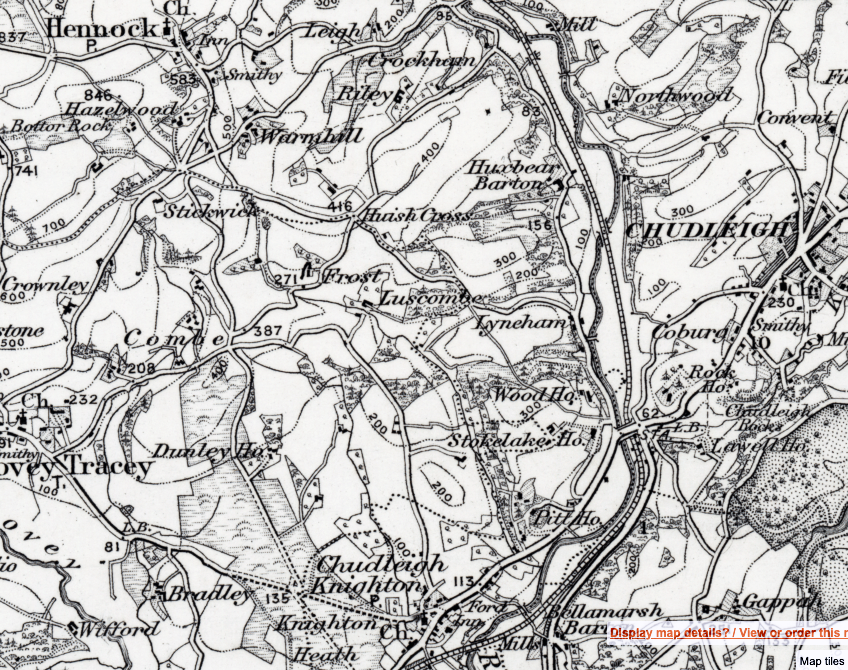
Black and white, cluttered map showing Hennock, Chudleigh, Chudleigh Knighton.
Map of Hennock showing Huxbear Barton near Chudleigh.

John Pinsent was one of the two middle sons of  Thomas Pinsent of “Huxbeare” by his wife, Julian Stidstone. He grew up with two brothers, Robert and Thomas, whose lives can be traced and a third, William Pinsent, whose life is less certain. He also had five sisters, one of whom we know died young. The others are, as yet, unaccounted for. Their father was an affluent yeoman who owned two farms, “Huxbeare” and “Knighton,” in Hennock. The former seems to have been the more important of the two.

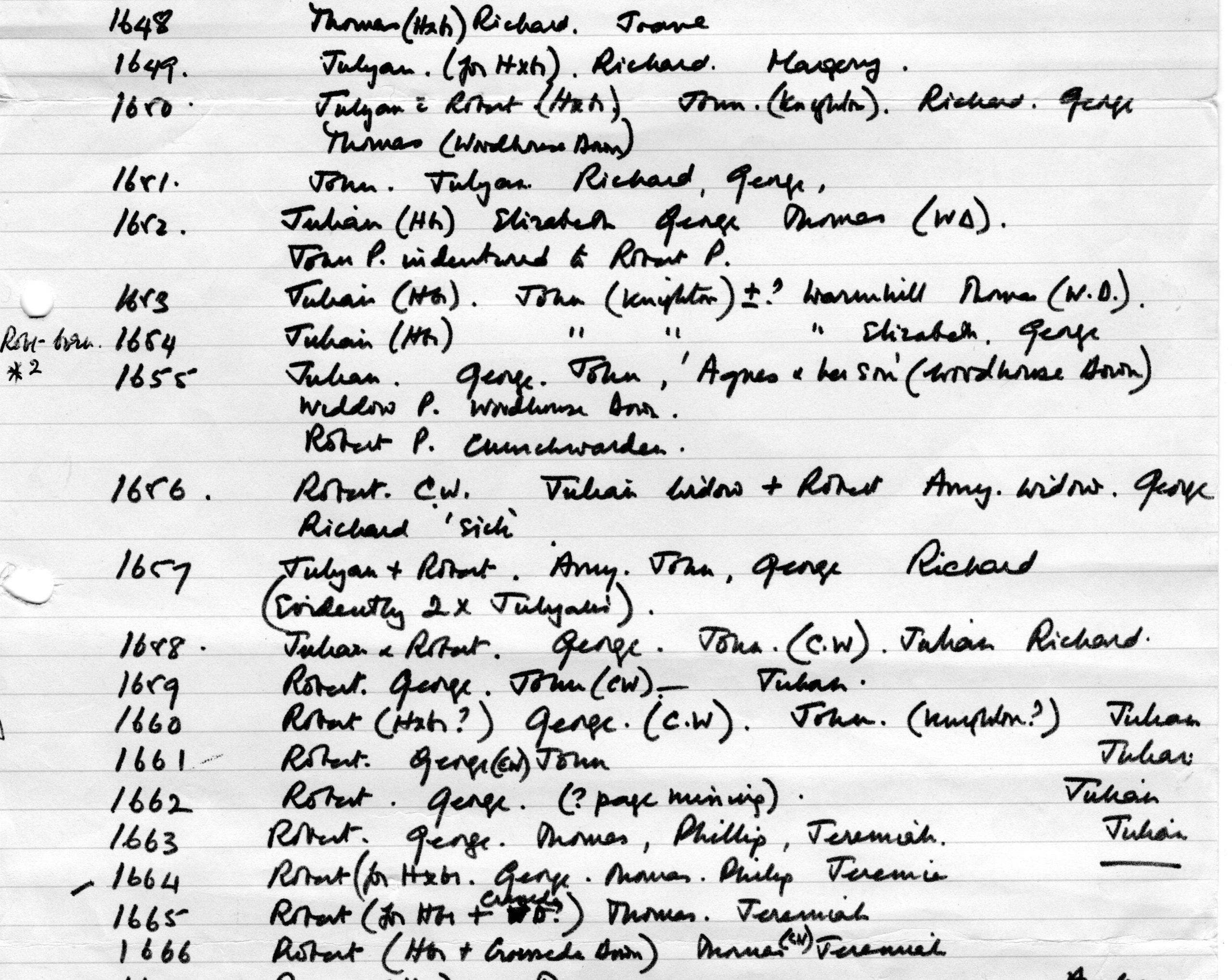
Handwritten transcript of the Church Warden accounts showing Julian and numerous properties.
Julian appears in the Church Warden’s Accounts.

Hennock’s “Churchwardens’ Accounts” show that Julian Pinsent paid the parish rates for “Huxbeare” and for four other tenements (“Downend”, “Knighton”, “Warmhill” and “that which was Pinsent’s”) when her husband died. He had lived through the Civil War and, somehow, managed to maintain his estate. He died in 1649. She held them for a while and then dispersed them among her sons. Robert Pinsent, her eldest son, took “Huxbeare”, “Cressida Down” and other ancillary properties and John, the next in line, was given “Knighton”, “Warmhill” and “Pinsents”.

The parish accounts refer to a payment “for the writing of John Pinsent’s indentures to Robert Pinsent” in 1652.  The documents are long gone; however, they probably related to the break up of their father’s estate – which must have occurred sometime before John married. Why the parish paid, I am not sure! John’s younger brother, Thomas Pinsent, was left out; however, he acquired a tannery at “Slade” in 1657 through a, presumably pre-arranged, marriage to Julian Wilmeade. John Pinsent, meanwhile, paid the rates for “Knighton” and “Warmhill” from 1650 through until his death in 1663.

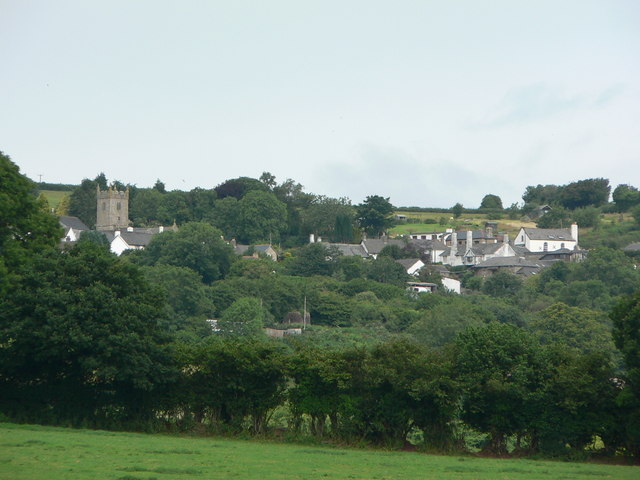
Modern photograph of white buildings across a hill surrounded by trees.
Hennock village photographed from the direction of Warmhill Farm.

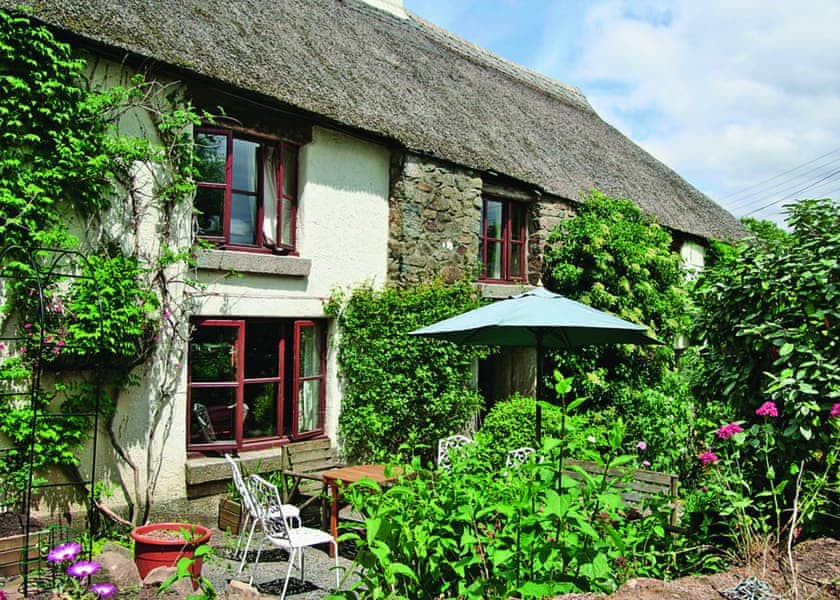
“Warmhill” is a Domesday listed farm on the side-slope below Hennock village. How long it had been in the family, I am not sure; however, the “Bovey Tracey Court Rolls (C.R.72)” show that Roger Pynson held two houses and 2 furlongs of land there from the Lord of the Manor when he died in 1429. His wife, Joan, received a life interest after which it was to go to Giles and Joan Sayer. The parish records, on the other hand, tell us that Robert Pinsent of “Warmhill’s” daughter Alison was baptized in Hennock in 1545. There were, and still are a cluster of houses at “Warmhill”. They are mostly recreational cottages, nowadays.

Modern photograph of a white cottage with a dark roof.
Warmhill Farmhouse in Hennock.

The Pinsents, Wilmeades and Meardons were land-owning families in and around the parish of Hennock and, as will become apparent, they seemed to have tried to keep it that way. John Pinsent married Philippa Wilmeade around 1652. I do not know exactly when as there are breaks in the parish records. His brother Thomas married her sister Julian in 1657. 

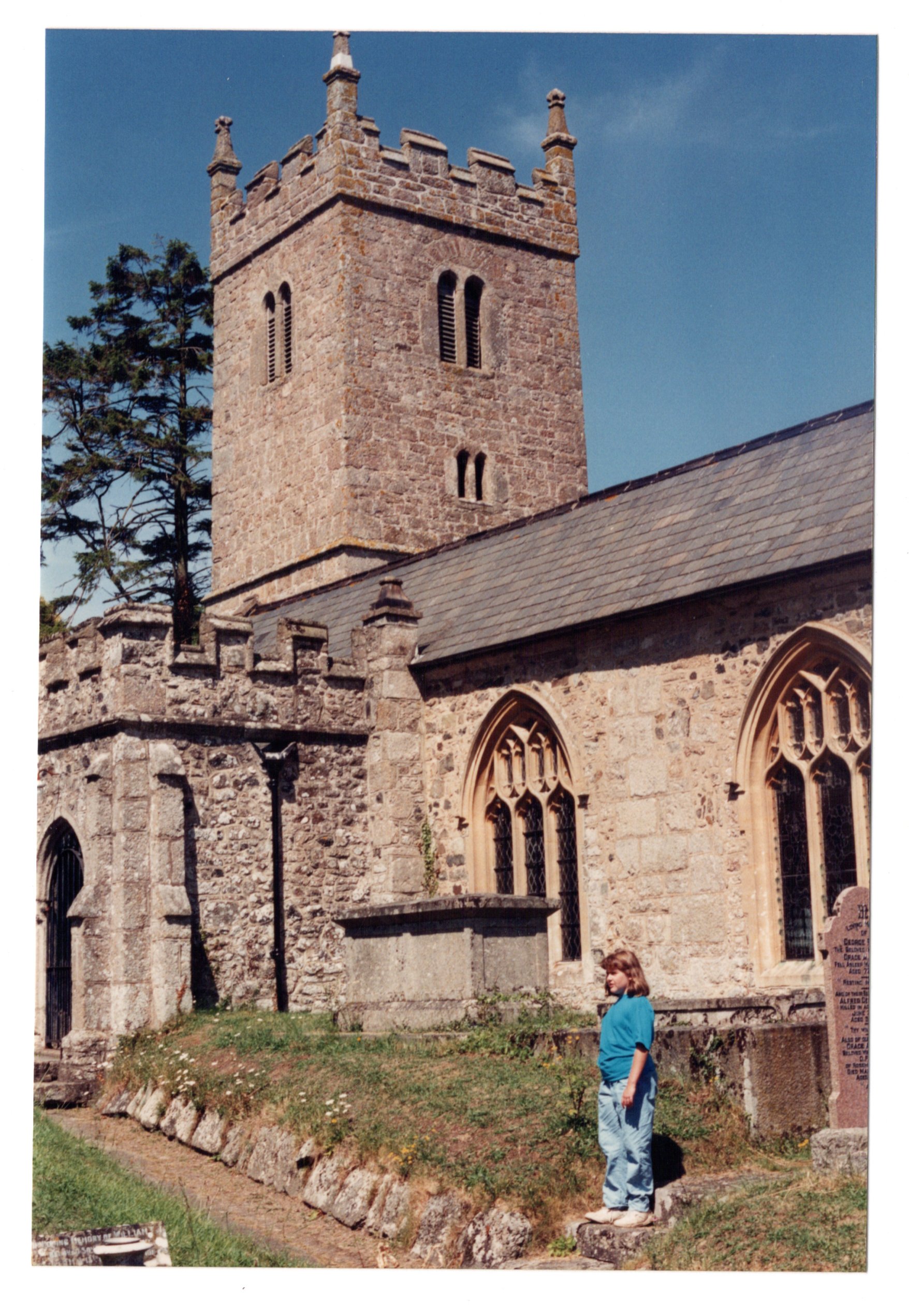
A girl in a blue shirt stands in front of a large stone church.
St. Mary’s Church is photographed in Hennock in 1994.

John and Philippa had four sons but only three survived. The eldest, Thomas Pinsent inherited “Knighton” when his father died in 1663. However, he was only eleven years old at the time and it must have been held “in trust” for him until he came of age. His mother married John Soper, by license, in Exeter in 1665 (Exeter Marriage Licenses) and he, presumably ran the farm in the meantime. Presumably John and Philippa knew there was an abundance of potters’ clay in the neighbourhood but they were more interested in the old farmstead adjacent to a small tributary of the River Teign. The relevance of the clay grew throughout the 1700s and the farm seems to have been absorbed into a clay-workers village in the latter half of the 18th century.  

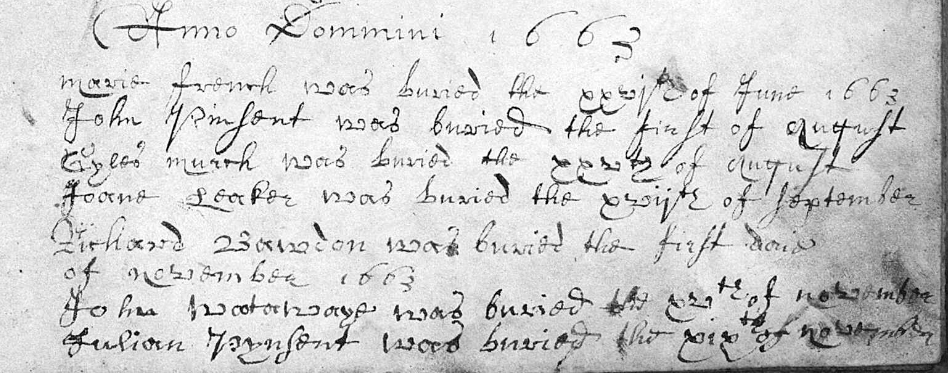
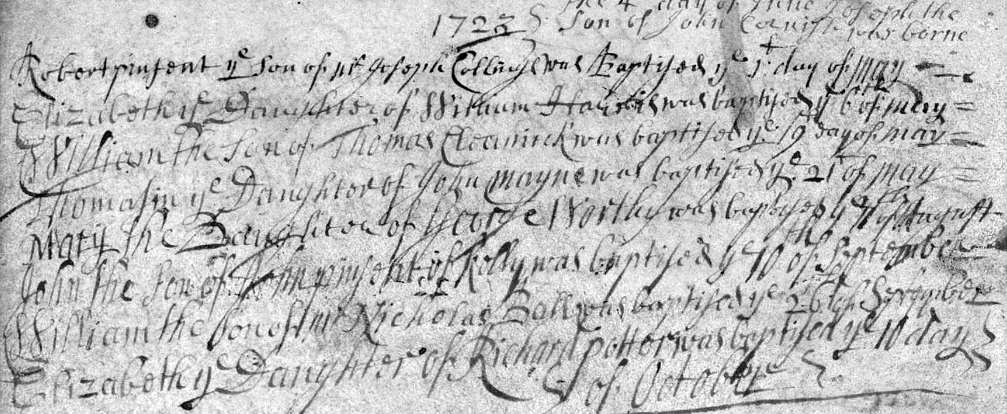
Handwritten notice of John Pinsent's burial in 1663.
John Pinsent is buried in 1663.

The middle son, another John Pinsent, is a loose end. I do not know what became of him. He may have died young. John’s youngest, Robert Pinsent, received an inheritance from the Wilmeade family that included a soap boiling operation and other land in “South Kelly” in what was then Hennock. It is through Robert and his wife Elizabeth (nee Delve) that the “DEVONPORT” branch has come down into modern times. Their descendants expanded the business into a successful operation in Moretonhampstead in the late 1700s. They ran a well-known drapery business in Devonport (and an equally well known brewery in Newton Abbot) in the 1800s and then moved into the legal profession. Sir Richard Alfred Pinsent founded “Pinsent and Co.” the modern-day firm of “Pinsents” in Birmingham, in the 1870s. It is still a going concern today. Their lives are discussed elsewhere.

It is not clear what happened to John and Philippa’s two daughters, Julian Pinsent and Joan Pinsent. They would have been children when their father died in 1663. John was a young man (by modern standards) when he died at the age of 36 years.  Once again, the family farm had to be held “in trust” for an eldest son.


Family Tree

GrandParents

Grandfather: Robert Pinsent: 1562 – 1626
Grandmother: Dorothy Carpenter: 1565 – 1643

Parents

Father: Thomas Pinsent: 1597 – 1649
Mother: Julian Sidstone: xxxx – 1663

Father’s Siblings (Aunts, Uncles)

Simon Pinsent: 1587 – xxxx
Robert Pinsent: 1589 – 1650
Dorothy Pinsent: xxxx – 1590
William Pinsent: 1591 – 1591
Helen Pinsent: 1592 – xxxx
Thomas Pinsent: 1597 – 1649 ✔️
George Pinsent: 1599 – xxxx
John Pinsent: xxxx – 1600

Male Siblings (Brothers)

Robert Pinsent: 1624 – 1671
John Pinsent: 1626 – 1663 ✔️
Thomas Pinsent: 1633 – 1701
William Pinsent: 1638 – xxxx


Please use the above links to explore this branch of the family tree. The default “Next” and “Previous” links below may lead to other unrelated branches.
John Pinsent

Vital Statistics

John Pinsent: 1690 – 1737 GRO1716 (Soap Boiler, Kelly and Leigh in Hennock)

Margaret Luscombe: xxxx – xxxx
Married: 1720: Exeter

Children by Margaret Luscombe:

Sarah Pinsent: 1721 – 1805 (Married James Wreaford, 1741, Hennock)
John Pinsent: 1723 – 1800 (Married Elizabeth Puddicombe, 1742, Crediton)
Thomas Pinsent: 1726 – 1757 (Married Mary Gildon of Kingsteignton, 1752; Inherited Leigh from his father).
Mary Pinsent: 1728 – xxxx
Elizabeth Pinsent: 1732 – 1804 (Married Joseph Wills, 1754; Her stepfather, Ambrose Rackett of Crediton, was a witness).

Family Branch: Devonport
PinsentID: GRO1716

Click here to view close family members.


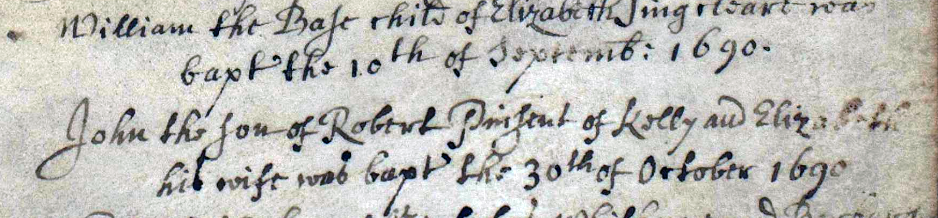
Handwritten note of John's baptism. Son of Robert Pinsent of Kelly and Elizabeth, his wife, was baptized the 30th of October 1690.
John is baptized in 1690.

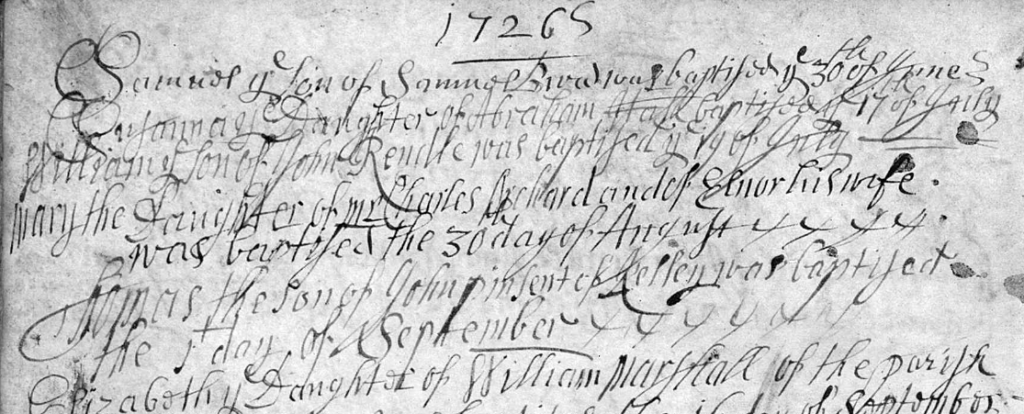
John Pinsent (1690 – 1737) was the son and sole heir of Robert Pinsent and Elizabeth (née Delve) of “South Kelly” in Hennock.  His father was a soap boiler and he was brought up in the family business. John married Margaret Luscombe, of Chudleigh, in Exeter in February 1720 (Exeter Marriage Licenses) and they had two sons and three daughters between 1721 and 1732. Three of them — Sarah Pinsent, Thomas Pinsent and Elizabeth Pinsent — were baptized in Hennock but the other two John Pinsent and Mary Pinsent were christened in Lustleigh, which was a far more convenient church and one whose jurisdiction would later be extended to include Kelly. Interestingly, Robert Pinsent Collings was baptized in Lustleigh a few months before John. Presumably, his mother was Mary Pinsent of Huxbeare – who had married Mr. Joseph Collings in 1700.

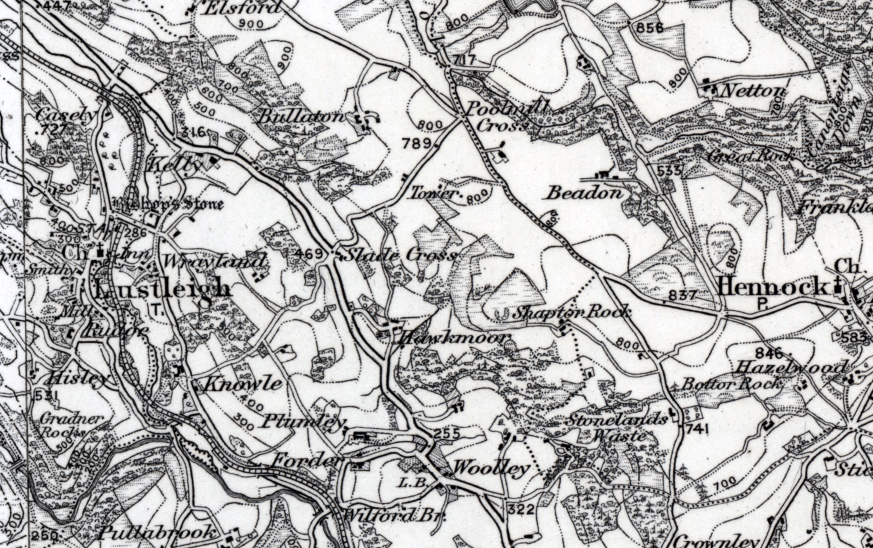
Cluttered black and white map displaying Hennock and Lustleigh close together.
Map of Lustleigh near Hennock.

According to Cecil Torr, in “Wreyland Documents: 1910”, John took over his father’s soap boiling business as part of his marriage settlement in February 1719/1720. His father retired from the production side of the business but retained “the shopp, the shopp chamber and the entry chamber through the garden next adjoining to the high way leading from Bovey Tracey to Moretonhampstead, parcel of the premises called South Kelly” for himself (as discussed elsewhere). Presumably Robert and Elizabeth still enjoyed being a shopkeepers.

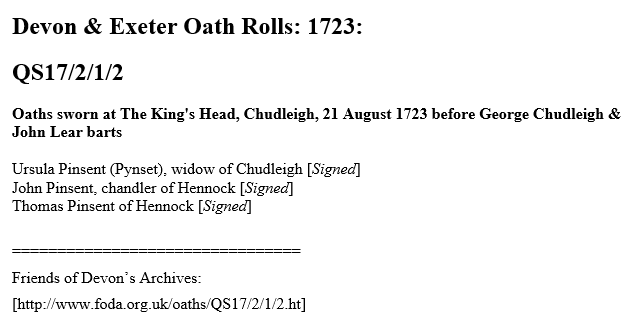
Transcript of a document reading "Devon & Exeter Oath Rolls: 1723: QS17/2/1/2 Oaths sworn at The King's Head, Chudleigh, 21 August 1723 before George Chudleigh & John Lear barts. Ursula Pinsent, widow of Chudleigh, John Pinsent, chandler of Hennock, Thomas Pinsent of Hennock." All three signed their names.
John swears an oath at The King’s Head in 1723.

It must have been a successful business as John took on apprentices. He was the “tallow chandler” who took on Thomas Luscombe of Chudleigh (probably one of his wife’s relatives) in 1721 and added Thomas Ellis in 1729 (Apprentices of Great Britain 1768-1774). He was also the “chandler” of Hennock who signed the “Devon and Exeter Oath Roll” in 1723. It was a declaration against “transubstantiation” aimed at limiting the job prospects of Roman Catholics – “Transubstantiation” being an article of faith for Roman Catholics and an anathema to the protestant church!

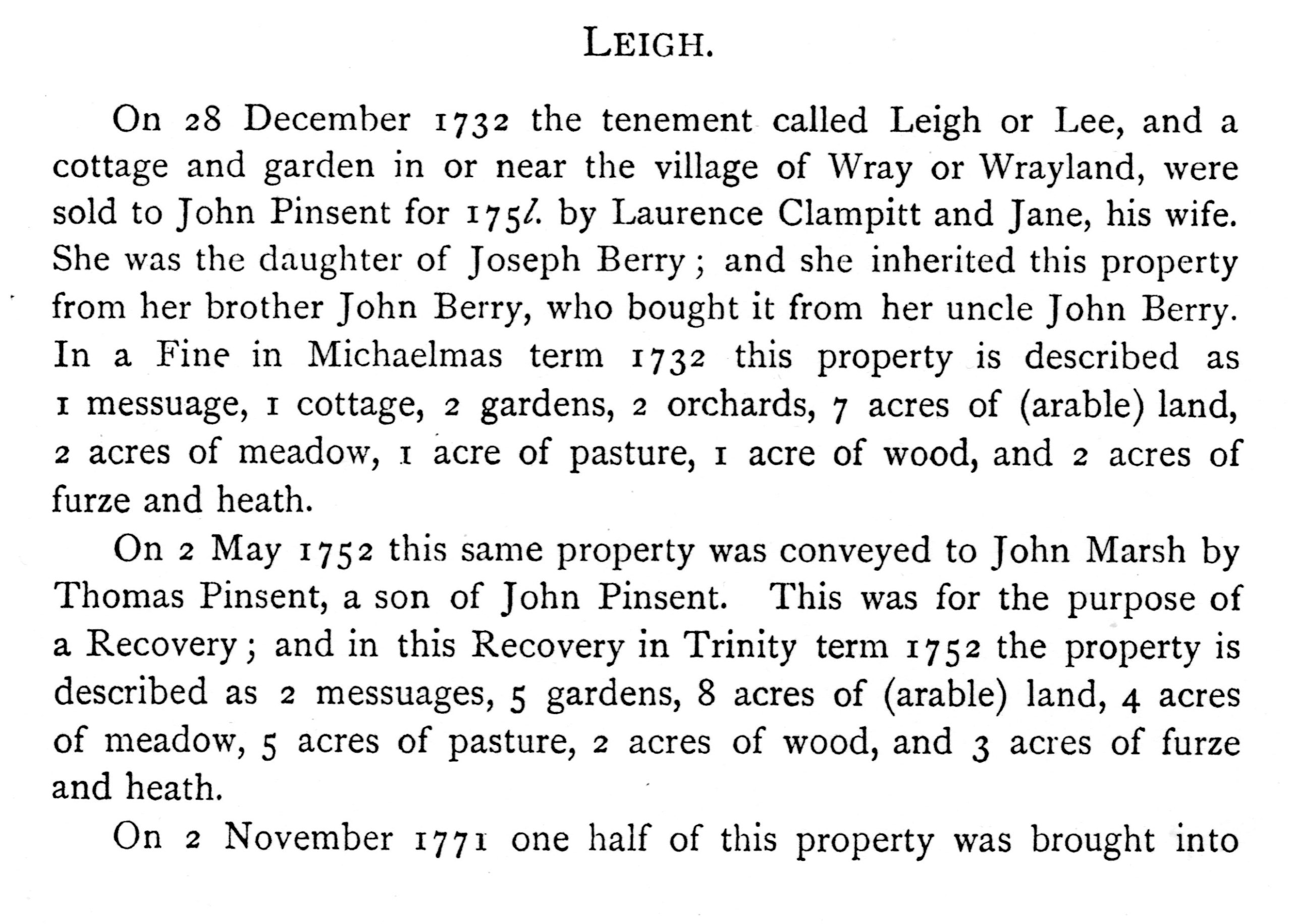
Excerpt describing the sale of a tenement called Leigh or Lee on December 28, 1732 to John Pinsent. On May 2, 1752, the same property was conveyed to John Marsh by Thomas Pinsent, a son of John Pinsent.
John’s purchases the tenement at Leigh in December of 1732.

John Pinsent paid parish rates of between 1/- and 1/6d for his land in Hennock between 1728 (when records resumed after a break) and 1738, the year after he died (Hennock “Church Wardens’ Accounts”). Then, as now, it can take time for the bureaucrats to catch up. He also appears on a list of Hennock “Devon Freeholders” that was compiled before his death, in 1737.

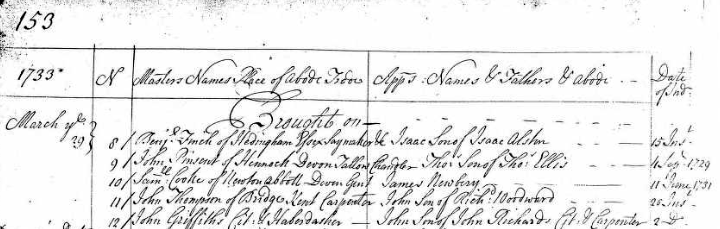
Entry dated March 29, 1733 listing John Pinsent of Hennock, tallow chandler
John appears in the UK Register of Duties Paid for Apprentices’ Indentures for March 1733.

John seems to have served on the “Manor Court Jury” in Wreyland periodically between 1711 and 1725 and he was, specifically, “presented” for non-appearance in 1727 (Wreyland Documents: Cecil Torr, 1910). He must have been elected “Church Warden” in 1736, as he approved the Hennock “Church Wardens Accounts’” that year. This was shortly before he died.

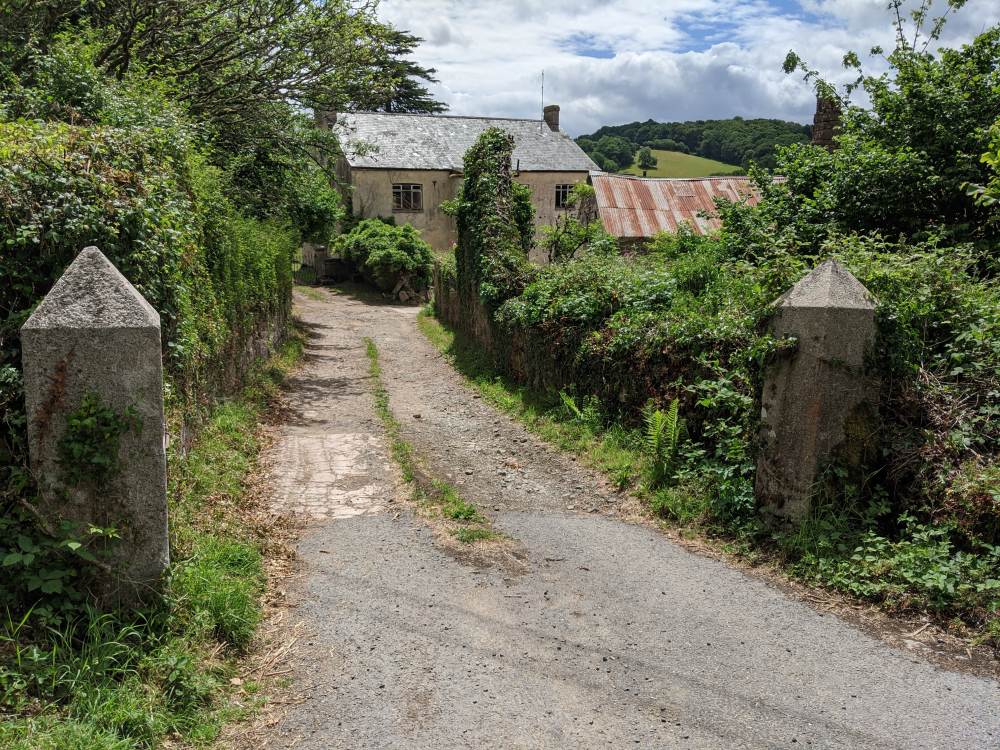
Modern photograph of stone farm buildings at the end of a road.
Kelly Farm as it looks today.

John purchased a tenement called “Leigh”, from Laurance Clampitt and his wife on 28th December 1732. It was near Wreyland Cross, just to the east of the village of Lustleigh. “Leigh” was contiguous with and down slope from, “Kelly.” At the time, it was described as “1 messuage, 1 cottage, 2 gardens, 2 orchards, 7 acres (arable) land, 2 acres meadow, 1 acre pasture, 1 acre wood, and 2 acres of furze and wood”. He later passed it to his younger son, Thomas, and the latter conveyed it to John Marsh on 2nd May 1752 (Cecil Torr: Wreyland Documents). This is not the first time that the Pinsent family owned land at “Kelly” and “Leigh”. According to Cecil Torr, Court Roll documents show that a Roger Pynsant held “one messuage and half a furlong of land in Calwelegh” (“Kelly with Leigh”) in 1437. Whether this Roger’s line made it through to the eighteenth century is not known.

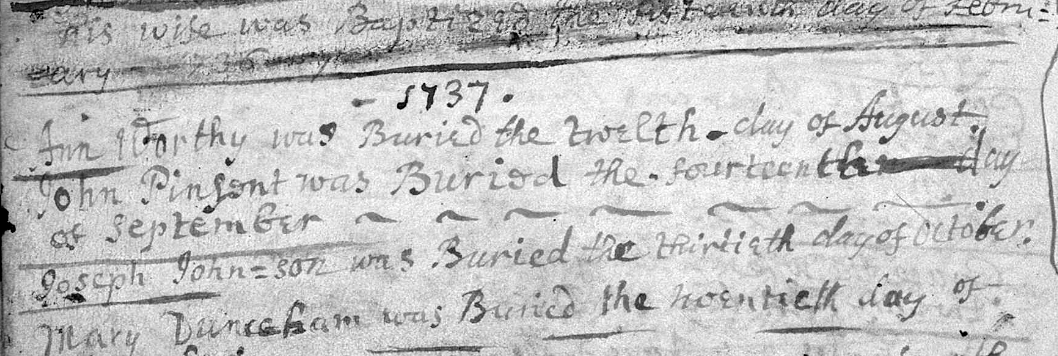
Handwritten note of John Pinsen'ts burial on September 14, 1737.
John is buried on September 14, 1737.

John Pinsent “senior” died in 1737 leaving his widow with several relatively young children to look after. He left a Will (“Calendar of Devonshire Wills and Administrations”); however, it was destroyed when the Exeter “Probate Registry” was bombed during the Second World War: its contents are unknown.  

Handwritten notice of Ambrose Rackett's marriage to Margaret Pinsent in March 1738.
Margaret marries Ambrose Rackett in March of 1738.

John’s widow, Margaret, was left with four (or possibly five) young children to look after. The following March, she married Ambrose Rackett, a “tanner” and moved her family to Crediton where his father was a “licensed victualler” (innkeeper). Ambrose managed the Pinsent “soap” and “tallow” boiling business for his stepson until he was old enough to take control. It may have been leased out for some of the time.

John Pinsent “junior” married Elizabeth Puddicombe in 1742. His life is described elsewhere; however, he worked at Kelly for a while and then set up a similar “tallow” boiling business in Moretonhampstead. He was there by 1762 and fully established by 1771. Ambrose, meanwhile, seems to have kept on managing the Hennock part of the business. He appears as a “Freeholder” in Hennock in 1741 (QS7/20/Teignbridge), and also in 1762 (QS7/36/Teignbridge) and 1771 (QS7/44/Teignbridge). 

John and Margaret’s younger son, Thomas Pinsent married Mary Gildon of Kingsteignton and most likely farmed a tenement called “Gildons” that was, many years later, still owned by his brother’s great-grandson – another Thomas Pinsent. John and Margaret’s eldest daughter, Sarah Pinsent, seems to have married James Wreaford in Hennock in 1741. Her sister Elizabeth Pinsent married Joseph Wills of Lustleigh in 1754. On that occasion, her stepfather, Ambrose Rackett, signed the Register as a witness. What happened to John and Margaret’s third daughter, Mary Pinsent, is uncertain.


Family Tree

Grandparents

Grandfather: John Pinsent: 1626 – 1663
Grandmother: Philippa Wilmeade: 1631 – xxxx

Parents

Father: Robert Pinsent: 1661-1729
Mother: Elizabeth Delve: 1665 – 1729

Father’s Siblings (Aunts, Uncles)

Thomas Pinsent: 1652 – 1711
Julian Pinsent: 1654 – xxxx
John Pinsent: 1656 – 1656
Joan Pinsent: 1657 – xxxx
John Pinsent: 1659 – xxxx
Robert Pinsent: 1661 – 1729 ✔️


Please use the above links to explore this branch of the family tree. The default “Next” and “Previous” links below may lead to other unrelated branches.
John Pinsent

Vital Statistics

John Pinsent: 1723 – 1800 GRO1400 (Soap boiler, Kelly in Hennock and in Moretonhampstead)

Elizabeth Puddicombe: 1719 – 1795
Married: 1742: Crediton, Devon

 Children by Elizabeth Puddicombe:

Elizabeth Pinsent: 1743 – xxxx (Married William Tucker in 1767, or alternatively William Stevens (?) in Moretonhampstead in 1769)
John Pinsent: 1745 – 1804 (Soap boiler in Plymouth; Married Anne Heard, 1768)
Mary Pinsent: 1748 – 1749
Mary Pinsent: 1751 – 1773
Thomas Pinsent: 1754 – 1841 (Merchant in Newton Abbot; Married 1) Anne Ball, 1777, and 2) Elizabeth Pridham, 1799)
Sarah Pinsent: 1759 – 1782 (Married John Studdy, 1781, Moretonhampstead?)

Family Branch: Devonport
PinsentID: GRO1400

References

Newspapers

Click here to view close family members


John Pinsent (1723–1800) was the elder son of John Pinsent of “South Kelly” in Hennock, by his wife Margaret (née Luscombe). He was baptized in Lustleigh (which is now the home parish for “South Kelly”) in September 1723. He was a teenager when his father, a “soap boiler,” died in 1737. His mother married Ambrose Rackett, a “tanner”,  and moved to Crediton the following year. Ambrose seems to have taken over the management of his father’s soap boiling operation and – although his family clearly came from Crediton – he is mentioned in the list of Hennock “Devon Freeholders” in 1744, 1762, and 1771. The records show that he remained active in Hennock until at least 1777. Nevertheless, the soap business would have passed to John when he came of-age and he most likely took control of it after his marriage to Elizabeth Puddicombe in October 1742.

John Pinsent was ambitious and he set up a similar “soap” and “tallow” boiling operation in Moretonhampstead in the 1750s. It seems to have been a bigger operation than at “South Kelly” and he regularly took on apprentices. They signed on in 1752, 1754, 1759, 1776, 1777, and (x2) in 1783 (Apprentices of Great Britain 1710-1762). By 1767, John was a man of some standing in the community and he signed an affidavit on behalf of his friend, Thomas Sesse of Moretonhampstead, stating that he was too sick to travel to Exeter to appear as a defendant at an upcoming, Easter meeting, of Devon Quarter Sessions. What the case was about, I do not know. In 1777, he leased a plot of land with several buildings, some of which were “in decay”, from Margaret Noseworthy for a year at five shillings and a “barley corn” as rent. He later bought the property for £58 pounds [DRO B/T/M103-105]. Presumably, the business was still growing.

Hennock’s “Land Tax” records show that John assumed control of his father’s land holdings in Hennock and Cecil Torr (Wreyland Documents: 1910) tells us that John Pinsent, “son and heir of John and Margaret Pinsent (soap-boiler) of South Kelly”, conveyed a tenement called “South Kelly” described as being “1 messuage, 4 linhays, 3 gardens, 30 acres (arable) land, 6 acres meadow, 6 acres pasture, 6 acres of wood, 6 acres of furze and heath and 5 acres of moor” to Joshua Banks on 21st May, 1785. This was for the purpose of a recovery. The property was assessed a land tax of £1 3s 4d and was occupied by Mr. Wreyford between 1780 and 1789, by John Pinsent himself from 1790 to 1791, and by a Mr. Hollier from 1792-1796. The following year, at the age of seventy-four, John sold the property to Mr. George Wills, of Rudge in Lustleigh, for £2,152 10s 0d.

John must have retained some of his land in Hennock as the “Church Wardens’ Accounts” show he and his son paid between 1s and 1s 6d for “the Kelly” between 1778 and 1804. Still, in 1805, Mr. Wills paid for “three Kelly’s” and for “Late Pinsent’s Kelly”. Mr. Wills was busy consolidating his holdings and he picked up John’s piece when he died in 1800. Mr. Wills held all four parts in 1818. Subdivided property was difficult to stitch back together again.

John and Elizabeth had their first child, Elizabeth, in Crediton in 1743. This was before they moved to Moretonhampstead. Their second child, another John Pinsent, was born in Moretonhampstead and learnt the “soap-boiling” trade from his father. John “junior” was later to run his own business in Plymouth, until the unfortunate death of his wife, Anne (née Heard), bankruptcy and the needs of his then aging father brought him back to Moretonhampstead.

John and Elizabeth had a short-lived daughter Mary Pinsent in 1748. They tried again, in 1751, and their second daughter of that name. Mary Pinsent, lasted longer but she too died relatively young – in 1773. She was buried in St. Andrews’ Churchyard in Moretonhampstead and a memorial stone describes her as being her parent’s “little daughter”: although at twenty one years of age she was, perhaps, not quite so little. Their elder daughter Elizabeth most likely married in the late 1760s; however, whether it was to William Tucker in 1767 or William Stevens in 1769 is not clear. Perhaps it was both in succession!

Their fifth child, Thomas Pinsent, was born in 1754. He was a soap and candle “salesman”, or “chandler”, and later a significant landholder in Newton Abbot. He married twice; firstly to Anne Ball of North Bovey and secondly to Elizabeth Pridham of St. Mary Church. The second marriage, or perhaps the timing of it — coming as it did after siring an illegitimate daughter by Elizabeth — seems to have upset his father and it may have influenced the distribution of his estate. Mr. John Pinsent was a devout Baptist and he took religion seriously enough that he left a small annual bequest to the “Deacon or Leader of the Tabernacle in Moretonhampstead” when he died. In 1775, John entertained a traveling preacher – and came in for some complimentary comments in the latter’s Diary (Rev. Henry Tanner, of Exeter: Extract from Mr. Tanner’s Diary: Google.co.uk).  

Finally, John and Elizabeth had a daughter, Sarah Pinsent, born in 1759 who probably married John Studdy in 1781 and died, as Sarah Studdy, the following year. John’s wife, Elizabeth (née Puddicombe) died in 1795 and John Pinsent, or Mr. John Pinsent “senior” as he came to be known, died after a long illness in October 1800 (Silvester Treleaven’s Diary).

John’s father had bequeathed a tenement in Hennock called “Leigh” to John’s brother, Thomas Pinsent, and Thomas had, in turn, left the property to his two daughters, Mary Pinsent and Elizabeth Pinsent, when he died in 1757. They split the rental income until 1771 when Mary contracted to marry Robert Pinsent. He was from another branch of the family but, coincidentally or otherwise, also a “tallow chandler” in Newton Abbot. Robert would have acquired Mary’s half interest in her father’s property through the marriage and this could have created long-term difficulties. According to Wreyland Documents, the girls’ trustees resolved the problem by selling their respective half-interests to their uncle, Mr. John Pinsent. In October 1775, he gave each of them £165 0s 0d for their respective interests. Mary’s younger sister Elizabeth most likely married John Collins in Wolborough in August 1774. Some years later, in 1787, we find that Ann Lamble was apprenticed to John Pinsent of Moretonhampstead for “Lee estate”, “in Bovey Tracey” (sic). John added to it. He purchased “a spot of land or meadow, about a quarter of an acre more or less, lying on the lower side of Leigh House” from Nelson Beveridge Gribble for 8 guineas on 16th November 1789.

Shortly after selling his land in “South Kelly” (including the cider press) and at “Leigh” (including the “spot of land”) to George Wills of Rudge for £2,152 10s 0d in 1797 (see above), John leased “a certain mine of black lead or some other mineral substance” in “South Kelly” for a period of 21 years. The mine produced a glittering micaceous hematite (or “shining ore”) from a vein that varied from two inches to three feet wide (Philosophical Magazine: January 1st 1904). The ore would have been used to make paint. The mine closed in 1951. However, some of the surface buildings remain and the “Kelly Mine Preservation Society” is slowly restoring them. The London Times shows that John Pinsent may have had other mining interests as he was clearly identified as the viewing agent for the Vitifer Mine “on the Tavistock Road, six mines from Moretonhampstead” in 1798. The “Dartmoor Mining and Smelting Company” had put it up for sale. It was a tin mine approximately 1.0 kilometre east of the “Warren House Inn” on what is now the B3212. It had thirteen shafts at one point and was a going concern employing forty men in 1796.

Land Tax Records show that John Pinsent owned a house in Moretonhampstead with an annual Land Tax value of 12s per annum and he rented properties called “Bugged Down”, “Caphills”, and “Court Tenement” (taxed at an approximate value of £2 14s 0d) from Lord Viscount Courtenay throughout the 1880s and 1890s.

Mr. Sylvester Treleaven, a gentleman who lived in Moretonhampstead, kept a diary in which he described day-to-day life in the town between 1799 and 1830. It has survived, and can be seen on the “Moretonhampstead Historical Society” website. In it, he describes the Pinsent family’s last few years in residence in the community. Among other things, he mentions that George Harvey, an apprentice bound to John in March 1799 caused quite a stir when he accused a fellow apprentice, George Hamlin, of stealing candles and selling them to a local shopkeeper. The Diary refers to Mr. Pinsent’s death,“after a long illness” and mentions the “great numbers” who attended his Methodist funeral. Mr. Pinsent’s household goods were, evidently, sold off in April 1801.

Mr. John Pinsent, “Soap-boiler of Moretonhampstead” signed his Last Will and Testament in August 1800 and died the following October. Unlike so many Devonshire Wills, a copy of his has survived [PRO IR 26/333/74]. It’s content is also summarized in the “Durham, Ely, Exeter and Oxford Death Duty Registers for 1796-1811”. When Mr. John died, he was living in Moretonhampstead with his son John Pinsent and his three granddaughters Mary Pinsent, Sarah Pinsent and Elizabeth Pinsent. His son seems to have been fairly ill himself, so John appointed his granddaughters joint executrixes. In it, he left his son, John “junior” his “utensils belonging to the soap boiling trade … for as long as he shall have an occasion to use them” with a reversion to his granddaughters — presumably to sell off. He left two-thirds of his interest in the mine at Kelly to his son “Thomas of Newton and Thomas his son” for the duration of the term of the lease (then around nineteen years) and he gave the remaining one third to Savery Moses and Joseph Wills to hold in trust for his granddaughters. The girls were also to receive the residue of his stock in trade, bonds and other securities — after payment of his debts and bequests.

John largely ignored his two sons, either because he had made previous arrangements with them, or perhaps because he knew his son John’s days were numbered (he died in 1804) and he had quarreled with Thomas! For whatever reason, he appointed his only (then-living) grandson Thomas Pinsent (son of his son Thomas Pinsent) his principal beneficiary — even though he was only eighteen years old. John left him four hundred pounds and the estate called “Caphills” referred to earlier “subject to an annual payment to his father of sixteen pounds”. He also left him the leasehold of the property called “Court Tenement” in Moretonhampstead “subject to a payment of thirty two pounds to Moses Savery of Bovey Tracey … Serge-maker and Joseph Wills the younger of … Ilsington” which was to be held in trust for John’s granddaughter Mary Pinsent “during the life of her father” and, if she was to die before her father, then in trust for her younger sisters Sarah and then Elizabeth. Unfortunately for Mary, her father (John “junior”) died four years later.

Moses Savery’s daughter, Mary Savery, married Mary’s cousin Thomas Pinsent in 1805 and Moses appears to have helped him set up and run a “drapery” in Devonport. John left his granddaughters wealthy women and he was adamant that the bequests were for them alone and not for the use of any future husband. This was probably a wise precaution.

Mr. John Pinsent made several minor cash bequests to be taken out of the profits from “Court Tenement”. For instance, he gave an annual bequest of six pounds per year for seven years to the “Deacon or Leader of the Tabernacle in Moretonhampstead”. He also gave “ten guineas of gold” to his son Thomas’s daughter Elizabeth Pinsent (presumably the “Betsey” described elsewhere) — which was to be paid to her when she became twenty one and, importantly, he left his infant “grandson John Pinsent, son of Thomas Pinsent of Newton” the sum of sixty guineas in gold to be paid him if and when he reach the age of twenty one years. Thomas’s first wife, Anne (née Ball), had died in 1794 and Thomas had married Elizabeth Pridham in St. Mary Church a few years later. They had a son John Pinsent baptized in Wolborough on 11th October 1799, shortly before his grandfather died. This John lived to collect and, as we shall see elsewhere, took off for America. Thomas and Elizabeth had an illegitimate daughter, Maria Pinsent, in 1797 before their marriage and she was notably left out of the will. Mr. John Pinsent was a man of standing in the Community )and a Baptist at that) and he was probably none too pleased (see also “Yeo society” website).

John Pinsent’s granddaughters probated his will in November 1800 and their cousin Thomas took control of “Court Tenement” and “Caphill”. Land Tax data show that he kept them both until 1806, and that he continued to pay tax for a house in Moretonhampstead until 1814.


Family Tree

Grandparents

Grandfather: Robert Pinsent: 1661 – 1729
Grandmother: Elizabeth Delve: 1665 – 1729

Parents

Father: John Pinsent: 1690 – 1737
Mother: Margaret Luscombe: xxxx – xxxx

Father’s Siblings (Aunts, Uncles)

Julian Pinsent: 1686 – xxxx
Elizabeth Pinsent: 1688 – xxxx
John Pinsent: 1690 – 1737 ✔️
Mary Pinsent: 1697 – 1711
Sarah Pinsent: 1701 – xxxx

Male Siblings (Brothers)

John Pinsent: 1723 – 1800 ✔️
Thomas Pinsent: 1726 – 1757


Please use the above links to explore this branch of the family tree. The default “Next” and “Previous” links below may lead to other unrelated branches.