Vital Statistics
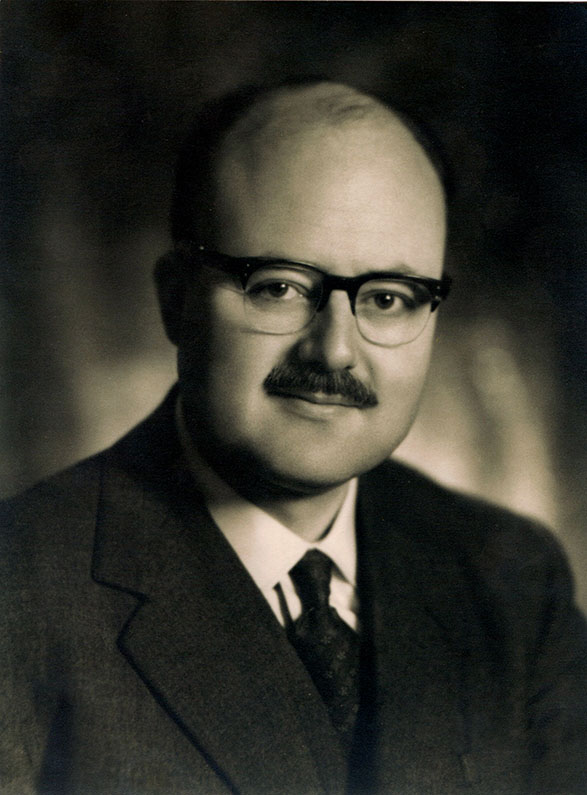
Robert John Francis Homfray Pinsent: 1916 – 1987 GRO0749 (Medical Practitioner, Birmingham)
Ruth McKechnie Morrison: 1916 – 2004
Married: 1941: Westminster, London
Children by Ruth McKechnie Morrison:
Daughter (GRO1150)
Daughter (GRO1151)
Son (GRO1152)
Daughter (GRO0037)
Family Branch: Hennock
PinsentID: GRO0749
Referenced
Click here to view close relatives.
Robert John Francis Homfray Pinsent (“Robin”) was the only son of Francis Wingfield Homfray Pinsent by his first wife, Janet Frances Cowtan. He was born in Devon at “Hillsborough” in Horrabridge, in 1916, but grew up in a nearby house that his father built on the edge of Roborough Down in 1920. Robin helped to lay the foundation stone. He was educated at the “Dragon School” in Oxford and at the “Kings School Canterbury”, in Kent.
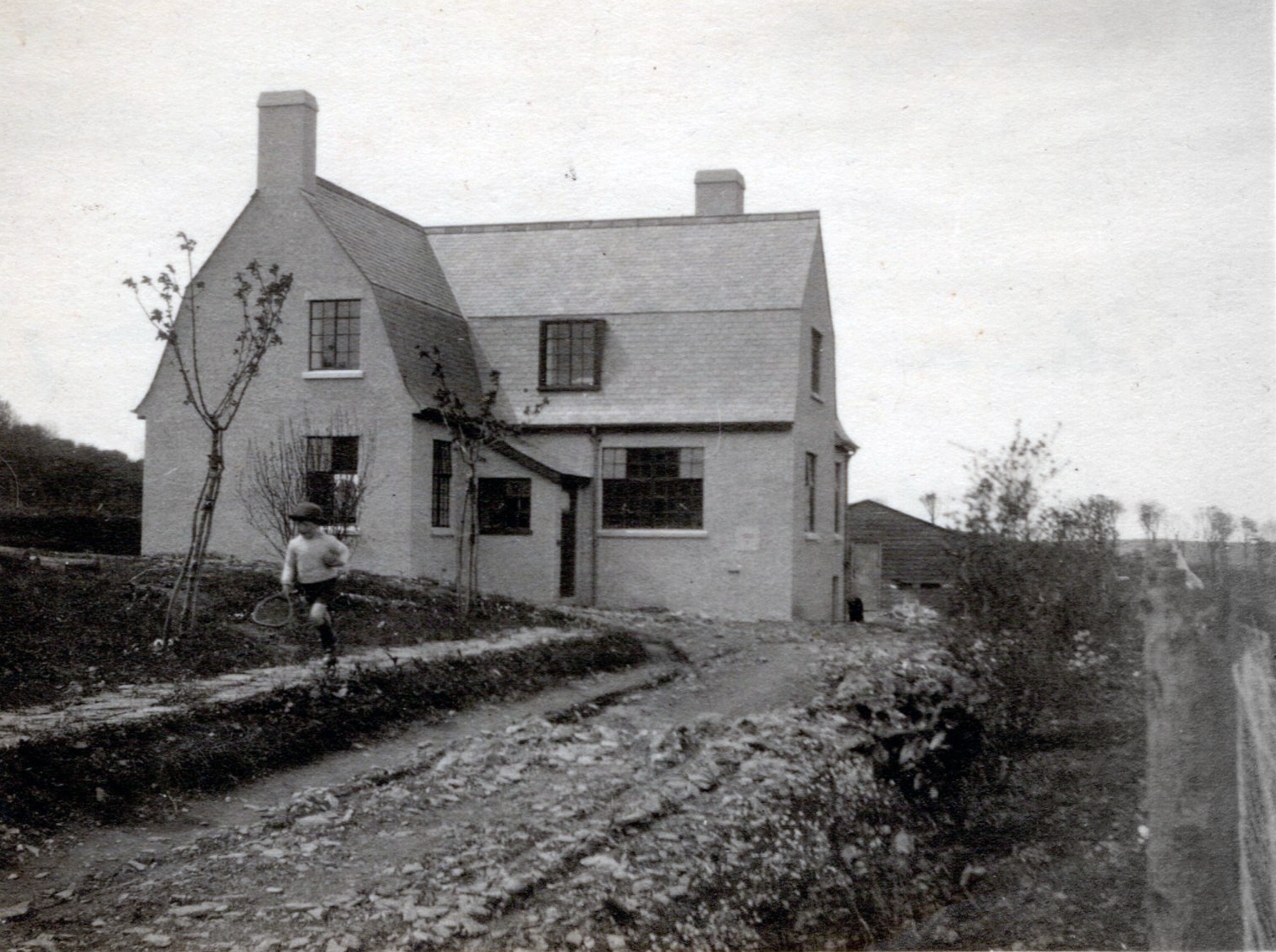
Robin was very much a country boy. He took a keen interest in natural history and wrote to the Western Morning News (5th May, 1933) to report his sighting of a swift. The following year, he won a silver medal for an essay he submitted to the “Royal Society for the Protection of Birds” (Dover Express: Friday 29th June 1934). In it, he described the preferred nesting sites of six species of bird. He did well at “Kings Canterbury;” although he does seem to have missed Devon, his dog and his pony. The latter was called “Someday” – as he had had to wait for it …
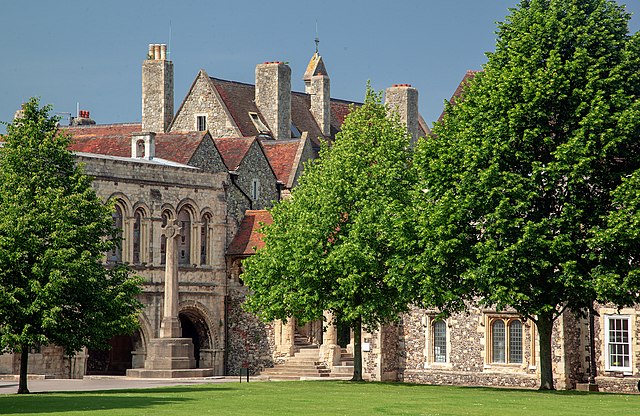

From “King’s,” Robin went up to “Selwyn College” in Cambridge to study medicine and to fish – he took his rods with him. The Cambridge correspondent of the “King’s School Canterbury Old Boys Association” wrote a letter to the Editor of the “Cantuarian,” (vol. 13 March 1933 – December 1934), and remarked that “R. J. F. H. Pinsent of Selwyn, enjoys the climate of Cambridge. Its general dampness and wetness is good for fishing”. The following year, the same sharp eyed correspondent reported seeing “this grand old sportsman returning home of an evening, tired but triumphant, after a single-handed encounter with a giant dace. He keeps the splendid victims of his rod in his rooms, neatly packed away in match boxes.” Perhaps this is a little unfair. Robin kept meticulous diaries in which he noted what he caught, when, where and how. The Western Morning News somehow learnt that he caught a 10 lb. salmon on the “Buckland Water” on the Tavy River, in Devon, in July 1937 (Western Morning News: Friday 16th July 1937). I doubt if you will find many of those there today. Robin was probably the “Mr. Pincent” who “brought home a nice brown trout of 3 lbs” from the Richmond Alms Hotel water in Banffshire in April 1938 (Banffshire Journal:
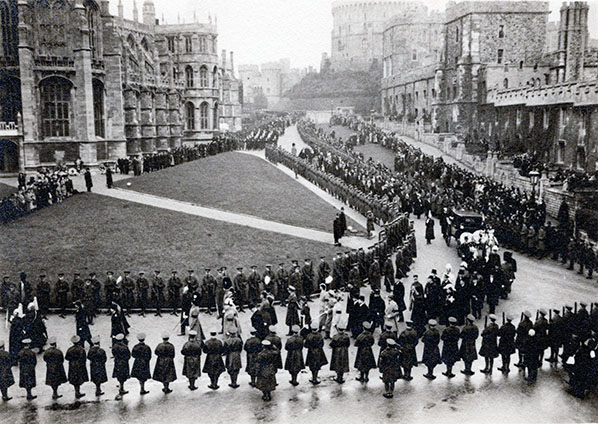
Robin joined the signals section of the “Officers Training Corps” while he was at Cambridge – partly (I gather) because it enabled him to indulge in one of his other passions, riding. Robin was one of 150 Cambridge University “Officer Training Corps” cadets selected to line the route taken by King George V’s cortege as it passed through King Henry VIII gate into Windsor Castle on its way to the Chapel on 28th January 1936. He wrote home describing the event. In his letter, he included a photograph from the London Times and a couple of small sketches that certainly show he could draw. He was one of the cadets facing away from the camera “presenting arms” near the chapel entrance. I do not know which one! The Cambridge cadets were also involved in the celebration of King George VI’s Coronation, which took place in Westminster Abbey, in London, on 10th May 1937. On that occasion they camped out in Kensington Gardens. Again, Robin wrote to his parents describing the event.
Robin finished his training with a stint at “Charing Cross Hospital” in London. While he was there, he, perhaps fortuitously as it turned out, transferred his O.T.C. [Officers Training Corp.] membership to the “London Division” of the “Corps of Signals.” By doing so, the army listed his seniority as a 2nd Lieutenant from November 1936 – which was to become extremely important during the war. He had rank seniority over anyone who came later.
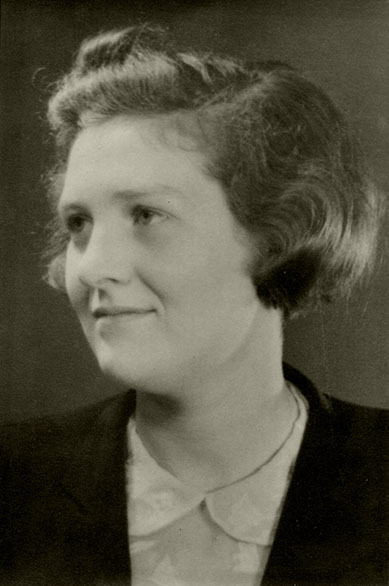
Robin met Ruth McKechnie Morrison while he was living in London. She had graduated from her home-town university of St. Andrews, in Scotland, and come down to London to attend a “Secretarial College.” The war-time register compiled in 1939 shows that she was, by then, “Secretary to the Manager of Ascot Gas Water Heaters” – a firm based in Wembley.
Ruth and Robin were in London in September 1940 during the early days of the blitz. Writing home, Robin describes watching in awe from Hampstead Hill as the docks in East London burnt on the 7th September 1940. A few days later, he wrote home (from the safety of a bomb-shelter during an air raid) describing this, his 57th air raid, and the trouble he was having getting Ruth’s mother, Mrs. Morrison, on a train back to the safety of Scotland. He was disappointed that he had missed Churchill’s “threat of invasion” speech on the 11th September – in which every Englishman was exhorted “to do his duty.” Although still a student, he worked in the “Casualty Department” at Charing Cross, stitching up victims of bomb blasts. He marveled at their continued good humour.
In one of his letters, Robin relates meeting up with his uncle, Guy Homfray Pinsent and “Cousin Bob” – Robert Burton Pynsent (as distant relation who had met up with Robin’s family in the early 1900s after returning from New Zealand). Robin’s father Francis Wingfield Homfray Pinsent was newly arrived from Newfoundland. They were both colonials returned to the “mother country” and they both lived in Kensington. On another occasion, Robin, quite reasonably, explained to his parents how difficult it was to study for exams with formations of German bombers flying overhead and releasing their bombs.
Robin heard the same sound while at home in Devon too. In a short article in the “Yelverton and District Local History Society Newsletter” published in May 1986, he describes how he made it back to Horrabridge for a week of leave the following spring (1941) and arranged to go fishing with a friend along the Abbey Waters on the River Tavy. It was to be night-time fly-fishing for “peal” (a sea-run trout). Unfortunately, the night they chose was the 21st April 1941, the first night of the Plymouth blitz and the night of the “Buckland Bomb!”. When the searchlights came on (on the bank above them) their initial concern was that the light would scare the fish; however, their priorities changed when the first tracer bullets smacked into the water beside them as the Germans tried to extinguish the lights. They headed home. After the war, the fishing warden – who knew they were there – told my father that the locals in a nearby pub were convinced that his car (seen passing through Buckland) was being driven by a spy who was signaling to the Germans. The warden kept quiet!
Robin eventually transferred to a Hospital at Ashridge, near Berkhamstead and Ruth moved to Warwick, where she worked as a “Civil Servant” with the “Gas Board (?)” and also undertook “Warden” duty in the Castle. They married in the “Scotch National Church” in Westminster, in September 1941. Ruth quit her job in Warwick – as was the convention of the day – and returned to St. Andrews.
Robin graduated in October 1942 and transferred to the Royal Army Medical Corp. He was destined for India but failed the medical examination – as far as over-seas postings were concerned because of an eye complaint. He knew the Army would post him as far from home as they possibly could and, hearing he was from Devon, they somewhat predictably sent him to “Scottish Command” – which was fine with him as his wife was in St. Andrews. Robin had an early posting near Roscobie Loch, in Angus – not a bad spot for a fisherman – and then, after moving around, spent the later part of war in the Orkney Islands looking after Italians prisoners of war. They were there because there was no possibility of escape and they could be employed in building causeways (a.k.a. “Churchill Barriers”) between some of the smaller islands around the Royal Navy base at Scarpa Flow.
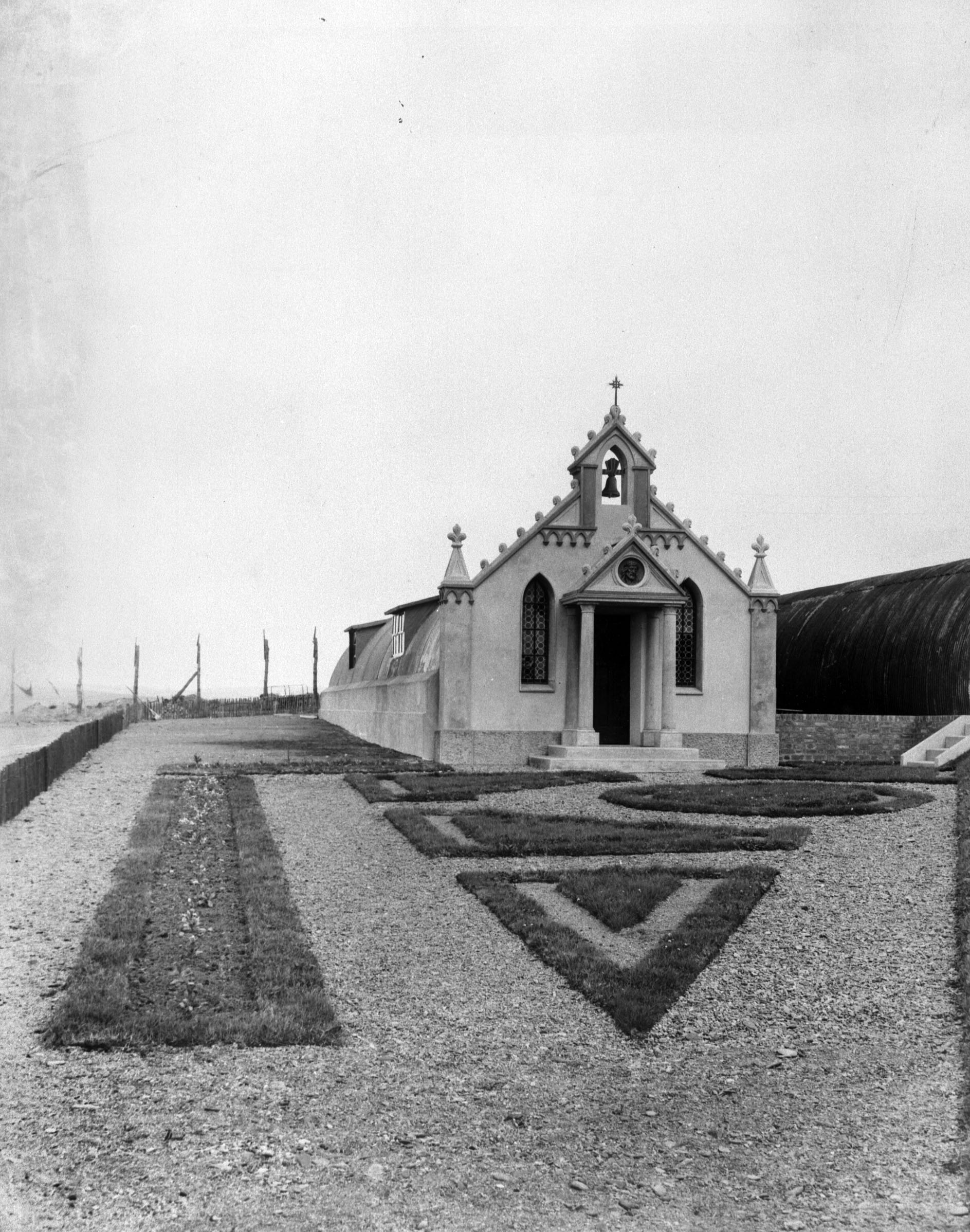
While there, the Italians converted a Nissan hut on Lamb Holm Island into an ornate Roman Catholic Church. It is still there and much as it was, although it has been renovated. For my father, there was plenty of time for fishing and shooting, and for creatively adapting military service and medical supplies to the more immediate and practical needs of a fisherman.
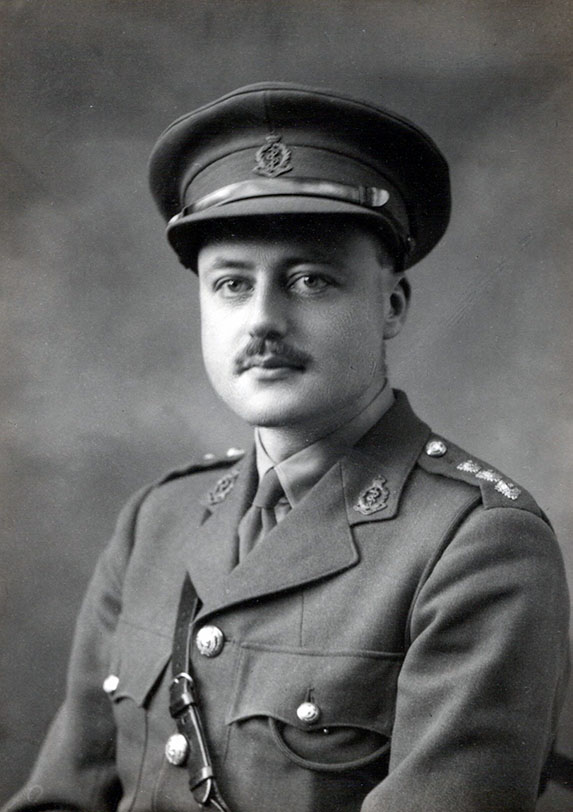
With Ruth back in St. Andrews, they were able to start their family during the war. Their two elder daughters and I were born in Scotland. When the war in Europe came to an end, Robin and many other home-based army doctors were transferred to Germany and (presumably) elsewhere to spell-off their counterparts who had seen active service. A letter that my mother Ruth received from Robin’s Aunt (Annie née March) in January 1946 mentions that “I hear you are now separated for a time. I suppose the wives do not accompany their husbands to Germany”.
Robin wasn’t released from the army until 1947 – and, although he looked, he was unable to find the quiet country medical practice he had hoped for. Instead, he joined a practice on Lozells Road in Handsworth in Birmingham and brought Ruth and the family down to the midlands. It was an epic rail journey during which, to the acute embarrassment of my mother, at least one of her three children made unmistakable signs of having whooping cough! A fourth child was spared the journey. She was born in Birmingham.
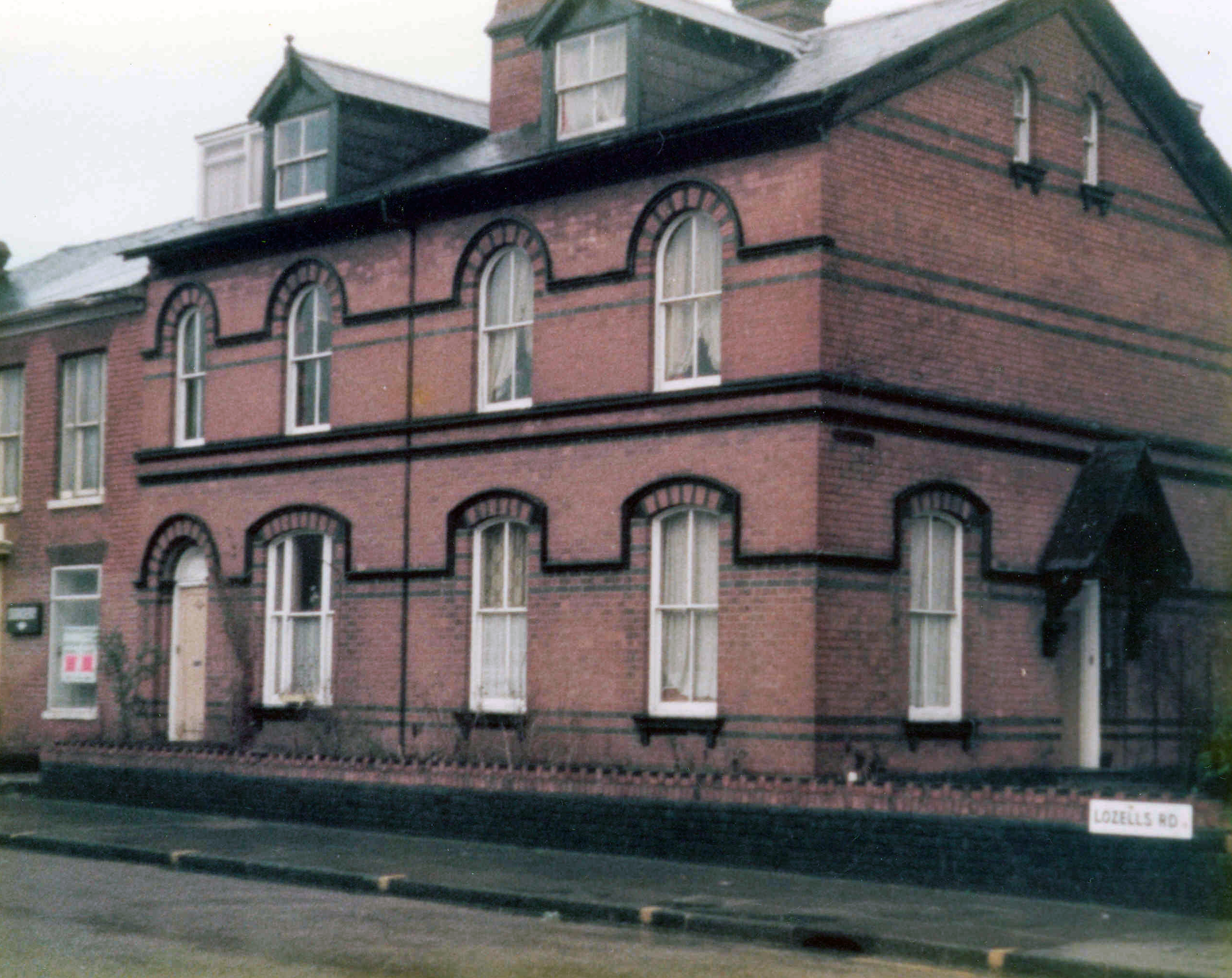
In Birmingham, my father restructured his home-based medical practice from a “drop-in” system to a more efficient “appointment” and “telephone” based model. It still meant doing his rounds every morning and conducting morning and evening surgeries – to say nothing of welcoming babies into the world at two in the morning. Sometime later he was to float the idea of “Flying Nurses” as an alternative to having “general practitioners” make unnecessary house calls. He suggested a two-tier system whereby the nurses could contact a doctor by short-wave radio in the event of an emergency (Birmingham Mail: Saturday 19th September 1970). Two years later, he told the “Post” that “the demands on a doctor are getting so great that they have to be used selectively, and the present system of using them to deal with trivial emergencies is completely un-selective”. With Dr. Brian Peacock, of the Department of Engineering Production at Birmingham University, he, once again, proposed: “that flying quads of nurses and drivers using estate cars with facilities to take stretcher cases should be on call for emergencies. If the nurse thought a doctor was needed, one would be contacted through her radio link with a central control point” (Birmingham Daily Post: Tuesday 16th July 1972). The whole idea of “house calls” seems quaint these days.
After the war, Robin developed his own ideas on family practice and submitted them as a MD thesis at Cambridge in November 1948, a matter of months after the inauguration of the N.H.S. (National Health Service). He saw a need for better communication within the medical profession, and wrote letters to the editor of the “British Medical Journal” that were, on occasion, picked up by the local press. I don’t think I have ever had Bornholm’s disease (a chest infection); however, there was a lot of it around in the summer of 1951 (Evening Despatch: Saturday 3rd November 1951).
Robin had no love of routine paperwork. One of his early suggestions – aired in the “Lancet” medical journal – was for a redesign of the “National Insurance Certificate” to give it a tear-off “Notice to Informant” section for a legitimate patient to hand to his employer to account for his or her time off work. If the employer needed more, perhaps it should make a token payment (10 s 6d) for it. That, he thought, would help lessen the insatiable demand of employers for “weekly” notes. Apparently, the municipal authorities were the worst offenders – they asked for one if even one shift was missed (Birmingham Daily Post: 6th April 1951). This was an ongoing issue and he submitted a letter to the “Birmingham Medical Review” a year later complaining about the “Miserable Traffic” in doctor’s signatures: “Doctor” or “Clerk”? That was the question (Birmingham Daily Post: Thursday 24th March 1952). He estimated that a quarter of the patients who attended his surgery displayed no physical complaint but came for a signature to explain time off from work. As he said: “It is not unreasonable that a man who misses his work because of illness should not lose his pay or his job, or that the employer should ask for proof of the man’s illness before making up his pay. But how is a doctor to distinguish, after the event, between the man whose stomach was genuinely upset for a day and the man who went to a football match? If he has his suspicions and refuses to sign a certificate that man has been ill, he may lose his patient or do him a serious injustice and lose the man his job.” It is worth mentioning here that his practice included Villa Park – home of Aston Villa Football Club. He would have preferred to spend his time with legitimate patients.
He returned to the issue of time wastage and “unnecessary visits” made to receive “certificates” at a talk he gave to a “British Medical Association” Conference in Canterbury, in April 1961 (Nottingham Evening News: Saturday 15th April 1961). While there, he had a chance to revisit his old school (Kings School Canterbury) and check up on his son, yours truly, who had, for better or worse, been dropped off there the previous autumn.
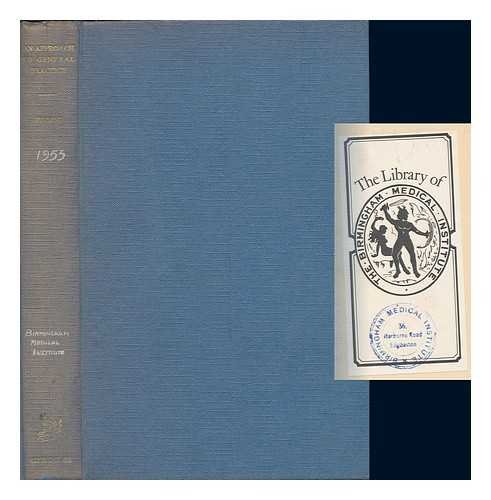
Robin’s thesis emphasized the need for systematic note-taking and collective research within the profession. He later published his ideas in a book entitled “An Approach to General Practice” that was put out by Williams and Wilkins in 1953. One of the downsides of a home-based practice in those days was that the doctor’s wife, Ruth in his case, was inevitably tied to the telephone. On occasion, even the children were brought in to help out. I remember being co-opted to make up bandages during one of the practice’s mass polio vaccination campaigns.
Dr. Pinsent later integrated his practice with those of two of his neighbours, Dr. Laurie Pike and Dr. Roger Morgan and they built a joint family practice centered on Birchfield Road, in Handsworth, in the 1960s. It was looking for a clerical assistant in January 1974 (Birmingham Mail: Tuesday 22nd January 1974). Once the practice centre was up and running, Robin and Ruth felt able to move across town to Croftdown Road, in Harborne. They were there from 1970 (Birmingham Mail: Thursday 1st January 1970) until Robin achieved his longtime ambition of retiring back to Higherfield, in Devon.
In 1951, Drs. John (later, Lord) Hunt and Fraser Rose wrote a letter to the “British Medical Journal” and to the “Lancet” advocating for the formation of a “College of General Practitioners”. My father wrote a letter of support in the “Lancet” saying that “while 75 per cent of the country’s illness is handled by general practitioners, there is no co-ordinating machinery for making known the great learning acquired in that work” and that it was a “natural and inevitable evolution and development of general practice” (Birmingham Daily Post: Saturday 22nd December 1951). There was a positive response nationally, and, thanks to the efforts of a steering committee (of which my father was a member), it became a reality in November the following year.
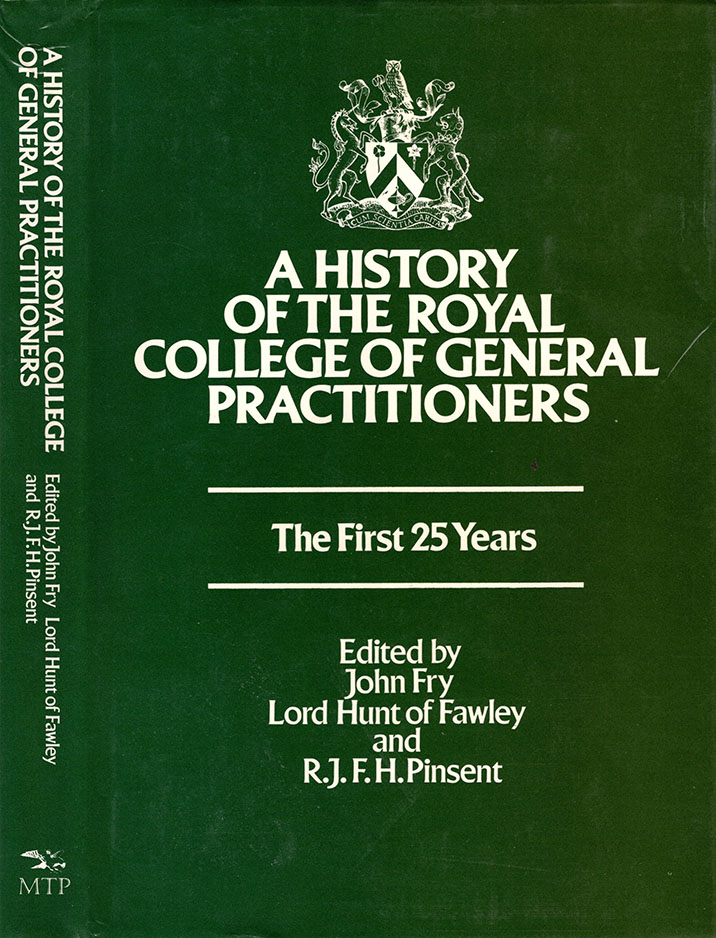
Robin liked working with wood, and I remember him turning out the first college gavel on his lathe in the workshop. Sadly, he had little time for such distractions. He was invited to join the “Foundation Council” and he was appointed chair of its “Research Committee”. The latter held its first meeting on 23rd March in 1953. Robin was an active member of the college and his practice work was eventually subsumed into “college work.” The College was granted its Royal Charter in 1972 and he co-edited an early retrospective look at the “college” entitled of “A History of the Royal College of General Practitioners: The First 25 Years” with John Fry and Lord Hunt of Fawley. It was published in 1983.
Robin served on numerous ad hoc committees and, although he was more of a facilitator than a research scientist, he wrote articles on a wide range of conventional (flu epidemics etc.) and not so conventional (homeopathy) topics that were published in the journals of the day. He would sit in his chair with a clip-board on his knees and write and then glue together pages, creating rolled up scrolls that would have done his medieval fore-bears proud.
He was appointed “Research Advisor and Director” to the College and edited its “Research News Letters” until the “British Journal of General Practice” came into being and became its principal vehicle for professional papers. After working out of his home for many years, my father helped to set up a “Research Unit” at the Birmingham Regional Hospital Board headquarters, in Harborne with Dr. Donald Crombie. Perhaps inevitably, it outgrew out of the space available. Its value was eventually recognized and it received a sizable grant to assist it to find new quarters in 1972. It then went looking for £2 million for an endowment fund for, according to his colleague Dr. Watson, studying such issues as the waxing and waning of natural immunity to influenza and the long-term of effects of taking aspirin, tranquilizers and tobacco (Birmingham Daily Post: Friday 26th May 1972).
In December 1958, Robin and Ian Grant replied to an article in “The Times” that complained about the lack of visible progress in the study of morbidity. They responded by pointing out that the College had spent the last four years developing a universal classification system for disease and it was slowly figuring out how to report and process the information doctors obtained (The Times: Monday 22nd December 1958). “National Morbidity Surveys” were becoming a possibility by then, as communication was gradually improving and computers were increasingly able to handle large volumes of data – if the necessary funds were made available. The College had data from a Measles Survey conducted in 1955 but had no one to punch up the computer cards! Letters to the press were one way to reach the public and Robin caused quite a stir when he pointed out the teenage girls that wore “roll-on girdles” might find that they later had difficulty in childbirth (Daily News: Thursday 26th February 1959). This was too much for Mrs. Chettle from Nottingham, who wrote to say that she had worn them all her life and had no problem what so ever … (Daily News: Tuesday 3rd March 1959).
Robin encouraged education as well as research and suggested that the “Medical Recording Service” purchase a tape-recorder and experiment with recording talks for circulation. They later tried distributing gramophone records (Dr. J. Graves: Journal of the Royal College of General Practitioners: June 1977).
Later, as part of his developing interest in genealogy and family history, Robin set up a pilot project designed to look at causes of death in specific families using birth, marriage and death data collected and stored in the General Records Office in London since 1837. It was predicated on the idea that some families might be more susceptible to some forms of disease than others. The results were described the “Journal of Biosocial Sciences” in August 1970 (The Times: Tuesday 11th August 1970). Unfortunately, the limited size of the study meant that the results were inconclusive. However, by choosing to study his own family name, he obtained useful information for one of his hobbies!
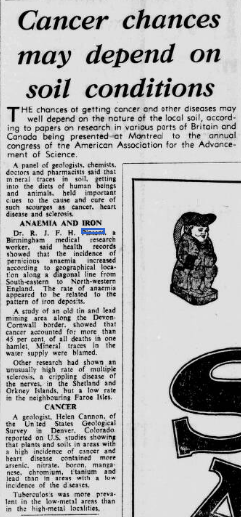
In 1964, Robin attended an “American Association for Advancement of Science” meeting in Montreal and gave a talk on some work he had done with Dr. Harry Warren of the Geology Department at the University of British Columbia, in Vancouver. The results showed that pernicious anaemia was prevalent in a swath of country extending from southeast to northwest of England that it correlated with low levels of iron in the soil overlying carbonate rich rocks (Nottingham Evening Post: Tuesday 29th December 1964).
Similar work showed that soils collected near old mine sites near the headwaters of tributaries to the Tamar River (between Devon and Cornwall) were frequently found to contain anomalously high levels of metallic trace elements – and that in at least one case it correlated with an above average incidence of death by cancer in a village downstream (Brandon Sun: 30th December 1964). It must have been about then that he tried to persuade doctors all over the world to grow lettuce from a stock seed, then reduce it to ash and check it for heavy metal content. He had clearly been talking to Harry Warren! Biogeochemistry is now a routine and recognized tool in mineral exploration.
The idea that the trace element content of soil was, perhaps, important did, eventually, take hold in the planning community; however, not without some resistance. Robin was called to give evidence at a inquiry into a proposed development at Beaumont Leys, near Leicester in 1971 (Leicester Daily Mercury: Tuesday 28th October 1971). Presumably it went ahead.
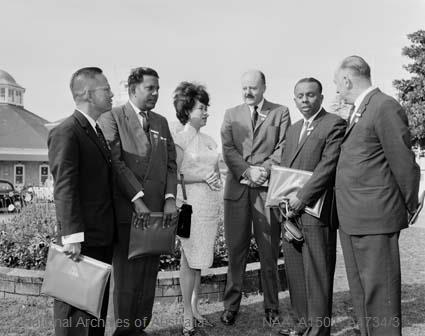
The College actively encouraged similar work by its over-seas affiliates in the United States, Canada, New Zealand and Australia. These independent bodies built on and added to the work done by the Royal College. In October 1963, Robin was appointed an Honorary Fellow of the “Royal Australian College of General Practitioners” and was invited to visit Australia. It was an opportunity for Robin and Ruth to travel abroad, something that they had only rarely had time to do while busy with work and family.
In 1968, Robin suffered a setback. He contracted cancer – probably at least in part from smoking a pipe while in the army – and he had his larynx (voice box) removed. Thereafter, he exhaled through a hole in his neck. What people thought when the saw puffs of water vapour emanating from it on cold winter days, I have no idea! Robin was required to learn a completely new way of speaking. It was a skill he mastered so well that most people were completely unaware of it – even when he was called upon to give speeches. Robin retired from medical practice in 1977 but maintained his connection with the College and assisted Sir John Hunt and Dr. Fry in editing the college history. He gave the “First Blackie Memorial Lecture,” (on homeopathy) in Edinburgh, in 1983.
Robin’s work for the College and the medical community was recognized. In 1970, Dr. R. J. F. H. Pinsent, M.R.C.S, L.R.C.P was awarded the O.B.E. (Order of the British Empire) in the New Year’s Honours (Birmingham Daily Post: Thursday 1st January 1970).
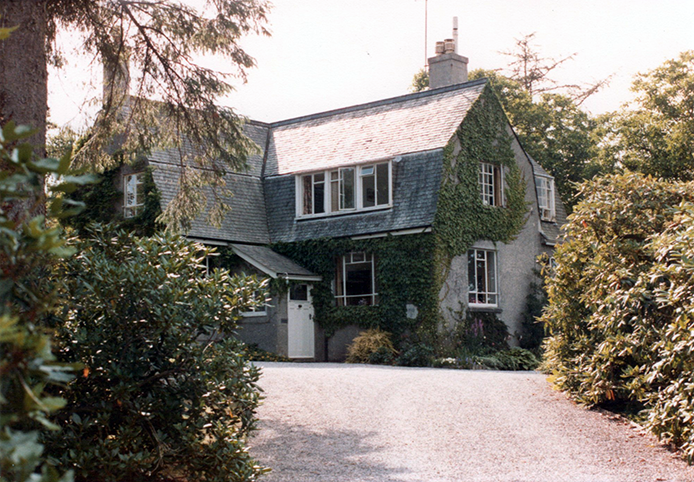
Throughout his time in Birmingham, Robin hankered to get back to his family home in Devon. His father had died in 1948 and “Higherfield” had been rented out since his stepmother Anne had returned to Switzerland in 1952. It was let to the Admiralty as a short-term billet for naval officers for a while, but the family was, occasionally, able to take a holiday there between leases. It was a constant source of regret to my father that the house was not being properly looked after. With all due respect to the Admiralty, a bullet hole in the mantle-piece and weed-killer in the kitchen garden did not go over very well! He regained control of the property in the early 1970s and started to convert it into the home he had always hoped it would be. Ruth and Robin officially retired there in 1977.
While living in Birmingham, Robin had had very little time for country pursuits but, now and again, he managed to get away for a few days with John Rundle, a friend from his youth. They caught six brown trout weighing 20lbs in two hours while fishing at Grantown on Spey in May 1950 (Sunday Post: Sunday May 28th, 1950). I am sure they were well documented in diaries. At other times, I remember seeing ducks hanging in the pantry.
Most of the fish he (or I) saw in those days lived in a collection of tanks in his surgery – some died when an electrical short led to a fire that caused one of the tanks to burst (Birmingham Daily Gazette: Tuesday 20th January 1953). Needless to say, the fire-brigade came to the rescue: “Half a dozen burly firemen in helmets and water-proofs crawled round the floor fishing in the puddles. Every few moments one of them would shout: “Here’s a another still alive!” (Evening Despatch: Monday 19th January 1953. A male sword-tail survived the experience of flapping around on the floor and lived on for years with a noticeably broken tail. Robin had developed a particularly impressive line in lace-tail guppies.
Back in Devon, Robin renewed his contacts and resumed his life-long passion for fishing – albeit from the shore as, given his laryngectomy, it would have been foolhardy to fish from a boat. He went back to keeping fishing diaries – a practice he had started in 1936. I hoped they would contain insight into his life during the war. Sadly, they are singularly lacking in contemporary colour. Most entries are limited to what, when, where and with what. Great for a fisherman but not so useful for a family historian. Nevertheless, to make up for this, he wrote a series of five articles entitled “The Making of a Fisherman”, “The Return Begins”, “The Remaking of a Fisherman”, “Natural History” and “Return to Fly-dressing” in the early 1980s. I doubt if they were ever published. They describe his introduction to fishing (tickling trout in a brook near Sheepstor) and his subsequent growth as a fisherman. As his friend John Rundle pointed out, by the time he retired a lot had changed since he had fished during the war.
These articles are reminiscent of ones written by his father Francis Wingfield Homfray Pinsent on hunting, his uncle Robert John Ferrier Homfray Pinsent on a failed logging venture and his grandmother on fishing in Newfoundland. She had articles published in “The Field” magazine in 1890 and 1892. Robin’s grandfather, Sir Robert John Pinsent, wrote learned articles about the “French Fishery Question” and on a somewhat lighter note on a court circuit he made dispensing justice in the out-ports of Newfoundland in 1892. I do not know if the latter was ever published.
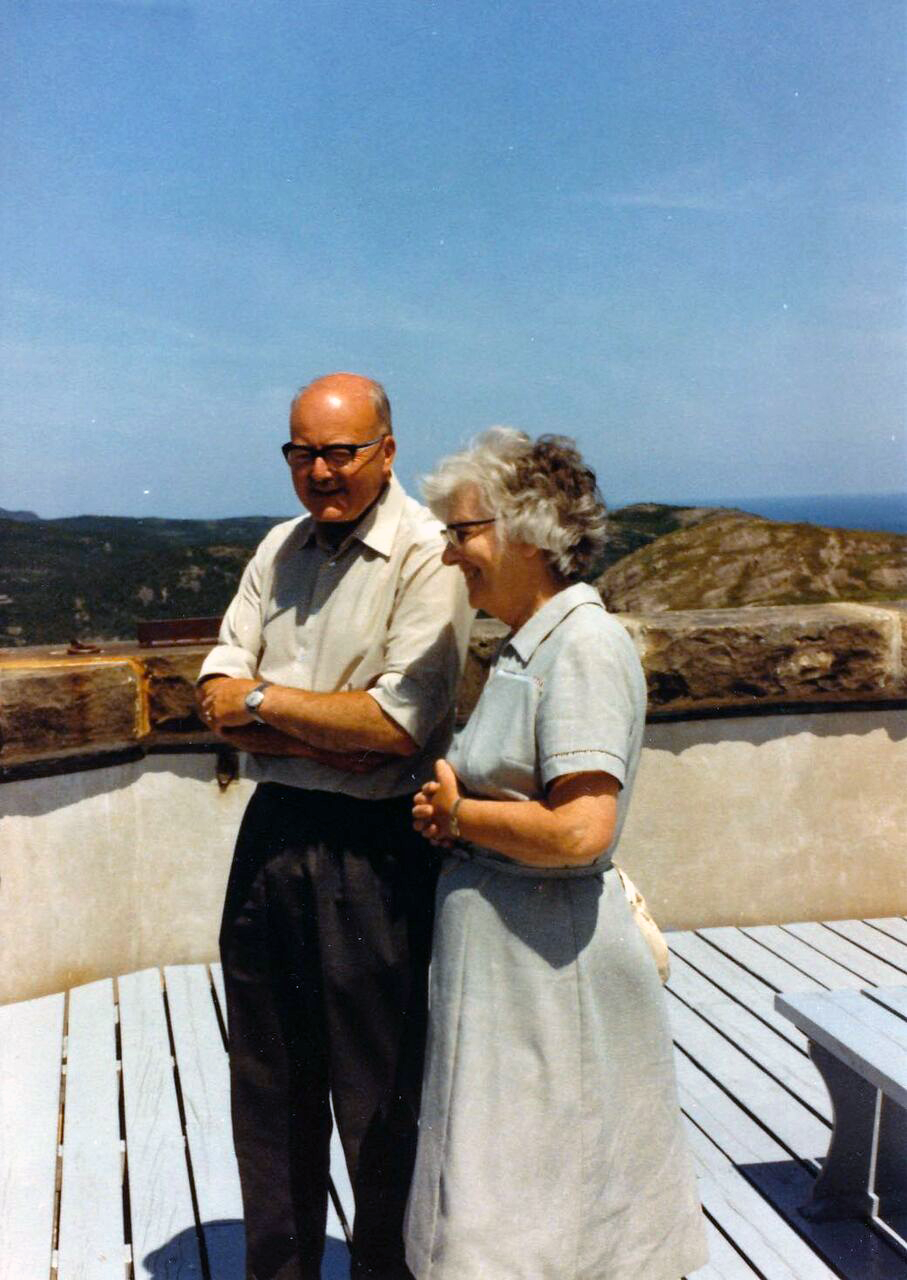
“Higherfield,” being the house and home it was, became a magnet for the family and Ruth and Robin probably saw more of their growing family there than they would have had they stayed in Birmingham. Ruth stayed on at “Higherfield” for a couple of years after Robin’s death in 1987 and then moved back to the Midlands, to live out the rest of her life beside her eldest daughter. Ruth and Robin had four children all of whom are alive today. His daughters married and have families living in England and Scotland, and his son has his own family here in Vancouver, in British Columbia, Canada.
In the late 1950s, Joey Smallwood, the then Premier of the Province of Newfoundland in Canada, wrote to Robin’s Uncle Guy to ask for information on Guy’s father, Sir Robert John Pinsent. It was for an “Encyclopaedia of Newfoundland” that he was then working on. This triggered my father’s interest in genealogy and he set about compiling information for the definitive family history. He was a generation too early but he made a start.
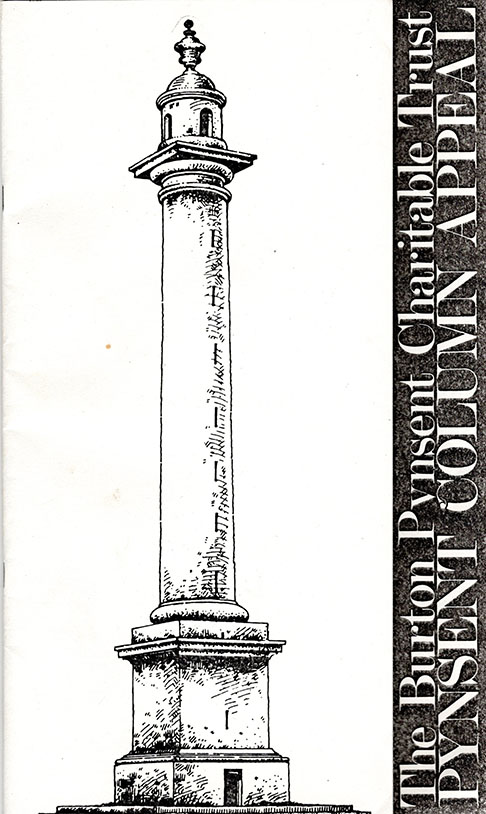
Robin, his uncle Guy Homfray and a distant “Cousin” John Pinsent (Dr. John Pinsent, “Lecturer in Classics” at the University of Liverpool – who was a descendant of Gilbert Pinsent) – compiled a considerable amount of birth, marriage, death and general anecdotal data over the years. Robin wrote to numerous co-lateral Pinsents and Pynsents and quietly worked behind the scenes on the campaign that was started in the 1980s to find the funds needed to repair the Burton Steeple in Somerset – a monument to Sir William Pynsent. Finding himself without heirs in 1765, this elderly baronet passed his not inconsiderable estate to William Pitt, Earl of Chatham – who built the monument to acknowledge the bequest! The repair work was completed in the 1990s. In retirement, Robin helped catalogue material archived at the Plymouth and West Devon Records Office.
My father took me to Hennock to see the parish registers in 1962 and the Rector allowed us to examine them on his dining room table. This sparked my interest and ensured that the project continued after my father’s death. This current work is truly a family effort.
Family Tree
Grandparents
Grandfather: Robert John Pinsent: 1834 – 1893
Grandmother: Emily Hetty Sabine Homfray: 1845 – 1922
Parents
Father: Francis Wingfield Homfray Pinsent: 1875 – 1948
Mother: Janet Frances Cowtan: 1878 – 1938
Father’s Siblings and half-siblings (Aunts, Uncles)
Lucretia Anna Maude Pinsent: 1857 – 1934
Louisa Catherine Pinsent: 1858 – 1890
Marianne Hedley Pinsent: 1859 – 1859
John Cooke Pinsent: 1861 – 1861
Robert Hedley Vicars Pinsent: 1862 – 1888
William Satterly Splatt Pinsent: 1864 – 1865
Charles Augustus Maxwell Pinsent: 1866 – 1910
Arthur Newman Pinsent: 1867 – 1946
Mabel Louisa Homfray Pinsent: 1873 – 1951
Robert John Ferrier Homfray Pinsent: 1874 – 1899
Francis Wingfield Homfray Pinsent: 1875 – 1948 ✔️
Emily Maude Homfray Pinsent: 1876 – 1877
Hilda Constance Homfray Pinsent: 1879 – 1882
Beatrice Mary Homfray Pinsent: 1883 – 1965
Guy Homfray Pinsent: 1889 – 1972
Please use the above links to explore this branch of the family tree. The default “Next” and “Previous” links below may lead to other unrelated branches.