Vital Statistics
Robert John Ferrier Homfray Pinsent: 1874 – 1899 GRO1147 (Forestry Company Cashier, Montreal, Canada)
Annie March: 1873 – 1950 (Methodist Missionary in Japan)
Married: May, 1896: St. John’s, Newfoundland
Family Branch: Hennock
PinsentID: GRO1147
Click here to view close relatives.
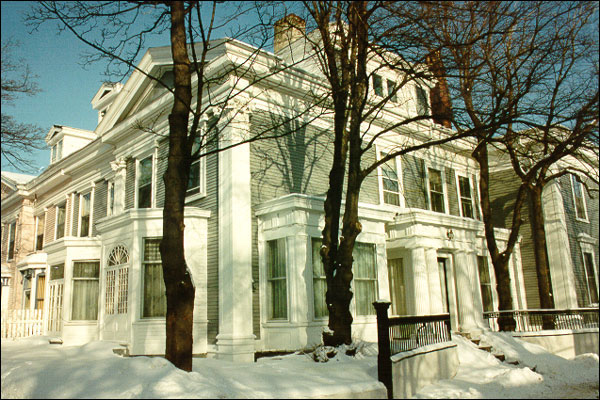
Robert John Ferrier Homfray Pinsent was the eldest son of Robert John Pinsent (a senior barrister and Queen’s Counsel in Newfoundland) by his second wife, Emily Hetty Sabine (née Homfray). His father’s first marriage, to Anna Brown (née Cooke), had ended in divorce in 1870 and Robert John had assumed responsibility for the maintenance and education of their five then living children (Lucretia Ann Maude, Louisa Catherine, Robert Hedley Vicars, Charles Augustus Maxwell and Arthur Newman Pinsent) – all of whom are discussed elsewhere. They were still quite young at the time – between the ages of 3 and 14 years.
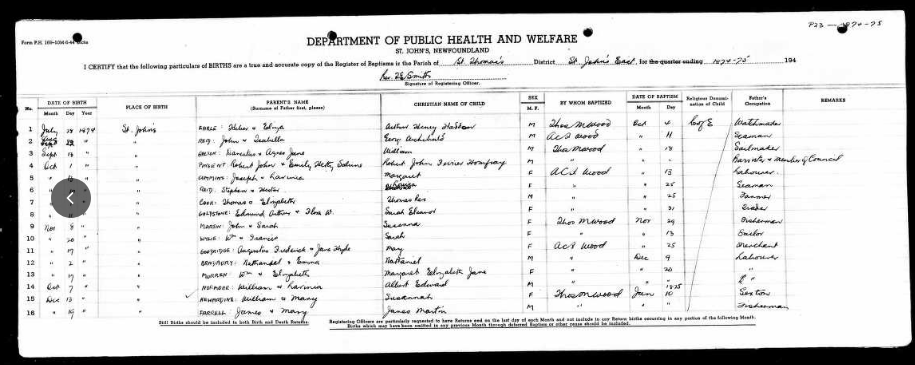
Robert was the second of five surviving children (Mabel Louisa Homfray, Robert John Ferrier Homfray, Francis Wingfield Homfray, Beatrice Mary Homfray and Guy Homfray Pinsent) from the second marriage.
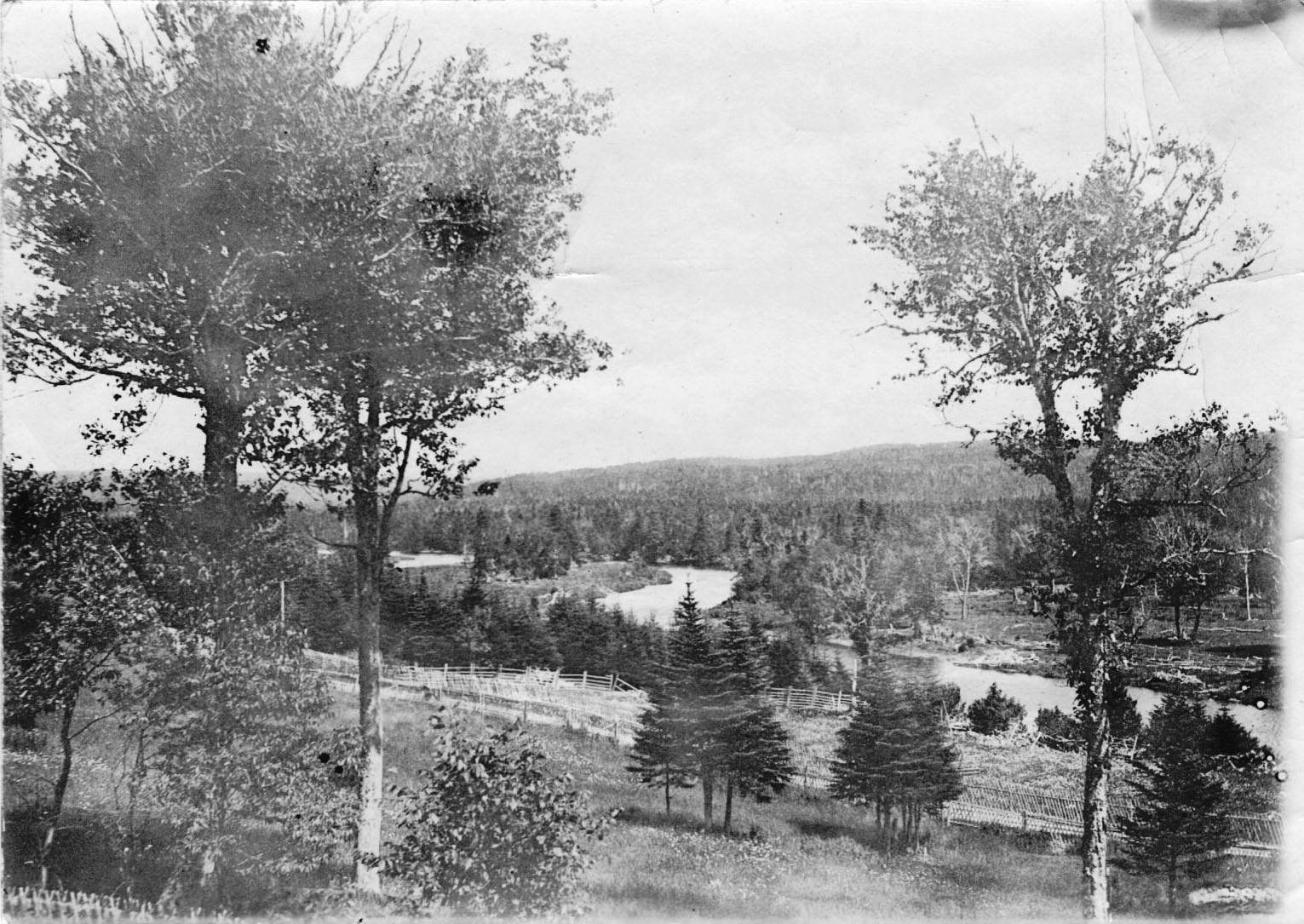
He grew up in St. John’s and at Salmonier in Newfoundland in a decidedly blended family that was dominated by the children from the first marriage. Interestingly, the family already had a child named Robert when Robert John Ferrier Homfray was born – which shows considerable devotion to the name that I, three generations later, now bear. Conveniently, Robert Hedley Vicars Pinsent was universally known as “Hedley,” so confusion was averted. He died in 1888, which eliminated the problem. Robert John Ferrier Homfray Pinsent went by “R. H. Pinsent.”
Robert John and Emily took some of their boys (Charles, Arthur, Robert and Francis) to England on the S.S. “Nova Scotian” in December 1877. Doubtless that was to see family but it may also have been to take the older children to school. I cannot speak for all of them but some of older ones (from the first marriage) certainly spent time there – as did some the younger ones from the second. Emily came from Bintry in Norfolk and it is interesting to note that she advertised in Newfoundland behalf of a school in East Dereham in Norfolk: “Board and good Education in a pleasant part of England is offered to a few young ladies; every advantage and comfort; terms moderate. Reference is kindly permitted to Lady Pinsent, also to Mrs. John Tessier, St. John’s, Newfoundland” (Evening Telegram: 6th July 1891). Perhaps some of her children had gone there.
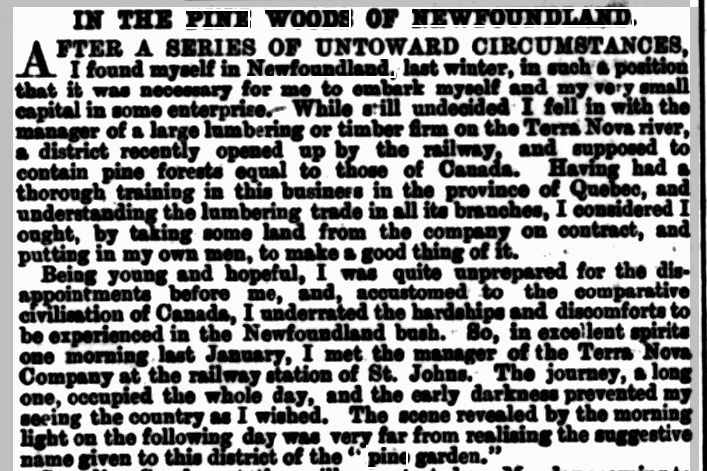
Robert was 19 years old when his father died and, according to one of Sir Robert’s obituaries, he was then “engaged in the lumbering industry on the St. Lawrence” (The Daily Tribune: Saturday 20th May 1893). How long he had been there, I do not know but it can not have been very long. Nevertheless, he felt confident enough to branch out on his own. He went searching for lumber in Newfoundland. His venture failed but he wrote about it anyway and had an article (entitled “In the Pine Woods of Newfoundland”) published in “The Field” magazine (The Field: Saturday 13th October 1894). It was later reprinted in an unidentified Newfoundland newspaper and Lady Pinsent kept a cutting of it with her papers.
In those days, Canadian and Newfoundland lumber mills were fed by trees felled and brought to them by private contractors who worked through the winter and used horses to sled the logs to the nearest navigable river. The logs were floated down river to the mill when the ice went out the following spring. In the early 1890s, Canadian Companies were looking for new sources of pine and the Terra Nova Company had set up a mill on the Terra Nova River north of St. John’s. The company was looking for contractors to supply the mill and Robert decided to try his luck. First, he had to find a suitable stand of pine. He went “cruising” (as it is called) up the Terra Nova River and after much searching located a likely stand that seemed to extend for some considerable distance back from the river. It had taken longer than he hoped and he (foolishly as it turns out) headed home before properly checking it out. He knew that he had to arrange for a crew and supplies for a logging camp and set them to work as fast as he could.
The winter was getting on and the weather had changed by the time he returned with men, materiel and a horse and he found his progress severely hampered by warm weather – which softened the snow and ice. It was the last thing he needed! Nevertheless, he eventually got his camp installed and started work – only to find to his horror that the stand of trees he was cutting was much smaller than he had thought and it would not pay his costs. He had to find more. He explored up river and did, eventually, find a better block; however, it was too late in the season to move camp and the new site would have to wait until the next season. In the meantime, he had to move his camp back to the mill through the wet snow and slush. It was a trial in itself. Sadly, he had failed to make his fortune and he moved back to Montreal.
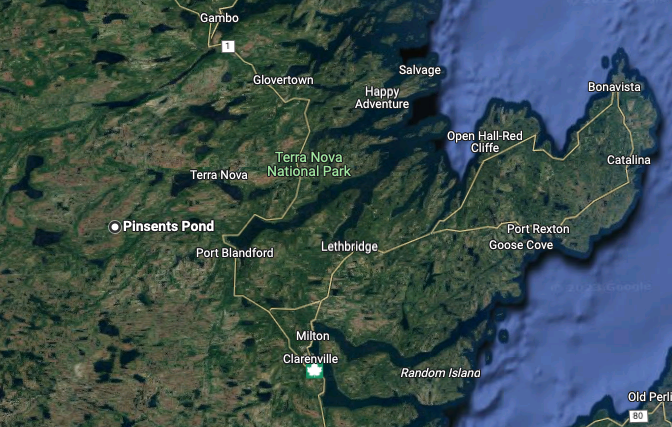
It is interesting to note that the Terra Nova River flows to the northeast into Bonavista Bay and there is a lake approximately 50 kilometres up-river from Terra Nova National Park and the coastal community of Charlottetown called “Pinsent’s Pond.” This may hark back to Robert’s venture; however, several generations of unrelated “Pinsents” have logged in this part of the world in more recent times, so it is not necessarily a reflection of his time there.
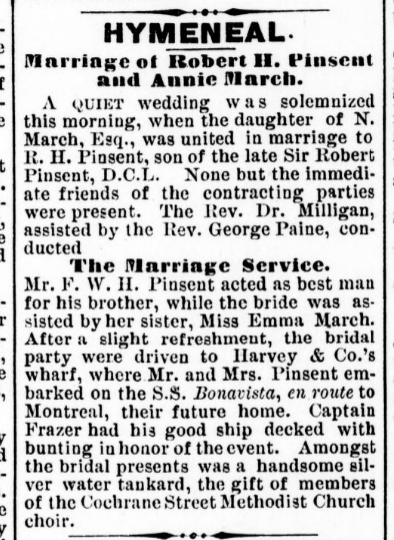
Robert John Ferrier Homfray Pinsent married Annie March in St. John’s in May 1896. He was working in Montreal at the time and he came back for the wedding on the S.S. “Bonavista,” arriving on the 16th May – having dodged the icebergs in the St. Lawrence. The onboard staff knew of his upcoming marriage and “The ship’s saloon has been done up in first-class style by the steward, Mr. Rankin” (Evening Telegram: 16th May 1896). The ceremony itself was a quiet affair: “None but the immediate friends of the contracting parties were present.” There were at least a couple of reasons for this – firstly the colony was still reeling from the effects of the financial crisis that occurred a couple of year earlier, and secondly it was an inter-faith marriage. Robert belonged to the Church of England and Annie was a Methodist, and a committed member of the Cochrane Street Methodist Church Choir. The latter had clubbed together to give her a “handsome silver water tankard’. They resolved the problem by having the ceremony performed in the bride’s home. Robert’s brother Francis served as “best man.” After the wedding, the happy couple were returned to Harvey & Co.’s wharf and embarked on the “S.S. Bonavista” for the voyage back to Montreal. The ship (which was gaily decorated) left that afternoon – but returned soon afterwards “owing to fog and ice” (Evening Telegram: 18th May 1896). They finally got back to Montreal they took up residence on Hutchinson Street.
Robert contracted tuberculosis while in Montreal and, after suffering there for several months in 1897, he returned to St. John’s to recuperate. His mother was in England at the time and his half-brother Charles Augustus Maxwell Pinsent (who had married in January 1897) controlled the family’s country house, called “Woodlands,” by the Salmonier river. Robert had grown up at “Woodlands” and he and Annie went there to recuperate. Unfortunately, the initial visit did not go well. Charles came to see them and seemed to resent them being there.
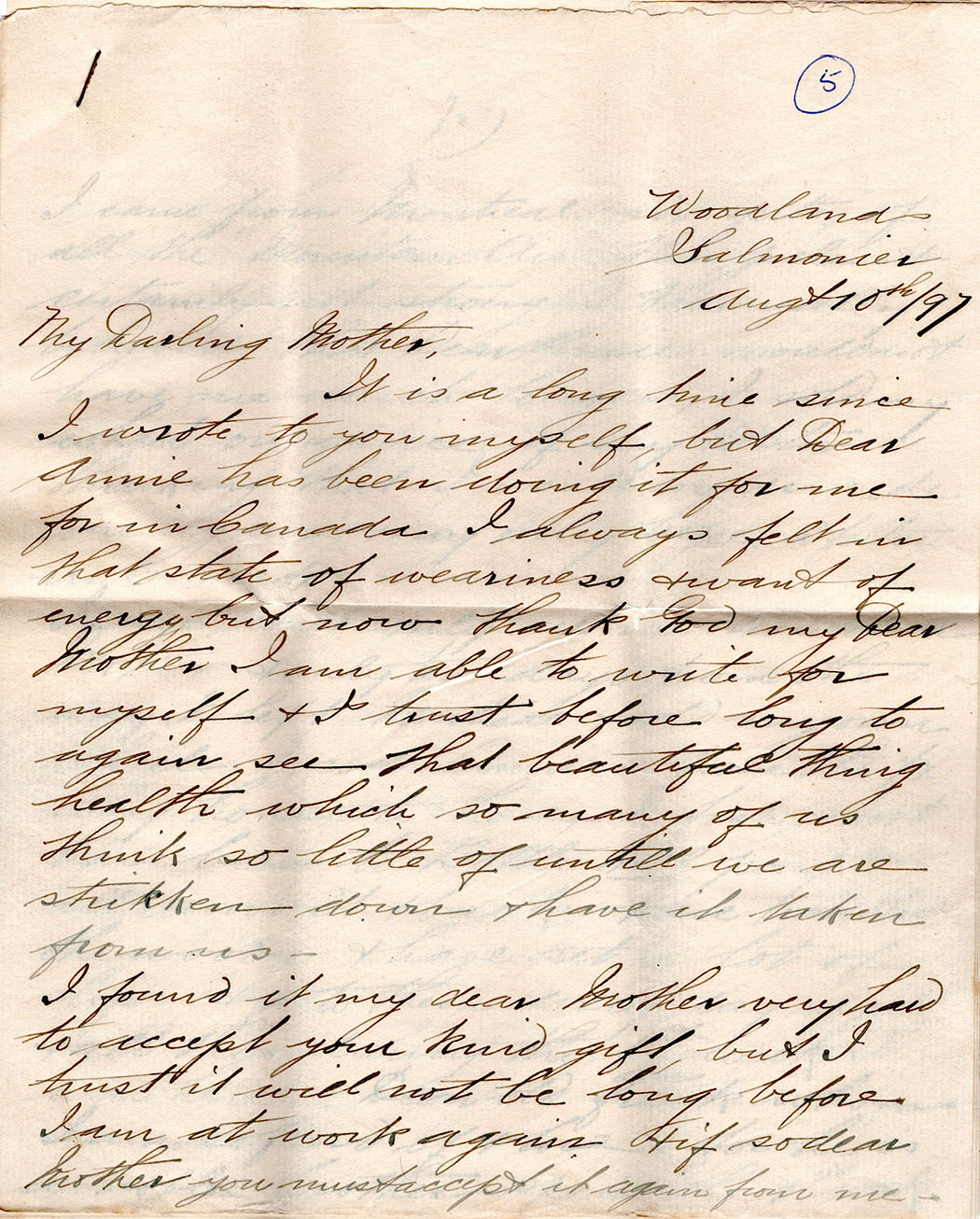
Robert wrote a letter to Lady Pinsent on 10th August. In it, he expressed his relief at seeing some improvement in his health and his disgust at the state of the family home: “Poor old Salmonier is but a rag of what it was, & I assure you the way the house is stripped will make a great difference in the price far above the value of what is taken from it & make the sale of the place very difficult.” He was also hurt by the fact that Charles had told Frank (“Dear old Frank”) “that he did not want me to touch one iota on the place – which I think a very unkind & unmanly insinuation to a brother in my place – who six weeks ago hardly knew if he would live to see him.” He had hoped to hunt and fish – as he had in his youth – but Charles refused to let him use his rifle and he “ask me to favour him by accepting no favour from Mrs. Carew, etc., who I may add has been very kind, brings in my parcels, sends us lettuce, butter & eggs, and the use of their boat at any time. I can hardly then, when I want friends especially, sacrifice friends like this for a whim of C’s.” Robert told his mother that his firm had been good to him; however, money was tight and Annie was looking for work as a schoolmistress in St. John’s. It was a difficult time.
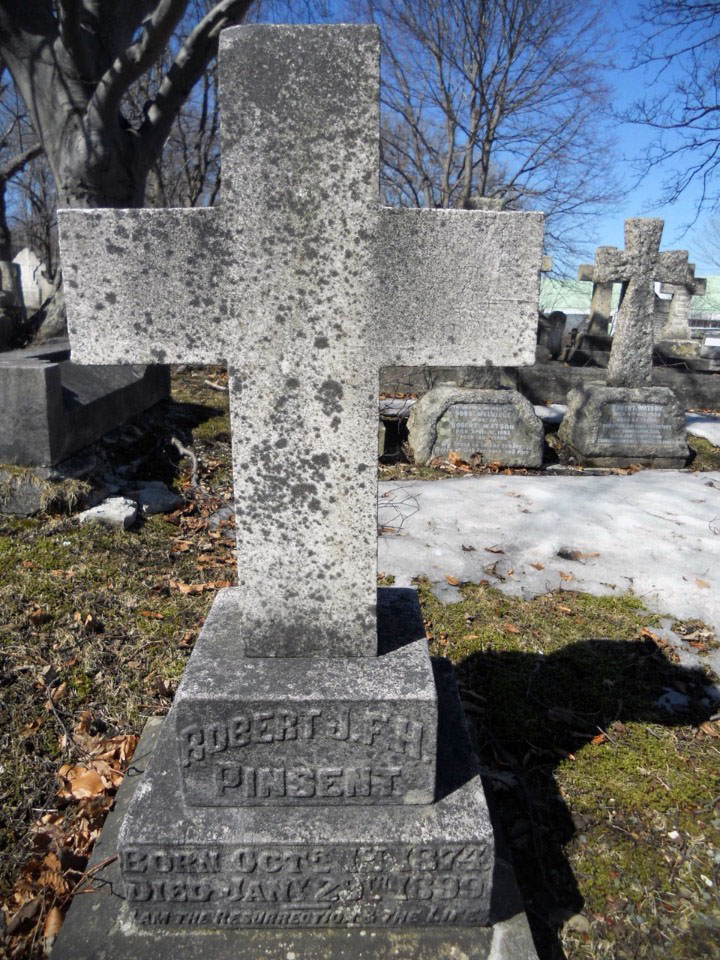
Sadly, Robert John Ferrier Homfray Pinsent never fully recovered. He lived on Logy Bay Road in St. John’s and tried this hand as a “commission merchant” (McAlpine’s 1898 Directory, St. John’s) for as long as he could. He died of consumption in January 1899 and was buried in Forest Road Cemetery in St. John’s, near to where his uncle Charles Speare Pinsent and his wife Blanche would later be buried. Robert was only twenty-four years old. He had been married for less than three years and he had no children. His widow, “Mrs. R. H. Pinsent” auctioned off part of the couple’s household furniture on Le Marchant Road a short time later (Evening Herald: Wednesday 8th February 1899) and went back to live with her family.
Annie (née March) was twenty-four years old when her husband died but she never remarried. Presumably, she found work teaching in St. John’s and rejoined the Cochrane Street Methodist community. She became interested in its missionary work and attended the First Convention of the “Women’s Missionary Society” when it was held in Newfoundland in 1902 (Evening Telegram: 16th May 1902). In October the following year, she was accepted for Missionary training in Ontario (The Globe (Toronto), 31st October 1903). One of Lady Pinsent’s (un-named and undated) newspaper clippings describes her departing for Toronto with the blessing “her co-workers in the Sunday School and choir of Cochrane Street Methodist Church.”
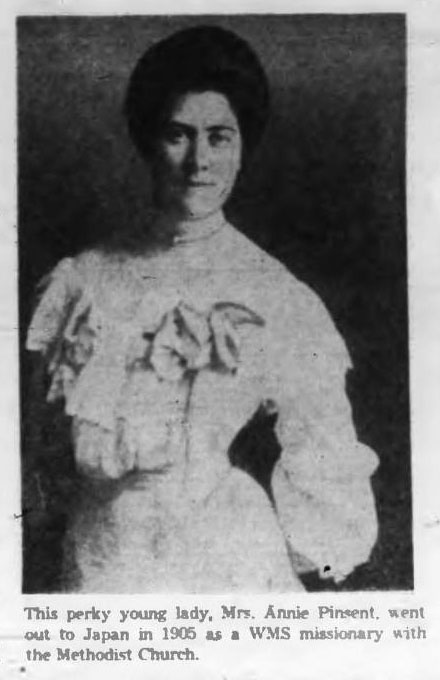
Meanwhile, an article on Cochrane Street Church in the “Newfoundland Quarterly, July 1905,” proudly states that Mrs. A. Pinsent, who was one of their own, was to leave for Japan in August as a missionary in the field. They were right in this as The Winnipeg Free Press noted her passage (presumably by rail) heading west on 11th August. This was a big step for her; however she seemed to thrive on it. The photograph comes from the Victoria (British Columbia) Daily Colonist on 6th January 1962.
In a discussion on “Temperance,” Strachan, E. S. and Ross, E. W. (The Story of the Years: A History of the Woman’s Missionary Society of the Methodist Church of Canada: 1906-1916) published in 1917: “Temperance. One of the numerous forms of effort was the publication of the “Children’s Herald,” which, under the able management of Mrs. Pinsent and her Japanese assistant, had a circulation in 1908 of 6,500 copies monthly. The following year the editing of this paper was passed over to the department of the World’s W.C.T.U. in Tokyo, as there was now a “Y” missionary in residence there. A Temperance Legion was formed among the boys who considered themselves too big for Sunday School”. Annie was based in Shizuoka prefecture, on the coast of Honshu – near Mount Fuji.
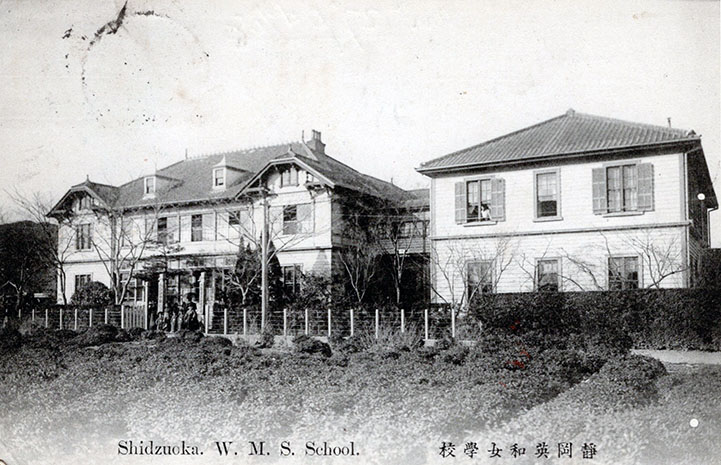
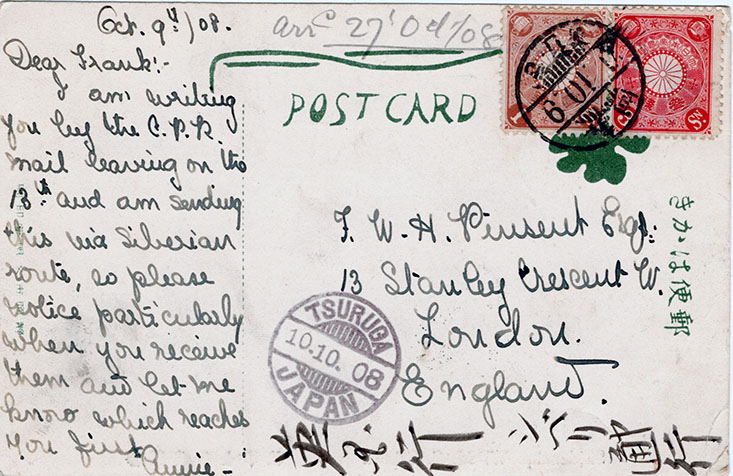
Annie returned to Newfoundland for a visit in October 1910 and the Women’s Missionary Society held a meeting to her mark return: “Mrs. Pinsent appeared as a Japanese lady and spoke about her work in Japan and of their customs …” (Evening Herald: Saturday 22nd October 1910).
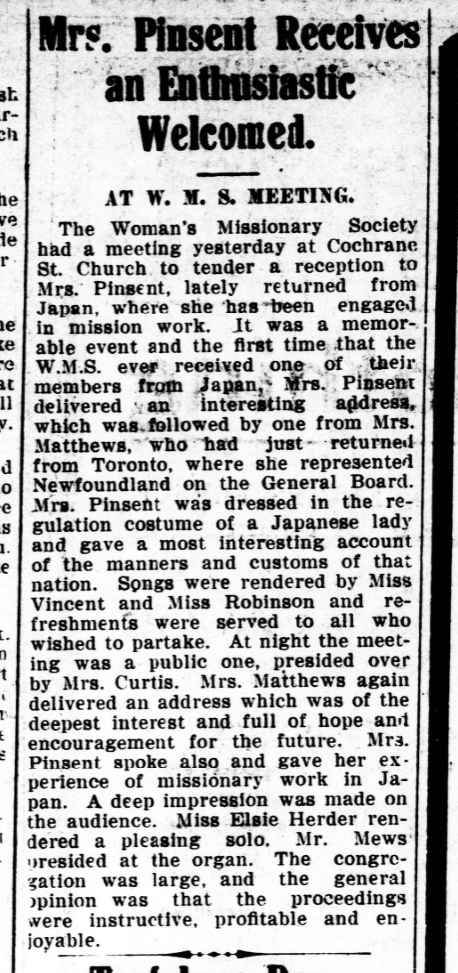
She gave several other talks over the next few months, including a more formal (illustrated lecture) in the Methodist College Hall in March the following year 1911. On this occasion she was joined by her sister Miss Gertie March and “Little Miss Mathews” suitably attired as a Japanese family: Mrs. Pinsent then told the story of her three (actually five) years life in Japan. It was realistic and held the undivided interest of the audience to the last. Mrs. Pinsent has a command of a choice vocabulary, is fluent and easily controls her audience (Evening Herald: Thursday 16th March 1911). It must have been quite an experience for people with little or no knowledge of Japan and its people.
While back in St. John’s she joined her Pinsent relatives, including Charles Speare, Earl Speare, their wives and the “Misses Pinsent” (presumably Charles’s daughters) in attending a “levee” at Government House that was given to celebrate the Coronation of King George V. (Evening Herald: Saturday 24th June 1911). That August, she returned to Japan: “Mrs. Pinsent, the Japanese Missionary, left by yesterday’s express to return to her missionary life in Japan. She has already spent five years in Japanese mission field and now proposes to devote the next seven years of her life to the same calling. She will stay at Toronto for a short time en route to Japan. As our readers are aware, Mrs. Pinsent is a daughter of Mr. and Mrs. Nathaniel March of this city (Evening Herald: Wednesday 9th August 1911).
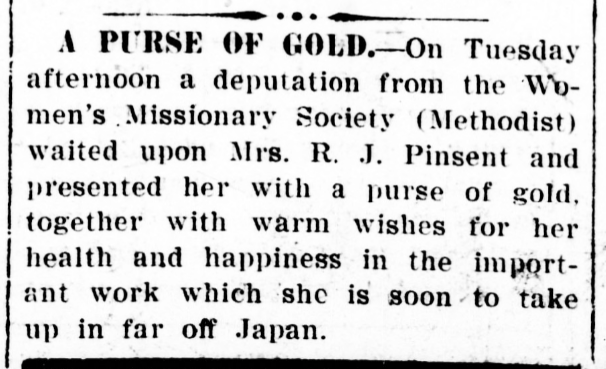
Before she left, a deputation from The Women’s Missionary Society “waited upon Mrs. R. H. Pinsent and presented her with a purse of gold, together with warm wishes for her health and happiness in the important work which she is soon to take up in far off Japan” (Evening Telegram: 10th August 1911).
Annie spent the First World War in Japan and, true to her word, returned to Newfoundland to see her family and friends in August 1918: “Mrs. R. H. Pinsent, is a daughter of the late Mr. N. March and sister of Major J. W. Marsh, M.C. After spending a month here with relatives, Mrs. Pinsent will go to London, Ontario, and thence possibly back to the foreign mission field. Seven years ago, Mrs. Pinsent returned to Newfoundland from Japan and instead of taking the usual Pacific route, crossed Siberia, Europe and the Atlantic Ocean” (Evening Telegram: Friday 16th August 1918).
Needless to say, Annie “our own missionary from Japan” was much in demand while back. She gave another talk at Cochrane Street Centennial Church in May 1919. In it, “she told of her experiences in the teaching of Japanese children, the difficulties in regard to the language and the marked success that attended the work. She instances the cases of several Japanese who had become faithful Christians. One kept a fish shop and Mrs. Pinsent described the surroundings of that place, the large variety of fish, and the methods of sale” (Evening Telegram: 19th May 1919). At another meeting of the Women’s Ministry Society the following month she “addressed the Branch in her most cheerful style, speaking chiefly on the kindergarten work in Japan and the wonderful results by the faithful staff of missionaries there” (Evening Telegram: 5th June 1919).
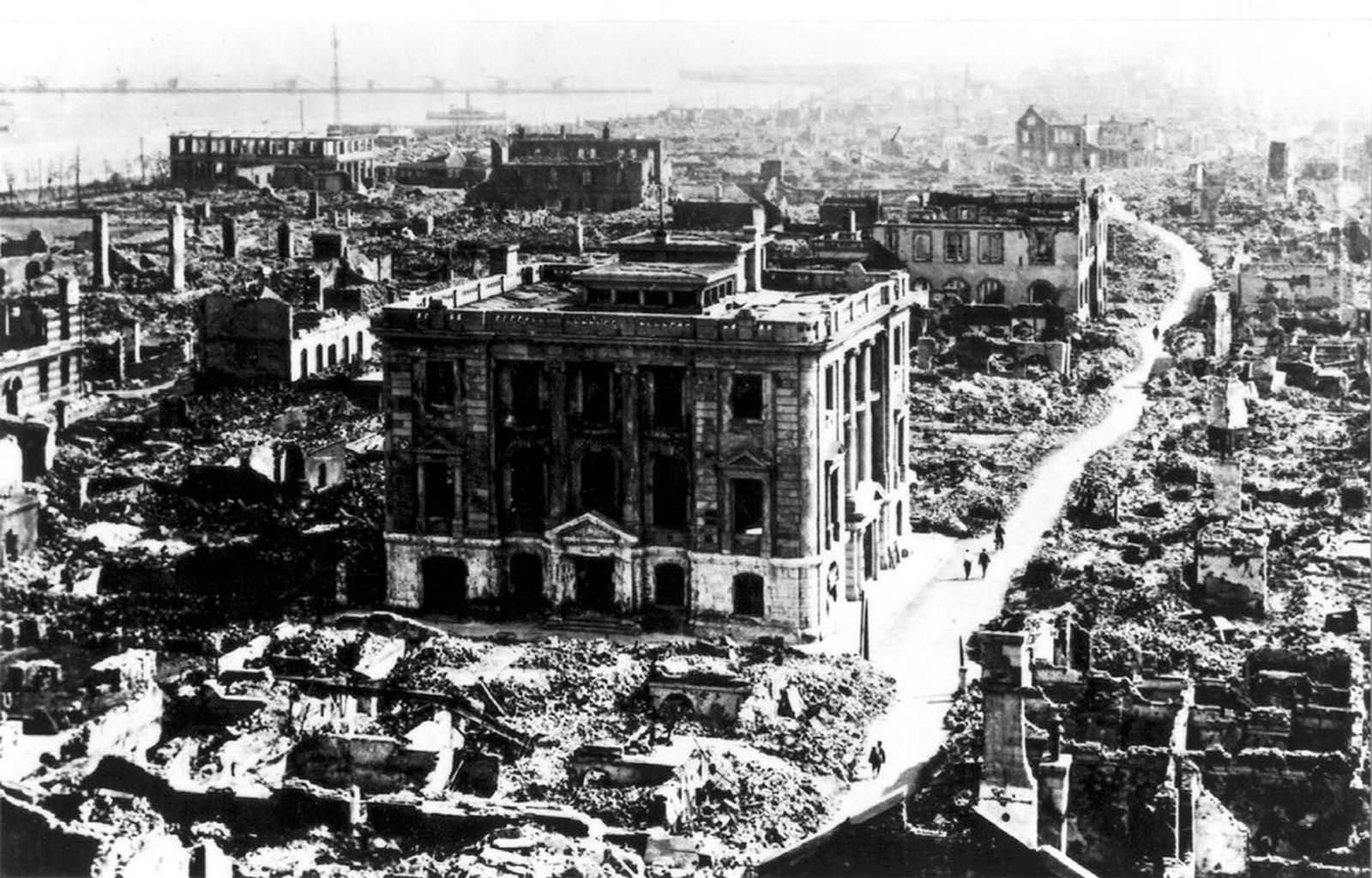
Annie returned to Japan and was there during the “Great Kanto earthquake” that struck the Island of Honshu on 1st September 1923. The quake and fires that followed caused considerable damage and Methodists in Newfoundland were much relieved to hear that: “Missionaries in Japan Escaped Destruction: A message received yesterday from Mrs. Lavelle, President of the Women’s Missionary Society of the Methodist Church of Canada stating that all the missionaries in Japan are safe. Amongst those devoting their lives to missionary work in Japan is Mrs. Pinsent, formerly Miss March, of this city” (Evening Telegram: 10th September 1923).
Annie took time out and visited England in 1926. Lady Pinsent had died in 1922, but she probably met up with her husband’s brothers Frank (“Good Old Frank”) in Devon and Guy – who she may not even have met before – in Surrey. She certainly must have met up their sister Mabel (Mrs. Eden). She may even have seen one of Charles Speare’s daughters, Frances (Mrs. Badcock). Annie Left Liverpool on 7th September 1926 and returned to Newfoundland on the S. S. “Nova Scotia” (Passenger Lists: Findmypast.co).
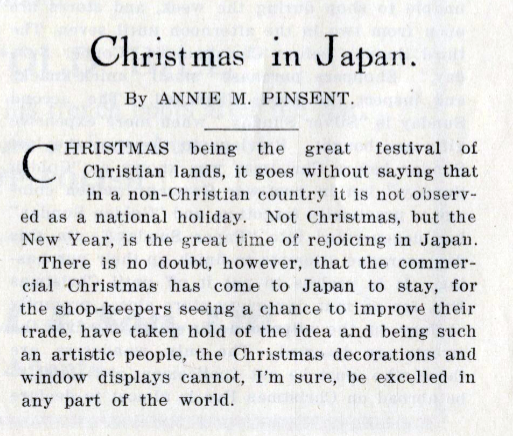
Like so many other members of the family, Annie liked to write about her experiences and an article of hers entitled “Christmas in Japan” appeared in “The Veteran: 1934: Vol. 10. No. 2, (December).” In it, she says “… Christmas is not celebrated but the Christian Church in Japan has introduced the idea into the population through its Kindergartens and Sunday Schools and it is often the children who are left to explain its meaning to their elders. For many it is the “Westerner’s New Year” … The Japanese have a prolonged and colourful celebration around then full of events and competitions – the stores are decorated and the firemen bring out their ladders and entertain the crowds …” It was so very different from Newfoundland.
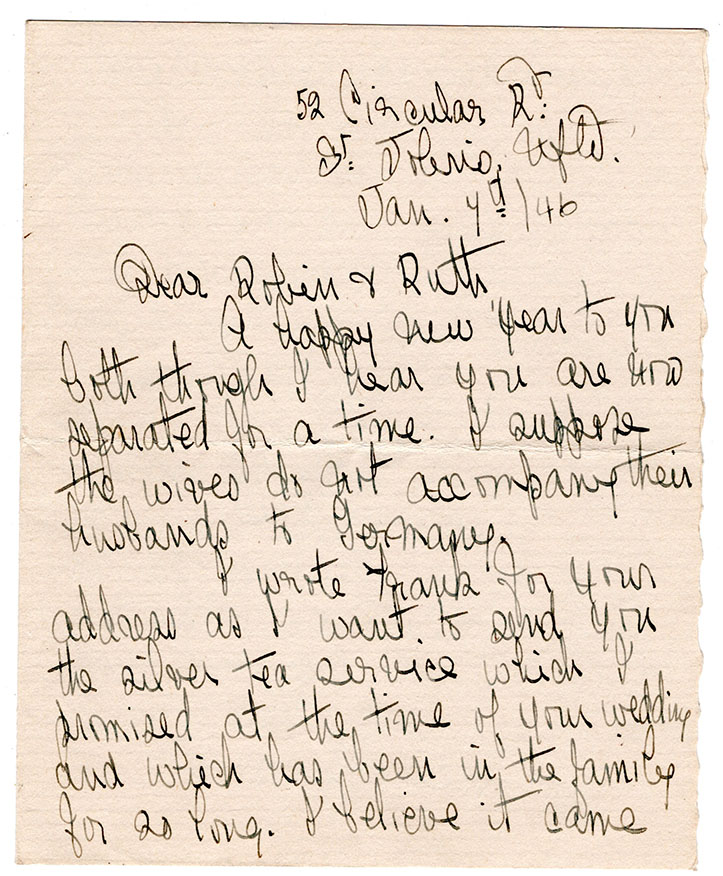
Annie was in St. John’s throughout the Second World War; however, she kept in contact with the family and, corresponded with my parents. In January 1946, she sent my parents a silver tea service that she had received from Lady Pinsent’s mother as a wedding present. She thought it must have been in the family for over 100 years.
In 1947, she sent bars of chocolate to my elder sisters. Sadly, I was too young to benefit. Annie died in St. John’s in 1950 and her will was probated there.
Family Tree
Grandparents
Grandfather: Robert John Pinsent: 1798 – 1876
Grandmother: Louisa Broom Williams: 1808 – 1882
Parents
Father: Robert John Pinsent: 1834 – 1893
Mother: Emily Hetty Sabine Homfray: 1845 – 1922
Father’s Siblings (Aunts, Uncles)
Mary Speare Pinsent: 1833 – 1833
Robert John Pinsent: 1834 – 1893 ✔️
Thomas Williams Pinsent: 1837 – 1890
Charles Speare Pinsent: 1838 – 1914
Louisa Williams Pinsent: 1841 – 1921
Mary Elizabeth Pinsent: 1844 – xxxx
William Burton Pinsent: 1846 – 1846
Male Siblings (Brothers, half-brothers)
John Cooke Pinsent: 1861 – 1861
Robert Hedley Vicars Pinsent: 1862 – 1888
William Satterly Splatt Pinsent: 1864 – 1865
Charles Augustus Maxwell Pinsent: 1866 – 1910
Arthur Newman Pinsent: 1867 – 1946
Robert John Ferrier Homfray Pinsent: 1874 – 1899 ✔️
Francis Wingfield Homfray Pinsent: 1875 – 1948
Guy Homfray Pinsent: 1889 – 1972
Please use the above links to explore this branch of the family tree. The default “Next” and “Previous” links below may lead to other unrelated branches.