Vital Statistics
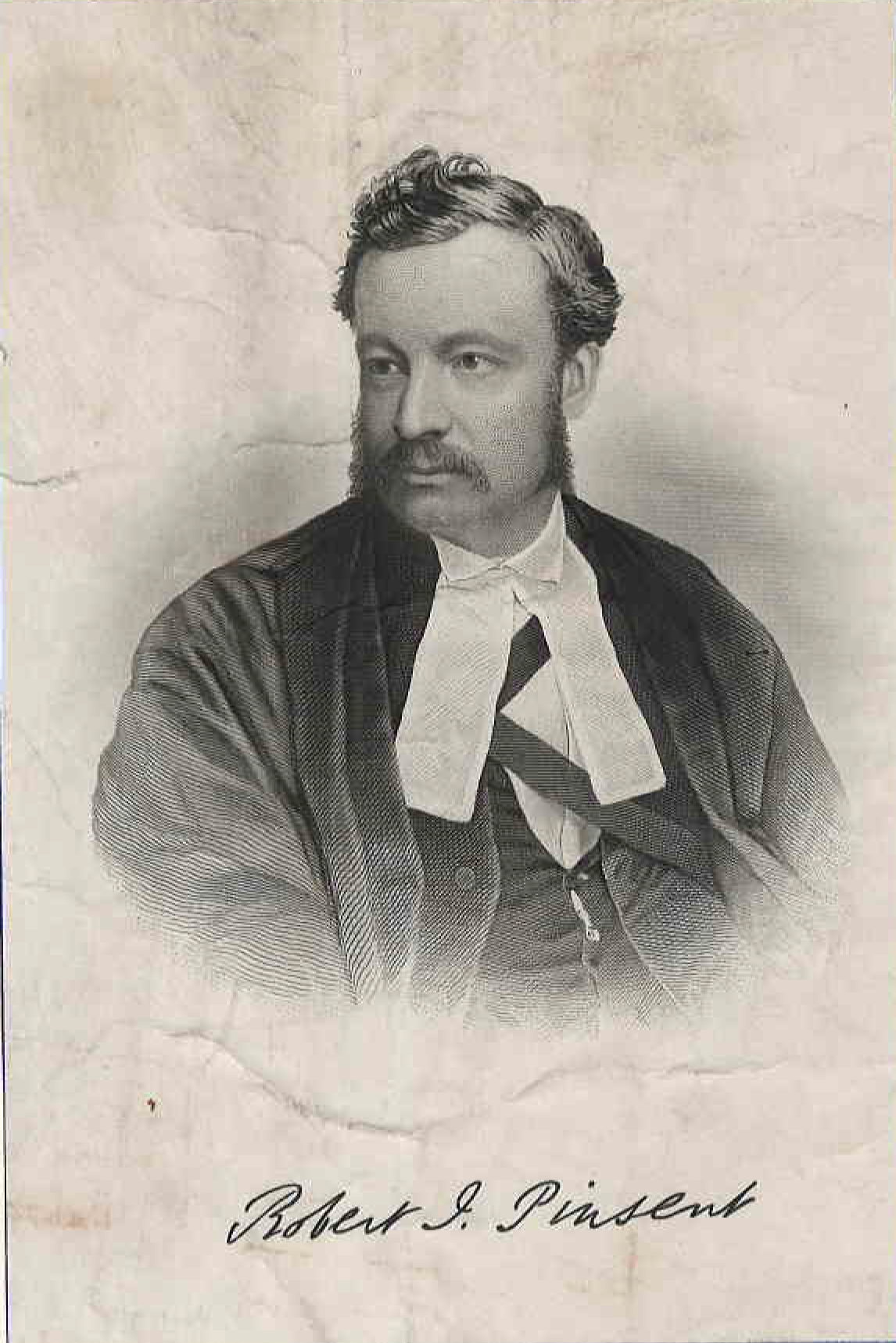
Robert John Pinsent: 1834 – 1893 GRO0747 (Justice of Supreme Court of Newfoundland)
1. Anna Brown Cooke: 1837 – 1882
Married: 1856: St. John’s, Newfoundland
Children by Anna Brown Cooke:
Lucretia Anna Maude Pinsent: 1857 – 1934 (Lady Abbess, Teignmouth Devon, Vatican, Rome)
Louisa Catherine Pinsent: 1858 – 1890 (Married George Shea, St. John, Newfoundland, 1888)
Marianne Hedley Pinsent: 1859 – 1859
John Cooke Pinsent: 1861 – 1861
Robert Hedley Vicars Pinsent: 1862 – 1888
William Satterly Splatt Pinsent: 1864 – 1865
Charles Augustus Maxwell Pinsent: 1866 – 1910 (Married Fanny Sophia Colley, Topsail, Newfoundland, 1897)
Arthur Newman Pinsent: 1867 – 1946
2. Emily Hetty Sabine Homfray: 1845 – 1922
Married: 1872: Froxfield, Wiltshire, England
Children by Emily Hetty Sabine Homfray:
Mabel Louisa Homfray Pinsent: 1873 – 1951 (Married William Annesley Eden, xxxx, 1895)
Robert John Ferrier Homfray Pinsent: 1874 – 1899 (Married Annie March, St. John’s Newfoundland, 1896)
Francis Wingfield Homfray Pinsent: 1875 – 1948 (Married, Janet Cowtan, Kensington, London, 1911)
Emily Maude Homfray Pinsent: 1876 – 1877
Hilda Constance Homfray Pinsent: 1879 – 1882
Beatrice Mary Homfray Pinsent: 1883 – 1965
Guy Homfray Pinsent: 1889 – 1972 (Married Ethel Betty Brittan, Sheepstor, Devon, 1923)
Family Branch: Hennock
PinsentID: GRO0747
References
Click here to view close family members.
Part I
Continue to Part II.
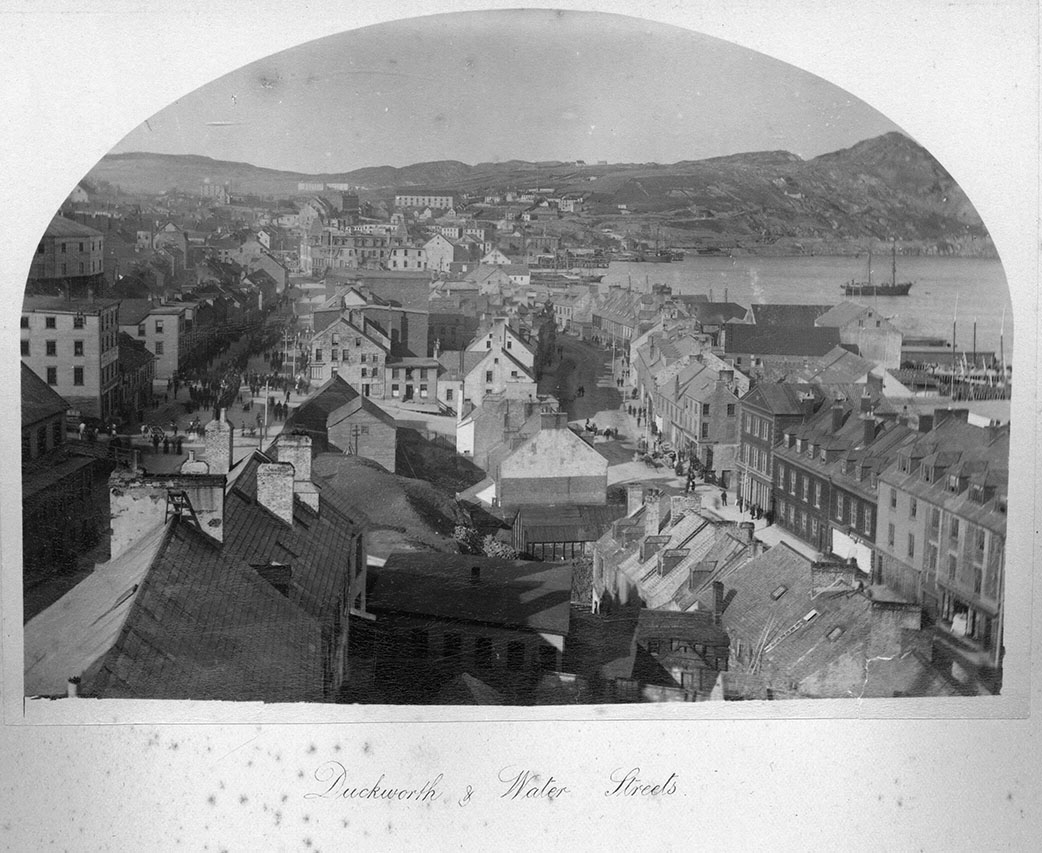
Robert John Pinsent “junior” was the eldest son of another Robert John Pinsent, by his wife, Louisa Broom Williams. He was born in Port de Grave in Newfoundland and brought up there, and in Harbour Grace with two brothers and two sisters. His father had come out to Newfoundland in the late 1820s to assist his elderly uncle, William Pinsent, run a shipping business. He had been born in London.
Robert John “senior” had married in St. John’s in 1828 and been appointed a magistrate in Brigus in 1832. He was later to be appointed a Judge of the Labrador Court and to dispense justice in the out-ports along the Labrador coast between 1863 and 1874. His life is discussed elsewhere. Perhaps it is not surprising that his son, Robert John “junior” (later Sir Robert) entered the legal profession.
The Newfoundland Evening Telegram published “A Biographical Sketch of Hon. Mr. Justice Pinsent, D.C.L.” in its Christmas edition (19th December 1888). It provides a summary of his life to that date; however, he still had four eventful years to go! I have extracted exerts from this “sketch” and they are given in italics inter-mixed with information from other sources. Robert John’s life is well documented and herein it is divided into two parts. The first (Part I) covers the period from his birth to 1870 – the year he divorced his first wife. The second (Part II) continues through until his death in 1893.
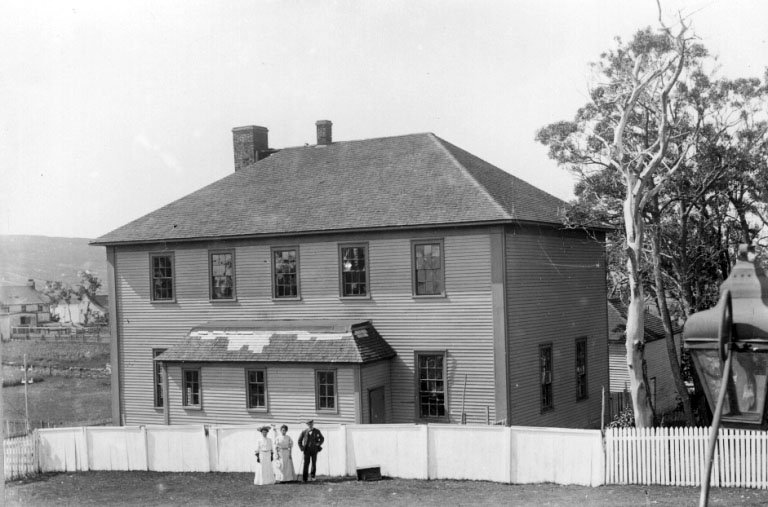
The “Sketch” includes a brief description of Robert John’s connections to the Williams, Vicars, Broom and other Newfoundland families and it shows that “he was educated at Harbour Grace Grammar School and entered his legal studies in St. John’s, under Mr. (afterwards Sir Bryan) Robinson, Q.C., and in 1855 and 1856 was admitted respectively Solicitor and Barrister. He was an able lawyer and was appointed to the Legislative Council in 1859 (see also St. James’s Chronicle: Thursday 6th October 1859) [Letters patent in my possession – RHP]. It was a position he held until 1865, which was the year that “Mr. Pinsent was called to the Inner Bar, as a Queen’s Counsel”. The Duke of Newcastle had “presented” him (to the Queen?) at a Levee in London two years earlier (Morning Herald (London): 27th February 1863). He was a man on the rise.
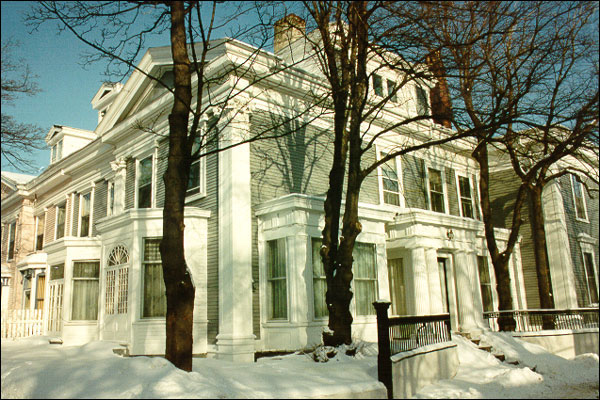
Robert John was fully settled in St. John’s by then. He had bought a house on Kingsbridge Road from John Fox in 1860 and he is said to have acquired a second (adjoining) house – on the corner of Forest and King’s Bridge Road known as “Devon Place” – a few years later. I believe they are now co-joined and part of the “Captain’s Quarters” hotel.
A website describing the latter building’s history shows that it started out as a duplex (http://www.captainsquarters.ca/viewpage.php?vu=1&id=2) . Robert John, perhaps informally, referred to his home as “Hillsborough” but it was, perhaps, more generally known as “Devon Place” – as when it was offered up for Let for a few months in 1882 (The Field: 4th February 1882).
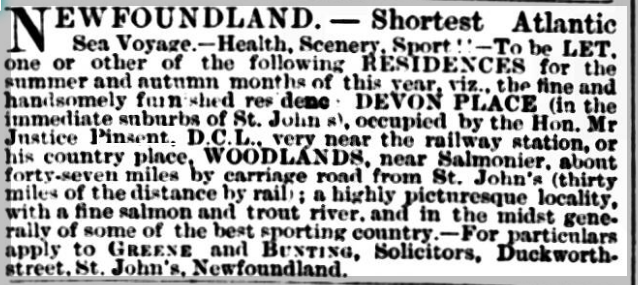
The name “Hillsborough” was probably a nod to his English relation, Thomas Pynsent, who had built and sold “Pitt House” in Hennock and moved to a very smart property of that name in Westward Ho! in north Devon (see elsewhere). Robert John seems to have lived at “Hillsborough” for the rest of his life. However, he had passed a substantial portion (7/8th) of it over to his son Charles Augustus Maxwell Pinsent in 1888.
St. John’s was a relatively small town in the 1860s and Robert John quickly made his mark. One of his early successes was in the prosecution of a magistrate who had pocketed around 80 doubloons from a cache he had found on a Spanish ship that had come aground in his jurisdiction. He claimed he had taken the doubloons for “expenses” that he and his family had incurred in rescuing the crew. Robert John argued on behalf of the owners, Marristan y Elias, and showed that the claim was excessive. The jury forced Mr. Simms to return £45 (The Patriot: 14th July 1859). Robert John was appointed Queen’s Council in August 1865.
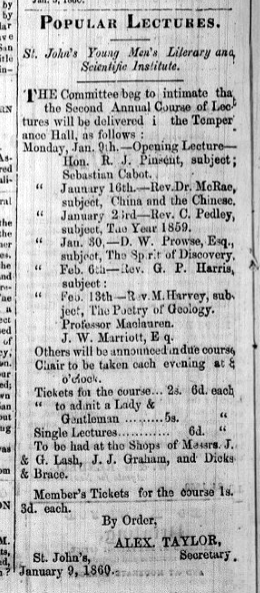
St. John’s was a growing community and there were relatively few opportunities for “further education,” so the “Young Men’s Literary and Scientific Institute” organized a lecture series that was held annually shortly after the New Year. Robert John not only helped organize the lectures but he quickly made his mark as an excellent speaker on subjects that displayed his interest in history. He lectured on “Sebastian Cabot” in 1860 (The patriot: 9th January 1860) and “Westminster Abbey” the following year (The Patriot: Monday 21st January 1861). Incidentally, I am sorry I missed the Rev. M. Harvey’s talk on “The Poetry of Geology.” Robert John had other interests too. Perhaps surprisingly, he was a strong proponent of agriculture in the Colony. According to the “Sketch” he was “President” and later “Vice-President” of the “Agricultural Society.” He was also “a member of the Synod of the Church of England from its foundation, and one of the Executive of that body under three successive Bishops.” Clearly, he was active in the community!
Confederation with Canada was a hot topic in 1865: “during the ongoing debate over Confederation with Canada, he resigned his Legislative Council position and was elected representative for his home constituency of Brigus and Port de Grave. In 1869, he acted as Attorney General while negotiations were being conducted in Canada. In the ensuing election on the question of Confederation that autumn, he was soundly beaten as the inhabitants of Brigus and Port de Grave were (by then) strongly against the idea.” Apparently the electorate now “feared they would be taxed to death” if Newfoundland were to join Canada.
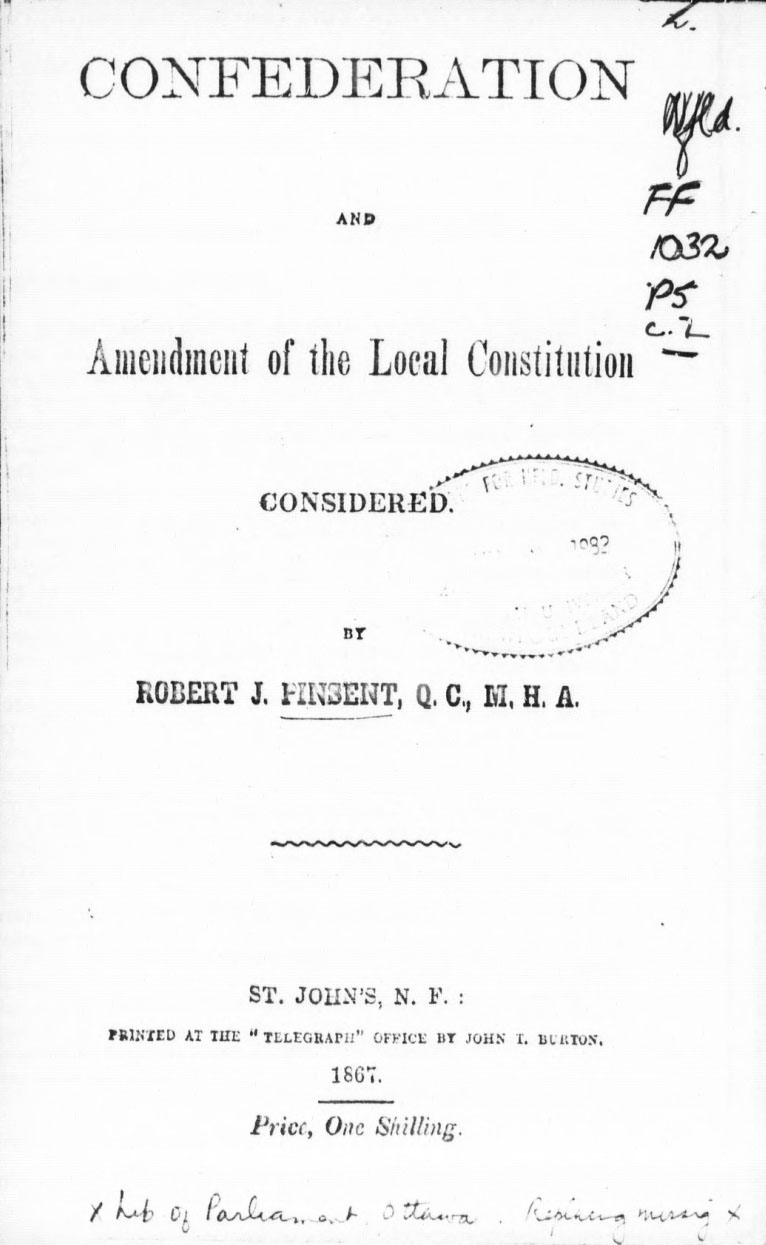
Robert produced a pamphlet entitled: “Confederation: Amendment of the Local Constitution – considered by – Robert J. Pinsent, Q.C., M.H.A.” in 1867. It was all perfectly logical but doomed his political future. Support for confederation had dwindled by the time he came up for reelection in 1869 – to the point where the magistrate at Port de Grave wrote to the returning officer at Brigus and informed him that “it was unsafe for the supporters of R. J. Pinsent to go out at night” and that the “antis” would prevent them from voting unless a strong police force was provided – G. W. Andrews, “Heritage of a Newfoundland Out-port”.
The issue of Confederation reemerged periodically and caused considerable anxiety. The Evening Telegram (12th February 1887) argued that the public was now far better educated than it had been in 1867, when “Judge Pinsent” (as he now was) published his “considerations” on confederation and was better able to evaluate the pros and cons. It encouraged discussion and one correspondent wrote: “I propose to write a series of letters upon the question of “Confederation;” and the title “Confederation Reconsidered” is intended as an allusion to that able pamphlet published in 1869 by the present Mr. Justice Pinsent, D.C.L., entitled “Confederation Considered.” Portions of that enduring monument of the author’s literary genius and statesmanlike perspicuity have recently been republished by you and have not only served to excite our admiration of Judge Pinsent’s prophetic and patriotic foresight, but also to concentrate public attention upon the subject which they so ably propounded eighteen years ago” (Evening Telegram: 15th February 1887). Mr. Justice Pinsent, as a Judge, was no longer able to dabble in politics and he said nothing. This attempt to drum up interest in confederation came to nothing. However, Newfoundland did eventually join Canada – in 1949.
After his defeat in 1869: “Mr. Pinsent was then reappointed to the Legislative Council [1870 Warrant in my possession – RHP] where he maintained his support for Confederation with the opposition party, led by Carter and Shea, until 1873 – when he severed his connection with them over some political controversy. Thereafter, he ran for the elective assembly a couple of times but was not elected.” The tide was against him. While in the (appointed) Legislative Assembly in 1870, Robert John wrote to the “Colonial Office” in London forcefully objecting to the British Government’s decision to remove its military garrison from St. John’s, arguing that the colony’s position at the west end of the trans-Atlantic cable system gave it strategic importance and, besides, it was still subject to unrest – particularly (as he knew all too well) at election time (The London Times: Friday 16th September 1970). A month later he received a formal letter informing him that “Lord Kimberley regrets … “ – Her Majesty’s Government had made up its mind on the matter (Exmouth Journal: Saturday 15th October 1870).
Mr. Pinsent was a barrister at heart and he was one of four (Messrs. Carter, Whiteway, Pinsent and Prowse) commissioned to produce a compendium of Newfoundland’s laws. The Patriot (Monday 21st November 1870) was not impressed: “Of the intrinsic merits of this volume, lawyers will be the judge, but a more slovenly, ill-printed and ugly quarto – abounding in typographical and other errors – never came under our notice.” I doubt if the lawyers had much to do with the printing but it is true to say that Robert John had other things on his mind around then. We will leave his professional career at this point and pick it up again in Part II of this discussion.
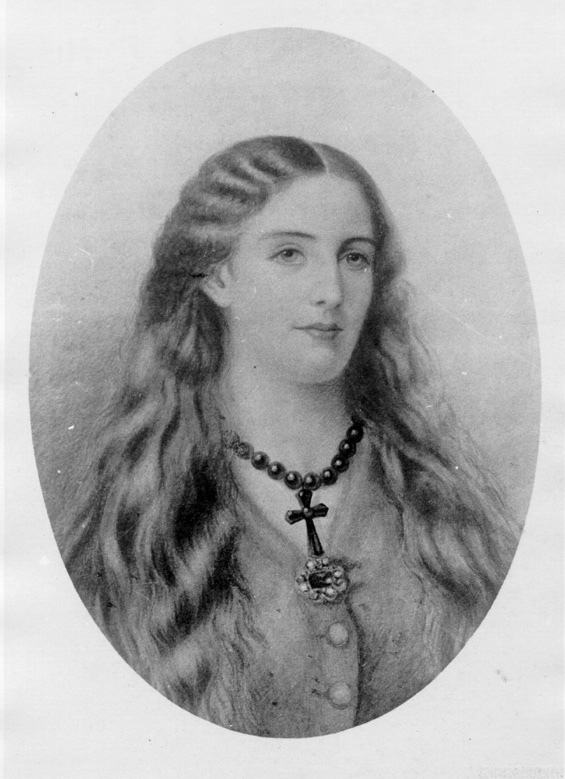
Stepping back in time, Robert John Pinsent Q.C. (who was an Anglican and member of the Church Synod), married Anna Brown Cooke at the home of a Wesleyan Minister (S. W. Sprague) in St. John’s Newfoundland on 28th April 1856. The location is somewhat surprising as Anna was the daughter of John Richard Maguire Cooke of Figueroa in Portugal and probably a Roman Catholic. Her eldest son Charles Augustus Maxwell Pinsent was later to become the Portuguese Vice-Consul in St. John’s. It was a notably low-key wedding (given the status of the two families) and the choice of minister was probably a comprise – given both family’s expectations.
In his will, written on the 24th July 1862, Anna’s father appointed David Steward Rennie Esquire and his son-in-law Robert John Pinsent as his executors, and he devised his real and personal estate to them in trust for his three principal legatees – who were to receive a third each. They were (1) his wife Mary (Cooke) whose portion was later to be passed on to one of his daughters; (2) his daughter Anna Brown Pinsent, wife of the Honourable R. J. Pinsent during her life and after her death to her children – in equal amounts and (3) his other daughter and after her, to her children – again in equal parts. By then, Robert John Pinsent and Anna Brown had three living children. However, they were later to add two more.
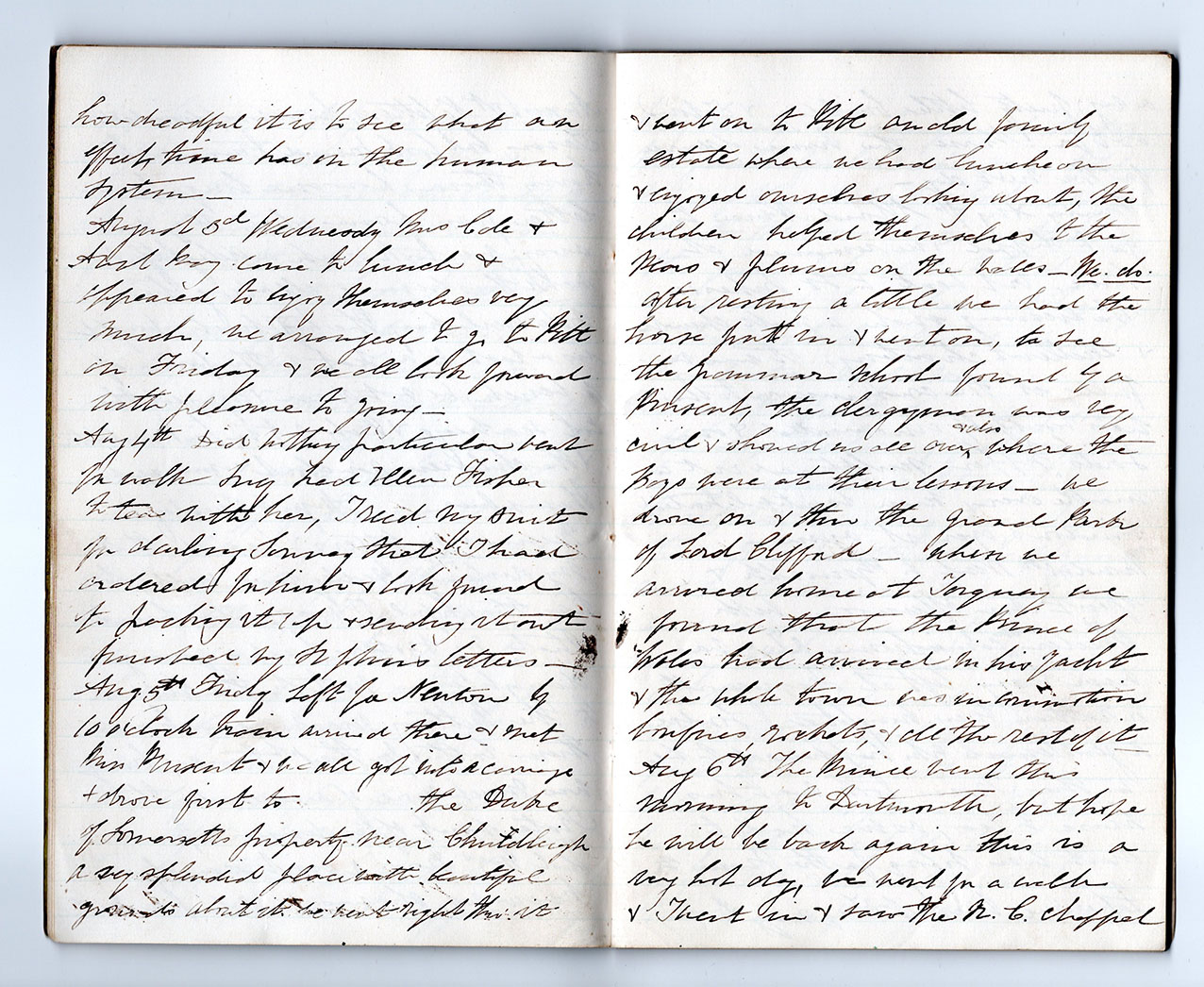
Anna Brown Pinsent and a nurse took three of her children Lucy (7), Kate (6) and “baby” Willie to England, in 1864. Why she left her son Robert Hedley (2) behind I am not sure. Perhaps she feared the “terrible twos” would upset the sensibilities of her English relations. While she was in England, she wrote a diary. The entries from Saturday 23rd July to Sunday 25th September describe her life in Torquay, where they were entertained by Mrs. Elizabeth Satterley Splatt (née Pinsent); at Woolwich Arsenal, in London where she visited her Aunt, Mrs. Col. Collington, and later in London – where she saw the sites. She describes daily happenings; she complains about the cost of living and talks about Sunday Church services, family visits and outings, and letters from home. She was clearly missing her husband and her son (Hedley (2)). Mrs. Splatt was the daughter of Joseph Pinsent who was one of Anna’s husband’s grandfather’s many English brothers! She had returned from Victoria in Australia where her husband, William Francis Splatt, had made his fortune running sheep and as a merchant in Melbourne.
Anna makes the following observations: “July 27th, Dear Robin’s birthday, I wish he were here….”. “July 30th. Baby [William Satterly Splatt Pinsent – clearly named in honour of their hostess – of whom more later] is 4 months old today: raining in the morning and I employed myself in writing a letter to Mrs. Keddell [one of Charles Pinsent of Pitt’s daughters] and Miss Pinsent”, who must have been one of Charles’s granddaughters none of whom were yet married. My guess is Margaret Jane Pynsent. She would have been twenty and an appropriate age to escort Anna and her children around. “July 31st… Good news from dear R. and my precious boy”. August 1st, No letters, how disappointed I am, but look forward tomorrow to having them…”.
August 5th: Left for Newton by 10 o’clock train and met Miss Pinsent and we all got into a carriage, and drove first to the Duke of Somerset’s property near Chudleigh, a very splendid place with beautiful grounds about it.” The Duke of Somerset’s Castle was actually in Berry Pomeroy, some distance from Chudleigh. Perhaps she went to Lord Clifford’s house at Ugborough, near Chudleigh and confused the two. “We went right through it and went on to Pitt, an old family estate where we had luncheon and enjoyed ourselves looking about; the children helped themselves to the pears and plums on the walls.”
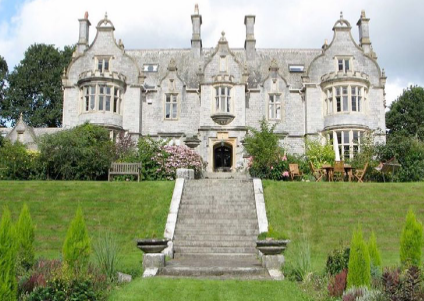
This suggests that Pitt House and farm were still in the family’s possession; however, it had been sold by then and they must have been the guests of the new owner. “After resting a little we had the horse put in and went on to see the grammar school founded by a Pinsent; the clergyman was very civil and showed us all over and also where the boys were at their lessons….”. [The school was founded by Mr. John Pynsent who was a local boy who became a Prothonotary (senior official) in the Court of Common Pleas. He founded the school in 1668]
August 17th, “… read NFL letters, good news, only Master Hedley opened the door of my bird cage and let it out”. August 18th, “We left Torquay … at Newton, dear Lucy and Tom got out and changed for Ivy Bridge … took a train for Woolwich … where my Aunt Mrs. Col. Collington lived… Darling Hedley’s Birthday”. August 27th, “… Lucy, dear little soul, she is learning to play croquette, Kate has been over nearly all day playing with Ella Swan”. September 13th “ … had a telegram from Liverpool saying S. was dying, did not quite believe it. Received letters from my dear husband and good news, I thank God for it”. September 15th, “Woolwich to London … drive off to Paddington for Lucie and Tom … dear Lucie looked so glad for me to be there …”. The Tom in this case was probably Charles Pinsent’s son Thomas who changed his name to Pynsent when he married in 1843. Tom had lived at Pitt Farm. He built Pitt House but sold it and the Pitt estate a few years later. Margaret Jane Pynsent was his daughter. They were doing their duty by their Newfoundland relations!
The family spent several days in London seeing the traditional tourist sites (Saint Paul’s, Hyde Park, Westminster Abbey, British Museum, Covent Garden, Madam Tussaud’s, Regent’s Park and several churches – what the children thought of it all, I have no idea) and shopping (school books, boots, gloves). On 18th September, the family spent the day in Hyde Park and enjoyed seeing the parade of young people out in the open space.
Anna, meanwhile, ponders on youth and mortality. “Dear me, when I look back, here I was in this very room [she may have been staying with her mother and sister in law: RHP] a year and a half ago and have crossed the broad Atlantic twice in that time”. “Such is life a constant change and yet to live it, Oh how strange””. September 24th, “My birthday, the advanced age of 27 years. Today, I wonder if I shall be alive next anniversary to record it. Oh My! It seems yesterday I was sweet 15 and here I am an ancient with four children. Old Father Time, you have no mercy”. September 25th, “… after tea heard the children read their scripture and read to them; much as I appear to think of the world, I would rather leave it all and go to God if I were sure my children were safe too, and my husband, dear old Robin. I wonder what you are doing at this minute, exactly nine o’clock at night, Sunday evening in the year of Our Lord, 1864”. [There is nothing in the diary to suggest that Anna Brown was unhappy in her marriage, although she does not seem completely fulfilled. She comes across as a compassionate person and a devoted mother and loving wife: RHP]
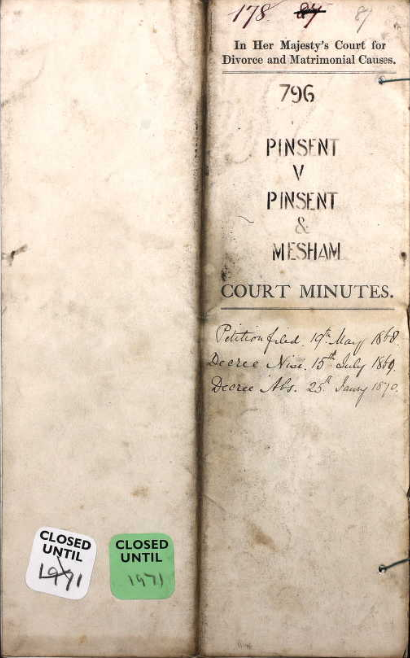
Unfortunately, notwithstanding the arrival of two more children, the marriage failed. Anna returned to England in December, 1867 – ostensibly to enroll two of her children in school and Bristol. However, she stayed on and met up with Charles Mesham in London. Robert claimed they may have spent some time in France together and lived together in Weymouth on their return to England. Some of their hotel stays were easy to document and may have been choreographed so as to establish adultery in England – and thus simplify the divorce proceedings. Robert John Pinsent was named as the Petitioner v. Anna Brown Pinsent Respondent and Charles Mesham as co-respondent in a petition filed in the “Court of Divorce and Matrimonial Causes” when it was filed in May 1868 (Morning Herald (London): Tuesday 8th December 1869, The Albion: Monday 19th July 1869, and other papers). “Court Documents” show that Robert had not heard from his wife since February 1868 and that he was not then aware as to her whereabouts. Mesham denied the allegation of adultery but up no defence.
Charles Mesham was an officer in the “Newfoundland Army and aide de camp and private secretary to the Governor” (Morning Herald (London) Monday 19th July 1869). He was a married man and had a family of his own. Although the affair may have formerly started in December 1867; however, I have an undated, intensely crumpled note that Anna wrote to her husband – probably sometime before going to England. In it, she “asks your forgiveness dear, dear Robert for leaving you in the way I did tonight. It went against my heart to do so, and I would not if I had not been told to treat (?) it with indifference by another person who noticed it, not that that is any excuse but Oh Robert I feel so very sorry.”
The Judge, in summing up, “observed that there was no trace of any surmise that the marriage had been otherwise than happy. In fixing the amount of damages, the jury ought to consider the position of the petitioner, as well as the co-respondent’s means of payment. It also appeared that the respondent, availing herself of a letter from her husband, had obtained goods from drapers at Woolwich to the extend of £250.” (Weekly Times and Echo (London): 18th July 1869).
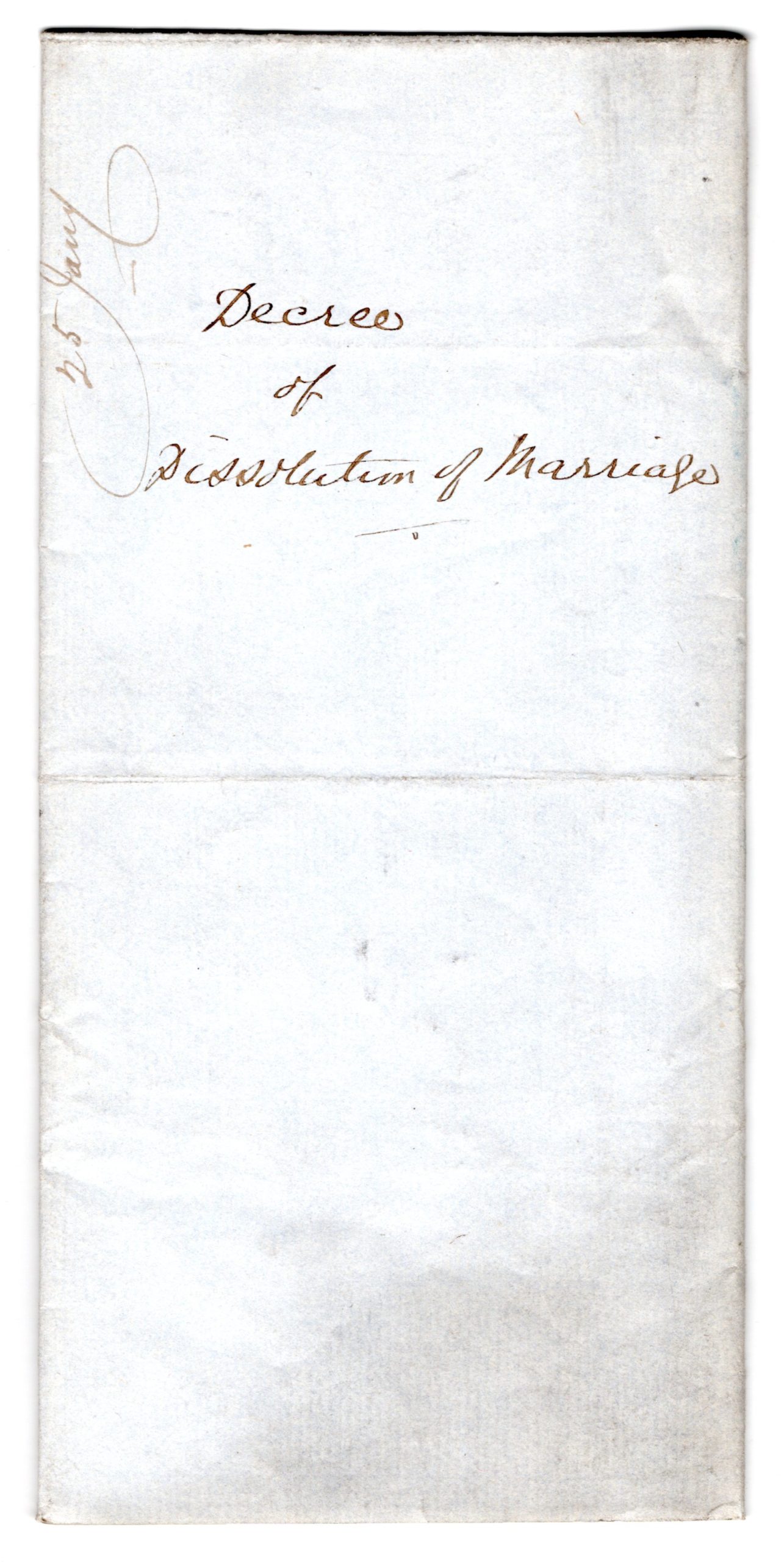
Charles Mr. Mersham, presumably reluctantly, paid the legal costs and stumped up £3,000 in damages! Robert John obtained a “Decree of Dissolution of Marriage” on 15th July 1869 but the divorce was not finalized in open court at Westminster until 25th January 1870. The marriage was dissolved by reason of adultery between the respondent and co-respondent. The The relevant documents are in the National Archives (J77/84 File 796). The scandal, such as it was, was only half-heartedly covered by the British press; which was, doubtless, what they hoped for.
Robert John Pinsent’s divorce led to a separation agreement that was signed 31st March 1870 [in my possession – RHP]. Robert John agreed to pay Mrs. Anna B. Pinsent for the remainder of the term of her natural life – as from the first day of January 1869 – an annuity of one hundred pounds sterling. And Anna Brown Pinsent on her part agreed to accept the said annuity and, in consideration of the payment thereof, acquit Robert John Pinsent from all further charge and from all claims whatsoever. She also signed over to him her interest and income arising from the estates of the late Lucretia Dickson and John R. Cooke to be used for support and education of his children by her. The deed was witnessed by Charles S. Pinsent and Louisa W. Pinsent (Robert John’s brother and sister) and others.
Robert John set about reorganizing the family’s estate in January 1869. In a Document of “Transfer and Division of Properties” [in my possession – RHP] he seems to have transferred much of his landed property to his children (Charles Augustus Maxwell, Gentleman, of St. John’s Newfoundland (23); Arthur Newman (22); Louisa Catherine (Kitty) Shea (wife of George Shea, Esquire of St. John’s, Newfoundland) aged (31) and Lucretia Maude (in religion Dame Mechtildis of St. Scholastica’s, Teignmouth, Devon) aged (32)). The transfer was complicated by the recent death of Robert and Anna’s third son, Robert Hedley Vicars Pinsent, of whose estate Robert John was both executor and legatee. The lives of all of them (except Louisa Catherine) are discussed elsewhere.
Robert John’s children ended up with fractional interests in several properties, including two houses on the east side of Barnes Lane in the City of St. John’s called “Cathedral Place”, premises called “Hillsboro’” on the Kings Bridge Road, St. John’s and leasehold properties on Military Road. He appears to have kept “#2 Cochrane Place”, Military Road, St. John’s, Newfoundland in his own name.
This reorganization took a while to fully implement and other papers in the “Newfoundland Archives” show that Robert John gifted his country house at “Woodlands” at Salmonier to his eldest son Charles Augustus Maxwell in 1884. He also granted him much of his remaining property, including “Hillsboro’”, in St. John’s in exchange for a release from an obligation to keep his life insured for $3,000.00. Robert John’s second son, Arthur Newman Pinsent appears to have sold his interest in the family’s estate to his brother Charles Augustus Maxwell Pinsent for $1,860.00 in cash and headed west into Canada. The name “Hillsboro'” for the family home is interesting as it mirrors that of Tom Pinsent (mentioned above). He settled in Northam on the coast near Bideford in North Devon and invested in farm land that he later sold for hotels and houses as Westward Ho! developed into a destination resort (complete with a golf course) in the 1870s. He made a bundle in the process.
Five of Robert John Pinsent’s eight children by Anna Brown Cooke were living at the time of the divorce. Sadly, only one of them, Charles Augustus Maxwell, produced a grandchild. He had a short-lived daughter. Arthur Newman never married – as far as I am aware – and thus there are no male descendants from Robert John’s first family.
English census records show that Robert John’s son Hedley V. Pynsent [8] (sic) was a scholar boarding at Ebenezer House C. Park School, in Westbury on Trym in Bristol, in 1871. It notes that he was born in Newfoundland and that his sisters L. Maude A. Pinsent [14] and Catherine L. Pinsent [12] were living nearby. In fact, they were living with Ann Keddle (a.k.a. Keddell) [66] at “#2 Mearncliffe Villa C. P., Westbury on Trym, Bristol. ” She was the sister of the Thomas Pynsent of Pitt in Hennock and (later) Northam in North Devon mentioned above. By then, she was a surgeon’s widow who living with her unmarried daughters, Anne P. [37] and Ellen M. [35] Keddle who had both been born in Keynsham, which is in Somerset. They were “teaching at home” and L. Maude and Catherine L. Pinsent were listed amongst their “scholars”. Both of the girls were correctly described as being “British Subjects born in Newfoundland”.
Robert Hedley Vicars Pinsent, or “Hedley” as he was generally known, went out to New Zealand as a young man but took sick and returned to Newfoundland via London in May 1889 (The Sydney Mail and New South Wales Advertiser (N.S.W.: 1871 – 1912): Saturday 14th May 1887). He died, unmarried, aged 25, soon after his return (New Zealand Herald: 30th April 1888). His brother, Arthur Newman Pinsent, farmed in Saskatchewan and served in the “Canadian Armed Forces” during the “First World War.” He died in Saskatchewan in 1946. Interestingly, there is a will for an Arthur Pinsent in the St. John’s Archives. However, it is dated 1949 (Newfoundland Wills Book: Volume 20: page 517). Perhaps he had residual property there.
Lucretia Anna Maude Pinsent, (“Lucy”) and, confusingly also (“Maude”) Pinsent converted to the Church of Rome and returned to Devon. Maude Pynsent [24] (sic) was an unmarried “associate” (nun) “engaged at domestic offices and needlework” at St. Scholastic Abbey on the Dawlish Road in East Teignmouth when the Census was taken in 1881. Ten years later, she was the “Lady Abbess” of the institution and responsible for approximately forty nuns and lay sisters. She then moved to Rome (see elsewhere).
Anna Brown married John Lee Stathem, a dentist she had first met in London while on her visit to England in 1864, in April 1870. What had become of Charles Mesham I am not sure! Perhaps he paid up and high-tailed it back to his wife and family in Newfoundland. Anna’s aunt Susan Rennie of Hastings in Sussex published a will, in 1877, in which she left an annuity of 50 pounds per year, to Anna Brown Stathem “formerly the wife of Robert John Pinsent” and gave Kate (i.e. Louisa Catherine Pinsent: above), Anna’s daughter by Robert John Pinsent a bequest of 20 pounds.
Anna Stathem died at Yandina, on the coast of New South Wales, in Australia, in 1882 and Susan Rennie added a codicil to her will in 1884. In it, she transferred Anna’s annuity to Catherine “during her life, until such time as she shall become the inmate of a Roman Catholic Convent, or marry with Robert John Pinsent’s consent”. Perhaps she was concerned that Catherine (“Kitty”) might follow her sister Maude into the Roman Catholic Church. She didn’t.
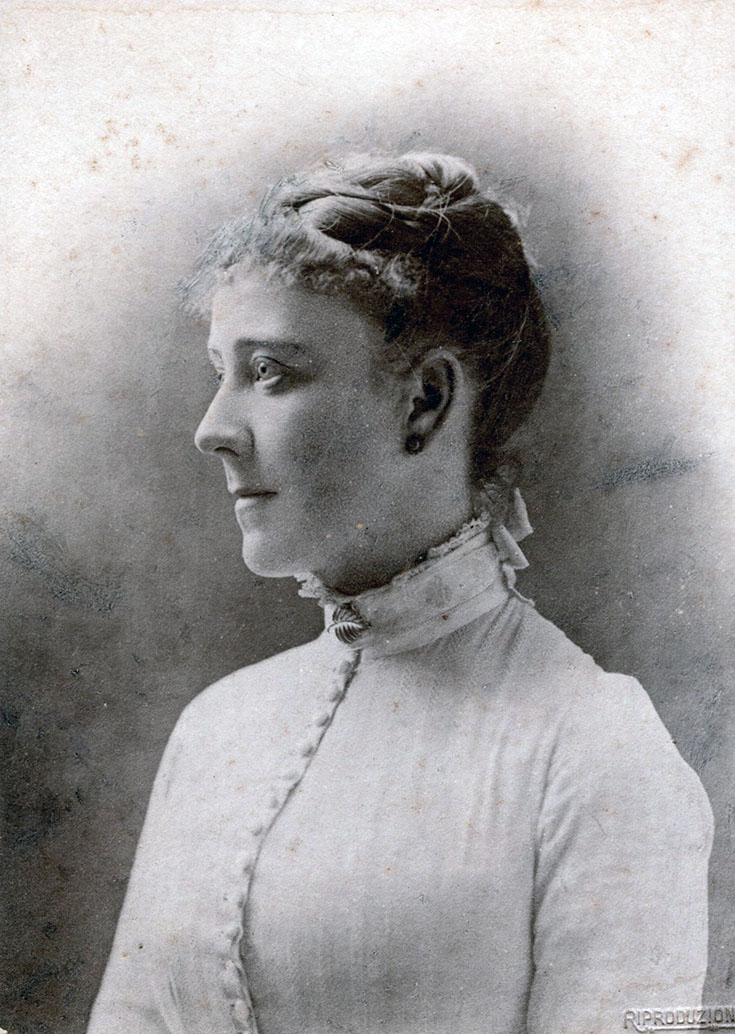
Catherine married George Shea, an aspiring politician in Newfoundland. His family’s firm “Shea and Co.” were shipping agents for the “Royal Mail Steamship Line”, the “Allan Line” and the “Ross Steamship Line”. Sadly, she died giving birth to her first child, in 1890. Mr. Shea later remarried and became a successful politician in the early 1900s.
For all that Anna Brown and Robert John had five sons, none produced sons of their own and to the best of my knowledge there are no male descendants on that side of the family.
After the divorce, Robert John was left to pick up the pieces and carry on. He had two young daughters and three sons (the youngest of which was only three years old) to look after. For more on his life, I suggest you move to Part II.
Continue to Part II.
Family Tree
Grandparents
Grandfather: John Pinsent: 1753 – 1821
Grandmother: Susanna Speare: 1766 – 1830
Parents
Father: Robert John Pinsent: 1798 – 1876
Mother: Louisa Broom Williams: 1808 – 1882
Father’s Siblings (Aunts, Uncles)
Mary Speare Pinsent: 1794 – 1882
Susanna Speare Pinsent: 1795 – 1819
John Pinsent: 1796 – xxxx
Robert John Pinsent: 1798 – 1876 ✔️
Elizabeth Pinsent: 1801 – 1828
Sophia Speare Pinsent: xxxx – 1805
Male Siblings (Brothers)
Robert John Pinsent: 1834 – 1893 ✔️
Thomas Williams Pinsent: 1837 – 1890
Charles Speare Pinsent: 1838 – 1914
William Burton Pinsent: 1846 – 1846
Please use the above links to explore this branch of the family tree. The default “Next” and “Previous” links below may lead to other unrelated branches.