Vital Statistics
Lucretia Anna Maude Pinsent: 1857 – 1934 GRO1138 (Lady Abbess, Teignmouth, Devon and Vatican, Rome)
Family Branch: Hennock
PinsentID: GRO1138
References
Click here to view close relatives.
Lucretia Anna Maude (“Lucy” or sometimes confusingly “Maude”) was Robert John Pinsent’s eldest daughter by his first wife, Anna Brown (née Cooke). He was a rising barrister in St. John’s Newfoundland at the time, and she was their first child. Lucretia was thirteen years old when her parent’s divorce was finalized in 1870. She had three living brothers (Robert Hedley Vicars, Charles Augustus Maxwell and Arthur Newman Pinsent) at the time, and also one living sister (Louisa Catherine Pinsent). Several other siblings had died.
Her mother, Anna, took three of her children Lucy (7), Kate (6) and “baby” Willie to England to meet their Devonshire cousins in 1864. Why she left another, Robert Hedley (2), behind, I am not sure. Maybe she feared the “terrible twos” would be too much for her English relatives. While she was in England she wrote a diary in which she discusses day-to-day events and outings. It is discussed elsewhere. Generally, it seems to have been a successful trip, and it was to be Lucretia’s first real exposure to the “Mother Country”.
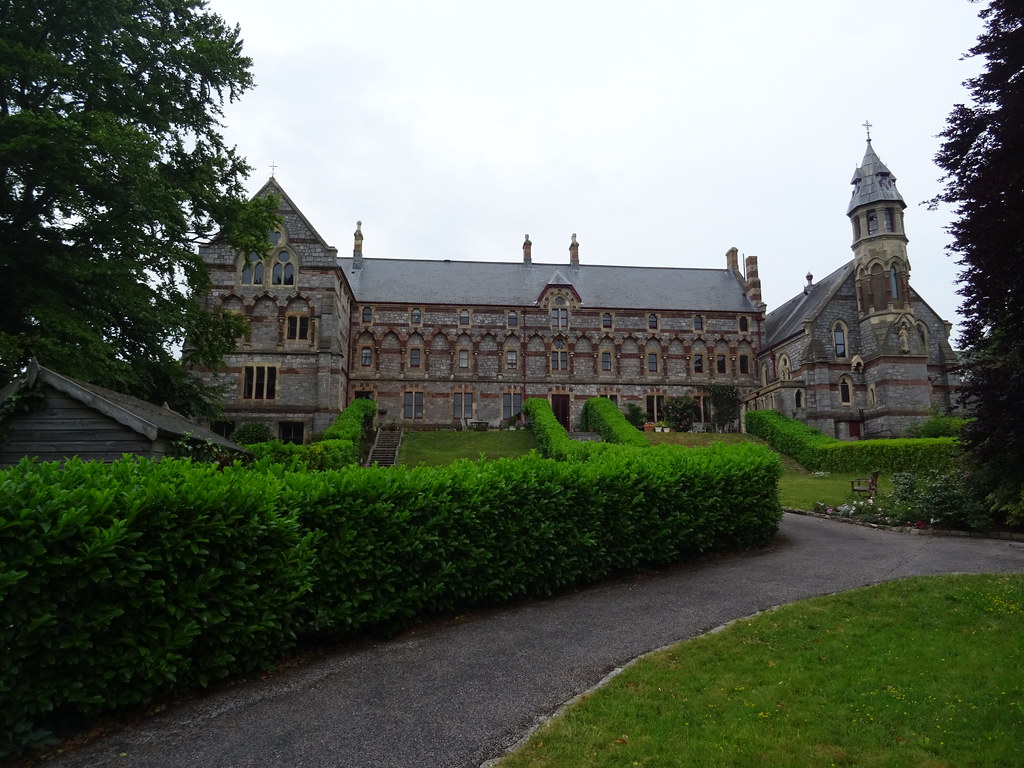
St Scholastica’s Abbey, Dawlish Road, Teignmouth, Devon via Flickr.
The 1871 census records show that “L. Maude A. Pinsent [14]” and “Catherine L. Pinsent [12]” were living with an English relative, Ann Keddle (a.k.a. Keddell) [66], a school teacher, at “#2 Mearncliffe Villa C. P., Westbury on Trym, Bristol. ” They had been sent to England to go to school.
Ann Keddle was the sister of Thomas Pynsent of Pitt in Hennock and (later) Northam in North Devon who was head of the English branch of the family. Lucretia (Maude) had met him on her earlier visit. Interestingly, she later to changed her surname to Pynsent – presumable to conform with Thomas’s wishes.
Ann Keddle was the widow of a surgeon and in 1871 she was living with her unmarried daughters, Anne P. [37] and Ellen M. [35] Keddle who ran a small school. The census shows that they were “teaching at home” and that the two Pinsent girls were amongst their “scholars”. The latter were correctly described as being “British Subjects born in Newfoundland”. As an aside, their mother, Anna Brown Pinsent, had (ostensibly) been in England looking after them in December 1867 when she committed the adultery that triggered the divorce proceedings that took place in London between 1868 and 1870. The divorce was finalized by the time the next census took place.
After the divorce, Anna’s children were left in the hands of their father who married Emily Hetty Sabine Homfray, an Anglican clergyman’s daughter, in Froxfield in Wiltshire in 1872. They added three living sons (Robert John Ferrier Homfray, Francis Wingfield Homfray and Guy Homfray Pinsent) and two living daughters (Mabel Louisa Homfray and Beatrice Mary Homfray Pinsent) to what became a well extended family.
What the children of the first family made of the divorce and their father’s remarriage, I am not sure – but it cannot have been easy for them. Their mother’s family had been merchants with strong ties to Portugal and Anna Brown may have been a Roman Catholic, and steered her children in that direction. On the other hand, her husband and his family had strong connections to the Anglican Church. So much so, in fact, that he was to be awarded the Honorary Degree of Doctor of Laws (D.D.L.) for his services to the Anglican Church in Newfoundland. He married an Anglican clergyman’s daughter after obtaining his divorce.
Sometime over the next few years Lucretia (Maude) formerly adopted the Catholic faith and joined a nunnery in Devon. The 1881 census shows that Maude Pynsent [24] was an unmarried “associate” (nun), born in Newfoundland, who was “engaged at domestic offices and needlework” at St. Scholastic Abbey on the Dawlish Road in East Teignmouth.
In January 1878, Robert John wrote to his wife Emily regarding his daughter Louisa Catherine (“Kitty”), who was going through a rebellious stage and was threatening to convert. Her actions were putting her education at risk and he wrote that her teacher “could not in justice to her pupils keep her after the holidays. I cannot blame her – of course, we both know that Kitty has her good points … I shall let her do as you say and then take her out, and if and when she is of age she clings to the idea let her go.”
It was a serious concern. In her will, written in 1878, Susan Rennie, who has Anna Brown (née Cooke’s) aunt left Catherine Pinsent the yearly sum of fifty pounds “during her life or until she the said Catherine Pinsent shall become the inmate of a Roman Catholic Convent, the said annuity to be paid to her half yearly and the first half yearly payment thereof to be made at the expiration of six calendar months from my decease: Provided nevertheless that in case she, the said Catherine Pinsent, shall become the inmate of a Roman Catholic Convent or shall marry during the lifetime of her father Robert John Pinsent without his consent.” Catherine married George Shea in St. John’s in 1888 with her father’s consent. He came from a “good” family and was a upcoming politician. Sadly, Catherine died in childbirth in March 1890.
Perhaps it was a little premature, but in 1885 W. Gordon Gorman included both Maude Pynsent and “Pynsent, Miss Katie, a Benedictine nun and abbess: daughter of the late Mr. Justice Pinsent, D.C.L.” in a list of “Converts to Rome: A biographical list of the more notable converts to the Catholic Church in the United Kingdom during the last sixty years.” He correctly identified the sisters but muddled them up. It was, of course, Lucretia Maude who was to become the Lady Abbess. Interestingly, when she did so, she went by the name of “Mechtildis Pynsent” – a German Saint. Her surname change was a nod to one of her distant English “cousins” – the Thomas Pinsent, of Pitt in Hennock who had changed his name to “Pynsent” when he married in 1843. He was wealthy and influential and managed to convinced several of his “cousins” – including Ferdinand Alfred, Charles Pitt Pynsent, Mary Anna Pynsent and eventually Joseph Burton Pynsent to make the same change.
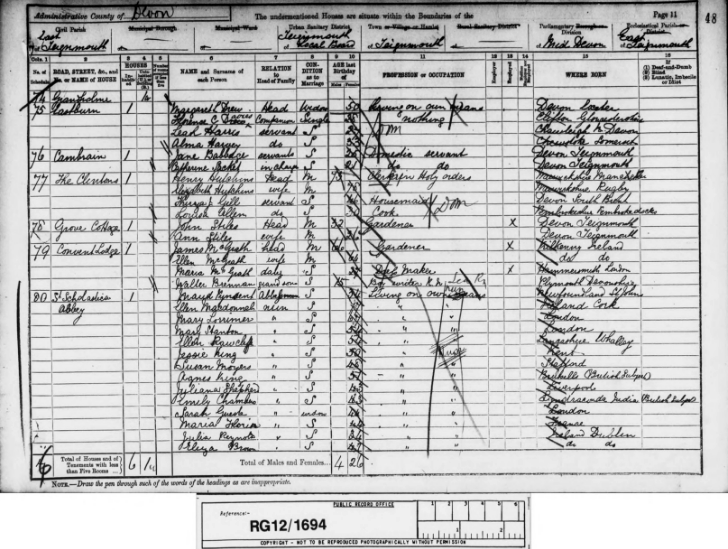
Lucretia was the Lady Abbess of St. Scholastica in East Teignmouth when the Census was taken in 1891. She was responsible for approximately forty nuns and lay sisters. However, she had plans for something bigger and in the early 1890s she moved to Rome and tried to establish a Benedictine convent for English women. Her father and stepmother visited her there in 1893. It was a short trip to see how she was doing. Sadly, Sir Robert died shortly after his return to England.
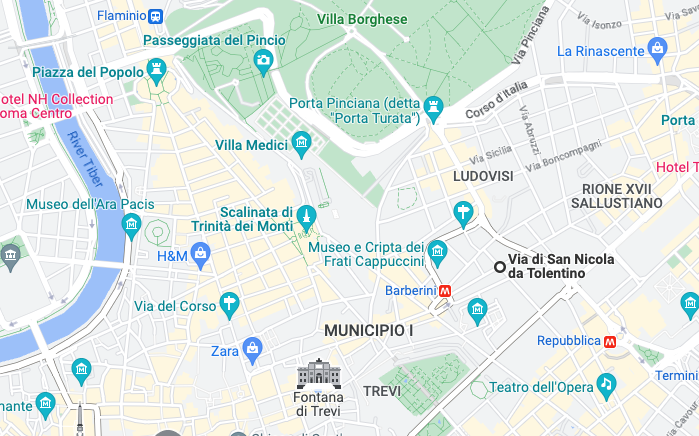
The idea of an English convent was well received in Rome and elsewhere. According to Freeman’s Journal (Sydney, N.S.W), “Several young ladies, well endowed with this world’s goods, have already joined the embryo community, which is highly approved by his Eminence the Cardinal-Vicar of Rome. A chapel, which, when finished, will be opened to the public, is in course of construction, and promises to be a very richly-ornamented sanctuary” (Saturday 23rd February 1895). Lady Pinsent kept an (unidentified) newspaper cutting in her scrapbook describing the opening of “a Benedictine religious house on Via S. Niccolo da Tolentino [a.k.a. Via di San Nicola da Tolentino], Rome, under the guidance of Lady Abbess Pinsent, O.S.B.”. The endeavour started out well and with strong support; however, it failed spectacularly! The nuns purchased an impressive house in Rome from the Irish Augustinians in 1898 in expectation of a large bequest that had been promised by a young English nun from a “good family.” Unfortunately, it was to be six years before the young woman received the money and the Lady Abbess had to negotiate an interim payment schedule. It might have worked; However, the young nun met an Italian monk in April 1899 … and decided she was no longer interested in the church! She would rather get married. The bequest was not to be forthcoming and, without her largess, the Abbess and her sisters were unable to complete their purchase.
The Lady Abbess had hoped the convent would cater to the poor and also provide a centre of learning for English speaking Catholics in Rome, while at the same time looking charitably on “the reduced nobility, whose pride will not permit them to seek assistance.” She knew she would need external contacts and funding for the venture to succeed, and she established links with “St. Andrew’s College” in Edinburgh, Scotland. Also, in the fall of 1899, she traveled to America. The trip was – ostensibly – to see how religious education was handled in the United States but she was primarily looking for funding.
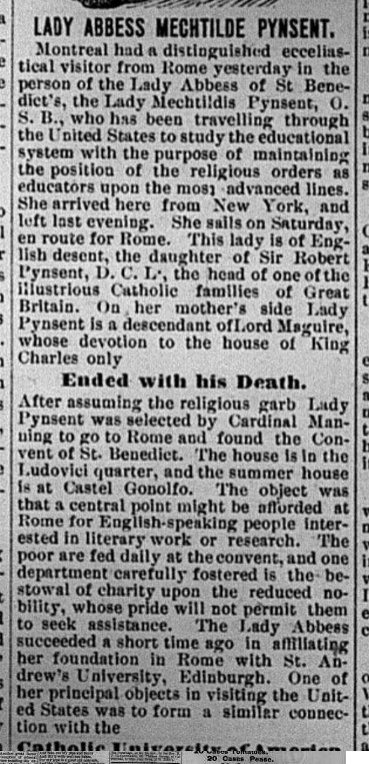
While there, Lucretia established links with the “Catholic University of America”. In an interview she gave to “Freeman’s Journal” shortly before she left, she was extremely complimentary about what she had seen and heard: “I know that when I tell my friends in Rome and elsewhere what I have actually seen they will be politely doubtful of the facts; but in many respects you far surpass Europeans. Take the great National Library at Washington, for instance. Of course, it lacks the treasures of the Vatican and the British Museum, but it would pay the administrators of those great central points of learning to study the methods of the “Washington Library”. In the way of architecture and adaptability to its purpose, there is nothing in Europe to equal it.” The journalist was, of course, delighted with this insight. He concluded his article with: “The Lady Abbess holds the highest dignity attainable by a woman in the Catholic Church. She wears the plain black habit of the Benedictines, the oldest order in the Church. She is about forty, aristocratic, and refined” (Freeman (Dublin): 18th November 1899 as reported in the Advocate (Melbourne): Saturday 30th December 1899). Clearly Lucretia, like her father, had a way with words!
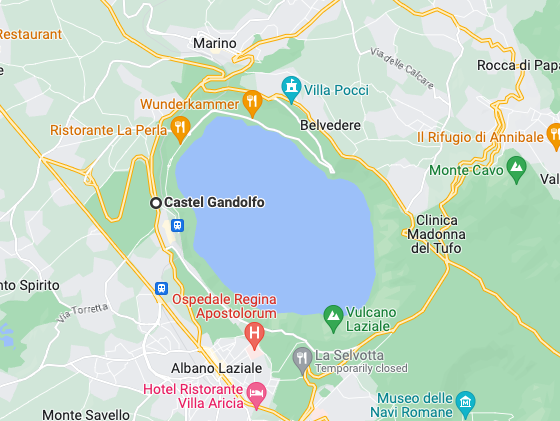
On 23rd November 1899, Lucretia (Maude’s) stepmother (Lady Pinsent) wrote to Rome – bringing her up to date with family matters and asking about her trip. “Do write & tell me all you can about your trip. Was it business connected with your convent especially, or the order generally. Was it a success?” By the sound of it, she had had positive feed back in Chicago and Washington – where she had been the guest of the Visitation nuns of Connecticut Avenue (Catholic Telegraph: 19th October 1899). The Georgetown College Journal (Volume 27: October 1898) tells us that “On Monday, October 16th, we were honoured by the visit of the Lady Abbess Mechtildis Pynsent, of St. Benedict’s Rome … The Abbess is the daughter of Sir Robert Pynsent, and at the request of Cardinal Manning founded the Benedictine Monastery in Rome, which recently was affiliated to St. Andrew’s College in Edinburgh. The Holy Father Leo XIII donated to this Monastery the Castle Gandolfo, on the beautiful Lake of Albano where the nuns spend the summer months. The Abbess is an erudite scholar and has written many works in English and in Latin. She is ready to receive at the Rome house a limited number of English or American young ladies … “. Lake Albano is southeast of Rome.
Unfortunately, money was hard to come by. Nevertheless, she found the support she needed in Canada. As she was later to put it in a long article in the “London Times”: “A French-Canadian from Montreal, Mons. Robert took up the matter very warmly and came to Rome in August 1900 for the express purpose of making a last desperate effort to save the community. His proposal for this end, he explained to Cardinal Rampolla in an audience and also by letter. It consisted in a generous offer to pay all the debts and to give sufficient money for a fresh start, on the one condition that the Pope would authorize him to collect subscriptions in Canada and the United States for the benefit of the nuns and to reimburse himself for the money he would have advanced. This most reasonable proposal was refused” (The Times: 21st September 1901).
This left the English Benedictines in dire straights and they once again appealed to the Papal Authorities for help – but without success. When they failed to meet their obligations, the Irish Augustinians sued them in an Italian Court! The nuns’ furniture and belongings were seized by creditors before a decision had been even been reached, and after much legal wrangling “there was nothing left to do but go through the humiliation of an eviction by the Italian police, who, to their honour be it said, suffered quite as much as their victims. As the nuns were standing on the pavement after their eviction, hardly knowing what to do, Cardinal Gotti passed in his carriage. It is freely said in Rome that the eviction of nuns by friars has been hitherto an unheard of event, and that it was reserved to the latter days of the pontificate of Leo XIII to witness such a spectacle in Rome” (London Times: 21st September 1901).
The Roman Catholic hierarchy in England closed ranks and the Bishop of Clifton, W. R. Brownlow, gave their point of view. He felt that the Augustinians had been more than reasonable and were quite within their rights to throw the nuns out. He said that the Lady Abbess had been extremely foolish in taking on such an expensive property, and the obligations she had. He added: “I have known Miss Pynsent for many years, have received many letters from her, have visited her in Rome when she was at the height of her prosperity and also when she was in the depth of adversity. She is a lady of great talent and of fascinating manners, with great power of influencing others. I am bound also to say that she has unlimited confidence in herself. This has been the rock on which she has been wrecked, although she cannot see it.” She should never have relied on the prospect of receiving funds from her flighty “sister in religion.” The Bishop, somewhat gratuitously, then goes on to say: “Your readers will be surprised to learn that Miss Pynsent does not believe in the Christian religion, …” – thus the Church authorities could hardly be faulted for not heeding her pleas for support (Monitor and New Era: Friday 4th October 1901)!
The Bishop of Clifton wasn’t wrong about her agnosticism. In a letter referred to in the columns of the “Record” a few days later (Record: 11th October 1901) she explains why; saying that:“sad experience convinced me that injustice and immorality are, in Rome, the rule rather than the exception, and that the church instead of being a purely spiritual organization, is practically a huge political machine worked for mundane ends by worldly minded men, I lost the belief that I had cherished during twenty-six unhesitating years of Catholic life.”
The Battle was now fully engaged and the two sides fought it out in letters to the press – principally the “London Times” -that were discussed just about everywhere. Father O’Gorman put the case for Irish Augustinians. He discussed the history of the house on Via S. Niccolo da Tolentino – which the Augustinians had built to honour St. Patrick – and explained the financial terms of the nun’s financial obligations. He felt that the Augustinians, along with all the powers that be in Rome, had been very positively disposed towards the venture and had gone out of their way to assist the nuns; however when their financing failed there was no reason why the Augustinians should shoulder the loss. “As to the animus displayed in Miss Pynsent’s letters against the ecclesiastical authorities in Rome, I have (he had) nothing to say here. Such diatribes may produce the effect intended on the Protestant gallery here in England, but most thoughtful and reasoning people will appraise them at their real value. Miss Pynsent has endeavoured to arouse racial animosities by hinting that the Irish Augustinian Fathers have acted with undue severity towards her and the members of her community for no other reason than that they are English women.”
Father O’Gorman emphasized the generosity of the Augustinians, noting that the furniture removed by the nuns’ creditors had originally belonged to them, and that the building had been considerably damaged after the nuns left. The lead pipes were gone, the electrical fixtures were damaged and many of the windows were broken. As for the eviction itself, he said that the Lady Abbess and some of the nuns returned to make it a spectacle – they notified the local newspapers (Monitor and New Era: Friday 18th October 1901).
The Roman Catholic hierarchy later justified its failure to assist the English Benedictines on their knowledge of the Lady Abbess’s loss of faith; however, she contended that the Inquisition was unaware of the fact when it allowed the nuns to be thrown out. She said: “I have written proof at this moment that, as lately as last spring, the Inquisition had no knowledge of the kind; if at the moment of the eviction, such knowledge had been obtained, I certainly ought to have been given an opportunity of declaring whether the reported change in my view were true or false. After an avowal on my part, the Church could have dealt singly with me, and have done justice to the nuns, for whose sake, and in whose regard, I had kept my secret so far as I honourably could.
Sadly, the Bishop of Clifton would not let it go. He smugly claimed that “Miss Pynsent had forgotten that, in a letter dated St. Benedict’s Rome, December 9, 1900, she had written to me: “When I tell you that I have been at the trouble to let the Inquisition know my sentiments, you will understand that my attitude is final”. To this, the Lady Abbess responded by saying “Bishop Brownlow is quite right in the quotation he makes from one of my letters to him in December, 1900. Could I have foreseen that such private correspondence would ever be made public, I should have sent him a second letter next day, explaining that, reconsidering the matter, I did not send to the Inquisition the communication to which I referred in writing to him, and which lay sealed on my table ready to be taken to its destination at the time his own letter were posted (Evening Mail: Monday 21st October 1901).
Lady Pinsent must have followed the blow-by-blow account of the failure of the Benedictine order as it unfolded in the press and she wrote to her stepdaughter in December 1901 indicating how worried she was: “I thought you were prospering so well and I cannot of course now understand the cause of your trouble. Did you go too fast do you think? Would no one give some help to tide over things a bit? The Vatican is credited with enormous wealth. Why don’t you interview the Duke of Norfolk & try and interest him in your work?” Perhaps she was referring to Maude’s future plans as the convent was now long gone.
Despite her now somewhat precarious position in the Roman Catholic establishment, Lucretia opted to stay on in Rome and turn her attention to history. She submitted an article entitled “The Queen of Italy” to “Chamber’s Journal” that somehow came to the attention of The Evening Public Ledger in Pennsylvania (an American Newspaper) and the Gisborne Times (a New Zealand newspaper). Perhaps one of her young ladies had moved to New Zealand. According to the latter, the Queen was – “Already famous for her good works and love of country, she is now known as an ardent archaeologist, particularly in relation to excavations in the grounds of the Royal villa of Castel Parziano” (Gisborne Times: 20th June 1914).
Lucretia (Maude) loved Rome and wrote an article entitled “Christmas in Rome” (World: 28th December 1916) in which she bemoans the loss of many of the traditonal celebrations that used to occur in the Holy City and describes the pageantry behind some of the survivals – including the “Armenian High Mass” at in San Niccolo da Tolentino. “Before the Altar hangs a curtain which is only drawn aside at certain parts of the service, and the chanting is heard whilst the Ministers of the Sanctuary are unseen – in memory of the veil which hid the Holy of Holies in the Temple of Jerusalem. When the veil is withdrawn at certain parts of the Mass, a picture is presented suggesting an Eastern royal court. The Patriach with his flowing beard and golden mitre sits enthroned and surrounded by his Ministers, clothed in brilliantly coloured vestments, some of them carry standards to which are attaches small bells, rung at certain part of the Mass. The singing is unaccompanied by any instrument and has a devout and impressive character, reminiscent of the Gregorian chant and of ancient Creek music. And so, strangely enough, the Liturgical beauty of a Roman Christmas is now, not so much in the Latin rite, but in that from the East from whence the Feast came, the birthplace of the Babe of Bethlehem.” She then calls for the documentation and retention of, now fading, forms of expression and celebration of Christ’s birth. Indeed, “The accompanying songs were traditional and should be collected before they are entirely forgotten. Indeed, no more beautiful or instructive history of Christmas could well be imagined than a collection of folk lore compiled and put side by side with pictures dating from the same centuries, for the number of songs and legends is immense and scattered over East and West, the scene of the Nativity is one the first favourites in the history of religious painting from the frescoes of the Catacombs down to the present time”. Lucretia wrote this during the First World War. She was no-longer a Lady Abbess; however, it was published under the name of “Lady Pynsent.”
Amusingly, “Lady Pynsent” continued to correspond with “Lady Pinsent” after the later went to live in Devon with her son Francis Wingfield Homfray Pinsent and his wife Janet (née Cowtan), and she continued to correspond with them after Lady Pinsent died in 1922.
Frank and Janet went out to Rome to see Lucretia (Maude) in 1929. Ship manifests (Ancestry.com) show that they left for Genoa on the Netherlands Royal Mail ship “Pieter Corneliszoon Hooft” on 23rd May and returned on the “Christiaan Huygens” almost four months later. It docked in Southampton on 12th June 1929. While they were in Rome the family discussed its genealogy and Frank wrote up some of his half-sister’s comments about their great grandfather’s brother Joseph Pinsent and his three wives – two of whom had come from the DEVONPORT branch of the family. They also discussed family portraits. The incident is referred to elsewhere in Frank’s biography and also briefly described in the attached item on “The Pynsent Baronetcy:” (“The Trials and Tribulations of a Litigious Family”: (1687 – 1765).
Two of Lucretia (Maude’s) letters to Frank and his wife have survived. In June 1931 she wrote to Janet. She described day-to-day affairs in Rome, asked if she would purchase and send out some items of English clothing – and she showed some delight that my father, Robert John Francis Homfray Pinsent might go out to Rome for a visit that Christmas. I am not aware that he, infact, did. Lucretia was getting on in years and had just recovered from a serious illness that had reminded her of her mortality. She was afraid that her clerical friends in Rome might be tempted to over-ride her views on religion – which were as strong and negative as ever and she wondered if “Frank would write a short undated latter to Msgr. (Rella) saying that he (the family) request there shall be no religion action of any kind when I am dead. The reason I ask is that he is as afraid of authorities here blaming him if he does what I wish but if he has a letter in your hand no one can make him responsible. Ask F. not to put off doing this – I am now splendidly well & as full of strength and energy as ever.”
Presumably he did so, as her next letter (to Frank) in July says “In regards to the letter to Mnsr. Rella. I have been thinking that it would be just as efficacious if I wrote one to the Consul here & asked him to take the responsibility of a civil burial. He would be obliged to see to it.”
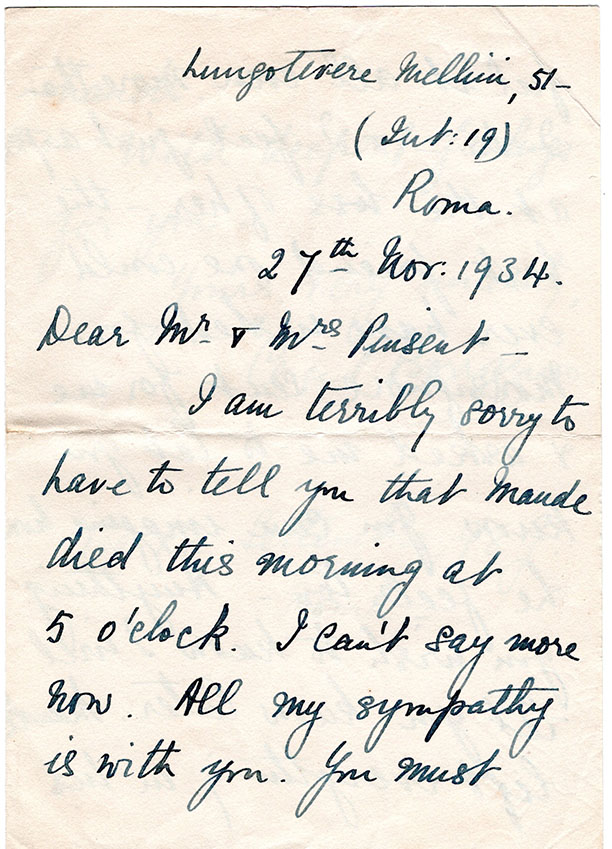
Lucretia Anna Maude Pynsent died in Rome on 27th June 1934 and Cecil Borrozzino promptly wrote to Frank to inform him of her passing. Her death was registered in the British Consul in Rome. Presumably the powers that be granted her wish for a quiet, non-religious burial.
Family Tree
Grandparents
Grandfather: Robert John Pinsent: 1798 – 1876
Grandmother: Louisa Broom Williams: 1808 – 1882
Parents
Father: Robert John Pinsent: 1834 – 1893
Mother: Anna Brown Cooke: 1837 – 1882
Father’s Siblings (Aunts, Uncles)
Mary Speare Pinsent: 1833 – 1833
Robert John Pinsent: 1834 – 1893 ✔️
Thomas Williams Pinsent: 1837 – 1890
Charles Speare Pinsent: 1838 – 1914
Louisa Williams Pinsent: 1841 – 1921
Mary Elizabeth Pinsent: 1844 – xxxx
William Burton Pinsent: 1846 – 1846
Male Siblings (Brothers, half-brothers)
John Cooke Pinsent: 1861 – 1861
Robert Hedley Vicars Pinsent: 1862 – 1888
William Satterly Splatt Pinsent: 1864 – 1865
Charles Augustus Maxwell Pinsent: 1866 – 1910
Arthur Newman Pinsent: 1867 – 1946
Robert John Ferrier Homfray Pinsent: 1874 – 1899
Francis Wingfield Homfray Pinsent: 1875 – 1948
Guy Homfray Pinsent: 1889 – 1972
Please use the above links to explore this branch of the family tree. The default “Next” and “Previous” links below may lead to other unrelated branches.