Vital Statistics
Gilbert Pinsent: 1840 – 1918 GRO0369 (Farmer, Ware Barton, Kingsteignton, Devon and Scrope Farm, Froxfield, Wiltshire)
Clara Bridgman: 1851 – 1932
Married: 1880: Newton Abbot, Devon
Children by Clara Bridgman:
Clara Ellen Pinsent: 1881 – 1942 (Married Frederick Dopson New, 1925, Great Shefford, Berkshire)
Mary Eliza Pinsent: 1883 – 1945 (Married Frederick Gotelee, 1916, Newbury, Berkshire)
Gilbert Soudon Pinsent: 1889 – xxxx (Married Agnes Mabel Broome, Buenos Aires, Argentina, 1914)
Family Branch: Hennock
PinsentID: GRO0369
References
Click here to view close relatives.
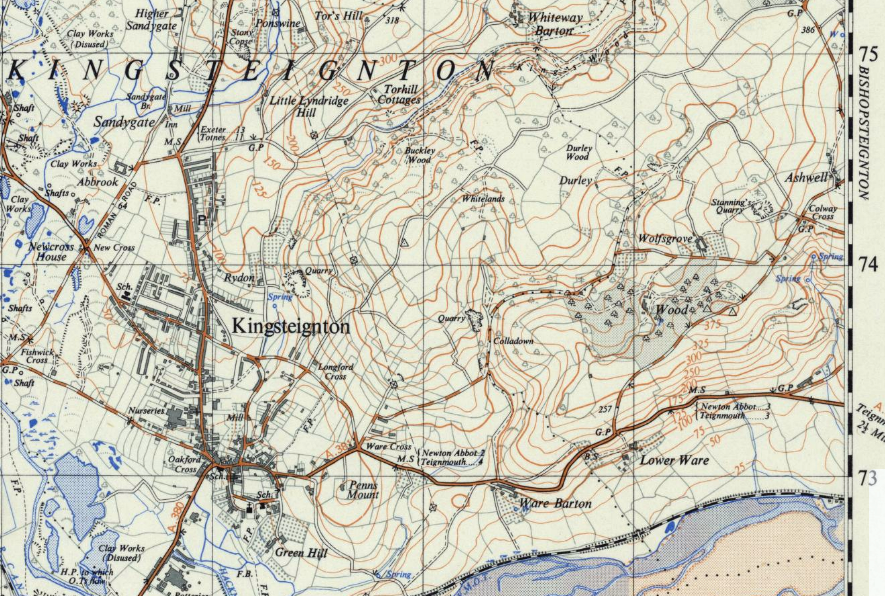
Gilbert was the second son of John Pinsent by his wife, Ann (née Brock). He was brought up at “Ware Barton” in Kingsteignton and he helped his elder brother, John Pinsent, and his mother to run the family farm after his father died in 1858. John left to marry in 1865 and his mother died the following year – so it fell to Gilbert to pick up the tenancy. He ran the farm with the help of his two younger brothers James Pinsent and Henry Pinsent until they too took off. Henry married in 1870 and James went out to Australia sometime in the 1870s.
The Pinsents were “nonconformists” and they attended a chapel in Kingsteignton that was largely built through the generosity of a very distant relative from the DEVONPORT branch of the family. Mr. Thomas Pinsent and his sons ran a drapery business in Devonport and a brewery in Newton Abbot and both were well known in South Devon.
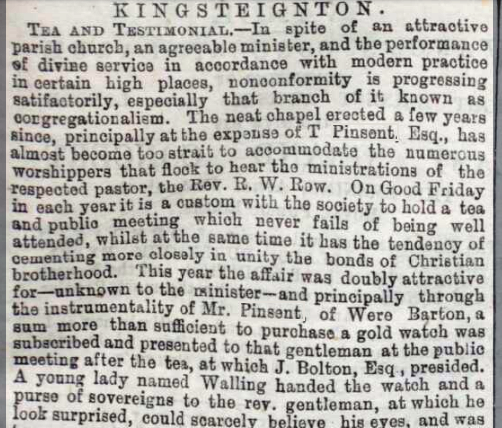
Gilbert was an active member of the congregation and arranged for a gold watch to be presented to the dissenting minister on Good Friday in 1870 (Western Times: Friday 22nd April 1870). He also treated “six-score children” to a tea at the farm later that summer (Western Times: 19th July 1870). Unfortunately, good deeds are rarely rewarded and the farm was infected by “foot and mouth disease” in the autumn (Totnes Weekly Times: Saturday 8th October 1870). Farm to farm infections were a serious problem before the age of antibiotics. A few years earlier, in August 1866, one of Mr. Pinsent’s employees, Benjamin Burnett, had been convicted at the Petty Sessions for “removing a calf” without the necessary certificates. He was fined 1s (Exeter and Plymouth Gazette: Friday 24th August 1866). It seems to have been deemed to be a serious offense at the time.
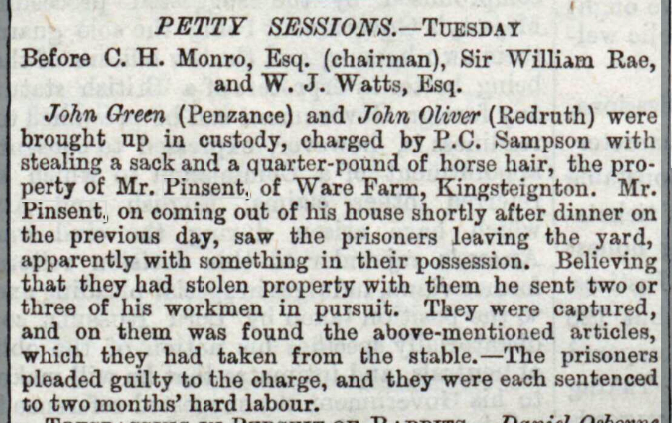
Towards the end of Queen Victoria’s reign, cheap imports from the Continent and elsewhere caused a good deal of suffering among farm works and it is, perhaps, not entirely surprising that a small amount of pilfering went on. Some cases came before the magistrates at the local Petty Sessions. For instance, two Cornish men were charged with theft in Newton Abbot in October 1865 after Mr. Pinsent saw them coming out of the stable with a sack and a quarter-pound of horsehair. They were captured and pleaded guilty (Exeter and Plymouth Gazette: Friday 20th October 1865). They were at least “foreigners”.
In 1870, two locals were brought up at Newton Petty Sessions for stealing some of Gilbert’s turnips. It led to two weeks in prison for one, Mary Horsham (who was probably the wife of one of Gilbert’s workers) and one week for the other, John Efferd (Western Times: Friday 28th October 1870). They were probably good turnips too, as Mr. Pinsent of Ware had received 1st prize for “the best crop of common turnips” at the “Newton Agricultural and Labourers’ Friend Society” meeting in 1868 and knew how to grow them.
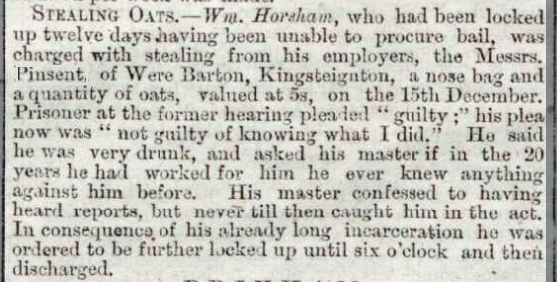
On another occasion, Gilbert’s brother James Pinsent caught William Horsham stealing oats from the farm – although he claimed he was too drunk to know what he was doing. At the Petty Sessions, he asked James if, “in the 20 years he had worked for him, he had known anything against him? (James) confessed to having heard reports but never – till then having caught him in the act” (Western Times: Thursday 29th December 1870).
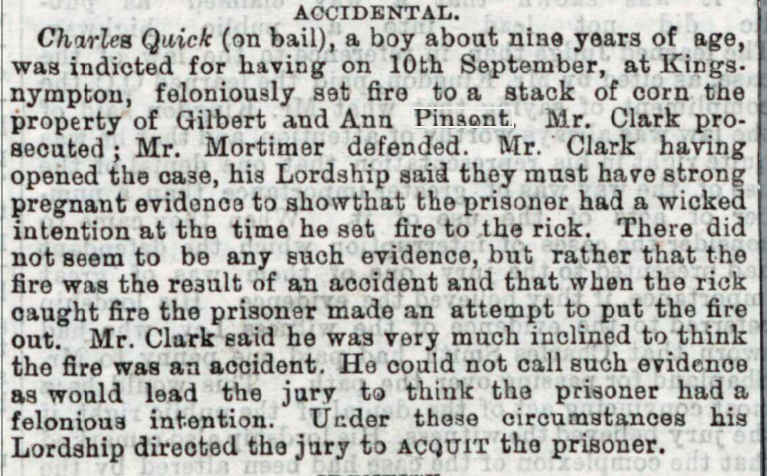
“Ware Barton” seems to have attracted miscreants. In September 1868, Gilbert had thirteen ricks of wheat and two of oats burned down. The fire caused £400 to £500 in damage that was, fortunately for Gilbert, covered by insurance (Exeter and Plymouth Gazette: Friday 11th September 1868). The two young lads who had been seen running away were later caught, and the elder of the two, aged 9, committed for trial. When the time came, his Lordship managed to convince himself that it must have been an unfortunate accident and the jury returned a verdict of “Not Guilty” (Western Times: Friday 16th March 1869).
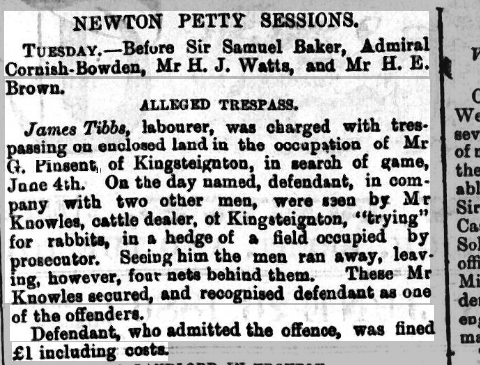
A few years later (in 1873) Samuel Lang pleaded guilty to stealing apples from Gilbert’s orchard (Exeter and Plymouth Gazette: Friday 29th August 1873) and in 1876 Thomas Causley was convicted of trespass in pursuit of conies (rabbits) (Western Times: Friday 23rd June 1876. Thomas Lang (a relation of Samuel’s perhaps?) was nabbed for a similar offense – going after rabbits at “Broad Aller” – in March 1881 (Western Times: Wednesday 9th March 1881). Perhaps there was a particular attractive warren on the farm. Even as late as 1886, James Tibbs and two others were charged with using a ferret and nets to try and catch rabbits along a hedge at “Ware Barton” (Western Times: Friday 25th June 1886).
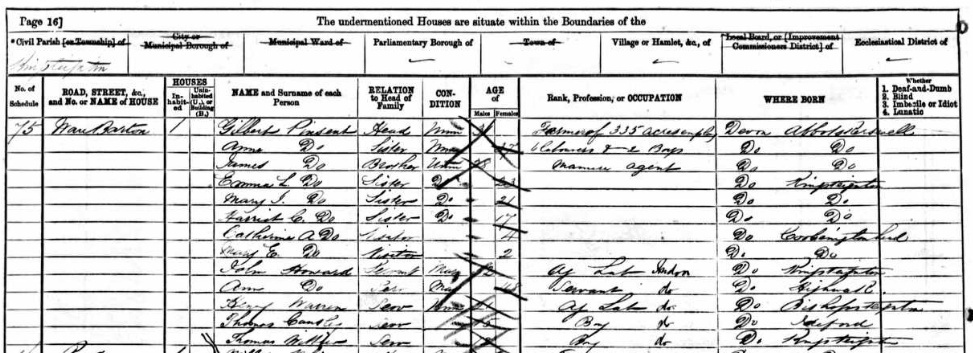
The 1871 Census shows that Gilbert was farming 335 acres with the help of his brother James and his then unmarried sisters Anna, Emma L., Mary I. and Harriet C. Pinsent. The farm also employed six day-labourers and two boys. James had a side-line. He worked for “Lawes”, a firm that distributed guano (bird droppings) and manufactured chemical fertilizers. He was quaintly referred to as being a “manure agent”. At the time of the census (1871), two of Gilbert’s nieces (his brother, John’s daughters Catherine A. and Mary E.) were visiting the farm.
Gilbert and his brother John were well known in the Newton Abbot area, although perhaps not as well known as their brewing counterparts from the DEVONPORT branch, and members of both families attended community events, such as the “Newton Abbot Agricultural and Labourers’ Friend Society” annual meetings. Both families were non-conformist and also attended Chapel services and occasionally wound up on Committees together. When it came to local and national politics, they both seem to have had a preference for the Liberal party. Gilbert was appointed to the committee of a “Parochial Liberal Association” in March 1885 (Totnes Weekly Times: Saturday 14th March 1885). However, he left the area a few years later.
Gilbert and his brother John sometimes picked up a prize or two at the annual meetings of the “Agricultural and Labourers’ Society” and they almost invariably attended the dinners. In 1871, John’s ploughman came in fourth and one of Gilbert’s servants, Ann Howard, received 15s for her twenty-seven years and four months of service to the Pinsent household at Ware (Exeter Flying Post: Wednesday 1st November 1871). Three years later, she was the second-longest serving servant in the district. Another of Gilbert’s “old timers” was found accidentally drowned the following January (Exeter and Plymouth Gazette: Monday 22nd January 1872). It was surmised that he had wandered from the path as he approached a bridge over the River Lemon.
Gilbert was elected to serve on the “Newton Abbot Board of Guardians” in 1868 (Exeter and Plymouth Gazette: Friday 2nd April 1869). It oversaw local contracts and was responsible for the management of the Workhouse. It also saw to the distribution of aid and education to paupers. He was on the Board for many years and was still active in 1882 (Western Times: Thursday 20th April 1882). His brother Henry seems to have joined Gilbert on the Board in 1883.
Gilbert married relatively late in life, and this seems to have been a source of amusement to his friends. When Lord Clifford, the Lord of the Manor of Kingsteignton, gave a dinner for his tenants on the occasion of his son’s coming of age, in 1873, Gilbert was asked to respond to the toast to the Ladies. He did so: “Mr. G. Pinsent, in responding, was not altogether hard upon the ladies – perhaps he was rather cowed at the presence of so many. Although he had not as yet entered the blissful state, he would not exclude them from meetings of that sort because he believed their presence would have a tendency to make the men a little more sociable” (Western Times: Tuesday 7th January 1873). He was probably right. Gilbert finally succumbed and married Clara Bridgeman, the daughter of a Torquay grocer. They married at the Congregational Chapel in Newton Abbot, in 1880.
Gilbert was a law-abiding farmer. When a stray, unmarked, white-faced cow wandered onto his land in November 1872, he put an advertisement in the paper (Western Times: Friday 15th November 1872). Presumably it was claimed. He did, however, eventually get on the wrong side of the magistrates now and then. In 1878 the local road surveyor summoned him for not pruning his hedges. Gilbert argued that he had done so, and that he profoundly disagreed with the surveyor as to how high they should be! He claimed they were not a hazard. Regardless, he was ordered to get the overhangs pruned. The surveyor also charged him with obstruction for leaving bundles of brushwood by the side of the road (which presumably gives the lie to his not having cut the hedges) but, as he had given Gilbert no notice of this particular offense, it was dismissed (Western Times: Friday 13th December, 1878). The trials of a Devonshire farmer! Anyone who had been down a Devon lane will know about its deceptive walls and hedges. Gilbert must has smiled when he was asked at the Kingsteington Vestry meeting on Ladyday (25th March) 1885 to serve on a Committee of Surveyors for the repair of roads (Exeter Flying Post; Tuesday 1st April 1885).
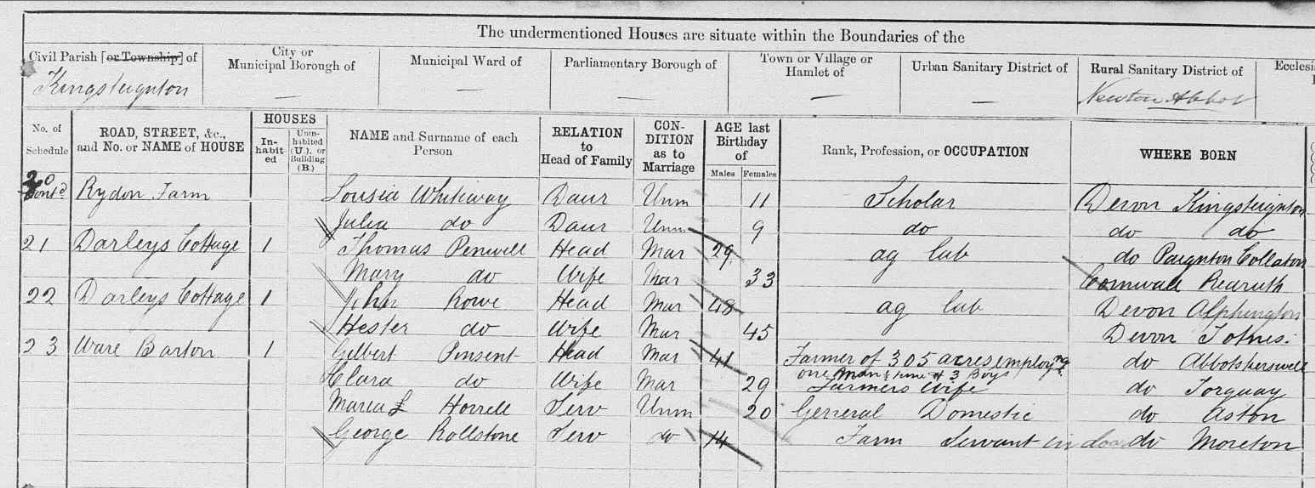
Gilbert and Clara were still working the farm at “Ware Barton” at the time of the 1881 Census. It was then said to cover 305 acres. James had gone out to Australia by then and Gilbert and his newly acquired wife were running it on their own, with the help of two domestic servants and, presumably, day-labourers. Their daughters, Clara Ellen and Mary Eliza Pinsent were born at “Ware Barton” in 1881 and 1883 respectively.
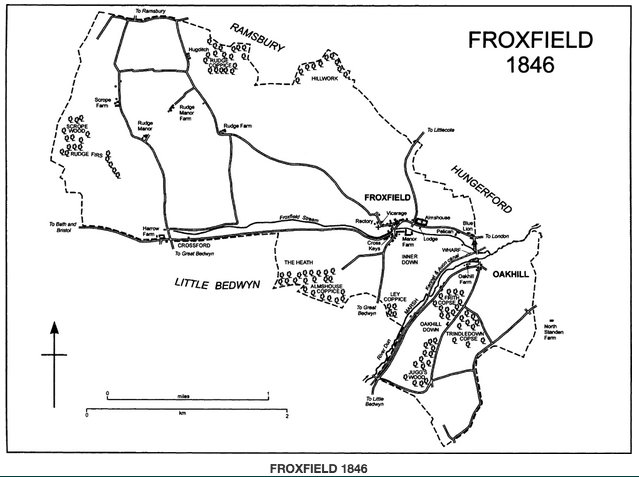
Gilbert’s brother, John Pinsent left “Roccombe” in Combeinteighhead and moved to “Gambledown Farm”, near Romsey, in Hampshire in 1884 and Gilbert decided to follow in 1887. He moved his family to “Scrope Farm” which is south of the River Kennett near Rudge a larger predominantly open-field farm to the north of what is now the “A4” road west of Froxfield, near Hungerford in Wiltshire. Strangely, the village of Froxfield was where Gilbert’s distant relation (they shared a common great-great-grandfather) Robert John Pinsent (later Sir Robert John Pinsent) married his second wife, Emily Hetty Sabine Homfray in 1872!
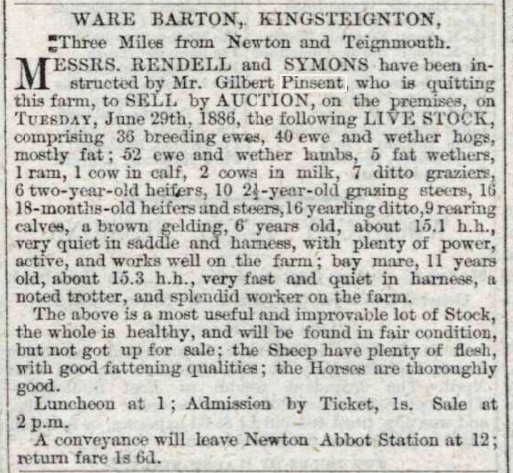
Rendell and Symons were commissioned to auction off Gilbert’s livestock at “Ware Barton”. It included “36 breeding ewes, 40 ewe and wether hogs, mostly fat; 52 ewe and wether lambs, 5 fat wethers, 1 ram, 1 cow in calf, 2 cows in milk, 7 ditto graziers, 6 two-year-old heifers, 10 2 1/2-year-old grazing steers, 16 18-months-old heifers and steers, 16 yearling ditto, 9 rearing calves, a brown gelding, 6 years old, about 15.1 h.h., very quiet in saddle and harness, with plenty of power, active, and works well on the farm; bay mare, 11 years old, about 15.3 h.h., very fast and quiet in harness, a noted trotter, and splendid worker on the farm” on Tuesday 29th June 1886 (Exeter and Plymouth Gazette: Friday 25th June 1886). The firm later sold the residual grass on 86 acres for grazing (Exeter and Plymouth Gazette: Friday 8th October 1886) and disposed of his remaining assets – including a few cows, pigs and chickens, eight ricks of clover and hay and faggots of wood. He also disposed of some household furniture (Western Times: Friday 23rd September 1887. Gilbert and Clara left for Wiltshire a few days later, at Michaelmas (29th September).
Gilbert was up and running and back in business the following year, 1888. He sold some fat ewes for a good price (45s – 48s) in June 1889 (Devizes and Wiltshire Gazette: Thursday 6th June 1889). Gilbert and Clara had a son, Gilbert Soudon Pinsent at “Scrope” shortly thereafter; which might explain why two of his nieces, Catherine A. and Ada Pinsent were living on the farm when the 1891 Census was taken. They were probably there to help Clara with the baby and to assist a resident school governess with the two young girls.
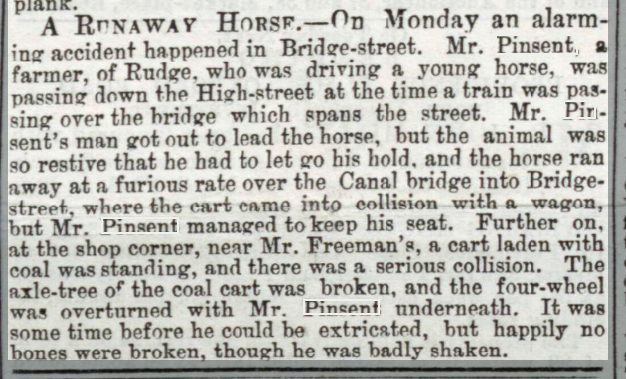
The Census records say that Gilbert was a “lame farmer” in 1891 – why I am not sure; however, I do know that he was involved in a painful accident in March the following year. His farm at “Scrope” was near Hungerford and he had the misfortune to be driving a horse and cart into town as a train passed nearby and spooked his horse. It careening down the street and crashed into a wagon-load of coal. after He survived with his bones in tact but he was badly shaken (Reading Mercury: Saturday 19th March 1892).
Perhaps indisposition was why he gave up the farm the following year. It was advertised to let in August 1893: “Scrope Farm, comprising 206 acres arable (including sanfoin), 8 acres pasture, 14 acres wood with house, homestead and 2 cottages with in 4 miles of rail and Hungerford” (North British Agriculturalist: Wednesday 9th August 1893. Gilbert went looking for something more manageable: “Wanted to Rent: A house with 5 or 10 acres of meadowland: Apply to G. Pinsent, Froxfield, Hungerford” (Newbury Weekly News and General Advertiser: Thursday 7th September 1893).
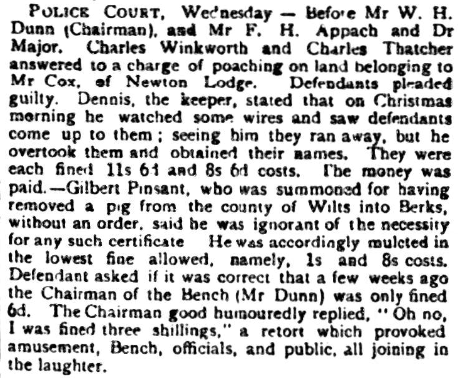
Shortly afterwards, “Mr. Pinsent late of Scrope Farm Bridge” was summoned before Hungerford Petty Sessions for moving a pig across the county line from Wiltshire to “his new farm” in Berkshire without a license. Gilbert claimed ignorance of the offense. He said that he had not sold the pig; it was his and he was just moving it to a new farm. Nevertheless, he was fined 1s with 8s costs! (Swindon Advertiser and North Wilts Chronicle: Saturday 13th January 1894).
Gilbert had moved to “Falkland Farm”, at Wash Common, near Newbury (Kelly’s Directory of Berkshire, 1899), which had been the site of the First Battle of Newbury, in 1643. The farm house is now surrounded by houses but still remains as “Falkland Garth” on Essex Road. While living there, Gilbert and Clara were involved in a wagonette crash that occurred when the main pin holding the shaft gave way as they traveled down Wash Hill into town. Gilbert attempted to check the horse but it careened through the town for quite a distance before it could be stopped. Neither was seriously hurt but Clara had managed to jump clear and received quite a shock (Newbury Weekly News and General Advertiser: Thursday 5th November 1896).
Gilbert, his wife and three children were living at Knapps House, Boxford, in Newbury when the census takers next came around in 1901. He was shortly to retire from farming and was living “on his own account.” Although he was partially crippled by then – possible as a result of his earlier crash, he was still able to drive a carriage and he, unfortunately, did so in May 1903. This time, his horse took fright and bolted in Newbury and he was much shaken by the time it was brought under control near the Town Hall (Marlborough Times: 9th May 1903). Gilbert’s livestock – largely cattle – and his farm implements were sold off by auction in October 1904 (Marlborough Times: 15th October 1904).
Gilbert and Clara had taken on a boarding house on Craven Street, in Newbury, by 1907 (Local Directories) and the census shows they were still there in 1911. Clara and her daughter, Clara Ellen, ran the house, which had ten rooms. The “Miss Pinsent” who helped collect funds for Dr. Bernado’s Homes in Newbury in 1907 (Newbury Weekly News and General Advertiser: Thursday 3rd January 19070 was probably Clara Ellen too; however that could have been her sister. Clara Ellen married a “corn merchant” in Great Shefford, Berkshire, in 1925 and Mary Eliza, her sister, who was a “stationers’ shop assistant” in 1911 married a “master ironmonger” in Newbury in 1916. Gilbert and Clara’s son, Gilbert Soudon Pinsent, seems to have had little interest in farming. He was not at home in 1911 when the census was taken. He went out to Argentina as a young man and may have already done so.

Gilbert Pinsent died in Newbury aged 78, in 1918 and was given an impressive funeral service prior to internment at the Old Cemetery in Newbury. The Marlborough Times (17th May 1918) describes the coffin and cortage and reminds us that Mr. Gilbert was a committed non-conformist and held strong Liberal views. The Calendar of Grants of Probate and Letters of Administration shows that his “effects” were valued at £200. In the absence of Gilbert’s son, who was in Buenos Aires, they were granted to his widow, Clara, who went to live with her daughter Clara Ellen and her husband, Frederick Dopson New, on Buckingham Road in Newbury. Clara Ellen received Letters of Administration for her mother after she died in 1932.
Family Tree
Grandparents
Grandfather: Gilbert Pinsent: 1758 – 1835
Grandmother: Margaret Snow: 1756 – 1843
Parents
Father: John Pinsent: 1799 – 1858
Mother: Ann Brock: 1811 – 1866
Father’s Siblings (Aunts, Uncles)
Thomas Pinsent: 1790 – 1804
Mary Snow Pinsent: 1793 – 1890
William Pinsent: 1797 – 1882
John Pinsent: 1799 – 1858 ✔️
Male Siblings (Brothers)
John Pinsent: 1838 – 1916
Gilbert Pinsent: 1840 – 1918 ✔️
James Pinsent: 1842 – 1902
Henry Pinsent: 1844 – 1894
Albert Pinsent: 1846 – 1846
Please use the above links to explore this branch of the family tree. The default “Next” and “Previous” links below may lead to other unrelated branches.