Vital Statistics
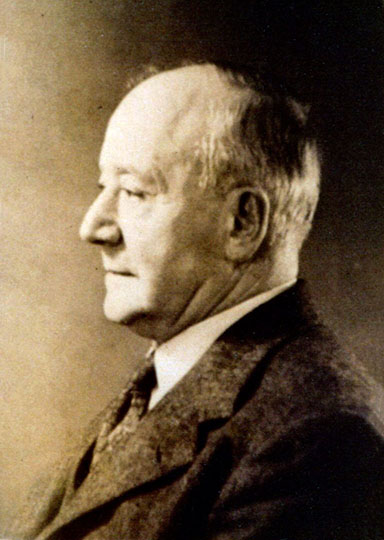
Francis Wingfield Homfray Pinsent: 1875 – 1948 GRO0322 (District Valuer, Inland Revenue, Plymouth)
1. Janet Frances Cowtan: 1878 – 1938
Married: 1911: Kensington, London
Children by Janet Frances Cowtan:
Robert John Francis Homfray Pinsent: 1916 – 1987 (Medical Practitioner: Married Ruth McKechnie Morrison, Westminster, London: 1941)
2. Anne Marie Stehrenberger: 1900 – 1984
Married: 1939: Yelverton, Devon
Children by Anne Marie Stehrenberger:
Daughter (GRO0802)
Family Branch: Hennock
PinsentID: GRO0322
Click here to view close relatives.
Francis Wingfield Homfray Pinsent (or “Frank” as he was generally known) was one of Robert John Pinsent’s older sons by his second wife, Emily Hetty Sabine (née Homfray). He was born in St. John’s into an extended family that eventually included five half-siblings: (Lucretia Maude, Louisa Catherine, Robert Hedley, Charles Augustus and Alfred Newman), two sisters (Mabel Louisa Homfray and Beatrice Mary Homfray) and two brothers (Robert John Ferrier Homfray and Guy Homfray).
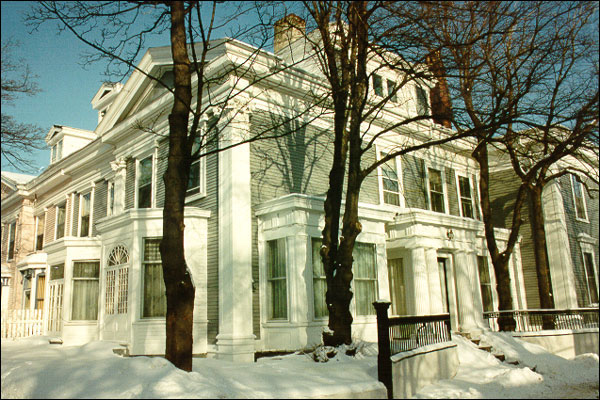
Francis’s father was a Judge on the Supreme Court of Newfoundland in the 1880s. His life is discussed in some detail elsewhere. He was a busy man, in addition to his routine day-to-day legal work, he had to deal with the fall-out from a major collapsed railway construction contract and also figure out the relative rights of French and Newfoundland fishermen along the so-called “French Shore.” In the latter case he found that the French were entitled to catch and process cod – but said they had no right what so ever to interfere with Newfoundlanders’ efforts to fish or acquire bait, and/or catch, process and can lobsters – what ever they might say to the contrary. He laid out his reasoning in an article entitled: “French Fishery Claims in Newfoundland” published in the “Nineteenth Century Magazine” (Nineteenth Century: Vol. 158, April 1890).
Robert John made several visits to England over the years (he gave a talk to the “Royal Colonial Institute” entitled “Newfoundland, our Oldest Colony” in April 1885 (Colonies and India: Friday 17th April 1885) and was a well known and respected advocate for the Colony. Queen Victoria honoured him with a knighthood in 1890.
Francis and his elder brother (another Robert) and their half-brothers were brought up in St. John’s and at the family’s second home at “Woodlands” which was on the Salmonier river, in rural Newfoundland.
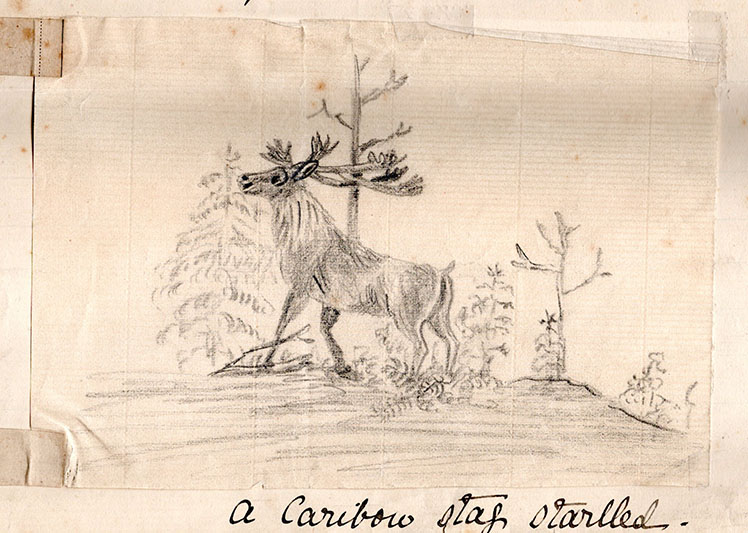
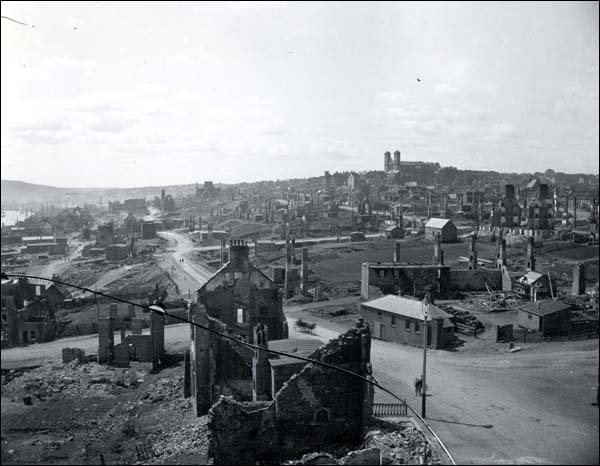
They were not just city dwellers. They saw themselves as country boys and Francis wrote and illustrated a short story entitled: “How I shot & Lost My First Stag.” This was at around the time his father died, in 1893. It describes a particularly wet hunting expedition he took with a friend while waiting for his school to reopen – after it burnt down! Unfortunately, a large portion of down-town St. John’s, including its Anglican Cathedral and Commercial Centre had gone up in flames in July 1892.
Frank refers to his disappointment at hitting but failing to fell an impressive-looking stag. I have a hand written copy of the story that may have been intended for his mother – who had stayed on in England after her husband’s death and must have missed St. John’s – or it may have been meant for publication. Either way, it is another example of the family’s love of writing short stories. Frank’s father, (Sir) Robert John Pinsent, wrote about Newfoundland history and described one of his trips around Newfoundland dispensing justice in the out-ports; Lady Pinsent wrote about fishing in “The Field” magazine and his elder brother Robert John Ferrier Homfray Pinsent wrote about a failed logging venture in Quebec for the same magazine. Frank’s son, Robert John Francis Homfray Pinsent, would later write about his fishing exploits. As for me – I write about the family.
In 1893, Sir Robert and Lady Pinsent took some of their children (but not Frank) to England and left them with Emily’s parents in Norfolk while they went on to Rome to see Frank’s eldest half-sister, Lucretia Maude, who was in the process of setting up an English-speaking Benedictine convent. The trip went well – I believe they had an audience with the Pope – but Sir Robert contracted pneumonia shortly after returning to England and he died at Bintry (Bintree) a few days later.
His death created immediate problems for Emily, as most of the family’s assets in Newfoundland were committed to the children of his first marriage – most notably Charles Augustus Maxwell Pinsent – and she was left with two teenage sons (Robert (19) and Frank (18)) in Newfoundland, and a grown up daughter (Mabel (20)) and two younger children, Beatrice (10) and Guy (4) in England to launch on her own. Presumably, it did not help that a large part of St. John’s had recently burnt down and two of the major banks in Newfoundland (including one managed by Sir Robert’s brother Charles Speare Pinsent) were to crash in December 1894. Such assets she had in St. John’s would have been severely reduced in value. Lady Pinsent stayed on in England and took employment as a “House Matron” at Harrow School and then as the “Matron” at Denstone School in Staffordshire. Guy and Beatrice (“Trixie”), who were with her in England, also stayed on. Their lives are discussed elsewhere.
Francis was educated at Bishop Feild (sic) and the Methodist Colleges in St. John’s and also – in part – privately under Reverend T. W. Temple of St. Pierre and Miquelon. Perhaps that was after his school burnt down! He joined the “Newfoundland Department of Agriculture and Mines ” in 1892 (McAlpine’s 1898 Directory, St. John’s). However, he was later (in 1899) to resign his position as 2nd Clerk ($700.00 p.a.) and to move to England to be with his mother, and the rest of his immediate family. This came as a great relief to Lady Pinsent who was well aware that one of her step-sons, Charles, was a heavy drinker and prone to violence. She wrote to the Lucretia Maude (the Lady Abbess in Rome) in November 1899 saying: “I am most glad to have Frank here as I was always in terror for him on account of Charlie, he is little better then a madman now, is quite so when he is drunk & people are terrified if he goes near them. He is very angry with me because I refuse to give him my signature to sell Salmonier, for his own benefit & I feared he would vent his anger on Frank.” Her fears, fortunately, seem to have been overblown as Frank and Charles managed to co-exist fairly amicably. Frank was best-man at Charles’s wedding to Fanny Colley, in Topsail in January 1897 (Evening Telegram: 7th January 1897).
Lady Pinsent’s older son in Newfoundland, Robert John Ferrier Homfray Pinsent did not get on quite so well with Charles. He wrote to his mother in August 1897 describing his meeting with Charles at “Woodlands” – where he had gone to recuperate from a bout of tuberculosis. In his letter, Robert is highly complementary about “Good old Frank” but much less so about Charles. He felt that Charles clearly resented him being there: “… when Frank asked him the other day if I could use his rifle which is out here he refused and requested that I would not even look at it. If Frank himself wanted it, he would lend it to him etc., but to no one else in the world. He also said to Frank that he did not want me to touch one iota on the place – which I think a very unkind & unmanly insinuation to a brother in my place.”
In the autumn of 1897, Robert and his wife Annie, and Robert’s brother Frank went out to Colorado – presumably to get away from the dampness of the Newfoundland winter and to take advantage of its dryer air. The “Massachusetts, U.S. Arriving Passenger and Crew lists, 1820 – 1963 (Ancestry.com)” tell us that they left Hawkesbury in Nova Scotia on 22nd October and arrived in Boston three days later. I image they took the train west from there. When they returned, I am not sure. Sadly, Robert never fully recovered. He died in 1899 and Frank took-off for London shortly thereafter.
Lady Pinsent had, through Monier-Williams family contacts, managed to find Frank a position with the firm of “Messrs. Viquers & Co., Chartered Surveyors, of #4 Frederick’s Place in London”. Having references signed by both the Attorney General and the Chief Justice of the Supreme Court of Newfoundland may have helped him get the placement.
Lady Pinsent was bored at Denstone. There was none of the social interaction she had so enjoyed at Harrow. She eventually left and moved to London where she bought a flat at #13 Stanley Crescent in Kensington – so as to be with Frank when he arrived from St. John’s. The Electoral Registers show that they both lived there for a few years. Frank passed the “Surveyor’s Institute” Fellowship Examination in 1901 and Lady Pinsent, who still corresponded with friends in Newfoundland arranged for Judge Prowse (the young friend of her husband’s who wrote a “History of Newfoundland” in 1895) to insert the following in a local paper: “Mr. Frank Pinsent: The numerous friends and admirers of the late Sir Robert and Lady Pinsent, will be very pleased to learn that their son, Mr. Frank Pinsent, who used to be in the Surveyor General’s Office, has passed a most creditable examination in London, and is now entitled to become a member of the Council of Surveyors for Great Britain. It was a very stiff examination — like all those held in London — and several members, five and ten years seniors to Frank, were plucked. Miss Trixie Pinsent has also passed with great credit the Senior Local Cambridge Examination, and is now studying for higher honours. D.W.P.” (Evening Telegram: 17th June 1901).
Frank was elected a “Fellow of the Surveyor’s Institute” in 1908 and went on practice with a partner under the banner of “Worthington and Pinsent, Surveyors, of Cannon Street in London.” Presumable, his strength was in land valuation. He was not particularly political; however, he did take time out in 1909 to write a scathing letter to the “Daily Telegraph” describing the detrimental impact that various land-tax changes proposed by Mr. Lloyd-George would have on land values!
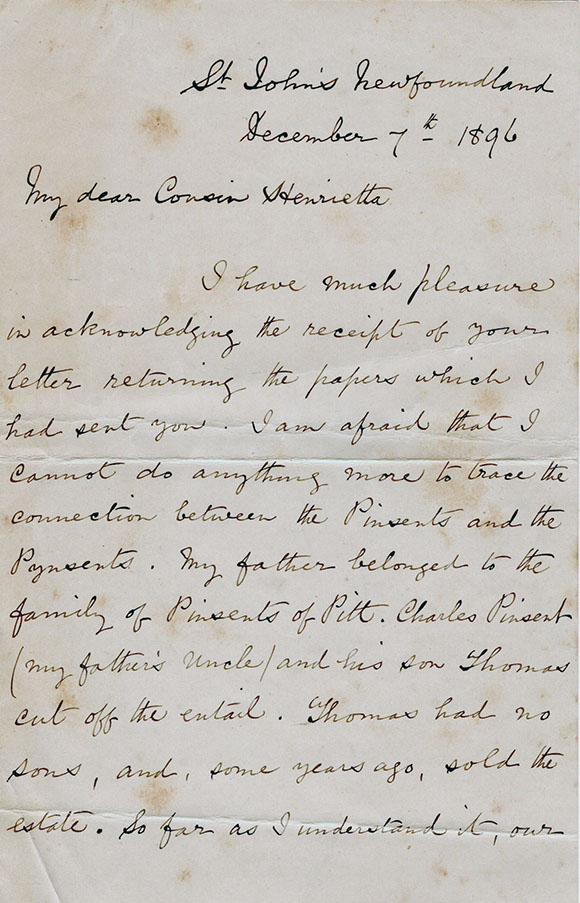
While in St. John’s in 1896, Frank had corresponded with a “Cousin Henrietta” (whoever she was) about the origins of the family and its connection to the “Pynsent family.” He had not been able to tell her much about them then, but he doubtless learned more when he connected with a distant cousin, Robert Burton Pynsent when he arrived in London. Robert’s life is described elsewhere. He was, like Frank, a recently returned colonial. His father (Charles Pitt Pynsent) – who had been a friend of Thomas Pynsent of Pitt House and Northam, Westwood Ho! (see elsewhere) had lived in Australia and eventually settled in New Zealand. Robert Burton was back from there to study and practicing law. They doubtless had contacts in common.
Robert Burton married Mary Isobel Addie, in Northaw, in Hertfordshire in 1906 and Frank became one of the two trustees of their Marriage Settlement. The trustees opened an account in Robert’s name and deposited a considerable sum in stocks and bonds. They then arranged for Mary to receive two hundred pounds sterling per annum out of the proceeds. Sadly, the marriage did not last (see elsewhere). The couple divorced – somewhat acrimoniously – in 1916.
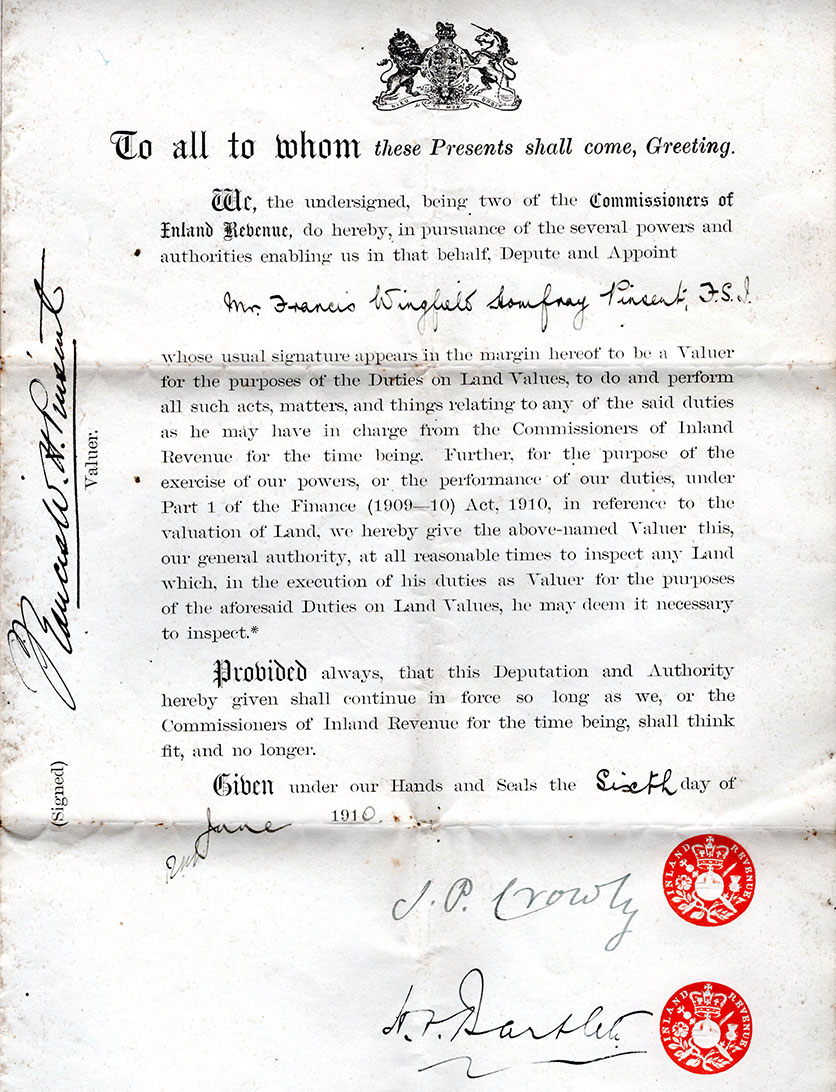
Frank later joined the Civil Service as “District Valuer” for the “Inland Revenue Service” in Plymouth. So, by this round-about route the family returned to its roots. He and Lady Pinsent moved down to Devon, where they were boarding in Plymouth at the time of the 1911 census. They may have been were down there looking for a permanent home while also preparing for Frank’s upcoming wedding. Lady Pinsent’s daughter Trixie moved into the flat in Kensington.
King Edward VIII came to the throne that year (1911) and Lady Pinsent wrote to the Prime Minister’s Office in St. John’s Newfoundland in a vain attempt to get tickets for the coronation out of the Colony’s allocation.
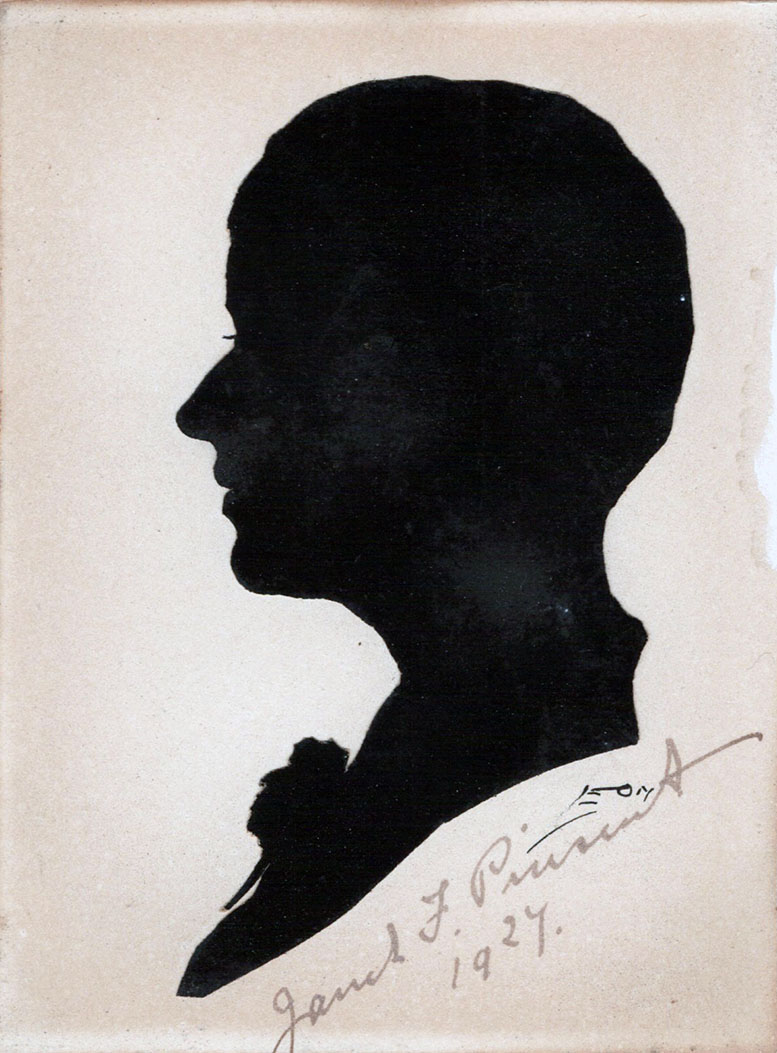
Frank married Janet Frances, the eldest daughter of Frank Cowtan of Aubrey Road Camden Hill at St. Mary Abbot’s Church in Kensington in April 1911 (London Daily News: 25th April 1911). Her father belonged to “Messrs. Cowtan and Sons Ltd.” – high-class “decorators, upholsterers and cabinet-makers” in Belgrave Square, in London S.W.1. The firm, which had been founded in 1790, was particularly well-known for selling quality wallpaper (London Metropolitan Archives). It was an artistic family. The attached painting of Janet as girl of around fifteen was painted by her sister, Mary Cowtan. Janet was a water colour artist in her own right and her paintings are among my prized possessions.
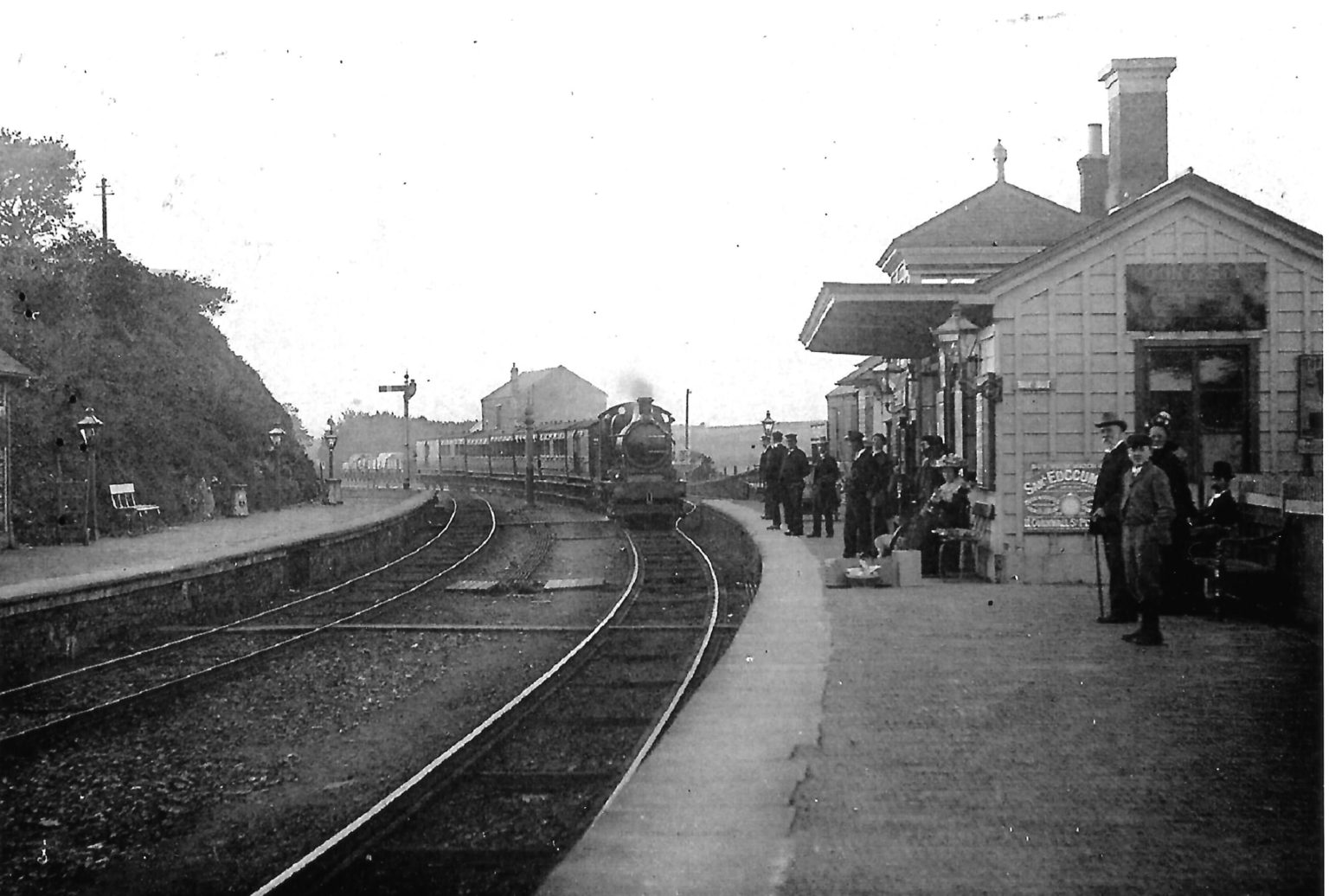
The Pinsent family (including Lady Pinsent) moved into a house called “Hillsborough” near, but downhill, from the railway station at Horrabridge – a small village on the edge of Dartmoor, approximately 12 miles (19 km.) north of Plymouth. Frank commuted into Plymouth by rail. The name “Hillsborough” was that of his one-time family home in St. John’s. It is also the name given by Mr. Thomas Pynsent (“late of Pitt House” in Hennock), to one of his homes in Westward Ho! in north Devon in the 1860s and 1870s.
Hundreds of young Newfoundlanders signed up for active service at the outbreak of the First World War and an early contingent arrived in Plymouth on the “S.S. Florizel” on 20th October 1914. One of them, Lieutenant Owen William Steele, kept a diary that describes the history of the “(Royal) Newfoundland Regiment” up to its near obliteration at Beaumont Hamel on 1st July 1916 – during the battle of the Somme. He documents the regiment’s activities at Gallipoli, its refurbishment and its later disembarkation in Plymouth. He tells us that: “A Mr. Pinsent introduced himself to the Colour Party as a Nflder”. Evidently Frank had not forgotten his roots. Sadly, Lieutenant Steele was killed going “over the top” at Beaumont Hamel – as, indeed were Privates Stanley Stewart Pinsent of Musgrave Harbour and Stewart Pinsent from Dildo, Newfoundland – two unrelated Pinsents who joined up and arrived in England sometime later. The “Florizel” met with its own tragic end. It sank after striking a reef while on route from St. John’s to Halifax on 23rd February 1918. Fortunately, Jacob Pinsent from Greenspond in Newfoundland, one of the ship’s carpenters, survived. There were, and still are, a lot of Pinsents in Newfoundland!
Francis Wingfield Homfray Pinsent joined the “Sir Francis Drake Lodge” of the Freemasons in Plymouth in February 1915. I am not sure how active he was; however, his uncle Charles Speare Pinsent (who had died in St. John’s the previous year) was a senior member of the order in Newfoundland and he would have doubtless been expected to join. Frank regularly attend “Devon and Cornwall Surveyor’s Institute” functions before, during and after the First World War. He was elected vice-chairman in November 1922 (Western Times: Friday 3rd November 1922) and chairman the following year (Western Times: Friday 2nd November 1923).
Frank was active throughout the “Plymouth Rent Tribunal” discussions held in 1923 (Western Evening Herald: 15th September 1923) and he was not infrequently called upon to estimate or arbitrate on the value of land and property. He can take some credit for the improvement in infrastructure in South Devon. For instance, Frank was involved in the cost-arbitration of 12 acres adjacent to a Torquay beauty sport – the “Bishop’s Walk” – in 1929 (Torquay Times and South Devon Advertiser: Friday 18th January 1929). He was also on hand when Ilsham Marine Drive at Torquay was formally opened (Torquay Times, and South Devon Advertiser: Friday 7th March 1924).
Most of his assessments seem to have been accepted; however, predictably, not everyone agreed with his valuations. For instance, a Mr. Hosking objected to the value he placed on a field near Ashburton needed for building purposes. The owner felt that the valuation did not take into account a significant vein of umber which, he insisted, must put the price up to at least L.2,000. Frank disagreed and the District Council looked to be heading to arbitration (Brixham Western Guardian: Thursday 8th April 1920). Similarly, the owner of the a strip of land needed for road widening at Knowle came up with far higher valuation than Frank and the issue went to arbitration in 1924 (Torquay Times, and South Devon Advertiser: Friday 7th March 1924). On another occasion, he advised the Minister of Health that the owners of the Rockend Estate had significantly overvalued their property (Torbay Express and South Devon Echo: Wednesday 26th October 1927).
After the “Rating and Valuation (Apportionment) Act” of 1928 came into effect, Frank was frequently called upon to pacify local landowners outraged by the classification (industrial, agricultural or freight-transport) given to their properties – which greatly effected that their ability to get Land Tax rebates. In July 1929 there were around 300 complaints before the “Plymouth Assessment Committee”. When these issues went to court, it was Mr. Pinsent who argued the case for the rating authority and the “City Treasurer” who argued for the local authority (Western Morning News: 13th Jul 1929). Some of the tougher cases lingered on into the early-1930s as it was not always clear whether a particular land “usage” met the test for an “industrial-use exemption” (Western Morning News: Friday 25th April 1930). The timber sector was a particular head-ache (Western Morning News: Friday 25th April 1930). Then there were land-use zoning issues to be dealt with … (Western Morning News: Wednesday 9th March 1932).
When it came to land needed for public use, Frank frequently found himself dealing with arbitration panels (Exeter and Plymouth Gazette: Friday 23rd January 1931). In 1932 the owners of land on Primley Hill in Paignton complained that he had grossly undervalued some land that Paignton Urban District Council needed to widen a road. They insisted on arbitration (Torquay Times and South Devon Advertiser: Friday 6th May 1932). This was just one of Frank’s valuations that was tested.
Sometimes, valuations changed for some reason or other. In January 1936, he wrote to the “Brixham Urban Council” to inform them that the valuation he had given for “Berry Head” (which they hoped to acquire as open space) was no longer operative. Perhaps it had timed out. He would be happy to provide a revised estimate (Exeter and Plymouth Gazette: Friday 10th January 1936). In another case, Frank valued a 4-acres property in a prime location on flat ground near the sea that the Corporation of Torquay wished to make into a public park. The land was owned by the “Devon Rosery and Fruit Tree Co. Ltd.” and it felt that Frank had grossly undervalued it. The company brought in its own arbitrator, from Birmingham (Torquay Times and South Devon Advertiser: Friday 28th February 1936). Presumably the two parties came to an acceptable compromise.
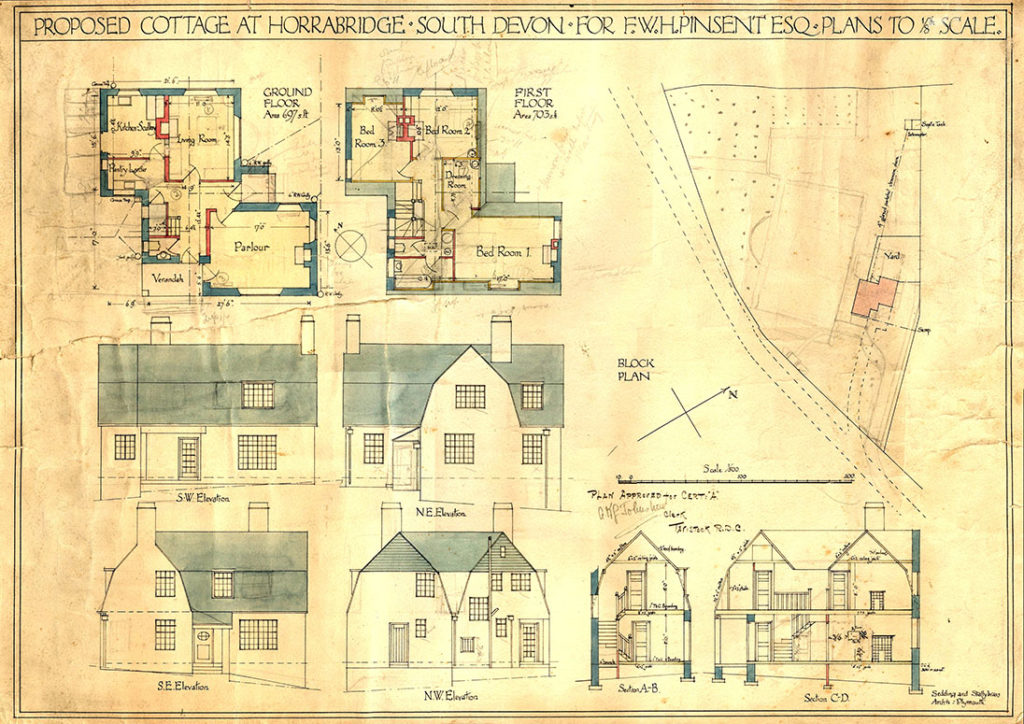
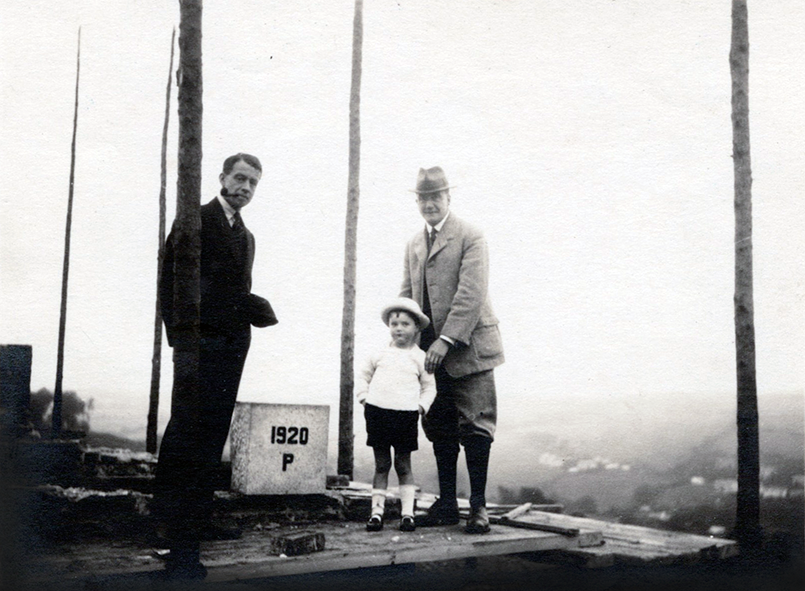
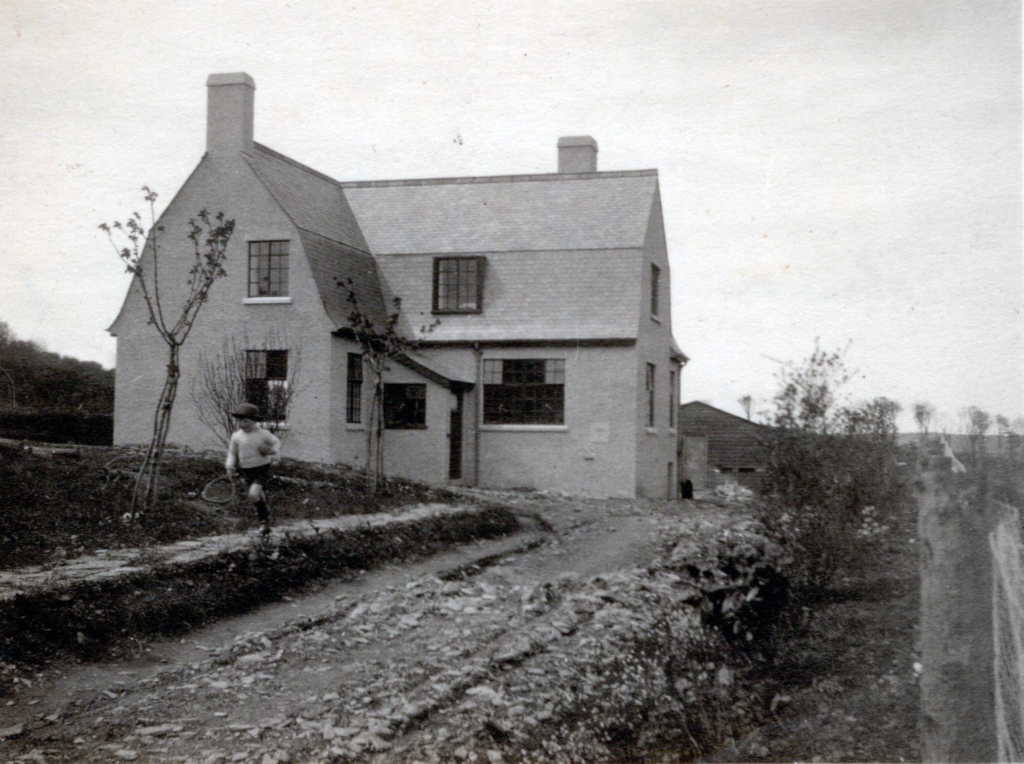
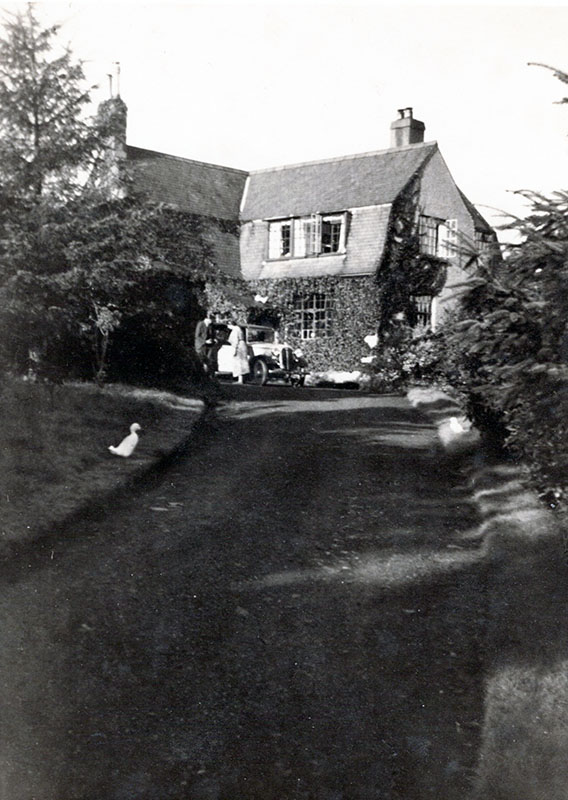
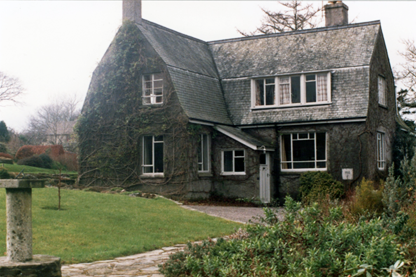
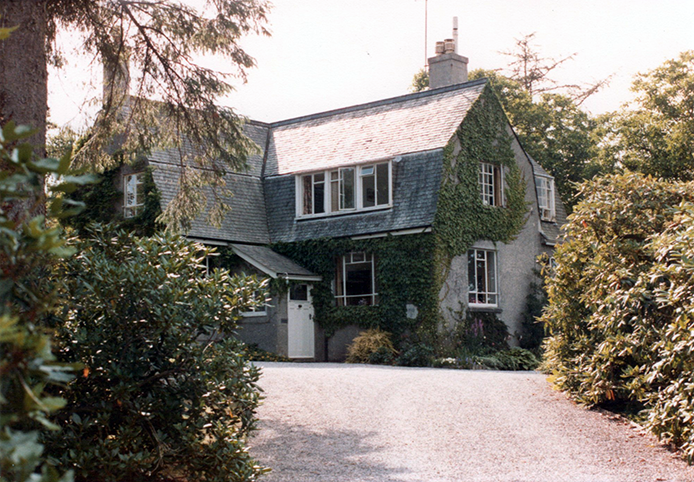
It was not all work. Frank and Janet’s only son Robert John Francis Homfray Pinsent was born at “Hillsborough” in 1916 and Frank decided to build a small house above the railway station at Horrabridge. He purchased three fields (approximately 3 acres) on the edge of Roborough Down above the station and built a small house, called “Higherfield ” in 1920. He was still able to commute to his office in the Barclay’s Bank building on Princess Square in Plymouth by rail. The family was, with the notable exception of Lady Pinsent (Emily Hetty Sabine) – who was visiting friends (Elizabeth Julie and Margaret Florence Francis) in Watford – residing at Higherfield by the time the census was taken the following year (1921). Frank, Janet and their son Robert were there with Agnes Marion Macnab, a family friend and companion, and a live-in servant girl, Beatrice Angell. The house had a detached cottage/garage that was inhabited by James Trembeth and his wife. He helped out in the garden and she was the family cook.
There was room for an orchard and a garden – and space in one of the fields for a Dartmoor pony for their son “Robin”. It came 2nd in its class at the Yelverton Horse and Pony Show in July 1924 (Western Morning News: Thursday 17th July 1924).
Frank’s brother Captain Guy Homfray Pinsent, M.C., married a local girl, Ethel Betty Brittan, the daughter of a well-known landscape Artist (Charles E. Brittan) in Sheepstor, near Burrator, in 1923 (Western Morning News: Friday 21st September 1923). Lady Pinsent had died the previous year but Robert Burton Pynsent (“Cousin Bob”) attended the wedding. Guy and “Betty” went out to China with the 1st Battalion North Lancashire Regiment; however, he later resigned his commission and the couple settled in the London area. His life is discussed elsewhere.
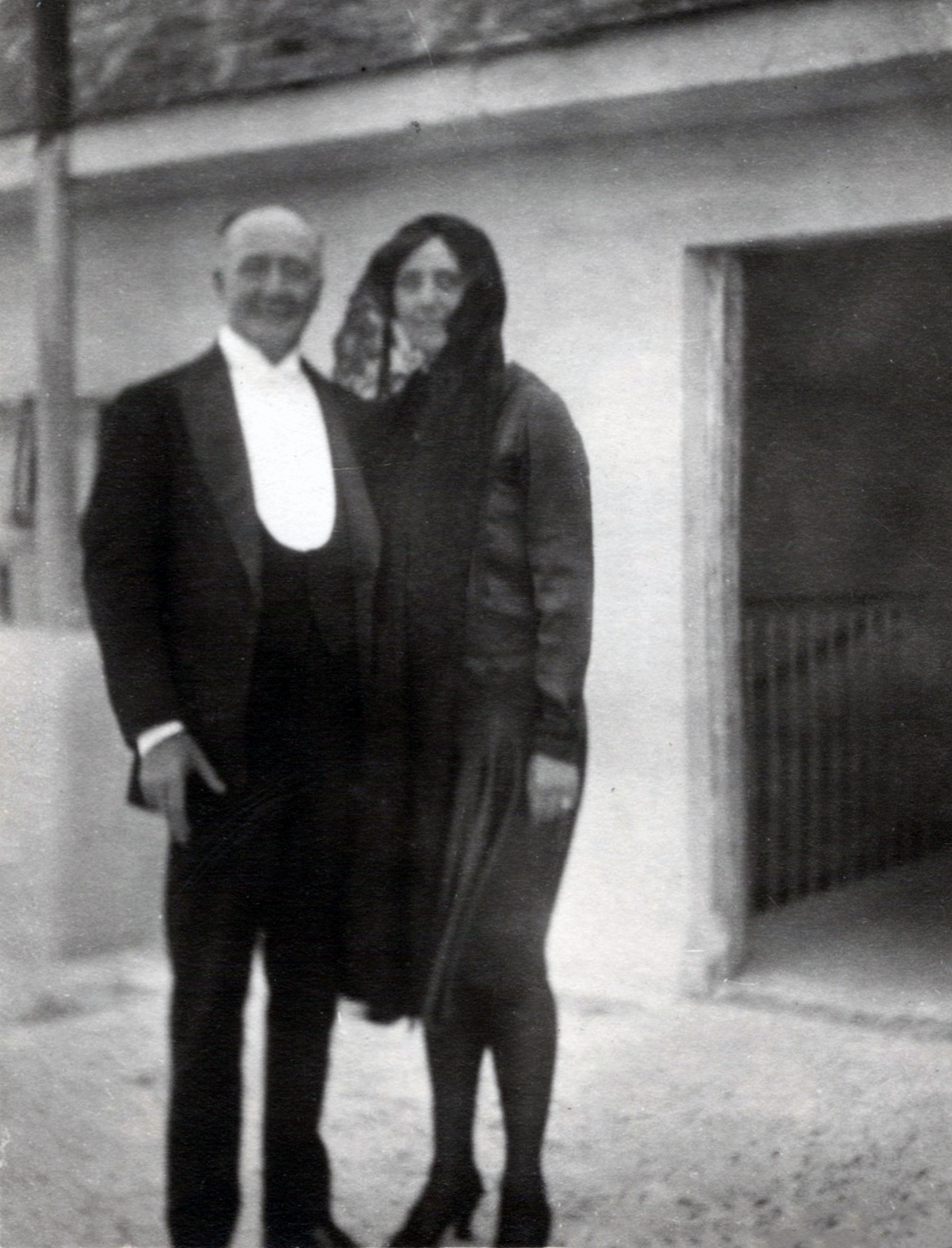
Francis and Janet traveled in France and went out to Italy to visit Frank’s half-sister Lucretia Maude in Rome in 1929. She was a “Sister in Religion” and a “Lady Abbess” prior to a dust up with the Roman Catholic authorities in the early 1900s (see elsewhere). Incoming Passenger Lists show them returning from Genoa on a “Netherlands Royal Mail” vessel, the “Christiaan Huygens” – which docked in Southampton on 12th June. In Rome, they discussed the family’s history and Frank wrote up some of his half-sister’s comments about their great grandfather’s brother Joseph Pinsent and his three wives – two of whom had come from the DEVONPORT branch of the family. They also discussed the distribution of family portraits.
Frank and “Cousin Bob” (Robert Burton Pynsent) remained friends and I gather from a letter Bob sent Frank in December 1932 that he had sent his son “Robin” (Robert John Francis Homfray Pinsent) a book on birds. He inquired after Robin’s “strong suits” at school. Robin was at “The King’s School Canterbury” by then (see elsewhere). Frank also corresponded with Edith Mary Radford (née Pinsent) about family matters. She wrote to him in March 1931. Edith was the daughter of Richard Steele Pinsent, the Devonport draper, and was from the DEVONPORT branch of the family (see elsewhere). She and her husband lived in London.
Frank attended professional dinners and Frank and Janet both attended annual New Year’s Balls and Summer Receptions and dances sponsored by the “Lord Mayor” of Plymouth (Western Morning News: Wednesday 7th January 1931; Western Morning News Wednesday 8th July 1931 and other dates). They played bridge and tennis and enjoyed their garden.
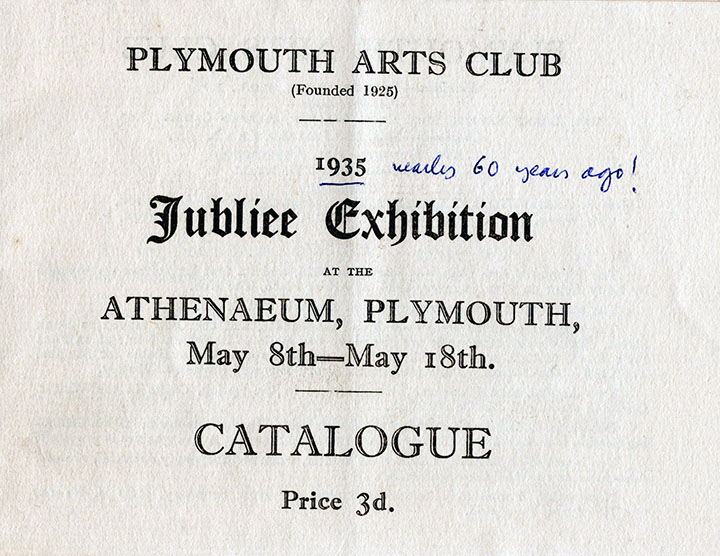
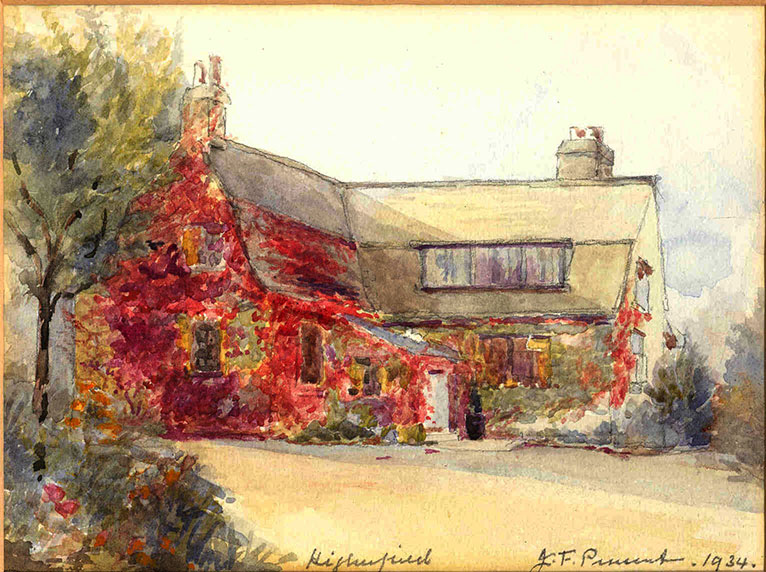
Janet also painted and two of her works. One entitled “From the Cottage Door” and the other “Denham Bridge” were shown at “Plymouth Arts Club: 1935 Jubilee Exhibition.” The latter is on a wall in my hallway.
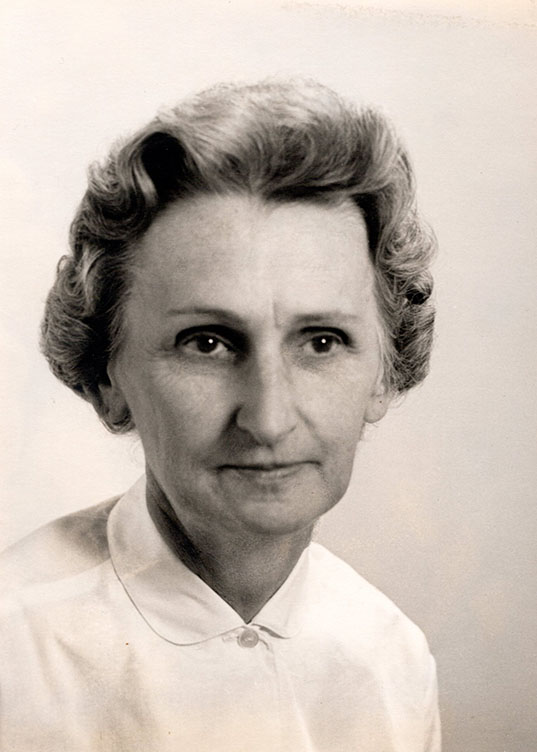
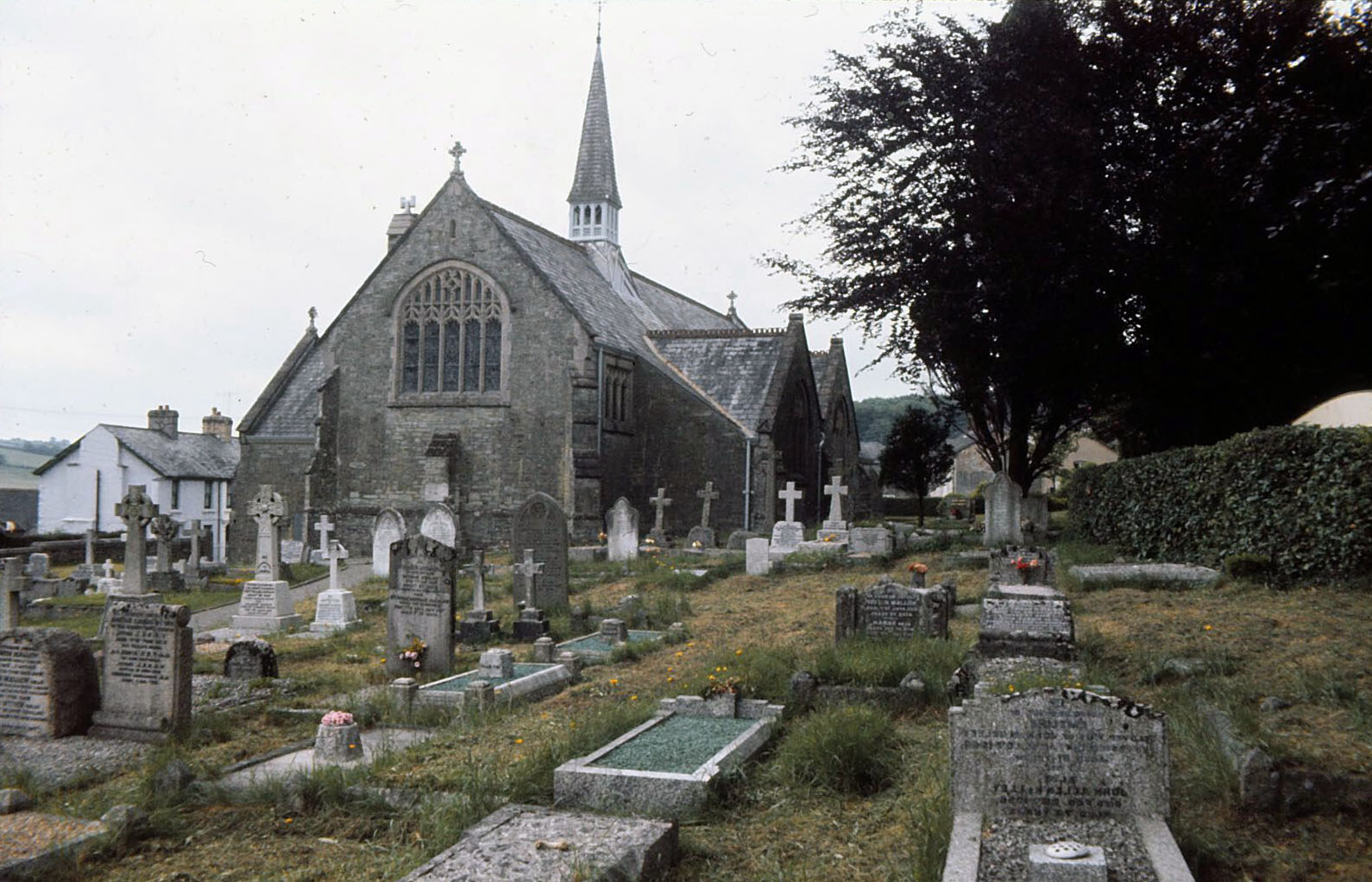
Janet Frances Pinsent died at “Higherfield” on 14th February 1938 and was buried in the family plot at St. John’s in Horrabridge. Her will was probated with “effects” of £2,744 2s 10d. She owned “Higherfield” and left it to her son – my father.
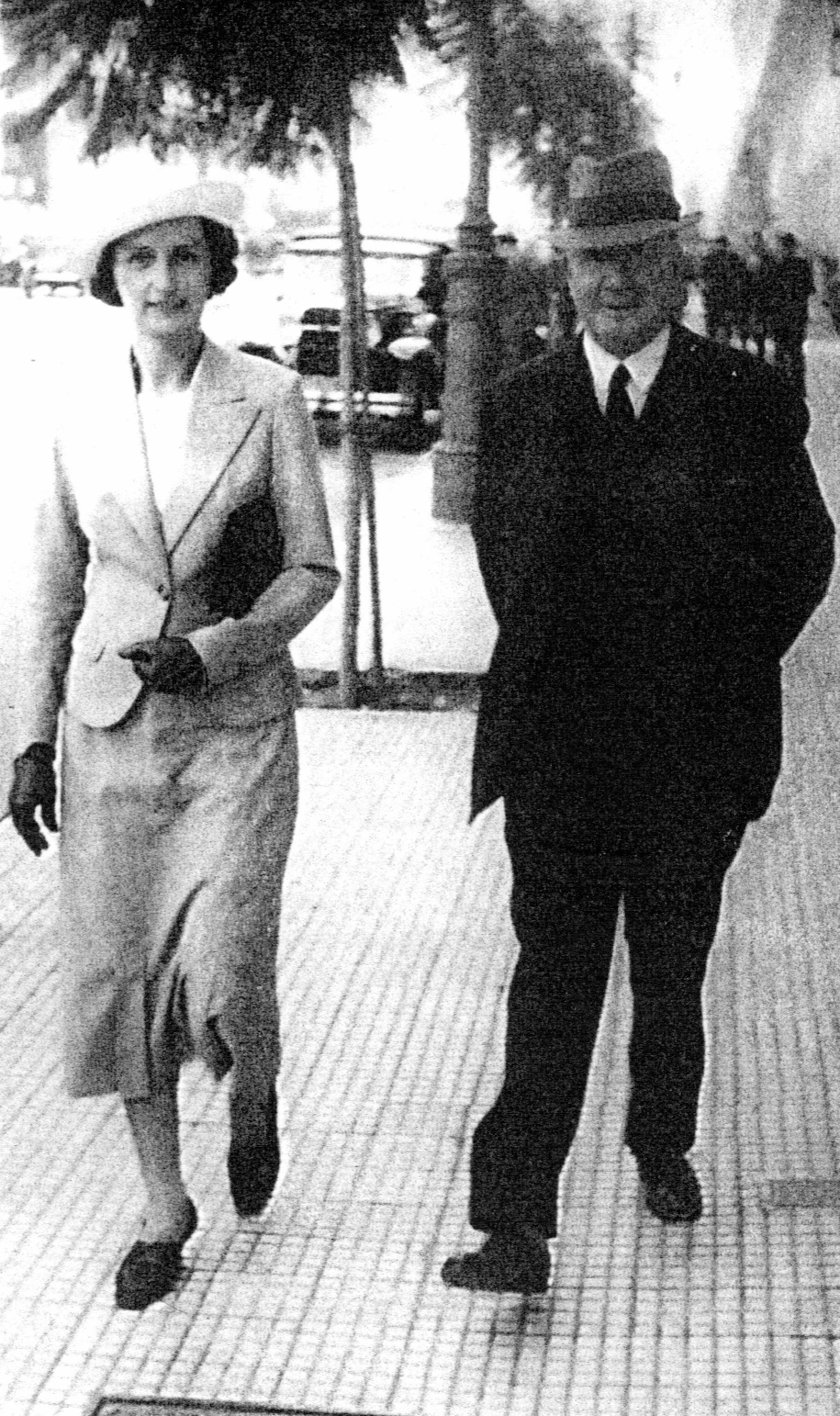
Shortly after Janet’s death, Frank Pinsent went out to Buenos Aires to see his sister, Beatrice Mary Pinsent (“Trixie”). It must have been a relatively short trip as he arrived back in Southampton on the “Royal Mail Steamship Lines” vessel “Asturias” on 25th April 1938. While he was there, Frank met Anne Marie Stehrenberger, a friend of Trixie’s who worked for the Swiss Legation in Buenos Aires. I do not know how much Trixie had to do with their subsequent marriage but she returned to England to see her two brothers (Frank and Guy) in July 1838 and Anne Marie came over a few weeks later (U.K. Incoming Passenger Lists: Ancestry.com).
Frank and his son, “Robin” attended the wedding of one of Janet’s cousins, Lieut F. Conway Morgan (R.N.) of “H.M.S. Excellent” (a shore station) to Miss J. E. Cunningham – the daughter of a Rear Admiral – at Bathampton in August 1938 (Western Morning News: 1st August 1938) and they then returned to Devon to prepare for Frank’s wedding to Anne Marie. The couple were married in the Roman Catholic Church in Yelverton (near Horrabridge) later that month. The Wartime Register, compiled in 1939, confirms that they lived at “Higherfield” – which is where their only daughter was born in 1941.
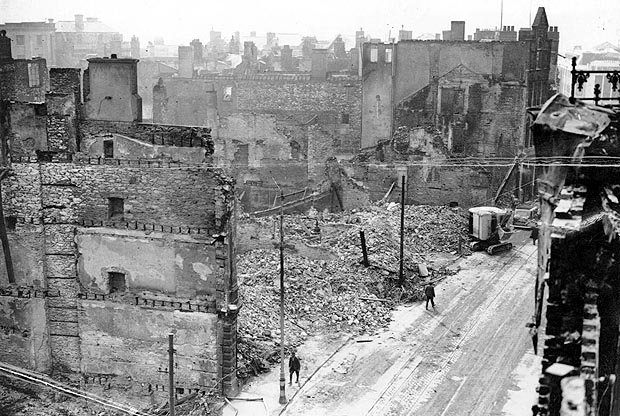
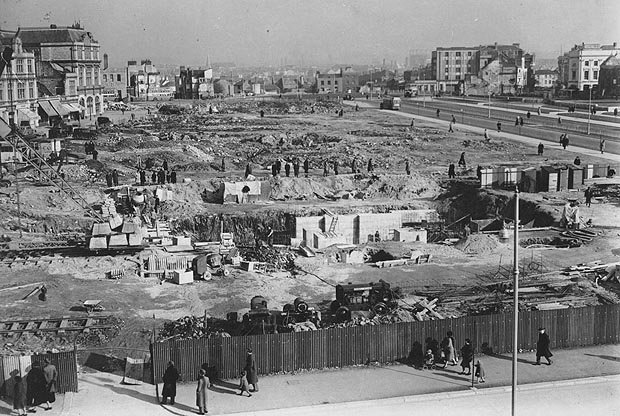
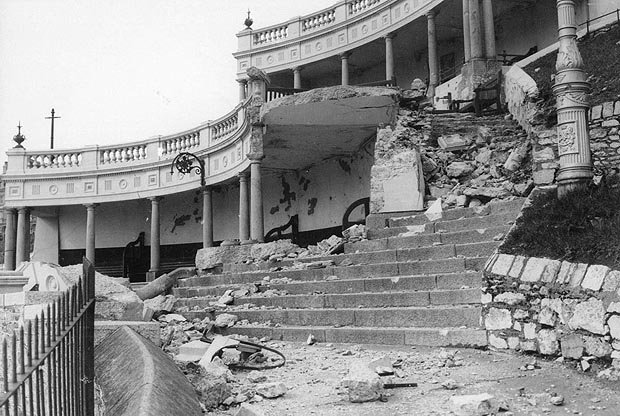
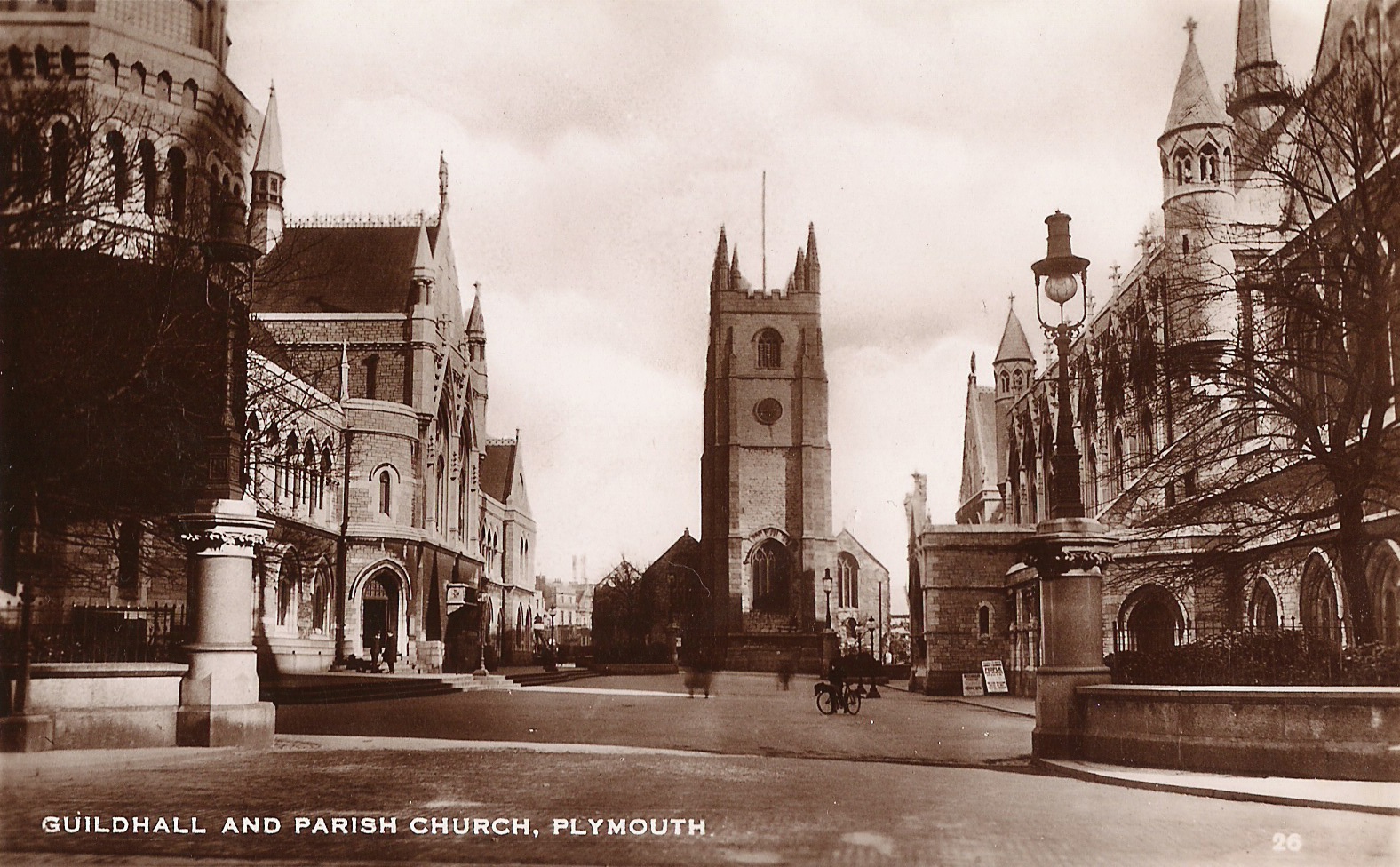
The Devonport dockyards were heavily bombed during the Second World War and much of Plymouth’s downtown core was flattened. It needed to be rebuilt after the war, which meant that property values had to be assessed and compensation paid before any rebuilding could take place. It was a monumental task and the “Valuation Office” needed as much information as it could get. I gather (from Frank’s daughter) that it bought up all the postcards and photographs of the City it could find so as to see what it had actually looked like before the war! The planning and rebuilding was done in record time and the city was well on its way to being rebuilt by 1952 (The Sphere: 4th October, 1952). Frank had formally retired from the “Valuation Department of the Inland Revenue” at the end of December 1943; however, given the circumstances – he had stayed on in a consultative capacity.
Francis Wingfield Homfray Pinsent died at “Higherfield” in 1948. In his will (prepared in 1941) he appointed his only son, Robert John Francis Homfray Pinsent, as one of his two executors, and as the guardian of his then “infant” child. He left his wife, Anne Marie (née Stehrenberger) money “and such articles of furniture and plate, and such other articles or effects of domestic or household use or ornament as she shall, within three calendar months from my death, select”. The residue (after payment of just debts etc.) went to his son. Probate was granted in Exeter in July 1948 (England & Wales, National Probate Calendar, 1858-1966).
A letter written by Anne Marie’s daughter, in 1988, [in my possession: RHP] tells me that Robert already owned “Higherfield,” as it had been part of his mother’s estate. It also shows that Anne Marie Pinsent stayed on at “Higherfield” until 1952 and then moved back to her hometown of St. Gallen, in Switzerland. She died there in 1984. Her daughter joined her in Switzerland for part of her education but later returned and settled in England, married and had children of her own. She is still living.
Family Tree
Grandparents
Grandfather: Robert John Pinsent: 1798 – 1876
Grandmother: Louisa Broom Williams: 1808 – 1882
Parents
Father: Robert John Pinsent: 1834 – 1893
Mother: Emily Hetty Sabine Homfray: 1845 – 1922
Father’s Siblings (Aunts, Uncles)
Mary Speare Pinsent: 1833 – 1833
Robert John Pinsent: 1834 – 1893 ✔️
Thomas Williams Pinsent: 1837 – 1890
Charles Speare Pinsent: 1838 – 1914
Louisa Williams Pinsent: 1841 – 1921
Mary Elizabeth Pinsent: 1844 – xxxx
William Burton Pinsent: 1846 – 1846
Male Siblings (Brothers, Half-brothers)
John Cooke Pinsent: 1861 – 1861
Robert Hedley Vicars Pinsent: 1862 – 1888
William Satterly Splatt Pinsent: 1864 – 1865
Charles Augustus Maxwell Pinsent: 1866 – 1910
Arthur Newman Pinsent: 1867 – 1946
Robert John Ferrier Homfray Pinsent: 1874 – 1899
Francis Wingfield Homfray Pinsent: 1875 – 1948 ✔️
Guy Homfray Pinsent: 1889 – 1972
Please use the above links to explore this branch of the family tree. The default “Next” and “Previous” links below may lead to other unrelated branches.