Vital Statistics
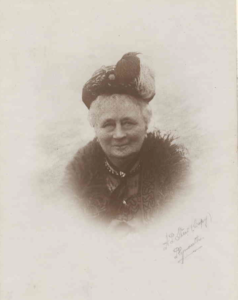
Emily Hetty Sabine Homfray: 1845 – 1922 GRO0254
Robert John Pinsent: 1834 – 1893
Married: 1872: Froxfield, Wiltshire, England
Children by Robert John Pinsent:
Mabel Louisa Homfray Pinsent: 1873 – 1951 (Married William Annesley Eden, xxxx, 1895)
Robert John Ferrier Homfray Pinsent: 1874 – 1899 (Married Annie March, St. John’s Newfoundland, 1896)
Francis Wingfield Homfray Pinsent: 1875 – 1948 (Married Janet Cowtan, Kensington, London, 1911)
Emily Maude Homfray Pinsent: 1876 – 1877
Hilda Constance Homfray Pinsent: 1879 – 1882
Beatrice Mary Homfray Pinsent: 1883 – 1965
Guy Homfray Pinsent: 1889 – 1972 (Married Ethel Betty Brittan, Sheepstor, Devon, 1923)
Family Branch: Hennock
PinsentID: GRO0254
References
The Hon. Robert John Pinsent married his second wife, Emily Hetty Sabine Homfray, in Froxfield, near Hungerford in Wiltshire on 16th April 1872. Emily was the daughter of the Reverend Samuel Francis Wingfield Clarke Homfray by his wife Louisa Ann (née Killik). She was born in Falmouth, in Cornwall, but moved to Norfolk with her parents after her father was appointed Vicar of the joint parishes of Bintry (Bintree) and Themelthorpe.
Robert’s grandfather’s nephew, Reverend Ferdinand Pynsent was the Anglican minister of a neighbouring parish at Bawdeswell and Robert John likely spent time in Norfolk in 1870 while his divorce was wending its way through the matrimonial court system in London. Why Robert and Emily’s wedding took place in Wiltshire, I am not sure. Perhaps there was still social stigma attached to marriage after a divorce. They were Victorians, after all.
Robert John was a barrister and member of the Legislative Council in Newfoundland and Emily joined him there in St. John’s. They had seven children in the years that followed; four girls (Mabel Louisa Homfray, Louisa Maude Homfray, Hilda Constance Homfray and Beatrice Mary Homfray (“Trixie”) Pinsent) and three boys, (Robert John Ferrier Homfray, Francis Wingfield Homfray (“Frank”) and Guy Homfray Pinsent). The middle two girls died young but the others grew up in St. John’s with two considerably-older half-sisters (Lucretia Anna Maude (“Lucy” or “Maude”) and Louisa Catherine (“Kitty”) Pinsent, as well as and three somewhat younger half-brothers (Robert Hedley Vicars (“Hedley”), Charles Augustus Maxwell and Arthur Newman Pinsent). There was quite a spread of ages; Lucretia was thirty years older than Guy! The children’s lives are discussed elsewhere.
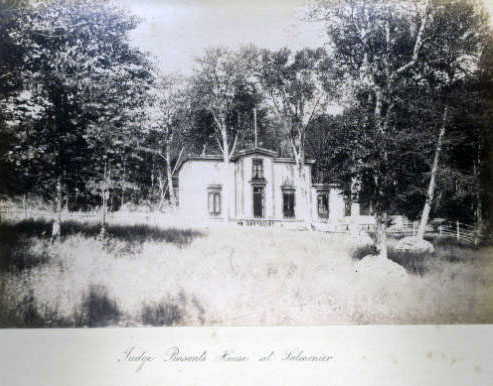
Robert John’s life is, similarly, discussed elsewhere. Suffice it to say that he was appointed “Queen’s Council” and made two failed attempts to obtain a seat in the “House of Assembly” before agreeing to run for a third time – in opposition to the Government in the electoral district of St. John’s West in 1879. To forestall that it saw as a significant challenge, the Government placed him on the Bench of the “Supreme Court”. Fortunately, he was well qualified. As the junior Judge, he bought justice to the ‘out ports’. This was no great hardship as he clearly enjoyed outdoor life and felt a deep attachment to the people. It gave him a better appreciation of the “French Shore Fishery Question” than he might otherwise have had, and he lobbied hard to see the issue resolved. In 1890, he received the honour of a Knighthood from Queen Victoria for his pains. Sadly, he died at Bintry in 1893, while back in England. Emily was left to look after a still relatively young, family.
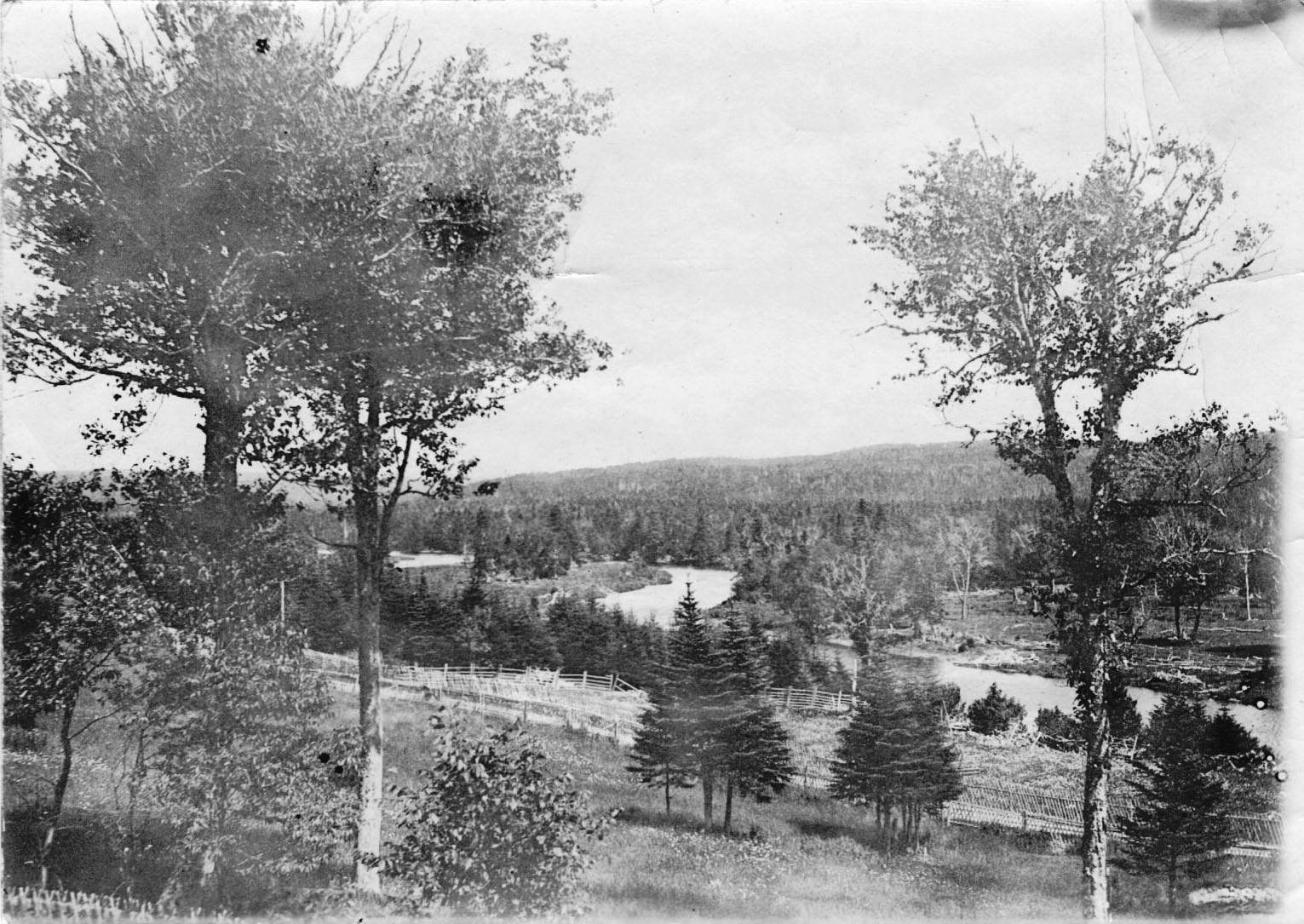
The whole family fished in its spare time and the couple bought land and built a house at “Woodlands,” besides the Salmonier River – which just happened to have one of the best Atlantic salmon runs in the Colony. They acquired two lots (Vol. 30 Fol. 136 and Vol. 42, Fol. 103) that together straddled both the river and the Forest Access Road (“Salmonier Line”). Sir Robert’s sons (probably Robert John Ferrier Homfray and Francis Wingfield Homfray) cut the first trail through some rough swampy “bush” to one of the best fishing spots – at a place that has long been known as “Pinsent’s Falls.”
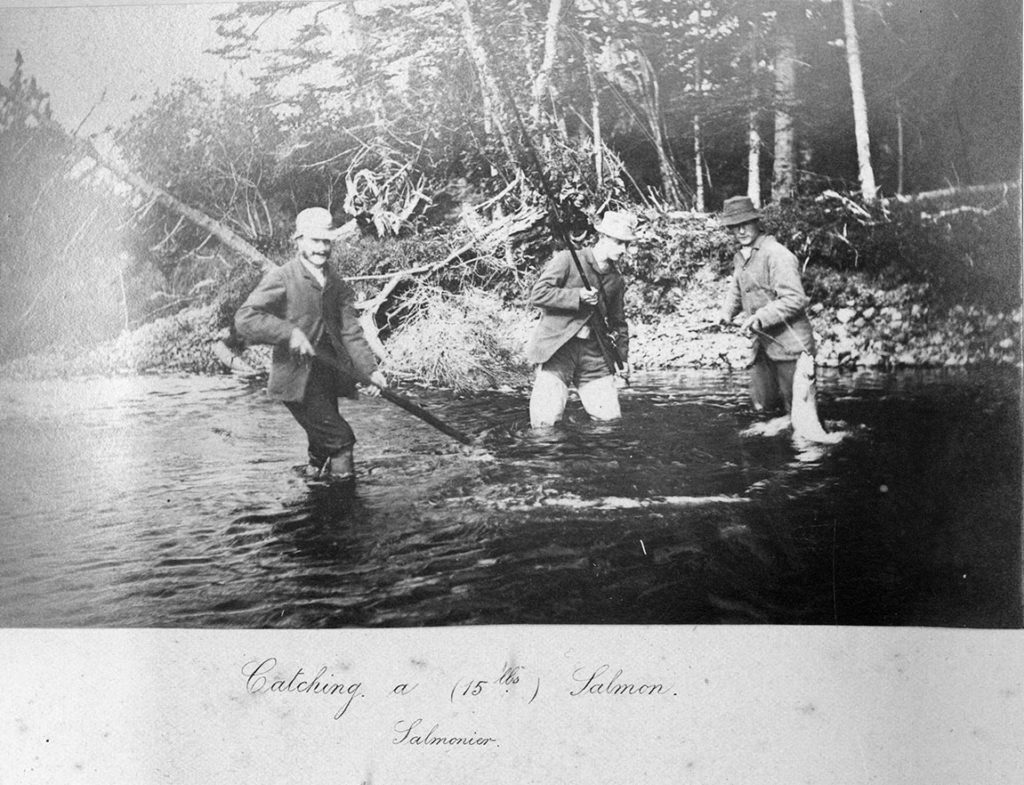
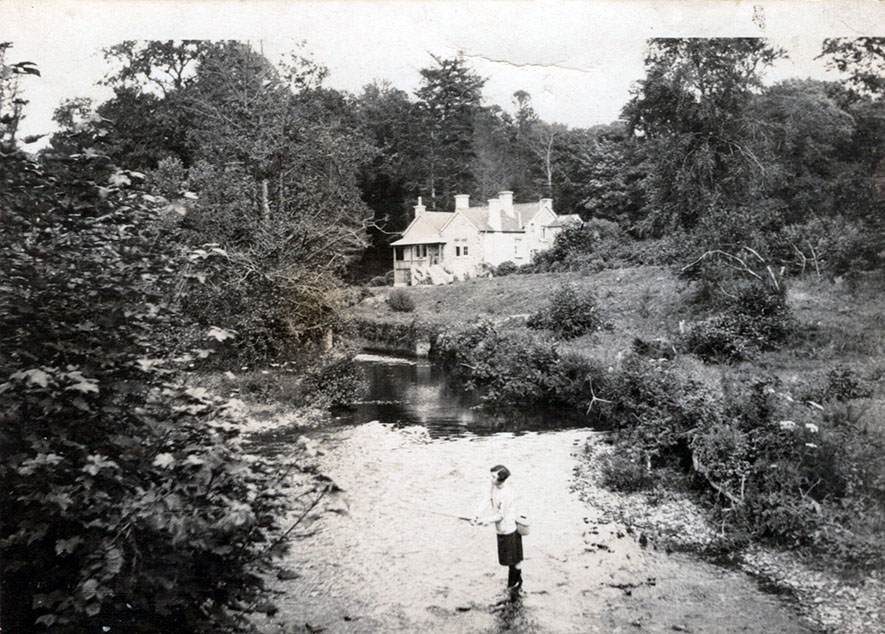
Lady Pinsent was as keen on fishing as her husband and sons, and she wrote at least two articles that were published in the “The Field” magazine. One, published on 23rd December 1890, was entitled: “Angling: Salmon Fishing in Newfoundland.” It described her life at “Woodlands” and a day spent fishing on the river. The other dated the 30th July 1892 was entitled: “Angling: A Day with Newfoundland Sea Trout.” It discussed an outing on the Colinette (Colinet) River. Yet another, shorter, article was reprinted in an (Unspecified) Quebec newspaper on 2nd May 1893. It describes how her youngest daughter (“Trixie”), aged nine at the time, landed two small salmon (grilse, 3 lbs. apiece) at the same time – while she was fishing for trout.
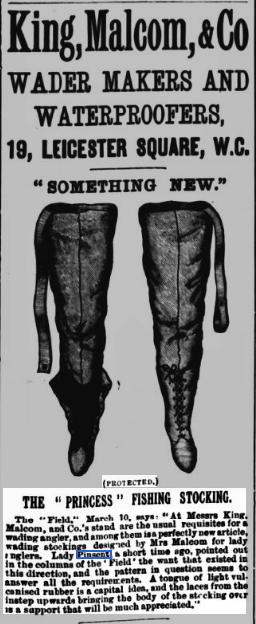
Perhaps she wrote other articles or letters as “King Malcom & Co.” noted that Lady Pinsent had grumbled in the “Field” about the lack of appropriate fishing dress for young ladies and they were now, in response, introducing a new line – “The Princess Fishing Stocking” to meet the needs of the fairer sex (The Field: Saturday 9th June 1894).
Ships manifests tell us that Mr. and Mrs. Pinsent and their children traveled to and from England fairly frequently in the 1870s. For instance, they took four children – Arthur, Charles, Robert and Francis – across to Liverpool on the “Nova Scotian” in December 1877 and they returned on the same ship in June 1878 (Patriot: 17th December 1877 & 24th June 1878).
Sir Robert and Lady Pinsent took a six-month leave of absence and returned to England for the last time in 1893. They arrived in January. There was a purpose behind the trip. Sir Robert was there to promote his report on French Fishery abuses in Newfoundland. He wrote numerous “letters to Editors” around then and, as discussed elsewhere, gave several talks and interviews. He was also there to receive a “Fellowship” in the “Royal Geographical Society” (Evening Mail: Wednesday 15th March 1893).
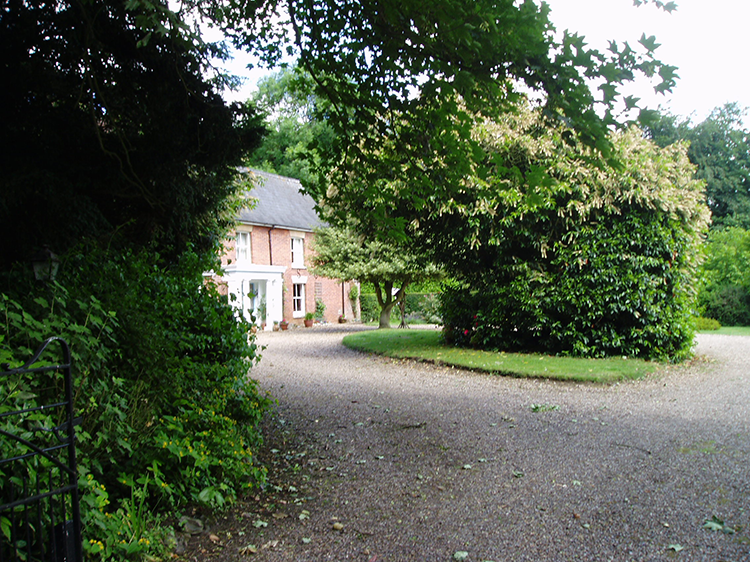
Returning to England was no hardship, as Emily (Lady Pinsent) came from Bintry and her family was well known in the district. On one occasion while there, Judge Pinsent (as he was then) and his wife attended a ball given at Sandringham House as part of the festivities surrounding the Prince of Wales’s (Prince Edward Albert Victor’s) “Coming of Age” (Pall Mall Gazette: Thursday 8th January 1885).
Several of their Emily’s children were educated in England. When Miss Mary Jane Shaw married William Jary in Bintree in August 1889, she carried a “charming bouquet, presented by Miss Pinsent, granddaughter of the much-esteemed Rector” (Norwich Mercury: Saturday 31st August 1889). This was probably Beatrix, but I cannot be sure. I suppose it could have been Sir Robert’s eldest daughter Mabel Louisa Pinsent who was staying with her grandmother at Bintry when the 1891 Census was taken – and may have attended a school near there. A Mrs. Hastings, who lived in Foulsham, Norfolk, advised any parents in St. John’s interested in sending their daughters for “Board and Education in a pleasant part of England” on moderate terms (of course) to talk to Lady Pinsent or Mrs. John Tessier (Evening Telegram: 6th July 1891).
The trip in 1893 provided Sir Robert with an opportunity to visit his eldest daughter by his first wife, who was, by then, a Lady Abbess in Rome. Sir Robert and Lady Pinsent went out to Italy for a short visit (during which they had a short audience with Pope Leo XIII). When they returned to England, she went back up to Norfolk to be with her younger children. Sir Robert, meanwhile, spent a few days in London- where he met his son Charles Augustus Maxwell (see elsewhere) and took sick with what turned out to be pneumonia. He joined his family in Norfolk on 20th April (as discussed elsewhere). A couple of days later, his daughter Mabel wrote to her half-sister Maude in Rome to thank her for sending her father flowers [letter in my possession RHP]. The letter included a note from her mother, Lady Pinsent, which was to let Maude know that her father was “in no immediate danger”. Sadly, she was mistaken. He died on 27th April 1893, at the age of 58 and was buried in Bintry.
News of Sir Robert’s death was sent to St. John’s by cable the following day and, given his previous good health, was received with considerable shock and consternation. He had been known throughout the Empire through the “Royal Colonial Institute” and notice of his passing was even reported in, what is now, Pakistan, where a local paper gave a short summary of his life (Civil & Military Gazette: Saturday 27th May 1893). Where his life would have taken him if he hadn’t died is impossible to say. However, a few weeks earlier he had dampened speculation that he was likely to succeed Sir Ambrose Shea in the Governorship of the Bahamas, claiming he had heard nothing on the subject (Glasgow Herald: Friday 10th March 1893). He certainly should have had more years of service to give.
Sir Robert’s death threw the family into disarray. His eldest son, Charles Augustus Maxwell, was with him in Norfolk when he died, but he returned to St. John’s shortly thereafter. He left from Liverpool bound for St. John’s on 9th May. Most of Sir Robert’s real estate had been committed to Charles and his immediate siblings as part of their father’s divorce settlement in the early 1870s and transactions that had taken place in the 1880s, so there would have been probate and legal matters to attend to. Sadly, Sir Robert had not lived long enough since his divorce to rebuild his finances and this was extremely unfortunate for Lady Pinsent and his second family! Nevertheless, his will, which was prepared in 1890, shows that Sir Robert left his widow the proceeds of several life insurance policies, and he made minor bequests of largely sentimental value to their children. Charles A. M. Pinsent was granted probate for an estate sworn at under $18,200.
According to one of Lady Pinsent’s newspaper clippings (she kept a book of them), Sir Robert was survived by his wife “Lady Pinsent” and eight children from the two marriages: (Lucretia) Maude “Abbess of St. Scholastique Abbey in Teignmouth” [she was actually in Rome by then], Charles (Augustus Maxwell), “merchant of St. John’s”; Arthur (Newman), “now farming in the United States” [ Saskatchewan in Central Canada, I think]; Robert, “engaged in the lumbering industry on the St. Lawrence”; Frank, “in the Surveyor-General’s Office in Newfoundland”; and Mabel, Beatrice and Guy, “now with Lady Pinsent at Bintry”. With the exception of Mabel, they are all discussed elsewhere.
Although Lady Pinsent (as she continued to be known) probably retained a life interest in her husband’s property in Newfoundland, it now belonged to her stepson Charles and she never went back. It can not have helped her financially that the Colony’s banks crashed the following year. I do not know how much that affected her finances; however, I fear the worst.
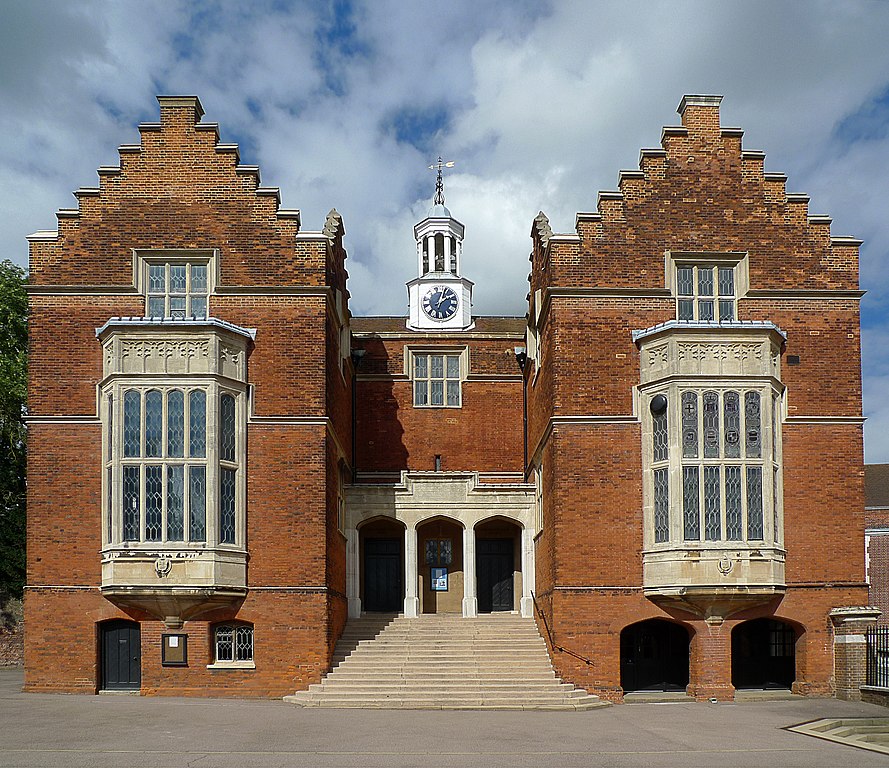

She stayed on in England to look after her younger children and I find that she attended a speech day at “Harrow School” in Middlesex in 1894 (Evening Mail: Monday 9th July 1894). Whether she was there to check it out or had already taken a job there as a “House Matron.” I am not sure – but she was definitely in residence two years later. She seems to have enjoyed her time at the school and in her scrapbook she kept numerous articles about the place and its headmaster, Rev. Welldon. Perhaps fortunately, she never had to deal with a particularly truculent student by the name of Winston Spencer Churchill. He left the school in 1892. Winston hated the place. Lady Pinsent left Harrow for “Denstone College” in the late 1890s – but frequently returned to Harrow to attend functions.
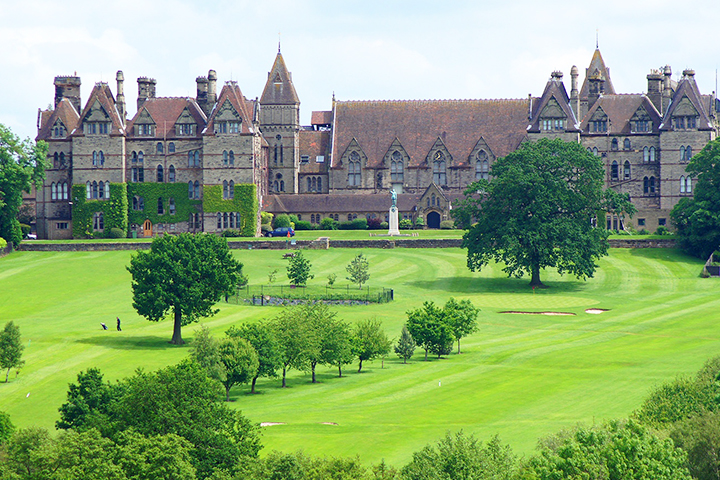
Why she moved to become “Matron” at “Denstone College” (another “Public” i.e. Private school) near Uttoxeter, in Staffordshire, I do not know for sure but it would have been a promotion and, presumably, better paid. She was there in November 1898 (Uttoxeter Advertiser and Ashbourne Times: Wednesday 30th November 1898) and stayed for several years despite being, by her own admission, extremely bored; “it is very quiet and dull here” (Letter to Lucretia Maude Pinsent, October 10th, 1900). I doubt if she was gripped by the talk that an “Old Boy”, Mr. F. G. Jackson, F.G.S. gave to the boys on the “Jackson-Harmsworth Arctic Expedition” (Uttoxeter Advertiser and Ashbourne Times: Wednesday 29th March 1899). Perhaps she missed the prestige that went with Harrow. Lady Pinsent was routinely listed with the dignitaries (such as they were) who attended sporting and social events at Denstone into the late 1890s and she was still living there when the census was taken in 1901, and when “Whitaker’s Peerage” was published in 1904.
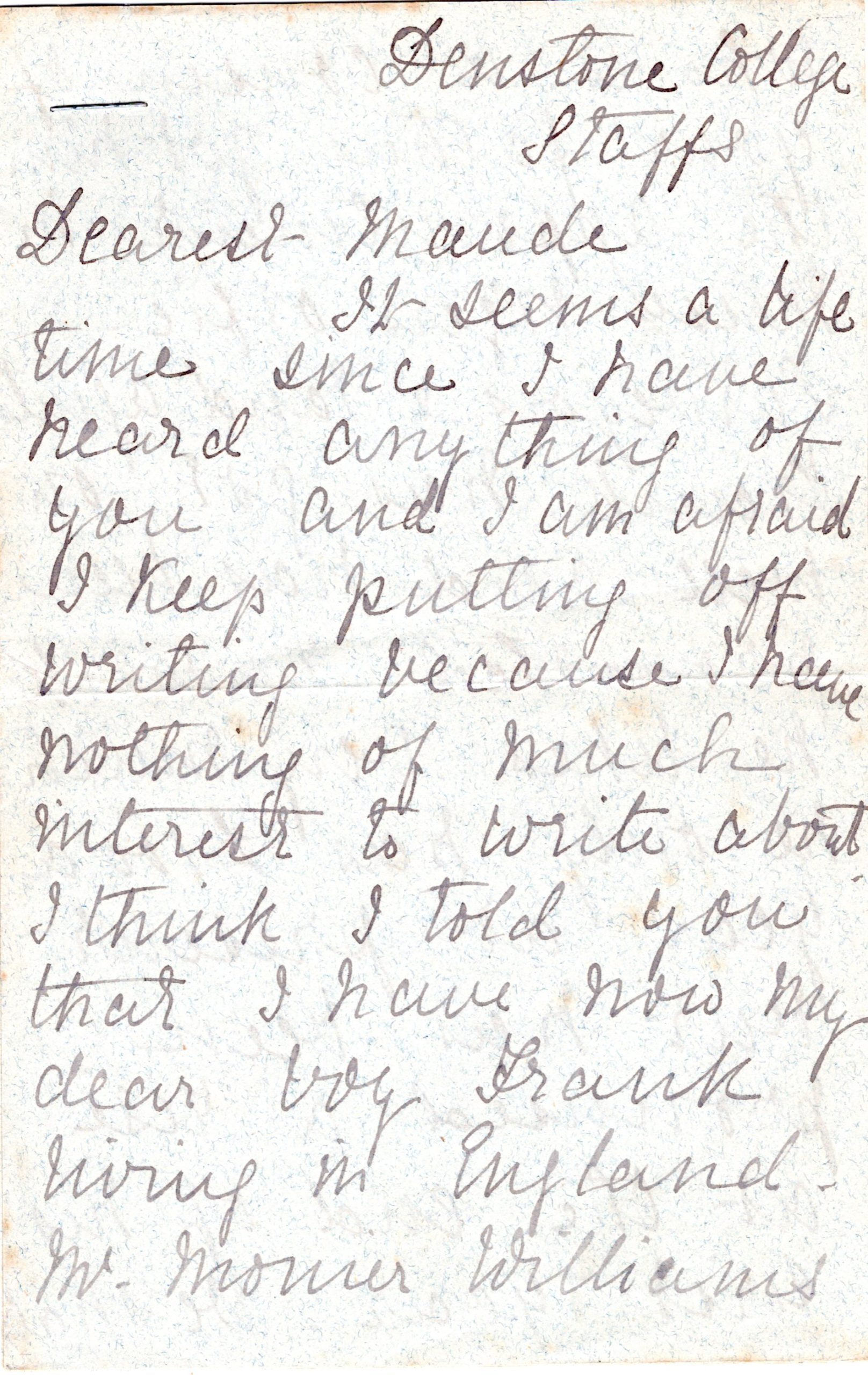
In three letters to “Maude”, written in around 1899 or 1900, Lady Pinsent airs her concerns about her children and stepchildren, in Newfoundland, England and elsewhere. In one she shows considerable relief that she had been able to get her son Frank (Francis Wingfield Homfray, my grandfather), a “surveyor”, a position in London – and that he was now with her in England. In the same letter she shows concern for the mental state of her stepson Charles who had taken to drink. She said she feared for the safety of his wife Fanny who had left him and was – as she thought – now living in England. Fanny did not want her whereabouts known to Charles and must have been deliberately vague. In fact, she was living at Ruthin in Wales. Emily and Fanny corresponded through the latter’s sister.
Lady Pinsent also told her step-daughter that she was pleased that her youngest children, Guy and Beatrice (“Trixie”) were at the “Blue Coat School” in Hertford, and that they were getting a good education. Trixie wanted to become a “doctor” and practice in India; however, that was not going to be possible for financial reasons. One of Lady Pinsent’s newspaper clippings describes the wedding of her eldest son, Mr. Robert H. Pinsent, (Robert John Ferrier Homfray) “son of the late Sir Robert John Pinsent, D.C.L., K.B.E., Justice of the Supreme Court of Newfoundland” and Miss Annie March, daughter of N. March Esq. on 18th May, 1896. It was a relatively low-key affair as both families had been hit hard by the recent financial crisis. “At the conclusion of the wedding, the couple drove to join the S.S. Bonavista at the premises of Messrs. S. March and Sons, and embarked for Montreal where they are to take up their future residence at #97 Hutchinson Street”.
Sadly, another clipping shows that Robert took sick and returned to Newfoundland after working for only a year in Quebec in the lumber industry. He died of tuberculosis in 1899 and his wife, Annie, became a “Methodist Missionary” in Japan. Both of their lives are discussed elsewhere.
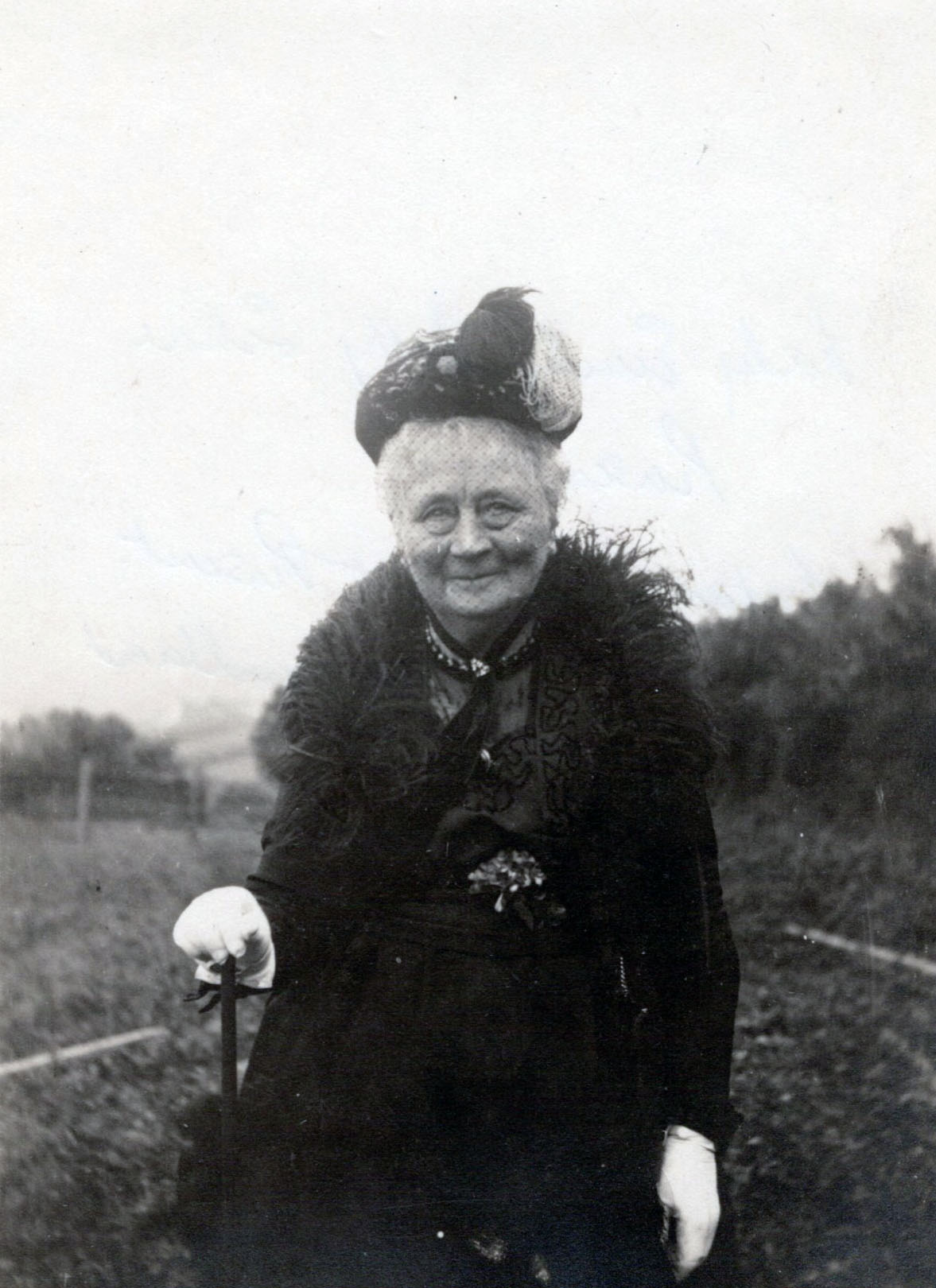
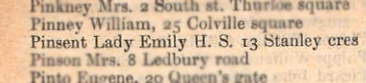
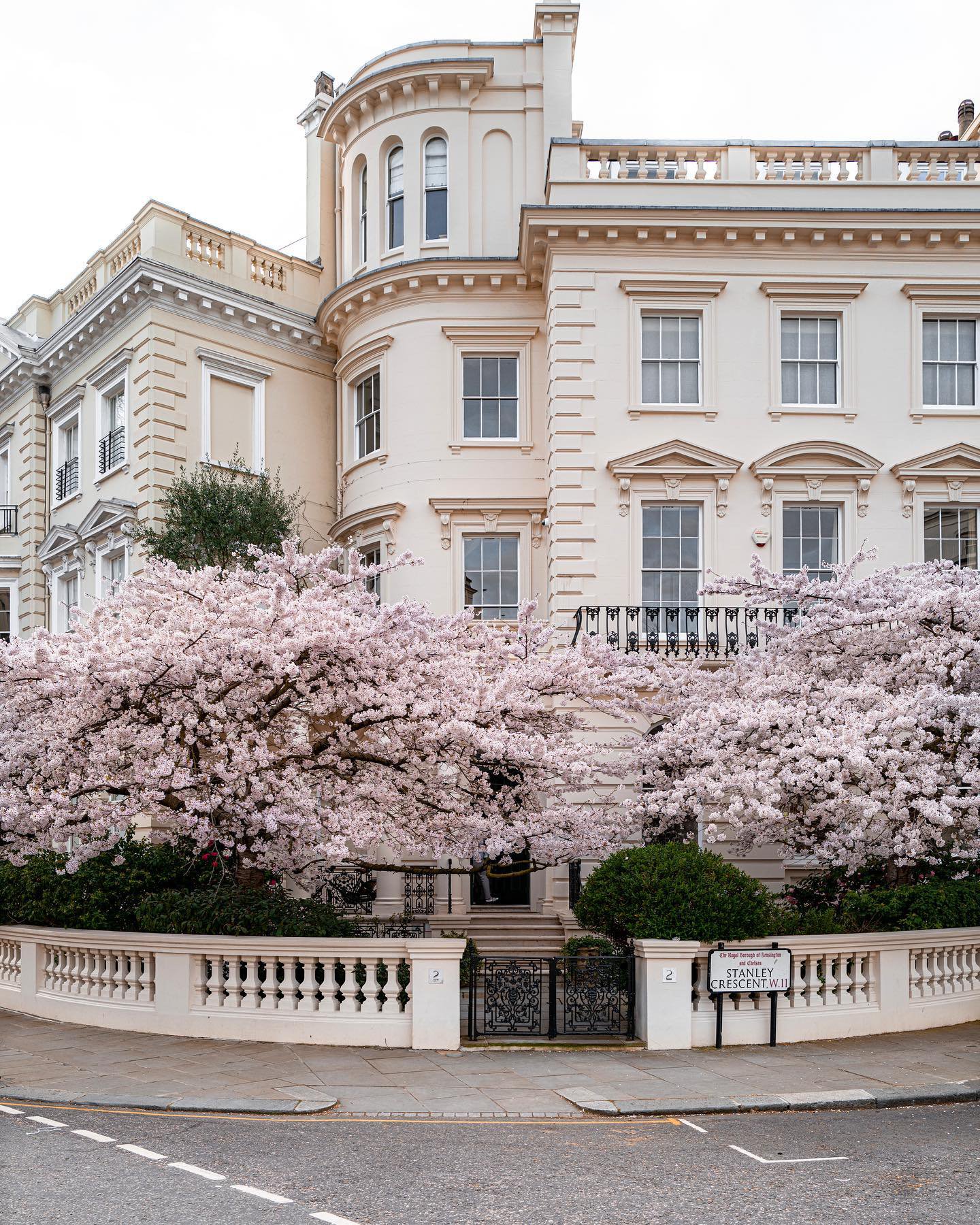
Lady Pinsent left Denstone in around 1906 and moved to London to be closer to her son Francis, who had settled there, and to her daughter Beatrice who was studying there. She was living on Stanley Crescent in Nottinghill when her mother, Mrs. Louisa Ann Rackham, died at Bawdeswell in October 1906 leaving her as her executrix (Nottinghamshire Weekly Express: 16th November 1906). Lady Pinsent later acquired the lease of flat or apartment on Kensington Park Road. Frank was elected a “Fellow of the Survey’s Institute” in 1908 and two years later joined the “civil service.”
In 1910, he accepted a position in the “Inland Valuation Office” in Plymouth and moved down to Devon. Lady Pinsent went with him, and the following year, when the census takers made their rounds, they were ensconced in a boarding house on Plymouth Hoe. They may have stayed there for quite some time, as it was the address that Lady Pinsent’s stepson Arthur Newman Pinsent gave for her when he filled out his “Attestation Form” at the start of the “First World War.” Perhaps this was actually a case of “Last Known Address”.
Lady Pinsent kept her flat in London for visits and for family use and her daughter Beatrice was living there when the 1911 Census was taken.
The family met up with Robert Burton Pynsent sometime in the early 1900s. “Cousin Bob,” as he was to be known, was a grandson of Joseph Pinsent, a younger brother of Frank’s great grandfather, John Pinsent – the baker who ran the shipping business out of London and Port de Grave in the early 1800s. The families had much in common. Lady Pinsent and her son Frank were ex-patriot colonials returned from Newfoundland and “Cousin Bob” was a colonial recently returned from New Zealand. Both families lived in Kensington, so it is not surprising they met up. “Cousin Bob” resurfaces intermittently throughout Frank’s life. Both their lives are described elsewhere.
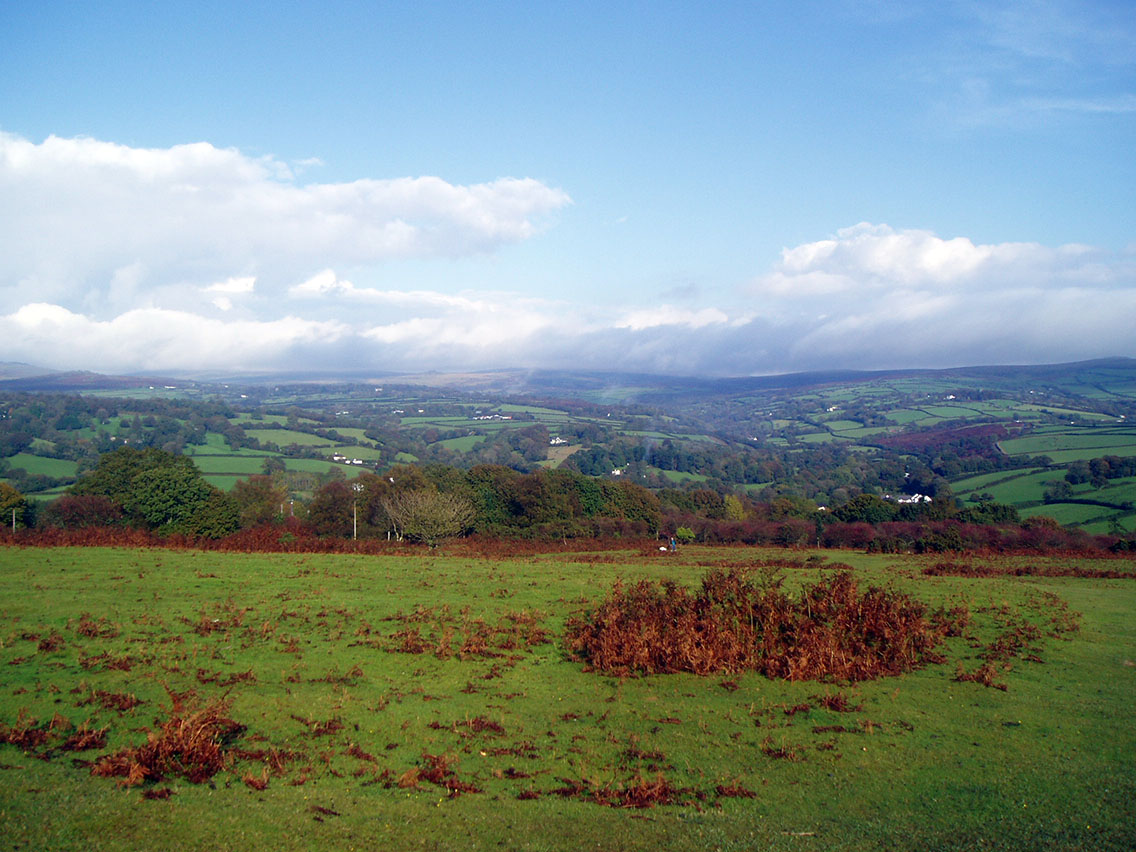
Frank married Janet Frances Cowtan in London, in 1911, and they settled into a house called “Hillsborough” in Horrabridge, a small village north of Plymouth. This was the name of Sir Robert’s home in St. John’s. He seems to have borrowed the name from another relation – the Thomas Pynsent of Westward Ho! You will find him discussed elsewhere.
Lady Pinsent joined them and was living at “Hillsborough” when she wrote her Last Will and Testament in 1917.
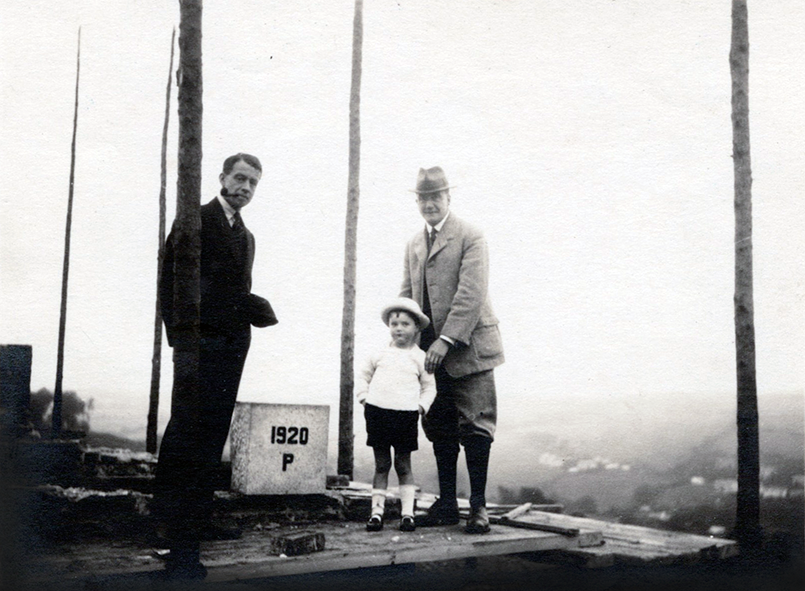
Frank and little Robin lay the first brick during the construction of Higherfield.
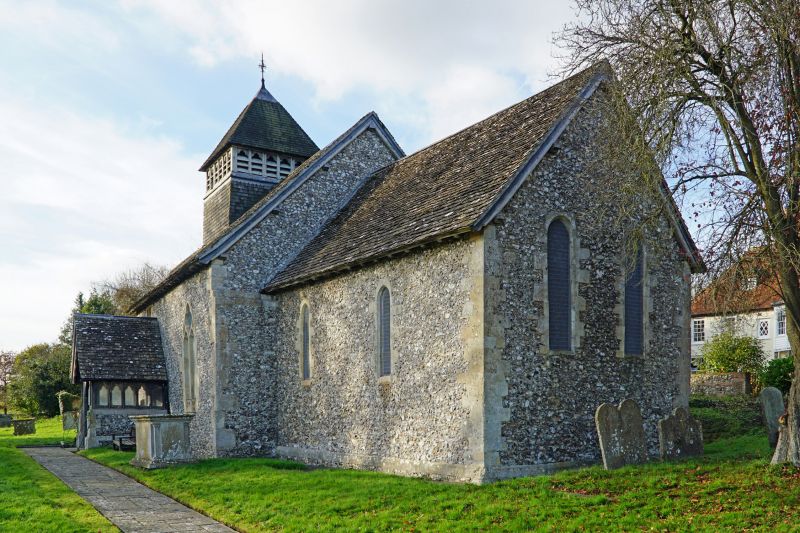
Frank evaluated land for a living and he had an eye for real estate. He purchased three small fields just above the railway station at Horrabridge and in 1920 built a small house abutting onto Roborough Down. “Higherfield” was Lady Pinsent’s last home. The family moved in just before the census was taken in 1921; however, she was away visiting friends, Elizabeth Julie Francis and Margaret Florence Francis in Watford in Hertfordshire at the time. Lady Pinsent died at Higherfield and was buried in the local Anglican Churchyard in 1922.
She had appointed her sons, Francis Wingfield Homfray Pinsent and Guy Homfray Pinsent as her executors. Her will shows that she gave her personal estate to her daughter Beatrice Mary Homfray Pinsent, if still living (which she was) with residual interests to her married daughter Mabel Louisa Eden and her granddaughter Ursula Eden, and also as a large sum of money to Guy. She left the residue, including her lease of the property on Kensington Park Road in London, to her son Francis. Her estate was not particularly large, which suggests that there may have been prior arrange ments made within the family.
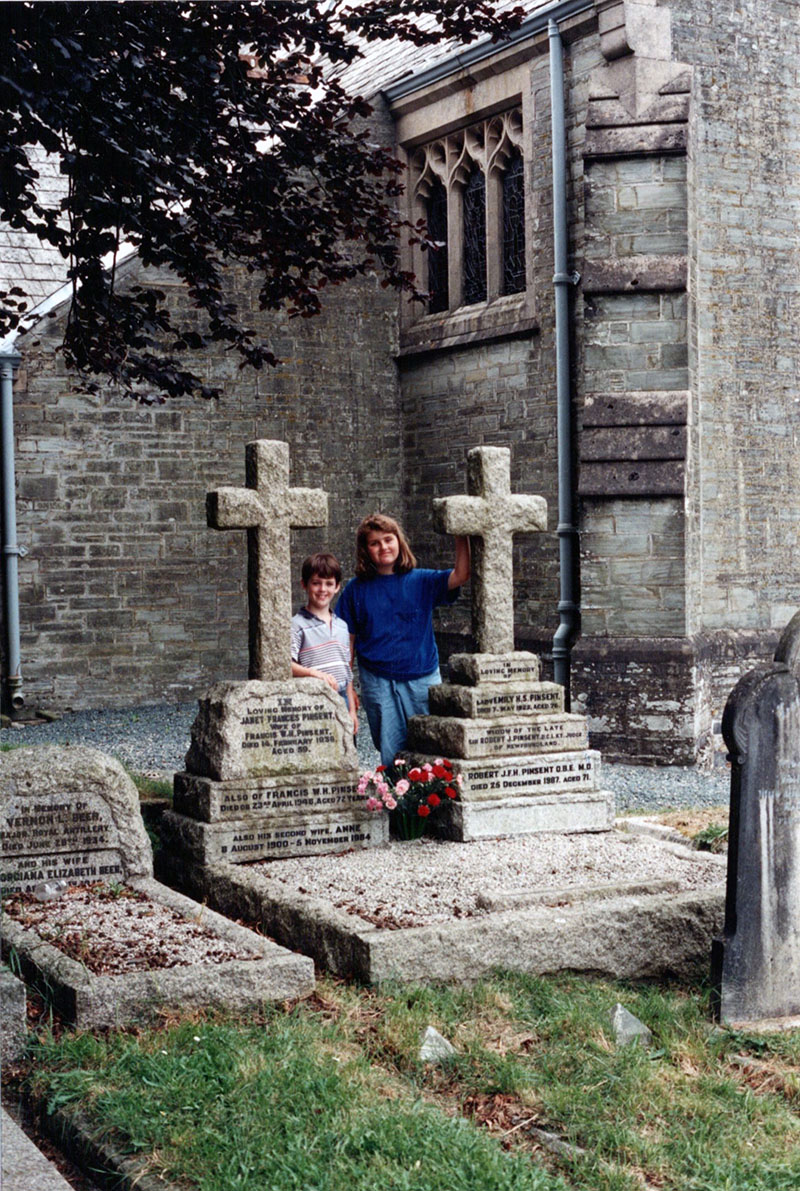
Lady Pinsent’s two living daughters when she died were Mabel and Beatrice (“Trixie”). Mabel had been born in St. John’s Newfoundland but educated in England. She was with her mother in Norfolk when her father died and she stayed on in England with her. Mabel married a medical practitioner, Dr. William Annesley Eden, in Bintry Church, in January 1895 (Gentlewoman: Saturday 2nd February 1895). They had several children – not just the above-named Ursula. Mabel corresponded with her mother and later with her brother, Frank. My father, (Frank’s son) Robert John Francis Homfray Pinsent corresponded with Ursula in the 1960s.
Mabel’s younger sister, Beatrix Mary Homfray Pinsent, never married. She went out to Buenos Aires and settled there. Her time in Buenos Aires overlapped with that of at least two other branches of the family. How well they knew each other – if at all – I don’t know! As for Lady Pinsent’s sons, Francis and Guy Pinsent, they both married but only Frank’s marriage produced a son. Despite Sir Robert John Pinsent having had eight sons by two marriages, he seems to have only had one grandson.
Please use the above links to explore this branch of the family tree. The default “Next” and “Previous” links below may lead to other unrelated branches.
=