Vital Statistics
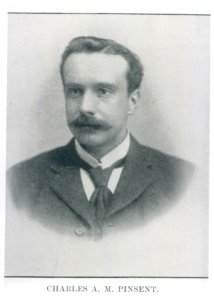
Charles Augustus Maxwell Pinsent: 1866 – 1910 GRO1144 (Businessman and Agent in Newfoundland)
Fanny Sophia Colley: 1870 – 1954
Married: Topsail, Newfoundland: 1897
Children by Sophia Colley:
Frances Vicars Raleigh Hoyles Pinsent: 1897 – 1898
Family Branch: Hennock
PinsentID: GRO1144
Click here to view close relatives.
Charles Augustus Maxwell Pinsent was the eldest surviving son of a “barrister” in Newfoundland, Robert John Pinsent. He came from Robert John’s marriage to Anna Brown, née Cooke. Their family consisted of three girls and five boys but, sadly, only the eldest girl, Lucretia Maude and two of the boys, Charles Augustus and Arthur Newman outlived their father.
Charles’s mother was the daughter of a “merchant” with strong links to Portugal. In 1864, she had taken a trip to England to visit the English side of her husband’s family. She had taken two of her daughters (Lucretia (7) and Catherine (6)) and her four-month-old “baby,” William. However, her son, Hedley (2) had been left at home with his father. Anna kept a diary while in England. In it, she seems to show that she missed her husband and her life in St. John’s: “July 26th: Tomorrow will be dear R’s birthday and we must drink his health in a little of the old Port… “. Unfortunately their relationship did not last. Robert and Anna had two more sons after she returned (Charles and Arthur), but their relationship seems to have come to an end shortly after Arthur was born.
Robert John Pinsent filed for divorce in “Her Majesty’s Court for Divorce and Matrimonial Matters” in London in 1869, claiming that his wife had left him in St. John’s and moved to England – where she was nominally looking after their children who were at school in Bristol. While there, she had (or, more likely, she continued) an affair with Charles Mesham, a married Newfoundlander.
The 1871 Census tells us that Anna’s son Robert Hedley Vicars Pinsent (or “Hedley” as he was known) was at “Ebernezer House School” and her daughters, Lucretia Anna Maude and Catherine Louisa Pinsent, were living with and were being schooled by the Keddle sisters in Westbury on Trym. The Keddles were family relations. The case wound its way through the Court and adultery was eventually proved. In January 1870 the divorce was finalized (National Archives (J77/84 File 796) and Mr. Mesham paid £3,000 in damages for his involvement. However, he was out the picture by then – perhaps he had gone back to his wife and family – so Anna married John Lee Statham in April.
Anna and Robert John negotiated an out of court financial settlement and Robert took control of the children. They were still young and the settlement took some time to implement. Family papers, now in the Newfoundland Archives, show that in 1884 Robert John gifted his country house, “Woodlands” at Salmonier, and most of his property in St. John’s, including (in part) his house called “Hillsboro,” to his eldest son, Charles Augustus Maxwell. He did so in exchange for a release from an obligation to keep his life insured for $3,000.00.
“Hedley,” meanwhile, died and Robert John’s second son, Arthur Newman Pinsent sold his interest in the family’s estate to his older brother Charles and received $1,860.00 in cash. He was later to leave St. John’s and head west into Canada, where he ended up in Saskatchewan. His life is discussed elsewhere.
Robert John Pinsent married Emily Hetty Sabine Homfray in Froxfield in Wiltshire in April 1872. Why they married in Froxfield and not Emily’s home church in Bintry (a.k.a “Bintree”) in Norfolk (where her father was the Vicar) is unclear. Perhaps divorce came with a stigma back then and it was strategically better to marry elsewhere. The couple soon started a second family that was to be made up of four daughters and three sons. Sadly only two of each sex outlived their father. Their lives are also discussed elsewhere.
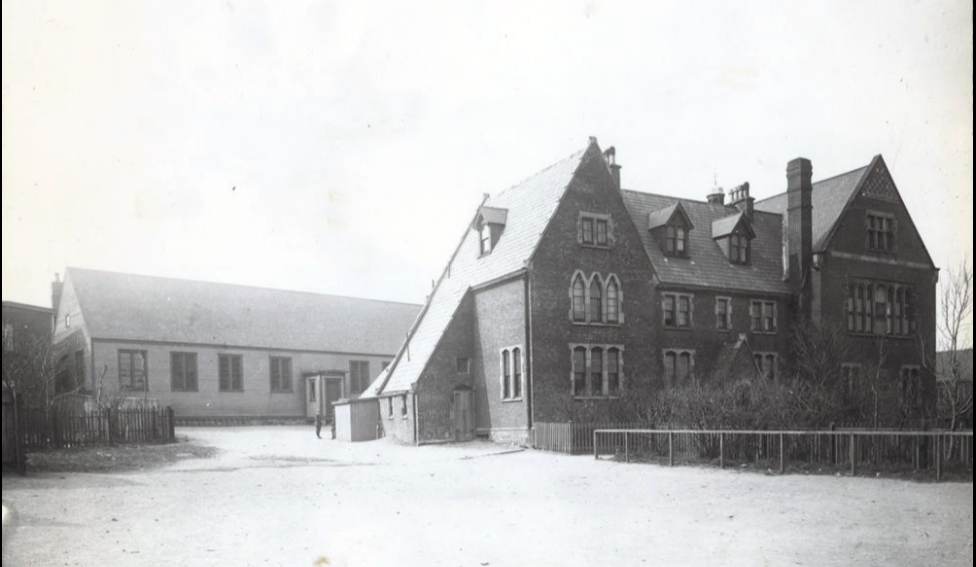
Back to Charles, who would have been six years old when his father married for the second time. There is a short biography of Mr. Charles Augustus Maxwell Pinsent in a book entitled “Newfoundland Men: Biographical Sketches” edited by Henry Youmans Mott, in 1894. It includes the portrait photograph above. It tells us that Charles was educated at the Church of England Academy (later known as “Bishop Feilds School”) – the premier Anglican “public” (i.e. “private”) school in St. John’s – and the Methodist Academy in St. John’s, Newfoundland, and also at a Norfolk County School in England. Most of the schooling in Newfoundland in those days was based around religious denominations. The Norfolk school was, presumably, near his step-mother’s home at Bintry.
Charles was, presumably, taken on as a “clerk” by one of his father’s mercantile friends in St. John’s when he left school. We hear little about him for a few years – until he comes to the fore again in his early twenties.
The “Sketch” alluded to above shows that he worked for “C. H. Bennett and Co., of St. John’s,” for a few years before branching out and becoming the Newfoundland representative of “Exploits Wood Co. of London.” He was later to become an agent of “Underwriting and Agency Associates of London” and manager of “Sun Life Assurance Co. of Canada”. Charles was also the “Vice Consul for Portugal” for several years [almost certainly a result of his mother’s family’s mercantile interests – RHP].
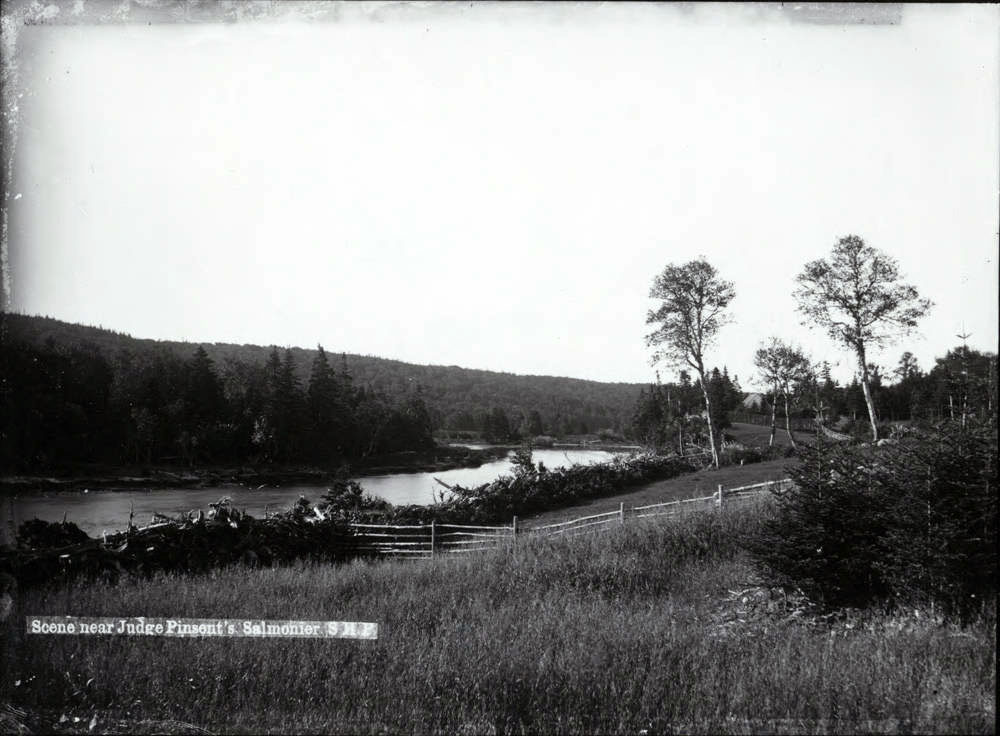
Robert John and his second wife Emily Pinsent lived at “Hillsboro’” in St. John’s while he was growing up and they owned a strategically placed country cottage called “Woodlands” on the Salmonier River near Holyrood. Robert and his family loved to hunt and fish and the family spent as much of its time as possible at “Woodlands” (a.k.a “Salmonier”). In fact, Charles and his brothers (presumably Hedley and Frank) are reputed to have cut the first trail from the main road to “Pinsent’s Falls” – which was one of the best salmon fishing-spots on the Salmonier River.
Charles had a predilection for hunting: “Mr. Charles Pinsent has just returned from Salmonier where, in company with a guide, he spent three days in the woods – camping out in the tilts being attended with beautiful weather. They saw two stags, a doe and a fawn. They wounded the two stags both mortally but one escaped. The head of the animal secured is massive with antlers of good size for the season” (Evening Telegram: 24th March 1885). A “tilt” is an angled roof built on site for protection from the weather. Charles was out hunting again the following Christmas: “We are informed that Mr. C. Pinsent, junr., who spent Christmas Day at Woodlands, Salmonier, visited the deer marshes next day and, with his accustomed luck returned with two deer. This young sportsman has brought to town four deer within the year, having been fortunate on every occasion he has visited the Salmonier parks” (Evening Telegram: 29th December 1885).
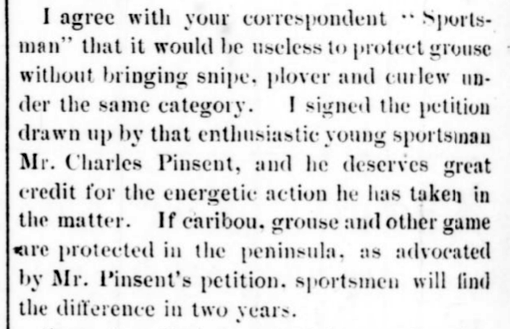
Charles was hardly an environmentalist, but he circulated a petition calling for better controls on hunting on the Avalon Peninsula and it received some interest in the press: Mr. Langrishe Mare wrote: “I signed the petition drawn up by that enthusiastic young sportsman Mr. Charles Pinsent, and he deserves great credit for the energetic action he has taken in the matter” (Evening Telegram: 11th March 1886). Many people must have agreed with him but not everybody was convinced: “It is the voice of every sportsman that signed Mr. Pinsent’s petition, “give us the same law as last year, all shooting to begin 1st September” (Evening Telegram: 16th April 1886).
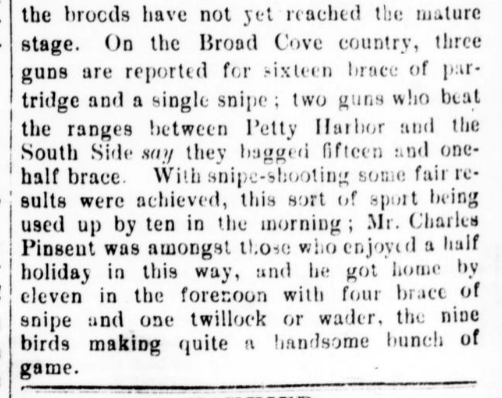
The following year, the country correspondent at the Evening Telegram breathlessly reported that “Mr. Charles Pinsent was amongst those who enjoyed a half holiday in this way, and he got home by eleven in the forenoon with four brace of snipe and one twillock or wader, the nine birds making a quite a handsome bunch of game” (Evening Telegram: 16th September 1887). Yes, in Newfoundland “twillock” does refer to a wading bird. It is not a derogatory term as it once was in English English! Who can complain if “Mr. C. A. M. Pinsent opened the shooting season with a good bag of birds, He shot fifteen snipe and a bittern before breakfast” (Evening Telegram: 16th September 1889).
To give credit where it was due, “Mr. C. A. M. Pinsent tells us that his nine-year-old sister, Miss Trixie Pinsent, paying her first visit to the Falls of Salmonier River, on Wednesday last, and making the first cast there for the season, booked, and succeeded in landing, two grilse at the same time” (Evening Telegram: 25th June 1892). This also impressed her mother, Lady Pinsent (as she then was) and she published an article in an unspecified Quebec newspaper in May 1893. I have a clipping she made of the item. Evidently Trixie was fishing for trout and caught the first on a “silver doctor” and the other on a “small trout fly”. A grilse (while we are at it) is an Atlantic salmon that has only had one year at sea.
When he was not out in the Newfoundland bush, Charles was, presumably working in St. John’s; however his work-life is not so well documented. He had a social life as well, of course. In January 1886, and again in February 1887, he served on the Committee that put on a “Charity Ball” on behalf or the Ladies of the St. Vincent de Paul Society (Evening Telegram: 23rd January 1886; 5th February 1887). Nevertheless, Charles did not marry until 1897.
Charles’s father, Robert John Pinsent, was appointed to the Supreme Court of Newfoundland in April 1880 and he spent several years dispensing justice “on circuit” around the Island’s out-ports. It gave him a unique perspective on the issues facing the Colony and he was well-placed to raise these issues in St. John’s. He also spent a considerable amount of time in England, where he also tried to and have them understood and addressed by the Mother Parliament. Queen Victoria honoured him with a Knighthood in 1890. For practical reasons, it probably made little sense to keep both his city residence and his country “cottage” open all the time – when one or other would do so they were not infrequently advertised for let. Lady Pinsent was quite happy to live at “Woodlands.”
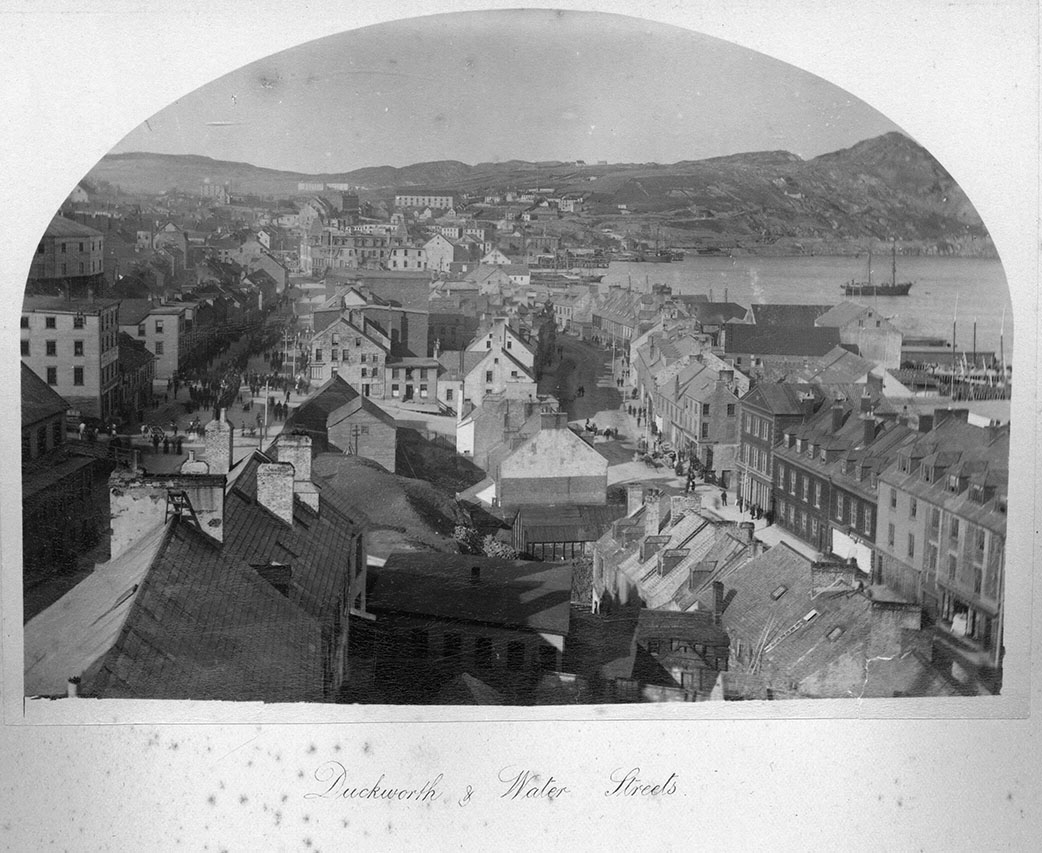
In April 1888, Charles advertised “Hillsboro’; having Conservatory and flowers, hot and cold water, and garden and stabling, with man-servant’s house, if required.” as available to let for the summer months (Evening Telegram: 30th April 1888). He did so again the following year: “TO BE LET, For the summer months of this year, or for a term, fully furnished, hot and cold water, gas and all other conveniences, HILLSBORO, King’s Bridge Road, commanding views of Signal Hill and Quidi Vidi Lake, with fine garden, stables, coach and manservants house attached, conservatory, &c” (Evening Telegram: 29th April 1889). It was the same story in 1890 (Evening Telegram: 12th May 1890) and 1892 (Evening Telegram: 15th June 1892). It was clearly more than a “cottage.” The latter year Charles also advertised a number of building lots in St. John’s for lease for 99 years. Whether it was family property – or he was just acting as agent for the owner, I do not know (Evening Telegram: 30th September 1892). It is clear that by the mid-1880s Charles was essentially in charge of much of the family business. A good deal of the property belonged to him anyway.
Life in the Pinsent family changed radically in 1893. Sir Robert and Lady Pinsent took a leave of absence and went to England where their younger children were still at school. While there, they took a trip out to Italy to see Sir Robert’s eldest daughter by his first wife, Lucretia Maude Pinsent – who was (as discussed elsewhere) – the Lady Abbess of a Benedictine convent in Rome. Sir Robert and Lady Pinsent returned to London in April and Lady Pinsent traveled back to her family in Bintry, in Norfolk.
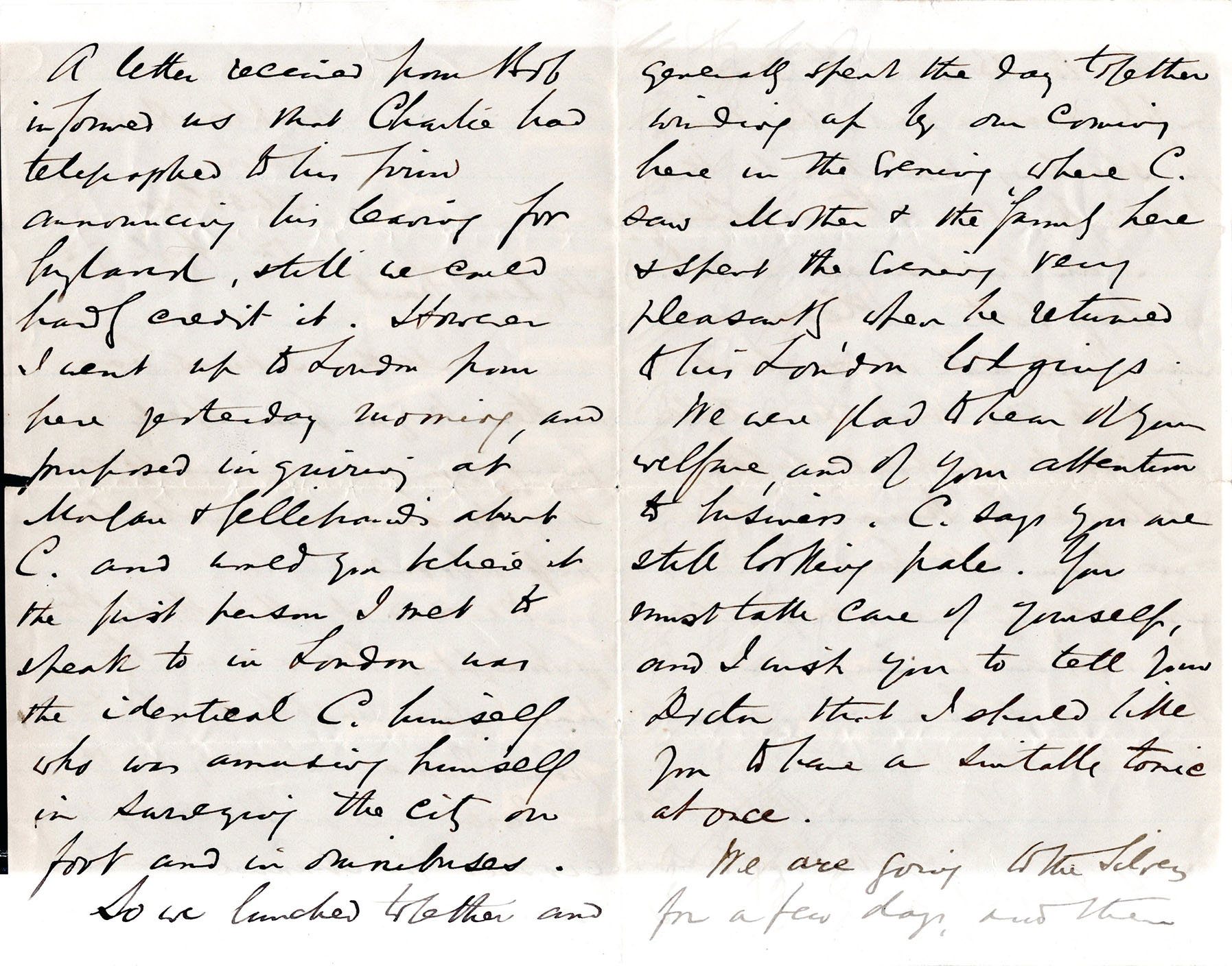
Sir Robert stayed on in London to conduct business. For one thing, he wanted to ship some trees out to Newfoundland to plant at “Woodlands.” In a letter he wrote to his son Francis he asked him to handle the shipment when it arrived. Evidently, he had arranged for Charles to do this – but he had turned up unexpectedly in London! “A letter received from Rob. Informed us that Charlie has telegraphed to his firm announcing his leaving for England, still we could hardly credit it. However, I went up to London from here yesterday morning, and proposed inquiring at Morgan & Jellinghams about C. and would you believe it the first person I met to speak to in London was the identical C. himself, who was amusing himself in surveying the city on foot and in omnibuses”. Charles had left St. John’s, bound for Halifax and then London on 28th March (Evening Telegram: 28th March 1893).
Perhaps it was fortuitous that he was there as Sir Robert took sick with pneumonia shortly after and he went up to Bintry. His daughter Mabel (the Lady Abbesses’ half-sister) wrote to Lucretia in Rome on 20th April saying: “You will be most sorry to hear dear father is very poorly today. Mr. Dashwood has been to see him. He says he has had a relapse but not in any danger. Dear mother is pretty well. We are having most lovely weather now, so I hope father will soon be stronger”. Lady Pinsent added a postscript: “Your dear father is a little better today but he is very weak. We are dong our best for him and the doctor says there is no danger. Poor darling, he has got so thin”. Sadly, the doctor was wrong. Sir Robert died on 27th April 1893. He was buried at Bintry.
The loss of a Judge of the Supreme Court caused quite a stir in Newfoundland and Charles, who was Sir Robert’s eldest son and the executor of his will returned to Newfoundland on the Allan Line’s S.S. “Corean,” which left Liverpool on 9th May 1893 (Passenger Transcripts: Findmypast). Lady Pinsent and her daughter Mabel and her younger children (Guy and Trixie) stayed on in England. There was plenty to be done in Newfoundland, particularly given the existence of his two families.
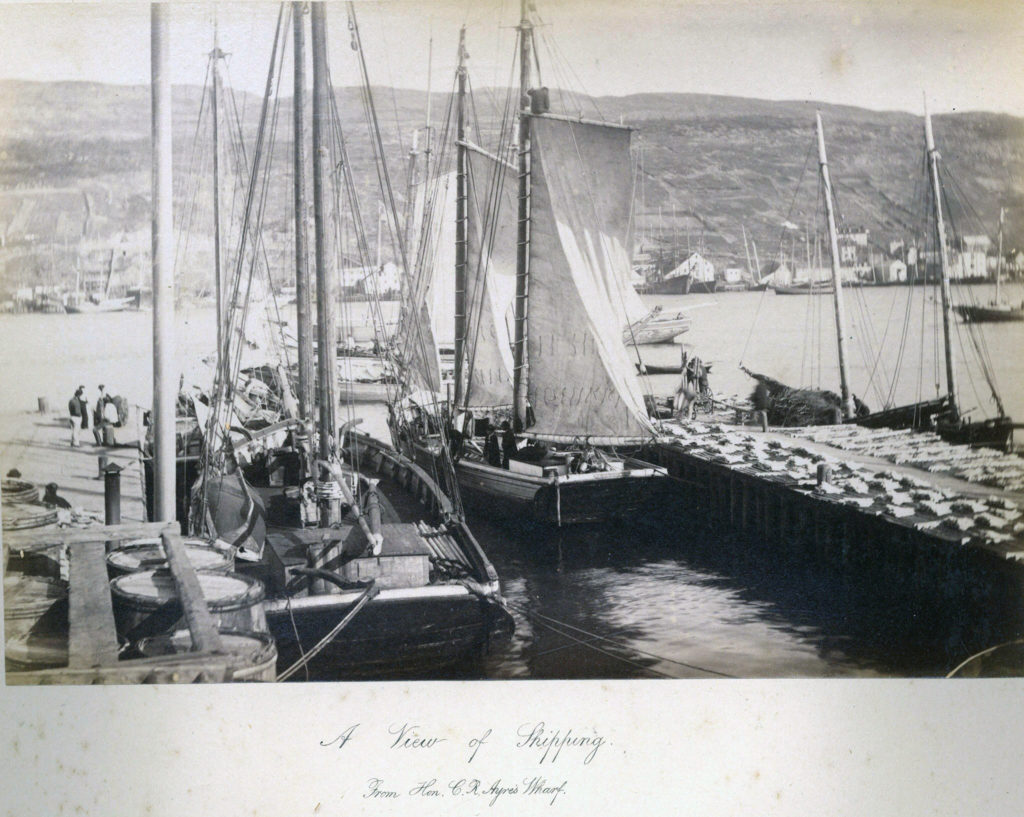
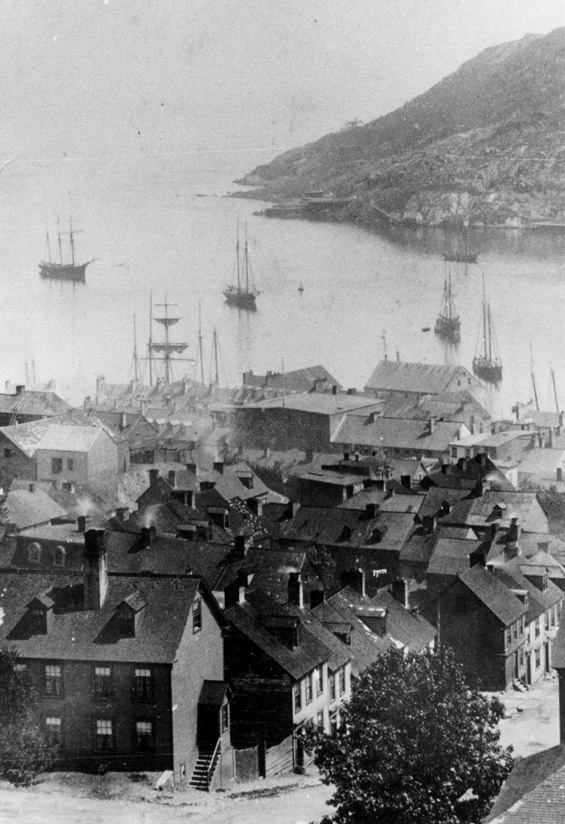
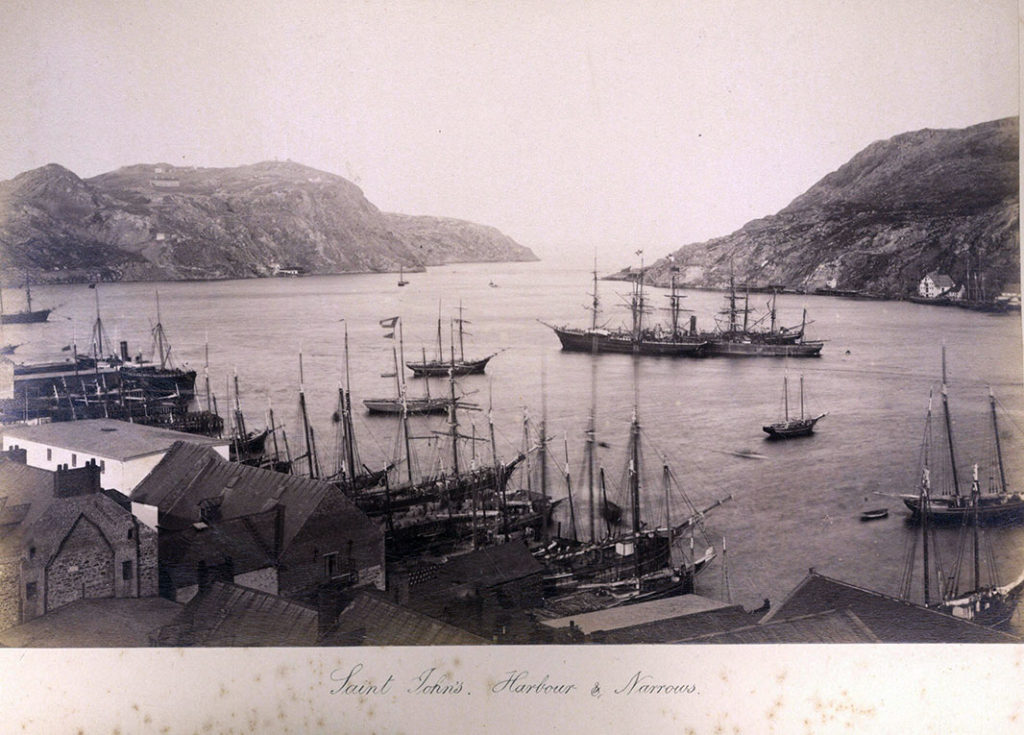
The legal processes got underway in June with the usual call for creditors to make themselves known to his son, the executor (Charles A. M. Pinsent, of St. John’s, Commission Merchant), “PURSUANT TO THE PROVISIONS OF the Act passed in the forty-first year of the of her present Majesty, entitled “The Trustees’ Act, 1878,” (Evening Telegram 7th June 1893). It was a busy time. In the same issue, Charles advertised “Salmonier: For Sale, or to Let for the season, or for a longer period, in good order and entirely furnished, that well-known property (through which the Salmonier River passes), “Woodlands,” Salmonier, belonging to the estate of the late Sir Robert Pinsent and also, if required, horse, carriage, cow and other requisites which are on the premises.” The presence of a cow is interesting! Whether the property was actually meant for “sale”, I doubt. Charles loved the place and Lady Pinsent and his brothers may well have had a retained interest in it.
Charles seems to have conducted other business that same day: He was the sole executor of Catherine Wrey of Twillingate and he had her will to probate as well as his father’s – and he had to arrange for her property to be let out (Evening Telegram: 7th June 1893). Perhaps she had died while he was abroad.
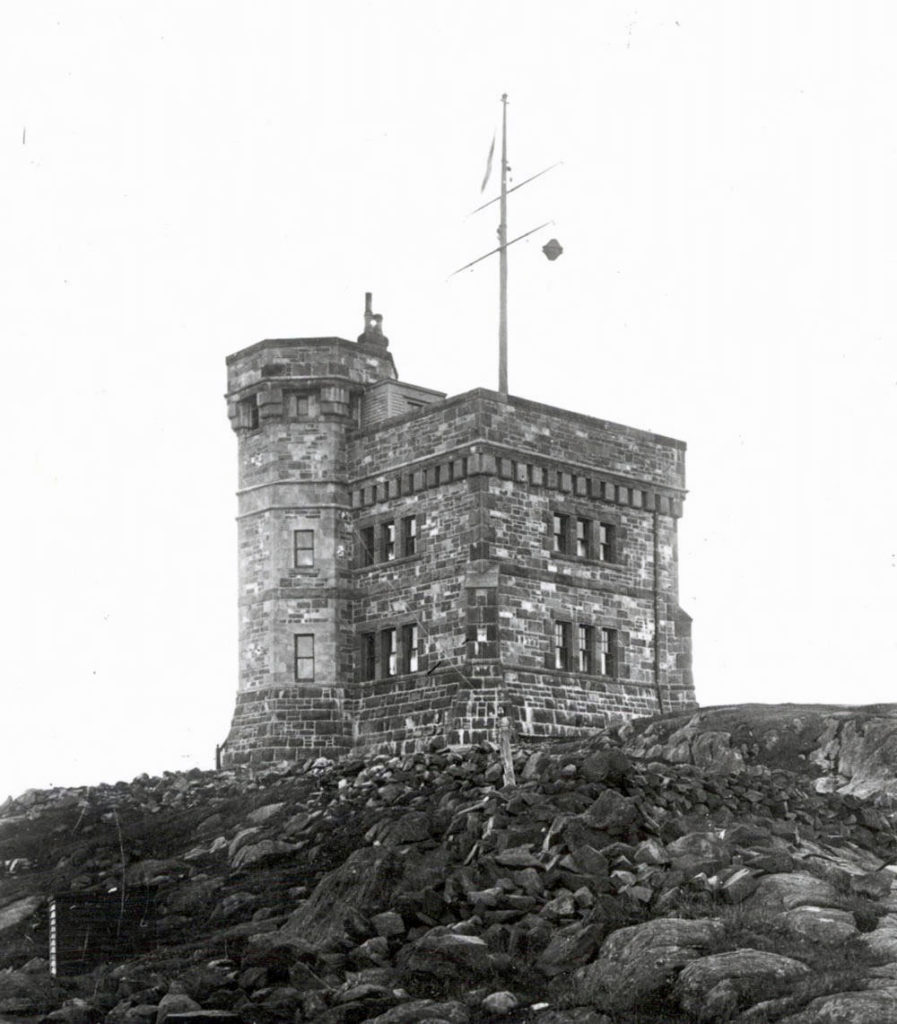
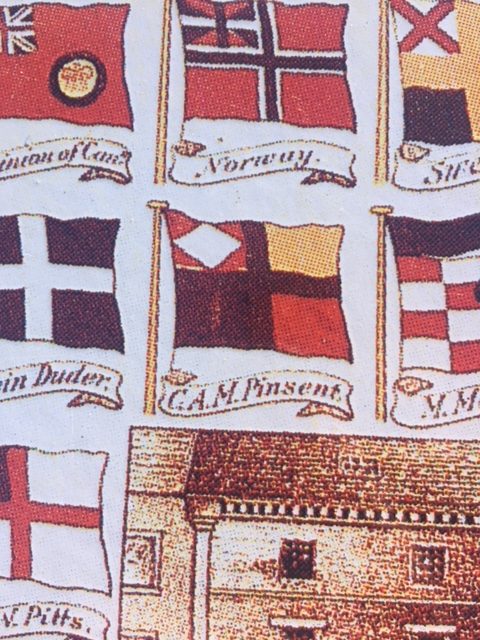
Interestingly, Charles may have inherited a residual interest in his grandfather Robert John Pinsent’s old shipping business as his name is (or was) attached to one of the Merchant House flags on display in the Cabot Tower on Signal Hill in the 1980s. There had been a disastrous fire in July 1892 that had destroyed most of down-town St. John’s and Charles was well placed to benefit from the rebuild – which inevitable required the importation of goods from England, the United States and Canada.
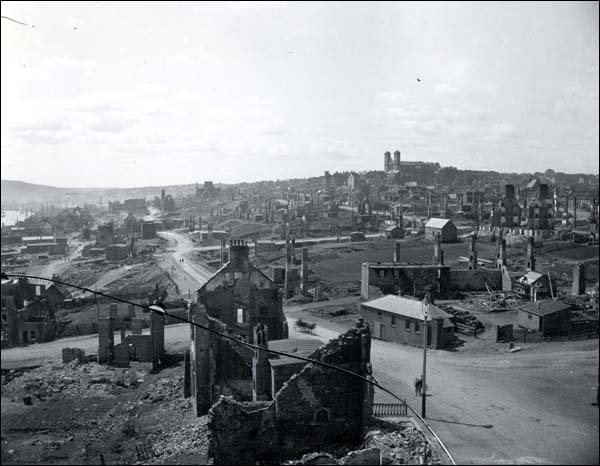
Charles had not only taken leave from the company he worked for prior to going to England in 1893, but he seems to have quit the firm – intending to work for himself. On the same day in June proudly announced: “Notice by the undersigned, is hereby given that he has been appointed Agent for the Exploits Wood Co., Ltd. of London, England in place of Messrs. Goodday, Benson and Co., of Quebec, who have resigned: Charles A. M. Pinsent” (Evening Telegram: 7th June 1893). The lumber needed to rebuild the town started to arrive from Montreal at the end of May (Evening Telegram: 29th May 1893) and it kept on coming in the ensuing months. For instance: “Lumber from Quebec: The Marie Vigilante, 14 days from Quebec, lumber laden, is consigned to Mr. C. A. M. Pinsent” (Evening Telegram: 29th May 1893) and “LUMBER FOR Sale: A cargo, whole or part of 2 and 3 inch pine lumber now landed at A. M. McKay’s Wharf, per schr. “Hyacinth” for particulars apply to C. A. M. Pinsent”(Evening Telegram: 1st September 1893).
Business was looking up and Charles took a trip to Montreal to report in and negotiate contracts that autumn. He left St. John’s for Halifax on 24th August on the S.S. “Carthaginian” (Evening Telegram: 24th August 1893) and, from there he headed up to Montreal. Clearly he was there to drum up business and he was not above using his father’s name to his advantage. He arranged an interview with the Montreal Gazette that was was reprinted in the St. John’s Evening Herald on 22nd September 1894. In it, he claimed that he was a proud Newfoundlander and anti-Confederation-ist. Among much else he said: “I am not an active politician … (and) … although my father took quite a prominent part in the political affairs of Newfoundland for many years. However, I have a deep interest in the political and commercial welfare of the colony and with such as the Hon. Mr. Goodridge, Hon. Mr. Monroe, Hon. A. R. Morine and Hon. W. B. Grieve steering the ship of state Newfoundland must be prosperous and the hour of confederation put back for several years”. Evidently, he felt that, given its fishing industry, its mines and forests Newfoundland would be well able to look after itself – at least in the short term. He was in Montreal, he said, “purchasing supplied for the men in the camps of the Exploits Wood Co., of London, England, and have already purchased here 7,000 barrels of pork, flour, and peas. Botwoodville, Nfld, had the largest lumbering mill in the colony, and exports three inch pine deal to Liverpool, London, Glasgow and Hull. It is managed by Morgan Gillibrand & Co. of London, Eng., and is a most valuable property. And all races and creeds live together in harmony.”
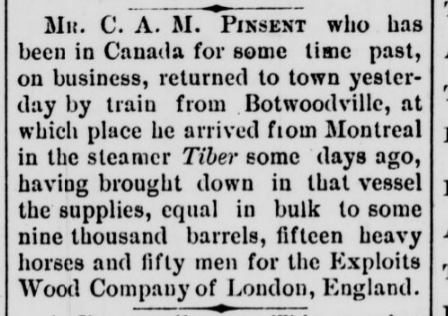
Charles went on to Ottawa and returned to Newfoundland on the S.S. “Tiber” in October with “supplies, equal in bulk to some nine thousand barrels, fifteen heavy horses and fifty men for the Exploits Wood Company of London, England” (Evening Telegram: 14th October 1893). The Company was clearly actively exploring and logging in the Colony. This may be around the time that Charles’s half-brother, Robert John Ferrier Homfray Pinsent made his ill-advised venture into the logging business in Newfoundland (“In the Pinewoods of Newfoundland:” (Undated article in “The Field Magazine:” see: elsewhere).
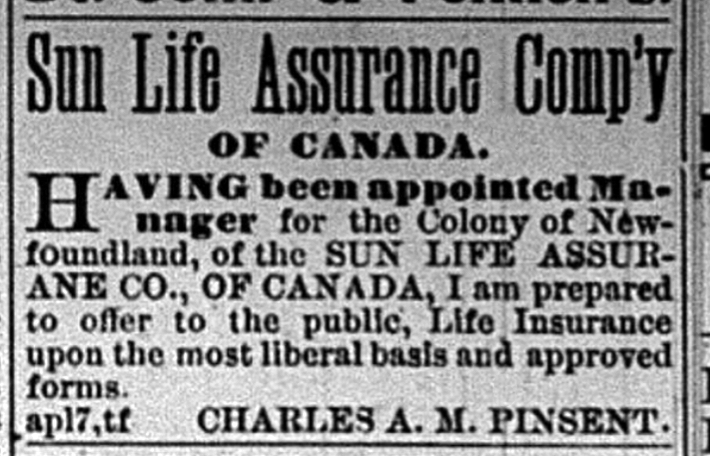
Business was looking good for Charles and he was appointed “Vice Consul for Portugal” (Evening Telegram: 28th February 1894) and manager of the “Sun Life Assurance Company of Canada” in the Colony in April (Evening Telegram: 7th April 1894). He proudly announced that: “I am prepared to offer to the public Life Insurance upon the most liberal basis and approved forms” and the paper remarked: “We congratulate Mr. Pinsent upon the appointment and feel sure the company will profit by such a representative.” Charles’s maternal grandfather John Richard McGuire Cooke was a merchant with Portuguese trading interests. He also seems to have brokered land sale transactions as well: “For Sale or to Let: That valuable piece of Fee Simple property situate almost immediately opposite the C. E. Orphanage, Military road, for particulars apply to C. A. M. Pinsent of Frank D. Lilly, Solicitor “ (Evening Telegram: 14th April 1894).
This is not to say that Charles did not still enjoy country pursuits, as the Evening Telegram tells us (14th February 1894) “Mr. Charles A. M. Pinsent left by this morning’s train for Woodlands, Salmonier, where he intends spending a couple of days, being the last of the season, on the deer grounds, within the peninsula of Avalon.” He even purchased a race-horse “… a good blood 2.40 pacer by the S.S. “Tiber.” It is a dandy; see it” (Evening Telegram: 26th February 1894).
Charles may have regretted having given such a public interview in Montreal. The fishery failed that year and in December two of Newfoundland’s three banks crashed – which totally destroyed the colonial economy. The fishery had, for generations, been run on the “truck” system whereby out-port merchants provided the materiel needed by the fishermen at the start of the season and received payment when the season ended. They then supplied materiel for the seal “fishery” and received payment when it was over. It was a precarious system that was untenable when the fishery failed. It did not help that many of the St. John’s merchants who ran the banks abused their position and that the Colony was on the hook for the construction of the Newfoundland Railway. There was a run on the banks and the “Commercial Bank” collapsed on 8th December 1894. This caused a run on the other banks and the “Union Bank” went down a short time later.
Embarrassingly, Charles’s uncle Charles Speare Pinsent was the manager of the “Union Bank” (see elsewhere) and his name was on the currency – which was now pretty well (o.k. not quite) worthless! The Colonial Government took a look at the finances and behaviour of the Bank’s “Board of Directors” and charged them with misrepresenting its finances. Charles Speare was also charged; however, he turned states-evidence and testified for the prosecution when the trial began in the fall of 1895. His evidence was not particularly damning and no major convictions were made. It took considerable assistance from Canadian Banks to rebuild the Newfoundland Economy.
In the meantime, there was the fall-out to deal with. Many Companies either left the Colony or collapsed completely. “NOTICE: ALL persons having accounts against the Exploits Wood Co. Ltd. of London, will please hand the same in at the office of the undersigned at once, where due payment will be made. CHARLES A. M. PINSENT, Agent” (Evening Telegram: 2nd February 1895).
Charles was, of course, still the Newfoundland agent for the “Sun Life Assurance Company of Canada”, which, reacted by providing a grace period for receipt of this payments (Evening Herald: Saturday 19th January 1895). It survived the crash, and now (and frequently thereafter) announced that it “Having been favoured with a large share of Life Assurance by the public last year, I would now remind them that the same most LIBERAL Policies are issued by the above Company. Information in connection with kinds and conditions of Policies can be had at the office of CHARLES A. M. PINSENT” (Evening Telegram: 24th May 1895).
Other Insurance companies also recognized an opportunity and one, the “Northern Fire Insurance Company, of London, England” hired Charles and offered the ”Lowest current rates of Premiums. Risks taken upon all sorts of Insurable Property, and valid losses promptly settled with liberality without reference to Home Office: Charles A. M. Pinsent, Agent for Newfoundland” (Evening Telegram: 18th May 1895). Presumably there was no conflict of interest between the two.
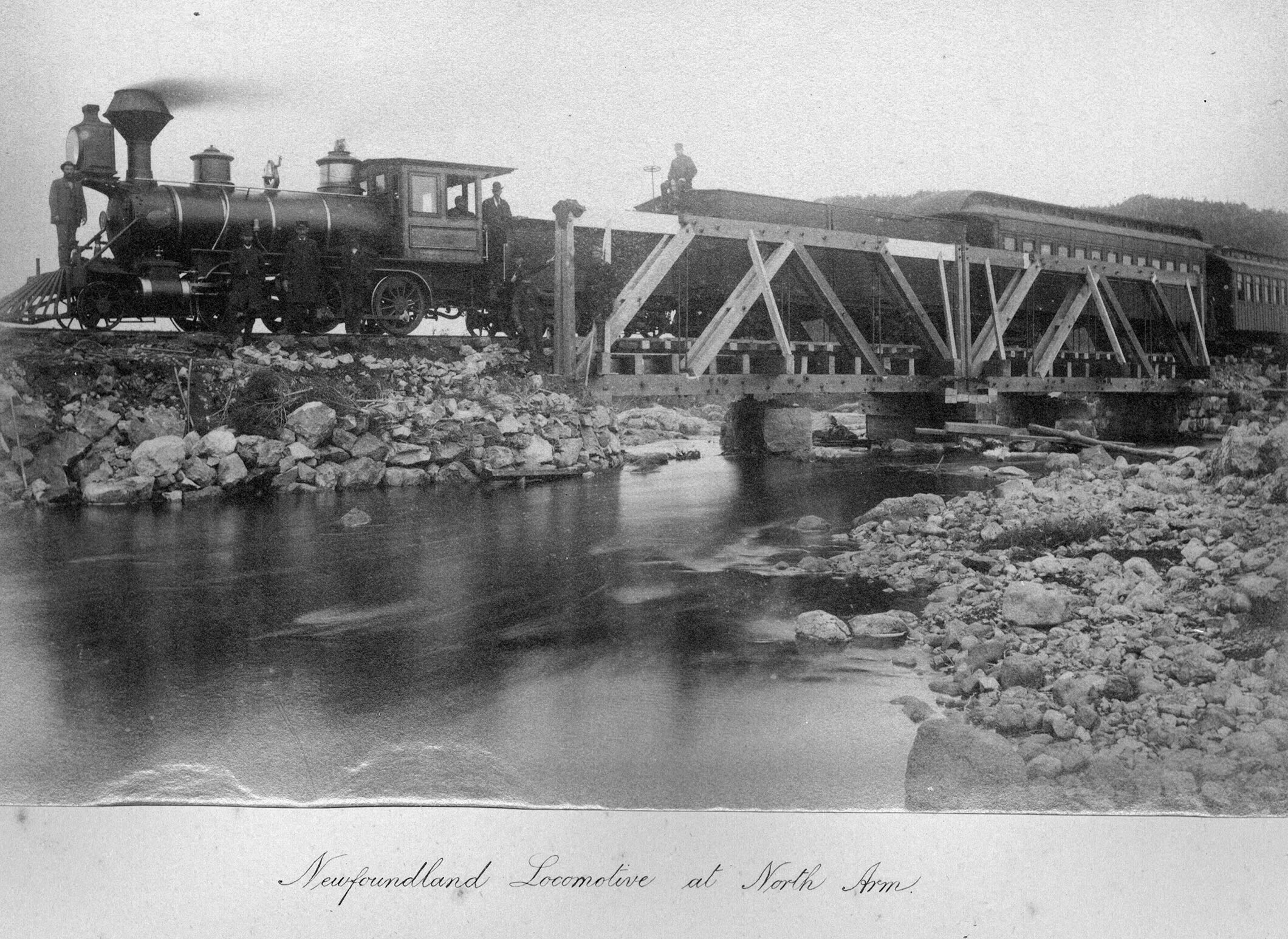
Charles still had “Woodlands”, although even it was advertised for “Sale or Let” for the summer months “furnished and with all conveniences and in perfect order, “Woodlands” Salmonier, the residence of the late Hon. Mr. Justice Sir Robert J. Pinsent. Fine salmon and trout fishing close at hand; also deer, partridge, snip and rabbit shooting” (Evening Telegram: 18th May 1895). He lived in St. John’s but I suspect he would have been loathe to see “Woodlands” go as he was now able to travel by rail from St. John’s to Holyrood – the nearest railway station – and back to town fairly easily. The train was still a bit of a novelty and the papers published the names of select people as they came and went: “Returned by Train: —Then returned by evening train: Archdeacon Botwood, from Topsail; Messrs. C A. M. Pinsent and A. O. Hayward, from Salmonier. The latter two had been trouting and procured fair catches” (Evening Telegram: 3rd April 1895).
Charles lived on Military Road in St. John’s and owned at least one piece of potential building land which he put up “For sale or to let: All that piece or parcel of freehold and unencumbered property, situate on the south side of Military Road and nearly opposite the Church of England Orphanage, and at present vacant, belonging the undersigned. For particulars, apply at the office of Chas. A. M. Pinsent” (Evening Telegram: 18th May 1895). He seems to have held and attempted to sell other property as well; however, he may have been acting as an “agent” for some other party.
Times were hard. He sold his horse – “For Sale: On Easy Terms: that brown blood mare “Ruby Stanton,” registered No. 9 in the La Huron Stock Book, may be examined, and tried in carriage, cart or saddle, also one first class prize Winsor dog cart, new; harness and saddle complete: Charles A M. Pinsent:” Evening Telegram: 6th July 1895) and he took to selling small quantities of imported consumable products – such as butter “… For Sale: 50 Tubs choice Canadian fine creamery butter (best quality)” and, more significantly, cigars: “Cigars: 13,000 Choice cigars of different brands and of really good quality. Will be sold cheap to close shipment: Call and see them: Charles A. M. Pinsent” (Evening Telegram 18th May 1895).
In September 1895, Charles put his business in St. John’s to one side for a while and returned to England to see his stepmother and her family, and doubtless cast around for business ventures (Evening Telegram: 21st September 1895). How he and Lady Pinsent got on I do not know, but there must have been some tension in the family as Charles, who was from Sir Robert’s first family received most of his estate and Lady Pinsent received very little. She had had to take on job as “matron” at a “Public” (i.e. “Private”) school and she was disappointed that she would not be able to give her children the education she felt they deserved. As discussed elsewhere, Trixie would not be able to go to medical school. It cannot have been made any easier knowing that Charles’s uncle (Charles Speare Pinsent) – her brother-in-law -was then still embroiled in the “Bank Scandal.”
Nearly every one in the family wrote articles for publication. Sir Robert, for instance, wrote (among other things) about the “French Shore Question” in the “Nineteenth Century Magazine” and Lady Pinsent wrote a couple of articles on Fishing in Newfoundland in “The Field Magazine” (see elsewhere). Her son Robert John Ferrier Homfray Pinsent, meanwhile published an article entitled “In the Pinewoods of Newfoundland” in the same magazine. It was about a failed forestry venture. Her son Francis Wingfield Homfray Pinsent wrote a (probably unpublished) discussion of a hunting expedition “How I shot & lost my first Stag.” I now have it.
Charles was not to be outdone: He wrote a long letter to the Editor of the Evening Telegram detailing his experiences in England and Scotland and included a story about how the S.S. “Corean” had narrowly escaped a collision travelling up river to Glasgow in dense fog. He was impressed by the architecture he saw in Glasgow but admitted that Edinburgh had an edge in its Universities, art and literature (Evening Telegram: 17th October 1895). Specifically what he was doing in Scotland, I am not sure.
The journey back to North America was not particularly eventful. However, his ship, the S.S. “Portia”, got caught in a storm on leaving Halifax on its trip back to St. John’s. Charles dropped by the office of the Evening Telegram shortly after he disembarked, and gave them a gripping account of the trip (probably the tail-end of a major hurricane that had come up the U.S. Coast.) “I relate, as an eye-witness, being, fortunately, an extremely good sailor, my experience from Halifax to St. John’s, in plain, unvarnished facts; although begun in the saloon, alone, in the midst of a hurricane indeed; and perhaps such, as few, if any one on board, of the 108 steerage and 12 saloon passengers, or crew, have Ever Hitherto Experienced”. It must have been quite the trip. “At 2 a.m., Thursday, it became worse, and the deck load forward had become loose, consisting of many iron-bound casks of petroleum, and the captain, for protection of life, the ship, and property, gave distinct orders, and rightly so, as it turned out afterwards, “to clear the deck forward;” and, in consequence, to have a clean deck, oil and other things were tossed into the seas”. Later he adds, “One woman, in the midst of the storm, in her agony, asked a reverend gentleman To Write Her Will and place it in a corked bottle and throw it overboard, with particulars, so that it might be known we were lost, and when and where. This portion of the narrative I am writing, as I began, alone in the saloon” (Evening Telegram: 14th December 1895).
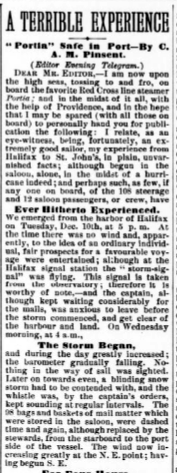
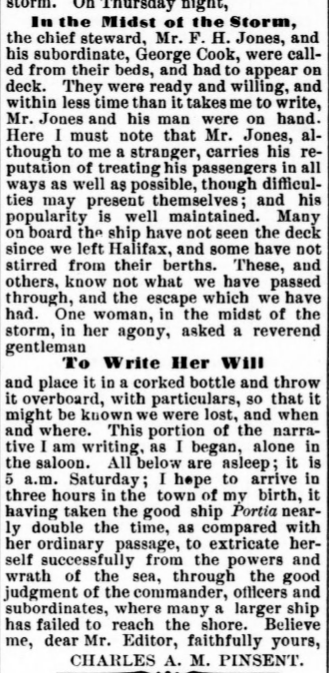
Charles had passed through Montreal on his way back to St. John’s and he had had a follow-up interview at the Montreal Gazette. His analysis was reprinted in the Evening Telegram on 16th December 1895. In it, he conceded that the financial crash had caused considerable damage but he now considered the prospects for the colony in better shape than ever! “I am not a politician, but there is no knowing when I may enter into the political arena. As regards Confederation, my natural feelings are opposed to it for several reasons. In the first place we enjoy to-day home rule in its entirety, and the feeling of the masses in the old colony is that we should retain it. It is only natural that we should and keep our present position of Practical Independence. I feel confident that, if our resources were developed, no doubt would exist, with good government, as to the colony retaining its independence.” As to the banking scandal, all he could say given that his uncle was the manager of the Union Bank was “In regard to the bank scandals, I would much prefer not to express an opinion, being personally acquainted with all connected in those matters, but I will say that any impartial mind, having a full conception of the past business workings of the colony, as a whole, would not attach any direct criminal blame to the directors of the institutions implicated.” Well they did ask.
Back in St. John’s Albert Ellis sued the “Sun Life Insurance Company” claiming that he had given Charles a cheque for $50 on 18th December 1894 in good faith and Charles had accepted it at full value despite the fact that the bank was then failing. The Company had refused to honour his policy and he now (not unreasonably) wanted his money back – in real dollars – as given – not in devalued ones! The judge evidently thought he had a point (Evening Telegram: 10th January 1896). Charles did what he could to make ends meet in the months that followed – moving back and forth from “Hillsboro” to “Woodlands” like a pendulum. In fact, the Evening Telegram’s travel correspondent was quick to point out that “We hardly know whether our good friend Mr. C. A. M. Pinsent lives in town or out of town these stirring times; but this much we do know, namely: that he arrived in town again this afternoon” (Evening Telegram: 4th April 1896). A month or so later, he reported that: “Mr. C. A. M. Pinsent has left to enjoy the ozone from the waters of Conception Bay, as a respite from business worry” (Evening Telegram: 15th June 1896). Clearly, things were not going well. However, he may have had more than business on his mind.
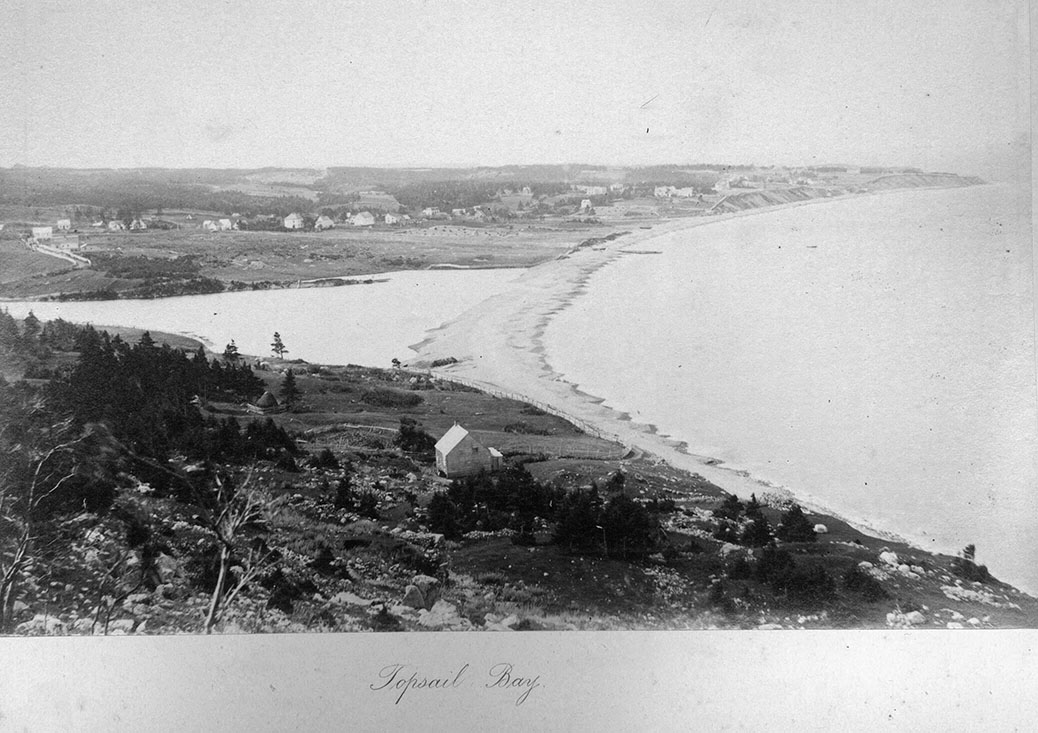
Charles had, in amongst all his travel and hunting and fishing, found time to marry. He married Fanny Sophia Colley, the daughter of Canon Francis Worthington Colley, a well-known Anglican Minister in the out-port community of Topsail. They were married in Topsail in January 1897 (Evening Telegram: 7th January 1897). Charles was supported by his brother Francis W. Pinsent who was also in charge of the (photographic) pictures. Sadly, I have none of them. News of the wedding circulated throughout the empire (Colonies and India: Saturday 6th February 1897).
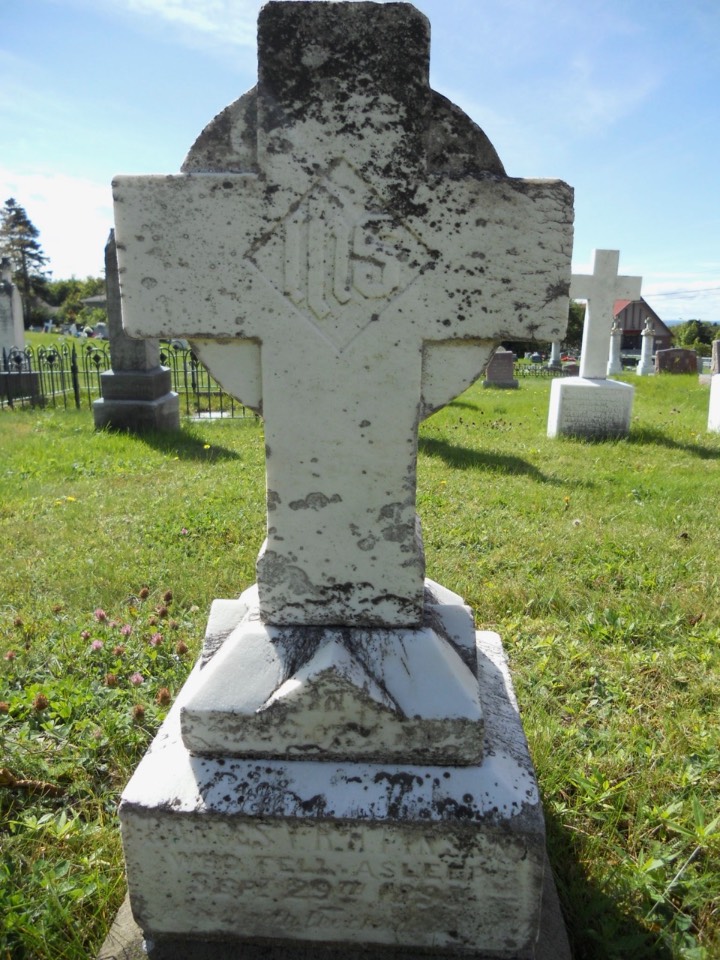
Charles and Fanny had a daughter, Frances Vicars Raleigh Hoyles Pinsent that November but she was to be short lived. She died in Topsail in September 1898 when only 10 months old.
Charles sold odds and ends, turkeys and dentist’s chairs at one point and also acted as an estate agent – being, for instance, he was involved in the sale of the late Hon. C. F. Bennett’s (the brewer’s) not inconsiderable estate in St. John’s and Goulds (Evening Telegram: 27th April 1897). He moved his office to the Commercial Chambers on Water Street (Evening Herald: 5th July 1897) and proceeded to sell bulk items, such as flour, butter tea and cigars by auction (Evening Herald: 24th January 1898).
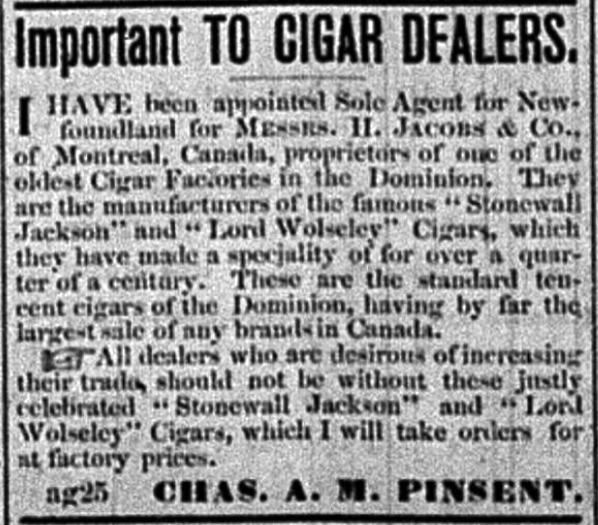
He proudly announced that he had been appointed “sole agent in Newfoundland” for “Messrs. H. Jacob’s & Co. of Montreal” the manufacturers of the “famous “Stonewall Jackson” and “Lord Wolseley” Cigars, which they have made a speciality of for over a quarter of a century. These are the standard ten-cent cigars of the Dominion, having by far the largest sale of any brands in Canada” (Evening Herald: Wednesday 1st September 1897) and this appears to have been his principal sales line in the years that followed.
Lady Pinsent’s eldest son, Robert John Ferrier Homfray Pinsent gave up his job in Montreal and returned to Newfoundland to recuperate from a bout of tuberculosis in August 1897. He stayed at “Woodlands” and wrote to his mother in England. He asked lovingly after her and the rest of the family. He was very complimentary about his brother Frank (who was soon to leave for England) but much less so about his half-brother, Charles Augustus Maxwell who dropped by for a visit. Robert thought that he resented his being there. Robert goes on to says that Fanny was “very nice but very quiet and reserved, but at present she is not very well which no doubt accounts for it.” She would have been pregnant at the time. Robert goes on to say that the house (“Woodlands”) “is but a rag of what it was” as it had been stripped of most of its contents, and he feared that it might be difficult to sell. They were not at all well off; however, his health had been improving and his wife, Annie (née March), had applied for a school (teaching) position in St. John’s.
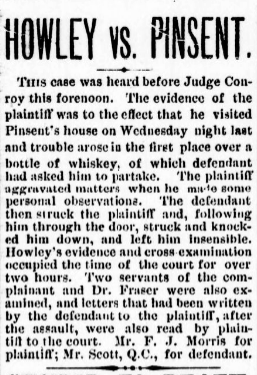
The loss of his child may have affected Charles deeply, coming as it did after four financially very difficult years. At any rate, his world unraveled further in 1898. In November he was in the Central District Court on a charge of assault on E. St. J. Howley. The evidence of the plaintiff was to the affect that “he visited Pinsent’s house on Wednesday night last and trouble arose in the first place over a bottle of whiskey, of which defendant had asked him to partake. The plaintiff aggravated matters when he made some personal observations. The defendant then struck the plaintiff and, following him through the door, struck and knocked him down, and left him insensible” (Evening Telegram: 17th November 1898). Or, as the Evening Herald would have it (19th November 1898): ”The plaintiff was the first to be put on the witness stand and detailed the facts of the altercation up to the point when he was hit by Pinsent and felled and afterwards kicked in the stomach, when he became unconscious. Since the assault some letters have been addressed to the plaintiff and his wife. They were taken in testimony, but most of them were of an extremely ludicrous and nonsensical nature, bringing the remark from His Honor that he was holding a court of lunacy”
This was not a good start; however, the press sensationalized the proceedings to such an extent that even Mr. St. J. Howley’s solicitor, felt that he had to intervene and set the record straight. Mr. Pinsent had NOT “kicked the plaintiff in the stomach as he lay unconscious” (Evening Telegram: 21st November 1898).
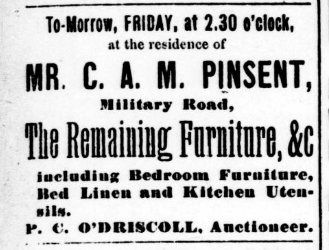
How the verdict came down, I am not sure; however Charles sold his household furnishings on Military Road by auction the following on September (Evening Herald: 4th, 14th and 21th September 1899). The house on Military Road “then in the occupancy of Geo. E. Bearns” was put to auction later that month (12th September 1899).
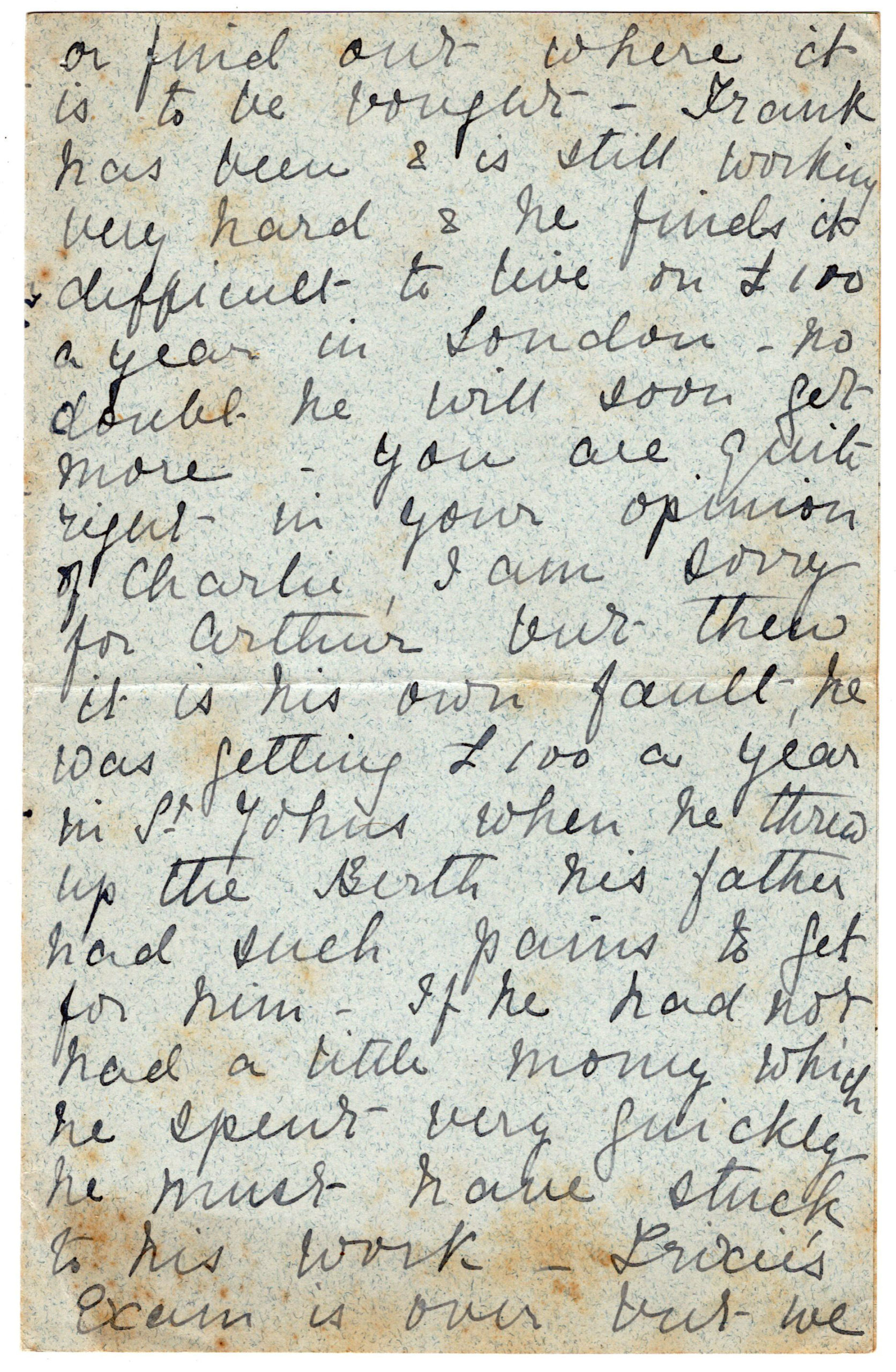
By November 1899, there was no disguising Charles’s drinking problem. In a letter to her stepdaughter Lucrectia Maude Pinsent in Rome, Lady Pinsent says: “I am most glad to have Frank here as I was always in terror for him on account of Charlie, he is little better then a madman now, is quite so when he is drunk & people are terrified if he goes near them. He is very angry with me because I refuse to give him my signature to sell Salmonier, for his own benefit & I feared he would vent his anger on Frank. I am acting on Mr. M. William advice. He is a solicitor, Charlie’s wife (Miss Colley) is in England but she is so afraid of his finding her she will not give either Frank or myself her address, we write through her sister.” Whether it was his failure in business or the loss of the child we will never know but it was not looking good.
Charles lost his position as Portuguese Vice-consul in March 1900 (Evening Telegram: 24th March 1900) and he drops out of sight around then – his career essentially over. The Misses Short may have sued him in April 1901. However, the plaintiff in that case was “Charles Pinsent” so he may have been entirely innocent: there were other “Charles Pinsent’s” around (Evening Telegram: 11th April 1901. He was (somewhat surprisingly) invited to dinner at Government House along with the members of the Legislative Council in April 1905 (Evening Telegram: 5th April 1905).
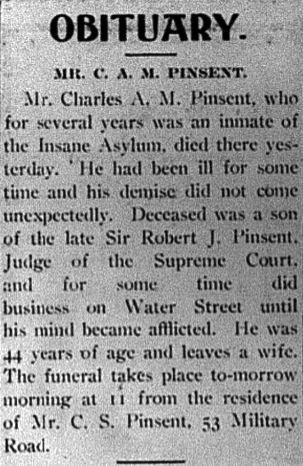
Nevertheless, he ended up in the Lunatic Asylum (presumably suffering from some form of dementia) and died there on 25th May 1910 (Evening Telegram: 26th May 1910). He was forty-four years old. His uncle, Charles Speare Pinsent took charge of the funeral arrangements.
Fanny (née Colley) lived in fear of her husband and fled to England sometime after the death of her daughter. Presumably she was living there when her father Rev. Edward Colley died in 1905. He left her a modest bequest in his will, which must have helped. Fanny had settled in Ruthin in North Wales and she, presumably, made contact with her step-mother-in-law after her husband Charles died in 1910.
Fanny raise funds for the Ruthin “Red Cross Hospital” during the First World War (Denbighshire Free Press: 18th November 1916) and was, among other things, the Secretary of a committee formed to put on a whist drive and dance in aid of funds for “providing Comforts for Soldiers” in December 1916 (Denbighshire Free Press: 30th December 1916). The committee’s work continued throughout the war and into the peace that followed. However, the Ruthin “Comforts for Soldiers” working party announced in April 1919 that it would, in future, direct its attention to other local charities (Denbighshire Free Press: 5th April 1919). It was about this time that she placed an advertisment in the Morning Post (15th May 1919) seeking a live-in help for two ladies who lived with three maids at “Woodlands” in Ruthin.
Fanny lived on Castle Street in St. Meugan’s Llanrhydd, Ruthin at least from the 1940s (British Telephone Books: 1880-1984) and she died there in 1954. Later that year, Kathleen Winifred Davis probated her estate, valued at £1,348. I do not know who Kathleen was; however, it is worth noting that Fanny and Mrs. Gertrude Martha Denim Davis had been the joint executrixes of the will of the Rev. Canon Edwin Davis twelve years previously (Halifax Evening Courier: Friday 24th July 1942).
Family Tree
Grandparents
Grandfather: Robert John Pinsent: 1798 – 1876
Grandmother: Louisa Broom Williams: 1808 – 1882
Parents
Father: Robert John Pinsent: 1834 – 1893
Mother: Anna Brown Cooke: 1837 – 1882
Father’s Siblings (Aunts, Uncles)
Mary Speare Pinsent: 1833 – 1833
Robert John Pinsent: 1834 – 1893 ✔️
Thomas Williams Pinsent: 1837 – 1890
Charles Speare Pinsent: 1838 – 1914
Louisa Williams Pinsent: 1841 – 1921
Mary Elizabeth Pinsent: 1844 – xxxx
William Burton Pinsent: 1846 – 1846
Male Siblings (Brothers, half-brothers)
John Cooke Pinsent: 1861 – 1861
Robert Hedley Vicars Pinsent: 1862 – 1888
William Satterly Splatt Pinsent: 1864 – 1865
Charles Augustus Maxwell Pinsent: 1866 – 1910 ✔️
Arthur Newman Pinsent: 1867 – 1946
Robert John Ferrier Homfray Pinsent: 1874 – 1899
Francis Wingfield Homfray Pinsent: 1875 – 1948
Guy Homfray Pinsent: 1889 – 1972
Please use the above links to explore this branch of the family tree. The default “Next” and “Previous” links below may lead to other unrelated branches.