Vital Statistics
Charles Pinsent: 1766 – 1826 GRO1187 (Yeoman Farmer and third owner of Pitt Farm, Hennock)
Mary Yeo: 1772 – 1844
Married: 1799: Lustleigh, Devon
Children by Mary Yeo:
Mary Pinsent: 1799 – 1830
Ann Pinsent: 1804 – 1881 (Married George Keddell, 1832, Hennock, Devon)
Thomas Pynsent: 1808 – 1887 (Married Jane Sparrow, 1843, St. Marylebone, London)
Family Branch: Hennock
PinsentID: GRO1187
Click here to view close relatives.
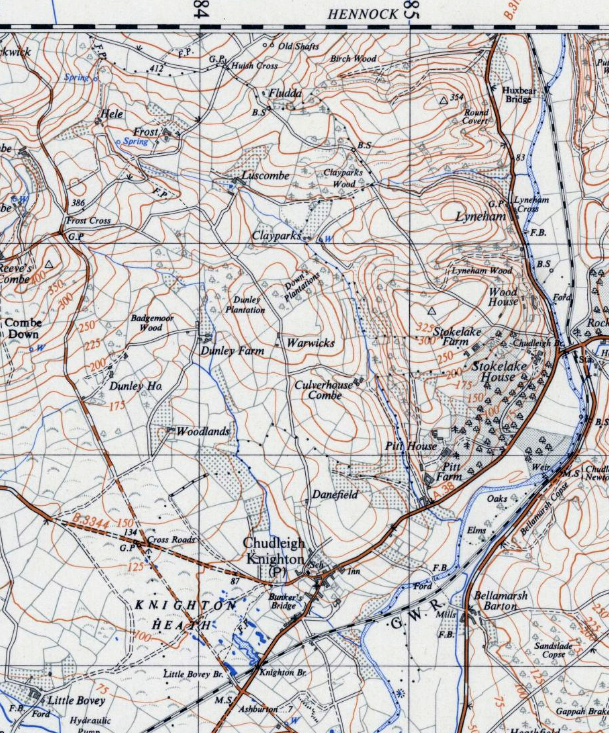
Charles Pinsent was one of the younger sons of John and Susanna Pinsent. He was born in Newton Abbot in 1766 and grew up there and, later, at Pitt Farm in Hennock. He inherited the farm from his uncle, Thomas “the younger” of Pitt, in 1802.
His father, John, was a “merchant” in Wolborough (Newton Abbot). Sadly, both his parents died within days of each other in 1772 – while he was still quite young. John and Susanna’s four elder sons (John, Robert, Thomas and William) were essentially launched by then but Charles and three of his brothers (Gilbert, Samuel and Joseph) were left with out a home. They went to live with their elderly grandfather, Thomas Pinsent, his son (their uncle) Thomas Pinsent and his wife (their aunt) Mary (née Mudge) at Pitt Farm in Hennock. The boys’ grandfather died in 1777 and the farm – which was a fairly large property – passed to their uncle Thomas. One of Charles’s brothers (Samuel) also died that year; which left three of John and Susanna’s younger boys living at Pitt with their uncle. Gilbert, Charles and Joseph grew up on the farm, helped out on it and eventually became farmers themselves.
One of the elder brothers, Thomas Pinsent, still thought of Charles as being from “Newton Bushell” (part of Newton Abbot) when he appointed him (although he was still under-age at the time) to be the executor and principal beneficiary of the will he made on joining “H.M.S. Exeter” in 1779. Sad to say, Charles was called upon to execute the will in 1785. “H.M.S. Exeter” was a Royal Navy 64-gun “third-rater” that served with the British fleet and fought the French in the Indian Ocean in the 1780s. I do not know if Thomas died in action. Gilbert married Margaret Snow in Kingsteignton in 1790 and settled into a farm called “Ponswin” in the same parish. He became a successful tenant farmer. Joseph, meanwhile, probably worked with his brothers (John and William) in the Newfoundland fishery for a few years before settling in London as a “Shipping Agent”. Nevertheless, he too farmed – at Lettaford in North Bovey. Their lives are described elsewhere.

Charles stayed on in Hennock and started to take responsibility for the management of the farm when his uncle was in his mid-70s. Land Tax Records show that Charles paid the £1 tax assessed on Pitt in 1791. The adjacent “Marshes” cost him an additional 10s. When Charles’s uncle Thomas (the second “of Pitt”) died in 1802, he left bequests for all his living nephews (see elsewhere); however, he made Charles his principal legatee.
Charles inherited “Pitt farm and the marshes”, a property in Teigngrace called “Diamond’s Delight” (10s land tax) and a farm in Kingsteignton called “Lower Albrook” (£1 6s 6d land tax). The latter, which is near Sandygate just to the north of Kingsteignton, had probably come to his uncle from the Mudge family. Charles was a significant land owner and a man of some note in Hennock. He signed the register in 1793, 1812, 1815 and 1818. Charles was also called upon to act as an executor to the will of a local worthy, Joseph Heaward, in 1819 and he was appointed Churchwarden in 1821 and 1822.
Charles seems to have sold “Diamond’s Delight” shortly after his uncle died. However, he held on to “Lower Albrook” and “Pitt and the Marshes” (£1 10s 6d in land tax) and consolidated his position in Hennock by adding a number of small properties, “Collyers”, “Voyses”, “Underhays” etc. with a cumulative land tax of £1 17s. From 1804 onward, he also rented property in the neighbouring parish of Chudleigh (“Greenhill and St. Albans (£1 1s 10.5d land tax), Marshes” – “late Frists” (£1 13s 3.25d land tax), “late Bickfords” (£1 13s 3.25d land tax), “Claypark Meadow (3s 9d land tax) and Marshes”, “late Newberry” (£1 13s 3.25d land tax). This patchwork may have been difficult to manage and the Clifford Family Archives in Ugbrooke contain documents that show that Charles negotiated a deal with James Templer of Stover that gave Mr. Templer access to his “Marshes over Teign” in exchange for several parcels of land in Hennock in 1810. When he died in 1826, Charles controlled land that was taxed at an aggregate value of £2 11s.

Charles paid land tax and parish rates and took some of the local children as apprentices to help work his property. He apprenticed Ann Walling and Elizabeth Kentisbeer for “Woolcomb’s Marsh” and “late Bickford’s Marsh”, respectively, in 1812. Joseph Hillman, a mariner, testified at a Settlement Examination (to determine if he was eligible to apply for support) in Bovey Tracey in 1821, that after he had served his apprenticeship in Bovey Tracey, he had gone to work for Charles at “Pitt” and was paid by the week for six months – until they “had words” and he was dismissed. However, he was reinstated after three days and he worked there for two year before going out to Newfoundland. Similarly, in 1808, Thomas Beer claimed he served out his apprenticeship in Kingsteignton and then moved to Hennock where he worked for Charles’s uncle Thomas until he died (in 1802). He then worked for Charles before marrying and returned to Kingsteignton. Such was life in the early 1800s.
Perhaps unsurprisingly, given the nature of his estate, the Devon Game Lists, (published annually in Trewman’s Exeter Flying Gazette) show that Charles purchased a “general certificate” (at a cost of approximately three guineas) more or less annually from 1805 to 1824. He probably shot ducks and geese on his “marshes” and “vermin” (pigeons, crows?) on his farm land. An entry in Hennock Churchwarden’s Accounts tells us that he (and seven other farmers) signed an agreement with the parish on a pay scale for killing birds, in 1816. The accounts also show that he was paid 7s 6d and 5s for killing them in 1822 and 1823 respectively.
Charles enrolled as a Volunteer in the Chudleigh Infantry Company in 1799 and, again according to the Ugbrooke Archives, he was a Quarter-master Sergeant in the Teignbridge/Chudleigh Yeomanry in 1808. This was during the Napoleonic Wars and a patriotic Charles was doubtless pleased to contribute £1 0s 0d to the “Waterloo Subscription” – a charitable organization in 1815 (Exeter Flying Post: Thursday 7th September 1815).
Charles married Mary Yeo in Lustleigh, Devon in 1799 and they had two daughters (Mary and Ann) and a son (Thomas) in the years that followed. When Mary’s mother Ann Yeo of Northwood, in Chudleigh, died in 1819 she left her daughter Mary Pinsent £10, her grandson, Thomas Pinsent, £5 and her grand daughters, Mary and Ann Pinsent a guinea apiece (Inland Revenue: Stamp Act Wills: 1819 & Sheila Yeo: Yeo Society website).
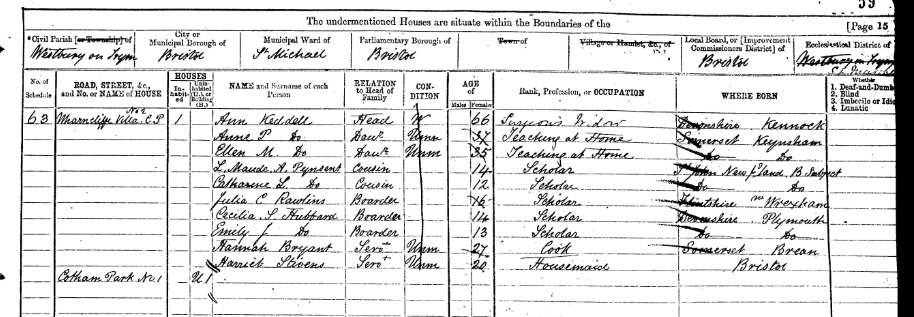
Mary, the elder of the two daughters, died unmarried, in Hennock, in 1830. Ann, who was the younger of the two, lived to marry George Keddell, a surgeon of Keynsham, in Somerset in 1832. They had a daughter, Ellen Maria Keddell who we will come across when discussing the life of (Sir) Robert John Pinsent, the barrister from St. John’s in Newfoundland (see elsewhere). Census Records show that Ann Keddell and her two daughters lived in Westbury on Trym, in Bristol, in 1871 and ran a small school there where they tutored their young Newfoundland “cousins” Lucretia Maude and Catherine Louise Pinsent (Sir Robert’s daughters). Ellen Maria Keddell corresponded with Lucretia Maude Pinsent (who was, by 1891, Lady Abbess of St. Scholastica Abbey, in East Teignmouth) and Lucretia Maude described a visit from her on 11th July 1886 in her diary. The various branches of the family were well acquainted and their correspondence shows that their interest in family history seems to have passed down through the generations.
In her diary, Lucretia Maude says that Charles Pinsent’s son, Thomas Pynsent (see elsewhere) owned a painting of Sir William Pynsent of Urchfont, Wiltshire (the second baronet) and it was hanging in his house at Westwood Ho! Evidently, someone called Ellen Maria (??) sent Lucretia a photograph of the picture. Lucretia goes on to says that Thomas’s “cousin” Elizabeth Satterley Splatt, (nee Pinsent) had “an excellent” copy of the picture at “The Elms” in Torquay. Lucretia Maude goes on to discuss Charles’s brother Joseph’s family and the loss of Pitt House. I do not have the diary but my grandfather, Francis Wingfield Homfray Pinsent, made notes from it while on a visit to his step-sister in Rome, in 1929. Francis also copied a photograph of a Prayer Book that had been endorsed by Leonora Ann Pynsent, Sir William’s only surviving daughter.
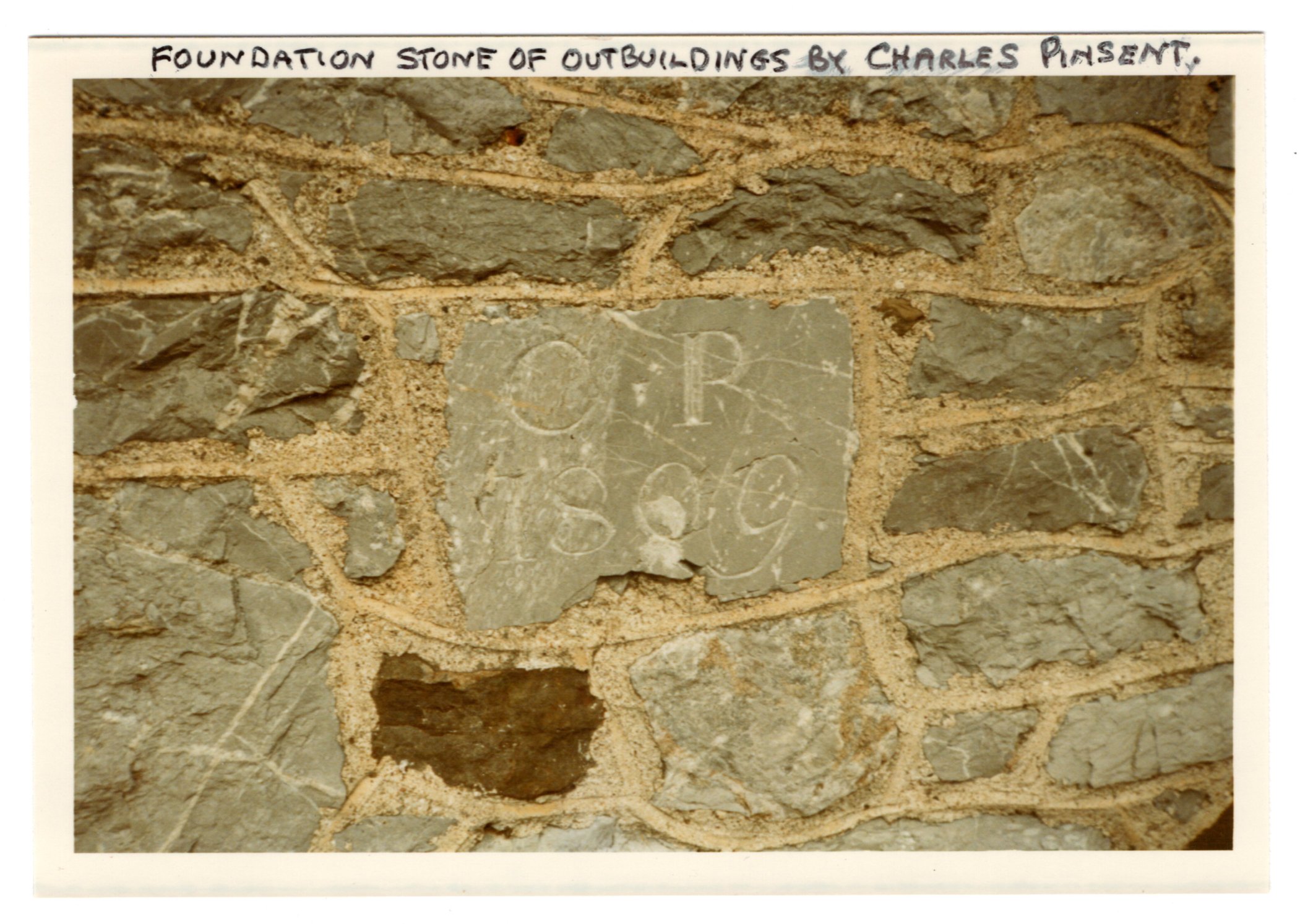
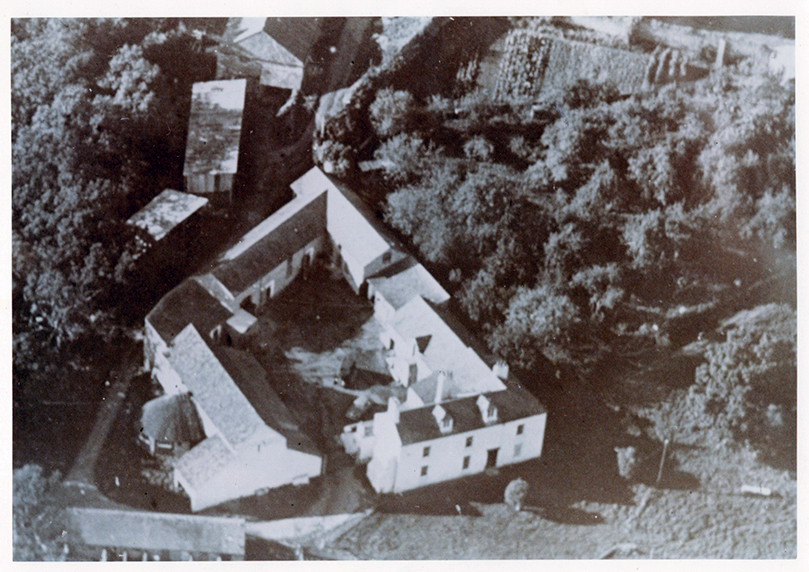
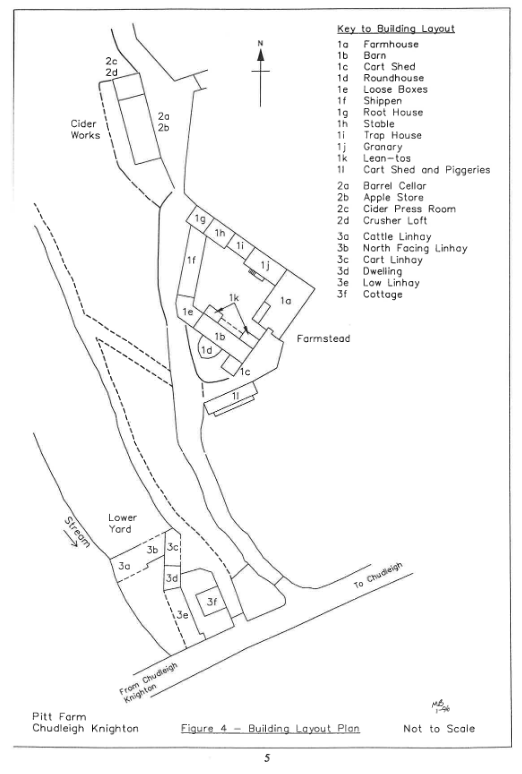
In 1996, The Devonshire Association published a detailed report on the design, layout and architecture to be found at Pitt Farm. It showed that the outbuildings underwent a considerable amount of work in the early 1800s and notes that there was a date stone inscribed “CP 1809” built into the granary wall.
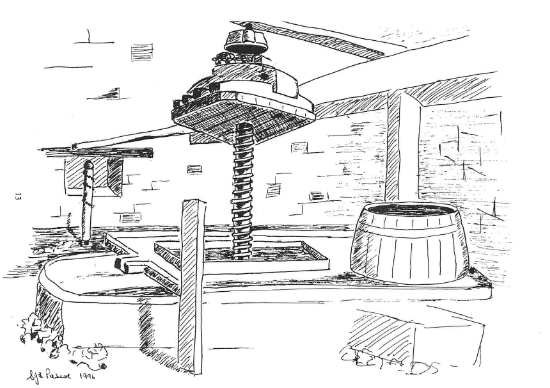
It must have been around then that the cider house was rebuilt: – “The cider house seems to be overbuilt: When the farm was for let in 1842 the blurb stated that there “was cellarage arranged for 400 hogsheads of cider, being well adapted for a cider merchant” – at 54 gallons per hogshead, this work out at 21,600 gallons storage capacity. In an extremely good year, the apples form an acre of orchard might produce 10 hogshead of cider but 2 to 3 hogshead per acre was more usual (38) Around one hundred and fifty acres of orchards would be needed to guarantee a supply of apples. Pitt Farm had 28 acres in 1842.” There is no obvious reason for the discrepancy. Perhaps Charles planned to establish a custom processing facility. The principal house and its various outhouses – which were built and rebuilt around a central courtyard – were converted into separate cottages in the early 1990s.
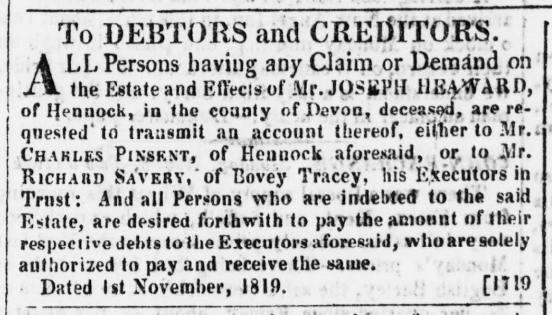
Charles was a man of some stature in Hennock and he was appointed Philip Edwards appointed him trustee when he made out his will, which was probated in 1818 (Inland Revenue Wills: 1818). Similarly, a Mr. Joseph Heaward appointed both him, and a Mr. Richard Savery of Bovey Tracey, to act as executors when he died – which he did in 1819 (Exeter Flying Post: Thursday 11th November, 1819). Richard Savery may have been the brother of the Mary Savery who married Thomas Pinsent the upwardly mobile draper of the DEVONPORT family line in 1805. Certainly, she had a brother of that name. Charles Pinsent was later called upon to witness a transaction that occurred in 1820, when the executors of a Mr. John Mudge, who owned land in Hennock, Bovey Tracey and elsewhere, arranged for land to be transferred to the Gould family (Manor of Wreyland: H. M. Preskett (1970): Devon Record Office).
In his will, signed in 1814, Charles Pinsent appointed Stephen Endacott and Joseph Yeo as trustees of his estate. He left his wife a surprisingly small annuity (£35); arranged for the education of his children and left “Pitt farm” and his other property – including “Lower Albrooke” in Kingsteignton, which seem to have been valued at £3,400, to his young son, Thomas Pinsent. However, he specified that if Thomas should not wish to buy out his sisters shares when he came off-age, he could have a portion of it, or else it could all to be sold and once the annuity and other bequests had been was secured, the profits divided between the children.
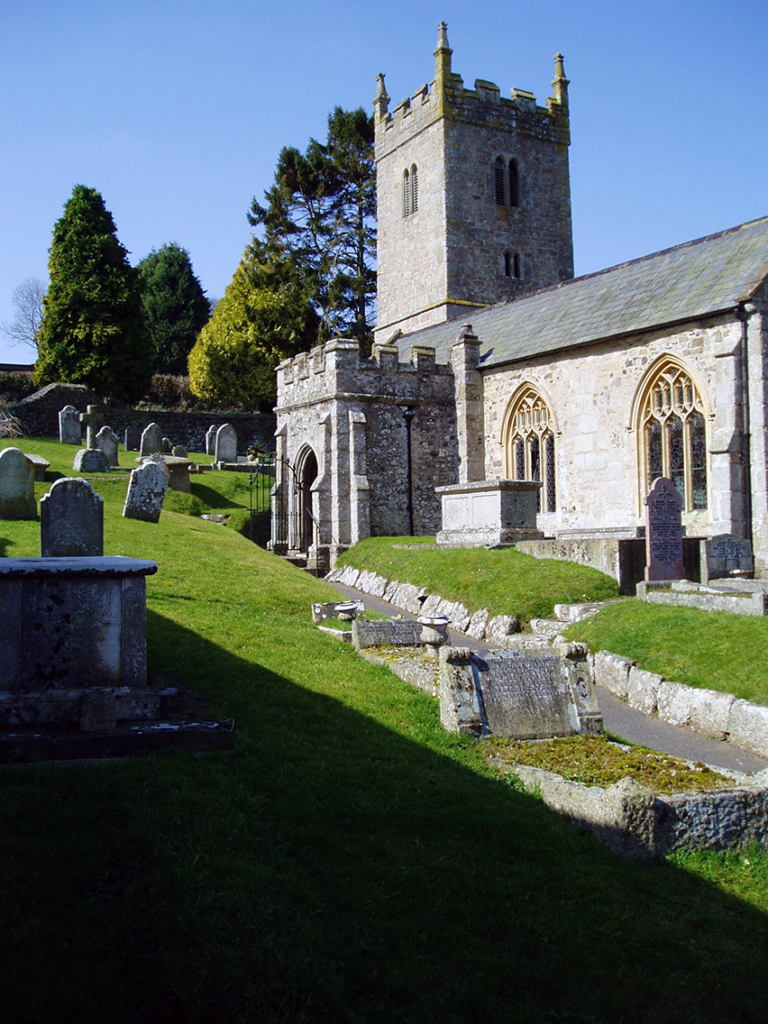
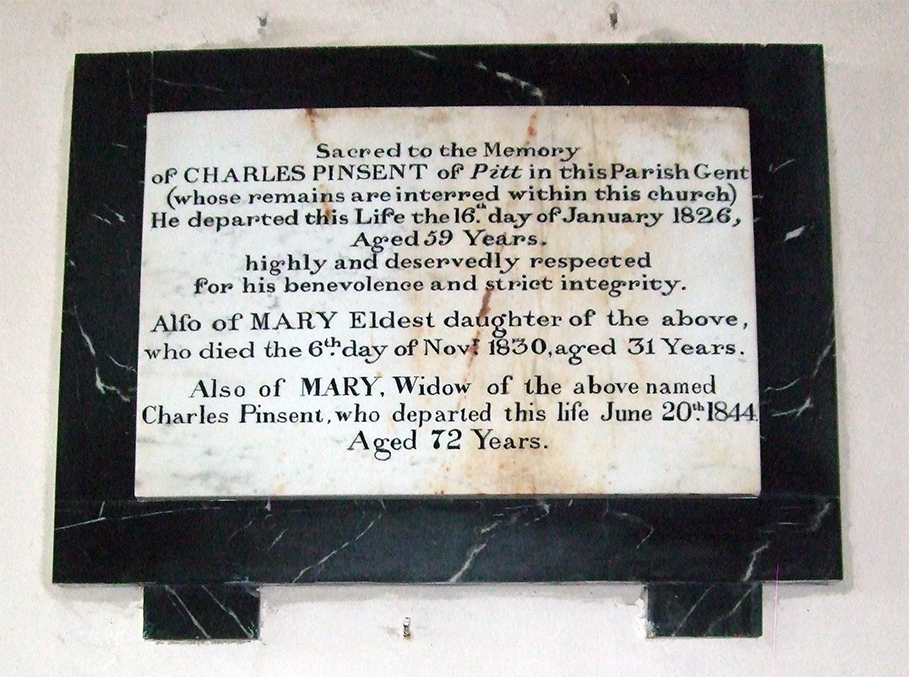
Charles died in 1826 and his elder daughter died, unmarried, a few years later. There is a memorial on the wall in St. Mary’s Parish Church in Hennock that that “Charles Pinsent of Pitt, nephew of Thomas, died 16th January, 1826 aged 59,” that “Mary, eldest daughter of Charles died on 6th November, 1830, aged 31 years” and that “Mary, widow of Charles died 20th June, 1844, aged 72”.
Mary (née Yeo) was still living at “Pitt” with a young kinswoman, Maria Yeo, at the time of the Census in 1841. However, they seem to have moved to Keynsham in Somerset, shortly thereafter; presumably to be with Mary’s daughter Ann and her son-in-law, George Keddell. She died there in 1844. Maria Yeo notified the registrar.
Family Tree
Grandparents
Grandfather: Thomas Pinsent: 1691 – 1777
Grandmother: Mary Gale: 1690 – 1774
Parents
Father: John Pinsent: 1728 – 1772
Mother: Susanna Pooke: 1730 – 1772
Father’s Siblings (Aunts, Uncles)
Urith Pinsent: 1714 – 1751
Thomas Pinsent: 1717 – 1802
Julian Pinsent: 1719 – 1721
Robert Pinsent: 1721 – 1783
Gilbert Pinsent: 1724 – 1794
Julian Pinsent: 1726 – xxxx
John Pinsent: 1728 – 1772 ✔️
Mary Pinsent: 1731 – xxxx
Male Siblings (Brothers)
John Pinsent: 1751 – 1753
John Pinsent: 1753 – 1821
Robert Pinsent: 1753 – 1787
Thomas Pinsent: 1754 – 1785
William Pinsent: 1757 – 1835
Gilbert Pinsent: 1758 – 1835
Charles Pinsent: 1765 – 1765
Charles Pinsent: 1766 – 1826 ✔️
Samuel Pinsent: 1767 – 1775
Joseph Pinsent: 1770 – 1835
Please use the above links to explore this branch of the family tree. The default “Next” and “Previous” links below may lead to other unrelated branches.