In the very beginning
1066 and all that
The Devonshire Pinsons
Pinsents appear
And then the Plague
Finding home
Pinsents at sea
To the manor born
In the beginning
The story continues
The taxman cometh
Parish records
Pinsents past
The here and now
Early days in Devonshire
1066 and all that
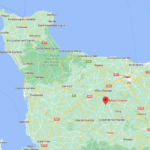
The “Pinsent” family is an offshoot of the Norman-French “Pincon” or “Pinson” family that settled in England some time after the Norman Conquest. The first arrivals may have come from the Mont Pincon area, which is southwest of Caen.
The French “Pincons” may be distantly related to the “Mompessons” – some of whom came to prominence in England in the 17th and 18th centuries. The two families came from the same part of Normandy.
According to the Essex Domesday Book, compiled in 1086, an unnamed “Pincon” (actually a “Pincun”) held 15 acres in (Castle) Hedingham north of Braintree from a gentleman called Aubrey De Vere. Who this “Pincun” was, or how he acquired his 15 acres, I do not know; however, he was probably one of several members of the family who settled in England after the Conquest.
For several hundred years post-invasion, England’s Norman/English government clerks systematically compiled royal decrees and state correspondence into “Patent” and “Close” rolls, and kept track of its finances through annual “Subsidy,” “Pipe,” and “Exchequer” rolls. They entered their data on rolls of parchment that can now be found in the “National Archives” at Kew, in London.

Short extracts of the rolls are now available in published “Calendars” – large tomes catalogued by date – that can be found in major libraries throughout the United Kingdom. They refer to quite a few Medieval “Pinsons” (the spelling had yet to formalize). However, it is impossible to tell if and/or how they were related. Some of the rolls are now scanned and (if you can wrap your head around the writing) can be examined on the “Anglo-American Legal Tradition,” “AALT” and other websites.
The documents show that, by the end of the 13th century, the “Pincuns” were living in London and Essex. From there, they spread out and two hundred years later there were also small clusters of “Pinsons” (living under a variety of spellings) in Devon, Berkshire, Norfolk, Suffolk, Lincolnshire, Leicestershire and Yorkshire.
The Chartulary of Guiseborough Abbey tells us that William Pinchun of Thorp, in Yorkshire, left five acres of land to the Abbey for the benefit of the hospital at Bernaldsby. This was around 1160.
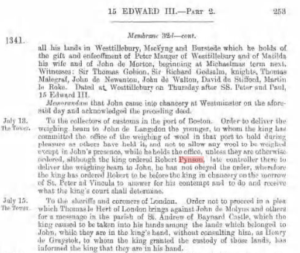
The Close Rolls for 1323 include an instruction for the Sheriff of Lincoln to find a new “Coroner” to replace John Pynson, who was sick and infirm. In 1341, the same set of Rolls show that Robert Pynson of Boston, a “wool merchant,” was obliged to appear before the King to make answer for his contempt. Apparently, he had failed to transfer control of a “weighing beam” (used to weigh wool for export) to a new “Comptroller” appointed by the King.
According to his Register (Volume IV), the Black Prince – who was the son of King Edward III – instructed his “Receiver” at Rising (Castle Rising, in Norfolk) to arrange for the catching of “coneys” (rabbits) in 1365. Presumably, Philip Pynceon arranged for them to be harvested from the Royal warren.
Later still, in 1408, Thomas Pyncheoun, the son and heir of John, a “citizen and alderman of London,” acquired 535 acres of land in “Barwe, Thunderlegh and Little Wakerynge” in Essex. Richard Whittington – he of cat fame – who had been Lord Mayor of London the previous year was one of the co-signers of the document. What Thomas Pyncheon had been up to I don’t know, but on the 3rd December 1470 he and his wife Elizabeth received a general pardon from the King for offenses committed before the 17th November that year (Calendar Patent Rolls)!
My father recognized that the “Pinson” family (as above – broadly defined) lived predominantly in the north and east of England, and he speculated that the family as a whole could have been derived from Scandinavian stock, and that the Anglo-Norman contingent found in the southwest of England may have been descended from Danes (“A surname and a source:” R. J. F. H. Pinsent; Devon Historian, Vol 10, 1975).
The various families doubtless grew and spread out over the centuries and gave rise to the Pinson and Penson families that were later found throughout England. However, it is to Devonshire that we must turn to look for the birth of the Pinsents.
The Devonshire Pinsons
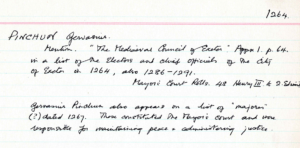
The Pinzun family was well established and had some status in Exeter by the early 1200s. Robert Pinzun was a “Praepositus” (administrative official) in the city between 1234 and 1244, and Gervais Pinzun (relationship unknown) was a “Seneschal” (senior administrative officer) in 1246/7 and 1262/3 (see a “List of Civic Officials in Exeter 1100-1300” published by the Devonshire Association in 1938).
We know that Gervais was involved in a court case over a “moiety of one messuage” in Exeter (i.e. a share in a dwelling house) in 1244 (Devonshire Feet of Fines Vol. 1). He seems to have resolved the problem by buying the “moiety” for 3 ½ marks (46s 7d) – which would have been a considerable amount in those days. That same year, Bartholomew Pinchun died in Exeter and left the rent from his house “which was formerly that of Adam Pinchun, his father,” to the Hospital of St. John. (“Death and Memory in Medieval Exeter” by David Lepane and Nicholas Orme: Devon & Cornwall Record Society: 2003).
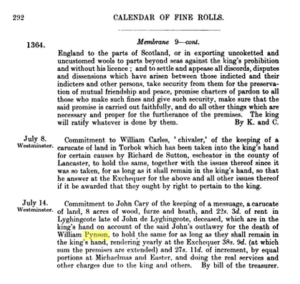
This particular branch of the Pinzun family must have had some standing in the local community; however, its record was not entirely unblemished. Henry Pinzun of Devon was charged with homicide in the death of a “merchant” in 1230. The Pipe Rolls show that he paid five marks but skipped bail – only to return in 1238 with a writ that showed – “that he made fine with the King so that, if he should find pledges for his standing to right, if anyone should wish to make suit against him, he should have peace.” The document doesn’t state where Henry lived, but it was probably Exeter. As if to rectify the balance in karma, we find that John of Loghingcote was outlawed in Devon in 1364 following the death of William Pynson, who had been “feloniously slain” (Calendar of Fine Rolls 38 Edward III). It was a tough life.
Pinsents Appear
Devon’s predominantly wool and tin-based economy prospered as time passed, and its population grew. Most of the productive farm land in the county was eventually developed, and the pattern of village and farm we see today came about during the 12th and 13th centuries. The “Pinzun” name, meanwhile, morphed into “Pinson;” however, the spelling was inconsistent as clerks wrote down what they heard – and that was influenced by the county’s evolving regional accent.
By the early 16th century, there was at least one “Pinson” population in Devonshire and there were several large “Pinson” and “Penson” populations in the west Midland counties of Shropshire, Staffordshire and Warwickshire. The “Pinsent” name is a distinctly Devonshire variant and, sooner or later, most of the families in the county became either “Pinsons” or “Pinsents”. Not that that ended the confusion. In one case we can show that a “Pinson” took off for Australia leaving “Pinsent” cousins behind! For some, If you couldn’t read or spell, I guess it hardly mattered.
None of the “Penson” and “Pinson” families in the West Midlands formally converted to “Pinsent” but some cross-over can be seen to have occurred. Individual “Pinsons” were mistakenly assigned the name “Pinsent” – particularly, I suspect, where the clerk was more familiar with it.
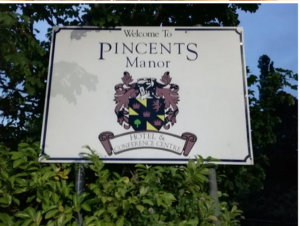
There were no true “Pinsents” living in Tilehurst in Berkshire in early Medieval times, but there were “Pincons” in nearby Reading shortly after the Norman Conquest. Gilbert “Pincent” – who is said to be from Sulhamstead – acquired 3 virgates (around 30 acres) from Reading Abbey in around 1316, and his son, Edmund, held around 100 acres around Tilehurst in 1341/2 (www.lovebritishhistory. co.uk) The manor later became known as “Pincents Farm” and it has, more recently, been the site of a hotel complex.
The “Pincent” name is now well established in the Reading area (“Pincent’s Hill,” “Pincent’s Lane,” etc.) but it has nothing to do with my crop of Devonshire Pinsents!
The names “Pinson” and “Pinsent” (and their “y” variants – “Pynson” and “Pynsent”) were – to a large extent – interchangeable in the late 1500s and early 1600s, and they were occasionally confused in the 1700s, and even later. Early Parish Records show that it was not unusual to be baptized with one spelling and married, and/or buried with another.
Interestingly, a “Pinsent” living in the mid-1800s decided to embrace the “Pynsent” spelling. This was a deliberate act – with a story attached. Go digging and you will find it!
Elsewhere, we find a suspiciously large number of “Pynsents” in Wiltshire in the early 1700s. This was the time of the “Pynsent” baronetcy. A few genuine “Pynsents” were born into the armigerous family. However, most of their Wiltshire name-sakes were from farming families and probably “Pinsons”.
And then the Plague
There is only one name in the Devon Lay Subsidy of 1332 that can reasonably be construed as being “Pinsent.” Richard “Peynsend” of Bovey Tracey paid 8d in tax. I do not know how long his family had lived in Bovey Tracey (a small market town in the Teign valley west of Exeter.)
The surviving records from this period mostly refer to “gentry” and, although he was probably reasonably well off, I doubt if our Richard would have qualified. He was probably one of several “Pinsents” living in Bovey Tracey and the neighbouring parish of Hennock when the bubonic plague or “Black Death” struck in the mid 1300s. Most of them would have been “yeoman” farmers, “tradesmen,” “craftsmen,” “tin miners,” and “labourers” with their respective families.
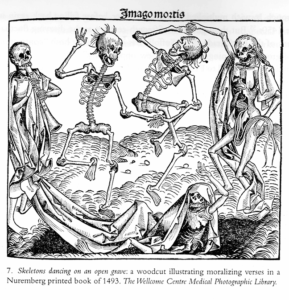
There was a marked change in iving conditions at the onset of the “little ice age” in the early 1300s. The climate in the Northern Hemisphere turned cold and wet, and there were food shortages. Britain’s population was thus weakened, and ill-prepared for the pestilence brought to the country by flea-ridden rats in 1348. Devon suffered innumerable bouts of plague both then and in the years that followed.
In his history of the County (Devon: A New Survey of England, Collins, 1954) Professor W. G. Hoskins states that when the plague first hit: “in terms of incumbent mortality, the Deanery of Kenn (which covers the part of the Teign valley we are most interested in) was the worst hit Deanery in England.” The lay community presumably fared no better than the clergy, and the death rate for farmers and their workers and families must have been high. Nonetheless, the family survived and, ironically, may have benefited from the social changes brought about by the plague.
When the survivors recovered from the initial trauma, they found that the feudal bonds and obligations that had kept them tied to specific overlords since “time out of mind” had weakened. The regional landowners and county “gentry” now had to compete for farm workers and successful tenants were able to break their feudal bonds and buy farms for themselves and their sons.
The shortage of farm workers caused by recurrent bouts of plague, and the need to retain tenants and workers might explain why the bulk of the “Pinson” and “Pinsent” population in Devon in 1500 (one hundred and fifty years after the arrival of the plague) was to be found in a surprisingly small corner of the county.
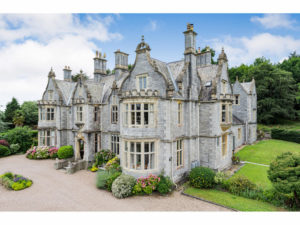
The “Pinsents” lived in a near circular cluster of parishes (Ashton, Bovey Tracey, Chudleigh, Hennock, Christow and Trusham) 10 miles (15 kilometres) southwest of the City of Exeter. The cluster has an approximate radius of 4 miles (6 kilometres). It straddles the main highway (A38) between Exeter and Plymouth and includes “Pitt House,” a modest “stately home” built by Thomas Pynsent (1808 – 1887) in the 1840s. The house can still be seen on the north side of the main highway between Exeter and Plymouth (A38).
The family took a while to disperse out from there, but there were a few living in the nearby parishes of Kenn, Dunchideok and Shillingford St. George as well as elsewhere by the end of the 16th century. The outward migration had at least started.
Back: Website Creation, Content and Design
Next: Finding home