Vital Statistics
Thomas Pinsent: 1652 – 1711 GRO1735 (Knighton, Hennock)
1. Catherine Parker: 1655 – 1686
Married: 1677: xxxx, xxxx
Children by Catherine Parker:
Julian Pinsent: 1677 – 1721
John Pinsent: 1680 – 1704
Thomas Pinsent: 1682 – 1702
Robert Pinsent: 1684 – 1685
2. Margaret Ball: xxxx – xxxx
Married: 1689: Lustleigh
Family Branch: Devonport
PinsentID: GRO1735
Click here to view close family
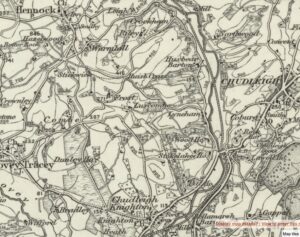
Thomas Pinsent was the eldest son of John Pinsent by his wife, Philippa Wilmeade. He was brought up on the family farm at “Knighton” (near what is now Chudleigh Knighton) at the south end of Hennock parish. His father died in 1663, when he was eleven years old, so his mother married two years later. Philippa and her new husband, John Soper, managed the family farm until Thomas came off-age. Hennock’s “Churchwardens’ Accounts” show that Philippa paid the parish rates for “Knighton” – at least until she remarried in 1665. Mr. Soper presumably paid them from then on. He must have also taught Thomas how to run the family farm.
Thomas married Catherine Parker in 1677 (Exeter Marriage Licenses) and they had four children, three boys and one girl in the years that followed. Their daughter, Julian Pinsent may have survived childhood. However, sadly, none of his sons did. John Pinsent, Thomas Pinsent and Robert Pinsent all died young. Robert was still an infant when he died; John was twenty-four when he died and Thomas was twenty. None had time to marry and have children, so the family’s connection to the farm came to an end when Thomas “senior” died in 1711.
Interestingly, there seems to have been a very significant die-off in Hennock and the neighbouring parishes around the turn of the century. The three “Knighton” boys may have suffered from the same affliction that killed-off their cousins at “Huxbeare,” another family farm. The heirs to both died out within a few years of each other. Nevertheless, some of the land at “Knighton” seems to have been back in Pinsent hands a few years later (see Thomas Pinsent of “Pitt”). The latter Thomas was a fairly distant cousin from a related branch of the family.
Catherine died in 1686 – either from sickness, or in childbirth and Thomas Pinsent was left with a young family to look after. He married Margaret Ball in Lustleigh in 1689. I am not aware of any children by this marriage. Thomas Pinsent of “Knighton,” died in 1711 leaving no obvious heir. He could have left “Knighton” to his brother Robert Pinsent; however, he had already received a significant legacy (a “halfendeale” of land and a soap boiling operation in South Kelly) from his grandfather, Thomas Wilmeade, in 1677 and was well established at “South Kelly” (see elsewhere). In an ideal world, he could have passed the farm back to his late uncle Robert Pinsent’s offspring at “Huxbeare”; however, they too had fallen prey to premature death, and the last Robert Pinsent “of Huxbeare” died in 1711 – just a few months after Thomas.
The death of Thomas Pinsent “of Knighton” is not quite the last reference to the farm being in Pinsent hands in the Hennock parish records though. There are one or two other tantalizing references, including the death of Julian Pinsent and the birth of Robert Pinsent at “Knighton” in 1721. They seem to be the children of a different Thomas Pinsent – by his wife, Mary Gale. They are from the “HENNOCK” branch of the family. When Thomas “of Knighton” died in1711, he may have passed at least some of his land to his late uncle Thomas Pinsent’s family – where there was a young second cousin, Thomas Pinsent working in a tannery and then contemplating his forthcoming marriage. Julian Pinsent and Robert Pinsent “of Knighton” were his children.
This transfer would have pleased both the Pinsents and the Wilmeades, as Philippa’s family’s contribution to the Pinsents well-being a generation back would have gone to her sister, Julian’s descendants. Thomas seems to have moved his family into “Pitt Farm”, which is essentially next door to “Knighton Farm”. Thomas Pinsent “of Pitt”, is the head of a major subsidiary branch that broke off from the “DEVONPORT” family. His descendants are still around today – as I can attest.
Hennock’s “Churchwardens’ or Overseers of the Poor Accounts” suggest that the original Pinsent farm at “Knighton” had been split in two at some point and the Voisey family held part of it in the 1680s and 1690s. Each family paid for its “Pte. of Knighton.” The account book that ends in 1692 makes no specific mention of “Pitt.” However, the next extant ledger, which starts in 1732 does and it makes no mention of “Knighton.” The two farms are, or were, near the hamlet of Chudleigh Knighton on the north side of the main road (now the A38) between Exeter and Plymouth (Donn’s (1 inch to 1 mile) map) and the farm at “Knighton” may have eventually been subsumed into the village of Chudleigh Knighton.
Sabine Baring-Gould (1908) describes the life of a notable Devonshire cleric, the Rev. W. Davy in an article entitled “Devonshire Characters and Strange Events.” Evidently, he had an aptitude for solving architectural and engineering problems. In it, she mentions that he was born of respectable parents in Tavistock in 1743, and that “they moved whilst he was still an infant to a farm belonging to them, Knighton, in the parish of Hennock”. Perhaps this was near the village.
The name “Pitt” in this case most likely refers to a hole in the ground – probably where someone extracted either marl for dressing fields or stone for building. It has nothing to do with William Pitt, Earl of Chatham – although he figures in the family’s story as the beneficiary of an eccentric Pinsent baronet, Sir William Pynsent, who died in 1765. The saga of the Pinsents of Combe and Chudleigh, and the rise of the Pynsent baronetcy is described elsewhere on this website [The Pynsent Baronetcy: The Trials and Tribulations of a Litigious Family: 1686 – 1765].
It is worth noting that the original farm at “Knighton” was once a separate manor beside a small tributary of the River Teign, close to what is now known as “Knighton Heath.” It was underlain by better quality potter’s clay than used to make tiles and bricks elsewhere in the parish (Western Times: 19thJanuary 1850) and Chudleigh Knighton – which grew to service a commercial pottery business (perhaps by the mid-1700s) may have absorbed much of what had once been the family farm. The manor still existed until the end of the 18th Century as there is a report “Of a Peramulation of the Manor of Knighton made on September 27th 1798” in the Devon Archives [Southwest Heritage Trust: (5421A/PB/1/f/1)].
Family Tree
Grandparents
Grandfather: Thomas Pinsent: 1597 – 1649
Grandmother: Julian Sidstone: xxxx – 1663
Parents
Father: John Pinsent: 1626 – 1663
Mother: Philippa Wilmeade: 1631 – xxx
Father’s Siblings (Aunts, Uncles)
Helen Pinsent: 1618 – 1618
Joan Pinsent: 1619 – xxxx
Mary Pinsent: 1622 – xxxx
Robert Pinsent: 1624 – 1671
John Pinsent: 1626 – 1663 ✔️
Julian Pinsent: 1628 – xxxx
Margaret Pinsent: 1630 – xxxx
Thomas Pinsent: 1633 – 1701
William Pinsent: 1638 – xxxx
Male Siblings (Brothers)
Thomas Pinsent: 1652 – 1711 ✔️
Julian Pinsent: 1654 – xxxx
John Pinsent: 1656 – 1656
John Pinsent: 1659 – xxxx
Robert Pinsent: 1661 – 1729
Please use the above links to explore this branch of the family tree. The default “Next” and “Previous” links below may lead to other unrelated branches.