Vital Statistics
Robert Pinsent: 1589 – 1650 GRO1763
Agnes Stevens: xxxx – 1655
Married: 1617: Hennock
Children by Agnes Stevens:
Margery Pinsent: 1618 – 1664 (Married George Pinsent of Huish, Hennock, 1635)
John Pinsent: 1620 – 1629
Simon Pinsent: 1622 – 1643
Thomas Pinsent: 1624 – 1655
Johanna Pinsent: 1626 – 1627
Family Branch: Devonport
PinsentID: GRO1763
Click here to view close family members.
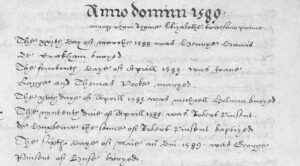
Robert and Dorothy’s eldest surviving son, another Robert Pinsent, married Agnes Stevens of Ipplepen in Hennock in 1617, and they had three sons (John Pinsent, Simon Pinsent and Thomas Pinsent) and two daughters (Margery Pinsent and Johanna Pinsent) between 1618 and 1626. Their eldest daughter, Margery, was christened in Ipplepen; however the others were baptized in Bovey Tracey – where the family seems to have settled.
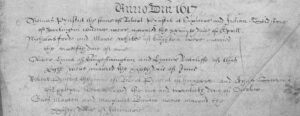
Why Robert and Agnes left the family farm, I do not know; however, as Robert had an elder brother, Simon, his father may have set him up in some other local business as Simon would have been expected to inherit the farm when he died. Unfortunately, Simon seems to have died before his father and – because Robert was otherwise occupied – the youngest son, Thomas, was best placed to take over the farm.
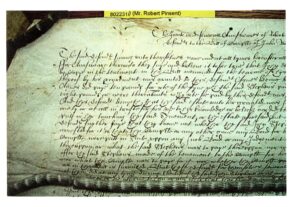
Robert’s wife, Agnes, was the daughter of a landed “gentleman” and her brother, John Stevens “gent”, left her a piece of land in Ipplepen (valued at £40 – so not insignificant) when he died. However, John Washer a “clerk of His Majesty’s Court of King’s Bench,” seeing an opportunity, claimed the property as a debt repayment and Agnes was obliged to fight an action in the “Court of Chancery” [C2/CHASI/W100/34:1630] to keep-hold of it. Agnes, through her husband, said that she had paid her brother £8 for a life-interest in the property and that she knew nothing about any deal he may, or may not, have made with Mr. Washer. Whether she won or lost the case, I am not sure. The term “gentleman” or “gent” was not used lightly in those days. A “gentleman” belonged to the lowest rank of the nobility and was eligible for a coat of arms. For Robert to marry into the “gentry” was a sure sign that the family was rising in social status. They had come a long way from the wooden platters of his father’s day.
Robert and Agnes had three sons, but none of them seem to have married. The eldest, John Pinsent, unfortunately died at the age of nine and his brother Simon, died at the age of twenty-one. Simon had been one of the eight male Pinsents from Bovey Tracey over the age of eighteen who had signed a (mandatory) Oath of “Protestation against the Papacy” in 1641. His father, Robert also signed, and his brother Thomas may have as well; however, given that there were other families around in the town, we cannot be sure.
Thomas Pinsent, the third son, seems to have lived to maturity and inherited “Woodhouse Down”, in Hennock, from his uncle Thomas Pinsent in 1649. Hennock’s parish accounts show us that he paid the parish rates in 1650, 1652 and 1653 and “Agnes and her son” paid in 1655, the year she died. “The widow Pinsent at Woodhouse Down” had been in receipt of parish funds at the time.
When Agnes’s husband Robert died, she applied to the “Prerogative Court of Canterbury” for “letters of administration” [British Records Society: Index Library Volume 68 p. 149]. Presumably, the bulk of his estate passed to his last remaining son, Thomas. What he did with it is unknown. I can find no further mention of Thomas Pinsent in the Devonshire records. Agnes had family connections in London and Thomas may have moved up to London and died there in Stepney, in Middlesex, in 1655.
It is not clear what happened to Robert’s daughter Johanna either but her sister Margery married George Pinsent of “Huish Farm” in Hennock, in 1635. He seems to have belonged to a completely different (and as yet ill-defined) branch of the family that had been living there since at least 1547. This particular George Pinsent paid the parish rates for the farm and was, presumably, the man who (along with Thomas and Richard Pinsent) signed off on the 39 Articles of Faith when they were read out in the parish church in 1645. He was a “Church Warden” in Hennock in 1661 and “Overseer of the Poor” in 1663. In the latter capacity, he signed a bond (Devon Record Office 2922A/P013) agreeing to pay the parish “Guardians” £40 (a considerable sum) should George Earl and his wife “late of Trusham,” become a burden on the parish. Margery Pinsent died in 1664 and George passed away the following year. It is not clear what happened to “Huish” after his death. He had three sons, of whom two (William Pinsent and George Pinsent) are still loose ends.
It is possible that William, was an early settler in Massachusetts. If so, he married Rebecca Green in 1675 and had a son, another William, who was born in Salem in 1677. Salem Court Records show that a William Pinsent/Pinson, “aged 30”, was involved in a court case in 1678/9 concerning the sale of the catch of a ketch called “The Leucy”. William induced his wife’s uncle, Thomas Robbins, to transfer the bulk of his extensive estate in Salem to him in 1681 – on the clear understanding that he, Thomas, and his wife Mary, would be well taken care off in their old age. Unfortunately, it was not to be. William took full advantage the bequest and, as shown in a complaint drawn up in 1685, failed to honour his end of the contract! Presumably he was an alcoholic. He seems to have verbally and physically abused his wife, as well as his elderly benefactor.
William did very well for himself on the strength of his bequest and become a prosperous merchant fisherman in Salem, and one of the “select men” of Salem who signed a petition to the central government, in London, in July 1680, asking for funds to rebuild the town’s Meeting House. Their place of worship was too small for town’s growing population.
William was constable of Salem in 1691 (Genealogical Quarterly Magazine: Volume II: 1901). What role, if any, he played in the “Salem Witch Trials” in 1692 and 1693 I hate to think! He died, in 1695 and left his widow a considerable amount of property in New England. His will was (interestingly) witnessed by a “cousin” – Thomas Pynson (Genealogical Magazine: Vol. 3, Dec. 1915 – Sept. 1916). We do not know which side of the family this Thomas came from – or if it was really a “cousin” as the term was used fairly loosely in those days. Salem birth records show that a Thomas Pinson had two daughters, Mary and Elizabeth by his wife Mary, in 1694 and 1697/8 respectively.
Whether it was this Thomas Pinsent who fell on hard times I do not know. The “Salem Town Records” record the presence of a Pinsent, Thomas, “a poor man” in 1697 (Genealogical Quarterly Magazine: Volume II: Ed. Eben. Putman: 1901).
Family Tree
Grandparents
Grandfather: William Pinsent: 1527 – 1601
Grandmother: Joan Unknown: 1535 – 1590
Parents
Father: Robert Pinsent: 1562 – 1626
Mother: Dorothy Carpenter: 1565 – 1643
Male Siblings (Brothers)
Simon Pinsent: 1587 – xxxx
Robert Pinsent: 1589 – 1650 ✔️
William Pinsent: 1591 – 1591
Thomas Pinsent: 1597 – 1649
George Pinsent: 1599 – xxxx
John Pinsent: xxxx – 1600
Please use the above links to explore this branch of the family tree. The default “Next” and “Previous” links below may lead to other unrelated branches.